




Abstract
The turn to identity within management studies has revealed important insights into management, by recognising its complex, contingent and relational nature, and through focusing on the personal experiences of managers and how they develop an identity as a manager. However, research has focused on processes of being and becoming a manager, rather than how individuals determine what makes a good manager, and what they are actually seeking to be. I therefore present an extended theorisation of narrative identity work which highlights the overlooked role of the ‘personal social landscape’ constructed through narrative, which gives meaning to the actors and actions within it. The theory is illustrated through detailed analysis of three manager accounts, which reveals processes by which managers construct personal versions of the same organisation, as social landscape to their self-narratives, and how these different organisational constructions create different meanings to their self-narratives as acting well as a manager.
Introduction
What makes a good manager? There is a plethora of work dedicated to the related question of how to be a good manager, such as what managers should do, how managers make decisions, the ethics of management practices and the skills and competences that managers should have and acquire. But the focus on how managers should act in particular circumstances presumes there is an agreed understanding of what a good manager is. This is by no means a settled question amongst management scholars (Gjerde and Alvesson, 2020; Harding et al., 2014; Korica et al., 2017) despite the prescriptive nature of much of the literature (Harding et al., 2014; Mantere, 2008). Additionally, there continue to be calls to pay closer attention to managers themselves, their situated meaning-making and accomplishments (Harding et al., 2014; Harris and Ogbonna, 2020; Korica et al., 2017) and although the recent turn to identity has generated important new insights, studies have remained focused on processes of becoming a manager, rather than how managers determine what it is they are seeking to become. Managers are subject to different expectations from different organisational constituents, and are therefore required to respond to, negotiate or resolve competing responsibilities (Bresnen et al., 2019; Clarke et al., 2009; Kempster and Gregory, 2017). Although managers are subject to normative discourses which privilege the organisation’s needs, one should not assume that they interpret their function in the same way, or that the purpose of management is self-evident to the individual inhabiting the role itself. Thus the question this article sets out to answer is: How do managers themselves determine what makes a good manager, and account for themselves as good?
To do so, I develop an extended theorisation of narrative identity work to incorporate the spatial dimension of narrative. In addition to the linear dimension of a narrative which constructs the individual as a coherent and consistent person across past, present and future, I argue for the crucial role of the narrative’s landscape, which determines the particular nature of the social world in which the narrative takes place and gives meaning to the actions of actors within the narrative. Specifically, I argue that individuals construct a personal social landscape from available discursive resources, and that this personal social landscape forms a key element of narrative identity work. Through a detailed analysis of three managers’ accounts of themselves, I demonstrate how they not only construct themselves narratively as managers but construct personal versions of the organisation in which they act as an integral part of narrative identity work, and that it is the particular nature of each personal social landscape of the organisation which determines what it means to act well as a manager within it: that is, how the manager is the hero of their own story. I further demonstrate how each manager both replicates normative organisational discourses of management and simultaneously constructs highly personalised, nuanced and differing versions of being a good manager. The paper’s contribution is threefold. It theorises processes by which managers make sense of their organisational role; it extends narrative identity work theory; and it highlights the diverse ways in which a manager role may be interpreted.
What makes a good manager?
Management studies have traditionally focused on the role and function of managers – what they do or should do, or the effects of a management role on postholders (Gjerde and Alvesson, 2020; Harding et al., 2014). This has resulted in a plethora of literature dedicated to answering how to be a good manager, focusing on issues such as how managers make decisions, and the skills and competences that managers should acquire. However, such literature has tended to be prescriptive, based on an assumed objective and agreed understanding of what the manager role is (Mantere, 2008), with much less attention paid to how managers themselves perceive and experience their role (Harding et al., 2014; Harris and Ogbonna, 2020; Korica et al., 2017); and to date the consensus on that manager role is ‘fairly inconclusive’ (Gjerde and Alvesson, 2020: 128). Despite attempts to create a management profession there remains no common set of professional norms (Bresnen et al., 2019).
The manager role is, rather, increasingly recognised as a complex, contingent and contested position. Managers are both controllers and the controlled (Harding et al., 2014; Hassard et al., 2009; Watson, 1997), exercising power over those for whom they are responsible but also vulnerable to those they answer to (Carter et al., 2014). Their organisational position in-between requires them not simply to implement organisational instructions and objectives but to ‘translate’ (Currie and Proctor, 2005; Ericsson and Augustinsson, 2015) executive intentions into operational practicalities, and to publicly support decisions they did not make (Lee and Taylor, 2014; Lloyd and Payne, 2014; Moshel and Berkovich, 2018). Managers are answerable to multiple constituencies with diverse and competing interests (Kempster and Gregory, 2017; Rostron, 2018). They are expected to represent the organisation’s interests: not only to deliver organisational objectives but also to secure staff commitment to those objectives (Currie and Proctor, 2005; Du Gay, 1996; Hassard et al., 2009). However, managers may also spend significant amounts of time with staff and need to develop effective personal relationships with them (Ericsson and Augustinsson, 2015; Huy, 2002) or have been promoted from among their peers (Croft et al., 2015; Moshel and Berkovich, 2018), and are subject to staff expectations to act on their behalf, protect them from excessive executive demands and protect their interests (Gjerde and Alvesson, 2020; Jones and Kriflik, 2006). Further constituencies may include professions and customers, particularly for managers who have been promoted from professional or technical roles (Martin et al., 2020; Moshel and Berkovich, 2018; Sirris, 2019) and for whom such technical expertise remains a source of security (McConville and Holden, 1999; Thomas and Linstead, 2002).
Despite normative assumptions on the part of organisations and much of the management literature (Gjerde and Alvesson, 2020; Rostron, 2018) managers themselves may not assume that their role is simply to be loyal to the organisation and to unquestioningly fulfil its objectives. What it means to fulfil a manager role, and thus what makes a good manager, is not straightforward in the context of multiple demands from multiple constituents. Thus, how managers determine what a good manager is, becomes an important question, but one which remains under-researched. Although the literature on middle managers recognises the tensions inherent in being ‘in the middle’, studies typically focus on one upwards or downwards relationship as a discrete unit, rather than how managers simultaneously manage multiple relationships (Croft et al., 2015; Gjerde and Alvesson, 2020). Those that do have focused on the difficulties of such tensions (e.g. Sims, 2003; Thomas and Linstead, 2002) or particular circumstances where such tensions are made especially salient (e.g. Clarke et al., 2009; Gleeson and Shain, 2003). How managers themselves understand their organisational role in the context of multiple and expectations and responsibilities therefore remains an important area to understand further (Gjerde and Alvesson, 2020).
The turn towards identity, and especially identity narratives by which individuals account for themselves (Brown, 2019) has generated important new insights for understanding managers. Firstly, identity studies have paid attention to managers themselves, how they become managers, develop a manager identity and seek congruence and fit between their self-identity and social expectations of a manager role (Bolander et al., 2019; Hay, 2014; Ibarra and Barbulescu, 2010; Sirris, 2019). Second, identity studies have highlighted the discursive context in which managers must make sense of their roles, and the interplay between identity work and identity regulation (Alvesson and Willmott, 2002). While the organisational, economic and social ‘scene’ invokes and precludes certain identities (Alvesson and Willmott, 2002; Watson, 2008) discourses are not monolithic or hegemonic (Brown and Toyoki, 2013) and may also provide resources for managers to select, co-opt and re-work in order to support their own identity work (Cuganesan, 2017) and challenge dominant discourses (Van Amsterdam and Van Eck, 2019). A third insight from identity studies is to highlight the manager role as relational (Bardon et al., 2017; Gjerde and Alvesson, 2020; Watson, 2001) and as discursively constructed by multiple subjectivities (Bresnen et al., 2019; Harding et al., 2014) from which the manager must make a working sense in the context of ‘assorted vulnerabilities’ (Brown, 2019: 10). Managers do not make sense of their roles in isolation but are answerable to the expectations of others.
Within identity studies the narrative turn (Brown et al., 2009) recognises the ways in which individuals use stories to make sense of themselves and others (Rhodes and Brown, 2005) through the selection and organisation of events into a meaningful and coherent whole (Boje, 1991; Ricoeur, 1981). The narrative turn has also started answering the challenge to examine processes of identity rather than discrete factors affecting identity outcomes (Ashforth et al., 2008; Brown and Toyoki, 2013) by examining how individuals make ongoing sense of themselves over time (Bolander et al., 2019; Mallett and Wapshott, 2012; Watson, 2009), how they accommodate the demands of different and changing social contexts (Bresnen et al., 2019; Van Grinsven et al., 2020), and the role of life histories and experiences prior to becoming a manager (Bolander et al., 2019; Carrim and Nkomo, 2016; Watson, 2009).
However, despite the important insights generated, scholars continue to observe the need for further theorisation and clarification of processes of identity and narrative identity work (Ashforth et al., 2008; Brown, 2015, 2019; Brown and Toyoki, 2013; Ghaempanah and Khapova, 2020). Brown (2019: 17) in particular observes that ‘how the macro performances of groups, organizations, industries and professions are connected to the micro identities processes associated with their participants is still largely a mystery’. This paper thus seeks to address one such connective question: namely that identity and narrative identity research has focused on how individuals (learn to) identify and account for themselves as managers, rather than how individuals (learn to) determine what a good manager is. That is, they address the more general processes of becoming, rather that the specific process of determining precisely what to become. In doing so, the paper explains the specific micro-processes of how individuals make personal sense of their organisational discursive context by narratively constructing a personal working version of the organisation, or a personal ‘social landscape’, as a key element of narrative identity work.
Extending narrative identity: The role of a ‘personal social landscape’
Narrative identity studies and theorising have focused on the linear dimension of narrative: that is, the identity work of the individual over time, and how the individual makes sense of themselves as a coherent and consistent individual across past, present and future, and across different social contexts (Bolander et al., 2019; Mallett and Wapshott, 2012; Watson, 2009). However, there is an important aspect of narrative which has so far been overlooked or taken for granted, and which can help to address the question of how managers determine what makes a good manager. As well as a linear direction, narrative also requires a spatial dimension (Gregg, 2006). A story is dependent on a landscape which affords meaning to the narrative arc, and the behaviours and choices of actors. Put simply, ‘he picked up the knife’ has different meanings depending on whether the act takes place in a restaurant, a domestic kitchen, an operating theatre, or a dark alleyway, and constructs both the actor picking up the knife and the narrative arc in different ways. When they construct themselves narratively, individuals do not only construct themselves as narrative actors over time, but construct a particular social landscape, the nature of which determines how they and others should properly act. This, I argue, is a crucial narrative process related to but distinct from the individual’s response to their discursive context, or the ‘scene’ (Alvesson and Willmott, 2002): constructing oneself as a narrative actor also requires constructing a personal, working version of the social context in which the individual is required to act, by selecting and foregrounding particular dimensions and features from available discursive resources. Managers do not only construct themselves narratively as managers but construct personal versions of the organisation in which they act as managers. It is the nature of a social landscape that gives meaning to the actions of a character within a narrative – which determines what it means to be a hero of the story; and it is the nature of a personally constructed organisation that gives meaning to the actions of a manager. The spatial dimension of narrative thus plays a fundamental role in narrative identity work. Without knowing the nature of the world, how can one act, and act well?
There has been increased interest in the role of stories in organisations (Brown et al., 2009), and extant research has touched many of these issues. Attention has been drawn to how managers commonly cast themselves as heroes of their own stories (Brown, 2019) and how organisational actors seek to position themselves and others according to moral judgements as ‘heroes’ or ‘villains’ (Hay et al., 2020; Sims, 2005; Whittle et al., 2009). Some authors have noted how social context (Clifton, 2018) or a ‘moral landscape’ (Whittle and Mueller, 2011) give meaning to a particular narrative and a character’s actions, but without theorising how such landscapes are produced. Recent studies have examined the role of individuals as co-constructors of group and organisational identities through stories (Foroughi, 2020; Savage et al., 2018; Sörgärde, 2020) but these important contributions still focus on macro- and meso-level processes of constructing collective stories and versions of the organisation, rather than how individuals construct personal versions. Some recent studies hint at the capacity of individuals to construct their own working versions of organisational discourses and thus the nature of the organisation (Gustafsson and Swart, 2020; Pérez and Sabelis, 2019) but such processes are not their focus, and they fail to explicitly draw out and theorise them.
The paper therefore extends knowledge of narrative identity work and the role of stories in organisations by theorising the necessary role of a personal social landscape. As part of narratively making sense of their social world, individuals construct their own personal social landscape, which is crucial for enabling them to know how to act well in that context and thus constructing and sustaining a particular identity. This theorisation is depicted in Figure 1 and incorporates three distinct facets which are understood as being dynamic and interdependent. ‘Positioning the self’ refers to how the individual constructs a narrative self over time, and how they trace a linear path across past, present and future (Bolander et al., 2019; Mallett and Wapshott, 2012; Watson, 2009). This includes previous experiences and life histories of individuals and how these inform their present understanding of themselves (Bolander et al., 2019; Carrim and Nkomo, 2016; Watson, 2009). ‘Responding to discursive practices’ reflects the particular social context of the individual, or the ‘larger social, organisational and economic terrain in which the subject operates’ (Alvesson and Willmott, 2002: 632). It expresses the discursive practices and resources available to the individual and the extent of their agency to respond to and utilise such resources (Brown and Toyoki, 2013; Cuganesan, 2017; Van Amsterdam and Van Eck, 2019; Watson, 2008). ‘Constructing a personal social world’ characterises the ways in which individuals select from available discursive resources to construct a particular social landscape and a personal working version of their social context. These three facets are dynamic and interdependent: all three, including the newly added ‘personal social landscape’ are necessary for understanding how individuals determine what it means to act well. The nature of a personal social landscape is prescribed by the discursive resources available and by the ways and extent to which an individual is able to respond to them; but the construction of a personal social landscape also induces and foregrounds particular discourses and tactics in response to discursive practices. A personal social world also provides the necessary landscape within which a narrative may take place and delineates the significant features through which a narrative must trace a path; but a particular narrative also gives meaning to a social landscape, by interpreting the nature of the selected features and dimensions. The nature of self-narratives and the ways in which the individual can position themselves through narrative is also informed and prescribed by the availability and nature of discursive practices; but self-narratives, plots and roles adopted and ascribed by the narrating individual also prompt and encourage particular responsive tactics to discursive practices and subject positions, by providing an available story, or framework, with which to make sense of those subject positions and discursive claims.
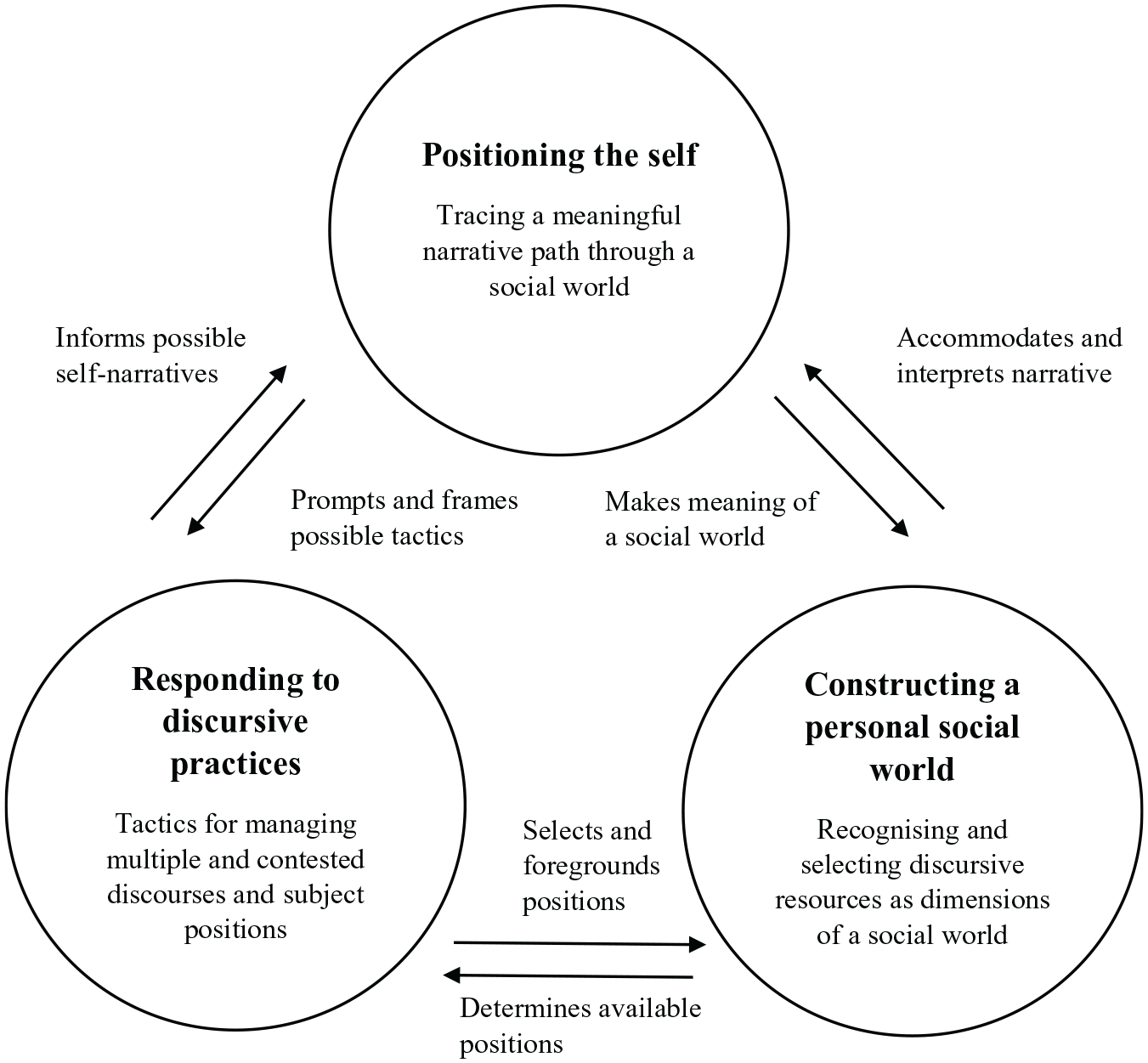
Narrative identity work.
In the second half of the paper I present a detailed analysis of three managers as an ‘insightful example’ (Clifton, 2018; Sveningsson and Alvesson, 2003) of this extended theory of narrative identity work. I reveal not only how these managers construct themselves narratively from available organisational discursive resources, but how they construct personal social landscapes as versions of the organisation; and I show how these personal constructions of the organisation are key to how managers determine what a good manager is, and how they account for themselves as one.
The research study
The research study, from which the illustrative cases are drawn, investigated how managers interpret their organisational position in the context of multiple constituencies, including the organisation, staff, customers, community and profession. The study took place at a registered provider of social housing in North West England, referred to in this paper as ‘Panorama Housing’. Panorama Housing employs c250 staff and manages c11,500 properties providing affordable housing to those in housing need. The research focused on managers responsible for a range of customer-facing services such as lettings, property management, rental collection and customer contact. A manager was defined as anyone both directly managing others and directly managed themselves; this identified 22 eligible managers and 21 agreed to take part.
Data collection
Data gathering took place between September 2013 and December 2014. The primary data source was an in-depth interview with each manager, and it is this data that the article focuses on. Additional data was collected through extensive observations of organisational activities, work shadowing of managers and organisational documents and artefacts such as Panorama’s website, internal newsletters, noticeboards and internal architecture. The purpose of this additional data was to understand the discursive context in which the managers worked.
The choice of interviews is grounded in the understanding that a research interview provides an occasion for the participant to respond to and make sense of discursive resources and subjectivities impinging on them (Denzin, 1989; Miller and Glassner, 2010) and an opportunity to investigate some of the processes by which a particular social reality is produced (Riessman, 2008). That is, the aim was to deliberately invite a ‘commissioned performance’ (Beech and Sims, 2007) from managers in which they accounted for themselves as they wished to be seen by me, as a researcher (Clifton, 2018). In keeping with this intent, the interviews followed a largely unstructured design which was also informed by the narrative paradigm within which the research is grounded. The focal point of the interview invited the manager to ‘Please tell me a story about you in your organisational role, which you feel represents what your role means to you’. Participants were given this request and some broad guidelines in advance. Story elicitation was intended to avoid premature framing (Flick, 2009; Sveningsson and Alvesson, 2003) by deliberately inviting managers to present themselves as they wished, and to facilitate some ‘creative rupturing’ (Sanger, 1996) of the traditional interview format and the polished or corporate answers that managers may be accomplished at providing. Having invited the manager to tell their story I then further explored the story with them. Key themes included: what the story meant to the manager; how the manager came to their understanding of their organisational role and significant influences; and their views on other organisational participants in the story. Interviews lasted just over 1 hour on average; the shortest was 45 minutes and the longest was 75 minutes.
Data analysis
All interview texts were fully transcribed and uploaded to NVivo. Analysis of the texts followed several stages which began with the original research project and its aim of investigating how managers interpret their organisational position in the context of multiple constituencies, and which were then revisited and further extended for this paper. The first stage involved analysing the managers’ stories to identify the core narrative structure including the nature and genre of the plot and the roles played by the manager and other organisational actors. The second stage concerned the ways in which the manager experienced their position within the organisation. The interview texts were analysed to identify possible subject positions available to managers at Panorama Housing and how each individual manager responded to possible subject positions: which subject positions they recognised in their texts; how they interpreted those subject positions and what meaning they ascribed to them; and how they managed potential tensions and conflicts between subject positions. In the third stage the analytical focus shifted to the ways in which managers selected and foregrounded discourses to construct a personal interpretation of their organisational position. A form of thematic analysis (King and Horrocks, 2010) was used to initially identify key characteristics of the organisation as perceived and experienced by the manager. These were then organised into dimensions based on sets of oppositions (Gregg, 2006; Kelly, 1963) which were then further analysed and aggregated into overarching primary dimensions which characterised how the manager understood the organisation and thus their position in it.
This paper now extends that analysis by focusing on the processes by which managers individually constructed the organisation: rather than seeking aggregate, higher-order themes or broad interpretations of the organisation, I examined the individual characteristics and dimensions within each manager text and ways in which a particular version of the organisation was constructed. I paid close attention to the dynamic interplay between narrative, discursive subjectivities and resources available to and impinging upon the manager, and the personally constructed organisational world in which the manager presented themselves as acting; and to the ways in which each might prescribe and frame the other.
In the next section I present three manager accounts. The managers are chosen because they are superficially similar, occupying the same organisational role, and telling similar stories of personal success. Initially all three appear to reflect a normative picture of a manager who successfully delivers organisational objectives and high performance. However, through a close analysis of the processes of narrative identity work, it is possible to discern the different ways in which each manager constructs their organisational world as a personal social landscape, and how this informs their construction of themselves as the hero(ine) of their own social world, and what it means to act well in such a world. My purpose is therefore not to categorise the range of ways in which managers might interpret their organisational role, but to demonstrate the crucial process of constructing a personal social landscape for being able to uncover and understand such different interpretations. Before presenting the three manager cases, the organisational and discursive context is briefly summarised.
Constructing the organisation: A tale of three managers
Panorama Housing was formed in 2006 to take over the housing stock of a local authority in North West England. Although the organisation’s origins are embedded in the public sector, the CEO and senior leadership team sought to construct Panorama as a wholly new organisation in contrast to the local authority. After an initial period of stabilisation, the leadership team embarked on a programme of deliberate cultural change designed to ‘change people’s thinking’ (CEO, interview) and establish a new organisational identity and vision. This was supported by a series of restructures resulting in significant staff and especially manager turnover. The key to Panorama’s new identity was being a business that was financially responsible and independent, and which would ‘stand or fall based on our own performance’ (CEO, interview). Key discourses, evident in both internal and external texts include commercial competition and growth, customer focus, and managers as having the necessary skills to operate in a commercial environment. Organisational emphasis is on being a business over a profession, referring to meeting the needs of ‘customers’ rather than delivering professional services to tenants. Another key discourse is ‘being the best’ (Panorama website). Panorama actively pursues and publicises accreditations and awards, and performance across a suite of indicators is rigorously reported and accounted for at monthly management meetings and benchmarked against national indicators. Managers are also expected to actively engage staff and secure their commitment to the organisation as a ‘great employer’: they are responsible for not only promoting but personally owning the organisational vision as ‘authors of the message, not simple deliverers’ (CEO, interview).
Fleming, Chapman and Jennings: Similar and different
‘Fleming’, ‘Chapman’ and ‘Jennings’ (all pseudonyms) are service managers at Panorama, with overall responsibility for an organisational service (e.g. rental income, community development or tenancy management), team leaders and officers. All three were recruited to Panorama as part of early restructures to appoint managers with the desired skills and knowledge. Superficially the stories they chose about themselves are also similar: Fleming and Chapman both described how they had found a failing service and successfully transformed it into a high-performing one, and Jennings recounted how he had turned a nascent, overlooked service into a growing and valued one (Table 1). All three managers thus presented themselves as the hero of their own story by drawing on and reflecting organisational and normative expectations of a good manager: to be business-orientated and successful. However, analysing each story based on the extended theorisation of narrative identity work reveals not only important nuances and differences in the nature of the story and the manager’s response to the organisational discursive context. It also reveals how each manager constructs a personal version of the organisation, as a social landscape to their story, and how this personal social landscape informs how each manager understands their position in the organisation and what it means to act well in it.
Analysis of manager stories.

Narrating the self
Fleming
When analysed as narrative plot, Fleming’s story is relatively complex, incorporating narrative peaks and troughs, twists and turns, and with the outcome uncertain until the end. Her story begins with a vivid description of the failing service: as well as performing poorly, staff were fearful and distrustful of previous managers who blamed them for their own incompetence: ‘[staff] were always waiting for the door to open and for them to fall through, they were always waiting for the rants, they were waiting for the attack’. Fleming had some immediate ideas for improving performance by re-organising workload distribution, but then suffered a personal setback at a meeting with directors when she was unable to provide any convincing explanation for the service’s current performance. She realised that she needed to be able to develop a detailed understanding of the service and be able to analyse trends and predict future performance, to give directors ‘confidence’ in her abilities to manage the service; and she started to gain some recognition from a director that ‘one of the things you can always count on is when I turn up to a meeting I’m always prepared’. She also began to make progress in encouraging her team to trust her, particularly by spending as much time as possible working alongside staff, by being open and honest and admitting to any personal mistakes. Nevertheless, there were further challenges: some staff remained anxious at having to work near a manager, and a 360-degree appraisal suggested that her initial enthusiasm and strong performance had waned, which was a personal shock. Fleming’s presented story is therefore one of continual struggle, of success despite failures, and achieved through personal determination: ‘it’s what you do from that point. . .do you then break down or do you pick yourself up and shake yourself off and move forward’.
Chapman
In contrast, Chapman’s story describes a much more certain trajectory. Like Fleming, Chapman was recruited to turn a failing service around, but Chapman’s story starts with a conversation with the CEO: I think when I joined, he recognised that, you know, I was driven and I wanted it to work, so he spoke to me directly and he said it doesn’t matter how much it costs. You tell me what we need to make it work, and we’ll make it work.
Whereas Fleming’s story involves continually having to prove herself as a manager, Chapman’s begins with clear recognition of her abilities from the organisation. Her subsequent story then directly builds on this as an account of her personal vision for transforming the service and how she then successfully implemented it through creating a culture of success and personal development amongst staff, particularly through encouraging talented staff to excel and then gain promotion in other parts of the organisation. Chapman’s success is immediate from the beginning and continues throughout her story: ‘I’m enthusiastic and I’m a good motivator, and I just encourage people’. As well as service transformation, Chapman’s story concludes with her vision of a culture of high performance, high commitment and investment in staff being taken up by the whole organisation: ‘The more I’ve sold it, the more I’ve said it, the better it makes sense really. . . [directors] just jumped on board. . .I’ve always thought that’s the best way to do things, and that’s what I’ve just instilled in the business’. Chapman’s story is one of unambiguous success: although the task she is faced with is considerable, there is little doubt that she will eventually succeed.
Jennings
Jennings’s story begins not with a poor service but with an unrecognised one. Jennings had a passion for social regeneration and thought that working in housing was ‘the job of my dreams’. However, he quickly discovered from meetings with senior managers that his service was not an organisational priority: ‘[it was] – just go and sit in a corner and we’re not really sure what you do and we’re not really bothered. . .so I was kind of sat at my desk thinking – what have I come to?’ Jennings confronted organisational indifference head on by seeking funding to build the team and support new projects ‘just so that we could demonstrate what actually we were doing’ and by taking opportunities to promote his service to other managers and to show its value: ‘I started getting the message up that the work we do is valuable and it means a tenant getting into work [which] means they’ll pay their rent which means that impacts on your business, so you should be grateful!’
Successfully bidding for funding meant that Jennings could build up a close-knit team of specialists around him, and with similar qualities to himself – ‘I employ people because of that creativity and because of that kind of drive’ – and with whom Jennings shares both the struggle for recognition and the successes of awards and positive media coverage: ‘So there is a real kind of camaraderie and we are very much – we are the [service area] and nobody messes with us!. . .we do an amazing job’. The culmination of Jennings’s story is that he had recently requested funding for two further posts and was surprised when the organisation agreed to both. This is a vindication for Jennings, not only proving the value of his service but his own qualities as a Panorama manager: ‘here’s two new posts because we believe that you’ll do the right thing with these members of staff and you’ll get the outcomes’.
Responding to discursive practices
The stories that individuals tell about themselves are both informed and constrained by the discursive context in which individuals act and are acted upon. Discursive practices also provide the available material to be selected and foregrounded in the construction of a personal social landscape. As already highlighted, Fleming, Chapman and Jennings work in the same organisation in similar roles and told similar stories about improving and developing services, thus foregrounding organisational discourses of business-focused managers who deliver. Nevertheless, each manager’s individual narrative also informs and supports responses to this and other discursive resources in individual ways.
Fleming
For Fleming, the story of service failure reveals tensions between organisational and staff interests. In her interview text Fleming recognises two competing subject positions implicit in her role: as a manager of a service responsible for delivering organisational performance, and as a manager of staff with responsibilities for staff needs and interests. Fleming’s own experience of her staff and their responses to previous manager demands, which forms the basis of her chosen self-narrative, thus challenges the organisational discourse that staff interests fully align with organisational ones. For Fleming, such interests are distinct, and her story is an account of how she sought to fulfil her responsibilities separately to each. Fleming accepts that she is accountable to directors for her service and its performance: ‘I’m under no illusions, I have a set of priorities I have to deliver on; if I’m not delivering on them, I know’. Equally, staff have finite capacity to be able to deliver performance and feel the effects of too much attention and pressure from managers: ‘just basically putting it all on the officers’ shoulders was making them less productive’. Fleming is sensitive to staff perceptions. They want their manager to be visible and available, but not ‘sitting next to them’; they want some autonomy but not to be held wholly responsible; negative behaviours such ‘being there to get the pay to go home’ are the direct result of being pressurised, blamed, or seeing their own manager under stress. Fleming thus accepts personal responsibility to the organisation and its requirement to deliver performance; but this creates a further responsibility to staff for protecting them from the stress of those demands.
Chapman
In contrast to Fleming, Chapman’s story of service reform constructs her as an unambiguously successful, incisive and transformational manager, and both induces and supports organisational discourses which align with this, such as continuous improvement, high performance, achievement and agential managers. Chapman’s story thus explicitly constructs her as a manager who fulfils Panorama’s expectations and values. However, rather than owning the organisational message, as the CEO expects of managers, Chapman goes further and centres herself as authoring and implementing her own vision for service and organisational success, becoming a heightened version of the ideal Panorama manager. Her self-construction as a visionary manager also informs her response to staff. Whereas Fleming recognises and responds to expressed staff needs, Chapman offers her vision to them. She invites them to develop their careers with her support, and to identify themselves with her and see themselves as her representatives outside and inside the organisation: ‘I try and tell my team that they’re representing me, so if they make a mistake I make a mistake’. This extends to staying in touch with staff who have been promoted into other areas of the business and reminding them of her vision: ‘I say don’t be scared to go outside of what you think the normal is and create something new for yourself, you know, be adventurous, have a flair for bringing something different, that’s why they’ve employed you’. For Chapman, organisational discourses of agential and successful managers provide the opportunity to justify her own vision of what the organisation, and staff need.
Jennings
For Jennings, discourses of expert knowledge and professional practice are a significant counterpoint to organisational discourses of business and delivery. Jennings’s story of service development and ultimate success is based on his background of specialist knowledge which the organisation lacks and initially does not even recognise. His expertise makes him unique in the organisation – ‘I wouldn’t say anyone’s come from the same sort of background as me’ – and enables him to see things that others in the organisation cannot, such as the needs of the community extending beyond buildings to live in: It’s like, you’ve missed the whole point, you’ve got all the buildings that look lovely and you’ve got some nice trees but actually where’s the community hub or where are people going to meet or how are we going to generate the social – you know, so it’s that element of things that sometimes just gets totally – it’s not on peoples’ radar.
This expert, outsider perspective, informs how Jennings recognises and interprets other discourses. As a manager his primary role is to make the case for his service, to compete for resources and to demonstrate its contribution. To do so, Jennings strategically co-opts discourses of the Panorama ideal manager, highlighting how his service contributes to core business, and making effective use of resources: ‘we believe that you’ll do the right thing with these members of staff and you’ll get the outcomes’. Being the ideal Panorama manager is necessary for Jennings to gain recognition of his expertise and his service. Being an expert practitioner also informs Jennings’s relationship with his team. Rather than subordinates, Jennings describes a close relationship with fellow expert-practitioners who do not need instruction so much as periodic guidance: ‘I think it is just an area that if you’re too directional you just lose your staff’s initiative and creativity really’. Rather than needing protecting (Fleming) or inspiring (Chapman), they form a self-contained unit with Jennings as their leader and advocate, who share struggles and achievements: ‘We do an amazing job and if people don’t understand that they need to and. . .we’re all together in it sort of thing’.
Constructing a social landscape
So far, the analysis has revealed how managers’ stories show them fulfilling Panorama’s expectations of agential, commercially aware and high performing managers. However, we have also seen how each story reflects their own managerial experience, and how these different narrative selves inform responses to their discursive context, including how they utilise and re-work organisational discourses of management. In this final section I now examine how such narrative selves and responses to discursive practices also construct different personal social landscapes which both accommodate and give meaning to the managers’ personal narratives. It is these constructed social landscapes of the organisation, and their interplay with narratives and discursive practices which determine what it means to act well as a manager: that is, what it means to be a hero in such an organisational world.
Fleming
Fleming’s story constructs a personal social landscape based on an overarching opposition between the expectations of directors of delivering organisational objectives through service performance, and the capacity and capabilities of staff to deliver those objectives. This opposition thus directly reflects her responses to discursive practices, and impinges on her role as a manager: It’s a middle management role isn’t it really, you get pressure from both ends. You’ve got to keep – sometimes the operational stuff or the stuff that you’ve got to do because of the direction of the organisation, doesn’t please the people you’re working with; and again the other stuff, the things that are going on at an operational level don’t necessarily fit [with director views].
By constructing a social landscape and the organisation in this way, Fleming also constructs a particular meaning for her story of service reform. Fleming framed her story thus: It was really a quite unique sort of situation when I started because there was a sort of distrust downstairs and anxious nervousness upstairs. So it was this position where there were problems with relationships on both sides and trying to address both of those relationships in different ways was quite unique.
Her story begins with the exacerbating effects of previous managers, who were unable to effectively manage the service themselves and who then exposed staff to the effects of their failure; and it ends with Fleming recognising and being able to resolve the demands of each, by establishing confidence in herself as an effective manager. Her ability to explain and predict performance reassures directors, while staff can be confident that they can fulfil performance expectations through Fleming’s workload reforms, and that they will be shielded from undue pressure from above. As Fleming herself says: ‘I’m effectively the insulator’, keeping each party happy but also separate from the other.
Fleming’s account of transforming a failing service constructs a social landscape which foregrounds the diverse constituents to whom Fleming is responsible, and especially the competing expectations of directors, who demand high standards of service performance, and of her staff and their capacity to deliver such performance. The meaning of the story of service transformation is therefore to be able to fulfil the different expectations that others rightfully have of Fleming, and to do so by acting authentically and with integrity. She holds up the example of former managers who denied their own instructions and who failed to take responsibility for their decisions and mistakes: in contrast, when Fleming was confronted with evidence that she was no longer perceived to be giving her best she accepted it as ‘whoa, got a problem here, need to really address this’. Throughout her story she presents herself taking personal responsibility for her actions and mistakes, and as willing to learn and change in response (‘what that experience has taught me. . .’; ‘what I learned from that is. . .’; ‘it’s what you do from that point. . .’). Nevertheless, Fleming’s social landscape also prescribes the extent to which she can fulfil the expectations of others. As the ‘insulator’ she keeps staff and directors satisfied but separate; she does not actively ‘author’ the organisational vision to staff but allows them to work in peace, and she does not feed up staff concerns but manages them herself. Being a manager means not acting for others but acting so that others can ‘be confident and have trust in me’. Fleming thus draws not only on the generic archetype of a quest, but on a more specific ‘coming of age’ trope, in which the hero learns both agency and responsibility in order to claim their birthright, and who must demonstrate their worth through trial and struggle. To be a good manager is to be trusted.
Chapman
In contrast to Fleming’s organisation of vertical oppositions, Chapman’s story constructs a more abstract and complex opposition between organisational and individual interests. Chapman’s text is infused with a number of related oppositions incorporating a wide range of stakeholders including staff, other service areas, tenants and organisational leaders, but which coalesce around the (false) assumption that organisational and individual interests cannot be equally met. Chapman develops two primary iterations of this opposition: between individual staff and organisational needs; and between public service and private commercial values. She contrasts the needs of the ambitious staff member who may look for opportunities outside their service area versus the service’s need for stability and consistency; and the need of the service to ‘keep hold of their best people’ in order to deliver high performance versus benefits to the wider organisation if a talented individual is promoted elsewhere. She also contrasts public and private sector values: public organisations deliver individualised services to everyone but at organisational cost, whereas private companies are efficient in their own interests – ‘more driven, number-oriented, target-focused’ – but unconcerned with differing individual needs which are secondary to ‘soulless money making’. Chapman thus draws on organisational discourses of performance and staff engagement, of effective business and social responsibility, to construct a personal social landscape made up of apparently irreconcilable tensions.
Such a social landscape creates a different meaning for a story of service reform. Within this landscape, service failure is not a result of ineffectiveness or bad intentions (as for Fleming) but a lack of insight; and service reform requires everyone – staff, managers, other services and directors – to think in new ways. The resolution of the story is achieved through Chapman’s personal vision. She can see and do what no one else can and is able to persuade others of her vision of new ways of working: that organisational and individual interests can indeed be creatively aligned to the benefit of each. By supporting the career ambitions of talented staff, the service will benefit from increased motivation in the short term; and by creating a culture of success Chapman will be able to continue to attract new talent and establish the service as a talent pool: ‘that’s a great way to join an organisation’. By reinscribing private sector values of efficiency and customer satisfaction, Panorama can save money by reducing delays and errors – ‘[If] it’s a bad experience it’s a costly experience’ – and deliver what customers want rather than presuming to already know their needs: It’s not: this is what you’re gonna be given – [it’s] this is what you’re asking for and we’ll try and deliver that for you. And you know, every day we’ll give great customer service and we’ll enhance the reputation of the organisation.
Whereas Fleming reifies the tension between directors and staff, but insulates each from the other, Chapman claims a new way of thinking and acting which brings competing interests into alignment. For Chapman, therefore, the story of service failure provides a context in which to demonstrate the need for new thinking and a new vision. The organisation is trapped by old assumptions and flawed thinking: the nature of the quest in Chapman’s story is of the outsider hero freeing a kingdom from darkness or slavery, by being willing to think and do what others cannot. For Chapman success itself, through incisive change, is the measure of being a good manager. To be a good manager is to enact one’s own vision.
Jennings
The organisational landscape constructed by Jennings’s story and text is one of horizontal tensions, in which services and managers are in competition for organisational resources and recognition. This is directly informed by Jennings’ central discourses of expert knowledge and professional practice, which are not dominant organisational discourses. Jennings contrasts services that represent ‘core business’ and whose value to the organisation is unquestioned – ‘rents and buildings and bricks and mortar’ – with his service that is sometimes dismissed as ‘fluffy’. He frequently refers to having to ‘battle’ for attention from directors, even while his service achievements are being featured in the local press – ‘You can get things in the paper much more easily than getting people to listen here!’ – and recognises that the work can be appear intangible: ‘we don’t do events, it’s ongoing interaction, dialogue, you know, engagement with people’. More critically, there is added pressure to maintain the profile of the service because ‘you’re not a core element of the business, that could be scrapped tomorrow, you perhaps feel more pressure’.
Within such a social landscape, the meaning of a story of a failing service is different again. The challenge facing Jennings was that he and his small team held essential skills and knowledge which the organisation needed, but which also remained unrecognised. In an organisation of scarce resources and high competition, the service is at risk of being side-lined or even scrapped altogether. Jennings’s resolution of the story is to prove the value of his service by translating its work and achievements into the language and values of the organisation. Although the value he brings to the organisation is due to his unique background and knowledge, which enables him to see things that are not apparent to others (‘it’s not on people’s radar’; ‘it’s a complex area’) it is his ability to demonstrate his worth as a manager which enables him to gain recognition for that expertise and that of his team. In making the case for his service Jennings emphasises how it contributes to the core business of rental income, as well as generating good news stories in the press, and demonstrates how he fulfils Panorama’s expectations of managers who are high performing and commercially aware: he can be trusted with organisational resources because ‘we believe that you’ll do the right thing with those members of staff and you’ll get the outcomes’. Organisational discourses for Jennings are thus a means to an end: his story is one of learning to speak such discourses fluently in order for his professional expertise to be recognised. For Jennings, the key to being a good manager means successfully selling himself and his team.
I definitely would say the work out there is far easier than the in-house kind of – selling of the service, I suppose and selling the benefits of it, it’s a constant thing but in this day and age you have to prove your worth, whichever service you’re in, and make sure that the outputs, new outcomes are really genuine and making a difference.
Narratively Jennings is the archetypal misfit or outcast who is assumed to have no status and thus no value, until he can acquire the right clothing to be noticed and thus for his qualities to be recognised. To be a good manager is to be able to prove one’s unique worth to the organisation, and that of one’s team.
Conclusions and implications
Despite increased and welcome attention being paid to the experience and perceptions of managers themselves, and the turn to management as an identity project, there remains an important gap in knowledge of managers and management. Given the contested and contingent nature of management, how do managers determine what makes a good manager? Although identity research has done much to reveal processes of becoming, that is, how individuals learn to identify and to account for themselves as managers, the important question of how individuals determine precisely what to become has remained unaddressed.
The contribution of the paper is threefold. The first is a contribution to knowledge of managers. The paper has shown how managers determine what makes a good manager, and what it means to act well as a manager, by constructing a personal version of the organisation as part of narrative identity work. A ‘personal social landscape’ is not mere background to a narrative but a necessary and distinct component of narrative identity work: in addition to personal history, experiences and desires, and in addition to the wider social context which makes certain discursive resources available and which invokes and precludes certain identities, individuals also narrate a personal working version of the social world in which they are required to act. Such working versions, dynamically constructed through the individuals’ personal history and desires, and responses to discursive practices, may thus be individually quite different and lead to distinctive meanings for acting well as a manager. For Fleming, in an organisation based on a vertical tension between the interests and expectations of top management and staff, being a good manager means fulfilling her responsibilities to each constituency by earning confidence in her abilities. Chapman’s construction of an organisation based on a false tension between organisational and individual interests demands a manager who can envisage and enact a new vision. For Jennings, an organisation based on managers and services competing for scarce resources means that a good manager proves their worth to the organisation and that of their team. The paper thus contributes specifically to literature on managers ‘in the middle’ and how managers understand their organisational role in the context of multiple expectations and responsibilities. Rather than examining discrete relationships singly (Croft et al., 2015; Gjerde and Alvesson, 2020), particular examples of such tensions (e.g. Clarke et al., 2009; Gleeson and Shain, 2003) or their consequences (e.g. Sims, 2003; Thomas and Linstead, 2002) the paper reveals the specific processes by which managers determine their own understanding of their everyday position in the organisation, based on their personal interpretation of the nature of the organisation, and the implications of that position for their relationships with others.
The second contribution is to narrative identity. The paper has answered calls for further theorisation and clarification of identity and narrative identity work processes (Ashforth et al., 2008; Brown, 2015, 2019; Brown and Toyoki, 2013; Ghaempanah and Khapova, 2020) and especially Brown’s (2019) call for the need to connect macro social performances to the micro identity processes of individuals, by presenting an extended theory of narrative identity work. The paper has addressed the important but overlooked process by which individuals determine what makes a good manager, rather than processes of becoming a manager; and theorised and demonstrated how managers make sense of their organisational roles by constructing personal working versions of the organisation as part of narrative identity work. The spatial dimension of narrative serves a crucial but overlooked function in narrative identity work: without knowing the particular nature of the world, one cannot know how to act or how to act well. Narrative identity work connects individuals to wider social performances through constructing a personal social landscape, and this personal social landscape informs, and is informed by both the individual’s personal history and self-narrative, and the discursive context in which they must act. The paper thus adds theoretical grounding to studies that have highlighted the role of landscapes in providing moral context for narratives (e.g. Clifton, 2018; Whittle and Mueller, 2011), or the capacity of individuals to personally interpret organisational discourses (Gustafsson and Swart, 2020; Pérez and Sabelis, 2019), and complements studies which have focused on the role of individuals in co-constructing shared versions of the organisation through collective stories and narrative identities (Foroughi, 2020; Savage et al., 2018; Sörgärde, 2020).
Thirdly, the paper draws new attention to the diverse ways in which a manager role may be interpreted, and to calls to centre managers themselves, and their situated understandings and accomplishments, rather than management (Harding et al., 2014; Harris and Ogbonna, 2020; Korica et al., 2017). The three manager cases presented here are not exclusive but point to a far wider range of possible interpretations of the manager role, particularly as these managers all worked within the same organisational role and discursive context. Fleming, Chapman and Jennings can all be seen reproducing organisational management discourses of success and high performance. Nevertheless, each manager also interpreted what it means to achieve success in the same organisation in different ways, drawing on their own life histories and organisational experiences, their responses to available discursive resources and their own working version of the organisation, or personal social landscape. The paper thus amplifies the call by Korica et al. (2017) to study management not as prescribed activities but as situated meaning-making, identity-forming and order-producing practices: the cases of Fleming, Chapman and Jennings further highlight that managers are required to negotiate multiple constituencies including the organisation, staff they manage, other managers, professional standards and customers, and that they respond to the claims that these various constituencies make on them in different ways and to different degrees.
Finally, the paper offers some implications for manager learning and development. The paper also adds to calls for management education to centre managers themselves, rather than prescribed skills and knowledge, and for it to afford opportunities for managers to reflect on their own experience and practice (Hay, 2014; Raelin, 2009; Rostron, 2018). The findings suggest that there might be significant learning for managers through critically examining the organisation in which they work, as well as their own management practice, and the paper also proposes a method for doing so. By inviting them to tell stories of themselves as managers, and to then reflect on what kind of worlds their stories create, and what kind of heroes such worlds require, managers could be enabled to enquire into, for example, how they understand and interpret their organisation and thus their own role in it; how such interpretations might change over time; and different possible interpretations of the organisational world. Furthermore, through the sharing of such stories, managers might also be enabled to reflect on both the range of ways to interpret the manager role and the limitations of any interpretation, and thus on contemporary discourses of the ideal all-seeing, all-knowing and all-doing manager (Corlett et al., 2019; Hay, 2014). The manager and the manager-as-hero cannot – and need not – be all things to all people. Such enquiry could be a powerful additional method for developing reflexivity in managers (Cunliffe, 2009) by enabling managers to surface and examine not only the organisational context in which they must work, but how they themselves make personal sense of it, how it informs their interpretation of their management practice and manager identity, and the realities that they create with and for others.
