




Abstract
Despite being one of the most used theories by scholars and practitioners alike, surprisingly little attention has been devoted to how Stakeholder Theory is taught, or to the conception of the human it assumes. In this paper, we address this gap by drawing on the affective phenomenological perspective of Michel Henry, for whom ethics, praxis and even life itself are rooted in affective subjectivity. We argue that bringing back the Latin notion of affectus (as a noun and as a verb) is central to learning about stakeholders by strengthening our understanding of the human – both theoretically and affectively – as it operates within Stakeholder Theory, thereby addressing its anthropological, relational and normative shortcomings. We provide a practical illustration of what this means for learning by reflecting on the affective components of an executive development course on values-driven leadership. We show how the multi-level ‘ME-WE-WORLD’ framework of this course retrieves the relational normative force that redefines the human from an affective, phenomenological perspective, and enriches the discussion of stakeholders in the classroom. We end by discussing some avenues for future research on how to teach Stakeholder Theory in a more affective and effective way.
Keywords
Introduction
Since its inception, over three decades ago, the notion of ‘stakeholders’ has been widely diffused among researchers, policy-makers and leaders (Aguinis et al., 2019; Fassin, 2012; Freeman, 1984/2010; Freeman et al., 2010; Jensen and Sandström, 2013). Decision-making tools such as stakeholder salience analysis are also consistently taught in management learning and education programmes (hereafter MLE) (Mitchell et al., 1997; Nonet et al., 2016). Yet, how this is done and whether it meaningfully reaches students is far less studied (Bonnafous-Boucher and Rendtorff, 2015; Henriques, 2019). The notion of stakeholders seems to be taken for granted, so much so that Stakeholder Theory (hereafter SHT) is implemented without much questioning of its underlying assumptions (Wicks et al., 1994 being a notable exception). In this paper, we revisit our understanding of SHT from a phenomenological perspective rooted in affect. This allows us to question the notion of the human that seems to be inherent in SHT, in order to highlight important pedagogical implications on how we teach SHT for learning about stakeholders.
We start our investigation by considering Freeman’s (1984/2010) original definition, where the word ‘stakeholder’ refers to ‘any group or individual who can affect or is affected by the achievement of the organisation’s objectives’ (p. 46). Consequently, an entity may be considered as a stakeholder when it is affected willingly (active mode) or unintentionally (passive mode) by an organisation. Miles (2012: 295) notes that the mention of ‘affect’ made by Freeman remains the most commonly used reference to define the notion of stakeholders, but despite its central role, it is considerably neglected, and constitutes a major black box of stakeholder thinking (Pajunen, 2010). 1 Overall, SHT privileges a very simplistic understanding of the verb-form (to affect in an active or instrumental way, and to be affected by passively). What is central to these definitions is the effect of affection, rather than the notion of affectivity per se. It largely ignores both more complex and problematic meanings of the verb itself, and more importantly also the noun-form (affect, affectivity). As such, SHT cannot properly account for the key affective dimension that lies at the heart of valuation and more deeply, leaves the humans behind the stakeholders unproblematised, and the teaching of SHT normatively weak.
We believe that challenging the implicit assumption diffused by most management and organisational scholarship that human beings are rational, individual subjects who are deliberately calculative in nature, is a fundamental task in decentering the humanities, and would allow them to regain their normative and relational force. From a teaching perspective, this is important for two reasons. First, since management learning’s ‘science-envy’ led to a massive disdain for the messiness of human realities (Schoemaker, 2008: 120), which has made the embodied affective self distinctly unwelcome in the classroom (Brewis and Williams, 2019; Giacalone and Promislo, 2013). Second, because the notion of stakeholders and the associated tools have insufficiently been discussed per se in MLE (Bonnafous-Boucher and Rendtorff, 2015; Henriques, 2019; for an exception see Ferguson et al., 2005 concerning accounting education only), nor have they generally sought to develop an affective dimension (Heath et al., 2019). Consequently, MLE ends up easily perpetuating a kind of superficial, and normatively empty conception of the human, reduced to a self-interested rational homo oeconomicus, not least of which through the widespread use of the stakeholder label. In particular, we argue that this undermines the possibility to effectively promote responsible business practices, by not enabling individuals to experience their own values affectively and therefore effectively, let alone animate collective action in and around organisations to address broader societal issues.
Indeed, what seems absent from the way in which the term is used is an acknowledgment of the inherently embodied, relational and affective human that lies at the core of what it means to be a stakeholder. However, theoretically, the lines of research within management studies that address the topic of affect within organisations (e.g. Barsade and Gibson, 2007; Beyes and De Cock, 2017; Bissola and Imperatori, 2017; Clough, 2007; Fineman, 2008; Fotaki et al., 2017; Leys, 2011; Staw and Barsade, 1993) have so far engaged marginally, if at all, with SHT. We seek to address this shortcoming by drawing on the humanities and more specifically on the phenomenology of Michel Henry (1922–2002) for whom ethics (for us, the possibility for normative engagement), praxis (in our study reflecting on work and collective action) and even life itself (understood as an immanent flow connecting all beings), are rooted in affective subjectivity (Henry, 1946, 1963/2011). His phenomenological contribution to the field of organisation and management studies is attracting growing interest (Deslandes, 2017; Faÿ, 2009; Pérezts et al., 2015; Puyou and Faÿ, 2013) and allows us to bring back the Latin notion of affectus (as a noun) to theoretically strengthen our understanding of the human as it operates within the stakeholder label.
In this paper, we begin by reviewing the literature on how we teach SHT, while also noting the taken-for-grantedness of the ‘human’ inherent in the concept of stakeholders on the one side, and its lack of engagement with the affective dimension on the other. Second, we explain how this may be addressed by turning towards affect, and in particular the phenomenological perspective proposed by Henry. Third, we discuss our point while offering a practical illustration through an affect-based exercise employed in an executive development course entitled Values-Driven Leadership into Action (VDLA) and explore how its multi-level ‘ME-WE-WORLD framework for stakeholder analysis in ethically problematic situations draws on different affective strategies. By illustrating the embodied relationality and affectivity that lies hidden within the notion of stakeholders, we discuss the normative implications of this affective approach for learning about stakeholders. In doing so, we hope to provide further impetus to enriching the way in which management education relates to the ‘human’.
Teaching and learning about Stakeholders
An under-researched issue
SHT has been commonplace in management literature for several decades (Donaldson and Preston, 1995). It is widely implemented in MLE training programmes on a variety of issues ranging from decision-making to strategy, to CSR and business ethics (Barsade and Gibson, 2007; Freeman, 1984/2010; Mitchell et al., 1997; Nonet et al., 2016). While considerable scholarly attention has fostered heated on-going debates on the theoretical elements of SHT, decidedly less attention is being paid to how SHT is taught within management education (Henriques, 2019: 211) and whether it meaningfully impacts learners.
Furthermore, when such attempts have been made, they have taken place outside some of the leading journals dedicated to the MLE field, namely Management Learning and Academy of Management Learning and Education. Many of their papers indeed use SHT and stakeholder analysis (for instance to study the implementation and efficiency of higher management education, e.g. Aguinis et al., 2019), or mention them as part of the tools already used in business ethics or sustainability courses (e.g. Giacalone and Promislo, 2013; Heath et al., 2019; Stead and Stead, 2010). Others argue for the need to further develop such tools (e.g. Banerjee, 2011: 728; Gherardi and Rodeschini, 2015) in order to bridge the relevance gap between the theoretical idea of ‘stakeholders’ and their effective inclusion in strategic thinking, decision-making and organisational practices more broadly. Pedagogically, this cognitive approach assumes that learning is mostly a matter of acquiring new skills focused on relevant implementation strategies (Longneaux, 2006). Interestingly, it is also worth noting that, despite SHT being so widespread in the field of management and organisation studies, not even one paper featured in these two journals is exclusively devoted to discussing the teaching of it per se.
Such discussions are instead mostly located within other outlets: the only reference we could specifically find assessing the teaching of SHT was in the field of accounting (Ferguson et al., 2005). Elsewhere, other approaches have fruitfully experimented with using literary tools to foster greater impact of SHT teaching (Montiel et al., 2018; Westerman and Westerman, 2009), or on the other end of the spectrum have openly defended the teaching of an instrumentalist and strategic perspective above normative concerns (Jennings, 1998). To be fair, business ethics journals have discussed some specific issues that relate to the topic (Fougère et al., 2014; Goodpaster, 1991; Nonet et al., 2016), including care ethics (Burton and Dunn, 1996), suggestions for fostering a stronger critical approach (Jones and Fleming, 2003), and discussions around the impacts on decision-making (Godos-Diez et al., 2015). For example, in a recent special issue of the Journal of Business Ethics Education, Bonnafous-Boucher and Rendtorff (2015) edited a unique collection of articles on ‘teaching business ethics and SHT’ in order to bridge the multidisciplinarity that such teaching entails, while providing a more ‘systemic conceptualization and ideas about and positions to be taken on how to approach teaching SHT in practice’ (p. 3). Within this volume, Frostenson (2015) suggests focusing on stakeholder-issues instead of actors, in order to highlight the relationships between actors in a more impactful way. Storchevoy (2015) proposes mapping moral issues to discuss stakeholder relations. Buhmann (2015) suggests using a legal method for understanding stakeholder expectations, and for increasing public regulation of CSR issues.
However, in most of the afore-mentioned contributions, neither the notion of stakeholders itself, nor the organisation-centeredness of analysis are meaningfully interrogated (Giacalone and Thompson, 2006). Currently, SHT in training programmes often tends to refer to groups of persons as distinct objectified entities and therefore misses out on various key issues: interrogating how the persons at ‘stake’ are to be understood (anthropological dimension), how they relate to each other (relational dimension), and what provides the normative force for their actions (normative dimension) that an affective perspective could help recover. Next, we shall first briefly unpack each of these main three shortcomings in the way SHT is taught (anthropological, relational and normative) before turning to affect in order to develop a richer understanding of the human, before retrieving the normative force that a humanities-inspired application of SHT in the classroom may have.
Teaching SHT devoid of affect : three shortcomings
While presented separately for clarity, these three shortcomings are closely inter-related in accounting for the missing affective dimension in the teaching of SHT. In order to illustrate our critique and our contribution, we will reflect on a prominent analytical tool used by many business ethicists (including ourselves) in classroom instruction, that is, the stakeholder salience model (Mitchell et al., 1997), as an illustrative example.
The first shortcoming we identified concerns the limiting anthropological assumption within SHT. By mapping stakeholders in the classroom, MLE assumed that stakeholders are entities that can be abstracted into labels (e.g. shareholders, citizens, government, planet Earth. . .), quantified and rationally organised, making it difficult to interrogate their inherent biases. Within the salience model, this is needed to judge the relative power, urgency and legitimacy of distinct stakeholders. Yet the conception of the human person that underpins the notion of ‘stakeholders’, from an ontological perspective, is far from clear. Analysing the definition of the word ‘stakeholder’, Miles (2012) found 435 different definitions in 493 articles. This testifies to the proliferation of research on the subject, but also to an ensuing lack of clarity (Reed, 1999). Recent criticisms of SHT (e.g. Banerjee, 2008; Derry, 2012; Miles, 2012) also highlighted how many of the practical and theoretical difficulties it faces, primarily stem from its inability to define the notion of person, whereby this theory can become much more explicit (Rhodes and Garrick, 2002). Stakeholder theorists themselves (Bevan and Werhane, 2010; Freeman et al., 2010) have identified defining a ‘SHT of the person’ as a high priority to ensure not only the future of the theory itself but also its relevance. Unfortunately, instead of interrogating the notion of personhood at the heart of SHT, scholars have attempted to agree on the crucial question of who/what is entitled to hold a stake in a given situation/organisation (Mercier, 2010). In the process, certain conceptions of the human are privileged in ways that hide its assumptions, with distinct normative implications. For instance, Braidotti (2013: 26) rejects the ‘unitary subject’ of humanism, because the ‘sameness’ that it assumes means that everything deviating from the norm can be assessed, regulated and allotted a designated social location. The ‘human’, Braidotti explains, is a historical construct that has become a normative convention, which functions in a highly regulatory way, instrumental to practices of discrimination and exclusion.
The second point, stemming from this limiting anthropological assumption, is the lack of relationality in SHT. In arguing who ‘counts’ as a stakeholder, on whom or on what will the legitimacy of decisions be based, and what shall we do if and when an individual belongs to several categories (e.g. shareholder and consumer) (Santana, 2012), we are in fact discussing how the various stakeholders relate to each other. In the kind of mapping described earlier that most MLE programmes using SHT begin with, relationships between stakeholders are reduced to mere interest ties, and connecting various levels of stakeholder relations proves very difficult. The way Mitchell et al. (1997) rank stakeholders according to the degree of urgency of their demands, their legitimacy and their power, remains intangible and relative to context, and as such, impossible to measure (Derry, 2012: 255). The immeasurability of stakeholder salience however does not preclude the possibility that it can be controlled through convention (Negri and Hardt, 1999: 87). In fact, one may argue that ‘conventional’ SHT’s assumptions about the human perpetuates this form of control, precisely because it steers clear of affect. In such cognitivist approaches, the preoccupation with ‘tangible resources’ undermines attention to the ‘intangible resources’, such as respect, identification and meaningfulness that stakeholders may value more (Henriques, 2019: 213). When privileging rational/cognitive aspects of performance and decision-making (Barsade and Gibson, 2007), what most of the literature actually does is simply overlook other important issues such as empathy and care (Heath et al., 2019). We believe that the use of the salience model may be characteristic of what Negri and Hardt (1999) describe as dealing with value ‘from above’, that is, assigning value in reference to the broader political economy. They explain that if the theme of ‘value-affect’ is integrated into calculative macroeconomic processes, it becomes invisible, as is the case with the domestic labours of women, for instance (p. 79). Value is assumed by stripping it from labor, and as such, from affect. If we are able to reverse this in our teaching of SHT, we may also regain its normative force, to which we now turn.
SHT’s normative weakness may lie in the fact that most of the scholarship assumes that ‘interests’ and ‘rights’ fundamentally define persons. Even those seeking to supplement the instrumentalist orientation of SHT with a normative insistence on the intrinsic worth of persons, struggle to define what lies at the heart of this personhood. Those drawing on Rawlsian justice concepts like Freeman and Evan (1990) or Donaldson and Dunfee (1999), inevitably revert to rights-based argumentation. The problem with ‘rights’, is that this argument is based on hypothetical rational agreements and a corresponding limited notion of the human, which often eschew the messiness of human bodies and contextual particularities, in favour of clear-cut categories. Donaldson and Preston (1995: 83) attempt to create normative ground for SHT by arguing that ‘property’ as a bundle of rights, can be defended on the basis of various notions of distributive justice, whether it be utilitarian, libertarian, or social contract theory. In the applying of Mitchell et al.’s (1997) salience model, normative questions are central to adjudicating the legitimacy of stakeholder claims. If, for instance, normative deliberations are focused on ‘property rights’, it is possible that a large group of stakeholders will not be seen as having ‘legitimate’ claims, because they do not meet the stated criteria and therefore ‘do not count’ (Banerjee, 2000, 2008). As recently stated by Gersel and Johnsen (2020: 3), we need to ‘beat the single-purposed shareholder account of rational maganerial decision-making by providing an alternative more inclusive multipurposed stakeholder theory of managerial choice’.
The tendency to locate our understanding of the human in universal humanistic values as a remedy for the relativistic drift of our times, is described by Braidotti (2013: 38) as ‘a reactive form of the posthuman’. Here, we refer to Braidotti’s reading of Nussbaum’s relationship to abstract universalism, considered by the latter as the only stance capable of providing solid foundations for the moral values of respect and compassion for others. The problem is that in the process, Nussbaum’s account of the human operates within the tradition of US-liberal individualism, which again establishes a specific culturally informed ontology as the norm, to the exclusion of others.
This latent bias – grounded on the three shortcommings of SHT detailed above – is something that we also witness in the way that it is taught. Indeed, the fact that SHT creates categories of stakeholders and labels them, glosses over the particularity of individual lives and simply leaves the question of the human outside of its spectrum of inquiry. Notable exceptions include Bevan and Werhane (2010: 137, 2011), who argue that stakeholders are particularised human beings implying unlimited responsibility: ‘They are “names and faces” rather than homogenized as “the others”’, relying on Levinasian philosophy to criticise this tendency. Others try to infuse SHT with a feminist-inspired ethics of care (Burton and Dunn, 1996; Engster, 2011; Heath et al., 2019; Wicks et al., 1994) which helps to foster relationships and empathy towards others. The instrumentality that lies at the heart of SHT is however not entirely avoided through these strategies. Though no one would deny that protecting one’s property and wellbeing is important, surely we are not fully defined by what we own, or what we can acquire, or what can be taken from us? We believe it is important to connect the notions of ‘interests’ and ‘rights’, with the values that embodied individuals hold dear.
Overall, it is as if most of the literature simply took for granted the teaching of SHT as a cognitive tool, without seeking to problematise either its modes of implementation, its underlying assumptions or its implications and effectiveness for learning. It is in this regard that we believe affectivity is key to strengthening SHT’s normative force, and that bringing the notion of affect – in a strong, embodied, normative and relational sense – back in, can be of great help to enrich SHT, the ways it is taught and, therefore, its use in today’s business world.
Bringing affect back into SHT through phenomenology
The ‘affective’ turn
In what follows, we take up Negri and Hardt’s (1999: 78) suggestion that we reconsider the problem of value ‘from below’, and in the process ‘leave behind the ignorance of political economy’. What is needed, according to them (Negri and Hardt, 1999: 84), is to change the direction of our reasoning towards induction, rather than deduction, proceeding from particular affects within singular and collective bodies, rather than from macro-perspectives. What would this mean for SHT? Stakeholders, that is, those who can affect or be affected by an organisation (Freeman, 1984/2010; Miles, 2012) – cannot feature in the theory (whatever simplified form it may be ascribed) unless they are endowed with ‘affectivity’. It is therefore high time to open the affective ‘black box’ of SHT (Fassin, 2012; Pajunen, 2010) and unpack its theoretical and pedagogical implications. To do so, it is important to go beyond its simplistic use in its verb-form only, which foregoes more deep understandings that can be brought to light by reconsidering affect, as shown by the recent growing and varied ‘affective turn’ in organisation studies (Gherardi, 2017).
At the most basic level, affect is used ‘as a general term that defines relations between all kinds of bodies’ (Beyes and DeCock, 2017: 61). From our perspective, this operates in three interrelated ways: as an embodied relation to our inner selves (subjectivity) and to others (relationality), as well as in our normative orientations to the broader worlds we are part of. More specifically, the importance of embodied affectivity has registered in various ways in organisational literature (Clough, 2007; Seigworth and Gregg, 2010): for instance in reflections on the processual (in)corporeality of Spinozism (Thanem and Wallenberg, 2015), Deleuzian-inspired frameworks for including the non-human (Clough, 2009; Leys, 2011), the psychoanalytic approach (Fotaki et al., 2012, 2017), political and especially gender-conscious readings (Painter-Morland and Deslandes, 2014), critical discourses on emotional labour (Hong et al., 2017), practice theory (Gherardi, 2017), and to some extent neuroscientific approaches (Lakoff and Johnson, 1999).
In a particularly active psychological research trend, the term ‘affect’ is used in order to describe positive and negative moods and emotions – which are most often understood as passive reactions to a given situation. Here, scholars acknowledge the idea that individuals bring into the workplace their own character traits and affective experiences as well as their reasoning and emotional abilities that may bespeak a better comprehension of a context or stakes (Barsade and Gibson, 2007; Lowe and Reckers, 2012). Where modern organisations have often required of employees to leave their emotions outside the workplace, there is increasing acknowledgement that this is simply impossible (Zietsma and Toubiana, 2018) and that cultivating appropriate emotions and affective habituation, is in fact important (Gonzales and Guillén, 2008). Within reflections on management learning however, exactly how appropriate emotions are to be cultivated in practical terms in the classroom and beyond, remains unexplored. Therefore, establishing connections between affect/affectivity and SHT seems important, because affectivity lies at the heart of understanding the normative force in dealing with others (Fotaki et al., 2017).
While not claiming to provide a detailed overview of affect theory in organisation studies (for a more complete ‘inventory’ see Seigworth and Gregg, 2010), our account hopes to extend the two broad vectors of affect theory that Beyes and DeCock (2017) highlight, that is, the psychobiological understanding of affect as the source of in-built, non-cognitive bodily forces, and the second Deleuzian-inspired understanding of affect as ‘formless and unqualified, impersonal and non-signifying forces. . . becomings or intensities that are located in in-between relations and resonances’ (2017: 62). We do so by highlighting the relationality that could be elicited affectively when human beings are decentered in their understanding of themselves, of others and of the world. A phenomenological perspective invites us to consider how all three – subjective, relational and normative – layers are shaped in and through affect.
Rediscovering affective subjectivities with Henry
We suggest now to reinvigorate an humanities-inspired approach to SHT learning by developing a lesser-known phenomenological account of affect (Letiche, 2006, 2009), and in particular that of Henry (1963/2011) which offer important insights that can deepen SHT’s understanding of the persons, whom we may too easily lump together as ‘stakeholders’.
Henry’s perspective is particularly suited to place the starting point of affect within the subject. Indeed, to Henry (1996: 79), ‘being born’ amounts to ‘coming to life’, that is, a relation to life understood as transcendental affectivity. This point of entry into Henry’s phenomenology might account for the general lack of attention of management researchers (for exceptions, see Deslandes, 2016, 2017; Faÿ, 2009; Pérezts et al., 2015; Puyou and Faÿ, 2013) in a philosophy which itself seems to show no interest in any form of representation. Indeed, studies of organisations, generally claiming to be objectivist, focus more on the objects and symbols with which they deal and which fascinate them than on a vital praxis, which nevertheless may be the only source of any ‘production’ (Deslandes, 2016; Faÿ, 2009).
In this respect, Henry contends that critics of subjectivism have always missed the point by situating reality within the ‘world’, since a subject can only truly exist in a context of absolute immanence, that is, affectively. Henry’s phenomenological approach to affect allows us to reconnect with affect as a philosophical concept linked to its Latin origin (affectus), broadly understood as what it means to be a human in the world, and inclusive of both the verb and the noun-forms. In privileging the former over the latter, SHT privileges instrumental over normative considerations, based on a specific anthropology, that is, that of homo economicus, the rational profit-maximiser, the individual whom Rhodes and Garrick (2002) call ‘the cogito-economic subject’. This has led to a watering down of SHT’s normative inclinations, especially when used in disciplines such as finance (Miles, 2012: 291). A Henryan perspective allows us to question whether endorsing this first/minimalist sense, renders SHT to be nothing but another tool designed to control and shape stakeholders’ behaviour for the sole benefit of ‘the stakeholder organisation’ centred around shareholder interests (Gersel and Johnsen, 2020; Jensen and Sandström, 2013).
Henry (2011) explains that, ‘even if I only seek to use others, I must first understand the existence of an absolute metaphysical freedom, an alter ego. I never consciously acknowledge this, but it informs all of my attitudes to others.’ (p. 116, our translation). We feel that this fundamental idea radically transforms and gives new meaning to SHT, reminding us that all forms of collaboration within organisational settings and by extension, all forms of management learning are, first and foremost, a living interaction between subjective bodies who agree to take on certain social roles. In the end, such roles maintain the distance between people and groups, each defending their own interests. This strategy casts the other as an obstacle, a means, or an adversary, instead of another human being that shares a wide range of affects (Faÿ, 2009; Puyou and Faÿ, 2013) and reduces relations to mere instrumental ties instead of fostering empathical and ethical ones. As a result, SHT has difficulty connecting various levels of stakeholder relations. From a Henryan perspective, we also go beyond a sterilised version of rights and responsibilities to a more affective understanding of relational responsibilities, with all the specificity this entails. All stakeholders experience their social roles affectively, and as such, our representation of various groups may not do justice to the lived experience of members of that group. ‘Stakeholder interests’ are too often used as mere tools to coordinate action, but individuals can only understand themselves as ‘acting selves’ because of the immanent affectivity that allows them to engage socially in the first place.
With this general phenomenological outline of affect in mind, we shall now turn to a practical illustration that in detailing the affective components of an executive values-driven leadership course (that invites participants to reflect upon their values as affectively experienced), will unpack the specific contributions of a phenomenological perspective for reconsidering the role that affect can play in teaching SHT.
A multi-level affective approach to stakeholders in values-driven leadership training
As mentioned above, despite being widely diffused in MLE, SHT has attracted insufficient scholarly attention on how it is taught and with which broader implications (Henriques, 2019). Furthermore, such works neither question nor problematise the notion of stakeholders, implicitly diffusing a vision of the human restricted to a rational calculator that will make decisions accordingly (Barsade and Gibson, 2007). Consequently, the normative potential of SHT is considerably hindered through its inability to foster affective ties to ourselves, to others and to the world we live in – unless we develop ways to teach SHT that bring affectivity back in. To illustrate how a phenomenological approach to learning about stakeholders may work in practice, we refer to the affect-based opening of an executive training programme called Values-Driven Leadership into Action (VDLA) implemented by the first two authors in several African countries since 2016. 2 The specific exercise is called the ‘Happy-Angry’ exercise.
The point of departure is that values-driven leadership is not something that can be solely taught theoretically, it must first be experienced affectively. This premise immediately decentres the common assumption that human subjects are defined by their cerebral or even moral capacities, understood as objective and universal. Instead, it invites participants to reconnect with their embodied affectivity, understood as the core of what makes them humans with a normative capacity to act upon their values. Facilitators therefore set the tone with the ‘Happy-Angry’ exercise, devised to challenge participants to identify their own values, and empathetically experience the values of others affectively, rather than simply cerebrally. The overall aim of the course is to foster affectivity as a means to break the habit of thinking in objectifying terms about themselves in regards to their work and about stakeholder relations, in order to develop effective, meaningful, embodied and habitual learning in values-driven leadership.
Facilitators ask each participant to individually recall a recent experience that made them very happy, and another experience that made them very angry, or if not angry, at least unpleasantly disturbed. Participants are encouraged to write these experiences down anonymously on post-it notes, which are then collated in either Happy or Angry columns on the whiteboard. Clusters of similar experiences begin to form: a series of work-related experiences such as an experience of harassment (Angry) or recent promotion (Happy), to personal situations such as a painful divorce (Angry) or holidays (Happy), or just ordinary life anecdotes like being stuck in traffic (Angry) or running into a childhood friend (Happy). The facilitators then explain that pleasant affects signal that certain values have been protected, enabled or celebrated, whereas angriness or negative affects signal the violation of particular values.
The facilitator reads out the anonymous comments, inviting participants to empathetically connect with what may have led to each happy, or angry moment, and to call out the values that may be violated/enabled in a specific occurrence, by tapping into why this may have led to similar affection within themselves. For example, if not getting a bonus that one deserved makes one angry, it may be because it violates one’s sense of fairness. By means of an interactive conversation, the facilitator re-clusters the notes according to the most salient values, creating a value-map that can be referred back to throughout the course (see Figure 1). This allows the group to constitute not the usual mapping of stakeholders gravitating around an organisation and its particular interests, but instead a value-map, where individual persons appear through their affective relations to a situation, instead of through objectifying labels.
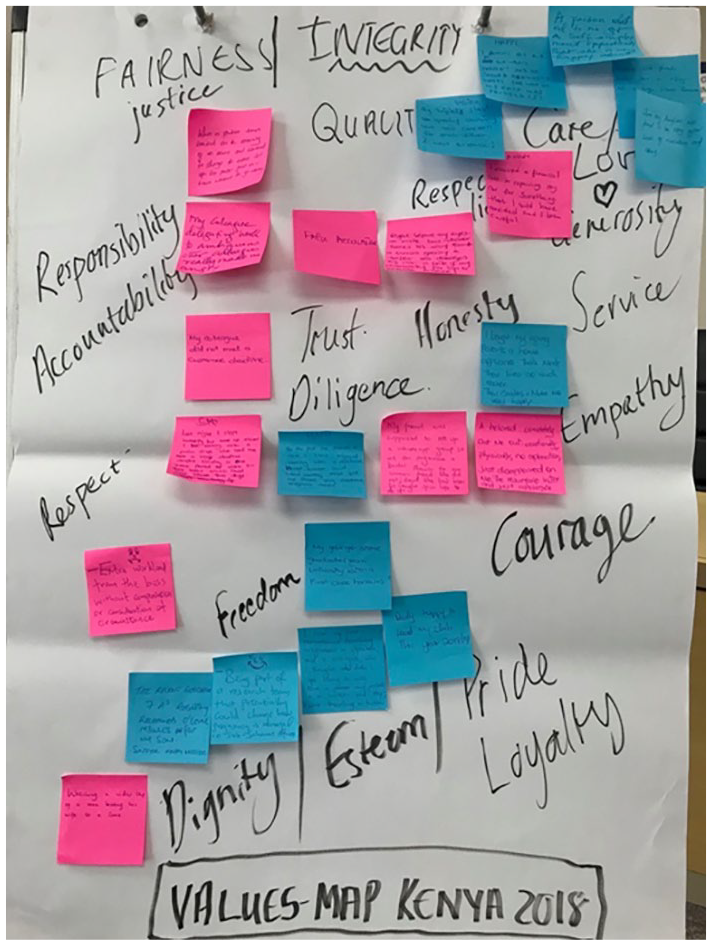
Values-map emerging from the happy-angry exercise of the values-driven leadership in action (VDLA) programme.
The relationship between affect, stakeholders and normativity seems key to understanding why this ‘Happy-Angry’ exercise functions as a fundamental part of values-identification in the early stages in the VDLA course. The course animates discussion on how the values that are identified via affective cues impact relationships to particular others (peers, bosses, family, community, the State, etc.). As such, stakeholders are not identified a priori in an abstract mapping of generalised rights or interests, as many exercises in stakeholder analysis suggest (Giacalone and Thompson, 2006). It also steers clear of viewing stakeholder interests through the lens of firm-interest. Instead, stakeholders are revealed through the affective reactions that are triggered in and experienced by participants. Through the affective ties which connect them as humans, the moral responsibility towards them crystalises. Recognising the values of others demonstrates that behind any stakeholder label, lies particular beings endowed with affectivity, that they can be treated as ends instead of means in the service of the organisation’s interests and performance.
What becomes apparent in this exercise, is that values have a strong affective force – they cause intensities that move individuals (i.e. that affect them, in a deep and embodied way). This shapes their understanding of what matters, that is, what is to be protected and nurtured, and how these create affective ties endowed with a stronger normative sense of responsibility to others who hold a particular stake in the matter. As such, it helps us to reveal ourselves as stakeholders in the first place, and articulate what is at stake in SHT for the persons involved, thereby guiding how they are moved towards action. Affect is the channel, the gateway to such identification in an experiential way that forces me to confront my personal level of implication in the network of stakeholders in which I am embedded, that the course refers to as the ‘ME-WE-WORLD’ framework (Pérezts, Russon and Painter, 2019). Indeed, I am personally happy/angry (ME), but this is always relational (WE) since I am happy/angry in regards to others in the situation (who contribute to the fairness/unfairness of it for example). This also has broader implications, related to our normative understanding of whether this is the most desirable state of affairs (WORLD). Although referred to in the course as the ‘ME-WE-WORLD’ framework, here we establish how each of these levels respectively addresses the anthropological, relational and normative weaknesses within the teaching of SHT.
What we see here is that this kind of affective exercise could potentially supplement or refame a classroom pedagogical technique such as Mitchell et al.’s (1997) salience model. Seen on their own, the criteria of power, legitimacy and urgency remain immeasurable and ultimately meaningless if one cannot account for the affective force at play on individual, collective/organisational and societal levels. Tapping into affect as a type of ‘reasoning from below’ allows one to operate from what Negri and Hardt (1999: 83) describe as a ‘non-place’ (positively defined) where measurement is impossible. This could accomplish several things, which they describe (hypothetically) as follows: affect allows us to act in ways that are both singular and at the same time universal. Furthermore, it allows us to see that the relationship between singularity and commonality is not static but dynamic, and as such inaugurates processes that are not formal, but material. The appropriated power fuels itself to become expansive in ways that Negri and Hardt (1999: 86) describe as ‘a power of freedom, ontological opening, and omnilateral diffusion’. In terms of rethinking the salience model in teaching SHT, this fundamentally redefines how power is understood, how urgency operates as a dynamic force, and how legitimacy is construed from both singular and universal perspectives. Ultimately, this may be a more meaningful way to deliberate about meaningful stakeholder identification, engagement and action.
From a philosophical perspective, the VDLA course also establishes bridges between several relational ontologies through affect: 20th century post-humanist traditions in Western thought are brought into conversation with Africa’s Ubuntu tradition (Pérezts et al., 2019). Both philosophies establish a close connection between emotions, values, deeper affective ties and the ability to relate ethically to others. Rather than privileging one view of the ‘human’ that underpins SHT, the embodied complexity of affect, and the relational triggers that allow one to have a sense of oneself, and of others, form the heart of the experience. As such, emotions tend to be the embodied and immediate clues and cues to our values – if a value is violated, anger emerges, whereas if it is validated and protected, one tends to feel happy. Though emotion is used as the ‘surface-level’ trigger that helps participants register something that animates them in the world in a familiar vocabulary, 3 the discussion goes further to probe into the unfamiliar or perhaps hidden affective dimensions that inform their relationships to themselves, to others and to their environment. In what follows, we delve deeper into this phenomenological approach to teaching and learning.
A phenomenological, affective pedagogical approach to teaching SHT
In what follows, we take a three-pronged approach, reflecting on the experiential learning ‘Happy-Angry’ exercise within the VDLA programme to discuss how affect in a Henryan sense plays out in the three levels of the ‘ME-WE-WORLD’ framework.
The affect in ‘ME’: a phenomenological perspective on ‘self-affection’
Our first level of analysis focuses on the individual person as the locus of affects, or as the VDLA course describes it, the ‘ME’ dimension. This unpacks the affectivity that is required for persons to experience and enact their own values, enabling them to become ‘stakeholders’ in the first place. Henry’s phenomenological account of affectivity allows us to get to grips with individual lived experience in and of itself, accounting for the enthusiasm inspired by shared experiences within a cooperative context (Pérezts et al., 2019). This ontology of the ‘unmeasurable’ as applied by Henry, which offers a more radical take within the tradition of phenomenology (Bevan and Werhane, 2010), ultimately understands stakeholders in terms of the singularity of actors and their lives, defining a new anthropological perspective. Here, the meaning generally ascribed to the word ‘affection’ (Letiche, 2009: 298) is transformed: we are no longer dealing with a phenomenal object or a character trait, but with what it means to be a human subject, (our affectus indeed). Since subjectivity is fundamentally ‘invisible’, and ‘immanent’ (without mediation), according to Henry we tend to lose sight of this reality and replace what we think we know with representations of the world (Deslandes, 2016; Marion, 2012).
Henry’s description of the self highlights a primary ontological passivity whereby life is received and perceived: it is this being ‘in the flow of life’, this self-affection, that grounds and accounts for my affective relation to myself (what he calls ‘ipseity’), to others and to the world. Sansonetti (2006: 115) argues that Henry is indeed close to Kierkegaard (Jean, 2011) in viewing the ‘self’ as a synthesis, that is, a relation to oneself established by another. In the case of the ‘Happy-Angry’ exercise, asking participants to recall a strong emotion allows them to tap into embodied beliefs that lie at the heart of the self. For example, when asked about what made them happy in recent times, time with family, or the care and love experienced with friends often predominate. While the high value we place on loving relationships is usually made invisible in workplaces, these affections are central to the constitution of the subject, that is, they lie at the heart of who and what ‘stakeholders’ are, as what Henry would call ‘flesh’ or ‘subjective bodies’ (their bodies being precisely this auto-affectivity itself).
This primordial importance of auto-affectivity, above any and all other considerations of mood or psychological traits, is an essential characteristic of our humanity, and we feel that this has been a blind spot in SHT. Furthermore, representing stakeholder interests in terms of roles, or objective ‘stakes’, warrants the same criticism that Henry extends to most of modern ‘science’ that only grasps ‘objectivities’ (Henry, 2012). Doing this would be to fundamentally undermine the coherence of the affective life that goes far beyond such roles (Puyou and Faÿ, 2013). Instead, Henry invites us to bring back embodiment to the forefront (Letiche, 2006). For instance, a recent study in banking compliance also using the Henryan framework, highlights how compliance analysts made risky decisions based more on the embodied ‘gut feeling’ of being ‘comfortable’ (or at least feeling the absence of malaise) than on the available information in their roles as analysts (Pérezts et al., 2015). Positive affects manifest in embodied reactions such as hugging a distressed co-worker or making jokes to ease tensions, thereby becoming an embodied force that animates various stakeholders, which we believe needs to be taken into consideration within SHT.
Who counts in SHT? Discovering the relational (‘WE’) force of affectivity
When turning to affectivity to address the issue of who counts, a question inevitably arises: if one focuses one’s attention on understanding individuals’ effort and affective power as it manifests in their lived corporeality and affectivity, in their individual ‘flesh’, does it mean that any attempt at understanding collective action may be undermined? Not at all. This question of ‘who are more ‘salient’ stakeholders?’ can be more meaningfully addressed if the affectivity at the heart of SHT is articulated in a strong sense, as a neglected and powerful means to determine where to focus collective force. The VDLA pedagogical approach pursues stakeholder analysis more affectively, steering clear of misplaced ‘objectivism’ such as rights and interests’ calculations, and instead stimulates relational responsibility. In this way, we go beyond strategies that cerebrally engage with stakeholder identification and instrumentally approach engagement (Kujala and Sachs, 2019: 230).
Far from being a philosophy of the self as the sole actual reality, in brief solipsism, Henry’s phenomenology of the person is profoundly relational in the sense of ‘interior resonance’ with the selves of others. This makes it particularly relevant to SHT whose characteristic property is precisely to give a ‘voice’ to entities and individuals previously devoid of any means of expression. In this sense, as the ‘Happy-Angry’ exercise illustrates, one becomes aware of the other in and through self-affection. For example, when asked what made them angry in the recent past, VDLA participants will often highlight HR-related incidents, such as not getting the promotion or bonus they expected (fairness seems violated), or being refused vacation or other benefits (disrespect may be experienced). In many cases, the discussion of affectivity also turns humorous, as participants reveal their anger at their football team losing yet another game, for example. The importance of humour (Pérezts et al., 2015; Pérezts, 2020; Sobral and Islam, 2015) Reference removed for blind review) is indeed key in experiencing ‘resonance’, that is, when people recognise themselves in the stories of others. Commenting on Henry, Jean (2011: 58) explains that ‘. . . what others say, express and do (. . .) is (. . .) “co-born in me,” in such a way that I become “contemporaneous” with them’. This helps in bypassing the cerebral to find ways of relating in organisations and understanding embodied relationality at work. Reintroducing affect therefore helps us to depart in significant ways from finding the normative basis of SHT in some theory of ‘rights’ or ‘interests’, which depend on general representations of people, and leans towards measurable criteria for adjudicating such rights. Henry’s theory would challenge such a conception of SHT because it objectifies the other according to the interests of the corporation. Solidarity then should not stem from some organisational logistics, but from a constituent action of affective life. As Letiche (2009: 304) wrote: ‘If there were no affectivity, there would be no “glue” to make relationships or to achieve commitment, or to attempt human bonding’.
Henry’s phenomenology is not a philosophy predicated on the selfish preservation of lives; it is concerned with enhancing shared life, and living and working together is geared towards producing the goods required by life itself (Henry, 1976: 119). It is through praxis that shared lives and togetherness, become manifest. This ‘esprit de corps’ (Pérezts et al., 2015) connects both internal and external stakeholders by intensifying the living and affective bonds by means of friendship, humour, shared-practice, but also through resistance to aggressive or exploitative practices that are aimed at undermining one’s life. Since each person has an embodied sense of ‘what is good’ – which is known pre-reflexively – ethics in groups, or in a social body, can only exist as ‘co-praxis’, which allows for sharing life’s immanent dynamics. While organisations employ all kinds of abstractions, faceless tools and delegations to get rid of the potential for experiencing affective relationality (Letiche, 2009; Puyou and Faÿ, 2013), pedagogical approaches like the VDLA seek instead to bring them back in, to experience both malaise and joy with others. In terms of stakeholder relationships within organisations, this helps to address some of the negative effects of disaffection at work, which have become so widespread in modern-day organisations (Bouilloud, 2012: 37). Affectivity is the locus in which successful collaborative work originates. When such a favourable environment does not exist, frustration prevails, thus working as a self-fulfilling prophecy (Davis et al., 1997): individuals misbehave, quality and productivity standards are seriously impaired. Affective relationality also seems to cut through the disempowerment and paralysis that individuals experience if they feel isolated in their embodied beliefs and intuitions. In reflecting on the course experience (in post-course evaluations), one of the most salient benefits to learners was that they realised that they ‘are not alone’ in their normative orientations. This allowed them to act on their values in ways they previously felt were impossible, to which we now turn.
Learning to act in the ‘WORLD’: The normative force of affectivity
Lastly, we move towards the more systemic dimensions of stakeholder activism and action, that is, the ‘WORLD’ components of the VDLA framework where the normative dimension plays out more prominently. If management education is to succeed in animating students’ involvement in proactively solving the world’s most pressing problems, it has to escape the cold distancing that results from objectivist approaches to learning, particularly concerning stakeholders. This means that though SHT remains an important tool for thinking through how organisations should act in and on the world, affective learning addresses the more important question of why certain actions are appropriate and necessary. Also, it offers a stronger motivational force, allowing students to collaborate more effectively, precisely because they are affectively engaged.
Henry’s phenomenology developed in reference to an acting subjectivity, where connecting to others is linked to an underlying affective stretch, allowing us to genuinely share a common experience of real life. An example that emerged while teaching the course in Kenya, relates to a situation where one participant intuitively felt that the organisation’s stationary costs were inflated, and in a sense ‘smelt a rat’ in terms of suppliers potentially influencing the procurement process in corrupt ways. She was however assured that ‘proper procedures were followed’, and was instructed ‘not to try to fix something that ain’t broken’. Through affective conversations amongst participants about similar difficiculties they had in challenging these rationalisations to not act, representatives of various organisations not only realised they were not alone, but also found the drive to act. As a result, three large organisations in Kenya agreed to a zero-tolerance policy against corruption and worked together in organising joint supplier training in anti-corruption. This consolidated stand taken by powerful corporate players in what is often perceived as a ‘sea of corruption’, seems to have been affectively empowered. Henry’s analysis helps us to understand this invisible bedrock of any collaboration which might be referred to as affectio societatis (Deslandes, 2016), that is, a kind of affective community and to entice individuals to formally accept the emotional consequences of such a partnership.
Debates around the values that trigger affect are however also encouraged, to reveal entrenched blind-spots. This is important in allowing participants to think through what their various social roles may allow them, or not allow them to see. For example, is the fact that as a parent, your child’s disobedience angered you, the result of a violation of respect, or a frustrated sense of care or responsibility? In a sense, there is no one right answer, as participants are encouraged to think about what animates their own action in the world. As ‘acting selves’, all stakeholders experience their social roles affectively, and as such, our representation of various groups may not do justice to the lived and embodied experience of members of those groups. In a Henryan-based analysis, Gély (2007: 79) explains that social roles are only experienced intensely because they reveal ‘within the forces of life [. . .] that the potential abilities of others are my own potential abilities’. Individuals do not act as robots in their social roles, precisely because they are by definition unable to sever their ties to themselves. Affect can therefore be used to relate, but not to dictate.
To sum up, construed at an ontological and not psychological level, affectivity not only offers a more meaningful anthropological basis for SHT, but allows us to redefine the concept of stakeholder management as a relational phenomenon with normative force operating at societal and environmental levels. These are key concerns of the ‘affective turn’ in management education (Gherardi, 2017), whose broader implications for learning we shall discuss next.
Discussion: Implications for management learning
How should we then think about the human in management learning? Some, like Braidotti (2013: 26), opt for an anti-humanism, which objects to the unitary subject of Humanism, and argues that it should be replaced with ‘a more complex and relational subject framed by embodiment, sexuality, affectivity, empathy, and desire as core qualities’. From our perspective, an affective approach takes us further along this path, that is, reinvigorating our understanding of the human from a phenomenological perspective. We believe that by infusing with affect the way we teach SHT could transform not only business practice, but also the way in which we empower students for their life in organisations more broadly.
If theories actually shape values (Miles, 2012: 291), the risk would be after all to believe too readily that SHT has the protocols and priorities that make business more ‘human’. By relying too strongly on a theory to identify which categories of people are legitimate and strong enough to make their voices heard, we may not solve the problem of equal treatment and plurality within and outside of organisations. As a matter of fact, in accordance with the interpretation given by Mitchell et al. (1997), it might be nothing but a tool designed to make a strategic selection of priorities depending on the agenda of the stakeholders who are the most capable of expressing their choices and preferences (in which case, stakeholders become powerful actors). This theory would also prove a most effective tool to annihilate the claims and demands of the persons who do not have the capacity to make themselves heard (Derry, 2012: 263). Much more is needed to recuperate the ‘human’ that lies latent in SHT.
Emphasising the role of affectivity allowed us to reconsider the teaching of SHT in at least three of its key aspects: by challenging its anthropological assumptions and by revealing its limitations in addressing the affective relationality between stakeholders, we can bring back the normative force of SHT that has been easily subsumed in favour of an instrumental approach. In doing so, we highlight the transformative social potential (Thompson and Willmott, 2016) of pursuing a pedagogical approach open to the affective dimension that lies at the heart of individuals as persons (Sedgwick, 2003). This will hopefully contribute to the nascent exploration of the impact of affect on learning (Brewis and Williams, 2019).
Henry’s phenomenological approach shows that the ethical potential of SHT lies at the level of the affective embodied power of individuals, not solely in the possibility – extensively studied in the existing literature – of ‘turning collective potential into an ability’ (Bonnafous-Boucher and Rendtorff, 2013: 105). Through the three levels we have explored concretely how such an ability may be enacted, as well as the political impact of reinfusing SHT with affectivity, thereby highlighting the practical, pedagogical implications of our argument. As our discussion of the ‘Happy-Angry’ exercise indicates, the visual mapping of values (Figure 1) allows the group to relate back to their affective experiences when specific moral dilemmas are discussed throughout the course. Though the argumentation about appropriate courses of action may be conscious and deliberate, intuitive affectivity is still in play. In this regard, we concur with Hernes and Irgens (2013) that allowing space for these intuitive abilities is key to organisational learning. This form of experiential learning elicits affective intensities that may strengthen the resolve of participants to engage in values-driven action.
While other researchers relied on different theoretical frameworks like behavioural economics (Kaufman and Englander, 2011) or the natural and environmental approach (Laine, 2010; Montiel et al., 2018), or even emotions in a restrictive way (Barsade and Gibson, 2007; Staw and Barsade, 1993), to address certain limitations of SHT, our phenomenological approach focused on affect, led us to place stronger emphasis on the role of subjectivity and relationality. By reclaiming SHT’s normative potential in and through stakeholders’ personhood, we contribute to the literature by articulating the implications that affective ontologies have for mainstream management concepts, such as SHT, and what this implies for management learning.
This study therefore presents an opportunity to rethink MLE outside its traditional scientific framework. The struggle against managerial objectivism – the ideal starting point of SHT, of the person predicated on affectivity – could be won if we foster a revaluation of the affective dimension of organisational life in the classroom instead of relying on statistical or other objectifying tools. In fact, taking affect into account in training, especially in scientific training, remains, from the Henryan perspective nothing less than a stake in civilisation. By erecting Galilean objectivity as the only source of knowledge regarded as valid, modern sciences and their pedagogical diffusion run the risk of resulting in what Henry labels ‘barbarism’ (2012/1987). Following Henry, we believe that culture and the humanities do not aim at any objective knowledge or quantitative measurement but to extend the powers of affectivity, of the phenomenological ‘matter’ which constitutes the human (which cannot be quantified). As Longneaux (2006) indicates, taking into account an education of the notion of affectivity is at the same time going beyond the functional approach of behaviourism, in which behaviours are dependent on their ‘environment’, as well as the cognitivist approach which ultimately equates every thought with ‘information’. In Henry’s sense, affectivity is not an ‘information’, it is the substrate of our humanity, of our receptive capacity to this world. ‘We will therefore admit that education cannot be satisfied with ready-made knowledge’, explains Longneaux, ‘To educate is to allow one who is educated to retrace the path, to redeploy within her/him the powers by which knowledge was first acquired.’ (Longneaux, 2006: 140). Changing the theoretical premises when we teach leadership, particularly to executives who are in influential positions (as in our case), can have deep implications in changing the prevailing ideologies and their shortcomings (Cunliffe, 2009). The example of the VDLA course highlights the importance of the pedagogical tools used, which train the mind in a certain way of thinking, in this case gearing towards affectivity from the start.
Furthermore, such a shift shows that this phenomenological analysis requires a genuine form of ethics. This ethics of affectivity (Seyler, 2010) should make us sensitive to what is ‘real’ in the analysis of stakeholders, to what seems precisely elusive: the subjective praxis, which is the constituent part of effective action. Such ethics should acknowledge what, in SHT, is likely to provide individuals with the experience of connecting their own powers in an affective and ontologically effective fashion. Or, put differently, if institutions prevent individuals from accessing their affective life by means of an insistence on abstract representation and distancing, they have no capacity for ethics (Puyou and Faÿ, 2013). All in all, affect is a powerful force animating and sustaining action, and it is in this regard that it holds great potential for more meaningful stakeholder empowerment and resistance and for exploring relationality around non-human and inanimate stakeholders, such as the environment. The affective force of environmental devastation, climate change, pandemics is often appreciated much too late, with devastating consequences, as the COVID-19 crisis has made adamantly clear.
Conclusion
In this text, we explored the affective pedagogical implications of one of management theory’s most central notions, that is, that of the ‘stakeholder’, that seems to suffer from the ‘grandiosity’ that plagues much of organisational scholarship (Alvesson and Gabriel, 2016). We believe that this allows us to reconsider how we understand the notion of the human person, or the ‘self’, also in relation to others, and to reframe our approaches to business ethics training and leadership development. Beyond highlighting SHT’s lack of adequate consideration of affect, a key contribution we sought to bring forward is how weaving a phenomenological approach to affect into an experiential pedagogy of SHT can foster affective relationality and normative engagement at the individual, relational and systemic levels.
In this regard, it may be relevant in future research to consider what Braidotti (2013: 38) describes as another significant ‘posthuman’ development, one that emerges from science and technology studies, and enforces the analytic form on our reconsideration of the ‘human’. The technologically mediated global interconnection between humans, and also between the human and the non-human worlds, creates webs of intricate inter-dependencies (Braidotti, 2013: 40). The main problem with this scientific approach to the posthuman, is the way in which it glosses over the implications that technology and science have for subjectivity and by extension, governance devoid of affectivity. This leads to pretences of political neutrality, which hides power relationships and steers clear of considering and critically interrogating the functioning of advanced capitalism.
In the end, the anthropological, relational and normative weaknesses of SHT have led to a watering down of SHT’s normative inclinations. This has limited its ability to contribute to values-driven leadership and ethics education more broadly. Following both Henry (2012), for whom ‘ethics is co-extensive with life’ (p. 96) and Freeman (1999: 236) who pleads for the pragmatic orientation of disregarding those views that do not help us to live better, we hope to have illustrated the way in which the affective quality of values registers within the emotions of individuals, as well as within affective relations with animate and inanimate others. Furthermore, our account shows how one’s relation to self and others is phenomenologically grounded, and how emotional and broader affective elements constitute relationships and enable action. In his conclusion based on the survey carried out by Meyor (2002) entitled ‘Affectivity in education’, Longneaux (2006: 142) argues that we should strive to foster affectivity, since it is linked to life itself: ‘To educate is to learn how to inhabit [the beating, distressing, boring or marvelous] world (instead of reducing it to being just a tool to be controlled or looted)’. Sharing this view, and hoping to have contributed a few new perspectives through this paper, we believe that it is time that a fully-fledged ‘human’ re-enter business school classrooms.
Footnotes
Acknowledgements
The authors would like to express their gratitude to the editors of the Special Issue and the anonymous reviewers for their support and helpful advice.
Funding
The authors disclosed receipt of the following financial support for the research, authorship, and/or publication of this article: Mar Pérezts was awarded a Visiting Fellowship Grant from the British Academy (VF1/103978) for this project, allowing her to become a visiting professor at Nottingham Trent University’s Responsible and Sustainable Business Lab, directed by Prof. Painter.
