




Abstract
In this article, we apply the concept of ‘targets and terror’, previously used in the healthcare sector, to the audit culture within business schools. We explore to what extent terror, or the inculcation of fear through processes of domination, is identifiable in the micro-level experiences of early career academics. Drawing on an international study of 38 Critical Management Studies early career academics from 15 countries, we develop a theoretical framework combining Bourdieu’s modes of domination and Meyerson and Scully’s Tempered Radicalism, which helps us identify top-down and horizontal processes of micro-terror and bottom-up processes of micro-terrorism, specifically self-terrorisation and counter-terrorisation. In extending the study of ‘targets and terror’ cultures to contemporary business schools, we develop a clearer understanding of how domination plays out in the everyday processes of management and self-management. From Bourdieu’s modes of domination, we discern a dark picture of institutional and interpersonal overt and symbolic violence in the name of target achievement. The Tempered Radicalism lens helps us to understand early career academic challenges that can lead to self-terrorisation but also brings possible ways forward, showing early career academics how to resist mechanisms of micro-terror through their own small acts of counter-terrorisation, providing some hope specifically as the basis for collective resistance.
Keywords
Introduction
Target cultures in public sector organisations can have damaging effects on employees (Diefenbach, 2009; Visser, 2016). During the 2000s, the imposition of a target culture in the English National Health Service (NHS) led to what some commentators termed a ‘targets and terror’ regime (Bevan, 2006; Bevan and Hood, 2006) resulting in a culture of workplace bullying (Francis, 2010). The ‘targets and terror’ epithet has also been applied to academia in the context of audit and accountability (Di Leo, 2015; Geppert and Hollinshead, 2017). In this article, while recognising that ‘terror’ applied to target-driven cultures may be overly melodramatic and under-theorised in existing literature, we ask whether ‘targets and terror’ can serve as a helpful lens to understand fear in contemporary universities and explore employees’ experiences of such ‘bullying cultures’.
Our aims are, first, to apply the concept of ‘targets and terror’ to problematise the audit culture within universities (Chandler et al., 2002; Strathern, 2000; Tourish et al., 2017) and specifically business schools (Huzzard et al., 2017; Willmott, 2011). Second, we explore how terror (inculcation of fear through processes of domination) is identifiable at the micro-level of early career academics’ (ECAs) lived experiences. Terror is, of course, a strong word, with connotations of totalitarian regimes and threats of physical and mental violence or even death. Therefore, we recognise that ‘terror’ as applied to the relatively privileged context of neoliberal capitalist universities and business schools may seem extreme compared to contexts where academics have been persecuted, imprisoned, tortured and killed for their beliefs and academic practices (Chatterjee and Sunaina, 2014) – in other words, are suffering from major terror. We acknowledge this and draw attention to their current causes. 1
Yet, we do need to emphasise that the contemporary neoliberal capitalist university is a far from happy place. The widely reported UK academic suicides at Imperial College and Cardiff University in 2014 and 2018 have highlighted the pressures facing faculty members. A subsequent Higher Education Policy Institute report points to ‘an epidemic of poor mental health’ in UK Higher Education Institutions (HEIs), identifying sharp increases in referrals to counselling (77%) and occupational health (64%) between 2009 and 2015 (Morrish, 2019). Universities are now ‘anxiety machines’ (Hall and Bowles, 2016) and academic well-being is a growing theme in Higher Education (HE) research (O’Brien and Guiney, 2018; Smith and Ulus, 2019).
HE research identifies changes in university cultures as the cause underlying the spread of well-being and mental health issues among faculty (Ruth et al., 2018). These macro-level changes are ‘triggering psychological and spiritual effects seeping into the individual lives’ (Smith and Ulus, 2019: 5) as identity insecurity challenges faced by academics are increasing (Grey, 2010; Knights and Clarke, 2014). A growing body of work looks at the impact of targets, audits and the commercialisation of universities on research culture (Willmott, 2011), workplace culture and collegial relationships (Parker, 2014), and the consequent changing ways of ‘doing academia’ (Alvesson and Spicer, 2016; Gill and Donaghue, 2016). This has implications for the measurement of academic performance (Kallio et al., 2016; Ter Bogt and Scapens, 2012) with the metrics-based ‘excellence’ culture impacting working experiences of academics ranging from the professorate (Butler and Spoelstra, 2012, 2014) to ECAs (Bristow et al., 2017, 2019; Robinson et al., 2017).
To date, however, very little work has focused on the mechanisms through which ‘targets and terror’ inculcate fear in academic cultures, how academics respond to this and the consequences of these responses. So, following commentators in the UK healthcare sector, who coined the concept of ‘targets and terror’ in drawing comparisons with the Soviet economic model (Di Leo, 2015), we explore the relationship between power, control and targets within the ‘new corporate university’ (Giroux, 2004), and the effects of this on academic working conditions under neoliberal capitalism. In doing so, we identify the processes by which the quest for achievement targets may transform into mechanisms of everyday ‘terror’ (Di Leo, 2015; Giroux, 2004) and ‘violence of academia’ (Smith and Ulus, 2019). We refer to such daily, mundane terror as ‘micro-terror’ – a kind of dark negative of ‘micro-emancipation’ (Alvesson and Willmott, 2002) – both to highlight its pervasive and often subtle nature and to distinguish it from more dramatic major manifestations of terror.
We have chosen to focus specifically on the experiences on ECAs, whose careers from the outset are framed within externally imposed target-focused cultures (Mingers and Willmott, 2013). Such cultures are driven in many national HE contexts by structural mechanisms – for instance, the Research Excellence Framework (REF), where an individual’s research output is measured against journal rankings such as the ABS/CABS list. 2 Understanding the socialisation and early experiences of this strategically important group of academics (Bristow et al., 2017), who are learning to develop their academic careers in a climate of increasing control, conformity and deadlines for the delivery of measured targets (Alvesson and Spicer, 2016; Bristow et al., 2017, 2019), is vital in terms of knowing what is expected of academics entering the profession today, and in shedding light on current and future trends. This group is also particularly vulnerable to the pressures of the current work climate (Robinson et al., 2017) because of the precarity of probationary and fixed term contracts (Bataille et al., 2017) and a lack of experience of the profession’s ‘underlying game’ (Smith, 2010). However, we do not see this group as without agency (Bristow et al., 2017) and examine ECAs’ reactions to ‘targets and terror’ in the light of their complex lived experiences of resistance, collaboration and pragmatic survival.
Our article draws on an international study of 38 Critical Management Studies (CMS) ECAs from 15 countries. We chose this group for their marginality and vulnerability to pressure within business schools but also for their potential as non-conformists, given that ‘being critical’ can be perceived as anti-performative and contrary to the neoliberal capitalist logic of their institutions (Bristow et al., 2017). As regards the aims of this article, they are ideal participants as, through their scholarship, they are familiar with conceptions of domination and abuse within organisations, and may therefore be more able to spot and articulate such patterns within their own institutions (Bristow et al., 2019) and be reflexive about their responses. We explore how downward forms of domination cause them fear through micro-terror but equally how their reactions and resistance to such mechanisms lead them to micro-terrorise themselves (what we call ‘self-terrorisation’) and the system (what we call ‘counter-terrorisation’). This enables us to address the following questions: (a) What mechanisms and processes of micro-terror shape and control ECAs’ socialisation into the academic field? (b) How do ECAs learn to respond to these? (c) What effects do such responses have in perpetuating or challenging the ‘targets and terror’ culture?
Theoretical framework
In constructing our theoretical framework, we bring together two theoretical lenses: Bourdieu’s (1976) work on modes of domination and its forms of inert, overt and symbolic violence and Meyerson and Scully’s (1995) notion of tempered radicalism (TR). This two-pronged framework emerged through our abductive, iterative research approach in which we moved repeatedly between theory and data (see ‘Methods’ section). Its dual nature enables us to address the two distinct but related aspects (more structural, top-down ‘targets and terror’ and more agentic, bottom-up ECA responses) of our research questions: Bourdieu allows us to theorise the structures and processes of micro-terror that affect ECAs; and TR helps to capture in more fine-grained detail the everyday complexities of ECAs’ own micro-terrorism.
Modes of domination
Bourdieu (2016) draws on Kafka’s The Trial to show how acceptance of domination is a process through which an individual such as Kafka’s Josef K comes to accept the imposed identity of the ‘accused’ in the face of an unknowable court wielding arbitrary power and terror (p. 224). For Bourdieu (2000 [1997]), The Trial provides a model of ‘a social universe dominated by such an absolute and unpredictable power, capable of inducing extreme anxiety by condemning its victim to very strong investment combined with very great insecurity’ (p. 229). Similarly, Bourdieu (2000 [1997]) quotes American author James Baldwin on how African-American children learn through interpersonal family interactions the social ‘terror’ of anticipating white racism in order to survive in a structurally violent and unjust society (p. 170). Bourdieu, therefore, argues that any lasting social order requires the ‘dominated’ to acquiesce in their own domination and that domination must either be objectified and stabilised through apparently impersonal institutional mechanisms (as in Kafka), which Bourdieu (2016) terms inert violence of institutions, and/or (as in Baldwin) mediated through close interpersonal encounters between the dominant and the dominated (pp. 212–213). Interpersonal modes of domination operate through two forms of violence: economic or overt violence (Bourdieu, 1980: 217–218) and symbolic violence. Economic/overt violence involves ‘direct, daily, personal work’ of domination, enforcing power relations in an overt way, through physical threat or the threat of economic ruin (Bourdieu, 1976: 190). Economic/overt ‘micro-violence’ is, as we will show, especially relevant to academia due to the widespread precarity to which ECAs are particularly vulnerable (Bataille et al., 2017).
However, in terms of establishing domination, this overt form of violence is less ‘efficient’ for the dominant than the ‘softer’, more seductive strategies of symbolic violence (Bourdieu, 1976: 191; Robinson and Kerr, 2009). The latter can be understood as the imposition and misrecognition of arbitrary power relations as natural and legitimate (Bourdieu, 1976: 122) and is well-embedded within university cultures (Roumbanis, 2018). As we demonstrate, this subtle form of ‘micro-terror’ is administered through line management relationships and other day-to-day governance such as workload and probation management. These, we argue, are more about hitting targets (Tourish et al., 2017) than supporting, nurturing and guiding new entrants into the profession (Gill and Donaghue, 2016).
Given its derivation from Weber’s (1978 [1922], 2004 [1919]) concept of charismatic Herrshaft, symbolic violence has been taken up by scholars researching the dark side of leadership, including the creation of ‘cultures of fear’ (Kerr and Robinson, 2012; Robinson and Kerr, 2009) and workplace bullying (Harrington et al., 2015). Symbolic violence in university leadership and line management is, therefore, a promising new direction of research. For example, Roumbanis (2018) explores how the use of senior academics in training academic entrants at a Swedish business school socialises ECAs into the dominant practices of the field through the exercise of symbolic violence. He considers how, although presented as kindly advice, the underlying message is conveyed that seeking research funding is not an option but an obligation. However, given that his study was based on observation, it is less evident how ECAs make sense of these processes, if they start to recognise them as domination and how they respond to them.
Although we can distinguish economic/overt from symbolic violence for analytical purposes, these are not mutually exclusive. Domination is a dynamic process in which both forms are normally situated in a context of structural domination (e.g. impersonal bureaucratic regulations). In this study, we explore processes of domination as socialisation, whereby, ECAs learn to play the rules of the ‘targets’ game. This game might be quite different from their expectations of academic life (Barkhuizen, 2002), even though PhD education may have acted as a ‘cognitive apprenticeship’ (Austin, 2009; Prasad, 2013). These processes of socialisation, we argue, are both impersonal, through interactions with organisational culture and structures, and relational, through interactions with organisational actors. Most ECAs choose to remain within the profession even though they become increasingly aware of its harmful effects (Bristow et al., 2017). This desire to remain is fueled by members’ illusio, that is their emotional investment in the field (Taksa and Kalfa, 2015), and the perceived importance of academic work and identity (Clarke et al., 2012; Robinson et al., 2017). Considering what ECAs have to navigate within this state of ambivalence leads us to our second theoretical lens of tempered radicalism.
Tempered radicalism
As our empirical analysis will show, viewing CMS ECAs as TRs helps to understand their multifaceted responses to academic ‘targets and terror’. Meyerson and Scully (1995) define TRs as ‘individuals who identify with . . . their organizations and are also committed to a cause, community or ideology that is . . . at odds with the dominant culture of the organization’ (p. 586). Such individuals are ‘radicals’ because ‘they challenge the status quo, both through their intentional acts and also just by being who they are, people who do not fit perfectly’. They are ‘tempered in the sense that they seek moderation’, but also, like steel in a fire, are strengthened by experience, while retaining their ‘temper’ (anger) against the dominant culture.
TRs perceive ‘the incongruities between their own values and beliefs about social justice and the values and beliefs they see enacted in their organizations’ (p. 589). This ambivalence presents them with four challenges. First, striving for acceptance in different constituencies, TRs may find themselves being perceived as hypocritical: too radical for one group and not radical enough for another. Second, TRs often experience isolation trying to maintain their dual identities without being seen as too firmly embedded in one position and thus losing credibility with the other. Third, they are subject to pressures of cooptation from within their organisation that push them ‘away from the “outsider” piece of their identity and more fully toward the “insider” piece’ (p. 591). Finally, they shoulder the emotional burdens of maintaining a dual position, which generate ‘anger plus a variety of powerful, unpleasant emotions’ (p. 593).
Although uncomfortable, these challenges force TRs to develop strategies which help them ‘effect change and simultaneously sustain their ambivalent identities’ (p. 594). The strategies include small wins (breaking large problems into manageable pieces, experimenting, picking battles and rising to unexpected opportunities), local, spontaneous authentic action (‘directly express(ing) their beliefs, feelings and identities’ (p. 596)), language styles, (speaking ‘different languages to different constituencies’ (p. 596)) and affiliations (building and maintaining networks and alliances on both sides). These strategies are effectively sets of practices developed by people in ambivalent contexts to pragmatically survive within them, and are thus, relevant to the dilemmas faced by CMS ECAs (Bristow et al., 2017).
Within the recent MOS literature, TRs have been identified as ‘micro change agents’ (Kelan and Wratil, 2018), and their micro-practices shed light on complex relationships of co-optation and resistance (Swan and Fox, 2010). We add to the above work by focusing on how CMS ECAs as TRs respond to micro-terror through micro-processes of ambivalence that may result in micro-terrorising oneself, for example, by succumbing to pressures of cooptation, while at the same time attempting to challenge (counter-terrorise) the system in line with CMS ideals. We now proceed to discuss our research approach.
Methods
To address our research questions, we draw on our empirical, abductive study comprising 38 semi-structured interviews with CMS ECAs working in 15 countries. In choosing participants, we adopted a ‘broad definition’ (Laudel and Gläser, 2008) of ECAs as those employed as lecturers (or equivalent) or postdocs for up to 6 years. In marginal cases, we followed participants’ own views on whether they see themselves as ECAs. We recruited interviewees through personal networks and at conferences (CMS and Academy of Management), using a chain-referral strategy (Heckathron, 2011) and aiming to represent diverse ECA demographics and experiences. Our final sample includes different age categories, countries of employment, genders, university types and career trajectories (Table 1). It is UK- and Europe-centred due to our own location as the starting point for chain-referrals and also to the geography of the CMS field, with Europe (and the United Kingdom in particular) being historically a centre for non-mainstream approaches in MOS (Üsdiken, 2010). However, we strove to include as many voices as possible from around the world, and particularly, from geographically and linguistically peripheral locations, and our participants include 14 ECAs in non-Anglophone countries and eight in the Global South. To ensure anonymity, we use pseudonyms to refer to all participants throughout this article.
Participant demographics (number of participants in brackets).
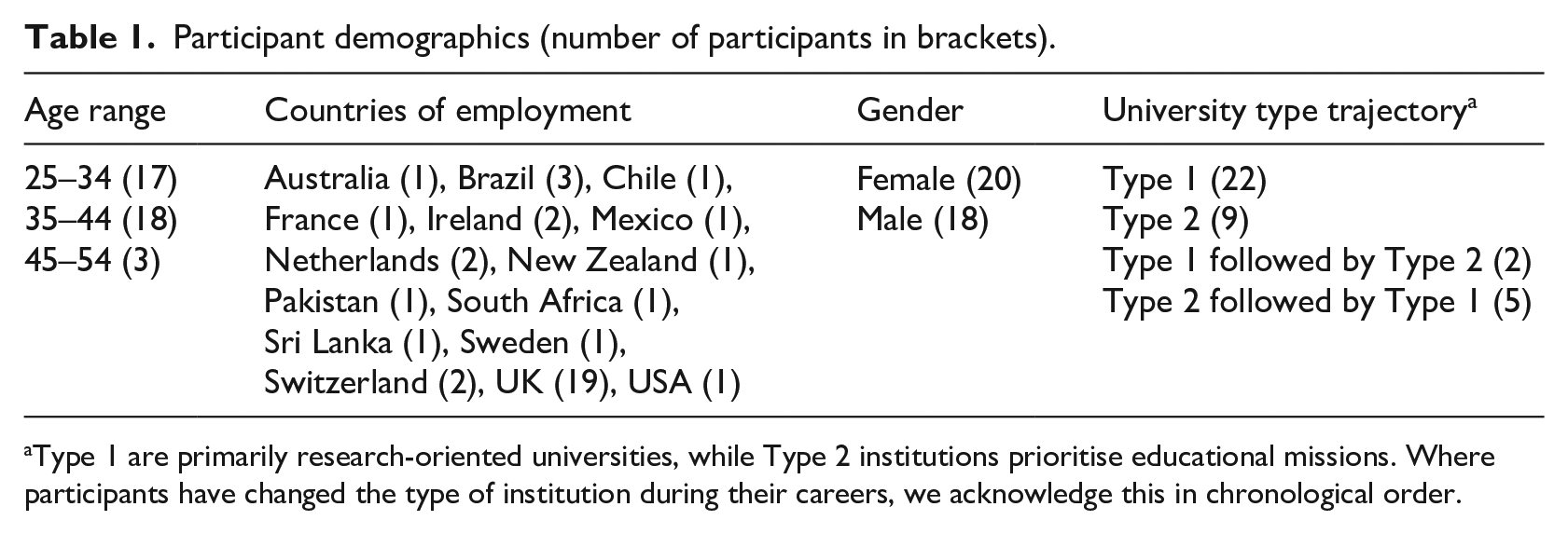
Type 1 are primarily research-oriented universities, while Type 2 institutions prioritise educational missions. Where participants have changed the type of institution during their careers, we acknowledge this in chronological order.
We wanted to give voice to lived experiences of CMS ECAs and enable them to shape our understanding of the issues of ‘targets and terror’ in conjunction with our theoretical interpretations of these issues. We, therefore, needed an abductive research approach that integrated both deductive and inductive elements in a process of ‘dialectic shuttling’ between theory and data (Atkinson et al., 2003; Schwartz-Shea and Yanow, 2012) allowing issues to emerge from the data around broadly formulated questions in iterative conversation with our theoretical lenses. We were also aware that, as with other researchers studying their own context (Clarke and Knights, 2015; Ylijoki, 2005), our own past experiences as CMS ECAs were inevitably entangled with this project. We wanted to make this entanglement constructive but not domineering. The semi-structured format of our interviews was the key in facilitating a dialectic balance between the more deductive and more inductive elements of our abductive research approach, enabling our interviews to act as sites of purposeful but open dialogue with our participants. To this end, we used a set of pre-prepared questions (informed by theory and our own experiences and observations) as a loose guide to prompt our interviewees’ reflections. Overall, our aim was to enable in-depth engagement with participants’ experiences and issues that were of primary concern to them (Cassell, 2009: 503).
We conducted the interviews face-to-face or through Skype. The interviews ranged between 1 and 2 hours and were voice-recorded and fully transcribed. Data were then analysed through a multi-stage collaborative, iterative approach, in which we moved repeatedly between our data and theory. In this cyclical process, we used heuristic coding – that is coding as ‘an exploratory problem-solving technique without specific formulas or algorithms to follow’ (Saldaña, 2013) – that we employed for ‘linking’, leading us ‘from the data to the idea, and from the idea to all the data pertaining to that idea’ (Richards and Morse, 2007: 137). We worked collectively through several cycles of coding, categorising, recoding and recategorising in order to refine our codes (some of which were broken down into a number of subcodes) and organise them into a structure that connected our data with more abstract themes, constituting our resulting analytical framework (Saldaña, 2013). Table 2 shows the latter, which fuses together more deductive elements of our dual theoretical approach and more inductive elements that have emerged from our interviews, extending and bringing new understandings to the concepts and theory. Table 2 also structures the findings part of our article, to which we turn next.
Analytical framework.
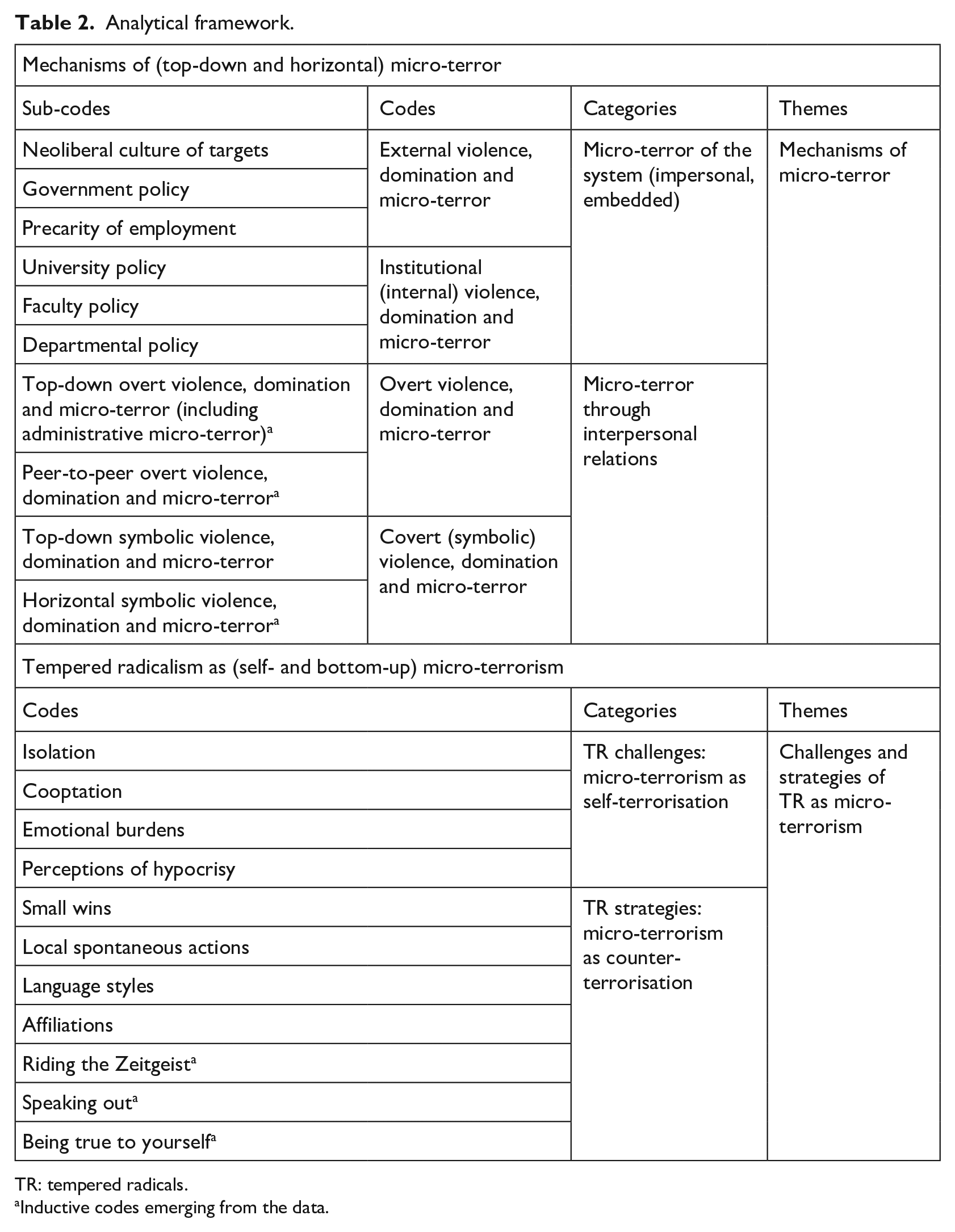
TR: tempered radicals.
Inductive codes emerging from the data.
Findings: mechanisms of domination within the business school
Our findings show how ‘targets and terror’ manifest as micro-terror emanating from various sources within the university and wider institutional hierarchies, affecting early career experiences of our interviewees. The processes of micro-terror impact on our participants through impersonal means such as institutional culture (inert, impersonal violence) and interpersonal relations with deans, line managers and peers (overt and symbolic violence). CMS ECAs respond through ambivalent processes of micro-terrorism operating through personal pressure ECAs put on themselves (TR pressures and strategies). The overall ‘targets and terror’ dynamics involve top-down processes of micro-terror, bottom-up processes of micro-terrorism and an emergent category of horizontal or peer micro-terror.
Micro-terror of the system
Our participants viewed the university systems as being imposing, impersonal and largely incomprehensible. As in Kafka’s The Trial, these systems were seen as impacting ECAs’ working lives, but without opportunity for recourse. The looming immensity of the HE institution was perceived as menacing. Participants spoke of ‘Big giant machines that are higher education’ (Grace) controlled by policy logics of ‘bean counting, accountability, for-profit practices being imposed on a university’ (Harriet). Interviewees felt that universities share a logic of targets reinforced by a ‘coterie of VCs [vice-chancellors] . . . following each other blindly’ (Harriet). Such logics were seen as infiltrating the whole system from the top down, encroaching on and removing local decision-making: ‘they have taken away the committee structures so all the decision-making happens in some other space, and decisions are communicated down’ (Oliver). Added to this was the perception of how exacting and controlling the top-down culture is, leading to feelings of resignation and powerlessness and perceptions that the lack of autonomy clashes with professional identity: You have to be realistic about how some of the institutional requirements shape your practice and what you may be able to do. (Sophie) We are trained experts in our field, who suddenly have to put our own professional judgement on the backburner and adhere to demands that we haven’t set for ourselves. (Hugo)
This ‘machinery of the institution’ driven by the target culture was seen as devaluing individual agency and, in some cases, with bullying undertones, leading to mental health issues: It essentially is a form of psychological bullying, but it is not pinpointed to an individual. It’s simply how the whole machinery of an entire institution works. (Ana) [The target culture] has had a very deep impact because I lost interest in my profession and . . . it pushed me into . . . chronic fatigue [and] clinical depression, and this was all due to not finding any meaningfulness and purposefulness or any kind of pleasure in what I was doing. I felt like a pawn in a big institution. (Zac)
Participants described their organisations as both tyrannical and chaotic: Grace talked about trying to survive in ‘the carnage and chaos that is my institute’, while Thomas told us how pressuring everybody to be ‘over average’ on teaching evaluations simply ‘doesn’t make sense’.
‘The entire institution’ pursuing the achievement of targets intensifies the pressure on ECAs and minimises the extent to which they can challenge a faceless bureaucratic system. This could lead to profound isolation: ‘you have the Dean of the Faculty siding with your Head of School and you are just being left there, isolated as a junior academic with the entire machinery coming down on you’ (Thomas).
ECAs described how this culture quickly socialises individuals to stop asking questions and accept their fate (Bourdieu, 2000) – for example, accepting unreasonable workloads: When you’re socialised in the system and you see . . . [that] everyone else is [over-] teaching, then it’s easier for management to tell them, ‘OK this is just our workload model planning. You know, everyone else is doing their bit so you have to teach [more]’. (Ben)
The pervasive pressure to perform in a certain way could be experienced as a feeling of surveillance, a subtle menace relating to not quite fitting in as a CMS ECA: You can feel that you are in the wrong place . . . it’s like, if we [take] one step in the wrong direction, we’ll be heavily, heavily talked about . . . I feel this tension in the air around us. (Rafael)
In other contexts, surveillance is far less subtle as mundane audits such as checks on attendance creep into some business schools: I thought . . . if I’m not teaching . . . I can definitely do the research at home . . . that was what the last school was like, where I did my PhD. And then when they told me: ‘No, no, no, you have to be here, you have to check in, check out’. . . . that was the biggest shock: ‘Well, wow, this is like a proper office job’. (Maria)
For some participants, precarity of employment (economic violence) greatly added to the pressures of target achievement, making them feel trapped and adding to anxiety and stress: They kept me on an hourly salary, where the more you teach, the more you earn. Obviously, there is not much time left for research in this kind of approach. At the same time, I was being asked to publish . . . This was getting me all sorts of stress and anxiety. (Gareth)
Migrant ECAs on working visas were particularly vulnerable to economic violence, as they could not switch employers, and, should they quit or lose their job, they would be forced to uproot their lives and leave the country: ‘So, you’re somehow forced to work in this context even if you cannot bear to do it anymore. So, I don’t think it’s any different from slavery in many ways. Academic slavery almost’ (Zac). Although ‘slavery’ is obviously an exaggeration in this context, it highlights the extent to which this interviewee felt captured by the system, making him fearful in the context of the domination inherent in the UK government’s immigration rules combined with academic pressures.
The above examples of how the inert violence of the system (Bourdieu, 2016) operates through academic ‘targets and terror’ show how mentally and emotionally unprepared many ECAs are for its effects in restricting academic freedom – feelings of isolation and confusion; feelings of being crushed, undervalued and bullied by the system; the menace of subtle or not so subtle surveillance; fear of failure to perform adequately and having no recourse to appeal; feelings of being trapped by economic violence; fear of losing their jobs – they all combine into what we call micro-terror of the system. This points to a profound malaise, a reduction in self-worth and a deep mistrust of the system. Learning to reconcile oneself to (or resist) such processes can lead to feelings of helplessness, anxiety and depression. As we will show next, this can be further exacerbated through more personal, relational (overt and symbolic) violence (Bourdieu, 1980) when the micro-terror of targets is seen to be channelled by individuals, particularly at university middle management level.
Micro-terror through interpersonal relations
Our interviewees experienced how the impersonal exigencies of the audit systems were mediated through interpersonal relations with line managers, members of evaluation committees (e.g. the probation committee) at school/departmental level, and deans doing institutional bidding in formal and informal interactions with the ECAs. The exercise of power through such interpersonal domination can be overt or covert (symbolic violence). The slipperiness of some targets, the lack of clear guidelines and their openness to interpretation face ECAs with Kafkaesque arbitrary and opaque judgements. Coupled with a rigidity of response from individual managers, this can be confusing and distressing for ECAs. For example, probation criteria could be subject to the ‘shifting goalposts’ scenario: I was given very specific objectives to meet as part of the probationary process . . . At the end of my three years of probation . . . I was told . . . I have met my objectives and that’s all good, but they want to fail my probation because they thought I hadn’t done enough. I was left shocked . . . because nowhere in my probationary document was it mentioned that the four-star [paper] was required. (Zac)
ECAs are often faced with an ever-moving set of demands that can potentially never be met, and judgements as to the worth of their work and their future in the school, as in Gareth’s example: ‘I had a chat with the Dean, and he told me: I don’t like your research, and I can’t see a future for you here because the school is changing direction’. Those on probation often felt acutely the target-related precarity: You learn that when you haven’t got the paper you need, you are in a world of trouble, and if you do have the paper you need, then it is a pat on the back and you are walking on air. So, you think OK, I like the good side of that, but the bad side is horrific because . . . you are literally out on the street. That is the experience of probation anyway. (Oliver)
A number of ECAs described overt violence, with the threat of the consequences of non-compliance seen to be deliberately cultivated to strike fear into the hearts of non-achievers: [The REF] was managed particularly badly, where the carrot and stick approach was used, but there was no carrot. In fact, there was just the stick . . . As with many universities, there were threats to change contract types, to create uncertainty for so many people, based on a conscious understanding of creating fear. It wasn’t a by-product of simply not knowing what they were doing. It was a conscious kind of cultivation of fear and anxiety at different levels of the senior management. (Ana)
By contrast, symbolic violence is by its nature subtle and difficult to recognise in practice. However, we do see instances of understanding in interviews, for example in the form of unease about the nature of seemingly supportive relationships with senior colleagues: [My head of department] is a micro-manager so she wants to know what we are doing. This is very good, she is a very good mentor . . . but there is too much micro-managing . . . She helps us to develop the papers, but it is very clear what we are supposed to be aiming at, and she will be disappointed if we do anything else. (Megan)
Some interviewees recognised symbolic violence when the mask of paternalism concealing its workings was removed. One ECA challenged his mentor when the work he promised him to support his degree fees did not materialise: ‘I started chasing (my mentor) saying, we had an understanding . . . And he said, well, you know, I can’t protect you forever’ (Alexander). Another ECA initially interpreted her dean’s attention as well-meaning yet in time came to see it as terrifying: On the surface, it was well-meaning. The Dean would come into my office, sometimes in the evening, when most people had gone home, and would have these long conversations with me. He would say, ‘I am spending time with you because I can see that you are bright. But your research is rubbish. CMS is for a bunch of misfits who are good for nothing. You can become a really great academic if you do proper scientific research’. This approach really got under my skin. It was flattering, soul destroying and terrifying. (Karen)
Three specific types of interpersonal micro-terror emerged inductively from our data. The first is what we term administrative micro-terror. This happens at departmental level in terms of rigid interpretation of rules and workload models. It is not always clear if these are administrators’ own interpretations of rules or whether they have been told to interpret the rules in certain (draconian) ways: A lot of things . . . are done in a brutal, administrative way . . . A lot of communications and allocation of work happens via administration, not conversations between academics. (Oliver)
Failure to meet administratively imposed targets can lead to public shaming: ‘If you don’t do your marking in the ten-day turnaround, it will be disciplinary action . . . I ended up on a name and shame list’ (Freya). The lack of opportunity to explain why targets were missed (in Freya’s case, marking was late because she was given more than anticipated) and to complain or appeal is striking, as is the absence in these accounts of line-managers trying to reconcile such problems.
Some ECAs encountered what we term peer-to-peer overt violence (the second interpersonal micro-terror concept emerging from our data), as when colleagues (themselves under pressure to publish in certain journals) deliberately transgress academic ethics by plagiarising: ‘Two academics, to be honest, they were stealing. They got our ideas and it helped them do some research . . . And so at a certain point . . . we stopped talking’ (Nadeeka). Collaborators can also put co-authors under pressure to target certain journals regardless of suitability: You’re forced to publish in certain journals where the thing you’re trying to say does not fit . . . But co-authors of yours might have ambitions . . . So, it’s not just about me really . . . other people you work with might have more of these pressures. So, I have collaborators in [country] who say: ‘well no, I need to publish it here’. (Thomas)
Peer-to-peer overt violence can therefore lead to a breakdown of trust and disengagement, with potentially destructive consequences for the research culture and individuals involved, and to a rigid shaping of research to satisfy the criteria of elite journals.
The third form of interpersonal micro-terror emerging from our data is what we term horizontal symbolic violence. This is where colleagues with no line management relationship to an ECA question their critical and/or methodological stance in ways that appear to be in their best interests but actually inculcate the belief that such work is undesirable in terms of target achievement: ‘When it comes to “critical”, most of the people look at us like: okay, why do you want to become critical?’ (Nadeeka); and: ‘[colleagues] have told me that to my face: I don’t think qualitative research is research’ (Maria).
This sub-section has demonstrated how, in the service of delivering on institutional targets, fear and anxiety have been inculcated by more senior colleagues through top-down interpersonal mechanisms of relational-overt and symbolic violence, but also, interestingly, through administrative micro-terror, peer-to-peer overt violence and horizontal symbolic violence. ECAs are often fearful of anticipating the reactions of deans, line managers, administrators and colleagues, which impact the perceived value of their work and could cost them their jobs. There is a shift from the malaise experienced in the previous sub-section to a micro-terror inflicted by individuals whom ECAs should be able to trust, which can be very isolating and frightening. Although these findings are quite shocking, and the role of university middle managers needs much more critical attention, it is equally important to understand the role of ECAs, to which we now turn.
Micro-terrorism: self-terrorisation and counter-terrorisation
Given that the modes of domination identified earlier are powerful and constraining, how can our participants fight back and exercise their CMS values? We term this work micro-terrorism to highlight the mundane violence it entails towards self (self-terrorisation) and the system (counter-terrorisation), exploring the challenges and strategies involved through Meyerson and Scully’s (1995) concept of TR.
As CMS academics, our participants are cognisant of the toll the audit cultures are having on their lives and physical bodies: It has been very demanding . . . I’ve managed . . . to get very good evaluations, . . . publish, . . . do a lot of things. But, you know, I’ve also managed to not be home, . . . not see my friends, . . . to make it all about work, and . . . I understand that’s not a healthy approach. (Maria)
Interviewees were reflexive about the way the internalisation of targets could produce what we call self-terrorisation: You have lots of freedom. But how do you use this freedom? You use it a very Foucauldian way, to control yourself. It’s a panopticon . . . You don’t know if people are looking at you, but you have to behave as if you are being evaluated all the time. (Rafael)
ECAs talked about setting targets for themselves and becoming machines: ‘you become a bit of a machine yourself in dealing with the apparatus’ (Thomas), ‘a writing machine, grant-getting machine, REF ratings machine’ (Harriet). Violence towards one’s own identity can also take other forms; one ECA, in order to be a successful (male) academic, deliberately assumed an ‘alpha male role’ reproducing rather than questioning an institutionalised ‘macho culture’: The only way to be successful is by being an alpha male . . . by being a dominant, by being very assertive . . . And especially if you want to stay in a department and . . . meet the demands and . . . progress, you have to be that. (Alexander)
However, sometimes ECAs are able to recognise their own complicity and question or resist it: Playing the game . . . One foot in and one foot out . . . you’re in a system, there are all these social norms and you unconsciously adopt some of them. It’s only on occasions like this [interview] where you get to sit back and reflect on your practices . . . I do flip back to and forth on it . . . Sometimes I’m consciously not playing the game, more times I’m playing the game and not knowing it. (Harriet)
We see CMS ECAs as Meyerson and Scully’s insider/outsider TRs (committed academics not fitting the image of the compliant subject who accepts the targets culture unquestioningly) facing the challenges of isolation, pressures of cooptation, emotional burdens, and perceptions of hypocrisy. Our interviewees’ experiences help to understand TR challenges as mechanisms of micro-terrorism which, depending on how ECAs respond to them, can result in self-terrorisation or counter-terrorisation.
Isolation manifests itself in terms of feeling different due to their CMS identity (compounded by management and peer questioning of CMS, as seen in the previous section). Responses include attempts to fit within dominant cultures, which can lead to not belonging anywhere: ‘I don’t really know where I belong anymore’ (Megan). Relatedly, pressures of cooptation (into business school mainstream) are experienced through targets often driven by interpersonal violence, leading to (self-) adaptation ‘through a slow process of voluntary adherence to these external norms and criteria of success’ (Hugo). Emotional burdens are reflected strongly in our data, with target-induced anxiety and fear provoking strong emotional reactions, particularly anger against the system: ‘the stupid REF’ (Rose), ‘this ranking shit’ (Curtis), displaying one of Meyerson and Scully’s (1995) meanings of ‘tempered’ (p. 586). One ECA’s anger at his changing probation targets led him to seek legal advice and move to another university. Finally, perceptions of hypocrisy are visible in ECAs’ recognition of having to do things they do not believe in: ‘[I] am writing papers that no one is going to read. I am not interested in the stuff I am writing’ (Jackson). Regardless of whether others see ECAs as hypocritical, this highlights what we call reflexive self-perceptions of hypocrisy, which carry a heavy emotional burden. ECAs may have learned to ‘accept necessity as fate’ (Bourdieu, 2016: 266), but they are ill-at-ease about the trade-offs involved: There’s not much option to challenge or confront that [targets culture]. So, you just try to find your way around. And that’s something that I do not feel quite comfortable with, and I feel a bit alienated and also kind of schizophrenic. I would say I do this, but I am not happy about it. (Curtis)
So far, our findings paint a bleak picture of CMS ECAs in contemporary business schools. Our participants not only are subject to multiple ingrained forms of micro-terror but also self-terrorise – arguably the most insidious and micro form of micro-terror. Once the processes of self-terrorisation are in place (e.g. changing one’s research direction in order to get publications ranked higher), they are very hard to break. However, individuals are also fighting back, resulting in what we call counter-terrorisation. Some of this maps upon Meyerson and Scully’s TR strategies (small wins, local spontaneous actions, the use of language styles and affiliations) and others are new, emerging inductively from our data (riding the Zeitgeist, speaking out and being true to yourself).
ECAs use multiple of these strategies to address the tensions of identity/hypocrisy/isolation identified earlier. Many of these merge into the combined categories of small wins and local spontaneous action where ECAs exploit micro-opportunities to challenge the prevailing culture through ‘little resistances . . . by bringing my identity, my politics into the classroom and into the [school]’ (Grace). The role of teaching is notable here: ‘I believe changing the attitudes, changing the lines of thinking . . . when it comes to students, they take these things in a very really interested way’ (Nadeeka). Paradoxically, taking a critical approach in the classroom can lead to good evaluations, thus combining unintentionally playing the system with preserving integrity: I do what I want and I teach a very critically-informed postgraduate [module] . . . and I get very good feedback . . . And it is good for me . . . I feel like I do my job to my students. (Curtis)
Spontaneous action can also be intentionally political, for example in trying to influence exactly who would be applying targets at the local level: We heard a rumour that one particular idiot was applying [for a management position] . . . I worked on one of my friends, and we begged him to put himself forward, so I actually nominated him, and I wrote the nomination thing . . . That was quite brave. (Harriet)
A related overtly political strategy emerging inductively from our interviews – riding the Zeitgeist – involves ECAs taking advantage of the broader macro-political moments to promote CMS ideals. This might incidentally lead to target achievement: Being in the CMS circle and . . . people knowing that that’s my area fits very well with the societal direction of [country]. And then we have a much more engaged youth and . . . management are seeing that . . . having someone like [me] in a classroom isn’t a bad thing because that may be what students want to hear about, what they’re thinking now. (Grace)
We see Meyerson and Scully’s language styles used as a strategy to reconcile imperatives to write for highly ranked journals while doing meaningful work: When I try to evaluate my work, I ask myself: would my close friends or close colleagues want to read this stuff? What can I write that will make them smile, that will interest them, that might make them laugh or be provoked in some way, that will make them think I am working on good stuff? (Hugo)
This is closely aligned with a potentially optimistic strategy emergent from our data that we term speaking out. Although the dangers of this strategy are keenly felt, some ECAs use political acumen to challenge conventions: Having built a little bit of a reputation for myself, knowing people, chatting to people, being just generally friendly . . . I’m just going to raise an issue or how I see things. I’m not going to do it in a negative way but I’m just going to do it in ‘this is what we are all thinking, guys. Do with it what you will’. (Grace)
Relatedly, making affiliations within management and CMS communities is an important (Meyerson and Scully) strategy that helps to combat isolation, mitigate effects of micro-terror and speak out. These affiliations could be internal to the institution: ‘the fact that you have good colleagues mitigates some of the anxieties that are more widely felt’ (Ana), or external: ‘I . . . had to rely on external networks and my external tribe’ (Zac). Seeking affiliations is often an outcome of the acknowledgement of the need for collective action: ‘The academy is already a very individualised place, and this is also boosted with neoliberal assumptions. And this should be the way: finding ways of collective resistance and transforming universities’ (Curtis). This can provide a strong impetus for ECAs moving from isolating self-terrorisation to counter-terrorisation and mitigating ‘targets and terror’ cultures, something that the strategy of being true to yourself (emergent inductively from our data) can help with too: I want to be a researcher and academic, rather than just a teacher. When my research is not recognised within my department, it does not matter to me . . . My family appreciates it, my friends abroad appreciate it, and I do not expect my local friends or colleagues [to understand it]. (Samiya)
Perhaps, a realisation that the focus on narrow targets is ultimately unsustainable can spur ECAs to engage in counter-terrorisation through self-assertion: ‘The pendulum will swing back. It’s getting so extreme, the pendulum has to swing back. It can’t sustain itself’ (Ella).
Discussion and conclusions
In this article, we have explored the relationship between power, control and micro-terror, and resistance and pragmatic survival of CMS ECAs. We have considered how ECAs are socialised to feel fear and micro-terror, to perpetuate these through self-terrorisation, and to resist them through counter-terrorisation. Bourdieu’s (1976) modes of domination have helped, in dialogue with our data, to identify top-down and horizontal mechanisms of micro-terror through which ‘targets and terror’ cultures are established and perpetuated. ECAs learn quickly the severity of this culture, its implications for how highly they have to perform from the outset, and the burdens these expectations put on their professional and private lives. Impersonal micro-terror of the system operates through external mechanisms like national research and teaching audits and their local translations into probation and promotion targets (e.g. 4-star publications). These mechanisms create a culture sometimes perceived as bullying, where everybody is expected to be excellent (Butler and Spoelstra, 2014) whatever the context or individual circumstances. Other forms of audit operate at organisational levels, for example, presentism cultures, symptomatic of a lack of trust in academics as professionals.
Our data also demonstrate how interpersonal mechanisms of micro-terror operate through line managers, heads of department and other self-appointed guardians of the target culture. This paints a dark picture of overt violence through processes of micro-managing, bullying and brutality of response (including through peer-to-peer overt violence and administrative micro-terror emerging from our data) if targets are not met, reminiscent of the constant background of terror in everyday life identified in Bourdieu (2000 [1997]) reading of James Baldwin. Adding to this is symbolic violence as a subtle form of interpersonal micro-terror manifesting as paternalistic advice or mentorship by line managers or senior professors or as (inductively emergent) horizontal symbolic violence in relationships with peers. Although symbolic violence is notoriously difficult to self-report as it is by definition misrecognised, our interviews show how ECAs become aware of how it disguises their dominated position. This awareness fluctuates; sometimes ECAs see through symbolic violence, at other times they accept it as their fate (‘one foot in, one foot out’). In starting this research, we expected to see more of this softer and disguised form of power, which Bourdieu (1976) argues is more ‘efficient’ and sustainable, but we found that overt violence is predominant for many of our participants. This is particularly pertinent in that our sample involves 15 countries and not just the extreme case of the United Kingdom.
Another contribution of this lens is that it highlights the complicity of middle management in administrating and perpetuating target culture through both symbolic and overt violence. The question of whether university middle managers are victims caught in the same trap or willing perpetrators is a fruitful avenue for further research. In summary, this lens demonstrates, as a contribution to ongoing debates as to how ‘captured’ academics are by the audit culture (Strathern, 2000; Trowler, 2001; Willmott, 2013), that the system can be quite totalising as different forms of violence are compounded without leaving much space for resistance.
In search of light in this darkness, we applied our second theoretical lens, tempered radicalism. This approach, contributing to the recent MOS literature on TRs’ micro-practices (Kelan and Wratil, 2018; Swan and Fox, 2010) enabled us to explore the role of CMS ECAs as TRs responding to micro-terror through processes of ambivalence, considering the challenges and possibilities for resistance, self-preservation and alternative futures. The challenges are not dissimilar to those faced by TRs in Meyerson and Scully’s (1995) study. In the ‘targets and terror’ culture, our participants micro-terrorise themselves in response to pressures of cooptation, isolation and emotional burdens. They show anger towards the ‘targets and terror’ culture and those implementing the targets. Many compromises are made in terms of hitting targets and keeping a CMS identity, in playing a game of stealth for pragmatic survival (Bristow et al., 2017). Consequently, they experience what we call reflexive self-perceptions of hypocrisy, which adds to their emotional burdens. Overall, ECAs often respond to micro-terror in ways that become what we term self-terrorisation – a form of self-directed micro-terrorism.
However, our data also show what we term counter-terrorisation, whereby our participants employ TR strategies of small wins and local spontaneous action, using different language styles and building affiliations, as well as three new strategies emerging from our data: riding the Zeitgeist, speaking out and being true to yourself. These are generally individualised small acts against a powerful regime of micro-terror. However, the use of what Meyerson and Scully (1995) call ‘affiliations’ could act as a call for collective action (e.g. with unions, support networks) that indicates one way forward in challenging the target culture. Our new emergent strategies are also promising in focusing on strengthening ECAs’ own position to fight against the system. TR is, however, by its very nature, constrained and oxymoronic, highlighting the paradox of embedded agency, and how this inevitably means that where agency is exercised for radical purposes, it is also always ‘captured’ by the structural constraints (and in this case micro-terror) of the system. However, it also highlights the possibility of more radical agency even in dominated spaces.
In this article, we have combined three conceptual languages: Bourdieu’s concepts of domination, Meyerson and Scully’s TR and our own abductively emergent concepts of (top-down and horizontal) micro-terror and (self-directed and bottom-up) micro-terrorism comprising self-terrorisation and counter-terrorisation. This third language bridges the two others, highlighting the complex relationship between ‘power and control’ and ‘resistance, collaboration and pragmatic survival’. This bridge could help ECAs to move from the pessimistic view of domination through organisational micro-terrorism to a more optimistic sense of the possibility of individual and collective agency (Bristow et al., 2017).
Our interviews have demonstrated the micro-brutality of the ‘targets and terror’ culture and its effects on CMS ECAs’ learning and socialisation. ECAs are facing, we have shown, an unpredictable environment of shifting, arbitrary judgements delivered impersonally, interpersonally and personally – a world in which symbolic, overt, inert and economic violence operate together or separately, and in unpredictable ways. In The Trial, Josef K never learns what arbitrary law he has broken or why he has been condemned, yet comes to accept his guilt and adopt the identity of ‘the accused’. Perhaps ECAs will become what the target culture wants them to be: subjects of a state of affairs that must be accepted – or endured – as such. If this is the case, then Bourdieu’s reading of Kafka’s social world of ‘extreme anxiety’ and ‘very great insecurity’ (Bourdieu, 2000[1997]: 229) may provide the best guide to understanding the obscure levels of power, domination and micro-terror that ECAs are facing.
We wonder, alongside our research participants, how sustainable can business schools be under a system of academic management that seems to routinely recourse to overt violence in the way it treats ECAs, who are its future? Are such working conditions viable long-term, given that the stress, anxiety and health conditions they produce are clear from our data, while other studies highlight the increase in academic burn-out and mental health issues, and the difficulties faced by academics with caring responsibilities (Gill and Donaghue, 2016; Hogan et al., 2016; Zábrodská et al., 2018)?
Finally, we contribute theoretical rigour to the concept of ‘targets and terror’, originally coined in relation to the English NHS (Francis, 2010). Applying Bourdieusian and TR perspectives, we extend this analysis to contemporary business schools and develop a clearer understanding of how domination through ‘targets and terror’ plays out in everyday micro-processes of management and self-management, including through what we term horizontal or peer-to-peer micro-terror. More positively, we explore how ECAs resist micro-terror through their own small acts of counter-terrorisation, identifying cracks which can let light into the darkness of target micro-terror. 3 So how can such ‘enlightenment’ be facilitated? First, recognising the relative privileges afforded by micro-terror within neoliberal capitalist academia vis-à-vis contexts where much more extreme macro-terror threatens academic lives (Chatterjee and Sunaina, 2014) is an important reality check that can emphasise the scope for action available within neoliberalism. Conversely, shedding light on the micro-brutality of the neoliberal system and those who, knowingly or unknowingly, implement it is an important step towards action and one of the contributions of this article. More research is needed that looks at relational counter-terrorisation, bringing examples of good and supportive line management in from the shadows. More radically, collective intellectual activism (Contu, 2017) is required to mitigate isolation, link individuals, build communities, design safe spaces within mainstream conferences, encourage network building (online and physical), work with unions on health and wellness, and celebrate success instead of focusing on failure, thus ringing the bells which still ring out 3 to warn against human, organisational and institutional costs of ‘target and terror’ cultures.
