




Abstract
While theoretical understanding of professional emotional labour has developed in recent years, methodological issues with capturing its practice mean that understanding of how professional emotional labour is enacted remains relatively limited. The current study utilises memory work to surface potentially unacknowledged meanings associated with the remembered performance of professional emotional labour as a proxy for the psychological access required to demonstrate dissonance between felt and displayed emotions. The article uses an emotionally charged feedback meeting between a management consultant and their client as an opportune context for surfacing the enactment of professional emotional labour. The combined memory work data – consisting of original meeting recordings and a parallel commentary developed in discussion with the consultant – are analysed through a Goffmanian lens in order to theorise role positioning as a tool of enacting professional emotional labour. A model is proposed that maps the roles adopted against the dimensions of playing with liminality and navigating power dynamics. We suggest the potential transferability of these findings to other situations of liminality and their relevance for management learning interventions.
Introduction
It’s not like acting, when you’re on a stage playing but you’re trained not to react to the audience. It’s like being a stand-up comedian where you have to respond to the audience. So the whole thing is about watching your impact on people, watching the response you get and modulating what you do in response to that. So, you know, it’s a stage act but it’s a responsive stage act.
The ‘responsive stage act’ that is professional emotional labour is now widely recognised as part of our working lives but, as our opening quotation aptly illustrates, we are still struggling to articulate what this means for the practicing ‘actor’. In this article, we address the need for a richer, more practice-oriented understanding of professional emotional labour as well as the methodological question of how such practice can most effectively be researched. The performance of emotional labour (Hochschild, 1983) in the professions is now well established in the literature (Iszatt-White, 2009; O’Brien and Linehan, 2014) and studies have identified the characteristics that differentiate it from the formulaic commercial appropriation of ‘emotion work’ (Bolton and Boyd, 2003) that defines its service sector counterpart. Specifically, the display of a wider range of emotions (Humphrey et al., 2008) and the exercise of greater judgement in their management (Harris, 2002) reflect the more complex and varied situations encountered in professional work. What is still largely absent, however, is the actual doing of emotional labour: its enactment as a moment-by-moment practice. This lack can, at least in part, be accounted for by the methodological challenges associated with capturing emotional labour, and specifically the gap between felt emotion or ‘feelings’ (Fineman and Sturdy, 1999) and displayed emotion, which is its essence. The methodological difficulties surrounding the surfacing of this gap compound the potential unknowability (Sturdy, 2003) of emotions in hampering progress in this field.
As a means of overcoming this ‘methodological stultification’ (Grandey and Gabriel, 2015: 23), the current study utilises memory work (Onyx and Small, 2001) to develop a ‘parallel commentary’ on the real-time performance of emotional labour. The original audio recordings of meetings occurring at key points during a marketing consultancy project provided the trigger (Mooney, 2017) for the interview process from which this commentary is derived. The strength of the method lies in bringing together two sources of data: the original ‘memory’ – in this case, a contemporaneous audio record of emotionally charged events – and the discussion of those memories, captured through a group interview with two consultants involved in those events. Taken together these data sources, and the memory work process, offer a promising proxy for the psychological access needed to demonstrate the dissonance between felt emotions and displayed emotions in the enactment of emotional labour.
Management consultancy appears to us to be an opportune context for the exploration of how professional emotional labour is enacted. The high stakes issues addressed by most consultancy projects suggest the likelihood that emotions will be felt (on both sides of the consultancy relationship) which it is inappropriate to display. At the same time, the character of consultancy as liminal work has frequently been noted (Borg and Söderlund, 2015; Czarniawska and Mazza, 2003; Sturdy et al., 2006), with the consultant’s ‘struggle for voice, space and footing’ (Petersen, 2017: 2) emerging as a key characteristic. While there seems to be little research directly concerned with the emotion work that such a contested, shifting space can be expected to entail, Fineman and Sturdy’s (1999) observations of the ‘emotionality of power’ in inter-organisational control relationships can be seen to have resonance here (p. 650). Drawing on consultancy as an opportune context for professional emotional labour, we focus on a particularly challenging and emotionally charged client feedback meeting – relating to the ‘market reality’ faced by the client – to surface its enactment.
We adopt Goffmanian role analysis (Goffman, 1959) as a lens for interpreting the audio vignettes drawn from the original recording and the parallel commentary that, taken together, capture the enactment of professional emotional labour in consultancy work. We theorise how different roles are adopted by the consultant as a tool of managing both their own and the client’s emotions, and posit two dimensions underpinning these roles. We propose a model of the consultancy roles required to (1) drive organisational change from a position of liminality, while (2) navigating the shifting power dynamics (Czarniawska and Mazza, 2003) of the client organisation.
This article is structured as follows. First, we review the literature on professional emotional labour, and propose why consultancy work constitutes an opportune context for the study of such labour. We then focus on Goffmanian role analysis as a lens for exploring the enactment of emotional labour. The methodology sets out the context for our study, the rationale for the data selected and the method through which it was analysed. We go on to lay out the descriptive analysis of the original ‘market reality’ consultancy meeting and the parallel commentary, establishing the performance of professional emotional labour and drawing out the role positions adopted during its enactment. We conclude by theorising our findings, discussing their transferability to other areas of liminality and outlining their potential to inform the emotional aspects of management learning and development more generally.
Emotional labour in professional work
The literature on emotional labour (Bolton and Boyd, 2003; Hochschild, 1983) has made many forays beyond its service sector origins and into the field of professional work. Harris (2002) explored the extent, content and consequences of emotional labour by barristers as status professionals, and distinguished between nuanced, differentiated expressions of professional emotional labour and the formulaic performances required of service workers. O’Brien and Linehan (2014) drew on the notion of the ‘backstage’ professional context in explicating how HR professionals manage the ‘balancing act’ of emotional challenges presented by differing stakeholder expectations. Subsequent research into professional emotional labour has encompassed such professions as information technology workers (Rutner et al., 2008), schoolteachers (Rayner and Espinoza, 2016) and those in leadership and management roles (Brotheridge and Lee, 2008; Iszatt-White, 2009). This latter strand of research acknowledges that ‘emotions and emotional skills are essential for everyday managerial work’ and challenges the ‘traditional stereotype of the exclusively rational manager’ (Brotheridge and Lee, 2008: 108).
Professional emotional labour has been shown to be significantly different from its service sector counterpart, at the same time that they are still recognisably similar. Both entail the commercial appropriation of the requirement to conform to socially accepted ‘feeling rules’ (Ekman, 1992) and acknowledge different ways of achieving the desired emotional displays in the form of surface and deep acting (Hochschild, 1983). The differences appear in both the drivers and the characteristics of emotional labour performed by the two groups. Service sector ‘service with a smile’ is typified by surface acting – or ‘faking in bad faith’ (Grandey, 2003) – which has been characterised as the ‘offering [of] cynical performances . . . [that result] in ultimate alienation from one’s “true self”’ (Bolton and Boyd, 2003: 290). This type of performance is formulaic, of short duration, requires limited engagement on either side and has been associated with instrumental goals and emotional dissonance (Zapf and Holz, 2006).
In contrast, emotional labour in the professions is characterised by the wider range of emotions required to be displayed (Humphrey et al., 2008) and the greater exercise of judgement entailed in crafting effective performances (Harris, 2002). Occurring in the context of ongoing relationships of shared endeavour, encompassing a range of interactions aimed at achieving complex and largely shared goals, professional emotional labour tends to be more value-congruent (Iszatt-White, 2009) and less commercially instrumental than its service sector counterpart. As such, professionals are more likely to employ deep acting – that is, efforts to conjure up sincere performances by altering the way they actually feel (Bolton and Boyd, 2003) – or ‘faking in good faith’ (Grandey, 2003) in trying to meet the emotional expectations of their working roles. What is still missing from our understanding of professional emotional labour are well-grounded insights into the enactment or practice of emotion management as a tool of professional work.
Management consultancy as an opportune context
In seeking to explore the specific practices that constitute the enactment of professional emotional labour, management consultancy is suggested as an opportune context. As a ‘powerful system of persuasion’ (Fincham, 1999: 335), consultancy can be expected to include emotional appeals as well as rational strategies. The ‘soft factors’ (Wagner, 2017) that contribute to successful consultancy and the emotions experienced by working consultants – in particular, the anxiety (Bourgoin and Harvey, 2018; Gill, 2015) and insecurity (Sturdy, 1997) to which they are subject – have been acknowledged in the literature. The incidence of boredom (Costas and Karreman, 2016) in the course of consultancy and other forms of knowledge work has also been noted. Suggestive of emotional labour is Sturdy’s (1997) observation that consultants need to combine the ‘technical rationality’ of a proposed solution with the emotional reassurance that it will work, at the same time as assuaging the client’s feelings of fear and resentment (p. 399). Finally, the vested interests on both sides of the consultancy contract can be expected to result in emotionally charged situations offering a rich opportunity for surfacing the performance of emotional labour in a professional context.
There are two additional characteristics of the consultancy situation that add to its ability to generate relevant data in relation to emotional labour. These are the nuances of the client/consultant power relations and the condition of liminality experienced by consultants. Traditionally, consultants have been seen as the ‘allies of management, in temporary positions of power’ (Czarniawska and Mazza, 2003: 267). The rites and rituals of the consultancy process ‘invoke power’ (Leach, 1968: 524) in order to produce organisational change and to ‘temporarily turn a regular organization into a liminal one’ (Czarniawska and Mazza, 2003: 279) to signal change and create space for it to happen. Notwithstanding their role as change agents, the activities of consultants frequently reinforce existing power relations within the client organisation and support inherent managerialism (Sturdy et al., 2004). The role of consultants as willing ‘scapegoats’ (Sturdy, 2009) for management teams seeking to offload responsibility for required change has long been acknowledged. At the same time, members of the client organisation can deliberately or otherwise thwart the exercise of consultant power by acting in the boundary-spanning roles of gatekeeper or broker rather than partner (Sturdy and Wright, 2011). Thus while consultants may exercise power in a number of different forms – viz. over resources, processes and meaning – their ability to do so can be significantly constrained both by individuals (e.g. clients) and institutions (e.g. competing ideologies) (O’Mahoney and Sturdy, 2016).
The notion of liminality is drawn from anthropological studies of tribal rites of passage (Turner, 1969; Van Gennep, 1960). In its original form, liminality thus relates to a period of time characterised by instability and uncertainty (Petersen, 2017). It captures a transitional period when the ‘passenger’ is ‘betwixt and between’ (Turner, 1969: 359) two different roles within the tribe. In later work, the idea of liminality was applied to transitional spaces such as hotels (Prichard and Morgan, 2006) and airports (McDonnell, 2015). Here, the usual rules of living are ‘suspended’ (Van Gennep, 1960: 115) and actors may choose to invert or challenge existing social structures (Turner, 1974). For consultants, liminality may be characterised by a ‘struggle for voice, space and footing’ (Petersen, 2017: 2) in an established community: a time of ‘professional vulnerability’ where they are impacted by the ‘interplay of structure, identity and agency’ (Lasky, 2005: 899) and the repeated experiencing of a ‘learning-credibility tension’ (Bourgoin and Harvey, 2018: 1611) as they establish themselves in new client contexts. Kitay and Wright (2007) draw attention to the structural constraints – particularly in relation to legitimacy – surrounding consultancy work and the construction of occupational roles or identities (e.g. professional, prophet, partner) as a coping mechanism. The requirement for consultants to adopt and sustain multiple roles and identities as an integral part of undertaking consultancy work has also been noted (Swan et al., 2016). At the same time, the presence of consultants in an organisation acts as a source of ‘noise’ that ‘disrupts established ways of doing and being by introducing interruptive action’ (Clegg et al., 2004: 31). The parasitic nature of the consultant’s role as noise-maker requires them to mediate between two systems, the old and the new, while themselves being ‘neither here nor there but in the middle’: it is, say Clegg et al (2004), ‘a task of translation’ (p. 39). We would suggest that the skilful performance of emotional labour as a ‘liminality competence’ (Borg and Söderlund, 2015) can be expected to emerge from a detailed examination of consultancy work.
Goffmanian role analysis
Goffman’s work on role analysis offers a useful lens for the exploration of how professional emotional labour is enacted. A role is defined by Goffman (1961) as ‘the activity the incumbent would engage in were he to act solely in terms of the normative demands upon someone in that position’ (p. 75). Roles are ‘fabricated performances, staged either for the benefit or at the expense of various audiences . . . [that] can be either cynical or sincere, depending on whether the performer believes in the part being played’ (Manning, 1992: 177). The playing of roles is accompanied by a theatrical ‘front’ – a combination of ‘setting’, ‘expressive equipment’ and ‘manner’– that defines the nature of the upcoming performance and guides the audience in judging how to receive it. Roles act as ‘anchors’ to the perceived reality of situations which are defined or ‘framed’ (Goffman, 1974) as real to the extent that participants identify with the roles they play (Manning, 1992). There is an underpinning assumption that each of us possesses a single self that spans all the roles we perform.
In the context of consultancy work, Mueller (2018) observed that consultants need to ‘perform competence’, not just be competent (p. 21). They need to conform to idealisations of what a good consultant looks like, combining a frontstage performance with backstage technical competence. The ‘presentational labour’ (Sheane, 2011: 147) required to transgress normal social boundaries and gain access to the client’s ‘backstage’ activity suggests the agentic (Chriss, 1999) nature of these role performances, in contrast to the ‘naturalistic attitude’ of performances accomplished as part of the everyday presentation of the self.
Methodology
Memory work, as a group method involving the collective analysis of individual written memories, was developed within a feminist perspective (Onyx and Small, 2001), and has its methodological roots in both hermeneutics and phenomenology. It aims to understand the participants’ subjective experiences through using a trigger or cue (Mooney, 2017) to surface potentially unacknowledged meanings associated with their experience. Memory work’s early use in the study of emotion and gender (Crawford et al., 1992) suggests its appropriateness for the exploration of the enactment of emotional labour. A key element of memory work is that it breaks down the barriers between the subject and object of research by ‘set[ting] aside a space where the experiential can be placed in relation to the theoretical’ (Crawford et al, 1992: 42). The academic researcher positions themselves as a member of the research group while the researched becomes a researcher, reflexively examining their memories in order to surface new insights into the events as originally experienced. The subsequent theoretical framing of these insights codifies them into potentially transferable knowledge of the underlying phenomenon, in this case, the enactment of professional emotional labour.
Haug (1987) saw memories as a ‘relevant trace’ (p. 50) of a person’s past, which the researcher can tap into through prompting a reflective engagement with and response to that which is remembered (Crawford et al., 1992). While it has been acknowledged (Mooney, 2017) that ‘all memories are unreliable’ they nonetheless serve as a valuable point of access to the layers of meaning that lie behind the memories themselves, as well as to the surfacing of power structures and relationships within which those layers of meaning reside (p. 143). As Mooney notes, the strength of the method lies in the bringing together of two sources of data – the individual written memories and the group discussion of those memories – in a reflexive dialogue. As observed by Onyx and Small (2001), the robustness of the approach has resulted in its increasing application as a broadly based qualitative research method to challenge conventional mainstream research practices.
In its basic form, the method consists of three phases (Mooney, 2017; Onyx and Small, 2001), viz.: (1) the writing by participants of a short, ‘objective’ description of their memory of an episode, action or event, referred to as a trigger or cue; (2) the discussion of the memories by the memory work group in a reflexive process of exploration, interrogation and intersubjective sense-making; and (3) the theorising – often by one member of the group – of the ‘common sense’ insights thus gained through a recursive process of comparison with relevant academic literature. The ability of the method to surface the ‘texture of the everyday’ and hence the power of ‘the normality of external control, of other people’s rules’ (Johnston, 2001: 36) is seen as particularly apt in the case of emotional ‘feeling rules’ (Ekman, 1992).
This study has adapted these phases to allow for the prior existence of audio recordings of client/consultant meetings – in which Peter was a principal – that were utilised as the initial trigger/descriptive memories. Playing the audio gave access to tones of voice and other sounds expressing impatience, frustration, defensiveness or anger as well as the actual words spoken. Applying this audio recording as a trigger, the use of ‘memory work’ (Onyx and Small, 2001) offered a means of ‘capturing emotion in process’ (Fineman, 1993: 222) and surfacing the dissonance between what was felt and what was displayed during the meeting. As adapted in the present case, the memory work process was as follows:
Phase 1
Audio recordings of a series of three 90+ minute client/consultant meetings recorded over the 2-year life of a marketing-based consultancy project were utilised as descriptive ‘memories’ of the recorded events. Peter had been a principal party to the events with another colleague, Adam, being aware of this project through his involvement in a separate consultancy project with the same client. Marian was not involved in the consultancy project or with the client/company in any way, but was given access to and became interested in the data as a result of collaborating with Peter on another project. Memories prompted by these recordings were discussed by Peter and Adam as principals and Marian as co-researcher to produce a detailed description of the client context and the consultancy project. This was crafted into a narrative by Marian and reviewed for accuracy by the other co-researchers to serve as a frame for subsequent interpretation. A brief version of this description and more detail concerning the role of Peter in the original project is set out below.
Phase 2
The data for this article are drawn from the audio recording of one particular client–consultant meeting from the series used in phase 1 above. This specific meeting was chosen because its subject matter – feedback delivered by the consultant, (Peter), to the company MD (Donald) on the senior management team’s (SMT) concerns about the ‘market reality’ faced by the company – was clearly emotionally charged and hence offered an opportune context for capturing the enactment of professional emotional labour. Marian selected a series of 21 substantive extracts from the recording which captured the pivotal moments in the meeting and replayed these extracts to Peter, thus bringing to life the emotional flavour of the meeting and resurfacing his experience of being there in the moment. The extracts were emblematic of the interaction between Peter and Donald throughout the meeting and, to a lesser extent, throughout the consultancy project. Marian led the discussion with Peter around what he was feeling at the time and how that related to the emotions that were evident in the language and tone of voice heard on the audio. This discussion involved playing all or part of an extract until Peter reacted to what he was hearing, and then pausing to explore his reaction before continuing. The entire discussion, lasting approximately 2 hours, was recorded and transcribed as a parallel commentary to the original recording/transcript.
Phase 3
As the subject matter expert in relation to emotional labour, Marian undertook a detailed examination of the ‘market reality’ extracts and ‘parallel commentary’ recording to extract relevant pieces of text and match them with illuminative commentary. The extracts selected in each case were those that appeared to most clearly evidence the feelings experienced by Peter at key points during the meeting, and the dissonance between what was felt and what was displayed. This effectively established that what was occurring here constituted emotional labour. The decision to focus on a small number of ‘illustrative vignettes’ (Handley et al., 2007: 184) from both the audio recording and the parallel commentary was seen as offering the most effective means of unpacking the emotional dynamics at play, while retaining the richness and intensity of the original material (Iszatt-White et al., 2017). The examples of professional emotional labour drawn from the two data sources were analysed by Marian utilising a Goffmanian lens to theorise the adoption of different roles by Peter during the course of the meeting and to match these with the performance of emotional labour through the identification of confirmatory text in the parallel commentary. Exemplar vignettes that best illustrate the different roles adopted were then selected for presentation.
Study context
The ‘market reality’ audio recording at the heart of this study is one of a series of recordings arising from an unpaid marketing consultancy project undertaken by Peter, as the basis of his doctoral research. This research was concerned with the nature and processes of managerial work and hence was orthogonal to the marketing strategy project that formed the basis of the consultancy relationship. For this reason, and with the MD’s full knowledge and consent, the audio recordings undertaken as part of the doctoral research were not discussed with Donald at the time or later. As long as the consultancy project itself was successfully completed and confidentiality was maintained in any use of the data in subsequent publications, both he and the company consented to this research going on ‘in the background’ and to the data being used at Peter’s discretion. There was no intention to sell further consultancy work to this client.
Peter was well qualified by both previous senior marketing experience and prior professional consultancy roles to undertake the consultancy project described below. For him, the project was personally important in terms of his commitment to delivering high-quality consultancy work at the same time as keeping the client on board to ensure his access to doctoral research data. Given Peter’s emergent opinion of Donald’s competence as MD, this was frequently problematic. It should be noted that, whether he was objectively correct in his evaluation of the MD is not pertinent to his performance of emotional labour, since the need to manage his emotions arises from his perceptions of the MD rather than from any objective ‘truth’. He is assumed to be professionally motivated, however.
The client company was a leading business-to-business manufacturer and retailer in the sports clothing industry. After a history of innovation and high-profile success, the UK arm of the business (where the consultancy was taking place) was now struggling in a competitive market and with the constraints placed upon it by its US parent company. To combat the former, the consultancy project aimed to restructure the way in which the business dealt with its key client accounts by introducing cross-functional working, while the latter was seen as being exacerbated by poor communication between the SMT and the MD. As is often the case with the decision to bring in external consultants, much of what Peter found on entering the company was already known internally, but it was deemed expedient to bring in someone from outside the organisation to deliver the tough messages which this knowledge entailed and to break the communication deadlock which was preventing necessary change. As the first formal feedback session between Peter as the consultant and Donald as the MD and primary client, the ‘market reality’ audio recording represents a highly tense encounter pivotal to the success of the project.
Establishing the performance of emotional labour
Listening to the ‘market reality’ client–consultant meeting recording, it is clear that both participants were experiencing a range of emotions including passion, frustration and anger, as evidenced by repeated instances of raised voices, suppressed tensions and loss of emotional control. The emotionality of the situation is also evidenced by the specific language used by both parties, at the same time as they are working to present themselves as professional and ‘rational’. The emotions he claims to have experienced – and the gap between these and what the recording indicates he displayed to the client – are explicitly articulated by Peter in the parallel commentary. It is through the bringing together of these two sources of data – the recorded ‘memory’ and the parallel commentary – that it is possible to establish the ‘emotion gap’ that is at the heart of emotional labour. What the combined sources also offer is a sense of the motivation behind Peter’s management of his emotions – that is, that he sees it as a tool to accomplish the consultancy goals – that constitutes it as emotional labour rather than, say, just professionalism. We are, of course, dependent on the memory, honesty and self-awareness of Peter for the ‘veracity’ of the parallel commentary. This said, Marian, as someone who has also worked at a management level in a business context, can reasonably be taken as a common referent in this situation. The resonance between the emotions described by Peter and the interpretation by Marian – of both the content of the meeting and the expressive tone of the audio recording – confirms at least the plausibility of the analysis which follows.
In the context of this meeting, the consultant is not only having to manage his own emotions, but also those of the client, Donald, who is resistant to the feedback he is receiving and defensive about the extent to which the company’s problems are his fault. At the same time, he is frustrated at his inability to move the company forward and the apparent resistance of senior managers to his attempts to do so. Peter’s overriding goal for this meeting is to get a difficult message heard without pushing Donald into an even more defensive – and hence unproductive – position. That this requires the ongoing performance of emotional labour is confirmed by the following extract from the parallel commentary:
It was difficult . . . so empathy with his frustration but at the same time I was thinking ‘you deserve exactly what you get, son. If you lead like this and manage like this then you have . . . you will continually have this issue’. I mean, all those things I blurted out [earlier in the parallel commentary], it was bubbling away inside me. (Peter, parallel commentary)
Peter’s feelings of empathy with Donald are limited to his sense of frustration. His empathy with the SMT is stronger and more broad-based: he saw them as competent and committed and hence deserving of better leadership from their MD. Thus he says of them,
I really liked them . . . because they did care, and I felt they deserved better, and that was a big thing for me. When you start to listen to people talk about what they’ve given to the outfit . . . there’s feeling for people’s emotional connection with the outfit, which had an impact on me. (Peter, parallel commentary)
His own ‘emotional connection’ with the SMT, founded on their commitment to the business, was a significant driver of his frustration with Donald – a recurrent theme in the vignettes below. In the management consultancy arena where the prevalence of ‘the language of rationality, logic and analysis’ (Lundberg and Young, 2001: 530) has been widely noted, these emotional underpinnings provide the backdrop to the effort required to appear professional and to be effective as a consultant. The first vignette relates to Peter’s attempts to feed back the message that is coming out of his meetings with the SMT. They believe that Donald is not aware of the market reality they are dealing with and hence do not see him as competent in his role as MD. The hard message here is that the way account management is structured within the organisation is not fit for purpose and does not allow otherwise competent people to operate effectively in a very competitive market. Donald seeks to shift blame onto senior managers for recent failures, without being willing to accept that his style of leadership is part of the problem. While Peter’s emotional displays are of compassion for Donald’s concerns about his team and reassurance that this is something that can be fixed, internally he is screaming about what he perceives as the inadequacies of the client with whom he is dealing. As the parallel commentary shows, Peter is having to drastically tone down his own emotions in order to deliver the message in a professional manner.
Here and elsewhere, we see in the parallel commentary the depth of passion felt by Peter which both a sense of professionalism and a need to effectively manage the consultancy process prevented him from expressing. That he has any compassion for Donald at all arises from a perception, expressed in the parallel commentary, that he ‘has some skin in the game . . . so Donald, although he was to my mind not particularly capable of that position, he cared’ (Peter, parallel commentary). That Donald’s perceived failure as a manager was painful to Peter was equally apparent. When asked how this meeting made him feel he said ‘[it] made my teeth ache. It was an affront to my values, an affront to my thinking of the way things should be’ (Peter, parallel commentary).
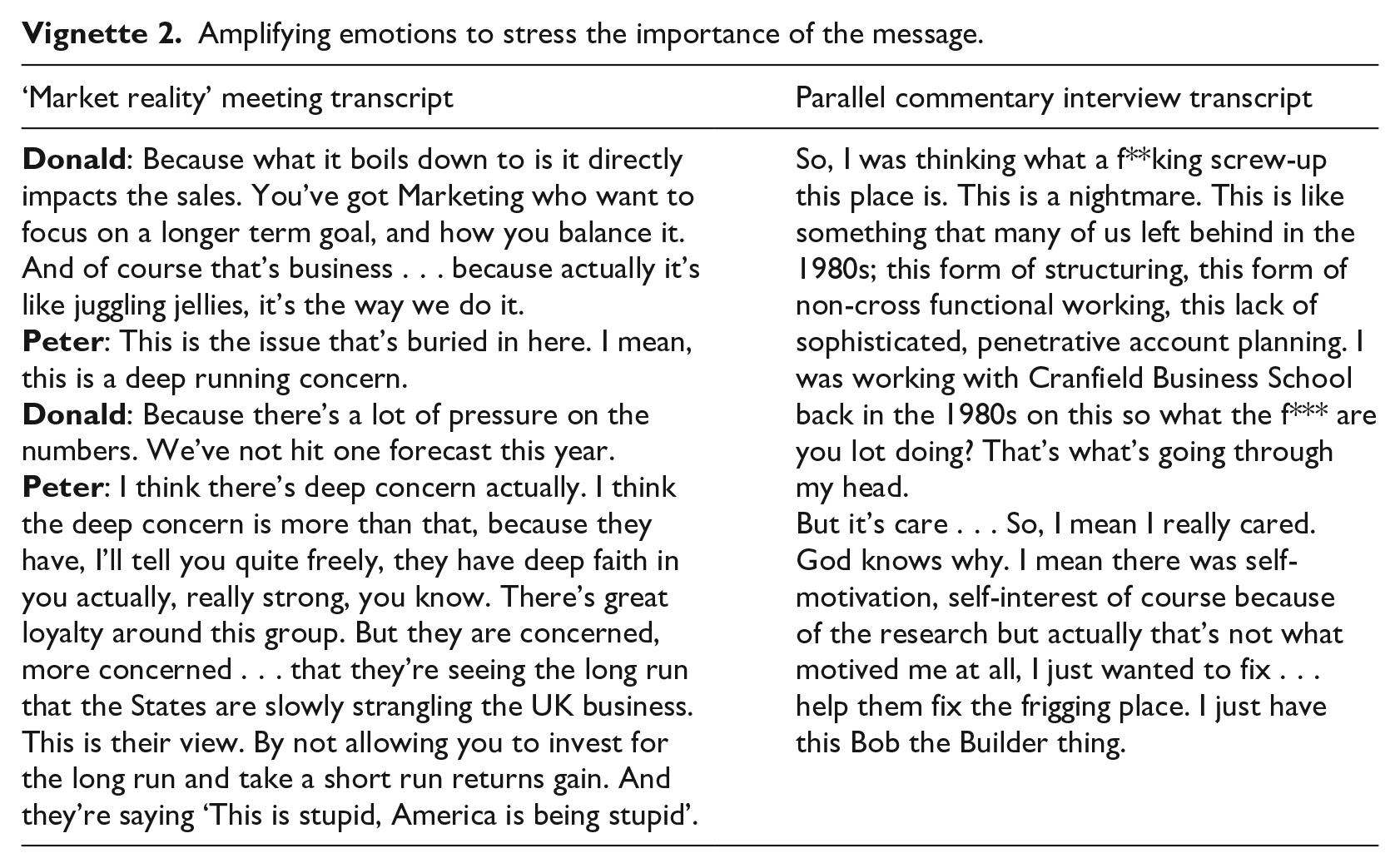
The first vignette showed Peter having to suppress his own strong emotions in order to manage the responses of his client to a difficult message. The second vignette demonstrates the other side of the emotional labour coin, namely that of having to amplify emotions. In the example below, this is achieved through the repeated use of emotive language to enforce the importance of what is being said. The use of phrases such as ‘deep running concern’ to emphasise the inescapability of the issue – set opposite the reporting of ‘deep faith’ in Donald as a salve to his recurrent defensiveness – are accompanied by an earnest tone of voice and a broadly compassionate demeanour. The emotive language here is still measured – especially when compared with the felt emotions Peter reports himself as experiencing – but his focus is on trying to ‘fix’ the problem because he recognises that people within the organisation care, and that he cannot help but care as well. Thus the emotions we see expressed are professionally acceptable – such as concern – and culturally positive – such as loyalty.
The blistering anger expressed in the parallel commentary as arising from Donald’s perceived incompetence is, as well as being professionally unacceptable, recognised as ineffective in supporting the consultancy process and must therefore be hidden. It would drive Donald towards further defensiveness and another expression of blame towards his SMT. What remains apparent, however, in Peter’s emotive reporting of his internal reaction to the situation is the deep-rooted care for the client company as the basis for his handling of the meeting. In emotional labour terms, he is ‘faking in good faith’ (Grandey, 2003).
Role positioning in the enactment of emotional labour
In the course of the ‘market reality’ meeting, we hear Peter deliberately shift how he positions himself in relation to individuals within the company and the company as a whole. He adopts different roles (Turner, 2006) to build rapport, demonstrate credibility, disarm resistance or defensiveness, and show compassion. While often subtle and operating in complex ways, these role shifts can be broadly mapped onto two dimensions: playing with the liminality of his position as a consultant and navigating the power dynamics within the client organisation. We explore the specific roles adopted by Peter as a consultant enacting emotional labour within this two-dimensional framework, as depicted in Figure 1.
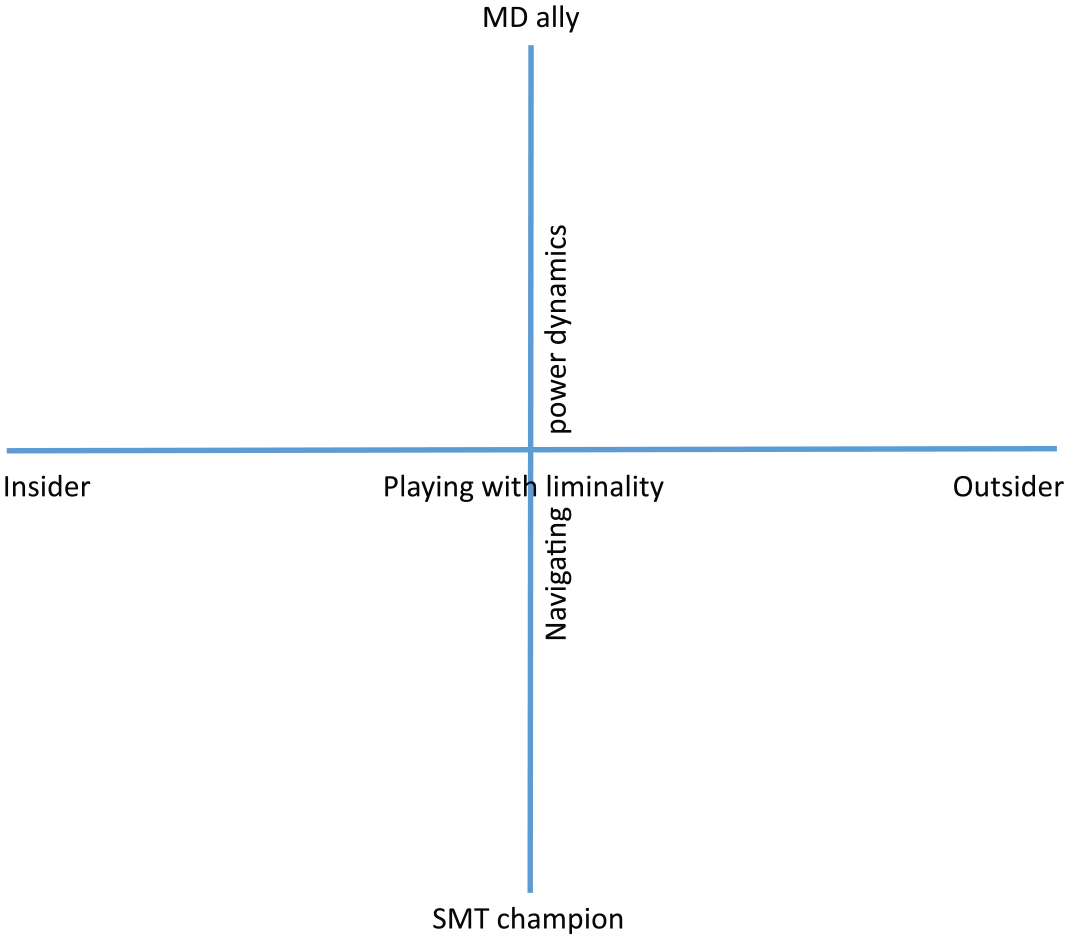
Dimensions of liminality and power dynamics: a framework for consultant EL role positioning.
Playing with liminality – dynamically neutral
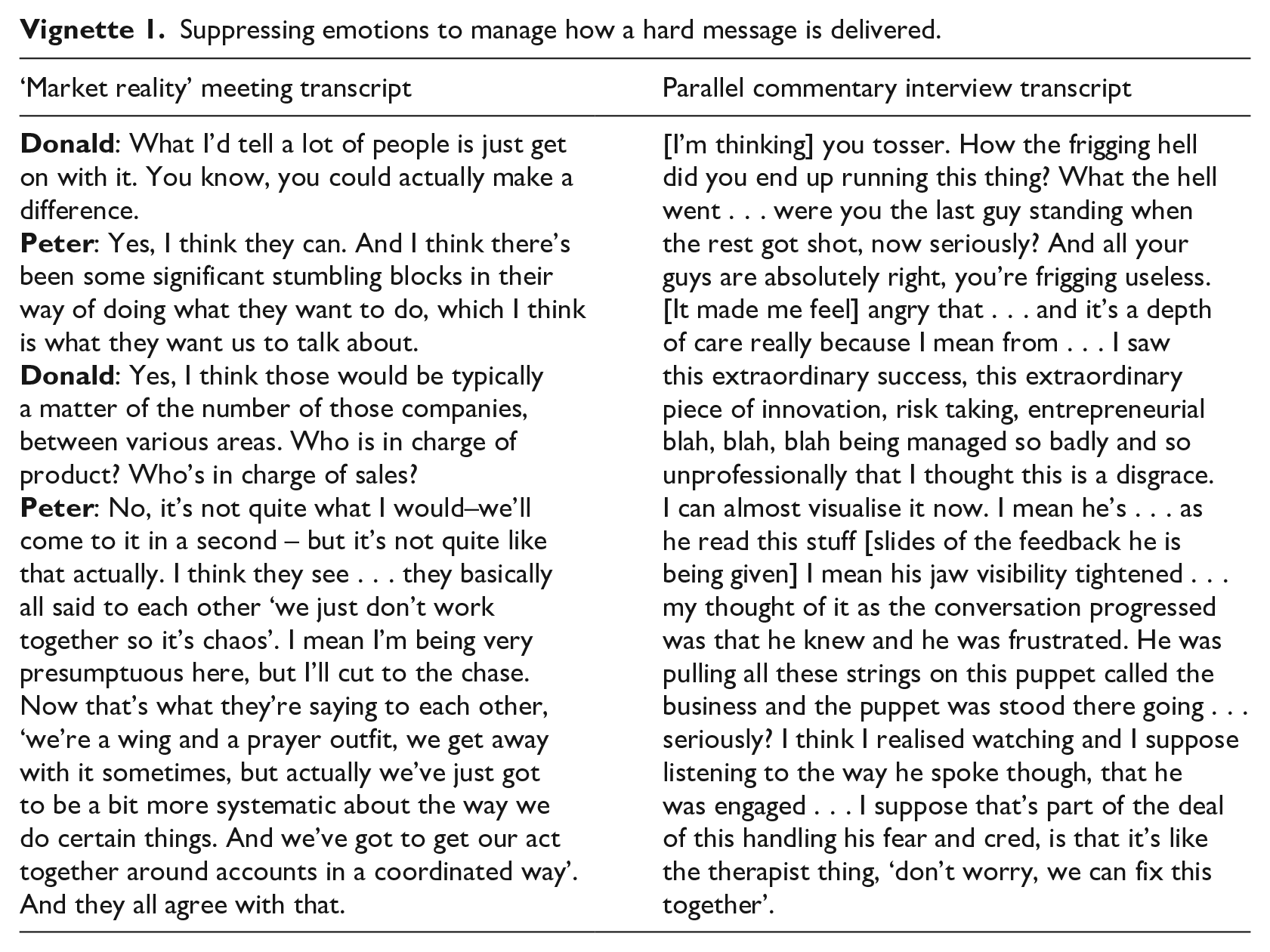
One of the simplest ways in which Peter shifts his role position is by the switching of pronouns – from ‘I’ or ‘you’ to ‘we’ and back again – to indicate his relationship to events or people and whether he is seeking to demonstrate insider knowledge and kinship or outsider objectivity and distance. Thus, Peter uses ‘we’ as a shorthand for ‘I understand the company and am an insider to the issues’ but ‘I’ to say ‘because I am an outsider, I can be more objective about what is going on here’. As we see in the final speech of Vignette 1, he can often move between these positions in the space of a single speech. In terms of the interaction between liminality and power dynamics, this example of role positioning can be understood as broadly power neutral – that is, its purpose is usually to shift his position in relation to the company rather than to individual factions within it.
Suppressing emotions to manage how a hard message is delivered.
Playing with liminality – dynamically loaded
More nuanced in terms of the degree of liminality, and at the same time more one-sided in relation to the power dynamics, is Peter’s claiming of specific roles or titles, such as ‘commercial man’, ex-marketing director and independent consultant. For example, in the first fragment below Peter describes himself as being ‘not very academic’ and by implication more of a ‘commercial man’. In saying he is ‘not very academic’ Peter is signalling a difference between how an academic outsider and a commercial insider would handle the consultancy process and positioning himself as the latter. At the same time, he is offering an implicit apology for the occasions when he has ruffled Donald’s feathers by ‘pushing’ too hard as well as flattering Donald by suggesting that he is giving him a privileged glimpse of his inner processes.
playing with liminality – dynamically loaded.
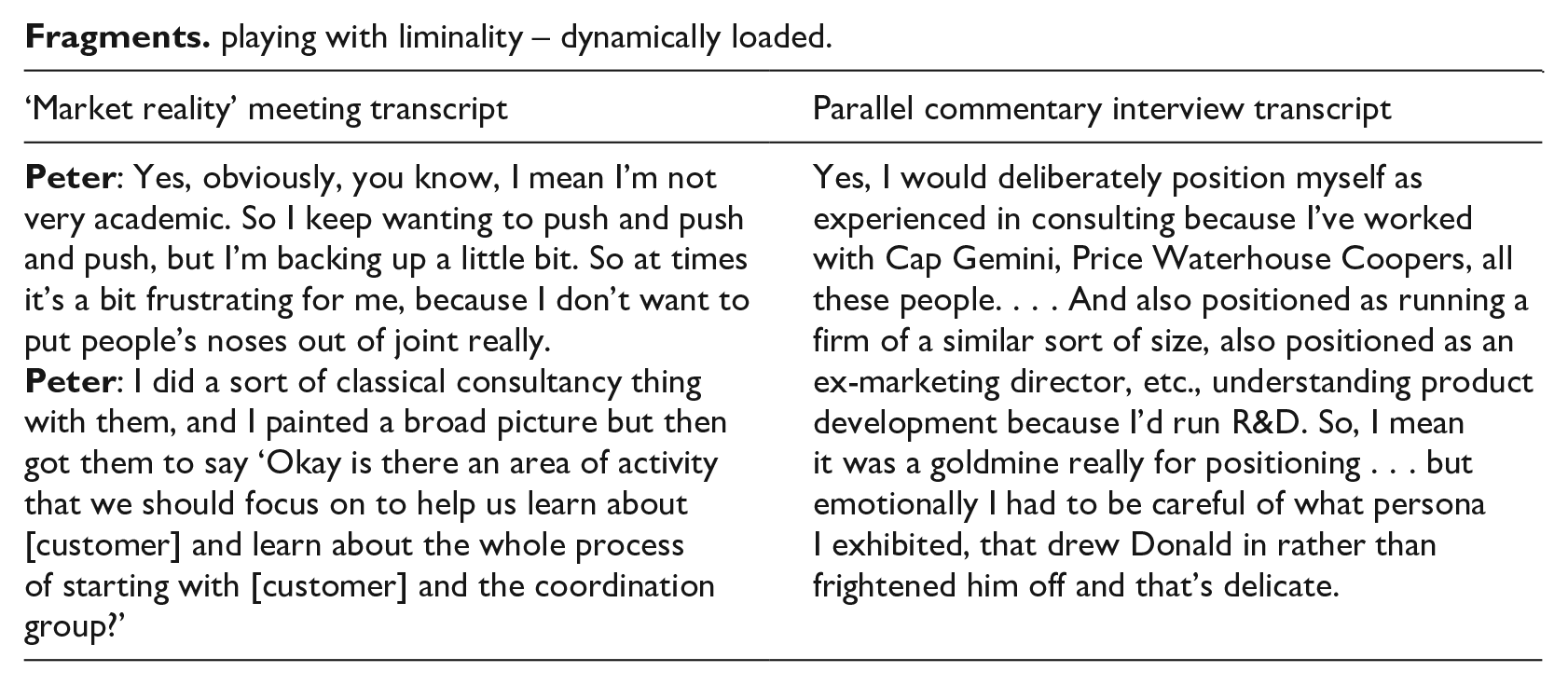
This sense of colluding with Donald as a fellow commercial insider is reinforced in the second fragment. Here, Peter’s explicit reference to the consultancy process as ‘the classical consultancy thing’ – the implication being that Donald will be very familiar with what this is – serves to position them both as being wise to the tricks of the consultancy trade. This frames the loaded power dynamics of the exchange by placing Peter as a management ally rather than as a champion of the SMT. Interestingly, he goes on to explain what ‘the classic consultancy thing’ actually entails to ensure this assumption does not backfire, leaving Donald feeling out in the cold.
Both these role positions are part of Peter’s managed emotional displays aimed at furthering the goals of the consultancy project by using them as a vehicle for managing his client’s emotional responses. That Peter was aware of this role positioning as a deliberate tool of enacting consultancy work, and of the emotional underpinnings of the need to do so in order to be effective, is made explicit in the parallel commentary. Here, he acknowledges positioning himself as ‘an experienced consultant’ and ‘an ex-marketing director’ as a means of establishing credibility at the same time as being aware of Donald’s vulnerability and hence that ‘emotionally I had to be careful of what persona I exhibited, that drew Donald in rather than frightened him off’.
Navigating power dynamics – liminally loaded
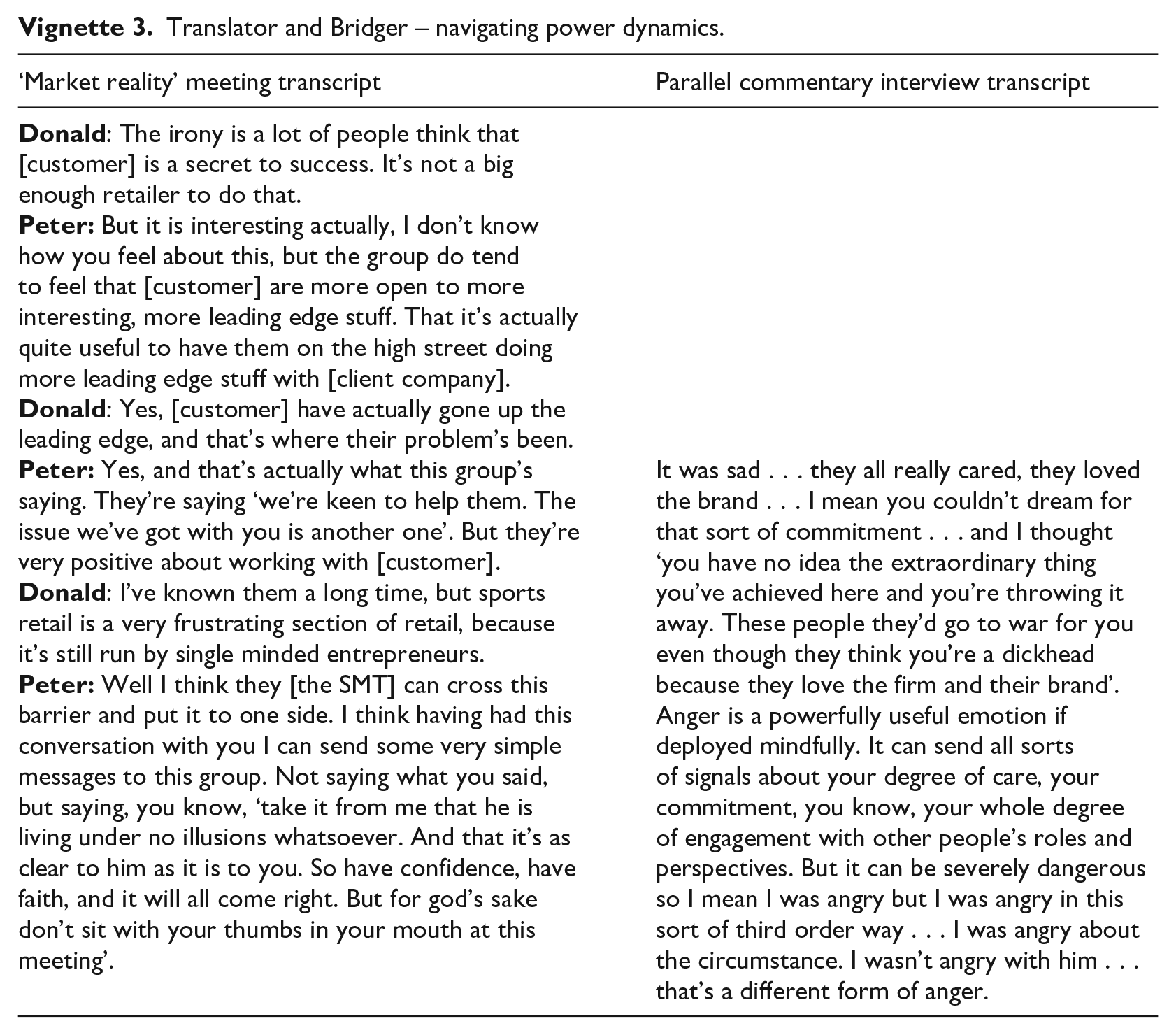
In Vignette 3, Peter adopts the symmetrical roles of translator and bridger as the opposite poles of the power dynamics between the MD and his SMT. These power-based roles are liminally loaded in the sense that they are both clearly insider roles. In the first half of the vignette, Peter is giving Donald information about how his SMT view a particular retail customer and the way they are being asked to work with them: he is translating messages he has received from the SMT into a palatable and constructive ‘spin’ for consumption by the MD. These are messages the SMT have previously been unable or unwilling to pass up the hierarchy. Underpinning the translator role is thus the ability or willingness to ‘speak truth to power’. In the second half, the direction of communication is reversed with Peter modelling how Donald needs to speak to his SMT (but does not) in order to bridge the gap between what Donald is telling Peter and the perceptions the SMT have of him. Thus, Peter attempts to teach Donald how to communicate better with his SMT without undermining his sense of his own status as MD.
As with the earlier vignettes, the parallel commentary gives a strong indication of the emotional labour required for Peter to keep his anger and frustration at Donald’s resistance (and perceived incompetence) under wraps while he navigates the organisational power dynamics in order to achieve a successful outcome.
Navigating power dynamics – liminally neutral
Not surprisingly perhaps, given that we only hear Peter in conversation with the MD and not with the SMT, the underpinning theme of the meeting relates to his championing of the SMT’s views and issues to Donald. As a counterpoint to this role of SMT champion, he also positions himself in the more traditional role of management ally – and specifically Donald’s ally. These roles are similar to those of translator and bridger that we have already seen, but differ in two important respects. First, they are more explicitly emotive in their groundings: they are not about translating information but about providing emotional support to the respective positions of the SMT and the MD. And second, they are liminally neutral in the sense that Peter draws on both insider and outside tropes to establish his position. This is particularly true of the management ally role, where Peter explicitly draws on his past experience of having been in Donald’s shoes to make the supportive connection with his client, at the same time as using the insider pronoun ‘we’ in describing how the issues can be addressed.
We first see Peter championing the SMT in Vignette 1, where he voices their position with regard to the existing system of client management within the company, and again in Vignette 2 where he defends their loyalty at the same time as voicing their concerns for the business. In Vignette 3, we see these two positions of MD ally and SMT champion juxtaposed in the space of a single exchange as Peter stays true to his understanding of the situation as put forward by the SMT at the same time as trying to keep the MD on board.
Amplifying emotions to stress the importance of the message.
Translator and Bridger – navigating power dynamics.
In Vignette 4, as Peter’s felt emotions escalate and his compassion for Donald diminishes, he plays heavily on his ‘duty’ as a professional, external consultant as a cover for championing the message he has received from the SMT. He uses the idea of being ‘duty bound’ is a distancing device, the implication being there is nothing personal in Peter’s message but that it is part of his role as an objective, professional consultant to pass on what he has been told. The message that Donald is part of the problem is, as Peter recognises in his parallel commentary, actually somewhat insulting (even though he believes it to be true). When the gravitas of a duty accorded to the feedback he is delivering pushes Donald into an unproductive position, Peter switches to the role of compassionate ally – someone who knows how it feels to be in Donald’s position – to interrupt a long, defensive narrative. The aim here is to force Donald to accept his part in the problems being experienced by the company, at the same time as trying to make this failing more acceptable.
MD ally or SMT champion – navigating power dynamics.
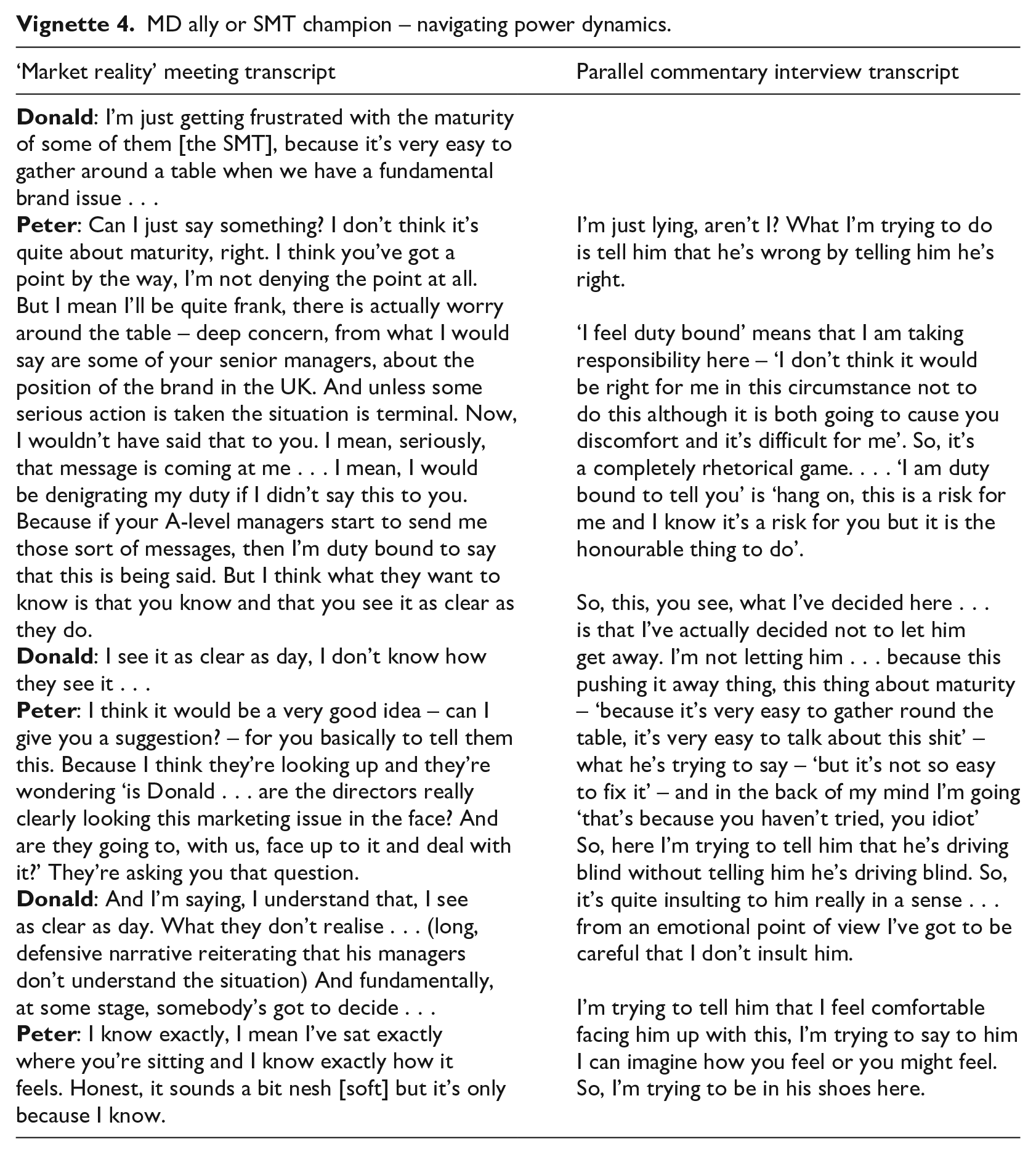
As well as simply signalling different roles, these positions serve a purpose in the enactment of emotional labour. So, for example, in claiming the role of ‘duty bound consultant’, Peter is depersonalising – and hence taking the emotional heat out of – his championing of the difficult feedback he is presenting to Donald, and distancing himself from the members of the SMT who have given it. In taking some of the sting out of what he is saying – the subtext is ‘I don’t believe this, I’m just passing it on’ – he aims to manage Donald’s emotional response and keep him on board with the process. When it is not enough to be ‘not with the SMT’ (although he actually is), Peter switches to being explicitly allied with the MD – and all the while Peter is suppressing his own anger and frustration in order to get the job done.
For the purpose of drawing out the dimensions of Peter’s use of roles in the enactment of emotional labour, the dimensions of playing with liminality and navigating power dynamics have been presented as distinct and separable. Not surprisingly, in the ebb and flow of interaction, the adoption of roles is less static and more interwoven than the matrix suggests, with various degrees of overlap occurring between both the roles and the dimensions. This is most obvious in relation to the degree of liminal variation between the bridger–translator roles and the ally–champion roles. What we can see throughout both the meeting transcript and the parallel commentary is the interplay of emotions – felt, expressed and suppressed – which is an integral part of the undertaking of consultancy work and the emotional labour that is thus an inherent part of its enactment. At the same time, there is powerful evidence of the use of a variety of forms of role positioning as a means of enacting emotional labour. Interestingly, no roles emerged from the outsider/SMT quadrant, presumably because they were not perceived as having value in managing the emotions of either the consultant or the client.
Discussion
By applying a memory work process to the opportune context of management consultancy, this article offers a model of how role positioning is used as a tool of enacting professional emotional labour. The use of live recordings and parallel commentary from the practicing consultant enabled us to establish the gap between feelings experienced and emotions displayed which is the essence of emotional labour (Hochschild, 1983). Vignettes 1 and 2 demonstrate how Peter suppressed his frustration and anger with MD, Donald, in order to deliver a hard message that needed to be accepted if the consultancy project was to be successful and amplified other emotions – specifically his ‘deep concern’ for the company – to make that message more palatable. In each case, the original ‘memories’ (in the form of the contemporaneous audio recording) and the discussion of those memories (captured through discussion with consultants involved in the events) give us an insight into the two distinct emotional landscapes of what is experienced and what is performed. We suggest that by bringing together two sources of data in this way, the application of a memory work approach offers a promising proxy for the psychological access needed to demonstrate the dissonance between felt and displayed emotions that constitute the commercial appropriation of managed emotional displays. We acknowledge that memory work is not without its limitations, particularly in relation to the challenges of capturing feelings and emotions, its continued reliance on talk and on Peter’s self-awareness, memory and honesty in relation to the emotions he articulates having experienced. Nonetheless, as a methodological contribution, we believe this has the potential to break the current ‘methodological stultification’ (Grandey and Gabriel, 2015: 23) in the study of emotional labour, and would encourage other researchers to experiment further with its development and application.
In looking at how Peter enacts emotional labour as part of consultancy work, we show his use of role positioning (Turner, 2006) as a tool for building rapport, disarming resistance and defensiveness and delivering difficult messages. His explicit recognition of these roles in the parallel commentary show this to be an ‘agentic’ strategy rather than a ‘naturalistic’ (Chriss, 1999) practice of self-presentation. We have theorised the role positions adopted by Peter in the performance of emotional labour into a model of the consultancy roles required to drive organisational change from a position of liminality (Borg and Söderlund, 2015) while navigating the shifting power dynamics (Czarniawska and Mazza, 2003) of the client organisation. The proposed model, illustrated in Figure 2, maps the roles adopted against the two axes of liminality and power dynamics, respectively. In proposing this framework, we are aware of the resonance with Kitay and Wright’s (2007) ‘occupational rhetorics’ through which consultants are said to construct their identities in the face of structural constraints which feature as part of their work. Their language of professionals, prophets and partners would have sat well as part of Peter’s narrative. The fundamental difference, however, lies in the static, structural nature of their framework, based on identity construction, versus the dynamic, interactional nature of the current model, based on role positioning.
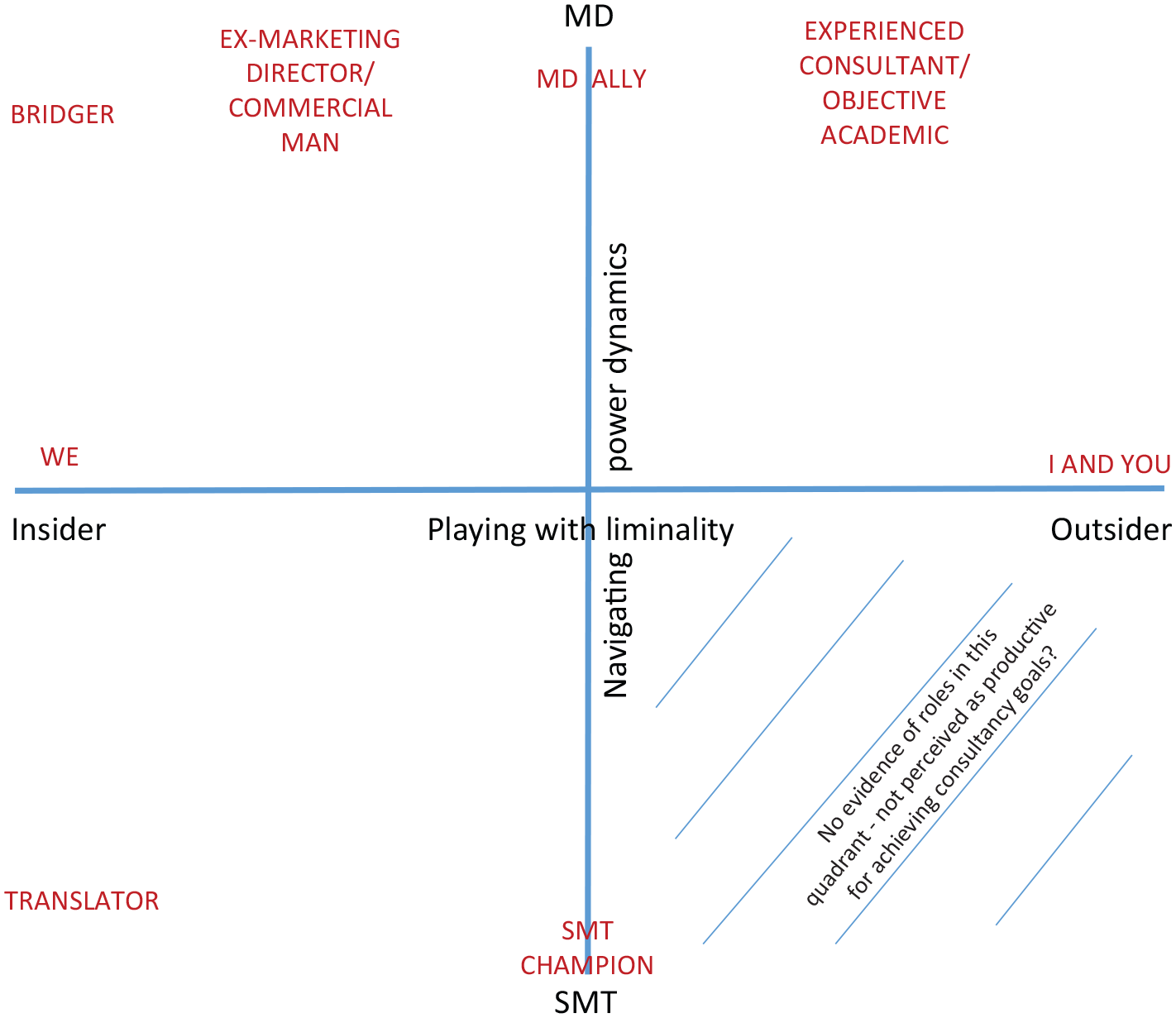
Consultant roles in the enactment of emotional labour: playing with liminality and navigating power dynamics.
Playing with liminality
The observed role positions offer illustrations of how Peter subtly ‘plays’ his liminal position as a consultant, by deliberately utilising the ‘betwixt and between’ (Turner, 1969: 359) nature of his position to be both insider and outsider. Operating as a boundary spanner (Sturdy and Wright, 2011), he is both distanced and objective (experienced consultant, objective academic, aka external to the company) and embedded and compassionate (ex-marketing director, commercial man, aka internal to the company). In some instances, it takes nothing more than a change of pronoun (from ‘I’ to ‘we’ and back again) to accomplish this change of role position.
Navigating power dynamics
At the same time, Peter navigates the power dynamics of the situation by presenting himself as both a champion of the SMT and their understanding of the ‘market reality’ faced by the company and as an ex-marketing director – someone who has been in Donald’s shoes – and hence an ally to the beleaguered MD. This latter positioning serves to ‘cool the mark’ (Goffman, 1952) – that is, ‘defin[e] the situation in such a way as to make it easy for him to accept his loss, his failure’ (King, 1973: 57) – by suggesting to Donald that Peter understands what he is going through. Rather than a ‘struggle for voice, space and footing’ (Petersen, 2017: 2), Peter capitalises on the suspension of the usual rules of organisational life (Van Gennep, 1960) afforded by a consultancy space to challenge the existing hierarchical structures (Turner, 1974) by being both management ally and voice of the lower orders. More generally, we see role positioning utilised as a routine tool of the interpersonal dynamics between Peter and elements of the client company.
The shifting of roles is an integral part of navigating the power dynamics of the situation. Ostensibly, Peter’s temporary position of power (Czarniawska and Mazza, 2003) to drive change arises from having been appointed by the MD to lead the consultancy project. In practice, he must invoke the power (Leach, 1968) of the SMT, through the evidence he has gathered from them, if he is to accomplish the project goals and instigate organisational change. At the same time, his ability to exercise positional power over Donald as his primary client is constrained both by the resistance of the client himself and by existing power relations within the institution (O’Mahoney and Sturdy, 2016). The performance of emotional labour – enacted at least in part through the adoption of a range of roles – is a key tool of his ability to exercise power over meaning (O’Mahoney and Sturdy, 2016) in a way that will break down these existing barriers to change. This upends the assumed dynamic of the consultant as reinforcing existing power relations (Sturdy et al., 2004) by forcing change on subordinates and demonstrates how the consultant can utilise different roles to disrupt or shift the existing power dynamics and push change up from below. Peter must be a skilled role manager as well as a ‘skilled emotion manager’ (Bolton and Boyd, 2003: 289) if he is to successfully navigate this sensitive challenge.
That Peter’s performance of these roles is sincere and intended for the benefit of his audience (Manning, 1992) is evident from the parallel commentary and the desire to ‘fix’ things for the client which this shows. In acting as both bridger and translator, the consultant takes on Goffman’s (1959) two-way role of a ‘go between’ (p. 148) who ‘“learns the secrets of each side” and gives both sides the impression of loyalty’ (Lehane, 2016: 14). Related to this is the anchoring of the ‘content’ of the meeting through Peter’s obvious identification with the roles he is playing. We can see here parallels with the ‘deep acting’ (Hochschild, 1983) or ‘faking in good faith’ (Grandey, 2003) of emotional labour itself. He really feels for Donald as an MD, at the same time, as feeling for the SMT as professional marketing men.
Collectively, the role positions illustrated in Figure 2 capture the different appeals Peter is making to his client concerning his ability to drive the ‘market reality’ project forward. While the ideas and solutions he is presenting are evidence-based and ‘objective’, his ability to get them heard and accepted by the MD is reliant on his enactment of emotional labour in order to manage Donald’s response to what he is hearing. The use of role positioning here is an important ‘additive’ to the ‘basic’ emotional labour in which Peter is managing his own emotions of frustration and anger.
Conclusion
This article has drawn on the revealing situation of a highly emotive client–consultant meeting to address the need for a richer, more practice-oriented understanding of professional emotional labour. It combats the methodological difficulties of capturing the doing of emotional labour by applying the principles of ‘memory work’ (Onyx and Small, 2001) to rich audio data of an emotionally charged consultant–client feedback meeting in order to produce a parallel commentary from the consultant. Collectively, these data sources offer a valuable proxy for the psychological access required to establish the gap between emotions felt and emotions displayed which is the essence of emotional labour (Hochschild, 1983), and hence makes a methodological contribution to overcoming the current ‘methodological stultification’ (Grandey and Gabriel, 2015: 23) in the study of emotional labour. While we are still reliant on talk as a proxy for actual experience, we suggest that the experiential nature of the audio trigger does much to bring us closer to being in the moment and to sharing the reflexive understanding of the performer of professional emotional labour.
The study also enhances current understanding of the enactment of emotional labour through the lens of role positions (Goffman, 1959). As an additive to the basic performance of professional emotional labour to manage one’s own emotions, it highlights the conscious adoption of a range of roles designed to manage an emotive client–consultant meeting through managing the client’s emotional responses to the information being presented. It contributes to our understanding of the enactment of emotional labour by suggesting a model of the consultancy roles required to drive organisational change from a position of liminality (Borg and Söderlund, 2015) while navigating the shifting power dynamics (Czarniawska and Mazza, 2003) of the client organisation. We would suggest the transferability of this framework to other liminal work places – for example, ‘precarious or mobile employment’ (Sturdy et al., 2006) such as contract work and project management – or in situations where a ‘liminal condition’ (Czarniawska and Mazza, 2003: 288) is experienced by workers more broadly. This transferability may be widened by the sense of ‘permanent liminality’ (Johnson and Sorensen, 2015: 321) which is a feature of modern organisations.
The current study is not without its limitations. Foremost among these is its reliance on a single case, confined to a particular type of professional emotional labour used in the context of consultancy work. Future research is required to both broaden and deepen the insights thus gained. The methodological innovation of a parallel commentary derived through the application of memory work principles as a proxy for direct access to the felt/displayed emotion gap is, we would hope, capable of future refinement and further innovations in order to approach even closer to emotional labour as a practice-based phenomenon. Future research could also usefully undertake a programme of in-depth case studies aimed at testing our model of roles adopted and the applicability of the dimensions of playing with liminality and navigating power dynamics to other (particularly change-related) situations. Similar case studies in different professional settings – leadership work (Iszatt-White, 2009), legal work (Harris, 2002) and broader management roles (Brotheridge and Lee, 2008) have already received attention – would enable the further theorising of role positioning as a tool of different kinds of professional emotional labour, and the repertoire of roles required across different settings. More broadly, a research agenda of this type would serve to establish a substantive body of research work grounded in the practice of emotional labour, rather than its disembodied description.
We envisage the proposed model as having direct relevance for management learning, in two respects. First, the liminal setting of classroom-based management development interventions may be particularly pertinent here, given that personal learning can be both challenging and emotive. For those developing management learning interventions, the ability to switch between roles associated with such interventions – from ‘external’ content expert to ‘internal’ fellow traveller/learner – may stand as a ‘liminality competence’ (Borg and Söderlund, 2015) needed to smooth the way for the kind of ‘identity undoing’ (Iszatt-White et al., 2017) often required as a precursor to such learning. At the same time, supporting the learners in a deeper understanding of how the enactment of emotional labour through role positioning contributes to their own leadership/management practice could form a valuable part of the curriculum. Second, and in relation to the navigation of power dynamics, the often differing agendas of those attending leadership programmes versus those who commissioned them can also require a degree of role-related navigation by management developers. The roles of senior management ally versus middle manager champion can be expected to play out in the classroom with serious – and often emotive – implications for the effectiveness of the programme.
The current research has the potential to offer insights into the successful accomplishment of organisational change more widely. In the opportune context of a consultancy meeting, we saw how role positioning as a form of emotional labour was used to drive organisational change from a position of liminality, but the link between liminality and the agentic use of roles need not be confined to roles/spaces that are positioned across organisational boundaries (Swan et al., 2016). A role-centred perspective has resonance with a variety of organisational change situations, where there are inevitably those ‘in the know’ and those who must be ‘brought on board’. Similarly, such situations inherently involve the navigation of power dynamics between those driving change and those on the receiving end. Whether undertaken by external consultants or internal change agents, an insight into the role-based enactment of emotional labour has the potential to add an affective richness to our often rationalistic understanding of organisational change.
