




Abstract
In this article, we use discursive qualitative interviews to explore identity challenges and opportunities experienced by younger academics in the business school environment. We frame identity construction and the influence of age as a reflexive and subjective process. We establish links between identity study and critical reflexivity and advocate for their benefits in supporting young academics in unpacking and navigating their fragile academic identities. Our analysis generates important insights into the sense-making process, where identity norms and definitions of young academics influence their engagement in shaping their identity and the extent to which they achieve confidence and credibility. Where internal and external perceptions of required identities were problematic, imposter syndrome arose, presented as accounts of marginalisation. We position the interplay of identity regulation and identity work as shaping the consequences of what were sometimes precarious outcomes of self-identity. Alongside this conceptual contribution, we provide practical avenues for support initiatives that may help young academics build legitimacy and overcome perceptions of marginalisation.
Introduction
This article analyses the experiences of young academics in UK business schools, as they navigate the challenges of their academic identity. We explore this through the conceptual lens of identity regulation, identity work and self-identity (Alvesson and Willmott, 2002). Previous research has explored how the concepts of ‘becoming’, ‘transition’, ‘otherness’ and ‘alterity’ have optimised the integration of learners (Gagnon, 2008), doctoral researchers (Hay and Samra-Fredericks, 2016), management researchers (Bell and Clarke, 2014) and academics more broadly (Knights and Clarke, 2014). This article is borne from our own experiences as young academics, which ignited our interest in exploring identity construction and consequences. To encourage critical scholarship, the notion of reflexivity is referenced in the quest to align and extrapolate ourselves from the data (Cunliffe, 2018). We are therefore cognisant of the constructions of meaning in our writing as a function of and intertwined with our own identity (Cunliffe, 2018).
We position storytelling as central to capturing identity, where we assert that the narration of identity experiences provides discourses of critical reflexivity that have practical and theoretical contributions regarding the need for support (Alvesson et al., 2008). Our own story began when we were working as academics in a UK business school in our late twenties. We developed a fascination with the intersection between constructions (ours and others’) of our biological age and our assumed (or otherwise) expertise, which manifested as a tension and anxiety we wanted to unravel. We pose three broad questions and answer them by drawing on qualitative interview data from young academics engaged in business school education.
Conceptually, we anchor these questions within the three components of identity outlined by Alvesson and Willmott, (2002): identity regulation (expectations about what one’s identity should be), identity work (behaviours that shape how one’s identity is perceived) and self-identity (identity impacts and outcomes). We argue that these identity components are intertwined with critical reflexivity, and understanding their interrelatedness is important (Cunliffe, 2016). Our questions are as follows: First, what challenges and opportunities present themselves in identity definition, especially with reference to credibility as a function of age (what does identity regulation look like for young academics)? Second, what strategies do young academics employ to manage these challenges and opportunities (what types of identity work takes place)? Finally, what are the consequences of identity regulation and identity work (how are outcomes appraised in terms of self-identity)?
We draw on Alvesson et al.’s (2008) suggestion on the need to provide solutions and develop an understanding of human and organisational experience. Indeed, other research advocates for an understanding of how individuals respond to identity challenges as imperative for uncovering individual and organisational consequences (Petriglieri, 2011), and we respond to calls to establish discursive approaches to the study of identity (Alvesson and Willmott, 2002). Our contextual concerns arise from the need to develop and sustain a productive workforce as central to the continued success of the Higher Education (HE) sector internationally amid increasingly managerialist performance indicators (Archer, 2008). As the role of academics has become more multifaceted, demanding and conflicting (Sutherland, 2017) and as work intensification has increased (Ogbonna and Harris, 2004), there is a need to ensure that young academics are attracted to and retained within the sector. We are interested in the interplay of these demands with young age in a business school context, where alongside academic expertise, practitioner experience of the working world is a determinant of credibility (Huzzard et al., 2017). To be clear, we focus on a biological definition of age, and acknowledge that though entrants to the sector are not always ‘younger’, we extrapolate constructions of identity challenges as a function of young age. Difficulties for early career academics (ECAs) have been well-documented (e.g. Bristow et al., 2017), and attention has been paid to managing the transition from apprentice to established academic where ‘new’ academics can constitute individuals spanning a range of age categories. We argue that though ECA transition has been addressed, reflections on the construct of young biological age, its physical visibility and implications for identity challenges within the business school environment remain underexplored despite its signposting as a pertinent demographic with regard to credibility and status: . . . the management researcher is represented as a powerful, high status, masculine hero supported by a cadre of young, junior academics. The consequences of this symbolism are exclusionary and marginalising of those who cannot or choose not to conform to it. (Bell and Clarke, 2014: 262)
The article is structured as follows: First, we present an overview of our context, and specifically the business school environment, where we set this alongside our rationale for a focus on young academics. Next, we explore the literature on each identity component in turn: identity regulation, identity work and self-identity, and assert the relevance and interrelatedness of these constructs. We then outline our methodological approach before discussing our findings.
Young academics and the business school context: is age just a number?
Depictions of academia in the neoliberal age have spoken of uncertainty epitomised by a raft of problems that have eroded freedom in the academic role and brought with them a plethora of pressures to the system (Bristow et al., 2017). These include heightened performative control, where success and its parameters are tight and unforgiving for both research and teaching. Identity has been viewed as bound by environmental expectations regarding conformity to identity norms (Alvesson et al., 2008). We conceptualise the HE environment as a lens through which to explore identity among young academics who experience marketisation conditions that amplify their concerns about the development and maintenance of a successful academic identity.
The business school environment is positioned as disconnected and decoupled from the wider institution due to its corporate identity, which is predicated upon the provision of elite education, engagement with prestigious business communities, inflated fees for high status programmes and the attainment of high revenues (Steyaert et al., 2016). Management and business education have been defined as commodities for sale (Parker, 2018). Artefacts of this prestige often manifest in the aesthetics of the physical environment, where buildings are grandiose and set apart from other departments in an attempt to portray efficiency and confidence in their status and achievements (Barrett, 2018), and these aesthetics are indicative of successful identity norms.
Identity norms concerned with success require a business school to uphold practitioner and corporate expertise alongside highly regarded research output (Huzzard et al., 2017). Indicators of successful identity are bound by this historical dualism (Alvesson and Spicer, 2017), which has implications for identity challenges for individuals who work within these institutions. Debates about the ethics of the perceived managerial capitalism of modern business school education may promote and diminish a positive identity for academics employed in this context, depending upon their values and audience (see for example, Parker, 2018). Expectations of conformity to brand and image may be worthy of consideration within the identity field. Petriglieri and Petriglieri (2010) define the business school as an ‘identity workspace’, which demands that individuals engage in identity work to shape their image and expectations of fit. Therefore, the landscape of the business school may shape how identity is manifested, upheld and contested by those who work within it.
In unpacking this concern, business schools implement branding of their offering and employees (Huzzard and Johnson, 2017). In this case, aesthetic labour (whether one’s face fits) plays a role in the extent to which employees are considered appropriate for different activities. In their study, they note examples of academics being deemed unsuitable for teaching certain cohorts despite having the appropriate experience and qualifications, as they did not ‘look the brand’ (Huzzard and Johnson, 2017). In what follows, we suggest that young age can present one example of operating against the development of a credible business school academic identity.
We contextualise our focus on young academic age as follows. In recent years, the number of young academics has been growing, with HESA (2016) estimating that 30 percent of UK academics employed on full time salaries are aged 35 or under. Notwithstanding, it is unclear whether enough progress has been made to abate previous concerns regarding sufficient numbers of new young entrants to the profession (Matthews et al., 2014). Age is typically studied from the viewpoint of older workers (Posthuma and Campion, 2009), and a research gap exists in age-related research generally, with little work addressing the experiences of young professionals. In the HE field, Archer (2008) examined young academics outside of the business school environment as the first on the scene of current neoliberal structures that can work against the legitimatisation of young people when their age works in opposition to authenticity. Though our chosen focus is the young age demographic of our participants, we acknowledge that age is one of many diversity facets that shapes identity. Our chosen emphasis positions age as relevant and underexplored but not of superior importance to other demographics. We seek to extend our understanding of the influence of age with reference to the interplay between different identity elements.
We now move to appraise Alvesson and Willmott’s (2002) identity framework to understand the interplay between identity regulation, identity work and self-identity as pertinent indicators of the lived experience of young academics. Our contribution is predicated on the need for a holistic view of identity in terms of its process orientation, that is, how identity comes to be, how it is responded to and what its consequences are. By exploring young academics’ stories of each identity component, we seek to provide rich accounts regarding the complexities in understanding identity challenges.
Identity regulation: young academics’ identity definitions
In the first element of their conceptualisation of identity, Alvesson and Willmott (2002) propose identity regulation as concerned with the recognition of identity definition, which is the precursor for identity work, and is important in informing reflections of self-identity. Relevant elements in our conceptualisation of identity regulation for young academics include that of ‘defining the person directly’ and ‘defining a person by defining others’ (Alvesson and Willmott, 2002: 629). Here, norms and expectations are established and are compounded by comparisons to the characteristics of others. We suggest that young age as a flag in identity definitions is pertinent here as a potential poor fit with the business school context. Of significance is the target of ‘hierarchical location’ where one’s position relative to the superiority or subordination of others can present a challenge for their credibility.
Identity regulation can comprise notions of success, which are woven with ideas of credibility and expertise. Here, the academic is inherently associated with expert status (Knights and Clarke, 2014), and to be credible, one must possess exemplary skills and knowledge in a specialist area. In professional identity, expertise may be ‘situated within practice’ (Pritchard and Fear, 2015: 2), and credibility is framed within the context within which it is played out. Thus, one’s credibility may be shaped by social construction and enactment as a response to perceptions about environmental requirements. Credibility may only be conferred if the individual and their audience share the definition (Sutherland, 2017). We link this to notions of aesthetic labour and suggest that for young academics, credibility may be considered low due to visible young age.
A further factor in identity regulation is legitimacy, which has been situated alongside belonging and adjustment and linked to external endorsement (Brown and Toyoki, 2013). Others have suggested that an organisation and its members are appropriate and proper if they meet predetermined criteria for success (Drori and Honig, 2013). At the organisational level, internal legitimacy is considered as accepted practices in the form of individual and social processes (Brown and Toyoki, 2013) driven by internal indicators. Drori and Honig (2013) suggest internal legitimacy encompasses individual strategies that unpack identity complexities. We establish links between this conceptualisation and our young academics’ identity regulation, showing that the potential for divergence between individual beliefs of success and credibility and markers of external legitimacy may position young academics as not yet credible.
Furthermore, legitimacy can be shaped by the ways in which an audience formulates their values around credibility. The cultural dimension of ‘achievement versus ascription’ (Trompenaars and Hampden-Turner, 1997) consists of opposing values in forming judgements about credibility. That is, whether we view success as a product of one’s objective achievements (e.g. ability and qualifications) or ascribe worth to our perception of an individual’s status (including factors like age and social standing). Taken together, these concerns suggest identity regulation for young academics present challenges, because internal or external definitions fall short of meeting accepted criteria in the business school context.
Identity work: behaviours and impression management
Alvesson and Willmott (2002) suggest identity regulation prompts the need for identity work, which involves activities to shape an individual’s identity in a desired direction. Of relevance to the HE context is impression management, a construct concerned with the transmittal of information by an individual to manipulate how others see them (Sinha, 2009). The academic role includes elements of ‘performance’, which has been inherently linked with our dramaturgical selves, that is, the ‘self as a target for regulation and control’ (Tomkins and Nicholds, 2017: 255). In meeting the requirements of regulation, the role of academics requires self-presentational performances that shift between different elements of the self as a requirement of contextual demands (Tomkins and Nicholds, 2017). Studies have explored the readiness with which academic identity is shaped by impression management where the need to ‘stage a convincing performance’ (Bell and Clarke, 2014: 250) is central to positive perceptions about appropriate identity.
Scholars have addressed the likelihood of engaging in impression management as dependent upon the motivation to manage the impressions others have (Turnley and Bolino, 2001). We position this as the interplay between identity regulation and identity work. Degn (2018) suggests that dissonance between how an individual sees themselves and how stakeholders, such as co-workers and students, perceive them constitute threats to identity. We assert the relevance of this to the contextual concerns of young academics operating in the practitioner, expertise-focused business school milieu (Huzzard et al., 2017), which may work against the attainment of legitimacy. We attend to the interplay between sense-making and behavioural responses in identity construction (Degn, 2018). Impression management, when it is part of identity work, enables a practical focus on emergent activities and behaviours that will help to situate our study within practice and support discourses (Alvesson et al., 2008).
Self-Identity: the usefulness of consequences
In moving to the final component of Alvesson and Willmott’s (2002) model, identity work and identity regulation inform the precarious outcome of self-identity. Our conceptualisation of this model acknowledges the inter-dependency between each component. We are specifically interested in how identity regulation (what should my identity look like?) and identity work (what steps do I take to get there?) manifest in consequences. We thereby address the practical contribution of identity study (Alvesson et al., 2008), termed ‘narratives of self’ (Alvesson and Willmott, 2002), as a lens to explore the consequences of potential challenges in academic identity and to harness the interplay between the model components. Alvesson and Willmott (2002: 625) frame self-identity as an ‘outcome of how one feels’, and we apply this by linking identity regulation and identity work with consequences. First, if young academics perceive a distance between their current and ideal identity, what are the impacts of this tension? Second, what might be the consequences of engaging in identity work?
Identity regulation and identity work may be troublesome for young academics, who may occupy a low hierarchical standing in a climate where young age can oppose a credible business school aesthetic. With this in mind, how do young academics experience these potential tensions? Research has highlighted permutations of crises in identity during which insecurity and anxiety manifest. Knights and Clarke (2014) focus on academic identity (irrespective of age), suggesting that this encapsulates fragility through narratives of aspirant, imposter and existentialist identities. They suggest that the aspirant identity is concerned with a ‘superior future more pleasurable than the present, working towards an ideal self’ (Knights and Clarke, 2014: 343) characterised by comparators in the form of more established and successful others. Perceptions of the imposter identity may be predicated upon reflections of vulnerability and failing as a ‘proper’ academic. Bothello and Roulet (2018) address imposter syndrome in junior academics in the management field and cite instances of anxiety as stemming from illegitimacy. They attribute the management field as ripe for imposter syndrome due to its potential framing as a pseudo-discipline compared to the social and natural sciences. Identity challenges thus encompass a fear that one’s profession and their ability to operate within it is bogus. In addition, Bothello and Roulet claim that expectations from outsiders for the provision of all-encompassing knowledge of one’s discipline may reinforce a sense of inadequacy. They suggest that this may be the case when audiences expect practical advice on management issues, which is something that (new and younger) academics may not feel confident providing.
How do young academics’ identity challenges manifest as a function of their young age? It is this transitional focus we seek to explore, especially in terms of how young academics traverse their potential statuslessness (Hay and Samra-Fredericks, 2016). In drawing these threads together, we suggest they may result in a perceived lack of synergy between individuals and their workplace (Edwards, 2008), which can constitute threats to identity. Petriglieri (2011) terms identity threats as experiences that present perceived harm to the values, meanings and individual enactment of identity, where impacts on wellbeing and self-worth are detrimental. Such threats may be stigma-driven, and therefore, our focus on marginalisation regarding age is applicable. Of interest is the construct of identity salience, that is, how much attention an individual pays to the role of their identity as influential in meeting goals and providing self-worth. We suggest that this nuance will have important implications for young academics’ reflections where salience may impact individual differences in reflecting upon internal and external validation (Drori and Honig, 2013).
Support in the early stages of academic careers is central to the avoidance of stress and burnout (Williamson and Cable, 2003). Nyquist et al. (1999) draw on the reflections of young graduate students who were seeking to further their academic careers, finding that they need space and time to engage in reflection as well as consistent and relevant mentoring about life as an academic. Discourses of micro emancipation (Alvesson and Willmott, 2002) may be helpful in positioning opportunities available for optimising positivity. Here individuals and organisations can work together to negotiate identity within a framework similar to mutual adjustment (Wapshott and Mallet, 2013), which might include negotiations for increased support and the acknowledgement of identity-specific demands and inequalities. Cunliffe’s work regarding intersubjectivity asserts the interactional context of discourses surrounding employer and employee needs as imperative. We therefore argue that permutations of self-identity framed as consequences of partaking in regulation and work can help in setting the agenda for the future provision of support.
Research design
At the time of data collection in 2014/15, we were ourselves ‘young academics’ and mindful of our motivations for investigating this topic as a function of our own experience (Cunliffe, 2018). In common with other academics who have explored identity, we are cognisant of the ontological struggles as a function of the seeming imperative to differentiate between our own experience and that of our participants when representing our findings (Knights and Clarke, 2014). However, in practice, we found such disentanglement hard to capture, especially given potential unconscious influences embedded within our own experience (Cunliffe, 2018). Removing our own expectations during the interpretive process is potentially impossible, as the interweaving of our own identity with that of participants’ accounts is in itself akin to the social construction of identity. In harnessing the contribution of reflexive enquiry (Tomkins and Nicholds, 2017) prior, during and after data collection we engaged in dialogue regarding contextual examples of where prior critical incidents in our own identity may lead us to assign importance to emergent themes. In doing this, we acknowledge that we use a co-productive dialectic between our reflections and the reflections of our interviewees.
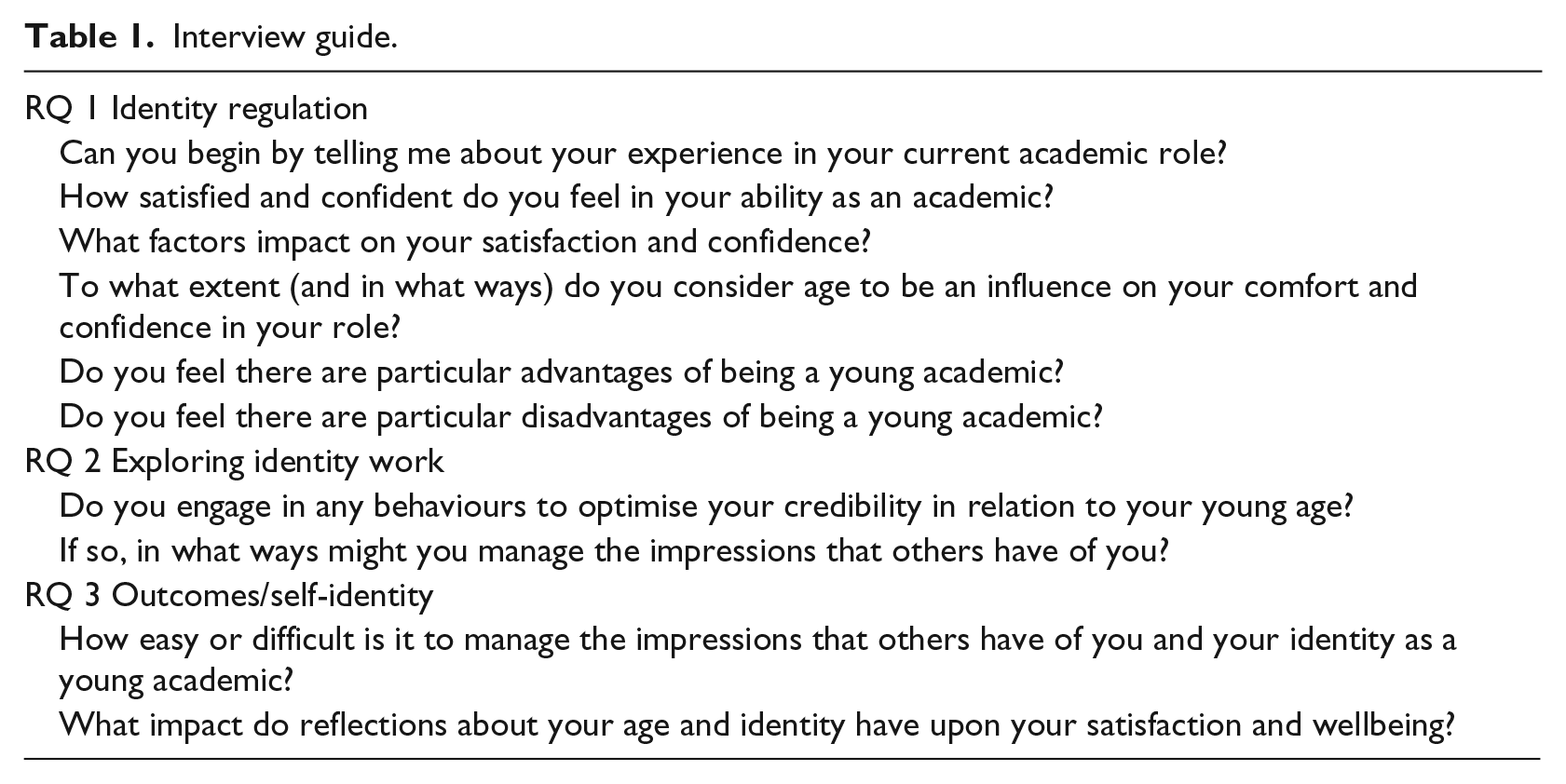
Semi-structured qualitative interviews were determined to be the most suitable methodological approach due to the ontological standpoint of explorative and discursive enquiry (Braun and Clarke, 2013). An interview guide was designed that mapped our research questions (see Table 1) in which open-ended questions were posed to elicit detailed narrative accounts (Knights and Clarke, 2014). This was used as a guide during the interviews in which the order of questioning was followed but adapted accordingly for each participant dependent upon areas of focus and relevance.
Interview guide.
Participants were 15 young academics, which we operationalised by Archer’s (2008) classification of young academics as being aged 35 years or below. This was also representative of HESA’s categories (HESA, 2016). We were mindful of a data saturation point (Saunders and Townsend, 2016), which was reached when repeated themes and content arose as interviews progressed. The sample was homogeneous according to our definition of young academics, and no comparative frameworks were employed to appraise demographic differences. Coupled with the subjectivity of the research topic, where identity is positioned as social construction, a conservative sample size of 15 participants was appropriate. The purpose of our study is to uncover rich discursive insights; qualitative work is driven by the depth and content of data rather than large sample sizes (Baker and Edwards, 2012). It is acknowledged that a sample of 15 is at the lower end of the recommended sample size for interviewing (Saunders and Townsend, 2016), but this small scale allowed us to consider rich individual-level analysis alongside thematic grouping across all participants.
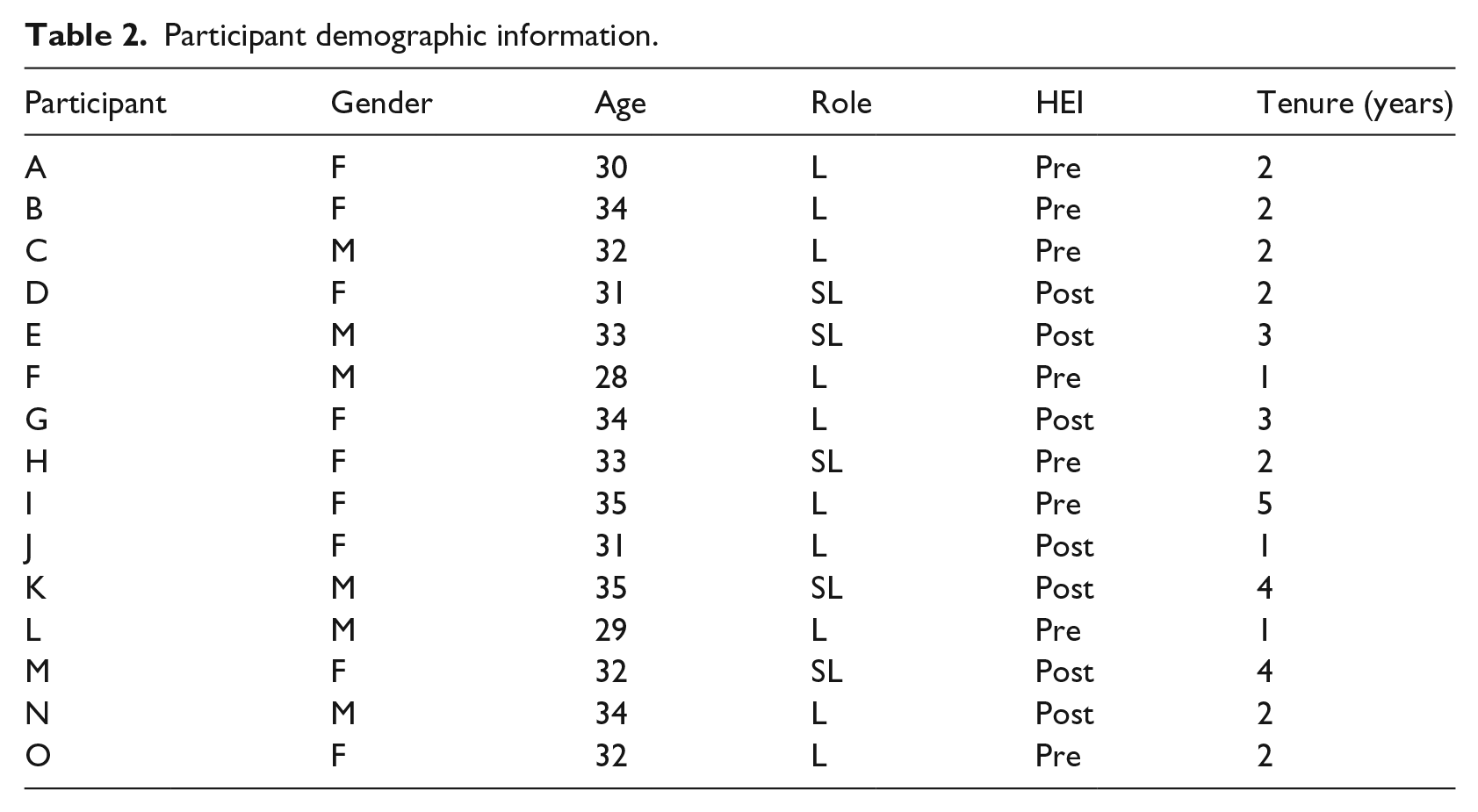
Participants were approached via an opportunistic sampling framework affording the researchers the ability to grow their sampling pool through existing participants’ networks and contacts as data collection got underway. In Table 2, we show the sample demographics. Participants were permanent employees at lecturer and senior lecturer level from four HE establishments in the United Kingdom and held both teaching and research responsibilities within their business schools. We sought participants who taught and conducted research in business and management within business schools. They had subject expertise in a variety of sub-disciplines, including management studies, human resource management and occupational psychology. The majority had been working in the HE sector for less than 3 years, and the remainder had worked for between 3 and 5 years. The average age of participants was 32.2 years, the youngest was 28 years and the oldest 35. Participants worked for both pre-1992 and post-1992 institutions. 1
Participant demographic information.
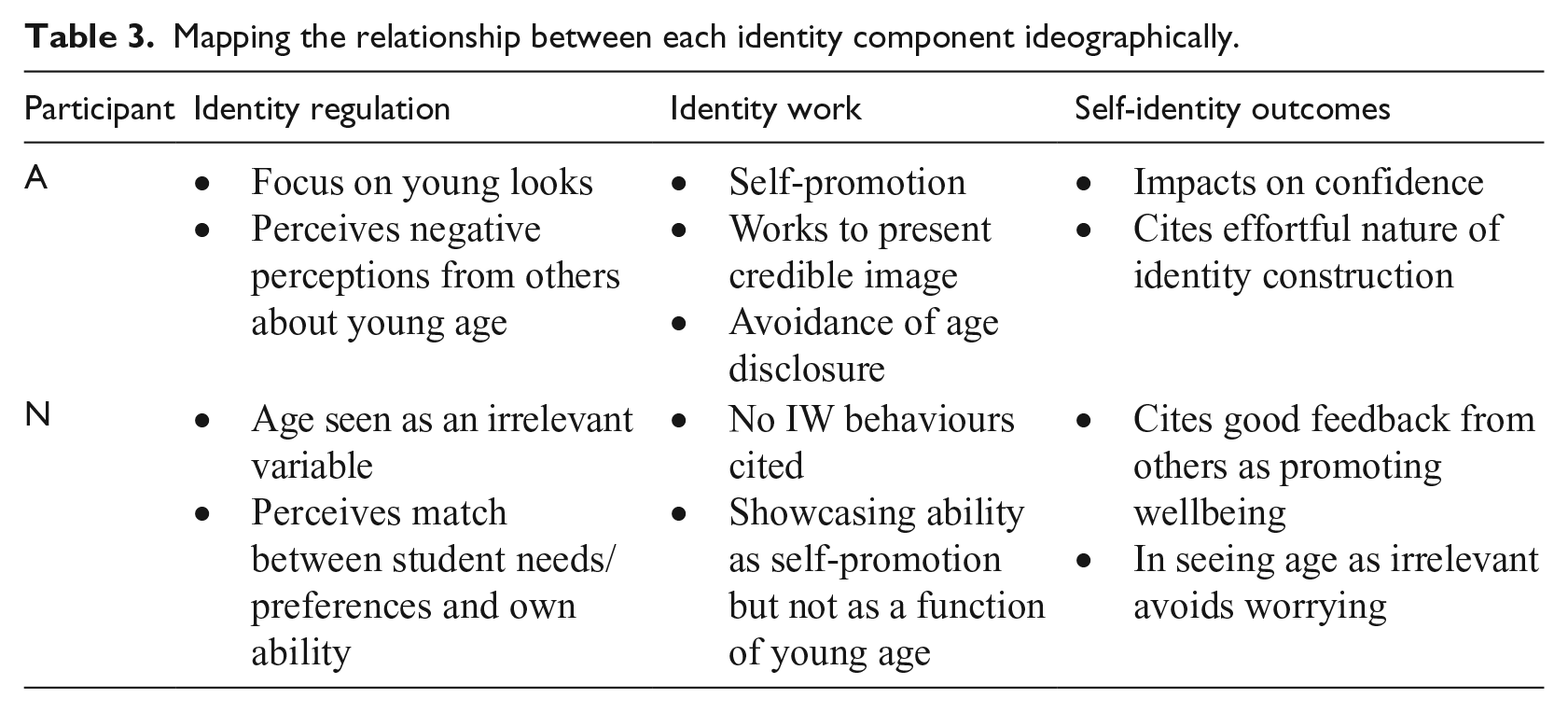
The majority of interviews took place face-to-face, though four were conducted over the telephone. The average duration of interviews was 77 minutes. Participants were informed of confidentiality and anonymity and were offered the opportunity to withdraw their data from the study. No participants chose to withdraw their data. All interviews were audio recorded and transcribed. Miles and Huberman’s (1994) guidance for thematic analysis was followed where the analytical pathway began with the familiarisation of the transcription. This involved immersion in the data to generate a sense of meaning (Braun and Clarke, 2013) from each participant response. Data analysis took place at the idiographic and nomothetic levels (Luthans and Davis, 1982). Nomothetic refers to the dominant approach of summarising trends across a group of participants. It is typically used in both reductionist quantitative studies and in grouping qualitative patterns in thematic analysis across a sample in interview studies. Idiographic analysis allows for further insights through the singular analysis of each participant’s account. A move towards both idiographic and nomothetic data representation can be helpful in exploring complexities within individuals and between process-driven constructs (Crozier and Cassell, 2016). We began our analysis by mapping each participant’s discourses at an idiographic level for each of our model components, which allowed us to appraise the interplay between each identity component. In Table 3, we illustrate a sample of the idiographic analysis mapping for Participants A and N. Our sample size of 15 participants enabled idiographic analysis.
Mapping the relationship between each identity component ideographically.
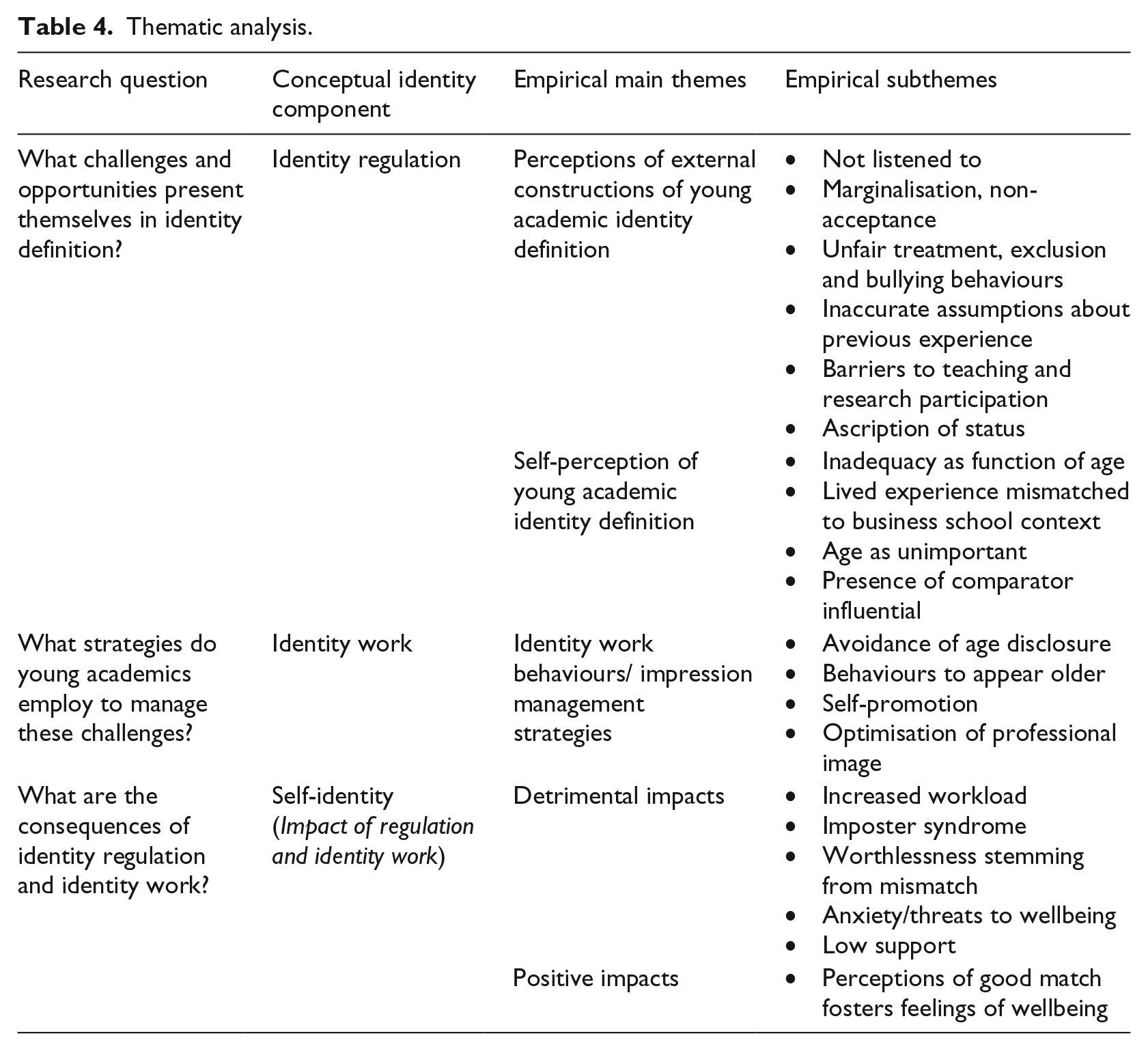
Next, at the nomothetic level, research questions were used as a framework to order and aggregate themes across all participants. The conceptual identity components were used as a structure from which the empirical findings emerged as themes. First, themes were divided into overarching or main themes and documented in the template matrix. Then, subthemes were derived from each main theme, allowing complexities in content and meaning to arise (King, 2004). The template matrix was drawn up in a tabulated form that listed each of the research questions alongside their associated interview questions. As main and subthemes emerged, they were listed alongside the corresponding research question. A final column of the matrix presented supporting quotations from interview transcripts. We have illustrated the main and subthemes that emerged at the nomothetic level in Table 4.
Thematic analysis.
Findings
We present the thematic analysis from our interview data as a function of each part of our conceptual model. First, identity regulation, which maps to our first research question concerning challenges in academic identity definition and young age; second, identity work, where we explore the strategies used in shaping credibility; and third, self-identity as a manifestation of outcomes. We draw attention to the process orientation of identity as important in filling a research gap and so assert the relevance of exploring all three elements and their interplay.
Identity regulation: challenges in academic identity definitions and age
Challenges in identity as systemic of self and others’ perceptions about young biological age emerged. The social constructionist view of identity articulates the importance of identity construction as a shared process between the self and the external world, and here, we provide support for Drori and Honig’s (2013) views of complexity and inconsistency in legitimacy.
Perceptions of external constructions of young academic identity
Participants sometimes believed their opinions were discarded, which impacted on their satisfaction and credibility: I’m definitely not listened to . . . in a meeting, I could tell they didn’t really want to hear my views . . . other times, I haven’t had much say in how things are done. (Participant C)
Many participants felt that their age presented them with challenges derived from perceptions held by other (older) colleagues, which was indicative of the influence of external views of their identity and supported the notion of hierarchical location as pertinent to regulation discourses (Alvesson and Willmott, 2002).
Our findings support Bell and Clarke’s (2014) delineation regarding age and status, where feelings of marginalisation and non-acceptance from other colleagues were commonplace. Such behaviours appeared to constitute unfair treatment, and participants felt that their older co-workers’ views translated into inaccurate assumptions about their knowledge or performance: . . . you get the ‘you weren’t around then so you won’t remember this or that’ . . . it can be really hurtful actually, as it is a bit undermining, and you feel embarrassed if they say it in front of the older colleagues and they all sort of laugh. (Participant F)
Perceptions of unfairness were also evident in research-related activities, as assumptions about lack of experience attributed to age were reported, supporting Trompenaars and Hampden-Turner’s (1997) notions of status ascription and Huzzard and Johnson’s (2017) discourses of aesthetic labour: We were applying for a grant, and there was just a view that I hadn’t done this before . . . and in ordering our names . . . they suggested my name would be last, and I’d have less involvement . . . they were like ‘Oh, we thought you’d come here straight from your PhD’. (Participant C) And I do think that is an age-visibility thing – Oh, he looks young, and he might be quietly spoken, so clearly he can’t manage this on his own. And I did think, you know, there are colleagues in their forties or fifties who behave the same, sort of understated – but I am pretty sure they would still be considered adequate because of their age. (Participant L)
The visibility of young age was implicated in aesthetic labour in the business school context and was seen to impact on selection for teaching activities (Huzzard and Johnson, 2017), despite internal beliefs (Brown and Toyoki, 2013) about holding adequate experience in the ‘real world’: I wasn’t allowed to teach on X [a postgraduate unit] as they felt I didn’t have the presence or ‘clout’ to be authoritative with students who are a little older. (Participant O)
Some participants noted that the ascription of status was influenced by age, which was a starting point from which others viewed the young academic, only dissipating once behaviours to demonstrate their skill set were illuminated: I think their perceptions change if you prove your ability through writing something or engaging well with the project team. At that point it’s like – oh, hang on a minute, they’re not just a child who might do some data entry on the project. (Participant J)
Self perceptions of young academic identity
Alongside experiences of how others constructed the identity of young academics, internal regulation discourses cited a lack of fit. Often, this was articulated as pertinent to the business school or management focus of the discipline, which was supportive of Huzzard et al.’s (2017) point regarding unique contextual challenges: We are teaching . . . in management, and I think if it was me [as a student] I would expect to see someone who’s really done that or who looks like they’ve done that out there in the real world . . . I suppose by looking at me, you know . . . you might assume I’d never managed anyone. And, do you need that? Or, if you don’t have that, surely you need to pretend? (Participant L)
In support of work that advocates for the deconstruction of experience (Cunliffe, 2016) and the subjective nuances in appraising identity (Petriglieri, 2011), beliefs about age as a factor imperative to credibility was influential. Those who placed less emphasis on age were psychologically more equipped to deal with the challenges of being a young academic: It’s not how old you are, it is how old you seem – not even [your] looks but commanding the attention of others . . . if you are constantly worrying about your age, it is going to be a problem for you – it needs to be seen as irrelevant. (Participant N) Old or young . . . it doesn’t matter. I personally like being seen as good even though I’m young . . . the students like me, as I can relate to them, I think. (Participant M)
The second quote is useful in examining awareness and links to organisational success indicators, especially student satisfaction, and is emphatic of the interplay between self-constructs of identity and the perception others held or were assumed to hold with regard to how legitimacy is defined. There was a view shared by a minority of respondents that students are likely to trust a lecturer who shares similar characteristics to themselves (Posthuma and Campion, 2009). In contrast, some participants believed that students had less faith in their ability as a function of age, especially in instances where a comparator in the form of an older academic worked alongside them. In these cases, participants defined themselves by defining others and by assuming their hierarchical location: We team teach, and he is a lot older than me . . . I can tell the students initially trust him more and take longer to warm to me . . . yet, when I’m teaching on my own that evaporates. (Participant D)
Identity work: use of impression management strategies
Participants engaged in different types of identity work and impression management techniques to manage the perceived impact of their young age. Perceptions of regulation discourses influenced the extent to which impression strategies were employed. Some participants explained that they took steps to avoid disclosing their age or engaged in behaviours to appear older. Participants cited instances in which they exaggerated the number of years since their graduation or took steps to suggest they were older: I have allowed people to assume my age and haven’t corrected them . . . a colleague was talking about someone . . . saying, ‘He’s like you, late thirties’ when actually, at the time, I was about 29. I remember thinking it was both good and bad – I was pleased they thought I was older but also worried that I’d be found out, and you know, I really should’ve corrected them, as now looking back, it was a good thing that I’d got to where I was being young . . . (Participant K)
Participants used self-promotion (Jones and Pittman, 1982) by emphasising their tenure in previous roles to appear credible in instances in which they feared their audience might assume otherwise: I like to tell people how long I was working here or where I was before . . . I think, because I look young, people might assume that I’m straight here from my education, when in fact I have many years of working out there in the real world . . . so I make a point of that, probably too much sometimes, but it helps me to feel I’m persuading them of my worth. (Participant I)
There were implications for how young academics employed identity work during research activities by asserting prior experience during interactions with more experienced colleagues to optimise their legitimacy (Brown and Toyoki, 2013). This was emphasised alongside cautionary reflections regarding potentially negative outcomes of impression management: . . . it would have been useful for me to say . . . what I’d done prior . . . it did unsettle me, as I thought if I want to be taken seriously, I need to tell them more about what I used to do – I have other things I can offer aside from just completing my PhD. So now I’ll mention it more. I like to say how long I did something for . . . but it’s like a balance . . . because I don’t want to seem as though I’m boastful of my skills, but without doing that they’d assume I didn’t have them. (Participant H)
By providing further examples of aesthetic labour (Huzzard and Johnson, 2017), participants cited instances of impression management and identity formation through strategies aimed at optimising an image of formality or professionalism: . . . there is a mix of people who wear very formal business attire and those who don’t and are casual in jeans or whatever . . . I dress in a business suit, because I know I’m young, and I want to look the part. I would worry that people would think I was a student if I didn’t . . . I don’t just look but I become more credible. (Participant F)
When participants appraised age in identity regulation as an irrelevant variable, they suggested less need for engagement in impression management activities, though Participant N suggested that self-promotion activities could be used to address issues other than age: Actually, I don’t think I manage impressions – not because of age anyway. I can see why people would if they thought age was a problem. I think we are all good at promoting our abilities at times, but that isn’t to do with being young for me. (Participant N)
Self-Identity: outcomes of identity regulation and identity work
We were interested in capturing the impact of identity regulation and work and the extent to which anxiety and self-doubt manifested as outcomes. We present two key findings. First, the impact of regulation discourses concerning legitimacy. We suggest that subjectivities in the appraisal of regulation can impact in both positive and negative ways. Second, we explore the impact of engagement in identity work behaviours.
Impact of regulation discourses on self-identity
Participants cited fatigue and the need to work to overcome the perceptions held by others as a function of regulatory perceptions. There was evidence of younger academics feeling that their workloads were heightened because of their youthfulness and assumed resilience: I remember him saying, ‘You are young with broad shoulders’ meaning I can be the one to manage, to cope, to be tested with more work . . . they didn’t mind so much placing it on me, as they thought I must have more energy. (Participant C)
Perceptions of a mismatch between young academics and the stereotype of a knowledgeable academic were commonplace (Knights and Clarke, 2014), and in some instances, this presented as imposter syndrome (Bothello and Roulet, 2018). This could be a pertinent stressor, culminating in feelings of inadequacy, worthlessness and anxiety. This appeared to emerge as a function of the gap between participants’ current and idealised image: I don’t feel like I’m good enough sometimes, like I’m not old enough to be doing the job . . . or I don’t fit the image of a ‘lecturer’. (Participant B)
Manifestations of stressful experiences included perceptions of low support from colleagues, alongside reported low trust in their ability to work independently or produce high quality results. Relational elements of exclusionary behaviours and symbolic representations of these (Bell and Clarke, 2014) were explored as stress precursors: I am the youngest by far, and I’m constantly working to change their views that they don’t have trust in me . . . it isn’t supportive, it is like they are babysitting me. It makes me feel rubbish, and I panic about that sometimes. I keep thinking they are going to come in [to a lecture] and correct me . . . like they see me as far, far inferior . . . (Participant L)
Positive perceptions were sparse. However, voiced perceptions of fit between young academic ability and the fulfilment of students’ needs indicated that academic identity credibility is shaped by feedback agendas (Sutherland, 2017), and markers of appraisal regarding the salience of identity regulation. When a focus on young age was deemed unimportant or was framed positively, reflections of positive wellbeing were reported (Petriglieri, 2011): . . . it’s less stressful . . . I’m liked by my students . . . it’s good as I know they prefer my style . . . so I don’t think stress from the age angle is a problem . . . I think the managers are like, ‘Phew – we’ve got someone who is actually able to talk to the students on their level . . . and I’m pretty comfortable with that. (Participant N)
Impact of identity work on self-identity
Participants who utilised identity work strategies and felt that their age inhibited their perceived credibility reported detrimental impacts. Engagement in identity work was seen as effortful and not necessarily effective in shaping others’ views: The job is busy enough, you know? And it’s also stressful enough – but these feelings of not being able – I do think are linked to my age – it’s like some form of exclusion from the club . . . and I think the work I need to do to change that is too difficult. (Participant O) I look younger than I am so feel I have to work harder to present that image of someone who knows what they are doing . . . I think I’m confident, but people have preconceptions that wear me down a tiny bit . . . I am always up against that. (Participant A)
At times, this was explored from a dissonance perspective. Participants believed that they were behaving inauthentically to meet regulation discourses surrounding legitimacy. Participants recognised the impacts of this lack of fit (Edwards, 2008) on their wellbeing, punctuating their accounts with reference to negative psychological experiences: . . . it worries me that I can’t just be me – I’m always trying to be different and older, and it isn’t really healthy I suppose . . . I am not myself at work, and it can be quite tiring . . . it is like another layer on top of everything. (Participant O)
Discussion
We have presented discursive accounts of identity for young business school academics where comprehensions of incongruence between internal and perceived external views form regulation discourses that can create tensions and prove troublesome. Our findings suggest that being a young academic can bring with it a number of challenges, including the perception of a requirement to manage the impressions of others through identity work to achieve a successful and credible academic identity. As young academics ourselves, we were interested in exploring the interrelatedness between several questions. The identity regulation component of our model allowed us to address ‘what should I be like?’, the identity work lens was concerned with the ‘what do I need to do to get there?’, and the self-identity focus examined ‘what are the impacts for me?’ Earlier, we suggested an interplay between identity discourses and critical reflexivity. We seek to draw together this contribution to show how our data sources present discursive accounts that can provide practical as well as theoretical insights (Alvesson et al., 2008).
We framed our first question through discourses of identity regulation, and our findings position external perceptions of young academics as novices. In this case, participants’ experience may have been overlooked due to ascription bias (Trompenaars and Hampden-Turner, 1997). Differences in external and internal permutations of young academic identity were prevalent. Despite reflections as to others’ views, young academics themselves often cited degrees of confidence in their abilities. Thus, we provide support for the complexities of reconciling internal and external legitimacy (Drori and Honig, 2013). Despite sometimes having positive self-perceptions, young academics voiced difficulties relating to the incongruence of polarised identity elements, sometimes referring to them as expressions of marginalisation and unfair treatment (Bell and Clarke, 2014). Subjectivity in sense-making was, to some degree, shaped by the extent to which young academics deemed age a relevant variable in their own identity definitions. Therefore, we assert the relevance of appraisal and identity salience as influential here (Petriglieri, 2011). Regulatory discourses are seen to act as powerful catalysts for positive or negative impacts that set the wheels in motion for the mobilisation of identity work and impact self-identity outcomes.
In focusing on our second question, we evidence a range of identity work activities. It appeared that regulation influenced the need for identity work, and we were able to map this for each of our participants through our idiographic analysis. Central to this was a belief that the onus was on young academics to shape the views of others through self-branding to obtain a good fit with the business school brand (Huzzard et al., 2017). Participants reported a need for self-promotion and acknowledged that they often signposted their previous experience to challenge external perceptions of the young academic as a novice. The perceived dissonance between the self and others with regard to legitimacy appears to influence the extent to which impression management strategies were deemed necessary and the extent to which they were employed. For some participants, engagement in identity work was effortful and inauthentic.
Our third question concerned the outcomes of regulation and work on current self-identity. We examine negative (and sometimes, positive) psychological impacts as consequences of perceived person-environment fit (Edwards, 2008), which was derived from regulation discourses and the impact of engaging in identity work. Our findings evidence challenges relating to the consequences of age-related identity norms and in some instances, non-conformity and marginalisation were seen to manifest in imposter syndrome (Bothello and Roulet, 2018). Identity work and impression management, when deployed, were often viewed as a heightened demand that fuelled tiresome and worrying experiences. In addition, we provide further support for the power of appraisal (Petriglieri, 2011) where strong internal regulation promotes a positive self-image and strong beliefs in credibility that feed into narratives of positive outcomes, irrespective of the perceived views of others. We position appraisal as relevant not only in shaping outcomes regarding identity threats but also in identity regulation activities and identity work. It is hard to disentangle the influence of each component from another – indeed, they appear to some extent interwoven in the narratives of how identity is constructed. Though an understanding of their separateness has helped us to develop accounts of each component and their part in the identity process, we aim not to ignore their overlapping and non-linear nature in the identity journey.
By reflecting on ourselves as young academics, we highlight the complexity associated with our interest in the study. We do this through the lens of ‘becoming’ where by sharing in and exploring the perceptions of others during this project, we acknowledge a simultaneous examination of our own identity. We draw on the notion of alterity as a self-discovery agenda, ‘By embracing alterity – the spaces of unknowingness and betweenness where new possibilities, new questions, new ways of seeing, being and acting arise – we come to know ourselves’ (Cunliffe, 2018: 13). We draw attention to the power of transitional encounters in providing both threats and challenges (Hay and Samra-Fredericks, 2016). We are emboldened by participants who believe that age is just a number, where their presiding belief in this premise attenuates legitimacy challenges and brings favourable outcomes.
We signpost the fluidity of identity where one’s credibility can both diminish and accumulate relative to the contextual environment of regulation targets (Alvesson and Willmott, 2002). For young academics, this manifests in the presence of an expert/older academic in a certain setting who act as a comparator to reinforce feelings of marginalisation and inadequacy. However, in some cases, participants drew positive comparisons, for example, citing students’ enjoyment of their teaching as a function of sharing a similar demographic. The fruition of credibility and diminishment of imposter syndrome is thus not an objective or a fixed phenomenon, and we know that fragilities in academic identity are dominant for all academics irrespective of age (Knights and Clarke, 2014). In positioning young academics as potentially a marginalised group, we acknowledge that marginalisation can indeed befall academics outside of this age bracket. For example, different expressions of otherness can intersect with different circumstances, such as entering the academic field later in life (Tomkins and Nicholds, 2017). Our findings illustrate that young age can act as one precursor of identity challenges. We are mindful that this is complex in several ways. We do not claim that young age is the only determinant of difficulties. Rather, we encourage further work to explore the intersection with other demographics and contextual factors. Moreover, both internal and external beliefs about the function of age in operating as components of regulation appear to be more important than the ‘objective’ criteria of young age.
A concern arising from this and other research (Bell and Clarke, 2014) is that marginalisation is not conducive to healthy working environments, and attention must be devoted to initiatives to help young academics overcome the challenges they face. Indeed, Bothello and Roulet (2018) cite the need for academics to develop new mantras to mitigate against imposter syndrome. We position this from the perspective of equipping young academics with support to manage the creation and maintenance of their emerging and often fragile identity. We call for further reflexivity in harnessing support and propose that developmental spaces, such as mentoring, working groups and formal development programmes, reference the influence of age and identity. We advocate for further research to explore the impact of such activities and suggest a starting point of engaging with permutations of age in academia would be helpful in unpacking the interplay of regulation discourses and their impacts. Future research might look to unpick the specific mutual adjustments (Wapshott and Mallet, 2013) that could take place in navigating such challenges, especially those that examine how they are managed and negotiated to reach favourable outcomes that preserve legitimacy and circumvent marginalisation. We suggest that the construct of appraisal could be helpful in the design of structured reflexive journals or guided workshops for young academics (e.g. how do I interpret identity challenges? What do they mean for me? How can I work to overcome them? What can be done to support my wellbeing?). We also suggest that mentoring dyads between young academics may provide comfort and social support in validating legitimacy. We propose that support mechanisms could be incorporated in all stages of becoming an academic, especially during periods of transition from student to academic, for example, during PhD training programmes. Furthermore, activities that promote wellbeing and support should be advocated for and led by organisations and not seen as the sole responsibility of young academics themselves.
Conclusion
In this article, we have presented identity discourses of young academics in business schools. Our contribution offers a conceptualisation of the role of young age in interacting with identity and its consequences. We have uncovered complexities in participants’ subjectivities, which signpost a rich unpacking of the interrelation of identity regulation, work and outcomes. The way in which accounts are constructed, maintained and contested by our participants illuminate the potential for reflexivity as a practical toolkit that can be helpful in working towards positive appraisal of identity experiences, and also as evidence of the need for organisations to provide developmental and support activities to manage fragility in identity. We hope our findings have illustrated the power of reflexive activity as an agenda for building legitimacy and understanding perceptions of marginalisation. We suggest that this may be helpful in optimising positive identity experiences and outcomes for all academics.
Footnotes
Acknowledgements
The authors would like to thank all of the participants who took part in this study. They also thank the editor and three anonymous reviewers who provided insightful and encouraging support throughout the article revision process.
Funding
The author(s) received no financial support for the research, authorship and/or publication of this article.
