




Abstract
This article contributes to leadership learning by discussing how retroduction can be used to enhance the reflexive capabilities of a professional group. The study shares insights from a critical realist research project to illustrate how the application of retroductive inference in interview design supports an investigation of the contextual constraints preventing practitioners from enacting desired leadership behaviours. This focus considers retroduction’s potential as a stimulus intended to encourage a practical, conversational and collaborative form of reflexivity between researcher and research participant. The leadership context investigated concerns the work place experiences of senior corporate communicators who express a desire to be empowering leaders. The study shows how the interplay between retroduction and reflexivity can enhance understanding of the conditions under which knowledge is enacted, or rather not enacted, in a specific leadership context. The article then highlights how the learning generated by the research was used to inform the development of a reflexive process which has since been applied in a range of professional learning environments. The discussion of its application contributes to the growing scholarly interest in reflexive pedagogy, meeting the need for alternative approaches to leadership learning which reconnect with context and explore the influence of power.
Introduction
This article contributes to leadership learning by discussing how retroduction can be used to enhance the reflexive capabilities of a professional group. As a form of logical inference seeking to understand the underlying conditions influencing observed behaviours and events, retroduction is embedded in critical realist research (Archer et al., 1998; Fleetwood and Ackroyd, 2004). In this context, retroductive analysis is applied to data with the aim of generating causal and explanatory modes of theory (Danermark et al., 2002). This article goes beyond retroduction’s role in data analysis to explore its wider learning potential as a reflexive stimulus. The discussion shares insights from a critical realist study to illustrate how retroductive inference can be used in interview design to explore the contextual constraints preventing practitioners from enacting desired leadership behaviours. This focus complements Kempster’s (2006) observation that ‘the variability of leadership may lie in underlying influences which are not immediately recognised by individuals through their lived experience’ (p. 4). Given this interest, an objective of the study is to highlight learning of relevance to researchers working outside of, as well as within, a critical realist ontology.
Through its discussion of an empirical research project, the study explores how a more ‘social’ application of retroduction can encourage a form of practical reflexivity (Cunliffe, 2009; Cunliffe and Easterby-Smith, 2004) among research participants, characterised by a concern for the critical scrutiny of ‘contested and contrary positions’ (Dovey et al., 2017: 24). Through its focus and orientation, the study supports Bhaskar’s (2014) view that if critical realist research ‘is to be “serious” it must be applicable’ (p. v). The founding father of critical realism (CR) also notes, however, that while ‘applied or practical critical realism … is, or should be, the soul or heartbeat of CR … there is a dearth of such texts’ (p. v). This absence of applied research is a problem for scholars given Ackroyd and Karlsson’s (2014) acknowledgement of the primacy of ontology, rather than epistemology and methodology, in critical realist research. The article therefore intends to identify and expand the practical value of a key feature of critical realist research. In doing so, it addresses a wider and complementary concern raised in this journal relating to the issue that practice takes little notice of the knowledge generated in academic research (Scaratti et al., 2017). In the spirit of bridging the academic-practice divide through engagement (Van de Ven, 2018), the study highlights how the learning generated by the research project has been used to inform the development of a reflexive process which has since been applied in a range of professional learning environments. A discussion of its application contributes to a growing interest in what is framed in the academic literature as reflexive pedagogy (Hibbert, 2013; Hibbert and Cunliffe, 2015; Iszatt-White et al., 2017).
The specific leadership challenge framing the study’s reflexive endeavour complements two pre-occupations in contemporary leadership development research. The first is the need to consider the role of agency in addressing structural constraints. Nohria and Khurana (2010) note that navigating the tension between agency and constraint is at the heart of leadership practice and must continue ‘to be vigorously investigated in future research’ (p. 21). The second pre-occupation seeks a better understanding for how scholars and practitioners might address the disconnection between principle and action, framed by Pfeffer and Sutton (2000) as the ‘knowing-doing gap’ (p. x). They argue that the divide between knowing and doing is ‘one of the most important and vexing barriers to organisational performance’ (p. x) and is especially pronounced in the leadership field. As Swart (2011) notes, ‘knowledge is only valuable when it is enacted’, and she further highlights the need to be ‘mindful of the importance of the inter-relationship between knowledge and its context’ (p. 320, italics in original). The article shows how the interplay between retroduction and reflexivity can enhance understanding of the conditions under which knowledge is enacted, or rather not enacted, in a specific leadership context.
Exploring critical intersections in leadership learning
Using retroduction to encourage a practical form of reflexivity meets the need for more critical and alternative approaches to leadership learning which not only ‘reconnect with context’ but also help to offset the ‘essentialist and normative ideals’ predominating in existing research (Edwards et al., 2013: 5). Sutherland (2012) notes how reflexivity (alongside reflection) has become the focus of management and leadership development and suggests it forms a ‘transformational bridge between experience and learning’ (p. 27). The study’s focus on retroduction as a reflexive stimulus builds on this bridging potential by highlighting its capacity to help practitioners consider their position in relation to social and organisational power relations, through a process which explores their individually felt experiences and actions (Cunliffe, 2002, 2004). This orientation is important given Nicholson and Carroll’s (2013) observation that, with some notable exceptions (Ford et al., 2008; Sinclair, 2009), most leadership development research has tended to ignore the existence and influence of power.
Building on this interest in power, the study also engages with a contested area of debate regarding the agency of individual leaders. For example, a key concern of critical scholarship in leadership learning is the need to highlight the possibility for oppression in individual-focussed development, while other contributions have made the case for the individual as a potential site of emancipation (Smolovic Jones et al., 2015). Rather than adopting an ‘either-or’ orientation regarding these different perspectives, the study supports the case for a leadership learning process which aligns with the argument that a focus on the personal can offer important insights into wider social and political issues (Mills, 2000; Swan, 2010; Watson, 2008). Given its orientation, the research further supports the idea that leadership learning can be usefully conceptualised as a continuum (Day and Harrison, 2007; Lord and Hall, 2005). Through this lens, practitioners are encouraged to think of themselves as individuals in leadership terms before moving on to consider their role in more collective, shared and democratic forms of leadership (Raelin, 2011). The approach adopted in the research therefore serves to accommodate the distinction Day (2000) makes between leader development (a focus on the leader) versus leadership development (which regards leadership as a social process involving everyone). This study’s focus on the former (the leader as the primary unit of analysis) is designed to inform the latter by exploring the interplay between the individual leader and their context through the application of its reflexive method, as well as testing the boundaries of agency and restraint. The study serves to encourage a shift to more contextually intelligent ways of viewing the world through an approach which recognises – and works with – the complex positioning of practitioners in relation to leadership (Smolovic Jones et al., 2015).
The specific leadership context investigated in the empirical research concerns the work place experiences of senior corporate communicators seeking to empower the people in their teams. The concept of empowerment provides fertile ground for the inquiry given it can be framed as the sort of idea which has the potential to impregnate organisations about what constitutes good and effective leadership practice (Alvesson and Sveningsson, 2003; Maynard et al., 2014). Empowerment is defined in this study as the formal, informal and oblique processes and actions which encourage a sense of personal efficacy, self-determination and value among an individual or group working on a task (Chia, 2011; Conger and Kanungo, 1988; Thomas and Velthouse, 1990). However, the purpose of the study is not to make the case for or against empowerment as a viable leadership practice. By exploring the ambition of a group of practitioners to be ‘empowering leaders’, it is designed instead to highlight the danger of disregarding the wider context of leadership (Schyns et al., 2012) through the application of its reflexive method which is used to expose situational contradictions, tensions, dilemmas and possibilities (Cunliffe, 2002). The study then links debates on reflexivity in leadership learning with retroduction by introducing a facilitation process which allows practitioners and scholars to explore why it is that leaders seem to exercise leadership in the very form they claim to dislike (Alvesson and Sveningsson, 2003). The research is therefore usefully framed as an endeavour with two complementary aspects. The first explores leadership ideas which practitioners claim shape their identity as leaders (in this case, the requirement to be empowering), while the second aspect considers the context which impacts on their perceived identity.
An interest in identity supports the observation made by critical scholars that this is a subject which has important implications for leadership learning and therefore merits further attention (Edwards et al., 2013; Ford, 2010; Ford et al., 2008; Nicholson and Carroll, 2013). In line with these concerns, rather than exploring how the leadership identities of practitioners are enhanced or might correspond with idealised leadership behaviour, the study considers a neglected aspect of inquiry which is the deconstruction and unravelling of identity. Nicholson and Carroll (2013) characterise this phenomenon as a form of identity undoing through which power relations impacting on the leadership learning process can be revealed. As with other pervasive and normative ideas about leadership, empowerment has an influence on how leadership identities are constructed. Using retroduction to better understand the disruption of an empowering identity in this context has the potential to help practitioners consider more widely their position in relation to social and organisational power relations.
Critical realism and the research participants
The study’s investigation of the organisational conditions influencing the empowering behaviour of leaders is suited to – and therefore informed by – a critical realist research orientation. CR is a stream of philosophical thought associated with the work of the British scholar Roy Bhaskar (1978, 1989). CR is favoured over other philosophical approaches because it seeks to chart a course between the empiricism of positivism and the discourse analysis found in social constructionism. According to Kempster and Parry (2014), such an orientation is particularly important for leadership studies as the ‘see-sawing between empiricism and discourse overlooks the fundamental need in leadership to replace the either/or and explore both’, that is, ‘leadership as a malleable interaction of structure and agency’ (p. 86). Assimilating the features of CR therefore supports an objective of the empirical study, which is to help leaders navigate the tension between agency and constraint by finding ways of taking action.
To understand the organisational conditions under which leadership approaches associated with empowerment occur, the study includes a qualitative element focussing on the observations a group of leaders have on their circumstances and experiences in particular workplace situations. This focus supports Bhaskar’s (1998) observation that ‘actors’ accounts form the indispensable starting point of social enquiry’ (p. xvi). Building on Bhaskar’s guidance, Smith and Elger (2014) note how scholars with a critical realist orientation acknowledge the importance of meaning construction and communication among people, ‘both as a topic of investigation and as an essential medium of research and theorizing’ (p. 111). While this does mean the critical realist approach to interviewing shares some similarities with social constructionism, they go on to note that its focus on the search for pre-existing structures and an understanding of their impact on people suggests important differences. According to Smith and Elger, this emphasis means that ‘critical realists seek to utilize interviews and other social research methods both to appreciate the interpretations of their informants’ but also crucially, ‘to analyse the social contexts, constraints, and resources within which these informants act’ (p. 111).
As part of the study, semi-structured interviews with 15 communication leaders were conducted, recorded and then transcribed to gather primary source data. In line with the study’s ethical protocols, the communication leaders’ contributions are acknowledged in a manner that does not mention them by their real name. The research participants were all board-level corporate communication and public relations directors working in government or the private sector. It is important to note the selection of the research participants was not based on an assumption that leadership is an activity only associated with those operating at the top of an organisational hierarchy, or that their job title suggests a particular competence in leadership. Rather, the interviewees were selected because of their extensive leadership experience (each of the participants has at least 10 years of experience in leading teams), as well as their potential as senior practitioners to offer insights into the operational, policy and/or strategic decision-making behind specific leadership practices (Pang and Yeo, 2012). This last attribute is important because of its capacity to inform a discussion around the contextual conditions shaping their empowerment practices.
The research participants’ prescribed strategic role, as set out by relevant professional bodies (Global Alliance, 2019) and in practitioner-focussed academic literature (Macnamara, 2012), is to build and maintain positive relationships with the stakeholders who are most important to their organisation. These stakeholder groups can include customers, employees, the local community, suppliers, interest groups, investors, government and regulators. The specific activities undertaken by the research participants and their teams involve deliberate efforts to formally communicate with stakeholders through media relations (traditional, on-line and social), owned media (such as the organisation’s website, blogs, podcasts, apps and videos), events (annual general meetings, conferences and webinars), as well sponsorships relating to sport, culture or good causes. An established base of academic literature further argues that to be organisationally effective, these communication leaders should be part of the top management team and involved in strategic decision-making processes (Beurer-Zuellig et al., 2009).
Reed (2018) notes that as an emergent expert occupation, alongside others fields such as management consultancy and information management, communicators correspond with Ackroyd’s (2016) conceptualisation of a corporate profession. This way of thinking about their professional identity is characterised by a state of ‘in-betweeness’ given corporate professions are occupations which are usually well remunerated, have a high status and an important social role, but where important aspects of professionalism are simultaneously absent. These missing links in the professional project include ‘where a body of knowledge hasn’t been formalised and barriers to enter the occupation are low’ and when individuals are ‘more aligned to the organization rather than the professional body’ (Reed, 2018: 224).
Embedding reflexivity and retroduction in the research project’s design
This article focuses on one aspect of the empirical research conducted with communicators by exploring the reflexive potential of retroduction through its application in their interviews. To provide the appropriate methodological context, it is necessary to locate the participant interviews within the study’s overall design and to also illustrate how retroduction is embedded in the research process. To assist with this discussion, the key features of the project’s design are presented in Figure 1. The methodological framework developed for the study and presented in the schematic is informed by the guidance for critical realist inquiry provided by Danermark et al. (2002). Their empirical protocol is designed to help the researcher move from the concrete (Stage One) to the abstract (Stages Two to Five) and then back again to the concrete (Stage Six). According to Danermark and colleagues, this approach is suited to identifying and understanding causal powers as two distinct explanatory logics are embedded in the process. The first is abduction which interprets observable everyday objects (usually provided by interviews or observational data) in an abstracted and general sense. The second is retroduction which builds on abduction by seeking to ascertain what the world must be like in order for what has been observed to be as it is. Both these forms of analysis are described by Habermas (1972) as ‘thought operations’ and as of providing the researcher with ‘different ways of reasoning and thinking’ (p. 113).
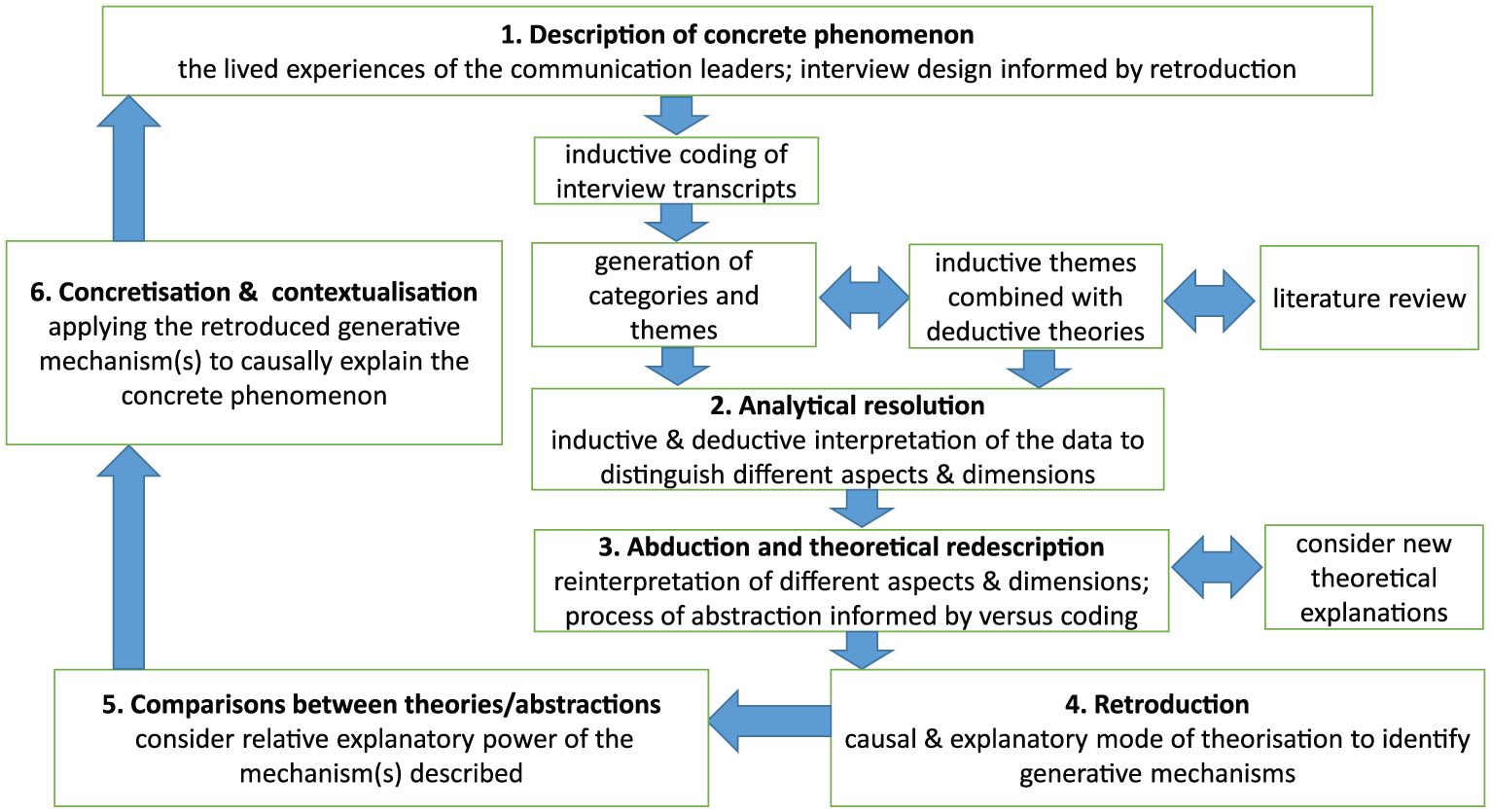
The project research design.
Given that the search for underlying cause lies at the heart of critical realist research, retroduction is regarded as the ‘central mode of inference’ given its purpose is the identification of factors which ‘helped produce, or at least facilitated’ a particular phenomenon (Lawson, 1998: 156). In the data analysis stage, its purpose is for each of the different components and aspects that have been identified in the data to be subjected to questions such as the following: why are the structures and relations (X) emerging in the data as they are? How is X possible? What causal mechanisms are related to X? By considering these questions, retroduction allows the analysis to ‘move beyond the inductive and deductive to the causal-explanatory mode of theorisation’ (Crinson, 2007: 39). It is, therefore, the mode of analysis designed to ‘identify the structure or mechanism underlying the concrete object’ (p. 39), and as such, the retroductive process is crucial to a consideration of the structural conditions which might be impacting on the communication leaders’ propensity to empower others.
In addition to the customary and embedded inclusion of retroduction in the research process to analyse data, Figure 1 illustrates how this study additionally applies retroductive inference in Stage One to inform the types of questions asked in the participant interviews. The aim of this approach is to stimulate a practical reflexivity focussing on the conditions under which the leaders’ knowledge about empowerment was either enacted, or not enacted. Rather than retroductive inference just being confined to the researcher’s own analysis of the data, its influence on the interview design is intended to promote a more participatory methodology. The emphasis is on engaging in a retroductive analysis with the research participants, instead of retroduction being something that is done for them by being applied to the data retrospectively by the researcher.
A more social application of retroduction in the research process has the potential to enhance the reflexivity of the research participants regarding the conditions which influence their behaviour. This participatory orientation builds on Archer’s (2003) idea of ‘conversational collaboration’ in reflexive critical realist interviews (p. 162). Given the purpose of critical realist investigations, Archer then goes on to highlight the importance in this reflexive process of the research participant not only ‘reflecting upon himself in relation to his circumstances’ but also considering his circumstances as being ‘two distinct parts of reality with different properties and powers’ (p. 14). This approach leads to a situation in which by saying what he does, the research participant ‘endorses a belief in his own subjectivity and that his reflexive deliberations affect his actions within the objective social situation (in which) he finds himself’ (p. 14).
Archer’s guidance in this regard supports Bhaskar’s (1975) foundational insight that the empirical is the experience of the participant and is distinguishable from the actual and the real. Smith and Elger (2014), in their discussion of the critical realist interview as a tool for investigating informant reflexivity, note that Archer in her promotion of reflexivity ‘emphasises the autonomy of human agents, with interior thoughts that belong to them alone, but also that such agents reflect upon themselves in a relational fashion, in relationship to others and society’ (p. 123). The inclusion of retroductive questions in the interviews with communication leaders is designed to encourage a form of reflexive engagement, assisting with the exploration of the respondents’ reflexivity regarding their subjective experience and relationship with their objective social situation, paving the way for a more nuanced approach to interviewing (McLachlan and Garcia, 2015). This collaborative orientation further recognises that in a reflexive endeavour, ‘there is no one-way street between the researcher and the object of study’, rather, ‘the two affect each other mutually and continually in the course of the research project’ (Alvesson and Skoldberg, 2009: 79).
To inform the types of retroductive questions used in the interviews, the study draws on the advice provided by Danermark et al. (2002) which identifies five strategies critical realist researchers can use to assist the process of retroduction. These are counterfactual thinking, social and thought experiments, studies of pathological cases, studying extreme cases and comparative case studies. In the study under review, a blended approach was used combining the last two strategies, enabling different forms of extreme cases to be compared as part of the retroductive process. From a leadership and empowerment perspective, the selection of this particular strategy is further informed by the experience of Kouzes and Posner (2012), who ask questions of research participants linked to their ‘personal best’ leadership experiences. Kouzes and Posner have used these experiences, and the behaviours and actions associated with them, to inform their work around how leaders mobilise others and empower them to act. In the author’s interviews, the research participants were asked to think about the times when they were at their best as a leader and to consider the conditions which allowed this to happen. They were then asked to think about the opposite extreme, that is, the times when they were at their worst and to reflect on the particular conditions impacting on this context. According to Danermark et al. (1997), the consideration of such extreme cases (i.e. the ‘best’ and ‘worst’ experiences) provides an opportunity to learn about the conditions for the normal area under investigation, generating data where the key conditions might appear more clearly than in other situations.
An empirical example: identifying contested and contrary positions
The discussion of an empirical example from the study now provides an opportunity to illustrate how the retroductive aspects of the interview design were applied to enhance the reflexive process. The example presented features Scott, who is the board director of a corporate communication consultancy. Scott claims to be passionate about empowerment and advocates the importance of ‘empowering key members of the team to go ahead and deliver … [in] their own way’. In keeping with this belief, Scott suggests that he generally prefers a laissez-faire approach to leading others by saying that ‘as long as they achieve results I don’t really mind which way they go about it’ but does add the caveat that ‘it’s got to be in keeping with the values of the business overall’. During the interview, Scott is also asked if empowering others comes easily to him. He notes that ‘it does come easy to me … I think it’s a personality thing’ and explains, ‘I am the kind of person who works better by … allowing the team to get on with it’, adding that, ‘I personally thrive more in that team environment and I am personally quite uncomfortable being prescriptive with people’. From the language he uses (phrases such as ‘it’s a personality thing’ and ‘I personally thrive’), Scott seems to regard this way of working as part of who he is as a leader.
In the retroductive stage of the interview, Scott is asked to consider the conditions which need to be present for him to operate at his best as a leader. He responds by noting, I think it is the heat of the moment, the responsibility, and the fact that all eyes are on you. Don’t get me wrong, I’m not in any way making a parallel, but I expect Greg Rutherford, when he’s lining up for the long jump in the Olympic final, with the whole stadium clapping, is absolutely in the moment … I think there’s that sense when you are in the heat of that moment, when you’re like ‘eyes are on’, this is my time, this is my moment. You get a buzz of adrenalin, fantastic, bring it on. This is what it’s all about, this is the moment where I’ve got to step up and show my metal. So, it’s almost a kind of adrenalin buzz, this is what I’m here for.
In response to this retroductive question, Scott is reflecting upon himself in relation to his circumstances in a visceral and passionate manner, associating his positive leadership practice with the type of performative pressure usually associated with elite sporting environments. The driving force behind his behaviour is therefore highly subjective. It is individualised and personal to Scott, rather than associated with any external influences. Other enabling factors are not highlighted in his response, and his effective performance as a leader is ultimately reduced to a biological response framed as an ‘adrenalin buzz’, an inner force which compels him to operate at his best. The high performing leader, not only enjoying the attention of the ‘crowd’ but benefitting from it, is the subject at the heart of this description. Like the Olympic athlete, these public and pressurised environments are ‘what I’m here for’ and where he gets to show his ‘metal’.
The next retroductive question asked in the interview elicits a similarly emotional answer. However, rather than just being inwardly focussed, it leads Scott to deliberate on the wider context in which he operates as a leader. His answer also continues the theme from the previous response linked to the idea of ‘all eyes being on’ the leader. In response to the question about the conditions which were present when he was at his worst and could not operate at his best as a leader, Scott talks about a situation where he overrules his team instead of empowering them. The episode is particularly insightful because of the motive which leads Scott to disempower rather than empower his team. Describing when he did not operate at his best, Scott returns to his earlier point about the importance of values to explain the conditions which led to this situation: I think always it’s when you lose sight of the mission and your values and you allow yourself to be swayed by other peoples’ opinions … We’ve got a client recently who had an idea for a campaign, and it was the chief executive’s idea, and we knew it was crap and I just thought commercially I can’t say no to this and every part of me knows it’s the wrong thing to do and the team has been working all hours and all night and I know they are looking at me and thinking ‘you fucker, you talk about values and you talk about leadership’ … I basically made a decision based purely on commercialism and money rather than on what was the right thing to do and it is clear that the world is smelly enough.
Scott’s response to the retroductive question asking him to consider the conditions which result in him operating at his ‘worst’ as a leader leads him to engage in a critical review of his situation through which he indentifies a contested and contrary position. He begins again with a subjective understanding of his situation by highlighting the importance he attaches to values and the client situation confronting him. Scott also returns to the theme of leadership as a performative practice involving an audience. However, instead of relishing the attention of the ‘crowd’ as before, in this situation, he is uncomfortable. Rather than being applauded as a high performer, his team is now ‘looking at me and thinking you fucker’. This shift from ‘best’ to ‘poor’ performer, as outlined in his subjective interpretation of events, initiates a reflexive deliberation during which Scott identifies an objective social situation which affects his actions. The objectivity of the situation as described by Scott is reinforced by his observation that rather than disagreeing with the team’s view about the appropriate course of action to take, he agrees with their analysis of the situation. Yet, despite this common understanding, he calls for an alternative course of action. In explaining the reason for this decision, Scott articulates a market and economically oriented motive which ultimately serves to challenge his values and self-identity as a leader. He recognises that he made ‘a decision based purely on commercialism’ rather than on ‘what was the right thing to do’. The market orientation that emerges in the interview is not framed as a subjective phenomenon, nor does Scott seem to just regard it as a locally occurring factor. It is more pervasive than that as expressed in his observation ‘that the world is smelly enough’. This prosaic closing statement on the episode suggests that for Scott, decision-making which promotes ‘commercialism and money’ over ‘the right thing to do’ is prevalent enough without the need for him to contribute towards what he sees as an already regressive context.
Reflecting on the reflexivity
Alvesson and Skoldberg (2009) note how the search in insight-driven reflexive research is for data which implies ‘a more profound meaning than that immediately given or conventionally understood’ (p. 284). They go on to emphasise that in this research context, ‘the work of interpretation is (more) central’ while ‘the empirical material – texts in various forms – is the subject of attempts to assess meanings and develop revealing insights’ (p. 284). Reflecting on the wider significance of Scott’s interview, he describes how his leadership practice was swayed by the demands of a client, causing him to behave in a way that ran counter to his beliefs and values. The example he gave to the second retroductive question stood out at the time of the interview given Scott’s narrative shifts abruptly from the importance of values and ‘doing the right thing’ to an economic consideration that distorts his decision-making. Although Scott argues earlier in the interview that his propensity to empower is driven by aspects of his personality, the client episode he recounts shows how his natural enthusiasm for a particular leadership practice is curtailed ultimately by considerations associated with maximising the organisation’s financial assets. A distinction, as well as a tension, is therefore created between doing what is right as a leader and doing what is financially right for the organisation.
This interpretation of the interview is supported by the research of Starkey and Hall (2012), who draw attention to the prevalence of an ‘economic narrative of management’ (p. 82) as part of their critical realist critique of leadership education. They note how this narrative ‘privileges a relatively narrow view of how leaders should think and act’ (p. 82) and focuses almost exclusively on financial performance. It is positioned as a hegemonic discourse working against other voices in the organisation and is responsible for promoting a regressive leadership mindset and repertoire of behaviours. Given Scott’s responses during the retroductive stage of the interview, acknowledging the presence of a prevailing economic narrative of management can lead to an enhanced understanding of his behaviour and relationship with team members. Such a dominant discourse disables his desire to be empowering, and he does not require a comprehensive understanding of its existence for the economic narrative of management to impact on his practice as a leader (Fleetwood, 2004). It instead influences his decision-making by setting the frame for the wider context which shapes his behaviour, compromising his own sense of autonomy, as well as the nature of the relationship he has with the people he works with. Scott identifies himself as an empowering leader, yet an economic narrative of management causes him to think and act differently as a leader, conflicting with his own self-identity. This outcome can be positioned as a form of identity undoing (Nicholson and Carroll, 2013). Having described the factors shaping his self-identity as a leader, Scott then engages in an uncomfortable examination during the interview of its subsequent ‘loss, fragmentation and disruption’ (Iszatt-White et al., 2017: 584).
This wider interpretation of Scott’s interview supports Starkey and Hall’s (2012) conclusion that an economic narrative of management can generate a distorted view of leadership, as well as create issues of identity for leaders as they grapple with conflicting narratives. In this case, between Scott’s desire to empower others and a more economistic leadership narrative. The discussion of the retroductive aspects of the interview also supports the view that in critical realist research, the search for causality generates ‘tendencies rather than inevitable, specific and measurable conditions’ (Alvesson and Skoldberg, 2009: 42). The economic narrative of management is therefore best understood as being highly contextual and emergent rather than seen in terms of universal and predictable patterns. Indeed, Hesketh and Brown (2004) conclude the purpose of CR ‘is not to seek constant event regularities or conjunctions in order to predict social outcomes or behaviour, but to identify and illuminate the structures and mechanisms, powers and tendencies that shape or facilitate the course of events’ (p. 324).
Through its identification of an economic narrative of management, the study begins, from a critical perspective, to inform about the conditions under which hegemony might operate, particularly its materiality and the conditions of its emergence. For example, by focussing on Scott’s version of events, the study simultaneously pays critical attention to his preferences (empowerment) and constraints (economic narrative of management), therefore highlighting the interplay between identity and power. In this context, the economic narrative of management is positioned as a form of power leading to a process of identity undoing and Scott’s sense of being a charlatan. Retroduction surfaces this unravelling of identity and, by doing so, shines a light on power and hegemony. By exploring ‘the edges of undoing’ (Nicholson and Carroll, 2013: 1230), the study’s method allows the researcher to consider in tandem the ‘hard-to-shift power relations of development and leadership’ (p. 1242).
Wider implications for leadership learning
Scott’s reflexivity regarding his situation leads to a discussion of the wider application of the study’s retroductive method in leadership learning. Originally conceived under the auspices of research methodology, the approach has since been adapted for use in leadership learning facilitation, including on a postgraduate programme the author delivers for the Cabinet Office in the United Kingdom. The participants on this programme are senior civil servants based in Whitehall and arm’s length bodies charged with communicating government policy, providing information about government activities and programmes to the public. Adapting the method developed in this study for this pedagogical context complements a call for leadership development facilitators to create strategies of ‘reflexive engagement’ (Smolovic Jones et al., 2015: 406) while further illustrating the important and on-going role that reflexive practice has in enhancing workplace learning (Matsuo, 2013). The application of the insights generated by the research project in a professional learning environment also serves to introduce retroduction into debates on reflexivity in leadership pedagogy.
To support a process of reflexivity, the author draws on the lessons of retroduction applied in the design of the research interviews to stimulate discussion among professional students about the impact of organisational context on their leadership practice. An example of the format of these discussions is presented in Figure 2 and set out as a six-stage interaction between the facilitator and the professional students. Each stage of the discussion is initiated by the facilitator and involves individual contemplation by the participants (Stages One to Four), the sharing of experiences in pairs after the individual contemplation (Stages Three and Four) and then wider discussion across the group (Stages Five and Six).
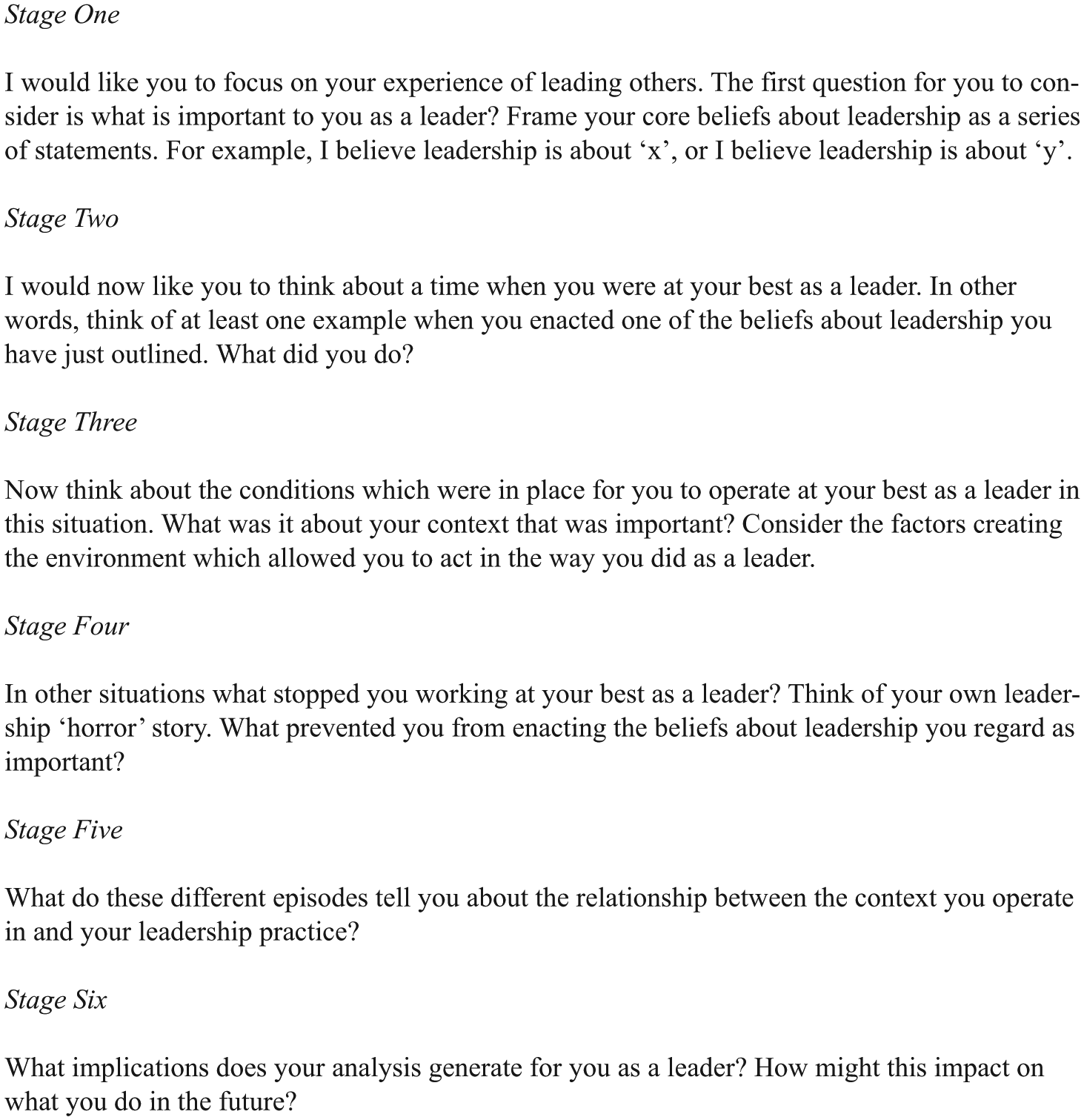
Stimulating a retroductive discussion for leadership learning.
The interactive process set out in Figure 2 illustrates how retroduction can set the parameters for a form of reflexive experimentation through which participants can begin to explore their leadership identity and the factors which distort it (Carroll and Levy, 2010; Carroll and Simpson, 2012). By allowing participants to author their own experience (Nicholson and Carroll, 2013), Stages One and Two provide an opportunity for participants to not only consider what is important to them as leaders, but to think of examples when they enacted those principles. Stages Three and Four encourage the participants to connect with their context, and the aim here is to promote the importance of developing a form of contextual intelligence which can help participants better understand the culture, structures, processes and practices in the organisation which specifically impact on how they do their job. Stages Five and Six then demonstrate how engaging with retroduction can potentially be a catalyst for emancipatory activity. As Smolovic Jones et al. (2015) observe, ‘change must originate somewhere and why not with managers enrolled in a leadership development programme?’ (p. 406). Through the creation of a reflexive workspace, informed by retroduction, the potential exists for the participants to become more aware of the complexity inherent in their context and, through a consideration of the state of power relations in their organisational environment, determine how they might begin to assert their own agency in these situations. Discussion within the group allows for different experiences and approaches – which can then be considered in relation to an individual’s own circumstances – to be shared among the participants.
The retroductive approach presented in Figure 2 serves two purposes in contextual terms. First, it helps both participants and facilitators better understand the relationship between context and agency. Second, it fosters this understanding by the creation of a particular learning environment through which participants can start to build their own understanding of the structural conditions impacting on their role. An appreciation of the importance of context as a subject of inquiry is therefore mirrored in the method of leadership learning.
Limitations of the study and directions for future research
This article contributes to a debate in the critical leadership development literature calling for new strategies for reflexive engagement. Its involvement in the discussion must though be set against an understanding of leadership as a complex social phenomenon. Contributions seeking to inform debates around leadership learning must acknowledge the labyrinthine ways in which leadership identities are formed, sustained and promoted. An issue with this article’s orientation is its focus on the application of a single method of investigation which may appear to work against this understanding. It is therefore important to emphasise that while retroduction may inform knowledge about the particular conditions shaping leadership practice, the potential for alternative interpretations must also be recognised. The case highlighted in the study provides just one understanding for why leaders might behave in ways which contradict espoused approaches. This positioning of the article’s research serves to illustrate the wider importance of scholars developing a nuanced repertoire of approaches. The application of retroduction should therefore be viewed as just one potentially useful tool in a wider research agenda. To further circumscribe its contribution, retroduction is framed in this context as a form of thought experiment setting the boundaries for a process of reflexive experimentation. This capacity provides researchers and professionals with different ways of reasoning and thinking as they attempt to identify the environmental conditions impacting on leadership behaviour. The emergent and elusive tendencies described in the article highlight that researchers, in turn, must be content with capturing fleeting glimpses of particular factors at work.
Reflecting on the experiences of applying retroduction also suggests ways in which the application of the method could be further developed. As an initial exploration of its potential, the article focuses on the use of a blended strategy involving the comparison of different extreme cases. This approach was applied because of the scope it gives participants to stimulate a process of reflexive engagement through the authorship of their own experience. When revisiting the interviews, what becomes apparent is how additional questions, framed by other retroductive strategies, can enhance discussions with research participants and professionals. By way of illustration, consideration should be given to exploring different episodes through the lens of counterfactual thinking (using questions such as could you imagine X without Y) and through social experiments, for example, by asking participants how they would feel about breaking particular norms of behaviour (Alvesson and Skoldberg, 2009). Building on the blended strategy introduced in this study, these approaches allow researchers and educators to investigate further the participants’ interpretation of events by making supplementary inquiries into the statements made by leaders.
These thoughts on the method’s potential generate opportunities for researchers to refine and broaden the role of retroduction in a reflexive context. Creating new points of reflexive engagement is also important given the analysis of individual leadership accounts can be open to interpretation. In this study, the potential exists for different readings of Scott’s account, such as his discourse includes what might be framed as heroic and masculine traits which romanticise his practice (Schyns and Bligh, 2007) and appear to be at odds with his claim to be an ‘empowering leader’. Extending Scott’s retroductive engagement through the supplementary approaches highlighted could deepen his process of self-confrontation (Beck, 1996) and additionally inform the problematisation of his discourse through different lines of retroductive inquiry. Confronting the challenge of interpretative plurality might also be addressed through the structure of the research team. In this regard, Gilmore and Kenny (2015) highlight the value of reflexive pair interviewing, whereby two or more scholars work on the same study to encourage self-reflexivity and an on-going openness to different interpretative possibilities. The potential also exists for a richer research picture to be generated by working with the accounts of others and by assimilating additional ethnographic aspects. This study makes no claims to be representative and draws on data generated by interviews with a small sample of practitioners. While these interviews have yielded some useful theoretical and practical insights, further research is required to more fully consider the potential for retroduction in a reflexive context.
Summary
This article explores how retroduction can be used to enhance the reflexive capabilities of a professional group. It draws upon experiences generated by a critical realist study investigating the work place experiences of communication leaders. In line with the raison d’etre of CR, the research focuses on the structural factors which encourage or inhibit the leaders’ behaviour. In its discussion of the learning generated by the project, the article makes a distinct contribution. While retroductive inference is usually applied in critical realist research during the data analysis stage, this study considers how it can be applied at an earlier and more formative stage of the research process. This approach is positioned as a social and productive application of retroduction in pursuit of a practical form of reflexivity. Through a presentation of an empirical example, the article further illustrates how the interplay between retroduction and reflexivity can enhance understanding of the conditions under which knowledge is enacted, or indeed not enacted, in a specific leadership context.
The study’s findings around the conditions which hinder a prescribed leadership practice add theoretical and practical value by reflecting on the materiality of hegemony and the conditions of its emergence in a specific context. In this regard, the research serves as a warning against normative, naïve and superficial calls for practitioners to adopt particular leadership approaches and practices. The interplay between identity and power highlighted in this article provides just one illustration of the tensions inherent in the practice of leadership. Such a challenging professional context underscores the importance of stimulating reflexivity among leaders to generate both individual and collective learning. The study suggests that the application of retroduction in this regard is therefore useful to researchers working outside of CR’s philosophical frame, as well as on issues other than empowerment. To move from knowing what they need to do as leaders, to a situation in which they might start to enact those practices, the article supports and informs the need for leaders to cultivate a form of reflexive intelligence that is concerned with understanding the organisational conditions which impact on how they do their job.
An interactive process designed for leadership learning facilitation is presented for discussion. The process has been used by the author to stimulate reflexivity among professional students about the impact of their organisational context on how they behave as leaders. Many practitioners can articulate what they should be doing as leaders, but often find it difficult to enact these behaviours in practice. In addition to being a teaching aid in the ‘classroom’ and guiding programme content, the process is also being used to shape more informal personal development conversations with leaders. The article therefore highlights how a method of inquiry originally developed for an empirical critical realist research project has been reconfigured for use in different learning environments. The study therefore responds to Bhaskar’s (2014) call for more ‘critical realism in action’ (p. v). It is also hoped that this critical realist–inspired field work may assist scholars from a range of disciplines who are considering adopting similar research approaches, while for those interested in supporting practice, the fusing of a critical sensibility with a recognition for the potential of agency might be a source of motivation.
