




Abstract
This article explores the role of embodied, sensible knowledge in practice-based learning. Despite recent efforts to conceptualize how practitioners become skillful through corporeal and sensible learning, it still seems under-theorized and hard to understand what this exactly entails. The aim of this article is to account for the inherently embodied and sensible nature of knowledge by drawing on a 2-year ethnographic study of train dispatchers in a railway control room. Embodied and sensible knowledge is developed through the work of Merleau-Ponty and Heidegger, as phenomenology is a way to theorize the body beyond being an object to, instead, account for embodiment as lived and experienced. The data show that such knowledge can be understood as a matter of ‘attunement’: dispatchers become progressively skillful in bringing their bodies and senses in tune with practical situations and perturbations in the environment. The article contributes to a richer understanding of embodiment, especially in the relation between knowledge and practices, in organization studies and management learning.
Introduction
The current interest in the relation between learning and organizational practices has advanced a view of knowledge as an activity, where knowing ‘resides’ in the doing (e.g. Gherardi, 2009a; Nicolini et al., 2003). Central to these practice-based approaches is an attempt to ground knowledge more firmly by arguing that knowing is as much constituted in actual, physical situations as it is in the mind. Says Bateson (1987: 461), ‘The mental world … is not limited by the skin.’ Practice-based studies on knowledge aim to reconcile the divide between mind and body by, for example, arguing that cognitive dimensions of practice are always constituted in concrete sociomaterial situations (Orlikowski, 2002; Suchman, 2007) or by emphasizing the aesthetic and sensible qualities of knowledge (Gherardi, 2009b; Strati, 1992, 2007).
These observations should be interpreted in light of an increasing interest in understanding the role of the body in relation to work and organizational performance (Dale, 2001; Hassard et al., 2000). The embodied nature of practices and knowledge in organizations is explored from diverse theoretical perspectives, for example, by drawing on Bourdieu’s (1990) habitus as a set of (bodily) dispositions, embodied capacities in construing organizational identity (Harquail and King, 2010), the gendered body (Butler, 2011), embodied sense-making (Cunliffe and Coupland, 2012), or in Foucault’s (1995) spirit to illustrate how surveillance creates workers as ‘docile bodies.’ Yet, despite these efforts, it has also been noticed that research on bodies in organizations still privileges a view of the ‘body-as-organism’ (Dale, 2001)—for example, by analyzing bodily movement, gestures, clothing—thereby implicitly treating the body as an object (Gartner, 2013; Hindmarsh and Pilnick, 2007).
One way to address this problem, the path I will follow in this article, is to draw on phenomenology in order to overcome further objectification of the body and, instead, focus on the body as it is experienced and lived. Indeed, as other practice-based studies have shown (e.g. Chia and Holt, 2006; Sandberg and Dall’Alba, 2009; Yanow and Tsoukas, 2009), phenomenology starts from the premise that all human activity is grounded in concrete sociomaterial practices. A phenomenological approach urges us to ‘turn to the things themselves,’ thereby offering opportunities to understand the temporality of knowing and how it emerges through our practical and embodied engagement with the world. For Merleau-Ponty, the body is not a passive slate awaiting some stimuli in the world that then leads to knowledge, but knowing the world means to engage with the world, and this is a ‘bodily, emotional and cognitive activity’ (Yakhlef, 2010: 416). From such a perspective, the body and senses become central aspects in understanding how knowing and learning in organizations unfolds. Lamenting the increasing ‘mentalization’ of organizational life (i.e. the idea that knowledge resides in individuals’ minds and that learning is a matter of successfully ‘transferring’ this knowledge), Strati (2007) coined the term ‘sensible knowledge,’ which is knowledge ‘perceived through the senses, judged through the senses, and produced and reproduced through the senses’ (p. 62). Sensible knowledge urges us to critically engage with what it means to be a skillful practitioner (Dreyfus and Dreyfus, 2005), scrutinizing the relation between the body, knowing, and forms of practice-based learning.
In this article, I draw on the data of a 2-year-long ethnographic study on collaborative practices in the Dutch railway system where, for 2 days a week on average, I observed and followed railway coordinators during their shifts. I specifically zoom in on the practices of train dispatchers in a regional control room. During my fieldwork at this control room, several apprentice dispatchers (ADs) were trained, allowing me to study how dispatching was learned in practice. The findings indicate that a great deal of dispatching knowledge was explained in terms of ‘synchronizing’ bodies with emerging situations on the railways. Moreover, in educating the apprentices, senior dispatchers (SDs) often referred to the importance of the body and senses in becoming a skillful practitioner. This article furthers extant debates on embodiment in organization studies in general and management learning in particular by providing an in-depth account of how practice-based learning is constituted in embodied sensible knowledge. It does so through a phenomenological perspective, which allows transcending the view of the body as an object to, instead, emphasize the temporality of embodiment and knowing.
I start the article by briefly explaining the context of the research setting and the work of dispatchers to argue why an analysis of collaboration in especially control rooms is insightful in understanding the embodied nature of knowing-in-action. I then explore embodied and sensible knowledge through the work of Merleau-Ponty and draw on Heidegger’s phenomenology to explain how such knowledge may be learned. After some methodological considerations, I show how train dispatchers learned and developed sensible knowledge in practice. I end the article by discussing its implications for organization studies and management learning.
Understanding dispatching practices—the role of the body and senses
The train dispatchers in this study work for the infrastructure manager of the Dutch railways, and they operate from 1 of the 13 control rooms that are geographically dispersed over the country. The main task of dispatchers is to create the conditions that allow for the safe coordination of trains. Through several computer systems, a dispatcher has a continuous overview of all trains in her area. She has to create ‘train paths’ or ‘shunting movements’ by operating switches or signals so that the trains ‘out there’ can move from A to B according to the train schedule. Most of the paths and movements are created automatically by means of the ‘process-plan.’ This plan, which a dispatcher monitors, shows information about all train movements, for example, train number, from-track and to-track, and the arrival/departure time according to schedule. During unplanned situations—delayed trains, incidents—dispatchers take over coordination by, for instance, redirecting trains, assigning platforms to trains, or manually operating signal posts. They do so with a large number of official procedures in mind, through several computer systems on six to eight screens on their desk, and with a large number of other actors inside as well as outside the control room (train drivers, dispatchers in other control rooms, police, firefighters, maintenance crew).
Studies on coordination centers, such as airport or railway control posts, have become paradigmatic to our understanding of knowing-in-practice (Gherardi, 2012: 30), as such work takes place across time and space through intense collaboration between different operators and technologies (e.g. Goodwin and Goodwin, 1996; Heath and Luff, 1992; Weick and Roberts, 1993). Operators in control rooms are continuously oriented to coordination problems related to space and time (Suchman, 1997); their knowledge of emerging situations is based on pieces of disparate, heterogeneous, and often incomplete information that they have to ‘assemble’ in order to respond adequately. More recently, these issues are also explored in studies on coordination in general (Bechky, 2003; Faraj and Xiao, 2006; Okhuysen and Bechky, 2009) to, for instance, understand teamwork in dispersed or virtual work.
In the background of these studies, it is recognized that coordination is a collective performance, requiring knowledge not simply located in the mind (e.g. learned procedures or formal interactions) but that is also tacit and happens through the body. Heath and Luff (1992: 73), for instance, highlight how operators in the London Underground have to be sensitive to each others’ activities in order to reach an ‘extraordinary interweaving of sequential and simultaneous responsibilities and tasks.’ Goodwin and Goodwin (1996: 64) show that the baggage handler at an airport must make specific objects—for example, planes, baggage, supporting tools—‘visible to her senses within a relevant organizational network’ in order to coordinate action among different actors. The ‘collective mind,’ allowing for the reliable performance on flight decks, refers to a mind that is as much cognitive as ‘embodied in the interrelating of social activities’ (Weick and Roberts, 1993: 366). Although these studies thus suggest that the body and senses play a role in such dispersed collaborative work, it remains elusive to understand how this exactly happens and how such knowledge may be learned and developed. In other words, we still now little of ‘how the body or embodied conduct is a critical resource that organizational members use in accomplishing real-time coordination’ (Hindmarsh and Pilnick, 2007: 1412).
One way to explore this question is to further scrutinize the inherent sociality of practices and knowledge. Knowledge does not stem from the mind of individual practitioners only but it is through social practices that knowing—cognitive as much as embodied and sensible—emerges (Nicolini, 2012). Thus, although at first glance it may seem that embodiment and sensible knowledge once again prefer a focus on knowing as individualistic—as it is my body that experiences and knows the world—practice theory tells us this is not the case as practices already set the (non-deterministic) rules of how to use our bodies. To make it more concrete, Reckwitz (2002: 251) argues that all practices are ‘the product of training the body in a certain way; when we learn a practice, we learn to be bodies in a certain way.’ In other words, engaging in a practice means to engage with certain rules that go beyond mere factual knowledge but include aspects of judgment and aesthetics (Gherardi, 2009b; Strati, 1992, 2007). I will now explain how we can understand sensible knowledge and practice-based learning through the phenomenology of Merleau-Ponty and Heidegger.
A phenomenological understanding of sensible knowledge
For Merleau-Ponty (2012 [1945]), all knowledge I can have of the world ‘is established within the horizons opened up by perception’ (p. 215). Perception is an essential bodily activity, ‘a pre-reflective grasp of our own experiences … that we do not and cannot understand … in abstraction from its concrete corporeal conditions’ (pp. xiv–xv). Grasping the world happens on different levels of the sensible, as I both have a body that can be touched and I am a body that can do the touching: the body is the medium through which I experience the world and I experience my body via that world. Perception, as action, can be further understood as perspectival, temporal, and intentional.
It is from my body, ‘which is my point of view upon the world’ (Merleau-Ponty, 2012 [1945]: 73), that I perceive and experience the world. Although this seems to imply that perception is always incomplete (as I perceive the world only from my perspective), it is exactly this ‘mineness’ that gives coherence to how I experience the world (Tomkins and Eatough, 2013). Knowledge is not a mental representation of some perceived yet distanced object but is about the capability to see the totality of this object: perceiving an object ‘is to come to inhabit it and to thereby grasp all things according to the sides these other things turn towards this objects’ (Merleau-Ponty, 2012 [1945]: 71). Perception as perspectival does not deny the inherent sociality of sensible knowledge. The coordination work of (train) dispatchers and operators, for instance, is a matter of ‘reading the scene’ (Suchman, 1997), something that happens through the multiple perspectives of available dispatching bodies and tools. Seeing the relation between these bodies and tools gives structure to how to proceed forward. It is in this way that the world discloses itself in practical action; we do not perceive objects scattered arbitrarily in the world but we see a coherent system:
When I see the lamp on my table, I attribute to it not merely the qualities that are visible from my location, but also those that the fireplace, the walls, and the table can ‘see’ … Each act of seeing that I perform is instantly reiterated among all the objects of the world that are grasped as coexistent. (Merleau-Ponty, 2012 [1945]: 71)
Perception is also always temporal in the sense that ‘in the moment of performance we draw on past experiences, present interactions and future anticipations’ (Cunliffe and Coupland, 2012: 83). To say that perception has a past should not be confused with the idea that we have a mental representation of previous experiences stored in our minds and nor that ‘memory lays a previous experience out before us like a painting’ (Merleau-Ponty, 2012 [1945]: 85); the past is not of a different temporal dimension than the present but, rather, is a previous present (p. 87). Thus, perceiving something already seen or sensed before, my body experiences this past in the present. For the dispatchers of this study, being a skillful dispatcher means to be able to make previous experiences sensible in order to make decisions in the here-and-now. Similarly, maintenance workers of airplanes (Goodwin and Goodwin, 1996) or copier repair technicians (Orr, 1996) draw on the specific historical trajectory of machines in order to make sense of present situations and to carve out potential solutions. Sensory experience is especially relevant here, as it has the quality of regaining the past, much like in Proust’s famous passage where dipping a madeleine cake in a cup of tea invigorates the body with a forgotten childhood experience.
In order to show how perception is intentional, Merleau-Ponty makes a distinction between bodily movements as ‘grasping’ or ‘abstract’; the former takes place pre-reflectively while immersed in practical situations (e.g. raising my hand to my mouth to sip from my coffee), whereas the latter is a conscious movement of the body (e.g. raising my hand to my mouth on command). This is not to say that grasping movements are not conscious, but it entails not an ‘I think that’ but rather an ‘I can’ (Merleau-Ponty, 2012 [1945]: 139). Grasping is not mental but understood as the body ‘being toward the thing’ (Merleau-Ponty, 2012 [1945]: 140), anticipating a situation to attain certain goals. It happens against the background of practical situations or the background of ‘the given world’ (Merleau-Ponty, 2012 [1945]: 113). This background is transparent: becoming a skillful practitioner implies to learn and ‘forget’ it (Dreyfus and Dreyfus, 2005).
Although there are important differences as well as similarities between the phenomenology of Merleau-Ponty and Heidegger, it is beyond the scope of this article to fully scrutinize these points. What is important to keep in mind is that both try to formulate a pre-reflective understanding of human beings, Merleau-Ponty through an investigation of the body and Heidegger through an investigation of the being of beings. It is in this sense, as Aho (2005: 2) argues, that Heidegger’s earlier work leaves the notion of the human body unacknowledged because he is interested in understanding the conditions on which anything, including the body, comes into being. In other words, whereas Merleau-Ponty analyzes perceptual embodiment as a matter of being directed toward the world, Heidegger’s project is to show how we are always and already ‘being-in-the-world’ (Aho, 2005: 16).
Learning sensible knowledge as a matter of attunement
When practicing, we always find ourselves ‘intertwined with others and things as we engage in our activities and projects’ (Sandberg and Dall’Alba, 2009: 1351). Therefore, we usually do not encounter equipment as mere ‘things’ but as ‘something-in-order-to’ (Dreyfus, 1991: 62–63), something to attain practical goals. Moreover, and this closely resembles Merleau-Ponty’s idea of the perspectival quality of perception, equipment always belongs to a structure of equipment, as ‘useful things always are in terms of their belonging to other useful things’ (Heidegger, 1996 [1926]: 64, emphasis in original). Understanding the structure of equipment is something that has to be learned. Just remember your first driving lesson where the car, steering wheel, traffic signs, and so on, showed up as different things to be understood; it is in becoming a skillful driver that we start to experience a structure of related equipment. This structure becomes transparent. Being absorbed in a practice means we are not aware of ourselves and the equipment we use; all that we are aware of is the totality that makes up our practice (cf. Yanow and Tsoukas, 2009).
Heidegger distinguishes these different modes of engagement with equipment as ‘present-at-hand’ and ‘ready-to-hand.’ The novice driver stares at the car as a thing still to be understood; the car is something present-at-hand. This is a different mode of engagement with equipment than the expert driver who, while absorbed in driving, only ‘sees’ the car against a practical background. For him, the car is ready-to-hand, meaning that it is ‘bound to the handiness of useful things’ (Heidegger, 1996 [1926]: 69). Equipment in the ready-to-hand way is encountered against a transparent kind of background; the expert learns to ‘forget’ what he is doing (Dreyfus and Dreyfus, 2005).
We can understand such learning as becoming increasingly attuned to situations or disturbances in the world. Being attuned should not be confused with an internal or psychological state. As Zundel (2012: 116) posits, even reasoning or ‘pure’ theoretical deliberation starts from our attunement, something ‘coloring’ how we perceive. Attunement, then, involves the senses in perceiving the world, but this is not a distanced sensation or looking at the world; learning is possible on the condition that attunement discloses the world to us, and this requires being involved in a practice that matters to a specific community:
Letting things be encountered in a circumspect heedful way has—we can see this now more precisely in terms of attunement—the character of being affected or moved. But being affected … is ontologically possible only because being-in as such is existentially determined beforehand in such a way that what it encounters in the world can matter to it in this way. This mattering to it is grounded in attunement, and as attunement it has disclosed the world. (Heidegger, 1996 [1926]: 129, emphasis in original)
For Ingold (2011), every use of a tool is both a new accomplishment as well as a reproduction of past practice: picking up a tool entails ‘a remembering of how to use it’ (p. 57) while, in order to use it skillfully, the tool also needs to remain withdrawn or ready-to-hand. This is not a quality that, once incorporated into one’s body, can be performed mindlessly but emerges from the totality of a situation in which perception and action are closely brought ‘in tune.’ For the skilled carpenter, sawing a plank implies that movement is felt and coupled with perception through fine-tuning or ‘sensory correction’ (Ingold, 2011: 58): ‘The carpenter who has a feel for what he is doing is one who can bring these several movements more or less in phase with one another, so that they resonate or are ‘in tune’’ (p. 60). The skilled dispatcher responds to perturbations on the railways by attuning movements without interrupting involvement with the situation at hand (cf. Yanow and Tsoukas, 2009). This is something learned and developed in practice, with qualities set by a collective of practitioners:
We see with eyes trained by our experience of watching what is going on around us, hear with ears turned by the sounds that matter to us, and touch with bodies that have become accustomed, by the lives we lead, to certain kinds of movements. (Ingold, 2011: 95)
The above discussion has several implications for practice-based learning; a cognitivist interpretation of learning where knowledge is ‘transferred’ is rejected in favor of a dialectical view of learning and practice. Learning is corporeal as the body is our medium through which knowledge about our world emerges (Yakhlef, 2010). Such learning happens through those practices where we pre-reflectively and pre-discursively attempt to ‘grasp’ a situation: the skillful body progressively learns how to respond to situations in the world. Thus, the roof-strippers of Strati (2007) ‘feel with their feet’ and the flute-makers of Cook and Yanow (1993) judge the quality of flutes by their ‘look’ or ‘feel,’ not because they know in an individualist cognitivist sense but because their senses are intentionally directed to the collective practices of roof-stripping or flute-making. Such embodied knowledge is social in the sense that it has to be learned.
Methodology
The findings of this article are part of a 2-year ethnographic research about coordination in the Dutch railway system. Ethnography is characterized by the researchers’ immersion in the (organizational) world he or she aims to study, through diverse methods in order to uncover both the remarkable as well as the mundane activities of organizational life (Ybema et al., 2009). The result is a detailed description portraying ‘the richness of local cultural worlds’ (Bate, 1997: 1151). For this article, I was interested in how dispatchers experience their work, and this required a set of methods inspired by phenomenology (Tomkins and Eatough, 2013). When I realized that the body and senses emerged as important themes, I started to reflect about the role of my own body in understanding the work of dispatchers, for example, by assessing my own sensory experience such as sounds and smells (Pink, 2015; Warren, 2008).
On several occasions, the manager of the control room where I conducted my fieldwork attempted to convince me to study the dispatchers located on the right-hand side. The left-hand side was called ‘The Cap,’ referring to the enormous arched construction covering the Central Station of this region, and the older dispatchers were usually working there. ‘The Cap is a mess,’ I was told, and those dispatchers were seen as ‘anarchists’ refusing to work according to new performance standards. Thus, the selection of participants may have been biased to the extent that I observed dispatchers whom the organization already saw as performing ‘desirably.’ However, these remarks made me more sensitive to the fact that what constitutes skillful practice is disputable, and after my first visits, I felt free to walk around the control room and also observe and talk to those at ‘The Cap.’
Methods and analysis
The main modes of enquiry were observations and interviews. Through observations, ethnographers aim to gain knowledge about how ‘natives’ experience organizational phenomena (Bate, 1997) while at the same time keeping a critical distance in order to observe certain cultural, organizational patterns. I observed 30 shifts at this control room, each observation lasting between 2 and 8 hours, and I conducted nine interviews with dispatchers and team leaders. While in first instance I was concerned with understanding dispatching work and how disruptions were handled in a general sense, my attention was soon directed to the role of the body and senses. This happened when I came to realize that dispatchers seemed to see something very different on their computer screens than I did and, when probed, they had a hard time explaining this verbally and instead used notions such as ‘mystery’ to describe dispatching work. Following Tomkins and Eatough’s (2013) methodological ideas on how to assess experience, I encouraged dispatchers to explain work from their own understandings, for instance, by letting them elaborate what the ‘mystery’ looks or feels like, rather than probing them to fit experience into pre-determined or theoretical categories.
During the course of the study, I also decided to follow several team leaders—most of them were ex-dispatchers—in order to take on a more reflective position. This proved valuable as through them I gained an overall picture of how dispatchers were connected to other functional groups in the railway system (train drivers, national traffic control). Moreover, team leaders’ work consisted for a large part of walking around the control room, and this allowed me to meet more dispatchers than just those who I followed. During observations, I jotted down significant observations, which I then wrote down in a more detailed ethnographic style in the field notes.
The main data sources were the field notes of observations and transcripts of the interviews. Furthermore, I had access to a range of internal documents, such as manuals or handbooks, which were relevant to understand dispatching work from the formal organizational perspective. The analysis happened in an iterative-inductive style (O’Reilly, 2005), meaning that I already started making sense during the collection of the data; emerging themes and insights (such as the body and senses) were then used in order to fine-tune further observations and interviews. At the end of the study, I read the data set multiple times and selected several passages that I clearly saw as a case of embodied and sensible knowledge. I discussed these passages with colleagues to check my own sense-making process (Schwartz-Shea and Yanow, 2012) and I finally analyzed the data as a matter of ‘attunement’ between dispatchers’ bodies and their environment.
Dispatching through the body and senses
An important practice for dispatchers is monitoring the computer systems, meaning that they have to guard that the train service is executed according to the timetable. Indeed, for many dispatching means monitoring the systems and eliminating small deviations in the train service. Managers often invoked that dispatchers were prone to ‘understress,’ implying that monitoring was a mindless task requiring little attention. For dispatchers, however, monitoring was not a passive affair: ‘It may look passive but you are watching and you do see a lot’ (interview dispatcher 12 September 2014). Although monitoring was one of the more mundane practices in the work of dispatchers, they also talked about this with a sense of pride and mystery:
The phone of Mandy rings. She does not pick up her phone but gazes at it and then at her screens, after which she turns to me and starts counting: ‘4, 3, 2, 1,’ and then the phone ‘magically’ stops ringing. She smiles: ‘I just knew he’d hang up.’ (Observation, 15 July 2014)
When dispatchers were asked how they saw on their multiple screens what happens ‘out there’ on the tracks, the replies were often in terms of ‘I just know it.’ Some claimed it was impossible to explain and it almost resembled a magical skill to predict:
You develop the capacity to predict. It’s really strange, but you can turn your back towards the screens and nothing happens. At one point you face the screens again, just like so [sits upright, hands on the table, focused]. And then the alarm goes off! It’s frightening almost. (Interview dispatcher, 11 September 2014)
As phenomenology is about seeking ‘to make explicit the implicit structure and meaning of experience’ (Sanders, 1982: 353), I will now analyze the monitoring practices by drawing on Merleau-Ponty’s insights on perception as perspectival, temporal, and intentional in order to show how dispatching is intimately related to the senses.
When probed, dispatchers explained that monitoring entails ‘reading the screens,’ and this involves some sort of visual translation where the outside (the physical trains, signs, and switches) is brought inside. This happens through their attunement, the coupling between their actions and what they perceive in the environment, and is based on experience; the outside world is disclosed to dispatchers, who are in a practical and relevant situation. Dispatchers do not, as I did, see planning lines, numbers, or dots on their computer screen; monitoring consists of seeing a situation as a meaningful totality (trains, tracks, drivers, switches, signs, the environment, (clock)-time, schedules, passengers, (hi)stories of specific parts of the railways, etc.). In other words, dispatchers perceive, through their monitoring, the railway world as a totality, that is, perspectival while simultaneously disclosing all the other ‘sides’ of a situation like a past experience brought in the here-and-now. Whereas I saw their different equipment as present-at-hand, dispatchers see a coherent and ready-at-hand system of equipment. In the words of a dispatcher,
I see a kind of matrix, draw connections between what I see. Things are coupled. I see twenty trains but still immediately notice the 3300 [train number] misses. It’s a logical order and there’s a connection between trains. (Interview, 5 December 2014)
Monitoring is not an individual endeavor. It is a practice in which several actors attune collectively in responding to emerging situations. Train drivers, for example, are considered as an essential part in how dispatchers ‘see’ the nitty-gritty of situations. Thus, monitoring does not involve a passive ‘staring’ at the screens but is about attuning to the senses of oneself and others in order to inhabit that what is perceived which, in turn, discloses the railway world to dispatchers as a coherent systems that can be ‘seen’ from all ‘sides.’
Dispatching often stands at the hierarchical end of career paths in the railways. Most started at a young age selling tickets behind the counter or as a station cleaner, after which some became train driver or, perhaps, dispatcher. Someone remembers,
We know the rails from the inside out. We started as simple platform guards. When I was cleaning platforms from paper and dirt, I would look up to the Dispatching Post, they always used to be located on the stations, and there you saw the dispatchers. They were Gods for us, up there. (Informal conversation with former dispatcher, 5 December 2013)
This draws our attention to the temporality of dispatching practices. Monitoring involves not only a looking at the screens in the here-and-now but also a remembering of other experiences of the railways from different temporal perspectives. This remembering does not entail a theoretical knowing of previous work but a practical knowing of the railway world. One dispatcher, with almost 30 years of dispatching experience, explains this as follows:
I see screens but also what it’s like outside. I use this [knowledge] when something’s wrong. Once, a train driver called. He saw children near the tracks. I saw on my screens he was just before the Lotus Channel. I know there is this sawmill there, so I asked the driver: ‘Are you in front of the sawmill?’ and he answered yes. I immediately formed an image and knew it’s difficult for these kids to leave that area because of a large viaduct. I translated this information to the police, so they knew where to go, from which side to approach the area. (Interview, 28 November 2014)
The extent to which someone ‘experienced’ or ‘sensed’ the railway world physically was called ‘the amount of gravel on one’s shoe.’ Dispatchers claimed that it was important to have worked outside and walked along the tracks, to have felt the immense weight of a railway switch, and to have experienced what it looks like to enter a dark tunnel in a high-speed train. Once, a dispatcher complained that they nowadays do not get the chance to go outside anymore, as dispatchers are mainly seen as system operators. He found this kind of experience so important that he decided to informally continue joining train drivers when going to or from work by train. He saw this kind of experience as essential to being a skillful dispatcher.
This experience should not be interpreted as something done in the past (which Tomkins and Eatough (2013: 263) call the ‘organizational attitude’ toward experience as a résumé or track-record), but it involves the ability to make a previous experience sensible in the present. One dispatcher, who had been a driver himself, received an alarm call from a train driver who had just witnessed a ‘jumper’ (someone committing suicide by jumping in front of the train), and he immediately knew how to respond as he could imagine and experience, in the here-and-now, what this must mean for the driver:
When I get an alarm call, I have to pick up the phone immediately. This sound has become such a part of my own system that I just have to react. It’s almost like a physical reaction. (Informal conversation dispatcher, 17 March 2014)
Dispatchers’ senses are attuned to those parts of monitoring that matter to them. That is, dispatchers’ bodies are not passively awaiting sensory input but are immersed in a practical situation and intentionally orientated to ‘the responses they anticipate from the world’ (Merleau-Ponty, 2012 [1945]: 261):
‘I can hear them on the other side,’ a dispatcher explains mysteriously. The other side is about 15 meters away, and I can’t hear anything but indefinable noise, a mix between people talking gibberish and rattling telephones. He pricks up his ear: ‘That’s Hank talking now. ‘The next signpost’, he says.’ The dispatcher’s eyes fill with pride: ‘This wasn’t anything important. People start talking differently if something is wrong, you just hear it.’ (Observation, 15 July 2014)
His ears are attuned to a practical situation and ‘know’ what to listen for. The dispatcher hears those bits and pieces of information that are practically relevant for him and he can, paradoxically, only do so by ‘forgetting’ what he is listening for in the first place (i.e. not attending to the ‘indefinable noise’).
When not asked by the researcher to distance from and reflect on monitoring practices, it became apparent that monitoring is a collective endeavor, as illustrated by the following example of two dispatchers (D1 and D2):
[D1’s phone rings but he does not pick up]
[Looks on D1’s phone to see that the driver of train 8800 is calling. He returns his gaze to his own screens to locate the 8800 and switches the sign in front of the train to green]
[Only now, and without having looked at D2, D1 picks up the phone]
‘This is dispatcher Central West. It should be green and you’re ready to go’ (Observation, 13 June 2014)
D1 and D2 are just there, attuned to others and their environment to attend to those aspects that matter to their practicing at that point. The almost banal practice of clicking the mouse button to switch a sign to green reveals how dispatchers’ senses collectively ‘know’ what to do: D1 sees from the corner of his eyes or feels with his body that D2 attends to his phone. D2 hears the phone ringing, feels what time it is, and when he sees that train is 8800 calling, he just knows it stands for a red signal (it happens daily with this train, on this trajectory, around this time). D1, his body being attuned to D2 and the ringing phone, feels when the sign is switched to green and then picks up his phone.
Learning attunement in practice—the role of the senses
Above, I have discussed how we can understand the role of the body and senses in dispatching practices. In this section, I will zoom in further by showing how such sensible knowledge is a matter of attunement and how this is learned in practice. I will first attend to my own senses to explain how I, as the ethnographer, ‘learned’ elements of dispatching practices:
There is something about the sound here, but I don’t know what it is. Sometimes the sound of phones and voices swells into a roar after which it tones down near to a silence, only to be followed by a new eruption of noise. (Field notes, 5 December 2013)
In the beginning, I was not able to make much sense of the sounds, but it did eventually come in helpful in guiding my observations. I could follow a disruption or incident acoustically, and after a while, I was able to anticipate how a disruption evolved: if phones are ringing here and people talk loud, then I know the people over there are busy within the minute. The logical proposition of my argument shows that I was still thinking mentally, but the example also shows that such knowledge is perceived through the senses. Expert dispatchers, having incorporated these sounds into their auditory ‘memory,’ can attune their bodies to such sound without thinking. Another example concerns the sense of smell. One typically entered via the cloakroom, which was located in the kitchen. After a while, my nose could ‘tell’ me what was going on in the control room: ‘cake or pizza?’ The smell of freshly baked cake meant an apprentice had successfully concluded the exams, and the smell of pizza told me that there was a major incident happening, as during such incidents dispatchers had no time to prepare their meals and a team leader ordered piles of pizzas. I now turn to concrete instances of practice-based learning.
Apprentice dispatchers (ADs) are assigned to a senior dispatcher (SDs) who supervises, educates, and evaluates the student. Apprentices learn many details of a specific territory in order to gain enough ‘track-knowledge’ to eventually work independently, and they are taught how theory works in practice. ADs mentioned that the theoretical aspects of dispatching cover just the tip of the proverbial iceberg and that it is important to learn informal rules and tricks of the trade in the everyday ‘diagnosing’ of the railway operations. However, SDs questioned to what extent new dispatchers were actually offered the right tools to become a, in their opinion, skillful dispatcher. Whereas a large part of the training of older dispatchers consisted of actually going outside—for example, walking along the tracks, seeing and feeling the switches, joining train drivers—current apprentices mainly learned their job from within the confinements of the control room. An SD explained that it seemed like the organization was now looking for ‘a nuclear plant operator’ who would just ‘check the parameters of the system’ (interview, 28 November 2014). Dispatchers developed the following practices through which they were able to teach apprentices to assess the sensible knowledge they saw essential to dispatching: knowing, reading, and imagining equipment.
‘Know your equipment’
The knowledge of a specific territory was developed through the senses and shared in narrative form. One day I observed an examination where two SDs evaluated an apprentice on the ‘track-knowledge’ of his territory. Typically, one of the SDs asked questions about specific objects in the apprentice’s territory that had to be answered factually. For example, ‘What is the most extraordinary object in your territory?’ was answered with ‘The level-crossing at the end of 13 Bravo.’ However, they seemed less interested in the actual answer than in the conversation that followed. For, even when a wrong answer was given, they engaged in sharing narratives about ‘this extraordinary object’ and the apprentice gave additional examples based on how he had encountered this object in practice: unlike other level crossings, this one blocks the full width of the street; it detects moving objects through a radar dome but, ironically, it can’t see pedestrians. The three of them together wonder about the extraordinariness of this level crossing, and through the examples the apprentice has encountered in practice he is able to convey his ‘true’ knowledge and show his ‘feel’ for this object; not just as a memory to lay bare analytically but as disclosing the experience ‘in the here-and-now … [with] our more immediate perceptual and sensory faculties’ (Tomkins and Eatough, 2013: 262). At an arbitrary moment, the SDs interrupt the apprentice: ‘Brother, welcome to our club. You’re a real dispatcher now.’
‘Read your equipment’
One dispatcher focused on teaching an apprentice to ‘read his screens.’ Rather than just staring at the monitors, I observed how this dispatcher stimulated an apprentice to actually look and understand what was to be seen. Every now and then he interrupted an apprentice, saying ‘Look at me now. Turn away from the screen and look at me.’ He then asked a very detailed question, such as ‘Where’s the 1200 [train number] right now?’ Once the apprentice answered such questions successfully, which usually lasted several weeks, the dispatcher went a step further: ‘If train 1200 arrives on platform 3, how long does it take you to direct it to track Sierra Echo in the shunting yard?’ Although it seems that answering these questions was factual, reading the screen was more a feeling or scanning movement than an actual, reflective reading. Apprentices were stimulated to use their senses—to look and listen in order to make sense of an emerging situation outside—rather than trusting on the timetable; they were ‘sensitized,’ so small deviations or unexpected situations were easily scanned and felt.
In the beginning, apprentices were surprised by such questions and unable to answer them as their equipment (computer screen, timetable, etc.) was still there, present-at-hand, as things to stare at and yet to be understood. But the SD continued until the apprentice was able to ‘read the screens,’ that is, until (s)he was able to see the practical situation at hand where equipment disappeared to a more transparent or ready-at-hand background. This involved that an apprentice could see the ‘logical order’ of the trains on their screens, set off against an expected pattern. Reading the screens, for example, also disclosed time: since the order of trains repeats itself every hour, dispatchers see ‘a dissonant screen’ when that pattern is disrupted. As an SD explained, this was a matter of ‘learning time’: for apprentices, the time was still perceived as present-at-hand but, once incorporated, it could ‘become part of your system’ (informal conversation, 13 March 2014).
‘Imagine your equipment’
A final example shows how an apprentice, while collaborating with an SD, learns the tricks of the trade in practice both through factual as well as sensible knowledge. An AD is monitoring the area between Central Station and Harbor; an SD sits right next to him, and she is monitoring an adjacent territory:
[AD notices the planning line of train 41800 turning red. It says +7, so the train has a provisional delay of seven minutes. AD presses the left mouse button followed by the right to put the train ‘back in line’]
[Without looking at AD]
‘No, this is the 41800’
[Looks back at his screens]
‘But … it has +7, so better keep it in front of the red. Right?’
[He looks at SD]
[Still without looking at AD]
‘I already gave this one some air. Heavy freight trains need some leeway’
…
[Several minutes later, SD becomes more attentive and taps AD on his shoulder]
‘Can you hear this?’
[She puts a finger behind her ear]
‘It’s a heavy one. It must be the 41800’
[SD stands up and gestures AD to follow her towards the windows where she points to a passing train]
‘Do you see how long it is? Imagine it’s full with coal or dangerous goods. You don’t want such a train in front of the red, that might be dangerous’
[SD explains more details of the territory: the tracks decline so it takes a while for heavy trains to stop for this signal and speed up again; she tells a story about a freight train that got stuck here] (Observation, 17 March 2014)
In first instance, SD pays little attention to AD and the knowing-in-practice is communicated in imperative form, something not unusual for cooperation between novice and expert in coordination centers (Gherardi, 2012: 41). However, the moment the train passes by, she shares her knowledge in narrative form by attending to the senses of AD. As Zundel (2012: 116) notes, attunement should not be seen as ‘an additional emotive appendix to already existing perceptions.’ By asking to imagine a situation being potentially dangerous, SD does not refer to a cognitive imagination to make AD’s factual knowledge of train such and such more complete, but she attends to his senses as imagining always happens in the here-and-now. ‘[T]he imaginary is not an absolute inobservable: it finds in the body analogues of itself that incarnate it’ (Merleau-Ponty, 1968: 77). Our capacity to imagine allows us to experience possible situations in a more sensible way and in a ready-to-hand fashion.
Discussion
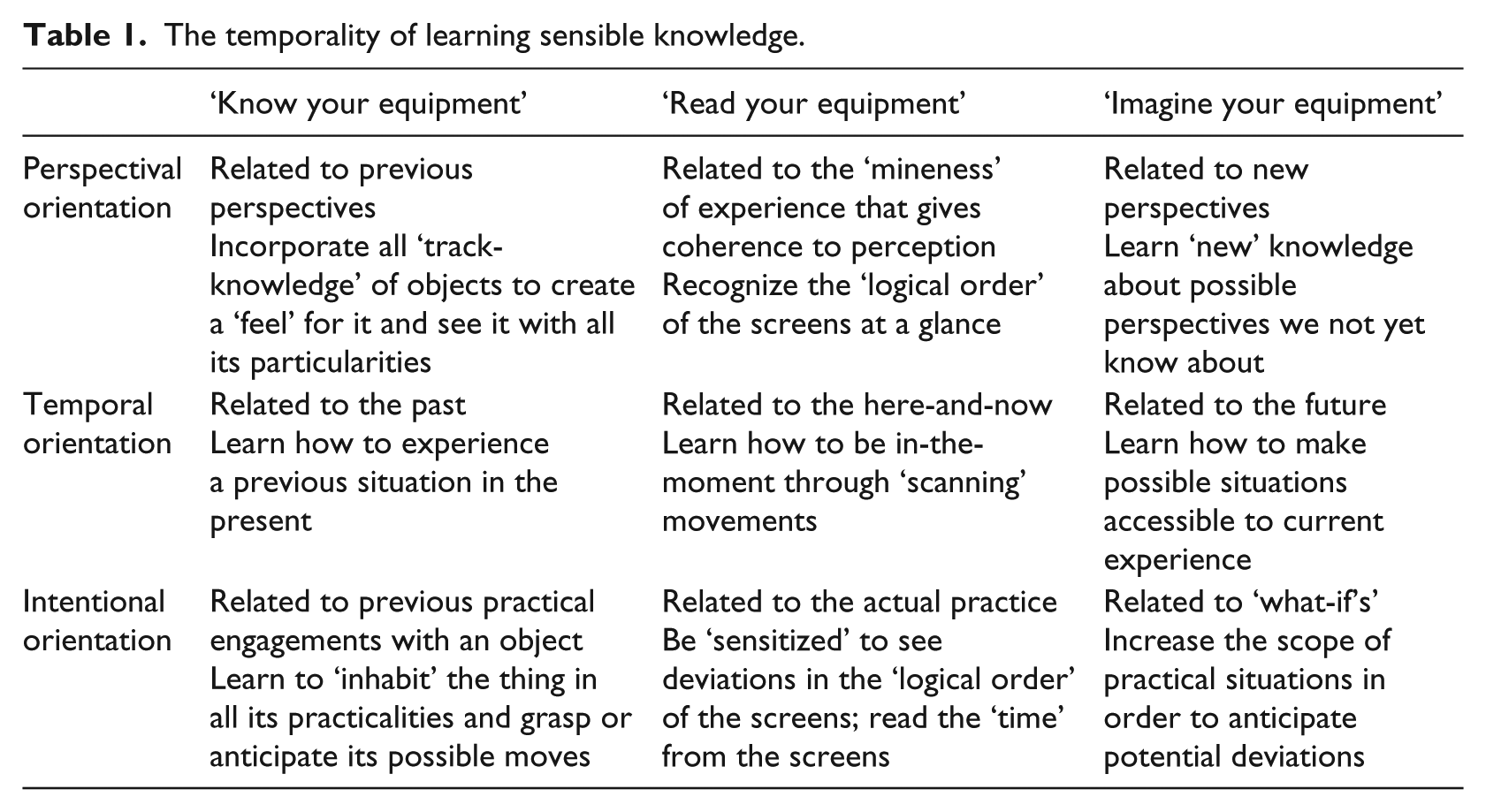
Dispatchers employed several ways to increase the ‘thickness’ of apprentices’ experience of work, thereby drawing on previous, current, and imagined situations (see Table 1). The perspectival orientation of learning deals with skills to perceive a situation from all sides at once, its temporal orientation with drawing past and imagined situations into the here-and-now, and its intentional orientation with getting a grasp on practical goals to anticipate perturbations in the blink of an eye. Now, it is important to realize that drawing on previous or imagined situations is all concerned with the present; it involves making past experience or ‘what-if’s’ accessible to this moment, from this perspective, and while engaged in this practice. ‘Through its horizon of the immediate past and the near future, each present grasps, little by little, the totality of possible time’ (Merleau-Ponty, 2012 [1945]: 87). Remembering or imagining is thus not the mental act of forming an association but involves making the past and future sensible in this moment of my life. Learning and embodied knowledge, then, involves the accumulation of perspectives, temporalities, and practical engagements in experiencing and attuning to current situations.
The temporality of learning sensible knowledge.
In the findings, there is evidence that one becomes attuned to the extent that one is able to ‘forget’ what is present. Forgetting is not a matter of deliberately discarding knowledge from memory. Dispatchers were able to ‘forget’ something only after truly inhabiting it, having perceived it from all different sides, and carefully considering that what ‘has been’ and that what ‘may come.’ Forgetting means to be attuned to something to such an extent that it can retreat to a more transparent, practical background. In Heidegger’s words, forgetting an object means it has become ready-at-hand, and it is in this sense that experts forget that what made them experts in the first place (Dreyfus and Dreyfus, 2005). Attunement means we synchronize our bodies with the world in a temporal sense; we bring, non-cognitively, the past in the present through our sensible experience as the world discloses itself to us. Although this happens pre-reflectively, it involves ‘intense concentration … that is not confined within the head of the practitioner but reaches out into the environment along multiple pathways of sensory participation’ (Ingold, 2011: 18). It is in this sense that the body is a central site of knowing.
Yet, the specific empirical context of this study also urges us to consider the inseparability of sensible knowledge and what we usually think of as cognition. Dispatchers’ work is characterized by the fact that their decisions may have potential harmful consequences, such as accumulating disruptions or even loss of life. Thus, although this article has shown how dispatchers guard their professional values by their own discretion (i.e. joining train drivers to keep experience up to date, or developing practices to teach the sensible aspects of dispatching to apprentices), the role of more formal ways of practicing and teaching should not be downplayed. Factual knowledge, rules, sociotechnical systems that guard safety on top of the actions of dispatchers, formally codified interaction patterns—these are all important aspects that provide the basis upon which dispatchers, through their embodied practices, can do their work. Moreover, also apprentices may bring new meaning to dispatching work, adding yet another layer of perspectives. Experienced dispatchers may be stuck within certain dysfunctional patterns and new sights can introduce more perspectives allowing to eventually be able to imagine situations more fully (see also Weick and Roberts, 1993: 366). This article has highlighted how dispatchers draw on their bodies and senses to collectively coordinate action and decide what is the best way to proceed forward. But it would be problematic to neglect cognition altogether.
The empirical context of this study, although at first glance perhaps very specific, also informs other organizational settings—especially new ways of working. Although I have mainly focused on the temporality of experience and embodiment in this article, there is clearly also a spatial element in the practices at the control room. Coordination takes place from different places at once and real-time decisions are made by collectively attuning to unfolding situation. Since new ways of working increasingly rely on collaboration or coordination between teams that are physically or virtually dispersed, it becomes ever more important to understand how these practices—which are less readily observable than, say, the carpenter who is sawing a plank—expose how knowing unfolds across time and space. This article has shown that the idea of ‘attunement’ may be a fruitful way to explore this further.
Conclusion
Despite its important links with knowledge, the body and its senses remain a long neglected and somewhat marginalized topic in organization studies (Strati, 2007; Yakhlef, 2010). The aim of this article was to explore the concept of ‘sensible knowledge’ into greater detail, specifically focusing on how such knowledge is learned and developed in practice. Drawing on data of an ethnographic study on the practices of train dispatchers, I explained the knowledge of dispatchers as closely resembling the idea of bringing the body and senses ‘in tune’ with emerging situations. Being a dispatcher means to know more than just that what resides in the mind; rather, the body and senses are crucial in understanding what it takes to become a skillful dispatcher. Dispatchers learn and develop this knowledge on the basis of experiencing the railways; that is, besides the intellectual capacity to learn the rules and procedures of dispatching, the railways have to be learned bodily, materially, emotionally by going out there and to touch the tracks, see the switches, feel the fast train enter a tunnel. Such experience forms the basis for sensible knowledge, through which dispatchers were able to closely bring perception and action ‘in tune’ with emerging situations.
I have aimed to contribute to the notion of embodiment in organization studies by providing an in-depth account of dispatching practices, thereby highlighting the importance of the body and senses in understanding how knowledge and practices are intimately related. The chosen phenomenological approach allowed me to theorize the embodied nature of knowing-in-action, thereby engaging with the critique that the majority of studies still treat the body as an object (e.g. Dale, 2001; Gartner, 2013; Hindmarsh and Pilnick, 2007). Instead, I have tried to account for dispatchers’ bodies as lived and experienced, and this has shown that dispatchers not only use their bodies and senses to achieve coordination in teams but that such practices are inextricably constituted in bodies and senses. In other words, a temporal understanding of embodiment highlights that the body is not a container in which knowledge ‘resides’ but that the body, in being attuned to the world, reaches out into the environment by opening up past experiences and future imaginations in the here-and-now.
This also furthers the debate on management learning. This study shows that the extent to which one can learn practices by cognition alone is limited. Attunement is a valuable concept to further understand how embodied, sensible knowledge can be developed and learned, and the findings as summarized in Table 1 help to account for the fullness of such learning by emphasizing the temporality of knowing and how it is learned across different dimensions of experience. Cognition should always be understood in the context of concrete situations. Practice-based learning seems an adequate way to assess the corporeal and sensible qualities of work; not as a mere supplement to knowledge but as a fundamental element of how we know.
Footnotes
Acknowledgements
The author would like to thank Mike Zundel, Jörgen Sandberg, and Alfons van Marrewijk for reading and commenting on earlier versions of this paper. The author is grateful to Todd Bridgman and three anonymous reviewers for their insightful and constructive feedback.
Funding
The author(s) disclosed receipt of the following financial support for the research, authorship, and/or publication of this article: This research has been funded by the Dutch Research Council (NWO) as part of the ExploRail research program WSP [funding number 438-12-308].