




Abstract

I go to a lot of exhibitions. Some delight me, others surprise me, and a few I forget as soon as I leave. But every once in a while, I am completely bowled over by what I see. It opens my eyes, touches my feminist sensibilities and makes me look at the world in a different way. This was the case with the retrospective by the Dutch-Argentine photographer Diana Blok, which took place from 31 March to 29 September 2024 in the Cobra Museum in Amsterdam.
In a series of photographic projects spanning a period of 50 years, Diana Blok explores family and friendship relationships in ways that unsettle gendered stereotypes. She takes us into the lives of the LGBTQ+ community as well as the world of drag queens, transvestites and sex workers from different parts of the world. Blok creates a visceral connection between the viewer and the subject of the photograph. Her photographs pull the audience in and ask viewers to take a closer look at their preconceptions about gender, sexuality and identity (see http://www.dianablok.com/)
Beginning with the series Blood Ties and Other Bonds (1985–1990), she explores family relationships, which do not fit the model of the conventional nuclear family. Her subjects pose nude in a neutral environment. As she puts it, by being unclothed in a setting where all signs of social status have been removed, the identities of the participants and their relationships come into play in a more fundamental way (cited in Foster, 2021). My favourite photo in this series was titled ‘Mother and Sons’. It was a wall-sized blow-up of a mother who (as I later discovered) had recently recovered from cancer. She is held aloft by her three teen-aged sons. In an audiotape accompanying the photo, Blok explains how the sons came up with the idea for how they wanted to pose with their mother. ‘Maybe we should carry her. She carried us!’
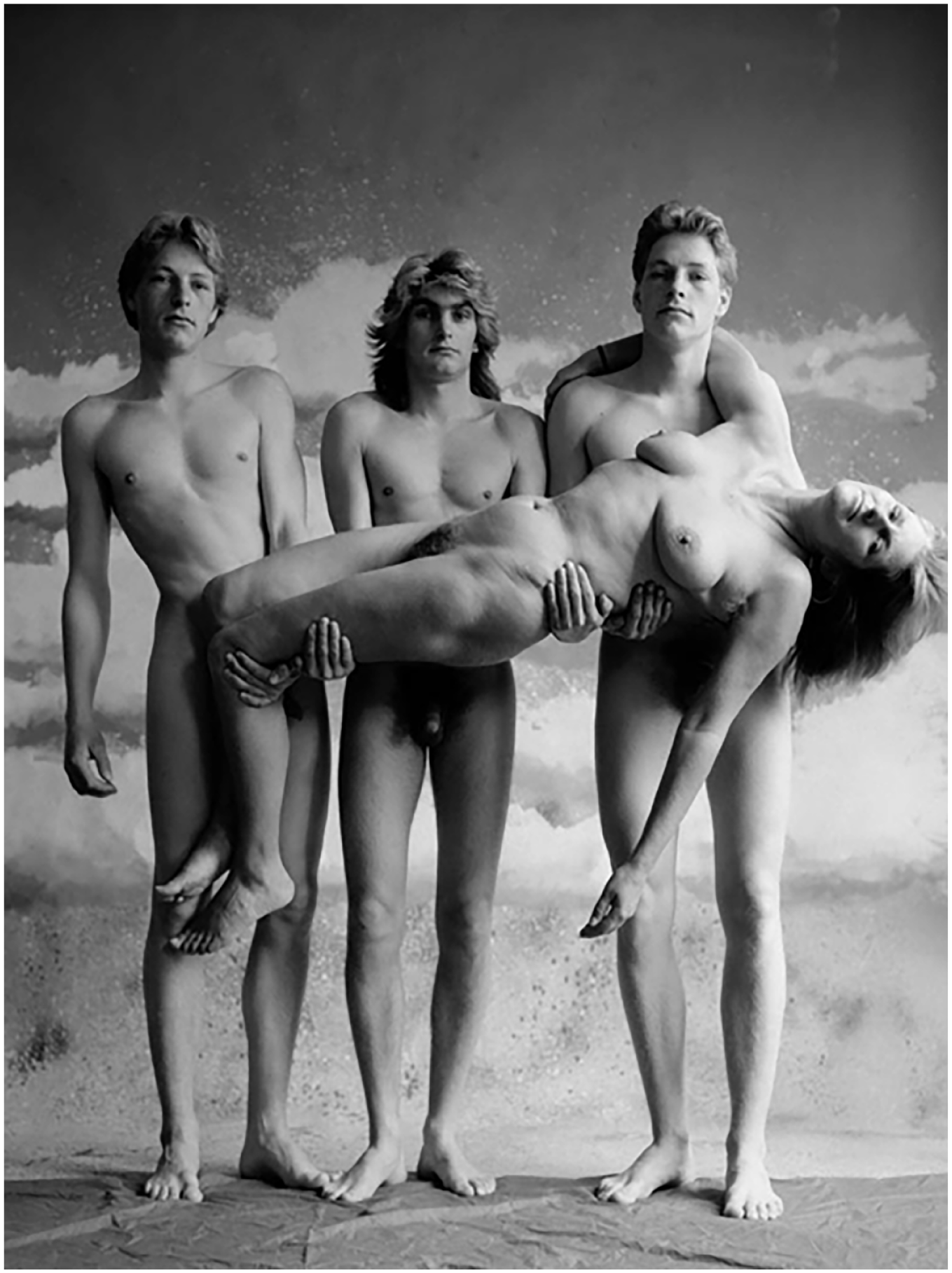
[“Mother-and-Sons”, 1987]
This same kind of direct approach that is both unsettling, yet strangely touching, was beautifully illustrated in the series that lent its title to the retrospective: ‘I challenge you to love me’. Between 2011 and 2014, Blok was invited by the Dutch embassy and other cultural institutions in Brazil to photograph the LGBTQ+ community, something she had done previously in Turkey in her series See through Us (2007–2010). The opening photograph shows the outstretched arm of a Brazilian transman with ‘Eu te desafio a me amar’ (I challenge you to love me) tattooed over his arm where the crisscrossed scars of previous cuttings are plainly visible. This iconic photo says it all. It represents Blok’s desire to portray the lives of people who live outside the conventions of traditional gender and heteronormativity. While her subjects are often marginalised and living under economically precarious conditions, they look unflinchingly into the camera, vulnerable and yet resistant. The photograph below from the same series shows Can, a male to female crossover belly dancer. Blok pulls her viewers into the photograph and challenges them to question prejudices that might prevent them from seeing Can as a person worthy of love and affection. In this way, she creates an affective connection across cultural, sexual, class and other differences that might otherwise distance the viewer from her subjects.
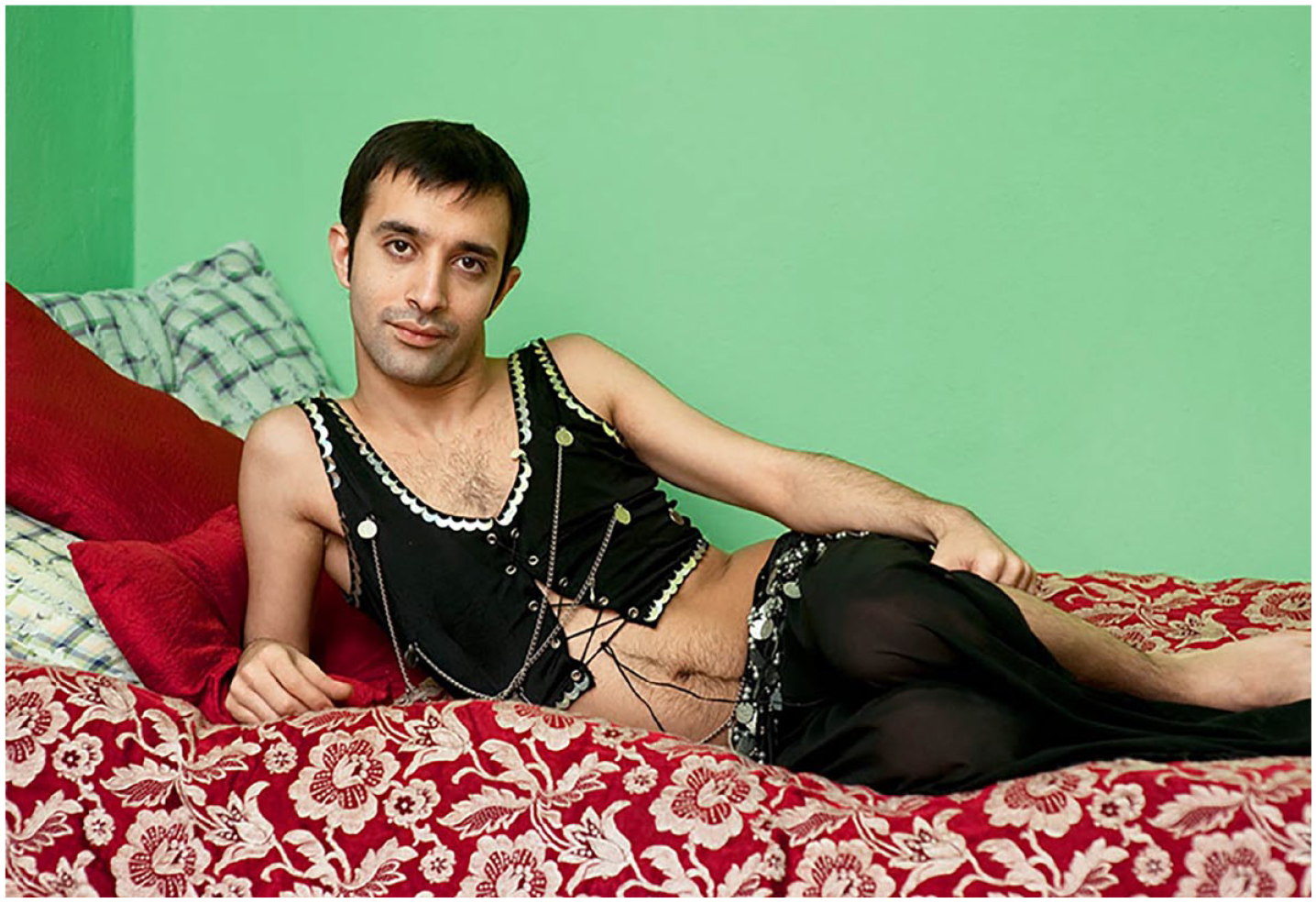
[-“Can”, in Blok, See Through Us, 2008]
While these projects were all interesting and thought-provoking, the two photographic series on gender and cross-dressing were the ones I liked most. Here Blok takes up the topics of gender, heteronormativity and sexual diversity, which are near and dear to any gender studies scholar, and gives them a surprising twist. The first was called Adventures in Cross-Casting (1996) and consisted of photographs of 30 well-known theatre people who were asked which role they would like to play on stage, had they been born as another sex. The portraits were made with a team of costume and makeup artists, completely analogue, with no photoshopping. They invariably chose to impersonate some famous persons or an iconic character, yet their choices were often surprising or unexpected. For example, the grand old lady of Dutch theatre, Kitty Courbois, appears as a tough guy, Don Corleone from the film The Godfather (Coppola, 1972), while the aging gay activist, dancer, actor and TV personality, Alfred Mol, looks out at the camera as a despairing Queen Elisabeth I with lead-white painted face and voluminous, jewel-encrusted gown. The effect is startling. The actors are familiar and recognisable as a man or woman, gay or cis in their everyday lives. But in these portraits, they have become someone else. Moreover, you no longer see them as a man or a woman. While biological sex has become irrelevant, the portraits are all about gender in its many variations. Unshackled from sex, the subjects appear free to try out different genders – genders from different eras and cultures, heroic or villainous, famous or infamous. Anything is possible. As a viewer, this experience was both disconcerting and liberating.
The sequel to Adventures in Cross-Casting came 20 years later and it was my favourite part of the retrospective. Gender Monologues (2016) is a much more ambitious project, involving an interactive media installation with larger-than-life video screens and spoken texts involving an international cast of actors and actress, dancers, musicians (https://www.gendermonologues.com/).
In a darkened room, six life-size video monologues are presented in which the actors impersonate the character they would most like to have played on stage, had they been born of another sex. Each performer delivers their monologue in turn while the others sit quietly and listen, sometimes fidgeting a bit while waiting for their turn to speak. When they have all spoken, six new characters appear on the screens, the full cycle involves 12 to 18 interactions (https://www.gendermonologues.com/index.html). The characters are iconic (Marilyn Monroe, James Baldwin, Federico Garcia Lorca), but iconic in specific cultures (Wangari Maathai, a Kenyan social, environmental and political activist who was the first African woman to win the Nobel Peace Prize in 2004; the 17th-century Mexican nun and poet, Sor Juana Inés de la Cruz, whose portrait appears on the Mexican 100-peso bill). Some are contemporary, others historical (Cleopatra) or fictional (Orfeo Negro, Hamlet). The actors recite texts that were written by Diana Blok and Glauber Coradesqui, a Brazilian dramaturg. The texts sometimes contain the actual words of the characters, but beyond that entail reflections on identity as well as their vulnerabilities, desires, and hopes for the future. The performance leaves you with the impression that you are not only viewing the actor as another person, but that you now know the character better than you did before. The impersonation becomes more profoundly real than the actual reality of the original characters or of the actors performing them.
One thing is clear. Diana Blok has plenty to say about gender, sexual identity and diversity and she does so in a way that is both serious and playful. Reason enough for me to want to talk to her. I wanted to know more about how her ideas about gender, identity and diversity developed, as well as how she finds her subjects and sets up the scenes for the photographs. After a preliminary chat over coffee, she agreed to an interview a few weeks later.
Interview
Diana Blok was born in 1952 in Uruguay to a Jewish Dutch father and a Catholic Argentinian mother. Her parents met when her father, who had been working as a diplomat for the Turkish embassy in The Hague, was transferred to Buenos Aires just before World War II broke out. As a child, she never knew that her father was Jewish, nor that his grandparents and brother had been murdered in Auschwitz. (She explores this unspoken family history in a documentary video: Time Tells, 2012). The second child of a family of four daughters, she explains that her parents had wanted a boy and that she, of all her sisters, was the one who liked sports, climbing trees, helping her father wax his car, and watching him shave. She remembers trying to shave on her own face until she was discouraged by her mother. It was not that she wasn’t attracted to men, but she never liked the behaviour that went along with it. She was, as she put it, just too independent for ‘all of that’.
The family moved around a lot because of her father’s work, living in various South American countries. Diana eventually studied sociology in Mexico and later moved to Amsterdam where she studied art history. She had romantic relationships with women, often artists or writers or theatre people, including an actress who had collaborated with the Chilean film director Alejandro Jodorowsky in his cult film El Topo (1970). While Diana never studied theatre, she was always interested in it, something that influenced much of her work. She initially began exploring photography with her then-girlfriend. Around this time, she made a series of self-portraits in which she dressed up as a man together with her girlfriend, who posed nude. It was meant to be both a critique of the archetypal ‘ideal’ of a male–female relationship as well as an exploration of how to live both of one’s masculine and feminine sides. During the 1960s and 1970s, she was pulled into the fashion world by the actress in El Topo, even working briefly as a fashion model herself. This was not the scene for her, especially because she did not like being told how to pose. However, she remembers one photographer who managed to capture how she was actually feeling while being photographed, which made her realise that this was the kind of photography she wanted to do herself. The seed was planted for the interactive style she developed and refined throughout her different projects. She would talk with her subjects and, together, they would try out different poses until they found the right one. Describing her many projects over the past decades, they always seem to begin with her noticing people who she imagined would be interesting to meet. She might be sitting in a café having coffee and would spot someone at another table. Before long, she would manage to strike up a conversation and sometimes end up asking if they would like to be photographed.
Diana has always been a traveller. Some of her most memorable trips were to India, where she got into mysticism, something that she often uses in her work. ‘Not in a religious sense’, she explains, ‘but as a kind of androgenous energy’. She discovered cultures in which people who were born with more than one sex could be socially accepted, even revered, within their communities. This discovery provided the impetus for her projects on transexuals and cross-dressing. While many of her subjects were sex workers who lived precariously and had experienced violence, there is an unmistakable pride and resistance in the portraits and even a kind of playfulness. As Diana puts it, there is always a ‘wink’ of complicity and flirtatiousness. She describes how this approach enabled her to connect with her subjects. ‘Even though it’s a couple of hours of a life and that I know I will never see them again, but as a photographer I want it to go deeper and to go deeper fast’.
Back in Amsterdam, she was already making a name for herself with photographs for theatre and dance posters and publicity shots of actors and dancers. In 1996, she was given carte blanche for an exhibition at the Theatre Museum of Amsterdam. The only requirement was that the portraits should feature people from the entire theatre world, i.e. not only actors, but dramaturges, composers, dancers, costume and wig designers and so on. Following a brainstorming session with the director and a novelist friend, the project Adventures in Cross-Dressing (1996) was born. The idea had historical and cross-cultural roots:
In Elizabethan times, the women weren’t allowed on stage. And in circuses, which I went to in India, the boys are dressing up as women because the women weren’t allowed to join the circus. So, these elements made us come up with the idea.
In order to realise the project, she mobilised the help of a makeup artist and made many trips to the flea market in Amsterdam in search of costumes and wigs. She generally accepted the character her subjects wanted to play. In her view, the project is about exploring what is important to a person’s identity, drawing upon their imagination as a path to reality. ‘We all have extreme fantasies that we don’t necessarily express but are essential to who we are’. The portraits allow these fantasies to come to light. As Diana puts it,
We live so many things in the imagination without manifesting them. Everybody has a story, but these theatrical stories are about imagination. You can pull out things that are who you are, the more hidden parts, and give them a place.
Having actors impersonate characters through talking had already emerged during the cross-casting project, when Diana noticed that the actress impersonating the character of Shylock had learned a few lines from Shakespeare’s play in order to get into the character. She remembers thinking: ‘Wow, this is like film, because she’s actually acting it. And somehow the idea to make these stills into a moving picture stayed in my memory’.
It wasn’t until 22 years later that she got funding to do Gender Monologues. She found a young Brazilian dramaturg who she had already photographed in the ‘I challenge you to love me’ project to help with the texts. ‘I got on really well with him and he loved the idea and couldn’t wait to do more’. She described doing research for the monologues, not just about the costumes and makeup, but incorporating facts about the lives of the characters, along with more philosophical and political reflections about identity, desire, and transformation. She invited actors from the Netherlands, Spain, Brazil and Suriname to participate. Some had been involved in Diana’s earlier projects. She described the process of how the actors chose the roles and got into them and the kind of improvising that it entailed. While the dramaturg wrote most of the monologues together with Diana for the actors to memorise, the actors also made decisions about how to present them.
A nice example was the Brazilian actress and playwright Grace Passô who chose to impersonate Martin Luther King, Jr. because – as she put it – she wanted to adapt his iconic speech ‘I had a dream’ to the situation of Black people in Brazil today (https://www.gendermonologues.com/actors.html). Grace’s idea was to do the monologue with her eyes closed ‘like in a dream’. But when Grace, having memorised the text, started speaking with her eyes closed, she kept forgetting the text and having to open her eyes. ‘So, I said, okay, look, you know, then just do it with your eyes closed and if you don’t remember, just open your eyes and then continue. And that worked’.
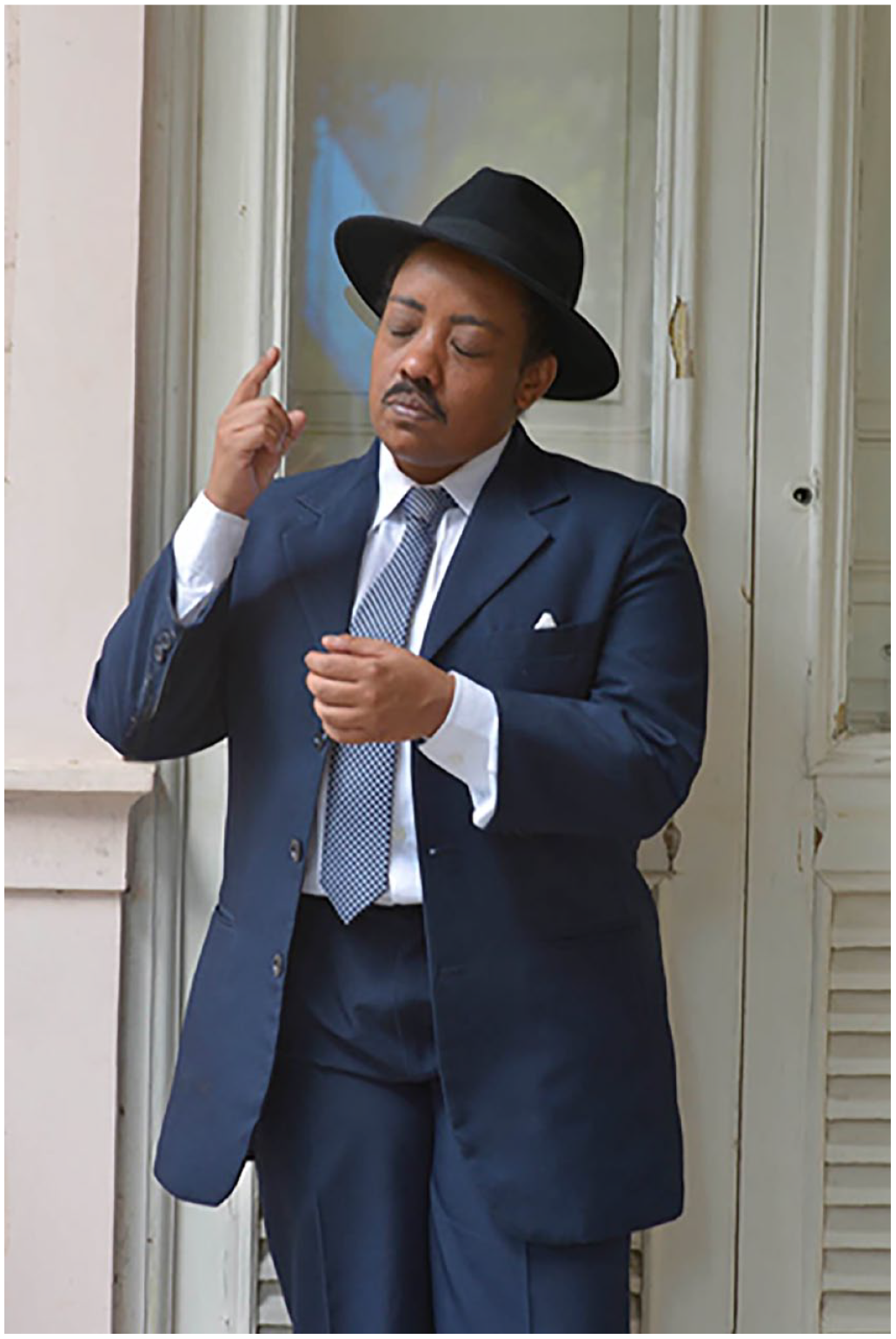
[Grace Passô as Martin Luther King, Jr., Gender Monologues, 2016]
The Gender Monologues have already been exhibited outside of Europe using local actors who chose to impersonate their own cultural icons. Diana imagines expanding these monologues indefinitely, creating a ‘cross-casted library of cultures’. She muses how Marilyn Monroe might figure in the imagination of a Chinese or Syrian actor. Or, closer to home, what kinds of iconic figures would an immigrant community in the Netherlands choose to impersonate? Who would people of different ages choose to impersonate? The possibilities for crossing the borders of gender, sexuality, age, time and place are endless. As Diana puts it, ‘Actually, this series can be a run-forever kind of thing’. These theatrical stories have a certain quality to them – everyone has lots of stories of things they’ve experienced in their lives, but these theatrical stories are so intriguing, because you can pull out things that are who you are and give them a place’. Reflecting on what she hoped the public would take away from her work, she explains: ‘I want them to question what they thought they knew, whether it is about gender or sexual identity or cultural differences. I don’t want them to just walk away and forget what they have seen. I want to open a window so that they will look and experience the world in a different way’.
Opening windows
I went to this exhibition expecting to enjoy Diana Blok’s photography, but I didn’t imagine it would make me look at gender and sexual identities in a new way. You can hardly be a feminist scholar these days without questioning societal conventions around gender and sexual identity. Blok’s photographic art resonates with the work of the queer feminist philosopher Butler (1990) who laid to rest the notion of sex as a biological essence in her – by now – classic work Gender Trouble in which she makes a case for treating gender as performance, something we have to ‘do’ in our everyday lives. Like Blok, Butler (2011) also made use of the metaphor of theatre, whereby drag became her example par excellence of subversion because it exposes gender as a performance of conventions and norms that can theoretically be copied by anybody (or any body). Dismantling the belief in a ‘true’ gender identity was a theoretical project for Butler, but it has had a far-reaching impact on the acceptance of non-conventional gender identities and queer activism, more generally.
Diana Blok’s work echoes these ideas, but with a twist. She moves what has become a somewhat tired discussion in gender studies about sex, gender and identity to a project that gives gender a positive role in spurring our imagination about who we would like to be. She not only invites her subjects to perform gender, but she asks them to use gender as a resource to help them imagine what it would feel like to inhabit a different body and a different identity. The gender performances are both temporary and infinitely expandable. More importantly, they are an invitation to experience what it would be like to have a body that expresses one’s most innermost desires, the person you always wanted to be or, at least, try out. In the process, sex becomes not just theoretically irrelevant, but simply unimportant for the ongoing performance. You can ‘know’ that the person in the portrait is a man or a woman, but this knowledge plays no role in who they have so convincingly enacted. Paradoxically, as sex becomes unimportant, gender becomes more important. It becomes a resource for imagining what it would be like to be someone else and for exploring one’s innermost desires and fantasies.
Diana Blok wants to change how we look at the world. She asks her audience to think about and question what they thought they knew about gender and sexual identity and unconventional lives. Like most radical artists, she wants to unsettle her audience. However, this unsettling occurs in a way I can only describe as an act of love. Her portraits are joyful; she is having fun and so are her subjects. As viewers, we are pulled into an affective connection across differences, which might otherwise divide or distance us from one another. It is a connection grounded in curiosity, in the desire to get to know the person, and an invitation to love them as who they are.
Her work is important because it mobilises a register that is less well developed in feminist inquiry, with the notable exception of Black feminist love-politics with its long history of activism held together by affiliation and communal affect (see, for example, Nash, 2013). For Blok, transformation takes place when you are able to be touched by another person – by their experiences, their vulnerabilities, their hopes and desires. She combines an ethic based on the recognition and acknowledgement of difference with an ethic of love – an ethic that demands we love the ways we are different. In my view, this is an ethic par excellence for any critical inquiry aimed at imagining a more equitable, but also a more joyful world.
Coda
For weeks after I saw the exhibition, I would regale my friends with an animated description of it, urging them to attend it and even going back several times myself. I remember asking some of my dinner guests who they would like to play if they could do a gender monologue. One of the most surprising (and intriguing) responses was from a psychiatrist friend, a middle-aged, balding and slightly pudgy Dutch man. Much to my surprise, he smiled mischievously and without the slightest hesitation, announced: ‘Audrey Hepburn’. I immediately began to transpose the ethereal, pixie-like appearance of Hepburn onto my friend, wondering, in the process, about the experiences, desires and hopes he had entertained that led to this unlikely choice. It also made me wonder who I would like to impersonate and why. Rather than revealing my most intimate fantasies to you, however, I leave you with the question Diana Blok has so provocatively raised: if you could portray a person of another sex, who would YOU like to be?
Footnotes
Author’s Note
I would like to thank Diana Blok for inspiring conversations and Ray Bachelor, Roswitha Breckner, Willem de Haan, Lena Inowlocki, Janice Irvine, and madeleine kennedy-macfoy for their helpful comments on this essay.
Declaration of Conflicting Interests
The author declared no potential conflicts of interest with respect to the research, authorship and/or publication of this article.
Funding
The author received no financial support for the research, authorship and/or publication of this article.
