



Abstract
In this article, we argue that the concepts developed in Central Asia are largely absent from the conceptual toolbox of the national and international academics researching the region in the field of art, activism studies, and education. We maintain that the exclusion is happening for multiple reasons: the domination of English language in global academic debates, the policy pressures for academics to meet global publications expectations in a narrow set of Western academic outlets and the multiple ongoing colonialities and hierarchies in the artistic, civic, and knowledge production processes. By specifically focusing on the case of gendered art, activism, and academic spaces in Central Asia, we show that while the region is used as an empirical testing ground for ready-made Western theories, local art, feminist-activist, and academic initiatives may play as credible sources of knowledge production, forms of resistance, and spaces for transnational solidarity and theorisations. We highlight more caring ways of producing scholarship by describing the concepts of asar and jeong and theorising the three cases of sonic, feminist, and academic asar and jeong. We conclude by urging scholars to focus on anti-colonial, reparative, and inclusive non-extractive research practices and the development of a diverse conceptual vocabulary.
Introduction
The social experience of the colonised world is historically different, and the practical work of feminism, in the settings where the majority of the world’s people live, requires theory that responds to this history. We need to conceive gender theory itself in new and globally inclusive ways.
With the breakdown of the Soviet Union and the re-gained independence of 1991, most Central Asian states fell under the category of the countries ‘in transit’ (Nazpary, 2002; Rumer, 2016; Treacher, 1996) that required to follow specific Western-centric blueprints of development to become democratic (Bossuyt and Kubicek, 2011; Hoffmann, 2010; Landman et al., 2006; Siegel, 2022; Warkotsch, 2006), neoliberal states (Matcharashvili, 2021; Nazarbayev, 2006). These major transformations had a significant influence on the Central Asian knowledge production infrastructure and research cultures that underwent revolutionary waves of transforming from traditional (oral, nomadic in certain parts of the region and Islamic and religious, philosophical, text-based forms in urban settings) forms of knowledge production to Marxist-Leninist totalitarian approaches in the Soviet period. And to Western-centric forms of knowledge production in the challenging conditions of the nationalistic autocratic demands after independence. As a result, many local and regional scholars remain in the unequal position to the new rules of the game of the globalised and Scopus-based forms of knowledge production (Kuzhabekova, 2022). Young scholars fall into the trap of ‘data providers’ when they work as research assistants but often are proper fieldworkers who conduct the interviews, focus groups in local languages or surveys and submit this valuable data to foreign researchers who do not have local language skills but consider this data significant for their conceptualisation. 1 Unfortunately, the complexity of this inequality leads to the lack of locally produced and widely accepted conceptual tools and theories.
While scholars from history (Kassymbekova and Chokobaeva, 2021), social sciences (Marat, 2021), and education (Mun, 2020) have raised the issue of epistemic injustice and Eurocentrism, building on Fricker’s (2007) work, research at large engages with Western concepts to theorise social processes neglecting local epistemologies and concepts (Tlostanova et al., 2019). Central Asia has been peripheralised and considered the ‘backyard’ of either Russia or China (often described as ‘China’s poor neighbours’); or its experience in the Soviet Union was ‘positive’ because of Soviets’ ‘civilizational’ and developmentalist programmes in places like Tajikistan and Uzbekistan. In a lot of these conceptual and stereotypical discussions, there is a hegemonic frame of viewing either Soviet or Russian influence on Central Asia only in positive light without considering how colonial, violent and totalitarian the Soviet rule was on Central Asia or to consider how China’s economic influence and Russia’s political influence preview shuts down and neglects the agency of individual countries and the whole region of Central Asia alike.
Indeed, Central Asia’s othering in global academic debates is not new. Gender scholars have been critiquing the portrayal of women from the Global South as a misleadingly homogeneous group (Lugones, 2020; Mohanty, 1988). Even though Angela Davis (1981) visited Tashkent, Uzbekistan, she does not engage with knowledge and concepts from Central Asia in her work on gender, race, and class. It is our observation that even critical and decolonial writing rarely mentions Central Asia (e.g. Fanon, 1952, 1961 etc), even writing from Central Asia by Central Asian women themselves, is still lacking nuanced concepts from Central Asia itself about the lived experiences of women in the region or in diaspora. Critical scholars based in the Global North and the Global South have highlighted the negative aspect of colonialism on the local knowledge production processes globally (Spivak, 1988), in Africa (Tamale, 2020), and Latin America (Lugones, 2007), to name a few cases. Central Asian experiences often fell out of these debates because their Soviet experience was not considered ‘colonial’ or because their post-colonial and post-Soviet development was often brushed under the same framework as ‘wider Russia’ where many scholars saw ‘post-Soviet’ as a simple extension of ‘Russia’ or Russian sphere of influence. This approach to see everything post-Soviet as homogeneous, universal and always part of the wider Russian world (Russkii mir) or Russian sphere of influence (thinking of Almaty or Tashkent as a peripheral version of Moscow) became a continuation of the coloniality imposed on this region. Adding to this complexity the overdue absence of the ‘race’ debate that could be applied to Soviet coloniality in the form of strict imposition of ‘ethnicity’ (Brubaker, 1994) distanced Central Asia’s input to decolonial debates. While there is racialisation, discrimination, and hierarchisation based on gender, race, and ethnicity of and within the region, there needs to be a development of appropriate vocabulary to connect Central Asian experiences, histories, and decoloniality to the lived experiences of race.
To address and partially repair intersecting chronic and ongoing complex epistemic and social injustices, we offer to engage more seriously with locally produced concepts as credible sources of knowledge. We propose to also include the knowledge from ethnically minoritised communities, in our case – Central Asian Koreans, who sometimes self-identify as koryo saram. 2 This proposition comes from the necessity to break away from the coloniality of knowledge production that in Soviet times required a totalitarian form of praising Marxist-Leninist frameworks in all research, and in the era of independence, often labelled by the ambiguous term ‘post-Soviet’ – the mechanical application of Western concepts on Central Asian soil. Both processes neglected and marginalised the local knowledge production where Soviet intellectual apparatuses considered indigenous knowledge of Central Asia as ‘backward’ and requiring ‘further development’ and Western knowledge production at best considered this knowledge another point in the dataset but rarely treated it on equal conceptual terms (see Kudaibergenova, 2017) on the discussion of Soviet discourse of Central Asian ‘backwardness’). In these processes, Central Asia became a testing ground of different concepts – from Soviet ethnographic knowledge production (Hirsch, 2005) to the theories of clans and authoritarianism (Collins, 2004, 2006; Jacquesson, 2012; Schatz, 2002, 2005). In short, the knowledge production in Central Asia experienced double colonisation (Tlostanova, 2012, 2018) – from the Soviet colonial hierarchisation and totalitarian approach to the specific knowledge production frames and equally by the European coloniality that influenced both Soviet and Central Asian socio-political and epistemic projects.
The double colonisation of Central Asia posed the question of whether the Central Asian subject can think and produce their knowledge outside the colonial frameworks. It also overshadowed local practical knowledges labelling these as ‘backward’ and juxtaposing them to the ‘rational’ and developed ideas of Soviet modernity (Tlostanova, 2012, 2018). The imposition of the dominant Soviet modernity meant that local and indigenous knowledge that did not fit the model was either purged or significantly censored or broken down and reshaped to fit the Soviet framework whether that was a framework of ‘people’s friendship’ to downplay the ethnic hierarchisation and control seeming inter-ethnic stability in multiethnic republics or the Soviet postulate of gender equality hiding the colonial paradox (Kandiyoti, 2007).
In this article, we urge to do conceptual and methodological work with Central Asia rather than ‘on Central Asia’ as most of the previous conceptual work proposed. We take on the feminist scholarship call of a critical reflexive ethics (Madhok, 2020) and to critically consider where we are theorising from and how we approach the inequalities created by the global power relations of knowledge production. We take inspiration from Latin American Rivera Cusicanqui (2020) in trying to root and connect the Central Asian concepts in grassroot struggles and practices. We agree with scholars calling for the need for an epistemically pluriversal knowledge creation process, which highlights the width, breadth and depth of non-Western knowledges to describe the world (Escobar, 2018; Reiter, 2018). Hence, the article calls for the development of anti-imperial epistemologies from Central Asia, building on existing concepts informed by its history, cultures, and socio-political placeness. 3 More specifically, we focus on the concepts of asar and jeong in Central Asian academic and activist spaces as a reparative pedagogical practice. We do not intend to romanticise the concepts and claim to provide a holistic and expansive overview of them, or even ownership, as due to the fluid nature of them it is not possible. Rather, informed by the decolonial intertwined nature of theory and practice, we show their interpretations and enactment in practice in the following subsections. Decolonial praxis in Central Asia calls for the critical assessment of multiple colonialities (from Eurocentrism to the secondary coloniality of the Soviet empire) and reclaiming indigenous knowledge that is not comprised or conceptualised within the ethnic hierarchy imposed by the Soviet Union where there is a clear differentiation and power relations attached to different ethnic groups, for example, titular ethnicity versus ethnic minorities. Central Asian women produce collective works on decolonisation and one collective zine demonstrates that such discussions are complex and there is no one singular definition or vision of decolonisation. 4 As it is written in the zine, some women are concerned about motherhood, some with personal trauma and others with rejecting nationalistic narratives as decolonial. With our work by describing local concepts of asar and jeong, we are joining Madhok (2024) who advocates for the creation of anti-imperial conceptual vocabulary: ‘First, an insistence on conceptual production from most of the world and this is a matter of an epistemic urgency – we urgently need conceptual work from site-specific contexts in most of the world’ (p. 1479). We add our voices to the growing debates of Central Asian feminists.
The article starts with the conceptual definitions of interpretations of asar and jeong, transitions to our decolonial methodological reflections, and subsections describing the three central cases of sonic, feminist, and academic asar and jeong. We conclude by gesturing towards the theorising potential of asar and jeong as reparative concepts.
Defining asar and jeong
There are no strict definitions of neither asar and jeong, as these concepts and practices are passed by one generation to another in a form of orally transmitted knowledges, practices, feelings, and community ways of living (Darmenova and Koo, 2021; Urinboyev, 2018; Usmanova, 2020). Hence, the definitions are constantly in flux, subject to interpretation and an adapted meaning that is crucial for Central Asian decolonial practice away from the rigid fixation of the colonial languages and categories. While we recognise and honour the fluid meaning of these concepts, which potentially ensured their resilience and survival despite multiple ongoing colonialities, we are proposing a few working definitions that we operationalise in this article.
Asar, also known as hashar, is a concept of mutual community help, when people come together to help someone in need. This can come in the form of financial or infrastructural help but also is a form of community-building and sustaining internal networks of mutual help even if it is non-material, for example, in the form of acknowledging your knowledge and experience. Asar as a mutual help and community-making process often happens spontaneously. If a crisis hits close or far, in one’s own country like Kazakhstan or abroad, like war in Ukraine, citizens search for spaces where aid is accumulated (punkt sbora) and where anyone can bring whatever is needed for the affected community. Depending on a scale of crisis, there can be a network of donation spaces and groups of volunteers organising, sorting, and sending donations to the crisis-affected communities. Sometimes the asar aid and networking can react to the crisis much faster than the state institutions and state response. For example, during mass floods in Kazakhstan in the spring of 2024, asar groups in different cities of the country responded with the aid collection faster than the state institutions that were under significant critique from the people in affected communities, especially in the city of Kulsary, in Western Kazakhstan. 5 As one of the Kazakh anonymous activists even once said that Kazakhstani citizens do not need their government or the authoritarian regime because they can self-organise, provide community help and deal with all the emerging crises themselves quickly establishing alternative infrastructure and networks away from the bureaucratised state institutions and be much more efficient in crisis-dealing.
In this way, the Central Asian concept of asar works as an effective, deeply community-driven practical tool away from the Western and often alienated concepts of ‘civil society’ or ‘good life’. Asar works as a natural, practical and emergent, immediate response to problem rather than heavily politicised and westernised ideas. Community knowledge matters because
it is the sensation of social cohesion based in culture and in the values and beliefs shared that molds individual human development. If the people live together, cooperate in a way that enables them to reciprocally prosper, they amplify their individual options. (Guinazu, 2008)
Similarly, jeong is a concept of mutual help and relatedness that calls for the development of the feelings of care about both human and non-human subjects. It is both a form of a feeling, an indigenous way of thinking about the world and existing as a human. It calls for thinking of the others as the extension of the self, moderate consumption of natural, social, material resources and an emphasis on the human being a part of the community rather than an individual exclusively rational self. It has an important cultural meaning and shapes the social relations in China and South Korea. In South Korea, jeong invites thinking about oneself in relation to the other and the community (Lee, 1994). Fundamentally jeong is a type of an emotion and is a relationship that forms under particular social conditions of people struggling together, seeing oneself as an extension of the other, and in need to act in the interests of a community (Choi and Lee, 1999). The key jeong characteristic is that the feeling should be lasting, it can be both negative or positive, and involves the cultivation of perseverance, survival, and endurance.
Researching in and with postcolonial and decolonial contexts frequently entails the processes of learning and unlearning, attending to the gaps in the knowledges and the reparation of such gaps. It’s a complex ongoing process. Here, we are ‘repairing’ the neglect of the minority knowledges in Central Asia by purposefully engaging with the concept of jeong. It is important to note that the exclusive narratives of belonging to Central Asia can be perpetrated not only by the ‘foreign’ scholars researching the region, but also by the ‘local’ scholars who only write about the ethnically Kazakh, Kyrgyz, Tajik, or Russian citizens of the related Central Asian contexts. Hence, informed by the decolonial praxis, the entwined nature of action and theory, we are extending the usage and theorisation of jeong in Central Asia to highlight the importance of the conceptual diversity from the communities of the displaced Koreans.
Asar and jeong are concomitantly similar and different. Both are developed and practised by the communities, by the people, from the ground up. Both emphasise thinking of oneself as a member of a wider community, of a society. In essence, asar and jeong promote grassroots democratic values of helping each other, promoting the values of engagement, compassion, and care for all that is human and non-human, for instance, natural resources, material commodities, and cultural objects. Central Asian nomadic and displacement histories require attentive relation with the environment that is often organised through local practices and knowledges like jeong and asar. We have observed how communities in the disappearing Aral Sea areas in Kazakhstan and Uzbekistan are working locally to sustain the population of fish and animals dying out or out-migrating due to this enormous colonial-ecological catastrophe caused by the Soviet economic goals to produce more cotton in the region (Peterson, 2019).
Although asar is widely known in Central Asia and jeong in South Korea, especially orally and in everyday contexts, and some studies about the concepts do exist, they are generally not well theorised in academic literature in neither of the languages. The concepts have different cultural and philosophical roots, as asar is stemming from the steppes, jeong is an extension and interpretation of Confusian beliefs. By engaging with asar and jeong and theorising the two, we are aiming to remedy the epistemic gaps in academic spaces that capitalise Western and European philosophies and concepts as worthy of theorisation, and the non-Western knowledges as opaque, mysterious, or ‘exotic’. Furthermore, because of the reparative nature of asar and jeong, we are naming them as reparative pedagogies that address the epistemic injustice prevalent in the global research ‘on’ Central Asia.
We agree with the critique of a Central Asian decolonial thinker – Syinat Sultanalieva (2023) – who critically writes about the places considered ‘unimportant’ and thus, under-researched and that
there is a lack of analysis of how local [Central Asian] women’s rights movements are developed in such localities, how they may be influenced by double or triple colonialities, and whether there are any specific characteristics in the local practices that could expand the general understanding of how feminism is rooted on local grounds. (p. 3)
In this article, we argue that local concepts like jeong and asar reflect more on the practical and epistemic nature of the local processes. At the same time, the inclusion of these concepts into the wider and global debates about feminist decolonial developments in all parts of the world allow us to engage in the epistemic repair that these societies have experienced for decades.
Jeong and suhbat as decolonial methodology
While Western theories are critiqued for the limitations and lack of attention to local ways of knowing, what about the social science methodologies? Traditionally a methodology section describes how data was collected, in what time frame, the rigour, and the limitations. We agree that these issues are important. Yet in this article we propose a few decolonial methodologies of suhbat and jeong that are creative, yet, we argue, are appropriate for our project. We agree with Madhok (2020), who highlights that one needs to continuously think about the ethical questions about cultural appropriation in working with indigenous concepts:
. . . how to demonstrate ethical responsibility by not appropriating epistemologies of subaltern movements or indeed indigenous mobilizations in the Global South, on the one hand, and/or by not displaying historical amnesia about their temporality, location and counterhegemonic contributions, on the other hand? (p. 407)
As academics trained in the most elite British research universities, we are very familiar with the standard ethical training, which we employ in our research. We also argue that one needs to be even more thoughtful and caring about the research participants and design in decolonial work. We are aware of the new literature on decolonising methodologies and using locally informed and culturally relevant ethics in Central Asian research (Gafu and Parmenter, 2025) and hope our project is contributing to this new scholarship. Tamale (2020) says: ‘Colonial intellectualism deliberately denigrated Indigenous oral traditions and wisdom as illegitimate methodologies and tools of storing records’ (p. 5). Hence, it is our anti-colonial stand to envision oral methods of suhbat and jeong as methodologies and ways of collecting and holding concepts and stories with care.
In Kazakh language, suhbat stands for a very particular type of a conversation that is the opposite of a small talk or a regular exchange of information between two colleagues. Suhbat stands for a genuine, honest, deep conversation that emphasises honesty, vulnerability, and self-reflection. We propose this article serving as suhbat between the two co-authors, and the writer and the reader of this piece. It is not our intention to sew the divisions on who can research Central Asia or serve as the gatekeepers of monitoring of what conceptual tools to use when writing with the region. On the opposite, while we are critiquing the dominance of the over-reliance on Western theories to look at the Central Asian empirics, we are arguing for the extension of the epistemic toolbox, stretching as to what counts as a theory or even valid way of knowing, being or conducting research.
In embracing jeong as methodology, the proposition is made to not only focus on the outcomes of the research and the impact of this process on the research participants, but on the producers of the knowledge as well (Mun and Min, 2022). Both co-authors of this article worked on it despite the work and personal commitments, to write a piece that would bring some new insights to the development of the field of Central Asian studies. Jeong as a type of emotion can be developed in hardship, when people struggle together. It was not a straightforward task to develop this article, as the literature in multiple languages had to be analysed, and oral stories in Kazakh, Korean, English, and Russian languages. The topic of repairing epistemic injustice requires an emotional labour to rethink what it is like to be a woman of colour, in a predominantly male and white British academic space, in which both co-authors are currently inhabiting.
On the issues of positionalities, jeong and suhbat require deep and honest conversations with each other and with ourselves. Hence, we recognise our own hybrid and evolving identities as being at the same time British academics at elite universities, yet with the history of migration from Central Asia to Europe. The authors of the article are women of colour with complex mixed ethnic identities of Korean, Kazakh, Russian, Tatar, Kashgarly, Ferghan, and North Ossetian heritage. Although ethnic identity is not central for the self-identification of either author, we recognise the impact of this socially constructed, imperialist cultural socialisation on our lived experiences and ways of external identification.
The limitations of our approach and methodology are that it is not representative, and we have selected the cases for illustrative purposes to reveal the interpretations and examples of asar and jeong. In short, this is a decolonial article that assumes the fluid process of analysing cases, when one is attempting to theorise a concept that was passed orally and through practice from one generation to another, and it is not an easy task to then ‘package’ it in the form of a traditional Western academic article. How does one cite a song, an artwork as a credible source of knowledge? Yet, we argue, that particularly in the postcolonial contexts, it is the family archive, a song, an artwork and the personal, the suhbat with a dear colleague – can serve as a rich epistemic material, an archive and a method.
The motivation for writing this piece is a shared concern, jeong or asar, of how to not re-create the multiple extractivist research practices. Based on the secondary data analysis available digitally, we have selected three cases from artistic, feminist civic and academic spaces as interventions to demonstrate asar and jeong at work. The common thread connecting all three selected cases is gender, since similar gendered epistemic injustices happen in the music industry of the case of sonic asar and jeong, in gendered violence in the second case of Saltanat’s Law and the third case shows the power of female solidarity in resisting and creating alternative caring academic practices in individualising neoliberal academia. The cases below are not merely empirical examples. Rather, we see their description as part and parcel of the asar and jeong conceptualisations.
The case of sonic asar and jeong in Moldanazar’s ‘Kogersin’
Music and film industries are very patriarchal and male dominated fields in Central Asia. Recently published, a first of its kind encyclopaedia on pop music industry in Kazakhstan edited by Kokhan (2024) barely mentions female producers, especially the ethnically minoritised ones, despite their well-recognised contributions to the music industry, unprecedented commercial success of their projects with some of the largest viewed music videos ever produced in Central Asia. 6 Such exclusions are not accidental. While globally Central Asian knowledges are marginalised and ignored, minoritised female academics, producers, artists face multi-layered colonialities and exclusion externally and internally (Chankseliani, 2017; Mun, 2020).
Yet Central Asian female producers, activists, artists and musicians, though largely ignored and unknown by the Western, Eastern, and Southern societies, actively participate in the creative processes and solidarity events with other marginalised communities. Humanitarian projects for Palestine exist in mosques, for instance. As a result of a war started by Russia in Ukraine in 2014 that spread more widely in 2022, pro-Ukrainian protests erupted in Almaty city, with many participants attending the international-minded peaceful protest marches for the first time in their lives. Resistance and solidarity continued in the artistic spaces, which in general are the most active resistance spaces in Central Asia (Kudaibergen, 2024).
To call for peace, Kazakh language music band Moldanazar produced a video titled ‘Kogersin’, which from Kazakh translates as ‘Dove’. 7 The video gained popularity on major social media platforms, on YouTube, and has direct subtitles from Kazakh to Ukrainian language, without the reliance on Russian language. It was presented at the festivals in India, in Mumbai, which directly develops South-South artistic collaborations. The plot of the story focuses on a conflict and war that is staged by a group of children of mixed genders (Image 1). It is unclear what the country where the events take place is, and shows the general nature of oppression, suffering, and healing (Image 2). One party destroys the houses of the other, imprisons the opponents and bullies a boy. This might gesture to the political oppression within Central Asia. The video ends on a peaceful note of a boy, who was bullied, building a shelter for all children in the type of a traditional Kazakh house–yurt (Image 3). The rain washes away the memory of fighting and anger, the rays of sun enter the hiding place through shanyrak, which is an opening at the top of the yurt (Image 4). The stills from the movie clip show the aesthetic set up of the project, which predominantly was filmed in nature showing how people colonise each other, the nature and the animals:
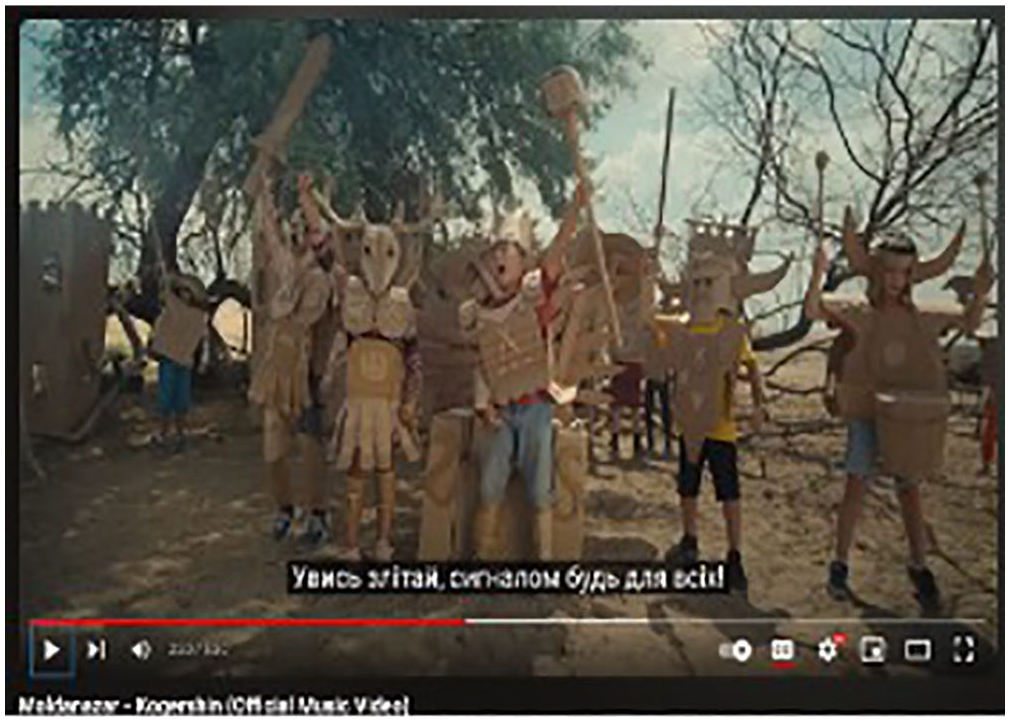
The oppressors.
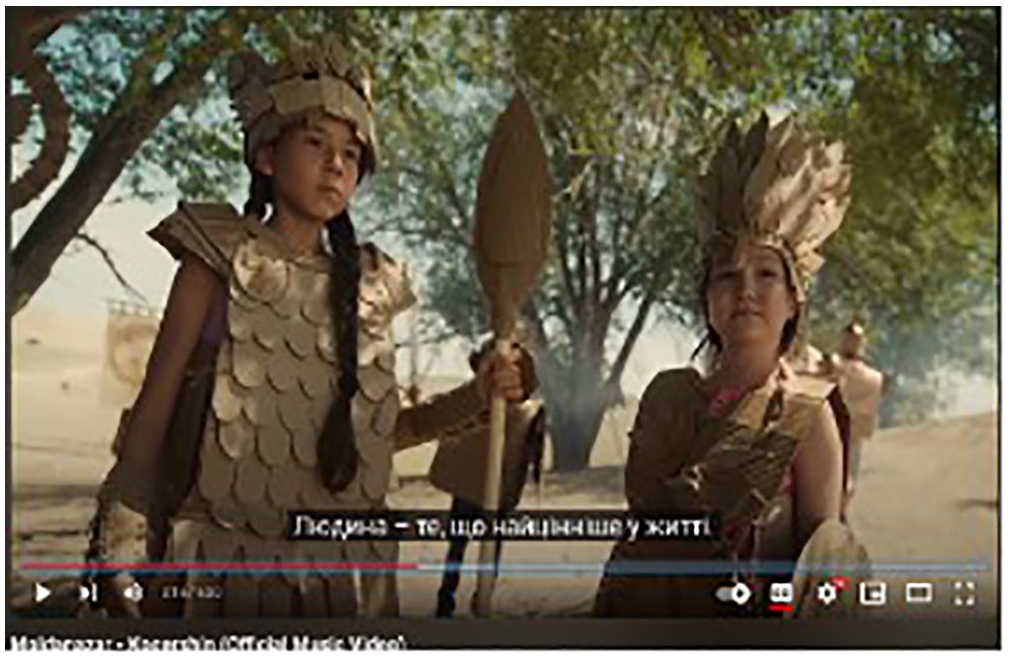
The fighting scenes.

Doves and shanyrak.
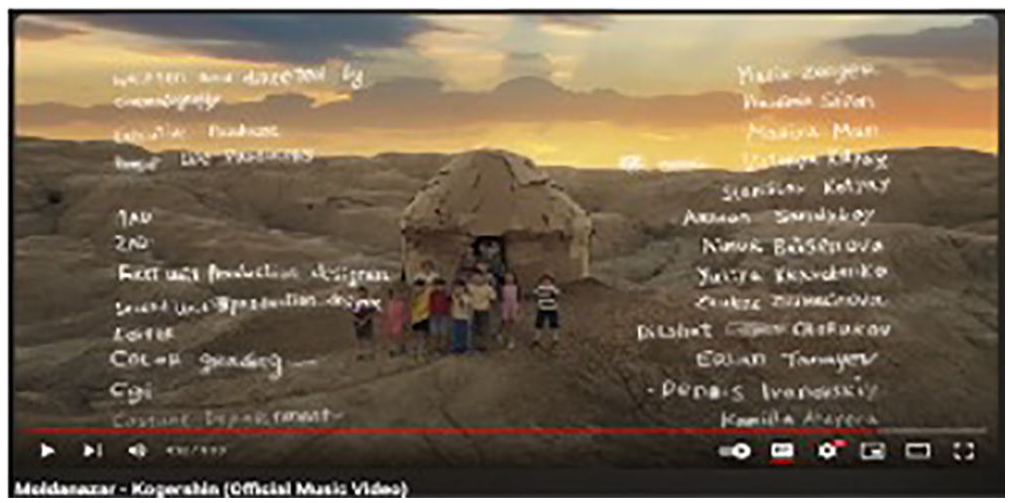
The yurt.
We argue it is a case of a jeong or asar for several reasons. First, it was produced by an explicitly multi-ethnic production team where a majority of staff was coming from diverse mixed backgrounds of Korean, Kazakh, Russian, and Tatar ethnicities. Importantly, the main goal of the video was a focus on peace, an idea that even though societies can go through violent times, conflicts, and wars, only peace ensures human flourishing. It is important to note that peace is seen as a feminist issue, as the female producer Mariya Mun with a multicultural team explicitly chose to prioritise the anti-war statement. 8 Asar and jeong were demonstrated in action, as the production community and artists, without a major external sponsor, mobilised and made a video calling for peace, despite a broader autocratic political environment prohibitive of the public discussion of the Russo-Ukrainian war. We interpret it as a case of asar and jeong, and as an illustrative decolonial case as per Rivera Cusicanqui (2020), as it is the grassroot initiative. The creative team led by a woman chose to do a project on peace, making a statement that women would like for their political opinions to be heard via an artistic medium, that women are not voiceless and are actively engaged in artistic and civic processes. ‘Kogersin’ demonstrates artistic resistance in neoliberal contemporary Central Asia, recognising the artist’s need to engage in commercial projects, while also doing such pro bono unfunded projects driven by internal motivation to advocate for peace, hence, shows a very localised understanding of what is Central Asian feminism, and what Haraway (1988) described as ‘situated knowledge’ that will contribute to understanding global feminism(s). The video was watched more than half a million times on YouTube platform alone, providing a pedagogical value at scale.
Saltanat’s law: Feminist asar and jeong for gendered justice
In early November 2023, Kazakh media and social media platforms were hit with the devastating and horrifying news that a young woman, Saltanat Nukenova, the wife of the ex-minister of economy Kuandyk Bishimbayev, died after he beat her up to death in his own restaurant in Astana. 9 Bishimbayev, who was once the youngest minister, and in the words of ex-dictator Nazarbayev, a promising politician, was already sentenced to 10 years in prison for a high-scale corruption case in 2018 but served less than 3 years of his sentence when he received amnesty which allowed him to meet and marry Saltanat, his third wife. From November 2023, Kazakhstani citizens started forming campaigns and sharing photos of the young woman with a name translated as happy festival, celebration from Kazakh language. When more details about her horrifying death at the hands of the ex-political heavyweight emerged, the more outrage and campaigns it caused online.
Saltanat’s case turned into widespread calls for ‘Saltanat’s Law’ and swiftly took over the authoritarian political space where ordinary citizens demanded criminalisation of domestic violence, inarguably, one of the most pressing problems in Kazakhstan. In court, the deceased Saltanat was represented by her brother Aitbek Amangeldi. A team of lawyers consisted of two males, ethnically diverse, and two females. One of the key representatives of the aggrieved party was a female domestic violence expert Zhanna Urazbakhova. Throughout the complex and lengthy process Urazbakhova 10 maintained that it is Saltanat’s case, not Bishimbayev’s case, and that the public and the media need to centre the loss of life of a woman. Despite the pressures from the suspect’s side to even remove the judge, the trial persevered and the guilty party was charged. As the trial process was complex, many experts provided their testimonies and expert opinion in court.
Saltanat’s case is an important one as it reveals the power of asar and jeong, as in solidarity of the community in mobilising to hold accountable judicial sectors of the government. It showed that the society in Kazakhstan is capable, knowledgeable, caring, and always ready in calling for justice. Corruption is seen as undesirable by the citizens who called for transparency in court and justice for all, regardless of their political connections and social status. The case was streamed online 11 and it was a major event for the public who watched it at work, in public spaces, at home, in Central Asia and internationally. Unprecedented level of transparency showed the flaws and strengths of the judicial process in Kazakhstan. The process also served a pedagogical value as to inform the public of the ongoing femicide in the country, with more than 3.4 million trial viewers online. 12
For the global knowledge production process, the case revealed outstanding performance of the locally educated legal team, the active role of the civil society organisations, fair and open media coverage, international solidarity protests around the world with Saltanat and her family, and all victims of domestic violence. The authors of this article participated in London and Cambridge based protests and commemoration events. While in higher education research, scholars focus on the role of foreign experts or foreign educated locals in bringing positive social change, capacity building and democratisation to Central Asia (Chankseliani, 2018), the case of Saltanat revealed that it is the female-led team of locally educated lawyers showed the high level of professionalism and brought major social and legal change in the country. Indeed, the people who developed the law included both local and foreign educated experts, yet it is the locally educated lawyers and the society who galvanised the politicians to adopt the law criminalising domestic violence.
To sum up, Saltanat’s case vividly represents an example of asar and jeong, because of a heartbreaking public murder of an innocent woman, the society had a national level mourning and went through suffering of watching the recording of the beatings collectively. The community nevertheless persevered and mobilised to improve the protection for all domestic violence victims. Continuous suffering together is a major characteristic of jeong (Mun and Min, 2022). The feeling of jeong, and care should also be lasting. Building on Saltanat’s memory, Aitbek initiated a fund to help women on a continuous and a sustainable basis. It is also a case of unprecedented asar and of mutual help by the community, who galvanised in a moment of crisis, which is a key asar characteristic. Such mobilisation by civil society organisations, social media influencers, children who drew artwork with Saltanat’s portrait was truly transformative.
Writing and conceptualising together: The academic asar
When the COVID-19 pandemic hit the world, many academics faced challenging times – disconnected from the field, community and often experiencing stress and burden of life in ‘lockdowns’. But as many Central Asian proverbs and sayings go, in crisis, new creative approaches flourish. In August 2020, an online group called ‘Central Asian Writing and Support Community’ emerged and quickly attracted many Central Asian scholars from Kyrgyzstan, Uzbekistan, and Kazakhstan. Both co-authors of the article were and are active members of this community. It consists of Central Asian doctoral students or those researching the region, and academics, predominantly women. During the first online meeting, also in August 2020, a group of active members proposed several activities and measures like weekly meetings, support groups, online workshops on themes of boosting productivity and dealing with stress and writing marathons that last for a month and require frequent meetings and discussions of each member’s work-in-progress. This support community emerged out of necessity to work collectively on issues that continuously and negatively influenced every member – the pressure to deliver knowledge production, writing blocks, stress and anxiety about not finishing doctoral dissertations, long overdue book projects and articles as well as the need to co-write and co-produce Central Asian knowledge together. The community established a rule that there is no formal leadership or sub-committees but that everyone who wishes to take on running the online discussion groups, writing marathons or organising an online workshop can do so at any time by announcing their proposal online. There were several platforms of online communication – from a more conventional Facebook group page to the privacy-protected 13 online chat rooms and informational channels to make announcements about forthcoming events.
The context of the pandemic provided the space for active online engagement in an already existing network of scholars but also opened up this space for the newer members. Even after the lockdown measures were lifted, the Central Asian Writing and Support Community continued its active work almost completely online. Weekly Zoom meetings, co-writing, and organisation of online workshops allowed many Central Asian scholars from teaching, research, elite, and regional institutions to develop cross-national connections with scholars and people who come from Central Asia but reside in Europe, North America, and Asia. This form of academic asar offered the much-needed space for transnational engagement and co-production of knowledge in a true pluriversal fashion – with the use of diverse Central Asian academic traditions and ways of writing, often inviting the necessity to write/speak/produce and debate in diverse Central Asian languages rather than keeping the dialogue only in English. The workshop participants did not explicitly use the term asar, but in conversations afterwards, theorisations started to appear such as asar and mahallah.
What does this academic asar concept tell us about the conceptual development and epistemic justice-building in Central Asia? Online spaces of the Central Asian Writing and Support Community grew into other networks like the annual Kurultai, a large meeting of Central Asian scholars from all over the world, who came together to discuss challenges and pressures of academic work and proposed to work together in dealing with these challenges. Smaller groups and infrastructures also sprang up offering more space for co-authoring, co-researching, and co-producing across different research interests, traditions, and themes. A highly successful mentoring programme Usta and many Central Asian decolonial discussions clubs also emerged from this academic asar. In a comparative perspective, Tamale (2020) describes in great details the issues of decolonisation of the African academy and the ongoing challenges with the colonial processes are similar in Central Asia and in Africa, with the dominance of Eurocentric curriculum and neoliberal practices. Yet, as the case of academic asar and jeong shows – resistance exists.
Conclusion: Towards conceptualisations of asar and jeong as reparative tools
To repair globally unjust and hierarchical epistemic injustices, scholars are calling for the expanded epistemic vocabulary with diverse concepts from the world (Madhok, 2020, 2024; Tamale, 2020). In this article, we demonstrated how Central Asia is not just the soil for testing western concepts but is a place that actively produces and practises concepts that may not always be known to the western or southern audiences. Writing with Central Asia, a region we claim home,
14
can offer more nuanced, decolonial, liberating and reparative practices of doing research and producing knowledge. In writing this collaborative piece, we wanted to write against the assumption that as a region, Central Asia can only be the ‘testing ground’ or the provider of the ‘raw materials’ in the form of natural resources (oil, gas, uranium, gold, soil) but also in a form of cultural and human capital. With this article and the approach of writing from home in and with Central Asia, we respond to Catherine Walsh’s (2020) and other decolonial writers’ stance
that challenged coloniality’s assumption of total control and hold, a perspective that endeavoured to think from and with social, political, epistemic, and existence-based practices, logics, and constructions aimed toward re-humanisation and re-existence (in non-anthropocentric terms), in the creation of radically distinct conditions of life and living, and of being and knowing that could contribute to the making of different social worlds. (pp. 605–606)
As the concepts of asar and jeong are grassroot, we see them as sustainable and reparative concepts and community-building practices. We call them reparative, as we see not engaging with the local epistemic concepts as limiting and potentially contributing to epistemic injustice and extractivist way of doing research. It was not the goal of this article to describe a complete traditional asar and jeong pedagogy, but rather to expand the conceptual tools of thinking about gendered art, activism, and scholarship practices in Central Asia.
Footnotes
Declaration of Conflicting Interests
The author(s) declared no potential conflicts of interest with respect to the research, authorship, and/or publication of this article.
Funding
The author(s) received no financial support for the research, authorship, and/or publication of this article.
