




Abstract
Over the last three decades, populist radical right-wing parties have gained prominence in Europe, entering the political mainstream. Among the common features of such parties are included the support for traditional gender roles, opposition to so-called ‘gender ideology’ and feminist movements, and the protection of women’s rights through nationalist immigration policies. While research on gender in relation to these parties has surged alongside their electoral success, a scarcity is observed on gender-focused research on the Portuguese populist radical right, particularly the party Chega, which by 2024 had established itself as the third largest political party in the Portuguese parliament. This article centres Chega as a case study, setting out to explore the alignment between the official gender-related perspectives presented by the party and those defended by its women members. The focus of this study is on positions pertaining to gender equality, reproductive rights, gender ideology and femonationalism. The article offers an analysis of official Chega documents, an analysis of a party event on feminism, and analysis of interviews with Chega women members. Although small discrepancies can be found, particularly on the subject of reproductive rights, there is overall alignment between the party’s perspectives and those of the women Chega members who were interviewed, with the women generally expressing more straight-forward and radical stances regarding gender-related issues. This study contributes to the growing research on how populist radical right-wing parties in Europe engage with gender, as well as radical right-wing women’s perceptions of gender.
Keywords
Introduction
The relationship between European populist radical right-wing (PRR) parties and gender has emerged as a trending academic topic, as these parties’ ideologies are linked to conservative beliefs, traditional gender roles (Spierings and Zaslove, 2015), anti-feminism (Pettersson, 2017), strong opposition to ‘gender ideology’ (Corredor, 2019), and disapproval of reproductive rights (Akkerman, 2015; Juhász and Pető, 2021). Research has also explored women’s participation and voting patterns in these parties, often named Männerparteien [men’s parties] (Mudde, 2019). However, as electoral success of PRR parties and women’s presence in them increase across Europe, a research puzzle arises: While women have historically favoured left-leaning policies and been less involved in PRR parties (Harteveld and Ivarsflaten, 2018), this trend is shifting. More women are joining PRR parties, rejecting feminist ideals or not seeing a conflict between their gender and right-wing ideology, arguing that issues traditionally viewed as ‘women’s issues’ are merely feminist claims which do not represent them (Celis and Childs, 2020; Pettersson, 2017). In parallel, PRR parties’ gendered ideologies are less transparent than they appear. While their conservatism limits the incorporation of women’s issues in political programmes, periods of electoral struggle often drive the increased focus on women’s issues in these parties’ platforms (Meguid et al., 2022).
This study examines the gendered perspectives of the Portuguese PRR party Chega, in its official documents and among its women members, assessing whether they align with the party’s views on gender-related subjects. Despite being founded in 2019, Chega has seen rapid electoral growth, by 2024 solidifying itself as the third largest party in the Portuguese parliament, with 18.07% of the vote and 50 MPs (CNE, 2024). Affiliated with the Identity & Democracy group in the European Parliament (Marchi and Azevedo Alves, 2022), Chega aligns with Mudde’s (2007) PRR party model, characterised by nativist, authoritarian, and populist traits, including anti-immigration views, discriminatory stances on Roma communities, defence of a strong rule of law, disdain for the Portuguese constitution, anti-elitist rhetoric, and self-portrayal as a saviour of the people (Palhau et al., 2021).
In feminist political research, it is crucial to examine women’s political participation and their heterogeneous ideologies, especially given women’s growing involvement in PRR parties. Women’s participation in Chega remains understudied, and while the party’s ideologies have been explored academically, understanding what attracts or repels women and whether they experience dissonance on gender-related issues is vital. This is particularly significant as women’s involvement in PRR parties has broader implications: some leaders co-opt feminist rhetoric, while others reinforce anti-feminist, conservative views on gender roles (Pettersson, 2017; Worth, 2020). This raises the central question reflected in the title inspired by Farris and Rottenberg’s (2017) ‘Righting Feminism’: do women in PRR parties align with their party on radical right-wing views on gender? This study addresses this question by comparing party documents, a semi-public event featuring a prominent woman member, and private interviews with women members, focusing on three dimensions: gender equality, reproductive rights, gender ideology, and femonationalism.
The first section reviews literature on PRR parties’ views on gender and women’s political involvement, followed by an introduction to Chega as a case study. The methodology is then outlined, and the results are presented in subsections addressing each dimension, discussing them in light of the literature. The article concludes by highlighting general alignment between the party and its women members, who often express more radical views on gender-related subjects and reflects on the implications for PRR gendered ideologies.
Gender as viewed by PRR parties
PRR parties are often overrepresented by men in membership and voting (Mudde, 2007), prompting studies on the masculinity in these parties (e.g. Blee, 2020) and the PRR gender gap in voting and support (e.g. Harteveld and Ivarsflaten, 2018). Hegemonic masculinity in PRR parties connects to gendered discourse and policies, particularly anti-gender and anti-feminist campaigns (Blee, 2020; Worth, 2020). Feminist scholars have examined PRR parties’ views on gender, often defending a complementarity between men and women, each with specific roles in the family and society (Akkerman, 2015).
PRR parties often equate gender with biological sex, embodying what Blee (2020) names ‘gender essentialism’. This reflects their opposition to so-called ‘gender ideology’, viewed as a threat to the family, a rhetoric described by Corredor (2019) as a counterstrategy challenging hierarchical constructions of race, gender, and sexuality, obstructing gender mainstreaming and Lesbian, Gay, Transgender, Queer, plus (LGBTQ+) policies. These ideas are key in connecting PRR parties to other right-wing actors (Kováts and Põim, 2015) and were vital to the shift from liberal to illiberal states in countries like Poland and Hungary (Grzebalska and Pető, 2018).
Gender conservatism is also tied to women’s sexual and reproductive rights, notably abortion (Akkerman, 2015). In countries such as Poland and Hungary, where PRR parties have governed, abortion laws have become contested flashpoints in civil debates (Juhász and Pető, 2021). Anti-gender and anti-feminist arguments contribute to the construction of an Us/Other dichotomy in radical right spheres (Sauer et al., 2016), which has expanded to femonationalist rhetoric. Femonationalism, which ‘describes the attempts of European right-wing parties, among others, to co-opt feminist ideals into anti-immigrant and anti-Islam campaigns’ (Farris, 2012: 187) is often framed as protecting native women from foreign men (Kantola and Lombardo, 2021). This reflects an instrumentalization of women’s rights in an attempt to uphold a ‘White Christian imagined community’ (Santos & Roque, 2021: 49). While gender conservatism prevails, PRR parties occasionally embrace gender equality, especially during electoral struggles, which are identified as the primary catalyst for heightened presence of women’s issues in PRR party programmes (Meguid et al., 2022).
Women’s involvement in PRR parties
The growing influence of women inside PRR parties, as members, leaders or general participants, is worthy of extensive investigation (Blee, 2020). Throughout Europe, women have reached prominent positions in PRR parties, from being involved in the formulation of the party’s ideology, working on logistical elements, promoting the ideology on social media and attending protests, meetings and events (Campion, 2020; Weeks et al., 2023).
Gender is key in women’s discourses within PRR parties, with issues like immigration, reproductive rights, sexual violence, gender identity, feminism, and family often more emphasised by women leaders than men (Mulinari and Neergaard, 2014). By opposing political correctness and feminism, these women help mainstream PRR ideals and appeal to female voters (Blee, 2020; Pettersson, 2017). However, discrepancies exist between women’s views on gender and the discourses of European PRR parties: Pettersson (2017) identifies an ideological dilemma, ‘Feminism versus Patriarchy’, where female members shift between supporting women’s rights tied to femonationalism and adopting anti-feminist, patriarchal positions. Anti-feminism is prevalent among women PRR members, who describe themselves as ‘feminine’ rather than feminist and view their stance as courageous opposition to politically correct feminism (Mulinari and Neergaard, 2014; Pettersson, 2017).
Despite their lower visibility, women in European PRR parties often uphold traditional gender norms, and their presence in high ranks contributes to the party’s electoral success, allowing their ideologies to influence policymaking (Weeks et al., 2023). While women members and leaders typically align with the party’s conservative stance on gender and immigration (e.g. Meret and Siim, 2015), other studies highlight their ambivalent discourse on feminist issues (e.g. Pettersson, 2017).
The party Chega as a case study
During the 2010s, whereas most European countries experienced an increase in PRR representation, Portugal deviated from this trend, in what is considered a ‘Portuguese exceptionalism’ (Carvalho, 2023) attributed to the recency of the Portuguese authoritarian regime (Heyne and Manucci, 2021). These parties remained marginal until 2019, when Chega elected its first Member of Parliament (MP). Five years later, in 2024, Chega gained significant prominence, securing 50 MPs (18% of the votes) (CNE, 2024).
Portugal offers a compelling case for this study. As Europe’s longest-lasting dictatorship, its progress in gender equality and women’s participation was delayed until the reinstatement of democracy in 1974, when the establishment of State Feminism, aligned with women’s movements and associations, drove change in the country (Espírito-Santo and Weeks, 2022; Monteiro and Ferreira, 2016). Despite significant advancements, conservative legacies persist, with women’s organisations facing underfunding, limited autonomy, and neglect by political actors (Monteiro and Ferreira, 2016).
Portugal has distinctive attributes that distinguish it from countries where the radical right obtained earlier electoral success, having had a significantly smaller number of refugees, lower immigration rates, as well as the recent memory of the authoritarian right-wing regime (Fernandes and Magalhães, 2020). Moreover, Portuguese society incorrectly view their country as one that had been a ‘better coloniser’, less racist and violent than its counterparts (Manucci, 2020). In its first years, Chega displayed its ethnonationalist ideology more through the targeting of Roma communities than anti-immigration (Mendes and Dennison, 2021). More recently, however, Chega shifted its attention to fighting ‘uncontrolled immigration’, now a central pillar of its ideology (Santos and Roque, 2021).
Research on Chega’s stance on gender is growing. Santos and Roque (2021) noted a juxtaposition between the party’s anti-feminist and anti-immigration views, further explored by Martins and Cabrera (2023), who focused on the public attention sparked by a female Chega MP who declared herself anti-feminist in a televised interview. The party is also described as taking an anti-abortion stance (Heyne and Manucci, 2021), supporting traditional gender roles (Martins and Cabrera, 2023; Santos and Roque, 2021), and opposing gender ideology (Caldeira and Machado, 2023; Santos and Roque, 2021). Despite its strong anti-gender ideology campaign, Chega programmes fail to define this concept (Garraio et al., 2023). Moreover, multiple gender-related issues remain underexplored in the literature, and no study has examined the perspectives of women in Chega, despite women holding 10 of 40 seats on Chega’s National Council, 3 of 10 on the National Board, and 13 of 50 parliamentary seats as of 2024 (Partido Chega, 2024)
Methodology
To explore the views held by Chega and its women members on gender-related issues, a qualitative approach was taken, consisting of qualitative document analysis (Bowen, 2009) of party documents, in-depth interviews with women members of Chega, and a content analysis of interventions made by a Chega MP at an event about anti-feminism promoted by the party’s national youth section.
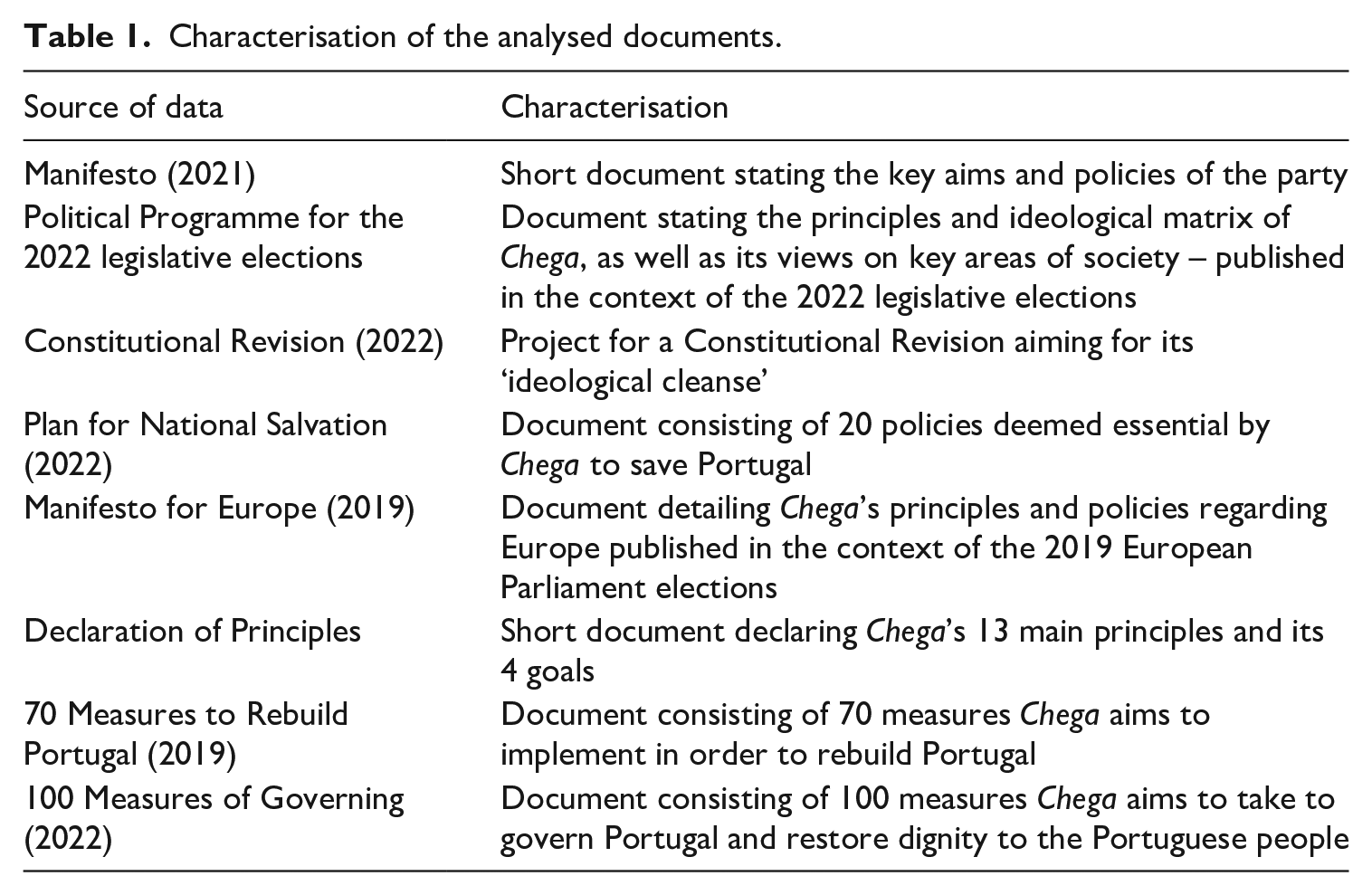
The Chega documents were selected following two criteria: their availability via open access on the party’s website, and the presence of both Chega’s political pledges and a general description of the party’s ideology, ranging from the founding of the party in 2019 until 2022, as displayed in Table 1.
Characterisation of the analysed documents.
The Chega party event on feminism was of particular significance to this research, as it was the first event held by a Chega national structure solely focused on gender issues, and particularly, on an anti-feminist stance. An ethnographical observation of the event was conducted, though for the purpose of this article, the analysis focuses on the statements made by one of the speakers, henceforth referred to as ‘Chega Member of Parliament’ (Chega MP). This prominent member of the party presented her views on gender and feminism to a public of apparent sympathisers and supporters of the party. These interventions were recorded and posted on Chega’s YouTube channel and website.
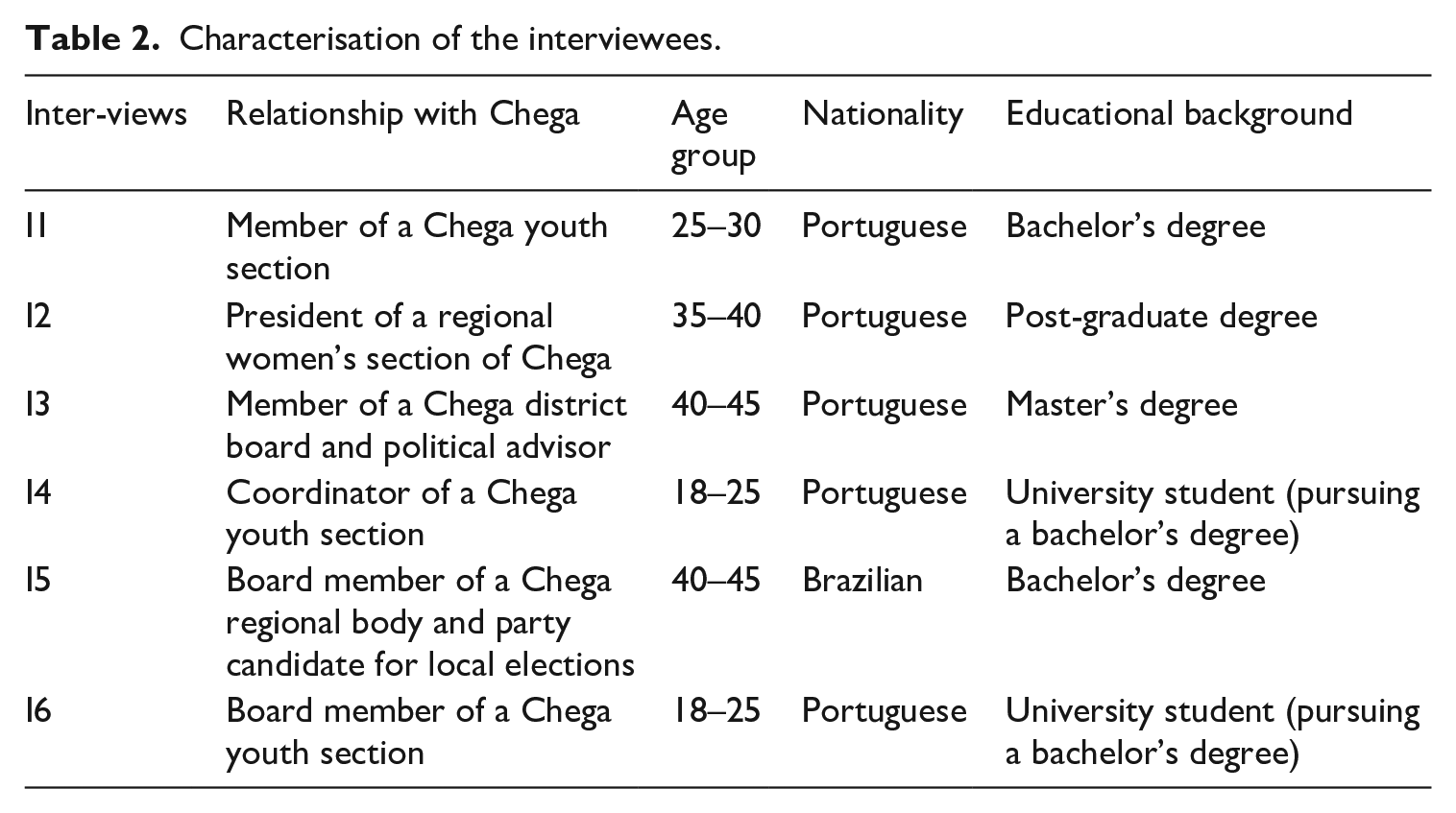
Individual, online in-depth interviews were conducted with 6 members of Chega’s regional, national and youth bodies, henceforth I1-I6 (see Table 2 for interviewee details). Research has demonstrated the importance of conducting interviews within far-right groups, as to deeply explore the perceptions and ideals of the women inside these groups (Blee, 1996). To reach the interviewees, several strategies were employed, such as establishing contact with Chega regional and national branches, social media contacts and snowball sampling. Reaching participants for this study proved to be a considerable challenge, as direct contact with Chega’s regional and national structures resulted in only one interview. The remaining five interviewees were recruited through social media outreach, which involved contacting 40 women in total. While no potential participants explicitly declined, only six responded and agreed to participate in an interview. This limited response rate contributed to the small sample size of the study. The six interviewed women have varying levels of involvement with the party, most holding board members positions at youth or regional sections. All women were white and had either pursued or were pursuing a university degree at the time the interview took place. With the exception of one Brazilian woman, all interviewees were Portuguese nationals. Interviews are shaped by a complex dynamic, influenced by the relationship between interviewer and interviewees (Tang, 2002). In this case, the interviewer, a 23 year-old white Portuguese woman, shared ethnicity and gender with all interviewees, and identified as a graduate student, traits which can foster a sense of familiarity. Nevertheless, some participants expressed caution, inquiring about the researcher’s intentions and objectives before fully engaging in the research. Participants were then asked about their opinions on a variety of gender issues and on their personal political ideologies.
Characterisation of the interviewees.
Some gendered subjects have been more extensively addressed by PRR parties: De Lange and Mügge (2015) differentiate classic gender issues, such as reproductive rights and work-life balance, from more recent issues such as immigration and Islam. Meguid et al. (2022) emphasise three categories of women’s issues present in PRR party manifestos: gender equality, violence against women and work-family balance. In parallel, Corredor (2019) explores gender and anti-gender movements and counter-movements, such as the feminist and LGBTQ + movements, and the anti-gender ideology movement. Accordingly, four dimensions were selected as the focus of this article: gender equality, reproductive rights, femonationalism and gender ideology.
The content analysis of the three sources and further categorisations were conducted manually. The interviews and interventions at the event were transcribed, and in addition to the eight Chega documents, were examined, as positions and expressions were highlighted and further grouped into each of the above-mentioned four dimensions.
Gender equality
Only two official Chega documents reference gender equality or gender-equal policies: the 70 Measures to Rebuild Portugal (three references) and the 100 Measures of Governing (two references). Chega proposes ‘repealing the Gender and Equality Law’ and ‘creating a true Law of Equality between women and men’ (70 Measures to Rebuild Portugal) claiming an aim to promote an equality which does not rely on ‘gender conflicts’ and acknowledges ‘the natural differences between women and men not as a source of problems but as a rich universe of added value’ (100 Measures of Governing). Regarding Chega’s views of gender-equal policies, it proposes ‘suppressing the Parity Law and any type of quota policies’ (70 Measures to Rebuild Portugal) and supports the ‘promotion of a domestic violence law that equally protects the elderly, men, women and children’ (70 Measures to Rebuild Portugal & 100 Measures of Governing).
At the Chega youth section Event, the Chega MP clarified the party’s views on gender equality, stating: ‘[Chega] defends both the women and the men, without shying away from saying what is a woman and what is a man’. Here, she refers to the party’s clear distinctions between men and women, simultaneously implying that transgender women and men will never be recognised as the gender they identify as, and that men and women cannot be completely equal, and should instead complement each other. This idea is also present in the Chega documents and is validated by the Chega MP’s following statement: ‘We can affirm the obvious. A man is a man, a woman is a woman, there is nothing more beautiful than their complementarity’. The speaker also used the term ‘sex’, claiming she was avoiding saying the word gender altogether (‘. . . the ministers were only discussing sex . . . sex, so as to not say gender’). The closing remarks of the first speech made by the Chega MP illustrate these views: ‘The values we [in Chega] defend are the ancestral values, so we just need to have strength, faith and determination and come back to our origins’. This wish for the return of traditional gender roles is shared throughout the event, where the speaker focused on the downfalls of feminism and how women should ‘not have to live like we are victims of something’.
The interviews with women members of Chega generally aligned with perspectives shared at the event. All six interviewees equated gender to sex, defining gender equality strictly as equality between men and women. When asked about their views on gender equality in Portugal, respondents expressed one of two positions. The first, held by two interviewees, argued that gender equality already exists under Portuguese law, rendering further efforts unnecessary:
We need to see equality according to the law. Be it a man, woman or however they identify, according to the law we are already equal . . . – I1
The second group of responses shared by three interviewees considered gender equality to be fake, wrong or not an objective, expressing the belief that if men and women are different biologically, their privileges, rights and abilities should also differ:
Gender equality is a social construct that came to confuse people’s minds. – I5 I don’t believe that men and women should be equal. We can do different things and need different things to get to different places. – I4
One interviewee strayed from the majority, believing that gender equality should exist but has not been achieved at all levels.
Overall, Chega claims to defend equality between men and women, but its goal to repeal the Gender Equality Law and replace it with a ‘true equality’ law lacks clarity on what that equality entails or how it would be achieved. The views presented at the event and by the interviewees reflect a conservative stance on gender equality, with five of the six interviewees considering the fight for gender equality unnecessary or rejecting its premise. All interviewees equated gender with sex, a view corroborated by the event speaker. The emphasis on complementarity and differences between men and women, rather than equality, is consistent across the three data sources. This aligns with broader trends in PRR parties’ gender conservatism, contrasting with their recent incorporation of gender-equal policies during electoral struggles (Meguid et al., 2022). This anti-gender equality stance also conflicts with contemporary Portuguese views, where gender equality is broadly accepted, despite occasional resistance to feminist policymaking (Monteiro and Ferreira, 2016).
Reproductive rights
Chega makes five references in three different documents to questions of sexual and reproductive rights. Of these five references, one refers to the ‘promotion of the expansion of the beneficiary base for prenatal family allowance’ (100 Measures of Governing), with a focus on large families. The other four references explicitly refer to abortion. On its Manifesto, Chega states its opposition to accessible abortion services, which is currently provided by the Portuguese National Health Service during the first ten weeks of pregnancy: ‘Chega came to refuse. Refuse what is today taken as normal patterns (. . .) Refuse the abortion-on-demand (..) paid for by taxpayers’. In addition, the party proposes to ‘eliminate from public health exemptions all surgical interventions not related to health such as (. . .) abortion (except in cases of rape, malformation or other issues that endanger the woman’s life)’ (70 Measures to Rebuild Portugal & 100 Measures of Governing). This displays a less extreme view on abortion laws, with the party also stressing that it is ‘essential that women with unexpected or unwanted pregnancies have information, assistance and genuine alternatives’ (70 Measures to Rebuild Portugal).
The interventions at the Chega party event contain fewer references to this topic, as the Chega MP made only one reference to abortion, mentioning the need for the public to come together and create pro-life non-governmental organisations (NGOs): ‘We need you to be activists, to create pro-life, pro-family, pro-women NGOs, occupy that space, it cannot just be up to the Left to occupy it’.
Among the interviewees, abortion was the most referenced topic regarding reproductive rights policies, with two contrasting perspectives. Four women expressed complete opposition to abortion:
I am pro-life. From conception there is life, and you own your body, but there’s another body inside yours and you need to respect that life. You don’t want it? Well, give it up for adoption. – I5 Abortion is not a reproductive right, it’s not a woman’s right (. . .) There are a lot of other methods, one of them being closing your legs. – I4
Contrastingly, two women showed a favourable position to the current abortion law in Portugal, which allows women to abort for any reason until the tenth week of pregnancy:
I don’t know how to justify it, but I think we have the right to choose to have a baby or not. – I2 There are very complicated situations (. . .) and a person being obliged to complete a pregnancy is horrible, it’s better to terminate it. – I6
The divergence in beliefs about abortion among the interviewed women cannot be explained by their socio-demographic characteristics and should not be generalised. All participants held or were pursuing university degrees, and no clear correlation emerged between their views on abortion and their nationality. I2 and I6, for instance, who expressed pro-choice positions, are from more rural regions of Portugal, contrasting with I3, a pro-life participant from a highly urban area. These findings highlight the complexity of individual beliefs, which cannot be easily attributed to education or regional context.
Overall, while Chega does not entirely reject abortion in its documents, its opposition to providing abortion through the National Health Service reflects disapproval of the current law. Four of the six interviewees aligned with the pro-life stance expressed by the Chega MP at the party event, while two supported the current law, spontaneously mentioning that their views diverged from the party’s position. Chega’s stance on abortion contrasts with that of other PRR parties, which often advocate for complete criminalisation, as seen in Belgium, Austria, or Hungary (Akkerman, 2015; Juhász and Pető, 2021). Previous studies have described Chega as strongly anti-abortion (e.g. Heyne and Manucci, 2021), a position not universally reflected in the interviewed sample.
Gender ideology
Though Chega does not extensively develop on the meaning of this term, ‘gender ideology’ is mentioned in four of the analysed documents, in a total of six references. Three of the six references state the party’s opposition to this concept, such as ‘Chega came to refuse. (. . .) Refuse the dictatorship of Gender Ideology’ (Manifesto), while one reference in Chega’s Manifesto for the European Parliament elections states that the European Union cannot be a transmitter of this agenda and ‘behave as transmitters of cultural Marxism (. . .) propagating the insufferable Gender Ideology to the many member-states’ (Manifesto for Europe). The two remaining references highlight the need to stand against it at schools and universities: ‘Prohibition of propaganda of the LGBTI agenda in the Portuguese teaching system with the aim of applying the inclusion and gender ideologies in the national educational system’ (100 Measures of Governing).
Despite its prevalence in Chega’s general discourse, gender ideology is not referred to by name by the Chega MP at the party event. Nevertheless, the Chega MP made two references to an agenda that is entering schools and universities, claiming that it ‘invades every step, and many times we think some narratives can be positive and have good intentions, but the truth is they don’t. It’s a very well-connected agenda’. The Chega MP argued that to combat this agenda in Portugal, ‘we need Chega to have more MPs, we need 50 MPs soon, maybe even an absolute majority. We need to occupy the other spaces (. . .) combat them at universities’. Moreover, the Chega MP highlighted transgender issues in education, opposing laws on mixed-gender bathrooms, name changes in school records, and participation in activities based on students’ gender identity. The speaker stated,
From now on, boys who identify as women can compete with women (. . .) if he identifies as a woman, he will start to be evaluated at school as a woman. And that would be unfair to all other men who actually identify as men.
The party’s position against gender ideology is corroborated by the interviewed women members. However, and though gender ideology is extensively mentioned by Chega, when asked to define it, three out of the six women were unable to provide a clear explanation of the term, often equating it with gender equality or gender identity, or seeking clarification on the concept. When asked for clarification, I explained that gender ideology is the perceived notion that gender and gender identity are ideologically charged concepts viewed as threatening the traditional family and society. Despite the initial confusion, all interviewed women expressed complete opposition to gender ideology, with five out of the six women expressing concerns for how this propaganda reaches children and schools and affects families:
Gender ideology is a problem because they’re imposing it to us . . . Nowadays we can’t watch TV without there being a gay couple, for example. (. . .) Children are being taught that the traditional family is wrong now. – I3 Gender ideology has the goal of controlling the masses, indoctrinating people, making them not think for themselves. – I4
Four women also expressed the need to combat gender ideology through specific measures, such as Chega’s opposition to the creation of mixed gender bathrooms in educational and public places:
We don’t defend the sexualisation of children, we don’t defend the implementation of gender-neutral bathrooms. No, thank you. – I6 We [Chega] are against this question of mixed gender bathrooms, of gender ideology, we are not in favour of it because I think things need to be separate. Our core values are God, the homeland, the family and work. Family, respect, education, that’s what we value. – I5
The growth of anti-gender movements in Europe has been largely dependent on the PRR parties’ support of their fight against what they consider a subversion of traditional family values (Kováts, 2018; Kováts and Põim, 2015). Chega adopts a clear anti-gender ideology, described as ‘insufferable’ (Manifesto for Europe, 2019) and a ‘dictatorship’ (Manifesto, 2021). This stance is evident in party documents, the Chega MP’s remarks at the event, and interviews with women party members. Consistent with other studies (e.g. Garraio et al., 2023; Santos and Roque, 2021), anti-gender ideology is a prominent party feature. However, as Garraio et al. (2023) argue, Chega’s programmatic framework on gender ideology is vague, which may explain interviewees’ inability to define the term despite its international significance. Interviewees’ alignment with the party is reflected in their frequent use of ‘we’ when discussing gender issues, contrasting with ‘I’ statements on other topics (see quotes above).
Femonationalism
The concept of femonationalism refers to a co-option and instrumentalization of feminist ideals into anti-immigrant and anti-Islam campaigns, often observed in far-right parties and groups (Farris, 2012, 2017). In its documents, Chega demands reform of the Portuguese immigration system and stricter control at the Portuguese borders. Four references are made to women’s rights or violent practices against women within Chega’s immigration proposals, all containing identical statements on abolishing ‘religious spaces, which directly or indirectly promote behaviours incompatible with western identity and culture (. . .) or any type of hate speech and incentive to religious or cultural practices, which harm human dignity and crimes against women’ (Political Programme) or promote ‘the application of Sharia Law, female genital mutilation and forced marriages of minors’ (Manifesto; 100 Measures of Governing & 70 Measures to Rebuild Portugal). These references to violence against women, particularly linked to Sharia Law, have also been frequently highlighted by other populist PRR parties in Europe, such as the Dutch Party for Freedom, the French National Rally or the Sweden Democrats (Duina and Carson, 2020). The inclusion of measures such as the implementation of immigration quotas based on country of origin (‘giving priority to nationalities that share language and culture with Portugal’) (70 Measures to Rebuild Portugal) further demonstrate Chega’s nationalist agenda.
No femonationalist position was expressed by the Chega MP during the youth section event, as she did not discuss immigration, and was instead more focused on the failures of the feminist movement. The views of the interviewees largely mirrored those of the party, as all expressed concern with the current immigration system, defending more restrictive policies. When asked whether more restrictions on immigration would influence gender equality and women’s rights, all interviewees pointed to a connection between Muslim immigrants and an increase in sexual violence and harassment. Three interviewees also mentioned specific cases of violence perpetrated by foreign men working in ride-sharing platforms:
The numbers of violent crimes against women committed by immigrants from countries where women have no rights, no role in society, have increased (. . .) We need to understand these statistics so we can understand that border control is important. – I3 We try to combat gender inequality here and we have to fight against them. (. . .) I can see it in their eyes, they are used to women walking around covered and we don’t, and they love it. – I6 The type of people coming into Europe are from Islamic countries, countries where women are subjugated (. . .) We have had a lot of cases in Ubers of women who were attacked, and the drivers were from there. – I5
It must be noted that femonationalism is frequently employed as a discursive strategy, mostly used in parties’ parliamentary interventions, as analysed by Kantola and Lombardo (2021) within the European Parliament. Meguid et al. (2022) found this issue to have low occurrence on party manifestos. Although four femonationalist positions were found in Chega’s official documents, all interviewed women expressed radical femonationalist positions, validating the thesis that this issue tends to be observed in more informal, conversational settings.
Conclusion
This article explored the alignment of women members of the PRR Chega party with the party’s position on gender-related issues. While some heterogeneity was observed among their positions, the women generally endorsed the party’s conservative views, including anti-gender ideology and femonationalist stances. Even when aligned with the party, their beliefs were expressed in a more radical style, likely influenced by the informal nature of the interviews, their sense of similarity with the interviewer in gender, nationality and race, and their emphasis on representing personal rather than party views. Alignment also varied based on their roles within the party; for instance, I3, who holds a prominent national position, exhibited greater alignment than less central members such as I2.
These findings prompt deeper contemplation. While Chega’s positions on gender, as reflected in party documents, the event, and interviews with women members, generally aligned with feminist literature on PRR parties, the trend of parties adopting less conservative, more gender-equal positions was not evident in this Portuguese case study. As expanded by Mudde (2019), some PRR parties, particularly in Northern Europe, openly support women’s rights without adhering to traditional beliefs about motherhood and gender roles. Why then has Chega not adopted such strategic positions? One explanation may lie in the enduring influence of the Catholic Church on Portuguese society, despite the secularisation of the state. Both the Church and PRR movements share connections to anti-gender ideologies and promote traditional gender roles (Leimgruber, 2020; Meyer Resende, 2022). In addition, following Meguid et al.’s (2023) framework, PRR parties often emphasise gender-related issues, such as gender equality, violence against women, or work/life balance, areas where women tend to hold more progressive views in times of electoral stress, when appealing to women voters is crucial. It is unclear whether Chega may alter its stance during such periods. Furthermore, in a global context where anti-gender ideologies are gaining momentum, Chega may align with other European PRR parties, such as Spain’s VOX or Italy’s Fratelli d’Italia, in maintaining neo-conservative gender views (Bernárdez-Rodal et al., 2020; De Giorgi et al., 2023).
The rise of anti-gender views, as seen in Chega and among its women members, is concerning, as research links the legitimisation of discriminatory views, such as these ones towards the LGBTQ+ community, Muslim immigrants, and women who challenge traditional gender roles, often tied to the growth of PRR parties, with increased hate speech and hate crimes (Bilewicz et al., 2017). Understanding the beliefs of PRR parties and their supporters is therefore essential, given their impact on society and on minority groups in particular.
This article contributes to the evolving field of gender studies in relation to PRR movements and parties in Europe, providing specific insights into the Portuguese radical right. Research on gender dynamics within Portuguese PRR parties remains limited, with few studies extending beyond the official party positions. This article highlights the perspectives of women within Chega on gender issues, particularly underexplored topics such as reproductive rights. As prior studies examined Chega’s femonationalist views (e.g. Santos and Roque, 2021), this research further confirms the prevalence of femonationalist discourse, revealing that women members express these positions in more radical terms than the party’s official stances.
One limitation of this study lies in the limited sample of interviewed women, primarily contacted through social media, which skewed the average age of respondents to 33 years old. Future research would be beneficial to obtain a larger sample of party members through a more quantitative approach, to better gauge party identification. Moreover, analysing Chega’s official documents provides only a partial view of the party’s stance on gender-related issues. A comprehensive understanding would require examination of proposed laws and parliamentary interventions, which became clear in interviews where members of the party highlighted measures deemed as priorities for Chega which were absent from the official documents analysed here.
While the interviewed women noted that disagreements with certain official party positions did not deter their support for Chega, further research could examine whether similar dissonance exists among a broader sample of women members and supporters, and how it impacts party cohesion. Such research could clarify whether women’s voices, needs, and perspectives are considered in shaping the party’s ideological positions. After all, despite limited media visibility, women in Chega hold leadership roles in youth and women’s sections and are regional and national advisors, coordinators and MPs – they are not merely names on a party list.
Footnotes
Acknowledgements
The author thanks the useful discussions and contributions of Ana Espírito-Santo (Iscte-IUL).
Declaration of Conflicting Interests
The author(s) declared no potential conflicts of interest with respect to the research, authorship, and/or publication of this article.
Funding
The author(s) received no financial support for the research, authorship, and/or publication of this article.
