



Abstract
This article attends to the strategies of survival, affective labour, and practices of care – for women’s film work and publics – within women’s film festivals during the COVID-19 pandemic through the case study of Films Femmes Méditeranée, a women’s film festival based in Marseille, France. The festival was founded in 2007 to give visibility to the work of female filmmakers from the Mediterranean through a curated program of films, showcased in art-house theatres, with free screenings for young audiences, students, the unemployed, and people living on social benefits. Drawing on interviews conducted with workers at Films Femmes Méditeranée, I first provide an overview of the history and the mandate of Films Femmes Méditeranée in relation to the legacy of early women’s film festivals by bringing to light the work of care carried on in the context of Marseille. I will then analyse Films Femmes Méditeranée’s practices of curation and care through digital media during the pandemic. Through a consideration of the labour of film programming and festival organizing vis-à-vis social distancing measures and an examination of curatorial choices, I interrogate how Films Femmes Méditeranée has adapted to the pandemic crisis through digital media to maintain its commitment to fostering transnational approaches to women’s film culture and to provide a space for encounters between female filmmakers and audiences.
Introduction: Practices of care and affective labour within women’s film festivals
In 2021, to commemorate International Women’s Day, the International Women’s Film Festival Dortmund + Köln produced a video in which the spokespeople of 18 women’s film festivals from around the world were asked to answer the question, ‘Why are women’s film festivals important now?’ 1 The video was uploaded to YouTube and Vimeo and was subsequently shared on other social media platforms. 2 The editing of the video weaves together the answers of the spokespeople, as if they were responding to each other and completing each other’s sentences. The aim of this form is two-fold: one, it outlines how the specific context of the COVID-19 pandemic has exacerbated gender inequality and violence against women; second, it affirms the necessity of women’s film festivals ‘to pass feminist messages and fight against violence’ (according to Cornelia Glele, founder of the International Women’s Film Festival of Cotonou in Benin) through narratives that centre female characters and through approaches to filmmaking that challenge the male gaze (as Marie Vermeiren, founder and programmer at Festival Elles Tournent in Bruxelles, reminds us) and open up to new imaginaries countering heteronormative and patriarchal structures. Moreover, Sam Lahoud, president of the Beirut International Women’s Film Festival, and Sarah Nsigaye, founder of the Celebrating Womanhood Festival in Kampala, stress that women’s film festivals are spaces of professional networking and education on gender equality. While most of the spokespeople are shot as talking heads, some found creative ways to record their answer: for example, we hear Marta Nieto Postigo, programmer at the International Women’s Film Festival of Barcelona, speaking over the fixed shot of a wall of video-cassettes, in front of which someone’s hand arranges some flyers of the festival’s previous editions (Figure 1). At the end of the video, Miki Soko, the director of the Senior Women’s Film Festival in Osaka, is with two other friends, all masked-up, in a park holding signs that say ‘Let’s get together and stand together’ and with hearts drawn on them (Figure 2). These modes of address draw attention to larger women’s film culture and its ephemera, as well as to the pandemic’s impact on social behaviours and interactions. Hence, the representatives of women’s film festivals in the video, oscillating between radical and liberal feminist discourses on gender equality, reclaim women’s film festivals as political and cultural spaces, crucial not only for the professional advancement of women filmmakers, but also for the formation of solidarity across various socio-political struggles. In this respect, women’s film festivals in the 21st century take on the legacy of early women’s film festivals, ‘developed in conjunction with feminist theory and film-making practice’ in the 1970s across North America and Europe, and their mandate to ‘stage a direct challenge to the historical and social reality of gendered access to space, and paucity of representations of female subjectivity’ (Heath, 2018: 2).
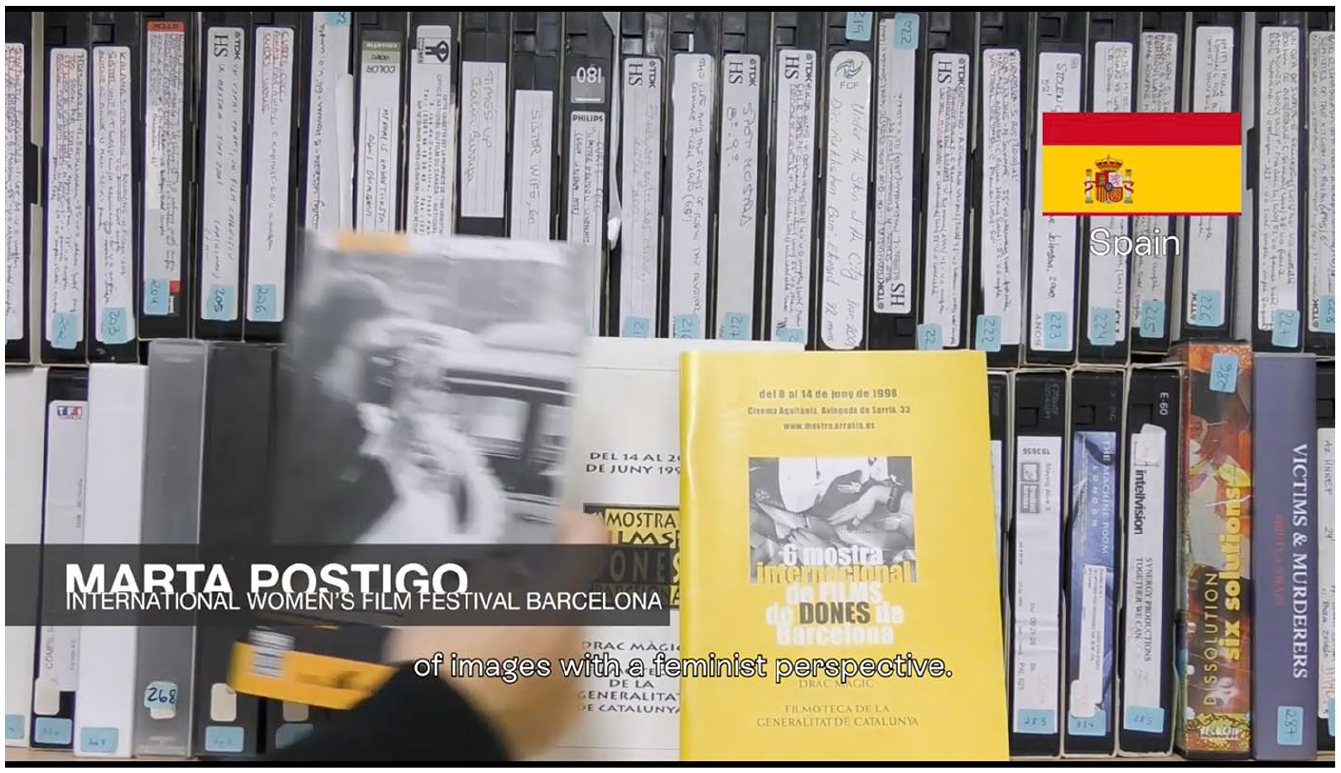
Screenshot from the video ‘Why are women’s film festivals important now?’
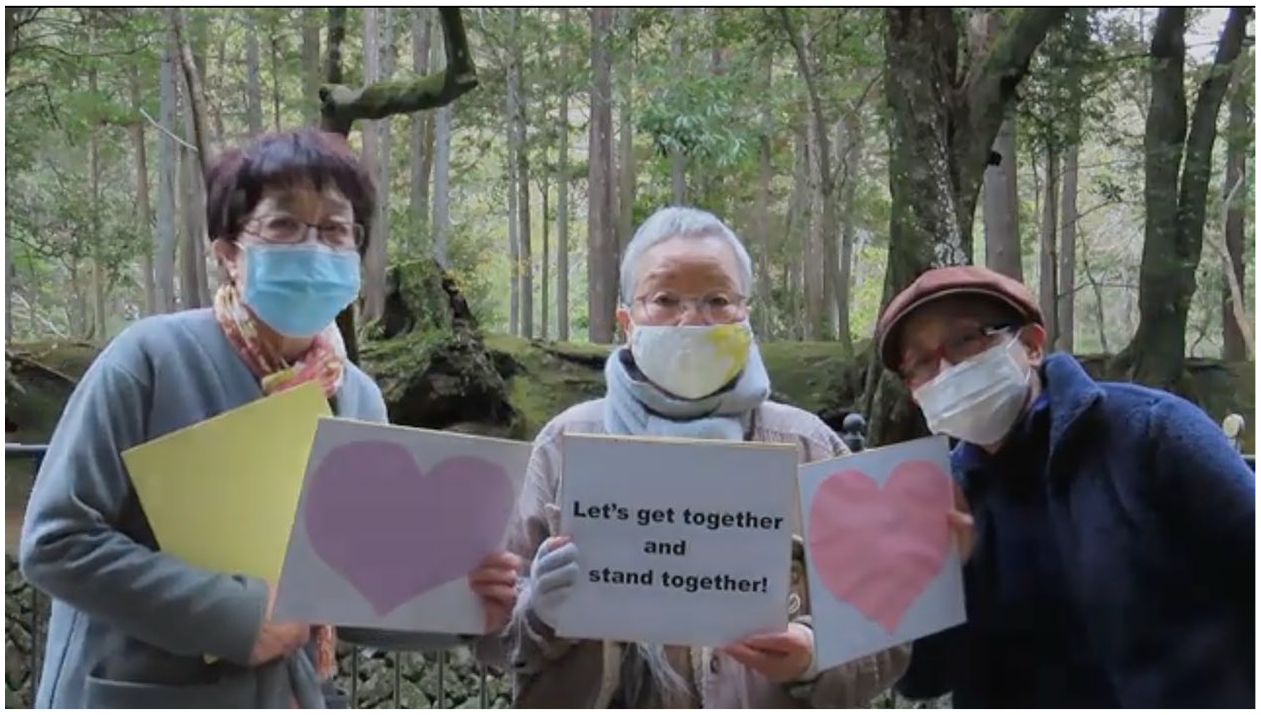
Screenshot from the video ‘Why are women’s film festivals important now?’
At the same time, the video speaks to some specific characteristics of women’s film festivals in the 21st century: first, the fact that the women’s film festival is now a fully fledged global phenomenon, with festivals in, for example, Brazil, Benin, and Lebanon; second, women’s film festivals have to deal with a new ecology of film production, distribution, and exhibition that includes promotion and communication through digital media – a context dubbed by Rosanna Maule (2016) as ‘2.0 generation of women’s film culture’ (p. 61). This context, in which ‘women’s film festivals today rely more and more on social media to open new spaces and links for women in the film industry’ (Maule, 2016: 23), has been further complicated during the COVID-19 pandemic.
Social distancing measures and lockdowns since 2020 (some of which has since been mitigated) have indeed pushed women’s film festivals to rely on digital media to rethink and adapt their mandate of creating spaces of solidarity, networking, and film literacy through alternative exhibition strategies (Thain and McLeod, 2021). Such exhausting efforts in maintaining community through film exhibition adds a layer of often unnoticed affective labour on the shoulders of the organizers and precarious workers within women’s film festivals. In the political context of COVID-19, when pandemic restrictions have disproportionally affected women’s working conditions and precarious workers in the arts sector, women’s film festivals have been particularly under threat and have struggled to survive financially. The video produced by the IFFF Dortmund + Koln (2021) described earlier is a testament not only to the predicaments of the COVID-19 pandemic, but also to women’s film festivals’ inventive solutions of creating solidarity, sustaining relations, and defending their right to exist.
This article attends to the strategies of survival, affective labour, and practices of care – for women’s film work and publics – within women’s film festivals during the COVID-19 pandemic through the case study of Films Femmes Méditeranée (FFM), a women’s film festival based in Marseille, France. The festival was founded in 2007 to give visibility to the work of female filmmakers from the Mediterranean. Every year in the fall, FFM organizes a non-competitive festival called ‘Rencontres’ (encounters), during which a curated program of feature length fiction films, documentaries, and shorts is showcased in art-house theatres, with free screenings for young audiences, students, the unemployed, and people living on social benefits. While FFM has been committed since 2016 to organizing year-long activities such as workshops in education in visual image and free screenings, they had to significantly reduce its scope during the first year of the pandemic. For its fifteenth annual festival (2020), FFM, in compliance with pandemic-era restrictions, experimented with the online festival format for the first time by exhibiting a free curated program of films, titled Utopie on the French VOD (video-on-demand) streaming platform Universciné. Moreover, throughout 2020, FFM curated a series of ‘Remèdes a l’ennui’ (Solutions to boredom) – short announcements which were circulated through a newsletter and additionally shared on Facebook. They provided updates on available master classes or films that were newly accessible online (often made available by filmmakers who had previously been programmed at the festival). In this article, I will frame FFM’s endeavour of maintaining a film festival through digital media as an extension of the work of care embedded in the organization of a women’s film festival.
Historically, women’s film festivals have always carried on a work of care for female filmmakers by providing them visibility and a space for professional advancement and for the community at large by ‘producing feminist cinematic consciousness’ (Rich, 1998: 31). During the COVID-19 pandemic, such labour of care was expanded to include the necessity for ‘self-care’, intended here as ‘a critical survival strategy’ (Hobart and Kneese, 2020: 2), that is, the preoccupation that workers within women’s film festivals had to face as precarious employees within a context in which their work was threatened with disappearance. In this context, ‘self-care’ means holding employment and survival. Hence, FFM’s practices of care during the pandemic eschew neoliberal imperatives of co-optations of care, but constitute, instead, an attempt at responding to the precariousness of women’s filmmakers and more broadly of women workers in the film and creative industries. In this article, I turn to the precarity, affective labour, and inventive solutions of festival organizers and programmers as a way to interrogate the viability of women’s film festivals beyond the singularity of the case study and a responsive modality to the pandemic crisis.
My understanding of the work of women’s film festivals as a work of care is based on a broad understanding of care work. As suggested in The Care Manifesto:
‘care’ is also a social capacity and activity involving the nurturing of all that is necessary for the welfare and flourishing of life. Above all, to put care front stage means recognising and embracing our interdependencies. [. . .] ‘care’ means as well the care of activists in constructing libraries of things, co-operative alternatives and solidarity economies, and the political policies that keep housing costs down, slash fossil fuels and expand green spaces. Care is our individual and common ability to provide the political, social, material, and emotional conditions that allow the vast majority of people and living creatures on this planet to thrive – align with the planet itself. (The Care Collective, 2020)
Expanding the traditional meaning of care as essential areas where people’s basic needs are met (such as domestic care, elderly care, or health care), the Care Collective includes networks of solidarity and activist social movements. Central to the Care Collective’s understanding of care is a notion of interdependence, which is the capacity of relying on interpersonal relationships. This stands in contrast to the dominant neoliberal ethos of individualism and the defunding of public services under fiscal austerity. Such an ethical approach to the understanding of care is within the theoretical lineage delineated by Joan Tronto (1993), for whom care is ‘the concern of living active humans engaged in the process of everyday living’ (p. 104), recognizing and countering the carelessness that surrounds us. However, it remains crucial that we do not lose sight of the political dimension of care from within the materialist theoretical concept of social reproduction (Savran, 2021), which, according to Tihti Bhattacharya (2017), defines ‘an approach that is not content to accept what seems like a visible, finished entity [. . .] but interrogates the complex network of social processes and human relations that produces the conditions of existence for that identity’ (p. 9). A political approach to care, therefore, allows us to reveal the processes of labour and its attendant physical and mental efforts, as well as its positive and negative affects.
This understanding of care – in both its ethical and political dimensions – guides my study of the work of women’s film festivals. By providing a space for the exhibition of women’s cinema, for professional advancement and solidarity among female filmmakers and workers within the film industry, as well as for exchanges between filmmakers and spectators, women’s film festivals create interdependencies and synergies while cultivating caring relationships. Moreover, they engage with political struggles insofar as they attempt to improve social relations by demystifying gendered power relations through cinematic narratives. FFM, in particular, improves life for some people by providing free access to film culture and links critiques of gendered power structures to other local political problems, namely the question of immigration in Marseille and in the Mediterranean. The work of care of a women’s film festival is also about the transmission of knowledge and information on feminist histories and approaches to filmmaking, as well as gender-related issues often in the relation to anti-racist, anti-colonial, and environmental struggles.
While the work of fostering community is a primary component of the work within women’s film festivals, I also consider the specific work of film programming as curatorial work, and hence as a practice of care. Film programming can be understood as a work of curation, as ‘festival programmers create meaningful discourses around film culture and society though the films they select and curate’ (Rastegar, 2016: 185). Curation, in turn, ‘is etymologically and practically rooted in care’, as Thain and McLeod (2021: 225) discuss in their analysis of alternative curatorial practices within queer and feminist festivals. In this light, the act of curating assumes both the meaning of taking care (of works of art, films, film archives), healing (social injustices), and nurturing (filmmakers and spectators). Curating consists in care work when it ‘works toward hope, joy [sic]’, attending to the ability of creating connections across various intersecting socio-political struggles (Krasny et al., 2021: 8). Krasny et al. (2021) approach curating as
a form of caring connected to the new feminist movement in the twenty-first century, with its focus on care, reproductive labor, and struggles for life and planetary survival in light of climate crisis, and most recently [. . .] the pandemic crisis. (p. 8)
Festival programmers within women’s film festivals create links among gender-specific issues and curate connections across feminist approaches to filmmaking. In this respect, film programmers can work towards ‘building communities and sustaining the shared meanings, affective dispositions and horizons of value that underpin social cooperation’ (Fraser, 2016: 101). The work of women’s film festivals hence contributes to sustaining human subjects as ‘social beings, forming their habitus and the cultural ethos in which they move’ (Fraser, 2016: 101). All these activities are the product of labour-intensive processes, often undervalued and consequently unpaid or underpaid.
Such forms of care work within women’s film festivals, rooted in exhausting and precarious working conditions, took on new configurations during the pandemic. Women’s film festivals had to find creative solutions to the demand of ‘shifting online’. ‘Shifting online’ is not as smooth and immediate operation; it requires instead a lot of work, such as restructuring the organization of the festival, adapting the film programme within the constraints of streaming platforms, revaluating how to develop and address audiences, and thinking economic and generational accessibility to digital technologies (Dawson, 2020; Olibet and Thain, 2023). ‘Shifting online’ is not necessarily the best solution for festivals such as FFM, where the idea of the ‘rencontres’ is at the core of its mandate. In this respect, FFM needed to operate within the constraints imposed by the technological infrastructures available to them to digitalize their festival and negotiate for good deals with streaming platforms. Furthermore, FFM also had to conceive of ways of reproducing the eventfulness and the affective dimensions of the festival experience. As for other festivals that put at their core the efforts of community-building, online platforming of the festival is not reducible to simply the streaming of films, but also thinking of ways to create social interrelations and a sense of togetherness (Olibet and Thain, 2023; Thain and McLeod, 2021).
My investigation of FFM’s response to the pandemic crisis as a work of care is in conversation with the theorization of film programming as a form of affective labour in film festival studies (Czach, 2016). Drawing on her experience as a programmer with the Toronto International Film Festival, Czach (2016) shifts attention away from the film programme as the main object of interest and clarifies the labour of film programming within festivals as a ‘process’ (p. 198): ‘The idea of film programming as what transpires over ten days during the festival fails to account for the labour that goes into planning and executing a festival’ (Czach, 2016: 201). While Czach (2016) focuses on the ‘negative affects’ of the work of film programming within a competitive festival, including ‘the management of one’s emotions and the emotions of the filmmaker’ (p. 203) when rejecting a film, her insights are useful in considering the multiple aspects that film programmers take into consideration in their process of selecting films, especially in a period of crisis and constraints determined by online film exhibitions. In my study of FFM, I investigate the methods of film programming bringing to light the negotiations and the flexibility required from film programmers within the context of a non-competitive film festival.
The affective labour of film programming, and more broadly of festival organizing, was complicated by the COVID-19 crisis and its consequences on the networked sector of film festivals. Damiens and De Valck (2023) note that ‘the arrival of the pandemic era [has brought forth] particular practical challenges for both festival participants and the film industry at large’ (p. 2). Such challenges, as Damiens and De Valck (2023: 5) expose, have further revealed ‘the reconfigurations of local, regional, national, and global relationships in the global film and media industries’, but have also illuminated ‘very local concerns over access, infrastructures, and cultural habits’. At the same time, Damiens and De Valck (2023) try to reduce the view of the COVID-19 pandemic as a ‘a historic rupture’ (p. 6) that has precipitated a crisis for film festivals and they invite us to see some of the solutions adopted by film festivals as informed by precedent experimentations. Such a non-linear understanding of the COVID-19 crisis shapes my approach to FFM: while I analyse the festival’s online shift in 2020 as a responsive modality to the crisis before the return to ‘normal’, I also attend to the protracted effort of social reproduction, of feminist community-building, and of thinking of labour practices within FFM.
Drawing on interviews conducted with workers at FFM, I first provide an overview of the history and the mandate of FFM in relation to the legacy of early women’s film festivals by bringing to light the work of care carried on in the context of Marseille. I will then analyse the FFM’s practices of curation and care through digital media during the pandemic. Through a consideration of the labour of film programming and festival organizing vis-à-vis social distancing measures and an examination of curatorial choices, I interrogate how FFM has adapted to the pandemic crisis to maintain its commitment to fostering transnational approaches to women’s film culture, to build new geo-political imaginaries around the Mediterranean basin, and to provide a space for encounters between female filmmakers and audiences.
How to think feminism within a women’s film festival: The history of Films Femmes Méditerranée
FFM’s mission is to facilitate ‘the discovery of works by female filmmakers from both shores of the Mediterranean’ (FFM, n.d.-a, ‘À propos’) through the organization of a non-competitive film festival and other events throughout the year – including screenings, workshops, and roundtables – in Marseille and neighbouring cities. 3 Marseille is an ideal setting for the festival, since the city has a lively film festival culture and has historically been a hub of decentralized francophone film culture (Bellan et al., 2021). 4 Since 2006, FFM offers an annual film festival titled Rencontres Films Femmes Méditerranée that foster women’s and feminist film culture by foregrounding ‘a female gaze, representations of women that avoid and deconstruct gender stereotypes’ (FFM, 2019, La Ligne Editoriale). The title of the festival signals that the exhibition of films in the programme is not linked to a competition of prizes and awards and denotes the intention of bringing visibility to the films and having the filmmakers interact with the public. 5 The title gestures towards the goal of creating both a shared space of coming together and a dialogue around women’s films wherein the hierarchies between festival organizers, filmmakers, and publics are minimized, if not completely erased.
Within the landscape of women’s film festivals in Europe, FFM has distinguished itself through its foregrounding of the geo-political and geo-cultural space of the Mediterranean. The editorial line of FFM specifies that ‘Mediterranean’ refers both to the geographical origin of the filmmakers and to the representation of themes and issues that are specific to the Mediterranean, while also privileging gender-specific perspectives (FFM, 2019, La Ligne Editoriale). 6 This commitment to the Mediterranean gestures towards a transnational approach to fostering women’s filmmaking and feminist film culture that includes the effort of programming films and filmmakers from the Global South. Beyond film programming, FFM is committed to creating knowledge on transnational feminist film culture and other socio-political struggles in the Mediterranean and the Global South. For example, in 2022, FFM issued a solidarity statement with Iranian women following the protests ignited by the murder of Masha Amini by the Guidance Patrol. Moreover, in October 2022, FFM participated in the organization of a march in support of Domenico Lucano’s visit to Marseille. 7 Finally, in April 2022, FFM declared solidarity with Turkish filmmaker Çiğdem Mater, an invited filmmaker to the 2019 edition of FFM, who was sentenced to 18 years of imprisonment on charges of attempting to overthrow the government of President Recep Tayyip Erdoğan by allegedly financing the anti-government protests of 2013.
Yet, the history of FFM defies the standard narrative about women’s film festivals as spaces of ‘inherent activism’ (Breidenbach, 2020: 74) and constitutes a ‘counterpublic sphere, a place where women can meet, defy sexist (and heteronormative) social conventions, form a group or network and mobilize around issues of feminism’ (Loist, 2012). Christine Ishkinazi (2023, Interview with the author), film programmer at FFM since 2014, also articulates the distinctive context and mission of early women’s film festivals in comparison to FFM:
With the first women’s film festivals, like Créteil, for example, we really have an image of pioneers and of defence of the first films made by women and of women filmmakers from all over the world. [. . .] I think there is an image of Festival International de Films de Femmes de Creteil that is linked to the first feminist struggles and to the values of research, of opening the way.
8
Rather than emerging from feminist activism, FFM was born out of the initiative of a single person: the secretary-general at the Italian Chamber of Commerce in Marseille, Marie Bottaï. Within the context of the Foire International de Marseille in 2006, she hired a film programmer from Paris to curate a programme of contemporary Italian films in order to promote the activities of the Italian Chamber of Commerce (Nadal, 2023, Interview with the author). 9 This very first edition of the festival, called ‘Huit et Demi’, was organized with the support of the Italian Institute of Culture in Marseille and the Festival Internazionale di Firenze Cinema e Donne (Nadal, 2023). 10 While already presenting a showcase of films made by female filmmakers or cinematic representations of women in the Mediterranean, it is only in subsequent editions that the festival specialized in women’s cinema from the Mediterranean and gradually opened to the exhibition beyond France and Italy to include the rest of Europe and North Africa. Today, ‘the programming of the Rencontres focuses on emerging women filmmakers from the Mediterranean who still needs festivals to gain visibility and get their films distributed’ (FFM, ‘Ligne editorial’).
Since its second edition in 2007, the festival has been run by a voluntary non-profit association organization that renamed itself ‘Films Femmes Méditerranées’. As a voluntary organization, FFM is supported by members’ individual subscriptions, as well as public fundings at municipal, provincial, regional, and national levels. Moreover, FFM establishes partnerships with local film theatres, cultural institutions, and French media outlets to guarantee the annual organization of the festival as well as with Crédit Mutuel, a French cooperative banking group that ensures free tickets for people that otherwise cannot afford festival tickets. The bulk of the group of volunteers sustaining and working for FFM are retired middle-class women (mostly professors, journalists, or administrators in government agencies) who bring their social and cultural capital to the association.
11
While most of the members of this group were involved in the Mouvement de Liberation de la Femme (MLF) during the 1970s in France, or have had experiences in organizing activist ciné-clubs, or have been involved in other grassroots forms of socio-political and cultural organizing, the association was not born out of explicit feminist activism. Marité Nadal (2023), former activist with the MLF and one of the volunteers who has worked for FFM since the beginning in various roles from administrative director to film programmer to logistics coordinator, explained to me in an interview conducted during my field work in Marseille:
We are not all ex-militants with the MLF, but we are all motivated by the same sensibility. [. . .] When I started getting involved in FFM, I was already engaged with migrants in the Mediterranean, the tragedy that is the Mediterranean crossing for immigrants. So, for me it’s a matter of coherence and I think for the other volunteers, too, it’s something like that.
These volunteers, motivated by larger socio-political activism within the context of the city of Marseille, have shaped the mandate, structure, and development of the ‘Rencontres’ so that FFM now recognizes its role in the advancement of women’s cinema from the Mediterranean, given the persistent gender inequalities in the film industry.
As the scope of the ‘Rencontres’ expanded throughout the years, with a greater number of screenings and more important partnerships with political national institutions, FFM started to recruit younger people. As such, FFM’s board of directors is now mostly composed of the core-group of older, retired, volunteers, and a few younger employees. This sometimes create some power imbalances, as the retired volunteers expect of the younger cohort complete devotion of time and involvement to the FFM. While most of the employees are motivated to work for FFM because of their passion for women’s cinema, they underline their work as a form of labour, and as such, working conditions should be respected. To solve this predicament, under the mandate of the current president Marcelle Callier (2023, Interview with the author), FFM is currently moving towards full professionalization, which corresponds to a larger trend observed within women’s and queer film festival to function within the framework of ‘creative industries’ (Maule, 2016; Richards, 2016). While such shift might seem in contradiction with a grassroots ethos usually associated with women’s film festivals, in the case of FFM, professionalization means that all the affective labour put into the organization and maintenance of the festival and its structure is fairly remunerated. Moreover, professionalizing FFM also means considering the future of the organization on the long term, as far as it would ensure generational turnover.
Today, the mandate of FFM rotates around the following three main areas: exhibition, providing assistance to film production for female filmmakers, and cultural mediation (FFM, n.d.-a, ‘À propos’). The first consists in the organization of the festival itself, with film screenings, master classes with invited filmmakers, and conferences in art-house theatres and alternative exhibition spaces in Marseille and neighbouring small towns, as well as a screening at the Baumette Prison. 12 The second area, assistance to film production, consists in the organization of a week ‘Journée professionelle’, an industry day during which 8–10 filmmakers selected from across the Mediterranean meet and pitch their projects to film producers. In this respect, FFM participates in the larger trend that sees film festivals as spaces facilitating access to film production, and more specifically, persists in the commitment of women’s film festivals in creating spaces for professional advancement. The last area of FFM’s mandate pivots on the notion of cultural mediation, intended as the effort to make film culture more accessible to broader segments of the population, through the organizations of film screenings in working-class neighbourhood and non-urban centres in the Region Sud, as well as workshops on film literacy and film programming. Such activities are framed by FFM as inspired by the values of ‘popular education’ (Rabhi, 2023, Interview with the author). 13 Hence, FFM expands its mandate to include education and the transmission of knowledge, thereby reconfiguring women’s film festivals’ activities during the 1970s, which included ‘the organization of workshops to teach women film and video production’ and ‘the creation of alternative circuits of film distribution and exhibition’ (Maule, 2016: 63).
In this respect, even if FFM does not overtly position itself as a feminist organization in its mission statement, it does centre an ethics and a politics of care by privileging the work of building communities through free film screenings for some segments of the population during the ‘Rencontres’ and through the ‘Ciné-solidaire’. Ciné-solidaire, in particular, is a series of screenings organized outside the week of the festival in community centres, educational centres, prisons, schools, and other social organizations with the aim of exposing women’s films and filmmakers to a broader public that otherwise would not attend the festival for financial, cultural, or social reasons (FFM, Dossier de Press, 2020). Such screenings are often conceived as catalyst for discourse and education, where spectators can learn to analyse and interpret film language through the support of these pedagogical tools (Trombi, 2023, Interview with the author). FFM’s approach to film culture resides in these activities. When I asked the programmers of the 18th edition if they consider FFM as a feminist endeavour, Mériem Rabhi (2023), the current programming coordinator, replied,
Feminism can also be thought through class. So, free [screenings are] something [important]. Precarious populations, women are greatly affected . . . I know we’re talking about programming, but I think that’s the starting point. [. . .] Finally, who is the festival aimed at? Who can we welcome? Where do we exhibit the films? and it’s true that I believe that free access is something important, which will affect the youngest, students under 26 years old. There are also material conditions that help to widen the roads even further, which would lead [precarious populations] to cinemas, or that we too can [bring to them] the ideas, images, films, visual arts and bring them. And, I think that it is completely linked to a feminist vision, when we have a materialist and Marxist vision of feminism, all of this comes together.
14
The consideration of FFM’s practices of care for the public as a fundamental part of the mandate of the festival exposes the different dimensions of care involved in the labour of women’s film festivals, ensuring that the public can access and participate in film culture, all the while maintaining women’s films by providing them a context of exhibition and a frame of reception.
In expanding the meaning of feminism within FFM through an attention to its politics of accessibility, programmer Mériem Rabhi, quoted at length above, readdresses some of the current impasses facing the organization, such as the specific type of feminism that underscores its historical choices of programming and the parameters of its scope. These impasses centre around the debate over the definition of what constitute ‘femmes’ (women), which lead to some ideological and generational frictions within the FFM, particularly between adherents of earlier feminist thought and those more attuned to contemporary intersectional feminist perspectives. For example, while some films made by non-binary filmmakers have been included in the last editions of the Rencontres, some volunteers at FFM oppose the use of inclusive language and defend an essentializing idea of who is to be considered a ‘woman filmmaker’. 15 These ideological tensions reveal the instability at the heart of FFM, which ultimately translates in different degrees of care (for the sustainability of FFM itself and its mandate) – among the people involved in the organization. Such differences exploded during the pandemic, which produced its own crisis of care within FFM. According to Marité Nadal (2023), FFM ‘experienced, like many voluntary structures after COVID, a loss of interest’, which was especially true for the retired volunteers in the organization. The pandemic demonstrated that the stakes and the efforts in upholding the functioning of the organization and in thinking of solutions to hold the festival during pandemic restrictions vary according to the paid or unpaid position that the workers have in the organization.
In the following section, I delve into the solutions adopted to shift the ‘Rencontres’ online and preserve the community of FFM during the first year on the pandemic, particularly through consolidated programming strategies and activities of care within the organization. While apparently simple and relying on effortless uses of existing streaming and social media platforms, when analysed from the embodied perspectives of the people who put them in place, these solutions not only reveal to be labour-intensive, but they also expose different, layered, forms of care embedded in FFM.
FFM’s pandemic version: Flexibility and adaptability
The health crisis caused by COVID-19 forced film festivals to change their organization. The various solutions adopted by different film festivals depended on the context of health restrictions adopted by each country. In France, the first containment measures (including a nation-wide lockdown) were announced in March 2020. Some festivals, such as Festival de Films de Femmes de Créteil, which was usually held at the end of March, had to cancel and postpone their 2020 edition. Other major festivals, notably Cannes, reluctantly gave up the physical organization of the festival. Uncertainty over the status of numerous film festivals was a result of France’s continuous back and forth between loosening and tightening health containment restrictions, which naturally led a sense of insecurity and indecisiveness about holding in-person screenings, especially for those festivals whose mandate is grounded in cultural mediation and community-based ethos.
16
This is the case for FFM, as Camilla Trombi (2023), the current chief delegate and worker at FFM since 2016, recalls,
At the beginning, until October, we thought that we could host the festival as usual. Then, there was the curfew that was imposed, so we thought: ‘okay, we can cancel the evening screenings, we can keep only those that end at 6 p.m. so that people can go back home’. But, then, of course, there was a lockdown, but we only knew that I think a month before. In the meantime, previously, we had thought of a plan B and we said: ‘we will still contact Universciné, which is the most important French streaming platform for independent art cinema. [. . .] We requested a quotation, and they told us: ‘okay, if lockdown happens [. . .], you need to tell us a month beforehand if you want to host the festival online’. We only had very few days left to decide, the lockdown took place, so, let’s go, we shifted online.
Here, Trombi attests both to the indeterminacy felt during the pandemic as well as to a spirit of flexibility and foresight typical of women’s film festivals, as they are constantly prepared to respond to crisis – especially in terms of fundings – and, more specifically in the case of FFM, in the promptness of working with the recourses available in terms of volunteer work. Undeniably, health restrictions had affected the working methods as well as the way people could contribute with their work within FFM.
The determination in ensuring the organization of the festival, the climate of uncertainty notwithstanding, reflects the commitment to creating interdependencies through film screenings and guaranteeing everyone’s safety, but also Trombi’s own investment in FFM as a paid employee. In this respect, Christine Ishkinazi, recognizing Trombi’s central role in maintaining the festival during the pandemic, notes how the fate of the festival was particularly important: ‘I think that Camilla [. . .] as an employee had a big question mark on her head [during the pandemic]. That’s something. We, instead, we have our retirement’ (Ishkinazi, 2023). In solidarity with Trombi’s newly precarious situation, Ishkinazi (2023) lucidly recognizes and respects the decision of persevering in finding solutions to the pandemic, even though she was against hosting the festival on an online platform:
For example, I didn’t agree. And still today, I don’t agree because I think that during the pandemic we have normalized the use of streaming platforms, and we were also complicit in that somehow so that now people have good reasons to stay home and watch films from their homes on a platform.
The COVID-19 crisis prompted specific interrogations for those festivals that do not play the role of cultural gatekeepers but are rather more interested in community-building. For festivals such as FFM, the challenge was about the safety of voluntary work, employment security, and social cohesion, rather than the preservation of the circuit of film art.
FFM’s decision to shift the festival online was a difficult one, both with respect to emotion and labour. When I asked Ishkinazi (2023) about her working methods as a programmer during the pandemic, she replied,
It was very sad indeed [. . .] because we couldn’t meet anymore, there were no more collective meetings. Everyone was in their own bubble, we would sometimes ask about each other. Actually, it seemed like FFM didn’t exist anymore, we couldn’t see where this lockdown would lead us, and, mainly, we had different opinions about shifting online.
In between difficulties of the restrictions social distancing imposed on work and discussions over the viability of an online format for the festival, FFM managed to host a curated programme on the French streaming platform Universciné. Founded in 2001 under the initiative of 50 producers and independent distributors in France (Croissant and Cambone, 2022), Universciné is a platform dedicated to French and international independent cinema through VOD service since 2007. Today, it offers both a basic subscription package and TVOD (transactional video-on-demand) services. Even before the pandemic, Universciné had been a crucial actor in film festivals’ extension online by ‘developing partnerships with several festivals in France and abroad’ (Taillibert and Vinuela, 2021: 106) and by offering them curatorial expertise. In recounting about FFM’s last-minute decision to hold an online version of FFM in 2020, Trombi explained how the constraints of the rules of film exhibition in France contributed to the shaping of online programming:
there is a media chronology in France according to which a film can be distributed on a streaming platform only 4 months after it is distributed in theatres. So, we programmed films that were already broadcasted on TV [. . .] or whose distributor accepted to be distributed online because they didn’t know if they would ever be able to distribute them in theatres; some films were older, like from 2010 and 2018.
17
Hence, the film programme that ended up online was not the same as the original programme that was intended for the in-person festival: the programmers had to reduce the programme to almost half of the planned films and had to move past the rigidity of the concept ‘femme méditerranée’ by including La riviere sans repos (Marie-Helene Cousineau and Madeline Piujuq Ivalu, 2019), a film by settler Canadian and Inuit filmmakers, which entered the programme as a ‘carte blanche’ from Créteil FIFF. 18 However, even though the shift online demanded the programmers to adapt their curation, the deal with Universciné guaranteed the possibility of making the films in FFM’s programme the more accessible as possible by making them available for free which allowed FFM to stay true to its mandate of promoting women’s film culture to a large public. At the same time, the decision of giving free access to nine films for only a week served as a strategy to maintain the temporality, the eventfulness, and the ephemerality embedded in the festival experience. All these decisions confirm that the demand to shift online not only requires a lot of labour but also complicates the labour of curation because of the constraints determined by online exhibition.
The film programme that emerged for the online edition of the ‘Rencontres’ on Universciné demonstrates a slightly different curatorial approach than the usual film programs at FFM. Usually, festival programs at FFM are not framed within an explicit overarching theme. 19 Instead, the word ‘Utopie’ recurs across the visual architecture of the 2020 online edition of the festival, namely on the poster and on the Universciné interface (Figure 3). The short curatorial statement on the platform states that the films in the program offer ‘past and present instances of resistance to systematic inequality and discrimination, as well as wishes to live within the complexity of making choices, and [women’s] crucial place in art and cinema in particular’ (Figure 3). Through a selection of films whose narratives span across various epochs and geo-political contexts, the program suggests several connotations of utopia: as resistance (to far-right ideologies or to patriarchal society), as hope (of getting a better life through migration, or of reconciliating different cultures), as desire, as inventiveness, as commitment to preserve culture, as self-reconciliation, and as creativity. 20 In this respect, Marité Nadal (2023), who was part of programming committee in 2020, said, ‘it was utopia in the sense of looking for a better situation, for a greater humanity, it was not about building an elsewhere, a different world, it was about looking for films about hope, about transformations for us’. The promotion of the program on social media and on the website employs a quote from Paul Ricoeur: ‘L’utopie fonctionne à ciel ouvert’, which could be translated with ‘utopia works in an open sky’. By framing the film programme through the words of the French philosopher, for whom utopias ‘always imply alternative ways of using power, whether in family, political, economic or religious life, and in that way they call established systems of power into question’ (Ricoeur, 1976: 25), the programmers of FFM attuned their curatorial project to the need of imagining communities of care across social and economic justice struggles and fostering politics of interrelatedness and interdependences. Together, the films in the programme, under the theme of utopia, project the imagination of an ‘otherwise’, or what Povinelli (2011) calls ‘forms of life that [. . .] emerge contrary to dominant modes of social being’, opening to possibilities for resistance, survival, and transformative social and political change.
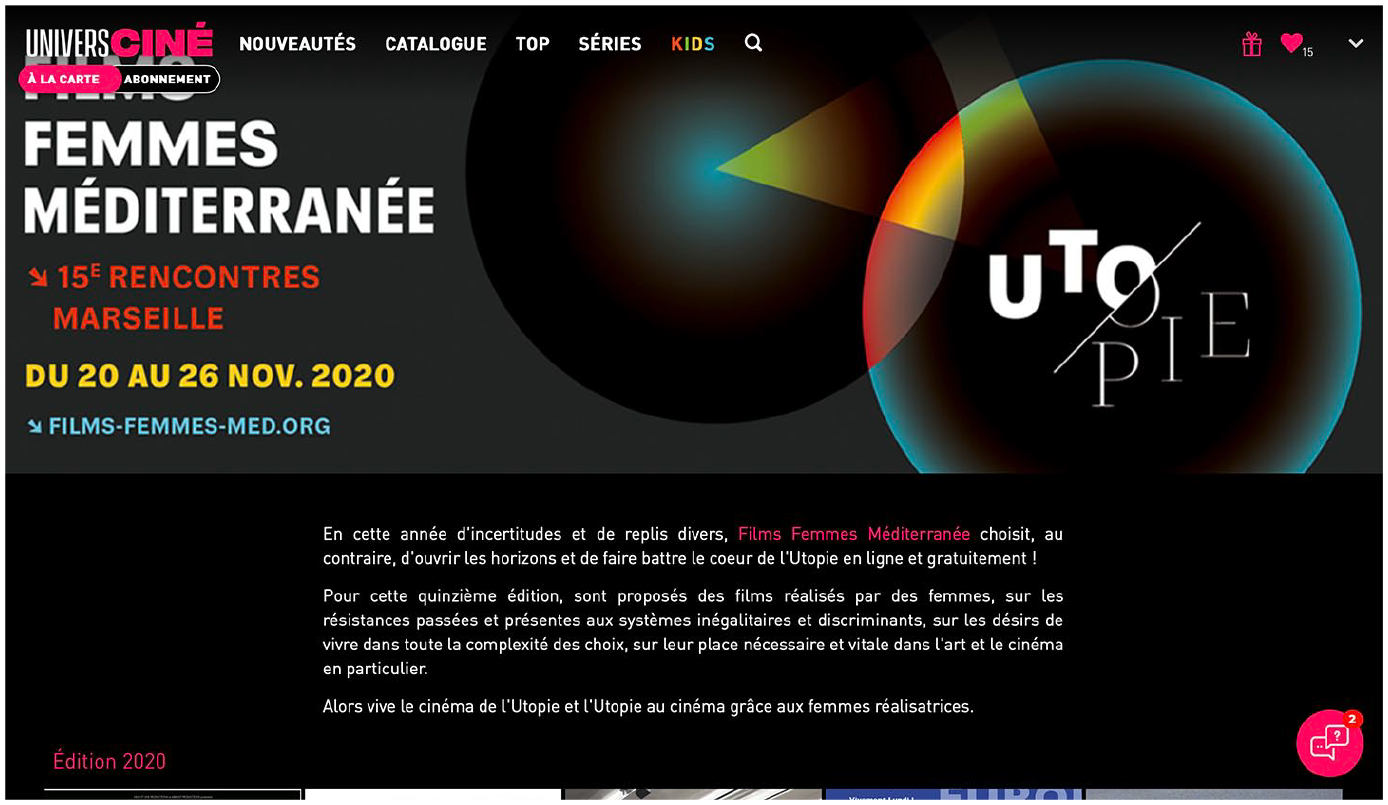
Screenshot by the author of the interface of Universciné hosting the 15th edition of FFM. LINK.
On the level of film programming, FFM fostered care through film curation by choosing the theme of utopia. On a material level, FFM maintained its commitment at community-building by choosing to programme free films and by attempting to reproduce the eventfulness of the encounters between filmmakers and spectators, which the rigidity of Universcine’s interface made impossible. As Trombi (2023) recalls,
The program was free, I think, but we thought that in order to attract people to watch films on this platform, which was not yet so known as it is today, and at the same time to make it look a little like a festival, we asked the filmmakers, who were ready and eager, to make one-minute long videos to introduce their films. So, Celia, who was the intern, made the subtitles to those videos. We would first meet in the office, and then we had to meet at my place to get work done. That’s how we became friends, I think, because in the end it was only me and her and we barely knew each other.
The idea of having short video capsules made by the filmmakers in order to encourage spectators to watch films online demonstrates the level of care that FFM has for its own public. Aware that programming a film festival online cannot reproduce the experience of being in a cinema and engage with the filmmaker following the screening, FFM conceived the capsules as an attempt at reproducing the eventfulness and the aura of the in-person festival (‘to make it look like a festival’) within the constraints imposed by the platform and the limited labour resources. The capsules were gradually released every day during the period in which the film programme was available on Universciné, from 20 November to 26 November 2020. Unlike other larger scale festivals that could embed videos of filmmakers’ introductions in the link of the films, FFM uploaded the capsules on its Vimeo channel, which were subsequently posted on Facebook and Instagram with a short-written introduction about the film. In most of these videos, the filmmakers directly address the spectators with a close-up frontal framing (‘a selfie-mode’) from their homes, thus contributing to a now-familiar pandemic aesthetic familiarized by numerous work-related and leisurely video calls. In their videos, some filmmakers provide some context on the production of their films. Others, including Ukrainian filmmaker Iryna Tsilyk, refers to the pandemic restrictions’ impediment to travel. Conversely, Italian filmmaker Chiara Malta adopts a very different strategy of addressing the spectators by choosing to not stage herself and instead tells the story of her film with a videography that freely horizontally and vertically pans over some objects that iconically stand for the characters, themes, and motifs of her film (Figure 4). Such eagerness on behalf of the filmmakers to address the spectators demonstrates the synergy of care work between festival organizers and filmmakers for both the public and their own work, and also for the broader mission of creating relationality within women’s film festivals.

Screenshot by the author of Chiara Malta’s introductory video for FFM.
While FFM’s 2020 free film program was only made available on Universciné for 1 week to partially reproduce the temporality of the in-person festival, the capsules are currently available on FFM’s website as a testament to the organization’s work of care during the pandemic. Another testament to such work is the method found to preserving the public’s affective attachment to FFM’s endeavour through announcements of films made available online for free by the filmmakers themselves or by the ancillary platforms of broadcast media. Trombi (2023) recalls this operation:
What I particularly liked in our method of adapting FFM during the pandemic was that [. . .] as part of my job I was asked to keep in touch with the public. So, with Lydia [a long-time volunteer at FFM], with whom I get along very well and who helps me to take care of the website [. . .]. We created a newsletter once per month, or maybe a little bit more, that we called ‘Solutions to boredom’. We had asked some filmmakers, whose short or feature films we programmed throughout the years at FFM, if they wanted to make available for free their films for a week or a month, whatever they preferred. I think we wrote about 15 ‘Solutions to boredom’. We introduced the filmmakers, we wrote the summaries of the plot, we thanked the filmmakers, and we told our public: ‘there, you can find this film online for a week, for a month, for free, it’s a present from the filmmakers’. [. . .] We collected these Solutions to boredom and it was . . . people thanked us! [. . .] It seemed like we were offering a service of companionship!
What emerges from Trombi’s recollection is that FFM also sees itself as a service that brings closeness through film screenings in response to the despair and weariness brought about by social distancing and other restrictions on social mobility during the pandemic.
During the interview I conducted with Trombi, she seemed pretty satisfied with the results obtained with the online edition of the festival in 2020: ‘even if we were not so well known, we had more than 4000 views [. . .] almost the same numbers we have when we do in-person screenings’. Nonetheless, she was also aware of the limitations of online exhibitions. Indeed, she explained to me that in 2021, when FFM decided to have a hybrid version of the ‘Rencontres’ with both online and in-person screenings, the films online were not very successful because ‘people really want to go back to the movie theatre’ (Trombi, 2023). This, along with Ishkinazi’s concerns about making use of streaming platform, demonstrates that, at FMM, the shift to the online festival format was the product of careful considerations and not a naïve belief in the benefits of online exhibition. Instead, film organizers and programmers recognize the inimitable affective dimension embedded in the experience of cinema-going and for this reason continues to preserve the organization of a festival dedicated to women’s and Mediterranean filmmaking even after the pandemic. 21
Conclusion
FFM’s responses to social distancing measures during the COVID-19 pandemic, which prevented the traditional experience of the festival, speak to the organizations’ established patterns and beliefs in film programming and film screenings as moments of exchange and interdependencies between festival organizers, filmmakers, and spectators. Within a context that lead to a significant increase of online culture, an organization such as FFM has been interested in preserving accessibility politics (in terms of free screenings) and building public interest in women’s film cultures of the Mediterranean. From this perspective, FFM has taken advantage of the deals offered by Universciné to flexibly adapt its films programme, as a response to the material constraints – especially in terms of labour resources – engendered by the pandemic. Ultimately, preserving the organization of the festival meant, in the case of FFM, to care for the community of spectators, for the work of filmmakers, as well as for the labour of film organizers and film programmers.
In response to these aforementioned challenges, the organization has been forced to rethink its structure and its future. The current rearrangement of FFM towards professionalization is intended as an effort of reproduction, of ensuring the survival of the organization itself and with it its mandate of providing visibility to women’s cinema, of expanding the accessibility to film screenings for ‘les publics éloignés’ (remote audiences), of the educating about gender-specific issues through films, and of promoting women’s film culture within the context of the Mediterranean at large.
These challenges speak more broadly to women’s film festivals incessant questioning about their role and viability. Ultimately, if long-standing structural gender inequalities within the mechanisms of film exhibition and circulation already constitute the evident reason of why we (still) need women’s film festivals, their role respond to the larger cultural project of changing how we think about gender through film screenings and education within safe spaces.
Footnotes
Acknowledgements
The author wishes to thank the participants who agreed to be interviewed for this research for their generosity and their warm welcome in Marseille. Special thanks go to the reviewers for their encouraging feedback and to Mark Barber for reading the first draft of this article. The author also acknowledges the generous support of the Moving Image Research Lab at McGill University and of its director, Dr Alanna Thain.
Declaration of Conflicting Interests
The author(s) declared no potential conflicts of interest with respect to the research, authorship, and/or publication of this article.
Funding
This research is supported by the Fonds de Recherche du Québec - Société et Culture.
