




Abstract
In this exploratory study, I analyse women’s experiences in a pre-professional business leadership setting. I adopt a perspective of structural contraints and conceptually draw on the construction of the ‘ideal’ female subject in late modernity and ‘new’ femininities. I argue that, although they are shifting, femininities persist to be a structurally rooted burden for assuming leadership roles for the women in this study. I develop my argument based on four interviews with women from an entrepreneurship programme in the United Kingdom. These women experience a double-bind in being a woman and being a leader and, importantly, anticipate further experience of such double-bind in the future. This creates a tension between their constructions of self, in which the women draw on ‘post-feminist’ discourses, and their experiences of inequalities. This research, hence, improves our understanding of women’s experiences in busines leadership settings by looking at the early-career stage, a perspective which is currently underdeveloped in the literature. This research also links women’s experiences in business leadership settings to the construction of the ‘ideal’ female subject and ‘new’ femininities by drawing on empirical data. The essay builds a starting point for further research by providing initial insights into these topics.
Keywords
Introduction
Woman or leader? The problem of having to grapple with being perceived as a woman and being perceived as a leader has been referred to as the ‘double-bind’ (Catalyst, 2007). The double-bind takes shape as women 1 handle competing expectations of being (perceived as) a woman, which are bound to embodying differing forms of femininity (Enderstein, 2018; West and Zimmerman, 1987), and being (perceived as) a leader, which is predominantly associated with hegemonic masculinity (Connell, 1987; Connell and Messerschmidt, 2005). While there is a substantial body of literature on women in senior leadership positions – mainly from the fields of management (e.g. Cook and Glass, 2014; Seo et al., 2017; Walker and Aritz, 2015) and (social) psychology (e.g. Fisk and Overton, 2019; Hoyt, 2010; Koenig et al., 2011) – there is little comparable work on women in pre-professional business settings. This essay, therefore, takes as its starting point the question of whether the double-bind applies for women at the early-career stage. I ask which expectations women are confronted with in a pre-professional business leadership setting and how they navigate these expectations. I also consider the ways in which women embed their experiences in this setting within wider societal discourses about the ‘ideal’ female subject.
In what follows, I highlight contradictions that arise for women who are faced with negotiating gendered norms related to constructions of leadership in a pre-professional business setting, who nonetheless seem to claim that gender inequality is a thing of the past. Femininity, in its multiple and shifting forms, is a key dimension of this contradiction, insofar as it emerges as both a potential opportunity and a persisting burden to women’s attempts to step into positions of leadership in business settings on an equal footing with men.
Gender and leadership in a pre-professional business setting
Given its focus on individuality, autonomy, dynamism, and agency (Lewis, 2014: 109), entrepreneurship is an ideal site for researching experiences of undertaking leadership roles and positions at an early stage of a person’s career. In addition, entrepreneurship exemplifies discourses about individual meritocracy and individualisation (Ahl and Marlow, 2012: 544). Lewis (2014: 109) argues that constructions of the ‘ideal’ female subject can also be identified within entrepreneurship. Therefore, this essay draws on women’s experiences within an entrepreneurship setting.
This essay is based on interviews conducted with participants in an entrepreneurship programme in the United Kingdom, to which I gained access by contacting the Head of Programme. In this programme, women had not (yet) established their own business but were taking on the role of team lead and participating in entrepreneurial training sessions. I recruited participants directly via the entrepreneurship programme and also via social media and conducted four semi-structured interviews. This small sample provides insights that can serve as a starting point for further research, as has been done by other researchers in the interest of improving understanding of women’s and girls’ lived experiences (e.g. Gordano Peile, 2018; Ringrose, 2008).
During the interviews, I asked the participants about their experiences at university (which provided the entry point to the entrepreneurship programme), their experiences of getting into and being part of the entrepreneurship programme, and their experiences within this pre-professional business setting. I adopted this approach to avoid limiting the lens through which I analysed participants’ experiences to only gender, and to make it possible to move from more general to possibly more intimate – and, therefore, potentially more sensitive – information sharing (Leech, 2002: 666). I also asked participants what they felt was expected from them in the pre-professional business setting and in what ways they viewed themselves as a leader in the present or in the future.
I transcribed the interviews verbatim from recordings, including paralinguistic features, such as the rhythm of speech and the facial expressions of participants, and I also relied on non-verbal observations from field notes. The transcription constituted a first step in the interpretive process (Kvale, 2007: 93). In analysing the data, I adopted an approach to coding that was both data-driven and concept-driven. Similar to Parr (2015: 202), I focused on passages that I considered particularly relevant to the research questions. These were (1) Which expectations do women feel confronted with in pre-professional business settings and how do they navigate these? (2) In what ways do women embed their experiences in the pre-professional setting within societal discourses about the ‘ideal’ female subject?
Intersecting structural constraints for women in leadership
As one element among the multiple structural constraints faced by women in the labour market, leadership is structurally gendered (for an overview see Patterson et al., 2012). By gendered, I mean that ‘advantage and disadvantage, exploitation and control, action and emotion, meaning and identity, are patterned through and in terms of a distinction between male and female, masculine and feminine’ (Acker, 1990: 146). According to Bierema (2016), the ‘ideal worker’ is ‘actually a man who is devoted to his work, prioritizing work over family, personal needs, and health’ (p. 120) (see also Reid, 2015). The implicit valuing of masculinity is hidden within the construction and common-sense understandings of who is the ‘ideal worker’ and also the ‘ideal leader’.
Professional leadership is also gendered through its embeddedness in gendered organisations (Acker, 1990; Martin, 2003, 2006). The gendered character of organisations is marked by power differences in the positions that are ascribed to men and women, both in terms of organisational roles and the position of power resulting from gender (Martin, 2003: 357). For instance, behaviour such as talking to colleagues is framed as negative when women engage in it, but as positive when it is done by men (Martin, 2003: 357–358). Moreover, the gendered organisation takes shape as ‘women’s bodies are ruled out of order or sexualized and objectified [. . . and] men’s bodies are not’ (Acker, 1990: 152). The concept of the gendered organisation, which Joan Acker theorised in 1990, is still relevant today (Acker 2012). While organisations have changed since then, there is considerable evidence that they continue to be gendered (for an empirical example see Correll et al., 2020). More recently, this has been demonstrated in studies on gendered work in and beyond formal organisations during the global Covid-19 pandemic (e.g. Johnson, 2021).
Importantly, gender constitutes only one of multiple characteristics, which determine women’s experiences in (pre-)professional settings. Conceptions of gender are attached to social dimensions (Andersen, 2005: 444) that are imbued with varying degrees of power and powerlessness in society (Schippers, 2007). Multiple further dimensions, such as race, age, and ability, shape women’s experiences in intersectional ways (Crenshaw, 1989). In this research, three participants were in their early 20s and one in her early 30s. One participant identified as British and three identified as nationals of different West and East European and East Asian countries. Only one participant spoke explicitly about her class status, noting that her parents had migrated to the United Kingdom with little financial means. Based on what the participants told me about their upbringing and family background, I would categorise all of them as middle class. One participant self-identified as Asian, one identified as belonging to the ‘Black and minority ethnic’ (BME) category, and two identified as white.
When speaking to the women participating in the research and when analysing the interview data, the different ways in which social dimensions intersect – as described by Crenshaw (1989) in her theorisation of Black women’s experiences – and create different marginalised experiences for different women were considered. Participants were asked about their overall experiences within the pre-professional business setting and about their pathways into this setting, rather than specifically about their gender or their experiences as women, as recommended in a personal conversation about using an intersectional lens in this research project. The aim of this approach was to make it possible for the complexities of the women’s individual experiences, as well as the differences between their experiences within the pre-professional business setting (Andersen, 2005) to emerge.
Femininity must also be understood in relation to different social positionalities, including class, race, and sexuality (McRobbie, 2009), among others. Not all women can successfully embody idealised/racialised notions of femininity (see Tate in Dahl et al., 2018). According to Baxter (2009: 14), femininity consists of cultural ideas associated with being a woman on one hand, and specific types of feminine embodiment, on the other. Consequently, female and male subjects – and not ‘masculinities’ and ‘femininities’ (Schippers, 2007: 92) – take different positions in relation to the norms against which they are held accountable. Schippers (2007) defines femininity ‘as contextually and culturally specific sets of meanings for what women (. . .) are and should be (. . .)’ (p. 92). Femininity, therefore, must be viewed in relation to the embodied social positionalities through which it (femininity) is read, enacted, and challenged. As discussed below, normative understandings of femininity emerged as a component of women’s experiences of what was expected of them in a leadership role in a pre-professional business setting.
Constructions of the ‘ideal’ female subject in late modernity
Conceptualisations of the late modern subject are rooted in Beck’s (1992) risk society, where individuation is increasingly required from subjects, and in Giddens’ (1991) notion of the self as an ongoing individual investment. The late modern subject is ‘flexible, individualized, resilient, self-driven, and self-made’ (Harris, 2004: 16). The subject’s position is conceived as the outcome of individual strategies and the successful employment of these strategies is the subject’s responsibility (Harris, 2004: 4). A subject’s value is, therefore, constructed around their agency, echoing the ‘neoliberal belief that individualization is the highest form of human achievement [. . .]’ (Pomerantz et al., 2013: 192). This logic is especially applied to young women because they are assumed to benefit from newly enhanced opportunities for achievement (Harris, 2004: 6; McRobbie, 2004: 258); young women are, thus, a ‘prototype’ (Ringrose, 2007: 484) of individualised achievement.
Individualised achievement mirrors a meritocratic logic, which, as Littler (2017) illustrates, is dominant in UK society, but does not represent reality. Subjects remain constrained by ‘a system of categorisation defined by social relations of dominance’ (Gonick, 2004: 200). The system materialises into inequalities that determine subjects’ opportunities and outcomes (Harris, 2004: 8). These inequalities impose limits with respect to what a (female) subject can or cannot achieve (Budgeon, 2011: 285). As a result – and in addition to the hierarchical social organisation of femininity – the position of the ‘ideal’ female subject is only attainable for some, not all, women (Harris, 2004: 45).
However, the structural constraints that women face are not reflected in the prevailing discourse (Budgeon, 2011: 287). Instead, there is a tension between gender inequality in society and the ‘post-feminist’ idea that equality has been achieved (Baker, 2010: 2). A ‘post-feminist’ discourse precludes female subjects from framing and making sense of their comparatively diminished social positioning as the outcome of structural gender inequality. The responsibility for (lack of) success is placed onto the female subject and is translated into an agentic imperative. A ‘post-feminist framework of presumed equality and choice’ (Baker, 2010: 13) is expected to become part of the subject’s presentation of self to meet the ‘ideal’. Hence, withholding social critique of structural constraints based on gender becomes part of embodying the ‘ideal’ female subject (McRobbie, 2004: 260). Both, the meritocratic and the ‘post-feminist’ stance, disregard the structural constraints that women face (see Figure 1).
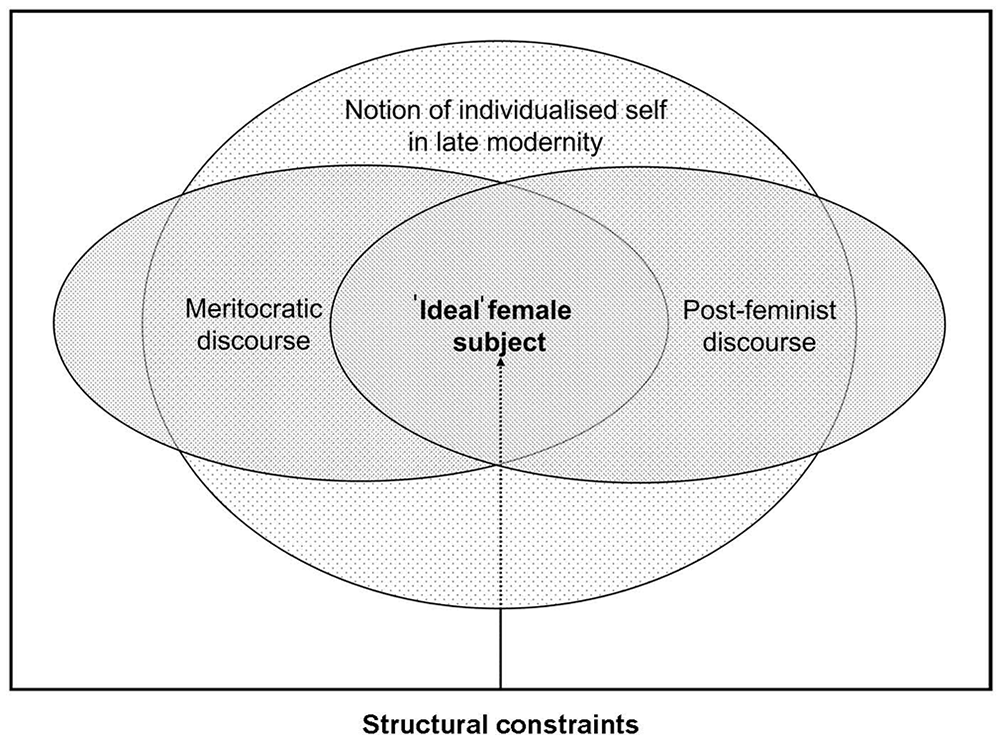
The ‘ideal’ female subject discursively constructed as individualised but nonetheless faced with structural constraints.
‘New femininities’ reflect notions of the ‘ideal’ female subject that emerged around the turn of the 21st century in ‘a context within which the meanings that attach to femininity are increasingly being questioned’ (Budgeon, 2011: 280). The new ‘ideal’ female subject does not only embody attributes traditionally associated with femininity, but also attributes typically associated with masculinity (Gonick, 2004, 2006; Ringrose, 2007). This combines characteristics such as being emotional and the view that women are restricted to the private sphere as an expression of ‘traditional’ femininity (Lewis, 2014: 114) with characteristics such as being autonomous and rational (Nielsen, 2004: 11), assertive (Ringrose, 2007: 484), professionally successful (McRobbie, 2009: 31), and powerful (Pomerantz et al., 2013) that are traditionally associated with masculinity.
Despite the broadening range of attributes that a female subject can acceptably embody in light of the conceptualisation of ‘new femininities’, contradictions in embodying the ‘ideal’ female subject persist. The ‘ideal’ female subject becomes an impossibility, requiring the representation of contradictory characteristics, such as ‘aggressor and nurturer’ (Ringrose, 2007: 485). In relation to career decisions, expectations of women can be ‘contradictory requirements of competitive achievement and a caring femininity’ (Baker, 2010: 11).
In what follows, I analyse how the experiences of the four young women who participated in this explorator were shaped by expectations about what it means to be both a woman and a leader in a pre-professional business setting. I also consider the ways in which the participants’ constructions of self reflected discourses about individualisation, the ‘ideal’ female subject, and ‘new femininities’.
Anticipating and experiencing gendered norms in a pre-professional business leadership setting
Gender emerges as a prominent element in the participants’ experiences regarding the expectations they faced in the pre-professional business leadership setting. Lucia 2 says people in business are ‘used to being the boys, the boys, the boys, the boys’ and Rita affirms that ‘It’s always been the men [. . .] so we follow them because we [women] [have] never done it’. Cara speaks of how male actors within the entrepreneurship programme would be ‘automatically closer [to each other] rather than women and guys [being close]’. These accounts confirm that men being part of this pre-professional business setting and interacting with each other is the status quo. These clear gendered lines between those participating in the entrepreneurship programme mirror findings in research on later stage career settings (Patterson et al., 2012).
Another participant’s experience demonstrates how gender intersects with ethnicity. Cara, who identifies as Asian, speaks of how ‘What people expect from me [. . .is] not just about women, [. . .] woman and Asian will be kind of, like, mixed together’. Cara clearly understands that expectations about her are based on both her gender and her ethnicity (‘mixed together’), and not only her gender (‘not just about women’). Lucia voices how she felt like she had ‘to go under the label of ‘BME’ women’ and take additional steps to get into the educational and professional position she wanted to be in. She explains that ‘It might just seem like I’m just being ambitious [. . .] but it’s just knowing I have to do this to get here’. During the interview, Lucia mentions investing additional time and not having access to educational resources in the ways women who do not belong to racially marginalised groups have, as examples of the additional steps she had to take. These accounts show how the participants’ trajectories into pre-professional business leadership settings were shaped by their intersectional positionalities. The intersectional experiences of these women expose the flawed nature of a meritocratic discourse (Littler, 2017), as their accounts illustrate that they face multiple structural barriers, including both racism and sexism. Considering that the individualised subject in late modernity is constructed as free from structural constraints or barriers, these participants’ testimonies indicate a different and differentiated lived reality.
With regard to the double-bind of being a woman and a leader (Catalyst, 2007; Eagly et al., 2014; Enderstein, 2018), participants expressed different degrees of anticipating and experiencing such a double-bind. In some accounts, I observed an implicit distinction being made between being a leader and being a woman. For instance, Catalina states that she can see ‘ways of combining both your feminine [part] [. . .] and your leadership part’ and Cara speaks of situations that she imagines require being ‘really tough and also a woman’. Both accounts suggest a distinction between being a woman, on one hand, and being a leader or being ‘tough’, on the other. The implication is that being a leader and being ‘tough’ cannot easily be reconciled with being a woman or being ‘feminine’. Another participant spoke in even stronger terms, suggesting that being a woman and being a leader is conflictual:
You are a leader, so people expect you should be . . . [hesitates] sometimes strict and straightforward, doing something tough, sometimes maybe making people uncomfortable. But as a woman you should be like soft and use more of your emotions to make people feel comfortable, to take care of everybody. And these things are just like [a] conflict between these two identities. (Cara)
We see here that the expectation of women’s inherent femininity – constructed as a care giver – can be a barrier to women taking up leadership roles, even in a pre-professional setting (see Due Billing and Alvesson, 2002).
The anticipation of a double-bind can also play out in terms of women’s behaviour. Rita’s account illustrates this particularly well. Rita explains how she avoids talking about personal life in response to my question about whether she thinks her experience would have been different if she had been a man: ‘I always in any way try to avoid talking too much about personal life [. . .] so I’ve never really experienced [. . .] something would be different’. Rita seeks to navigate gendered norms by avoiding any discussion of her personal life. This reflects both agency and conformity, or a choice to abide by the gendered norms (McNay, 2000). Perhaps, Rita anticipates that sharing personal aspects of her life could lead to a negative perception from others. This might stem from the idea that domestic spheres of life are naturally associated with women (Crompton, 2006; Scott et al., 2010: 2) and displaying an ‘overly womanly’ or ‘feminine’ image might go hand in hand with a perceived lack of professionalism, which, therefore, needs to be avoided.
Other participants also navigate expectations by avoiding certain behaviours. Cara shares how she avoids behaving in ways that could be seen as authoritarian in anticipation that others might ask – in Cara’s words: ‘Why are you being that way? Why are you not just being a soft woman?’. Lucia explains how she refrains from being assertive and claiming ideas as her own in group settings, to avoid being labelled as ‘confrontational’ by others:
I’d give an opinion, or a suggestion and they’d be asking somebody else for their suggestion or opinion and that person repeats exactly what I was saying and they would be ‘yeah, yeah, yeah, that’s a brilliant suggestion’ and I’ve just said that. But you don’t want to be . . . it’s again that thing ‘Oh you’re being confrontational’ and that’s again navigating all that kind of stuff.
These accounts demonstrate that participants situate being a woman and a leader within the double-bind that is rooted in the perceived incompatibility between a normative femininity and leadership. ‘New femininities’ (Budgeon, 2011), which could potentially reduce the perceived contradictions of being both a woman and a leader, do not seem to be salient in participants’ ideas about how – as women – they are expected to be or to behave. Lucia’s account also underlines the racialised constructions of femininity. She refers to herself as ‘[going] under the label of BME’ earlier in the interview and anticipates being seen as confrontational by others when proactively presenting her contributions as her own, which alludes to the negative racialised stereotype of the ‘angry Black woman’ (e.g. Ashley, 2014). Participants also describe how behaviour towards them affected their experience. One salient theme in this regard is the feeling of not being fully respected or seen as a leader by others. Lucia shares that, when her consulting team met a client, the client ‘would direct all the questions to the boys in the group rather than to [her]self’. Rita expresses a similar feeling: ‘What game are we playing? Because if I’m supposed to be the manager, then why are you following what an assistant is saying just because it’s a guy?’
Participants also sensed that they must prove themselves continuously, both before and after supposedly being granted legitimacy as leaders of the team. Lucia describes this as an awareness that ‘We [women] kind of know that [. . .] we’re gonna be scrutinised to the core’. She anticipates her work being examined ‘to the core’ and assumes that other women also ‘know’ this. Similarly, Rita states that, as a woman, ‘You always have to show that you’ve thought about it, why this way is more efficient than others’. Rita seems to have a strong sense that her work will be critically examined. Preparing for a critical evaluation of their work is a shared element of the women’s modus operandi in the entrepreneurship programme.
Combining anticipation of scrutiny and the experience of facing gender-based barriers at an early-career stage together, Rita expresses acceptance of having to make additional investments, compared to men: ‘First you have to break that barrier and then the game is done, [. . .] then you can properly work and properly talk to the others’. She stresses the possibility of being treated equally once she has ‘proven herself’, rather than the disadvantage of not being treated equally right away: ‘It’s mainly [to] gain [. . .] respect for your ideas and respect for your abilities because once you’ve got that, it doesn’t matter who you are’. Rita seemingly downplays the disadvantage stemming from the additional labour (both productive and affective) she feels is required of her as a woman. As with not speaking about aspects of her personal life, the acceptance of having to do extra work can be interpreted as Rita (and the other participants) exercising agency by taking steps to counter, repel, or overcome negatively gendered expectations and behaviour directed at them because they are women. I want to suggest that the mere anticipation of facing gendered barriers constitutes a gendered barrier at an early stage in these women’s careers. This observation ties in with Fisk and Overton’s (2019) argument that the anticipation of a negative evaluation of their actions as leaders makes women reluctant to take on leadership roles.
‘Post-feminist’ gender equality versus lived experiences of gender inequality
Participants made connections between their own experiences and gender inequality in society in different ways. Catalina seemed hesitant, overall, to speak about gender inequality. Instead, she assumes that men and women can occupy the same positions of power(lessness): ‘You get the positions that you want, you get the respect from others, and it doesn’t matter if you’re a woman or not’. Catalina does not seem to see that women experience structural disadvantages, as she considers anything to be achievable, regardless of gender. Instead, Catalina puts the responsibility for ‘succeeding’ on individual women: ‘If a woman really, really would like to take up a role like that [in leadership], she can do it’. Individualised achievement seems to be intertwined with being a woman, which echoes current constructions of the ‘ideal’ female subject who is fully responsible for her own achievements (Baker, 2010; Budgeon, 2015). Yet, there was also a contradiction in how Catalina talked about women and their position in society: While essentialising women, for example, by characterising them as ‘more emotional’ and ‘shy’, Catalina states that gender would not be an impeding factor to her aspirations of taking on a leadership role: ‘I think it’s in the society’s minds, but it doesn’t happen now. You’re not mistreated just because you are a woman’. Catalina’s statements exemplify how ‘post-feminist’ beliefs can become an element of identity construction for female subjects, reflecting current cultural ideals (McRobbie, 2004: 260). It demonstrates the contradiction between the denial of structural constraints that women face, in a context where other (and ‘othered’) women are experiencing structural constrains on the basis of their gender and ethnicity.
In contrast, Cara expresses the belief that although there is still gender inequality in society, on the whole, things have improved: ‘We’re better than 10 years ago, but we’re not the best. [. . .] We still need to fight for the real fairness between the different genders’. However, she also expresses doubts about the validity of her observations: ‘I don’t know whether it’s just . . . I just think about it too much’. Put differently, Cara expresses, but only in a hesitant way, the need for feminist change in society. Further contradictions emerged in the statements of other participants, which showed their awareness of the myriad ways in which things were not equal between women and men in the pre-professional business setting. Rita noted that she was not paid the same as the man who previously held her position, as required by equal pay legislation: ‘I know that my role is paid more [when it was held by] the guy I’m replacing, [. . .] that’s still a battle that we still didn’t win’. Lucia spoke about ‘these little subtle things that are at play’ and Catalina highlighted how women are disadvantaged in their career by taking maternity leave, yet she does not frame this is a disadvantage: ‘This one year that you have to be off [when having a child], that takes you, you know, a bit behind what you would normally do, but that’s fine’.
For some of the participants, it seems normal to deal with the barriers they face individually, and to disregard the need for structural change, while others recognise that gender equality has not yet been achieved. Caution around saying outright that gender inequality exists in two out of the four interviews can be interpreted as – consciously or subconsciously – striving to meet societal expectations by endorsing a meritocratic and ‘post-feminist’ discourse (McRobbie, 2004: 258). This points towards a tension between the prescriptive belief that gender inequality no longer exists in the United Kingdom – as seen in constructions of the ‘ideal’ (‘post-feminist’) female subject – on one hand, and the participants’ lived experiences and observations of gender-based inequalities in a pre-professional business setting, on the other.
Conclusion
This essay focused on women’s experiences in a pre-professional business leadership setting in the United Kingdom, analysing how young women navigate gendered norms and position themselves in relation to the construction of the ‘ideal’ female subject. Femininity emerged as a key component within expectations of women’s behaviour and the possibilities of assuming leadership in a pre-professional setting. The women I interviewed experienced and – importantly – anticipated the experience of a double-bind in being a woman and a leader. ‘New femininities’, which could potentially challenge the double-bind, were less of an opportunity and more of a burden, given what participants said was expected of them. The women’s experiences in the pre-professional business setting were mainly shaped by the well-known gendered differentiations between women and men in work environments.
In addition, the women drew on ‘post-feminist’ discourses in their reflections on progress towards equality between women and men, even as they spoke about the structural barriers they faced as women working towards taking up leadership roles. There was, hence, a tension between the women’s constructions of self and their lived experiences of inequality.
Further research should explore how the experience and anticipation of intersectional gender-based barriers unfold longitudinally along women’s career stages, and how shifting femininities continue to shape both constructions of the self and understandings of who can and is expected to ‘naturally’ take up leadership roles in business settings.
Footnotes
Acknowledgements
Dr Stephen Kemp, Senior Lecturer at the Department of Sociology, University of Edinburgh, Edinburgh, UK provided valuable comments on this research project.
Declaration of Conflicting Interests
The author(s) declared no potential conflicts of interest with respect to the research, authorship, and/or publication of this article.
Funding
The author(s) received no financial support for the research, authorship, and/or publication of this article.
