



Abstract
The literature shows that throughout the COVID-19 pandemic, in the different regions of the world (Europe, Africa, Asia, North America and Latin America), women academics submitted fewer articles and grant proposals than their peers who are men because, in addition to the increased burden of domestic work, they devoted more time to teaching activities and to the demands of students, than to their research activities. However, little is known about what drives the high level of commitment by women academics to their tutoring and pastoral care duties. This article looks at how women embodied their teaching tasks throughout the first year of the COVID-19 pandemic and the ‘emotional labour’ that this required of them. Findings from the analysis of 17 in-depth interviews conducted with women scholars in Portugal point to the complexity and contradictions in the ‘emotional labour’ carried out by women teachers during the COVID-19 pandemic and provide evidence of overlaps with the practice of ‘care’.
Introduction
Neoliberal academia is ‘a deeply and complexly hybrid institution’, marked by high pressure to publish in top-tier journals and competition for funding, increased workload, proliferation of administrative work, obligation of internationalisation and normalisation of the ‘caretaking’ of students as part of teaching responsibilities (Barcan, 2013; Lawless, 2018; Pereira, 2017). The marketisation of higher education has redefined universities as corporate entities in which teachers are service providers and students are consumers (Nixon et al., 2018). In this ‘customer culture of higher education’ (Hughes et al., 2007), students’ evaluations of teaching, as captured by quantifiable metrics, have become an important indicator for career progression (Slaughter and Leslie, 2001). Teaching, however, encompasses one dimension that is neither recognised nor rewarded in such career evaluations, even though it is expected: the dimension of care (hooks, 1994). Both students and universities expect faculty members to make personal connections with their pupils and support their well-being.
This article adds to the literature on women’s experiences in neoliberal academia by looking at the relationship between care, emotional labour and teaching during the COVID-19 pandemic (hereafter referred to as ‘the pandemic’). We explore how women scholars located in Portugal defined their main academic priorities within their research and teaching activities throughout the global health crisis. We seek to investigate the embodied teaching experiences of women in attending to students’ emotional demands. Evidence has been gleaned from our qualitative research, which was conducted in Portugal between December 2020 and March 2021 and comprised 17 in-depth interviews with women academics. Our empirical analysis reveals that the profuse dedication of many women to their teaching activities and their decision to relinquish research tasks stem from a complex matrix of gendered norms in which neoliberal mindsets, emotional labour and teaching commitments intertwine in the practice of care.
The neoliberal transformation of Portuguese academia took place at the turn of the 21st century, and the years of austerity (2011–2014) were key in heightening this tendency, as it legitimised cuts to public funding for academic institutions and enforced complex auditing regimes that led to the intensification of academic labour (Pereira, 2017). In the last decade, as these new public management logics progressed, scholars’ conditions of employment worsened dramatically, marked by a rise in part-time positions, escalation of fixed-term and casual contracts and steep increase in faculties’ workload with women being more affected than men (Carvalho et al., 2022). Only a small number of scholars retained were able to achieve tenured full-time positions in the Portuguese academia (EU Directorate-General for Research and Innovation, 2021; Ferreira, 2022). Along with this expanding precarity, the performativity culture advanced considerably, introducing complex metric systems in which publishing is the gold standard (Ferreira, 2022; Pereira, 2017). Scholars in Portuguese academia, however, are not equally affected by the ‘publish-perish’ imperative. Aiming to ‘survive’ in academia, those in precarious conditions feel the pressure to conform to the metric expectations more intensely than those who hold tenured and stable positions (Ferreira, 2022).
The persistence of gender inequalities in Portuguese society, in turn, is linked to the country’s long dictatorial regime (1933–1974), which underpinned enduring beliefs about the myth of women as carers. For instance, the division of domestic labour within full-time, dual-earner couples in Portugal is one of the most unequal in Europe, with care work towards children remaining central to women’s time allocation (Santos, 2015). As a result, Portugal ranks 21st in the European Union (EU) 2021 Gender Equality Index with a score of 63.3 – below the EU-27 average of 69.1 – when comparing women’s and men’s allocation of time to caring activities (EIGE EI for GE, 2021). Moreover, as authors (XXX) have stated, even among skilled women, ‘[t]heir traditional [care] role in the family seems to remain constantly present in their lives as professionals’. Thus, women academics are expected to engage emotionally with their students. According to Carvalho and Diogo (2021: 149): ‘[i]t seems that the traditional sexual division of labour still persists with women [academics] being more identified with the caring roles and, as such, more associated with teaching roles’.
Emotional labour versus care in neoliberal academia
The outbreak of the pandemic led to a rise in demand for support among students, increasing pressure on teachers to become caregivers (Newcomb, 2021). As Minello et al. (2021) and Newcomb (2021) argue, the extra effort made by teachers to meet students’ rising demand for emotional comfort has remained largely invisible. In the ‘gendered university’ (Tsouroufli, 2020), women have carried most of the burden related to students’ and institutions’ expectations regarding care. This has compromised their availability for fulfilling other dimensions of their academic work and, thus, also their future career opportunities (Walters et al., 2021).
It was 1983, at the very beginning of the neoliberal shift in the Anglophone academia and before it spread to other geographies (Barcan, 2013), that Hochschild coined the concept of ‘emotional labour’. At that time, demands by institutions, parents and students for teachers to provide emotional support for students were not at the forefront of this process. Nowadays, as it has been observed in the British academia for almost two decades, the expectation that teachers will establish a personal relationship of caregiving with students is being normalised in many different academic contexts, including the Portuguese (Lawless, 2018; Nixon et al., 2018; Pereira, 2017; Varallo, 2008), despite not being specifically included in the job descriptions of academic positions.
According to Hochschild (1983), the idea of emotional labour relates to the unwritten prescription for individuals in the service sector, traditionally linked to feminised jobs, to manage their emotions and offer appropriate emotional support to those they serve, their customers. Teachers at the primary and secondary levels were also identified as workers who were expected to perform intense emotional labour by regulating their own emotions in order to meet students’ demands, by nurturing and caring for them. In tertiary education, however, the role of teachers was mainly perceived as being to intellectually stimulate their students. Moreover, higher education teachers have traditionally been valued mainly for their expertise in their discipline and for their publication rates (Trautwein, 2018), and their training has tended to overlook actual classroom practices (Barcan, 2013).
In current neoliberal academia, however, expectations regarding the role of teachers have changed profoundly. The British audit culture that has arisen from the obsession with ‘productivity’ has been reproduced in numerous academic contexts, such as the Portuguese, Turkish and Latin American (Coşkan et al., 2021; Ferreira, 2022; Torres and Schugurensky, 2002). It has led to the implementation of a complex monitoring apparatus aimed at quantifying academic labour, which also encompasses teaching activities (Barcan, 2013; Pereira, 2017). The ‘corporatisation of the university as a marketplace’ (Bartos and Ives, 2019) has added to this, turning students into consumers whose satisfaction with the ‘services’ provided becomes vital to the academic institution’s standing in the race for students and rankings on league tables (Nixon et al., 2018).
In this context, students have adopted an entitled attitude in their demands for availability, support and attention from their teachers (Varallo, 2008). Due to the gendered expectation that women are naturally emotional and nurturing, women teachers shoulder a heavier burden in this regard compared with men, resulting in an exhausting load of emotional labour that they have to perform (Hughes et al., 2007).
Students have higher expectations of their women teachers developing a personal relationship with them, offering emotional support, being more available to them and giving better grades than they do of teachers who are men (El-Alayli et al., 2018; Lawless, 2018). These gendered expectations shape the evaluations given by students, in which women teachers tend to be assessed not only on the basis of their knowledge and teaching skills but also on their full-time availability, their willingness to pay personal attention to students, their openness and kindness (Darby, 2017; El-Alayli et al., 2018). However, as emotional labour is essentialised as natural to women, it has been taken for granted, gaining neither attention nor recognition (Eveline, 2004).
‘Caring about’ students is indisputably an essential aspect of teaching (hooks, 1994), and it does involve an ‘emotionally engaged labour’ (Lynch, 2007). Thus, the boundaries between emotional labour and care are not straightforwardly clear. Care requires ‘effort, time and energy’, which can also be tiring and stressful; however, the reciprocal and relational realities of caregiving nourish carers with pleasure, allowing them to thrive as subjects (Hughes et al., 2007; Lynch, 2007: 554).
Care relates to the radical transformative practice of building collective spaces of solidarity (Ahmed, 2014), challenging the neoliberal drive towards privatisation and individualisation logics. For Askins and Blazek (2017), the ‘ethics of care’ in neoliberal academia is a political stance that challenges the individualist line of thought in performative academia, as it encompasses reciprocity in the giving and receiving of care.
Building on the view of Tronto (1993), we understand ‘care’ as an ongoing complex relational construction, produced through practice. For Raghuram (2014), the ‘embodied and physical’ practice of care produces and enacts care as an ethical principle, so that care as a practice and care as an ethical principle can never be considered entirely removed from one another. Care as an ethical principle focuses on the interdependency and interconnectedness of human relationships and ‘insists on addressing [our] need for care’ (Lawson, 2009: 212).
Neoliberal academia, however, dismisses the caring dimension of education (Lynch, 2010). As a result, care is commodified in standardised ‘pre-packaged units of supervision’, undermining its pleasurable and reciprocal nurturing parts (Lynch, 2007: 564). With the advance of auditing logic, academia has become ‘careless of people and values’ (Blackmore, 2020: 1), and its culture of performativity has fostered individualism and an ethos of competitive productivity among scholars, hampering any space for care to thrive (Walker et al., 2006). As Lynch (2010: 57) argues, in ‘careless’ academia, ‘even the care of one’s own emotional wellbeing is incidental’ – let alone care for other people. Hey and Leathwood (2009: 103), looking at the UK context, observed that, meanwhile, in aiming at promoting student retention, academia has engaged in an ‘affective turn’, ‘a rhetorical new emphasis on creating a support/ive culture of learning’. At the same time, care is downplayed.
Methodology
To gain a deeper understanding of the issue of how women academics experienced and performed emotional labour during the COVID-19 pandemic, we followed a qualitative approach that encompassed 17 in-depth interviews with women scholars. The participants were scholars holding a PhD degree who were affiliated with a Portuguese academic institution and who were in Portugal during the 2020 spring semester.
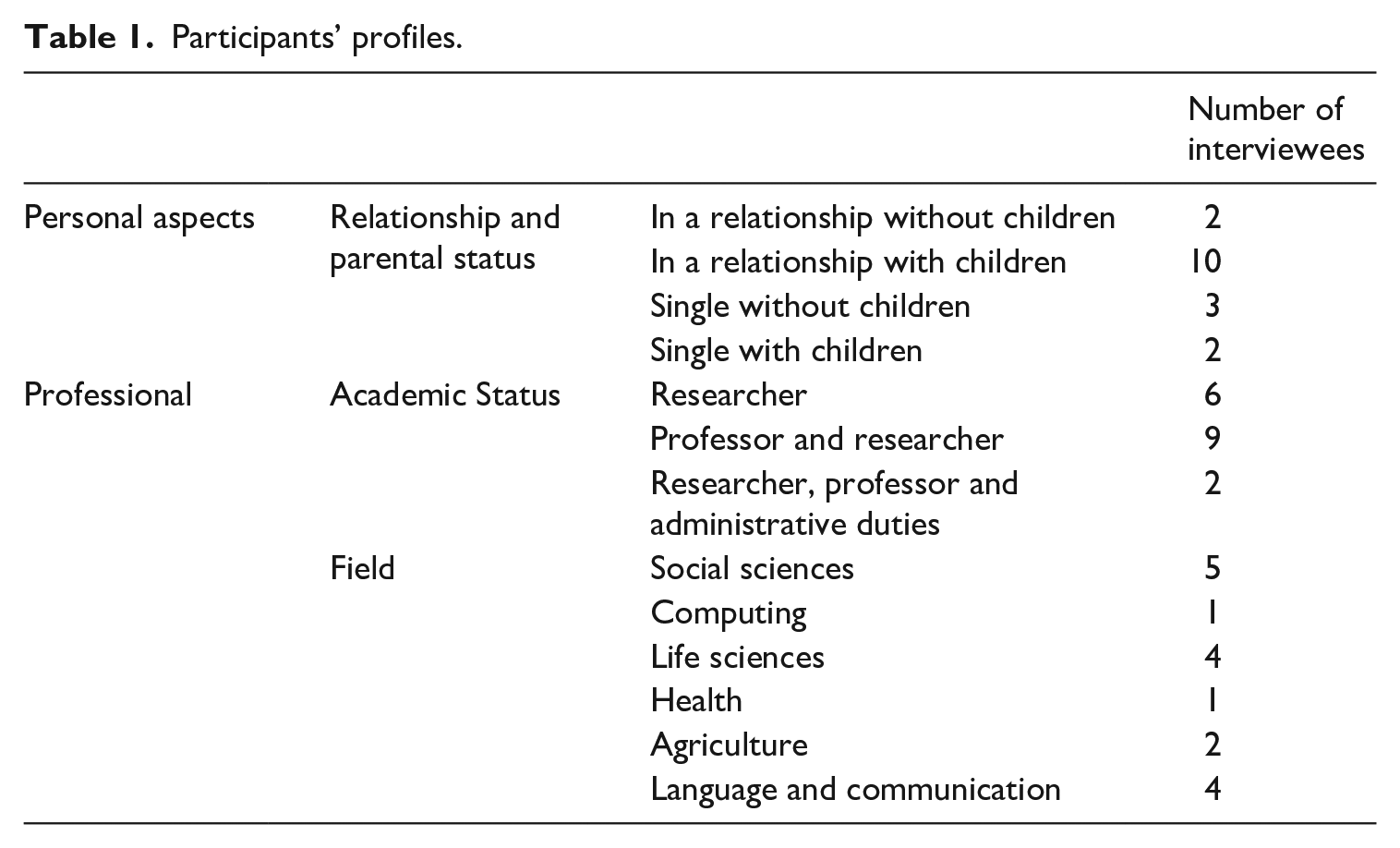
All interviewees identified as heterosexual, white women and cis-gendered women (Table 1). The homogeneity in our sample roughly mirrors the lack of diversity in Portuguese higher education institutions (Tavares et al., 2014). Participants were recruited via various methods: snowball sampling, personal invitation and an expression of interest in participating in the qualitative part of the study after answering the online questionnaire.
Participants’ profiles.
Fieldwork was conducted between December 2020 and March 2021, during Portugal’s second lockdown. The study was approved by the ethics committee and GDPR officer of the authors’ institution.
Interviews were conducted via Zoom and recorded in full. Before the study began, its aim was explained to all participants, whose names have been anonymised here for confidentiality. The interviews commenced only after oral consent had been obtained. The duration of the interviews ranged between 30 and 90 minutes. Participants were asked about the impact of the COVID-19 pandemic on their professional lives and mental health and how they had managed to reconcile their professional and private lives.
Interviews were transcribed and analysed using the computer software MAXQDA. Qualitative coding was used to analyse the collected data (Charmaz, 2006), and seven final categories were identified. For the purposes of this article, we will focus on three categories: student demands and emotional labour, the contradictions of caring during the pandemic and mental health and the cost of care.
The COVID-19 pandemic, student demands and emotional labour
During the COVID-19 pandemic, time became a scarce resource due to increased domestic workload and a lack of familiarity with new ways of performing academic work, as most teachers’ courses were not adapted for virtual delivery. Confronted with choices concerning how to allocate their extremely limited time between their various professional duties as scholars, those of our interviewees who had teaching or supervisory roles unanimously stated that their students were the priority. However, the commitment of our participants to their teaching duties and students came at the cost of their research productivity and personal well-being (Giudice et al., 2022; Roubinov et al., 2022; Walters et al., 2022). Natalia is a Portuguese associate professor in a nursing school. She is 54 years old and lives with her youngest son, who is 34, and her elderly mother. Her account illustrates the additional burden imposed by the shift to remote classes and the impact it had on her research productivity.
My main worry was the clinical training classes for the students . . . so I had to invest a lot of time planning how it was going to be . . . Contrary to common sense, remote teaching takes a lot of time in preparation, thus one of my projects is very late, it should have ended before 2021. However, every time I am about to start working on it . . . some teaching issues appear. Thus, my research is totally halted now. – Natalia, Associate Professor
The unfamiliarity of academics with the remote environment, and the added labour of having to adapt teaching materials to a new format, required extra efforts to ensure students received quality teaching, as well as taking care of their well-being. This transition was time-consuming and, most significantly, prevented women from dedicating themselves to research.
Vanessa is Brazilian and has a fixed-term professorship and researcher contract. She is 43 years old and has full custody of her 3-year-old daughter. In the following excerpt, Vanessa explains how she put her research activities aside in order to safeguard her teaching duties and respond to students’ demands: Articles, conference calls . . . and grant applications, I could not handle them. My answer was: ‘under normal conditions, for sure I would accept it. Thank you for the invitation, but I can’t’. . . . Teaching was never put aside, accompanying students, especially those who were writing their dissertation, this was my priority . . . I had until the end of January to submit two articles, and I didn’t . . . I sent an email to say that I was very thankful and very frustrated, because it was one of those opportunities one could not miss . . . not when everything counts towards your evaluation. – Vanessa, Professor and Researcher
If women academics’ focus on teaching aimed to respond to an institutional demand, it also related to a personal perception of what was the most important consideration for them in such an unparalleled situation. The decision of women teachers to put their research on hold was, however, neither naïve – nor was it free of frustration. Amid a culture of metrics and audits, our interviewees in precarious positions, such as Vanessa, reported being aware of the impact such decisions could have on their careers, even though students were their priority. Conversely, it seems that it was not very clear to our interviewees how their constant availability for their students might affect their personal well-being (Scharff, 2018). As students’ calls for attention skyrocketed, some of our interviewees felt compelled to respond to these demands at any cost – as narrated by Helena, a 48-year-old mother of two teenage daughters who is in a heterosexual relationship. Helena is Portuguese, she holds permanent positions as a senior researcher and assistant professor, and during the first year of the pandemic, she was also chair of her department. She describes how during that time the boundary between her role as teacher and caregiver became extremely blurred.
I created WhatsApp groups with them right away, which is still crazy today, because I have 150 students . . . and they send me messages, they call me on Saturday nights, Sunday mornings . . . Today, one of them has already called me because he broke his foot . . . another called because his father died . . . I was managing all that; some didn’t have a computer or internet access and I started recording summaries of classes on WhatsApp to explain to those who couldn’t be on Zoom . . . And I can’t help answering them. I even made the mistake of scheduling tests on Mondays or Tuesdays, and then they were studying at the weekend and had doubts and questions on the weekends, and I felt I had to answer, I couldn’t not answer. What I’ve been trying to do now is put my phone in flight mode at 9 pm, because they text me at 10 pm / 10.30 pm and, I don’t know, I could pretend I didn’t see it, but I can’t. Even if I don’t answer, I’ll read it and it stays in my head.
– Helena, Senior Researcher and Assistant Professor
Helena’s statement shows that, during the pandemic, women felt pressured to be constantly on-call for students’ requests, both academic and personal, ready to solve any kind of challenge they might possibly face. Her account also discloses the relationship between teachers’ load of emotional labour and the institutional offer of social service. The incapability of most Portuguese universities to offer adequate institutional support to respond to students’ academic and non-academic needs during this period exacerbated the expectations of women teachers to take care of students.
Although we have so far talked about the pressure neoliberal academia places on women teachers to provide pastoral care to students, the quotes above raise some questions about the extent to which this pressure is solely institutional or is driven by other factors. Given that the weight of traditional ideas about gender in Portugal is still prominent, women are still raised to be caring and attentive (Rosa et al., 2016). Hence, our interviewees’ dedication towards their students might also relate to gender socialisation dynamics operating in Portuguese society, in which women are deemed to be care providers. However, care is a constituent part of teaching and a key practice in challenging the individualisation of academia (hooks, 1994), so this acute devotion to their students’ needs could also be underpinned by an ethics of care. Our data do not allow us to clearly affirm the main drivers behind such intense dedication or to determine to what extent such drivers are interwoven; however, we can state that, independently of their own motivations, this intense commitment to students’ well-being and the lack of adequate institutional support within neoliberal academia enable women teachers to be exploited in terms of their performance of care (Quinn, 2007).
Contradictions of caring during the pandemic
When asked about the positive aspects of the pandemic, Helena refers specifically to closer contact with students being a favourable aspect. Moreover, she resents not being able to engage to the same extent with her new students as she did with students she knew from previous years: I think a positive aspect [of the pandemic] was the greater contact with students . . ., especially with the students I already knew, who were already my second- or third-year students . . . I am sad when I think of my first-year students, because I don’t know their names, I’ve only seen [them] with masks, via Zoom, most of them don’t turn on their cameras . . . so I don’t know them well. It’s sad for me, not knowing their names.
Florbela is a 46-year-old Portuguese woman who lives with her husband and their four children. She is an associate professor and senior researcher. Like Helena, she describes ambivalent feelings towards teaching during the COVID-19 pandemic: My biggest concern was teaching . . . because we had to adapt to [remote classes] and . . . nobody was prepared for this . . . also, students’ demands increased enormously, it would consume my day . . . but some classes went very well, like the Master’s courses I teach, because they were only 14 students, so we could see each other . . . talk about how they were doing, because we thought it was important . . . we would spend some time on this, we even decided to have more meetings . . . classes were once a week for three hours and we realised it was not enough because we wanted to talk about these things . . . so every two weeks, we would have three meetings instead of two . . . but this also required more preparation, more work.
– Florbela, Associate Professor and Senior Researcher
This apparent contradiction – high volume of student demands versus greater contact with students as negative and positive aspects, respectively – resembles the taxonomy of ‘perverse pleasures’ for women academics identified by Hey (2013). Hey looks at feminist scholars’ ambiguous pleasure in responding to performative academic standards – grants, publications, citation indexes and so on – despite the stress, frustration and exhaustion involved in doing so. In a similar vein, the complex entanglement between care and emotional labour ensnares women academics in a trap of contradictory feelings towards their role as teachers. In the context of excessive workloads due to the pandemic, and despite the stress and exhaustion reported by women teachers as a result of attending to students’ emotional demands, such women also experienced unexpected pleasure in caring for them. For Hughes et al. (2007), in spite of the personal costs involved, caring also fosters feelings of goodness and moral superiority. As the author states, ‘[w]e feel pleasure at our achievement of being caring’ (Hughes et al., 2007: 142). This ‘seductive’ power of care, as Hughes et al. (2007) term it, is also central to comprehending why one cares.
Mental health and the cost of care
By acknowledging that women’s dedication to their teaching duties may be multi-faceted, we expose the complex relationship between care and emotional labour. Furthermore, this entanglement can simultaneously inspire resistance to individualism in academia and escalate emotional despondency. Catarina is a 46-year-old Portuguese woman and holds an assistant professor position. She is a widower and takes care of her two teenage sons. The long excerpt from her interview, which follows discloses how being a teacher during the pandemic was about far more than just delivering content: It did have an impact on my mental and emotional state . . . Every time a student . . . had to be in isolation, we received a notification with their name, saying ‘the student meets the conditions to stay at home’, so I would look to see if that student was at home in the next class and ask him how he was, because I had to care about the students since they’re part of my life in that semester . . . I’m in some way responsible for their learning, so I had to show that I cared about them . . . ‘I know you’re in isolation, is everything okay? How’s your family?’, and when people responded, I was a little more relaxed . . . they’re people who are part of our affections, . . . at least for me, because I don’t know how to teach any other way. During that period . . ., even if it’s just that – they’re part of my life on Mondays from 2 pm to 4 pm, and on Wednesdays from 8 pm to 10 pm – so if they’re not there, if I know the reason why they’re not there, then of course I have to write them, asking ‘Are you okay? Is your family well?’ . . . of course . . . it affected me. It couldn’t be any other way. I’m a teacher, I’m a person, and I care about others.
– Catarina, assistant professor
Catarina talks about how, for her, teaching is also about caring for her students as holistic beings who, like her, were also struggling with sometimes difficult circumstances in their private lives. Demonstrations of authentic concern and empathy for students’ personal circumstances are a first step towards resisting neoliberal academia and creating a caring community in which both students and teachers show mutual care for each other and share responsibility for the learning/teaching process (Mountz et al., 2015). However, as Madge et al. (2009) argue, it also requires deep, intense and laborious emotional investment. Caring for others is circumscribed by one’s personal life in a way that might compromise one’s emotional availability and ability to care, so recognising limitations to one’s care is fundamental to building a caring environment (Madge et al., 2009). Given the extreme pressure placed on teachers by academic institutions in relation to the technical aspects of teaching, as well as the demands of their own private lives and their personal fear and anxiety, women teachers were just as much in need of care as their students. However, due to the marginal space that care occupies in discussions about teaching in neoliberal academia (Askins and Blazek, 2017), most of our participants had not been prepared to engage so deeply with their students’ vulnerabilities: I had two major problems . . . One was that I was an Erasmus coordinator; the other was that I had many African international students. . . . the Erasmus students were very worried, because many of them were unable to return home, and the African international students were abandoned – I mean, they didn’t have anything to eat, they didn’t have a cafeteria, they had nothing, and that was very emotionally heavy for me . . . at the beginning of the pandemic, I started having panic attacks and I actually had to take medication . . . So yes, it was a period, from a mental health perspective, of something I had never experienced – I have no depressive tendencies – and it was a very complicated period from that perspective. And I think that’s why, when you asked me, ‘What was it like to live through the pandemic?’, I felt like sharing this in order to alert people to the fact that even a person who hasn’t lost her job, who has a good life, who is in a wonderful place, who isn’t confined, can become so fragile in face of the situation we are experiencing.
– Dulce, Associate Professor
Dulce is a 54-year-old Portuguese Associate professor who is married to a Swedish man and has no parenting responsibilities. Like Dulce, many women academics who have never previously experienced any kind of mental distress, reported being emotionally affected by the pandemic (Saw et al., 2023). As a childfree woman, Dulce’s account illustrates how it is not only academics with child-caring responsibilities who experienced emotional despondency due to the stress they faced during the pandemic (see França, 2022). Like their students, women teachers have also been overwhelmed by anxieties over an uncertain future, the safety of their loved ones and concerns over their personal well-being and career (Boncori, 2020). After the onset of the global health crisis, almost all governments worldwide quickly enforced social distancing measures, compromising their country’s economy to contain the spread of the virus and protect people’s physical health. Efforts to limit the pandemic’s impact on mental health, however, were close to none. It is known from previous epidemics that situations of uncertainty trigger psychological distress, while social isolation can increase the risk of loneliness and depression (Choi et al., 2020).
While institutions were extremely concerned with students’ mental health and learning outcomes – asking faculty members to be more patient and flexible – almost no attention was paid to academics’ own emotional distress (Burk et al., 2021). As our participants stated, the impact of the pandemic on their well-being and mental health was tremendous. In an environment that was already mentally unhealthy pre-pandemic, the increased stress and fear surrounding the outbreak’s unknowns, together with the multiple demands placed on academics, exacerbated the mental exhaustion and emotional despondency they were already experiencing prior to the pandemic, as described by Gill (2010). Pereira (2017) argues that this emotional and psychological suffering cannot continue to be framed as an individual and private problem. Emotional distress results not only from biology but also relates to precarious social relations (Peake and Mullings, 2016). Hence, Dulce and Catarina’s mental distress was not a product of their own making, ‘but rather the result of a systemic issue’ (Dunn, 2020: 496) that was exacerbated by the pandemic.
Conclusion
This article enters into the debates about ‘care’ and ‘emotional labour’ in neoliberal academia by exploring the ways in which women academics made compromises in their teaching duties during the first year of the pandemic, in the context of Portuguese academia. While there is no doubt that engaging emotionally with students is central to the teaching and learning process, gendered and personal expectations regarding what this engagement means are draining and exhausting for women teachers, in spite of any satisfaction that providing such care to students might bring. In ‘careless’ academia (Lynch, 2010), neither institutions nor students consider that women teachers also need care, and they are simply expected to intensively perform the emotional labour needed by their students.
Our analytical choice to focus exclusively on women academics is supported by the understanding that care is gendered (Tronto, 2010). Thus, by looking at the experiences of women teachers, we were not ‘claim[ing] that care ethics are articulated only by women, nor that they represent a unified feminine (or feminist) standpoint’ (Jordan, 2020: 23). Our objective was to highlight the experiences of women academics in Portugal with regard to their caring endeavours as scholars during the global health crisis. Indeed, the existing literature on the impact of the pandemic on academia offered initial evidence that some male faculties’ academic work was also affected by the increase of domestic and care work in their personal lives (Abdellatif and Gatto, 2020; França et al., 2023). Little is known, however, about how men dealt with the growing emotional labour demand and their caring duties as teachers, a gap that requires future research. Adopting a broader definition of care in academia (Hook et al., 2022), our study also opens new investigative avenues to explore how the ‘careless’ neoliberal academia shaped scholars’ strategies to navigate their caring and academic responsibilities during such an unprecedented situation.
Studies investigating the impact of the pandemic on women academics demonstrated how, amid the health crisis, women teachers found themselves torn between following their institutions’ ‘business-as-usual’ example by prioritising their publications and projects (and thus safeguarding their careers) or devoting extra time to their students’ learning outcomes and demands for care, despite a lack of recognition for this additional labour (Walters et al., 2021). Our article adds to this debate by showing how women’s commitment to their teaching duties during the pandemic can be linked to a number of different causes, including the push to comply with students’ and institutions’ gendered expectations of ‘caregiving’, the consumer culture of neoliberal academia, the lack of adequate institutional support, pedagogical concern for students’ learning outcomes and a genuine commitment to students’ well-being in line with an ethic of care.
In the case of Portugal, given the gendered precarity in the academic system and the importance of publications for grants and job applications, for many women academics, the negative impact of an increased emotional labour load might irreversibly compromise their academic careers. We are aware, however, that not all academic women were equally affected by the disruptions caused by the global health crisis. The scholarship has shown how, during the pandemic, existing inequalities experienced by LGBQT+ scholars, racialised women, single mothers and mothers with disabilities in academia were exacerbated, and new ones emerged (Davis et al., 2022; França, 2022; Wagner et al., 2022). Thus, the lack of diversity in Portuguese academia reproduced in our sample is a key limitation in our findings.
We agree that ‘care’ can constitute a path to challenging the individualistic and atomistic approach in academia. However, ‘care’ in academia also encompasses a big volume of emotional labour that can deplete women teachers’ well-being. Thus, the demands by students and institutions for emotional support from women teachers, without any reciprocal practice of care and attention to these women’s own needs, exacerbate their mental and emotional distress. Taking up hooks’ (1994) idea of an ‘engaged pedagogy’, we argue that, when teaching is informed by an ethic of care that also considers teachers’ needs, and not by a unilateral expectation of ‘emotional labour’, ‘teachers grow and are empowered by the process’ (hooks, 1994: 21) instead of experiencing exhaustion and anxiety. Academic work underpinned by an ethic of care is committed to alternative forms of student–teacher interactions, transforming academia back into a ‘place to learn’ (hooks, 1994) instead of a ‘marketplace’. This allows for the creation of ‘a true learning community’ supported by a network of ‘reciprocal care’ (Pétursdóttir, 2017), in which women teachers’ needs are also taken into account. As Mountz et al. (2015: 1239) argue, the creation of caring communities through the ‘cultivation of spaces for ourselves, students and colleagues’ is a way of resisting the pressures within neoliberal academia. Teachers, learners and the knowledge they produce together interact across a widespread social network, disrupting the neoliberal logic of the marketisation of education (Morley, 1998). Hence, rather than being a task to be performed (invisibly) by women teachers, or a matter of individual practice, care should be a communal ethic that involves teachers, students and academia as a whole.
We also acknowledge that it is a very complex endeavour to navigate the boundaries between care for students that are profit-driven and that which is motivated by an ethic of care. In many situations, it may not be especially clear whether we are conforming to the expectations of neoliberal academia, aiming to safeguard our careers or practising genuine care. Considering that neoliberal academia tends to enforce ‘atomistic market relationships’ (Lynch and Kalaitzake, 2020) and that spaces for other-centred practices are limited, this should not be equated to simplistic blurred boundaries of care practices. Building on Lynch and Kalaitzake’s (2020) ideas of calculative solidary in ‘what is given, needs to be reciprocated’, this growing tension between the ethical and the calculative (self-centred) dimensions of care undermines the possibilities of creating a more affect-driven academia. At the same time, it reduces care within the academic community to the banality of transactional exchange (Naidoo and Jamieson, 2005). Rather than minimising the importance of care as a result of the contradictions and ambiguities involved in its practice, acknowledging such complexity allows us to reflect on the effects of the advance of neoliberal logics within academia on our approaches to teaching and on student learning processes.
Footnotes
Acknowledgements
The writing of this article was greatly enhanced by Maria do Mar Pereira’s generous contribution of her knowledge. I extend my heartfelt thanks to her for bringing invaluable insights to this discussion. Additionally, I wish to express my deep gratitude to the anonymous reviewers and their insightful comments.
Declaration of Conflicting Interests
The author(s) declared no potential conflicts of interest with respect to the research, authorship and/or publication of this article.
Funding
The author(s) disclosed receipt of the following financial support for the research, authorship and/or publication of this article: This work was supported by Fundação para a Ciência e a Tecnologia, Portugal under the scheme GENDER 4 COVID, grant 619958202.
