




Abstract
Roma women face multiple inequalities at the intersections of ethnicity, gender, and class. Framed by Romani feminism, studies have explored Roma women’s own perspectives and experiences, drawing attention to the diversity within this group and the specificities of their social position due to the complex forms of discrimination they face. Drawing on interviews with Spanish Roma women, this article contributes to and extends this strand of research by exploring Roma women’s experiences and constructions of womanhood and motherhood. We found the construction of womanhood to be focused on the effective management of responsibilities, particularly caring and household tasks. Moreover, Roma women defined motherhood as a valued experience for them and their communities. A homemaker position was associated with mattering, something, we argue, which needs to be understood in the context of racial hostility, exclusion, and precarity in which Roma women live.
Introduction
The Spanish Roma, also self-identified as Calé, Kalé, gitanos, or Spanish gypsies, is the largest ethnic minority in the country, accounting for around 1.5% to 2.1% of the total population (Fundación Secretariado Gitano, 2008). Since Roma people arrived in Spain in the 15th century, they have experienced persecution, racism, assimilation, and spatial segregation (Alfaro, 2013). Their oppression should be understood in a context of discriminatory structural mechanisms, like stigmatisation and governmental measures that promote the exclusion of Roma from political and social spheres (Peña García, 2020). For instance, the Roma were used as scapegoats for poor economic performance and criminality during the Franco dictatorship, between 1939 and 1975 (Saulesleja and Castro, 2018). At the same time, they have been represented as an exotic group in narratives that aim to make them attractive to tourists (Saulesleja and Castro, 2018). Nowadays, the Roma are still the target of othering discourses derived from ethnocentrism and cultural relativism (Sordé et al., 2014).
Because ‘racialised discourses and processes are strongly gendered’ (Sordé et al., 2014: 90), Roma women are particularly exposed to stereotyping as they are represented as a homogeneous group in stereotypes produced within Spanish majority society (Peña García, 2020). The intersection of racist and gender stereotypes reinforces Roma women’s vulnerability and exacerbates the recognition of their struggles for equality (Bitu and Vincze, 2012; Oprea, 2012). Due to multiple and intersecting inequalities that prevent their access to basic social rights, Roma women are among the groups that suffer most from discrimination (Sordé et al., 2014). These oppressive mechanisms impact key dimensions of Roma women’s life experiences, such as motherhood and marriage (Cukrowska and Kóczé, 2013; Stojanovski et al., 2017).
Research has found that motherhood reinforces the vulnerability of Roma girls because it hinders them from completing secondary education and increases the risks of physical and mental problems (Boden et al., 2008; Crowley et al., 2013). At the same time, researchers have suggested that motherhood among Roma girls can be understood as linked to a desire to be valued and accepted by members of their community (Elliot et al., 2004; Janevic et al., 2011). It is in this regard that the concept of mattering is useful. Rosenberg and McCullough (1981) defined mattering as a process through which a person ‘perceives and feels that she counts to others, that others care about her future, and that others depend on her- that they need her’ (p. 165). Mattering through motherhood implies the recognition of Roma women in their social environment.
This article explores how Spanish Roma women (Spanish gitanas or Kalé) construct and experience womanhood and motherhood. First, we discuss the literature on Romani feminism and the contribution that its theoretical frameworks provide for this article. Second, we present the methodology and research findings. We then discuss constructions and experiences of womanhood and motherhood through the voices of Roma women and how these can be understood. Finally, we draw conclusions based on our analyses.
Romani feminism
Research on Roma women has focused on either gender or ethnicity as factors of disadvantage and, therefore, has not recognised the specificities of Roma’s women situations and the challenges and possibilities they face at the intersection of sexism, racism, and socioeconomic inequalities (Kocze and Popa, 2009). Rooted in an essentialist view of Romani culture as the cause of women’s oppression and patriarchal gender relations, academic analyses have tended to portray feminism and Romani culture as conflicting (Brooks, 2012; Oprea, 2005). These analyses present Roma women as unaware of their own oppression and in need of salvation (Sordé et al., 2014). Moreover, the use of cultural explanatory models to explain the experiences and situations of Roma women has led to the reproduction of stereotypical images of Romani culture and Roma women (Aiello et al., 2019; Pagán and Vasileva Ivanova, 2020).
Conducting research through an anti-racism lens calls for attention to the histories of repression and racial domination that shape the lives of Roma women and men (Brooks, 2012). To deconstruct hegemonic ethnicised discourses on the Roma, it is crucial to acknowledge Romani culture in the context of a system of ethnic domination which shapes their culture and identity. In this regard, Romani feminism has emerged as a critique of Eurocentric feminist analyses (Bitu and Vincze, 2012; Sordé et al., 2014) that universalise White women’s experiences and, in so doing, overlook the racism and marginalisation that shape power relationships within Romani communities (Bitu and Vincze, 2012; Goienetxea, 2017; Oprea, 2004). Qualitative methodologies, which recognise the specific and diverse contexts of Roma women’s lives, emerge as useful approaches for a more nuanced understanding of the experiences and situations of Roma women (Kocze and Popa, 2009: 62).
Framed within a nuanced, contextualised perspective, some studies have analysed Roma family life and the ways in which motherhood is constructed and experienced by Roma women. Rather than being considered an oppressive institution, the family emerges as an important asset for Roma women, as it is considered ‘the guarantor of both cultural memory and the resistance to marginalisation’ (Pagán and Vasileva Ivanova, 2020: 158). Family structure emerges as part of a group’s resistance strategy against racial oppression (Collins, 2000; Jabardo Velasco, 2008). Similarly, studies have found that motherhood and respect for elders are important values that some Roma women embrace (Sordé et al., 2014: 92) and are not seen as oppressive. This strand of research shows that to understand Roma women from their own perspectives, researchers must acknowledge the historical discrimination against Roma communities and the complex layers of oppression they have faced and continue to face across European countries. Likewise, it is crucial to rethink categories typically applied to Roma communities within Eurocentric feminist analyses – like the conceptual separation between the domestic/private sphere and the public/social sphere – that could lead to a passive objectification of Roma women defending their role in their families (Jabardo Velasco, 2008).
Methodology
This study is part of the European project RoMoMatteR, ‘Empowering At-Risk Roma Girls’ Mattering through Reproductive Justice’ 1 conducted in Spain, Romania, and Bulgaria. The project addresses Roma women’s reproductive justice and contributes to efforts to prevent gender discrimination against Roma girls and women within and outside of their communities. These patterns of discrimination are strongly associated with motherhood as Roma women often become mothers at an early age. RoMoMatteR promotes actions to empower teenagers to freely decide their life goals, be recognised and valued in their communities regardless of their decisions about motherhood and influence decision-making processes in their communities (Garcia-Ramirez et al., 2020). The project was approved by the Ethics Committee at the University of Alicante (Exp. UA 2019 07 18).
The first stage of this project included semi-structured interviews with Roma women, aimed at uncovering their life experiences, perspectives, and future expectations. In the Spanish context, 19 semi-structured interviews were conducted with Roma women between 18 and 67 years old in Alicante, from April to June 2019. This article draws on the narratives of those interviewees (13) who had children or were pregnant at the time of data collection, focusing on their constructions and experiences of motherhood and womanhood.
The interview script included 43 questions organised into 8 sections, 2 addressing issues such as mothering, family planning, empowerment, and mattering within the Roma community. The meaning and experience of womanhood and motherhood were topics addressed in all interviews.
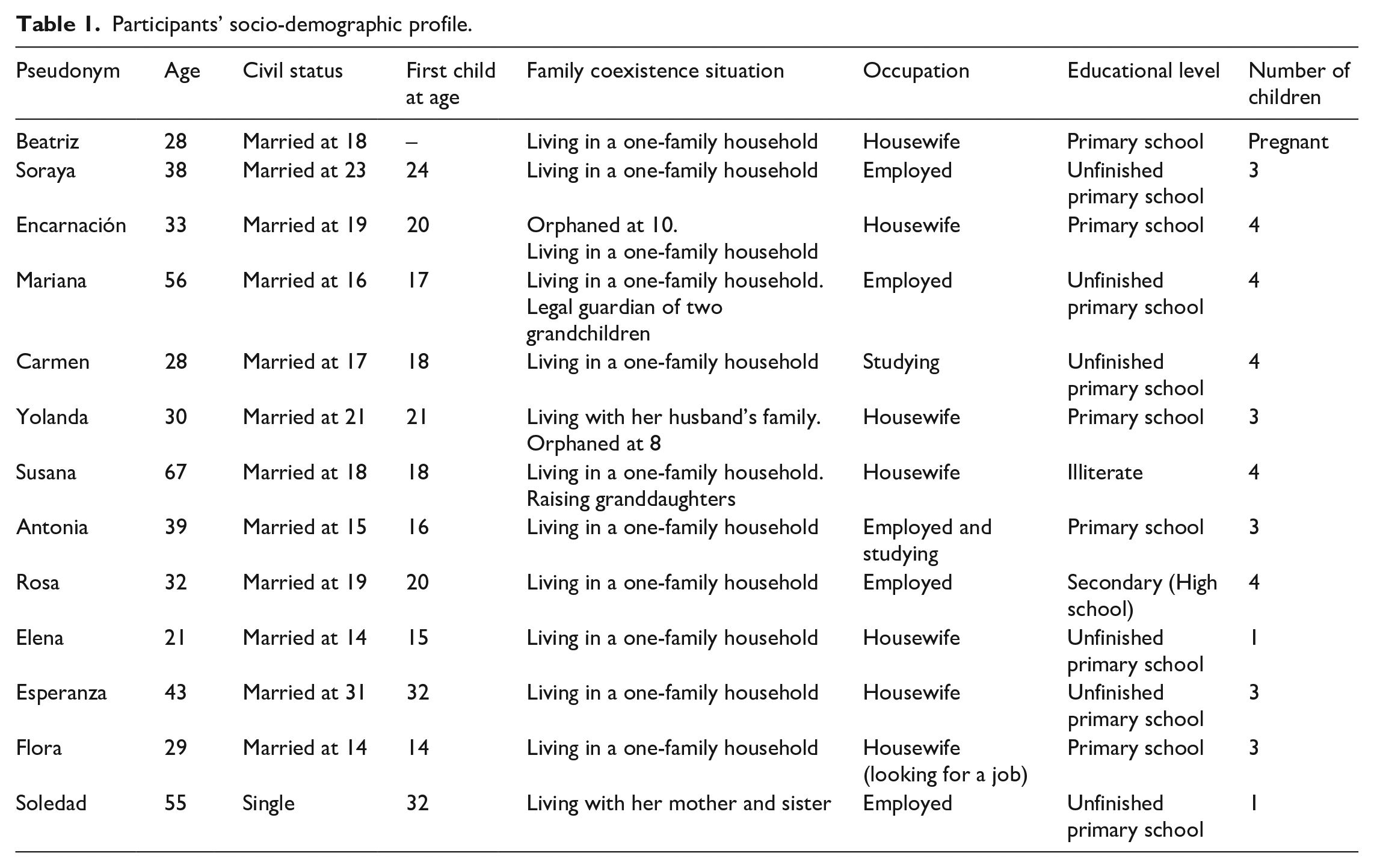
The participants were intentionally selected with the help of key actors in the Roma community, thanks to the participation in the project of the Autonomous Federation of Roma Associations (FAGA). The selection strategy sought to reach maximum diversity in combining the variables of age, marital status, family situation, occupation, and the number of children (see Table 1). The sample is relatively homogeneous regarding income levels, as the participants were selected from neighbourhoods characterised by high poverty levels.
Participants’ socio-demographic profile.
With the aim of creating a space of empathy and trust, the interviews were conducted by two members of the project, both women, one of them of Romani ethnicity and the other linked to the Romani community through family ties. This strategy also contributes to providing a view from both within and outside of the Roma community on the topics discussed. Interviews were recorded and transcribed in Spanish once the participants had signed an informed consent form. Data were imported into qualitative analysis software NVivo12 and analysed thematically following Braun and Clarke’s (2006) model: First, author re-read the transcripts and inductively coded all the data. Second, she arranged the codes into themes according to their similarity in meanings. Third, themes were reviewed and redefined considering the existing literature. At this stage of the analysis, all authors gave important intellectual insights that guided the revision of the final coding tree and the reporting of the results. The analysis focuses on identifying constructions and experiences of womanhood and motherhood among the research participants.
Findings
We present participants’ constructions and experiences of womanhood and motherhood and how they negotiated diversity in gender roles in interaction with wider family, and in relation to social and economic factors.
Constructions and experiences of womanhood
Womanhood was defined as a social role entailing gendered practices, behaviours, norms, and beliefs. Mariana and Carmen represent testimonies in which some Roma women associate family responsibilities, like household tasks, caring for children and elders, and supervising younger siblings, with being a woman: Even [if she is] unmarried, a woman is always responsible for helping her parents, her mother, her brothers, whoever. For me, that’s being a woman. (Mariana) Being a woman is feeling you are responsible for something. (Carmen)
This representation of womanhood shaped Mariana’s and Carmen’s relationships with their families, community, and their own identities and entailed numerous laborious chores. It is important to note that, while describing the tasks and practices associated with being a woman, the interviewees rejected how Romani women are represented in racist hegemonic discourses. Typical Spanish majority ethnic representation portrays Roma women as victims of oppressive gender roles rooted in the Romani culture. For the research participants, a women’s homemaker role legitimises the status of womanhood in their family and community and proves how important and resourceful women are. As Encarnación said, women are ‘the pillars of the home’: I believe that it (being a woman) is to be the pillar of the home because, at least in my house, even if my husband is working and doing things, I’m the one who takes care of everything. As a woman, you take care of your children, the house, the husband, the worries, everything.
Like other interviewees also did, Encarnación appropriated an image that is part of the stereotypical representation of Roma women (the homemaker) in a way that emphasised the value and recognition of its versatility, strength, and resourcefulness. We found accounts that pointed to the mattering that depends on a woman’s homemaking ability: Even my husband (when he is) at home without me, he doesn’t know how to do anything, [. . .] [. . .]. The other day, my husband said, ‘if you weren’t here, I would die because I wouldn’t know what to do’. I’m simply the fairy godmother of my home. (Encarnación)
Likewise, other participants insisted on their husbands’ helplessness and expressed that their mattering is rooted in being resourceful and needed by their families: My home, my husband, everyone, they’ll die if I am not there. (Elena)
Interviewees emphasised respect, dedication, love, care, family closeness, and resourcefulness as positive attributes that they identify with the Romani representation of womanhood. In this regard, we found that participants shared that they felt proud of being Roma women and embraced the values associated with this, while they showed an awareness of the stigmatisation of Romani culture within the wider Spanish society: Being a gitana woman is the most beautiful thing that can happen to you. [. . .] [. . .] when I say I’m feminist, it’s because I stand up for women’s rights and equality, and I experience [gender] equality at home, but I don’t know if it’s something natural that, as a gitana woman, I like to do Romani things, for example, I feel very good when my husband comes from work, and I serve him food [. . .] I like it, and it makes me feel good. (Antonia) [Being a woman] is something beautiful. In our culture, there are many limitations, but I think that was before, not now. There is more freedom now. For me [being a Roma woman] hasn’t limited me. (Flora)
In the above quote, Flora recognises the dynamic nature of Romani culture. Other participants emphasised the positive features they associate with being a Roma woman, which come from Romani cultural values, the ability to adapt to changes and the aspiration for self- and community development. Additionally, some women drew on Pentecostal religious beliefs when they reflected on womanhood: Based on the word of God, I believe that a wise woman builds the home. A woman who isn’t wise demolishes the home, destroys it. So, I think that women occupy a very important place in the world in this regard. [. . .] I don’t mean that a woman’s place is only in the house [. . .]. A woman should fulfil herself doing any work she likes; she must fulfil herself because she can be useful outside her home too. (Soledad)
Together with accounts that associated the duties, practices, and responsibilities they carry as women with mattering, we found reflections on the limitations these put on their agency. The following are examples of critical accounts of a notion of womanhood rooted in unequal gender roles and power relations between men and women in the household: When a woman gets married, she must care for her husband, taking care of her mother-in-law. (Mariana)
Furthermore, some participants pointed out that machismo among Roma men could be better understood if we acknowledge the role of racism in hindering gender equality. In this way, they recognised the intersection of gender and ethnicity in the multiple forms of oppression they face. An example is the next quote from Encarnación: I think it’s a question of gitano machismo, but at the same time, it’s also about racism from non-gitanos. Because if the non-gitanos weren’t like that, I think the gitanos would have changed a long time ago because they are the ones who judge us. You go out, and the first thing they judge about you is being gitana, so racism makes the gitano (man) in the house says: ‘well, don’t you see they don’t want because you’re a gitana? Home is the place you must be’ [. . .] [. . .] because we (women) go out and are treated with disrespect many times just for being women.
The quotes above mirror the diversity and plurality of positions among our research participants. Although kinship relationships and care were crucial in forming the women’s identities as women, we also found values of individualism informing constructions of womanhood: A woman is born a woman and becomes a woman herself; it’s something that goes with the person, achieving her goals, doing what she wants to, I don’t know, feeling free. (Antonia)
Finally, when asked about mentors who provided participants with guidance on their development as women, interviewees mostly pointed to female relatives like mothers, sisters, aunties, grandmothers, and mothers-in-law. For example, Yolanda shared that her grandmother was her most influential role model. Although she described her as being ‘mean’ because she forced her to clean the house when she was only a child, Yolanda understands that her grandmother was doing so ‘for my own good, according to her, so I’d become a woman so that in the future, my mother-in-law wouldn’t scold me’.
Markers of womanhood
Most participants shared that they had not experienced a transition from girlhood to womanhood. Having carried caring responsibilities since an early age, we found that most interviewees defined themselves as having always been women: I’ve always been a woman. [. . .] That transition from girlhood to womanhood? No [I haven’t experienced it], I have always been very old. [. . .] they make us grow up so fast, [. . .], we are 7 siblings, my mother took me out of school to help her. (Soraya)
Interviewees stated that they reached womanhood when they were given responsibility for household chores and caring for nephews, siblings, or their own children. As Antonia explains, such a homemaker role is not only a manifestation of gender roles within the Romani culture but a solution to the economic constraints faced by interviewees’ families: I didn’t go to school because I stayed at home [. . .] helping to take care of my nephew because my sisters and my brothers-in-law have always worked, and we have helped each other like this. (Antonia)
Likewise, other participants stated that they stopped being a girl when their families needed their contribution to woman-based solidarity networks that were of great importance for the survival of their families. Events like the death of a mother, birth of nephews, and new employment of female family members hastened this process: Of course, the circumstances make you grow up (referring to the death of her mother). You had to be old; you had to be the one who takes care of your brothers [. . .]. So, I wanted to be the girl you must be, but I couldn’t. [. . .] [. . .] I’ve raised four children together with my aunt since she had them until they grew up, [. . .] I was unmarried but running a home. (Encarnación)
For some of the women, this situation motivated their decision to get married at an early age: I’ve always been a woman. [. . .] [. . .]. I mean, from the age of 5 I was no longer a girl [. . .] [. . .] [. . .] I got married out of boredom, I said ‘I’m a single woman who is having a married woman’s life’, because I cleaned, ironed, cooked, I did everything, my sister and I. (Yolanda)
For other interviewees, womanhood was achieved when they were emancipated from their parents by getting married and working. Thus, womanhood was associated with having responsibilities and managing on their own: When I left home and started working and earning some money, then, maybe, it was when I thought, ‘I’m older because I’m working’. (Soledad)
Motherhood marked the transition to womanhood for some interviewees. This perception was based on the caregiving duties that come with having a baby, which shows again how the women associated caring responsibilities with being a woman. The following is an example from Flora who answered the researcher’s question about when she became a woman in this way: When I got pregnant [. . .] you take on more responsibility [. . .] because you have your baby, and you know that she already depends on you.
Motherhood also marked a shift in women’s status (from girl to woman) because it promoted their maturity and growth; interviewees associated ‘being a woman’ with resourcefulness and strength.
Constructions and experiences of motherhood
We found that participants constructed motherhood as ‘a gift from God’, and a natural and expected outcome in a woman’s life. For our informants, joy, greatness, protection, love, tenderness, and dedication seem to be keywords to define how they experience becoming and being a mother: [I experienced getting pregnant] with great joy, great enthusiasm, and as a gift from God. There is something inside of me, which is the Holy Spirit [. . .] I already knew that it was a gift from heaven, one that can only be children. (Beatriz) My children are the most wonderful thing that has happened to me. (Esperanza)
References to women’s innate maternal instinct were also found in interviews in which some participants described motherhood as intrinsic to women’s nature. Based on this perception, interviewees presented motherhood as an expected and desired outcome for all women: It’s the most wonderful thing in the world. [. . .] [. . .] [. . .] It’s a change, and it comes out naturally. In other words, when a woman has a baby, that feeling of being a mother comes out. (Antonia) It is happiness, responsibility, affection, something that comes from within you . . . you know you always must take care of (your child). [. . .] [. . .] All married women . . . well, I think that all women want to be a mother, right? (Elena)
However, we also found accounts where the women navigated diverse norms for motherhood and acknowledged new ways of framing this experience. For example, in the next quote, Rosa says that although motherhood is the ‘best thing’ that happened to her, other women may find fulfilment in life through other experiences: For me, being a mother is the best thing that can happen in life, but there are also many things that you can do. There are people who devote themselves to travelling; others devote themselves to studying; other people devote themselves to going out with friends. For me, as I’m a mother, the most important thing is my children.
Navigating diverse norms for motherhood, participants emphasised the empowering potential of this experience for women, as both the family and the community would show more respect towards them, while they acknowledged new ways of framing motherhood by incorporating values of freedom and individualism.
The intersection of motherhood and womanhood
For some interviewees, womanhood is not achieved through motherhood. Because being a woman was associated with having caring duties, many participants shared that womanhood is reached when a girl becomes responsible for the household: It isn’t necessary to be a mother to be a woman. Simply running our homes [makes us women] [. . .] [. . .] [. . .] You are already raised in this way: ‘you have to do everything’. [. . .] everyday life makes you a woman. (Encarnación)
Likewise, other interviewees shared that womanhood is not a status to be achieved through motherhood but one with which a woman is born: A woman is born a woman. (Antonia)
During her interview, Beatriz shared that motherhood is a personal choice, but one that is not in accessible to all women since some experience the impossibility of conceiving children: For me, she (a woman without children) is still a woman, and that’s that. She has her thinking, her values as a woman; motherhood is a choice. Not everyone is prepared, nor do we have the same mindset. [. . .] [. . .] [. . .] [. . .] in case she can’t [have children], poor thing, it is not even a question [whether she is a woman or not] but [it’s] something painful. [. . .]
Some participants did construct motherhood as central to women’s identity. Across these interviews, we found more references to the inborn nature of the maternal instinct and to the impossibility of conceiving children as a misfortune that some women suffer. Few interviewees viewed not having children as a personal choice or decision: I think that a [non-mother] woman isn’t complete [. . .], I think it’s necessary [to have children to become a woman], at least, to have that feeling of being a mother, of being worried [for your child] [. . .] well, I don’t know, it can happen, I know some girls who cannot conceive, and this doesn’t mean that their lives . . . But I don’t know. (Soraya) I think so; being a woman [means] having your children [. . .] You have been a woman since you are born, right? What happens is that something wakes up inside you, I don’t know when you are a mother, that maternal instinct, but you have been a woman since you were born. [. . .] [. . .] well, if a woman tells you, ‘I can’t [get pregnant] because I’m sick or whatever’, you feel sorry for that person who cannot [have children], well, if she decides not to have them, it is her decision. (Mariana)
We also found accounts where interviewees reflected on how the Romani community represents motherhood and womanhood. For instance, in the next quote, Beatriz alludes to stereotypes of Roma women being discriminated against within the Romani community for not having children: If there is no chance to be a mother, it’s ok; it’ll be handled very well, my environment will accept it. (Beatriz)
Although Beatriz points to tolerance towards women who have no children, it is relevant to note that she was referring to women who cannot conceive, as opposed to women who make a decision not to have children. Soledad also emphasised tolerance and acceptance for women who have no children within the Pentecostal Church. She did so by referring to this community’s religious values which, according to her, promote the equal value of all people: It (non-motherhood) is respected because what matters is the person and not what she has [. . .] because that is how the Lord looks at us all. [. . .] Here [in the Pentecostal church], there are no positions, no status, no levels, here, [. . .] we care about the person.
Yet, other interviewees shared that the Romani community stigmatises women who have no children since motherhood is viewed as a source of women’s social status: Roma people, when they (a couple) get married, and one becomes a mother, they respect her more and value her more. (Yolanda)
Despite the mattering associated with motherhood, when asked about their power to make decisions, participants noted consulting their husbands before deciding on any important matters: At home, I’m the one making the decisions but sometimes [. . .] depending on the subject, I don’t know right now, but a problem that I have, I don’t know, with my grandchildren, right? Then, I can make the decision, but if it’s a big problem, he (husband) must help me with that problem because sometimes women, there are many things that women don’t, we can’t, men must talk (about it). (Mariana)
Finally, some participants felt that the special value given to motherhood in the Romani community could lead to social pressure to start a family. In these accounts, we also found criticism towards getting married at an early age without having achieved economic security through formal education or employment: If life goes wrong when my daughter gets old and she has no resources to support herself, she doesn’t have a house, and her husband isn’t a grown man, I would advise her not to have children [. . .] not just because you get married . . . [you must have children] I mean, not as we, gitana women, do ‘one gets married, and if she doesn’t get pregnant in a month, it isn’t valid’, I don’t think so. (Yolanda)
Discussion
The Roma women who participated in the research defined womanhood in terms of caregiving responsibilities, strength, and resourcefulness. They associated their homemaker position with mattering within their broader communities and, at the same time, were critical of the challenges this role posed in their lives, such as work overload and limitations to individual decision-making and gender equality. Interestingly, this construction both supports and challenges Romani cultural norms of womanhood. Framed by western notions of the divisions of the spheres, a Eurocentric feminist perspective may see the public space (e.g. employment) as a source of empowerment and, consequently, position women who remain in the private sphere (household) as subordinate (Jabardo Velasco, 2008). From this view, a homemaker position would be understood as opposed to a notion of womanhood as strength. However, drawing on insights from Romani feminism, in which women’s oppression does not stem from Romani culture per se (Bitu and Vincze, 2012; Brooks, 2012), our study calls for the need to look at Roma women’s own understandings and experiences of womanhood and the socio-economic-political context in which these are located. This implies that Roma women’s constructions and experiences of womanhood and motherhood should be interpreted in relation to the forms of economic and cultural discrimination they face, rather than as a result of tradition or an essentialist characteristic of Romani culture.
On the whole, we heard from the research participants that womanhood was achieved when women effectively manage household responsibilities as daughters, sisters, nieces, wives, or mothers. Similarly, getting married and starting employment were put forward as markers of becoming a woman. In this regard, our findings complement studies that identified marriage as the marker of womanhood among Roma women (Saulesleja and Castro, 2018). Womanhood was, therefore, constructed around an ability to successfully manage (domestic, caring, working) responsibilities. This view mirrors how participants linked womanhood to their transition to adulthood, the latter understood as a life stage that entailed gendered tasks and responsibilities.
When asked to define womanhood, interviewees referred to the category of ‘being a gitana woman’, implying that this is different from simply ‘being a woman’. Drawing on insights from Romani feminism and the accounts from informants who reflected on the interlocking of gender with ethnicity, we argue that references to ‘being a gitana woman’ show participants’ awareness of the gendered and racialised discourses intersecting in hegemonic constructions of Romani womanhood. Particularly, as discussed by several researchers (Bitu and Vincze, 2012; Brooks, 2012; Oprea, 2012; Saulesleja and Castro, 2018), the Roma have been portrayed as an homogeneous ethnic group in racialised discourses that legitimise the discrimination and marginalisation faced by Roma communities in Spain and elsewhere in Europe. Within this group, Roma women are specially targeted in stereotypical generalisations, that is, being submissive to men and unwilling to work or study (Sordé et al., 2014). Our interviewees, rather than rejecting the stereotypical image of the homemaker, reinterpreted it as they highlighted their appreciation for some values and beliefs within normative womanhood. In line with previous research (Pagán and Vasileva Ivanova, 2020), participants responded to the stereotypes attributed by western culture to being a Roma woman by appropriating some of them. The women positioned themselves as active subjects and counteracted racialised discourses by stressing their homemaker position as a source of mattering and, in so doing, legitimating gender inequalities. References to their resourcefulness in contrast to their husbands’ dependence on them to do household chores and to the happiness they find in caring for their families are examples of this.
As Goienetxea (2017), studying the Spanish context, has argued, naturalising gendered norms should be understood as a strategy through which the Roma resist the majority culture’s domination. In such a context of wider racialised and gendered societal oppression, Roma women hold a relevant position in their families as guarantors of the reproduction, reinterpretation, and recreation of Roma culture (Pagán and Vasileva Ivanova, 2020; Sordé et al., 2014). Similarly to other ethnic groups, Roma women are responsible for transmitting cultural symbols and elements that are seen as forming their ethnic group’s cultural identity (Peña García, 2020: 61). This position as ‘pillars of the family’ (Goienetxea, 2017) emerged in our study when participants pointed to female relatives as mentors who taught them how to be a woman and also monitored their compliance with the behaviours expected of women.
Racialised hostility and discrimination from the majority society also seem to play a role in patriarchal positioning of Roma women within their communities. This can be seen most clearly in the accounts of some interviewees who recognised that fear of being discriminated against reinforced the belief among Roma men that a woman’s place should be in the home. Importantly, we also found reflections on experiences of being trapped in a vicious circle of poverty and social exclusion, which limits women’s access to education and perpetuates their marginalisation within the wider society (Macías and Sama, 2012). In a context of racialised discrimination and precarity, women undertaking household chores and their participation in female intrafamilial solidarity-networks arise as a strategy for Roma families and communities to face poverty and social exclusion. Such a homemaking position can also be seen as a way for the women to foster a sense of belonging to their ethnic community in a context of wider social marginalisation (Sordé et al., 2014). We suggest, therefore, that the construction of family responsibilities as a central pillar of Roma womanhood can be understood by recognising how Romani culture intersects with several layers of oppression within Spanish and other European societies.
When it comes to motherhood, our findings support previous research regarding the value of family to Roma women (e.g. Sordé et al., 2014). Far from being an institution that oppresses women, the family is a vital element in Roma women’s lives and communities. Kinship relations emerge as a protective space in which they can develop their identities as Roma women, as well as an economic survival strategy. The Roma women in our study portrayed themselves not just as individuals with their own needs, but as part of a collective (the family) with both cultural and economic survival needs. In this context, they represented themselves as being resourceful in meeting these needs and, therefore, as mattering to and in their communities. This resonates with the writings of Black feminist scholars (e.g. Collins, 2000; hooks, 1989), who have discussed how Black women find in the family – in brotherhood with Black men – the support needed to resist marginalisation and racism. As for Roma women, Goienetxea (2017: 217) has argued that they move forward together with their husbands as they resist oppression from the majority society in Spain. Thus, characterised by values of solidarity and a sense of belonging, kinship relationships are theorised within Romani feminism as a source of a person’s value and self-identity (Peña García, 2020).
In line with studies that discussed motherhood as a source of mattering for Roma women (Cukrowska and Kóczé, 2013; Durst, 2002; Stojanovski et al., 2017), we found that being a mother was associated with responsibility and maturity, and, consequently, participants stated that women acquire a higher social status in Roma community when they have children. However, it is important to note that such a valued social status (motherhood) did not necessarily translate into women’s empowerment because, as Roma women, they lacked the power and resources to make some decisions that were crucial for themselves, their families, and communities. Interviewees recognised how the intersection of gender, ethnicity, and class hinders women’s access to several social spheres. Particularly, the exclusion Roma women faced from the labour market, education, and social and political spheres limited their agency in their daily lives and their participation in public spaces (Magyari-Vincze, 2006). We also found a contrast between informants’ own experiences of motherhood and those they wished for their daughters. While most of the interviewees got married and had children at an early age, they recommended that their daughters postpone motherhood until they secured some resources, through education and employment, which would enhance economic security for themselves and their families, in line with previous analyses (Ferrández-Ferrer et al., 2022).
The experiences of the Roma women who participated in this research demonstrate the relational character between norms of motherhood and womanhood (Narayan, 1997). In our study, these norms were negotiated by Roma women in a context characterised by structural discriminatory mechanisms. The women negotiated what may seem to be contradictory positions and values within notions of womanhood (such as the homemaker vs the career woman) and of motherhood (such as destiny vs personal choice). This also mirrors the dynamic nature of identities, or as Saulesleja and Castro (2018) stated, ‘it is possible to be a gitana and transform/transform oneself’ (p. 167).
Examples of such a negotiation of norms were particularly found in the accounts of participants who belong to a Spanish Pentecostal Church. In these interviews, we found that the women drew on biblical references and Pentecostal beliefs when describing the position that a woman should have in her family and community, and when defining motherhood (‘a gift from God’, ‘the Holy Spirit’). As other researchers have pointed out (e.g. Muñoz Vacas, 2005), Pentecostal movements may use biblical references to naturalise gender inequality. Yet, we argue that the interplay between religion and gender norms in the construction of womanhood and motherhood is complex. We found that religious beliefs legitimated continuity and change in gender norms. An example of this is that drawing on Pentecostal beliefs, interviewees prioritised a woman’s homemaker role over her career, while they recognised that ‘a woman’s place is not only in the house’ but she must contribute with her own skills to her community. At the same time, religious references were employed both to portray motherhood as the essence of womanhood and to justify that a woman’s status in a community is not dependent on motherhood. Further research might pay more attention to religious affiliation as a variable that has an impact on the constructions and experiences of motherhood and womanhood among Roma women, especially since the Pentecostal church in the communities we have studied includes Roma believers almost exclusively.
References to the notion of maternal instinct were found across some interviews in which motherhood was described as a woman’s inborn ability to know what her baby needs and a tendency to want to protect and raise her child. Motherhood was naturalised as a goal shared by all women, and childlessness was constructed as involuntary (the outcome of infertility) and undesired. However, some of these participants recognised that what for them was something natural and unquestionable (motherhood) may not be the same for other women. Similarly, other interviewees referred to childlessness as a personal decision and incorporated values of freedom, individualism, and decision-making when discussing motherhood. Data collected from non-mothers in the context of the RoMoMatteR project indicates that such narratives would have been more common in a research sample comprising Roma women with university-level education (Ferrández-Ferrer et al., 2022).
Conclusion
The Roma women who participated in this research negotiated norms of womanhood and motherhood in complex ways within a context characterised by structural racialised gender discriminatory mechanisms. Womanhood was constructed to take on responsibilities that included caregiving and household tasks, and motherhood as a valued and important experience. Both womanhood and motherhood were a source of Roma women’s mattering in their homes and communities. To better understand Roma women’s experiences and meaning-making in their lives, it is important to avoid cultural explanatory models that might overlook the role of structural factors, such as poverty and racism. We argue that the association of women’s homemaker position with mattering needs to be understood in a context of racialised hostility, social exclusion, and economic precarity.
Footnotes
Declaration of conflicting interests
The author(s) declared no potential conflicts of interest with respect to the research, authorship and/or publication of this article.
Funding
The author(s) disclosed receipt of the following financial support for the research, authorship, and/or publication of this article: This article draws on data from RoMOMatteR, a research project funded by the DG Justice of the European Commission in the Call for proposals for action grants under 2017 Rights Equality and Citizenship Work REC-AG#809813.
