




Abstract
This research examines how the 2023 PricewaterhouseCoopers (PwC) Australia consulting scandal challenged understandings of what it means to be a public sector consultant. The scandal problematised the professionalism of consultants working for government in the discursive field of the media scandal – which overlapped with the Australian Senate inquiry on the integrity and management of consulting firms – and aired long-standing criticisms of consultants. Through an analysis of 331 news media articles published over five months, two distinct phases are identified: the ‘bad consultant’ and the ‘good system’. In the initial phase, the archetype of the ‘bad consultant’ challenges consultants’ performance of professionalism in terms of ‘expertise’. In the subsequent phase, there is a discursive shift to systemic concerns about the prevalence of consultants at the intersection of public interest and the hybrid government context. At stake during this discourse event was not whether consultants met their own definition of professionalism, but rather how consultants’ relationship with government and performance of professionalism was defined in terms of ‘public interest’ – itself a discursive construct.
Introduction
The 2023 PwC Australia consulting scandal was a site of struggle in public discourse, exposing deep tensions around the integrity, professionalism, and accountability of government consultants within a media-driven scandal that converged with Senate questions into the conduct of consulting firms. In May 2023, Greens Senator Barbara Pocock asked senior public servant Treasury Secretary Dr Steven Kennedy, during a Senate estimates meeting, about governance failures including concerns about the ‘dominance’ of current and former consultancy partners on the government's regulatory bodies for tax advisers, accountants and auditors (Commonwealth of Australia, 2023b: 23). In response, Dr Kennedy defended governance systems and justified the use of consultants in terms of their expertise: I'm a hundred per cent confident that we and the regulators are working for the good of the country, and, as you said, we vigorously pursue that. As part of doing that, we can't pretend that we have all the expertise within the department. We must talk to others. I feel we clearly have to be able to do that in good faith, and we have to have full assurance that we're able to do that, and that's one of the reasons we are strengthening our own confidentiality arrangements. We do not want to be in an outcome in which we can't talk to people about these issues in developing the policy, because there's genuine expertise for us to be able to draw on. (Commonwealth of Australia, 2023b: 24)
As part of the Senate estimates questioning of Dr Kennedy, Senator Pocock developed a critical line of questioning not framed in terms of expertise, but the assumption that consultants ‘are actually working for the good of the Australian people’, and declared ‘we cannot pretend that the current structures are working’ (Commonwealth of Australia, 2023b: 25). Through a comparative analysis of government inquiries, Grube (2014) has argued that such inquiries move beyond the specific circumstances of a given event to allow for a deeper examination of governance failures in terms of the structures and systems in place. In this context, public accountability ranges from opportunities for learning through to what Grube calls ‘politically charged theatre’ (Grube, 2014: 224). Similarly, McCallum et al. (2024) argue that media reporting plays an important role in mediatising public accountability by contextualising specific events in relation to the broader conditions that enable them. In the case of the PwC Australia scandal, the system that enabled public sector consulting premised on expertise was questioned and framed instead in terms of the public interest. Indeed, Senator Pocock, and others, invoked ‘public interest’ – which Pocock defined as ‘working for the good of the Australian people’ (Commonwealth of Australia, 2023b) – to challenge expertise as the basis for relying on consultants to do the work of government. Pocock questioned whether Australians can have confidence in governance mechanisms as risk mitigation for deeper structural issues, such as the hollowing out of the Australian Public Service, which is a critique of hybrid government. In this context, the exchange between Senator Pocock and Dr Kennedy presents a microcosm of the broader discursive context and highlights the tension between competing interests of for-profit and public interest motives. These tensions have seemingly intensified because the ongoing corporatisation of government and hybrid approaches to the work of government requires consultants to be part of government operations and ideally work in the public interest. This research, therefore, explores how media reporting of the PwC Australia scandal provides access to the struggle over meaning for what is the latest or next iteration of a longer duration debate about the hiring of consultants for government work, the prevalence of consultants in government decision making and the role of the consulting industry more broadly. At stake for consultants are the non-expertise-based jurisdictional claims of public image and cultural legitimacy and authority which help professions secure and maintain control over work that is beyond their technical knowledge or expertise (Abbott, 1988: 69, 184).
With consultants occupying influential roles in democratic processes and institutional governance, research on the professionalism of consultants is concerned with the performative and discursive construction of their legitimacy. Applying Abbott's insights on professionalism, Kantola (2016) argues that consultants use rhetoric and storytelling to justify and legitimise their professionalism with clients and customers. As part of Groß and Kieser's (2006: 94) research on how consultants assert their legitimacy they state that ‘being professional means being exposed to a permanent discursive process’, as professionals seek to sustain their claims of professionalism amid contestation with issues raised by others. Similarly, in the context of digital disruption, Von Platen (2016: 364) argues that discursive struggles may constitute a ‘crisis’ of identity and legitimacy for a profession. Responding to Kantola's call for critical research on discursive practices of professional legitimation, Giomboni (2024: 64) examines trade news publications as a ‘discursive space’ for the self-storying of professionalism and the limitations of such attempts. This research extends Abbott (1988), Kantola (2016) and Giomboni (2024) on the discursive contestation and construction of professionalism by examining the discursive struggle over what constitutes professionalism for public sector consultants in reporting on the PwC Australia media scandal.
Problematising professionalism: media scandals, hybridity and discursive struggles
The PwC Australia scandal, already a mediatised ritual (in the form of a breaking news story), became an institutionalised political ritual when it was the subject of a Senate inquiry. Mediatised rituals are characterised by ‘high-level media exposure and collective media performativity across different media outlets in space and time’ (Cottle, 2006: 416). Similar to other approaches that treat media and political scandals as research objects (Carvalho, 2008; McCallum et al., 2024; Mesikämmen et al., 2020; Wagner and Kristiansen, 2019; Waller et al., 2020), this research understands that ritual as mediatised scandal provides access to shifts in discursive positions. As Cottle argues, the outcome of a media scandal is uncertain and dependent on the various struggles that ‘are waged, won or lost in each of its various phases’ (Cottle, 2006: 423). The Senate inquiry amplified the scandal through ‘revelations and claims that are then followed up by further disclosures and/or counter-claims’ (Cottle, 2006: 422). A critical analysis of discourse can reveal whether ‘established’ discursive positions are challenged (Carvalho, 2008: 166), paying attention to ‘what is present and what could have been there, but is absent in a text’ as both reinforce or disrupt the status quo (Mesikämmen et al., 2020: 382).
Traditionally, media scandal involves transgressions of societal norms, although what is a norm in one context may be different from another (Pollack et al., 2018). Institutionalised rituals such as parliamentary committees (Grube, 2014), mediatisation of royal commissions (McCallum et al., 2024), and politics more generally gives politicians framing power (Flew and Swift, 2015), enabling them to co-create meaning around perceived transgressions. In this case, the inquiry's terms of reference was to examine the management of consultants’ conflicts of interest including how unethical behaviour was prevented or action was taken in response to breaches; and the management of risks to public sector integrity around the work of consultants including issues with transparency and accountability (Parliament of Australia, 2023). Raknes and Ihlen (2024) broadly identify public interest or public good as a concept that professions, politicians, interest groups and organisations seek to align with or define so as to influence how it is (re)interpreted. Similarly, Bivins (1993: 117) observes that ‘the question of service to the public or in the public interest is one that has concerned nearly all professions at one time or another’. Therefore, the media scandal can be understood to challenge the system and structures that developed consultants’ professionalism in tension with the public interest.
The transition from traditional forms of public service to hybrid government has created a contentious space with lots of tensions for professionalism, some of which were surfaced through the work of journalists and politicians during the PwC Australia scandal. Hybrid government is a concept that captures the blending of public interest logic with profit-driven motives, such as buying expertise in the form of consulting services to deliver or develop public policy; with the blurring of actors, organisations and sectors manifesting in multiple ways (Denis et al., 2015). A critical focus on hybridity is emerging in research, which is productive for understanding how traditional notions of professionalism are further complicated. Anchored in public administration and organisation studies, hybridity is the combining of ‘two or more purposes, governance forms, or logics’ and is increasingly relevant in post-modernity (Hallonsten and Thomasson, 2025: 27). Hybridisation is a sub-theme with growing significance in the field of public administration (Johanson et al., 2025), able to account for differing logics such as consultocracy or the power that consultants have in the work of government without democratic accountability (Ylönen and Kuusela, 2019). For hybrid organisations, ‘hybrid or multiple identity orientations reside within one organisation’ and the differences between these orientations can be substantial such as profit-driven multinational corporations that purchase socially-oriented enterprises (Wickert et al., 2017: 503). Similarly, consulting firms are hybrid, bringing together a wide range of professions under the occupational title of consultant who enacts their own professionalism while also serving the private interests of the firm. Hybridity complicates professionalism and the ongoing scrutiny of consulting firms and greater awareness of the major public impact of government policies have highlighted concerns that consultants may be trusted advisors to government on policymaking but they ‘sometimes sit on the opposite side of the table, advising corporates and other entities in conflict with government and, sometimes, in conflict with the public interest’ (Kells, 2023: 23). A scandal exposes how hybridity amplifies risks to integrity and transparency, as professionals in a hybrid government context must be responsive to public interest logic within a governance system that is shaped by commercial logics.
As shall be explored below, competing narratives are constructed through media reporting that frame the public image and legitimacy of consultants – from the archetype of the ‘bad consultant’ to the idea of a ‘good system’. This research focuses on the discursive construction of consultants’ public image in terms of how ‘professionalism’ is mobilised, contested, and reframed. Building on Abbott's (1988) sociology of professions, and insights from research on consultant professionalism, the discursive conditions of possibility extend beyond technical expertise to working in the public interest. The researcher identified three broad dimensions of the performance of professionalism in the existing literature that pertain to public interest for public sector consultants: transparency, integrity, and externality. Rather than static attributes, these dimensions operate as thematic categories that structure the discursive field of the scandal. Each dimension is subject to discursive inversion and recontextualisation, revealing the performative and contested nature of professionalism in hybrid government contexts, as actors seek to defend or delegitimise consultants’ legitimacy. Analysis of the media scandal below followed an iterative process of inductive coding to reveal key themes alongside these three theoretical categories that emerged from the literature.
‘Transparency’ is a foundational concept in debates about professionalism because it functions as a discursive resource through which legitimacy is claimed and contested (Helgesson, 2023; Von Platen, 2016). In consulting, transparency is the practice of enabling reflexive, open, and accountable communication that reveals organisational processes, decisions, and assumptions. It involves both the ethical imperative to serve public or stakeholder interests and the strategic function of enhancing legitimacy and trust (Fredriksson and Edwards, 2019). Transparency is enacted through critical observation, dialogic engagement, and the facilitation of informed decision-making, while being shaped by institutional, organisational, and professional constraints (Hoffjann et al., 2021; Röttger and Preusse, 2013).
‘Integrity’, as discussed by Coombs and Tachkova (2023), is a core dimension of professionalism that reflects adherence to moral principles and stakeholder expectations during crises. When violated – especially through evident misconduct – it evokes moral outrage, signalling a breach of ethical standards that undermines trust and demands accountability beyond technical competence. Integrity is an ongoing site of tension for public sector consulting. A short-sighted focus on the client's objectives or on profit can neglect public interests (Hoffjann et al., 2021) and have an impact ‘on long term social psychological interests like trustworthiness’ (Van Es, 2002: 151). Consultants’ performance of integrity recognises that neglecting public interest may disrupt the civic role of consultants including their contribution to democratic processes of government and civic society.
‘Externality’ is a critical dimension of consultant professionalism because it signifies independence and difference, positioning consultants as distinct observers whose legitimacy rests on claims of distance. As an independent function, consultants are ‘second-order observers’ and their externality makes them different (not necessarily better) advice-givers who cause perturbations, facilitate decisions and encourage reflection by the client organisation (Röttger and Preusse, 2013: 106). Externality is achieved through ‘distance’, which is considered necessary ‘to observe the problem from alternative perspectives’ (Hoffjann et al., 2021: 8). While consultants’ observations are premised on their independent perspective, there is an inherent tension in their performance of externality. Clients often consider closeness such as ideological synergy in politics or strategic alignment in the corporate world to be necessary and an indicator of the effectiveness of consultants’ advice-giving (Helgesson, 2023; Hoffjann et al., 2021).
The discursive struggle over consultants’ legitimacy and their public interest motives as key actors in the work of government is significant for critical media studies, particularly in relation to trust in government and trust in public institutions. Accordingly, the research question posed in this paper is: How is the professionalism of consultants problematised in media reporting of the PwC Australia scandal?
Mediated discourse event as method
The research object for this analysis of the PwC Australia scandal is primarily compromised of news-based media texts, which includes journalistic news-based reporting and news-based opinion or commentary published in mainstream newspapers (print-based and digital-first) about the scandal and Senate inquiry. These news-based media texts represent the primary location of the scandal as a mediated discourse event. The concept of mediated discourse event comes from the work of Carvalho (2008), who conceptualises mediated discourse events as moments where discourse is not static but subject to transformation, making the temporal dimension of texts and their contexts central to analysis. News media texts share a synchronic temporality yet offer varying constructions of ‘reality’ and so a comparative analysis can reveal something of the collective that is greater than each single text (Carvalho, 2008: 171). This approach moves beyond isolated texts or outlets to examine broader discursive effects, enabling researchers to trace how meanings evolve and positions are reconfigured over time. Identifying a ‘critical discourse moment’, which is a point where competing narratives converge or fracture, provides a methodological entry for observing these transformations (Carvalho, 2008: 166). News-based media texts are simple to sample yet exist in a complex discursive context, with cross-cutting thematic inflections, including social concerns such as ‘public interest’ – itself a discursive construct – and the transformation of professionalism for hybrid organisations and governments. In a different but related way, Fuller (2017) includes social media commentary as texts that are constitutive of mediated discourse events as they reflexively circulate talking points that, in part, constitute media publics. The adaptation of Carvalho for the post-broadcast media era expands the kinds of texts that can be included when sampling discourse to include the rhythms of circulation and affect with digital communication technologies (Chadwick, 2017; Fuller, 2017; Fuller et al., 2022). For the current research, the circulation of news-based media texts in the broader context of the PwC Australia scandal is sufficient to foreground the role of discourse in constituting the event itself. The pairing of contextual examination with the analysis of written journalistic texts is a productive approach for understanding the broader structural dimensions of mediated discourse events (Carvalho, 2008).
To begin, a digital archive of news texts was generated for analysis with newspaper articles between 1 May and 30 September 2023 sourced through the ProQuest Central database. Australian news reporting on the scandal was the most intense during the three-month period of May through July 2023, but included for analysis is coverage until the end of September. The news coverage followed the rhythms of the Senate inquiry public hearings in May, June, July and September (see Figure 1), during which long-held criticisms from a range of politicians about consultants in government business came to the fore. Creating an archive of news-based media texts does have methodological challenges. ProQuest Central, like other databases of information, provides many criteria that can be used to search for materials and provide easy access to mainstream media coverage. Using the advance search functionality, articles were located through a keyword search of PwC in the ‘document title’ to identify 449 articles in the database directly related to the scandal with the filters ‘source type’ of newspapers, ‘location’ of Australia and ‘language’ of English. The total was further refined to 331 articles after excluding any non-Australian newspaper articles, ‘teasers’ or duplication. There may have been other articles that discussed the scandal without PwC in the title but considering PwC was the focus of the media reporting before and during the Senate inquiry, the sampling method is assumed to be viable representation of the media discourse.
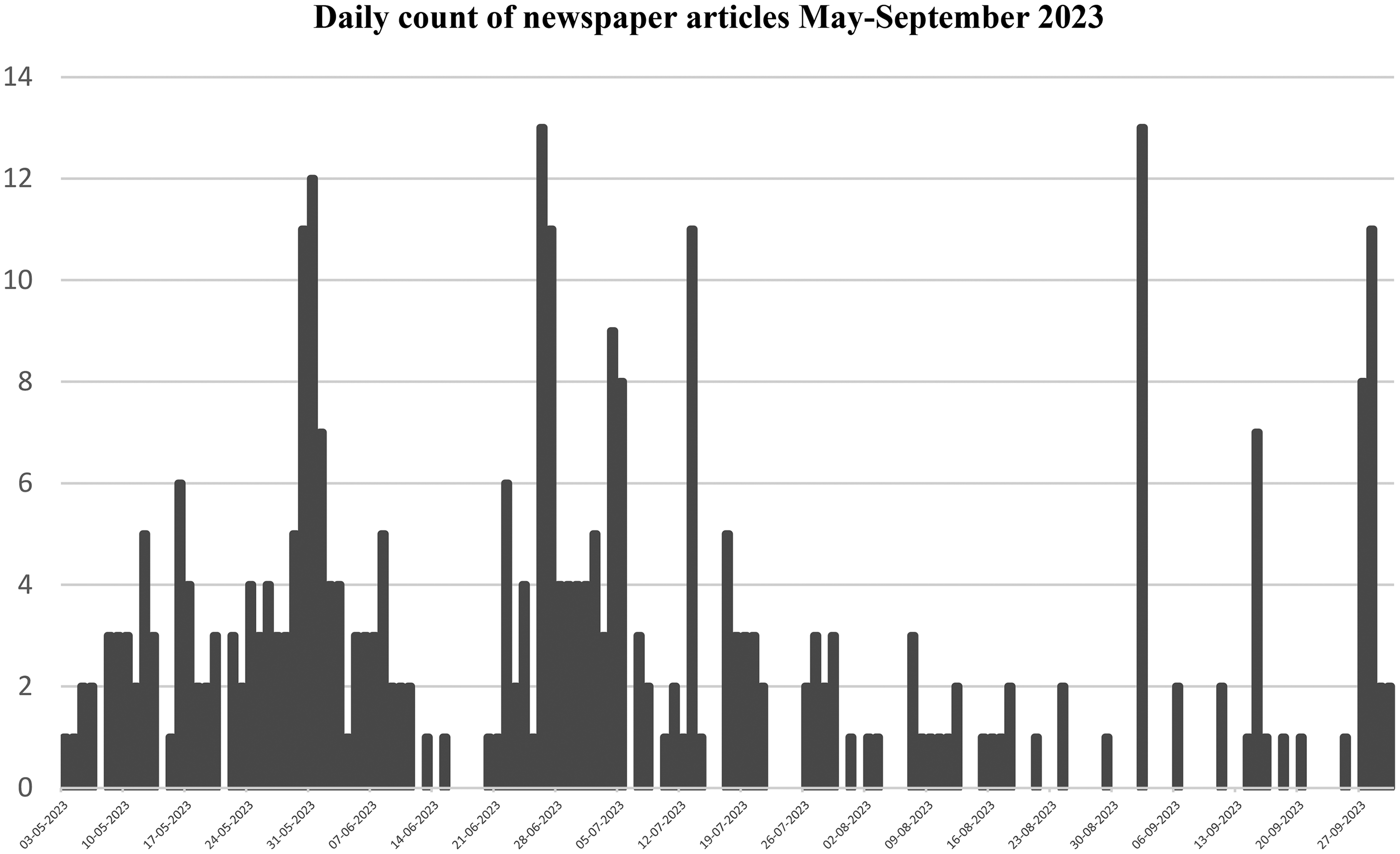
Daily count of newspaper articles published across five months of the PwC Australia scandal May-September 2023.
The analysis followed a two-stage process designed to capture both the internal dynamics of media discourse and its broader contextual framing. The first stage of analysis is premised on an open-ended reading of the 331 articles to identify the most significant characteristics, controversies and debates of the media discourse. For the textual analysis, the researcher used an iterative process moving back and forth between the texts and the emergent themes in the data – guided by the three dimensions of professionalism: transparency, integrity, and externality – until a point of saturation was reached in the variety of discursive themes. This process aligns with Carvalho's (2008) emphasis on the temporal dimension of mediated discourse events, allowing for the identification of recurring motifs and shifts across texts that share a synchronic temporality yet construct divergent realities. For the second stage of the analysis, focus shifts to the examination of the wider social context. The media texts are further contextualised with a broader suite of materials examined including Senate transcripts, media releases, websites, official reports and books. This multi-source approach enabled the tracing of discursive transformations across different communicative arenas, providing insight into how media narratives intersected with institutional framings and political rituals (Carvalho, 2008; Fuller, 2017; Sandham and Fuller, 2020).
Crisis of legitimacy: operatives, outsiders and trusted advisors
In early 2023, news media reports revealed that leading consulting firm PwC Australia had engaged in improper dealings with information among government and corporate clients (Chenoweth, 2023). PwC is one of the Big 4 global firms – along with Klynveld Peat Marwick Goerdeler (KPMG), Ernst Young (EY) and Deloitte – which play a central yet contested role in the advice industry in Australia. The Big 4 provide a full range of professional services including management consulting, communication consulting, financial advisory, risk advisory, and tax and legal services, in addition to the staples of audit and assurance (Deloitte, 2025; EY, 2024; KPMG, 2025; PwC, 2025). The media scandal initially centred on allegations that information about tax legislation had been exploited for profit at PwC Australia (Chenoweth, 2023), however, it was then ‘revealed the leak had gone much further than previously known’ (The Australian Financial Review, 2023: para 5; Chenoweth and Tadros, 2023). Media reports described wariness by government departments in engaging PwC Australia's services, which was ‘effectively a ‘shadow ban’’ on all consultants working for PwC (Tadros and Chenoweth, 2023: 16). In 2022-23, the Commonwealth government spent more than $3.2 billion on management advisory services (Commonwealth of Australia, 2024: 14). By November 2023, PwC Australia's government consulting arm had sold for $1 to a private equity firm (Tadros, 2023). This was as dire an outcome as possible for the firm: Today, PwC has been reduced by a third to 650 partners, its revenue now the smallest of the big four firms, behind long-time laggard KPMG. It remains a target for regulators and the federal police, and a punching bag for politicians. (Tadros, 2024: para. 14)
Media reporting of the scandal overlapped with the Senate inquiry with questioning led by politicians from the Australian Labor Party and The Australian Greens party, who were critical of the way consulting firms were used to privatise government operations by the previous conservative Coalition government. It was clear from the political discourse during the inquiry that the entire consulting industry was being challenged, rather than the specific details of a single act. Greens Senator Barbara Pocock framed the specific case of the scandal in terms of being the ‘tip of the iceberg’ and advocated for a broader inquiry to critically engage with the ‘huge, opaque consulting industry at large’ (Pocock, 2023: 7). Labor Senator Deborah O’Neill was equally vocal and described the consulting business model as ‘a major cancer’ and a threat to Australia's ‘national interest’ during Senate parliamentary debates (Commonwealth of Australia, 2023a: 1740). Thus, the multiple contestations and translations articulated in news reporting and commentary about the PwC Australia scandal are nested in larger-scale social and cultural narratives; the discursive struggle becomes not just about PwC consultants, but all consultants and the advice industry more broadly.
Media coverage shapes and reflects public discourse about professionalism and governance with the critical discourse moment – or discursive field of the scandal – challenging internal standards of ‘expertise’ or the logic of professionalism. In response to the research question, 17 themes of the discursive struggle emerged through an iterative inductive analysis. These were grouped through an inductive process into two distinct categories of discursive themes that represent the ways consulting was problematised in media reports over a five-month period. The first category, dominant in the early phase of the scandal, focused on the qualities of individual consultants and their comportment of professionalism, emphasising attributes such as expertise and advice-giving. The second category, absent initially but emerging later, shifted attention to broader organisational concerns regarding the system of public sector consulting, including hybridity and the principle of ‘public interest’. This temporal shift marks a discursive transformation rather than a simple layering of frames: the focus moved from individualised accountability to systemic critique, revealing how the scandal reconfigured the meaning of consultants’ professionalism over time. The thematic analysis thus traces how consultants’ identity and practice were reframed during what Carvalho (2008: 166) would call a ‘critical discourse moment’, exposing the instability of professionalism as a legitimising logic in hybrid governance contexts.
First phase: the ‘bad consultant’
Consultants’ comportment of professionalism was the focus in the early phase of the scandal and characterised the initial category of 11 discursive themes. Following Abbott's (1988) conceptualisation of professionalism, the expertise of consultants and their practice of providing advice and outcomes for clients is the basis for their professional legitimacy. To properly comport their professionalism, consultants must manage their access to information and relationships with their government clients while performing their expertise. In this phase, questions were being asked of regulators and professional associations, and there were tactical responses to overhaul ethics training. From the discursive field of the scandal, however, the emergence of an archetypal ‘bad consultant’ problematised consultants’ professionalism beyond expertise (see Table 1). The discursive figure of the ‘bad consultant’ did not meet certain social expectations or professional norms due to improper dealings with information among clients (trustworthy theme). Professional attributes of the consultant such as ‘devising clever work arounds’ (expertise theme) and being ‘ahead of the game’ (competitive theme) were now compromised. The bad consultant's performance of professionalism related to matters ranging from failing to meet confidentiality obligations (ethical theme) and failing to stem the poor behaviours that were compromising working relationships with government (accountable theme) to lacking the necessary safeguards to avoid conflicts of interest (self-regulating theme). Also critiqued was the motivation of the ‘bad consultant’ to solve problems (solution-oriented theme), be promoted (team player) and receive remuneration (highly paid). Consultants are ubiquitous in the work of government due to the demand for their external expertise, yet critique of their performance of professionalism is premised on broader discursive positions than expertise.
‘Bad consultant’ category of discursive themes.
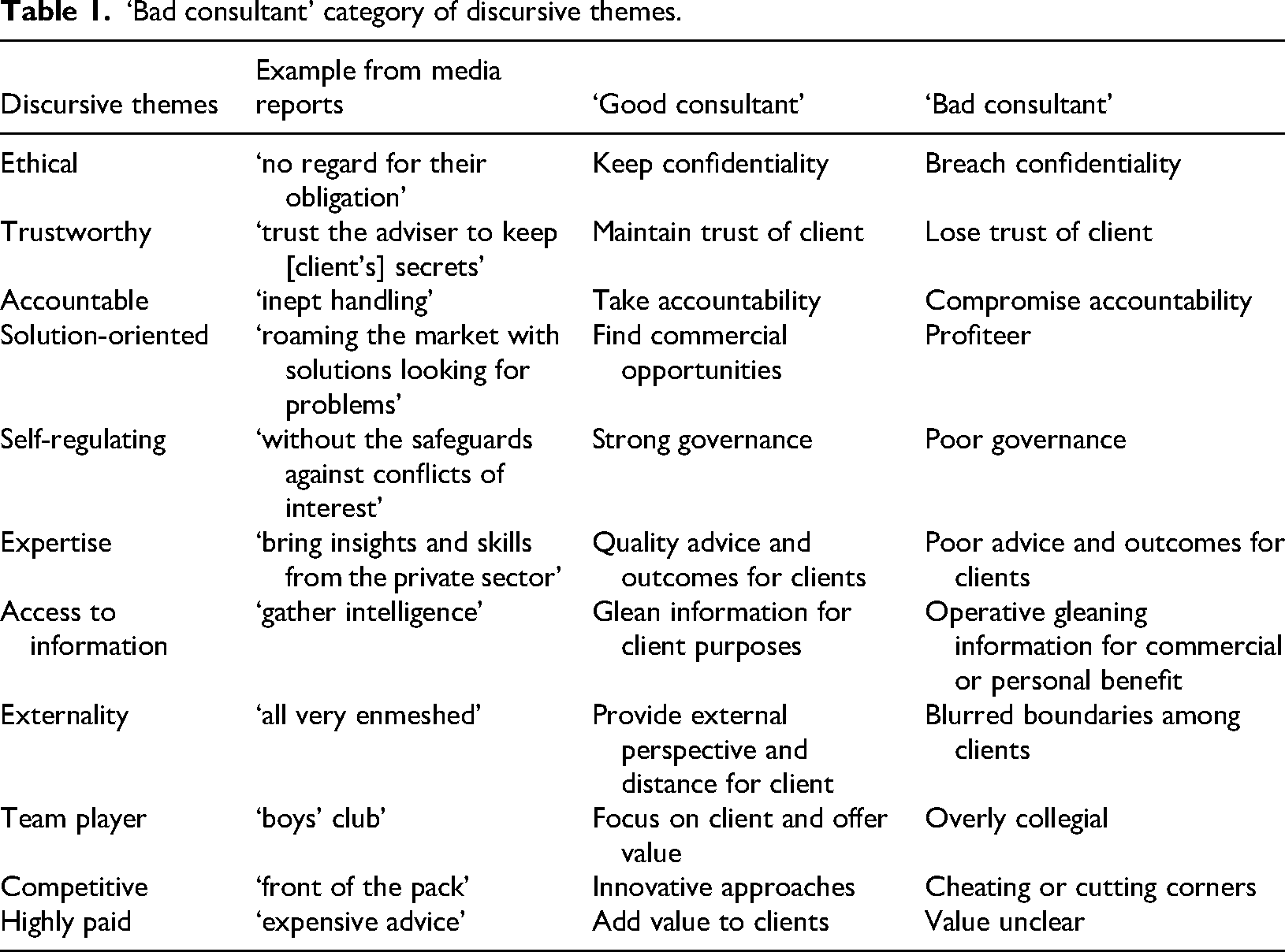
The media discourse marked a shift in the valuation of expertise: no longer a guarantor of professionalism, it became a signifier of risk when detached from ethical conduct and civic responsibility. This culminated with the representation of consultants as ‘operatives’ who took advantage of information as ‘intelligence’ (access to information theme). The term ‘operative’ was used in 12 articles to infer consultants were ‘insiders’ with special access to information, and, during the PwC Australia scandal, this extended to being capable of taking national secrets and breaching trust and ethical standards by sharing those secrets for financial gain. ‘Operatives’ gleaning information without ethics epitomise the ‘bad consultant’: a consultant-turned-operative. The concern articulated in the ethical theme is that it was not a ‘bad apple’ but rather ‘more than one bad apple’ (three articles referring to Senator O’Neill's comment ‘this is not a couple of bad apples’ and Senator Pocock's comment ‘this is not about one individual bad apple’); with stronger regulation required to prevent ‘acting badly’ and ‘bad actors’ (three articles); and the ‘bad behaviour’ and ‘bad actions of some’ was tolerated (mentioned in 10 articles referring to the PwC Australia-commissioned independent review of the company's handing of the scandal by Dr Ziggy Switkowski). As explained in one media report quoting the Switkowski review, failures were made possible ‘by overlooking or minimising the significance of questionable behaviours’ (Harcourt, 2023: 49). The ‘bad consultant’ challenges consultants’ performance of professionalism as a ‘good consultant’ who works in the best interests of government and therefore ostensibly for the civic good. The implication is that with the right (good) consultant and good relational approaches to the work of government, the system or structural issues (such as the prevalence of consultants) are not a problem. Thus, through the media scandal and the mediatised political ritual of the inquiry, the discursive figure of the ‘good consultant’ with appropriate expertise doing the work of government was transformed into an ‘operative’ without ‘public interest’ motivations.
The consultant-turned-operative characterisation draws attention to the ‘insider’ function of consultants’ performance of professionalism, however, consultants are also ‘outsiders’ who work in (and as part of) government operations but are not part of government. The demand for consultants to provide an external perspective and distance for clients is clearly articulated in the corpus of materials in the analysis, and this capability has been categorised as ‘externality’ (externality theme). A consultant who fails to perform externality loses the ability to disassociate. The discursive theme of ‘externality’ in media reports was described as being mediated through ‘Chinese walls’, ‘ringfencing’ and ‘confidentiality boxes’ – which are notional or functional organisational structures to compartmentalise firms’ public and private sector work. In the discourse of the scandal, ‘externality’ was characterised as consultants wearing many client ‘hats’, yet as professionals they are independent and remain at arm's length. Ideally, as one media report asserts, consultants are ‘divorced from the ethos of the market’ (Longstaff, 2023: para. 12). The challenge of externality, according to another media report quoting Senator O’Neill, is ‘it's pretty hard to see where you take one PwC hat and put on another’ and so ‘it looks like it's all very enmeshed’ (Duran, 2023: 23). There are attempts in the discourse to enact and (re)frame the profession at the meta-level of the ‘good consultant’. For example, there is recognition among the authors of The Australian Financial Review's AFR View column that there are many ‘blameless public-sector partners and staff’ caught up in the scandal (Treasury Review An Off Ramp, 2023: 38). As a ‘good consultant’ working for government is expected to maintain ‘externality’ when they comport their professionalism so that their expertise can be trusted, key tensions emerged around the effectiveness of this in a hybrid government context as the scandal moved into the second phase.
Second phase: the ‘good system’
The latter phase of the scandal marks a discursive transformation from individualised concerns about consultants’ non-expertise professionalism to systemic debates about governance and ‘public interest’. This shift reflects a reconfiguration of the discursive field: rather than focusing on expertise and advice-giving as markers of professionalism (Abbott, 1988), media narratives began to foreground organisational logics and the hybrid nature of government–consultant relations. Central to this transformation was the emergence of a discourse of ‘public interest’ as a legitimising principle of professionalism for public sector consultants, mobilised to (re)mediate support for the system within which consultants operate (see Table 2). Six themes comprise this second category, articulating how governments and consulting firms negotiate the tension between commercial imperatives and civic responsibility. These themes, which surfaced from late June and intensified through August and September, range from avoiding blurred lines in government work (pure theme) to contributing to public policy (values-driven theme) and prioritising the client's interests (relationality theme). Collectively, they construct a system seeking to demonstrate integrity and alignment with the public good (civic theme), even as media reports highlight persistent risks, such as outsourcing and conflicts of interest, through metaphors like ‘inviting the fox into the hen house’ (Longstaff, 2023: para. 11). This discursive reframing culminated in tangible organisational change, exemplified by PwC Australia's divestment of its government consulting business and the creation of Scyne Advisory with a ‘[pure] focus on government business’ (Korporaal, 2023: para. 2).
‘Good system’ category of discursive themes.
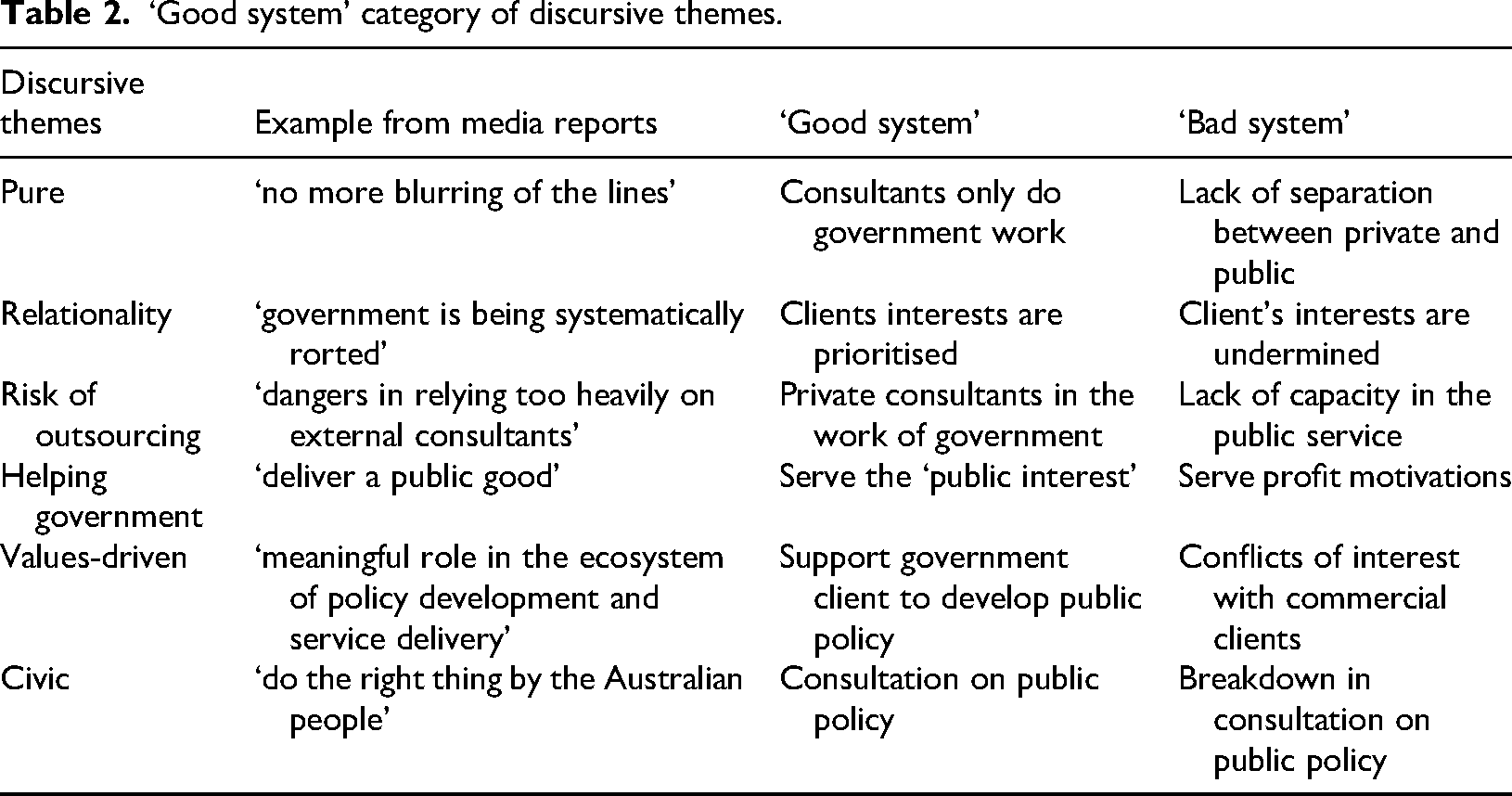
The discursive themes map a new norm for the way government business is known and performed; that is, with elevated expectations of integrity and transparency for the system that underpins the prevalence of consultants in the work of government. The implication here is that structural issues are not being challenged as indicative of a ‘bad system’; instead, a ‘good system’ is being refined through discursive constructs that emphasise ‘purity’, such as ‘no more blurring of the lines’, ‘zero conflict’, ‘vetted’, and ‘clean slate’, and the ‘meaningfulness’ of working for government, expressed through phrases like ‘public focused’ and ‘deliver a public good’. These themes frame consultants as contributors to civic virtue rather than as symptoms of systemic dysfunction. Purity and meaningfulness are activated as metaphors for trust and adhering to higher virtues. This reframing in the second phase of the scandal represents a discursive transformation from a concern with individualised accountability to systemic legitimacy, revealing how the scandal reconfigured the normative expectations of governance under hybrid conditions.
Spanning the discursive categories: ‘bad externality’
In the discursive field of the scandal there were multiple cross-cutting themes, crossing various aspects of discourse focused on individual, organisational, financial and civic dimensions. ‘Externality’, as a core quality of consultants’ professionalism whereby they demonstrate critical distance to be able to provide expertise-based advice, crosses over the discursive categories of ‘bad consultant’ and ‘good system’ and was consistent across the discursive context of the two phases of the scandal. When independence was lost as secret information leaked between clients (‘bad consultant’), the consultant's ‘externality’ was compromised by a profit motive – indicating a ‘bad externality’ or the limits of ‘externality’. The improper mediation of ‘externality’ resulted in a loss of confidence in consultants more broadly. The breakdown of confidentiality structures in hybrid government consulting revealed how profit-driven expertise can undermine norms of the public sector. Thus, the discursive categories that describe individual professionalism and organisational structure taken together provide a more holistic explanation of how the professionalism of consultants was contested in the PwC Australia media scandal. The persistence and inversion of ‘externality’ across both phases underscores the discursive transformation identified earlier – from individualised accountability to systemic legitimacy – revealing how a cornerstone of professionalism became a site of struggle under hybrid governance conditions.
Public interest and inverting the logic of professionalism
This research extends knowledge on the problematisation of professionalism in discursive spaces (Giomboni, 2024; Kantola, 2016) to include the mediatised ritual of media scandal. There are three main points to be derived from these findings. First, are the limitations of a logic of professionalism premised on expertise. A consultant good at their job (expert) may fulfil expertise-based standards of professionalism but not the standard of ‘good professionalism’. Second, is the work of the scandal to (re)define professionalism beyond expertise. In hybrid government contexts, the performance of externality, or maintaining critical distance while navigating relational complexity, emerges as a central, contested practice. Third, the shift in discourse from critiquing individual consultants to interrogating systemic arrangements has significant implications for the consulting industry. In this transformation, expertise-based professionalism was inverted and rearticulated through the principle of ‘public interest’, aligning legitimacy with civic imperatives rather than commercial logic. Establishing value for consultants now depends on demonstrating responsiveness to public interest norms.
The scandal surrounding PwC Australia revealed that meeting internal standards of ‘expertise’ is no longer sufficient to sustain professional legitimacy in public sector consulting. Instead, consultants’ legitimacy or ‘good professionalism’ is discursively constructed and publicly contested. The logic of professionalism premised on technical expertise was destabilised with the emergence of the ‘bad consultant’ archetype, which failed to meet evolving expectations of ethical conduct. The scandal, as a mediated discourse event, discursively inverted the logic of professionalism, requiring consultants to (re)imagine their role not just as technical experts but as ethical actors in hybrid government. This shift presents both a threat and an opportunity: while it destabilises traditional jurisdictional claims, it also invites the consulting industry to engage with new ethical frameworks and ‘public interest’ logics that could restore trust and redefine professionalism in more socially responsive ways. Thus, consultants must navigate a broader discursive terrain where external standards – such as alignment with ‘public interest’ – are shaping a new version of professionalism that is not premised on profit motives. Could working in the ‘public interest’ include working counter to a firm's profit motives? A consultant good at their job is expected to adhere to ‘good professionalism’, which is not static but constantly evolving. In a similar way, consultants need to respond to the waves of digital disruption – the latest iteration of which is artificial intelligence (Tadros, 2025) – as new technological developments are an external force outside expertise-based jurisdictional control and have the potential to destabilise the profession's jurisdictional claims (Von Platen, 2016).
Second, consultants’ performance of ‘externality’ – as a quality of observer, intermediary and critical distance – is a critically important dimension of ‘good professionalism’. ‘Externality’ is a complex relational consideration that serves to legitimise decision-making. The ‘bad consultant’ of the PwC Australia media scandal troubled the notion that consultants can work with a corporate client while working for government on the same issue and maintain their independence or distance. In hybrid government contexts, the proper mediation of ‘externality’ can be understood along a continuum. At one end of the continuum is the normative function of consulting offering independent advice and representing ‘good externality’. At the other end of the continuum are actions, such as failing to mediate conflicts of interest ethically, which constitute ‘bad externality’. The performance of ‘bad externality’ disrupts rather than supports government decision making and undermines confidence and trust in the work of government. Therefore, if externality, as a performative dimension of consultants’ professionalism, is valued and in demand, then it needs to be protected from profit motives.
Third, the shift in public discourse to ‘public interest’ requires the consulting industry to adopt a reflexive logic of professionalism. The ‘bad consultant’ archetype problematised how individual consultants enact professionalism including through themes of compromised trust, ethical breaches and blurred boundaries of accountability. This shift involved an inversion of the expertise-based logic of professionalism, reconceptualising it to align with ‘public interest’ imperatives. A consultant who excelled at technical tasks but failed this public interest test was reframed as an ‘operative’ within the ‘bad consultant’ category of themes. In the subsequent phase, the entire system was problematised in terms of ‘public interest’ (‘good system’ category of themes). The Labor and Greens senators critiqued the professionalism of consultants through the discursive (re)construction of ‘public interest’. Journalism complemented this process by exposing competing interests in government work, such as consulting firms’ commercial priorities, and by defending public interest ideals and values. The social and ethical responsibilities of consultants will continue to be a point of contention in public interest journalism and feature in discussions about consultants’ performance of professionalism in the work of government or public organisations such as universities (Morton, 2025). Consultants’ professionalism has been recontextualised and aligned with ‘public interest’ so that consultants’ legitimacy is contingent on their social responsibility. This discursive shift, amplified through the mediatised ritual of scandal, represents a critical discourse moment in Carvalho's sense; transforming professionalism from a technical logic into a civic logic and reconfiguring the normative expectations of governance under hybrid conditions.
Conclusion: consultants in hybrid government
The discursive contestation over professionalism and ‘public interest’ during the PwC Australia scandal articulated an expectation that consultants require a clear sense of professional standards in a hybrid government context. The implication is that with the right (good) consultant, the (good) system is functioning (better) with higher standards, but none of this is a given. These discursive shifts unfolded over time, and future media debates and scandals will likely draw on this episode, repurposing or extending existing frames. For politicians, ‘public interest’ remains a productive discursive strategy. During the Senate inquiry, Senator Pocock expressed concerns about widespread governance failures across the consulting sector and questioned whether consultants can work for the good of the Australian people. Future research could explore how ‘public interest’ is discursively constructed in other national scandals involving consultants in government or public sector organisations that may be compromised by profit motives. Both ‘public interest’ and ‘professionalism’ are discursively produced, framing consultants’ legitimacy beyond expertise-based jurisdictional claims, but consultants must increasingly rely on non-expertise-based claims to support their public image and cultural legitimacy. As a result, consultants who serve the Australian government face a more immediate crisis of legitimacy. There is no single definition of what it means for a profession to act for the good of the Australian people, but at its core, public interest is prioritised over individual or commercial interests. In terms of their performance of professionalism, for consultants, this includes maintaining independence or externality above profit motives. For communication and media scholars, greater attention to the public interest presents threats and opportunities for the consulting industry. The professionalism of consultants should now be responsive to both the public interest discourse and government expectations that consultants have robust social responsibility. This focus on social and ethical responsibilities is likely to be part of future discursive contestations over professionalism given the next wave of digital disruption with artificial intelligence, and the concept of hybridity may be helpful to explain shifts in discourse. The PwC Australia scandal was a critical discourse moment that exposed the limits of expertise-based definitions of professionalism and signalled a discursive shift toward public interest-based understandings of the work of consultants in government. These findings have implications for future studies on political and social issues, including the corporatisation of government, declining trust in public institutions, and the resilience of democratic governance.
Footnotes
Acknowledgements
Not applicable

Ethical approval and informed content statements
There are no human participants in this article, and informed consent is not required.
Funding
Declaration of conflicting interests
The author declared no potential conflicts of interest with respect to the research, authorship, and/or publication of this article.
Data availability statement
Not applicable