



Abstract
The experience of viewing television has since its earliest days been inherently connected to the notion of pause. For narrative drama in particular, the industrial figuring of pause through distribution scheduling continues to inform television consumption practices, which in turn influence (and are influenced by) production elements such as narrative structure and genre paradigms. This paper explores the interplay of these consumption and production practices through a comparative analysis of two case studies on rival subscription video on demand (SVOD) services – Netflix Original series Stranger Things (2016-) distributed in full-season drops for audiences to binge; and Marvel Cinematic Universe limited series, WandaVision (2021), released via weekly intervals through Disney + . Discussing these contrasting distribution and consumption models as reflecting the broader continuity and adaptation of television's technological and industrial practices, the paper explores their impact on production elements such as narrative structure and genre, as well as on the body of the viewer who, when consuming content without pause, is engaged in a ‘durative’ viewing experience. Finally, the paper turns to the use of subjective flashbacks that work to either foreground or elide moments of pause within the diegetic action. These flashbacks, which I term ‘reflective’ and ‘embodied’ respectively, not only echo the contrasting consumption models adopted by SVOD services but also recall the resulting bodily impact on the viewer when pause is invited or omitted. In closing, the paper suggests that pause can be used as a lens to view the simultaneous continuity and adaptation within television consumption and production practices over time.
This paper will examine the notion of pause within television consumption and production. Television viewing is inherently tied to the experience of pause – from its beginnings in the broadcast era with scheduled programming interwoven across regular advertising breaks, to the episodic structure underpinning narrative drama series (i.e. the grouping of episodes into one or more television season/s) with their interconnected yet distinct chapters. In the streaming era however, services known as ‘subscription video on demand’ (‘SVOD’) are changing the way that pause is figured in relation to both television consumption and production through their dual role as distributor and producer of original content, adoption of full season releases and promotion of ‘binge’ viewing. Binge viewing offers subscribers the ability to watch multiple, or indeed all episodes of a new release season in one sitting, as opposed to one-at-a-time, ‘appointment’ viewing, which drip-feeds season episodes at set intervals. These differing distribution models demonstrate a distinct shift in how pause is figured in television, variously foregrounding or rejecting the notion of pause by accentuating or eliding the space between episodes. In so doing, these distribution models either discourage pause, creating an experience of consumption that this paper will refer to as ‘durative’, reflecting its meaning of continuous or unfinished action, or urge audiences to consume each new instalment separately via staggered release – an ‘episodic’ viewing experience. At the same time, television series across these contrasting distribution models adopt differing production strategies, especially within their structure and narrative action that respond to the evolving episode form. As Baker (2017: 41) describes, television ‘designed for ad-free streaming has no need for mini-cliffhangers before an advertisement break, and the way traditional episodic structure fits into broadcast television flow becomes irrelevant’. How pause is figured in television consumption impacts and reflects how it will be figured in television production, so it is necessary to explore both in tandem.
To examine these different approaches, this paper will compare how pause is managed within delivery, consumption and production across two rival platforms, Netflix and Disney + . It will look at two case studies in particular: the Netflix Original series Stranger Things (2016-) distributed in full-season drops for audiences to binge, and Marvel Cinematic Universe (MCU) spin-off limited series, WandaVision (2021), distributed at weekly intervals through Disney + . While, as I discuss further below, both case studies display some variation to these distribution models, there remains a clear predominance of all-at-once distribution on Netflix and drip feed distribution on Disney+, so this paper will discuss those forms as being the platforms’ preferred models for both consumption and production. By focusing on these two case studies, the paper will interrogate the differing approaches adopted across rival SVOD services, arguing that they offer a microcosm that encompasses the simultaneous continuity and adaptation of industry practices from linear broadcast to on-demand streaming. In addition to their distribution models, the paper will argue that genre paradigms play a significant role in how the two series configure the notion of pause in television production, informing structural elements that impact viewing practices within television consumption. Finally, having explored that macro level of series consumption and episode structure, the paper will turn briefly to the figuring of pause at the micro level – within the diegetic action of the storyworld – through flashbacks. As with the differing models of binge and appointment viewing, flashbacks can work to either foreground or elide moments of pause within the diegetic action. Through close readings of sequences from the case studies, the paper will suggest that ‘reflective’ flashbacks create a pause within the diegetic action played out in the character's memory, while ‘embodied’ flashbacks layer that memory on top of the diegetic action, forcing the character to interact physically with the past. In this way, reflective and embodied flashbacks echo the modes of consumption outlined above in which the body of the viewer (be it the television audience or character within the diegetic action) is impacted by the inclusion or elision of pause. From this consideration of television consumption, production and narrative structure, the paper suggests that pause can be used as a means to negotiate the changing nature of television over time and the attendant tension between continuity and adaptation in technological affordances and industrial practices.
Pause in television consumption: Binge viewing versus appointment television on streaming services
Turning first to television consumption, there are two distinct forms available through the streaming industry which impact and inform how the notion of pause is constructed – all-at-once, binge viewing, and drip feed, appointment viewing. This section will examine these two delivery models and their link to previous forms of film and television consumption, arguing that they demonstrate the simultaneous continuity and adaptation of television's technological and industrial development since the 1950s. Television scholars encompass these industrial shifts within three broad periods: TVI, TVII, TVIII (Dunleavy, 2017; Jowett and Abbott, 2013; Pearson, 2011; Rogers et al., 2002). While scholars differ in the exact periodisation across TVI–TVIII, Pearson (2011: 107) offers the following timeline: In the United States, TVI, dating from the mid-1950s to the early 1980s, is the era of channel scarcity, the mass audience, and three-network hegemony. TVII, dating from roughly the early 1980s to the late 1990s, is the era of channel/network expansion, quality television, and network branding strategies. TVIII, dating from the late 1990s to the present, is the era of proliferating digital distribution platforms, further audience fragmentation, and, as Rogers, Epstein, and Reeves [2002] suggest, a shift from second-order to first-order commodity relations.
The gradual nature of industrial change and continuous adaptation within television's industrial practices mirrors what we see in the differing distribution models adopted by SVOD services. Appointment viewing, with single episodes released at a scheduled date and time across the season, has been a norm of television distribution since its beginning in TVI – also known as the ‘classic network’ or ‘[b]roadcast’ era (Dunleavy, 2017: 10; Todreas, 1999: 11). While contemporary viewers on streaming services such as Disney + are not sitting through regular advertisement breaks during or even between episodes, the streaming service's adoption of staggered releases for new television content echoes in part the viewing experience of audiences in the broadcast era, with programmed breaks between episodes. Of course, there is a limit to the similarity – once each episode has been released through SVOD, the content forms part of the streaming service's library and is available to rewatch on demand. However, when considering new content distribution, this staggered release schedule harkens back to the broadcast model of appointment viewing and enmeshes television consumption with the notion of pause, compelling viewers to wait until next week to see the next episode.
In contrast, the all-at-once content delivery model favoured by Netflix (Jenner, 2018, 2021) removes those restrictions on content consumption, enabling what the company has come to promote as ‘binge’ viewing, a term which despite its common usage, is somewhat contested. Pierce-Grove (2021: 109) argues that the episode is ‘the conceptual unit of the binge-watch’, while Rubenking and Bracken (2021: 2) instead emphasise the length of time spent in ‘focused, attentive’ viewing which is ‘limited to one sitting’ as defining binge viewing over other forms (see also, Entis, 2013; Jenner, 2021). For clarity, this paper proposes binge viewing be understood as watching a minimum of two total episodes in row, with no upper limit. While binge viewing has become largely synonymous with Netflix as a streaming service, in another example of industrial adaptation and innovation, the practice of watching multiple episodes harkens back to earlier periods. Against a backdrop of commercial broadcast television programming of content within set schedules, evolving technological affordances such as the VCR and DVD box sets shifted the audience's ability to manipulate how they consumed content, at what speed and in which order (McCormick, 2016). These capabilities created a new form of television consumption in which the experience of pause became increasingly interactive and determined, in part, by the viewer. Reflecting these developments, it was Netflix’s roots as a DVD-rental service that provided insights into audience viewing behaviour, demonstrating a desire for what co-chief executive Ted Sarandos (2013 as cited in Jeffries, 2013: n.p.) termed ‘self-dosing’ television episodes, free from the confines of ‘schedulers bent on stopping them seeing what they want, when they want’ (Jeffries, 2013: n.p.). It is an ethos that remains central to the company's self-promotion, with the website offering a list of ‘BingeWorthy TV Shows’ and claiming, ‘[w]hen it comes to great TV, portion control is for suckers’, encouraging viewers to instead ‘devour [them] all at once’ (Netflix, n.d.).
Netflix’s championing of binge viewing is one of the key developments that Jenner (2016, 2018) suggests has led to the emergence of a new era, TVIV. Jenner highlights Netflix’s use of all-at-once season releases and simultaneous international distribution of original content as leading to a significant change in how, when and what audiences consume on television, stating: TV IV is understood here as a process. This process brings together discourses of technology, audience behaviour, industry, policy, national media systems, etc. Netflix is currently an important part of TV IV, but it is hardly the only one. Nevertheless, Netflix’ usage of binge-watching and its specific location in discourses of transnational broadcasting are a significant part of this process. (2018: 19–20)
From this brief overview of television's evolution across eras of production, it is possible to see a simultaneous continuity and adaptation of industry practices from linear broadcast to on-demand streaming. On the one hand, appointment viewing maintains a level of staggered scheduling that enforces pause within the consumption of new release content. This ‘episodic’ viewing experience echoes broadcast era television practices, foregrounding pause between each instalment of narrative drama, which is distributed and consumed in distinct viewing sessions. By contrast, binge viewing allows a more continuous experience of consumption, in which the pause between episodes or instalments is minimised. Indeed, the very word ‘binge’ evokes connotations of unbridled, extreme consumption without pause. The term ‘durative’ is instructive when considering this form of viewing experience. Meaning a state that is ‘[c]ontinuing; not completed’ (Oxford English Dictionary, 2023), ‘durative’ allows us to get closer to capturing that sense of continuous consumption that is enabled and encouraged by binge viewing – of consumption without end. Furthermore, as a term that ‘relat[es] to a continuous action’ (Cambridge Dictionary, 2024), ‘durative’ encompasses an implied physicality, a sense of open-ended doing over time, that has ramifications for the body of the viewer. These bodily implications have been discussed by Baker (2017: 48) in relation to binge viewing as ‘[e]pic-viewing’, which is ‘physically experienced in extended time, as our bodily fatigue conjoins with, and partly underpins, our viewing pleasure…’. In a similar vein, Perks’ (2015: ix) notion of ‘media marathoning’ describes a state of ‘conjoined triumph of commitment and stamina’, in which ‘readers or viewers rapidly engag[e] with a story world’, freed from what Perks sees as the negative connotations of the term binge watching (see also, Gutierrez, 2018; Lynch, 2018; Meek, 2018). While Baker focuses on television and Perks’ analysis encompasses television, film and literature, both scholars speak to a sense of the physical endurance required for durative media consumption. Building on those discussions, this paper suggests a broader connection between pause and the body, encompassing not only the body of the viewer, but also characters’ bodies within the storyworld through the use of flashbacks that elide the sense of pause within the diegetic action and layer the past on top of the present. A structural element within the narrative action, these flashbacks are informed by the figuring of pause within television production to which I now turn.
Pause in television production: Impact of consumption models, genre and flashbacks
While pause in television consumption can be impacted by models of appointment versus binge viewing, those same models also impact how pause is figured within television production. This section will examine this interweaving of consumption model and production in the streaming era through the case studies Stranger Things and WandaVision, which were released using binge viewing and appointment viewing in turn. At the same time, it will consider the impact of their genre paradigms in how pause is figured. Finally, it will explore the role of subjective flashbacks within the narrative, and how they can variously create or elide a sense of pause within the diegetic action through their positioning as either ‘reflective’ or ‘embodied’ flashbacks and the attendant impact on the body of the characters within the storyworld.
Consumption, production and genre
While not all Netflix Originals are strictly speaking original content – some are pre-existing series that have been licensed to the streaming service – Stranger Things is an example of a series in which as Jenner (2018: 8) explains, ‘Netflix functions as producer and original (and exclusive) broadcaster’. As such, Stranger Things offers a clear example of how Netflix’s distribution model can impact how pause is figured in both consumption and production practices. Since the release of its first season in 2016, Stranger Things has been created in line with what journalist Ben Cohen (2022: n.p.) describes as the platform's ‘signature innovation: the binge-watch’. Even the fourth season, which broke with the series’ usual distribution style by releasing the first seven episodes in one drop, followed by the final two episodes a little over six weeks later, offers audiences the opportunity to binge multiple hours of content in one sitting (the first seven episodes together run for more than nine hours, while the final two episodes combined are just under four hours). This distribution model and implied consumption context impacts how the series’ narrative is structured, as Baker (2017: 41) explains, ‘[t]he heightened association between Netflix’s in-house productions and binge-viewing rests partly upon its ability to optimize the structure of its series to fit its delivery model, minimizing repetitive exposition and maximizing what we might think of as a form of streaming flow’. This model of consumption, in which the episodic television structure is adjusted to a more durative form of continuous content flow, is reflected in comments by one of the series’ creators, Ross Duffer (2016 as cited in Chaney 2016: n.p.), who in an interview with brother and co-creator Matt Duffer about season one explained ‘we always saw this as a big eight-hour summer movie’. Duffer's vision for the season demonstrates its cohesion within the structural model of Netflix Original narratives, designed to flow seamlessly across episodes and be binged without pause.
Genre paradigms also play a part in how Stranger Things configures the notion of pause within its narrative structure, as it pays homage to its generic predecessors. Stranger Things is a supernatural coming-of-age drama/horror set in the 1980s, that pits the inhabitants of a small town in Indiana against a malevolent force from a parallel underworld (or as it is called in the show, the ‘Upside Down’), a hive-minded entity variously embodied across the seasons as the Demogorgon, Demodogs, the Mind Flayer and Vecna (Jamie Campbell Bower). Vecna, also known as Henry Creel (Raphael Luce) and One, is introduced in season four as the key antagonist of the series – a human with supernatural abilities who seemingly controls the various manifestations of the hive mind. The series is heavily influenced by the cinematic suburban supernatural horror texts of the 1970s and 1980s, most especially the work of John Carpenter and Steven Spielberg, and pays homage through visual references, storyline development and casting choices (Chaney, 2016; WIRED, 2019). These cinematic texts offer a blueprint for the small-town, suburban setting and interplay of intimate domestic drama, in particular the coming-of-age narrative of pre-teen or teen protagonists, with a blend of science fiction, horror, fantasy and adventure – a generic mix that McFadzean (2019) refers to as ‘suburban fantastic’. In addition, these texts have structural hallmarks which impact how pause is figured within the narrative. Firstly, as feature films they are designed to be experienced from start to finish in one sitting – a distinguishing feature of Rubenking and Bracken's (2021) definition of binge viewing mentioned above. Secondly, suburban supernatural horror narratives such as Halloween (1978), Poltergeist (1982), and A Nightmare on Elm Street (1984) begin with everyday normality being upended by the arrival of the supernatural, gradually building towards a climactic confrontation between the protagonist/s and monster or demonic force. Within this context, pause may be used for its contrasting dramatic effect, for example by slowing the action to prime the audience for a sudden jolt, known as a ‘jump scare’. However for the most part, these textual hallmarks create a continuous structure designed to gradually ratchet up the narrative tension and momentum.
In addition to cinema, televisual forms and in particular television horror provide a generic context for Stranger Things. Jowett and Abbott (2013: 17) discuss the development and ‘[m]ainstreaming’ of horror genre content on television, arguing that ‘[i]ts iconography and conventions are a key part of popular culture … appear[ing] as frequently on mainstream television as in cult shows on niche channels’ (30). This mainstreaming of horror genre markers on television, alongside the popularity of suburban fantastic cinema from the 1970s and 1980s offer the generic context for Stranger Things, informing its durative viewing experience within a televisual format.
With these elements in mind, it is illustrative to examine the first season of Stranger Things. The season has eight episodes, each of which is given a chapter number as part of the title (e.g. ‘Chapter One: The Vanishing of Will Byers’ and ‘Chapter Two: The Weirdo on Maple Street’). This titling convention continues throughout the series’ four seasons, a literary reference that speaks to the influence of Stephen King's horror fiction on the series. The first five episodes begin in the evening – episode one opens with the title card ‘November 6th, 1983 / Hawkins, Indiana’ – and end the following evening. Within these episodes, the diegetic time gap between one ‘chapter’ ending and the next beginning is generally implied as a matter of minutes. This fluid movement between episodes only increases in the final three instalments of season one, which occur almost entirely across one twenty-four hour period (episode eight flashes forward for the final sequences following the title card, ‘One Month Later’). To reinforce this daisy chain of episodes which close and then re-open within a brief span of diegetic time, the series uses ‘cold opens’, a narrative technique which begins each episode with a dramatic scene before moving to the opening credits (Dunleavy, 2017: 115). This narrative structure, matched with the series’ use of minimal diegetic time gaps between episodes, creates a thread of continuous storytelling that flows seamlessly from one episode to the next, limiting the break signalled by periodic markers of opening and closing credits. In this way, Stranger Things’ narrative, production and consumption models work together to elide the sense of pause or break between episodes, instead creating a viewing experience that recalls the cinematic form of its generic influences and positioning the content to flow unabated across the eight hours of season one, to be binged by the audience.
By contrast, WandaVision was distributed through Disney+, which released the first two episodes simultaneously in January 2021, with each subsequent episode released weekly thereafter (Alexander, 2021). The show presents two of the key figures from the MCU (villain-turned-hero, powerful witch Wanda Maximoff (Elizabeth Olsen) and her cyborg-supercomputer partner, Vision (Paul Bettany)) in a limited series that is both a meditation on grief and a highly stylised, nostalgic homage to the American television situation comedy (sitcom). Unlike Stranger Things, whose references to the suburban fantastic cinema of the 1970s and 1980s recall the artistic influences of creators Matt and Ross Duffer (Chaney, 2016), WandaVision's homage to the sitcom is driven by the character of Wanda herself. Wanda's grief over Vision's death, depicted in Avengers: Infinity War (2018), is shown as the catalyst behind the Hex, the three-dimensional simulacrum of sitcom reality which Wanda has magically projected over the small town of Westview. Inside the Hex, Wanda creates an imaginary life with Vision based on various historical expressions of the sitcom from the 1950s on, with shows such as I Love Lucy (1951-1957) and The Dick Van Dyke Show (1961-1966), through to the 2010s with Modern Family (2009-2020). A flashback sequence in episode eight reveals Wanda's abiding love for sitcoms, which I will discuss in more detail below. This generic basis plays into WandaVision's weekly release distribution model, referenced by director Matt Shakman (2021 as cited in Boone, 2021: n.p.) who states ‘with WandaVision being this love letter to the history of sitcoms, … coming out weekly also feels right for our show, because we're coming out the way those shows used to come out, so it all seems to make sense’. Engaging an industrial lens, Webster et al. (2022: n.p.) consider WandaVision's weekly release schedule within the MCU's overarching distribution strategy, suggesting that ‘[w]hile the episodic delivery of content was a clever way for Marvel to offer audiences a nostalgic, broadcast TV experience, more importantly it allowed Marvel to maximise interest in the show, and keep viewers subscribed to Disney+’. This strategy is borne out by the show's popularity. According to Parrot Analytics, which measures global audience demand through media engagement, WandaVision became the most viewed show in the world a little under four weeks after its first episodes appeared in January 2021, due in no small part to its weekly release model on Disney + (Mayberry, 2021). It is also worth noting the series’ context of distribution during the COVID-19 pandemic, when many populations globally were experiencing travel restrictions or lockdowns. Articles from the period discuss this context, suggesting that the weekly release model built anticipation and created a sense of community for audiences at a time of anxiety and social isolation (Langan, 2021; Wood, 2021).
WandaVision's weekly release schedule encouraged appointment viewing, a model of consumption that was echoed and amplified by the series’ production and narrative structure. Far from the seamless flow of narrative time and action across episodes that is evident in Stranger Things, WandaVision foregrounds its episodic breaks by featuring a different opening credit sequence and accompanying theme tune for its first seven episodes, excluding episode four – the aptly named ‘We Interrupt This Program’, is shot in a more conventional MCU style and focuses on another character within the series and the wider MCU, Monica Rambeau (Teyonah Parris) in the weeks prior to her arrival in Wanda's Westview. The series also plays with temporal continuity across these episodes, presenting each sitcom sequence with its own distinct cinematographic aesthetic, production design and technical elements from the 1950s to the 2010s. These production parameters shift in the final two episodes, as the mystery around the Hex is revealed. As Wanda's illusion of sitcom-inspired reality is shattered, the series morphs from nostalgic homage to the American television sitcom, to science-fiction/action/drama, a generic gearchange mirrored in the cinematography's return to the ‘familiar MCU’ aesthetic of the wider franchise for the final two episodes (Hall, 2021 as cited in Giardina, 2021: n.p.). At the same time, this generic shift impacts the series’ narrative structure, with a move away from clearly demarcated instalments to a more continuous, durative form in which the action flows across episodes – as previously discussed in relation to Stranger Things. This is particularly evident in episodes eight and nine of WandaVision (the penultimate and final instalments), which close and then re-open in the same diegetic place and time, following the climactic revelation of Wanda's identity as the Scarlet Witch – her alter-ego within the Marvel Comics but hitherto unannounced within the Cinematic Universe. This change in narrative structure, away from clear episodic breaks to a more continuous flow of action across instalments, demonstrates the underlying generic influence on how pause is constructed within the production elements of WandaVision. However, while this generic transformation moves the series toward a more durative expression of television viewing which elides the breakage or fragmentation between episodes, WandaVision's weekly release schedule maintained the experience of pause within the series’ consumption. In talking about the series, director Matt Shakman (2021 as cited in Boone 2021: n.p.) states that, ‘[b]inging has its place, for sure, but there's something about the mystery – especially for a show like WandaVision – where people can think about what they've watched and come up with their own theories and it builds anticipation’. Shakman's comments highlight how pause in television consumption can deepen the audience's engagement with the storyline and associated diegetic elements of television production.
For both Stranger Things and WandaVision, their consumption model and genre paradigms influence how pause is figured within the television production elements, most especially in the narrative structure. As a Netflix Original series, Stranger Things was produced to be binged through the streaming service, allowing for a more continuous viewing experience which is mirrored by the narrative structure's use of cold opens and a daisy chain of episodes closing and reopening within a brief span of diegetic time. These aspects mirror the underlying generic influences of the suburban supernatural horror cinema of Spielberg and Carpenter, works which were designed for continuous consumption in the movie theatre, using pause sparingly to increase tension or lull the audience before a sudden jump scare, gradually building momentum towards a final, climactic confrontation. In contrast, WandaVision's love letter to the American sitcom foregrounds television drama's inherently episodic nature. Its weekly release schedule enforced pauses in consumption while its highly stylised cinematography and production elements foregrounded the temporal break between instalments. In this way, the two series demonstrate how genre paradigms and distribution can impact how pause is figured in television consumption and production within the streaming era.
Flashbacks
Having considered how pause is figured within the intersection of television consumption, production and genre, I would like to conclude by briefly exploring the use of flashbacks as foregrounding or eliding pause within the diegetic action and their resulting impact on the bodies of the characters within the storyworld. While the distribution models and episodic structures discussed above offer clear variations in how pause can be figured in television consumption and production, most especially between episodes, they are less instructive in considering how pause is figured within the diegetic action of the episode itself. Flashbacks offer a narrativised structural form to consider in relation to the figuring of pause within television production. This section will consider the nature of narrative flashbacks in relation to the notions of story and discourse, before exploring the use of ‘reflective’ and ‘embodied’ flashbacks in Stranger Things and WandaVision respectively, how they work to foreground or elide the experience of pause within the diegetic action, and the resulting impact on the body of the characters.
Flashbacks can operate in multiple ways within television narrative. Mittell (2010: 87) explores their use as first-person ‘subjective flashback[s]’ (emphasis in original) that reveal a character's memories, or as third-person perspective ‘replays’ (emphasis in original) which allow the show to ‘fill in backstory rather than triggering memories…’ (88). In both instances, Mittell focuses on the utility of flashbacks as a narrative tool for the audience, either to deepen their recognition and engagement with the characters, or to furnish them with new narrative information which will allow them to keep up with the storyline. Booth (2012) explores the relationship between media and memory, discussing flashbacks as moments of ‘temporal displacement’ that engage the viewer in complex, long-form television narratives while reflecting broader cultural fragmentation. For this article, it is this sense of displacement inherent to the subjective flashback that I would like to explore in relation to the notion of pause within the diegetic action.
Before continuing, it is worth briefly highlighting here what I mean by ‘diegetic action’ in relation to the notion of pause. I use the term ‘diegetic action’ to indicate the series of events that occur within the storyworld and the order in which they take place. This is similar to Russian Formalist concepts of ‘story’ or ‘fabula’, which refer to the chronological order of events that occur within a narrative; in contrast to ‘discourse’, ‘plot’ or ‘sjuzhet’/'syuzhet’, which instead describe how those events are represented to the audience (Booth, 2012; Bordwell et al., 1985; Felluga, 2011). The diegetic action relies on the temporal rules of the storyworld. In both Stranger Things and WandaVision, the diegetic action unfolds in a linear way, from past to present (Figure 1).

The continuous forward motion of diegetic action, from past to present to future (which is sometimes glimpsed in flashforward sequences).
By transporting audiences to a past moment in time, subjective flashbacks create a temporal disruption within the forward linear direction of the diegetic action. Applying this to the notion of pause, I would argue that these flashbacks take one of two forms – ‘reflective’ or ‘embodied’, which variously highlight or elide the experience of pause within the diegetic action.
Reflective flashbacks occur as a disruption or cessation within the temporal flow. They transport us to another time where we view the character's memory as though it were another scene within the narrative. At the close of the flashback, we are returned to the diegetic action along with the character themselves, who we see react to their experience of the memory. An example of such a flashback is from episode three, season one of Stranger Things. Eleven (Millie Bobby Brown), a young girl with superpowers who is being hunted by violent henchmen from a government facility, is hiding out at her new friend Mike's (Finn Wolfhard) house. Home alone and bored, Eleven eventually finds her way to the television. She turns it on, switching channels aimlessly until a glowing orange light clicks onto the screen, reflected on Eleven's face. It is a Coke commercial. The bright red branding takes Eleven back to a memory from the facility. She is alone in a cold, clinical room, a skull cap of wires covers her closely shaved head. On the bare table in front of her sits a Coke can. Standing watching her through a glass wall are three men, two in lab coats and a third, suited – Dr Brenner (Matthew Modine) whom we recognise from episode one as the man leading the search for Eleven. At a cue from Brenner, Eleven focuses on the can. An electroencephalograph measures the activity from her brain, the lines quickly tightening as her concentration grows. Suddenly, the can crumples. Eleven looks up, she is bleeding from the left nostril. We cut to a wide shot and see Eleven from behind the glass wall, with Brenner's ghostly reflection towering above her childish form at the table. The moment ends, we return to the close-up of Eleven's face in the glow of the television, anxiously watching the screen as the advertisement soundtrack comes to an end. Throughout this flashback, we are shown events from Eleven's past as she relives them in her mind. This is signposted not only by the focus on Eleven across the two locations but also through the matching shots that bookend the sequence. As we enter the flashback, the close-up on Eleven in the living room slowly tilts down, obscuring her face behind the darkness of the television set, only to tilt up and reveal her face at the end of the sequence. These matching close-ups signal the move into Eleven's memory, while also effectively pausing the ongoing momentum of the action in the diegetic present to return to the time of the memory, creating a moment of pause in the diegetic action (Figure 2).
A moment of pause in the diegetic action, brought about by a reflective flashback.
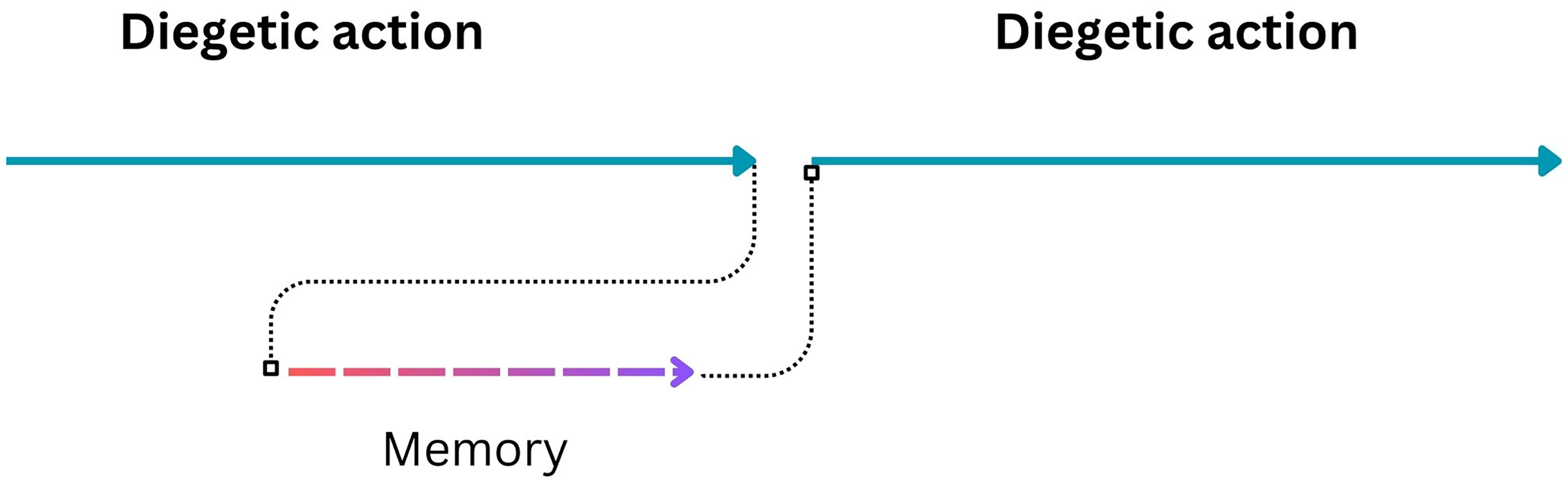
In contrast to reflective flashbacks, embodied flashbacks incorporate the characters as doppelgängers within their own memories. They are shown to interact with the physicality of the memory – engaging bodily with the recalled environment and the other characters within it. In this way, the flashback can be said to be ‘embodied’ by the character, as they physically watch or interact with themselves in the past. An example of an embodied flashback is from episode eight of WandaVision, in which Wanda's neighbour who has recently revealed herself as the powerful witch Agatha Harkness (Kathryn Hahn), has taken Wanda captive to discover the source of her incredible power. In the first of a series of interconnected embodied flashbacks within the episode, Agatha uses her magic to recreate a scene from Wanda's past. A door appears in the wall of Agatha's basement lair, opening on a small apartment with, as Agatha terms it, a ‘cold war aesthetic’. It is Wanda's childhood home in Sokovia, a fictional Eastern European country in the MCU. As the two women watch, Wanda's father (Daniyar) returns and is greeted by her mother (Ilana Kohanchi) and brother, Pietro (Gabriel Gurevich). Pietro calls for his sister, Agatha pushes Wanda forward, the camera circles her anticlockwise, and she is transformed into her child-self (Michaela Russell), being embraced by her father. The scene plays out – we see the family sit down to watch The Dick Van Dyke Show, Wanda and her brother on the floor in front of their parents on the couch. The family dynamic is warm and loving, a sharp contrast with the soldiers exchanging fire on the snowy streets outside. As the show begins, the camera zooms to a close-up on the television screen, allowing us to watch the sitcom along with Wanda. The sound of the television recedes under a soft orchestral score that cocoons the happy moment. Suddenly, an explosion. Everything turns dark and silent. Wanda comes to in the rubble of her home. She and Pietro take shelter under the bed. Their parents are gone. A bomb with ‘Stark Industries’ (the company of MCU character Tony Stark, aka Iron Man) crashes into the apartment floor, a red light on its body slowly blinking. From under the rubble, The Dick Van Dyke Show continues to play on the smashed television set. Child Wanda reaches out a hand towards the bomb and is pulled backwards. Adult Wanda comes out from under the bed, still in the deserted rubble of her childhood home. Another door opens and Agatha remarks, ‘the only way forward is back’, a fitting comment for a series of flashbacks that, by embodying the characters physically within the memory space, move the diegetic action forward while exploring the character's backstory (Figure 3).

The overlapping of memory with the diegetic action that occurs within embodied flashbacks.
Unlike reflective flashbacks that create a moment of pause within the diegetic action, embodied flashbacks layer the memory on top of the diegetic action. This layering effect minimises the sense of pause within the diegesis, eliding it so that present and past diegetic zones occur simultaneously. In this way, embodied flashbacks recall the continuous nature of television consumption and production enabled by binge viewing. They also introduce a similarly physical element – just as binge viewers are required to sit for long periods of time (as in the epic viewing or marathoning described earlier), so when the notion of pause is elided within the diegetic action, it is the characters themselves who embody the lack of pause. In either case, we find that the durative nature of television viewing without pause is balanced by a greater emphasis and impact on the body of the viewer.
Play / pause / binge
This paper has sought to discuss how pause is figured in narrative television consumption and production in the streaming era, both at the overarching level of series and episode structure, and within the diegetic action itself, focusing on the series Stranger Things and WandaVision. Considering the echoes in viewing experience across television's history, it has argued that from the broadcast era of the 1950s, the experience of viewing television drama has been inherently episodic in nature, with staggered release scheduling not only moulding consumption practices through appointment viewing but also impacting how stories were told within television production. In the SVOD era, companies such as Disney + have adapted this traditional model to the new streaming industry. By contrast, Netflix’s championing of binge viewing recalls and extends the multi-episode consumption made possible by technological shifts in TVII and TVIII, offering durative viewing experiences, often of ‘Original’ content, designed to be watched in one, continuous session. This paper suggests that the notion of pause offers a means to navigate these complexities. Pause creates a lens through which to examine distribution models and consumption practices on one hand while on the textural level, informing narrative structure and generic paradigms. It has ramifications for the body of the viewer through the physical impacts of binge viewing and of embodied flashbacks within the storyworld. Finally, it foregrounds other, industrial considerations such as how SVODs are positioning themselves in the streaming market and how they approach subscriber retention and churn (see e.g. Cohen, 2022; Webster et al., 2022). So by taking a moment to consider pause within television consumption and production, we have a window to explore the evolving form of television drama over time, how we relate to it and the impact of whether or not we play the next episode.
Footnotes
Acknowledgements
I would like to express my gratitude to my supervisors Professor Belinda Smaill and Dr Tessa Dwyer, with particular thanks to Dr Dwyer for her constructive feedback and encouragement throughout the development of this article.

Ethical considerations
There are no human participants in this article and informed consent is not required.
Funding
The author(s) disclosed receipt of the following financial support for the research, authorship, and/or publication of this article: This research is/was supported by an Australian Government Research Training Program (RTP) Scholarship.
Declaration of conflicting interests
The author declared no potential conflicts of interest with respect to the research, authorship, and/or publication of this article.
Film and television works cited
A Nightmare on Elm Street. Dir. Wes Craven. New Line Cinema, 1984.
Avengers: Infinity War. Dirs. Anthony Russo and Joe Russo. Walt Disney Studios Motion Pictures, 2018.
Halloween. Dir. John Carpenter. Aquarius Releasing and Compass International Pictures, 1978.
I Love Lucy. Exec. Prod. Desi Arnaz. CBS, 1951-1957.
Modern Family. Crs. Christopher Lloyd and Steven Levitan. ABC, 2009-2020.
Poltergeist. Dir. Tobe Hooper. MGM/UA Entertainment Co., 1982.
The Dick Van Dyke Show. Cr. Carl Reiner. CBS, 1961-1966.
WandaVision. Cr. Jac Schaeffer. Disney+, 2021.