



Abstract
In January 2019, the South Australian Government released the report of its Royal Commission into the Murray-Darling Basin, which investigated the implementation of the Basin Plan and allegations of water theft in upstream states. This study analyses the report and specialist rural media coverage of it. Previous research has found that rural media imaginaries of the rural space validate the ‘productive’ use of land and reinforce the discursive power of rural elites such as political actors, industry bodies and landholders, offering few opportunities for alternative voices. Drawing on the concepts of ‘agrarian imaginary’ and ‘settler common sense’ and adopting discourse analysis as a methodology, we found that while the report made a clear connection between settler activities and the ill health of the Basin, specialist rural media did not approach it as an opportunity to broaden the dominant rural imaginary but further cemented the productive use of land discourse.
Introduction
The summer of 2018–2019 drew sharp attention to the environmental crisis in Australia's Murray-Darling Basin (MDB). Gripped by drought for some years, the rivers had stopped flowing in north-west New South Wales (NSW), leaving some towns on severe water restrictions. There were four ‘fish kill’ events in December 2018 and January 2019, including two of unprecedented scale at the Menindee Lakes on the lower Darling River in NSW. This crisis inspired media commentary that took a step back to question the management of the river system through the key policy instrument known as the ‘Murray Darling Basin Plan’ (see e.g. ABC, 2019; Davies, 2019). The Basin Plan has been controversial since its inception, with some saying that too much water is taken for irrigation and others saying that the volume allocated for the environment is too high (see e.g. Bourke, 2011). This was the environmental, political and media context for the release of the 746-page final report of South Australia's Royal Commission into the MDB Plan on 31 January 2019 (Walker, 2019).
News reports about allegations of widespread water theft were the trigger for an independent review in 2017 that found that the Basin Plan was not enforced appropriately by the upstream states of Queensland and NSW (The Guardian, 2017). As a result, the SA Government established its royal commission in 2018. Key conclusions included: that the Murray-Darling Basin Authority (MDBA) had mal-administered the Plan; that the MDBA has ignored scientific knowledge, especially climate change projections, in the determination of Environmentally Sustainable Levels of Take and the setting of Sustainable Diversion Limits; that there was inconsistency between states in terms of compliance and enforcement of the Basin Plan; that the MDBA lacks transparency; and that Traditional Owners’ cultural needs and interests have been marginalised and that they need to play a central role in water management (Walker, 2019). The report made a clear connection between settler activities dating from the time of colonisation and the ill health of the Murray-Darling. It therefore provided a significant departure from the agrarian discourse that prioritises settler activities such as primary production over First Nations and environmental rights, and arguably had the potential to challenge and change dominant discourse about the Basin.
This study first analyses the Murray-Darling Basin Royal Commission Report (Walker, 2019) followed by its coverage in rural media to explore the alignment between the discourses in the selected texts. Drawing on the conceptual ideas of ‘agrarian imaginary’ (Mayes, 2014) and ‘settler common sense’ (Rifkin, 2014), the article questions whether rural radio and newspapers approached the report as an opportunity to broaden the dominant rural imaginary of irrigators’ assumed sense of entitlement to water (Downey and Clune, 2020), or further cemented the discourse of the ‘productive’ use of land (Mesikämmen et al., 2021; Waller et al., 2020b). We draw on critical-cultural scholarship to investigate the coverage published in The Land, The Weekly Times and Stock Journal and broadcast on the ABC's Country Hour programme in the immediate aftermath of the release of the report.
News media, environmental conflict and rurality
Much of the literature on news and the environment focuses on environmental journalism as a specialisation (Hansen, 2020) and on the operation of power in mediated environmental conflict (Lester, 2010; Lester and Hutchins, 2013) where news outlets and the media strategies of key stakeholders, from community-based activists to big business, are understood to play a constitutive role in structuring public and policy discussion, debate and conflict (Lester and Hutchins, 2012; 2013). In this way, news representation determines how conflicts between dominant political and economic interests and environmental groups become visible and play out (Foxwell-Norton, 2017). There is a tradition of scholarship on the gate-keeping function of journalists and the framing of ecological concerns by commercial and public service news that reveals the uneven media field that actors in environmental issues must negotiate. For example, environmental stories that are technical or policy related such as the one at the centre of this article, have been found less likely to receive coverage than ‘events’ and ‘conflicts’ (Cottle, 2013).
The research presented here concerns reporting of a key environmental issue by rural news outlets. As Freeman and Hutchins (2023) argue, the concept of rurality is often under-examined in environmental debates, especially the degree to which it influences media discourses and political decisions (Freeman & Hutchins 2023: 438). They conceptualise rurality as a source of place-based power and inequality that arguably adds another layer to the hierarchy of social struggles that determines which environmental issues and topics rise to community and public attention, and which are ignored and delegitimised (Freeman & Hutchins 2023: 439). Of further relevance, Hansen (2020: 46) has examined environmental reporting in regional media and found that it differs to metropolitan coverage in terms of the range and types of voices accessed, and in how critical or deferential the reporting is regarding local industries or employers in the context of environmental problems. Furthermore, he says that there is evidence of ‘a changing public communications environment where expert testimony and science-based evidence count for less than opinions and are less effective than referencing of deep-seated cultural myths and fears’ (Hansen, 2020: 43), a point we will examine through the case presented here.
Agrarian imaginary and settler common sense
The conceptual frames of ‘agrarian imaginary’ and ‘settler common sense’ are used here for revealing and analysing the discourses at play in rural news coverage of the Royal Commission report. The concept of an agrarian imaginary (Mayes, 2014; Thompson, 2010) extends the notion of a social imaginary, which according to Taylor (2004) carries deep normative ideas that motivate the way individuals and communities believe social practices and relations should be conducted. Thompson (2010: 53) explains that in the Anglo-American world, agrarian political thought draws heavily from the ideas of Thomas Jefferson, who famously remarked that farmers are ‘the most valuable citizens’. The philosophical foundations of the agrarian imaginary can be traced back through this line of American colonial thought to 17th century English philosopher John Locke's theories of limited, liberal government that were used to justify the idea that ‘[f]armers who occupy and improve the land thereby have a natural right to it’ (Eisinger, 1947b: 14 in Thompson, 2010).
Mayes (2014) argues that contemporary proponents of agrarian social thought focus too heavily on agrarian virtues such as self-reliance, sustainability and community, thereby ignoring or marginalising historical practices of agrarian violence, exclusion and dispossession. Rifkin (2014) has theorised how such vices are camouflaged by the hegemonic operation of what he terms ‘settler common sense’. He suggests that the suspension of Indigenous rights through settler modes of governance is a prerequisite for ‘the everydayness of settler domestic life’ and developed the concept of ‘settler common sense’ to explain how settlement's ‘histories, brutalities, effacements and interests become quotidian and common-sensical’ (Rifkin, 2014: 2, 5). He discusses how non-Indigenous texts are affected by histories, legalities and policies of First Nations dispossession and settler jurisdiction in ways that do not appear to have anything to do with First Nations people. However, these representations and erasures give rise to specific visions of social life, modes of ethics and conceptions of placemaking that participate in the ongoing processes of settler colonialism. In this article, we explore how rural journalism discourse participates in the construction of the settler way of imagining rural space.
Politicised spaces: the MDB and rural media
As geographic, political, economic, historical, social and cultural contexts inform critical analysis of media content, we provide a brief background on the river system and the rural media outlets discussed in this article. The MDB is Australia's largest river system and generates many competing interests (see e.g. Bourke, 2011). It is the unceded lands and waters of over 50 First Nations, a crucial ecosystem and the source of water for more than 3 million people, and its key industries include agriculture and tourism (MDBA, 2023a). It is perhaps no wonder, then, that the Basin is also a highly politicised space and its health has declined over the years due to droughts and increased use (MDBA, 2023b). In response, policy makers implemented a significant national water management policy overhaul, passing the Water Act 2007 and establishing the MDB Plan in 2012, which is a management arrangement between the Federal Government and the Basin states. The key aspect of the plan is to set the yearly amount of water that can be extracted from the Basin while leaving enough for the environment (MDBA, 2023b). The management of the MDB is based on one of the most sophisticated water markets in the world, which has attracted criticism, especially the strategy of buying back water entitlements for the environment (Wheeler, 2022).
Specialist farming media
Country Hour was established in 1945 and is the nation's longest running radio programme, with a weekly audience of more than 94,000 listeners. Each state has its own edition, broadcast each weekday. It is part of ABC Rural, which delivers ‘daily information about the business of farming, agriculture and mining and how it impacts every part of our lives’ (ABC News, n.d.) and has long been recognised as a highly politicised media space due to the powerful interests it serves (Lee, 2015). The ABC Charter requires the ABC to reflect the cultural diversity of Australian society including rural communities and First Nations, and its editorial policy states: ‘Creating opportunities for Aboriginal and Torres Strait Islander voices, perspectives, and stories to be heard is a vital part of the ABC's role in fostering the national conversation, and in comprehensively and fairly reflecting the cultural diversity and national identity of Australia’ (ABC, 2021).
The Land was launched in 1911 as the official mouthpiece of the NSW Farmers and Settlers’ Association. Its founders set out to create a newspaper to ensure ‘the voice of farmers couldn’t be drowned out by city-based politicians, mainstream media and lobbyists wanting to put their interests above agriculture and country people’ (Graham and Norris, 2019). It is now owned by Australian Community Media (ACM) with a weekly circulation around 20,800. Australia's biggest selling rural newspaper with a circulation around 53,800, The Weekly Times, was launched in 1869, is owned by News Corporation and its key audience is in regional Victoria. Stock Journal was established in 1904 as the Adelaide Stock and Station Journal, has a weekly circulation of around 9600 and is owned by ACM, which describes it as SA's leading rural weekly (ACM, n.d.). Both The Land and The Weekly Times refer to themselves as ‘the Bible of the Bush’ (Graham and Norris 2019; The Weekly Times, n.d.), and The Land and Stock Journal have a common heritage as ‘official organs’ of powerful settler agricultural lobbies. These points highlight these news outlets’ claim to authority and the politicised nature of the rural news space.
Methodology
To explore whether specialist rural media approached the Royal Commission report as an opportunity to broaden the dominant rural imaginary of the productive use of land (Downey and Clune, 2020; Mesikämmen et al., 2021; Waller et al., 2020b), we conducted a discourse analysis. First, we examined discourses emerging from the report, and then we analysed its coverage in the Country Hour editions aired in the Basin states (Queensland, NSW, Victoria and SA) and the three newspapers. Country Hour, The Land, The Weekly Times and Stock Journal were selected for analysis because they are the leading farming media outlets in the Murray-Darling Basin states. Furthermore, as they have a particular way of imagining the rural space, their coverage provides fruitful ground for exploring the potential of a key inquiry to make a significant intervention in dominant approaches to imagining and managing the MDB and the role the media play in advancing or holding back that potential. The state-based nature of the newspapers enables us to draw parallels with the relevant Country Hour editions.
The following research questions directed our analysis:
RQ1: What dominant discourses emerged from the Royal Commission report? RQ2: What was the volume of coverage of the report in selected rural media? RQ3: How were social actors, events and actions represented and explained in the coverage by journalists and their sources?
Drawing on Fairclough (2010: 230), we define discourse as ‘a way of construing aspects of the world associated with a particular social perspective’. This recognises the broadly accepted understanding of discourse as a form of social practice that both constitutes and is constituted by social phenomena (Fairclough, 1995; Richardson, 2007). The identification of discourses was based on how certain events, actions and social actors were represented, how past and present events and action was narrated, and how events and actions were explained and justified (Fairclough, 2010: 19). We focused on identifying discursive strategies employed by various social actors (Carvalho, 2008). These include the author of the report and those who made submissions quoted therein, as well as journalists and the sources used in their coverage. Counting of sources in Country Hour content included those whose voice was heard in the stories. In the newspaper coverage, those who were assigned direct voice through quotes or who were paraphrased by journalists were counted as sources.
The media analysis focused on the initial aftermath of the report. We listened to all Country Hour programmes broadcast in the Basin states from 31 January to 8 February 2019. There were 255 stories, of which 23 referred to the report and were included in the dataset. Newspaper articles were identified through a search in the Factiva database with search terms ‘Murray Darling’ and ‘Royal Commission’ from 31 January to 16 February. A longer time frame was set for the newspaper dataset, given that the papers are weeklies. The Factiva search yielded 18 relevant items that were included in the dataset. All media texts were coded manually, and data was recorded on coding and Excel sheets.
Power struggle: the Royal Commission report
The Commission travelled to nine towns in the Basin states, made 20 site visits, held private consultations with and received submissions from local governments, individuals, farmers, farmers’ lobby groups, First Nations organisations, state governments, academics, environmental advocacy groups and others (Walker, 2019: 730–745). It received 165 submissions and heard 68 witnesses in public hearings. The final report made 44 recommendations, including changes to the determinations of Environmentally Sustainable Level of Take (ESLT) and Sustainable Diversion Limit (SDL) to ensure more water for the environment; the establishment of an independent Commonwealth Climate Change Research Authority; the inclusion of at least two Aboriginal representatives on the MDBA Board; and greater transparency in terms of modelling used to administer the Basin (Walker, 2019: 71–75).
Our analysis identified an overarching theme of power struggle that took multiple forms – for instance, the report sheds light on First Nations’ struggle to be heard in water management and care for country due to lack of cultural flows, competing interpretations of the Water Act, the struggle to get authorities to act on climate change and the unwillingness of federal representatives and water bureaucrats to participate in the inquiry. We present our discussion of this through three discourses that are interwoven in the report: settler responsibility, law and environmental justice and political contest.
Settler responsibility
The settler responsibility discourse is evident from the outset, as Walker (2019: 1) states that the damage to the Basin since colonisation and the dispossession of First Nations peoples ‘are part of the same story’. It continues in the section outlining the history, in which Walker (2019: 13–15) suggests that the current plight of the river system can be traced back to key 19th century settler policies used to regulate the Basin water resources as a ‘servant’ or to resist it as an ‘enemy’. The report also acknowledges that Australian laws lack clear recognition of Aboriginal values and interests, and calls for a greater inclusion of First Nations in decision-making about water planning and management (Walker 2019: 73–74, 470). It acts as a channel for the traditional custodians of the Basin to voice their perspectives through their evidence to the inquiry. In problematising the agrarian imaginary and emphasising the need to listen to First Nations, the report provides a significant departure from the approach prevalent in political discourse and the administration of the Basin that prioritises settler activities, especially primary production. It therefore presented journalists with opportunities to pursue some different angles and amplify some different stakeholders to those usually featured in regional and rural media spaces.
Law and environmental justice
The law and environmental justice discourse refers to the inquiry's focus on the statutory framework governing the management and use of the Basin – the Water Act 2007 and the Basin Plan – and whether its management is compliant. Walker suggests that the good intention of the law as an agent for a sustainable environment is being thwarted in the name of productivity by bureaucrats, politicians and rural elites. He concludes that elements of the administration of the statutory framework were ‘unlawful’, especially in terms of the MDBA ignoring ‘best available’ science and socio-economic analysis in its modelling for water take as well as secrecy surrounding that modelling (Walker, 2019: 54–70). These arguments are legitimated through Walker's legal analysis of the implementation of the Basin Plan as well as evidence provided by stakeholders including scientists and Basin residents (see e.g. Walker, 2019: 394–395). Further, Walker suggests that the MDBA's socio-economic analysis in relation to the assessment of the impact of water recovery – especially ‘buybacks’ – was inadequate. The term ‘buybacks’ refers to the federal government purchasing water licences from farmers wishing to sell, thereby boosting the potential water available to river ecosystems and contributing to a sustainable environment as required by the Water Act. However, the measure has been strongly opposed by irrigator groups and political advocates who argue buybacks cause a loss of farm production and unemployment among other things. Consequently, the conservative Federal Government in power at the time the report was released scrapped buybacks (Grafton, 2020). The law and environmental justice discourse is strengthened further in the report through quotes from scientists about the non-market value of environmental flows as well as voices of farmers like Christopher Bagley who says that the river system is being ‘push[ed] too hard’ (Walker, 2019: 35–38, 395–396).
Political contest
Three notable arguments presented in the report underscore the politicised nature of the administration of the Basin: that its management is affected by interstate rivalry; that the interpretation and implementation of aspects of the statutory framework is politically motivated; and that there is a lack of transparency surrounding the management of the Basin. Firstly, while Walker (2019: 38, 117) considers the Water Act as a compelling example of the capability of governments to regulate water resources cooperatively in the national interest, he also suggests that the complex framework of governance acts as ‘a cockpit for interstate rivalrous self-interests’ (Walker, 2019: 117–118).
Further, the report suggests that the determination of ESLT has been influenced by politics, particularly through the MDBA's adoption of the ‘triple bottom line’ slogan, which refers to the principle that decision-making should effectively integrate economic, environmental, social and equitable considerations (Walker, 2019: 18). Calling the slogan a myth, Walker (2019: 21–22) explains that the Water Act did not mandate balance between the environment and human uses as some claim, but is a law requiring the needs of the environment to be based on science. The inquiry found that the perceived negative effects of water buybacks are not based on sufficient evidence and disregard factors such as technological developments and climate change (Walker, 2019: 392–394). Consequently, Walker suggests that the vilification of buybacks is politically motivated.
Finally, the Commission was troubled by the lack of transparency of the MDBA and relevant authorities’ unwillingness to subject themselves to the inquiry, which was a direct challenge for the Royal Commission's authority and legitimacy. In addition, the MDBA's lack of proper disclosure and scientific scrutiny made Walker (2019: 718) sceptical about the ability of the Water Act and Basin Plan to achieve their objectives and purposes.
Media analysis: limited coverage
Our analysis of the Royal Commission report identified an overarching theme of power struggle comprising settler–Indigenous, primary production–environment and state/partisan political contests. In the media coverage, an encompassing theme of power struggle also emerged, but the focus was on primary producers’ struggle with aspects of the Basin Plan and those who manage it, as well as the state/partisan political contest. This indicates the highly politicised nature of public discourse on the MDB. Some, albeit limited, space was assigned to environmental discourse, with First Nations’ struggle against settler power being near absent.
Coverage was limited in most of the media outlets examined (Figures 1 and 2). Notably, the SA edition of Country Hour and SA-based Stock Journal had the most items. Stock Journal published nine news articles and one editorial across the two-week timeframe, while The Land published five news items and one editorial. In The Weekly Times, there was only one item that focused on the inquiry (Knight, 2019), and another about the effect of the drought on rice growers’ yields, with only a brief reference to the inquiry (Bell, 2019). The farmer's criticism of the Royal Commission was mentioned towards the end of the article, as opposed to it being the main topic.
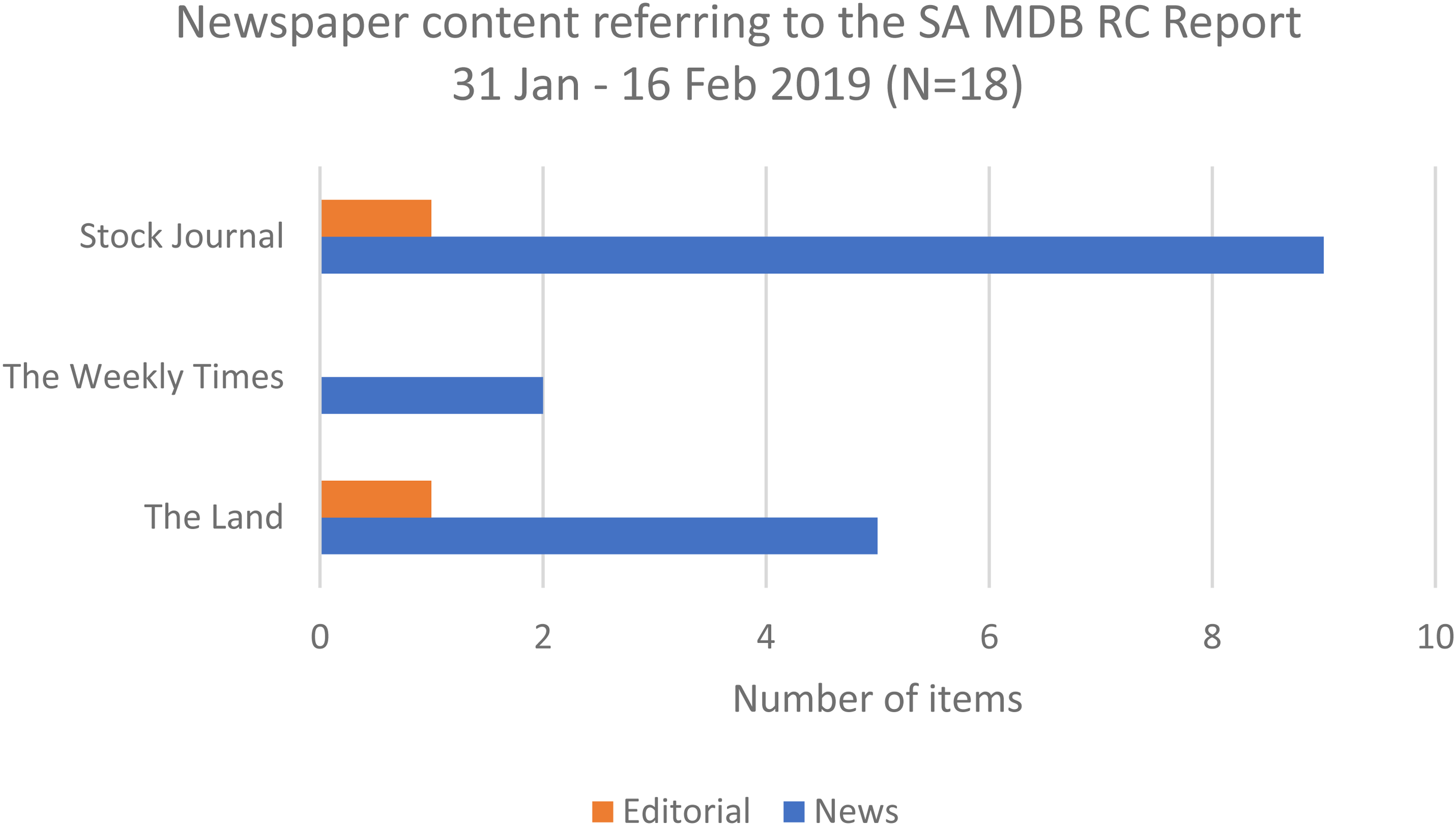
Number of items per newspaper.
Analysis of Country Hour content shows that the SA edition aired 11 stories related to the inquiry across the study period. The Victorian edition broadcast three, the NSW edition five and the Queensland edition four. Comparing the number of Royal Commission stories to the total number of items aired on Country Hour in the Basin states, the report did not gain much traction, especially in the Victorian, NSW and Queensland editions, which aired a total of 43, 67 and 88 items respectively. The total number of items aired in the SA edition was 57 (Figure 2). The majority of stories took the form of reaction or commentary, which is standard journalistic practice when a major report is released.
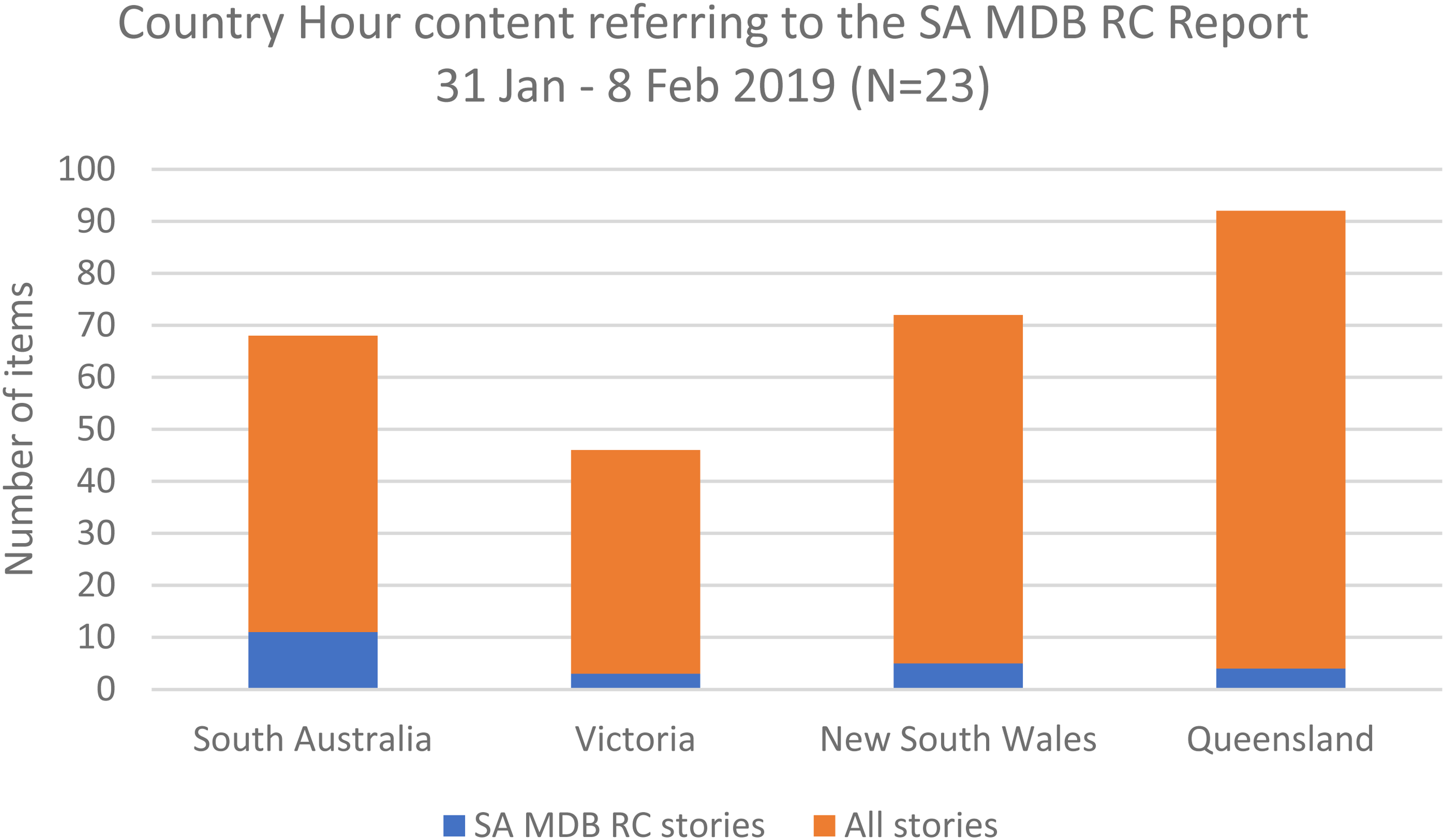
Number of items per Country Hour edition.
The most common sources in both newspaper and radio content were politicians, which is also indicative of the highly politicised nature of the Basin (Figures 3 and 4). Further, peak agricultural body representatives were drawn on more often than others on Country Hour as well as in the Stock Journal. This finding aligns with earlier studies on Country Hour, which found that the programme reinforces the discursive framing power of political actors, industry bodies and landholders, offering few opportunities for alternative voices (Mesikämmen et al., 2021; Waller et al., 2020b). A similar pattern has also been found in studies on water reporting in other Australian news outlets (Kosovac et al., 2024; Wei et al., 2015). Rural media's practice of assigning discursive framing power to the rural elite means that, with a few exceptions, their audiences did not hear the voices of relevant experts, Traditional Owners or community members who made submissions to the inquiry. In contrast, readers of the report can hear these voices clearly recorded, detailing how the intent of the Water Act and the MDB Plan were manipulated and corrupted to ensure that ever more water was available to irrigators (see Walker, 2019).
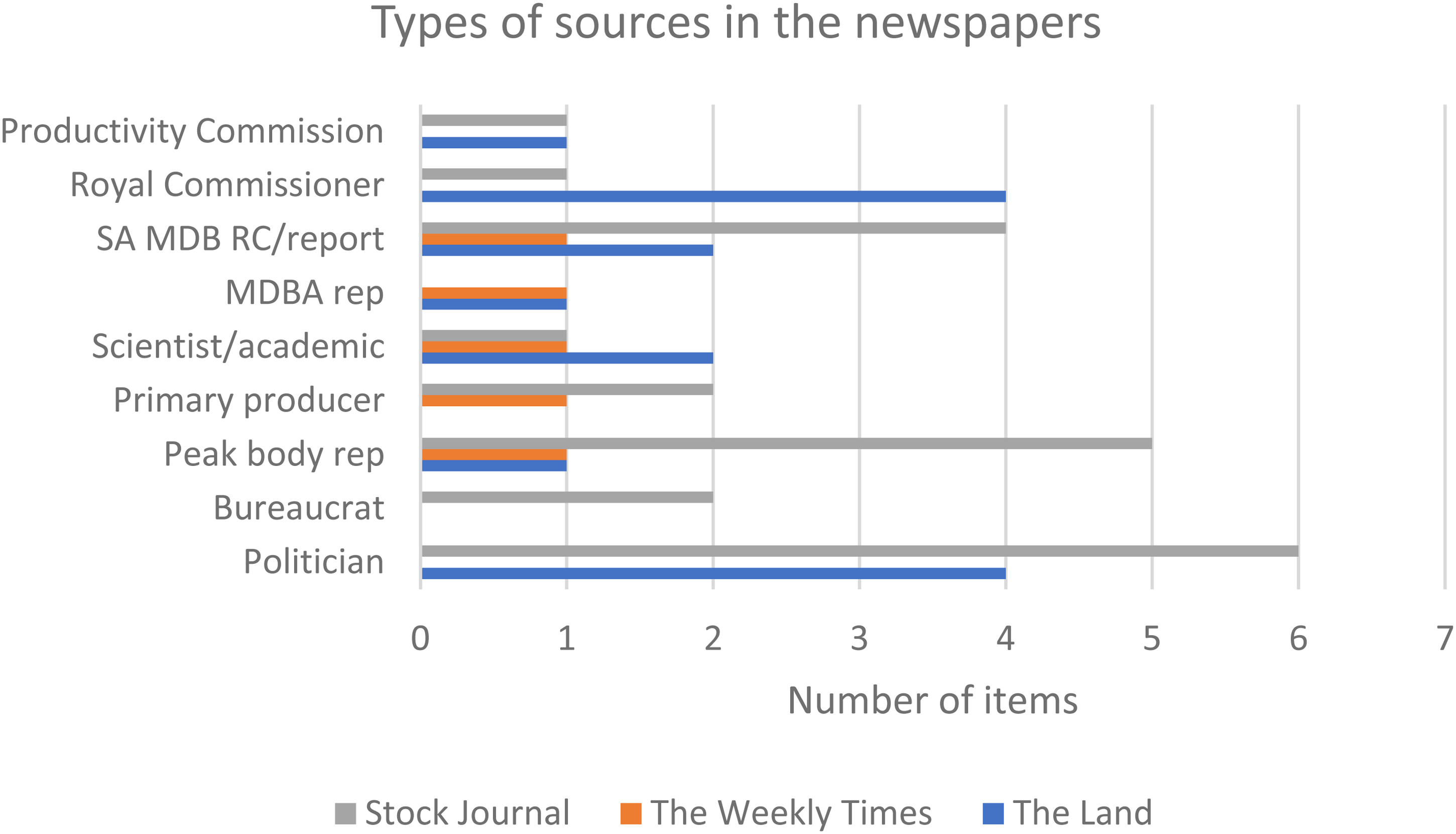
Types of sources in newspaper content.
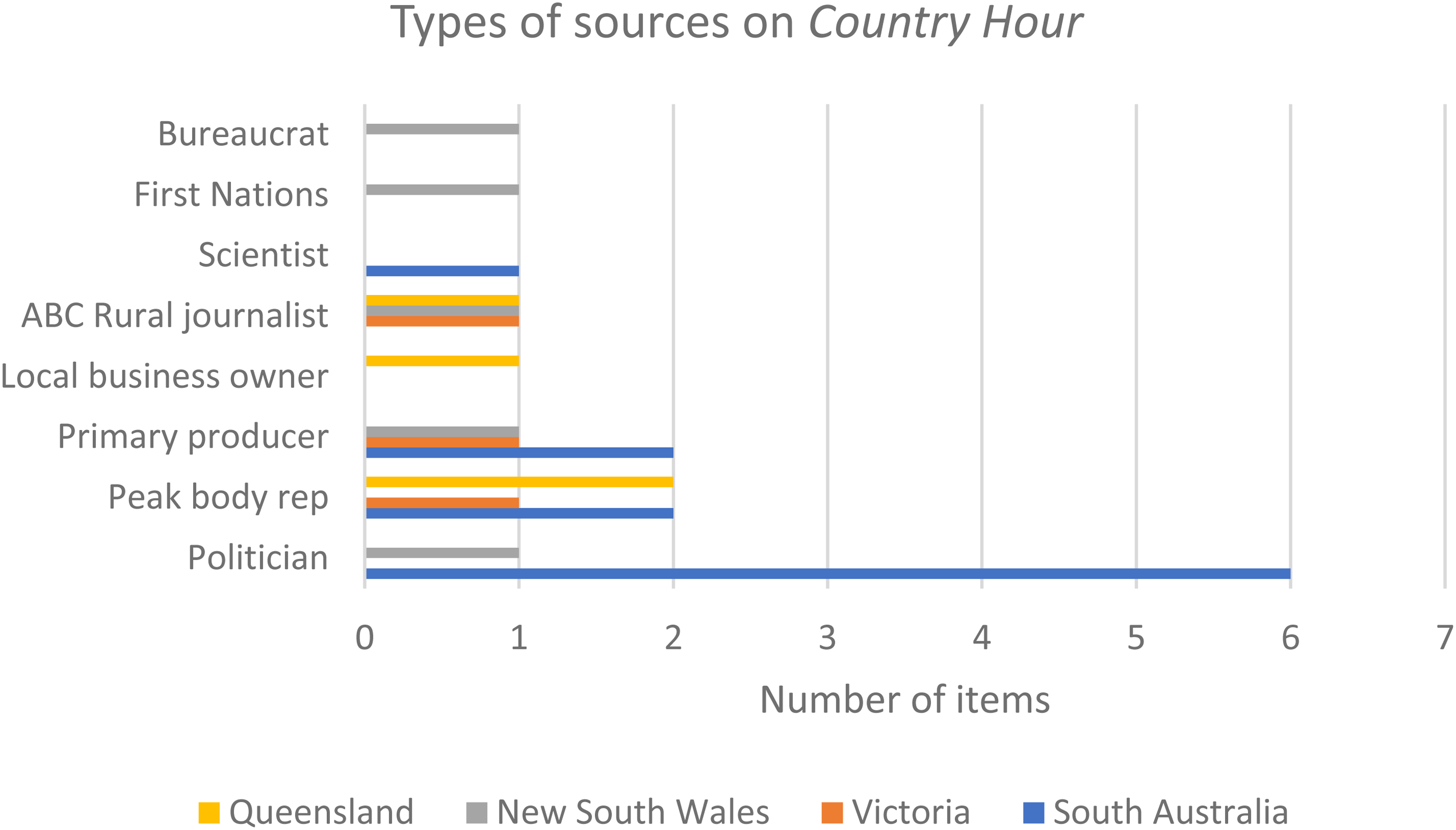
Types of sources on Country Hour.
There were exceptions, most notably in The Land, which assigned discursive framing power to Commissioner Walker, and Stock Journal, which drew directly on the report. These sources were used to describe the inquiry findings and to enable Walker's voice on findings including that the MDBA is ‘an incompetent administrator’ of the Basin Plan (Foley, 2019); and that the MDBA ‘acted unlawfully when it “completely ignored” climate change projections for the determination of water allocations, it [the report] said’ (Bermingham and Coughlan, 2019). However, the majority of articles that assigned discursive framing power to the report or Walker also presented the perspectives of politicians and/or agricultural peak body critics, likely to adhere to the journalistic principle of balance. Further, while some stories provided a voice to the Australia Institute's senior water researcher Maryanne Slattery, there was a notable absence of First Nations perspectives.
In the following sections, we shed light on a discourse of ‘political contest’, especially over water buybacks, which had a dominant presence in the media coverage, as well as a discourse of ‘environmental emergency’, present to a lesser extent and almost never as the primary discourse.
Political contest over water buybacks
A ‘political contest’ discourse, especially over water buybacks, was largely constructed by representatives of agricultural industry bodies and conservative politicians. For instance, an article in The Land on 1 February begins with an outline of the inquiry findings and the Commissioner's key arguments: The MDBP is unlawful and should be rewritten so that the health of the river system is the only consideration when it comes to calculating the amount of water recovered from irrigation. That's according to the SA Royal Commission into the Murray Darling Basin Plan … (Foley, 2019)
While the story leads with the inquiry's call to consider the environment, its findings are presented as unconditional, which sets the scene for the political contest. Further comments from Walker are followed by quotes from four conservative politicians as well as the MDBA chief executive criticising the inquiry. For example: Mr Blair [NSW Water Minister] appeared to reject the prospect of further water recovery, warning he would ‘fight tooth and nail’ for irrigation communities. (Foley, 2019)
This discourse is also evident in a report in Stock Journal titled: ‘Water reform blasted’ (2019a). It begins with the journalist's framing of the report as inadequate or flawed: …the SA Royal Commission report into the implementation of the MDBP has left many feeling disappointed that a huge opportunity had been missed … (Stock Journal, 2019a)
Further down, SA Murray Irrigators chair Caren Martin is reported to have said the report was ‘…disappointly (sic) “a one-eyed, overindulgent legal opinion that doesn’t take into account the history and intent of water reform in this country”’ (Stock Journal, 2019a). She calls the report ‘another opinion in the mix of noise’ and says: The commissioner may be right from a legal point of view, but in context of the intent of the water reform, he isn't right. He has now muddied the waters and made it quite political. (Stock Journal, 2019a)
The same story also quotes SA Dairyfarmers’ Association CEO Andrew Curtis who says: The commissioner believes there is a clear heirarchy (sic) that the environment is atop, and social and economic outcomes run a distant second and third. This is not the understanding of any politician who put the deal together or the MDB Authority. (Stock Journal, 2019a)
Both Martin and Curtis position Walker as someone who has not considered the original context of the MDB Plan and has therefore produced a skewed or flawed report. They frame the ‘triple bottom line’ approach as guaranteeing water for human activities, especially agriculture. This is interesting, as the MDBA website states: ‘At its heart, the Basin Plan sets the amount of water that can be taken from the Basin each year, while leaving enough for our rivers, lakes and wetlands and the plants and animals that depend on them’ (MDBA, 2023b).
The anti-buybacks discourse emerged from many of the Country Hour stories as well, constructed by both the journalists and interviewees. For example, the day following the report's release, the SA Country Hour presenter opened the programme saying that its reporting would focus on what ‘some of the irrigation and river communities in South Australia think about that report’ (Country Hour SA, 2019b). In fact, more airtime was devoted to what politicians had to say, but SA Country Hour's editorial position legitimated irrigators’ rejection of the report's recommendations by giving them voice and interviewing more politicians who supported primary producers’ position than those who did not. The framing was established in the introduction when the presenter said irrigator communities ‘were not that happy about what they’ve heard’ and continued: Now the report even says the argument by rural communities that buybacks decimate their towns is more fiction than fact and … that this statement could be disproven by anyone with an undergraduate degree. Now I know interstate this has been very strongly rejected. (Country Hour SA, 2019b)
The presenter uses the adverb ‘even’ as an intensive to emphasise her characterisation of the report, casting it as condescending about rural communities and invoking ‘interstate’ rejection as legitimising this way of thinking about it. This editorial positioning was reinforced immediately through interviews with an irrigator, who accused Walker of displaying a ‘high degree of ignorance’ and the chairman of the local irrigators’ peak body who said water buybacks ‘could destroy small towns, small regions’.
In the Victorian Country Hour on the previous day, the presenter opened the programme with: ‘Coming up … we’ll hear from those directly affected by the Basin Plan’ (Country Hour Victoria, 2019). Because the two stories related to the Royal Commission in the programme are interviews with a peak body representative and an irrigator, this assertion assumes that only farmers are directly affected. Groups like First Nations or river users who are not primary producers are excluded by this framing. Later in the programme, the presenter introduces one of the interviews with: … the Victorian Farmers Federation has taken aim at the Murray Darling Basin's commission report (sic) and chair of the VFF's Water Council Richard Anderson says farming communities in Victoria would suffer if recommendations like reallocating more water from irrigation to the environment were implemented. (Country Hour Vic, 2019)
The reporter interviewing Anderson introduces questions about climate change, buybacks, changes to the MDB Plan and the report's criticism of the ‘triple bottom line’ approach. When asked about the potential implications of the recommendations to allocate more water for the environment for Victorian irrigators, Anderson says: Well, I think if you take more water out of the consumptive pool, obviously you’re gonna have a detrimental effect on regional communities and farming communities, irrigators as such. (Country Hour Vic, 2019)
Anderson's references to water entitlements held by landholders throughout the interview reproduces the agrarian imaginary of the rural space – that is, the idea that farmers who occupy and ‘improve’ the land, from a settler perspective, have a natural right to it (Thompson, 2010; Mayes, 2014).
The Queensland Country Hour presenter sought feedback from listeners, saying: ‘the SA Royal Commission has recommended buybacks – what do you think?’ (Country Hour Qld, 2019). These listeners had not been informed by the programme of the information provided to the Royal Commission by scientists and other experts, which persuaded the Commissioner of water buybacks as a more cost-effective mechanism for achieving environmental sustainability than the so called ‘efficiency measures’ (strongly favoured by irrigators) that do not remove water from the irrigation pool.
Environmental emergency
While journalists’ routine sourcing practices often centre on a narrow range of elite actors, the openness of public inquiry processes provides opportunities to assign framing power to a diverse range of actors and sponsor different discourses on issues of high public importance (Waller et al., 2020a). There were a few items in our datasets that assigned discursive power to First Nations or environmental sources. For example, a story aired on the NSW Country Hour the day following the report's release included interviews with three NSW Aboriginal Land Council representatives (Country Hour NSW, 2019). They were able to discuss how First Nations have been left out of the conversation on the Basin, as well as their connection with and concern about the river system. For example, Wiradjuri man and then chairman of the NSW Aboriginal Land Council Roy Ah-See said: It's about the health of the river system, and it's been declining for a long, long time. We’ve always said that there's two laws – there's man-made laws and there's spiritual laws. Once man-made laws interfere with spiritual laws, the system becomes broken … So, we’re at a point now where the spiritual law is starting to break down, and it's our responsibility – we were given custodianship by our elders and our ancestors to stand up to make sure that this system is around for another 60,000 years. (Country Hour NSW, 2019)
However, what is useful to consider here is the structural organisation of the programme – the story including the Aboriginal Land Council was positioned between an interview with a cotton farmer criticising water buybacks and then NSW Water Minister Niall Blair's framing of the terms of reference of the SA Royal Commission as political in design. Blair also suggests that there has been consultation with Indigenous communities regarding the MDB (Country Hour NSW, 2019). This arguably diminishes the discursive power of the First Nations sources interviewed in the programme.
The SA Country Hour edition from the same day (Country Hour SA, 2019b) included an interview with Greens Senator Sarah Hanson-Young, who therefore held some discursive framing power and used it to talk about the importance of environmental flows. However, in a segue from irrigator and government rejection of the inquiry's recommendations to the interview with Hanson-Young, the presenter employed a ‘so what’ provocation which de-legitimated Walker's findings and Hanson-Young's position: It's all well and good to have a Royal Commission … but I think one of the questions that's come out of it is, what can really come of it? You can put up these comments there's been maladministration that there's been negligence but so what, really? (Country Hour SA, 2019b)
Hanson-Young responded by invoking the collective ‘we’ several times to emphasise the dire situation in the Basin – or perhaps in an effort to position herself in alliance, rather than conflict, with all Australians, including the Country Hour audience and the rural elite: We have a river system in crisis, it's now an environmental emergency … As the impact of climate change takes hold the river system is only going to get sicker. This means river communities will suffer more and more as the river gets sicker. We’ve got to do something about it. (Country Hour SA, 2019b)
Stock Journal also provided Hanson-Young with an opportunity to speak for the environment on the day following the report's release: Our river desperately needs more environmental flows if it is to survive. It's time for the environment to be back at the centre of the Plan. (Fogden, 2019)
A week later, in a piece about the Greens’ push for a federal Royal Commission into the MDB, Hanson-Young was the sole source, and in addition to references to corporate and political contest over the Basin, she constructed the environmental emergency discourse: Saving this river is not going to be easy, but if we continue with business as usual it will die … There are no jobs, no river communities and no agriculture on a dead river. (Stock Journal, 2019b)
There were also some instances of landholders advocating for the environment: on the day the report was released, the SA Country Hour presenter interviewed a landholder who emphasised the need to go back to water buybacks (Country Hour SA, 2019a). Another example emerged from the Stock Journal (2019a), in which a fourth-generation farmer Neville Jaensch was quoted saying: … it is obvious that the greed of a few is outweighing the needs of many. Everybody's needs are important and valid, but people need to realise we need the environment to survive or the river will die from the bottom up. (Stock Journal, 2019a)
Both Hanson-Young and Jaensch's perspectives were presented at the end of the news reports, which according to the inverted pyramid structure of news suggests that they are less important than those of conservative politicians and agricultural peak bodies that came before them.
Discussion and conclusion
This study has explored whether a few key rural media outlets approached the Murray-Darling Basin Royal Commission Report as an opportunity to broaden the dominant rural imaginary of the productive use of land. Our analysis of the report identified an overarching theme of power struggle, which underlined three interwoven discourses of settler responsibility, law and environmental justice and political contest. It gave voice to scientists, First Nations and other stakeholders concerned about the environment, providing the rural news outlets with perspectives and potential sources that differ from those who are usually offered a chance to speak about matters related to water policy (Kosovac et al., 2024; Mesikämmen et al., 2021; Wei et al., 2015).
While the report received some national media coverage, the Royal Commission's findings and recommendations barely made a ripple across the rural media outlets that serve communities in the Basin states. Similarly to Cottle's (2013) findings, the number of stories about the report was low in most of the media outlets, with Country Hour SA and Stock Journal giving the topic some more attention. Further, in their coverage of the report, the news outlets prosecuted the ideological position of agrarian imaginary (Mayes, 2014; Thompson, 2010), prioritising the needs of irrigation and marginalising the perspectives of First Nations and others living in the MDB and speaking for the environment, such as primary producers who made submissions to the Royal Commission. This is evidenced by the dominance of the ‘political contest’ discourse focusing on conflict over water buybacks. Research on media coverage of other Australian Royal Commissions has found that the reporting was shaped by news routines and values including conflict and scandal more so than the inquiry's publicly stated priorities (Nolan and Waller, 2021; Waller et al., 2020a). Our analysis identified a similar pattern emerging in this study, with journalists maintaining a narrow focus on the report's most contentious recommendations relating to irrigators and environmental flows.
Finally, while the report presented journalists with clear opportunities to pursue different angles and sources to the rural elite, for the most part, they did not deviate from their routine sourcing practices or news agendas. Conservative politicians and agricultural peak body representatives – many of them opposed to water buybacks – dominated the rural media discourse. Our analysis also found that the report was highly politicised by both journalists and their elite sources, with some suggesting that it was the Commissioner who politicised the issue of water in the Basin. In the southern states editions of Country Hour and select newspaper stories, some First Nations and Green political voices advocating for the environment did cut through. However, social actors constructing the ‘environmental emergency’ discourse were assigned much less space than those criticising water buybacks and supporting the ‘productive’ use of the waterways, so there was no significant departure from the agrarian imaginary of the Basin in the stories about the Royal Commission.
Given that specialist rural media plays an important role as a source of information to farming communities – and to urban audiences about the rural space – it is problematic if they omit perspectives on and discussion of relevant inquiries and thereby limit public discussion. By ignoring the opportunity for a more nuanced public discussion provided by the inquiry, rural media delegitimised the needs of the environment and the perspectives of scientists and others than irrigators sharing the rural space, bolstering the dominant agrarian imaginary of the MDB (see Freeman and Hutchins, 2023; Mayes, 2014). Moreover, the near-absence of First Nations perspectives reinforces the settler common sense (Rifkin, 2014) approach to the MDB at a time of changing climate when a nuanced public discussion including voices that tend to be marginalised is required to ensure the survival of the MDB. This is especially problematic for the public broadcaster which has added responsibility due to its Charter to reflect the cultural diversity of Australian society, including First Nations. While the ABC does have an Indigenous portal and it covers some Indigenous stories in its mainstream news service, First Nations should not be excluded from ABC Rural, as First Nations are a part of Australia's rural population and have a significant cultural connection to land.
The analysis of the report suggests the Murray Darling Basin Plan's foundations or ideological framework rest upon the concept that water is a commodity (see Walker, 2019), reflecting the settler view of the land and water. However, the report does acknowledge First Nations’ rights and agendas and clearly states that they should be stakeholders in the management of the MDB. Commissioner Walker goes as far as he can and states that there should be more consultation from now on. In late 2023, the Australian Parliament passed the Restoring Our Rivers Bill, making amendments to the Water Act 2007, such as the expansion of options to meet water recovery targets and provision of support for First Nations to develop cultural flows planning and cultural economies (Australian Government, 2024). Future research might investigate rural media discourse on the new bill, whether it begins to give higher prominence to expert testimony and science-based evidence (see Hansen, 2020), and its impact on the imagining of the MDB.
Footnotes
Declaration of conflicting interests
The authors declared no potential conflicts of interest with respect to the research, authorship, and/or publication of this article.
Funding
The authors received no financial support for the research, authorship, and/or publication of this article.
