



Abstract
Over the past few decades, there has been significant industry and scholarly interest in diversity, equity, and inclusion in television. Alongside this, attention has been paid to the politics of queer representation in screen and media contexts. Providing much-needed data on these issues, this article catalogues the representation of gay, lesbian, bisexual, transgender, and nonbinary characters in Australian scripted television since 2000. We highlight the inclusion of more queer characters onscreen and situate this in the context of two significant decades of change in the Australian television industry and the broader socio-political context. In teasing out recent trends around gender and sexually diverse representation, we identify shifts toward representing more complex and inclusive queer story worlds on Australian television. We also note significant tensions in these representations, highlighting how Australian television remains quite conservative in depicting queer sex, intersections between sexualities and gender identities, and bisexual identities.
Keywords
Introduction
In 2023, Screen Australia released Seeing Ourselves 2: Diversity, Equity and Inclusion in Australian TV Drama, a much-anticipated follow-up to their 2016 benchmarking Seeing Ourselves report. The report highlights an increase in the proportion of lesbian, gay, bisexual, transgender, intersex, and queer (LGBTIQ+) main characters on Australian television from 4.5% (2011–2015) to 7.4% (2016–2021). In addition to this industry-oriented data, queer media scholarship has catalogued LGBTIQ+ representations through Australia's rich televisual history (Beirne, 2009; Hart, 2016; Howes, 1998; McIntyre, 2015; McKee, 2001; Monaghan, 2020; Riggs and McIntyre, 2022), challenging the prevailing assumption of historical and contemporary ‘invisibility (or under-representation) of gender and sexual diversity on Australian screens’ (Cover, 2024: 121). Internationally, queer television studies has emerged as a field of inquiry interested in the representation of LGBTIQ+ identities and the queer politics of the medium (Griffin, 2023; Miller, 2019; Parsemain, 2019; Villarejo, 2014). Building on these scholarly and industry insights, this article advances a systematic analysis of contemporary Australian television's lesbian, gay, bisexual, transgender, and nonbinary (referred to herein as gender and sexually diverse) representation. 1 As Kevin Guyan (2022) notes, the collection of data about gender and sexually diverse people can ‘recreate simplified, stereotypical and exclusionary rules, but also operates as a tool to gather evidence, document inequality, and bring about change’ (p. 4). Aligned with this latter aim, we address the following questions: What trends can be observed in the representation of gender and sexually diverse characters, how do these relate to historical trends, and how have they changed over time? We situate this analysis in the context of two decades of change, including shifts in the Australian socio-political context and disruption in the way audiences experience Australian television.
To interrogate the inclusion of gender and sexually diverse characters on Australian television, we utilised content analysis (see Harwood and Garry, 2003) to count appearances and their durations, and textual analysis (see McKee, 2001: 1) in analysing themes and trends. There is no go-to source for this information, so by necessity, we collated from a range of sources, including series synopses and episode descriptions on aso.gov.au, australiantelevision.net, wikipedia.org, and IMDB.com; lesbian and bisexual women characters catalogued on LezWatch.TV; discussion of relevant tropes on TVTropes.org; and watching episodes that aired between 2000 and 2019. The websites listed are user-generated, meaning they cannot be assumed to be exhaustive. Additionally, Australian screen productions tend to have less information available about them on international user-generated sites. Thus, watching episodes was necessary, particularly to capture once-off story arcs.
We approach this study from our respective positions as screen and media studies researchers who identify as cisgender and queer. Both authors are white, Australian-born settlers. Author 1 is a descendent of Irish, Scottish, and English immigrants, and Author 2 of English, Irish, and Welsh immigrants. Significant to our positionality is our shared experience of growing up in regional and rural Australia through the 1990s and early-2000s, where onscreen representations of queer identities, particularly in television, were a vital lifeline. From this shared experience, we consider televisual representations such as the ordinariness and acceptance of Simon's sexuality on The Secret Life of Us and the relationship between Sky and Lana on Neighbours to have contributed to the formation of our self-identities. Our research adopts a frame of analysis that prioritises gender identity and sexuality. However, we acknowledge that the LGBTIQ+ community is not monolithic, and there are other intersectional ways to analyse this data.
Our analysis reveals that Australian scripted television has seen increasing representation of some gender and sexually diverse identities, more diverse storylines, and the emergence of queer story worlds. Across the 2000s and 2010s, we identified 72 series that represented gender and sexually diverse characters (Table 1). Gay men appear in most series (44 of the 72), while bisexual men are comparatively rare (three). Lesbians are in the second highest proportion of programs (32), then bisexual women (15). Transgender women appear in more programs (eight) than transgender men (three). A nonbinary character appears in one series in 2018 (one). Not only are there more queer characters, but there is also a greater likelihood that series that include these stories will have both once-off and longer-running appearances, which we view as indicative of a shift toward representing more complex and inclusive queer story worlds. However, we do not wish to paint a clear narrative of progress as there are significant tensions to be uncovered here. Though the number of characters is increasing, we continue to see more depictions focusing on sexuality than gender identity, and very rare intersections between queer sexualities and queer gender identities. Additionally, we note hesitancy surrounding bisexual identities, the longevity of queer relationships, depictions of sex between queer characters, and the absence of some identities within the LGBTIQ+ community. Our analysis highlights these tensions through key themes that reflect social, political, and industrial change taking place through the 2000s and 2010s.
Decades of change
The 2000s and 2010s saw a meaningful socio-cultural and political change for gender and sexually diverse people in Australia that formed the basis for much of Australian television's dramatic storytelling about sexuality and gender identity. While not an exhaustive account, we note a few significant events. Following the 2004 recognition of same-sex relationships in Tasmania, the Howard Government introduced the Marriage Amendment Act to exclude same-sex couples (Richardson-Self et al., 2020: 91). This change marked the beginning of an increasing focus on same-sex marriage rights until the national plebiscite in 2017. Across this era, laws excluding gay couples from accessing in vitro fertilisation (IVF) were publicly debated and same-sex parent adoption rights were introduced on a state/territory basis (Western Australia first in 2002 and the Northern Territory last in 2018) (Gahan, 2018: 247; Hose, 2018; Waldhunter, 2017). Altruistic same-sex surrogacy laws were introduced in most states/territories over the two decades (Commonwealth of Australia, 2016; Gahan, 2018: 248). In addition to these major public debates, there were high-profile instances of gender-diverse recognition in Australia across this period. In 2003 there was approval of marking gender as ‘X’ on an Australian passport, and a 2014 High Court decision meant NSW residents can identify as neither male nor female (Levine, 2014). In 2013, a Full Court decision from Australia's Family Court removed the need for the court to authorise Stage 1 treatment (known as puberty blockers) for transgender children (Telfer et al., 2018: 1097). In 2017, the role of the Family Court was also removed for Stage 2 treatment (Telfer et al., 2018: 1097–1098).
In addition to the socio-political shifts, changing production contexts for Australian television have set the scene for more diverse representation onscreen. Digitisation and multichannelling throughout the 2000s, and the official introduction of streaming into the Australian market in 2015 fractured audiences and disrupted long-held assumptions about broad appeal (Given, 2015, 2016; Potter and Lotz, 2021; Miragliotta and Errington, 2012: 56; Turner, 2016: 23). New, younger-skewing digital channels (particularly on ABC and SBS) saw more socio-politically progressive content across the 2000s and 2010s. With the introduction of streaming services, there has been an emergence of series that look to appeal to new ideas of distribution, considering conglomerated niches and narrowcasting (Lotz, 2022: 46) over the traditional broadcast model.
Gay and bisexual men in Australian scripted television in the 2000s and 2010s
From 2000 to 2019, 44 Australian series included gay men and three included bisexual men. While gay and bisexual men have often been written into once-off storylines (Howes, 1998; Monaghan, 2020), the 2000s and 2010s saw more regular appearances in roles that continued beyond the single-episode format. Prior studies of Australian television highlight some of the dominant ways that gay and bisexual men have historically found inclusion onscreen: as friendly camp side characters, villains, or as victims of homophobia (Howes, 1998; Monaghan, 2020). In the 2000s and 2010s, these trends remain a staple of Australian televisual storytelling about queer men. We see examples of violence and tragedy in Michael Curtis (Scott McRae) and Nathan Peter's (Murray Bartlett) gay bashing in Above the Law, the short-lived and tragic relationship between Archie McMahon (Nick Simpson-Deeks) and Clarence ‘Clarry’ Long (Leroy Parsons) in The Circuit, and examples in crime genre series Harrow, Bite Club, and Deep Water. Similarly, the camp sidekick remains a figure in the ghost of Helen Gregory's gay best friend, Patrick (Simon Burke) in The Alice; Mr G (Chris Lilley) in Summer Heights High; and Jonathan Kurtiss (Damien Brodie) in Winners & Losers. However, our study notes several new trends: an abundance of narratives about ‘coming out’ which contrast with series featuring ‘already out’ gay and bisexual characters, the emergence of a ‘gayngst’ trope that internalises homophobia of the preceding decades, and the growing representation of sex between men.
Coming out versus already out
A major storyline for gay and bisexual men in the 2000s and 2010s was the coming out narrative, which focuses on a character recognising their sexuality and sharing this with others. This narrative typically incorporates both regular and once-off storylines, using the introduction of a new character to act as a narrative catalyst. The coming-out narrative is an ever-present structure within television featuring gender and sexually diverse characters, where queerness is ‘not assumed but is itself the secret that produces narrative complication’ (Allen, 1995: 611). Reflecting on its dominance in a US context, Dennis Allen (1995) argues that coming out became something of a televisual norm through the 1990s, where it was ‘substituted for any possible narrative, romantic or otherwise’ (p. 611). Coming-out narratives have similarly become a staple within Australian television. Across the 2000s and 2010s coming-out stories were included in: Above the Law, Secret Life of Us, Always Greener, Dance Academy, Home and Away, Neighbours, Winners & Losers, A Place to Call Home, Playing for Keeps, Please Like Me, and The Family Law. Echoing coming out narratives on US television (Tropiano, 2002), many of the 2000s examples were limited to one-to-two episodes, such as that of Above the Law, a drama series following the lives of residents living above a police station. In a brief storyline in 2000, the main character Senior Constable Debbie Curtis (Bridie Carter) worries about the repercussions of her brother Michael coming out to their parents. Michael is attacked for being gay in a later episode. However, there were a few examples of longer coming-out storylines such as the first season of The Secret Life of Us in 2001, with Richie Blake (Spencer McLaren) a long-running character over three seasons.
In the 2010s, coming-out narratives were further extended through several series that explored queer masculinities. Please Like Me challenged the traditional coming-out narrative by opening with Josh (Josh Thomas) being told by his girlfriend that he is gay, which sparks a coming-out narrative that develops over four seasons. Similarly, The Family Law builds over three seasons to Benjamin Law's (Trystan Go) coming out. Meanwhile, Playing For Keeps places a gay coming out narrative in the macho world of professional Australian Rules Football, with Rusty O’Reilly (Ethan Panizza) struggling with his sexuality and coming out in the first season. In these examples, coming out is part of a bigger life for the characters, for whom sexuality is central, but not the sole defining aspect of their story.
While most of the coming-out narratives we have identified here focus on gay characters, Dance Academy's Samuel ‘Sammy’ Lieberman (Thom Green) appears in a principal storyline that we understand as coming out as bisexual (although it is never explicitly named). In the second season, when he shares with his friends that he is dating Ollie Lloyd (Keiynan Lonsdale) he explains ‘I didn’t say gay. I just have a boyfriend’. He later kisses his former girlfriend, Abigail Armstrong (Dena Kaplan). Melissa Allen (2023) identifies three common negative tropes of bisexual representation in media: compulsory binarization, bisexuality as illegitimate, and bisexual promiscuity (p. 208). Dance Academy explores and challenges these through the nuanced portrayal of Sammy coming to terms with his bisexual identity across two seasons before the character's death at the end of Season 2.
The 2010s also saw the inclusion of already out gay and bisexual men in a range of series including Counter Play, Crownies, Dance Academy, Five Bedrooms, Glitch, Hardball, House Husbands, Neighbours, Outland, Party Tricks, Please Like Me, Sisters, Squinters, Starting From … Now, The Heights, The Principal, Tidelands, Why are you Like This, and Winners and Losers. In these series, sexuality is sometimes a central focus, and at other times it is not. For example, Callum (Michael Piccirilli) in Love Bytes was the first identifiably bisexual man in Australian scripted television since Bruce (Paul Weingott) in Number 96 (1972–1977). Rather than focusing on Callum's coming out, Love Bytes centres on the scandal of his sexual relationships with a woman and her gay flatmate. In contrast, in Party Tricks, de facto couple Oliver Parkham (Charlie Garber) and Tom Worland's (Oliver Acland) story is about their work as a political advisor and journalist (respectively) and the tensions this creates for their relationship within the political drama. Across these examples, we note characters’ experiences extending beyond, or not being about, the initial moment of coming out, complicating the traditional coming out narrative as singular and condensed within a short narrative arc. As the public debates around sexually diverse rights in Australia have shifted, stories of coming out have gradually become more nuanced.
Gayngst
Where Australian television of the 1970s–1990s often focused on the impacts of homophobia on gay and bisexual men, representations of the 2000s and 2010s frequently internalised these issues through the ‘gayngst’ trope. ‘Gayngst’ foregrounds unhappiness for gay men, centred on self-loathing and internal homophobia (Johnson, 2020: 7–8). This usually plays out through a character's fear of their sexuality, and/or a character throwing themselves into the gay ‘scene’ and engaging in sexual and substance use behaviours that are characterised as risky (Johnson, 2020: 8). For example, when Nick is introduced in Always Greener, the first mention of his sexuality relates his identity to his troubled past. He explains that he had attempted suicide as a teenager because ‘I don’t belong. At least, not everywhere I’m supposed to’. In the second season, Nick is violently beaten after fooling around with hypermasculine Bomber. The attack is driven by the Bomber's internalised homophobia. As Nick explains to another character, ‘Why else do you think he beat the crap out of me? I’m him, only he's too scared to admit it’.
‘Gayngst’ is also apparent through Richie's storyline in The Secret Life of Us as he navigates his coming-out narrative over the first season, framed alongside the breaking down of his heterosexual relationship with his girlfriend, Miranda Lang (Abi Tucker). As he grapples with his sexuality, Richie's behaviour escalates with excessive drinking, and an attempt at an anonymous sexual encounter in a public toilet which results in him becoming aggressive. Richie's ‘gayngst’-focused narrative is juxtaposed with the appearance of another regular out gay man, Simon Trader (David Tredinnick). While the appearance of Simon is initially set as the friendly sidekick (see Monaghan, 2020), and his position as a catalyst/support for Richie's exploration of sexuality is maintained for the first three seasons, he also develops into a regular character with other stories.
In the 2010s, several historical dramas engaged with the ‘gayngst’ trope. A Place to Call Home, set in post-WWII Australia, contextualises the ‘gayngst’ trope within the historical period when series regular James Bligh (David Berry) feels shame about his sexuality and seeks conversion therapy as an attempted ‘cure’. In that same series, recurring appearances of other gay men navigate and overcome these feelings of shame. Similar issues appear in storylines in Glitch and Operation Buffalo, which present internalised homophobia and shame as remnants of the past. These examples of the ‘gayngst’ trope place a character's internalised homophobia as a barrier to their acceptance of their sexuality, and as contributing to their behaviour. We note its decreasing prominence through the 2010s as perceptions of greater acceptance of sexually diverse people mean there is less of a clash between sexuality and societal expectations.
Sex
A developing trend through the 2000s and 2010s is the depiction of sex between men, though there remains a notable difference in the representation of heterosexual sex and gay sex on screen. In the early 2000s, The Secret Life of Us was notable for the inclusion of sex between men, although it regularly used cinematographic censorship to gesture to rather than explicitly depict sexual acts. For example, when Simon goes down on Richie, the camera tilts up to avoid the act itself; or when Brad (Kenneth Ransom) removes his towel in front of Richie, they kiss and a cut provides a strategic ellipses before moving on to the next scene. Similar techniques were employed in Tripping Over and Love Bytes in the mid-2000s, which danced around onscreen representations of sex between men.
This avoidance of onscreen gay sex reinforces a homonormative approach to reprenting gay and bisexual men on television. Homonormativity applies heterosexual norms on gay men, often through depictions of monogomy and fatherhood, but also through avoiding depictions of intimacy (Hunter and Riggs, 2020: 85). This continues through the early 2010s when Oliver and Tom in Party Tricks kiss, but are not seen having sex. Similarly, Kane and Tom raise a family in House Husbands, but unlike their heterosexual counterparts, gay intimacy is not shown and rarely discussed onscreen (Hunter and Riggs, 2020: 85).
However, by the mid-2010s, socio-political shifts and changing televisual production and distribution contexts also enabled more gay sex to be visible on screen. Please Like Me charts this progression over its first three seasons. Initially, in Seasons 1 and 2, the series included several open conversations about sex as part of Josh's exploration of his sexuality, while also continuing cinematographic censorship. The awkwardness of navigating first-time gay sex plays out for Josh in his first sexual encounter with Geoffrey (Wade Briggs). He confesses, ‘I don’t want to put anything in my bum’. While somewhat played for comic effect, the scene also establishes a dramatic truth of someone not having the language to discuss their sexual desires after coming out. Season 2 sees suggestions of gay sex including Josh and Geoffrey taking off their clothes until the camera cuts away; and Josh waking up next to a naked Patrick (Charles Cottier), for the audience to infer that a sexual encounter took place.
In contrast, the audience is shown the process of gay sex in its intimate and logistical realities in Please Like Me's third season. When Josh and Arnold (Keegan Joyce) have sex for the first time, we see Arnold reaching for a condom and lube. Later, Josh (an inexperienced top) seeks reassurance from Arnold. Then, while their bodies are concealed by a blanket, the camera does not cut away during the moment of penetration. The scene received praise, with reviewers declaring it as ‘a very tender moment that is rarely afforded to queer characters in films or TV series’ (Gallegos, 2015); ‘portrayed in a frank and positive manner’, also mentioning the significance of a condom and lube appearing on television in relation to gay sex (Walsbergerová, 2017); and even ‘funny, frank, and so so sweet’ (Heeney, 2015). Please Like Me's third season stands out as a unique example that challenges both the homonormative framing of gay and bisexual men's relationships on screen and the hesitancy surrounding gay sex appearing onscreen in Australian television.
Lesbian and bisexual women in Australian scripted television in the 2000s and 2010s
Historically, Australian television has represented lesbian and bisexual women with less frequency and longevity than gay and bisexual men (Monaghan, 2020). Although there are a few outliers such as The Box (1974–1977), Prisoner (1979–1986), and Pacific Drive (1996–1997), which centralised the experiences of queer women. Over the 2000s and 2010s, lesbian characters appeared in 32 programs and bisexual women in 15 programs. However, with many lesbian and bisexual characters appearing in the same program (nine of the 32 series featuring lesbian characters also featured bisexual women), we note that these representations are across comparatively fewer programs compared to gay and bisexual men. Foxtel's Wentworth is a significant contributor to these appearances, with 18 lesbian and bisexual women characters over eight seasons. As with prior studies (Monaghan, 2020; Beirne, 2009), the inclusion of sexually diverse women in this genre series (as well as other crime dramas) results in the prominence of criminality and violence in representations of queer women onscreen. Indeed, Screen Australia's Seeing Ourselves 2 (2023) notes that Wentworth skews the data on occupations of LGBTQ+ characters. The other major contributor to the inclusion of queer women onscreen is the independently produced web series turned SBS drama Starting From … Now, which centres on the lives of lesbian and bisexual women in Sydney's Newtown and features almost entirely gender and sexually diverse characters.
Exploring attraction versus already out
For lesbian and bisexual women on Australian television, storylines tend to focus on characters that are assured of their sexuality or are temporarily exploring romantic or sexual attraction. Unlike the narratives associated with gay and bisexual men, which are largely tied to specific identities, women on Australian television typically express romantic or sexual interest in other women without claiming an identity.
In the 2000s, a common theme was a female character's temporary romantic or sexual attraction to other women (see Secret Life of Us, Home and Away, and All Saints). As Monaghan (2016) highlights, the depiction of queerness as a temporary or ‘passing phase’ is an ongoing issue in lesbian and bisexual women's representation. In some instances, the introduction of an out lesbian character serves only to facilitate a previously straight-coded character's exploration of sexuality. For example, in 2003 The Secret Life of Us introduced an out lesbian character named Chloe to begin a romance with series regular Miranda. As Williams and Zwar (2003) noted at the time, ‘the plot means life has come full circle for Miranda, who was dumped by boyfriend Richie … in the first series when she discovered he was gay’ (p. 16). The relationship was short-lived, lasting only for 12 episodes before Miranda was eventually written out. Chloe remained in the series, though as Beirne (2009) notes, her storylines largely did not focus on her sexuality. Similarly, in 2009 Home and Away regular Charlie Buckton (Esther Anderson), who had previously been in straight relationships, had a relationship with out lesbian Joey Collins (Kate Bell). Joey departed the series at the conclusion of the storyline, and Charlie went on to have relationships with men.
The 2010s saw a shift toward the inclusion of more out lesbian and bisexual women. We identified regular and recurring lesbian and bisexual women in Bad Mothers, Crownies, House Husbands, Lost in Pronunciation, Lunatics, Metro Sexual, Miss Fisher's Murder Mysteries, Mr Inbetween, Mustangs FC, Neighbours, Offspring, On the Ropes, Picnic at Hanging Rock, Pine Gap, Ready for This, Rush (carried over from the 2000s), Secret Bridesmaids’ Business, Sisters, Starting From … Now, The Hunting, The Katering Show, Tidelands, Wentworth, and Why Are You Like This? In contrast to earlier representations, which focused either on romance or incidental themes (Monaghan, 2020), there is a lot of narrative diversity across these representations, with storylines focusing on romance, identity, family, friendships, conflicts, and relationships. For instance, in the crime drama Rush, Stella Dagostino (Nicole da Silva) is hinted as bisexual in the first season and has relationships with men and women throughout the series, though she is most often featured in storylines about high-stakes policing. Much like its predecessor Prisoner, prison drama Wentworth features a significant number of lesbian and bisexual characters that enter the series as sexually diverse characters and are prominent in storylines about all aspects of prison life. As critic TM Obscura writes, the series is valued for ‘stellar performances, diverse LGBTQ representation, and plotlines so realistic and confronting you’ll be shaking in your boots’ (2017).
Two of the most prominent coming-out narratives in the 2010s were in children's television series: Ready For This and Mustangs FC. As with Dance Academy, mentioned earlier, children's television provides a setting where coming out narratives are part of a bigger story for the character. Ava Ban (Majeda Beatty) in Ready For This, for example, is understanding her sexuality while part of a prestigious school program, living at Arcadia House with other Aboriginal and Torres Strait Islander teens who are exceptional in their chosen field. Mustangs FC includes out lesbian teen Ruby (Ciline Ajobong) and a soft coming-out narrative for Lara (Monique Heath) in Season 2 (2019). Lara's position concludes as one of requiring more time to understand her feelings, a supportive theme of coming out in your own time. These examples highlight a trend of lesbian or bisexual women partners as disposable and temporary, often written out after fulfilling a one-dimensional dramatic premise about exploring sexuality. However, just as public debates and understanding of sexually diverse women have progressed, so too have the complexity of these characters to have stories that explore alternate sources of drama.
Desires versus identities: The problem of unnamed bisexuality
One of the more troubling trends in Australian television is that bisexuality is rarely named. This is reflective of ‘compulsory binarization’ (Allen, 2023) or ‘compulsory monosexuality’, which Maria San Filippo (2013) describes as being ‘systematically reproduced by pressing socio-sexual subjects to conform to either heterosexuality or homosexuality, and by keeping bisexuality (in)visible’ (p. 10, original emphasis). For example, as we have noted, in The Secret Life of Us Miranda dated both Richie and Chloe but her bisexuality was never named in the series. Though Beirne (2009) argues this storyline reflects ‘the 2000s trend of rejecting identification’ (p. 30), we see this as an example of ‘compulsory monosexuality’ at play. This is particularly evident in media reporting, which described the Miranda/Chloe relationship as the series’ ‘first lesbian storyline’ (Williams and Zwar, 2003: 16). A similar logic underpins the brief same-sex relationship and kisses in 2004 between Sky Mangel (Stephanie McIntosh), in a straight relationship at the time, and Lana Crawford (Bridget Neval) in Neighbours. This storyline resulted in criticism from conservative groups and significant backlash (The Age, 2004). Lana was promptly written out of the series and Sky continued to have relationships with men until she departed in 2007. However, Sky and Lana returned to Ramsay Street in 2019 for the series’ second same-sex wedding, though neither character's sexuality was explicitly named. In particular, Sky was considered straight while dating men, and lesbian while in a relationship with Lana.
We note similar instances of unnamed bisexuality in several storylines about heterosexual women's romantic or sexual attraction to other women. Storylines such as those mentioned in The Secret Life of Us, Neighbours, and Home and Away highlight a character's attraction to one specific woman, which may be reflective of a character's bisexual identity, but it is never named. Similarly, in Playing For Keeps’ second season, Tahlia Woods (Olympia Valance) takes a woman home after the end of her relationship with Connor Marrello (Jackson Gallagher) in the previous season. In one of the few sex scenes between women in our study, a wide shot reveals Tahlia leaning back in a chair and the woman's head between her legs. However, this sexual encounter is never again mentioned in the series.
While this trend of unnamed bisexuality often focuses on previously heterosexual-coded characters exploring their sexuality, it is also prevalent in series that treat bisexuality as an aberration from lesbian identity. On this note, we regard All Saints’ Dr Charlotte Beaumont (Tammy Macintosh) as a bisexual character despite the fact she was introduced as an out lesbian character. Charlotte initially stated that her heterosexual marriage ended when she came out as a lesbian, but her backstory was rewritten when she became a regular character in the series. The new backstory highlighted a lack of intimacy as the cause of marriage breakdown. Charlotte's later storylines involved sleeping with a man and becoming pregnant. In Beirne's (2009) assessment of the series, this is considered evidence of Australian television's hesitance ‘at truly including lesbian characters and their relationships as an integral part of their story arcs’ (p. 4). However, we read this as an unwillingness to name bisexuality in storylines that seem to explore the complexities of bisexual women's experiences.
Though we have presented several problematic portrayals of unnamed bisexuality here, we also recognise the engagement of this trend as a means of exploring sexuality beyond labels. We see this best reflected in Wentworth's Bea Smith (Danielle Cormack) who began a relationship with fellow inmate Allie Novak (Kate Jenkinson) in 2016. Bea had entered the prison in Wentworth's first season after attempting to murder her abusive husband, Harry. Entering the narrative as an ostensibly heterosexual character, Bea had no further romantic storylines until falling in love with Allie, though she did note that she had no sexual pleasure or fulfilment in her abusive marriage. Bea and Allie's relationship lasted only a few episodes, concluding with Bea's death at the end of the season. Throughout the storyline, Bea grappled with her identity, seeking support from prison psychologist Bridget Westfall (Libby Tanner) before exploring her attraction to Allie. Signalling a rejection of identity politics, Bridget tells Bea, ‘if you’ve fallen for someone, then fuck the labels’. The appearances of bisexuality that we have highlighted here demonstrate the slipperiness of bisexuality onscreen and the ease with which bisexual identities can be erased within popular culture. As we have shown, there continue to be instances of unnamed bisexuality in Australian television, even when sometimes acknowledged as resistance to labels.
Families
Family life is a focus of a growing trend featuring lesbian and bisexual women. Similar to earlier representations of the 1990s including GP (1989–1996) and Fire (1995–1996) both of which featured episodes about IVF, the 2000s and 2010s stories reflect a broader interest in social issues relating to sexually diverse families. For instance, we see these issues portrayed through a two-part Blue Heelers episode in 2003 that focused on a family custody dispute between a lesbian couple and their sperm donor. Also in Dr Charlotte Beaumont's pregnancy storyline in 2004 on All Saints. Later in the 2010s, we see characters such as Janet King, who raises two children with her partner in Crownies and becomes a widowed parent in the spin-off series Janet King. Bad Mothers deals with the complicated divorce and custody arrangements between the regular character Maddie Hicks (Mandy McElhinney) and her recurring ex-partner Jesse McKinnon (Michala Banas). Regular appearances of Kim Akerholt (Alicia Gardiner) include reference to balancing her job with a long-term girlfriend and caring for their daughter. While these examples of lesbian parents make raising their family a major storyline for these characters, there are also instances of inclusion in less prominent characters. For example, the appearance of recurring lesbian mothers in The Hunting is not made a significant focus for the story of their daughter, the regular character Zoe (Luca Asta Sardelis). It is worth noting that these representations appeared alongside and in response to a number of significant legal shifts in Australia that enabled increased access to IVF, adoption, and surrogacy. To us, the prominence of families in Australian television over this period, particularly for lesbian couples, reflects an ongoing trend of television writers leaning into social issues as a source of narrative drama.
Transgender men and women, and nonbinary people in Australian scripted television in the 2000s and 2010s
Though there are a few rare exceptions, gender-diverse characters have largely been invisible in Australian scripted television. One of those exceptions is the notable casting of transgender woman, Carol ‘Carlotta’ Byron as the trans character Robyn Ross in Number 96 (1972–1977). The character is noted for her groundbreaking inclusion, but also the problematic nature of her storyline (McIntyre, 2015). Our study of the 2000s and 2010s highlights the inclusion of eight transgender women, three transgender men, and one nonbinary character. Media representation of transgender people, including those in Australian scripted television, can perpetuate transnormative framings of binary gender identities and a desire to be perceived as cisgender (Riggs and McIntyre, 2022: 463–464). We also found these stories largely focus on identity and when they include romance this is often (though not always) in a heterosexual framing.
The only appearance of a transgender woman in the 2000s is Chantal Wilkinson, portrayed by cisgender actor Kate Fitzpatrick, in a two-episode storyline on Always Greener. Chantal is a brief love interest of Bert Adams (Peter Corbett) after they meet on his trip to the city. When she comes to visit him on the farm, several characters recognise that she is trans and make jokes about her. Centralised in this storyline, Bert is portrayed as naïve, lovesick, and oblivious about her gender identity. Chantal later decides it is best to leave, rather than tell Bert. Later, in the 2010s, a similar once-off character appears in Packed to the Rafters during a visit to Sydney's infamous King's Cross. Petra, a character coded as a transgender woman and sex worker, solicits one of the men. He is mocked for not realising that she is transgender. In both examples, transgender women are sidelined in stories of trans deception (Pini et al., 2018: 61–64) that are focused primarily on cisgender characters’ recognition of trans identity.
The 2010s saw a substantial increase in the number and longevity of transgender characters and the first out nonbinary character on Australian television in the character of Chloe (Liv Hewson) in Homecoming Queens. Significant examples include Carol ‘Carlotta’ Byron (Jessica Marais) in the 2014 biopic, Carlotta, which charts the well-known Australian's real-life journey of self-identity. Another notable example is Kim Gordon (Damon Herriman) in the first season of the spy-thriller Secret City in 2016. Kim is already out, but her gender identity is shown to be a point of tension between her and her ex-wife Harriet Dunkley (Anna Torv). Kim's gender identity is also a focal point within the political espionage narrative. In one scene, she is subjected to a degrading strip search and cavity search, which is ordered by her boss as a means of seeing if she's hiding anything but also, and perhaps more so, as a means of humiliating her. In this scene, the audience sees a prosthetic breastplate on the actor, and a close-up on her face as an officer reaches up her skirt.
Later in the 2010s, narratives focused on self-identity and authenticity took the fore, which coincides with out transgender and nonbinary actors portraying these roles from 2018 onward. Prior to this point, cisgender actors were cast in almost all transgender roles in Australian scripted television. McKenzie Hargreaves (Georgie Stone) joining Neighbours in 2019, saw media describing how the character came about when Georgie Stone wrote to head writer Jason Herbison (Barber, 2019). The stories that place her identity as a point of tension with a childhood friend and with her father (which Stone was involved in writing), resulting in declarations of her trans identity.
As gender-diverse characters appear in longer narrative arcs, there are more opportunities for the exploration of trans and nonbinary experiences beyond themes of identity. For example, within Secret City's thriller setting, Kim Gordon's role as a senior-level Australian spy (and handler) means that she is central to the development of many aspects of the plot. Similarly, Maxine Conway (Socratis Otto) navigates numerous story arcs within the prison drama setting of Wentworth. Homecoming Queens is principally about the protagonists’ illness, with Chloe's nonbinary identity as part of the broader narrative. Finally, in Nowhere Boys, the appearance of Claude Topper receives little onscreen focus and is a result of the actor (Fin van de Wall) transitioning offscreen, with his character being rewritten to align with his gender identity.
However, a troubling trend that we have noted across these examples is the limited intersection between gender diversity and queer sexualities. For instance, Chantal seeks a match in Bert, and Maxine Conway only has reference to one relationship, her ex-partner Gary. Reflecting the real-life story, Carlotta has relationships with men. Kim Gordon shows sexual interest in Charles Dancer (Alex Dimitriadis). McKenzie Hargreaves has a crush on Jay Rebecchi (Dhruv Malge), dates Richie Amblin (Lachie Millar), and marries Hendrix Greyson (Ben Turland), all cisgender men. Similarly, almost all of the representations of gay and bisexual men and lesbian and bisexual women are cisgender characters. There is one exception across the 72 series in our study: Chris (Harvey Zilinski) in Starting From … Now, a transgender man who also demonstrates pansexuality. He is shown throughout Seasons 4 and 5 to have numerous casual partners of various genders. The independent production by an out queer woman is likely a significant factor in pushing this boundary for a binary transgender story. The significant legal and public attention on transgender self-identity is reflected in the themes for appearances in Australian scripted television. Although nonbinary representations lagged behind progress in Australian law, reflecting binary transnormative ideals.
From once-off characters to queer story worlds
The representation of gender and sexually diverse characters on Australian television has grown substantially over the period of analysis, with the 2010s more than tripling the previous decade (see Table 1). Studies of sexuality in Australian television have traced representations through categories of once-off arcs and single episodes, recurring characters with limited narratives, and regular characters that appear across ‘multiple episodes, seasons, or years’ (Monaghan, 2020). Building on this framework, we have mapped gender and sexually diverse characters across these categories over the past two decades in Table 2, which includes gender and sexually diverse characters across multiple categories within the same series. For example, the gay character Charlie Thompson (Sean Keenan) was central to three seasons of the sci-fi series Glitch, while the series also included limited story arcs about Raf (Jackson Gallager) who appeared for two episodes, and George (Gabriel Carrubba) who appeared for one episode. Additionally, the series included minor characters credited on IMDB as ‘Gay Man #1’, ‘Gay Man #2’, and ‘Gay Older Man’ who appeared for only one episode. Across the 1970s–1990s, only a few series included combinations of once-off, recurring, and regular queer characters such as this: Cop Shop, Prisoner, Breakers, Raw FM, and Heartbreak High.
Australian scripted television series containing gender and sexually diverse characters: 2000s and 2010s.
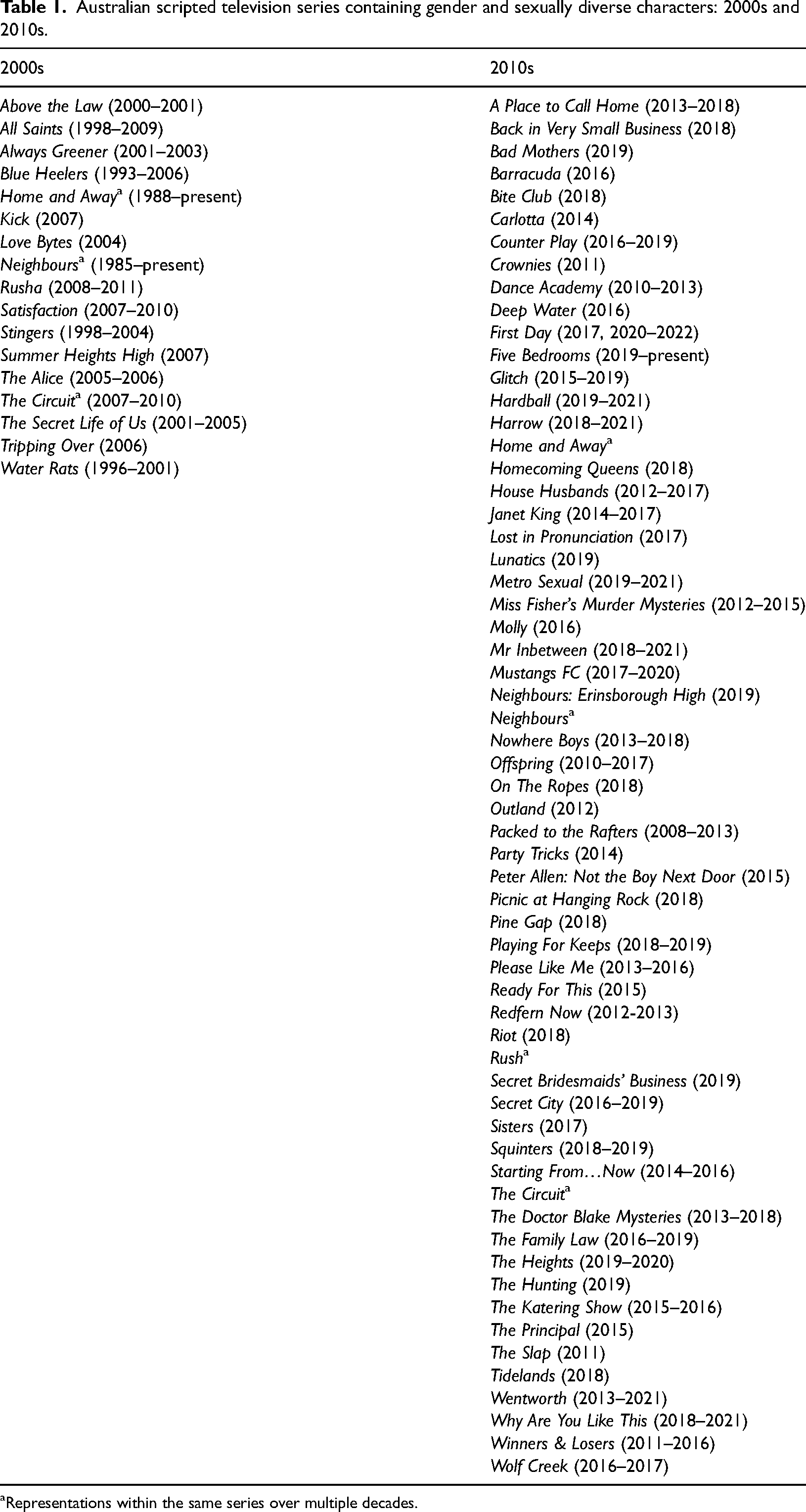
Representations within the same series over multiple decades.
Gender and sexually diverse representation on Australian television in the 2000s–2010s grouped by the duration of the story.
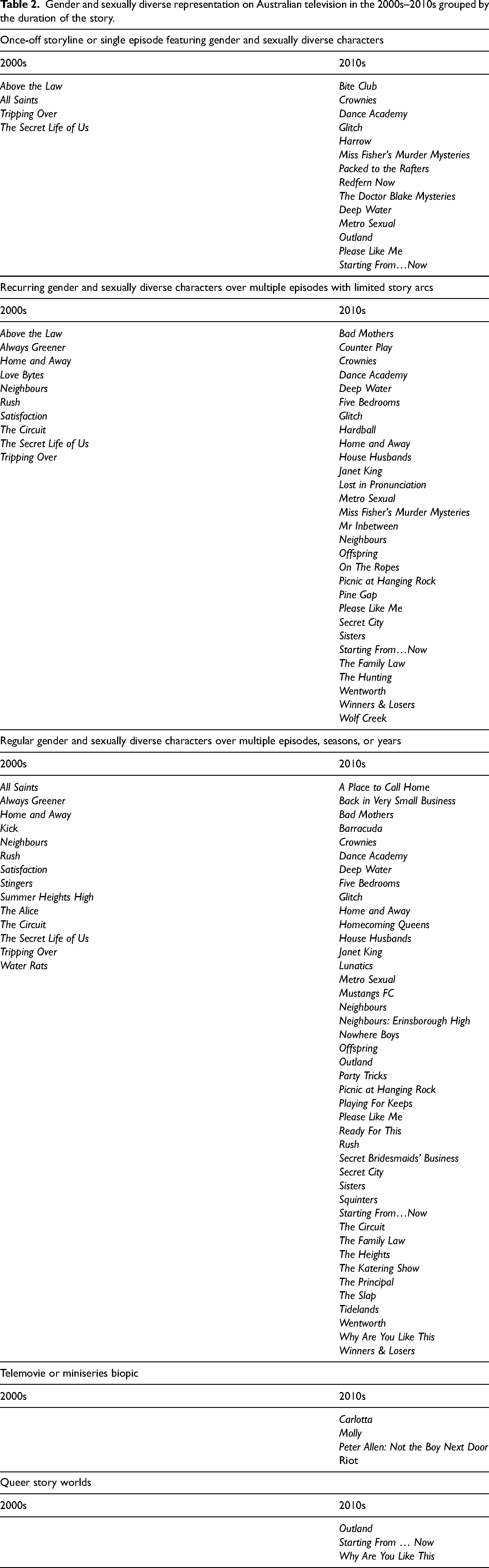
We understand the inclusion of gender and sexually diverse characters across categories as the beginning of a vital movement away from representing isolated once-off queer characters toward representing robust and diverse queer communities. In Screen Australia's reporting, almost half of the identified main characters (between 2016 and 2021) were the only gender and sexually diverse characters in the series (Screen Australia, 2023: 47), but this is a clear improvement on the limited inclusion of gender and sexually diverse characters in previous decades (see Beirne, 2009; Howes, 1998; Monaghan, 2020).
Connected to this are two further trends that advance the complexity and depth of Australian queer screen storytelling. The first of these is the queer television biopic (feature-length or mini-series) focusing on the lives of notable gender and sexually diverse Australians (these are Molly, Carlotta, Peter Allen: Not the Boy Next Door, and Riot). In these examples, we see gay men and trans women centralised and queerness celebrated within Australian culture. The second trend is the depiction of queer storyworlds. Outland is the first Australian series to feature all characters as gay and lesbian. It rejects ‘gayngst’ narratives focusing on an ensemble of already out, sci-fi-obsessed gay men, and one lesbian. It was created with the specific goal of it not being a coming-out story and is notable for being broadcast on the ABC's main channel, ABC1. Co-creator Adam Richard said as much in press interviews during its release ‘Yes, all the characters are gay but that's not the issue, it's the embarrassment they feel around science fiction’ (Adam Richard quoted by Atkinson, 2012). Comparatively, Starting From … Now constructs a distinctly lesbian story world. It centres on a group of lesbian and bisexual women living in the inner suburbs of Sydney. The characters deal with life challenges beyond their sexuality, though the series focuses heavily on relationship drama, sex, and identity. Unlike Outland, Starting From … Now was not developed for television, but as a web series that proved an audience (Monaghan, 2017). It's fourth and fifth seasons were broadcast on SBS, but its episodes were considerably shorter than a traditional television series (8–12 min each). As gender and sexually diverse people became more prominent in public debates, some series began to reflect more on the community and connection to aspects of queer life. Queer story worlds, however, stand as an exception, as they emerge from specifically queer creators actively pushing the boundaries of what stories appear in Australian scripted television.
Conclusion: Looking forward to the next decade
Through this article, we have traced significant developments in the number of representations and variety of narratives for gender and sexually diverse characters in Australian scripted television. Across all identity categories, we have noted more appearances, longer, and more complex narratives when compared with previous decades. However, there is no clear line of progress to be drawn here. Though we are beginning to see the representation of robust queer communities onscreen, Australian television remains quite conservative when it comes to representing diverse genders and sexualities. Australian television represents diverse sexualities more frequently than gender diversity, with limited intersection between queer sexualities and gender identities. Additionally, though we are seeing more representations of cisgender gay men and lesbian women and more nuance to these representations, bisexuality remains relatively invisible or unnamed. Finally, we continue to see double standards around the representation of sex for heterosexual and queer characters.
Despite this, we do feel hopeful about the next decade of gender and sexually diverse representation on Australian television. We have already seen further developments in the first years of the 2020s, with series such as First Day, The Newsreader (2021–present), Five Bedrooms, and Iggy & Ace (2021) depicting vibrant gender and sexually diverse characters. While we are unable to present a detailed analysis of these here, we do note that transgender men and non-binary characters have already matched the two decades of representation we have mapped. It is clear that ongoing research into LGBTIQ+ inclusion on Australian television is necessary as new norms of representation become established through the next decade.
We reference and draw thematic links to social, political, and industrial change through the decades, and recognise that further research is needed to understand how these influence gender and sexually diverse stories in a production context. Further research is also needed to extend the analysis we have presented here and enable a deeper understanding of each series. These future avenues for research are particularly important given the breadth of series that we have catalogued and important industry shifts toward actor-character aligned casting and short-form digital formats that have shaped contemporary Australian queer television and that are not adequately highlighted in industry data. Finally, we hope this scholarship provides foundations for future studies through an intersectional lens that would further unpack the complexities of LGBTIQ+ identities on Australian screens in relation to race, class, ability, age, and location.
Footnotes
Declaration of conflicting interests
The author(s) declared no potential conflicts of interest with respect to the research, authorship, and/or publication of this article.
Funding
The author(s) received no financial support for the research, authorship, and/or publication of this article.

Notes
Correction (April 2024):
Article updated to insert Damien John O'Meara's ORCID id and few textual corrections.