



Abstract
Proliferating media content is key to public understanding and discussions about the environment and climate change. While scholarly interest in mediated environmental communication has been ample and multi-directional, the questions around media's impacts remain pressing and largely under-theorised. This paper uses an example of popular environmental media in Australia – i.e. media aimed at attracting wide audiences – to discuss how impact is perceived and pursued in the distinctive Australian context, and what can be inferred from this study about environmental media and its impact more generally. Drawing on 28 interviews with media-makers and practitioners, conducted between 2022 and 2023, we catalogue common creative/narratives strategies used to engage audiences, noting a diversity of views and approaches for creating and measuring impact. The paper contributes to theoretical debates on media impact and encourages active academic research-media industry collaborations as part of initiatives aimed at meeting the challenges of climate change.
Introduction
This article investigates how ‘environmental media’ is produced at the current juncture in Australia – marked by the shifting political and media landscapes – and how its impacts are conceptualised and pursued in practice by media-makers and practitioners. For our purposes, we define ‘environmental media’ as a diverse group of media oriented towards telling – and inspiring through – environmental stories that are underpinned by credible knowledge about the environment, natural world climate and energy efficiency. They pertain to ‘popular media’, intending to engage wide audiences (Seelig, 2019: 46; see also Smith, 2017) – and are different from ‘alternative media’ produced to express ‘resistance to social and corporate power structures’ (Atkinson and Dougherty, 2006: 64) or ‘activist media’ specialising exclusively in environmental advocacy, for example, by environmental organisations (e.g. Greenpeace) or as part of activists’ own media publicity (e.g. Greta Thunberg) (DeLuca, 2009; Haugseth and Smeplass, 2023, respectively) and associated with niche audiences. Environmental media discussed here share the commitment towards the making of ‘popular’ environmental content/stories rather than institutional affiliation or genre; they span reality and lifestyle TV shows, documentaries, YouTube or TikTok videos on a range of environmental/sustainability subjects and include a diverse group of media-makers and practitioners.
In approaching environmental media inclusively, we follow the framing that refers to ‘a broad landscape of media forms and practices’ ( The Journal of Environmental Media ) as applicable in the Australian context. We also build on international media research, particularly Seelig's ‘cross-section’ approach that addresses environmental screen media in its diversity (Seelig, 2019: 47; also Smith, 2017), or Robe's (2015: 94) findings about the possible ‘convergence’ of environmental and entertainment/commercial agendas in environmental media-making. The case for inclusivity has been also made by Dudo et al. (2017: 1), who argue that ‘improving the breadth and depth of research in this [environmental media] area (…) can stem from more robust theorising, analyses that focus on a more diverse menu of entertainment media and the interactions among them, and increasingly complex analytical efforts to capture long-term effects’.
The issue of ‘effects’ – or what we prefer to canvas as ‘the multidimensionality of impact’ involving different goals and outcomes (Nash and Corner, 2016: 230) – is complex and understudied. Seelig (2019: 46) points out, for example, that ‘limited research has examined popular media's role in shaping society's understanding for environmental issues in [the] new production culture’. Media practitioners, for their part, are concerned that the climate and biodiversity crisis are not being adequately addressed through current environmental media operations (e.g. Aitchison et al., 2021), and that artistic and narrative decisions to make environmental media impactful are poorly understood (Jones et al., 2019). Consequently, there are calls to robustly monitor, evaluate and enhance real-world impacts of environmental media through co-creation of impact evaluation and subsequent interventions (Aitchison et al., 2021; Jones et al., 2019).
This article addresses the vexed questions of environmental media's impacts through the case of Australian environmental media practices. Drawing on the analysis of perspectives and strategies for creating engagement and impact shared with us by media practitioners, we demonstrate multifold ways in which impact is conceptualised, articulated and pursued in practice. The article catalogues a set of strategies for impact and encourages further productive exchanges between academics and media-makers (see also Aitchison et al., 2021). Theoretically, it contributes to scholarly discussions about media impact as ‘multidimensional’ (Nash and Corner, 2016) and culturally grounded, offering some instructive, internationally relevant findings from the emergent environmental media in Australia.
Scholarly contexts: Productive media
The topic of media's impact and influence has a long history in the scholarship. Many strands of the literature have addressed the role of media, from television and social media (e.g. Spartz et al., 2017), in audiences’ perceptions of the reality (including environmental) and behaviours through the theories of ‘media effects’ (Klinger and Metag, 2021), ‘cultivation’ or ‘persuasive communication’ (Holbert and Tchernev, 2012). In the 70s, the Entertainment Education research unit was established at the Annaberg School, charged with examining impacts of entertainment media (Blakley in Friesen, 2016: 162). Since then, much research has addressed the value of ‘edutainment’, i.e. the media content that combines elements of education and entertainment (Seelig, 2019). In the area of environmental media, for example, research has suggested a connection between watching entertainment education radio dramas and the increased support for ape conservation, resulting from changed human behaviour and social norms (Barker et al., 2018). Cultivation, agenda-setting theories (Shanahan et al., 2022) and various persuasive/strategic and non-persuasive communication approaches have also been influential in environmental/climate change communication. Deployed for different target audiences and contexts, and accompanied by different evaluation methods (Holmes and Hall, 2019), research uncovered indirect links between a perceived entertainment value of videos and cognitive engagement associated with climate change (Topp et al., 2019).
Further, there is a substantial body of literature focused on understanding media's contributions for positive social change. It has ranged from a rich theoretisation of critical media and communication studies for understanding ‘broader societal issues’ and power structures (Fuchs, 2011: 86), through to conceptualisations of ‘media activism’ or ‘social justice media’ in the digital arena (Jansen et al., 2011), as well as analyses of media segments deliberately aimed at addressing environmental issues, for example, as part of ‘alternative media’ (Foxwell-Norton, 2015) or ‘media for social innovation' (Podkalicka and Rennie, 2018). Concerns over environmental sustainability and climate change have motivated much research in this vein, linking the power of media to community belonging, resilience and survival (Rincón and Rodríguez, 2015).
The community-centred literature connects to the scholarship that positions media as key to citizenship, cultivated through a diversity of representations (or ‘voices’) as the matter of ‘recognition and agency’ (Murphy, 2015: 102) or civic ‘participatory action’ in the public sphere (Nash and Corner, 2016: 239). Concerning ‘green citizenship’, it extends to responsibility for global ecological futures (Lewis, 2012; also Spellerberg et al., 2006), which, in the words by Maxwell and Miller (2009: 20) means: Bypassing contemporary needs to enter the sphere of historic and future obligations, [green citizenship] transcends conventional political-economic space, extending rights beyond the hic et nunc in search of a globally sustainable ecology. [It] looks centuries ahead, refusing to discount the health and value of future generations as it opposes elemental risks created by capitalist growth in the present (Dobson 2003). the current discourse about sustainability and changing environmental conditions is not taking place in a vacuum. It is already spun into a web of meaning, the problem gets translated into a story with all its required elements: heroes, villains, victims, an object of struggle, a beginning, middle, end, and morale of the narrative (2018: 2).
Additionally, media research has paid attention to the thorny issues of the instrumentality of impact measurement that gestures at the neo-liberal or marketing nomenclature and approaches applied to media (Nash and Corner, 2016: 228) and cultural/arts outputs more broadly (Gattenhof et al., 2021). The analysis of ‘strategic impact documentaries’, for example, explores a ‘parallel industry’ of documentary-making, ‘with its own methods of production and distribution and its own organisational ecology’, represented by various commercial and not-for-profit companies supporting social change media – and an associated bundle of (cross-media) strategic communications and campaigns, involving the formalised role of ‘impact producers’ (Nash and Corner, 228; 231; see also Balfour, 2020). It emphasises the professionalisation and industrial factors underpinning the emergence of this sector, driven by reduced funding, which requires documentary makers to seek sponsorship and funding alternatives and demonstrate concrete/measured outcomes (Nash and Corner, 2016: 228). Usefully, Nash and Corner (2016: 230) define the ‘multidimensionality of impact’ as change that can occur for ‘different change targets (from individuals, to organisations, to social and political structures) and the different change goals (from awareness to attitude, behaviour and structural/policy change)’, which we take up in our discussion.
Finally, novel contribution to understanding impact comes from the field of ecocriticism. Its proponents insist that environmentally oriented texts including literature, films, and other media obtain social, cultural, and political importance – and that empirical ecocriticism, that conjoins ecocritical textual analysis with social science methods, can test ‘reliable claims about the social, psychological, and political impact of environmentally engaged narratives on their audiences’ (Schneider-Mayerson et al., 2020: 333). Elsewhere, Schneider-Mayerson et al. (2023: 1) foreground the media's centrality in communicating ‘stories’ of climate crisis (see also Cottle, 2009) and the necessity to understand their specificities and impact: Most environmentally engaged scholars, thinkers, and activists agree that to respond to the existential challenges we currently face, we need new narratives about who we are, how we’re entangled with the rest of the natural world, and how we might think, feel, and act to preserve a stable biosphere and a livable future with as much justice as possible. But what kinds of stories should we tell? To which audiences? Through what media? Are some stories more impactful than others? Are some counterproductive? (Schneider-Mayerson et al., 2023: 1).
Australian context
We locate our study in a distinctly Australian geographic and socio-cultural context, known for enduring recurrent natural disasters such as cyclones, bushfires and floods, and, over the last decades, political manoeuvring around climate policy and action (Chubb, 2014). The ‘Black Summer’ bushfires of 2019–2020, followed by the catastrophic floods in 2022, brought home to the mainstream Australians the centrality and immediacy of the climate crisis (Biddle et al., 2020; Quickie, 2021). Climate issues were a focal point for Australia's 2022 federal election which saw a change of governing party as well as the ascendance of ‘Teal’ independent politicians (named so for the colour of their campaign materials) who campaigned for ambitious emissions reductions and received funding from a crowdfunding organisation ‘Climate 200’ (Tana, 2022). Recent years have also seen a growing public recognition of the value of Indigenous knowledge and practices for conservation and environment management efforts (e.g. The First Nation's cultural burning practices, Steffensen, 2020). These cultural shifts are occurring amidst the politicised debate over the place of indigenous affairs in the federal and state politics, culminating with the 2023 Indigenous Voice to the Parliament referendum on the inclusion in the Constitution of an advisory body to represent Aboriginal and Torres Strait Islanders’ affairs. 1 The collective, social consciousness about climate change and the Indigenous voice were cited in our interviews as an important background and consideration for Australian environmental media.
Methods
We conducted semi-structured expert interviews (n = 28) with media practitioners engaged in making environmental content in Australia (see Table 1), recruited through our professional networks and publicly available information. The interviews ranged from 30 to 60 min in length and were conducted mostly via video conferencing.
The interviewees represented a range of professional experiences across commercial, public, user-generated media and impact campaigns. Many traversed sectoral boundaries, navigating available funding, career opportunities, expediencies, and genres and formats of media-making, which bears out the general findings about contemporary media industries (and creative work) as characterised by diversity and mobility – internationally and locally. Drawing on her experiences in the Canadian media, Tracey Friesen (2016: 5), for example, refers to ‘portfolio’ and ‘hybrid’ careers. In Australia, too, the precarity of creative work has been widely acknowledged, with most creative workers found experiencing ‘multiple career pathways, and [being] less likely than in the past to be employed and trained through large, often public sector, agencies’ (Hearn et al., 2014: 7). An economist, Jim Stanford, notes, recently, that only ‘60% of total employment in the broader IMT [Information, Media, Telecommunications] sector reflects a traditional “standard” employment relationship: permanent full-time waged work with normal entitlements’, and estimates that one-third of media workers hold part-time jobs.
Further, the international media literature notes a multiplicity and convergence between different media formats, including the transformative role of multiple broadcast channels on media-making (Brereton, 2018; Dudo et al., 2017; Kääpä and Vaughan, 2022; Takahashi et al., 2022; Seelig, 2019; Shriver-Rice and Vaughan, 2020). The Australian experience of media work appears similar, whereby ‘the blurring lines between different models of media production and dissemination, combined with the growing cross-ownership of multiple platforms by diversified media interests’ mean that media practitioners are increasingly required to ‘simultaneously develop content for multiple modes of distribution’ (Stanford, 2021: 23–4).
Our cohort of the media practitioners makes such ‘big picture’ overviews tangible in a concrete sense; it underscores the aforementioned diversity and changeability, while defying clear categorisation of media work. We interviewed media practitioners who, during their careers, have created film and television content for commercial stations and public broadcasters. Several interviewees are well-established filmmakers and producers, some of whom have actively supported the development of production companies and initiatives geared towards funding socially engaged film-making, including environmental stories, while continuing to produce non-environmental content. Some have performed various media roles for many years, including commissioning, promoting or contributing to creative development in TV and cinema, and across fictional and factual content. Others have begun making environmental content more recently; a few solely for social media platforms (e.g. podcasts, YouTube or TikTok videos) but don’t rule out working for a commercial media, for example. A couple have pivoted into media on the back of their qualifications in energy efficiency as expert advisors. This diversity and non-linear pathways result in cross-pollination of ideas, experiences and approaches to impact. We have maintained the anonymity of the interviewees for parity and consistency.
List of diverse subject matter and genres/formats covered by our sample.
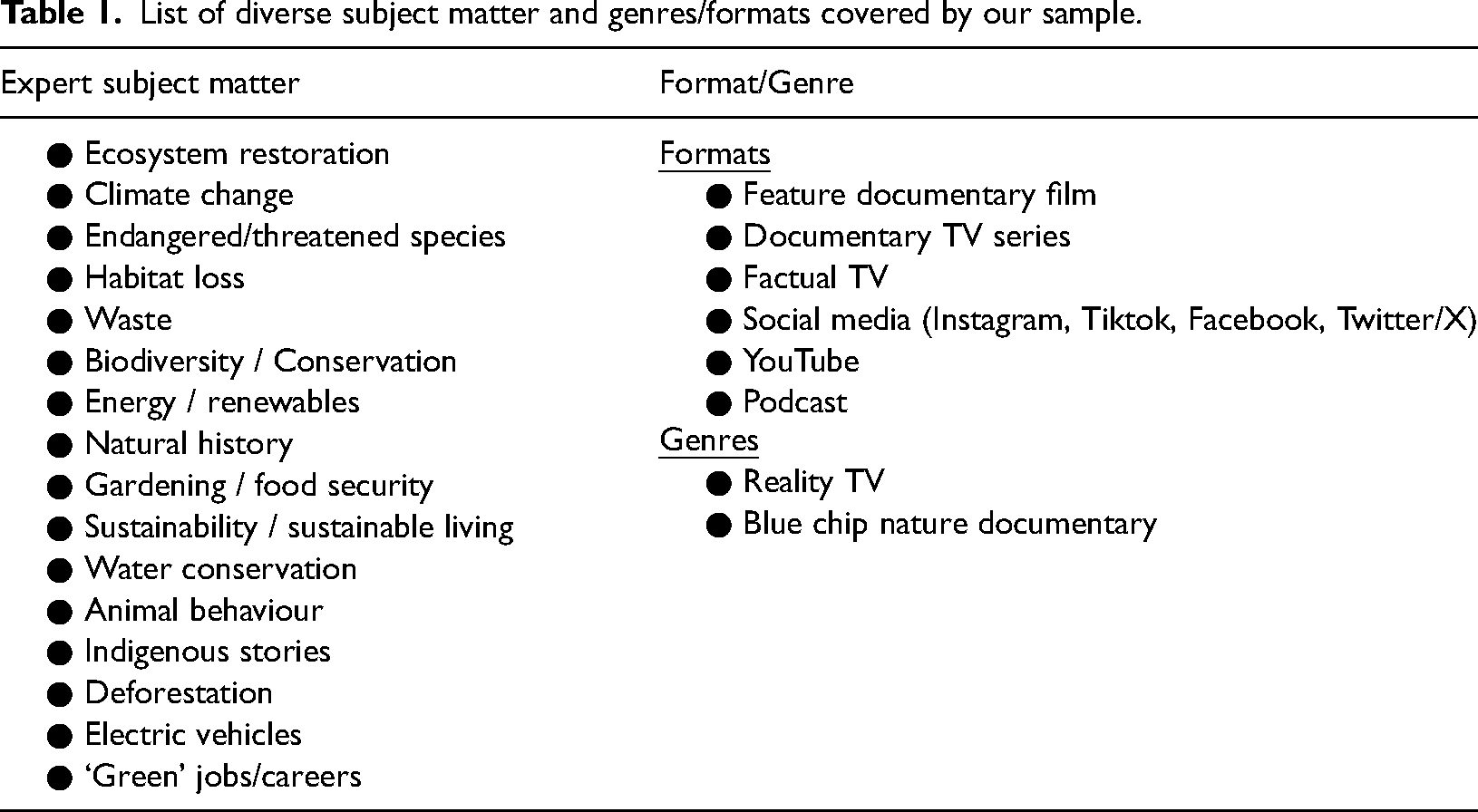
The interviews aimed to understand how media-makers produce environmental content and conceive of its impacts. Our data was coded using a mix of themes from the literature review and the data itself. We organise our findings along the four salient – and interconnected – creative/narrative strategies that show how environmental media is made in Australia, and further how ‘impact’ and its integration in media practice were discussed.
Findings
The idea that for the media to be impactful, the story must be well-conceived and engaging (Napoli in Nash and Corner 2016) was strongly present in our material. Four key strategies can be discerned as (a) communicating hope and solution, (b) communicating via ‘subtext’ and respecting the audience, (c) (re)connecting humans with nature, and (d) including and supporting a diversity of voices – and are largely consistent with the environmental media scholarship (e.g. Smith, 2017; Abbati, 2019; Seelig, 2019; Aitchison et al., 2021) and practical guidelines. In the US, for example, the work at Rare synthesises the principles for ‘effective and inviting climate communication’ as making it ‘personal; accessible; empowering; doable; collective; normal; trustworthy; and for everyone’ (Rakhimov et al., n.d.; see also Wackerly, 2022). We discuss how the identified strategies are meaningful in the Australian context, before exploring prevalent perspectives and approaches to impact, and their implications.
Communicating hope and solution
The interviewees frequently addressed the importance of focusing on optimism and solutions in storytelling by presenting what can be achieved and positive developments that are already occurring, rather than conveying cultural messages of ‘gloom and doom’. Many considered the climate crisis as a central global challenge faced by humanity and recognised the presence of ‘enough’ collective anxiety to justify the need to develop and spread narratives of ‘hope’ and ‘celebration’. Such variously termed ‘stories of hope’ or ‘hopeful stories’, told through character-driven narratives, involve communicating the extant ‘meaningful’ work, specific community-and environment-benefiting grassroots projects and initiatives, and practical ideas and tips that can be embedded in people’ everyday lives.
Narratives of hope were framed as useful for developing a sense of collective possibility, agency and a better environmental future amongst audiences. Their meaning, in the Australian context, must be interpreted against the backdrop of ongoing conservation initiatives such as protecting native forests or the health of the Great Barrier Reef – and alongside the recent environmental disasters (e.g. bushfires and floods). To take an example of native forest protection, the insight was to avoid focusing on devastation, and instead craft a positive and optimistic story centred around taking action rather than compounding despair. The films that focused on ‘doom and gloom’, while possibly ‘successful’ in media terms (e.g. winning awards), were considered as ill-suited for engaging wide audiences, and risking, as noted, alienating climate skeptics who are likely to ‘tune out’, for example when presented with the conventional pictures of ‘polar bears struggling on ice’ or, closer to home, ‘bushfires’. Instead, hopeful and inspirational stories were identified as a fertile ground for strengthening a collective momentum for positive change, including into the future, as explained by one interviewee here: We don't want to be blind to reality, but we want to see and latch onto these more aspirational avenues that we need to move towards as a species. And we need tangible examples of where that's happening.
The onus placed on concrete – and realistic – solutions that are ‘easy to get one's head around’ rather than political or ideological discussions speaks to broader media practice developments, not merely those focused on environmental content, and associated, for example, with ‘solutions-based’ or constructive journalism (ABC News Channel, 2023; McIntyre, 2019). While the discussion of these developments is outside of the scope of this paper, it is important to point out that existing environmental media and environmental communication literature attests to the presence of ‘hope’ narratives, including alongside a binaristic counterpart of ‘doom and gloom’ narratives, which help shape broader environmental communication and media discourses. However, there appears to be no consensus over which of these approaches might ultimately prove most effective (Ettinger et al., 2021).
Communicating via ‘subtext’ and respecting the audience
A recurrent theme in the interviews was creating a mode of address that both respected and harnessed audiences’ diverse values and lived experiences of the environment and sustainability. This strategy, as above, derives from the understanding that people face multiple daily challenges and so it is important not to compound their experiences by the content that is too ‘depressing’ – or ‘judgmental’. Informing and inspiring audiences (using scientific research and accurate facts) was seen as important but different from telling people they are in the wrong. It was closely related to the idea of not ‘preaching to the converted’ – that is audiences who are already well-aware of the climate crisis and its consequences. Instead, the interviewees insisted on connecting with mainstream audiences, through the content that is accessible and has entertainment value. They addressed the potential of incorporating environmental messages within existing popular TV programs (see also Smith, 2017; Seelig, 2019) such as Masterchef (cooking show), The Block (renovation show) or Bondi Vet (pet show) to leverage their audience base and popularise, for example, how to minimise consumer waste, increase home energy efficiency or highlight how heat waves will impact pets, respectively. The nightly news with a regular segment on the amount of carbon released into the atmosphere daily was another example of normalising the everyday conversation about climate change impacts. In addition, the goal is to explore new ways of creating engaging narratives that ‘feel like they’re fresh and new and original’, which can be achieved through including new (and relatable) talent, new music, new ways of editing stories, and so on. An environmental message should be communicated in a simple, approachable and ‘non-confrontational’ way – but without dumbing it down or making it ‘preachy’ or didactic. The statements frequently used included not ‘hammering the [environmental] point’ – or ‘beating on’ things too much.
There seemed to be differences in the degree to which the ideas of impact through storytelling were foregrounded, depending on the interviewees’ background and experiences. To many, especially those formally trained media practitioners, an environmental message was considered as secondary to the overarching goal of engaging the audience through compelling stories, that are character-driven and emotion-arousing, and utilise the classic plot-driving ‘hero's journey’ and the story arc of ‘hope, failure, redemption’. Here, the interviewees referred to communicating via ‘subtext’ and used an array of metaphors such as ‘the wolf in sheep's clothing’ or ‘the Trojan horse’ to describe the storytelling approach that gives primacy to an engaging narrative over an overtly ‘green’ messaging (see also Seelig, 2019). For the practitioners who did not come from a traditional media/film background, creating an environmental impact was often the main priority – whilst recognising that the content needs to be engaging to achieve the desired impact.
(Re)connecting humans with nature
The theme of (re)-connecting audiences to the landscape and natural environment – and the significance of emotions – came up frequently. One interviewee referred to emotion as the ‘currency’ for media-making/storytelling; another spoke of ‘emotional values-based messaging’ which was seen as more effective than storytelling based on facts. Emotion-arousing and immersive experiences can lead to ‘deeper connection and appreciation of the ecosystem’, while emotional affect was considered a positive and correlated with encouraging viewers to act. The focus on emotions in the interviews corroborates, in general, the academic writing that espouses the power of emotions in engaging and sustaining audiences. Nash and Corner observe: Emotions as much as, and sometimes more than, knowledge feed into social subjectivity and the ‘social imaginary’, becoming the generators of a collective orientation’ (2016: 236).
The remarks about emotional aspects co-existed alongside references to environmental media made at different locations, while also drawing attention to the distinctive geographical location of Australia, and therefore the relevance of place-specific environmental/conservationist topics such as ‘ocean’, given that, as one interviewee put it, ‘the ocean connects everybody because every state is surrounded’ and the vast majority of Australians live along the coast. The focus on place (or place-making) came up prominently, captured by the reported intent to ‘show people's connections with [the] landscape’, or focusing on ‘the junction of humanity and nature’. While relatable everyday human-focused stories were viewed as key to engaging audiences (see above), ‘the world’, ‘the landscape’, ‘nature’ surfaced frequently, and were posited, in a narrative sense, as a worthy, significant ‘protagonist’ in environmental stories. Statements about ‘giving place a voice’, ‘being in an environment’, or ‘featuring landscape as its own character’, achieved in practice through various audio-visual, immersive or spatial techniques, were often mentioned. Here the interviews canvassed the role that media-makers’ own perspectives and lived experiences play in the place-specific media-making, anchored in socio-cultural backgrounds (e.g. migrant, rural/farming settings), and adopted philosophies and lifestyles, from striving to live sustainably in major cities or regional towns.
Including and supporting a diversity of voices
Relatedly, the ‘inclusivity’ theme was salient. Some interviewees spoke of the importance of including marginalised voices, especially by young and First Nations people, to reflect the diversity of views and lived experiences of the changing environment. Others talked about an acutely felt sense of responsibility, as media-makers, towards communities that are experiencing environmental issues. There was also a recurrent mention of leveraging digital media for inclusive representation and harnessing the power of people to build communities and generate impact. Amongst mentioned examples was an initiative by the Australian public service media, the ABC, encouraging stories from audience members; or a valued ability to have specific topics suggested by social media audiences.
Generating a sense of community through promoting examples of ‘good behaviour’ and social norms was seen as another way towards impact. At the content level, this was reported to be achieved by depicting existing changes and developments so that audiences ‘want to follow suit’, demonstrating alternatives to mainstream conspicuous consumerism, as well as the specific steps for introducing those changes in daily practice – for example, concerning ethical/environmentally friendly consumer products. Building and showcasing ‘community’ was predicated on the understanding that audiences should feel they are part of ‘movement’ and are able to have effect because others were taking action also. An extension of this, was the notion of meeting audiences where they are currently at and assisting them on the journey to becoming more environmentally friendly, without ignoring structural impediments that may exist.
Notable was the attention brought to First Nations as traditional custodians with deep-reaching cultural connection to the place/country. Several interviewees spoke about the importance of including First Nations people's perspectives on environmental issues and training First Nations people in media production so they can tell their own stories. More inclusive, empowering and ‘communal’ approaches to storytelling were considered key to an adequate conversation about the environment and fostering positive socio-political changes in Australia more broadly. However, none of our interviewees identified as Indigenous Australian. Although responsibility for participant recruitment lies with researchers, the lack of representation of indigenous media practitioners in our sample may speak to broader characteristics of Australian media industries. A 2022 Media Diversity Australia industry report concludes, for example, that ‘there is limited representation of Indigeneity and cultural diversity in the workforce and leadership suite’ (Groutsis et al., 2022: 46) and identifies a perception that ‘Indigenous and culturally diverse people experienced additional barriers to career access and progression, with women most likely to perceive amplified career obstacles’ (26). In the Australian context, then, inclusion of Indigenous environmental knowledge and Indigenous perspectives on environmental issues in popular environmental media remains an unresolved, though prospective, issue.
Impact
Compared to the outlined creative/narrative strategies, direct conceptions and articulations of impact – what it means, how it can be achieved and measured – were varied, ranging from the ideas about the forms of storytelling for audience engagement (as above) through to building partnerships. Based on the practitioners’ accounts, we suggest that environmental media-making in Australia, currently, represents variability in the way impact is conceptualised, and attempted – the latter displaying an extent of informality and flexibility. Several interviewees acknowledged the emergence of professional ‘impact production’ in Australia, noting leaders in the area such as the not-for-profit organisation Documentary Australia that, during this research launched an ‘Environmental Accelerator’ program, designed to help 8–10 films ‘reach new audiences and create lasting social impact’ over 3 years. Some interviewees admitted to utilising expertise or specialised impact programs/toolkits from overseas, and many practitioners shared informal experiences, lessons and strategies they draw on to make environmental stories impactful.
One such strategy is building diverse production teams and professional networks. Here the interviewees reflected on the importance of a diversity of viewpoints and experiences represented by the creative team, cohering around shared values and approaches to media-making, especially around the desire to make a difference. Commonly discussed also was the value of collaboration and partnerships, emerging through both planned and informal arrangements (see Nash and Corner, 2016 on ‘strategic relationship building’). Partnering with NGOs associated with environmental content and leveraging the network of organisations, celebrities or cultural figures to reach a broader audience was frequently cited. The interviewees also mentioned collaborations and utilising the resources of project partners as an alternative to collecting data and measuring impact.
Existing literature notes that media-makers, working in social change/social justice, while ‘interested in understanding their impact’, tend to approach it with an ‘understandable caution’, and that impact production and measurement is ‘a controversial and evolving field’ (Shome in Friesen, 2016: 156; Nash and Corner, 2016: 237). In our research, the interest in understanding impact was clear, but conceptions, practices and techniques of impact measurement were diverse – partly traceable to professional or generational differences within the media industry, and further to media affordances, whereby certain media types lend themselves better than others to communicating and creating impact in a particular way.
Across our diverse sample, impact measurement was not often undertaken in an extensive, systematic or formalised way. Reasons given included not having adequate time or resources – especially financial, training and skills. Other mentioned constraints to impact measurement included the content being commissioned and produced for clients. While impact measurement was generally seen as useful, a couple of the interviewees were unapologetically unsympathetic to the discourse of ‘impact’, and particularly impact measurement, which they viewed as adding an extra burden to their already busy workload. Impact was nonetheless pursued in project-specific and contingent ways (see above), highlighting also the value of professional experience, and capacity and willingness to adapt. One interviewee, for example, took on the role of an impact producer while learning on the job; another observed that media-makers may be doing ‘impact production’ work without likely realising it, because such work is ultimately reliant on a collection of skills and expertise that those with diverse professional backgrounds could step into.
For tracking impact, social media analytics (i.e. number of views, likes, etc.) were the most common metric mentioned, recognised for their relatively easy accessibility. However, there was an understanding that ‘views don’t equal impact’; and some queried such metrics’ reliability. Qualitative data was also identified as a method of obtaining audience feedback, with the caveat about its limited generalisability, because small sample sizes aren’t representative of the broader population. Formal techniques of measuring impact, such as evaluation surveys or focus groups that are designed and implemented to target representative samples, were mentioned less commonly, with the exception of media projects that partnered with research institutions or had designated funding for impact producers. Many practitioners drew on reviews of social media comments, email feedback/testimonials or observations of people's reactions or discussions at screenings. The reliance on tacit understanding was mentioned too, expressed as ‘having a feeling’ of how environmental content is resonating with audiences.
Crucially, the interviewees recognised the challenges in measuring the impact that content may have on audiences and beyond, arguing that less tangible functions of media such as shaping cultural values are not easily documented or quantifiable (see also Arnold, 2018; Friesen, 2016: 156; 178). This is reportedly exacerbated by the volume of co-present diverse messaging in the environmental mediasphere, including ‘the rapidly growing creation and consumption of climate change video content online’ (Ettinger et al., 2021: 1), making it, in general, difficult for one media production to ‘take credit for change’ or a specific (pro-climate action) election result. Insightfully, when discussing impact, the interviewees acknowledged the perennial tension between intrinsic, cultural value of the arts – with media outputs an important part of it – and more instrumental, social/developmental agenda that arts/media are required to fulfil (Gattenhof et al., 2021).
Discussion
Our analysis of environmental media in Australia has the following implications. Theoretically, we further the conception of media's impact as ‘multidimensional’ (Nash and Corner, 2016: 230), but stemming from culturally situated media practices that draw on and extend beyond formal skills and specialist impact evaluations or strategic campaigns. The ‘multidimensionality of impact’ is grounded in our empirical material. While the language of ‘behaviour change’ (Shove, 2010 for critique) was present in the interviews (especially discussing intended impact), frequently noted was a cumulative and ‘multilayered’ contribution of environmental media to the public discourse – to ‘the cultural, national story’ – alongside the statements about ‘the actual social and environmental impact outcomes’. The interviewees invoked the value of ‘sparking a conversation’, or bringing different generations of people together, rather than pitching the young against the old, which, in one instance, was suggested to be a typical approach in climate stories. There was a motivation to capture the context-specific ‘zeitgeist’, signifying the unfolding socio-cultural changes in public consciousness about sustainability or climate change, and political trends such as the Voice for the First Nations People in Australia. This broad socio-cultural framing means focusing on the sometimes inconveniently elusive aspects of creativity and storytelling – in line with Arnold's remarks: A purely instrumental in-order-to-approach won’t reveal the cultural process of civil discourse, because it is too strongly focused on providing recipes for communication handbooks (Arnold, 2018: 3).
Another implication of the encompassing notion of impact corresponds to relations within the media industry – often invoked, in the literature, by the concepts of ‘media ecology’, ‘the narrative economy’ (Arnold, 2018: 126) or ‘the interplay between meaningful and entertaining content (…) for mediating environmental issues’ (Seelig, 2019: 47; 72–73). This is further made clear in the practice-oriented Story Money Impact publication, which notes the ‘untapped’ potential to ‘understand how each of the projects fits into the larger conversation’, therefore accounting for – and benefitting – from their collective and cumulative impact over time, rather than focusing on ‘a single media project’ (In Friesen, 2016: 156–9; also Nash and Corner, 2016). Our interviewees similarly recognised the contribution of various media – including by activist and popular/entertainment environmental media in Australia; while, as media-makers, they themselves represent a range of personal networks and attachments to various environmental concerns, communities, and projects. There is another aspect to environmental media work and ‘scalability’, whereby practitioners who do not come from a traditional/formal media background get involved in environmental media-making, taking advantage of relative accessibility of digital media, to create impact.
Environmental media also includes media products that may not label themselves overtly as ‘environmental’ or ‘green’ but can be driven by environmental aims, values or contain environmental messages. They too can be influential. One interviewee, for example, commented on a popular lifestyle TV series and its season-long commitment to sustainability as impactful on promoting, among audiences, the concrete ideas of residential energy efficiency but also on a broader media industry, through example-setting and partnership-building. The show itself, however, would not self-describe or be classed as ‘environmental’ formally, e.g. in the broadcaster's annual reports. Media practitioner and Director at albert in the UK, Carys Taylor, makes an analogous argument, when she observes that ‘it doesn’t have to be a David Attenborough film to have an impact’ (In Borchardt et al., 2023: 141; see also Garrett, 2020: 46–7). Taylor gives an example of the HBO's hit series Succession and how it popularised donations to the environmental organisation Greenpeace after the show included it in its storyline. These points underscore arguments in the literature on impact outside of media studies, namely the importance of learning from, ‘normalising’ and scaling effective innovative approaches designed for impact (Gabriel, 2014).
Finally, environmental stories are made within the media landscape that is complex and changing, characterised by technological and industry transformations. For example, while the democratising role of digital media in the production/dissemination of environmental content presents opportunities for building a momentum, as well as diversifying, extending and sustaining audience reach and impact (e.g. through the creation of transmedia content on websites or social media platforms), the pressing issues of polarisation or declining public trust in the media (Ziffer, 2023) require reflection and ongoing adaptations by environmental media-makers.
Conclusion
We have captured different types of popular environmental content, pertaining to different topics, genres, and a range of media practices informed by practitioners’ various professional (non-linear) trajectories coupled with different lived experiences. This diversity and dynamic complexity, as previous studies have argued, is characteristic of contemporary media industries, including in Australia. However, our study does not quantify or represent Australian environmental media as ‘a whole’; neither does it focus on its specific segment or institution/s (e.g. public service media or documentary production), which future research might undertake. Models for such work are available in Australia and internationally, although their methodologies and typologies can differ (see for example, Debrett on ABC in Australia, 2017; Spellerberg, Buchan and Early's study of free-to-air TV in NZ, 2006; Smith's study of the BBC in the UK, 2017). Equally, future studies can address important, and frequently mentioned in the interviews, (emergent) industry initiatives to curb material carbon footprint of the media in Australia and consider how these initiatives compare to international efforts.
Instead, we sought to offer an exploratory but empirically rich discussion of creative/narrative strategies used by Australian media practitioners involved in making environmental content today, and how they conceptualise and approach ‘impact’. Our analysis reveals also the general contours of the creative/media practice in transition, not least due to continuous media transformations but also socio-cultural and political changes that are shaping environmental storytelling. The study contributes to the literature on environmental media and its impacts by demonstrating some context-specific features of environmental media in Australia – especially a situated diversity of views, practices and strategies towards impact. Finally, the article advances the notion of ‘multidimensionality’ of media impacts and further strengthens the case for inclusive approaches to studies of (popular) environmental media. It advocates for collaborative research-media industry partnerships to facilitate the development of practical strategies to create, measure and evaluate impactful environmental media.
Footnotes
Acknowledgments
The research is based on the collaboration between the Monash University and CSIRO. The researchers would like to express gratitude to all media-makers and practitioners who have generously participated in the study and shared their valuable insights. An early draft of the paper was presented at the 2023 IAMCR conference – thank you to the session participants for their questions and comments; and to the anonymous reviewers for their useful feedback. Many thanks to Anthony Wright for his support of the project, and Claire Perkins, Tomi Winfree and Ramon Lobato for ongoing conversations about impactful media.
Declaration of conflicting interests
The authors declared no potential conflicts of interest with respect to the research, authorship, and/or publication of this article.
Funding
The authors disclosed receipt of the following financial support for the research, authorship, and/or publication of this article: This work was supported by the Commonwealth Scientific and Industrial Research Organisation (CSIRO) and Monash University.

Notes
Correction (February 2025):
Article updated to correct Takahashi et al. reference in displayed reference list.