



Abstract
Climate change is most acutely experienced at the local level so conversations and action must be locally relevant. Australia's community radio sector is uniquely positioned – both as hyperlocal media and a platform for diverse voices – to facilitate these conversations. Drawing on research conducted with 12 community radio stations, this article enlists Dreher and de Souza’s idea of community radio as community ‘listening posts’: spaces for communities to engage with external groups as well as those within. Community radio stations present opportunities for political leaders and policymakers to access community sentiment and experiences of climate change. The role of listening in community radio also speaks to the relationships between communicative justice and climate justice – the politics of who speaks and who is heard. The findings suggest that the Australian sector and its global contemporaries could embrace the role of listening with community radio to support community resilience to climate change.
Australia's weather is experienced as irregular patterns of wet and dry, of flourishing abundance and desperate lack, of fiery death and verdant rebirth. These patterns were baffling and dangerous to colonial invaders, yet the Traditional Custodians of the lands now known as Australia had and retain a deep connection to and understanding of these rhythms (Green et al., 2010). Yet the impacts of climate change throw this delicate balance into turmoil. From the terrifying and unprecedented ferocity of the Black Summer bushfires of 2019–2020 to levee- and record-breaking floods along the east coast in early 2022, the scale of climate impacts in Australia is rapidly increasing (IPCC, 2023). While climate change policies are made in the temperature-controlled halls of the capital cities, their impacts are lived by local communities.
Community radio is an important ally in climate change communication. A hyperlocal medium, community radio has a strong tradition of deep community connections and of sharing news and information that is relevant and important to local people (Forde et al., 2002, 2003; Forde, 2007). There is global evidence to support the capacity of community radio stations to harness these local connections and put them to use in projects focused on climate change and the environment (see Abdulai et al., 2021; Bisht and Ahluwalia, 2015; Hampson, 2017; Harris, 2014, etc.). Equally, there is important work taking place in the Australian sector (Foxwell-Norton et al., 2022), yet the full potential of community radio and climate change communication remains under-researched and potentially underutilised.
The broader research project aims to explore how community radio stations approach climate change communication in order to build confidence and capacity across the sector. The pilot phase of the research focussed on five community radio stations in New South Wales and seven stations in Victoria. Drawing on this growing body of data, this article explores some of the conceptual tensions that are emerging from the ongoing fieldwork and investigations into the role of community radio in communicating climate change in Australia.
Community radio in Australia
Established in 1972, community radio is the largest independent media sector in Australia, with one in four Australians tuning in to the 450 broadcasting services across the country (McNair Ingenuity Research, 2019; Anderson et al., 2020). The sector peak body – the Community Broadcasting Association of Australia (CBAA) – outlines several guiding principles that member stations are required to adopt, including that they promote ‘harmony and diversity and contribute to an inclusive, cohesive and culturally-diverse Australian community’ as well as foster access and equity particularly for groups not represented by other types of media (CBAA, 2021). Community radio stations in Australia may serve generalist or specialist audiences. Generalist stations focus on a particular geographic location but can also be understood as ‘geosocial’ communities linked to a specific place (Hess, 2013). More specialised stations may also serve communities of interest, which can be understood as identifiable communities with ‘specific, ascertainable common interest’ which may be ‘institutional, religious or cultural’ (Tacchi, 2003: 2185). The Australian sector also offers specific services to several communities of interest or lived experience including multicultural groups, First Nations communities, people with disability, LGBTIQ + communities, religious communities, young people, older people, and special interest music (Forde et al., 2002; Dreher, 2017). Of particular importance are the services provided by First Nations broadcasters and stations: these stations play a vital role in maintaining Aboriginal and Torres Strait Islander languages and cultures, as well as supporting local music (Forde et al., 2009; Watson, 2017). The community radio sector, with its commitment to local issues and voices, represents a vibrant and essential part of the Australian media landscape.
Community radio and climate change
The focus on community – whether geosocial or based on interest or lived experience – is a critical part of what makes community radio such a valuable ally for facilitating discussions about climate change. Australia's community radio sector reflects the vast cultural and geographical diversity of the country. This diversity is further echoed in the unique set of climate impacts and associated challenges faced by different regions (Adger et al., 2005). Community radio stations are deeply ingrained within their respective communities and possess an intimate understanding of local values, attitudes, beliefs, and the political, economic, and socio-cultural context (Anderson et al., 2020). This local knowledge is crucial in sharing empowering, strengths-based stories of adaptation, mitigation, and resilience in the face of worsening climate change impacts. This approach recognises the need to move beyond climate science and instead recognise climate change as a complex and pervasive issue that affects the social, cultural, economic, and ecological fabric of communities (Hulme, 2009). Community radio is used to communicate climate change and to support climate action initiatives around the world (see Abdulai et al., 2021; Bisht and Ahluwalia, 2015; Hampson, 2017; Harris, 2014; etc.). In Australia, the role of community radio in disasters has been investigated in government reports and enquiries (Binskin et al., 2020; NSW Parliament, 2022) and detailed in many articles (Bisset, 2022; CBAA, 2022; Ewart, 2020), there remains a dearth of research that considers climate change communication within community radio more broadly.
Currently, the community radio sector in Australia has a mixed record of engagement with environmental issues. Some stations have no specific environmental programming, while other stations are highly active, for example, there is comprehensive environmental programming on stations such as Melbourne's 3CR, Castlemaine's Main FM, and Byron Bay's Bay FM, among many more. However, the spate of recent weather-related disasters across the country has brought climate change to the front of the nation's consciousness, as evidenced by both the 2022 Federal Election results (Cave, 2022) and an extensive survey of Australians’ attitudes towards climate action (Bradley et al., 2022). A recent review (Foxwell-Norton et al., 2022) of the approaches to climate change communication and other environmental issues revealed three key areas of engagement: disaster broadcasting, disaster recovery and support, and climate change programming. Many stations have found themselves, either intentionally or inadvertently, adopting the role of emergency broadcasters and broadcasting critical information throughout these extreme fire or flood events. Examples include the work of Braidwood FM and 3MGB during the Black Summer bushfires of 2019–2020, Ngaarda Media and Yolŋu Radio during several severe cyclones – with Yolŋu Radio notably broadcasting disaster information in the local language – the work of BayFM during the Northern Rivers 2022 floods (Foxwell-Norton, 2021), and the role of Wangki Radio during the flooding in Fitzroy Crossing (Backhaus and Foxwell-Norton, 2023). Similarly, many stations are involved in post-disaster recovery efforts: Triple T supported the Townsville community through recovery from the 2019 floods, and several stations in Northern New South Wales have been instrumental in coordinating relief and recovery efforts in areas affected by successive flooding events in 2022 (Bisset, 2022). In terms of specific climate change programming, there are very strong examples from across the sector that focus on a range of topics, though are predominantly within the ‘talks’ format, prioritising spoken word content and discussions as opposed to music. As discussed, Melbourne's 3CR offers a range of regular environmental programming including Earth Matters, which applies a social justice lens to discussions of climate change and other environmental issues. 2DRY in Broken Hill in far west NSW produces Water Watch, a program that explores the water politics of the contentious Murray-Darling river system. There are a range of examples of specific climate change programming from across the sector, however, these programs tend to be grouped within specific stations rather than spread evenly across the sector (Foxwell-Norton, 2021). Further, there is a growing collection of environment and conservation focussed programming available for syndication through the Community Radio Network including 3CR's Earth Matters and Radioactive, Living Planet produced by Canberra's 2XX, Real World Gardner by 2RRR, and That's What I Call Science produced by Edge Radio in Tasmania (CRN, 2023). The uptake of these programs by other stations is unclear but represents a vital area of future enquiry. There are also a number of podcasts focussed on climate change produced by the sector, most notably the collaborative From the Embers podcast (CBAA, 2020). Finally, there is at least one example of locally syndicated climate change content: Saltgrass is a podcast produced by MainFM in Castlemaine, Victoria, that is also rebroadcast on 3MDR in the Dandenong Ranges. Saltgrass is available to download online but is not available via the CRN. This implies there may be other small-scale climate change content sharing taking place, however, this represents yet another area for future enquiry. Overall, the results of this review highlighted the inconsistency in environmental programming across the sector – which is likely to reflect the diversity of locations and interests served by community radio stations, and also represents an area for potential research, intervention, and development.
Methods
This article draws on data collected from a small pilot study in New South Wales (NSW) and a larger study in Victoria. Data collection was scaffolded and commenced with a desktop review of available academic and grey literature on climate change communication and community radio in Australia. This review incorporated government submissions, publications and content from community radio's peak body, the Community Broadcasting Association of Australia (CBAA), as well as community radio station websites, program guides, and other content, and other grey literature. The aim of this desktop review was to identify current barriers, initiatives and other significant issues relevant to climate change communication on community radio and to develop a high-level snapshot of climate change and environmental content on community radio across Australia. Drawing on the findings of this desktop review and in consultation with the CBAA, five stations across NSW were approached to participate in the pilot study. The aim in selecting stations was not comparison nor capturing a representative sample, but instead to explore experiences that reflect the diversity of the community radio sector. The participating stations covered diverse target communities including regional/rural geographic areas, First Nations communities, youth, and religious communities. Data collection was done in mid-2020 and involved in-depth, qualitative interviews with station representatives who were identified to have an interest in their station's approach to climate change – primarily station managers and producers involved in environmental programming.
The approach and findings of the pilot study informed the subsequent phase of research that took place in Victoria in mid-2021. This data collection took place in closer collaboration with the CBAA, with the additional aim to collect data to inform a sector-based training module on climate change communication. Taking a similar approach to sampling, seven stations across Victoria were approached with the aim of exploring diverse experiences. In-depth, qualitative interviews were conducted with station representatives, again, primarily station managers. A summary of the interviews conducted for the project can be seen in Figure 1. The interviews were transcribed and analysed using NVivo qualitative data analysis software.
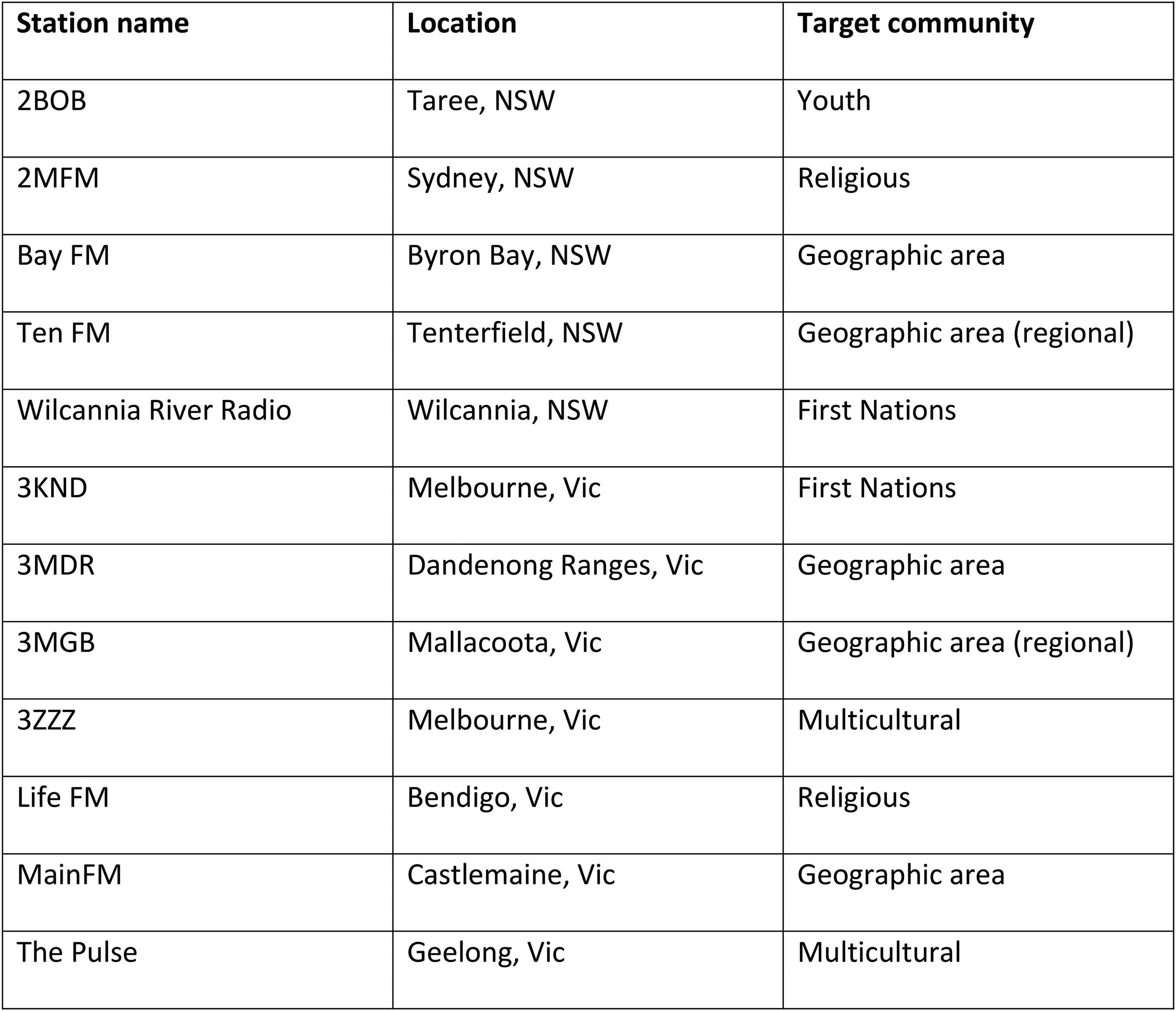
Summary list of station interviews.
Findings and discussion
Community radio stations as listening posts
Crucial to community radio's unique role within communities is its ability to listen to audiences. In general, media consumers are kept distant from the sites and processes of media production; Macnamara (2013: 161) describes such consumers as ‘doubly assumed and imagined – assumed and imagined to exist and assumed and imagined to listen’. In contrast, for community radio, the boundaries between producers and consumers are blurred (Downing, 2001; Foxwell, 2012) and the sites and processes of production are predicated on community access (Carpentier, 2015; Rodriguez, 2001; Tacchi, 2003). These values and traits facilitate a more dialogic form of listening, where the demarcations between ‘speakers’ and ‘listeners’ are dissolved and speaking and listening occur contemporaneously (Penman and Turnbull, 2012). This dialogic approach to listening is critical to inform the local content that is central to the day-to-day operations of community radio. Indeed, reflecting the community through local content and production is a key value of community radio: one that serves to reinforce shared interests and experiences, and contribute to the structure of the community itself (Backhaus, 2022; Carpentier et al., 2003; Forde, 2011). Dialogic listening, therefore, is central to both the values and day-to-day activities of community radio, which supports the concept of stations as community listening posts, as suggested by Dreher and de Souza (2021).
Community radio as community listening posts frames stations as local cultural resources that act as both sites for listening to community stories, as well as to external groups. In this way, community radio stations present peerless opportunities for political leaders and policymakers at the forefront of climate action strategies to tap into community sentiment and experiences of climate change. While community radio plays a role in listening to and reflecting the views of its community, it can also help to shape community views by leading and facilitating discussions and dialogue between different societal groups. Forde et al. (2002: 58) highlight this as the ‘cultural role’ of community radio in ‘by enabling dialogue between diverse components of a community, building on a common background, shared culture and experience’. This cultural role as a community listening post and a conduit for discussions meant that community radio is ‘not just about broadcasting the news, or whatever, we actually are agents of social change’ (Backhaus, 2019; Foxwell-Norton, 2016; Fox, 2019: 149).
There were numerous examples from the research that supported the role of community radio as a community listening post and highlighted the potential for climate change discussions. For one station, their role as a trusted source of information stemmed from the accountability of hearing local voices: If you had someone from the local communities, people listen to it because they knew who it was. It seemed like a voice that was telling them that they knew what was going on and what wasn't going on. (Pulse FM)
The importance of local voices was also formally recognised in audience feedback collected by one of the stations: That's one of the things, when we did our survey, our community is sort of like: this is why we're listening ‘cause it's local people providing local information’. (3MDR)
Community radio as listening posts took on a broader role in the multicultural broadcasting stations, with broadcasters engaging with local communities but also with listeners in their home countries. This had implications for how the broadcasters approached discussions of climate change: Back home, they probably are more progressive and they see, even if it's not directly affecting their family and community, they know that there are government initiatives, whereas in Australia it's much harder. (3ZZZ)
The overarching institutional environment – in this case, the Australian government's historical inaction and dismissal of climate change – has significant impacts on how community radio broadcasters approach their role as listening posts. Equally, how these institutions interact with community radio also affects how stations are able to engage with climate change issues in their local communities.
Institutional listening
While community radio stations represent an important site for local dialogue – as both spaces for listening and voice – the capacity of community radio stations to speak and be heard beyond their immediate communities is less clear. This has implications for facilitating discussions around climate change as it impacts communities’ capacities to share their local experiences of climate change and advocate for themselves, while also limiting the relationships between communities and other institutions. Institutional listening refers to ‘an active practice of listening enabled by formal institutions’ (Scudder et al., 2021: 5). Community radio stations engage with institutions regularly: through regulatory bodies and national groups such as the CBAA and grants administrator the Community Broadcasting Foundation, as well as more localised institutions. Community media is said to embody a ‘rhizome’ in how it connects disparate individuals, groups, and organisations: these interconnections are crucial to the medium's role within communities (Carpentier, 2016; Santana and Carpentier, 2010) – therefore, it is important to interrogate institutional listening, particularly surrounding a topic that impacts upon all levels of society, from international and national institutions to local communities.
Many stations enjoyed productive and collaborative relationships with local institutions, which became particularly crucial during times of disaster. For two stations in New South Wales (Ten FM in the highlands and Bay FM on the coast), the experience of broadcasting at the beginning of the fire season and during the bushfires, emphasised the need to have established relationships with emergency services and other officials that the station could draw upon to help the community prepare for an withstand the disasters; I was speaking with the representative of the RFS here every day (BAY FM). And where that hadn’t worked very well, they were making changes to improve for future events. The last time we had a major crisis here, the crisis centre was set up down in the memorial hall, which is about half a kilometre away. This was the place where the police, the SES [State Emergency Service], the RFS [Rural Fire Service], the council and so on, could go and coordinate their efforts. But it was very disjointed, because each of the organisations had to refer back to its own headquarters. So, now they are building an emergency centre in the council building where all these people can sit down together and have direct communication with a) their local headquarters and b) their regional headquarters. Now our radio station is adjoining the council buildings so it means that we can really keep our finger on the pulse and let people know what is going on, almost instantaneously. (Ten FM)
Stations also found it useful to have interviews and information about potential risks at timely periods, such as the beginning of the fire season or during a high-danger alert period. Only a week or two before (the local bushfires) … I had brought in the RFS volunteers in the region that hadn’t been in the station before. They came in and I was so glad that I had them on air doing that – saying things like ‘clear your gutters: if the fire is coming, fill your gutters up with water, block the edges off at each end’. (Bay FM)
The experiences and relationships between community radio stations and proximal institutions, such as emergency services and local governments, varied between communities but were broadly more conducive to institutional listening than distal institutions. The lack of relationship with distal institutions appeared to be a breakdown on both sides of the communication equation: institutional listening by non-local institutions seemed difficult or non-existent and, equally, community radio stations, despite their ability to effectively communicate with local audiences, appeared to struggle with ‘speaking out’ to wider audiences.
An example of this disconnect between the voice of community radio stations and the institutional listening of non-local organisations was discussed by 3MGB, a regional station in Victoria significantly affected by the Black Summer bushfires. While images of people huddled on Mallacoota's beaches awaiting evacuation on Australian Navy ships under a red, smoke-filled sky, were beamed and streamed across the world (ABC News, 2020), it was the local community radio station that played the essential role of emergency broadcasting. The vital and courageous role of 3MGB's broadcasters during the Black Summer bushfires of 2019–2020 was recognised in the media, through the CBAA's From the Embers podcast series, and also in the Royal Commission into National Natural Disaster Arrangements (Binskin et al., 2020). According to the station, however, 3MGB is no longer an emergency broadcaster due to changes to the emergency broadcaster accreditation process, prohibitive technical requirements, and a lack of ongoing support. Royal Commissions are cited as examples of institutional listening – as national conversations linking public spheres with decision-making powers (Scudder et al., 2021; Waller, 2020). However, for Mallacoota, one of the most severely affected areas by the violent and dangerous impact of climate change, there are clear limits to this institutional listening as well as prompts for change in the future. Importantly, 3MGB station representatives noted the emotional and mental trauma that followed their role in supporting their community during and post-disaster. During the bushfire crisis, 3MGB's volunteers faced the intractable choice of broadcasting essential information to the community or protecting their own homes and families. Despite the traumatic position imposed on these volunteers, and the ongoing personal implications of these choices, as a volunteer organisation, the station and arguably the sector, has not yet attracted the same level of meaningful institutional recognition and support that could deliver formal planning and processes to support their ongoing involvement in local emergency responses.
The limits of listening
Community radio has a long history of contributing to more vibrant public spheres and representative mediascapes. The medium's role in exercising communication rights is well-established (Fraser, 1990; Saeed, 2009; Thomas, 2011), but what is less understood is the interactions of communication rights and climate justice within community radio. Community radio is fraught with contradictions: while community radio plays a vital role in acting as alternative public spheres (Fraser, 1990) and creating much-needed diverse spaces, voices, and perspectives within the Australian media landscape, the structural conditions remain embedded within neoliberal, colonial systems. As discussed in a panel at the 2020 CBAA Conference titled ‘Decentring white privilege: Decolonising and diversifying the airwaves’, there is still significant work to be done within the community radio sector, particularly around managerial diversity and the ongoing ‘weak’ or ‘liberal multiculturalism’ that maintains diversity ‘at the margins’ – as seen in the siloing of intersectional voices within the ‘ethnic broadcasting’ wing of the sector – while still centring whiteness (Dreher and de Souza, 2021: 45; Moran, 1995). This is also critically important in the context of climate justice, where those least responsible for climate change are the most impacted (Arriagada et al., 2020; Hall and Crosby, 2020; Nixon, 2011). These structural issues have significant implications for how climate change can be discussed and the kinds of mitigation and adaptation strategies that can be introduced to and adopted from communities.
The limits of listening and the tensions between the exercise of political voice and the act (or lack) of institutional listening were highlighted in discussions with Wilcannia River Radio, a station situated in a remote town in NSW with a large population of Aboriginal people. The issue for this community radio station is not facilitating discussions within the community about how to adapt to climate change, but how to have a wider, national discussion about climate change that results in action that returns their river to a functional ecosystem that can sustain not only life, but culture: Our community is already doing the talking. There is certain community leaders, young people, elders, families have already spoken to everyone they can possibly think of to keep the awareness, keep the people understanding the devastation and the impact. But it has got to be from voice to action. That's the biggest thing. Who are we yelling it to? We are not yelling it to the true Australians. We are yelling it to the people who are responsible for the decisions. We are yelling it to the people who are accountable for these decisions. To simply listen to one thing that our community is saying ‘Bring back our Barka’ [the local river]. Let it have its natural flow and its natural connection to the community and the culture. Then our lives will become better. Our children will become healthier. Our social and economic will become stronger. Our place in our community will improve. We wouldn’t be worried about youth suicide and depression and drugs and alcohol. We will be out playing football in front of our elders. More people will have jobs but more importantly, the identity of the Barkindji people will be brought back. So, to be honest, we need people not just only to listen but to act and help us make the change. The last 15-20 years it's – I’m not going to say it's been going downhill because that's wrong thing. It's been – I’ll put it this way – It's just part of the slow genocide that's been happening to our community, to our people, but especially to our children. This nation, this country, needs to act on it. That's what we need people to help us on making the government to see differently. (Wilcannia River Radio)
Wilcannia River Radio's call for change and action speaks to what Foxwell-Norton (2017) calls ‘eco-communicative democracy’, which situates democratic communication within an ecological frame, focusing on both the democratic benefits of plurality and diversity of worldviews and the idea of democratic relations between nature and culture. These complex interconnections between human culture and the environment have been recognised and embraced by Australia's First Peoples for tens of thousands of years, yet still, Wilcannia River Radio's calls fall on deaf institutional ears.
Conclusion
Community radio has significant potential to facilitate a more meaningful co-production of knowledge about climate change, one that goes beyond an ‘idiom’ that describes how Western scientific knowledge is embedded in social worlds (Jasanoff, 2004). Meaningful co-production involves ‘contending with other interpretive frameworks, epistemologies, and expertise’ (Callison, 2014: 161) and grappling with ideas of cognitive justice, which rejects the hegemony of Western scientific paradigms and actively recognises the existence of multiple worldviews (Visvanathan, 2006). Embracing multiple co-existing worldviews and questioning the hegemony of Western scientific knowledge is particularly important when discussing issues like climate change that have real implications for local relationships between culture and nature. Therein lies the importance of listening. Community radio's unique role within communities, and intrinsic value to more meaningful discussions about climate change, is interconnected with its ability to listen to audiences. Considering community radio as community listening posts (Dreher and de Souza, 2021) frames stations as critical local cultural resources. In this role, stations are sites for both listening internally to community stories, and for external groups to access community experiences and perspectives. This is of crucial importance for discussions about local impacts of climate change as well as local mitigation and adaptation efforts, as demonstrated within the experiences of PulseFM in speaking to multicultural communities and of 3MGB in their disaster broadcasting efforts. Despite this potential, there remains an urgent need for institutional listening practices that understand the unique role of community radio and are receptive to the challenges and opportunities presented by stations’ deep interconnections with their local communities. As the experiences of Wilcannia River Radio demonstrate, a lack of listening can lead to disenchantment and disempowerment within communities: a situation antithetical to the goals of both community radio and meaningful climate change communication. Further research is needed to explore the full impacts of limited institutional listening on how community radio stations are able to engage with climate change issues. What is clear though, is that by embracing the democratic potential of community radio in acting as both a listening post and as a potential site for the activation of eco-communicative democracy, the medium has significant potential to facilitate more meaningful, collaborative, and local engagement with climate change issues.
Footnotes
Declaration of conflicting interests
The author(s) declared no potential conflicts of interest with respect to the research, authorship, and/or publication of this article.
Funding
The author(s) disclosed receipt of the following financial support for the research, authorship, and/or publication of this article: This work was supported by the Lord Mayor’s Charitable Foundation.
