



Abstract
The Paralympics is globally the largest and most significant sporting event that takes place for athletes with a disability. The 2020 Tokyo Games was heralded as significant in its extensive media coverage that served to promote the disability athletic movement, breaking all broadcasting viewing records from the number of broadcasters, viewers, and a number of events provided live. In the past, however, media reporting of the Paralympic Games has not been without controversy. Stereotypical representations of disability, for example, have often been cited). These involve representations such as framing disability as something to be overcome; where athletes ‘participate’ rather than ‘compete’; and for those with adaptive technology, being portrayed as ‘cyborgs’, rather than as competitive athletes. This article has been driven by the curiosity to determine if media depictions of Paralympic athletes have improved over time. We wished to explore the current representations of the print and television coverage in Australia of the 2020 Tokyo games. Our research found that media coverage did, for the most part, provide coverage of events where Paralympians were represented as athletes first and their disability second. Despite this positive outcome, stereotypes prevailed in both print and television reporting. These included minimalising a person's disability, often to the point of making the disability invisible; focussing on overcoming tragedy; using inspirational language to position athletes as advocates for the disability; the use of patronising language; and the positioning of athletes as needing to be grateful. We conclude that whilst the media in Australia has made significant steps towards representing Paralympians as elite athletes, continued attention and primary focus needs to be given to the athlete’s first narrative.
Introduction
The Summer Paralympics that was originally scheduled to take place in Tokyo, Japan in 2020, was postponed by a year due to the COVID-19 pandemic, with the rescheduled Games still referred to as Tokyo 2020 for marketing and branding purposes. The Games featured 539 medal events in 22 sports and involved 4403 athletes from 162 participating countries (https://www.paralympic.org.au/).
The word Paralympics is derived from the Greek term ‘para’, meaning alongside or parallel to the Olympics, and is meant to illustrate how the two movements exist side-by-side (Bressan, 2008). This positioning promises an equal representation of participants as elite athletes whether they are able-bodied or have a disability (Rees et al., 2019). Media representation of Paralympic athletes, however, has been fraught with controversy in the past because of the persistent portrayal of Paralympic athletes as fundamentally different from their able-bodied counterparts. The prevailing narrative of the Paralympian has been as an object of pity or inspiration (Schell and Duncan, 1999). Commentators have been criticised for their ‘patronising attitude’, and the media coverage described as ‘superficial’ and ‘curious’ because of the attention being directed towards an athlete's impairment rather than their sporting prowess (Goggin and Hutchins, 2017). Emphasising Paralympians’ disability and portraying their efforts to ‘overcome’ their disability as superhuman or heroic, under-values their athleticism and reduces the Paralympic games to the status of an ‘entertainment show’ rather than a major sporting event (Rees et al., 2019).
While the amount of television and media coverage of the Paralympics has increased, and the media portrayal of Paralympians has improved over the past 20 years there is still a need to strike a balance between the representation of athleticism and disability. In the past, the media emphasis on an athlete's impairment aligned with the medical model of disability (Beacom et al., 2016). The medical model offers a deficit view, where the focus is on an individual's ‘disabling condition’ and any problems that a person has in functioning is regarded as an inherent aspect of the individual. An alternative view is provided by the social model which attributes any difficulties in functioning to an unaccommodating environment where the supports a person needs to function effectively are unavailable or inadequate. From this perspective, while individuals may have bodily impairments, they do not need to live with a ‘disability’ if society provides the accommodations they require. The World Health Organization’s (WHO) 2001 International Classification of Functioning which is used to classify athletes for the Paralympic events, proffers an integration of these two opposing views through the ‘interactionist’ or ‘biopsychosocial’ model. The biopsychosocial model recognises that disability occurs as an interaction between a person's disorder or disease, and the supports and barriers in the social and physical environments in which the individual operates (WHO, 2001). The interactionist model has been described as an ‘affirmative’ model because it recognises and validates the existence and experiences of an individual whose life is affected by both an intrinsic impairment and the external limitations imposed by society (Swain and French, 2000).
Previous criticisms of the reporting of the Paralympics include the media preferring to showcase athletes with an acquired disability rather than those with a congenital disability (Ellis, 2009). McGilivray et al., (2021) describe this as a ‘hierarchy of disability’ and suggest that people whose disability was caused by accident, injury or illness, such as those in wheelchairs or with limbs amputated, are seen as more ‘normal’ and ‘palatable’ than Paralympians with conditions such as cerebral palsy or Down syndrome. Unlike Paralympians who were born with a disability, athletes with an acquired disability provide the media with a ‘human interest’ story as to how they came to sustain their disability. Retelling and highlighting the ‘tragedy’ that befell a Paralympian reinforces the ‘heroic’ stereotype of a person overcoming their disability to achieve their goals (Pointon, 1997). While this is portrayed as an ‘inspirational’ story of how people with a disability can accomplish their dreams through courage, determination and effort, it is argued that focussing on an athlete’s ‘superhuman’ qualities ignores and obscures the actual societal and attitudinal barriers that most people with a disability face in their everyday lives (McGilivray et al., 2021). Often the reporting of a Paralympian's backstory is given greater prominence than the athlete's performance in an event (Ellis, 2009). From her analysis of the 2008 Paralympics, Ellis (2009) argued that focussing on the inspirational qualities of athletes overcoming their disability, rather than on their sporting abilities, prioritises able-bodiedness.
Despite representing Paralympians as positive, though possibly unrealistic, role models, the media has also been accused of treating the Paralympics as a consolation contest and the performance and achievements of Paralympians as secondary to, or lesser than, those of Olympic athletes (Bruce, 2014). In their analysis of the narrative frames that were used in the reporting of the Rio Paralympics, Maika and Danylchuk (2016) identified the ‘little brother’ frame of discourse which portrayed the Paralympians as less than able-bodied athletes and inferior to Olympians. The secondary status of Paralympians is also perpetuated by the ‘charitable discourse’ of commentators who depict Paralympians as ‘being grateful’ for the chance to participate in the games and seek to elicit sympathy from viewers (Mitchell and Snyder, 2000). Brittain (2009) reported that Paralympians described how past reporting of the Paralympics was ‘demeaning’ and ‘patronising’ as the participants felt they were being presented as ‘victims’ or objects of pity. Maika and Danylchuk (2016) confirmed that this portrayal of Paralympians has persisted, and identified a narrative frame they called ‘charity/victim’ where the discourse centred around Paralympians as damaged and unable, carrying a burden, and ‘in need of saving’. However, it is not only the media which perpetuates these images of needy or heroic athletes. In her interviews with Canadian Paralympians, Pearson (2020) revealed that some Paralympians consciously acted out these stereotypes and shared their stories of adversity and triumph in order to help secure funding and sponsorship so they could pursue their sporting careers. Adding to the pressure on Paralympians to divulge their personal stories of disability is the commercial imperative to increase television coverage by making the content appealing to a global audience (Howe, 2011). Goggin and Hutchins (2017) report that at the London Paralympics in 2012 social, mobile and online media were incorporated into media communications. As a way of equipping future Paralympians for wider public exposure, athletes preparing for the 2016 games were given media training and encouraged to express and emphasise their ‘raw’ emotions during their post-event interviews in order to differentiate them from the ‘rehearsed’ presentations typically given by professional athletes. Rees et al., (2018) also noted that the broadcast panel discussions during the Australian television coverage of the 2016 Paralympics used emotive reflections to evoke feelings of empathy and pity for the Paralympians and enhance audience engagement.
Inx her analysis of the New Zealand mainstream media reporting of the 2008 and 2012 Paralympics, Bruce (2014) noted that compared to Paralympians from New Zealand, international athletes were given more stereotypical coverage and their disabilities and differences were emphasised. The home nation athletes were given more, and higher quality coverage, and their disabilities were minimised. Bruce argues that this nationalistic focus promotes a new kind of us/them duality where the international athletes are regarded as ‘other’ while the home nation athletes are seen as being more like ‘us’. While Paralympians and many disability advocates have called for less focus on the athlete's disability and more reporting of the sporting event and the person's athletic performance, others have warned this should not come at the cost of hiding or diminishing the effect of the individual's impairment (Ellis, 2009). Focussing on the disability or what caused it ‘medicalises’ the athlete, however, ignoring or hiding the disability might seem to normalise the person but obscures the obligations society has to provide the support and accommodations that are necessary for creating opportunities for success. Ideally, a balance should be achieved where the athletic performances can be praised while providing enough information about the athletes to maintain the uniqueness of the Paralympics (Maika and Danylchuk, 2016).
Jason Diederich, an Australian Paralympian who participated in two Paralympics, published a heartfelt article in the weeks leading up to the 2020 Tokyo Paralympics, Diederich describes London 2012 as the benchmark for Paralympics, with the approach taken by the Game's organisers as ‘ground-breaking’: ‘It is the reason more people with disability in the UK now have the same opportunities as people without disability to work, to shop, to play sport, to travel, to love and to live the lives they want’ (ABC News, 9 August 2021). The influence of media representation is wide-reaching, and, as noted after the London games, it has the capacity to change the way disability is viewed and understood by the broader community. This is a powerful tool to wield, and Diederich challenges the media to use it for good (ABC News, 9 August 2021): Sadly, the media focuses on the negative aspects … reinforcing the view that disability is a burden to the community, a cost to taxpayers…I challenge all of us in Australia to recognise and celebrate the positive contributions made by people with disability in our communities. I also challenge the media … It will change lives. (ABC News, 9 August 2021)
Method
Over the course of the 12 days of the Paralympic Games, between 25 August and 6 September 2021, a sample of the television and print coverage in Australia was reviewed in order to respond to the research question: In what ways are para-athletes represented?
Researchers analysed media coverage as reported on the only free-to-air channel that provided television coverage. One sports event each day was randomly selected. The observations were recorded for an hour at a minimum. The observations were recorded as a narrative of the event. Data were also noted on the gender of the athletes, the category of event and the type of event.
Across the 12 days, more than 200 print articles were sourced from six different Australian media outlets – The ABC News, The Guardian Australia, The Sydney Morning Herald, The Age, SBS, The Australian, and news.com.au. A cross-section of 20 articles was selected for analysis, representing athletes from a variety of sports, categories and genders.
Thematic analysis was used to analyse the data, as it provided a flexible tool to facilitate the examination of underlying themes across both data sets (Clarke and Braun, 2017). A theoretical approach, involving engagement with the literature regarding media reports of prevailing narratives and media framing of the Paralympics, was employed to guide analysis. Aligning with Clarke and Braun's practices, the authors first engaged in the familiarisation of the existing literature. This involved taking note of initial ideas and preliminary themes. In the second phase, initial codes were generated by systematically working through the data sets, taking account of exceptions and inconsistencies. An author check across all data against the themes identified in the analysis was conducted as a further method of increasing rigour.
Results and discussion
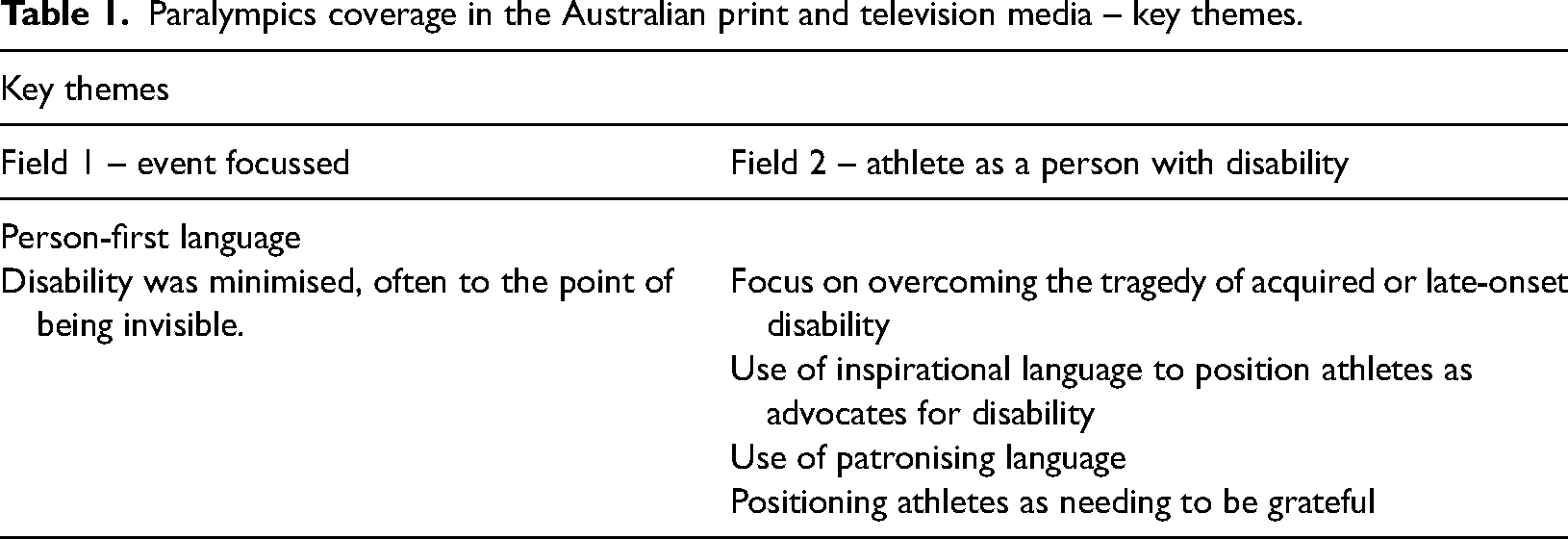
Results from both the television and print coverage provided a range of themes. Themes fell into two distinct fields. The first field reported on para-athletics as a parallel and equally elite sporting endeavour, which we have labelled as Event Focussed. The other field reported on the athletes themselves, and we have labelled this field the Athlete as a Person with Disability. Six key themes were identified across both fields. The use of person-first language traversed the two fields and was utilised in the majority of the Paralympic coverage. When person-first language was used, the reporting of the event was done effectively, however on the few occasions when it was not employed, the omission was obvious and confronting. In the Event Focussed field a single additional key theme emerged, that minimising the disability. In the Athlete as a Person with Disability field, four key themes were identified from the data: (i) a focus on overcoming the tragedy of acquired or late-onset disability; (ii) the use of inspirational language to position athletes as advocates for disability; (iii) the use of patronising language and (iv) the positioning of athletes as needing to be grateful. These themes are presented in Table 1.
Paralympics coverage in the Australian print and television media – key themes.
Person-first language
While the representation of athletes differed somewhat across the different media outlets, some similarities were observed. The most notable was the predominantly consistent use of person-first language. When an athlete's disability was mentioned, it was generally noted after the name of the athlete. However, on a small number of occasions, this was not the case. The starkest example of this was where athletes were described only in terms of their disability: More power to the fierce young Japanese girl at the opening ceremony who represented all the one-winged aeroplanes – the amputees, the intellectually disabled, the blind, the paraplegics, the quadriplegics, the dwarfs, those categorised as Les Autres – who have left the tarmac and swooped on the first haul of gold medals at the Tokyo Paralympics. (The Australian, 25 August 2021)
Of note, our sample of language use during television reporting did not reveal any instances where anything other than person-first references were used. Certainly, such Paralympic coverage by the host broadcaster, which broadcast live for over 12 h per day on free-to-air TV and another 12 h streaming per day on 16 channels, would have been noticed. The largely consistent use of person-first language across both televised and print media is perhaps unsurprising, as this sits front and centre of the guidelines for reporting on para-athletes (IPC, 2021). This person-first spotlight was intensified by the IPC when it released WeThe15 campaign, which was pitched as the sport's greatest human rights movement aimed at ending discrimination against people with disabilities by raising visibility and participation in an effort to create a more inclusive society (Siegfried et al., 2021).
While examples of this were less common than may have been present in media coverage in the past, when person-first language was not used, the emphasis on the disability positioned the athlete as being second to, or of less interest than, the impairment. It must be acknowledged that the use of person-first language is contested and not advocated by all within the disability community (see for instance Botha et al., 2021 for a discussion on person-first language and autism). Yet it is acknowledged that when discussing disability broadly, as at the Paralympics, using descriptive terms before identifying the person can cause harm (Crocker and Smith, 2019). In the examples presented above, the language used may potentially cause harm to both the individual athletes, as well to the way disability is understood by the audience engaging with the media coverage. The power of language can have a significant impact on the way that people perceive athletes with a disability and the right to access and participate in all levels of sport (Gray and Verdonck, 2016).
Event focussed
The field of Event Focussed coverage reported on the event itself. This was by far the most prevalent aspect of both the television coverage and the rolling coverage presented in the print media. Commentators and journalists were generally professional and factual in their depiction of the events and discussed tactics and other relevant athletic performance activities. Yet this often led to an athlete's disability being minimised or ignored altogether.
Minimisation of disability
In the television coverage, facts about the participant's disability did at times describe the athlete's level of functionality and were generally added to provide the audience with information about how the person's disability impacted their role in a team or performance in an event: ‘he has more upper body functioning which is why he is in the position of forward offence, and this is where his additional functionality works well’ (Wheelchair Rugby). In the print coverage, articles that focussed on explaining a particular sport also made reference to aspects of disability that were relevant to the sport, as in this article on Wheelchair Basketball: Visually, Wheelchair Basketball shares many similarities with its able-bodied counterpart: the game is fast, aggressive and tactical. But there is one significant difference: maths. Players are classified according to their impairment from one to four and a half (most to least impaired). Teams cannot have more than 14 points on the court at any time.
“A below-knee amputee would be your typical 4.5 – someone who has almost their entire body working,” says Blair. “Then going down the scale to a class one, which is what I am, who is typically a paraplegic…” (The Guardian Australia, 25 August 2020)
However, this was not the case for all reporting, and in some instances, the disability was minimised, to the point of being invisible. This was noted in television coverage of many Equestrian events, where it was not clear what category of the event was being televised, or what type of disability the athletes had. This theme was also identified in the print media. An article that celebrated a gold medal win in the men's T54 marathon event of an Australian para-athlete, made no mention of the athlete's disability (news.com.au, 5 September 2021). This was replicated in articles across much of the print media, where event categories were noted without any other acknowledgement of disability. While this lack of attention to disability in event focussed coverage may be a result of the shift towards a paradigm that embraces a social model of disability (Stewart and Spurgeon, 2020), it is not without its problems. Minimising disability may divert attention away from the lived experiences of people living with disability in Australia, and further perpetuate the notion that ability is the norm and that disability is something different, not to be talked about (Goodley, 2014). People with disabilities have, for many years, been seeking equitable media representation (Kent et al., 2018), but perhaps this minimisation of disability in some reporting of the Paralympics was a missed opportunity to further inform the audience about the impact of disability on a person's lived reality.
Our findings support Macková (2021) conclusions on the recent changes in journalistic style as the Paralympics became more professional. Summarising the reporting style of the Tokyo Games, Macková found that life stories of athletes with a disability are becoming less prominent and commentators are focussing on the event instead. However, the story of the ‘inspirational’ athlete persists as journalists believe that the human-interest story is still couched in educating ‘the public on disability-related issues’ (Macková et al., 2021: 54). Further, journalists reported that ‘you can’t see the disability. So, you need to inform the audience’ (Silva and Watson, 2021: 58).
The athlete as a person with disability
This field reported on the athletes themselves primarily in the form of athlete interviews, profiles and special interest stories that went beyond the event itself. Interestingly, we noted a far greater amount of air and screen time was given to athletes with an acquired disability, or with a late-onset condition. Athletes with a congenital disability, particularly more complex disabilities such as cerebral palsy and intellectual disability, received much less media coverage. In the print media, it was found to be approximately 10 articles to one, and most articles about people with congenital disabilities featured high-profile athletes such as the tennis player, Dylan Allcott. The reporting in this field was more problematic than the reporting on events. It was here that we found a focus on tragedy, the positioning of athletes as inspirational advocates for the disability cause, the use of patronising language, and an obligation for the athletes to express gratefulness.
Focus on overcoming tragedy of acquired or late-onset disability
It was interesting to note that comments made or written about tragedy focussed on athletes who had either acquired a disability or their disability was the result of a late-onset condition; something that was noted across the various media outlets explored in this study. Television coverage of an athlete's story of overcoming tragedy was most apparent during commentary between events. The tragedy of the athlete's disability was often foregrounded, with the print media regularly positioning events that led to disability in their headlines. One headline read, Paralympic basketballer Jannik Blair: ‘All I remember is light and dark as the ute was rolling’ (The Guardian Australia, 25 August 2021). This was followed by the byline ‘An accident on his farm as a child left the Australian in a wheelchair on a path towards the 2020 Games in Tokyo’. From here, the article traverses the athlete's journey of overcoming tragedy and their rise through sport to the Paralympics. A different approach was adopted in an article about American athlete, Haven Shepard (news.com.au, 1 September 2020). Again, the tragic event was positioned in the headline, however, instead of focussing on the athleticism and achievements of the Paralympian, the article minimised it to being about ‘fun’:
Bomb survivor Shepherd ‘just having fun’ at Paralympics
US swimmer Haven Shepherd lost her legs as a baby after her parents detonated a bomb intended to kill the whole family.
They strapped themselves to a bomb, held Haven and detonated the device, killing themselves instantly and blasting their tiny daughter 12 metres (40 feet) out of their hut.
(entire article)
Kirakosyan (2021) interviewed Paralympic athletes to determine how the athletes themselves felt about media reports of the overcoming-adversity narrative and found that while they agreed that coverage has progressed towards becoming more performance-oriented, there was still a long way to go in moving away from the established discourse. Despite this finding, journalists remain steadfast in their desire to promote the story of overcoming hardship and adversity for audiences.
Athletes as inspirational advocates
Athletes were often described as inspirational, and many comments were made referring to the athlete as giving hope and/or courage to others as a result of overcoming adversity. An example was noted in the television coverage, where some athletes who had overcome adversity linked to their disability were described in superhuman ways: ‘What courage!’, ‘Amazing!’, ‘An inspiring teammate’. The print media set up para-athletes in a similar way. Terms such as impressive, inspirational, and extraordinary appeared in many articles. Interestingly, on some occasions, the focus of the commentary, both on television or in print, shifted from the inspirational athletes to the emotional state of the commentators and journalists. One television commentator noted, ‘There is a sense of family, the [Paralympic] movement means a lot to me, I feel proud’, while another said, ‘We have cried through so much of these Paralympics’. It is unsurprising that the heightened levels of emotive language used in the television coverage was not replicated in the print media, however, emotion was present. One journalist recalled feeling inspired by Louise Savage in 1996 when she won the wheelchair 800 m event: ‘It was a wonderful bit of integration between the Paralympics and the Olympics’. The journalist went on to describe their feelings about the prospect of this happening again: ‘…how fantastic would it be to see him [Jaryd Clifford] jostling with the best of them in the Olympics, as they came around the final turn in Paris 2024!’ (The Sydney Morning Herald, 3 September 2021).
As symbols of inspiration, para-athletes were positioned as advocates for disability. One commentator said about an Australian swimmer, ‘It is not just about the athlete, but the impact beyond the pool. She is an advocate for disability’. This notion was reflected in the print media, where achievements of para-athletes at the games were situated as promoting the disability cause. Positioning para-athletes as disability advocates raises some interesting questions (Haslett and Smith, 2021). While it places them in the spotlight, it should also be asked if this is the right stage on which they should perform.
Use of patronising language
We found the use of patronising language was prominent in the television coverage. Commentators consistently used patronising language after or between events, and athletes were frequently spoken about in a way that positioned them as ‘children’. This phenomenon is known as infantilisation, and has been noted as a persistent and problematic issue in the disability discourse (see for instance Safta-Zecheria, 2018). One commentator made the following remarks after an athlete had completed an event: ‘He is a beautiful man, I want to give him a big hug….he is a warm, kind, gentle person with a fine face. It suits his personality’. This type of language was also used to describe female athletes: ‘What an absolute sweetheart, a beautiful interview, so sweet, it is so lovely’. Language that positions adults with disability as childlike normalises their exclusion from adult society (Safta-Zecheria, 2018), and sits in direct contradiction to widely held ideologies that the Paralympics can positively influence the way society views and understands disability (ABC News, 9 August 2021).
At times the praise appeared excessive. Often athletes were described in character-first language rather than athlete-first language: ‘he is a great character’. ‘He is a wonderful person’. These patronising comments can be linked with other Emotional descriptions. Television media reporting commonly refers to athletes’ Emotional states. Some examples included: “She is overcome”
“They are embracing! What a magic moment”.
“The embrace was beautiful to watch”.
“Her teammates are so excited for her!”
“Once again, beautiful scenes at the Aquatic Centre”.
When the emotional statements were embedded within the event itself, it changed the nature of the reporting from a commentary about the event to one that was qualitatively different. For example, one commentator stated, ‘he swam beautifully’, instead of ‘he swam strongly’ which is a reporting style expected in a sporting event. While Ellis et al. (2021) suggested that the superhuman discourse has replaced this ‘ahh bless’ approach, it appeared alive and well in our data, particularly in the television coverage of events.
The emotional ‘superhuman’ language is also worth interrogation. While it serves to replace the ‘ahh bless’ approach (Ellis, 2021:83), media have been cautioned about its overuse, as triumphing against all odds is not possible for many people with disability, and there is also a danger of setting public expectations that are unrealistic (Shakespeare, 2016).
Peers, a Paralympian herself, captures the (dis)empowerment perfectly: I realize how the heroic Paralympian relies on discourses of the pitiful cripple who can’t overcome and the burdensome gimp who won’t. I realize how these discourses serve to set us apart, whether up on the pedestal or down in the gutter: they enable others not to look us in the eye, they induce us not to look into each other’s and they encourage us not to look inside of ourselves. (2009:2)
Positioning of athletes as needing to be grateful
In the television coverage, it was often reported that athletes, when winning medals, should be Grateful and therefore needed to be thankful. This reinforcement of dependency ties into the notion of infantilisation (as discussed above), where links were found in commentators asking athletes to state who they wished to thank, often followed by a media push to raise money for the Paralympic Disability awareness movement.
After television events, athletes were interviewed and asked to comment on their events. Athletes were asked: “Who do you want to thank? One athlete replied: ‘I want to thank my coach for inspiring me’, and the reporter probed ‘Who else do you want to thank? Do you want to thank Mum, Dad, family?’
Of interest, commentators appeared ‘surprised’ when their question provoked an emotional reaction from competitors. For example, one reported, ‘when they are asked about their families, they get so emotional, they are so grateful’, ignoring the fact that the commentator was typically the one who initiated the focus of the conversation.
Often acknowledgement of support people was solicited, for example, ‘Do you want to say something to all your wonderful supporters?’ to which the athlete responded ‘I couldn't do it without you’. This was followed up with the reporter commenting that ‘I can see your emotion. You must be grateful’. Infantilisation was thus evident in the way commentators asked athletes to thank others as an adult instructs a child.
Further examples of this emphasis on gratitude were cited in a print article on an athlete with a degenerative condition that affects sight and hearing, and that was diagnosed when the athlete was in their 20s (ABC News, 27 August 2021). This article focussed on the level of support the athlete needed to participate in the sport and the dedication of the support person: ‘I need someone's shoulder or elbow’. Commitment from the support person was described like this by the journalist: ‘Silk (name of support person), who has a full-time job, travels from Brisbane at 4:00 am up to three times a week’, whereas the athlete's commitment to training was not noted, just that she ‘trains on the Gold Coast’.
The implication is that Paralympians are dependent and are unable to achieve their goals without the assistance of others. Schell and Duncan (1999) noted this need for athletes to be grateful over two decades ago. Peers (2009) speaks of the danger of negating the athlete's own achievement and accomplishments when they are deferred and attributed to other able-bodied people.
Conclusion
This research reported findings that the Australian print and television media coverage of the 2020 Tokyo Paralympic Games did, for the most part, provide coverage of events where Paralympians were represented as athletes first While this is a positive outcome, stereotypes were still located in both print and television reporting. The stereotypes and minimising of people with disabilities included the diminishing of a person's disability, where at times the disability was made invisible. Additionally, we found that there was a focus on overcoming tragedy, especially of acquired or late-onset disability. Further, there was an overuse of inspirational language to position athletes as advocates for disability. Finally, the use of patronising language, and the positioning of athletes as needing to be grateful were also evident. We conclude that while the media in Australia needs to be acknowledged in regard to the steps forward it has taken to address traditional detrimental and negative stereotypes of athletes with a disability, a concerted and consistent reporting narrative that depicts people with a disability in equal terms is required.
One journalist concluded: These Paralympics were an absolute joy to cover. Reporters are usually discouraged from using adjectives such as ‘incredible’ and ‘inspiring’ to describe the performances of athletes with a disability, but there was a noticeable shift this time around. Stories of hardship, adversity, feats of bravery and near-death experiences were central to storytelling at these Paralympics but they were certainly not the be-all and end-all. Results mattered. (The Sydney Morning Herald, 6 September, 2021)
Footnotes
Declaration of conflicting interests
The authors declared no potential conflicts of interest with respect to the research, authorship, and/or publication of this article.
Funding
The authors received no financial support for the research, authorship, and/or publication of this article.
