



Abstract
Improving the wellbeing of young people is an international priority. Community music education programs (CMEPs) are increasingly recognized as an empowering environment for participants to learn healthy life strategies in addition to music. This qualitative case study used the theoretical lens of Self-Determination Theory (SDT) to investigate how a CMEP in regional Australia satisfied the psychological needs and enhanced the wellbeing of adolescents and young adults experiencing challenging life circumstances. The CMEP offered free afternoon programs where learning music, particularly songwriting, was used as a transformative resource to engage youth in formal life education. Entry to the program was available to all young people, regardless of their previous music education experience. Data were generated using researcher participation, observation, and individual semistructured interviews with young people and program facilitators. Reflexive thematic analysis was used to analyze the collected data. The three overarching themes of Belonging, Learning, and Empowerment were derived as the guiding pillars of this CMEP. Participants described the no-judgment, inclusive, and safe family environment created. Young people engaged in informal music activities, which opened the door to learning formal life skills. Facilitators were crucial in creating a positive learning culture that empowered young people to make independent healthy choices and provided them with support in accessing appropriate services. The discussion examines how this CMEP promoted wellbeing by facilitators creating an environment that satisfied young people’s relatedness, competency, autonomy, and deficit psychological needs, and advances our understanding of SDT and wellbeing in music learning contexts with young people in vulnerable situations. This innovative model of music education disrupts traditional approaches to school music education and calls for a recalibration where musical flourishing for all students is achieved by removing entry barriers, combining informal music and formal life learning, and emphasizing the need for highly personalized learning goals.
Improving young people’s health and wellbeing is a global priority (Agency for Healthcare Research and Quality [US], 2022; World Health Organization, 2022). In recent years, there have been increases in the number of youth (24 years and lower) suffering from mental illness, socio-economic disadvantage, and in contact with the criminal justice system (Meherali et al., 2021). Young people’s poor mental health can cause emotional and behavioral challenges, which can have lasting impacts on academic performance, social capacities, family relationships, and society more broadly (Ogundele, 2018). Suicide is now a leading cause of death for young people and is correlated with youth mental illness (World Health Organisation, 2021). Hardship, including dysfunctional households, neglect, abuse, and socio-economic status, impacts youth mental health, leading to depression, substance dependency, brain changes, stress, suicide ideation, and decreased wellbeing (Juwariah et al., 2022).
Youth community music education programs (CMEPs) are increasingly recognized for promoting positive education and life outcomes (e.g., Bolden et al., 2021; Rimmer, 2018). They provide nonmedical and community-based opportunities to reach out to young people who are struggling and promote wellbeing and healthy living. Self-Determination Theory (SDT) and Basic Psychological Needs Theory (BPNT) offer an emerging perspective to examine youth wellbeing in CMEPs. This case study examines how a CMEP satisfies psychological needs and promotes the wellbeing of young people facing challenging life circumstances and offers implications for school music education.
Background
Youth wellbeing and music education
A growing body of research has been devoted to supporting the wellbeing of young people in response to the global youth mental health emergency (World Health Organization, 2022). There are calls for neoliberal educational policies that prioritize economic growth to be replaced with an alternative education perspective where the central aim is wellbeing or human flourishing (Duraiappah et al., 2022; Elliott & Silverman, 2015). Alongside a range of mental health services and wellbeing initiatives, music education is emerging as a wellbeing strategy that can support young people to thrive and flourish (Goopy & MacArthur, 2025).
There is extensive evidence that young people listening to music (Dingle et al., 2019; Miranda et al., 2012; Papinczak et al., 2015; ter Bogt et al., 2017) and, more recently, making music (Miranda, 2019; Stepanović Ilić et al., 2024), can promote wellbeing. Learning and developing music knowledge, skills, and understanding have the potential to augment the individual, social, and educational benefits of listening and making music, and young people in at-risk situations can benefit the most (Goopy & MacArthur, 2025). A contemporary aim of music education is musical flourishing for all: “living a good life that is joyful, meaningful, and ethical in, through, and with music for the betterment of oneself and their community” (Goopy, 2025a, p. 38). Further research is needed to understand how music education can assist specific population groups and settings.
Community music education programs (CMEPs)
Community music education is gaining recognition as an effective alternative to traditional music education settings. Debate continues regarding what constitutes community music education (e.g., Costes-Onishi, 2019; Schippers & Bartleet, 2013). In this study, we define a CMEP as a learning program facilitated by local community members operating with and beyond formal institutions in a community music setting. CMEPs are devised by the local community with community members in mind. As CMEPs are not bound by school curricula, they can be highly contextualized and innovative. Such innovations can potentially be adapted to school music education settings and benefit broader populations.
Research has only recently begun reporting on the wellbeing outcomes of CMEPs with youth. For example, Sistema-inspired orchestral ensemble music education improved young people’s enjoyment and happiness from music-making, sense of belonging through positive relationships and structures, and increased self-esteem by mastering skills, receiving praise, and performance showcases (Harkins et al., 2016). Barrett and Zhukov (2022) used the PERMA (Positive emotions, Engagement, Relationships, Meaning, and Accomplishment) model (Seligman, 2011) to examine an intensive summer choral program and found that children and families reported personal wellbeing benefits as a result of singing, friendships and teamwork, and a sense of belonging. A greater understanding on how CMEPs enhance wellbeing framed by interdisciplinary wellbeing knowledge is needed (Goopy & MacArthur, 2025).
Psychological needs and wellbeing
SDT is an organismic psychological theory that examines conditions that facilitate or hinder wellbeing (Ryan & Deci, 2017). Initially a theory to examine motivation, SDT has more recently been applied to investigate wellbeing and supports human flourishing as an overarching aim of education (Curren et al., 2024; Ryan et al., 2023). SDT consists of six mini-theories, and this study utilizes BPNT, which states that satisfaction of autonomy, competency, and relatedness needs is fundamental and essential for psychological wellness and full functioning. Autonomy is the need to self-regulate and self-endorse experiences and actions. The need to feel effective in social interactions is referred to as competency, and relatedness is the need to belong and feel cared for by others. The satisfaction and frustration of these three psychological needs are interrelated and vary within and between individuals, time, and contexts. While they are generally balanced, some needs may require more satisfaction than others. People being mindful of and reflective upon themselves and their context improves need satisfaction. Needs can be satisfied or frustrated regardless of their value and are facilitated by autonomy support rather than control. Satisfaction of deficit needs, such as security and self-esteem, can prevent illbeing but does not typically enhance wellbeing (Ryan & Deci, 2017). From an SDT perspective, education practices are therefore at their best when students want to attend, are interested in learning, and care about others (Ryan et al., 2023).
Young people’s psychological needs in music education
Music education can satisfy and frustrate psychological needs (Evans, 2023). Psychological needs satisfaction and frustration can influence students’ time dedicated to practicing instruments and intentions to continue learning music (Evans & Bonneville-Roussy, 2016; Evans et al., 2013; Evans & Liu, 2019; Evans & McPherson, 2017; Freer & Evans, 2018, 2019). School music education that does not satisfy psychological needs can detract from students’ wellbeing (Evans et al., 2013). Parents and teachers can intervene by prioritizing social music learning environments that are interesting, enjoyable, and motivating and where students feel connected with their teachers and peers (Evans, 2015; Evans & Liu, 2019; Freer & Evans, 2019). School music education can support youth wellbeing by going beyond traditional music career education to nurturing student identities where music plays a positive and healthy role in daily life (Goopy, 2023, 2024, 2025a, 2025b).
In higher education, psychological needs have been investigated to understand how musical instrument motivation and practice quality facilitate expert performance (McPherson et al., 2017). Studies have suggested that high-vitality students experience structured, goal-oriented, fast-paced lessons that foster competence and accomplishment, supported by teachers who are likely to show interest in making personal connections and providing mentorship (Blackwell et al., 2020). Stress can negatively predict vitality (Miksza et al., 2021), while elevated levels of perfectionism can negatively impact university music student motivation and wellbeing (Miksza et al., 2019). Teachers’ autonomy support can positively impact perfectionism (Herrera et al., 2021), while controlling behaviors hinder wellbeing (Bonneville-Roussy et al., 2020). It has therefore been recommended that institutions integrate specific wellbeing support mechanisms that accommodate the unique profiles of performance-focused music students (Alessandri et al., 2020).
However, research on community music education and young people’s psychological needs and wellbeing is extremely limited. One study found that online group music-making during the COVID-19 pandemic satisfied young people’s psychological needs, especially those with individual difficulties and those from lower socio-economic backgrounds. Music was used for self-expression, management of emotions, restoration of musical identities and confidence, and social connections, although a direct sense of belonging, typically an experience of group music-making, was lacking in the online space (Levstek et al., 2021). The following research question therefore guided this study: How does a CMEP satisfy the psychological needs and promote wellbeing of young people experiencing challenging life circumstances?
Methodology
Research setting
This qualitative case study (Yin, 2017) profiles a CMEP. The CMEP operates from a converted shop front in a regional area in Australia, one hour’s drive from the nearest major city. It supports adolescents and young adults experiencing mental illness, trauma, substance abuse, homelessness, unemployment, social exclusion, and/or disengagement by using music to transform young people’s lives and help them thrive. The building includes a main room serving as a lounge area, session room, and performance venue with a side kitchen. There are numerous breakout rooms, including a podcast studio, recording studio, dance studio, and staff room. Staff are a combination of musicians, creatives, and social workers. Young people initially connect with the CMEP in various ways, including walk-ins and referrals from peers, social services case workers, and other support services. It relies upon a range of funding partners to deliver its programs, including a major record label.
The CMEP has evolved over time, adopting a range of afternoon and evening programs that are offered free of charge and address the specific needs of different age groups and circumstances. circumstances. One of these is a specialised trauma-informed postive music education program (see Goopy, 2025b). There are also online, interstate sessions for young people who live outside the immediate area, though this study focuses on the CMEP’s in-person offerings. Each program has weekly or monthly sessions, which are approximately two hours long and follow a similar structure. Sessions begin with 30 minutes of connection over shared food made by a CMEP facilitator, accompanied by a playlist of popular music incorporating young people’s suggestions. A communal jam led by facilitators follows, including original songs and freestyle. Facilitators then lead the life lesson portion of the session for approximately 30 minutes, involving discussions that are usually assisted by PowerPoint presentations and a workbook. Following this, “creative time” allows participants to work on specific music projects of interest individually and collaboratively. The facilitators monitor and provide music and life mentoring. All sessions conclude with facilitators and young people sharing gratitude for each other, based on experiences shared and observed throughout the session.
Young people are often involved in multiple programs per week. The timing of the afternoon sessions encourages adolescents to continue attending school. In addition to music-making and mentoring, the program can connect participants with external support services, including counseling and psychological services, the local hospital’s mental health unit, employment services, and housing support.
Participants
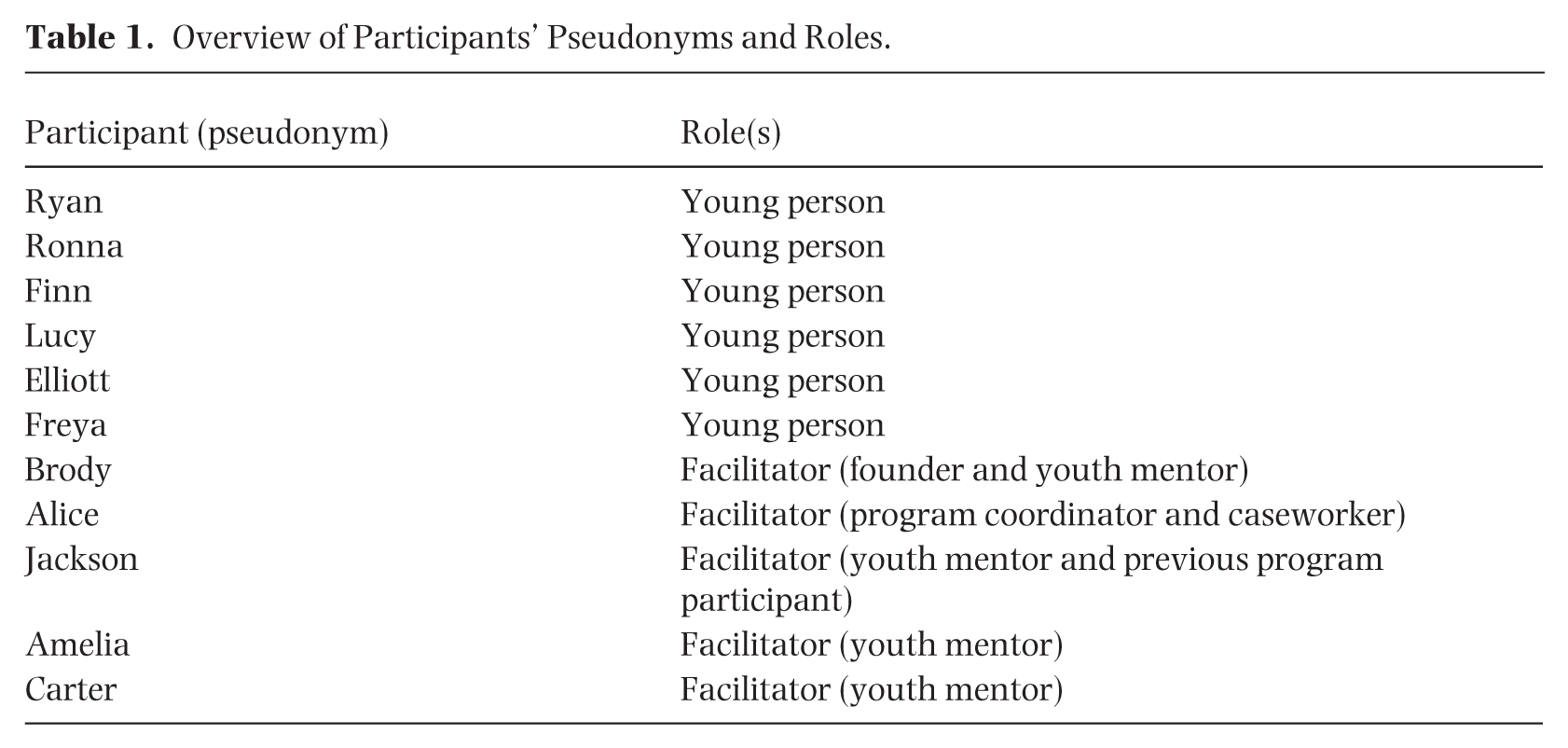
Eleven participants from the CMEP were part of the study, consisting of five facilitators (identified as F) and six young people aged 15–24 (identified as YP). Recruitment procedures were negotiated directly with the program and ethical clearance to conduct research was granted by the Edith Cowan University Human Research Ethics Committee (2022-04027-GOOPY). A CMEP staff member was given a recruitment script emphasizing participation was voluntary and confidential and introduced young people to the study. Interested program participants were provided with an information letter and consent form in hard copy and digital copy. All participants were required to provide written consent, and young people under 16 years of age were also required to have parental or caregiver written permission. Participants also affirmed their consent at the beginning of each interview. Table 1 provides an overview of the participants, their pseudonyms, and their roles.
Overview of Participants’ Pseudonyms and Roles.
Data collection
The first author collected qualitative data by observing and participating in sessions and conducting one-on-one semistructured interviews with young people and facilitators over three visits. Participation included singing during opening jam sessions and sharing in subsequent group discussions. After the initial group work, the first author observed young people during their creative time. Participant interviews were conducted on-site and scheduled before, during, and after regular program sessions. Young people completed three 30-minute share and tell interviews involving a drawing task and sharing music with follow-up questions. Given the nature of the setting, particular care was taken to ensure the safety of all involved and the first author was always accompanied by a CMEP facilitator. Facilitators completed one 30-minute individual semistructured interview and were asked to describe the program, their approach, observed outcomes, and follow-up questions. Interviews also included a distress protocol; however, it was not needed on any occasion. Participants had the opportunity to check and amend their interview transcripts, with no changes made. The program reviewed and approved the manuscript for submission.
Data analysis
Data were analyzed using six phases of inductive reflexive thematic analysis (Braun & Clarke, 2006; Braun et al., 2019; Terry et al., 2017). The sequence involved both authors familiarizing themselves with the data through close and repeated readings of interview transcripts and observation notes. The authors then identified initial codes that summarized and organized the data, generating themes that reflected patterns of participant experiences. Themes were reviewed and checked according to the data codes, then defined, described, and named before producing the report. Thematic materials were discussed in detail between the authors throughout the analytic process. In what follows, findings are structured by three overarching themes with three to four subthemes each, supported by quotations from the participants. The discussion examines the findings using BPNT, the limitations of the study, and the implications of the research for school music education.
Findings
Three overarching themes were derived for how this CMEP satisfied psychological needs and promoted wellbeing for the young people participating. A sense of belonging was achieved by a positive, family-like environment promoting no judgment, connection, and inclusion. Facilitator role models provided informal music and formal life learning activities. Young people were empowered to take control and were instilled with a sense of accomplishment and purpose. Figure 1 provides a visual representation of the themes and subthemes.
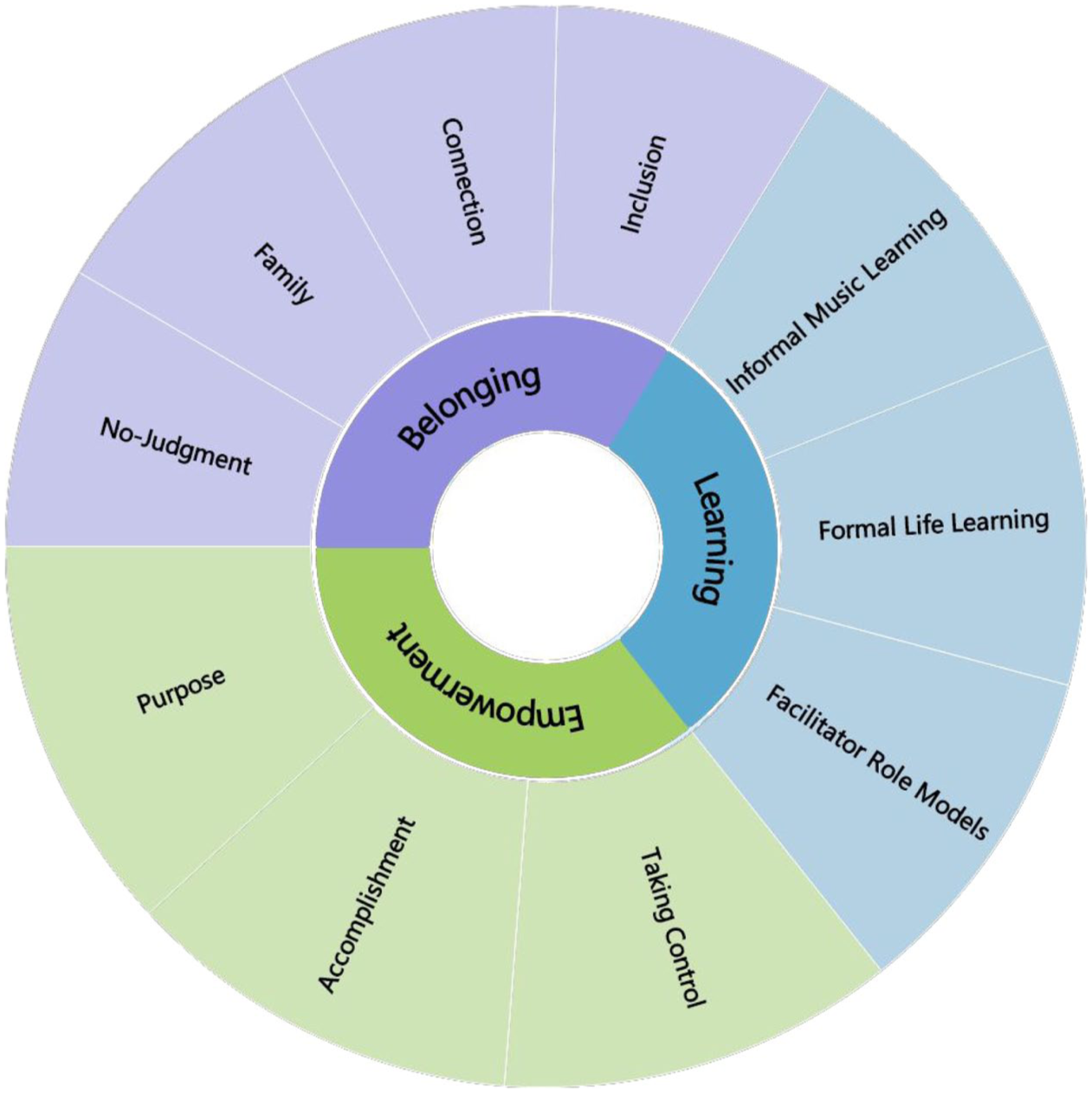
Community Music Education Satisfying Basic Psychological Needs and Promoting Wellbeing of Young People Experiencing Challenging Life Circumstances.
Belonging
This CMEP contributed to the participants experiencing a powerful sense of belonging and place, which was central to their future investment, attendance, and engagement in music learning. Belonging was particularly important, as some participants were unaccustomed to feelings of trust, intimacy, or social cohesion due to their circumstances. Ryan (YP) described his first day in the program as:
One of the best days I’ve ever had . . . I found a group of people that I can talk to, and I can trust in . . . The fact that I was able to come to this place and express any pains or thoughts or funny things . . . was amazing.
Further investigation of participants’ perceptions of belonging revealed four subthemes: no judgment, family, connection, and inclusion.
No judgment
The CMEP facilitated a no-judgment understanding of participants’ personal backgrounds, free from evaluation or criticism by peers and facilitators. This was experienced through validation in a strengths-based sharing approach in group activities, storytelling, reflections, and attention to music and life skill development. Brody (F) described music as central to creating a judgment-free environment, saying, “We’ve become very good at setting culture and helping young people quickly open up, in a non-judgment place, through music . . . Music gets underneath the mask.”
Family
Participants described their presence in the program as being at home and part of a trustworthy family providing unconditional support and guidance, separate from the outside world. For example, birthdays were celebrated with merchandise donated from sponsors. Amelia (F) reflected on her role, “I’m like a big sister.” She added, “It doesn’t matter what’s going on outside, this is family when you’re here.” Ronna’s (YP) experience of family within the program was linked with a perception of not being judged, “Walking in here for the first time . . . everyone was so nice to me, and it just felt like home . . . I could be myself without the judgment of others.” Jackson (F), a former CMEP young person and current facilitator, anthropomorphized the program, expressing its all-encompassing guiding force, “CMEP is like a family member to me . . . the people, . . . the culture, the way of living, the way of addressing your life, the way of thinking about challenges; it’s an attitude, and it’s a purpose.”
Connection
Connection was experienced in an empathetic environment, whereby participants were nourished by sharing food and personal stories. These intimate processes helped participants overcome adversity. For example, Amelia (F) explained how the provision of food not only fulfilled the basic need for nourishment but also, like music, opened communication pathways, contributing to a greater understanding of young people’s experiences:
For me, food is a gateway, just like music is. It helps a young person open up. For some of our young people, they don’t have food that’s accessible at home. They could be homeless . . . Food and chatting is usually when you pick up if there is a mental health, . . . financial, . . . or housing issue.
Ryan identified how connection with others in the CMEP contributed to experiencing unfamiliar feelings of security and being understood:
I haven’t always had people who I could talk to . . . I’ve had to keep a lot of my stuff bottled up. . . The fact that I can do this right here and speak what’s happened to me, and I can just be open and honest, is the best part for me. That’s what I love about this place.
Inclusion
Participants were nurtured with intensive individual, life-focused, and deliberately inclusive, equitable support, in which their backgrounds, abilities, challenges, triggers, and aspirations were known, understood, and cared for. This environment was unfamiliar and previously out of reach for some. Amelia (F) explained, “It doesn’t matter what the person’s background is, there’s no discrimination . . . everyone’s welcome . . . treated fairly, equally, and equitably . . . Everyone has the same opportunities . . . On the streets, it would be a very different situation.” Through shared understanding and musical pursuits, participants were encouraged to communicate and build relationships with others. Finn (YP) stated, “It helped me because before, I felt like I was the only one who was going through bad situations in my life. Hearing other people’s situations and how they were still positive about life helped me a lot.”
Learning
Learning as a support mechanism for young people in this program emerged as the second central theme. For Elliott (YP), the program was “Educational, fun and . . . it really changes your life . . . If you want to learn about not just music, but grown-up stuff that they don’t teach you in school, then CMEP is your place.” Three subthemes were derived within this theme: informal music learning, formal life learning, and facilitator role models.
Informal music learning
Listening to and making music often drew young people to the program. Elliott (YP) exclaimed, “I love music. Music brought me here.” Then, through informal learning processes, participants devised music projects, such as writing a song or recording a podcast, which inevitably involved the need to upskill musically, including lyric writing, instrument playing, and digital recording and production skills. Developing music skills gave each young person a focus, improving their lives. Jackson (F) explained,
Most come because they love music. Maybe they play an instrument, they sing, they rap, they want to produce . . . maybe they . . . just love listening to music. I think music is so intertwined with our being that it finds a way of cutting to the core of what’s important to you, regardless of what you’re going through. So, maybe they come in just for the music, but it very quickly becomes about how you make your life better. It’s sneaky learning.
Formal life learning
The young people were drawn to the program by music, and these artistic pursuits served as a resource for developing life skills. For example, songwriting collaborations included young people’s stories. However, facilitators prioritized formally teaching life skills, addressing fundamental survival topics such as budgeting, finding a job, securing safe housing, obtaining a driver’s license, and choosing healthy relationships. Carter (F) explained, “Each week, we have a different focus . . . where we’re addressing a different life skill . . . that can elevate your performance.” Carter (F) identified the impact of the formal instruction, “We’re giving them the tools and the skills to be able to put themselves where they want to be and access all their potential.” In this context, learning success was measured primarily by achieving life skills rather than musicianship. Lucy (YP) explained her learning experience, “The program’s not all about music, you learn . . . how to budget, how to live life as a functioning adult . . . I’ve learned how to network a lot better . . . presenting work to potential collaborators and then other connections.”
Amelia (F) explained how the program provided one-to-one support, describing the impact on one individual:
The young person refuses to go for driving tests because she doesn’t want to fail. She feels like she’s failed everything in her life, so she doesn’t want to fail that too . . . We really encourage her . . . by getting her to come in one-on-one, or even during programs.
Acquiring skills such as a driver’s license in a regional area can be life-changing by expanding employment opportunities. A driver’s license is also deeply personal, as “they’ve got something that’s their identity.” Amelia (F) continued, “For some of them, driving is something that most of their family doesn’t do appropriately . . . It’s . . . learning the right way to do things and . . . achieving something that they could never imagine.”
Facilitator role models
Facilitators functioned as relatable music and life role models within the program. Brody (F) linked the facilitators’ mentorship with music, “Every young person deserves someone who believes in them, and we do that through music.” Facilitators were key to establishing a supportive culture, leading young people to expand their perspectives on themselves and their learning capacities. Ryan (YP) explained how the facilitators had a united approach in their mentorship, “They all have their different ways of doing it, but they’re all trying to do the same thing; make me the best me.” Ryan reflected how his broadening learning experiences with peers were enabled by facilitators and contributed to developing trust, “I’ve learnt that there are people more like me, . . . there are people I can talk to.” Facilitators were examples of individuals overcoming personal difficulties, mainly through musical endeavors, and served as inspiring and healthy identifiable role models. Alice (F) commented on the impact of one former CMEP young person turned mentor, “The kids just absolutely adore him . . . They look at him and the story that he’s got and they go, ‘Well, look how well he’s doing, that’s what I want.’”
Empowerment
The third derived theme was empowerment, whereby musical involvement contributed to young people experiencing transformation and escaping unhealthy patterns. Jackson (F) reflected,
The CMEP is a place where music is the medium for change. It’s not music for music’s sake, it’s music for life and for growth and happiness and safety and joy and security and love, and all of the things tied to our lives. That’s what we’re using music for. We’re not just teaching kids G chords.
Brody (F) linked the program’s communal focus on music to its capacity to nurture and heal young people:
We use music to uncover what’s special about each young person, to help heal trauma, . . . find their place in the world, and . . . have a voice . . . We’re a family that dance together, sing together and . . . believe in young people’s potential, and help them break free from negative cycles.”
Ronna (YP) described the impact on musical development on her life: “It gives me a sense of freedom because I can just express how I’m feeling with making music . . . It doesn’t feel like anyone else’s but my own.” The theme of empowerment was underpinned by three subthemes: taking control, accomplishment, and purposefulness.
Taking control
It was acknowledged within the CMEP that many of the young people faced circumstances beyond their control. Jackson (F) explained,
It just makes me really sad how many people in this country don’t have [adult life skills], and of no fault of their own. It’s just they don’t have the privilege of having people around them, whether it be family or mentors . . . that can teach them that.
However, participation in the program facilitated the young people’s ability to take control and be responsible for themselves. For example, Alice (F) reflected, “I’ve seen a lot of kids want to put the work into changing to be better people.” Learning music and life skills with the program motivated young people to improve their situation and make positive choices. Amelia (F) reflected,
I’ve seen kids go from being homeless to having a job and a roof over their head that they’re paying for and thriving . . . I’ve seen young people that were extraordinarily shy . . . now performing on our stage, . . . making social connections, . . . have friends . . . I’ve watched kids fighting drug addictions and overcoming them.
Accomplishment
A growing sense of accomplishment fueled young people’s motivation to continue taking control of their lives. Future goals in music and life were strongly encouraged by the facilitators and were gradually believed to be achievable and within reach for the young people, whereas previously, they were unimaginable. Elliott (YP) described how his increasing musical abilities were a means of supporting his future:
I see it going all my life . . . I don’t want to lose music . . . In my life music is the one thing that helps me . . . If I need time away from my thoughts or from screens or anything, I’ll hop on the kit, grab my guitar, ukulele, piano, and do that.
Purpose
This CMEP was a transformational resource for young people, helping them develop a sense of purpose. Brody (F) explained, “There’s been a lot of powerful, transformative work over the years . . . A lot of our kids go on to be the change . . . So, it’s a ripple effect . . . They come in here, they realize they can make a difference.” Freya (YP) described a profound love of music “because it gives me a voice, and, since I battle with anxiety, it helps me express my feelings and articulate them.” She added that without music, “life would be dull or meaningless and boring.”
Purpose involved the young people constructing a personally meaningful future vision for themselves and a perspective on how they could positively impact others, often through their music. Freya (YP) viewed herself as a potential role model and felt a sense of purpose in the hope that her growing musical capacities could lead to a career as a professional musician, “I would like it to have an impact on other people . . . I would like to perform my songs . . . That’s where I want it to take me, to start making a career out of it.” Freya hoped her music could reduce isolation for others, “so if people were struggling and going through similar things, they can know that they’re not the only one and the message will reach out to them.”
Discussion
Psychological needs
This CMEP promoted wellbeing by facilitators creating an environment that satisfied young people’s relatedness, competency, autonomy, and deficit psychological needs. The findings provided insight into how needs were satisfied and wellbeing enhanced in this CMEP.
Relatedness
Relatedness was the leading psychological need reported to be satisfied by the young people and facilitators. All aspects of the program were social, underpinned by a positive family-like environment where culture and relationships were deliberately nurtured. Connections and trust between young people and facilitators were supported by sharing previous difficult experiences. Involvement included genuine participation in group music-making at one’s own level and the voluntary sharing of personal perspectives and experiences, contributing to security. Belonging was achieved through positive relationships in a safe, no-judgment, and hope-filled environment that revived and shared lost family rituals. The program was a sanctuary for young people where difficulties from the outside world could do no further harm, and facilitators created supportive spaces for young people to pause, reflect, and begin to take healthy actions. Cultivated friendships transcended the boundaries of the program. Music served as a pathway to satisfying relatedness needs, allowing young people to “open up” and get “underneath the mask” (Brody, F).
Relatedness as a leading psychological need disrupts traditional views of music education, which typically prioritize music knowledge and skill development. Emerging research in high school class music has also identified the importance of relationships in music learning environments with older adolescents (Goopy, 2024), and there are calls for relatedness to become a priority (Freer & Evans, 2019). While relatedness may have been the leading need in this context, it may not be the same for all contexts and groups of people, and it is acknowledged that leading needs vary (Ryan & Deci, 2017). For example, Goopy (2025a) found competency to be the leading psychological need for young adolescents committed to music education in an academic high school environment. Further global research is needed to understand leading psychological needs in music education and how they can be satisfied in diverse contexts and populations. As belonging is contextual (Ryan & Deci, 2017), further investigations are needed to understand whether participants’ wellbeing outcomes extend beyond the program. Determining how music education can go beyond a location-based wellbeing resource would be valuable.
Competency
In this CMEP, competency was satisfied through highly individualized learning within a group setting. The CMEP curriculum was aspirational, focusing on meeting young people where they were and enabling personal growth, rather than achieving prescribed outcomes. Young people were attracted by learning music but benefited most from life skills, which a prior participant and now facilitator, Jackson (F), described as “sneaky learning.” Formal and informal instruction were complementary approaches in this program. Life skill development occurred through a formal approach using a carefully planned sequence of lessons directed by facilitators. Each week had a different focus and was often viewed through the experiences of relatable facilitator stories and contextualized to the music industry. Musical skill development occurred through informal learning. Creative time involved self-directed learning and a process of reflecting on life lessons learned. In this CMEP, all levels of knowledge and skill were welcome, and personal growth was celebrated. The highly individualized learning for young people supported the need for a “living curriculum” (Alessandri et al., 2020). In this case, learning and engaging in music initially had greater value; however, competency in life skills provided greater satisfaction. The need for competency in life skills over music skills is an example of how psychological needs that require satisfaction may not always be those that are most valued (Ryan & Deci, 2017).
Autonomy
While life skill development was non-negotiable content at the CMEP, young people had significant choices in their attendance and engagement, types and ways of music-making, listening and learning, collaboration, and extent of sharing their stories with others. Ongoing endorsement occurred from facilitators, peers, caretakers, and close relations, as well as broader public recognition through social media, sponsors, and society, as opportunities grew. Young people’s autonomy and self-awareness developed in tandem, strengthening together. Empowerment occurred when young people took control of their choices, found a sense of purpose through and with music, and accomplished music and life goals. Controlling contexts have been highlighted as causing needs frustration, with a careful delineation needed between control and structure (Blackwell et al., 2020; Bonneville-Roussy et al., 2020; Ryan & Deci, 2017). A balanced structure in this program was achieved through highly independent engagement in music and recognizing a need to formally address life lessons.
Deficit needs
Given the life backgrounds of young people in this context, satisfying deficit needs was an important aspect of the CMEP to combat need frustrations and facilitate thriving. Creating a sense of belonging satisfied the deficient needs of security (protection) and self-esteem (feelings of worth) (Ryan & Deci, 2017). Security needs were satisfied by fostering a positive family environment and connection. Self-esteem was also satisfied with a no-judgment and inclusive environment. Satisfying deficit needs is not known to have been previously considered in music education studies. Given the widespread and complex mental health issues currently faced by youth, further research on how to satisfy deficit needs is warranted to truly achieve inclusive and equitable music education.
Autonomy support
A significant feature of this CMEP was the extensive autonomy support provided and modeled by facilitators toward all the psychological needs of youth in their care. In this setting, the facilitators each had specialized roles and were strong musical and life models. Every session began with a group musical jam led by facilitators and group sharing of personal stories of triumph and overcoming struggles. Highly individualized support was provided, similar to that offered by caseworkers in social work, and included proactive check-ins and one-on-one support outside sessions. Facilitators also took on roles traditionally filled by family members, such as “sister” (Amelia, F) and “goofy big brother” (Carter, F) and demonstrated a genuine interest in and care for young people’s wellbeing. Young people also began taking on roles modeled by facilitators, such as providing gratitude, praising peer success, and peer teaching during informal learning. Support grew from others outside the program as the youth’s success became apparent.
The need for autonomy support in music education has been identified in recent years (e.g., Blackwell et al., 2020; Bonneville-Roussy et al., 2020). Genuine care for and interest in students has been previously advocated (Goopy, 2024) and autonomy support has been found to have an influential role in supporting the psychological needs and elective music uptake of high school students (Freer & Evans, 2019). This CMEP exemplifies that autonomy support is effective when teachers and caregivers are responsive to the individual needs and perspectives of the people they care for (Ryan & Deci, 2017). Research is needed to further understand how music teachers and facilitators can provide individualized autonomy support, especially for diverse populations and contexts.
Limitations
This study was limited to young people in a specific CMEP who were already motivated, committed, and regularly attending the program. The research did not include young people with irregular attendance or those uncommitted to community music education. The financial pressures of operating music education programs in nonprofit and charitable organizations are acknowledged, and the authors worked to minimize biased participant advocacy through triangulation of multiple research methods and data sources and critical discussion between the authors during analysis.
Implications for school music education
School music education presents an opportunity to reach and satisfy the psychological needs of a broad and diverse youth population. CMEPs are uniquely positioned to innovate and disrupt the rigid structures of long-standing curricula and pedagogies, and the findings of this study have a range of implications that could be transferable and benefit school music education. This CMEP adopted an inclusive agenda that actively recruited and differentiated for youth who were struggling, with a genuine desire to support and care for all through music education. Findings revealed the power of self-selected, collaborative, and inclusive music-making and songwriting. While participants demonstrated an interest in learning music, they did not all necessarily have extensive music education backgrounds, and the CMEP catered for a range of musical abilities. School music, especially in later high school years, often demands particular levels of music knowledge and skills to participate, but this CMEP provides a compelling case for school music education to consider how the field can reduce, or even, in some cases, eliminate expertise barriers to accessing music education. A more inclusive approach would consider how curricula and programs can create multiple entry points into music learning. Such an approach would provide youth with a choice of when and how they access music education and would particularly benefit those with limited previous experience or a recently developed interest.
This CMEP used pedagogy that broke with tradition, combining informal music and formal life education. School music teachers should be empowered to re-evaluate the purpose of music in schools and re-imagine existing pedagogies to ensure they best serve young people’s healthy living. In this CMEP, psychological needs were met by prioritizing life skills over music skills and participant connection over skill development. Previous studies (e.g., Evans & Bonneville-Roussy, 2016; Evans & Liu, 2019) have suggested leveraging psychological needs to motivate students to continue studying and practicing music; however, we promote musical flourishing as a central aim. Schools and teachers are encouraged to reconsider the purpose of music education to enhance life, rather than only as career development.
This study spotlighted the significant and specialized role of facilitators within a support team and their influence based on their shared adverse life experiences. Overwhelmingly, in this context, the highly individualized support provided to young people and the facilitators’ co-construction of music and life goals satisfied individual psychological needs and promoted wellbeing. Rather than shying away, there was an expectation that personal stories of hardship would be shared in a safe, noncompetitive, and no-judgment environment. Schools and teachers should recognize the benefit of highly individualized support and goals for music students, and embed them as part of program planning and workload.
Conclusion
SDT, with a specific focus on psychological needs, is a useful theoretical lens to examine music learning and wellbeing. This CMEP satisfied the psychological needs of young people facing adverse circumstances and guided them toward healthy living and flourishing. Facilitators provided intensive individual support, formally teaching life skills complemented with informal musical development, and creating an environment with a sense of belonging that empowered young people. The insights gleaned from this CMEP disrupt typical dominating priorities in school music education, particularly those focusing on professional music career preparation, and call for a recalibration of music education where musical flourishing is a core aim (Goopy, 2024).
Future investigations are needed to determine how music education satisfies specific psychological needs and enhances wellbeing within and between individuals in diverse contexts and communities, particularly in vulnerable populations and nontraditional approaches to music education. Given the multiple avenues that typically contribute to an individual’s music education, there is an opportunity to interrogate the contribution to psychological needs satisfaction of different contexts more closely, including how they interact and how these findings might be scalable. Future research on music education and wellbeing using the other mini-theories of SDT is needed, including Organismic Integrated Theory (OIT) and the motivation continuum. The data collected in this study represent views from one moment in time, and future research is needed on the long-term outcomes of such programs. We also acknowledge that for many young people, this CMEP is potentially one of several support services used, and future research would benefit from examining how CMEPs can effectively operate within the allied health ecosystem.
Footnotes
Author contributions
Declaration of conflicting interests
The authors declared no potential conflicts of interest with respect to the research, authorship, and/or publication of this article.
Funding
The authors disclosed receipt of the following financial support for the research, authorship, and/or publication of this article: This project was supported by funding from the Edith Cowan University Early-Mid Career Researcher Grant Scheme 2022 (Stream 1).
Ethical approval and informed consent
Ethical clearance to conduct research was granted by the Edith Cowan University Human Research Ethics Committee (2022-04027-GOOPY).
Consent to participate
All participants were required to provide written consent, and young people under 16 were also required to have parental or caregiver written permission. Participants also affirmed their consent at the beginning of each interview.
Consent for publication
Participant information letters and consent forms informed participants about the use of their data and gave consent for publication. Participants also had the opportunity to check and amend their interview transcripts, with no changes made. The program reviewed and approved the manuscript for submission.

Data availability statement
The datasets generated and analyzed in this study are not publicly available because the ethics approval for this project did not permit the sharing of collected data. Requests to access the datasets should be directed to J.G.