



Abstract
The master–apprentice model has received substantial criticism within music education. While critiques often focus on the negative impact on the artistic agency of students and the rigid hierarchical structure of master–apprentice teaching, the ways in which gendered bodies move through and navigate such spaces are rarely considered. Through in-depth interviews with 20 musical women who work in the Australian Classical Music Institution (ACMI), this study identifies the presence of abusive and sexist behaviour in the Australian community and demonstrates how the role of a “master” pedagogue indoctrinates its musical women, perpetuating and normalising abusive pedagogical practices that extend into workplace culture. Drawing on the accounts of these musical women, this article presents a model to conceptualise and problematise the cyclic nature of the master–apprentice model and calls for a diversification of pedagogy within instrumental music education. The lived experiences of musical women working in the ACMI highlights how it is not merely the individuals within the system who perpetuate a culture of abuse, but the system itself that enables—and, indeed, encourages—gendered and abusive behaviour.
Keywords
Introduction
Much attention has been afforded to the exploration of the gendered lives of conductors (Bartleet, 2009; Bartleet & Hultgren, 2008; Howley, 2022), composers (Bennett et al., 2020; Macarthur, 2015; Mulligan, 2023), and performers (Bull, 2019; Hendricks et al., 2016; Ramstedt, 2022) in the global classical music industry. Gender research extends to gendered influences on students’ instrumental decisions (Casula, 2023; Doubleday, 2008; Halstead & Rolvsjord, 2017) and the embodiment of feminine and or masculine roles within musical spaces (Gibson, 2024; Kelley, 2020). However, surprisingly little research confronts the complex and highly gendered nature of pedagogy within the instrumental classroom. 1
Founded in Bel Canto traditions, the master–apprentice pedagogical model remains the dominant teaching method in instrumental music education (Burwell, 2013). Curated to a process of imitation that centres a “control of learning strategies” (de Bruin, 2019, p. 264), it emphasises processes such as exploring, modelling, and scaffolding (de Bruin, 2019, pp. 264–265). As a form of “teacher-centred pedagogy,” the master–apprentice model is also known for the perpetuation of “a clear hierarchy of power” (Sherwood, 2023, p. 13) that fosters a culture of silence (Gibson, 2024; Sherwood, 2023). Mateos-Moreno and Garcia-Perals (2024) have also described the master–apprentice pedagogical model as one that “neglects” creativity through its links to cultures of Western classical music (Holmgren, 2022), and that is negatively contrasted against “more modern and equitable teaching philosophies” (Mateos-Moreno and Garcia-Perals, 2024, p. 11).
The master–apprentice model has also been identified as being overly focussed on musical products (musical performance) above all else, consequently neglecting the health and safety of students (Evans et al., 2024; Matei & Phillips, 2023) and impacting their personal growth and development (Jääskeläinen, 2023). It has also been criticised for its reliance on imitation (Burwell, 2013), which encourages not only the perpetuation of the idealised performance of music and gender (Gibson, 2024) but also the imitation of specific cultural values (Bartleet, 2008). However, despite its many—and ongoing—critiques, students continue to expect to learn from a master (Ferm Almqvist & Werner, 2024). For example, advocacy within Australia continues to prioritise the perpetuation of the master–apprentice model (Media, Entertainment and Arts Alliance, 2025), demonstrating its perceived association with quality music education.
Socio-cultural studies have investigated the meaning and role of the master in musical spaces, noting phenomenological connections between the master and the genius—an intrinsically masculine conceptualisation of professional ability (Battersby, 1989, 2020; Borgström Källén & Ferm Almqvist, 2025; Gibson, 2024). This gendered construction has historically prohibited women from being respected as genius musicians, as they were considered “physiologically unsuited to be a great artist” (Battersby, 1989, p. 47). 2 Battersby (2020) endeavours to challenge the prevalence of genius in Western culture, noting that it should be conceptualised as a collaborative experience. However, once it is connected to a meritocratic, entrepreneurial, and individualist society, the claim of genius remains gendered (Battersby, 2020). Therefore, the culture of the genius that continues to exist within musical spaces (Borgström Källén & Ferm Almqvist, 2025) plays a pivotal role in the re/production of musical patriarchy (Green, 1997).
Studies exploring the similarities between professional performance and conservatoire cultures have also identified the persistence of gendered roles across orchestral and educational spaces (Higham-Edwards, 2023). Pedagogically, Wickström (2023) identifies the closed relationship of the master–apprentice as its central isolating trait, making students’ experiences with their teacher invisible to outsiders (p. 57). Others deduce the master–apprentice relationship as central to the perpetuation of a culture of gendered self-affirmation, self-reproduction (Prokop & Reitsamer, 2023, p. 39), and assimilation (Kawabata, 2023), acculturating (Christophersen, 2013) 3 students into a system that negatively impacts networking opportunities and self-confidence (Bull & Bradley, 2025). Wickström (2023) also notes that students are keenly aware of their teachers’ power as gatekeepers who have the capacity to “destroy” (p. 57) their careers. While some scholars have noted the added complexity of intersectionality in pedagogical spaces (e.g., Bull et al., 2023; Jorgensen, 2001; Ramstedt, 2024), research connecting the master–apprentice method to gendered experiences is only just emerging.
The success of musical women 4 is determined by an individual’s ability to imitate and or replicate the behaviours, cultural capital, and values of those in power (Puwar, 2004, pp. 122–126). Teachers represent the successful embodiment of an ideal and, through social cloning (Puwar, 2004), perpetuate a lack of diversity in musical spaces. Importantly, a fear of not being “taken seriously” (Wickström, 2023, p. 54) significantly impacts students’ decisions to speak out against injustice. Ramstedt’s (2023a, 2024) research into educational culture in Finland has also noted that current education methods utilised within musical classrooms leave female students vulnerable to abuse, grooming, and assault, demonstrating an urgent need for both pedagogical change and greater accountability.
Despite calls for a more “ethically response-able” (Burnard & Mackinlay, 2025) focus in music pedagogy and a proactive approach to harassment (Bull & Bradley, 2025), the master–apprentice approach remains common within instrumental education. As identified in this article, master–apprentice teaching is dominant not only in higher music education, where most research critiquing the master–apprentice structure originates (e.g., Bull, 2025; Ferm Almqvist & Werner, 2024; Werner & Kuusi, 2023) but is also commonly utilised in high schools and primary schools. To demonstrate the impact of the master–apprentice on Australia’s musical women across all stages of their education, this article will explore systemic inequalities through a critical feminist epistemology (Leavy & Harris, 2019) and poststructural ontology (Hesse-Biber, 2012) to challenge positivist ways of knowing (Leavy & Harris, 2019) and reconceptualise current understandings (Cannella & Lincoln, 2018). It will ask:
How does the master–apprentice pedagogical model function to acculturate musical women into the Australian Classical Music Institution?
How does the master–apprentice pedagogical model perpetuate gendered norms in the Australian Classical Music Institution?
Methodology
Participants and recruitment
This research draws upon interviews with 20 musical women working in the Australian Classical Music Institution (ACMI). The interviews were designed to use a life-history (Jackson & Russell, 2010) narrative method to explore the lived experiences of each participant within three facets of the ACMI: (a) beginner education, (b) semi-professional education, and (c) professional performance spaces. Between participants, interviews varied from 42 to 93 minutes in length.
Participants were recruited through a variety of methods such as engagement with prior research, snowballing, and social media callouts. Participants met the following criteria:
Female identifying.
With experience working professionally within the ACMI.
With some classical music training.
Participants and data gathered ranged in geographical location and decade. Some musicians recalled their experiences from the 1980s Australian music scene, while others spoke about more recent experiences across diverse locations such as Europe. At the time of the research, participants ranged in age from mid-20s to late 60s, reflecting the perspectives of musicians at different stages of their careers (from emerging or post-study to well-established or nearing retirement), and varied in instrument specialisation.
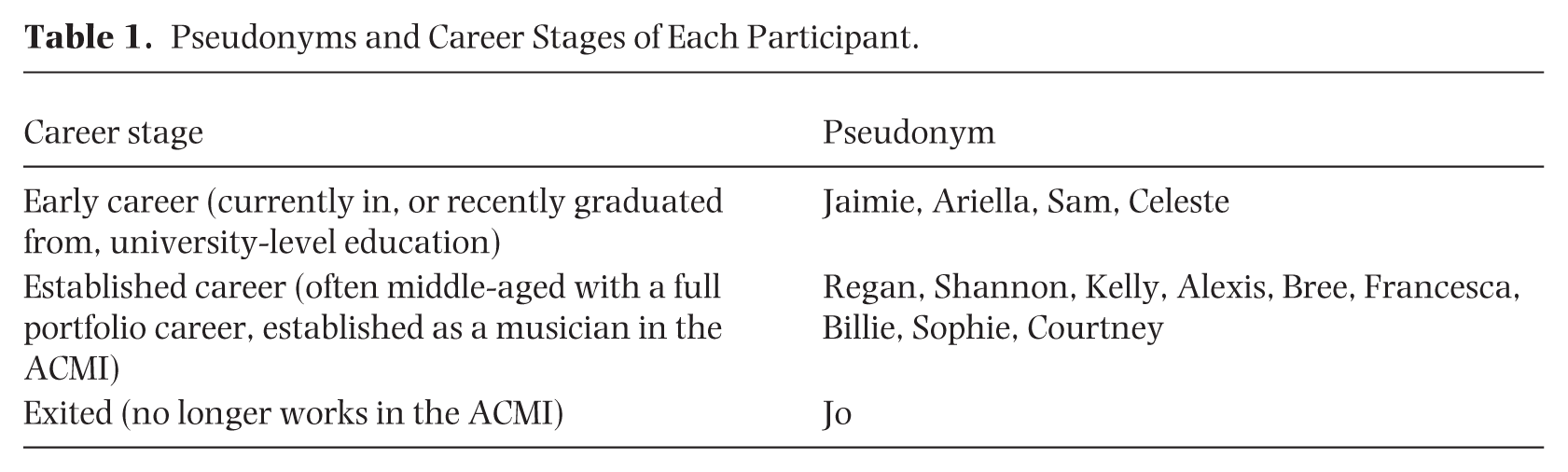
Of the 20 interviewed for this study, the accounts of 13 are included in this article. A full list of participants’ pseudonyms and career stages can be seen in Table 1.
Pseudonyms and Career Stages of Each Participant.
All interviews were conducted via Zoom in accordance with the COVID-19 pandemic lockdown restrictions in Melbourne, Australia. Recorded interviews were transcribed verbatim and coded in NVivo.
Analysis
This study utilised thematic analysis of participants’ narratives to demonstrate how their lived experiences existed in relation to other participants in the study (Barrett & Stauffer, 2009). Initial analysis of transcriptions occurred prior to a secondary analysis in NVivo, where streamlining of codes began. Discussion of educators was coded under “teachers,” with sub-codes for descriptions of feedback from teachers (“receiving feedback,” “providing feedback”), and descriptions that were explicitly gendered (“gendered language,” “gendered qualities”).
Once thematically processed, participants’ narratives were “turned” (Barrett & Stauffer, 2009, p. 3) to demonstrate connections between their otherwise independent lived experiences. Turning facilitates an inquiry into how our “social, cultural, familial, linguistic, and institutional narratives within which individuals’ experiences were, and are, constituted, shaped, expressed, and enacted” (Clandinin, 2016, p. 20). These enable the transformation from what is occasionally “messy talk” (Riessman, 2008, p. 28) into “mode[s] of knowing” (Barrett & Stauffer, 2009, p. 7) that facilitate the exploration not only of what is said, but also of how and for whom it is said (Riessman & Speedy, 2007). Riessman (2008) noted that maintaining the original meaning of stories shared—keeping them “in-tact” (p. 53)—is also an important component of turning (Barrett & Stauffer, 2009), as the goal of narrative inquiry is not to represent statistic occurrences, but to demonstrate theoretical and phenomenological commonalities (and differences) between them. In the present study, through the process of turning, results were also triangulated (Denzin & Lincoln, 2018; Natow, 2020) to increase reliability.
Ethics
Ethics approval was granted for this study (Project ID: 24438, Monash University, Australia). Concern for participants’ safety and appropriate use of their lived experiences was an ongoing and critical part of the research process. This ethic of care was present during interviews and then in the processes of interpretation and turning, ensuring that the analysis process felt safe, ethical, and just for both participants and researcher, while also advancing understandings of the social and institutional processes acting on participants as gendered subjects. I engaged actively with participants to care for their wellbeing during and after interviews through opt-out opportunities, member checking, and facilitating moments where participants could speak off the record or retract statements. Every effort was made to ensure that participants were not re-traumatised by avoiding intrusive questions.
Some participants expressed direct concern around identification during our interviews and participated with the knowledge that identifiable information would not be provided. This formed an integral component of a confidentiality agreement. Therefore, while participants reflected a range of intersectional identities, for the purposes of participant safety and anonymity, in this article, identity descriptors are not ascribed and names are replaced with author-assigned pseudonyms.
Findings
The following section describes how participants discussed their experiences with male and female teachers. 5 Most musical women implied their awareness of “feminine mothers” and “masculine masters,” describing their teachers with gendered language. Some participants described explicitly how they were taught as gendered subjects. They recounted a lack of boundaries, issues of trust, and the use of touch in musical spaces. These musical women also articulated the impact of their teachers’ critique, demonstrating the consequences of “feedback” on students’ sense of self as musicians and as individuals. The turned narratives of these musical women as gendered subjects demonstrate the lasting impacts of the master–apprentice model.
The masculine master and the feminine mother
For Regan, an established musician who was at one point in her life having two lessons a week, the role of teacher “was much bigger [. . .] than just your music teacher.” Often described as mentors, teachers were typically chosen for their musical skill and reputation. However, gender appeared to shape perceptions of and reactions to educators, as interviewees often described their mentors through gendered language. Only Bree explicitly expressed an awareness of a gendered perception of music teachers, describing her colleagues’ responses to educators, and the reasons for their reactions, with cynicism:
I’ve seen female students being quite star struck by their male teachers . . . I wasn’t busy with their charisma at the time . . . I think the, um, role that [my female teachers] played has had a deeper lasting effect on me than that kind of momentary charisma.
Bree’s description of “star struck” students foreshadowed the gendered adjectives that many musicians used to describe their teachers. Musicians such as Celeste (who stated that her teacher “was like a really big mother figure to me”), Jo (whose teacher was “like a mother figure . . . really kind and supportive”), and Bree (who described her teacher as a “grandmotherly figure”) used maternal and feminine gendered language to describe and explain the impact and role of their female teachers in their lives.
Regan also described her female teacher as a “kind of motherly figure,” while Ariella described her teacher as “kind of like my [instrument] mum” and as an “incredibly strong person.” Using such personal descriptors for their educators clarified the importance of female teachers in their lives, describing their roles emotionally and as primarily maternal. Bree also noted that there was something special about being taught by a female-identifying musician:
I think [having mostly all female teachers] made a difference for me, as far as role models go, and I think that was important. I think there actually is something special that, also with my own teaching with little kids, especially little girls, I think really identify well with a woman teacher and sort of aspire towards that. So I think I had that for sure, as well.
The impact of female educators was also expressed by Shannon, who described how seeing a female teacher who was married with a family and had a professional life:
was a really big opportunity to go, “Aw, look!” This is how life can be. You can work and you can be a mother. You can teach, you can play, you can do everything!
Male teachers seemed to have a different impact on their students. As Bree foretold, a star-like quality seemed to be invoked whenever these musical women discussed their male educators. Conversations moved away from maternal descriptors and instead towards discussions of technical ability and incredible musicality. The closed relationship (Wickström, 2023) was also emphasised here, as these musicians were recognised for their role in providing a platform for these musical women to enter the ACMI. The power of these gatekeepers in the ACMI extended from teachers to other musicians in powerful positions. As Kelly said:
I think very much in our industry there are so many people who are talented and you need people that actually identify and recognise your talent . . . and if you’re lucky, and you get a powerful conductor, say, or artistic director who likes your work . . . it makes such a massive difference to your career.
Kelly continued by describing herself as the “naughty daughter” of her male teacher-cum-mentor—forming one of the only familial references for a female student and a male teacher that appeared in these interviews. These experiences described an element of admiration that facilitated the manipulation of power within the master–apprentice relationship. This gendering of musical mentors saw male musicians, teachers, and mentors benefitting from a gendered culture that had the potential to benefit some and disadvantage others.
Male gatekeeping was a dominant theme echoed in many participants’ educational anecdotes. Musicians such as Kelly said her teacher “had a massive impact on my life, getting into the industry and staying in it.” Courtney also noted her male teacher provided opportunities, saying:
He got me my first couple of gigs. When conductors rang [him] up and said that they needed a musician for this or that, he put me forward for them. So he obviously saw something in me.
In contrast, Alexis was one of the first participants who raised an awareness of the possible issues that surrounded the master–apprentice dynamic. As we briefly spoke about her experiences with teachers, she recalled a particular educator who made her feel like she was never good enough and “said something really inappropriate.” While Alexis could not elaborate on this in our interview, her story hinted at the powerful position of educators, especially those who function within the traditional master–apprentice pedagogical model (Figure 1).
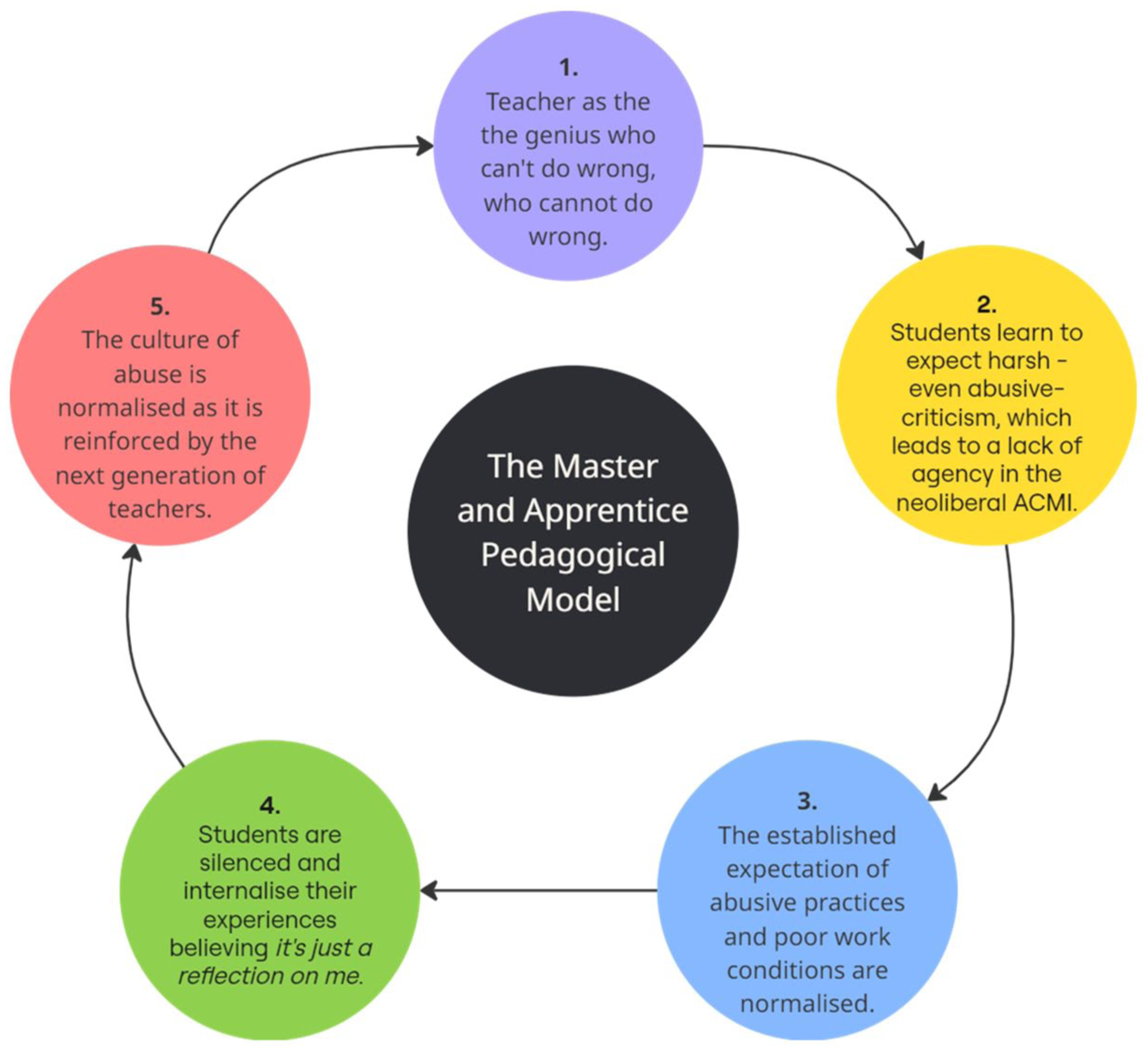
The Master and Apprentice Pedagogical Model.
The descriptions shared by these musical women demonstrated strongly gendered perceptions of musical educators. While many of the stories these musical women shared were positive, their perceptions of educators placed gendered expectations upon them, informing how they reacted and responded to their teachers’ actions. While there were teachers who, as Sophie said, were “supportive of everybody no matter their skill level, no matter their age, no matter [what career they wanted to pursue],” there were also teachers who manipulated students and, as implied by Alexis, behaved unprofessionally and inappropriately.
Trust, touch, and boundaries
[T]here was a very strange moment when we decided as a family to leave a particular teacher—I’d forgotten about this! He was teaching my sister and he was talking about the muscles you should use as a musician and he took his shirt off so that she could see muscles. I don’t know how old she was, but pretty young. She came home and told my mum and my dad and they were like, “Right! That’s it for that teacher!” Haha!
Suddenly recalling this memory shocked Bree. While they could have gone further and complained, Bree noted that her family chose not to and instead decided:
[not to] make a big deal out of [the situation]. We’re just moving on to a new teacher and that [behaviour was] not OK. And we’re going to tell her [my sister] that it’s not OK.
Bree was one of the few who recalled leaving a teacher. Most musical women instead described accepting unprofessional or dangerous behaviour as part of the norms within the ACMI, enduring this predatory behaviour as a rite of passage. As Jaimie said:
I, haha, the things that I’ve been yelled out about um, are pretty, they seem minor. And [my teacher] really, um, she really instils the importance, maybe sometimes a bridge too far, but on her students of, I want to say professionalism. I mean, just pretty much being above reproach in terms of punctuality, how prepared you are, how organised you are, how polite you are, um, and just giving nobody anything untoward to say about you, which is, um, has been a lot of pressure. Um, but I am grateful for it in that, I think it means I don’t have to worry, “Oh, crap, did I just say something really stupid?” Or, “What if this person hates me for something that I did?” Um, because it just, yeah, it eliminates all of that. And I—it’s different, I imagine, again, once you’re sort of more established, and you have jobs and that kind of thing. Um, but certainly, [female teacher] has played an enormous role in establishing, um, well, in helping me establish a professional identity, um, musically, I would say.
Jaimie seemed grateful for the lessons her teacher taught her, and her tone demonstrated a trust in their teacher’s actions and methods, despite potential abuse of that trust. This was not uncommon, with many musical women describing the abuse of power and manipulation that occurred in music lessons. Jo was particularly aware of the overwhelming lack of agency that she experienced as a student. As an 18- to 19-year-old, Jo worked with a number of music specialists at conservatoria and orchestras alike, where many musical men displayed an unprofessional interest in her.
I was like, “Wow that’s amazing, [he] has added me on Facebook! That’s so weird like, and so cool at the same time,” cause I was like, “Oh my God, that’s an in!” blah, blah, blah. I can talk to this person, because they’re from this amazing orchestra. Looking back I feel kind of gross about it. That I was so like, didn’t realise that that’s probably a bit of a red flag cause he was probably only adding me because I was a young, pretty girl that just happened to play [the same] instrument. And I was like, “It’s an in!”
Jo later realised that these interactions were not because of her musical abilities or his interest in her professional career.
In my eyes, it was like, “Oh, this is my ‘in’ into the industry!” I was so blind to the fact that I was just being taken advantage of . . . It’s hard to grapple with, because it’s like, you know, I thought that they saw me as someone that was quite hard working . . .
Jo revealed that one of the orchestral musicians she had thought she could trust later said “Oh, I really wanted to ask you out.”
Oh my God. This guy’s nearly 50! That’s fucked! . . . He was like, “Aw, I thought people would be like, think that was weird that I was going after all the young girls,” and I was like, “Well, obviously you are!” He used to say a similar thing to my housemate, too. Urgh! I think there’s this thing, this entitlement, that a lot of men have in this industry—and they’re just gonna take advantage . . . of young girls who are trying to get ahead [in the institution] and don’t realise that, you know, they’re not talking to you because they want you to be the best musician [you can be]. They’re talking to you because you’re pretty.
Jo described an awareness of the emotional impact of her teachers’ abusive criticism and the implications of this pedagogical norm:
[F]or some reason we idolised [them] and really wanted to be torn down [. . .] for some reason we had this idea that if he ripped you to shreds it meant that he, um, thought you were a good player. [. . .] [W]e just thought that it was OK to be spoken to like that and just absolutely obliterated by people. And we thought we wanted that. We craved that.
Jo’s expression as she described this sensation demonstrated confusion and a sense of overwhelming bewilderment. The ongoing consequences of this form of abusive pedagogy could also be located in the way that musical women navigated the institution. As Shannon said,
[Y]ou know, the old male teacher dating every female student that goes past [. . .] it’s still there with the older male teachers making sure that they’ve got to have an affair with all their beautiful students.
Shannon continued, as many musicians did, to suggest that “no one does it consciously, I guess,” expressing her belief that these types of behaviours happened less in Australia than in other countries.
[Conservatoria] really are the wild, wild West. I mean, you could be in your room with your teacher doin’ all kinds of, they could be saying any kind of inappropriate stuff. You’re placing a lot of trust in this person and [. . .] they can tank your career. I like to think that things are a bit less hardcore now. But if your teacher doesn’t like you because you call them out or reject them in some way then, you know, you’re effed and you don’t want that to happen.
Likewise, Billie reflected on her experiences with power imbalance within the “wild West” of the conservatorium, describing the changes that she has witnessed since she was a student:
[W]hen I was a student, um, even though it never happened to me, um, you know, I was aware that, um, friends and—not even at the university that I was at—but friends at other universities, you know, had been, you know, propositioned and—and I would say, probably mildly harassed by their old, you know, university . . . male university teachers. And, and obviously you know, those times have completely changed. And if that happens now people lose their jobs! But, that was still kind of the culture.
Despite Billie’s belief of increasing accountability and visibility within instrumental education, the experiences shared by these musical women demonstrated an invisibility and a significant lack of accountability. The use of touch, abuse of trust, and unprofessional boundaries existing between masters and their apprentices in the institution demonstrated inconsistencies with Billie’s perceptions. With only one musician recalling leaving a teacher, educators rarely appeared to be accountable for their actions, and instances of “people los[ing] their jobs” (as assumed by Billie) were seemingly non-existent.
“Keep trying”: The teacher’s critique
[. . .] “If you’re serious about music, you’ll study up in [this prestigious music] school with [this prestigious music teacher]. But, to be honest, you probably won’t get in and if you did, you’d be the worst one there.” [. . .]
This was what Jaimie’s male teacher told her during a lesson in the lead up to her Year 12 music exams. Despite her qualification that he “didn’t say it in an aggressive way,” Jaimie’s account identified multiple instances of “harsh” criticism from her teachers. She also described this particular exchange not only as a foreshadowing of the communication style she grew accustomed to in her tertiary studies, but also as:
a bit of a reality check and, um, it was quite traumatic, haha, while it was happening [. . .] I think he was acting at her [the prestigious teacher’s] behest or something [. . .] And, I mean, he was right. There was no way I was gonna survive in her music class as a coaster. So I think it was—I understand his reasoning, um, and I think it worked. But [I] was sad while it was happening.
Jo had similar things to say about her experiences receiving feedback from “respected teacher[s].”
There was one teacher who was a male in his, like, 60s. Super respected teacher. But um, for some reason we just had this idea that if he ripped you to shreds it meant that he, um, thought that you’re a good player—which is totally ridiculous now that I look back on that. And I’ve spoken to a lot of friends about that for some reason we were taught that it was OK to be spoken to like that and just absolutely obliterated [by our teachers]. And we thought we wanted that. We craved that.
Jo continued describing how these experiences “kind of messed you up a little bit,” sarcastically saying:
[N]ow I’ve got this advice I can move forward because this person believes in me ’cause they took the time to rip me to shreds!
Both Jo and Jaimie were chuckling as they told me these stories, laughing at the ridiculousness of what they experienced. For many musicians, receiving harsh feedback could lead to a near paranoia concerning their self-perceived competencies and abilities. Even when these musical women recounted moments where they received positive feedback, they still expressed feelings of incompetence and failure. Sam was especially clear about her reactions to positive feedback, saying that she would never really believe it, responding to comments such as “Your playing was so lovely!” with disbelief and denial.
We don’t even hear [the good comments]. We don’t like it. We think to ourselves, “Don’t be stupid, it was crap!” You know? We have this little answering back that goes on [in our heads] when an audience member says something was good. We don’t actually believe them [. . .] [Verbally, we reply with] “Thank you so much. I’m so glad you enjoyed it,” while another part of your brain is going, “Well, actually, I played the worst on our planet today.” You know?
Most musicians spoke about formative experiences where they learned to distrust good feedback and expect harsh criticism. Francesca’s discussion explored this distrust more deeply, speaking about the impact that this learned criticism could have outside educational settings and in orchestral job applications:
I auditioned for him when I just finished university and he said to me, “You’re never going to get this job. But don’t give up. Keep trying. Keep trying.”
“Keep trying” became a mantra reflecting how musicians pushed through such harsh criticism. Many of these musical women noted the importance of their friends and colleagues who reminded them of their best experiences when they forgot to remind themselves. Jaimie was in the thick of this during our interview and was still developing this “keep trying” mind-set.
I feel like at the very beginning—cause that mindset now, that sort of receiving that kind of feedback more frequently and, um, being able to learn from it is something that [. . .] you learn to live with—and eventually you feel kind of uncomfortable with any other kind of feedback. Either you sort of, if people just say nice things, or [are] saying nothing at all, I just feel disoriented. At least when it’s harsh criticism, you know exactly where you stand.
The experiences of these musical women demonstrated a strong reliance on and desire for external validation from mentors. This formed the foundation for their experiences in musical spaces and illustrated how perceptions of teachers as geniuses whose behaviour was beyond scrutiny embedded the internalisation of criticism. As demonstrated by these turned narratives, not only did these musicians learn to expect harsh (sometimes abusive) criticism, but they also anticipated it, minimising positive reinforcement and normalising expectations of poor working environments (see Figure 1).
Discussion
The normalisation of hierarchy and silence through the master–apprentice method
The lived experiences of these musical women reveal how the master–apprentice model ensures the dominance of gendered education for future generations in the ACMI. Through the idolisation of the educator, musical women are taught silence and submissiveness. The reverence they have for their teachers (as demonstrated by the gendered vocabulary they often use to describe them) internalises perceptions of the teacher as a genius who cannot do wrong and whose words bear much authority, significance, and power.
The perpetuation of the role of educator as a musical genius places teachers in a position of seniority and authority over their students. In a moment of intervention—when a teacher interrupts or advises a student—their critique becomes internalised. The student reflects on the feedback (no matter how abusive or unprofessional) and resolves to be better: to improve their performance to meet their teacher’s standards. This is a process that militates against student agency, indoctrinating them into a culture of dependence. The nature of this feedback was described as confusing for many of the participating musicians, as they reflected on their inability to accept positive reinforcement, their expectation of abusive feedback, and, in turn, their resulting state of confusion, disappointment, sadness, and a lack of confidence. Only the most egregious forms of abusive communication (as described by Bree) were met with immediate action—and this was most commonly an act of silent protest, leaving a teacher without causing a fuss.
As in Ramstedt’s (2024) investigation into women’s experiences of classical music education in Finland, where participants recounted experiences of power-based gendered abuse in educational spaces (Bull & Bradley, 2025; Ramstedt, 2023a), this study suggests that students of the ACMI learn that their teacher has control over their musical successes and personal failures. They learn a dependence and reliance on their genius figure and find that their submission and silence is required to maintain this (abusive) relationship. The competitiveness of the institution sees these musical women entering the ACMI as isolated musicians with lower levels of self-efficacy and self-belief (Hendricks et al., 2016). This acculturation (Christophersen, 2013) ensures that, should musical women be faced with abusive treatment, they are less likely or unable to speak up for themselves. Ultimately, instead of problematising this abusive culture, these musical women continue believing that their experiences in the ACMI are simply a reflection of their competency or (in)ability to navigate existing power systems and perform effectively.
Perhaps most insidiously, this model teaches these musical women that these experiences are normal, “neutral and universal” underpinning “the social inequalities backing the mechanisms of their reproduction” (Casula, 2023, pp. 19–22). This socialises musical women into submission while reestablishing the importance of “stylistic genius and soloist virtuosity” (p. 23), solidifying an aggressive individualism where “people have to find their own individual solutions to structural issues” (Vibrans, 2023, p. 136), if they recognise them at all.
Conclusion and implications
These findings speak to the power of masters in the institution, when current pedagogical practice perpetuates reliance on their talent, expertise, and judgement to critique the performance of others. The master teacher ensures students’ acculturation into submission, internalisation of abusive comments, and reticence in all musical workplaces. Furthermore, the lived experiences shared in this article illuminate abusive practices within master–apprentice relationships for musical women of all ages, not only in tertiary education. The competitiveness of the institution and subsequent social isolation that many participants described further emphasises the role of the teacher or mentor as gatekeeper. Musical women looked to the guidance of those who were established to help them launch their own careers. This systemic reliance on a star mentor is what provides masters with the power to manipulate and abuse emerging musical women around them.
The emphasis upon self within the master–apprentice model positions gendered educators as geniuses, manifestations of a binary patriarchal form of knowledge re/production, where the ideal is considered the standard. These performances of the ideal risk perpetuating Fauser’s (2001) concerns of the Self and Other binary that may lead to reduced subject agency. While this may create an objectified and misrepresented Other, it also enforces the internalisation of the authentic musician (Kowalczyk, 2023) and may have a direct impact on an institution’s conceptualisation of the ideal musician.
These turned narratives also highlight how power imbalances can alter the experiences of musical women in the ACMI—from the beginning of their music education to their entry into the professional world. I therefore posit that our reliance on the master, the genius who cannot do wrong, restricts the professional opportunities of musical women. The master moderates which musical women enter musical spaces (and how they enter), controlling their engagement as they move through the institution. This process normalises and perpetuates not only the injustices that these women are exposed to, but the very culture of the profession—a culture of abuse and injustice.
As demonstrated by the lived experiences of these musical women, this is a cyclic system that acculturates musical women into a world of silence, where they are unable to embody agentic positions or advocate for themselves. I propose a shift towards a form of pedagogical care, where teachers consider their ethical response-ability (Burnard & Mackinlay, 2025) to their students as central to their pedagogy. As such, educators and education institutions (not just in higher education) must reconsider how and why they utilise master–apprentice pedagogy.
Therefore, I commend providers of music education to consider the following:
Actively acknowledging the inequities that enable sexual harassment and abuse within master–apprentice relationships;
Re/developing clear codes of conduct which include policies for dismantling the closed door inherent to the master–apprentice method without placing the onus on students;
Actively seeking alternative pedagogical approaches that prioritise “ethical response-ability” (Burnard & Mackinlay, 2025);
Furthermore, it is essential that all places of learning acknowledge that they have a greater responsibility to ensure the safety of their students, without adding to the burden of individuals who experience abuse or harassment. Institutions should consider the need for greater teacher training—not only to ensure all staff are aware of codes of conduct and professional standards, but also to engage in reflexive practice so they better understand their role as gatekeepers to the profession. It is essential that the response-ability (Burnard & Mackinlay, 2025) falls on the institution. Teachers and institutions must embrace an ethic of care that seeks to disrupt traditional lesson structures and that provides students with ethical and safe learning environments. The institution must take responsibility for the injustices musical women experience while under their care and remove the responsibility of students as individuals to hold the institution and its masters to account.
Footnotes
Acknowledgements
This research would not have been possible without my supervisors, Professor Margaret Barrett and Dr Claire Tanner. I would like to thank them for their ongoing care and support.
Author contributions
Declaration of conflicting interests
The author declared no potential conflicts of interest with respect to the research, authorship, and/or publication of this article.
Funding
The author disclosed receipt of the following financial support for the research, authorship, and/or publication of this article: This research was undertaken as part of a doctoral programme supported by the Australian Governments Research Training Stipend.
Ethical approval
Ethics approval was granted for this study (Project ID: 24438) by the Monash University Human Research Ethics Committee. Participants signed a written consent document.
Data availability statement
Data is not and cannot be made available at risk of compromising participant anonymity.
