



Abstract
This systematic review aims to assess research studies published between 2010 and 2023 to update the state of the art on how inclusion and pedagogical support for students with special educational needs (SEN) in Grades 1 to 9 (aged 6–15) are implemented in music lessons. The review is reported according to the PRISMA statement (Preferred Reporting Items for Systematic Reviews and Meta-Analyses). Nineteen studies met the inclusion criteria and were entered in the extraction phase. The results showed that inclusion is still understood and, thus, implemented, mainly as integration of students with SEN in general music lessons. Analysis of the original studies highlighted beneficial practices for the participation and learning of students with SEN, such as student-centered pedagogy, peer-interaction strategies, co-teaching and collaboration, and varied pedagogical methods (e.g., Dalcroze). Some challenges of inclusive pedagogy were also described, such as lack of resources or specific training for music teachers implementing inclusive music lessons. This systematic review brings together the latest research on inclusive music education to support music and special education teachers with research-based guidelines for and critical analysis of more inclusive music education practices.
Introduction
Music teachers teach classes that include students with different special educational needs (SEN). However, inclusive music education has been marginalised research topic, meaning that music teachers often lack the research-based knowledge necessary to provide adequate pedagogical support to students who need it. Prior review studies have focused, for instance, on attitudes toward inclusion and special education policies, such as inclusion practices and legislative acts. Jellison and Taylor (2007) identified 32 studies between 1975 and 2005 on attitudes toward inclusion and students with disabilities in music settings. They stated that the viewpoints of students with special educational needs, their parents, and family members were hardly heard. Brown and Jellison (2012) conducted a systematic review of music research with children and youth with a broad range of disabilities and with their typically developing peers, concentrating on 1999 to 2009 and including 45 studies. Focusing on the ways in which special education policies were reflected in the studies (with inclusive music education as one variable), they found an increase in studies concerning students with autism and studies including ideas, practices, and language used in the field of special education (Brown & Jellison, 2012). Later, Jellison and Draper (2015) found in their review of 22 studies between 1975 and 2013 on music education in inclusive school settings, that there was a need for further research on inclusive music education, student participation, and teaching strategies for inclusive music classrooms. In addition, Jones (2015) reviewed trends in music education research relating to the Individuals with Disabilities Education Act (IDEA) in the United States. The review covered a time span dating from the 1975 passage of the Education for All Handicapped Children Act (name changed in 1990 to the IDEA). Jones (2015) summed up that most of the research since 1975 had been done on teachers’ perceptions and attitudes toward inclusive music education and teacher training, and less on the classroom experiences, assessment, and evaluation of students with SEN as study participants.
The systematic review reported in this article consolidates and examines the inclusive music education research literature from 2010 to 2023. Extending the scope of prior literature reviews, we focus on music lessons for students in Grades 1 to 9 (aged 6–15) and how inclusion and pedagogical support are implemented in teaching. In this article, special educational needs refers to students who have, for example, learning difficulties, attention or concentration problems such as attention-deficit/hyperactivity disorder (ADHD), autism spectrum disorder (ASD), cognitive impairment, or developmental disabilities. Although our focus in this review is to examine how inclusive practices have been organized and enabled for students with special educational needs, inclusion, in general, refers broadly to the best possible inclusion of all students, emphasizing possibilities to participate over location-based definitions, and grounded in premises such as educational equity, equal access, benefit, quality, fellowship, participation, democratization, and justice (e.g., Haug, 2017; Sebba & Ainscow, 1996). Inclusion, then, can take place at every point of the continuum of educational placements, from special schools to integration and full-time learning in a mainstream class—meaning that inclusion is defined as a process rather than a finished state (Hausstätter, 2014; Sebba & Ainscow, 1996). In addition, it is essential to note that genuine inclusion is not just about participation but requires a reciprocally transformative process that aims to make inclusion meaningful on an individual and societal level, to reflect on current perceptions and strive for a better, more humane, and socially just society (Laes, 2017).
Inclusive (music) education
Regardless of the relatively long history of powerful agreements and statements—such as the Universal Declaration of Human Rights (UDHR) (United Nations, 1948), UNESCO World Conference “Education for all” (UNESCO, 1990), the UN decade of disabled persons (1983–1992) (United Nations, 1994), the Salamanca Statement and Framework for Action on Special Needs Education (UNESCO, 1994)—and a vast number of studies on inclusive education and schooling (Hernández-Torrano et al., 2022), there is still disagreement on how inclusion works and whether it is beneficial or potentially harmful (Allan, 2014).
According to a review study by Kart and Kart (2021), inclusive education can have a neutral or positive effect on the academic performance of students without special educational needs in lower grades but a neutral or negative influence in the upper grades. This negative impact could be due to a lack of pedagogical knowledge (e.g., emphasis on content knowledge in subject teacher training), timely access to resources, and cooperation with special needs teachers (Kart & Kart, 2021; see also Dalgaard et al., 2022).
Attitudes affect the effectiveness of inclusion. Saloviita (2020) found that attitudes toward inclusion were the most negative among subject teachers, mostly negative among classroom teachers, and mostly positive among special needs teachers. Yet, most teachers accepted the basic idea of inclusive education: that all students (with or without special educational needs) can be effectively instructed in mainstream classrooms (Saloviita, 2020). Furthermore, Paseka and Schwab (2020) found that attitudes toward inclusive education among parents were mainly positive or neutral. However, those depended on the cause of special educational needs; for example, physical and sensory disabilities were seen positively, but behavioral problems and severe cognitive disabilities were considered more critically (Paseka & Schwab, 2020). In a systematic literature review of studies between 2012 and 2019, students’ attitudes toward disability were mainly positive but varied depending on different factors (e.g., gender, age, type of disability) (Freer, 2023). De Boer et al. (2012), according to their review of studies between 1998 and 2011, noted that although the majority of students seemed to have overall neutral attitudes toward inclusive classrooms, there was still much variance, some holding more positive attitudes and some far more negative attitudes.
Although the body of research literature for inclusive music education strategies has grown in recent years (e.g., Darrow & Adamek, 2017, 2018; McCord, 2015), there remains a need to provide evidence-based practices for music teachers and adequate support for students with special educational needs who deserve quality music education (Jellison & Draper, 2015). Yet, these practices demand sensitive pedagogic skills since, as Laes (2017) has noted, addressing special educational needs might lead to segregative practices, either physically or through differentiated goals maintained by past practices for organizing inclusive teaching. Thus, it is crucial to identify which practices may be considered inclusive but might lead to categorization and exclusion, as some harmful and medicalized discourses of inclusion still exist within music education (e.g., care, therapy, helping professionals, special education) (Laes, 2017).
Pedagogical support is connected to educational systems
Educational systems differ in how pedagogical support is organized and provided in different countries. As examples, multi- or three-tiered educational support systems in the United States, Finland, and China are briefly described here. According to Zhang et al. (2023), all 50 states in the United States have adopted the multi-tiered systems of support (MTSS). Tier 1 refers to high-quality core instruction or universal instruction, universal support, and screening for all students; Tier 2 is usually small-group instruction for those who need more targeted support; and Tier 3 is for students who need intensive and individualized pedagogical support (Prasse et al., 2012; Zhang et al., 2023).
Similarly, since 2011, Finland has had a three-tiered system of pedagogical support in elementary and lower secondary schools (Grades 1–9), defined by the duration and scope of support as general support, intensified support, and special needs support (Ministry of Education and Culture, 2014, 2024) 1 The national core curriculum (Finnish National Agency for Education, 2015) states the following about the different levels of support: general support is based on high-quality basic education, which includes, for example, differentiation, cooperation between teachers (including co-teaching) and other teaching staff, remedial teaching, part-time special needs education and all other forms of support except individualization. When there is a need for regular support and different forms of support, the student is entitled to intensified support, which includes all support methods except individualization. Special needs support is provided if the student’s growth, development, and learning outcomes cannot be achieved otherwise. This includes individualized curricula, special needs education, and other forms of support (Finnish National Agency for Education, 2015).
Resembling the continuum model from the United States, China has a three-tier special education service delivery model, which has placement options from special schools, special classes, and, as a major initiative, an inclusive education model called “Learning in Regular Classrooms” (LRC) (Deng & Zhu, 2016). Learning in Regular Classrooms aims to provide all students (including those with special educational needs) access to education in their neighborhood schools, similar to Finland (Deng & Poon-Mcbrayer, 2012). Compared to Western educational systems, where special schools are decreasing or even closing, China has developed special schools and Learning in Regular Classrooms in a parallel manner, where special schools offer support and consultation for Learning in Regular Classrooms programs and are specialized in providing education and rehabilitation services for students with disabilities (Deng & Zhu, 2016). This means that most special classes have been transferred into resource classrooms for students with disabilities in Learning in Regular Classrooms (Deng & Zhu, 2016).
Although the systems for providing pedagogical support for students in the United States and Finland are similar in many ways, there are differences, for example, in assessment and instruction (e.g., length of intensified instruction) (Björn et al., 2018). Compared to China, cultural factors that influence how inclusive education is perceived are also different (Deng & Poon-Mcbrayer, 2012; Deng & Zhu, 2016). In many countries, it is likely that pedagogical support is mainly targeted at academic subjects, but it is important to find out how it is implemented in arts subjects such as music. Depending on different national educational systems, we may expect to find different approaches in studies investigating inclusive practices and pedagogical support in music lessons.
The aim of the study
The task of music education is, among other things, to create the conditions for active cultural inclusion and to promote students’ ability to cooperate with others (Finnish National Agency for Education, 2015). According to previous research (Grenier, 2016; Strakšienė, 2020), difficulties in implementing inclusive music education may be due to, for example, lack of resources, subject-specific practices or lack of knowledge, and attitudes in the school system in general. The latest practices and regulations in special education do not always reach music teachers, and teachers may also experience discriminatory resourcing and training within the educational system (Hammel & Hourigan, 2011; Wong & Chik, 2016b).
The study reported in this article aimed to investigate how inclusion and pedagogical support for students with special educational needs are implemented in music lessons for students in Grades 1 to 9 (aged 6–15). Through searching for studies carried out between 2010 and 2023 we also aimed to update the state-of-the-art of reviews on inclusive music education. Extending prior literature reviews, we were interested in examining:
How is inclusion and pedagogical support for students with special educational needs implemented in music lessons (Grades 1–9)?
How is pedagogical support in music lessons organized?
What kinds of pedagogical practices are included in music lessons?
Which practices in music lessons are found to be beneficial for participation and learning for students with special educational needs?
Methodology
This systematic review is reported according to the PRISMA statement (Preferred Reporting Items for Systematic Reviews and Meta-Analyses) (Page et al., 2021). Of the 19 studies, 16 were qualitative and three quantitative (one quantitative study included open comments and semi-structured interviews, which can also be considered a mixed-methods study). We limited our scope to examine how inclusion and pedagogical support are implemented for students with special educational needs in the context of music lessons in Grades 1–9. If the study also included students who were younger or older than our target students, those parts of the study were left out of our analysis. The time span was selected based on earlier reviews and observed changes in school systems in relation to inclusion in the past decade. First, we set the inclusion criteria for the studies, which had to:
be reported as an empirical research article in a scientific journal,
be reported in English,
be published between 2010 and 2023,
include students with SEN in Grades 1–9,
include music education and pedagogical support.
We wanted to focus only on empirical studies published in scientific journals to ensure the quality of the original studies. The exclusion criteria were review articles, pedagogical texts, book chapters, dissertations, studies published in other languages, studies published before 2010, and studies involving extracurricular activities and music therapy.
For searching studies, we used four international article databases: Scopus, Web of Science, EBSCO Databases, and ProQuest Databases. Academic Search Ultimate, APA PsycArticles, and ERIC were used in EBSCO Databases. Humanities Index, Education Collection (Education Database, ERIC), International Bibliography of the Social Sciences (IBSS), Library & Information Science Collection (Library & Information Science Abstracts (LISA), Library Science Database, and Social Science Database were used in ProQuest Databases.
The search string was: “music education” AND inclusi* OR special OR support* OR equal* OR equit* OR pedagog* AND “primary education” OR “primary school” OR “elementary education” OR “elementary school” OR “comprehensive school” OR “Grade 1” OR “Grade 2” OR “Grade 3” OR “Grade 4” OR “Grade 5” OR “Grade 6” OR “First grade*” OR “Second grade*” OR “Third grade*” OR “Fourth grade*” OR “Fifth grade*” OR “sixth grade*” OR “1st grade*” OR “2nd grade*” OR “3rd grade*” OR “4th grade*” OR “5th grade*” OR “6th grade*” OR “middle school” OR “middle grade*” OR “Grade 7” OR “Grade 8” OR “Grade 9” OR “seventh grade” OR “eighth grade” OR “ninth grade” OR “secondary education” OR “secondary school”
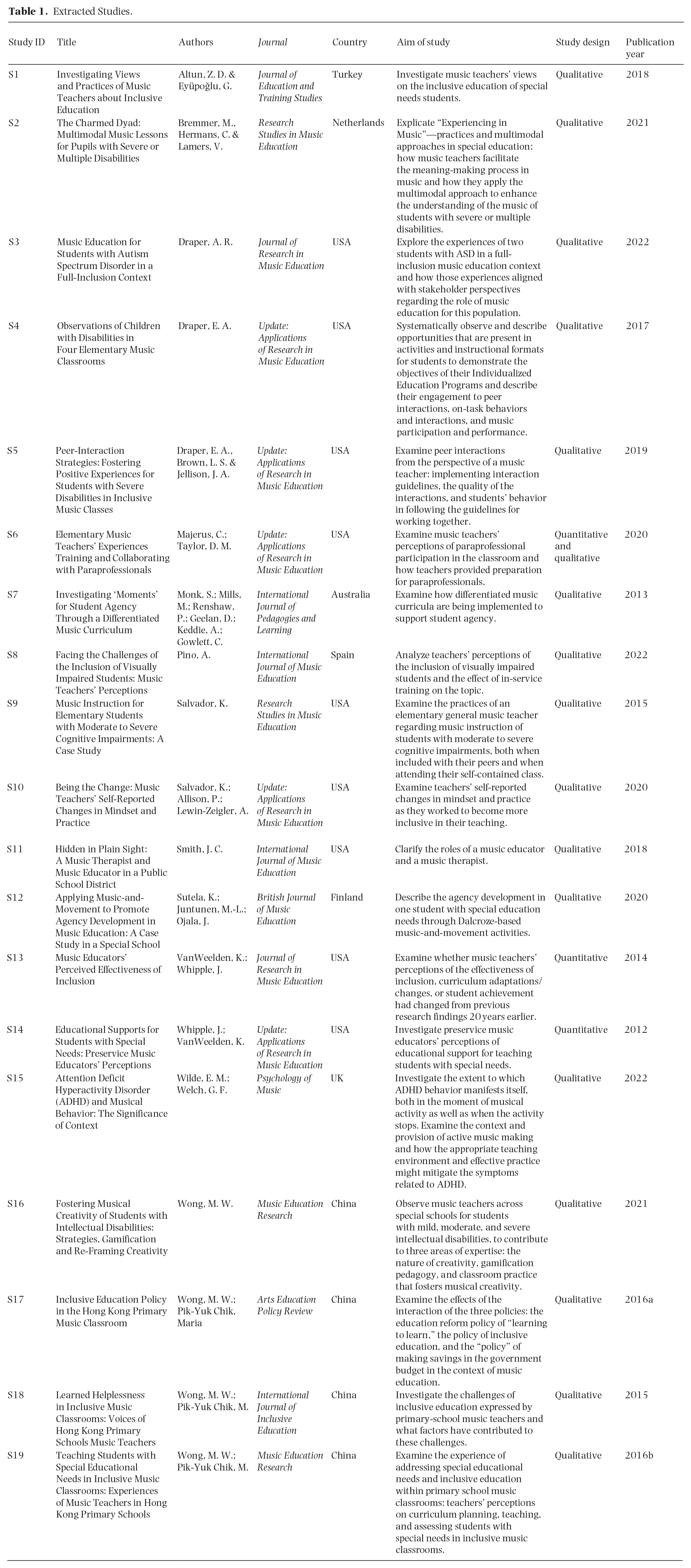
The final data search yielded 966 articles and 979 duplicates (1945 studies imported for screening) (see Figure 1). We used Covidence software (Covidence, n.d.) to screen the studies. The articles were screened independently by the first and the second author based on the titles and abstracts of the articles. Conflicts (within include/exclude/maybe) were solved together by all the authors. Altogether, 55 studies were included in the full-text screening. Full-text screening was done independently by the first and the third author, and possible conflicts (include/exclude) were solved by all authors. Two studies (Perry, 2022; Rozsics, 2010) were left out since they were inaccessible. A total of 19 studies (Altun & Eyüpoğlu, 2018; Bremmer et al., 2021; A. R. Draper, 2022; E. A. Draper, 2017; E. A. Draper et al., 2019; Majerus & Taylor, 2020; Monk et al., 2013; Pino, 2022; Salvador, 2015; Salvador et al., 2020; Smith, 2018; Sutela et al., 2020; VanWeelden & Whipple, 2014; Whipple & VanWeelden, 2012; Wilde & Welch, 2022; Wong, 2021; Wong & Chik, 2015, 2016a, 2016b) were included in the extraction phase (see Table 1).
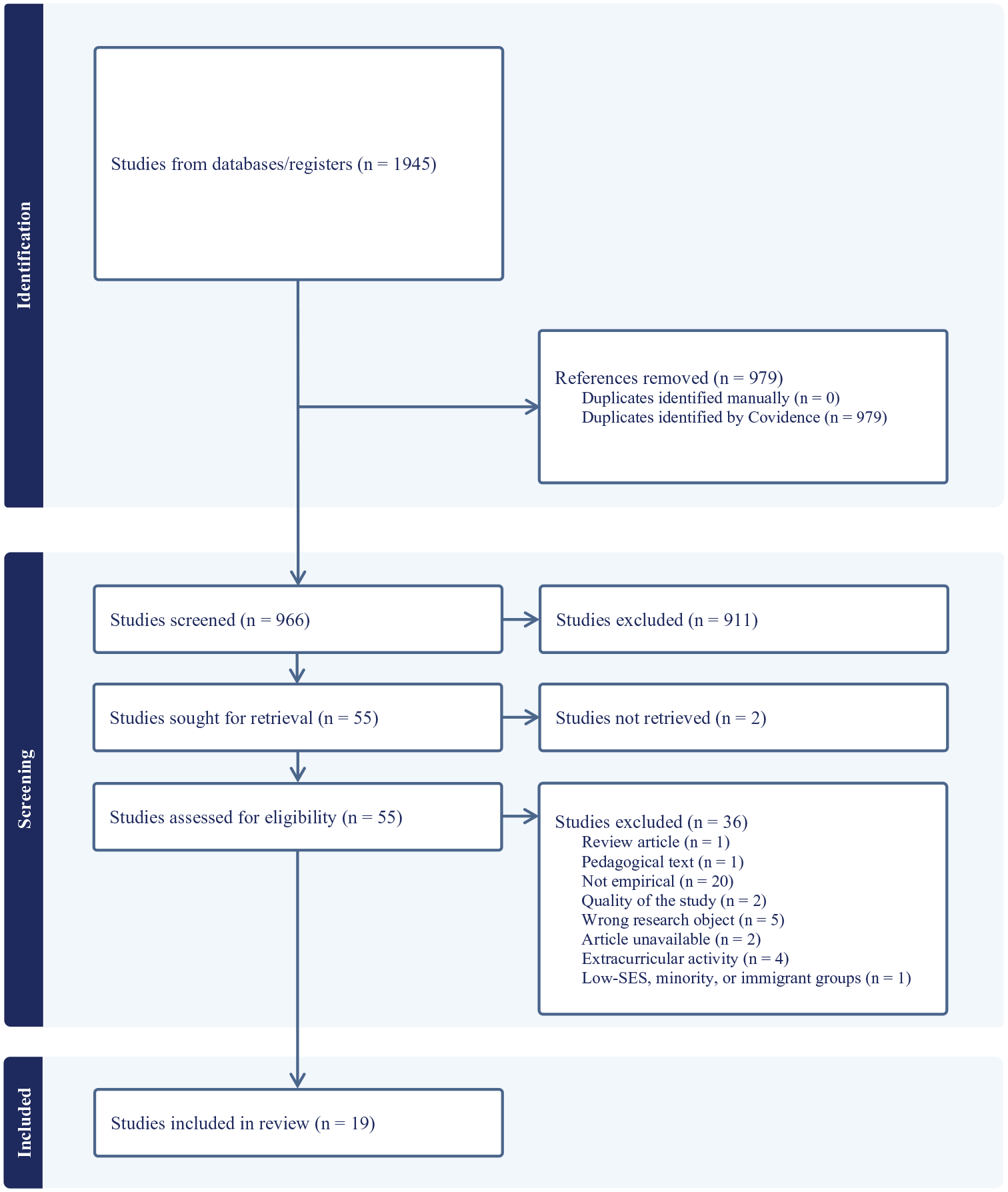
PRISMA Flow Diagram.
Extracted Studies.
Results
In what follows, the main findings of the data from the extraction phase are presented to address the research questions. In addition, Appendix 1 in the supplementary online materials presents the summarized data for each original study.
Inclusive practices in music lessons for students with special educational needs
Based on our analysis of the studies included in this systematic review, inclusion was mainly implemented at the level of integration of students with special educational needs into regular classrooms (Altun & Eyüpoğlu, 2018; E. A. Draper, 2017; E. A. Draper et al., 2019; Majerus & Taylor, 2020; Wong & Chik, 2015, 2016a, 2016b), meaning that music lessons were inclusive since students from different classes were combined together to learn music. One way to do this was to partly integrate self-contained lessons (i.e., small groups for students with special educational needs) into regular classroom music lessons (Salvador, 2015; Smith, 2018). Only one study included a full-inclusion K–5 (Kindergarten to Grade 5) school with no self-contained special education classrooms (A. R. Draper, 2022). In that school, inclusion was seen as a philosophy and overall practice, and the school emphasized accessibility and peer relationships. Some other studies were conducted in special schools, meaning that students with special educational needs received music classes segregated from their peers (Bremmer et al., 2021; Sutela et al., 2020; Wong, 2021).
Teacher training was seen as a central part of achieving understanding and knowledge toward inclusive practices. In Salvador et al.’s (2020) study, teachers took a graduate-level course to adopt more inclusive mindsets and practices. In Pino’s (2022) study, the focus was on in-service teacher training. These professional development courses may have affected implementing inclusion through the expansion of concepts and theoretical foundations and the provision of pedagogical resources. VanWeelden and Whipple (2014) concluded that sufficient inclusion and pedagogical support are partially possible by means of pre-service or in-service training, courses, workshops.
Studies from Hong Kong reported how administrative solutions could significantly affect the outcome of implementing inclusive practices (Wong & Chik, 2015, 2016a, 2016b) Although in Hong Kong the government has allocated resources to support students with special educational needs and the implementation of inclusive education, it is usually targeted only at core subjects, and music is regarded as a non-core subject (Wong & Chik, 2015). In their study, Wong and Chik (2016b) concluded that even though reaching toward inclusion, the educational system in Hong Kong remains academically competitive and does not provide adequate training for all teachers to meet the needs of students with special educational needs.
Administrative solutions can also support the inclusivity and accessibility of music studies. For example, A. R. Draper (2022) reported that in her research, all musical opportunities were available before and during the school day. The special education team used administration-instituted disability awareness programs to develop an inclusive school culture, and students and personnel were educated about diagnoses and provided with tools and language for advocacy (A. R. Draper, 2022). Music as a subject was seen as a point of access for all students, and the learning goals for students with special educational needs were individualized (A. R. Draper, 2022). Monk et al. (2013) reported similar findings where the school had a set of differentiated music programs to foster the participation of students and engage them in school in general.
Organization of pedagogical support in music lessons
One of the most common ways of providing pedagogical support was to offer more teaching personnel and assistants in the classroom (Bremmer et al., 2021; A. R. Draper, 2022; Majerus & Taylor, 2020; Salvador, 2015; Sutela et al., 2020). Paraprofessionals helped students and teachers in the full-inclusion school (A. R. Draper, 2022), and teachers could collaborate with paraprofessionals by communicating expectations and soliciting their advice (Salvador, 2015). In contrast, Majerus and Taylor (2020) pointed out that in their study, teachers did not provide sufficient guidance for paraprofessionals supporting their classes, nor did they have any formal meetings outside classes.
Another way to arrange pedagogical support was by using peer-interaction strategies. Peer-interaction strategies were used broadly in the full-inclusion school, where all the students had a peer buddy (A. R. Draper, 2022). In Salvador’s (2015) study, peer assistance was fostered throughout the school, and a counselor provided special lessons on how to help others. E. A. Draper et al. (2019) described the process of teaching peer-interaction strategies: guidelines for working together were printed on large posters in words and icons, then they were taught by talking about examples, modeling behaviors listed on the posters, showing video models about positive and negative examples of working together, and discussing, repeating and practicing examples of the behaviors in partners and small groups. Guidelines were reviewed before activities, then reinforced and prompted during the activities, and paraprofessionals were asked to assist students only when necessary (E. A. Draper et al., 2019).
There were also examples of schools or teachers lacking in organizing pedagogical support. Altun and Eyüpoğlu (2018) found that teachers did not organize individual content or support for students with special educational needs in inclusive music classes. According to many of their respondents, VanWeelden and Whipple (2014) reported that students with special educational needs followed the same curriculum and were graded on the same standards as students without special educational needs. Wong and Chik (2016b) stated that teachers held diverse opinions about assessing students’ music performance. The practices varied from everyone being evaluated according to the same criteria, to all students with special educational needs receiving a passing grade regardless of their actual performance (Wong & Chik, 2016b).
Wong and Chik (2016a) found that solutions for organizing sufficient pedagogical support involved different practices such as peer support, social workers educating students in getting along with each other, and parents or learning assistants helping at the beginning of the semester. They summarized that pedagogical support for students with special educational needs varied “from nil to targeted” and that there was a lack of organization of pedagogical support in subjects such as music. Furthermore, elementary schools’ inclusive classes were often too large to provide effective support (Wong & Chik, 2016b).
Pedagogical practices fostering inclusion for students with special educational needs
Based on the original studies, many pedagogical practices fostering inclusion and pedagogical support were utilized. Activities such as singing, playing, music theory activities, music knowledge activities, and listening to music (Altun & Eyüpoğlu, 2018; E. A. Draper, 2017; Salvador, 2015) were taught in pairs or small groups (Altun & Eyüpoğlu, 2018; Salvador, 2015), through peer-interaction strategies (E. A. Draper, 2017; E. A. Draper et al., 2019; Salvador, 2015; Wong, 2021; Wong & Chik, 2016a), in dyadic format (i.e., structured communication between two people) (E. A. Draper, 2017), or in turns (e.g., some groups play the harmony while the rest of the class sings) (Salvador, 2015). There were some modifications in a class with students with cognitive impairments; for example, a paraprofessional was assisting, the recorder was replaced with melody bells, and color-coded notation was used (Salvador, 2015).
Teachers also used pedagogical strategies adapted from lower grades, such as simplification, smaller steps, breaking learning tasks into smaller units, and a slower teaching pace (Wong & Chik, 2016a, 2016b). Yet along with peer assistants, collaborative group work, and a variety of activities, teachers also designed particular tasks for students with special educational needs, provided more teacher–student interaction, repeated tasks and instructions, and gave more time to practice (Wong & Chik, 2016b). As a strategy, teachers also placed students with special educational needs sitting in corners or close to the teacher (Wong & Chik, 2016a).
Music-and-movement was utilized as pedagogical support in several studies (Bremmer et al., 2021; Salvador, 2015; Sutela et al., 2020; Whipple & VanWeelden, 2012; Wong, 2021; Wong & Chik, 2016a). Salvador (2015) studied music-and-movement including movement and body percussion. Sutela et al. (2020) examined music-and-movement applying Dalcroze-based music education. Dalcroze-based music-and-movement activities were singing with movement, follow and quick reaction exercises, body percussion exercises, movement expression, improvisation, dances, and relaxation exercises (Sutela et al., 2020). Whipple and VanWeelden (2012) viewed classroom cultural dance activities and movement as aiding in acquiring music concepts. In the study of Bremmer et al. (2021), movement was part of a multimodal pedagogical approach that included experiencing music through embodiment and using narrative and material elements with social aspects overarching all dimensions (Bremmer et al., 2021). In their study on ADHD and musical behavior, Wilde and Welch (2022) reported that a need for movement and talking was combined with the set task, such as inventing and performing a rap song or enacting rhythms using body percussion.
In addition to Dalcroze-based music education, a variety of other music education approaches were viewed in several studies: the Kodály method with a variety of multimodal tools, the methods of John Feierabend, the Suzuki method, and administration-instituted disability awareness programs (e.g., Circle of Friends, Best Buddies International) (A. R. Draper, 2022). Supporting strengths was mentioned as a teaching philosophy in one study (A. R. Draper, 2022), as well as scaffolding and positive pedagogy in Monk et al.’s (2013) study.
Ways to support participation and learning of students with special educational needs
Beneficial ways to support the participation and learning of students with special educational needs in music education were grouped into five categories: (1) Student-centered music education, (2) Peer interactions, (3) Co-teaching and collaboration, (4) Teaching approaches and methods, and (5) Beneficial practices for teaching students with ADHD.
Student-centered music education
The student-centered approach was seen as a core matter when teaching students with special educational needs. Salvador et al. (2020) pointed out the importance of valuing individual students and shifting from a teacher- and subject-centered teaching style toward a student-centered approach. Altun and Eyüpoğlu (2018) noted that teaching music to students’ levels would be beneficial. Differentiation, finding different ways to meet the needs of all learners, modifying the curriculum, and adapting lessons were all efficient and engaging ways of teaching (Smith, 2018). Salvador (2015) mentioned using alternative instruments and notations, modifying musical activities, and adjusting repertoire, assessment, classroom management, and expectations as ways of differentiation. Monk et al. (2013) stated that using alternative representation in notation allowed students to express complex musical ideas to their peers, participate in composition, and overcome beliefs that they did not have musical skills. In Whipple and VanWeelden’s (2012) study, icons, other visual aids, and color coding ranked as the top three effective educational ways of supporting music listening and musical game activities.
According to Wong (2021), the most essential factor was to give time to explore musical topics. In addition, various strategies were found beneficial, such as gamification pedagogy, music-and-movement exercises, composing and arranging, differentiation, use of alternative representation in notation, being student-centered, and scaffolding (Wong, 2021). In addition, Monk et al. (2013) found that differentiation and good pedagogical practices were more likely to make students engage and participate in learning and making music.
Peer interactions
Peer relationships were seen as nurturing and were experienced as a discrete form of support (A. R. Draper, 2022). Whipple and VanWeelden (2012) found that the buddy system was rated as the most effective educational support for classroom cultural dance activities, singing activities, instrument playing activities, and movement to aid music concept acquisition. In Salvador’s (2015) study, peer assistance increased participation and positive affect. In E. A. Draper et al.’s (2019) study, 86% of the peer interactions were coded as positive. In their research, students engaged most in following the guidelines when working with assigned partners. Prompts to follow guidelines were highest in academic tasks and lowest in instrumental tasks, in which students knew what to do and how to support their classmates (E. A. Draper et al., 2019).
However, according to E. A. Draper’s (2017) study, peer-interaction engagement could vary: some students engaged and some did not. In her study, all the third-grade students were involved in peer interactions, but the duration, type, and frequency of these interactions varied. Peer interactions were more efficient when the teacher encouraged students to collaborate in formal and informal settings during music classes, and students were mostly on-task during the instructional activities (E. A. Draper, 2017). Nevertheless, when students were taking roles as peer mentors, they gained a new understanding of students with special educational needs and formed genuine friendships that were mutually beneficial (A. R. Draper, 2022). According to Sutela et al. (2020), joint activity helps students be present and take initiative.
Co-teaching and collaboration
Co-working between different professionals was seen as a possibility and a resource. In Salvador’s (2015) study, cooperation with paraprofessionals was considered a part of the success that the teacher had working with students with a cognitive impairment, since paraprofessionals had knowledge of each student’s physical, behavioral, social, and academic needs, and did social and behavioral modeling. Majerus and Taylor (2020) found that paraprofessionals provided behavioral and physical support for students with special educational needs. They also assisted spontaneously in adapting music activities, transitioning from activity to activity, entering and exiting the classroom, reinforcing music concepts, and classroom management. Teachers who collaborated regularly with paraprofessionals or special education teachers all experienced robust administrative support (Majerus & Taylor, 2020). Teachers indicated that the most efficient paraprofessionals were those engaged with their students and did not try to co-teach or interrupt classroom management strategies (Majerus & Taylor, 2020).
Beneficial teaching approaches and methods
Some pedagogical approaches and methods were noted to be beneficial for participation and learning. In Salvador’s (2015) study, the informal Music Play/MLT method was helpful and engaging for students with cognitive impairment. Furthermore, it could also be adapted for students of any age who struggle with matching pitch or finding beat, or for nonverbal students. According to A. R. Draper (2022), the Suzuki method appealed to students with ASD. A. R. Draper (2022) added that administration-instituted disability awareness programs empowered students. In a similar context with a student with ASD, Dalcroze-based music-and-movement activities had a positive influence on the student’s self-confidence, courage, and body skills, and helped him to overcome his social anxiety and hypersensitivity in music-and-movement lessons (Sutela et al., 2020). When verbal communication was difficult, the student could engage in nonverbal dialogue and interaction with his classroom teacher through movement, gestures, and music (Sutela et al., 2020).
A. R. Draper (2022) reported that discipline and structure within instrument studies had a transfer effect to other routines outside school, and that music studies also seemed to strengthen self-confidence. Sutela et al. (2020) had similar findings, underlining that the repetition, anticipation of situations, and familiarity or predictability of exercises were crucial elements of succeeding in a process. In their study, a student with ASD started to gradually show interest in musical activities and moving in space with others, once he knew what to expect during music-and-movement lessons (Sutela et al., 2020). The student also learned new ways to participate, interact, communicate, initiate, control his actions, and express himself meaningfully (Sutela et al., 2020). According to Sutela et al. (2020), the student’s new active agency was also noticed afterward by teachers, assistants, and peers, even outside the classroom. Similarly, Monk et al. (2013) found that social relationships and belonging to a musical community were seen as a meaningful aspect of the whole music-making process and a way to succeed better in other subjects.
When organizing multimodal music lessons for students with severe or multiple disabilities, the key elements in teaching were having a fixed spot for every student and an assistant teacher or carer, making the structure of the class predictable (i.e., introduction, middle, end), having musical activities that tell a story, including overarching themes, using visuals, and incorporating appropriate materials (Bremmer et al., 2021). According to Bremmer et al. (2021), materials were used as a bridge between students and the music, and to support the narrative. The starting points were a safe learning environment, a predictable lesson structure, the teacher demonstrating the activity before inciting a student to join in, and using positive feedback (Bremmer et al., 2021).
Beneficial practices for teaching students with ADHD
Only one study focused specifically on music education for students with ADHD. Wilde and Welch (2022) found that behaviors attributed to ADHD (e.g., inattention, hyperactivity, impulsivity) were evident in moments before, after, and between active engagement in music-making and learning. Conversely, ADHD symptoms were absent or least noticeable when making music. Instances of creative music-making enabled one student with ADHD to act on his feelings and needs in a musical way. In all moments of active music-making and spontaneous musical expression, no ADHD symptoms were evident in his behavior. When the same student was unable to participate in the general classroom due to unstable emotional state, he was offered the possibility to engage in non-lesson related activities in a separate place with the special educational needs support assistant and SEN coordinator. This enabled the student to calm down and act out his hyperactivity (Wilde & Welch, 2022).
According to Wilde and Welch (2022), it was crucial for students with ADHD to have an opportunity to express themselves musically, and they were given the opportunity tutors to self-represent themselves as a musician. This resulted in positive perceptions of students’ musical potential and high expectations (Wilde & Welch, 2022).
Discussion
In this systematic review, 19 empirical studies were selected for the extraction phase to answer our research questions. Our review shows the development of the research field, especially from the point of view of teaching music for students with special educational needs in inclusive classrooms (Grades 1–9). This has not been within the scope of earlier reviews, and we were additionally able to fill a research gap in reviews on the topic of inclusive music education concerning the time span of 2010 to 2023. Compared to earlier reviews, one can see some increase in the number of studies conducted on the topic, which could result from broad aspirations toward more inclusive practices in schools worldwide during the last two decades. During the selected time frame (2010–2023), inclusive practices have moved a step further from idea (UNESCO, 1994; United Nations, 1948) to practice, which has, in turn, generated more topics to be studied.
One can reasonably argue that music lessons are widely seen as a point of access for all students (e.g., A. R. Draper, 2022). However, based on the findings of the current review, one can also ask how inclusive music education is if students with special educational needs are mainly integrated into regular classrooms during music lessons. Integration is not always an inclusive practice (Sebba & Ainscow, 1996), and when students with special educational needs participate in regular classrooms, compared to academic subjects (e.g., mathematics), music and other arts subjects still lack enough empirical studies on how to arrange adequate pedagogical support. This lack of research could lead to, for example, insufficient administrative solutions and teacher training and is, therefore, one reason why there are no broadly established practices for supporting students with special educational needs in music education. Another reason might be the unquestioned assumption that music is a non-core subject (e.g., Wong & Chik, 2016a).
The previously expressed need for further research on inclusive music education, student participation, and teaching strategies for inclusive music classrooms (Jellison & Draper, 2015) and on the classroom experiences, assessment, and evaluation of students with special educational needs as study participants (Jones, 2015) has, nevertheless, been met on some scale. However, the number of empirical studies still remains relatively small. In the current systematic review, teacher training (pre-service or in-service) was a crucial starting point for successful inclusive classrooms. But lack of knowledge on the topic of inclusive music education was still reported, and therefore highlights the need for further professional development for music teachers in the field. Furthermore, administrative support and organization are needed to ensure adequate resourcing and a framework for teaching music. For example, effective co-teaching and collaboration need administrative solutions and resources. Based on our findings, we suggest that initiatives to introduce co-teaching, peer-learning strategies, and inclusive practices should be launched in more teacher training.
Lack of resources, knowledge or subject-specific practices, attitudes in the school system, or discriminatory resourcing and training (Grenier, 2016; Hammel & Hourigan, 2011; Strakšienė, 2020; Wong & Chik, 2016b) have been previously noted to be issues for implementing inclusion and pedagogical support in music education. According to the results of this study, solutions to make inclusive music classes work are often easily accessible in terms of resources. For example, student-centered pedagogy, peer-instruction strategies, using different pedagogical methods, and differentiating between varying levels of learning were found to be effective solutions (e.g., A. R. Draper, 2022; E. A. Draper et al., 2019; Monk et al., 2013; Salvador, 2015; Salvador et al., 2020; Smith, 2018; Sutela et al., 2020; Wong, 2021). Another form of support and inclusive school culture (which admittedly requires some financial resources by means of employing teaching assistants) was collaboration between teaching personnel and assistants.
Students’ voices in research remain almost unheard, generating a research gap and calling for elaborating upon exisitng data collection methods. Having students as informants has been noted to be difficult for data collection, as Sutela et al. (2020) reported in their study. For future studies of the topic, an important aspect would be to examine the experiences of the students with special educational needs, the kind of support they would like to receive, and what they have experienced to be beneficial in music education. In addition, for future review studies on the topic, it could be beneficial to include non-empirical and non-peer-reviewed studies (e.g., book chapters, pedagogical texts, and dissertations), since they could offer significant insight and crucial perspectives for improving educational practices (e.g., narratives from the lived experiences and voices of students with special educational needs).
Limitations
There are potential limitations to this systematic review study. First, some relevant literature might have been left out due to limitations in the search string. In addition, our inclusion criteria which were restricted to articles in scientific journals might have excluded some relevant studies. However, we wanted to ensure the quality of the studies by including only peer-reviewed research. Furthermore, we were aware that studies that were left out (e.g., pedagogical texts, book chapters) might have included important perspectives and insight for understanding the topic.
Second, our target was to select studies that included students from Grades 1–9. Educational systems differ in different countries regarding how different school phases are named and at what age students enter these stages. At times, the ages of the students corresponding to the grades were difficult to identify in full detail from the original studies since the ages of students were not mentioned precisely or at all. Finally, inclusion is a wide concept that may be understood in various ways among researchers. Since definitions of inclusion vary, including in the 19 original articles we reviewed, this might have affected results.
Conclusion
In this systematic review, we aimed to examine the implementation of inclusion and pedagogical support in the context of music lessons in Grades 1 to 9 for students with special educational needs. Implementation of inclusion in music lessons varied from segregation to full inclusion and from robust pedagogical support to insufficient support. If we think of inclusion as a process (Hausstätter, 2014; Sebba & Ainscow, 1996) rather than a final end-goal, this review demonstrates that music education across the world is already involved in this process. The same kinds of issues arise in different parts of the globe, and the same types of solutions are applied. While some countries face more issues depending on administrative initiatives and educational systems, the direction across the world seems to be the same: toward more inclusive music education. In this pursuit, as Laes (2017) argues, music educators should reach beyond conventional ways of thinking and acting about inclusive education—not considering themselves as caregiving or helping professionals, but rather as offering an emancipating teaching practice and acting as change agents. The original studies in this systematic review show that the topic has been noted for many decades, but further knowledge still needs to accumulate to gain a firmer foothold both in educational research and in educational practice, within schools and in societies, to more closely approach an ideal of inclusivity that benefits all students.
Supplemental Material
sj-docx-1-rsm-10.1177_1321103X251342143 – Supplemental material for Inclusion and pedagogical support for students with special educational needs in music lessons: A systematic review
Supplemental material, sj-docx-1-rsm-10.1177_1321103X251342143 for Inclusion and pedagogical support for students with special educational needs in music lessons: A systematic review by Oula Mommo, Katja Sutela and Riikka Mononen in Research Studies in Music Education
Footnotes
Author contributions
Declaration of conflicting interests
The author(s) declared no potential conflicts of interest with respect to the research, authorship, and/or publication of this article.
Funding
The author(s) received no financial support for the research, authorship, and/or publication of this article.
Availability of data and materials
Upon request from the correspondent author

Supplemental material
Supplemental material for this article is available online.
Notes
Author biographies
References
Supplementary Material
Please find the following supplemental material available below.
For Open Access articles published under a Creative Commons License, all supplemental material carries the same license as the article it is associated with.
For non-Open Access articles published, all supplemental material carries a non-exclusive license, and permission requests for re-use of supplemental material or any part of supplemental material shall be sent directly to the copyright owner as specified in the copyright notice associated with the article.
