



Abstract
There is limited literature exploring studio instrumental music teachers’ perceptions of the value of professional development opportunities aiming to enhance pedagogy for students with disabilities. In this qualitative study, semi-structured interviews with 10 music teachers who had undertaken specialized training were conducted and analyzed according to the principles of Interpretative Phenomenological Analysis (IPA). Five themes were identified in the analysis: (1) confidence to teach students with disabilities is built upon having knowledge of students’ strengths and challenges; (2) quality teacher interactions with students are essential for learning; (3) financial and time pressures on teachers can limit accessibility; (4) including parents in music education is promoted as the ideal but can be fraught; and (5) teacher job satisfaction is high when student learning is evident. Participants valued gaining knowledge of their students’ conditions and developing their awareness of factors that supported learning. Following the specialized professional development training, many teachers continued to deepen their knowledge, created customized music lessons, and expressed increased personal and professional satisfaction when teaching music to students with disabilities. The findings indicate that specialized professional development opportunities can promote teacher confidence to facilitate music lessons for students with disabilities, leading to better access to music education.
Keywords
Instrumental music teaching often involves students undertaking individual or small group lessons with a music teacher who is an expert instrumentalist. In Australia, this form of music education is sometimes referred to as “private music lessons” or “studio lessons.” While registered music teachers in Australia must have a relevant qualification and engage in continuous professional development (Victorian Institute of Teaching, 2021), there are no such obligations for studio music teachers. These differences in levels of qualification and training can result in studio music teachers having limited knowledge of the learning profiles of students with disabilities and suitable teaching strategies (Pickard, 2019).
The reported musical benefits of instrumental lessons for students with and without disabilities are similar, such as instrumental and/or singing skill development and mastery, music performance skills, acquiring general musical knowledge, and skills in musical creativity (Kaikkonen, 2016; Pickard, 2019; Platz, 2012; Soo, 2019; Weishaar, 2014). Although musical benefits are noted, the non-musical benefits of instrumental lessons for students with disabilities are also often accentuated. These non-musical benefits, such as general improvements in developmental domains, are sometimes referred to as “outcomes,” which implies a therapeutic benefit of music education (Jiminez, 2012; Pickard, 2019). Similarly, the quality-of-life benefits of instrumental music lessons have also been emphasized for students with disabilities, including pleasure, enjoyment, self-expression, relaxation, independence or autonomy, confidence, and the acquisition of life skills (Jiminez, 2012; Kaikkonen, 2016; Platz, 2012; Weishaar, 2014). Accentuating non-musical benefits for students with disabilities may blur the lines between music education and music therapy.
Approaches to studio instrumental teaching for students with disabilities
Researchers and educators have described various approaches to studio instrumental teaching for students with disabilities. We note that some authors have described approaches that are more student-centered, emphasizing the importance of flexibility and customization in teaching (Dumlavwalla, 2020; Kaikkonen, 2016; Norris, 2020; Steele & Fisher, 2011). Other authors have emphasized aspects of the student’s condition that may impede participation in standardized approaches to learning (Au & Lau, 2021; Parkes, 2014, 2016).
Student-centered approaches to instrumental teaching
In more student-centered approaches, instrumental music teachers are considered providers of opportunities for inclusion and empowerment (Kaikkonen, 2016; Norris, 2020). Teachers who embrace a student-centered approach are also described as taking responsibility for maintaining a positive learning environment that promotes student engagement (Dumlavwalla, 2020; Kaikkonen, 2016; Norris, 2020; Steele & Fisher, 2011). These music teachers are viewed as valuing rapport-building and seeking to foster meaningful connections with students with disabilities (Froehlich, 2012; Jiminez, 2012; Kaikkonen, 2016; Norris, 2020; Weishaar, 2014). Furthermore, student-centered music teachers are characterized as working with students’ strengths and innate abilities (Berger, 2017; Jiminez, 2012; Pickard, 2019); using teaching strategies that result in achievable and meaningful tasks (Jiminez, 2012; Kaikkonen, 2016; Soo, 2019); and incorporating students’ sensory and motor profile into their approaches (Froehlich, 2012; Norris, 2020; Platz, 2012; Soo, 2019). Associated personal teacher attributes include positivity, enjoying challenges, intuitive responses, flexibility, and patience (Berger, 2017; Norris, 2020; Polischuk, 2019; Steele & Fisher, 2011). Teacher self-awareness, openness to self-education, and willingness to challenge assumptions about disability are further aspects described as features of a student-centered approach (Jiminez, 2012; Kaikkonen, 2016; Norris, 2020). Overall, music teachers who are more student-centered are characterized as being willing to adjust the music curriculum, adapt the pace of learning, and design achievable and meaningful learning tasks that are guided by the student’s engagement.
Behavioral strategies within instrumental teaching
In contrast, authors reporting on music teaching approaches that focus on describing the features of students’ impairments tend to emphasize behavioral strategies and adjusting expectations for student learning (Parkes, 2014, 2016) Having knowledge about disabilities and special education is important, as music teachers with training in special education are reported as having more positive attitudes toward their students (Au & Lau, 2021). However, although the positive correlation between knowledge and attitude reported by Au and Lau (2021) in the context of teaching autistic students is encouraging, the qualitative data from the same study highlight that music teachers still had lower expectations of progress for these students. Other authors have also noted the complex relationship between instrumental music teachers’ knowledge of specific conditions and disabilities and their attitudes toward students with disabilities (Norris, 2020; Parkes, 2014, 2016). A survey of 146 studio music teachers found that while most teachers were prepared to modify their lessons when they understood student needs, there were limits to this flexibility when it came to using alternatives to traditional notation (Norris, 2020). Although undertaking training has been shown to improve music teachers’ sense of preparedness to teach students with disabilities, concerns about the challenges that teachers might face can persist (Parkes, 2014, 2016) While complex, it seems that encouraging music teachers to improve their knowledge of a student’s impairments may generally lead to improved attitudes, but they may still experience challenges in adapting their teaching strategies, perhaps due to limited awareness of alternative approaches. A lack of customization to meet individual student learning needs may result in the use of inappropriate pedagogical practices, such as providing overwhelming amounts of information (Soo, 2019) and under-utilization of multisensory learning pathways (Norris, 2020).
Parent involvement in studio instrumental lessons
Including parents in studio instrumental music lessons for students with disabilities is often recommended (Pickard, 2019). However, the contribution parent participation makes to student learning is less clear in the literature. At times, parents are considered integral to the learning process by supporting the student in the studio lesson and during practice time at home, and parent feedback is described as motivating for teachers and students alike, or as leading to relevant adjustments to teaching approaches (Pickard, 2019). At other times, parent participation in the lesson is positioned as a source of discomfort or interfering with student learning (Au & Lau, 2021; Berger, 2017; Jiminez, 2012; Norris, 2020; Steele & Fisher, 2011).
Research context
Although various approaches to music pedagogy for students with disabilities have been described in the literature, the impact of teacher engagement in specialized professional development on teaching practice and attitudes has received little attention. As a largely unregulated professional community in Australia, studio music teachers must seek out their own professional development activities according to their needs or interests. Therefore, the purpose of this study was to understand studio music teachers’ lived experience of teaching students with disabilities following their engagement in specialized professional development. To meet this aim, we posed the following research questions:
How do studio music teachers experience teaching students with disabilities following engagement in specialized professional development?
What aspects of studio music teacher practice or attitudes changed, if any, following their engagement in specialized professional development?
What insights did studio music teachers gain, if any, into the learning needs of students with disabilities?
Method
This qualitative study explored the lived experience of studio music teachers in Australia (Victoria and New South Wales) working with children with disabilities who had completed professional development in specialized teaching approaches for these students. The students’ diagnoses were typically communicated informally to the teacher by the students’ parents. An Interpretive Phenomenological Analysis (IPA) was undertaken, which involved an iterative and flexible approach to analysis so that unexpected themes and sub-themes could be identified (Smith et al., 2022; Smith & Fieldsend, 2021). Aligned with related theories from phenomenology, hermeneutics, and idiography, IPA promotes inquiry into the meaning of an experience from the participants’ perspective as interpreted by the researcher (Smith et al., 2022; Smith & Fieldsend, 2021). IPA therefore acknowledges the subjectivity of the researcher’s interpretation and the importance of reflexivity throughout the process of data collection and analysis.
Ethics
Ethical approval was obtained from the Central Human Research Ethics Committee (CHREC) at The University of Melbourne (ID# 2022-24486-31069-3). Participants were given a plain language statement that explained the research aim and the voluntary nature of their participation. Written consent was obtained from participants, and each received a $30 AUD shopping voucher upon completion of the interview to thank them for their time.
Recruitment
To support recruitment, we invited input from a private education provider in Melbourne, Australia, who specializes in offering professional development to music teachers to enhance their work with students with disabilities. Recruiting music teachers who had engaged in a reputable training program with this provider offered a solid foundation to answer our research questions. The provider emailed information about the study, and how to contact the research team, to instrumental music teachers who had completed one of their training programs.
Specialized professional development
The private education provider offers a variety of training programs for instrumental music teachers working with students who are autistic, have attention-deficit disorder, learning disabilities, cognitive disabilities, and/or physical disabilities (Keys of Life, 2024). The main facilitator has a background in the Suzuki method and more than 35 years of experience in teaching students with disabilities. The 3-day training program includes the following topics: scientific information about symptoms, traits, strengths, and challenges; setting up the physical space to support learning; supporting music excellence; pedagogical strategies for students with disabilities; teaching demonstrations; collaborating with parents; and performances by students with disabilities. Music teachers can also participate in these modules as a half- or single-day training.
Participants
We recruited 10 studio music teachers. Nine participants had completed a 3-day training program and one had completed a half-day training. Seven participants held a university qualification in music at undergraduate level or higher, and some had further accreditations from independent bodies. One had a teaching certification from an independent body without university training. Their teaching experience ranged from 7 to 44 years; eight had been teaching for more than 20 years. Some conducted their studio music lessons in mainstream public and private schools, and others were self-employed, generally teaching from their homes, including (in one instance) online lessons; and some worked in multiple settings. One participant conducted studio music lessons in a private therapy clinic. The students that participants taught ranged from pre-school age to young adults, and most were diagnosed with autism and/or attention-deficit hyperactivity disorder (ADHD), while others had dyslexia, Down Syndrome, unspecified learning and memory difficulties, anxiety, panic attacks, fine motor impairments, or hearing loss. All participants taught instrumental music lessons; nine taught piano and six of these offered other instruments as well. One teacher taught strings only. Several teachers taught instruments they were not trained in themselves if their students wanted to try them.
Semi-structured interviews
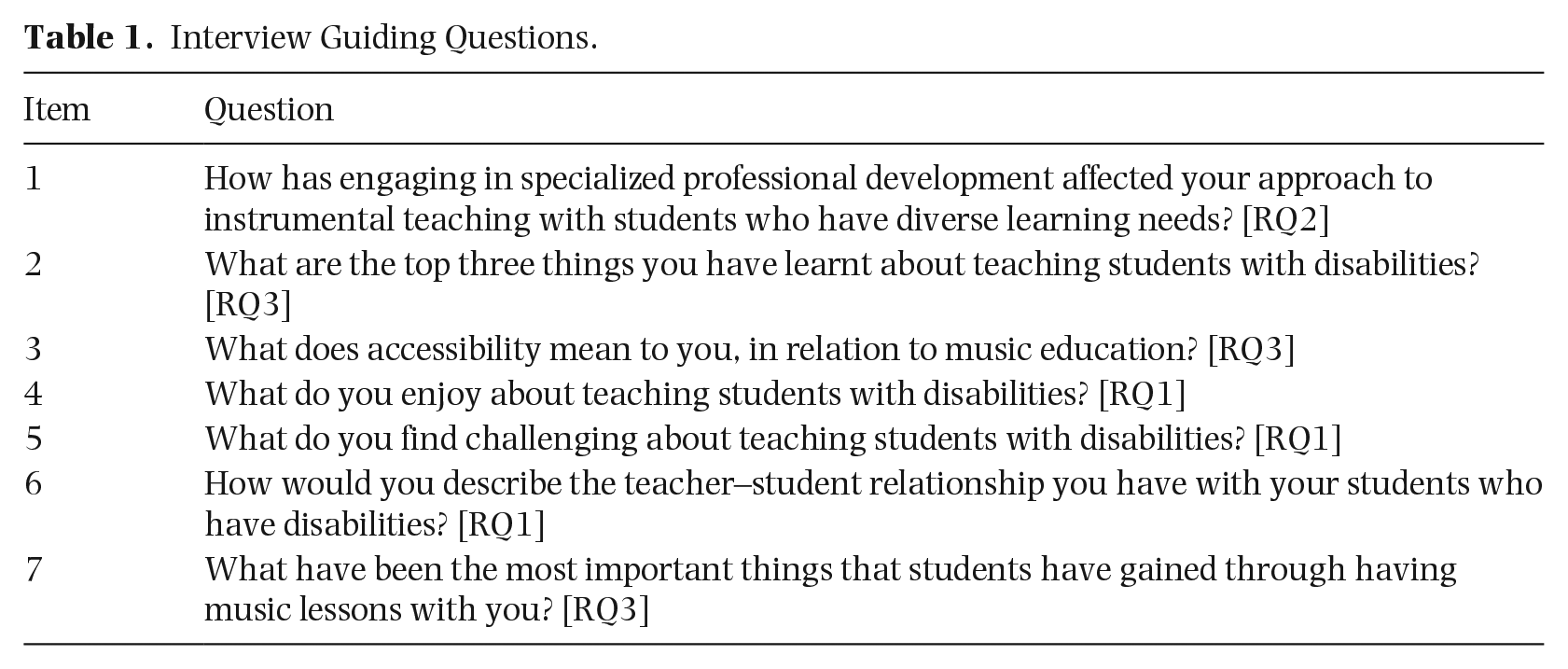
A semi-structured interview guide was created that covered topics related to music pedagogy with students with disabilities, changes in teacher attitudes, and personal understanding of issues related to accessibility. We asked the questions in a broad way to limit the sense of evaluating the quality of the professional development program. These questions were the starting point for discussion, allowing for deeper inquiry where appropriate. Table 1 presents the guiding questions used in each interview, including their relationship with the research questions (RQs). Examples of further prompts used by the interviewer are provided as Online Supplementary Materials. All interviews were conducted via Zoom with the second author, were video recorded, and ranged from 28 to 60 min in length.
Interview Guiding Questions.
Data analysis
Informed by the process outlined by Smith et al. (2022), we began by transcribing each interview, reading each transcript several times, and identifying relevant text related to our research question. While the analysis can be described in steps, IPA is a reflexive, iterative, and creative process requiring a flexible approach. Following immersion in the transcript, during step two we collaboratively discussed our first impressions of the semantic content and identified preliminary topics of interest. The third step involved the second author coding key statements from the interviews using language close to that of the participant, often referred to as verbatim coding (Saldaña, 2021). We collaborated during the fourth step to identify preliminary themes from the codes for each interview, before looking across interviews for patterns of similarity. During this stage, similar preliminary themes were organized into initial concept groups. For the fifth step, we stepped back and asked critical questions of the data, shifting to a more reflexive and interpretive stance, and explored patterns of convergence and divergence. In the sixth and final step, we consolidated the cross-case analysis and identified main themes and sub-themes that had emerged from this process, illustrated by quotes from the interviews.
As this study focuses on a single set of data, we engaged in a processes of investigator triangulation, where each author contributed to the analysis both independently and collaboratively (Denzin, 1978). For example, the second author undertook the first round of verbatim coding, which was cross-checked by the first author. Next, concept groups were initially mapped by the first author, and then a series of collaborative meetings took place where each author’s different perspectives on the data groupings were deeply considered and discussed.
Researcher positionality
The first author has lived experience of disability. She is also a registered music therapist, researcher, and educator who has worked with children with disabilities and their families for approximately 20 years. She has led seminars and workshops for music teachers in inclusive teaching practice and also mentors music teachers to design learning strategies that meet the needs of students with disabilities. As such, she has engaged with music teachers with a broad range of perspectives and experience in working with students with disabilities.
The second author is a humanities researcher with a background in historical literary studies. Her work on the changing representation of children’s voices in literature from different historical periods has developed into a consideration of how the empowering connotations of voice are available to living children. She has convened events on contemporary and historical childhood with a strong focus on the multi-modal pathways used by children of all abilities to express themselves, and the developmental benefits of having their diverse modes of communication recognized. In this study, she closely considers the perspectives of the learners and the responses of the teachers to students’ expressions of their learning experiences.
Findings
Five themes emerged from the analysis that illustrated various facets of the experience of studio music teachers who undertook professional development in pedagogy for students with disabilities. As the themes emerged from the cross-case grouping of preliminary themes related to individual interviews, we have captured the constellation of nuanced elements arising within each theme through sub-themes. The five themes are listed here, with the relationship to the research questions indicated. The sub-themes within each theme are elaborated in the section below:
Confidence to teach students with disabilities is built upon having knowledge of students’ strengths and challenges (RQ1);
Quality teacher interactions with students are essential for learning (RQ2&3);
Financial and time pressures on teachers can limit accessibility (RQ3);
Including parents in music education is promoted as the ideal but can be fraught (RQ3);
Teacher job satisfaction is high when student learning is evident (RQ1).
Theme 1: Confidence to teach students with disabilities is built upon having knowledge of students’ strengths and challenges
Participants valued engaging with the information included in the professional development materials, including diagnostic information. They experienced a positive shift in their confidence related to gaining deeper knowledge about the challenges students with disability face, and their strengths. The three sub-themes highlighted different aspects of knowledge that particularly enhanced their confidence.
Gaining awareness of diverse learning needs
Most participants described how increased education about learner needs is an important component of successful teaching, highlighting “if anyone’s going to consider teaching these kinds of children or any children really, you have to have some understanding of the diverse set of needs” (Participant T4). Another participant pointed out that such knowledge is not routinely considered in instrumental teaching, explaining: [this training] presented a lot of science to help teachers understand what they’re dealing with when they’re working with students with special needs [. . .] that’s really helpful. Because as musicians and music teachers, we’re just so focused on just the music side of things (Participant T9).
Participants experienced that acquiring this knowledge expanded their teaching practices, and some explained how understanding more about students’ learning differences helped them reframe their perceptions of uncooperative behavior as moments of difficulty for the student, since “understanding the reasons for what looks like behavioral issues, helped me be more empathetic” (Participant T9).
Furthermore, having access to video examples of student progress within the training was described as helping to bring theory to life by some participants. Participant T3 explained: From the beginning, [the trainer] had videos. We see the “before” as well as the “now.” That is really, really important. Otherwise, it’s just words on paper. [. . .] You can see there’s barriers there for children. You can see they’re trying but there’s legitimate barriers.
Other participants described how important it was to observe the trainer, who was an experienced music teacher, in action, particularly when the teaching strategies did not always lead to a perfect outcome. Participant T5 explained, “in one of the demonstrations, there was the looks of a meltdown in the making happening, and [the teacher] was just like, OK, we step away and it’s time to just back off [. . .]. So it’s OK.”
General good teaching principles are relevant to students with disabilities
Several participants found that improved awareness of diverse learning needs enhanced their application of universal teaching principles; “[the] training showed me that good teaching is good teaching, regardless of whether a kid is neurodivergent or neurotypical. And part of good teaching is having considered expectations and sensible expectations, but nevertheless, having expectations” (Participant T1). Good teaching principles extended for Participant T1 to recognizing feelings of achievement as important motivators for all students: People get a buzz if someone has a high expectation of you. . . Particularly if it’s a reasonable high expectation, not a stupidly unattainable thing, but I think that’s an opportunity for building positivity in a kid. And I wonder sometimes whether students who struggle [. . .] I’d like to think that they know that if they come to a lesson, there is an expectation because there’s a belief that they are capable.
Taken together, this and the previous sub-theme suggest that teachers who feel well-informed about their students’ learning needs can draw flexibly upon a repertoire of strategies that promote student engagement.
Creating a positive learning environment
Participant T7 noted how “[the trainer] talked a lot about not giving negative feedback to the student” which prompted them to reconsider how the framing of feedback could enhance the learning environment. Other participants appreciated information about students’ multiple learning pathways, especially focusing on the students’ positive resources, such as aural alternatives to reading music notation. Participant T3 stated: “you’ve got to adjust your teaching to get the best out of the student.” These comments indicate an increased awareness of the importance of working with student strengths, along with an enhanced ability to address areas of challenge following the specialized training.
Theme 2: Quality teacher interactions with students are essential for learning
Looking back on their learning from the specialized training, many participants emphasized their increased understanding of the importance of quality teacher–student interactions when teaching students with disabilities. Two sub-themes further delineated the participants’ experience of quality teacher interactions, including the benefits they perceived from prioritizing connection with their students, and the approaches they adopted to enhance these connections.
A strong teacher–student connection helps students flourish
Gaining a deeper understanding of the importance of communication, particularly when students are non-speaking or have high support needs, helped teachers to see the importance of connection. Participant T1 explained: [students with disabilities] are very capable, and you got to find the language and find the connection that promotes that, that allows that to flourish. And when that starts happening, then you start to see the beauty in their persona and what they have to offer. [. . .] That was very powerful.
For Participant T4, connecting involved engaging with students beyond their musical learning: Sometimes, in the lesson, I get a sense there’s a real yearning for normalcy [. . .] he’s very conscious of the fact he goes to a special school. And so, I will sometimes spend half the lesson just talking with him about whatever he wants to talk about. And I feel like that’s just as important as teaching him how to play the [instrument].
Refining teacher observations of student readiness and responding with flexibility
A number of teachers found that the training increased their attunement, sensitivity, and patience, explaining the importance of “gauging the child’s receptiveness” (Participant T5). For Participant T2, being more flexible in their teaching approach revealed possibilities for new learning pathways: And a few weeks into lessons with [M], I just couldn’t get her to really sit at the piano. I thought, what can I do? And we would walk down the hallway together to her lesson. [. . .] She was coming to a piano lesson reading a book. And increasingly, she would read this book, and I didn’t know how to get her back to the piano. And so I just thought, I’m going to read the book with her. And we’re going to put it on the piano stand. [. . .] I discovered that [M] loves lyrics, she loves words, in books, in music. So now [. . .] we always have a song. . . there’s something in it we can sing.
Participant T2’s description suggests that she understands her role as assisting students to tap into their innate abilities and identifies opportunities for learning by following their lead. More attention to learning readiness assisted some participants to better recognize “more subtle signs of when the student’s anxious and working to reduce that first before you try and teach” (Participant T9). A few participants explained that they now draw on this information to ensure that their students were not inadvertently placed in unduly stressful situations. Participant T6 described being more aware of the possible negative impacts of performance on students with disabilities: understand[ing] that the anxiety is always part of it as well. So to be actually more careful with things like, “Hey, come on. Play at a lunchtime concert” [. . .] if you have a [student] on the spectrum, they might say yes but they’re actually really anxious about it. So I think I’ve learnt from that [the training] to make sure they are 150% prepared and you talk to the parent as well and don’t throw them in the deep end.
Other participants described having a deeper understanding of how flexible teaching practices can contribute to longer-term learning outcomes for students with disabilities. Participant T5 described the importance of gauging the student’s mood, and that if they are “not receptive to even coming for their piano lesson [. . .], I’ve tried to kind of calm [the student] and get in the correct headspace, or not even had a lesson.” Participant T5 seems to be working toward co-regulation, and her observation suggests that flexible responses to student readiness both depend upon and promote teacher-student connection, illustrating the relationship between these two sub-themes.
Theme 3: Financial and time pressures on teachers can limit accessibility
Accessing and implementing appropriate resources for teaching students with disabilities requires time and can be costly, presenting teachers with a number of interrelated difficulties. For some participants, these pressures were a prominent factor in their experience of improving accessibility. The two sub-themes highlighted different but related challenges connected to time and money pressures.
Building resources and knowledge takes time and money
Many participants expressed a desire for more timely access to appropriate education about the needs of students with disabilities. Some wished for greater access to supportive networks or professional bodies to provide “ongoing learning [. . .] perhaps a membership-site type of approach where teachers can get on and chat with one another [. . .] keep the conversation going and keep the training going [. . .] developing a community” (Participant T8). In the absence of such support, some participants searched the internet for resources on teaching techniques, but Participant T3 found that this approach was challenging: How do I as a professional [. . .] access that kind of a resource? I can’t. What I could do is go Google, Google, Google, look, look, look until I find somebody with that background. Then the second thing is, how do I then go and pay them to chat about stuff like what have you learned?
Teachers can feel hesitant to charge fees if outcomes for students are uncertain
The expense of studio music lessons was acknowledged by these participants as potentially limiting access to music education for students with disabilities. Some participants described offering free or subsidized lessons for students with disabilities because the learning outcomes were unknown. Participant T6 explained her approach as follows: the first few lessons, I just don’t charge. I say to the parents, let’s see how it goes and whether [your child] is really enjoying the lessons. [. . .] [Then] it’s usually the parent who lets me know when to start charging.
Other participants described feeling guilty about charging for lessons if the child was not focused on music learning at the time. Participant T5 considered that individual lessons did not always produce an outcome directly related to music education. Themes 1 and 2 highlight that teachers gained awareness of the importance of attuning to students and providing positive environments, but within this sub-theme, their comments suggest that these aspects were not necessarily recognized as having a financially quantifiable “value” for the music lesson.
Theme 4: Including parents in music education is promoted as the ideal but can be fraught
The specialized professional development undertaken by these participants aligned with the Suzuki method’s parent–student–teacher triangle framework. The participants generally responded positively to the principles of this framework; however, they also raised concerns. Three sub-themes highlighted the participants’ nuanced experiences related to this theme.
Collaborating with parents is integral to teaching students with disabilities
Some participants embraced the importance of parent–teacher collaboration when teaching students with disabilities, with Participant T2 noting, “if you can get the parent onboard, and you get that triangle of the teacher, student, parent engagement, it is incredible the fruits of that.” Participant T4 similarly noted gaining “greater insight into the needs of the families, the need to incorporate the families within the learning sphere.” Consciously viewing the student as part of a family seemed to open up new ways of understanding learning dynamics and had benefits for parents. This was particularly the case through performance opportunities that “also [give] the parents an opportunity to socialize afterward, because they might not get to do that. . . they might not connect with other parents [of students with disabilities]” (Participant T2). Like Participant T1’s comments about limited opportunities for students with disabilities to experience a “buzz,” Participant T2’s observations recognize that families may also miss out on moments of celebrating their child’s educational achievements.
More recognition needed of challenges to parent involvement
While several participants embraced facilitating parent involvement in the music lessons, others found this aspiration out of reach in their professional context. Participant T5 observed that the circumstances in which [the instructor] teaches are absolutely ideal. She’s got this lovely studio. She’s got very supportive parents. And it’s not like that in the real world. It really isn’t. [. . .] [the] average parent of a child with those needs has to go to work and can’t spend all day taking them to music lessons. . . and it’s really hard.
The family’s financial situation was also raised by other participants in relation to parent involvement in music lessons. Participant T6 observed that when some music teachers choose not to charge fees to students with disabilities, it may make parents feel they have an obligation to participate in lessons, but this arrangement was not possible in her own practice. It seems that many participants were keenly aware of the impacts of time and money on parents’ availability to participate in the ideal learning triangle espoused by the training provider.
More training needed to collaborate effectively with parents
Participants reflected that their experience of parental involvement did not always conform to the ideal framework recommended in the training. In some cases, these participants recounted that parent preferred not to attend the lessons with their child, while at other times teachers were uncertain about how to work with parents where there were conflicting expectations. Participant T7 explained: [The parent] is often in lessons [and] has been anxious [. . .] [saying to their child], “You need to do it again. Try it again.” And kind of talk over me [. . .] but in my experience I can see [when] students [have] had enough. You have to leave it and move onto something else. And that’s frustrating just for me in trying to navigate. I can’t really tell this parent off, but I can see that’s not good for the student.
While most teachers stated that they value parental involvement, and the training provided a relevant framework, some were uncertain how to adjust the approach when that ideal model could not be achieved.
Theme 5: Teacher job satisfaction is high when student learning is evident
Most participants enthusiastically described the sense of job satisfaction they experienced from teaching students with disabilities. This experience seemed to be linked to their engagement in the specialized professional development, and their enhanced skills and knowledge of students with disabilities. The two sub-themes highlighted different but related concepts contributing to their experience of job satisfaction.
Satisfying to see students develop a sense of pride
Despite the financial and time pressures of undertaking professional development, participants reported that adapting their teaching for students with disabilities was ultimately fulfilling: “I love teaching them. I’ve learned more about teaching children who are neurodivergent than all the other teaching I’ve done. . . They teach me so much about being [. . .] a better teacher” (Participant T3). Witnessing student success was personally rewarding for many, with participants describing how they “take joy in each of their [students’] breakthroughs” (Participant T10). Some participants considered that music learning also contributes to students’ sense of self-esteem: I think the sense of pride within themselves. You want them to walk out and be proud of themselves. You want them to walk out and feel in no way different to anyone else. [. . .] I really feel that music should be a means of building up a child’s esteem. Sometimes, it can be challenging. (Participant T4)
Participant T4 reprised the idea that a goal of teaching students with disabilities is to provide access to the same innate positive experiences that are available to their non-disabled peers.
Providing access to music lessons to learners of all abilities
Some participants described more explicitly how the specialized training equipped them to foster students’ musical skill development. Participant T2 expressed fulfillment when supporting students’ musicality to develop, explaining how “all of a sudden, you have little lightbulb moments where the fingers start moving [. . .] and you know that there’s music, that they’re expressing something.” Participant T7 was mindful that the studio music lessons might even foster a lifelong connection to music, stating: “I want to give them the skills to be able to keep enjoying piano long after they have lessons with me.” Many participants similarly indicated that teaching music to students with disabilities could have far-reaching connections to music that rendered their time and effort rewarding.
Discussion
In this study, we explored the perspectives of ten music teachers who had undertaken pedagogical training for instrumental lessons designed for students with disabilities. Five themes and their related sub-themes suggested there are connections between teacher confidence, job satisfaction, improved knowledge of students’ strengths and challenges, and expertise in relevant pedagogical approaches. While the themes emerging from the analysis generally aligned with student-centered approaches identified in the literature, additional factors were apparent.
Several themes suggested that when teachers gain increased knowledge of student needs, they feel better equipped and more confident to effectively teach students with disabilities. Au and Lau (2021) similarly identified that including information about autism in music teacher education was associated with positive attitudes toward these learners, yet Dumlavwalla (2020) found that only a minority of the studio teachers they surveyed had accessed relevant training. The participants in this study indicated that specialized training curtailed their misunderstandings and instead helped them identify student strengths and challenges. Furthermore, teachers in this study generally recognized, implicitly or explicitly, their role as providers of a secure and dependable relationship that could support students to tap into their capacities and process learning within their own window of tolerance (Shanker, 2020; Siegel, 1999).
A novel finding emerging from this study was evident in the various ways participants described that tuition fees do not reflect the time and expense required to develop necessary pedagogical resources suitable for teaching students with disabilities, including those that contribute to a teacher’s flexibility, patience, and sensitivity. Compounding the challenges described was the sense that some teachers were concerned that parents may not perceive the music lessons as being value for money if there was no immediate musical achievement; therefore, they did not always feel comfortable charging tuition fees when musical outcomes were not apparent. These findings raise a new set of issues that to our knowledge have not previously been specifically identified in the literature. Nonetheless, the teachers in this study were themselves motivated to pay for specialized professional development and also continued to seek informal self-education. This commitment to professional development appears to reinforce the importance of Theme 1, which illustrated a relationship between teacher confidence and appropriate training. For those teachers who described being uncomfortable to charge tuition fees, perhaps their confidence as teachers requires further support to trial lesson formats and ways to articulate that the pace of learning will be individual for each student with a disability.
For the most part, teachers in this study recognized that parents could play an important role in instrumental music lessons for students with disabilities, differing from the more contradictory attitudes toward parents in the literature (Au & Lau, 2021; Berger, 2017; Jiminez, 2012; Norris, 2020; Steele & Fisher, 2011). Many participants appreciated gaining an understanding of the theory related to the parent–student–teacher Suzuki triangle, and some reflected on the effects of instrumental music lessons as supporting the family’s participation in a community through music performance events. This emphasis on parent and community participation arguably promoted further teacher reflection on their role within the interrelated networks of support and opportunity comprising the student’s ecological system (Simplican et al., 2015; Walker, 2023). Other participants, however, found this formulation of parent involvement too idealistic, instead describing the absence of parents as unfortunate but unavoidable, or feeling that parent involvement could be at odds with their teaching methods. Several described a need for more support with strategies for ameliorating these difficulties.
Many of the participants repeatedly described a rich sense of satisfaction when they were able to understand their students, teach effectively, and witness the resulting progress and joy experienced by the students, in relation to both specific musical achievements and students’ quality of life. These experiences aligned with other findings reported in the literature suggesting that teachers who are committed to inclusion also tend to foster strong teacher–student relationships that are authentic, empathetic, and trust-promoting (Jiminez, 2012; Pickard, 2019; Weishaar, 2014). Investing such personal resources into the teacher–student relationship implies that student successes are implicitly rewarding for teachers.
Limitations and recommendations for future research
The participants in this study had all completed specialized training with one professional development provider. While the training undertaken was specific to supporting knowledge of teaching students with disabilities, which is the focus of this study, the perspectives of these participants may not be representative of instrumental teachers working with students with disabilities more broadly. Furthermore, all but one of the participants worked in major Australian cities, and most were musically trained in Australia either through universities or through other organizations. The results may therefore be influenced by the participants’ cultural and training contexts.
Furthermore, teachers who volunteered to participate in this study may have been those who already hold positive views about teaching students with disabilities. While participants expressed concerns about the affordability of professional development and needing more support to work effectively with parents, other common concerns may not have been relevant to these participants. Future research may benefit from capturing the views of a larger cohort of teachers with more diverse professional development experiences to explore factors related to enhancing access to instrumental music lessons for students with disabilities.
Conclusion
This study sought to identify aspects of professional development that were important and helpful to instrumental teachers working with students with disabilities. The findings indicated that teachers felt better equipped to meet the needs of students with disabilities following participation in specialized training. Teachers who undertook this specialized training gained a deeper understanding of how an attuned and flexible teacher–student relationship is a valuable pedagogical resource. These findings suggest that additional and appropriate training can foster teachers’ confidence and commitment to teaching students with disabilities, and thereby lead to better access to instrumental music lessons.
Some teachers felt the need to financially subsidize students by not charging fees when a particular lesson did not meet an apparent musical goal. Further support is recommended to raise awareness of the time needed to develop the teacher–student relationship, and/or the importance of sensitively adjusting to the pace of learning to the readiness of the individual learner. This finding highlights the importance of ensuring that instrumental music lessons can be sustainably offered to students with disabilities by including learning objectives that focus on building the teacher–student relationship.
Although parent participation was encouraged by the specialized professional development materials, and teachers expressed that they generally valued parents’ contributions to the learning process, it was not always possible to engage parents effectively, resulting in uncertainty about how to address this issue. These findings indicate that there is scope for more explicit education to be included within specialized professional development programs to guide teachers in how to engage parents of students with disabilities and better understand family pressures that may hinder parent engagement. When circumstances permitted, teachers derived profound satisfaction from learning about their individual students, developing a good working relationship with them, and willingly researched and implemented strategies that promoted learning. These findings suggest that specialized professional development has an important role to play in improving access to instrumental music lessons for students with disabilities.
Supplemental Material
sj-docx-1-rsm-10.1177_1321103X241308079 – Supplemental material for Studio music teacher perspectives of undertaking professional development in pedagogy for students with disabilities: A qualitative analysis
Supplemental material, sj-docx-1-rsm-10.1177_1321103X241308079 for Studio music teacher perspectives of undertaking professional development in pedagogy for students with disabilities: A qualitative analysis by Grace Thompson and Melissa Raine in Research Studies in Music Education
Footnotes
Acknowledgements
We thank the Board of Directors of Keys of Life Foundation, for assisting us with the recruitment of participants for this project. We extend further thanks to the music teachers who gave their time to participate in this study.
Author contribution(s)
Declaration of conflicting interests
The author(s) declared no potential conflicts of interest with respect to the research, authorship, and/or publication of this article.
Funding
The author(s) disclosed receipt of the following financial support for the research, authorship, and/or publication of this article: The authors received financial support from the Melbourne Disability Institute at The University of Melbourne for the research, authorship, and publication of this article.

Supplemental material
Supplemental material for this article is available online.
Author biographies
References
Supplementary Material
Please find the following supplemental material available below.
For Open Access articles published under a Creative Commons License, all supplemental material carries the same license as the article it is associated with.
For non-Open Access articles published, all supplemental material carries a non-exclusive license, and permission requests for re-use of supplemental material or any part of supplemental material shall be sent directly to the copyright owner as specified in the copyright notice associated with the article.
