



Abstract
In this article, we present findings from a study undertaken with nine teachers working in diverse mainstream and alternative schooling contexts in Queensland, Australia, who participated in a year-long affinity group to understand the ways in which hip-hop pedagogy could support their pedagogical practice, professional identity, and well-being. Hip-hop pedagogy centers on a participatory ethic of collaboration and shared expression, which is also central to the affinity group method. The remixing of hip-hop pedagogy through the affinity group enabled teachers to (a) express vulnerability as an educator, (b) maintain safe spaces for learning and teaching, (c) share stories of practice, and (d) confront a lack of recognition that permeates schooling in this present moment. We contend that engaging in an affinity group provides creative opportunities for collective teacher professional and personal development, alongside the rich potential for affective engagement through hip-hop pedagogy as a praxis-based pedagogy.
Introduction
I feel like a chip on my shoulders
I feel like I’m losin’ my focus
I feel like I’m losin’ my patience
I feel like my thoughts in the basement
Feel like, I feel like you’re miseducated
Feel like I don’t wanna be bothered (Kendrick Lamar, 2017)
Recent studies of teacher well-being have indicated that many teachers report “being very or extremely stressed” (Carroll et al., 2022, p. 441) in a climate where an “exodus of accredited teachers” is diminishing the profession (Oluk, 2023, p. 887) and practitioners are becoming burned out (Lee, 2019). For example, in the Australian context, Heffernan et al. (2022) found that only 41% of teachers intended to stay in the profession. Educators often take the blame for systemic failures in schooling (Dunn, 2018), with concomitant challenges of increasing administrative load, mandated modes of teaching, and narrowly defined accountability and performance benchmarks defining the day-to-day experience of teachers’ work (Semler, 2017). We contend that a reconceptualization of schooling is required if the prospects for teacher well-being and the effectiveness of mainstream and alternative forms of schooling are to improve (Granziera et al., 2021; Hickey et al., 2022; Rajendran et al., 2020; Riddle, 2022).
This article presents findings from a study undertaken with nine educators working in diverse mainstream and alternative schooling contexts in Queensland, Australia, through purposeful engagement in an affinity group (Gee, 2008, 2020). We utilized the affinity group approach as both a “practical” methodological application and theoretical prompt toward the investigation of hip-hop as a critical mode of education (Freire, 2000; Gee, 2007). Here, the affinity group provided a means to explore the ways in which hip-hop pedagogy (Adjapong & Emdin, 2015; Emdin, 2011; Wheatley, 2022) could support the pedagogical practices of our group of participating teachers. As the teachers progressed their attempts toward a critically infused and inclusive mode of education, the affinity group approach enabled different enactments of professional practice and identity to emerge in safe and inclusive ways (Emdin, 2011). We argue that the affordances of engaging in an affinity group provided creative opportunities for teacher professional and personal development for the affinity group members, alongside the rich potential for affective engagement through hip-hop pedagogy as a praxis-based pedagogy (Freire, 2000). As such, there are important implications for how the elements of hip-hop pedagogy might have broader utility for teaching and learning in challenging and complex contexts.
Six affinity group sessions were conducted during 2023 with the nine members. During the sessions, the educators relayed accounts of their experiences of incorporating hip-hop pedagogy into their teaching practice. The affinity group provided a forum for reporting specific instances of classroom teaching practice, and an opportunity to reflexively consider the positionalities they maintained as educators. In this way, the affinity group functioned as a space of professional learning and support, which was infused with critical intent toward creating spaces for learning and teaching that valued diverse forms of participation and that valued agency and the activation of professional judgment. In this sense, the hip-hop pedagogies deployed by our participating teachers registered a means for enacting a “critically realist” (Gee, 2007) praxis, wherein the day-to-day realities of classrooms and the positionalities maintained by students and teachers were recognized and given credence as the basis of their pedagogic engagement (Freire, 2000). Hip-hop pedagogy proceeded as an incursion into lived experience, in which participants validated a meaningful purpose for these enactments of teaching and learning. This critical intent provided a throughline in our deliberations with the participating teachers and registers as a point of conceptual orientation in the deliberations offered here.
In this article, we consider how the members of the affinity group worked with hip-hop pedagogy to (a) reengage students and develop curricula that connected with the lived experiences of their students and (b) invigorate their own practice and reflect on teaching in contexts of marginalization and disadvantage. Hip-hop pedagogy enabled these educators to think differently about what is taught and how the engagement of students might occur. First, we turn our attention to providing an overview of hip-hop pedagogy, followed by the methodological approach of working with an affinity group.
Hip-hop pedagogy
Hip-hop has its origins in the late 1970s in New York and is often associated with youth disenfranchisement and impoverishment (Henderson, 1996). During a period in which young people were “searching for outlets to channel their creativity and aggression” (Rose, 1994, p. 33), hip-hop provided an accessible form of cultural production that enabled young people to narrate and convey accounts of their experience. Hip-hop has since expanded to become a “multi-billion-dollar global industry” (Perry, 2008, p. 635). More importantly, hip-hop has become a worldwide cultural force (e.g., Alim, 2011; Rollefson et al., 2023) that has inspired “emancipatory movements, personal development, and an educational access point” (Fowler, 2022, p. 1). However, hip-hop also has a complex and contested set of cultural markers (Anyiwo et al., 2022), which create pedagogical tensions and “dilemmas involved in a reconciliation of linguistic and cultural inclusiveness, social mobility aspirations, and citizen formation through education” (Ringsager & Madsen, 2022, p. 259). We acknowledge that there are important critiques of certain forms of hip-hop and their association with violent, homophobic, and misogynistic tropes (e.g., de Boise, 2020; Wheatley, 2022). Despite these inherent tensions in the cultural phenomenon of hip-hop, we contend that its creative cultural elements—DJing, emceeing, graffiti, and breakdancing—remain central to its aesthetic foundations as a productive artform that provides amenity for more relational modes of pedagogy (Hickey & Riddle, 2023; Riddle & Hickey, 2025).
Hip-hop pedagogy follows a similar logic of vernacular creative production. Educators who engage in hip-hop pedagogies also apply elements of spontaneous creative production to prompt knowledge creation and to mediate curricula that students are active in co-constructing. Hip-hop pedagogy is invested in affirming the development and representation of the performer’s identity, with this known in hip-hop culture as “Knowledge of Self.” In extension to the aesthetic and creative elements of hip-hop as musical style, “Knowledge of Self” is considered an important tenet of hip-hop pedagogies (Dimitriadis, 2009), where an underpinning of self-exploration, inquiry, and the centrality of “learning and individual growth” (Thomas et al., 2022; Wheatley, 2022) is affirmed.
Although the origins of hip-hop as a cultural and artistic movement can be traced back 50 years, hip-hop pedagogy is emergent (Bridges, 2011; Kruse, 2020). In particular, there is a need for more diverse, global perspectives on hip-hop pedagogy from outside the United States, to which this article provides a contribution from an Australian perspective. Hip-hop pedagogy utilizes five main elements—emceeing, breakdancing, graffiti, Djing, and knowledge production (Love, 2016)—to encourage questioning, self-expression, self-education, and collaboration between educators and students by “authentically and practically incorporating the creative elements of hip-hop into teaching” (Adjapong & Emdin, 2015, p. 67). The pedagogical viewpoint of hip-hop challenges more didactic educational roles that hierarchically separate student and teacher positionalities, by emphasizing the importance of dialogue and student-centeredness in the pedagogical encounter. For Akom (2009), such a student-centered focus—in which student knowledge of the(ir) world(s) is considered valuable—enables educators to understand and work with the experiences that students bring to the learning encounter.
Recent scholarly interest in hip-hop pedagogy (e.g., Hall, 2023; Levy et al., 2023; Parker, 2023) has focused predominantly on international contexts, namely, applications of hip-hop pedagogy drawn from the United States, Brazil, and parts of Africa (Milu, 2018, p. 98). However, minimal empirical research has been undertaken in Australian educational settings and even less within non-mainstream and alternative settings (Lloyd et al., 2015; Minestrelli, 2016; Shay & Heck, 2015). The popularity and influence of hip-hop, combined with the current disillusionment with mainstream schooling and the increased bureaucratization of education and its “never-ending deluge of data . . . according to whatever measures are declared applicable by those in authority” (Semler, 2017, p. 12), indicate that hip-hop pedagogy holds significant potential to engage students and educators in modes of learning and schooling that resonate meaningfully with lived experience. We take up the accounts of the educators we collaborated with to provide an initial survey of how hip-hop pedagogy is considered and used in the Australian context.
In the United States, more than 300 colleges and universities offer courses on hip-hop (Jones, 2020). Yet, and as de Paor-Evans (2018) conveyed, although hip-hop pedagogy holds significant potential as a pedagogical approach, it remains marginal in discussions of mainstream schooling. Hip-hop pedagogy’s ability to encourage collaboration, develop vocabulary and literacy skills, improve critical capacities, and encourage knowledge of self and its practical application for reengaging “at risk” young people indicate why it should be considered more seriously. We suggest that hip-hop pedagogy holds significant potential in mainstream schools that serve marginalized student cohorts but echo Kirkland’s (2008) observation that “in a world where hip-hop has become such a pivotal force in the lives of youth, why aren’t educators using hip-hop to help youth make sense of and change their worlds?” (n.p.). Research into hip-hop pedagogy has generally drawn from idiographic datasets, primarily constituted through interviews with individual participants, usually teachers and students (e.g., Adjapong, 2017; Emdin et al., 2016). For this project, we were interested in understanding how hip-hop pedagogy could fulfill a more collaborative and relational function; one that fuses “the creative meshing of scholarly and artistic endeavours” (Cole & Knowles, 2008, p. 65).
We are cautious to not suggest that hip-hop will in itself solve the ills of the current situation in education. Hip-hop is not a panacea, but it does represent a different way of “doing” schooling that holds amenity for student engagement and dynamic modes of teaching and learning (Adjapong & Emdin, 2015; Bridges, 2011; Emdin, 2011; Kruse, 2020). It is through the disorienting capacity that hip-hop brings to “standardised” ways of doing schooling that its critical imperative is realized. Hip-hop brings different affordances and values to the enactment of schooling, at the same time its content foci and modes of address open out space for students and teachers to express themselves in ways that draw into deliberation questions of power and positionality (Freire, 2000). On this, we note Bingham and Sidorkin’s (2004) clarion that the reconstitution of schooling “will not necessarily solve the problems of inequality and prejudice that plague our schools. However, we need to move from struggling against something to struggling for something” (p. 6).
Hip-hop pedagogy provides a viable way of “struggling for” the sorts of rich curriculum (e.g., Mills et al., 2022) and relational approaches to pedagogy (e.g., Hickey & Riddle, 2023; Riddle & Hickey, 2025), which engage learners and that provide educators with the capacity to meaningfully connect to the lives of their students (Riddle & Cleaver, 2017). We use the notion of “struggling for” because there are substantial challenges to working within and against the grain of current education policy settings, which seek to standardize curriculum and pedagogy, rather than provide opportunities for more inventive and collaborative forms of teaching and learning in formal and informal education contexts (Hickey et al., 2022; Riddle & Cleaver, 2017). However, we contend that, especially for marginalized student cohorts, hip-hop pedagogy provides an important opportunity to collaboratively narrate shared experiences and challenges, and provides the means to convey insight and knowledge in rich and productive ways, which are not otherwise available through more restrictive approaches to curriculum and pedagogy (e.g., Adjapong, 2017; Evans, 2023; Gage et al., 2020).
Affinity groups
To further extend this critical remit of hip-hop pedagogies, and to provide a tangible expression of the ways that educators might come together to interrogate their practice and share the experiences of teaching in dynamic ways, we applied Gee’s (2007, 2008, 2020) conceptualization of the “affinity group” as a means to highlight—and provide methodological grounding for—the innate interpersonal connections that hip-hop pedagogy requires. As Gee (2020) argued, “when we enter into groups, we grow new powers by being supplemented by good tools and other people” (p. 241). The collaborative nature of hip-hop aligns neatly with the affinity group method’s concern for shared enactment of practice and co-creation of knowledge (Anderson, 2022; Bell, 2015).
In this project, we used an affinity group of educators (Freire, 2000; Gee, 2007; Pour-Khorshid, 2019) to draw together like-minded participants who shared the goal of conceptualizing accounts of effective hip-hop practice and the creation of more inclusive and equitable experience in educational environments (Bell, 2015). Gee’s (2007, 2008) original conceptualization of the affinity group method was based on the idea that teaching and learning occur not under formal institutional mandate, but in “loosely organised social and cultural settings” as a shared responsibility of participants (Gee, 2007, p. 84). Gee’s (2007, 2008, 2020) explorations of affinity groups, particularly in online and gaming communities, have highlighted how significant learning can occur outside of rigid structures and environments typical of formal educational settings.
The non-hierarchical nature of affinity groups, based on an ethic of shared responsibility and cooperation, also aligns with hip-hop pedagogy’s prerogatives to engage and develop the group skills of participants (Gates et al., 1998). In this sense, the affinity group concept mirrors the function of hip-hop to provoke highly codified yet unstructured practices where youth who identify with hip-hop culture information exchange in the form of raps or dance. [It is] something that is cyclical, such as in freestyle rapping where each participant in the circle takes turns after the other (Levy et al., 2017, p. 104).
Both hip-hop pedagogy and affinity groups are collaborative in nature and encourage a “power-with” instead of a “power-over” viewpoint (Stuart, 2004, p. 27). Hip-hop pedagogy not only encourages questioning and collaboration but also establishes an environment where participants are not always concerned with immediately providing the correct answer. Instead, participants are empowered to create “connections through experimentation” (Lee, 2012). The “co-teaching” attributes of this approach allow participants to “identify as the masters of content, [similar to] in hip-hop where traditionally two MCs deliver musical content to an audience” (Adjapong, 2017, p. 12). By aligning the collaborative elements of hip-hop pedagogy with the affinity group model, our teacher participants were given the opportunity to question, co-teach, express vulnerability, and explore alongside other affinity group participants.
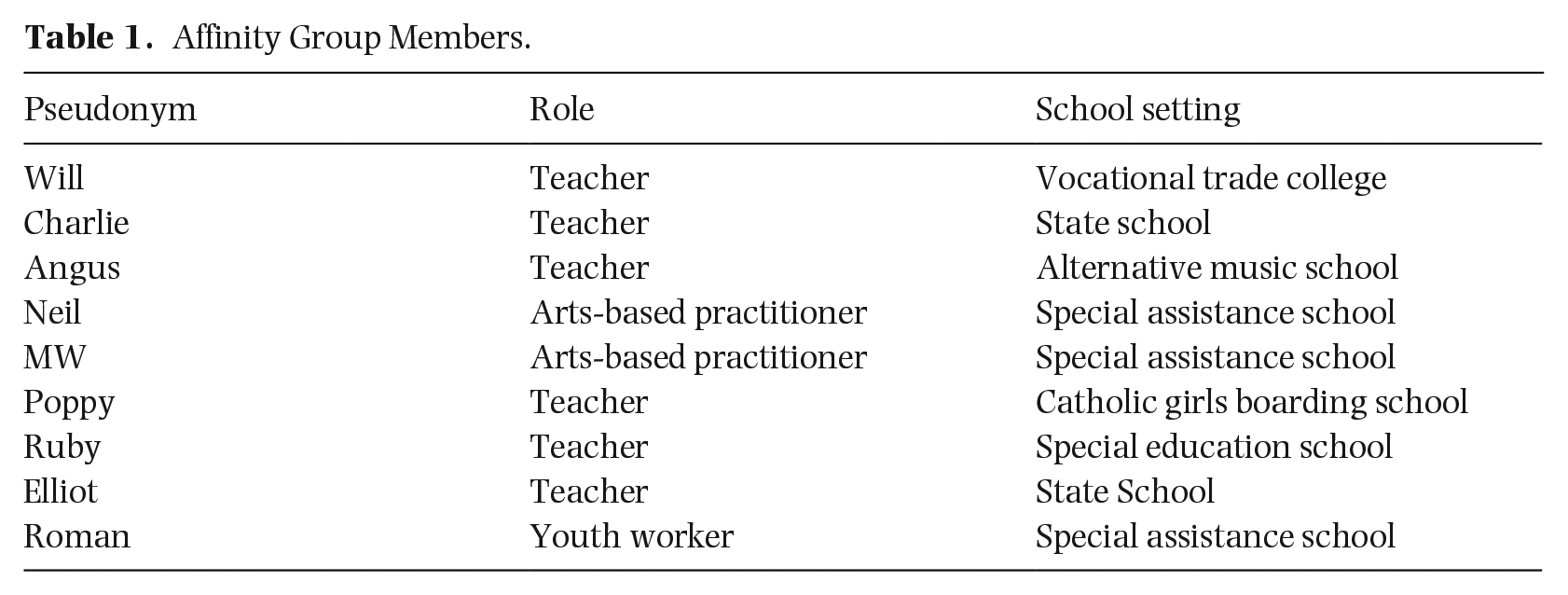
The affinity group assembled for this project included a diverse range of teachers and cognate school staff who worked in educational settings across Queensland. The group was constituted by teachers (n = 6), a youth worker (n = 1) and arts-based practitioners (n = 2) representing state (n = 2), boarding (n = 1), alternative (n = 1), vocational (n = 1), special education (n = 1), and special assistance school 1 (n = 3) settings in Queensland (see Table 1). The group included very experienced teachers, as well as recent graduates. The group met through a series of six scheduled group meetings (digital and in-person), across three school terms in 2023. The affinity group members held different levels of experience with hip-hop pedagogy, but each shared a desire to convene as members of the affinity group to relay accounts of their practice in using hip-hop pedagogies. It was with this “affinity” common to the participants that established “a force for new foundations of trust and collective intelligence” (Gee, 2020, p. 242).
Affinity Group Members.
The key research question that guided our inquiry was: how can an affinity group of educators working in diverse contexts support collaborative approaches to hip-hop pedagogy? In addressing this question, we sought to work with educators who were working in complex and challenging educational contexts and who were open to trying something new in their pedagogical practice as a form of pedagogical renewal. Ethics approval to conduct this study was provided by the University of Southern Queensland Human Research Ethics Committee (Ref#ETH2023-0125). All participants provided written and verbal consent to participate in the project, and pseudonyms have been used to ensure anonymity. Data for this project were generated through recordings taken of the affinity group meetings and further discussions with each participant, along with rhymes produced by the affinity group members. Narrative inquiry provided a basis to “capture and investigate experiences as human beings live them in time, in space, in person, and in relationship” (Clandinin & Connelly, 2000, p. 211). The first meeting provided a sense of context and background on each member’s backgrounds and teaching experience and provided the opportunity to relay specific accounts of their approaches to teaching and current enactments of hip-hop pedagogy. Subsequent groups were focused on specific aspects of hip-hop pedagogy and where participants workshopped strategies and more general accounts of personal experience.
This approach to the affinity group sessions allowed for a “multitude of possibilities” (Clandinin, 2019, p. 201) as participants shared their perspectives and experiences. Allowing time for the participants to “find new ways of making sense of their work as teachers and as people” (Clandinin, 2019, p. 202) revealed the shared epistemological bases that drove the participants’ practice. This was especially apparent in sessions during which the participants shared examples of rhymes that they had developed and activities that they had workshopped with students. Songwriting and the development of rhymes formed a significant part of this project, demonstrating a “practice as research paradigm” that is important for affinity group collaboration (Negus & Astor, 2015, p. 228). The affinity group method followed this practice-informed approach where accounts of creative practice with students were shared, collaboratively developed, and used as prompts for further exploration and inquiry into practice (Candy & Edmonds, 2018).
Remixing hip-hop pedagogy with the affinity group
We note that there is a growing need for educators and those who work in educational settings to connect with each other in the interests of developing trustworthy climates of collegiality. This is especially important in terms of generating new and imaginative enactments of education that meet the remit of students and teachers emplaced within educational sites that are socio-economically complex. According to Adjapong and Emdin (2015), hip-hop pedagogy, unlike more didactic educational approaches, enables participants to feel comfortable to “develop their voice” (p. 73) as this capacity for agency emerges within the space of the pedagogical encounter. This ethic of collegial support was evident in the affinity group formed for this project. The participants reported feeling secure in their capacity to authentically share accounts of practice, creatively produce rhymes, and interrogate their pedagogy. Although discussion of the intricacies of the interpersonal dynamics inherent to this group is outside the scope of this article, commonalities and shared conviction across this group resulted in the affinity group sessions proceeding successfully. Each participant had engaged with hip-hop pedagogy in their own unique way, with this representing a particular strength of this group. The capacity to offer accounts of personal practice and experience in different educational settings, as well as genuinely engage in the interrogation of practice and development of strategies toward new practice led to the success of these sessions. We note that selecting participants who: (a) maintained a shared conviction toward education; (b) appreciated the function of hip-hop pedagogy as a means for reconnecting students to learning; and (c) felt comfortable interrogating their own practice were crucial for the effective enactment of the affinity group.
We turn now to detail the principles that the participants identified as crucial for hip-hop pedagogy. These principles of hip-hop pedagogy were relayed across the sequence of affinity group sessions to constitute indicators of the approaches and strategies our participants use in their own enactments of hip-hop pedagogy.
Expressing vulnerability: Having “empathy for my students”
Although each member found the affinity group a safe and inclusive environment, most of the participants mentioned how writing and presenting a rap in front of their peers represented a daunting experience. For many, the activity also provoked a greater understanding of their students’ situations: It [performing a rap] gave me great empathy for my students. I’ve never rapped before. As teachers, we think we understand what our students are going through when they present publicly. But it made me realise that I’m still viewing it through how easy I think the content is. Rapping publicly made me realise that even though my students are also sharing with a supportive group, it’s still intimidating when you aren’t confident with the content or haven’t done it before. It was a great learning moment as a teacher (Elliot).
For others, the sharing of narratives in a rap form enabled them to consider the assessment process in schools: I felt incredibly uncomfortable [performing a rap]. It was intimidating knowing that I’d never done this before, I had just written it last minute and I was sharing in front of experienced professionals. It was undeniable, the connection between this and how my students must truly feel with their assessment. I thought I empathised with them. This activity really brought home real empathy (Poppy).
Some members highlighted how the experience made them feel more vulnerable and how this coincided with their roles in education: “It’s always scary performing in front of new people but a sense of relief once it’s done. Great leaders show vulnerability” (Neil). It was observed how the shared experience of performance quickly built trust among the affinity group participants through the open expression of vulnerability (Applebaum, 2017), which encouraged some members to experiment further and extend their practice by “encompassing an openness to change, dispossession and willingness to risk exposure” (p. 870). In addition, Poppy noted that the experience of rapping with the affinity group enhanced her understandings of her students’ positionalities: The importance of setting up safe and accommodating spaces within the classroom and providing students with the tools to be themselves . . . I’m a relational teacher and hip-hop pedagogy assists me to develop relationships with my students due to encouraging trust and vulnerability . . . The affinity group has encouraged me to lead by example in the classroom and if I expect my students to do something, I should also be willing to do this . . . [the affinity group] is a comfortable and casual setting with no pressure.
Both the affinity group model and hip-hop pedagogy provided the capacity to engage with her students and consider the perspectives from which they approached schooling (Clandinin, 2019). For example, an indication of this awareness was noted in Poppy’s accounts of incorporating the role of “cipher” (Levy et al., 2017; Rollefson et al., 2023) into her practice: I run many of my drama lessons like a cipher, I may provide a starting point such as a script or an idea, I provide some independent work time, and then the whole class, including myself, stands together and shares. We also provide honest feedback on the performances.
For Poppy, taking on the role of cipher enabled her to demonstrate her place in the classroom while opening space for students to contribute their views on their own work and that of their peers. It also occurred that she was vulnerable in this moment, and as part of the classroom affinity group, was prone to student feedback and evaluations. This positionality demonstrated the democratic ethos of the classroom she was facilitating, with her own modeling of an affinity group approach with her students working toward this conviction for participation and engagement.
Maintaining safe spaces: “Sharing ideas with others”
Extending the theme of generating empathy and understanding of the students’ positionality, the affinity groups also revealed the importance of creating safe spaces for students to share their experiences. For Angus, an experienced educator and musician at an independent school, the affinity group deliberations encouraged him to consider what educators share with their students. Angus shared a reflective rap on this point:
As a teacher, and a musician
who makes music no-one wants to listen
A shy person, but recovering
Beating the black dog, embracing black star loving . . .
Sometimes I think vulnerability is too easy for me
And if you read between the lines you might see
Demonstrative ability to and conceptual overfamiliarity
Sometimes I finish a lesson and collapse from exhaustion
And others I am elated, on a high to a point of caution
Despite this, I know it is just term two, so I brace for the torsion
Sometimes I finish a year and know what I did was good
And if I recall lessons and interactions I realise it would
Decide in favour of the good and I have given all I could.
Making space to share aspects of the Self—to relay “Knowledge of Self” (Dimitriadis, 2009)—was important in Angus’s practice as an educator. He wanted his students to know that he too had experienced some of the challenges that they were encountering. By making space to discuss aspects of the personal and positional, Angus demonstrated how his hip-hop allowed him to engage with his students through empathetic relays of self-narrative (Clandinin, 2019). Through Angus’s sharing of stories and experiences through rap, he was able to demonstrate how vulnerability forms part of the human condition. However, for this to occur, it was crucial that safe spaces to share and demonstrate vulnerability were created (Applebaum, 2017; Loveless et al., 2016).
The importance of sharing stories: “You realise you are not alone”
Experienced DJ, workshop facilitator, and affinity group participant Neil noted that one of the strengths of hip-hop pedagogy is its ability to convey authentic stories. For Neil, this sentiment is evident in one of the initial narrative songs in hip-hop and important artifact in hip-hop culture: “The Message” was what Melle Mel saw as a ghetto youth . . . it is the beginning of hip-hop having a broad appeal . . . we all love and hate a sad story . . . it is both authentic and creative and asks questions of what is happening . . . this group allows us to keep asking what is happening and sharing our own stories of what is happening now.
Other participants relayed a similar sense of the “authentic.” Roman, a youth worker in a special assistance school, explained how the stories shared in raps provided scope for his students to conceptualize and relay feelings of isolation and disenfranchisement: It has been awesome to be a part of it . . . to work with likeminded people, people who are thinking outside of the box . . . the stories make you realise that you are not alone.
Our participants broadly agreed that there are limited opportunities for safe, honest, and collaborative discussions in mainstream school settings. Roman explained both students and educators each share a sense of frustration with the current system, and a feeling of disconnection: “so many teachers and youth workers feel defeated.” Part of the function of hip-hop pedagogy was in the capacity it provided for students and teachers to relay a shared sense of the world. As Roman observed, this held a “therapeutic” function: One young person I have worked with who had a traumatic background with parents in prison and struggling with his own substance abuse had this desire to write his own raps . . . I worked with him through some workshops and with a music producer [MW] and he was able to record his own music. He became more engaged at school, especially with attendance and developed a more positive outlook . . . One of my personal highlights was the opportunity to perform [a song they both wrote together] at a showcase with this student at Studio 188 . . . it was the first time we had both performed live at a proper venue and our anxiety levels were the same . . . I was shitting myself . . . I was able to share my nervousness with the student and we were able to encourage each other to perform . . . It’s a story I will always remember.
In this moment, Roman modeled the collaborative nature of hip-hop. Vulnerability was crucial to these moments of sharing, with the exposure of “Knowledge of Self” central to the collaboration and engagement. The curative and reflective potential of hip-hop narratives is evident in this excerpt from Roman’s composition “Song For Them”:
I don’t sleep most nights. I just lay awake and think
These lost souls walk along this earth addicted to the pipe or the drink
The virus out there is the ice and crime that goes up on these streets
Can we rise from defeat? Kids getting bashed for the Nikes on their feet . . .
Every night always ends the same
Dad’s drunk, Mum’s crying in pain
Cops are called and Dad promises that he’ll never hit her again
But he does and you grow up to think that’s how a man should show love
You want to forget it’s in your head, so now you drown it out with the buds
This goes out to all the ones that are stuck and lost in the system
The ones that had to grow up to protect their brother and sisters
Importantly, through sharing this story, Roman was able to express some of the challenges he and his students encountered in his school context, with this expression of vulnerability providing a valuable point of dialogue and engagement.
Confronting a lack of recognition: “Stress levels elevated, job never celebrated”
Participants also raised the issue of a lack of recognition for those who work in educational environments: “We are often the first blamed and the last thanked. We have so many people we need to keep happy but our role is not highly regarded” explained school leader Will. This theme of recognition led to the formation of one of the first collaborative songs written as part of the affinity group: “Staffroom Superstar.” Like other songs written during the affinity group sessions, the piece started with one participant writing a verse (in this case, the first author) and then circulating it to others for feedback and collaboration. The recording can be accessed online (https://on.soundcloud.com/4tSDGjKhaP9ymPqF9) and the lyrics are shared here: Staffroom Superstar Verse 1—Charlie
Bell rings, can’t contain it’s about to start soon
Agitated got to get to the classroom
Keep it animated like I’m in a cartoon
Stuck at the laminator inside the staffroom
Feeling “stupider” do you know who we are?
The real superstar, if you could view my car
Or hear the things said to me
You would rethink the concept of fame and celebrity
Zombies—still feeling dead at school
It’s on me, who we put up on a pedestal
Better still some recognition
For those who get the mission and set the vision
Big-hearted—overcome by guilt
Red carpet? I guess some blood’s been spilt
Can’t stop me, another coffee, stay stoic
So pour one out, those teachers are heroic
Verse 2—Roman
Yo tell me, do you know who we are?
We’re the educators, the real-life superstars
Signing off exams like we’re signing off autographs
Dapping kids through the halls that’s just how I’m movin’ bruh
Yeah it’s touch and go
Connect the dots, dominos
I’ve got some frustration that I need to get off my dome
One teacher 30 kids addicted to their phones
And you struggle with that one kid you’ve got at home
Did I hit a nerve? Hanging off my every word
Kids make beats with a desk and pen as I spit this verse
Hang with the jocks and nerds
Seen ’em at their best and worst
This is my classroom, sit back it’s time to learn
This is for the ones not appreciated
Deal with kids irritated, ADHD is it medicated?
Stress levels elevated, job never celebrated
No matter what they always stay dedicated
Verse 3—MW
Trying to balance work rest and play like a Mars Bar
As an MC I’m only dope as my last bar
Arrive at the school car park, no car parks
I go down the street, seems off to a hard start
Unload my portable studio on my trolley
Gotta keep the audio quality for my students, yo
Drag it to the office to sign in
Tell ‘em I’m not a random and I was invited
To come to a class and teach ‘em bout rhyming
Could you please tell me whereabouts I might find them?
How many staircases will I be climbing with my giant 50kg studio box? It’s tiring
After I set up they wanna know if I’m famous and I explain this
I’ve been making this music for ages
Barely anyone outside my state is aware what my name is
Though I may be the greatest, I must be crazy or courageous
The above composition provides an example of the creative possibilities of working in an affinity group, in which individuals can share ideas that lead to an authentically generative collaboration (Scahill, 2023). By working together on a creative composition, group members were able to draw on distinctive individual and shared experiences remix hip-hop pedagogy as an expression of vulnerability as educators, share stories of practice, and confront challenges in a productive and generative space (Adjapong & Emdin, 2015; Loveless et al., 2016). This process allowed the affinity group to validate the experiences of individual participants and, beyond demonstrating a recognition of each member of the affinity group, also named and exposed a phenomenon that each member had encountered in their own experiences of schools. This revealed a shared sense of experience which was then opened for scrutiny and appraisal through the compositional and song-writing process.
Conclusion
This article has demonstrated the intersections of hip-hop pedagogy and affinity group method as a way for educators to engage in collective reflection on their pedagogical practices, professional identities, and well-being. It was with this aspect of hip-hop pedagogy that the critical possibility of hip-hop as a way of doing teaching and learning was realized. Hip-hop challenged the constitution of education—of what “counted” as education for these teachers—and in doing so, effectively disrupted the expectations that form around prevailing enactments of schooling and teaching and learning. It also provided space for different enactments of identity. Hip-hop opened out new ways of being a teacher and of collaborating. Working in tandem with the affinity group method, hip-hop pedagogy centers on a participatory ethic that values collaboration and that mediates shared expression.
In this article, we were interested in charting the amenity that the affinity group held for educators interested in working with hip-hop pedagogy and how the affinity group opened space for teacher peer support, collective professional development, and reflective practice. As this article reported, the affinity group space enabled educators to define and conceptualize their practice and opened opportunities for “trying-on” pedagogical innovations that could be taken back into members’ respective classrooms and other educational contexts.
This article reported that the remixing of hip-hop pedagogy through the affinity group enabled teachers to: (a) express vulnerability as an educator; (b) maintain safe spaces for learning and teaching; (c) share stories of practice; and (d) confront a lack of recognition that permeates schooling in this present moment. We suggest that affinity groups that attend to dialogue around these points provide a network of support for teachers to reflect on their practice and innovate. Elliot, one of the affinity group participants summarized this intent in the following way: My involvement in the project has made me enjoy work a lot more. It has also given me some confidence. I have only been teaching for about 18 months. I’ve felt like such an imposter and an outsider amongst other teachers. The project feels like someone pulled out a seat at the fun table in the corner and told me I could sit with them . . . I’m confident this project has already made me a better teacher, allowed me to justify my decisions with confidence, to parents, colleagues and bosses. It will also keep me happily in the teaching profession for longer.
We are in a moment where education is in crisis around the globe, which requires innovative approaches to more inclusive and sustainable schooling (Riddle, 2022). This article has demonstrated how educators working together on hip-hop pedagogy through an affinity group were enabled to define their pedagogical practices and conceptualize potential strategies to engage with students in more relational ways (e.g., Hickey & Riddle, 2023; Riddle & Hickey, 2025). We contend that the enactment of hip-hop pedagogy informed by an affinity group of collegial support achieved just this, with the outcomes of this project illustrating how a group of educators engaged in the delivery of innovative pedagogies can collaboratively support each other in the delivery of meaningful education for all young people.
Footnotes
Author contributions
Declaration of conflicting interests
The author(s) declared no potential conflicts of interest with respect to the research, authorship, and/or publication of this article.
Funding
The author(s) received no financial support for the research, authorship, and/or publication of this article.
