



Abstract
Creativity has been described as an indissociable component of music education, complex to conceptualize and often overgeneralized. This article provides an overview of existing research on musical creativities in secondary education between 1990 and 2020. A total of 76 articles published in peer-reviewed journals are reviewed according to PRISMA (Preferred Reporting Items for Systematic reviews and Meta-Analyses) guidelines. To present and discuss the results, several dimensions of creativity research have been clustered into five categories: product, person/group, creative process, context, and domain. The 22.37% of the articles focus on the creative process, 14.47% on the context, 13.16% on the person/group perspective, and 1.32% on the product. The 48.68% of the studies focus on the domain perspective, showing an emphasis on specific activities traditionally associated with musical creativity like composing or improvising. Music listening is not present, and various forms of musical creativities are underrepresented. Over these three decades, an increasing orientation on teaching and learning within a sociocultural framework can be observed. In addition, the pedagogical challenges concern an expanded vision of creativity, albeit based on a specific and precisely defined framework.
Introduction
Creativity has become an iconic and global phenomenon in the field of education, and a priority in the field of research for the last 30 years. In this sense, Craft (2005) points out two “waves” of creativity in education: the first during the 1960s, based on a long line of child-centered policies, philosophies, and practices, which are aligned with pioneering pedagogical approaches to music creation by Schafer (1965) and Paynter and Aston (1970). The second wave, in the late 1990s, was preceded by policy initiatives integrated into curricula, growing interest in education research, and the support of the business world in terms of creativity’s importance. Increasing interest in creativity is reflected in the exponential growth of research since the 2000s (Hernández-Torrano & Ibrayeva, 2020; Randles & Webster, 2013).
The complexity of this multifaceted phenomenon has been approached within a sociocultural framework (Glăveanu, 2019) conceived as creative action (Glăveanu & Beghetto, 2021), where psychological, behavioral, social, and cultural aspects operate simultaneously, putting forward systemic and dialogical aspects of creativity as results of dynamic interactions (Glăveanu, 2018; Glăveanu & Beghetto, 2017; Glăveanu et al., 2015). This corresponds to the pluralization of creativity in a variety of domains, processes, or styles (Sternberg, 2005), extended into music education through diverse forms of authorship (Burnard, 2012).
By emphasizing the procedural and plural nature of music, different ways in which musicians are creative through composition, improvisation, performance, listening, and producing can be shown (Hill, 2018; Randles & Burnard, 2022). Approaches to creativity as a thinking skill have been present in music education research since the 1990s, leading to several models of the individual cognitive process (Webster, 1990, 2002). During the last two decades, growing attention has been put on the socio-constructivist framework for teaching and learning, highlighting the role of group work and teacher-learner interactions (Giglio, 2015).
From the seminal Rhodes’s (1961) four Ps framework from a cognitive and individual perspective (personal, process, press—referring to context—and product), Glăveanu (2013) proposes a framework from sociocultural and ecological psychology in a dynamic integration of five As: actor, action, artifact, audience, and affordances. A seven Cs framework including creators, creating, collaborations, contexts, creations, consumption, and curricula is presented by Lubart and Thornhill-Miller (2019). Sternberg and Karami (2021) extend the framework to eight Ps: purpose, press, person, problem, process, product, propulsion, and public. Four main dimensions of creativity have been identified in music education literature: studies looking at the creative person, the process, the context, and the assessment of the creative product (Hickey, 2002; Odena, 2012a, 2018). Randles (2020) suggests five Ps: person, product, process, press, and position.
Teachers’ understanding of creativity seems to be wide and rather incomplete in general education (Mullet et al., 2016), which is in line with the overgeneralization and the need for specific categories and definitions within the field of music education (Odena, 2012b; Philpott, 2007). As pointed out by Sachsse (2020), the growing interest in creativity in music education can be linked to a more general occidental societal phenomenon: the injunction to become creative. He argues for a critical and clear position toward music invention activities and creativity in music education.
Our contribution in this article attempts to highlight the relation between musical creativity and specific pedagogical approaches in secondary education, characterized by a rather small corpus of studies. Even though a growing number of contributions on creativity are to be found in peer-reviewed journals (Strand, 2017), educational research into activities such as improvisation, for example, seems still to be relatively underdeveloped (Larsson & Georgii-Hemming, 2018; Siljamäki & Kanellopoulos, 2019).
The aim of this study is to establish a profound understanding of research since 1990, to identify and relate key concepts in literature, and to draw conclusions for further practice-oriented research and pedagogical practices. In addition, the aim is to provide a mapping of topics, methods, and concepts related to music in secondary education. This review takes into account activities described as composition, improvisation, creative music making, and creative music listening. The following research questions (RQs) are identified:
Research Question 1. What are the research trends in creativity for secondary music education between 1990 and 2020?
Research Question 2. How is musical creativity implicitly or explicitly understood and/or defined in the research articles about secondary music education in the last three decades?
Research Question 3. What are the core themes and main challenges for music teaching and learning?
Method
This integrative review (Whittemore & Knafl, 2005) aims to develop inductive and interpretative forms of knowledge synthesis from a mixed methods approach, and proposes new perspectives for the field (Torraco, 2016). This study was guided by the PRISMA (Preferred Reporting Items for Systematic reviews and Meta-Analyses) checklist, considered appropriate for quantitative and mixed-methods studies (Urrútia & Bonfill, 2010) and eMERGe meta-ethnography reporting guidance, focused on qualitative reviews (France et al., 2019).
The review was carried out on a search of Web of Science (WOS) and SCOPUS bibliographic databases. A series of keywords were established from their previous use in high-impact work related to the object of study: “Creativity,” “Secondary School,” “Composition,” and “Improvisation.” Finally, using the Boolean operators “OR” and “AND” the following search equation was formulated and applied to both databases: (“Music” AND “Creativity” OR “Composition” OR “Improvisation”) AND (“Education” OR “Secondary School”). In addition, after checking that not all issues of indexed journals were included in the period of the systematic review of the present study in WOS and SCOPUS, a specific search was conducted in the following journals of music education and creativity in education: British Journal of Music Education (BJME), Bulletin of the Council for Research in Music Education, International Journal of Music Education (IJME), Journal of Creative Behavior, Journal of Research in Music Education (JRME), Journal of Music Teacher Education, Musicae Scientae, Music Education Research (MER), Psychology of Music, Research Studies in Music Education (RSME), Thinking Skills and Creativity.
The inclusion criteria were established as follows: (a) empirical research studies with data collected through quantitative, qualitative, or mixed methods; (b) studies that analyze and explore explicitly or implicitly the phenomenon of creativity; (c) articles developed in secondary school settings, based on compulsory or elective secondary programs from both teaching and learning perspectives; and (d) peer-reviewed journal articles in English, to ensure a standard of quality and reliability, published between January 1990 and December 2020. The exclusion criteria were based on the following selection: (a) conference papers, book chapters, or books; (b) practitioner reports or description of teaching experiences without empirical research; and (c) theoretical or literature review articles.
The search identified 12,135 items. A total of 152 articles were considered relevant after the first screening from the reading of the title and abstract by Authors 1 and 2, following the Inclusion Criteria 2 and 4, and excluding those with explicit information in the title or abstract related to Inclusion Criterion 3. After a careful reading of the 152 articles identified and approved in the first screening, 25 articles were excluded in relation to the Inclusion Criterion 1 as not based on empirical research, but as a description of teaching experiences (24), or historical research (1). In relation to Exclusion Criterion 3, 12 articles were excluded as theory-based articles, and 5 as literature review articles. This left 108 articles. In relation to Inclusion Criterion 2 and after careful reading, six articles were excluded as not based on the topic of creativity in secondary music education. Then 26 articles were excluded following the Inclusion Criterion 3, as not being related to music in secondary schools. A total of 76 articles were finally selected (see Figure 1 and Supplemental Appendix).
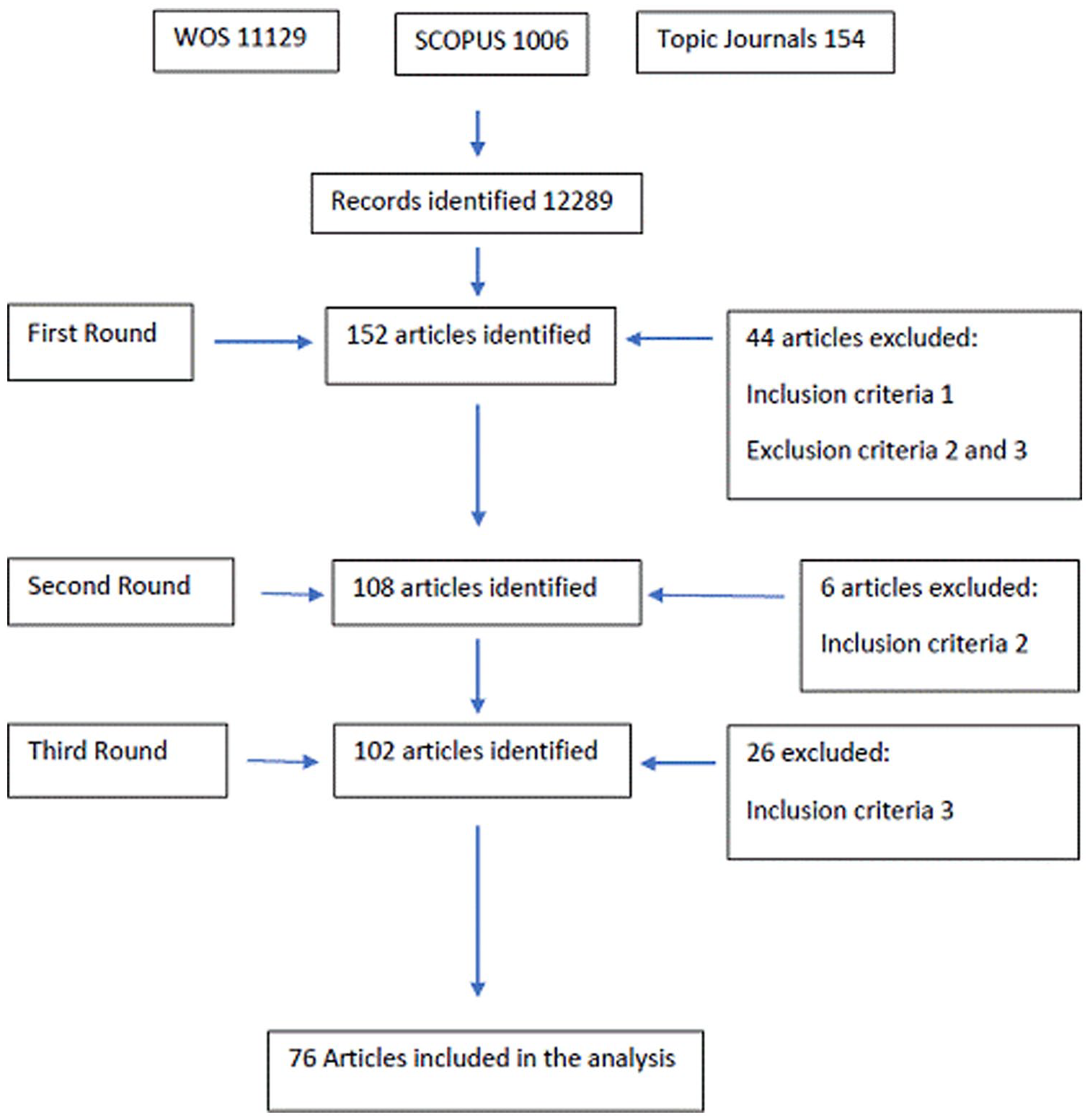
Flow Diagram.
The contextual and methodological perspectives in RQ1 were analyzed descriptively through frequency and percentage, using VOSviewer software. The full-text articles were coded and approved by Authors 1 and 2 according to the inductive categories established ad hoc considering the studied phenomena: (a) general information (date, journal author, country), (b) research methods and design (quantitative, qualitative, mixed), (c) focus on a specific category of participants (students, teachers, others), (d) topic (improvisation, composition, creativity in general, others), (e) article content (context, student characteristics, tools used, music style/genre, semiotic resources), and (f) implications for practice.
Inductive categories related to creativity were established to analyze the topics and implicit or explicit conceptualizations of creativity to answer RQ2. The results are presented using categories inspired by existing models of creativity, especially by Lubart et al. (2003) and Glăveanu (2013): person/group, process, and product, as well as the context (conative and sociocultural dimensions). These categories are completed according to our particular focus on music education using domain-specific terms such as composition, improvisation, teaching, and assessment. The final categories are (a) product, referring to musical creations; (2) person/group, referring to group interactions and individuals; (3) process, referring to the creative process; (4) context, referring to the social environment, conative elements, and affordances; (5) domain, in relation to teaching and learning composition, improvisation, and teaching creativity. Categories have been coded and agreed on by Authors 1 and 2 using Atlas.ti8 software.
Results
Research study characteristics
The evolution of the year of publication of the articles shows an upward trend from 1995 to 2004, and a slight and very gradual decline from 2004 to 2020 (see Figure 2).
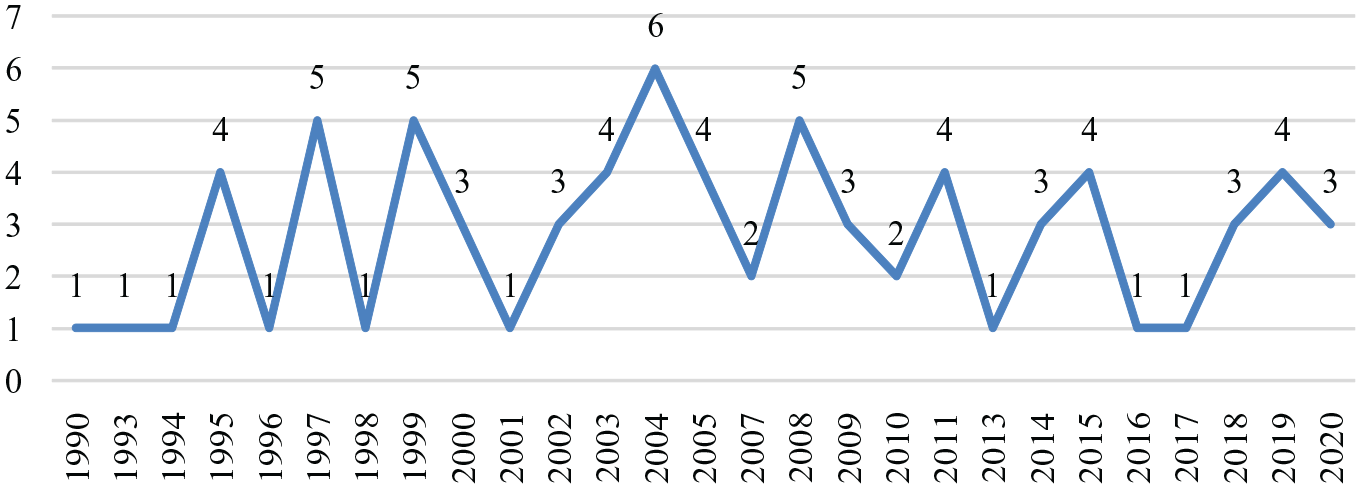
Evolution of the Publication of Articles on Creativity.
The vast majority of the selected articles have been published in five journals: (a) BJME (n = 19, 25%); (b) MER (n = 15, 19.74%); (c) RSME (n = 12, 15.79%), (d) IJME (n = 8, 10.53%); and (e) JRME (n = 7, 9.21%). In relation to the nationalities of first authors’ universities, a large majority are from the United Kingdom (n = 39, 51.31%), followed by the United States (n = 12, 15.79%), Australia (n = 8, 10.52%), Spain (n = 5, 6.58%), New Zealand (n = 4, 5.26%), and Hong Kong (China, n = 3, 3.94%). Figure 3 shows the frequency of authors who have the most published work on the topic (n = 73; two and more articles per author).
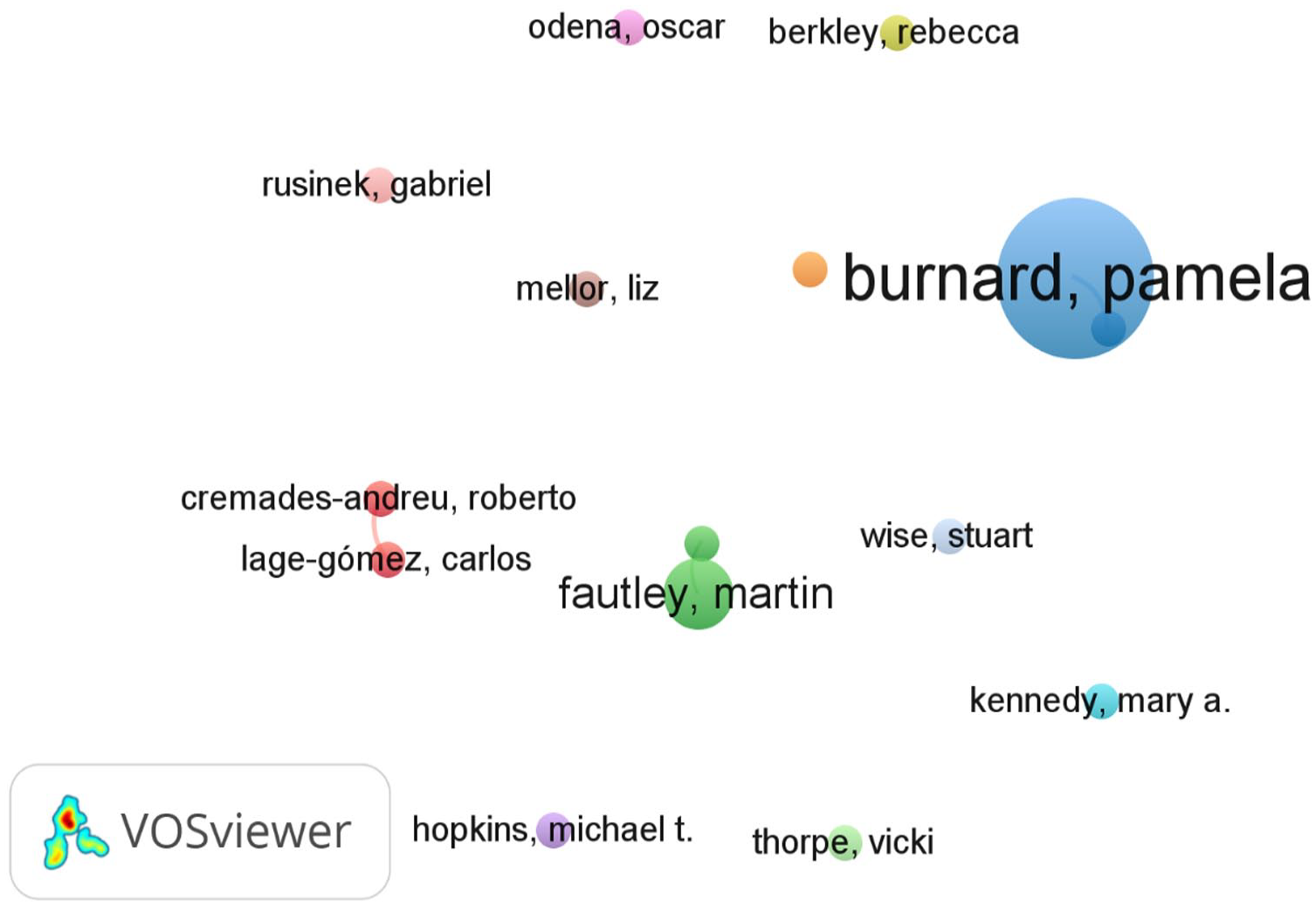
Publishing Authors.
As can be seen in the above figure, the author who has written the most single- and coauthored articles is Pamela Burnard, who is one of the international references for this research topic, as is Martin Fautley, who is the next most published author.
The research design of the selected articles is mainly qualitative (n = 61, 80.26%), followed by quantitative (n = 8, 10.53%) and mixed methods (n = 7, 9.21%). In this sense, it is not possible to establish unified criteria to perform a meta-analysis, as the disparity in results presented does not allow us to compare the data collected. It has been found that some of the articles that claim to have a quantitative or mixed design do not offer the psychometric values of the measuring instruments developed, nor do they offer inferential statistical analyses, although they include descriptive statistics (frequencies and percentages).
Moreover, 75% (n = 57) of the articles are focused on students, while 21.05% (n = 16) are focused on teachers. The 3.95% (n = 3) of articles are focused on both students and teachers. In relation to the domains, 76.32% (n = 58) of the articles focus on composition. The 9.2% (n = 7) of articles focus on improvisation, while articles focused on both composition and improvisation represent 5.26% (n = 4) of the total. The 9.21% (n = 7) of the articles focus on the wider phenomenon of creativity (see Figure 4).
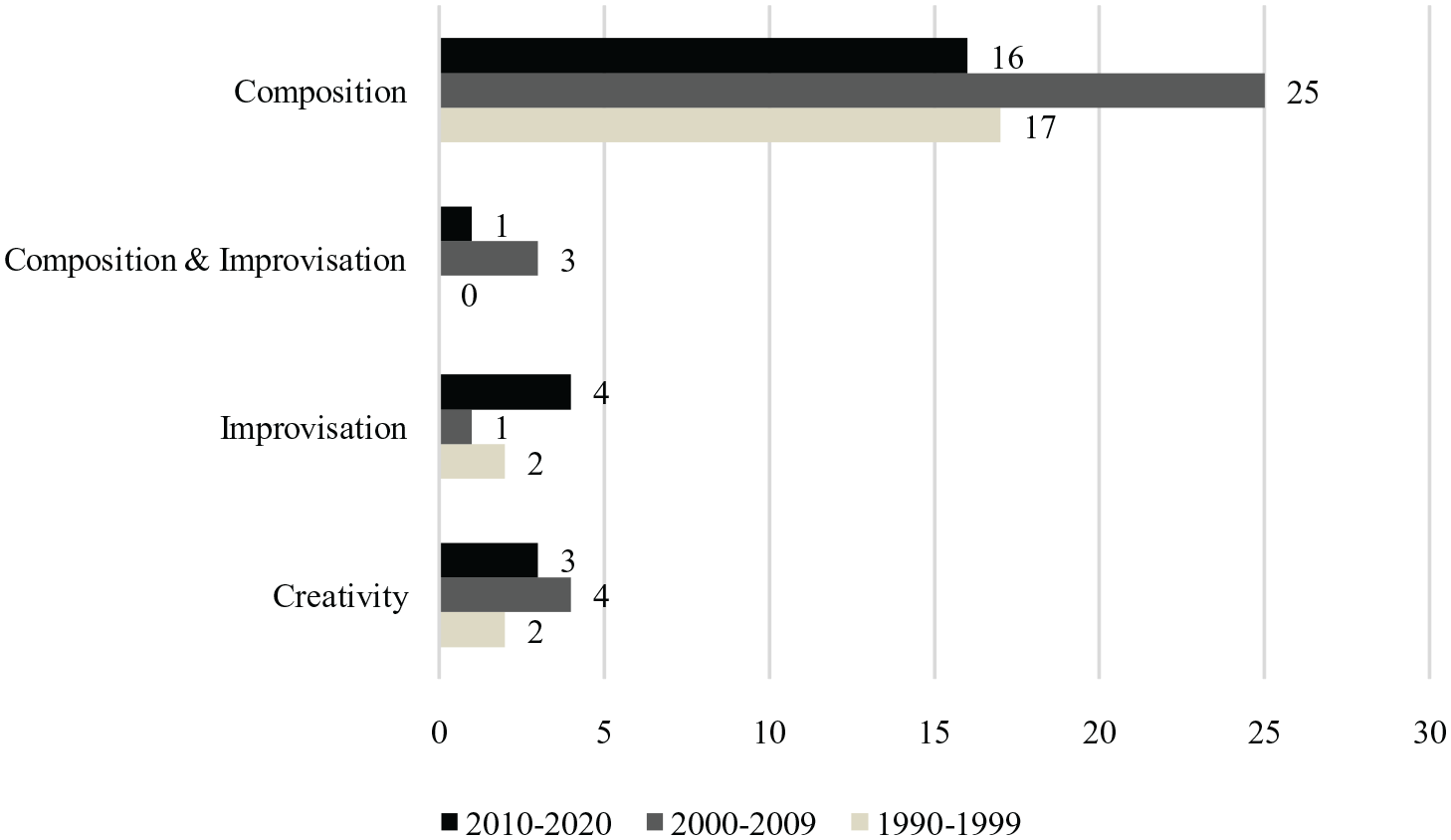
Evolution in Creativity Domains.
Conceptions of creativity
Explicit conceptions of creativity as a phenomenon can be found in 9.21% (n = 7). These articles were published during the 2000s (n = 4, 57.15%) and the 2010s (n = 3, 42.85%). The 48.68% (n = 37) focus on the domain perspective, from which 22.37% (n = 17) focus on teaching composition, 11.84% (n = 9) on teaching creativity, 7.89% (n = 6) on learning composition, and 6.58% (n = 5) on learning improvisation. The 22.37% (n = 17) focus on the creative process perspective; 14.47% (n = 11) on the context; 13.16% (n = 10) on the person/group perspective, from which the 60.00% (n = 6) on the group interaction and 40.00% (n = 4) on the individual. In relation to evolution on dimensions, interest in the creative process during the 2000s (14.47%, n = 11) and during the 2010s (9.21%, n = 7) can be highlighted. The classification in decades can be observed in Figure 5.
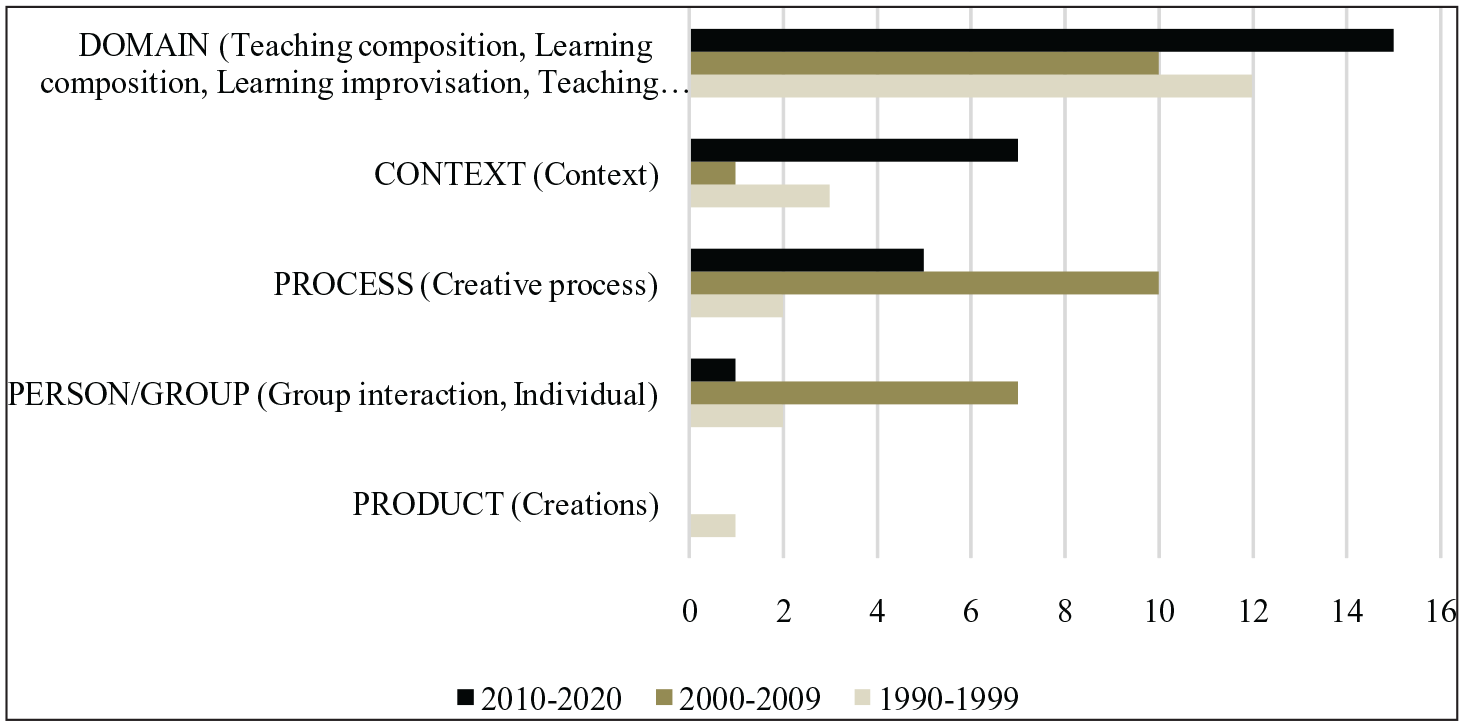
Creativity Taxonomy.
The understanding of musical creativity is considered a key and complex issue for teachers. In this sense, Burnard (2012) underlines its “multiplicity of forms, fluid roles and meanings defined in contemporary popular musics” (p. 8). Furthermore, Crow (2008) identifies the tensions between the general domain conceptions of creativity as an educable competence and the specific role of music knowledge in creative learning. A distinction is established between approaches of creativity coming from the conceptualization of artistic creativity, and those inspired by the concept of everyday creativity with educational purpose, considering creativity “as imagination successfully manifested in any valued pursuit” (Odena & Welch, 2009, p. 417). Creativity has been approached implicitly or explicitly as a sociocultural phenomenon, from which emerges a dichotomy between individual and group forms of creativity. Individual creativity is based on the conception of composing following the romantic ideal (e.g., Odam, 2000). Creativity as a distributed and collective activity, from the perspective of the social nature of music education, has been observed for two decades. To enhance the group/individual dimensions of creativity, coconstructing, coauthoring, and distributed perspectives upon creativity are evidenced in literature (e.g., Faulkner, 2003; Hopkins, 2015). Different forms of creativity emphasizing its sociocultural nature have been described as communal and collaborative creativity (Burnard & Dragovic, 2014; Burnard & Dragovic, 2015) or participatory creativity (Lage-Gómez & Cremades-Andreu, 2020). Collaborative creativity is based on subjects’ interactions, whereas participatory creativity focuses on the participatory interrelationships between all aspects of the teaching and learning process. All these dimensions are integrated in the following cooccurrence of the keyword analysis (see Figure 6).
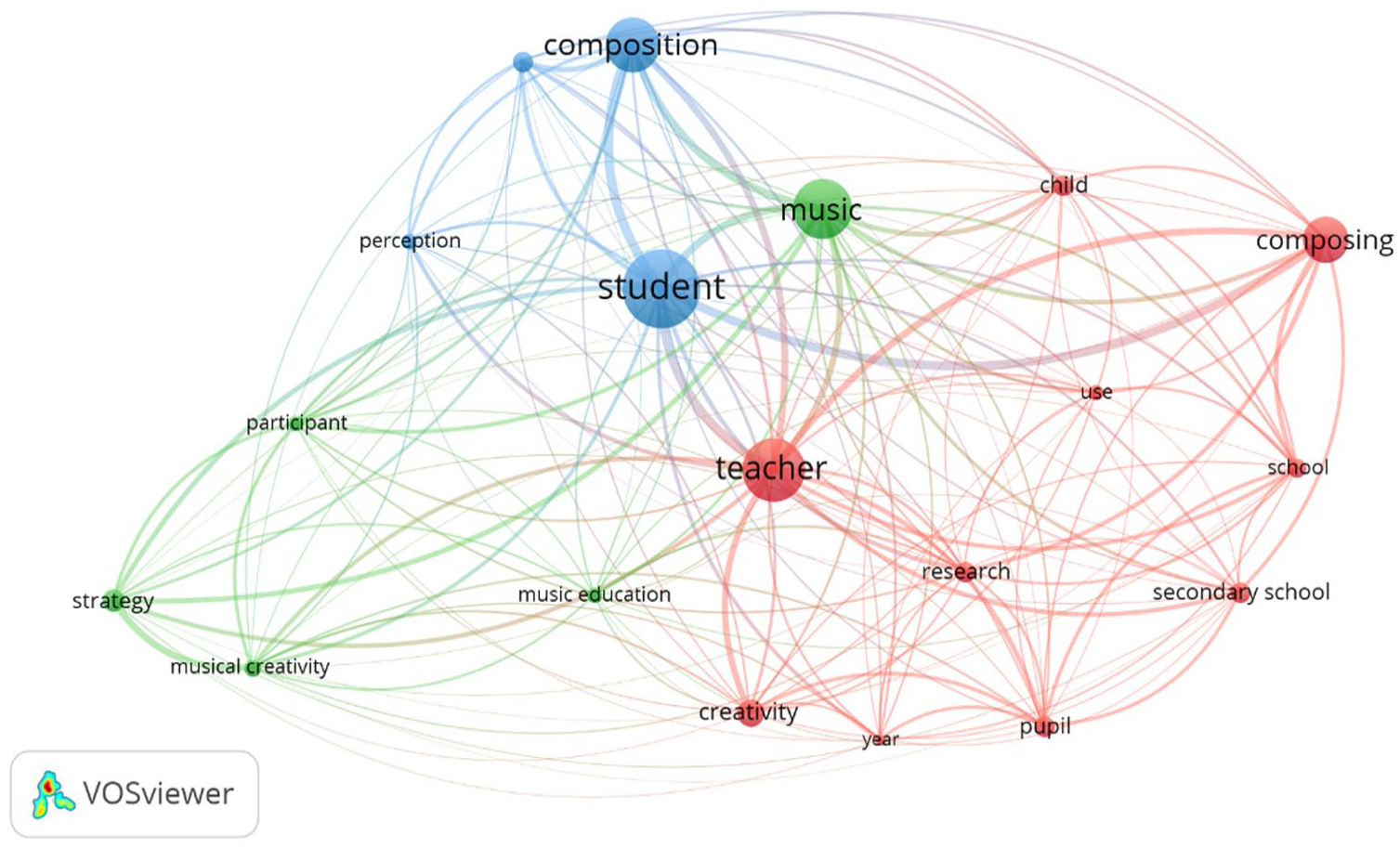
Cooccurrence Keywords of the Publications.
Dimensions of creativity for music teaching and learning
Creative process and product
It is of note that the product is rather absent in studies, except that of Pilsbury and Alston’s (1996) study. The process in composition activities emerges as the central issue in the literature. In this vein, several authors propose linear models in different phases such as Kennedy (2002), Fautley (2005a), and Hopkins (2019) based on Fautley. Another perspective concerning the creative process is to describe it as dynamic and cyclical (Burnard & Younker, 2002). Mellor (2008) also corroborates this perspective with ICT (Information and Communication Technologies)-based composition, as do Lage-Gómez and Cremades-Andreu (2020) in soundtrack cooperative composition and Kaschub (1997) in a choral setting. The importance of listening has been underlined as key in the creative process (Kennedy, 2002), together with reflection (Kokotsaki, 2011). In addition, the importance of the creative process as a tool to orient students in composition has been pointed out by Hopkins (2019).
Creativity launches and frames the space of creative possibilities through dynamic processes, as suggested by Mellor (2008). In this sense, divergent thinking is described as relevant in composition tasks from a perspective of artistic creativity (Leung, 2004) building on prior knowledge (e.g., Fautley, 2005a). Berkley (2004) underlines and summarizes the balance between divergent and convergent thinking from a problem-solving perspective.
Mellor (2008) suggests a differentiated individual approach to composing regardless of participants’ backgrounds. On the contrary, Seddon and O’Neill (2003) report differences between and within composition strategies depending on students’ backgrounds, especially in terms of the length of “exploratory” behavior (Seddon & O’Neill, 2003).
The importance of classroom talk within the process is underlined by few studies (Burnard, 2000a, 2000b, 2002; Burnard & Younker, 2002). Major (2008) analyzes talk in composition, identifying six main types of talk in the composing process. This is in line with Leung (2004), who criticizes a lack of reflection about musical concepts and metacognition.
Individual versus group procedure (person/group)
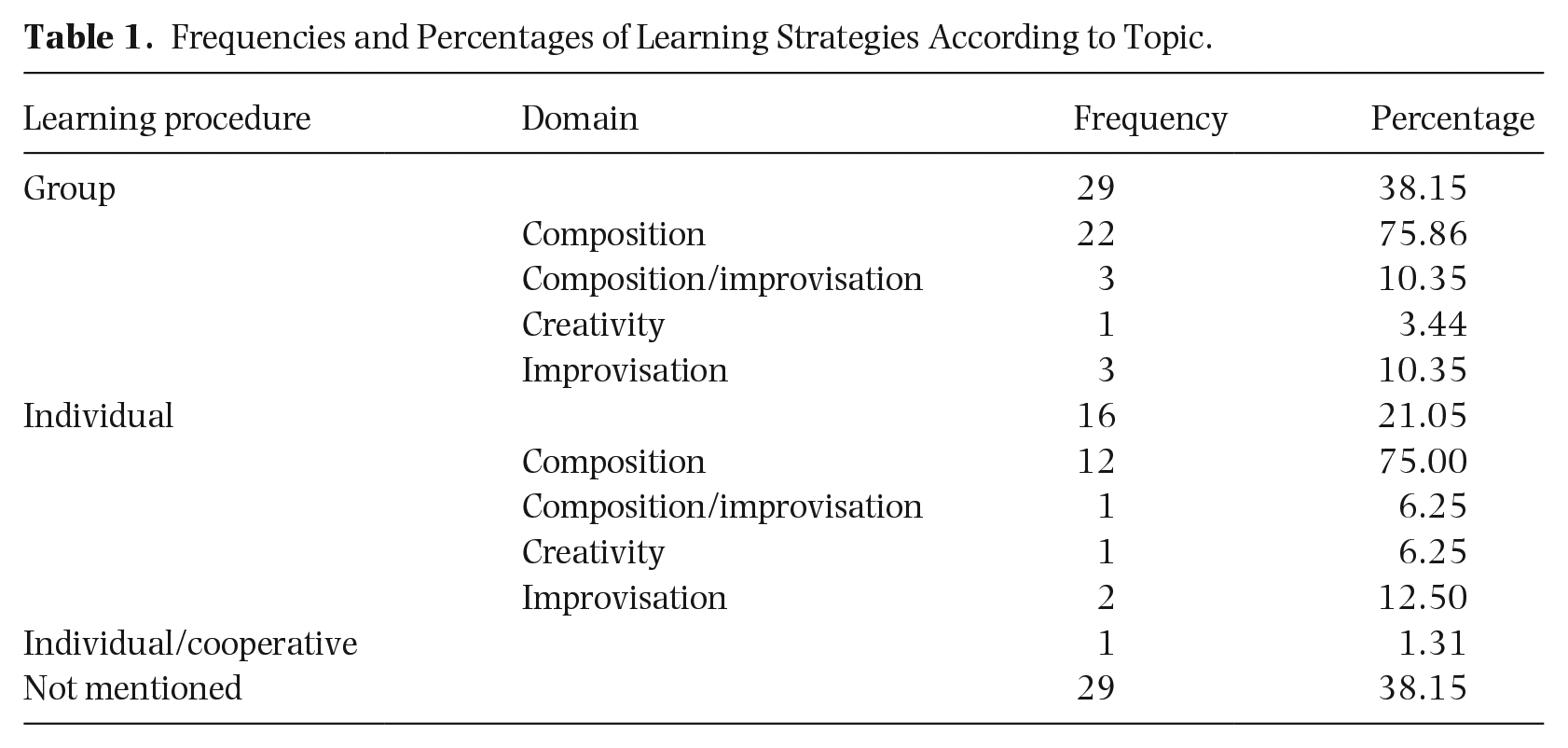
The 38.15% (n = 29) of the selected articles focus on group work as the learning procedure, whereas 21.05% (n = 16) focus on individual work. The 1.31% (n = 1) of the articles are based on both individual and cooperative work and in 38.15% (n = 29) this distinction is not mentioned (see Table 1).
Frequencies and Percentages of Learning Strategies According to Topic.
In this sense, research about a series of elements in the social sphere is emphasized in literature, analyzing the role of collaboration or interaction (e.g., Faulkner, 2003). Gilbert (1995) discusses the value of cooperative work in creative tasks, demonstrating their benefits in the classroom atmosphere. The author also focuses on interpersonal skills and knowledge, and alerts readers to the issue of individual accountability and noise.
In relation to group procedure, Hopkins (2015) finds a weak or nonsignificant correlation between music performing, composing experience, and final quality of the score. On the contrary, Lage-Gómez and Cremades-Andreu (2020) relate students’ satisfaction and identification with the product and the creative experience. McGillen (2004) and colleagues (McGillen & MacMillan, 2005) investigate the cooperative composition processes of a group of adolescents in a rural school in Australia. The authors suggest the contribution of cooperative composition to the development of students’ self-perceptions as authors. Music self-concept was found to be significantly related to compositional experience (Randles, 2010). Thorpe (2018) found a relationship between students’ identities, their achievement in group composing, and socioeconomic disparity. Moreover, age and formal music training affect the choices made by students during the compositional process, as well as their aesthetic response (Carlin, 1997).
In relation to musical style from an individual or group perspective, Allsup (2003) points out classical music as an unproductive style for group composing or community-making.
Context: Conative elements, learning environment, affordance
From the conceptualization of composition as a form of social action emerges the importance of a series of social aspects in the creative process. Motivation is connected to ICT-based composition (Chen, 2020) and curriculum integration (Cuervo, 2018). The task also has an impact on students’ intrinsic motivation (Leung, 2004). Thorpe (2018) states that motivation to compose in a group setting may not necessarily be driven by the extrinsic rewards of a school qualification, but rather by the enjoyment of social music making. In a similar sense, Lage-Gómez and Cremades-Andreu (2020) point out procedural and group mechanisms as relevant to encouraging students’ motivation. This perspective relates to the emergence of positive emotions at a multidimensional level, which is corroborated by Burnard and Swann (2010), who underline the emotional dimension in learning in collaboration with artists and the importance of the context for learning. In relation to motivation, the quality of time spent is correlated with a degree of satisfaction and enjoyment (Hopkins, 2015). Mawang, Kigen, and Mutweleli (2020) point out correlations between goal motivation and musical creativity which are positive between creativity and deep processing strategy, but negative between creativity and surface processing strategies.
The connection between engagement, participation, transformation, democracy, and empowerment is identified by Burnard and Dragovic (2014), emphasizing well-being and group improvisation. In this sense, a high degree of concentration, motivation, and positive emotions emerges, contributing to pupils’ well-being (Lage-Gómez & Cremades-Andreu, 2019). Burnard (1995) describes the influence of task design, compositional context, and students’ experience of constraint and freedom. Della Pietra and Campbell (1995) suggest the evidence of an evolving sensitivity to the improvisation process.
As an aspect of affordance, the use of technology emerges as a key issue in the analyzed articles. In the 1990s, the role of resources (Rogers, 1997) and changes in pedagogical practice (Ellis, 1995) are discussed.
The analysis of the link between informal learning and use of technology leads Folkestad, Lindström, and Hargreaves (1997) to the conclusion that schools should offer an appropriate context rather than teaching a specific strategy for composing. They point out differences in students’ approaches regarding previous experience or gender. Pedagogical practice can be redefined through the understanding of creativity, originality, and identity within computer-based composition (Mellor, 2008) or by careful analysis of professional composers’ work as described by Savage (2005). Savage considers the use of ICT as an enriching and challenging experience in the face of curriculum change, necessitating teachers’ adaptation. Other aspects like motivation for learning (Chen, 2020) or the development of thinking and learning strategies (Augustyniak, 2014) are pointed out during the last decade. Devaney (2019) underlines the prevalent use of technology in composing in the United Kingdom, summarizing positive and negative aspects. Technology as a linear and unrealistic “shortcut” for composition can be seen as negative for musical creativity. On the contrary, live performance or other real activities using ICT connect students to the world and bring meaning and life to the music classroom (Bolden, 2009; Wise, 2016; Wise et al., 2011). Technology is considered as a factor that can democratize composing, especially for students without formal musical training (Ward, 2009). Nonetheless, for teachers there remains a challenge in planning tasks in e-learning (Chen, 2020). Beyond pedagogical and technical knowledge, teachers’ beliefs and attitudes are identified as influential factors for the use of ICT (Wise et al., 2011).
Composition and improvisation
The 76.32% (n = 58) of the analyzed articles focus on composition: 17 (89.47%) during the 1990s, 24 (77.41%) during the 2000s, and 17 (64.00%) during the 2010s. A decline over time can be observed in the percentage of published articles based on composition. The majority of articles based on composition during the 1990s are centered on teaching (domain perspective, n = 4, 23.53%) and learning composition (n = 4, 23.53%), together with the creative process (n = 3, 17.64%). During the 2000s, there is a shift to the creative process (n = 10, 41.66%) and person/group based on group interaction (n = 6, 25.00%). The majority of the articles in the 2010s focus on teaching composition (n = 8, 47.05%), creative process (n = 4, 23.52%), and context (n = 3, 17.64%). Of the articles based on improvisation (n = 7, 9.21%), the majority were published during the 2010s (n = 4, 57.14%), 28.57% (n = 2) in the 2000s, and 14.28% (n = 1) in the 1990s. An increase of the published articles based on improvisation is observed. Of the articles focusing on both composition and improvisation (n = 4, 5.26%), two are published during the 2000s and two during the 2010s.
In this sense, composition and improvisation are identified as the core activities connected to musical creativity, and are also related to listening and performance (e.g., Kokotsaki, 2011). The importance of listening in composition (Fautley, 2005b; Kennedy, 2002a) and improvisation (Augustyniak, 2014) is underlined as enhancing students’ musical skills and holding a central position in creative processes. Moreover, strong correlations between performance and composition suggest they are related traits (Fowler, 2014).
Composition in the classroom has been described as a plural musical procedure in terms of: (a) a temporal and nonverbal artistic construction (e.g., McGillen & McMillan, 2005); (b) a sociocultural action, involving a series of conative aspects such as student motivation (e.g., Lage-Gómez & Cremades-Andreu, 2020) and classroom atmosphere (e.g., Kaschub, 1997); (c) problem-solving procedure (e.g., Berkley, 2001, 2004; Burnard & Younker, 2004); (d) a vehicle for the development of creative thinking (e.g., Fautley, 2005a); and (e) a tool for music language learning (e.g., Blom, 2003). The role of composition in the curriculum is considered to be an interesting, but secondary, addition compared with other musical knowledge and skills (Berkley, 2001).
According to Burnard (2000a, 2000b), composition and improvisation might be described as distinct and separate, or interrelated and indistinguishable. Nevertheless, improvisation can also be considered as a part of composing procedure (Blom, 2003). Norgaard, Stambaugh, and McCranie (2019) point out the importance of adding improvisation activities to the curriculum and the need to develop them. Musical skills such as auditory memory, listening (Augustyniak, 2014), and cognitive flexibility (Norgaard et al., 2019) are encouraged in improvisation and linked to performance (Burnard & Dragovic, 2014). The importance of an exploratory and experimental perspective in group improvisation, as related to dialogical theory, is highlighted by Lage-Gómez and Cremades-Andreu (2019). McPherson (1993) suggests that kinesthetic factors have an influence on improvisational ability, but no influence on performance proficiency. Gender is not found to be a factor. Learning another instrument, mentally rehearsing music, and participating in singing activities favor the ability to improvise. An emphasis on improvisation may improve aspects of executive functions (Norgaard et al., 2019), and at the same time foster the creation and performance of students’ music rather than the established repertoire (Burnard & Dragovic, 2014).
Teaching and assessment
Besides the five dimensions mentioned, studies focusing on teaching offer a variety of perspectives: teachers’ roles in guiding and accompanying the creative process (e.g., Menard, 2015); teachers’ own capacity to compose (e.g., Blom, 2003); and teachers’ attitudes and beliefs toward creative music making (Kokotsaki, 2011; Langley, 2018). Tobias (2013) widens the perspective by drawing attention to the development of students’ agency as contemporary musicians, performers, and sound engineers. As established by Kokotsaki (2011), creativity “would emerge on an intuitive level as a by-product of a learning objective rather than being explicitly considered in the planning process” (p. 108). Difficulties around the nature of creativity, musical understanding and skills versus fostering more generic life, and social skills are pointed out by Crow (2008). Teachers’ knowledge about creativity is considered as important. Explicit discussion of what teachers and children consider to be creative helps improve teachers’ ability to teach creative music making (Kokotsaki & Newton, 2015).
Teachers’ strategies to facilitate children’s composing are identified by several authors. Hogg (1994) underlines three roles of music (as knowledge, as accomplishment, and as an empowering agent), whereas Blom’s (2003) model distinguishes teacher profiles as “expanders” versus “pastiche teachers” by putting forward the role of the musical product. The comparison between a teacher-directed mode versus allowing freedom and space for students puts classroom interaction in the center (Leung, 2004). The capacity to guide group activities is recognized as a difficulty, as are students’ musical levels (Augustyniak, 2014) and time spent off-task (Hopkins, 2015). As a result, productivity is not constant in each composing session, but comparatively high in the last session (Hopkins, 2015; Lage-Gómez & Cremades-Andreu, 2020). According to Odam (2000), too many teachers use methods inappropriate to the resources available to them. There are problems around the progression and preservation of pupils’ work. Moreover, the difference between teaching creatively and teaching for creativity seems to be pertinent. Crow (2008) argues “that more acknowledgement of the kinds of creativity capable of being expressed in the classroom would improve the self-image of music teachers” (p. 383). This aspect is corroborated by teachers’ lack of confidence in their own musical and pedagogical skills (Langley, 2018).
Literature emphasizes the importance of teacher training programs (Menard, 2015) with different levels of guidance depending on students’ levels (Hopkins, 2015) and the high level of professional knowledge and skill required during teacher training (Thorpe, 2017).
Assessment is mostly directed toward the creative process. Only a few studies explicitly look at product assessment (Pilsbury & Alston, 1996) or at the assessment board criteria, for example in Key Stage 4 in the United Kingdom (Savage & Fautley, 2011). Research on teachers’ perceptions shows the importance of characteristics in a student’s composition, such as representing stimulus ideas or imaginative use of musical elements and devices (Kokotsaki & Newton, 2015). Thorpe (2017) identifies difficulties in assessing compositional processes with peers and with teachers. This perspective is congruent with the correlation between students’ and teachers’ perception of quality in composition performances identified by Fowler (2014). The importance of ongoing feedback and communication between teachers and students is underlined (Leung, 2004). In the same sense, the role of talk in formative assessment and assessment for learning is identified from dialogic theory (Major, 2008).
Discussion
The literature review presented reveals research trends over the last three decades. In the previous section, we presented the results using the five dimensions of analysis connected to creativity research (process, product, person/group, domain, and context). In this section, according to our three RQs, trends of research (RQ1), the conceptual understanding of creativity (RQ2), and perspectives for teaching for creativity in secondary music education (RQ3) will be discussed.
Creativity has remained a desirable competence in the school environment. The publication of articles from 1990 to 2004 shows a significant upward trend. This would correspond to the exponential growth described in the literature as the second wave of creativity in education (Craft, 2005), developed in parallel with the emphasis on creativity in secondary music curricula. The slight downward trend observed between 2004 and 2020 might correspond to the significant global reduction in arts in education curricula (Aróstegui, 2016). A significant proportion of the articles comes from doctoral studies and diverse forms of practitioner research. Most studies’ methods are qualitative, consider the student as the subject, and focus on the learning processes. In this sense, the four main topics of research identified by Odena (2018) (developmental studies on the creative person, cognitive studies about the creative process, confluence studies about the environmental context to converge, and assessment studies) can be partly confirmed.
Research focusing on context and creative processes has been promoted during the last two decades, mainly through publications by Pamela Burnard and Martin Fautley. A shift from studies about the creative person to more collective and sociocultural approaches has been observed, as shown by the predominance of group activities and analysis in the classroom. During the last two decades, creative processes in music education have been investigated through various models emphasizing its linearity (e.g., Fautley, 2005a) versus its cyclical character (e.g., Burnard & Younker, 2002). In line with the confluence theory of creativity, the second decade of the 21st century has seen further exploration of the influence of conative aspects and learning environments, rather than studies on the creative thinking abilities of individuals. Increasingly, the role of material conditions has been observed, especially considering the use of digital technologies. Studies on this topic point out both the potential of, and some obstacles to, using these tools for music creation. These could be linked to reflections on affordance and creativity in specific sociocultural contexts (Corazza & Glăveanu, 2020). The use of technology has now been in discussion for more than 20 years; currently, its prevalent use for creative activities in schools is being critically discussed (Devaney, 2019).
We argue that creativity is increasingly considered as a sociocultural and distributed phenomenon in line with a paradigm shift in educational sciences (Glăveanu, 2018). However, a dichotomy has been observed between individual approaches, focusing on psychological aspects of convergent and divergent thinking (Webster, 2016), versus approaches to creativity as a social practice through various forms (Burnard, 2012). The definition of creativity as a form of imagination (e.g., Hargreaves et al., 2012; Odena & Welch, 2009) can be interpreted as an integrative perspective of artistic creativity (Glăveanu, 2019) and everyday creativity (Craft, 2005). This specific angle upon creativity in an educational context might be widened through the concept of creative action (Glăveanu & Beghetto, 2021), including psychological, behavioral and sociocultural aspects.
The predominant place of activities linked traditionally to composing and improvising can be interpreted as the valuing of artistic creativity and practice. The number of articles on musical composition increases during the 1990s and 2000s, although decreases during the 2010s. The presence of improvisation is rather limited, in line with Larsson and Georgii-Hemming (2018) and Siljamäki and Kanellopoulos (2019). In our view, this result can be linked to the 19th century and Western conceptualization of artistic creativity (Burnard, 2012; Glăveanu, 2019) which highlights the intrinsic connection between composition and music creation versus improvisation, which is sometimes seen as a first step to composition or as another way to develop musical creativity. Music listening (e.g., Kratus, 2017) as well as performance and appraisal (e.g., Odena, 2018) have been mostly considered as a part of the creative process but not as creative activities in themselves. In relation to musical style, contradictions exist between the approach to artistic creativity from a historical perspective, and thus implicitly internalized, and other musical styles such as folklore or avant-garde styles of the 20th century. New forms of musical creativities in the classroom, as pointed out by Burnard (2012), are not clearly defined and observed in most studies. Therefore, emphasizing concrete and varied pedagogical approaches—such as songwriting and the use of technology (Kratus, 2016)—would open new perspectives in the secondary music classroom.
The value of creative activities in music education is widely recognized and promoted in the curricula of numerous countries. The lack of preparedness, the need for conceptual understanding of creativity (Crow, 2008; Kokotsaki, 2011; Kokotsaki & Newton, 2015; Odena et al., 2005), and the need for experience as musicians, composers, and teachers (Leung, 2004; Odena & Welch, 2009, 2007) are underlined. The epistemological differences may be interpreted as the result of blurred goals and theoretical understanding of creativity in music education, and highlight the importance of clarifying the link between creativity and music learning (Crow, 2008).
As creativity is an imperative in the postmodern world (Sachsse, 2020), there is a danger that teachers will advocate for it by any means. To not just follow a trend, critical reflection on creativity as an educational goal is needed. Therefore, the acceptance of what creativity is in music education should not only be widened, but also precisely defined and constructed from existing literature. To summarize, clear conceptual understandings, musical and pedagogical competencies, and adequate material conditions are recognized as important factors for enhancing musical creativity in the classroom.
This review on creativity in secondary music education shows the complexity of conceptual understanding and knowledge about creativity related to teaching and learning processes. From our look at three decades of research, some perspectives concerning future challenges can be outlined.
A stronger focus could be put on interactions between teaching and learning strategies. Studies on empirical work should provide more concrete information about the research context and on procedures for developing appropriate tools for creative teaching and learning in secondary music education. As the relation between creativity and music production is sometimes unclear, various musical activities involved in musical creativity could be explored. The place of creative listening, as well as students’ informal musical practice—underrepresented during the last decades—could be fostered. According to the challenges of a more complex environment, research could focus on inter- and transdisciplinary creative activities. Multiple forms of musical creativities could be investigated in various classroom activities, where analogical and digital forms of music making coexist. This approach could challenge the traditional distinction between improvising and composing. A more holistic view of creative music activities in human life opens up a field of research on their possible contribution to well-being, self-growth (Randles, 2020), and social change through varied participatory practices. As suggested recently by Randles and Burnard (2022), musical creativities are important elements for preparing citizens to face the uncertainty of a global world, according to the guidelines of Education 2030 (UNESCO, 2016). For music educators, the challenge remains to define the multiple faces of musical creativities, to justify them as goals or initial conditions for learning within the present societal context while keeping a critical distance.
Supplemental Material
sj-docx-1-rsm-10.1177_1321103X231181559 – Supplemental material for Toward conceptualizations of musical creativities in secondary education: An integrative literature review between 1990 and 2020
Supplemental material, sj-docx-1-rsm-10.1177_1321103X231181559 for Toward conceptualizations of musical creativities in secondary education: An integrative literature review between 1990 and 2020 by Carlos Lage-Gómez, Sabine Chatelain and Roberto Cremades-Andreu in Research Studies in Music Education
Footnotes
Acknowledgements
This article is written with fond memories of Marcelo Giglio, who participated in its elaboration until his untimely death.
Declaration of conflicting interests
The author(s) declared no potential conflicts of interest with respect to the research, authorship, and/or publication of this article.
Funding
The author(s) received no financial support for the research, authorship, and/or publication of this article.

Supplemental material
Supplemental material for this article is available online.
Author biographies
References
Supplementary Material
Please find the following supplemental material available below.
For Open Access articles published under a Creative Commons License, all supplemental material carries the same license as the article it is associated with.
For non-Open Access articles published, all supplemental material carries a non-exclusive license, and permission requests for re-use of supplemental material or any part of supplemental material shall be sent directly to the copyright owner as specified in the copyright notice associated with the article.
