



Abstract
Highlighting the need for teacher education programs to respond to rapidly diversifying societies, this article reports a qualitative metasynthesis of intercultural outreach projects in music teacher education, conceptualizing these projects as a “pedagogy of interruption.” Results show that such outreach projects interrupt the individualistic frame of music teacher education, the known difference, the logic of teaching, and the understanding of what intercultural teacher competence is, rather moving toward letting the context teach. The complex relational work involved in intercultural outreach projects can be seen to establish spaces for framing learning within professional self-reflexivity, embracing uncertainty and trusting relational becomings through an investment in the political and moral aspects of teacher education and intercultural theorization. The article argues that intercultural outreach projects and theorization can be taken as a healthy test for contemporary music teacher education to rethink what competence and its own education is for in the 21st Century.
Keywords
Introduction
It is increasingly difficult to envision what it means to equip future teachers with the necessary skills “to be able to reflect on the processes of learning and teaching through an ongoing engagement with subject knowledge . . . and the social and cultural dimensions of education” (European Commission, 2005, p. 1). While competency-based teacher education programs have recognized the need to develop culturally responsive programs in catering for diversifying student populations, intensifying social tensions and conflicts highlight the urgency for such programs to consider how teacher education programs might “capture the complexity of the concept of culture” in contemporary societies (Ogay & Edelmann, 2016, p. 389). In response, teacher education scholarship has highlighted the need for graduates to develop intercultural competence. Recent music education research has shown, however, that there is a lack of opportunities for not only music teacher students but also their teachers to learn from each other and form knowledge communities at the institutional level with respect to expanding such competence (Miettinen et al., 2018). One attempt to nurture intercultural competence has been to expand learning and teaching beyond familiar university classroom settings through projects that provide student teachers with opportunities to practice and enact intercultural work in cultural contexts vastly different to their own. Requiring student teachers to navigate and engage with real-world ethical challenges, the competence expected to develop through such projects extends beyond the technical-rational training culture from which competence discourses emanate (Ecclestone, 1996). Rather, through navigating and engaging with real-world ethical challenges, intercultural outreach projects could be seen as aiming to develop critical self-scrutiny and reflexivity among student teachers, encouraging them to respond to and reach beyond what is, to prepare them for what could be at the individual and institutional levels.
In this article, we explore the reflexivity that can be expected to arise as part of these intercultural projects in the context of music teacher education through a qualitative metasynthesis (Sandelowski et al., 1997) of published research and empirical material from one of our own intercultural outreach projects analyzed through the theoretical concepts of pedagogy of interruption (Biesta, 2017) to the culture of teacher education (Popkewitz, 1985). Our analysis searches for a greater collective awareness of the ways in which professional boundaries are culturally and institutionally constituted and contested through intercultural projects. We argue that if teachers are to respond to the complex, ethical, and political demands of teaching in the 21st Century, intercultural competence might be best conceptualized not as an end-goal to achieve, but as perpetually unfinished business. Indeed, as intercultural projects render the culturally and institutionally legitimized political conditions of teacher education visible, the very notion of competence itself is rendered open to reflexive critique, holding the potential to unsettle the very culture of teacher education.
Intercultural teacher education as a “pedagogy of interruption”
Although the terms multicultural and intercultural are often used interchangeably, scholarship on interculturalism generally represents a shift with respect to how cultural diversity has been conceptualized and how it might be best navigated in educational contexts. Research on multiculturalism has tended to emphasize the geographical and ethno-cultural origins of culture and identity as well as already-established communities and traditions as a presupposition for cultural belonging or distinction (Beagan, 2018). Accordingly, multicultural educational ethics are typically focused on the recognition and rights of individuals or social groups, rather than on the qualities of interactions or collaborations between different people (Abdallah-Pretceille, 2006). In contrast, research on interculturalism has assumed a more future-oriented stance, highlighting cross-cultural exchange and processes of identification as opposed to fixed identities. Who one is can thus be understood as a lifelong construction through, and in relation to, constantly changing cultural resources (Dervin & Machart, 2015). Recognizing that people engage with one another beyond already defined cultural silos, interculturalism emphasizes the dynamism, instability, and fluidity of cultural identity and focuses on the processes by which interactions and new communities are born and nurtured. This shift in thinking has significant implications for what universities consider to be the competences that music teachers need for responding to such multifaceted intercultural collectives where social interaction between individuals with their own different, intersecting and dynamic cultural identities—being-in-between—constitutes the pedagogical landscape.
Taking into account the change inherent in intercultural settings, it is perhaps unsurprising that there is no consensus on what intercultural competence in education implies (e.g., Byram et al., 2001; Deardorff, 2006; MacPherson, 2010; Spitzberg & Changnon, 2012). Deardorff’s (2006) seminal work defines intercultural competence broadly as “the ability to communicate effectively and appropriately in intercultural situations based on one’s intercultural knowledge, skills, and attitudes” (pp. 247–248). This has further been operationalized by MacPherson (2010, p. 273) in the context of preservice, in-service, and university teachers’ collaborative conversations about culture. She identifies five aspects of intercultural competence:
Attitudes—for example, empathy and “the ability to maintain high expectations and standards for all students, including minority learners”;
Cultural responsiveness—teachers’ dispositions and efforts to show interest in including “cultural knowledge and perspectives” beyond the majority culture;
Curriculum and instruction—the kinds of intercultural aspects that are encouraged and given attention to in each institution’s curricula and course portfolio, as well as in the practices and classrooms of individual teachers;
Communication and language—the communicative competences of the teachers, including “intercultural instructional conversations . . . cross-cultural listening . . . and power dynamics”;
Critical perspectives—informed and reflective understandings of one’s own “power and privilege” and the ways that cultural differences are interconnected with social inequalities and further complicated by individuals’ intersectional belongings.
Going further, Dervin (2015) has proposed the concept of postintercultural teacher education to emphasize “a critical, socioconstructivist and anti-essentialist understanding of the ‘intercultural’” (p. 72). He characterizes postintercultural teacher education as promoting critical literacy through “extreme” intercultural dialogue, “sensitising the student teachers to an alternative way of looking at the ‘intercultural’ in education” (p. 74). Similarly advocating for a critical stance, Ogay and Edelmann (2016) warn that “interculturalists are at risk of overreacting by way of a culturalist discourse, explaining everything in terms of cultural differences, reducing individuals to ‘their culture’” (p. 391). Instead, they propose “a reasonable understanding of culture” that allows “one to take culture seriously but without exaggerating its importance” (p. 390).
Regardless of definitions or preferences between the terms multicultural, intercultural, or postintercultural, scholars seem to be in general agreement that providing student teachers with the opportunity to engage with issues of cultural diversity will enable them to critically reflect upon their own professional identities and respond to difference in more informed and ethical ways. In the absence of an “exact blueprint for building intercultural competence” (Cushner & Mahon, 2009, p. 304), a common approach to promote interculturality has been to offer experiences where student teachers can learn not only about but also from and with others in unfamiliar cultural settings (Cushner & Brennan, 2007; Darling-Hammond & Lieberman, 2012; Perry & Southwell, 2011). Depending on the approach, such outreach can aim at cultural “immersion,” while others suggest to maintain reflexivity and “a position of ‘emersion’” (Ogay & Edelmann, 2016, p. 391, referring to Camilleri, 1990), providing student teachers with encounters through which to “challenge their prior expectations” (Mitchell & Paras, 2018, p. 323). These different conceptualizations accompany a variety of terms used to refer to these projects, such as outreach projects, intercultural immersion, cross-cultural collaboration, service learning, outbound mobility programs, and so on, each underpinned by ideals and onto-epistemological standpoints that are important to problematize, especially given that such work often takes place in often inherently inequitable settings. For the purposes of this research, the term intercultural outreach project is employed to describe the physical reaching out beyond the university classroom, but also the opportunity that such projects offer to leave one’s comfort zone and engage in professional reflexivity. This reflexivity extends beyond the self to also consider the educational culture within which one has learnt what teaching and learning is, and the cultural regimes of truth underpinning any given education system. These interventions can be seen as successful when they reveal the political nature of teacher education and the demand for intercultural competence in “dismantling the structures that oppress” (Hoskins & Sallah, 2011, p. 122). Through this kind of critical, relational learning, the student teachers equally as teacher educators occupy vulnerable positions as the very notion of teacher competence is placed on shaky ground. Such projects can thus serve as a pedagogy of interruption in music teacher education putting something “in the way” of the student’s legitimized trajectory (Biesta, 2017, p. 87) within the culture of music teacher education.
Drawing upon Gert Biesta’s theorization, a student teachers’ trajectory is here approached as an existential matter, rather than a pathway pertaining solely to cognitive skill development, a rational mindset, or even learning per se. While offering alternative “time, space and forms” to teacher education-as-usual, intercultural outreach projects may invite new perspectives on “the desires we have about ourselves, about what we want to be, how we want to be” (p. 89). In this way, intercultural outreach projects may experientially interrupt where the student teachers are, what they are doing, who they are (identity), and what they want (desires) (Biesta, 2017). With or without explicit teaching, such outreach projects seem to have a special character as they are “aimed at subject-ness” and “interruptions of desires, not in order to suppress desires but in order to create opportunities where the question whether what is desired is what should be desired can be engaged with and worked upon,” or “interruptions of identity where the question is whether the sense of self that is being established will help or hinder attempts at trying to be at home in the world, outside of oneself” (p. 87).
Research approach
With Biesta’s (2010, 2017) concept of pedagogical interruption and an understanding of music teacher education having a context-specific culture (Popkewitz, 1985) as the analytical framing for interrogating intercultural competence in music teacher education, the research questions guiding this study are as follows:
RQ1. In what ways might intercultural outreach projects in music teacher education interrupt the legitimized trajectory of student teachers?
RQ2. How might such projects serve as effective interruptions to the culture of music teacher education itself?
In addressing the research questions, this article reports on an interpretative metasynthesis (Murray & Stanley, 2014; Sandelowski et al., 1997) of qualitative studies published on intercultural outreach projects in music teacher education and unpublished data from a study conducted on an intercultural outreach project in Finnish music teacher education. Bringing together “individual pocket[s] of knowledge of a phenomenon,” this approach aims to “create a new, deeper and broader understanding” (Aguirre & Bolton, 2014, p. 283). In focusing on the new, deeper, and broader, our approach was not concerned with metasynthesis as an approach to enhance validity and reliability across findings (see e.g., Sandelowski & Barosso, 2006), but rather to critically consider how intercultural competence might be constituted in and through the field of music teacher education. This was done through embarking upon synthesis, rather than the aggregation of publications to a disruption of “the theory/practice binary by decentering each and instead showing how they constitute or make one another” (Jackson & Mazzei, 2013, p. 264). In other words, an interpretative metasynthesis puts empirical research in dialogue with theory, enabling the research to be “pulled out of shape by its framings” and also pulling “framings . . . out of shape by the [research]” (Lather, 2013, p. 324). This approach, Lather (2013) argues, “challenges who you think you are in a way that holds promise for advancing the critical edge of practice” (p. 324).
Search strategies and data selection
A systematic literature search was conducted through the EBSCO/Education Resources Information Center (ERIC) database as well as university library databases and Google Scholar through applying the following search terms in combination with music education and/or music: intercultural competence/competencies; cross-cultural collaboration; cultural immersion; cultural diversity; outreach project; service learning; multicultural*; urban music education; intercultural education; outbound mobility program. Further hand searches were conducted using the names of authors with relevant publications and the reference lists of selected publications. Although a substantial body of literature exists on cultural diversity and school music education as well as intercultural teaching and learning in community music contexts, the ways in which intercultural competence is constituted within the context of music teacher education have significant implications for how future pedagogical, and indeed societal, landscapes are envisioned and formed. Thus, to focus particularly on recent developments in the preparation of future teachers, the selection criteria applied to studies sourced through this review included the following:
Publication in a peer-reviewed academic journal or peer-reviewed books;
Published since 2005;
Published in English;
The inclusion of empirical material;
Pertaining to the preparation of music teachers for general education in schools;
Reference to projects that are in some way separated from the everyday curriculum (for instance, taking place in a context outside the university campus or involving overseas travel);
Explicit reference to culture through the authors’ inclusion of terms such as culture, cultural, multicultural, cross-cultural, intercultural, and so on.
Following from the extensive and systematic searches conducted, only nine publications satisfied these selection criteria and were included in the metasynthesis of which two were written by at least one of the authors of this article. While this small sample is perhaps surprising given the increasing focus on cultural diversity in music education research and practice, the systematic nature of these searches implies that we can assume that it represents the vast majority of international research on this topic in the context of music teacher education. It is also noteworthy that the selected publications represent a relatively narrow geographical scope. Not to suggest that this work does not take place elsewhere, the sample may reflect shifts in the educational policies, higher education policies, research funding allocations, or national curricula for certain countries as a response to increases in immigration or a growing recognition of culturally defined social inequities. Table 1 provides an overview of the publications included in the metasynthesis.
Features of the Published Studies Included in the Metasynthesis.
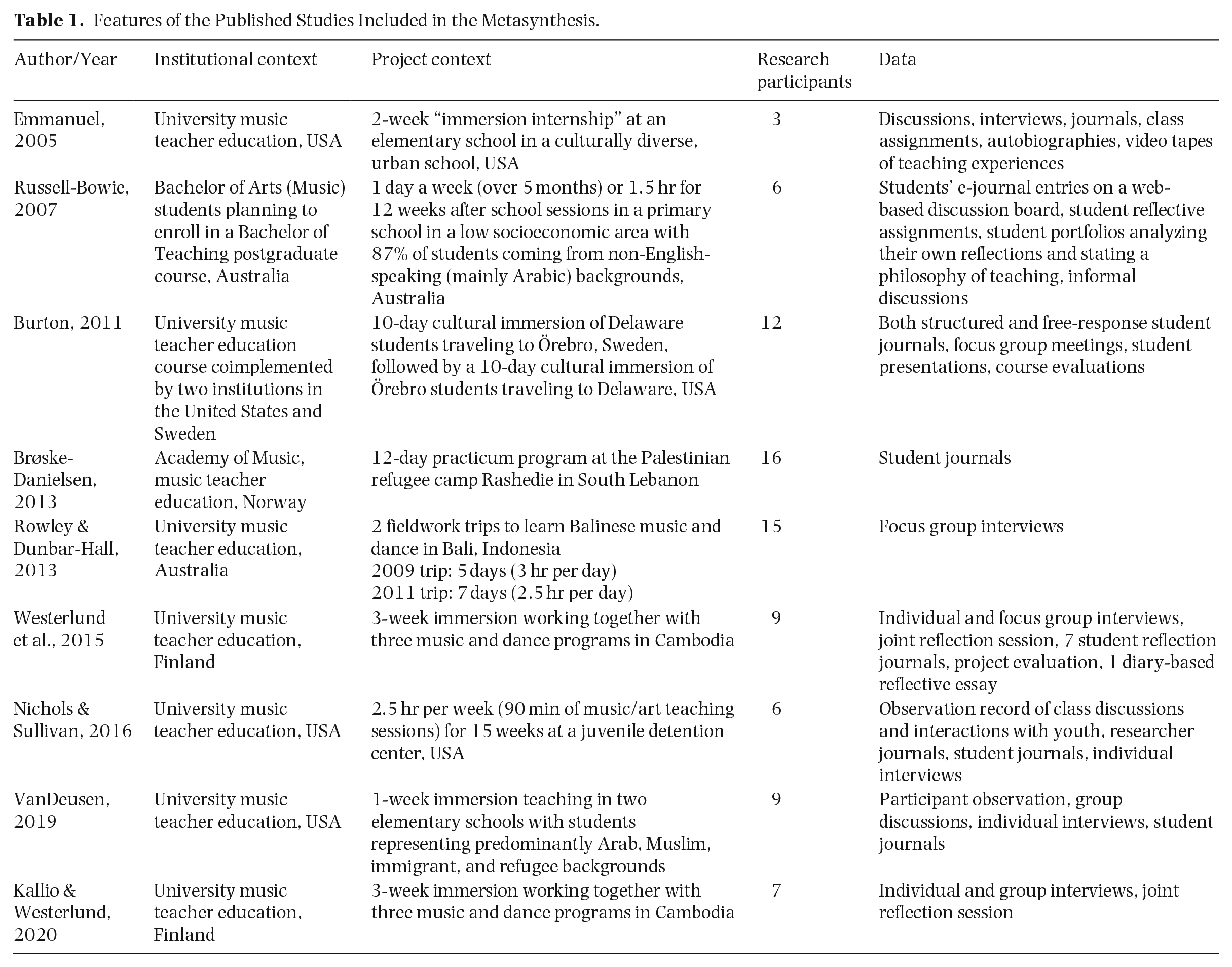
The unpublished data included in this metasynthesis were generated as part of research on a 1-week-long intercultural outreach project conducted at a music university in Finland. Conducted in 2017, it involved student teachers traveling to the far North of the country to Sápmi, the Indigenous Sámi homelands, to run workshops for students in schools and as part of a Sámi music festival. Although the project was in its sixth iteration, this was the first year that the project had explicitly intercultural aims or had engaged with indigenous musics or communities. Data were generated through interviews conducted before and after the outreach project with the two participating music education students, covering their expectations and experiences of the project, as well as reflections upon their own developing intercultural competences. 1 In combining unpublished data with selected publications and theoretical framings as part of a qualitative metasynthesis, we aim to extend the theoretical frames of previous research and “transform the data that exists . . . into a new conceptualization with the capacity of integrating the entire body of qualitatively derived knowledge about the phenomenon” (Thorne, 2008, p. 512).
Data analysis and metasynthesis
Aligning with Aguirre and Bolton (2014), the interpretative metasynthesis conducted here extended beyond the aggregation of findings to a reinterpretation of outreach projects in music teacher education through both making connections between largely separate bodies of knowledge and the extension of existing theoretical understandings. The findings of each publication were approached as “data” and their key features and findings organized in a table (author, year of the publication, country of the teacher education, research aim, number of participants in the outreach project, methods of data collection and analysis, institutional context, project context, reported outcomes, ways to interrupt students’ learning trajectory, the ways the project interrupts the culture of music teacher education). These findings were then analyzed thematically (Braun & Clarke, 2020). In the thematic analysis stage, we identified four overarching themes relating to the ways in which intercultural outreach projects may interrupt student teachers’ legitimized trajectories: (1) the individualistic frame, (2) the known difference, (3) the logic of teaching, and (4) teacher competence and letting the context teach.
The second stage, the interpretative metasynthesis, involved the interpretation of these themes through, or against, one another in relation to Biesta’s (2010, 2017) pedagogy of interruption to the culture of teacher education (Popkewitz, 1985), extending critical questions of culture and transformation beyond individual student teachers, to the culture of music teacher education itself. In this way, the synthesis stage of data analysis involved the translation of selected studies into one another, what Noblit and Hare (1988) describe as piecing together a “line of argument,” a “second-level inference that assigns interpretive significance to each study” in relation to the theoretical frame (p. 64). Thus, the objective of the metasynthesis was not simply to deconstruct or map what is already known, but to integrate the entire body of qualitatively derived knowledge about the phenomenon “at a higher conceptual level” than could be achieved through any single qualitative study (Murray & Stanley, 2014, p. 175).
Findings
Intercultural outreach projects interrupting legitimized trajectories
Below we present the findings from the thematic analysis, positioning intercultural outreach projects as interruptions to the legitimized trajectories of music teacher education. Excerpts from the original publications are included to illustrate the ways in which intercultural outreach projects served as interruptions.
Interrupting the individualistic frame
The first theme identified through our analysis of research on intercultural outreach projects was the potential that coteaching approaches, typical in such projects, have for interrupting the individualistic frames of music teacher education. Teaching alongside or together with peers brings to the fore many learnings that otherwise might remain unnoticed or unattended to, generating an “awareness of competence,” both one’s own and that of others (Brøske-Danielsen, 2013, p. 310, emphasis added). An important aspect of developing such awareness, or intercultural cocompetence (Dervin et al., 2020), is the opportunity that teaching in a group or team provides for seeing oneself mirrored in the actions of other student teachers. As part of the process of learning to collaborate and build partnerships in unfamiliar conditions, student teachers are also required to regulate their own participation in group settings to allow for the varying competences in the group to be engaged and further developed. The unpredictability of working in new contexts, with new participants, and ways of interacting, generated this need for experimentation informed by collaborative reflection-in-action (Schön, 1987 cited in Brøske-Danielsen, 2013, p. 309). As Westerlund et al. (2015) found, The quickly changing situations and the need to react in the moment, rather than to stick to predetermined plans, also challenged the student teachers’ preconceived understanding of their own place and role in the group. During the project, those who had regarded themselves as “leaders” learnt that it is sometimes more productive to step back and let others take the lead. (p. 65)
The coreflection was seen to be enhanced through shared planning and joint reflection sessions, facilitated by responsible teacher educators immediately after teaching and learning engagements in the outreach project settings. These discussions also allowed for connections to be made between experiences and “theory and their own beliefs and values” (Brøske-Danielsen, 2013, p. 311). This promoted a shared sense of responsibility for not only the quality of teaching they offered in the outreach project contexts but also the depth of reflection and learning that they themselves engaged in: that “no one could be successful without the support of the others” (Nichols & Sullivan, 2016, p. 166).
Interrupting the known difference
As student teachers engage in dialogue and negotiate or revise their own “deep-seated attitudes about how the world works and what music education looks like” (Burton, 2011, p. 122), it is likely that their assumptions of what intercultural competence is will also be interrupted. Hence, the second theme identified in our analysis was an interruption to the known difference, through challenging student teachers’ assumptions as to what constitutes difference, culture, or the politics of intercultural teaching and learning. Student teachers in Australia participating in an outreach project in Bali made clear demarcations between their own pedagogical approaches and a “Balinese teaching strategy” (Rowley & Dunbar-Hall, 2013, p. 45) which they tried to mimic, suggesting that musical practices themselves may allow for very little pedagogical flexibility. However, findings conveyed by Russell-Bowie (2007) also show that student teachers may learn “that children from different cultures can have different ways of communicating and responding to each other” (p. 56) and take such learnings as a point of departure for their own teaching.
This interruption of the known difference is not only a process of learning new ways of learning and teaching music but also one of getting to know the self. Our analysis identified the context in which intercultural outreach projects take place as an important component in interrupting the known difference, with student teachers “crossing [a] metaphorical and literal border” (Nichols & Sullivan, 2016, p. 162) as a prompt for self-examination and critical reflection (Emmanuel, 2005; VanDeusen, 2019). However, traveling abroad was not necessarily a prerequisite for having one’s views of the world contested, which could also occur in a context that is geographically nearby, but socioculturally distant. This is evident in our own unpublished interview data, where student teachers describe a sense of culture shock when attending an Indigenous Sámi music festival within their own national boundaries: It felt like I was a stranger in my own country . . . it’s difficult to explain that feeling because I’d never felt it before in Finland. Of course, when I travel somewhere abroad I expect it, but, we were in Finland! We didn’t actually go anywhere! (Lea, Sápmi outreach project post-trip interview)
Nichols and Sullivan (2016) describe these, often uncomfortable, processes as spurred by “instances of dissonance” where student teachers working in a juvenile detention center reported “‘wrestling’ or ‘struggling’ with . . . occasions . . . [that] altered their previous understandings” (p. 161). The discomfort arising from these interruptions can also be seen as a heightened awareness of unearned privilege, as students develop critical perspectives (MacPherson, 2010) on their own positionality. Particularly for outreach projects conducted in the United States, this was seen through the recognition of student teachers’ own racial subjectivities, and how their Whiteness afforded them “privileged positions in schools and society” (Nichols & Sullivan, 2016, p. 155) and an insensitivity to “racial slurs or discriminatory remarks” (Emmanuel, 2005, p. 56). The requirement to navigate sociocultural difference as part of intercultural outreach thus enables student teachers to confront their own prejudices as part of interrupting otherwise unquestioned trajectories. This is described by Emmanuel (2005) as “an important first step in coming to terms with how their beliefs and attitudes, which developed from their own cultural histories, would impact on their future teaching” (p. 57). These first steps are often accompanied by feelings of guilt and shame, and even anger, as seen through one student teacher’s reflections on her own school and university education after participating in the outreach project in the Indigenous Sámi homelands: We have no clue what [Sámi culture is] really about. I read through the history on this trip and it breaks my heart how the people were treated . . . everything was stolen and ripped apart . . . I think we should learn more. (Lea, Sápmi outreach project, post-trip interview)
The strong feelings associated with coming to terms with one’s own personal but also institutionalized complicity in systemic injustice may be a necessary precedent for action, in developing a reflexive and critical consciousness with regard to the (re)production of inequality in education as one enters the profession.
Interrupting the logic of teaching
The third theme identified in our analysis focused beyond student teachers being displaced from their familiar places and spaces of learning, to outreach projects diverging from the familiar paths and processes by which such learning took place. Far from the carefully structured and progressive acquisition of musical skill or pedagogical knowledge, intercultural outreach projects require student teachers to abandon the familiar logics of time, preparedness, structure, and assessment, and embrace uncertainty. This interruption to the logic of teaching was already evident as part of preparatory workshops or preimmersion planning, characterized by student teachers as “lack[ing] . . . clarity regarding what was expected of them and their new teaching context” (Westerlund et al., 2015, p. 63). Whereas the student teachers’ prior professional learning paths have a certain predictability with “a set day, time, curriculum, syllabus, and content to adhere to” (Rowley & Dunbar-Hall, 2013, p. 44), the outreach projects are not typically accompanied by set lesson plans: Going to this different culture, it’s not something you can plan ahead so much. It felt that the only thing to get things going was to just go there, and start doing things. (Joonas, Sápmi outreach project, post-trip interview)
This lack of clarity enables student teachers to focus less on “going there” to start “doing things” and more on critically questioning what “things” ought to be done in the first place. Realizing that one might not have the required knowledge or repertoires (Rowley & Dunbar-Hall, 2013), or that the pedagogical “schemes of action” (Kallio & Westerlund, 2020, p. 55) may not apply in these new contexts, was described by one student teacher as a “huge [pedagogical] learning curve,” having “thought I had researched [pedagogical] strategies enough but I guess putting it into practice is a totally different thing” (Russell-Bowie, 2007, p. 55).
In the selected publications, it was reported that student teachers often resisted these interruptions and the demands for reflection-in-action, improvisation because of the unexpected, and experimentation in highly complex situations often even without a shared language. Both Kallio and Westerlund (2020) and VanDeusen (2019) describe student teachers adopting deficit discourses, or erasing difference in attempts to conserve their prior assumptions as to what constituted a “normal” classroom or student hence also resisting the development of intercultural competences that could have come through a change of attitudes concerning what music teaching is about and how it is organized (Deardorff, 2006; MacPherson, 2010). For example, a student teacher in VanDeusen’s (2019) study assumed that a child without English language skills had “a special need” (p. 50) and another in Kallio and Westerlund (2020) expressed frustration in considering whether to adapt their teaching approach for particularly vulnerable student populations, instead just wanting to “get on with it and teach” (p. 54).
Interrupting teacher competence and letting the context teach
The experience that student teachers gain “of themselves when meeting an unknown culture” (Danielsen, 2012, p. 99) often provides “new insights into their own professional development” (Nichols & Sullivan, 2016, 166), reconstituting understandings of what teacher competence means. Through locating their own professional education as only one script among many, student teachers are able to situate their own experiences within broader or different understandings of what music education and music teacher education is for, thus potentially increasing their cultural responsiveness and ability to engage in cross-cultural listening (MacPherson, 2010). For example Burton (2011) describes a transformative process that begins with confrontation, and develops into “perspective consciousness” (p. 126). Student teachers gained this perspective consciousness through having another cultural context as the basis for comparison, to raise questions such as “why are things like this? Why do we do things differently?” (p. 100, emphasis orig.). In moving beyond concerns of teaching content to focus on teaching students, “the student teachers’ preconceptions were challenged . . . [and] led to increased appreciation and respect for the differences of others and other cultures” (Brøske-Danielsen, 2013, p. 310; Emmanuel, 2005).
This process of letting go (Rowley & Dunbar-Hall, 2013) and critical questioning reflect shifts in student teacher identity (as seen in Burton, 2011; Kallio & Westerlund, 2020; Nichols & Sullivan, 2016; Rowley & Dunbar-Hall, 2013). As student teachers move from a learner and musician identity to a teacher identity, they are able to “think differently about music education in relation to” their past, present, and “futures as school music teachers” (Burton, 2011, p. 127). Through this interruption to the sense of competence, new educational cultures are made possible. Furthermore, this interruption to the sense of competence enables student teachers to form an awareness and criticality toward the trajectories legitimized by their education as future teachers and begin to envision alternatives. As Kallio and Westerlund (2020) note, [the student teachers] came to question some of the most central visions of Finnish music education, such as student-centered pedagogies, and participatory democracy in the classroom. They reflected upon their own discomfort, holding the mirror up to their own assumptions and narrations of what the visions of Finnish or Cambodian music education really are, and the extent to which they are enacted in practice. (p. 57)
The critical reflexivity generated through these projects also brings the potential to interrupt future iterations of intercultural outreach projects in music teacher education. For example, recognizing the potential of an outreach project in a juvenile detention center to perpetuate racial prejudice, Nichols and Sullivan (2016) “revamped the course readings to include critical readings about youth development, the school-to-prison pipeline, and issues pertaining to juvenile incarceration” (p. 168) and also included more time for critical discussion relevant to these topics.
Interrupting the culture of teacher education toward self-reflexivity and a reconceptualization of intercultural competence
Together, the four themes identified in the analysis present a strong argument for intercultural outreach projects serving as a pedagogy of interruption to student teachers’ legitimized trajectories. In this section of the article, we turn our attention to the second research question, considering how intercultural outreach projects serve as interruptions to the culture of music teacher education and its cultural regimes of truth, and how this research may inform future developments in music education that strive toward building a sense of communal solidarity amid diversity and counter increasing sociocultural polarization, as urged by international policies. This is done through reporting findings from the qualitative metasynthesis, as a “second-level inference” (Noblit & Hare, 1988, p. 64). Three metathemes were identified through this process of translating the themes reported in the previous section into one another in relation to the theoretical frame:
Learning within professional self-reflexivity
Embracing uncertainty and trusting relational becomings
Investing in the political and the moral through intercultural theorization.
By raising the abstraction level, we can further ask what intercultural music teacher education is for, thus addressing the question of intercultural competence from a wider educational perspective.
Learning within professional self-reflexivity
The ways in which intercultural outreach projects may serve as a pedagogy of interruption to the culture of music teacher education can be seen through student teachers’ reflections and teacher educators’ actions taken after outreach projects have concluded, alongside researcher interpretations and analyses reported in the selected publications. The studies illustrate the conceptual limits of understanding intercultural competence as a linear end-goal achievement as an outcome of learning. Rather than acquisition, effectiveness, or adaptation (e.g., Delors, 1996), intercultural competence might be better seen as something that emerges in a world that resists and interrupts (Biesta, 2017). Such interruptions may serve as a series of awakenings that form part of student teachers’ ongoing and critical professional self-reflexivity. These awakenings enable them to see their professional work from multiple perspectives, presenting them with choices from the myriad ways of interacting in uncertain situations. As researchers of critical interculturality have acknowledged, intercultural education and the work conducted by the people involved in it—student teachers, teacher educators, and administrators alike—require multiple commitments: a commitment to discomfort, a commitment to questioning oneself and one’s identity, a commitment to engagement with difficult truths and alternative histories, a commitment to developing ethical relations with the Other . . . [and] a commitment to critical and hyper self-reflexivity. (Martin et al., 2017, pp. 252–53)
Although some of the findings from our thematic analysis clearly can be understood through the conceptualizations of Deardorff (2006) and MacPherson (2010), as shown above, our metasynthesis also illustrates that the knowledge, skills, and attitudes involved cannot be achieved once and for all. Rather, the work of intercultural education holds potential to provide recurring opportunities to practice navigating and engaging with paradoxes and the complex ethics of intercultural teaching where new questions, rather than answers, arise.
The findings illustrate the existential interruptions which are typically not even wished for in music teacher education, through practicum placements or assessment tasks that measure self-confidence, competence, and effectiveness. Biesta (2009) explains that we can never know all the relations, contexts, and situations before educational action, and indeed “we do not learn about the contexts in which we act in order to adjust our actions better to the context” (p. 71). Rather, we “only learn about the relationships between our actions and their consequences” (Biesta, 2009, p. 71). Accordingly, the experimentation that takes place as part of the outreach projects reported here illustrates that “transaction is about real change, which means that as a result of ongoing transactions both we and ‘the world’ change” and “[t]he transactional field is therefore an ever-evolving one, not a field that is fixed” (p. 71). For Biesta (2017), this is the middle ground between world-destruction and self-destruction . . . where the question of limits and limitations is encountered, and where we encounter the task of reconciling ourselves to reality, of trying to be at home in the world—a world that is not of our own making and that may not be the world we would have chosen if we had had a choice. (pp. 38–39)
For a future music teacher, it might therefore be more important to acknowledge one’s own cultural boundaries and recognize that existential discomfort may relate to such becoming more self-aware.
Embracing uncertainty and trusting relational becomings
Recognizing the dynamic cultural constituents of the transactional field of music teacher education or typical classroom situation requires a conscious paradigm shift. Critical reflexivity is needed to move from the individualistic cognitive framework of competence to social constructionism and the acknowledgment that teacher education itself is socioculturally constructed. This shift from teacher education developing the individual mindset and dispositions to more dynamic, nonfoundationalist, relational becomings (Gergen, 2009; see also Dervin & Gross, 2016, and Westerlund et al., 2020) may need to be explicitly discussed to allow for more complex and critical understandings of competence to emerge. Moving beyond binary divisions between the “self” and “other” can trouble the very concept of intercultural, locating culture within a world that is not just there to be discovered but still in the making (Gergen, 2009). But as research on intercultural projects suggests, the in-between spaces of outreach projects require an engagement with the political and uncomfortable situations that arise as part of engagement and the ethical ramifications of teaching and learning beyond the deterministic self- or university-centric acquisition of knowledge and skills. They require existential tolerance, not of the Other but of uncertainty and discomfort, of engaging in a lifelong battle with one’s own professional trajectory and culturally constituted and shaped preconceptions. The outreach projects provide a collective reflexive space for advancing this existential tolerance. Yet, these spaces are not typical for music teacher education, even in programs such as our own that actively cultivate peer-learning and “collaborative learning in small groups” as a consciously chosen shared goal (Westerlund & Juntunen, 2015, pp. 209–210).
Returning to the etymological Latin roots of “competence” as “rivalry,” to “strive for a goal in joint effort . . . or to appertain to someone/something” (Röhr-Sendlmeier & Käser, 2019, p. 125), intercultural competence can be described as the “ability to interact effectively and appropriately with, rather than for, people from other cultures” (Perry & Southwell, 2011, p. 455). It thus represents an endless cycle of necessary failures and ethical dilemmas to work through as part of realizing a society that is never complete. The students’ reflections in Westerlund et al.’s (2015) Cambodia project illustrate how an intercultural outreach project may work against the very idea of competence-based teacher education: This has been a significant journey also in a philosophical sense. It feels like I’m on the right path, but I’m not taking anything for granted . . . or “now I can do this,” but, instead, I am all the time, and increasingly so, interested in learning and understanding more about what it means to be a music teacher and what it is to encounter a human being . . . That is something I want to take with me for the rest of my life and in every encounter—the skill of encountering that [you can] never complete. Every person brings you something new. (p. 68)
Along these lines, our metasynthesis of intercultural outreach projects in the context of music teacher education suggests that instead of perpetuating the discourse of competence, as it appears, for example, through Deardorff (2006) and MacPherson’s (2010) work, it might be more “effective” to steer the focus of student teachers’ actions through engaging with the notion of critical “relational” or “dialogical” expertise (Cribb & Gewirtz, 2015, p. 126). Through such a lens, interculturality is always constituted and realized in relation (Miettinen, 2020) and in motion, rather than through a set of skills, attitudes, or even criticality that one can acquire once and for all, and certainly not within a single classroom or project. Such relationality is not simply about musical cultures but more widely about what is considered “good” and “best practice” in teaching and learning. Hence, the interruption offered through outreach projects is not so much about qualification or socialization into certain cultural or musical knowledge even though these learnings become part of reflexivity. Rather, it is an ethical and existential positioning in a context and heightened “responsibility for a particular” (Biesta, 2010, p. 91); a commitment to situational negotiation taking into account one’s own and others’ subjectivity and uniqueness in the intercultural encounter. This is not merely a new intercultural skill or attitude but a much deeper professional repositioning of oneself as a music teacher. As another student reflected in the Cambodia project, If one also considers that this isn’t a performance situation or practicum . . . nor a situation where I am attempting to prove to someone how competent a teacher I am, then actually all those thoughts should just be thrown away . . . It’s actually an extremely liberating thought when crafted to its very conclusion. (Westerlund et al., 2015, p. 68)
Investing in the political and the moral through intercultural theorization
Intercultural outreach projects as a pedagogy of interruption to the culture of music teacher education raise pertinent and critical questions about oneself and the world, supporting the emergence of what Clarke and Phelan (2017) call an “agonistic” culture of teacher education. This culture-in-the-making can be seen to fuel “conversation, contemplation and critique” (p. 15) as central features of competence. Phelan (2014) writes about the cultural role of teacher education: when teacher education research takes a cultural role, researchers can emphasise the significance and complexity of becoming a teacher, and by implication, the value of teacher education; they portray and promote a vision of teacher education itself as an educational project. Finally, they can influence the kinds of questions that the profession asks of itself and the depth and scope of its response. (p. 169)
Our metasynthesis also suggests that theoretical thinking and research, not just skills and attitudes, might play an important role in nurturing self-reflexivity and relationality in music teacher education, offering “a strategy to ‘unthink’ the common sense of schooling, to denaturalize what is taken-for-granted, and to make fragile the causalities of the present” (Popkewitz, 2014, p. 14). As Popkewitz (2014) writes, “Theories are styles of reasoning that generate cultural theses about modes of living . . . They inscribe differences, divisions, and exclusions . . . and the (im)possibility of change” (p. 13). The challenge in theories and research in contemporary situations is thus not how they guide action, such as music teacher education and music teaching, but how they “hold up for scrutiny the theories that order what is seen and acted” (p. 15). Theories of interculturality may therefore be seen as embodying important interruptions into the dominant theorization of music education when moving forward from simply pinpointing cultural diversities, boundaries, and “what is” toward morally and educationally “what could be.” They provide material for enhancing “a moral stance” in music teacher education (Westerlund, 2019), the necessity to negotiate, acceptance of incompleteness and vulnerability, and the intercultural competence—understood as an ongoing rivalry—in nurturing solidarity between cultural groups through whatever culture means without prescribing how to act in each situation. In other words, intercultural theorization and intercultural outreach projects can be taken as a healthy test for rethinking what competence might be for and what education and teacher education in general are for in current societies.
Conclusion
As teacher education has highlighted intercultural competence as an important response to intensifying migration, and global communication around the world, intercultural outreach projects have also emerged as a key pedagogical response in music teacher education. In this article, we have reported findings of a qualitative interpretative metasynthesis of publications and unpublished data on such projects, challenging assumptions that intercultural competence is fostered through simply encountering Other musical practices. Furthermore, we have called into question common conceptualizations of intercultural competence as individual attainments that can be set as a linear goal and outcome of outreach project work. Instead, when analyzed through the lens of a pedagogy of interruption (Biesta, 2009), intercultural outreach projects may be seen to generate wider self-reflexivity toward music teachers’ professional education, an existential awakening toward the relational nature of teaching itself, and an understanding of one’s own and others’ unique subjectivity in constantly changing and unstable situations. That said, from the sample of articles used for our metasynthesis, it is clear that intercultural outreach projects are seen as fruitful in this respect (or at least reported in research as such) in certain geographical contexts. Thus, we do not propose such projects as a universal solution to developing reflexivity in all music teacher education settings because, as we have noted in earlier writings, even “employing a lens of interculturality is insufficient, given that such a perspective may too become one-sided and result in professional blindspots” (Westerlund & Karlsen, 2020, pp. 217–218). Rather, in our view, music teacher education, including the reflexivity enhanced within it, needs to be developed through multiple entry-points, and with great sensitivity to what is pertinent to the society immediately surrounding it. An “interrogation of the conditions under which music teaching and being a music teacher build future societies and are constituted and accepted as culturally legitimised” (Bleakley, 1999, p. 322) is essential if future teachers are not only to be equipped to critique the conditions in which they work but also to change them and ultimately strengthen the promise of music teacher education in 21st-century societies. Under certain societal conditions, intercultural outreach projects might stimulate or even jumpstart such interrogation. Thus, if embarking on such projects, and with the above analysis in mind, we believe that it is crucial to consider intercultural competence as ongoing and perpetually unfinished business. This perspective allows for a more relational and reflexive approach to music teaching and learning that might set the stage for student teachers to reconstruct and reinvigorate music teacher education beyond its taken-for-granted regimes of truth toward a more just, equitable, and sustainable world.
Footnotes
Declaration of conflicting interests
The author(s) declared no potential conflicts of interest with respect to the research, authorship, and/or publication of this article.
Funding
The author(s) disclosed receipt of the following financial support for the research, authorship, and/or publication of this article: This research was supported by the Global Visions Through Mobilizing Networks project funded by the Academy of Finland (grant number 286162).
