



Abstract
This instrumental case study explores and theorizes on the educational potential and value of free collaborative vocal improvisation, a process that enables equal access to music regardless of musical skills. The focus of the article is on the musical activities of an adult choir in Finland that applied tenets from improvisational theatre to facilitate the social and musical processes of free improvisation. This study applies an ecological perspective to understand how improvisation can offer asylum—a physical or conceptual safe space within which an individual can flourish socially and musically—and explore how it is sought, constructed, and supported, and what opportunities it can afford to those participating in it. The analysis shows how the participants used various techniques for seeking asylum, both in and away from their shared social space, when they encountered the inherent discomforts of improvisation. Depending on the social ecology of each situation, the musicking activities provided the participants with the resources to construct both social and musical agency as well as experiences in playful collaborative musical learning and wellbeing. The present study calls for an ecological framework for music education and improvisation that supports musicking in a safe and playful learning environment with a focus on social processes, and which could be considered the starting point for music education at all ages.
Keywords
Introduction
Improvisation can be learned by anyone, regardless of technical proficiency or age. Therefore, it has long been recommended that it be considered a core element of music education syllabi (Borgo, 2007; Sawyer, 2008). Yet, the actual practice of improvisation is still a rare occurrence in most Finnish schools (Partti, 2016). Research on improvisation in music education has been mostly focused on idiomatic, individual, and instrumental practices (Siljamäki & Kanellopoulos, 2020), and has been heavily influenced by cognitive studies with quantitative methods (Biasutti, 2017). In addition, studies on collaborative free improvisation are scarce, despite its potential for posing questions on egalitarianism, social relations, and empowerment (see Hickey, 2015; Wright & Kanellopoulos, 2010). Hence, this study calls for a more holistic and multidisciplinary understanding of improvisation in music education by exploring the educative value and potential of collaborative free vocal improvisation, a musical practice that is situated at the interface of music and theatre, from the perspective of the social ecology of education.
Free improvisation is understood as a mode of performance that collaboratively experiments with ways of sound organization not bound by idiomatic structures (Kanellopoulos, 2007b, p. 101; see Schroeder, 2019). The present study explores the case of an adult choir in Finland that takes its guiding tenets from improvisational theatre (see Johnstone, 1981). This choir, hereafter referred to by the pseudonym IC51, uses collaboratively improvised free polyphonic vocal music, without a conductor or a leader, as its sole method of practice. This practice neither includes nor excludes existing musical styles or genres, and enables childlike play with equal access to music, regardless of musical skills. As a member of the improvisation choir and a music professional, the author is an actively immersed insider (Greene, 2014) in the choir’s practices and is thus able to offer a distinctive on-site perspective on this complex phenomenon (Creswell, 1998, p. 58). Drawing on gentle empiricism (Ansdell & Pavlicevic, 2010) with ethnographic features, an ecological perspective is assumed to understand how music matters in these particular social settings (DeNora, 2013a).
In this study, free vocal improvising—as a form of free improvisation that incorporates the tenets and mindset of improvisational theatre—is here recognized as “musicking,” “a mode of communicative action, a way of sharing time and space” (DeNora, 2013a, p. 141). Musicking is understood as a transformative practice (DeNora, 2013a) that shifts the focus from mastery of technical skills, musicality, and performance as the sole definers of quality toward embracing social skills and interaction. The ways in which the participants support the construction of a safe space, or an asylum (DeNora, 2013a), are examined by exploring what happens when the focus is turned from musical parameters to “the way [these] musicians [think] about the music” (Schroeder, 2019, p. 5). The present study advocates that social, personal, and musical growth should be placed at the heart (Westerlund, 2008; see also Davis, 2016) of creative and collaborative learning (Borgo, 2007), while also fostering learning spaces that are suitable for developing the musical and social self (Wright & Kanellopoulos, 2010) and wellbeing (DeNora, 2013a).
The case of IC51: A free improvisation choir
IC51 is an independent and collaboratively led free improvisation choir that organized open and free-of-charge improvisation sessions and performances from 2014 to 2017. It was a recreational community of improvisation enthusiasts founded by six members of a former improvising choir in Finland (2011–2014), with the aim of continuing the legacy of developing free choral improvisation practices based on facilitating musical processes through the use of improvisational theatre tenets. The number of active members comprised approximately 12 adults, with varying backgrounds, including inexperienced singers and those without a formal education in music, to those holding a degree in higher music education or the performing arts. The collaboratively led improvisation sessions could be called together by anyone in IC51; the choir thus convened on an irregular basis 1 to 3 times a month, typically with four to 12 participants, in frequently changing free-of-charge locations (e.g., university gymnasiums or office spaces). No singing auditions were held, but an individual’s preparedness for cooperation and group work was informally and collaboratively evaluated in one to two sessions before being included as a new member.
The IC51 improvisation choir did not conform to traditional choir configurations or voice types, and the sessions always included bodily warm-ups and exercises. Simple structures with flexible boundaries were used for initiating improvisations, such as limiting the number of singers in a piece or starting the improvisation with a vowel or consonant. The improvisations often started with the singers standing in a circle, and could vary from minimalistic musical explorations of sounds to alterations of chaotic soundscapes, from rich harmonies to prolonged silences. The aesthetic material (see DeNora, 2000) consisted of all kinds of sounds—singing in traditional and nontraditional ways, optional improvised text and lyrics, as well as bodily movement and the versatile use of space—and could include references to existing musical styles without prescribed parts or voice leading. Individual sounds and solos were embraced, whereas choral blending and precision were not required. Instead of using conducting cues or authoritarian musical leadership, the choir improvised collaboratively with the support of guiding tenets derived from improvisational theatre (see Dudeck & McClure, 2018; Johnstone, 1981) (see Table 1). This approach included an understanding of improvisation as a skill, and the inspired application of both bodily and verbal elements in improvisation.
Examples of the Tenets Used in Improvisational Theatre to Guide the Process (e.g., Dudeck & McClure, 2018; Johnstone, 1981).
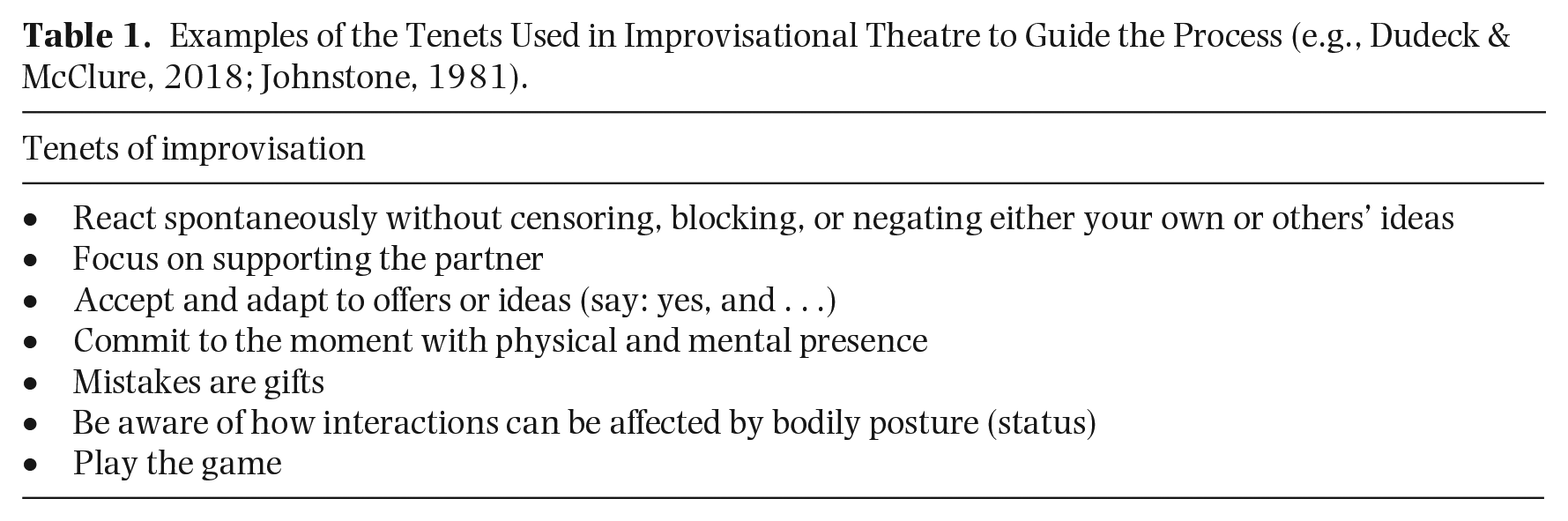
These tenets were not employed in the form of strictly formatted theatrical scenes, or taught as such, but were rather adopted as a mindset for initiating and upholding social processes in the improvisations. For instance, one technique for improvisation was to accept everything, which allowed the group to focus on following and agreeing. Because no imitation of another is ever exactly the same, a piece usually started to develop on its own, and featured speedy collaborative transitions between whatever aesthetic material was contributed and the singers’ perceptions and reactions to that material during the collaborative creation. These practices and techniques were tested and further developed through collaborative discussions and decision-making in each session.
Conceptualizing free vocal improvisation
Earlier research
Although improvisation has been argued to enhance creative ability, musical growth (cf. D. Hargreaves, 1999; Harrison & Pound, 1996), and musicianship (Farrell, 2016), it is still regarded as the least important skill (Creech et al., 2008), and improvisatory music is often seen as “not real” music (Seddon & Biasutti, 2008, p. 418). The focus of this study is specifically on free vocal improvisation, where the focus is turned toward “the actions and attitudes involved among the participants” (Johansen, 2014, p. 14) as knowledge “emerges from the need to act in the environment” (Borgo, 2018, p. 1025). Free improvisation has been reported to provide a greater sense of freedom, with enhanced “ownership for musical tools for expression” and agency (Johansen, 2014, p. 14), as compared to vocal jazz, which requires deep immersion in a stylistic musical knowledge base (Madura Ward-Steinman, 2014). The scarcity of studies in music education on both collaborative and individual free vocal improvisation is evident (Siljamäki & Kanellopoulos, 2020).
The few studies that have researched collaborative improvised singing share an understanding of creating a safe and playful environment without criticism or judgments on musical value (Farrell, 2016; Yun & Willingham, 2014), which concurs with the understanding of professional free improvisation pedagogues (Hickey, 2015; Tonelli, 2015). It has been reported that the experiences of vocalists in jazz improvisation are different from those of instrumentalists, as the human body is their instrument and their sense of personal risk is thus heightened (W. Hargreaves, 2013). Hence, there is need for studies such as this one in terms of bringing forth the role of the voice as “an equal player in the field of improvised music” (Tonelli, 2015), as well as exploring unconducted and collaborative forms of improvisation with both traditional and nontraditional uses of the voice.
Earlier research suggests that the pedagogy of free improvisation requires facilitation skills and a process-centered pedagogy (Wright & Kanellopoulos, 2010), an inclusive and generous mentorship (MacGlone & MacDonald, 2018, p. 285) or avoidance of preconceived notions of musical quality and the inclusion of the teacher in the improvisation as an equal-status collaborative partner with the students (Hickey, 2015, p. 440). Still, the question of how to facilitate free improvisation with beginner level skills in music is left unanswered (Hickey, 2015), while greater understanding of free vocal improvisation’s pedagogical potential and theoretical underpinnings is needed. Furthermore, feelings of discomfort or fear related to improvising are common and stemming from “not knowing what to sing” (Farrell, 2016, p. 35), being “judged by peers” (Yun & Willingham, 2014, p. 241), or associating imperfections in improvisations as related to one’s character (W. Hargreaves, 2013, p. 391). Although various strategies for reducing the negative feelings or fears associated with improvisation have been suggested (see Farrell, 2016; W. Hargreaves, 2013) theoretical understanding of how challenging moments during improvisations are encountered is needed, specifically in the context of free improvisation with the voice.
Beyond the field of music, improvisational theatre has a history of understanding improvisation as a skill of intuitive and imaginative responses to people and things in the environment, which is trained through basic tenets such as spontaneous reacting without censoring one’s own ideas, being physically and mentally present in the moment, and focusing on supporting the partner (see Dudeck & McClure, 2018; Johnstone, 1981). Meanwhile, vocal improvisation has been approached as a skill oriented toward learning and mastering specific musical styles and elements, such as jazz (W. Hargreaves, 2013), although attaining “interactional synchrony”—also known as “shared groove”—has also been reported as a core goal (Madura Ward-Steinman, 2014, p. 355). Nevertheless, both improvised music and improvised theatre have been recognized as “self-organizing” performances emerging “from the collective actions and interactions of the entire group” (Sawyer, 2008, p. 50). However, social skills are referred to as “traditionally difficult to teach and develop” (Biasutti, 2017, p. 3), or thought of as simply assumed, or simultaneously learned and employed during the “pedagogical engagement” of free musical improvisation (Thomson, 2007, p. 1). Because creative, collaborative, and improvisational ways of working have been claimed to enhance learning and a deeper musical understanding (Sawyer, 2006, pp. 162–162), improvisational theatre has likewise been suggested as a means for learning the skills required in collaboration and group work (Sawyer, 2011, p. 20).
An ecological perspective on collaborative free vocal improvisation
Drawing on DeNora’s (2000, 2007, 2013a, 2013b) work, this study moves away from “music itself” to “describing music’s semiotic force in social life” (2000, p. 23). Rather than being a closed entity or merely a stimulus, music is always “with” something that is added during engagement with the music (DeNora & Ansdell, 2014, p. 6), and likewise affects “the social processes between the individuals” (DeNora, 2013a, p. 143). This means that musicking in free vocal improvisation entails not only making sounds but also engaging with others and, furthermore, “with things outside the self” (DeNora, 2013a, pp. 139–140), while using the human voice and body as the musical instrument. In this way, the music and the interactions between the singers are expanded from being mere sonic phenomena to being seen as the bodily reception and perception of impulses from various sources, with unconventional and contemporary techniques and sounds, including movement and words. The concept of what counts or does not count as music can thus be blurred and expanded, while personal and collective intentionality and experiences become central to defining what music is within the “complex process of interdependent interactions between people, practices and things within a particular place” (Ansdell & DeNora, 2016, p. 41). In an ecological framework, music education is seen as an open system, where one is interrelated and connected with all things in life, and the musical experience is defined in relation to factors both intrinsic and extrinsic to individuals (see DeNora, 2013a, p. 26). If one aspect is changed or affected, it will also resonate in other parts of the ecosystem.
Music, more specifically improvisation, as an active object, is an affordance structure, and provides resources for “world building” (DeNora, 2000, p. 44). As music is coupled and interrelated with other things and cultural practices, such as when one talks about it or experiences it through bodily movements, music begins to “afford opportunities and possibilities for action, experience and relation to others” (DeNora & Ansdell, 2014, p. 7). Hence, music can afford pleasure, opportunities for musicianship (DeNora & Ansdell, 2014), or resources for negotiating and crafting one’s social (DeNora, 2013a, p. 77) or musical agency (Karlsen, 2011). This aligns with the notions of experiential and transformative becoming (see Borgo, 2007; van Manen, 2012) and social learning (Lave & Wenger, 1991), where the experiences of undergoing transformations through social processes are at the heart of learning. Furthermore, musical improvisation can be employed to configure a space to afford some particular activity or use (DeNora, 2000, pp. 60–61), as a medium for furnishing (DeNora, 2013a) a social environment so as to make it more habitable or comfortable. In other words, seeking asylum (DeNora, 2013a), “in or away from a social world” (p. 74), is a way “to maintain the space or room for self, security, flow and belonging” (DeNora, 2013a, p. 50). Asylum can be sought through removal, as when seeking shelter or escaping from a social environment to obtain some privacy by establishing some distance from others. Asylum can also be sought through refurnishing, by making an attempt to remake the sociomusical space by adding something (e.g., sounds through singing) that others will then encounter. In this context, singing is both “the musical presentation of self and the reflexive furnishing of socio-musical space through that presentation” (DeNora, 2013a, p. 82). In the ecological framework, free collaborative vocal improvisation can also offer asylum, as in a physical or conceptual space “within which to play on/with one’s environment” (DeNora, 2013a, p. 47), a space that offers momentary or long-lasting “respite from distress and a place and time in which it is possible to flourish” (DeNora, 2013a, p. 1). While acknowledging the connotations attached to the notion of asylum, DeNora’s (2013a) it is a possible conceptual avenue for understanding the core features of improvisation in the arts, including the deeply paradoxical process (Montuori, 2003, p. 239) of facing the unknown (D. Hargreaves, 1999) in which feelings of uncertainty and insecurity are induced. Furthermore, the ecological framework links music education to the discussion on how wellbeing is pursued and afforded in music classrooms. Free improvisation might therefore provide tools and methods to better understand how to coconstruct safe learning environments where positive rather than negative wellbeing is afforded, not only in music classrooms but also across all music educational contexts.
Methodological approach and empirical material
Adopting DeNora’s (2013) theory of social ecology as a frame of analysis, this study explores the case of an adult improvisation choir (IC51) in Finland and documents some of its participants’ experiences over the course of a year. The research task of examining “what are the social and educational affordances of engaging in free improvisation choir” is further explored through three subquestions:
How is an asylum constructed and supported within the social processes of a free improvisation choir?
What kind of asylum-seeking strategies (e.g., removal and refurnishing) are employed by its participants?
What kind of affordances are provided by engaging in collaborative free vocal improvisation?
This instrumental case study (Stake, 1995) aims to build an in-depth view of the case while emphasizing the richness of the practice and the theoretical contribution over generalizability (Creswell, 1998). The stance of the author as an insider enabled an immersion in the practices and interactions in natural settings, and enhanced the ability to describe and understand the phenomenon through this particular social choir (Creswell, 1998, p. 58). The empirical material was generated with “gentle empiricism” (Ansdell & Pavlicevic, 2010) through ethnographic methods over the course of 1 year in 2015, however with no particular moment representing the beginning of the data collection (Stake, 1995): a “considerable proportion of all data is impressionistic, picked up informally as the researcher first becomes acquainted with the case” (p. 49). Within this period, IC51 performed in three art festivals and offered one open workshop for the residents of a local community center. During that time, 12 members (six males and six females, including the author) between the ages of 25 and 45 years with varying occupations and musical backgrounds participated in the study, as these members were the most active in the choir. A thick description of the local conditions, conventions, practices, and environments associated with these events was recorded through a researcher diary, field notes, visual and/or audio recordings of the sessions and performances, the author’s personal notes, and one focus group interview (see Supplemental Table 1). The interview was the main source for documenting and recording the “connections made by participants themselves” (DeNora & Ansdell, 2017, p. 241), and followed a 2-hr improvisation session to promote ecological validity (DeNora, 2013b). Five IC51 members (two males, three females) with experiences in these practices ranging from 6 months to several years were chosen for the interview, to represent the diversity of the members of the choir. The author assumed the role of a facilitator, with a set of questions guiding the interview such as “When you improvise, how does it happen and why?,” or “Has vocal improvisation affected your life outside the sessions, and how?” This enabled a collective interaction and the emergence of spontaneous, expressive, and emotional views (Kvale & Brinkmann, 2009, p. 150).
The empirical material was analyzed using thematic analysis (Braun & Clarke, 2006), which continued throughout the research period as a recursive process. All the written material was condensed by dividing the sets of diaries and interview transcripts into smaller meaning units, which were then reduced further. During this phase of the analysis, the participants’ original quotes were used to avoid an overinterpretation of the empirical material. In particular, the meaning units were organized inductively into naturally emerging themes that included “moments of discomfort” and “communal experience,” while the emergent subthemes included “interaction skills” and “diversity of rules”. Detailed accounts of the contexts, observed practices, environments, and the participants’ social engagements were written up using DeNora’s (2013a) ecological framework as a reference point. All the empirical material, including the video and audio recordings and the author’s own experiences of improvising over two decades, was actively revisited to confirm the themes and findings; to code additional themes if needed; and to identify patterned regularities (Creswell, 1998, pp. 148–149). Influenced by DeNora and Ansdells’ (2017) notion of a musical event schema, the empirical material was reorganized into three groups—past, present, and future—to respectively (a) draw out the participants’ retrospective accounts of their experiences from the interviews, (b) provide observations on the participants’ real-time actions and musical engagements, and (c) identify particular experiences in terms of what the free improvisation practices have offered or provided to the participants (see Table 2).
An Example of Applying DeNora and Ansdell’s (2017) Musical Event Schema as a Frame of Analysis.
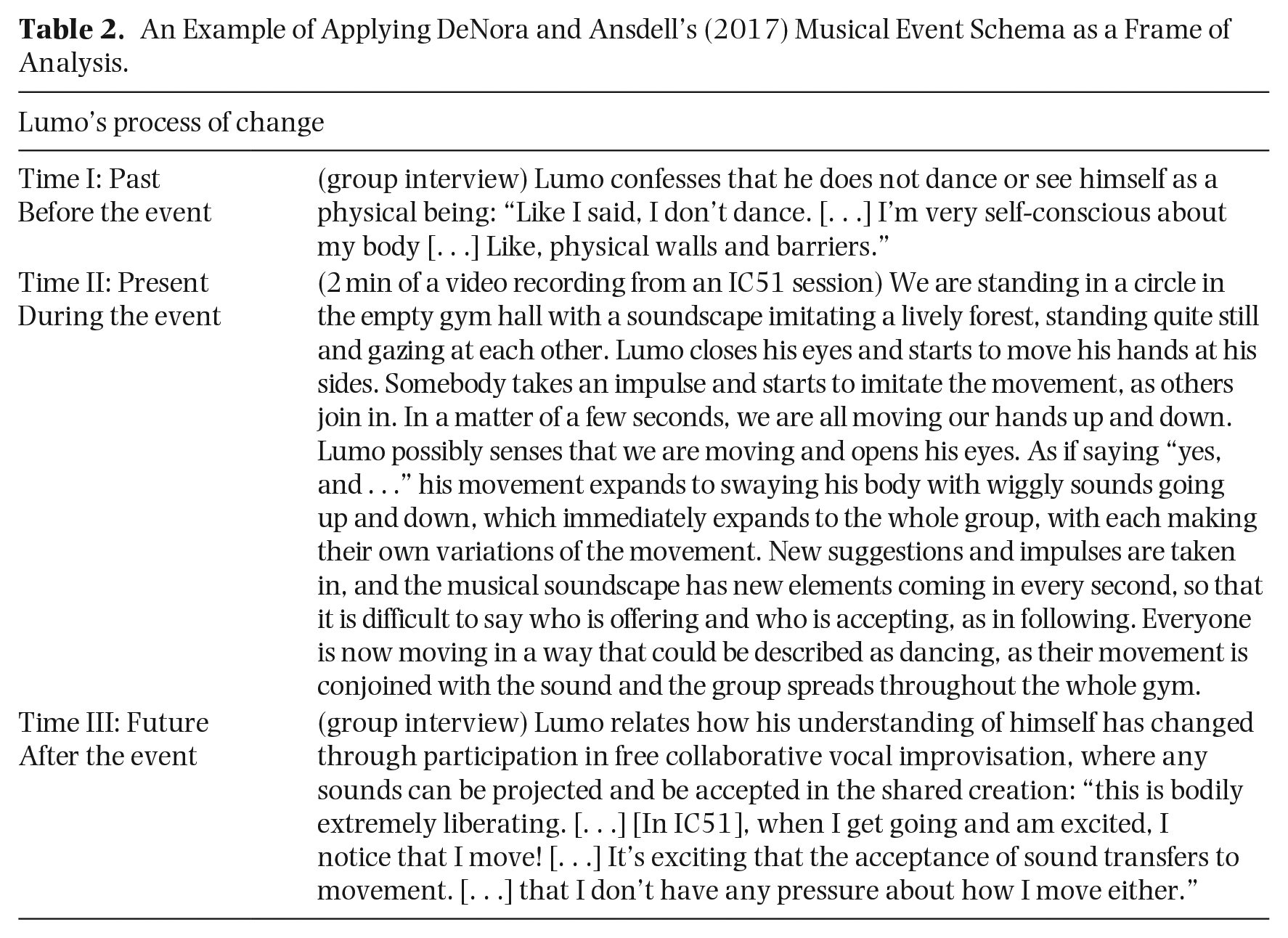
This analytical step enabled a deeper understanding of the underlying processes of change, including the connections between “relevant (linked) pasts and futures,” and of “what gets accumulated and changed when music is invoked” (DeNora & Ansdell, 2017, p. 241). This recursive process included refining the emerging themes, which finally led to the identification of four overarching themes with subthemes (see Table 3).
The Overarching Themes with Subthemes and Their Interrelation with the RQs.
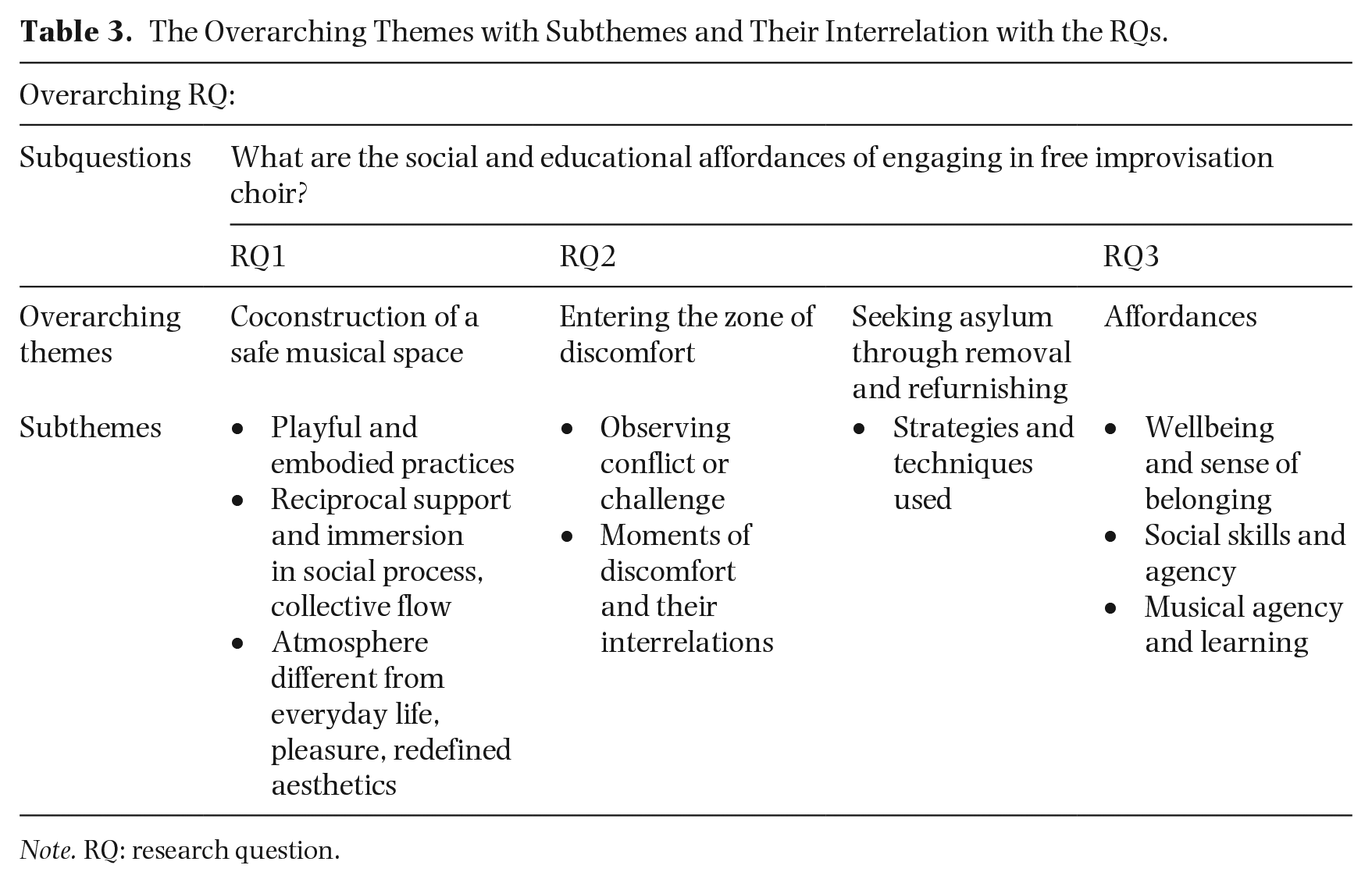
Note. RQ: research question.
Table 3 above presents four overarching themes that best capture the participants’ lived experiences of the social processes, asylum seeking, and affordances of the practice. Of these four overarching themes, the first one addresses the first research subquestion, the second and third themes address the second research subquestion, while the fourth theme addresses the third research subquestion. Furthermore, each of the overarching themes features one or several subthemes. In the fourth overarching theme, the subthemes are indicated in the main text with italicized subheadings (see pp. 15–18). Together, these overarching themes and subthemes collectively address the overarching research question (RQ) which is presented at the top of the table.
Ethical considerations
Insider research poses unique challenges, and requires a thorough engagement with and deliberation of both internal and external ethical issues (Floyd & Linet, 2012). Instead of trying to avoid the dichotomy of subject/object or attempting to overcome insider or outsider perspectives (Greene, 2014), the author aimed at acknowledging the permeability of the boundaries in such a position (Taylor, 2011) and its effects on conducting and reporting a case study. To conduct valid research and still claim the benefits of insider research, the author executed reflexive and self-conscious positioning while acknowledging intertextuality as part of the data gathering and writing process (Taylor, 2011, p. 9). Safeguards were established against distortions—such as the possibility of bias, making assumptions, and assuming participant views due to closeness to the phenomenon—by challenging the researcher/practitioner’s subjective roles through constant reflection, peer debriefing, writing a researcher journal, triangulation of data, deconstructing the familiar world through participating in other practices, and engaging in discussions on the phenomenon of improvisation (see Greene, 2014). While written informed consent was sought from the actively participating improvisers (N=12), Ethical Committee approval was not required. Due to the unique nature of the group, the participants’ anonymity was maintained as far as possible while informing them of the possible risks in reporting the study. Pseudonyms were chosen by the author for the choir and its members. Although these pseudonyms may pose a limitation to the study, providing individualized contextual information about each of the members was not possible due to the scarcity of similar groups or choirs in Finland. The use of pseudonyms thus assured the anonymity of the participants. The final report was member checked.
Findings of the study
RQ1: Coconstruction of a safe musical space
The process of unconducted musical interaction in IC51’s musicking activities takes place on multiple levels, as the practice includes a wide variety of aesthetic materials and no preset signs or conduction cues are used when improvising. The coconstruction of a safe musical space is supported by the participants’ references to the social and musical forms of “accepting,” “offering,” and “playing,” which are characteristics that are similar to the fundamental aspects of improvisational theatre. The participants strive to offer reciprocal support by focusing on participatory coconstructions, and emphasizing on the social processes of the group’s collective playfulness over the members’ individual actions within the ensemble. These feelings of playfulness and collectiveness that the members associate with the choir’s improvisation practices reduce the pressure on participants to invent something novel, in real-time, as Essa notes: It’s enlightening, relaxing, and soothing, realizing that it’s born without inventing. Kind of like collaborative play—flowing, relaxing, and a delight. [. . .] And when I don’t have to invent, I’m not responsible for anything that goes on here. I’m enjoying the collaboratively engendered music that takes place instead of my own achievements.
Social engagement is not solely dependent on listening and producing sounds, but also includes bodily awareness, as interaction and expression are extended to an embodied experience. This is described as a “kind of a dance” (Lumo), as well as making contact that “starts to ignite something in our bodies too” (Dara). Hence, silence and being silent become active elements of the embodied interaction of musicking. As Dara describes, If I’m silent in the middle of a piece, I’m present with doubled senses, ready to jump in [while] listening, and [the sense of] being [bodily] awake is extremely heightened. It’s definitely not being stuck on what will I eat next, but being crazily focused. You just listen in silence, and through that silence you find the focus to go along.
In this shared sociomusical space, the emergence of aesthetic elements is socially negotiated between the participants in each session, which are then balanced by their manifold preferences, past experiences with music, and goals for the practice. The space is held open for any sounds, as the participants have varying backgrounds ranging from having no prior experience in music to being professionals, and the interaction is occurring on multiple planes simultaneously. It is described as negotiating and exchanging, offering and blocking impulses and ideas from oneself and others, as well as a nonverbal sharing of meanings and values. In the shared negotiations, the valuation of aesthetics and understandings of how music should and could sound have been expanded from previous understandings to include all kinds of sounds and ways of using the voice, while making it possible for anyone to be musical. As Dara explains, “Ugly is beautiful, and anybody can sing.” In a similar sense, understandings of how a choir should sound or look are opened up to discussion, as space in the collaborative vocal improvisation is used in a multitude of ways (see Figure 1), from standing still in a circle to moving around or spreading out in the space; moving in nontraditional or expressive ways; or altering the distances in between or the positions in relation to others. In doing so, this sociomusical space differs significantly from a traditional music class or choir configuration.
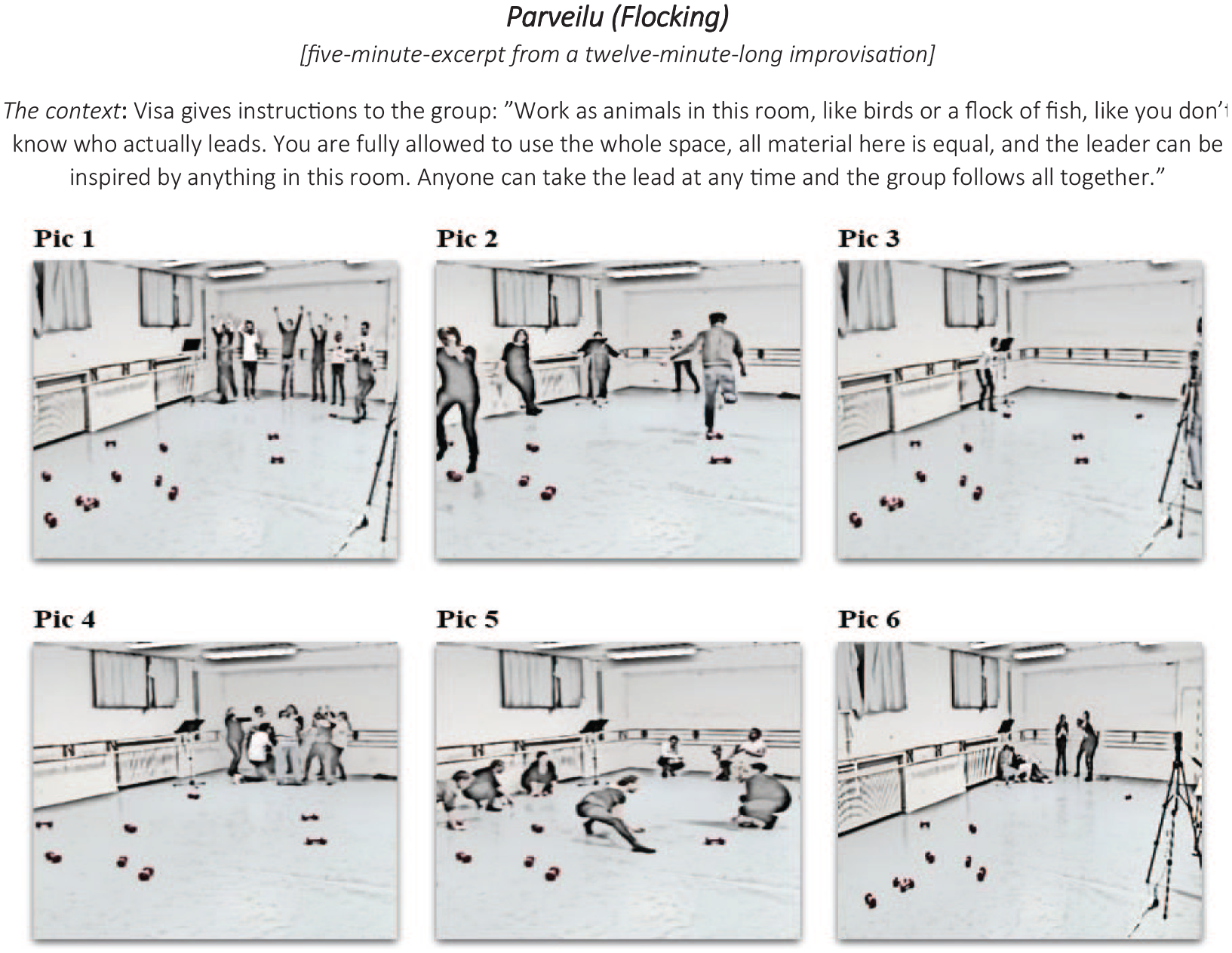
On the Use of Space and Body—A Series of Selected Screenshots from an Improvisation.
A distinctive feature of the atmosphere in free vocal play is how rules agreed upon at the onset of an improvisation can be interpreted and mutated through reciprocal understanding during the improvisation without verbally communicating with each other. This means allowing what the participants call safe changes of direction to occur within the real-time musical negotiations that take place during the improvisation. These moments could be understood as peak moments, where the experience is described as being deeply immersed in the improvisation: “kind of like losing oneself in it . . .” (Lumo), and what Tuli refers to as “the collective mash.” It is connected to the experience of being relieved from norms or conventions, as well as being freed from adhering to some form of “adult” criteria (Essa). In these moments, the collective flow enables the overriding of previously established rules, and suddenly the improvisation proceeds in unforeseen directions based on the members’ collective acceptance and social engagement.
When [the improvisation] proceeds so well that everyone has this kind of collaborative feel, then intuitively and totally naturally it breaks, and something else is born. It’s the greatest of all. [. . .] people are so into it that it falls apart on its own. (Lumo)
This means that the initial socially agreed-upon rules that gave the improvisation a recognized form can be broken and transformed through collective agreement during the improvisation, which then gives way to an increasing amount of unexpectedness. Hence, it is not surprising that improvising in IC51 is experienced as being deeply immersive, in a way that allows one to rediscover a highly unique yet intensive form of the collaborative process. It is described by members as “a primitive communal experience” (Lumo), where one is committed to the coconstruction of a collaborative creation, yet also experiences it as being fun, playful, at ease, and feels a sense of relief from the responsibilities and seriousness that one faces in everyday life. Tuli shares this sense of freedom in her experiences of musicking with IC51: Sometimes I think about the image of a crowded bus, when children are like tiidiidii [makes sounds and wiggles her hands] and the grown-ups just sit still [laughs]. The kind of a mental image that all adults suddenly create from the uncomfortable feelings they are experiencing [wiggles and moves sideways]. And the kids would just watch. Here, it’s allowed for an adult to [express] that “I feel like göögöö.”
This sense of playfulness is featured in the practices of IC51’s musicking, where one is “allowed” to express oneself “comprehensively” (Tuli). It means allowing oneself to laugh and play like a child without normative inhibitions, or even “going crazy,” as Tuli remarks. In this sense, a recurring feature of engaging in asylum-seeking actions during improvisation is “stepping outside normative demands and frames” (DeNora, 2013a, p. 65) in a playful atmosphere, that is distinct from the participants’ everyday lives and their prior experiences of collaborative music making.
RQ2: Entering the zone of discomfort
Free improvisation in IC51 musicking consists of balancing between and within the different aspects of the aesthetic material and the multiple levels of ongoing social interaction in real time. From an ecological perspective, this can be seen as the need to adapt and develop in relation to the “ever-changing physical, social and cultural environment” (Ansdell & DeNora, 2016, p. 41). This process involves challenges, as the participants bring their deep well of individual history into the shared negotiation of the sociomusical space, combined with their own ideals of improvisation and music, their visions of possible futures for themselves or the group, and their own goals, expectations, preferences, and identities. A “zone of discomfort” (Tuli) is described as balancing between feelings of insecurity and safety, or the fear of failure and the experience of pleasure, within challenging moments. The importance of these sometimes difficult moments is in their ability to affect one’s presence, potential, and participation in the collaborative improvisation, and their ability to challenge the moment of cocreation. A “zone of discomfort” (Tuli) is induced when one becomes aware of, or is overly aware or self-conscious of, their own thoughts during improvisation, in relation to how they are seen or perceived by others, or by one’s own expectations. For example, Tuli describes how her focus often turns toward a negative valuation of her own musical efforts: [It felt like] a dreadful and wrong sound came out . . . And even though I had previously performed and sang and everything, it was somehow a really difficult threshold [to make the sound]. You start to analyze yourself—can I say this out loud, and what do the others think—which then destroys the flow.
Feelings of discomfort and fear are aroused in different situations, such as bodily engagement, performing for an audience, aesthetic valuation, the need to abide by rules, or stressing and coercing creativity. Situations that arouse negative emotions, feelings, or interpretations of oneself or one’s own or others’ actions take the attention away from the improvisation process itself. As an example, Essa explains how her previous ideals affected her ability to participate: . . . improvisation, to me, was like perfect musicians in a jazz band making perfectly improvisatory executions out of the blue [. . .] kind of a bubble, an achievement. [. . .] I was afraid of making the wrong sounds—am I doing it properly? I was simply afraid of screwing up, that I might not be able to make a perfect performance. [. . .] It was like a choker around my head [laughs], the feeling that I need to do this correctly!
Interestingly, although discomfort might be sensed during real-time improvisations, it might not be apparent from an outsider’s perspective, when one is focusing solely on the sonic environment. This effect unfolded when the author was watching visual material from an IC51 session: It looks like we’re nervous about encountering each other. The bodily postures are not open and functional [. . .] I still remember the feeling, how we were stuck somewhere at the limits of our courage. [. . .] But now, if I listen only to the music, I can’t tell that we were nervous. The music, in fact, sounds more or less interesting. (Researcher diary)
Likewise, personal experiences may vary within a group, even within one and the same activity. An individual’s insecurities or discomfort can affect not only themselves but also the whole group, and these feelings in such moments can steer the flow of the collaborative improvisation, depending on how they are perceived and acted upon within the group. Instead of gradually becoming extinct, feelings of insecurity and discomfort can arise even after several years of experience in improvising. It is a recurring element, an inherent part of the process of improvising and development as an improviser.
RQ2: Seeking asylum through removal and refurnishing
The ways in which the participants cope with these moments of discomfort can be interpreted as balancing between the desire to escape from (e.g., removal) and remake the environment (e.g., refurnishing) (see DeNora, 2013a). From an ecological perspective, collaborative singing and sharing of sound are understood as transforming shared spaces, seeking asylum through refurnishing (DeNora, 2013a). Therefore, socially engaging with the environment, such as offering a musical idea or moving in a space with others during an improvisation, can be seen as ways of refurnishing the public asylum, making it “more conducive to wellbeing so that one feels less need to escape” (DeNora, 2013a, p. 68).
Indeed, when they encountered moments of discomfort, the participants would consciously make allowances for occurrences that at first might not seem pleasant, or even familiar; these often included the types of chaotic soundscapes that are a common feature of free improvisation. As an example, Tuli finds it important not to focus on the first negative thought or feeling because improvisation requires an acceptance of “allowing that it can get more or less out of hand.” She describes how the sounds can “create a world of their own [. . .] when you allow it for yourself, and others allow it.” Hence, the importance of acceptance in the social process of free vocal play is similar to refurnishing, in terms of making an effort to open one’s mind to collaboration through both silence and sounds. This in turn makes room for pleasure, sociality, and breaking away from old limiting habits, as well as challenging oneself through collaboration: What makes these chaotic [moments in music] great, is when we do it together, and it gets some direction at some point. [. . .] (Tuli)
Interactions at multiple levels can simultaneously create a flood of impulses or cues and elevate the risk of discomfort, especially when visual contact is made. Blocking visual cues can create a momentary safe space (e.g., an asylum) through removal. As Lumo explains, “I think it’s easier with my eyes closed. It’s easier to forget myself. I’m less conscious of myself, and my reactions come more automatically and naturally.” This desire to “retreat from the [visual] environment” (DeNora, 2013a, p. 50) was shared by all the participants. Passivity, or what might be termed stagnation, can also be a means of removal: . . . if I feel like I look like a jerk when I’m moving, then I give it up. Likewise, if I sound like a jerk [. . .] I give up singing. (Noe)
Yet, how others respond to an individual’s process of removal can also result in a transformation of the social space through refurnishing. For instance, a retreat can be interpreted by others as an offer to follow those actions. If the others join in and close their eyes after seeing someone do so, or if they also “give up singing” in a similar way, the initial removal can become a form of refurnishing.
Becoming aware of techniques for seeking asylum in moments of discomfort can enable one to let go of limiting ways of working. This can be seen in Tuli’s battle against her fixation on following rules: “It’s been kind of a conscious breaking away, like: What if I just let go? Realizing that, for some reason, having rules brings me a sense of safety.” In a negatively experienced moment, gaining control over one’s own participation can be assumed by ceasing to focus on the more difficult things, or sticking to familiar elements, as Dara explains: “I always want to tell a story, ‘cause it’s kind of safe and familiar [. . .] then I don’t think so much about how I sing.” The ways in which the participants manipulate the shared media, negotiate and innovate, express themselves, and perform in both comfortable and uncomfortable moments, are all means to achieve asylum (DeNora, 2013a, p. 56).
RQ3: Affordances—from free collaborative vocal improvisation to everyday life
Engaging in collaborative free vocal improvisation has enabled the IC51 participants to make connections between music and life in ways that have furthered their musical learning, their wellbeing, and their construction of “who one knows one is” (DeNora, 2000, p. 63). Table 4 shows examples of what kind of individual and diverse affordances have benefited the participants over time as they engaged with the free improvisation choir (see Table 4).
Examples of Affordances Under the Three Subthemes for Affordances.
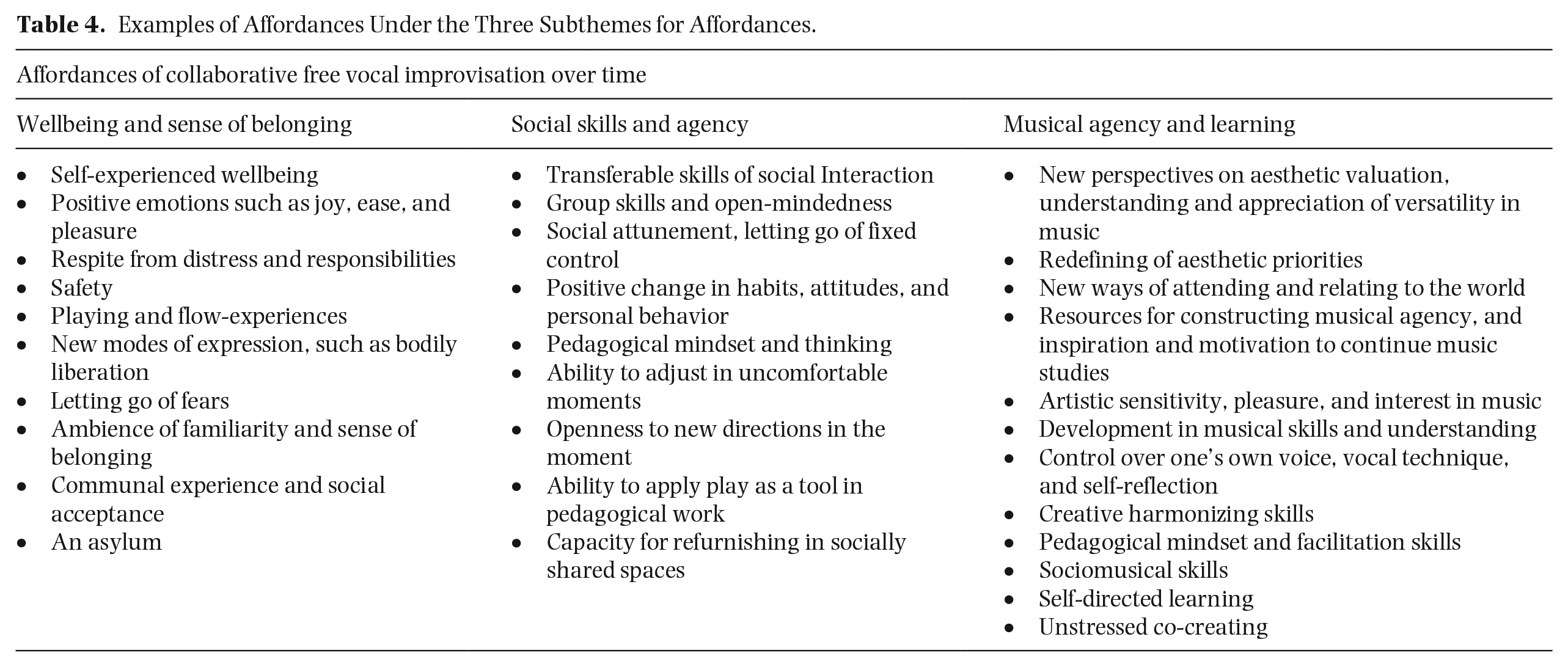
As shown in Table 4 above, there are three subthemes for affordances, which are unpacked in the following subsections (see also Table 3). The first subtheme addresses the participant wellbeing and sense of belonging; the second subtheme addresses their social skills and agency; and the third subtheme addresses musical agency and learning. Together, these three subthemes address the overarching theme of what kind of affordances are provided over time when participants engage in free collaborative vocal improvisation.
Wellbeing and sense of belonging
The musicking of IC51 can be seen as an activity that affords asylum: a “space or room for self, security, flow and belonging” (DeNora, 2013a, p. 50). This was evident in how the participants described their experiences of the musicking as opportunities for self-experienced wellbeing and positive emotions such as joy, ease, pleasure, and unstressed co-creating, as well as for seeking and receiving momentary respite from distress, responsibilities, and control. Even though the participants’ primary goals in engaging in free vocal improvisation were not related to therapy or wellbeing, but rather to vocational or musical development for some members and recreation for others, the participants described the practices in a way that resembles therapeutic experiences. As Tuli says, “. . . the allowance that exists here is like a treatment [gently strokes herself from the shoulder to feet].” According to Tuli, the atmosphere is safe, with the ability to express “all sides of being a human,” as new modes of expression are afforded through playing. Similarly, Lumo claims to be very self-conscious about his body, but finds the practice to be bodily extremely liberating. Like I said, I don’t dance. [. . .] But . . . [in IC51], when I get going and am excited, I notice that I move! [. . .] It’s exciting that the acceptance of sound transfers to movement. [. . .] that I don’t feel any pressure about how I move either.
Thus, an ambience of familiarity and a sense of belonging, social acceptance, and communal experience are afforded through engaging in free vocal improvisation, even though both the space and the participants may vary in each session. The participants speak about becoming aware of and letting go of their own fears, being brave and experiencing the flow. However, it should be noted that affordances are not perceived equally by everyone, but instead are dependent on the social ecology of each moment, which includes prior experiences and understandings. For example, Lumo’s perception of bodily liberation was not experienced by everyone in the same manner. While Tuli and Essa aspired to engage in bodily experiences during improvisation, they found it difficult because they conceive of sound and body as separate “pieces” (Tuli).
Social skills and agency
All the interviewees found that the interaction and group skills involved in free choir improvisation transferred into their everyday lives in terms of listening attentively, keeping an open mind toward others and their differences, having the ability to adjust to a group, and allowing room for others in situations where they were not able to do so before. The participants spoke of perceiving changes in their own behavior or attitudes in relation to other things and people, depending on the requirements of the situation. This kind of social attunement, including being able to act and see things differently than before and challenging one’s own preconceptions, can be seen as a type of social learning, where one is “becoming a different person with respect to the possibilities enabled by these systems of relations” (Lave & Wenger, 1991, p. 53). This transference was experienced in both the participants’ leisure and professional lives. As an example, Lumo describes how he felt transformed through the IC51’s musicking sessions: . . . the listening in choral singing and developing a sensitivity towards others [. . .] has helped my overall process of reducing an inherent or typical trait of my personality—being overly individualistic [laughs]. I realized that I don’t have to be different from others in every area of my life.
Improvising together in a choir afforded the participants opportunities for developing the ability to let go of fixed control, moving toward what could be theorized as a type of process-focused pedagogical thinking and mindset of growth (see Rissanen et al., 2019, p. 205) that encourages people to be flexible in their attitudes and to move beyond inhibiting hierarchies and rules, according to the needs of the moment. In this sense, Essa has been able to apply the abilities of playing within flexible rules and being sensitive to social processes to pedagogical situations with children.
I don’t have a clue where this game is going, but I just agree and go along. [. . .] It’s no use trying to tell someone to brush their teeth in the middle of playing with Legos, so we just play a while, and then the playing just leads towards brushing the teeth [laughs].
Similarly, Tuli mentioned a situation in her work life when she was leading a group where the individual members did not “possess a similar understanding of the game’s rules or being in a group,” or even speak the same language as Tuli. She felt uncomfortable when she was not able to follow the rules with this group, but she discovered new ways of working with this issue when she “allowed” the social process to proceed on its own terms, where “it just exploded. We just improvised. [. . .] They invented their own and totally new exercises.” In this challenging situation, she let go of being in control and allowed the emergence of something surprising and new. Both Tuli and Essa give credit to IC51’s musicking sessions for their abilities to successfully adjust and adapt to these uneasy moments. Their views can be interpreted as an affordance structure that endures after engaging in improvisation, where the participants reuse the resources they have acquired for refurnishing as well as make use of the knowledge and capacity for transforming social-shared spaces with/of others to achieve a state of asylum in future settings (DeNora, 2013a, p. 56).
Musical agency and learning
IC51 musicking afforded the participants opportunities to develop their aesthetic understandings and valuations, and an appreciation of versatile musical practices and talents. The foundations of “what makes music beautiful” are challenged as the quality of the collaboration becomes an aesthetic priority in itself. As a result, the “goodness of a musical event is defined in terms of the quality of the relational experiences of participants and the overall social enhancement achieved” (Ansdell & DeNora, 2016, p. 171) instead of using musical technique as a sole criterion, as Tuli explains: . . . the aesthetics come more from, not beauty, but the fact that we do it collaboratively and believe in it, and it receives some kind of credibility and direction from us.
In a similar way, Noe was able to be more open to new and unfamiliar territories in music; free improvisation has afforded him new ways of perceiving, relating, and attending to the world (see DeNora, 2013a, pp. 130–131) outside the sessions.
. . . I’ve become more tolerant. I used to think of rap music as totally crap. But now, when I listen to it, I realize the guy may be quite talented, and uses his voice well, and has some interesting things to say. [. . .] that it’s kind of nice, even though I don’t like the style of music. [. . .] I can find something else in it.
For both Lumo and Noe, the IC51 musicking sessions have afforded them resources for constructing musical agency. Lumo had no prior experience in studying music, but engaging in collaborative free vocal improvisation provided him with a gateway to musicking, and has inspired him to actively pursue his pathway in music.
. . . throughout my adulthood I’ve had this extreme but always postponed need for musical expression. [. . .] A lot of other things are coming along with [IC51 musicking]. Now I am going to adult singing lessons, and will continue it next spring as well . . . Finally. [. . .] through this choral hobby I have gained assurance of music’s value to myself.
The members have afforded opportunities to extend their individual musical knowledge into unfamiliar territories and awaken their interest in exploratory musical creativity. In addition, the IC51 musicking sessions have afforded the development of “artistic sensitivity” for the members, which, according to Lumo, has introduced fun and pleasure into music and exploring the voice.
The participants also recognize how IC51’s way of musicking, such as experimenting with the voice or following and imitating each other, has helped them to develop their musical skills and understanding. Furthermore, the participants experienced moments of personal realizations stemming from connections that were made during the sessions, such as a discovery that Kira had made in an improvisation session: “For the first time, I noticed how different postures [in the body] affect the sound. Totally new sounds came out, and new ways of producing sounds” (Field notes). In Dara’s case, the learning could be described as an experiential and self-directed process, where she challenged her own familiar ways of improvising by gravitating toward different vocalization techniques instead of relying on lyrics and narratives. Dara felt that the IC51 musicking sessions afforded her opportunities for professional development, such as gaining greater control over her voice and vocal technique, as well as self-reflection skills, learning to listen to what she needs or wants to develop in her singing.
Similar to the development of the pedagogical mindset, as introduced earlier, is the development of facilitation or pedagogical skills through free vocal improvisation, even for those without prior experience in formal music education or teaching in music. For Noe, vocal improvisation offered a “low threshold” into musicking: “If I can’t even play the recorder, at least I can make sounds. It’s awakened my interest in my voice. I’ve started learning some music theory, and how to really sing.” He became interested in learning more about music through his experience of free vocal improvisation, and has also volunteered to facilitate exercises for IC51. One exercise (see Figure 2) that Noe developed featured a vocal harmonizing technique that was challenging even for professional musicians, such as the author. Tuli welcomed the exercises in terms of sharpening her listening skills, as well as training her in both improvising and arranging skills: “How to listen and harmonize on the fly, beautiful and not beautiful [. . .] without any musical [elements] upfront.”
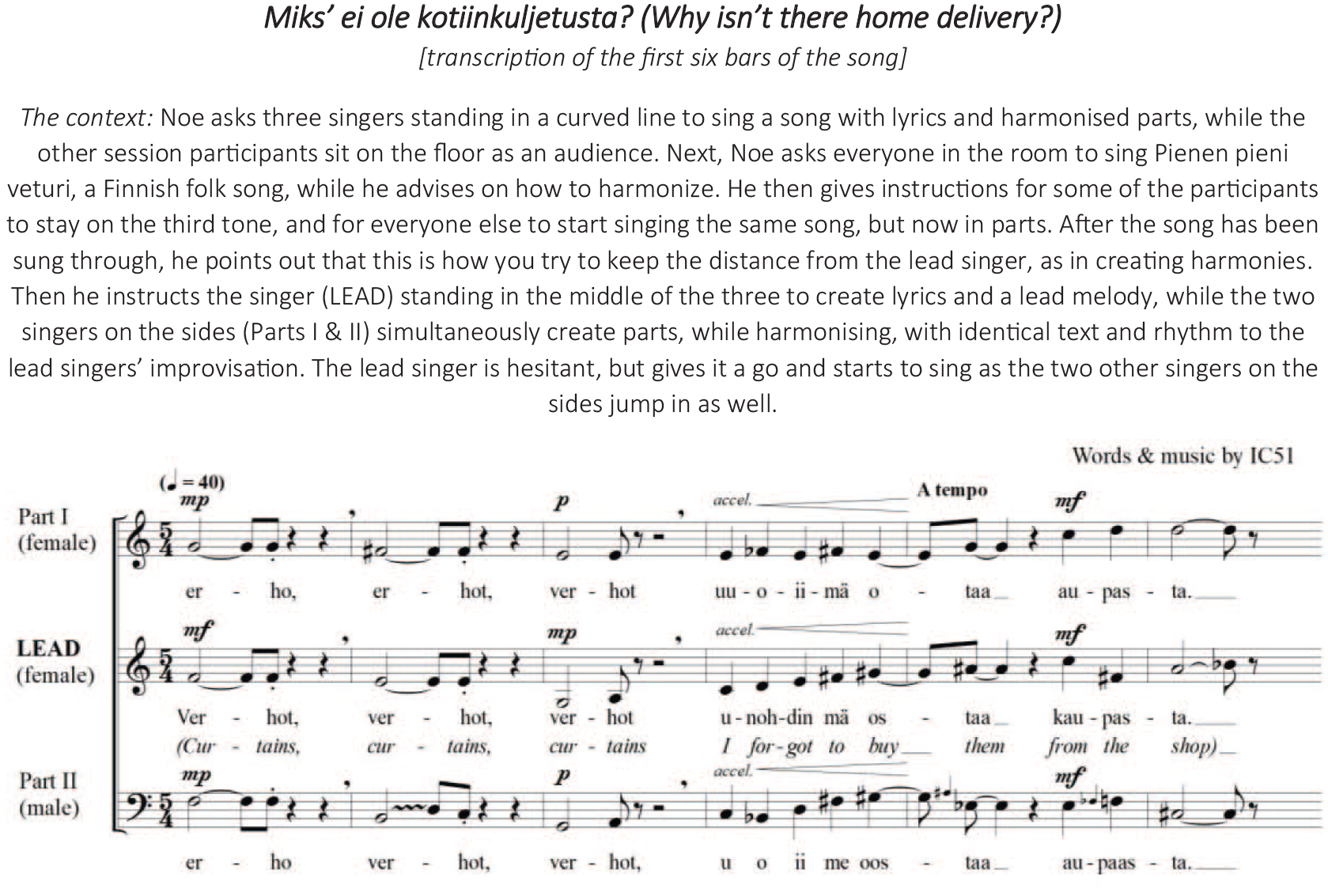
Facilitation of a Harmonizing Exercise.
Dara presents another example of a member who has developed her pedagogical skills through IC51, and who now uses her experiences to help people who have been through “trauma from singing, [. . .] where an elementary school teacher had told them they are lousy and will never be anything.” Although Dara had no previous experience in teaching music, she acquired some of these skills through musicking with IC51: All of the knowledge I have gained from here, what we’ve done in our improv choir: the exercises, doctrines, and how I was as a leader, how I supported [others], and my own thinking; [it has influenced] how I teach singing.
Hence, the choir afforded new ways to make and facilitate music, and to develop a pedagogical mindset for achieving musical growth (see Davis, 2016). It can be said that through the IC51 musicking sessions, Dara, Lumo, and Noe, among others, were supported by the safe environment and playful collaboration of their intensified experiences (see Tuli’s feelings of collaboration on p. 11–12) and transformative becoming (see Noe’s feelings of changes in his attitude on p. 17) (see van Manen, 2012). In summary, through IC51’s activities, these participants learned sociomusical skills, transformed their identities, and constructed their musical and social agencies—even those who did not have prior experience in formal music education. The process of musicking in IC51 provided them with the motivation to continue their musical development and learning outside the sessions; to follow their own pathways in music; and to share their learned skills through their own pedagogy.
Discussion
This study has demonstrated how engaging in and acquiring a holistic and multidisciplinary understanding of free vocal improvisation can empower individuals to create safe and meaningful spaces for engaging in collaborative musical learning and for experimenting with a playful use of the voice. In this process, the development of sociomusical skills is placed at the heart of the musicking. As this study has shown, incorporating aspects of improvisational theatre into free vocal improvisation can provide musicians with resources and tools that can in turn be used to develop a wide range of sociomusical skills, as well as to adapt them to various learning environments. The case study of a choir that regularly practices free vocal improvisation showed how engaging in playful music making can afford its participants resources for constructing musical agency as “a way of negotiating social worlds, a realm in which possibilities of difference and change [were] broached in safe ways” (DeNora, 2013a, p. 42). Even though the IC51 is an adult choir, the improvisation practices interconnect with the “naturally multimodal way that children musick, holistically incorporating movement, gesture, language play and dramatic explorations to make sense of their personal and social worlds” (Countryman et al., 2016 p. 7; see also Tonelli, 2015). As has been reported earlier, bodily engagement is an essential part of children’s improvising experiences (Burnard, 1999). Hence, the body’s latent “expressive potential” (Lockford & Pelias, 2004, p. 434) in adult musicking could be enabled by combining bodily engagement with freely improvised and playful use of the voice, as was exemplified in the case of Lumo (see p. 15).
The findings of this study support the inclusion of free vocal improvisation in music education practices, with a focus on the quality of the social process rather than musical quality. As the case study shows, adopting a playful and collaborative approach to free vocal improvisation can dismantle inhibiting conventions, responsibilities, stress, and competitiveness while empowering individuals through interactive collaboration and emphasizing the acceptance of oneself and others as imperfect human beings. This supports an understanding that the innate creative musical potential in everyone could be reciprocally supported if every child and adult would be considered a singer, and musical per se, regardless of prior experience or training in music. Through this approach, a platform for embodied and situated social learning (Lave & Wenger, 1991; see Wright & Kanellopoulos, 2010) in and through music making could be created, and with an instrument every individual possesses. Both the body and voice could be used playfully, and explored in unconventional and disruptive ways, regardless of one’s age—in the same way that a child uses their voice as the first toy in playing (Papousek & Papousek, 1986), which is the most natural mode of learning (Addison, 1988, p. 258).
This case study of a free improvisation choir provides an example of how strategies of seeking asylum are employed when individuals encounter the inherent discomfort of improvisation, and brings forth music’s potential role as an active ingredient of wellbeing in all music pedagogical and musically inflected spaces, including classrooms and beyond (see DeNora, 2013a, p. 6). IC51’s free vocal play sessions were featured as a creative, collaborative, expressive, and joyous practice in an ambience of acceptance, affording the participants a safe sociomusical space and an asylum, as was similarly portrayed in DeNora’s (2013a) work: “an anytime/anyplace of health promotion and maintenance and a set of practices for achieving (locating, maintaining, discovering, inhabiting) this place” (p. 136). The sociomusical skills that were required for refurnishing safe spaces were simultaneously developed and employed in and through musicking. This enabled the formation of a safe space for encountering the inherent challenges of improvisation (see Farrell, 2016; W. Hargreaves, 2013; Johansen, 2014; Madura Ward-Steinman, 2014) within the zone of discomfort. An asylum was collaboratively and reciprocally created and reconstructed in every musical session through reflective discussions and free improvisation, without imposing either a glossary of music theory or hierarchical positioning.
These findings suggest that establishing a feeling of safety in any musical space, be it free improvisation or a general music class, should not be presumed as a default value, or be subordinated to authority. Rather, the teacher’s, choir conductor’s, or facilitator’s role could be seen as providing the students and participants with resources for social refurnishing and seeking asylum. This process can be furthered by organizing possibilities for practicing collaborative free improvisation with a focus on the social process. The potential effects of engaging in simple acts could easily be explored, such as being allowed to make music with one’s eyes closed, musicking in a different space from the ordinary classroom, or providing room for movement, listening, and both visual and physical contact.
Based on the findings related herein, this study urges the reconsideration of music classrooms as spaces that embrace explorative, experimental, and collaborative approaches, as well as bodily engagement in free improvisation. In addition, music classrooms might adopt a learning culture where any object could be used as if it were a musical instrument (Kanellopoulos, 2007a, p. 129), and “mistakes, instead of being regarded as signs of failure, are thought of as opportunities for the development of musical imagination” (p. 132). When liberation from enculturation and the task of mastering an instrument are realized, a wide variety of affordances can be made available, and be suited to different needs and contexts. Furthermore, the boundaries between experts and novices can be effaced, providing room for empowerment, agency, and novel creations. Thus, the novice as well as the experienced musician can be empowered to find countless uses for the voice and body—rather than being “put in their place” by limited notions of music—and likewise, the expert can be empowered to explore novel uses for and expansions of her professional skills. Individuality could be embraced by approaching perceived differences in vocal skills and quality as resources and opportunities, not only for learning but also for redefining the quality in music and making music through those differences. This is supported by the way in which the discrepancies in the IC51 choir members’ varying backgrounds and skills resulted in a variety of affordances and learning. As the affordances are not isolated from the music, and are not “extra-musical” but instead are inherent aspects of musicking (Ansdell & DeNora, 2016, p. 35), we should recognize that neither learning, wellbeing, nor any other affordances or outcomes can be presumed to be collective or universal, and be applied to every individual in the same manner, or equally so on the basis of what is taught. Rather, affordances and outcomes are dependent on the social ecology of each situation: the participants’ backgrounds, previous experience, environmental features, and social settings, as well as their goals for the activity. As DeNora (2013a) notes, “It is this totality of connections that we should include in our attempts to understand what music is and how it works” (p. 6). Hence, the larger question of possible bias in the standards for measuring learning outcomes is raised because one activity can afford multiple opportunities, and the outcome of learning cannot be predicted or generalized. Moreover, the case study of this free vocal improvisation choir’s focus on the social processes between its members shows that groups with vastly varying skill levels and diverse backgrounds in music making and singing can create a shared musical space wherein motivational collaborative learning leads toward individually satisfying affordances.
In this study, the diversity of the members and the variety of sounds that were produced in their choir appeared to enrich the processes of music making and collaboration. In addition, this case study presented new ways of thinking about and in music, affording tolerance of diversity and seeing beauty where it did not appear before, as the “musicians actively learn from their collaborators during [the improvised] performance” (Thomson, 2007, p. 1). The incorporation of free (vocal) improvisation into music education is a possibility to further justice and equality by refuting simplistic dictates of how the voice should sound and be used (Tonelli, 2015, p. 1). Free vocal improvisation can be used to explore what happens when traditional categorizations based on developmental stages and earlier experience and competences are abandoned, and instead our practices and collaborations are built upon a foundation of equality—the assumption that every individual is a singer and a musician in the here and now of musicking.
Conclusion
This instrumental case study has introduced an ecological perspective on music education, which suggests that playing and improvising in a safe and playful learning environment with a focus on social processes could be considered the starting point for music education and musicking for all, at all ages. The coconstruction of safe learning environments is required for improvisation and collaborative learning situations, as conflicts arise when understandings and interpretations of different identities, pasts, and trajectories enter simultaneously into the collaborative work on multiple planes of interactions. Acknowledging this ecological perspective on musicking, learning, and life in general allows us to see that a forced entry into the world of improvisation in an unsafe social setting or an established, prescripted environment may result in a less-than-ideal state that is the opposite of achieving an improvement in one’s wellbeing. However, establishing a reciprocal system of support that provides an asylum and a playful space can enable the dismantling of issues related to learned ideals and barriers to creativity, as well as allowing participants to experience some freedom from the conventional constraints of music and everyday responsibilities. The strategies that the participants used to cope with difficulties can be seen as developing process-focused pedagogical thinking and a growth mindset (see Davis, 2016; Rissanen et al., 2019) with the ability to see challenges as opportunities for learning. This process of constructing a pedagogical mindset was further evidenced in the skills and knowledge that were accumulated and transferred to helping others in a much broader sense—not just in improvisation, but in everyday life. Free improvisation in general could thus be seen as affording equal access to music making and achieving improvements in one’s wellbeing, as well as providing inspiration for music making, musical learning, and the construction of musical and social agency. In light of these findings, further studies on the pedagogical implications of the implementation of ecological interrelations, affordances, and safe spaces should be conducted. Moreover, there is also a need for the further exploration of the process-focused pedagogical thinking and mindset of growth that is enabled in/through collaborative free vocal improvisation, particularly among school-aged children, in music teacher education, and among music teachers.
Supplemental Material
sj-pdf-1-rsm-10.1177_1321103X20985314 – Supplemental material for Free improvisation in choral settings: An ecological perspective
Supplemental material, sj-pdf-1-rsm-10.1177_1321103X20985314 for Free improvisation in choral settings: An ecological perspective by Eeva Siljamäki in Research Studies in Music Education
Footnotes
Acknowledgements
Sincere thanks are due to Heidi Westerlund, Tuulikki Laes, Panagiotis Kanellopoulos, and Christopher TenWolde for constructive comments at various stages of this project. I would also like to thank the anonymous reviewers of Research Studies in Music Education (RSME) for their meticulous comments, sharp questions, and critical observations.
Ethical Approval
The research in this project adhered to the ethical regulations of the University of the Arts Helsinki as well as those outlined by the Finnish National Board on Research Integrity. All participants provided written informed consent prior to enrolment in the study.
Funding
The author(s) disclosed receipt of the following financial support for the research, authorship, and/or publication of this article: This research was undertaken as part of the Arts as Public Service—Strategic Steps towards Equality (ArtsEqual) project (project no. 293199 and 314223/2017) funded by the Academy of Finland’s Strategic Research Council from its Equality in Society program. In addition, it has also been funded by the Sibelius Academy, University of the Arts Helsinki, and the Center for Educational Research and Academic Development in the Arts (CERADA), where I have been employed as a research associate.

Supplemental material
Supplemental material for this article is available online.
Author biography
References
Supplementary Material
Please find the following supplemental material available below.
For Open Access articles published under a Creative Commons License, all supplemental material carries the same license as the article it is associated with.
For non-Open Access articles published, all supplemental material carries a non-exclusive license, and permission requests for re-use of supplemental material or any part of supplemental material shall be sent directly to the copyright owner as specified in the copyright notice associated with the article.
