



Abstract
Although entrance test criteria seem decisive for accessing higher music education programmes, and problems and challenges with the assessment process are reported, the area is largely unexplored. This article concerns how entrance auditions, specifically primary instrument auditions for Swedish specialist music teacher programmes, are examined and discussed. The data comprise video-documented auditions, focus group conversations, and stimulated-recall-based interviews involving assessor groups at four music education departments. Social-semiotic theory is used to study how assessors judge applicants’ knowledge representations in audition performances. A music-centred assessment culture is constructed, emphasising assessments of technical, communicative, and genre-anchored interpretation skills essential for meeting the demands of the education and profession. Also, a person-centred assessment culture is revealed, emphasising the assessment of personal traits suitable for education and profession. The discussion addresses the reliability, credibility, and validity of assessing abilities in terms of being and behaving in a particular way.
Keywords
Introduction
For entrance to higher music educations, admission tests with specific selection requirements have long been used as a sorting tool. In Sweden, special eligibility requirements and selection principles are permitted if there are special reasons regarding the content and focus of the programme or possible graduate destinations. However, the design of the tests has varied between educational institutions and programmes, as have the skills, knowledge, and attitudes tested (Jørgensen, 2009). For music teacher programmes in the United States (Payne & Ward, 2020) and European bachelor of music programmes (Tomatz, 1996), primary instrument auditions, aural skill and music theory tests, and interviews are reportedly common. For Swedish specialist music teacher programmes, which qualify students to teach a variety of music subjects including instrumental courses at upper secondary schools, applicants have to demonstrate sufficient skills on a primary instrument, singing to their own accompaniment and music theory as well as competencies in interplay and musical leadership. Research regarding admission tests in the Swedish music teacher education context is lacking, but when assessing applicants’ performances in auditions for instrumental courses in higher music education, technical, expressive, interpretive, communicative, and creative skills are thought necessary for admission (Olsson, 1997).
The assessment process in both admission tests and other assessment contexts can be seen as problematic for assessors and applicants, in terms of how judgements are made, what criteria are used, and how the criteria are interpreted. The need for greater assessment clarity was called for in a study of ensemble playing in a bachelor of music programme in which teachers’ unfamiliarity with documents and procedures and students’ problems with the grading process resulted in confusion and lack of transparency about how to assess results (Harrison et al., 2013). Additionally, in upper secondary school, a lack of common articulated criteria, difficulties making adequate assessments of music, and a lack of adequate language for assessing performance and artistic aspects (Zandén, 2010) have been reported. Although sharply articulated criteria were used for technical proficiency in higher music education courses, the assessments of sense of style, expression, and communication used fuzzy criteria, metaphorical language, and individually formulated concepts (Olsson & Nielsen, 2020). Also assessed in musical performances are non-auditory aspects such as appearance, clothing (Wapnick et al., 1998), and body language (Juchniewich, 2008) in higher music education courses, as are attendance, attitude (Russell & Austin, 2010), autonomy, commitment, expressiveness, and fun (Zandén, 2010) in upper secondary school. These previous findings raise questions about the credibility and validity of admission tests, especially given the observed lack of transparency of assessment procedures. Also, with non-auditory aspects and unarticulated perceptions of knowledge and quality, there is a risk that the reliability of the assessments may be weakened. Tests of instrumental, aural, and theory skills have admittedly shown positive correlation with study results in music teacher (Demirbatir et al., 2015) and bachelor of music programmes (Lehman, 2014) but little or no correlation (Bergby, 2013; Wolf & Kopiez, 2014) between study results and aural and theory skills in bachelor of music programmes. Several professional and personal traits, such as teaching experience, beliefs about musical ability, and social skills, have been identified as predictors of instrumental and vocal music teacher self-efficacy (Biasutti & Concina, 2018), yet no correlation has been found between assumed occupational personality traits and the teaching effectiveness of music teacher students (Teachout, 2001). In addition, self-perceived teacher identity has been found to be the only significant predictor of self-confidence related to music teacher education (Isbell, 2008).
Hence, there are many challenges in assessing musical performance fairly and reliably. According to Sadler (2009), assessments can be seen as either analytic or holistic, with or without using criteria. Analytic criteria using rubrics and rating scales are said to be effective by articulating specific aspects of performances (Bergee, 2003; Stanley et al., 2002; Wesolowski, 2012), and distinguishing between performances of varying achievements with reliability and precision (Edwards et al., 2019), especially if the holistic assessment is only communicated through a grade (Ciorba & Smith, 2009). Conversely, in a study using several rubrics for evaluating solo instrumental performances in secondary school, the judging panel still made holistic judgements, especially when the results were near achievement level thresholds (Wesolowski et al., 2018). Similarly, in a study of vocal performances in undergraduate music education, where the level of detail in given criteria resulted in disagreement between the examiners, they still drew on tacit knowledge (Gynnild, 2016). Gynnild concludes that rubrics have the potential to yield more transparent assessments, but that they can never replace professional holistic values.
Although problems and challenges with the assessment process are reported, and entrance test criteria seem decisive for accessing higher music programmes, the area is largely unexplored, and there is a great need for research, especially into entrance tests for music teacher education. Likewise, little is known of assessors’ conversations about criteria used in authentic auditions for music teacher education. In addition, universities in Sweden, as in many other Western countries, must strive for strengthened societal democracy by promoting equality and broader recruitment. From this perspective, it is important to review various selection instruments, not least given the lack of positive results in a recent Swedish experimental study of aptitude testing and assessment procedures for access to teacher education. This article accordingly critically reviews how criteria are articulated and used in primary instrument entrance auditions for Swedish specialist music teacher programmes by studying how representations of quality and knowledge are constructed and legitimised.
Theoretical and methodological framework
The theoretical framework used is designed to capture how instrument/vocal performance and “body language” are represented, verbally articulated, and assessed, that is, how applicants’ actions in auditions are represented and assessed. Using a social-semiotic approach, individuals’ meaning-making activities can be rendered visible through the choice and use of historical and socially created linguistic, material, and bodily semiotic resources to transform, represent, and communicate understandings of, attitudes to, and interpretations of various phenomena in the social world (Kress, 2010). In this regard, multimodal meaning-making is seen as the realisation and articulation of particular aspects of reality in ways appropriate to the interests of social actors in specific contexts. This implies that semiotic resources, with all their variations of offerings, let individuals represent what they regard as knowledge of the world. According to Kress, knowledge assessment in an institutional context is intended to recognise signs of learning, that is, to see, hear, and understand knowledge representations in applicants’ performances to recognise required knowledge. Such a process is illustrated in Selander’s (2008) learning design sequence model (Figure 1), where multimodal learning and communication are linked to both assessment and institutional framing.
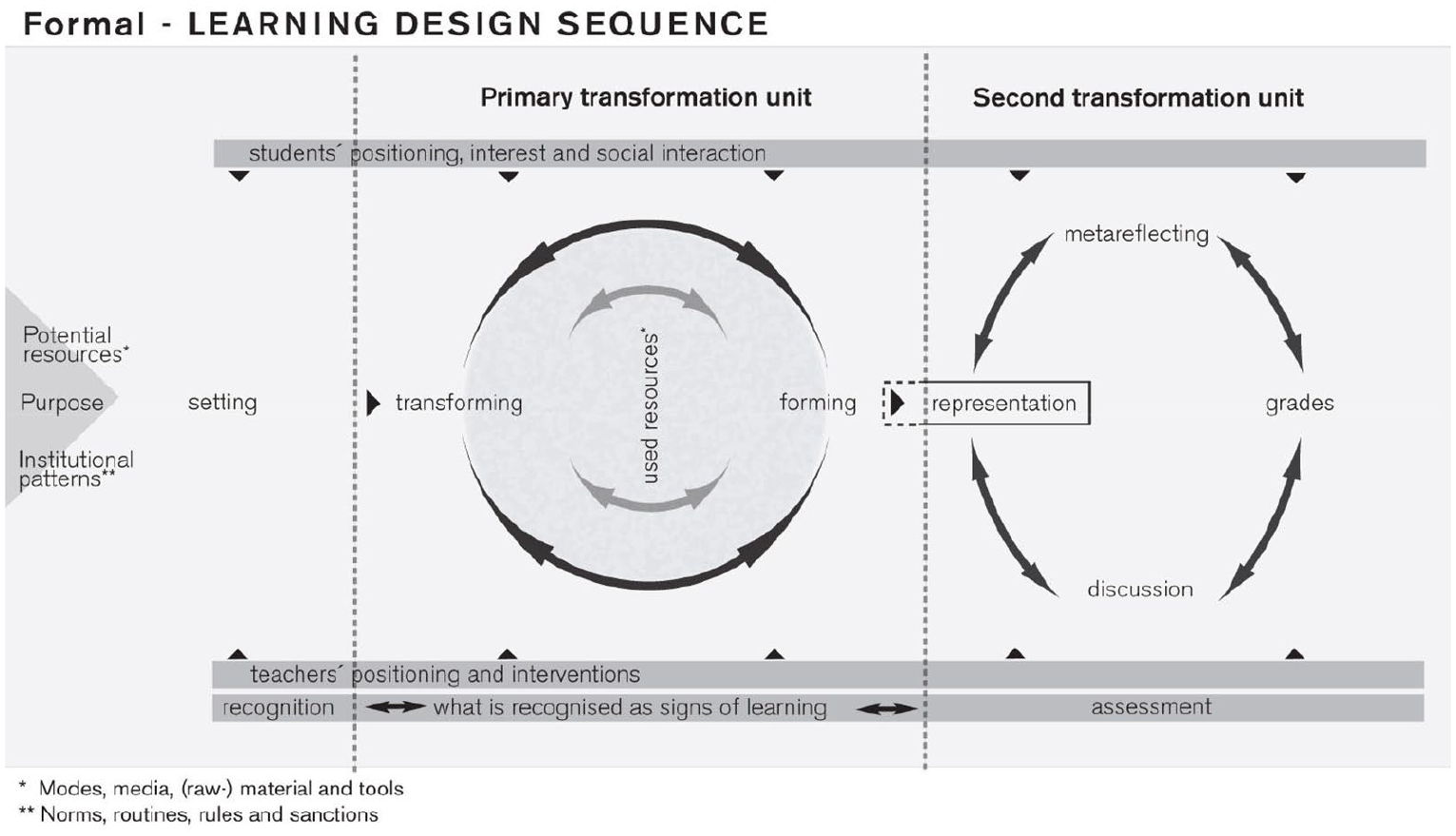
Learning Design Sequence (Selander, 2008, p. 17, Revised Version).
The first transformation cycle concerns how semiotic resources are used, transformed, and shaped in a specific context. In this study, this includes how applicants transform, shape, and realise their knowledge of music and musical style in instrumental/vocal performance and body language by using notes, musical instruments, voice, and body. The second transformation cycle concerns reflections and discussions on communicated representations. Here, the assessors’ meta-reflections and discussions on applicants’ knowledge representations are in focus. The activities in the transformation cycles are influenced by the available resources, activity purpose, and institutional patterns, here in the form of the norms, rules, and practices underlying both applicant performances and assessor judgements. Considering these underlying aspects, the second transformation cycle’s focus on the cultures of recognition established in a specific context is also of interest. In this regard, the prevailing assessment and what are recognised as acceptable ways of representing learning and knowledge form various assessment practices and ways of evaluating. Kress and Selander (2012) describe a culture of recognition as determining the principles underlying and governing interpretation and judging, and thus what is seen as accepted learning and knowledge in a specific context. In this sense, a culture of recognition is a culture of valuation and of the effects of social power. From these perspectives, one can study how assessors value applicant performances, what is considered knowledge, the kinds of assessments used, what is recognised, and what principles underlie the judgements produced and constructed within the studied institutions.
Research design
Video documentation illustrating the use of semiotic resources (Jewitt, 2006), focus group/individual interviews addressing specific themes (Cyr, 2019), and stimulated recall for comments on video-recorded situations (Calderhead, 1981) were used for data collection. The present study is a part of a larger project about the assessment of entrance auditions to Swedish specialist music teacher education, financed by the Swedish Research Council. The data in this part comprise 27 video-documented entrance auditions on a primary instrument and 22 conversations with assessor groups, consisting of music teachers, produced during the Spring of 2018.
Procedure and participants
The project started by asking research permission from four, of a total of eight, Swedish institutions offering specialist music teacher education programmes. The institutions were chosen based on variation in institutional background, current organisation, teacher programme profile, and musical genre. When asking assessors and applicants to participate in the study, they received written information about the project and the Swedish Research Council’s guidelines regarding de-identification, voluntary participation, and consent. All applicants who gave their written consent were video recorded during their entrance auditions. Almost every teacher in the assessor groups, in which video recordings had been carried out, agreed to participate in focus group conversations/individual interviews by signing a written consent. Most interviews were conducted within 2 weeks of the entrance auditions, and a few within 2 months. Some of these were structured individual conversations, while others were focus groups with two to four participants. The assessors were invited to select two videos of the auditions they assessed, one resulting in a pass and one in a fail, and were asked to comment on the quality of the applicants’ performances. They were asked to use the videos to remind themselves of their thoughts and evaluations at the time of the auditions, and the few assessors who were not present at the auditions were asked to comment on what they saw and heard in the videos. They were also asked to reflect on entrance auditions for music teacher education in general. All the interviews were audio-recorded and transcribed.
Analysis
The first step of analysis, based on the first transformation cycle, concerned the assessors’ detailed descriptions of the semiotic resources they could see and hear in the performances as well as the qualities and knowledge that caught their attention. Furthermore, parts of the selected video-recorded sequences were transcribed by the researchers into scores and drawings illustrating the transformation, collaboration, and function of the semiotic resources used by applicants. The second step of analysis, based on the second transformation cycle, concerned distinguishing and categorising variations in assessors’ conversations about what was communicated and recognised as acceptable knowledge and skills in the applicants’ performances. In addition to identifying different criteria constructs, the assessors’ articulations and values of accepted knowledge were also analysed. The third step of analysis, also based on the second transformation cycle, concerned the assessors’ rhetorical strategies to legitimise the criteria constructs, in addition to what seemed to be at stake when deciding what to recognise as accepted. These analyses highlighted the conceptual patterns and principles underlying assessors’ reflections on acceptable knowledge, thereby identifying general understandings on which the assessments were based, presented in the results as assessment cultures.
To challenge the researchers’ own assumptions and acknowledge confirmation bias, we have presented and discussed our analyses and results at various research conferences and seminars. The fact that we are three researchers, based at three different universities, has also contributed to avoiding bias. In presenting the results, no statements or categories are attributed to specific institutions or assessor groups. The intention is to depict various statements, not individual assessors or institutions. When a dialogue between assessors is cited, they are referred to as Assessor 1 and 2. In the block quotations, deleted passages are indicated with ellipses.
Assessment cultures
Two assessment cultures emerged in the analysis: the music-centred assessment culture emphasising assessments of the technical, interpretative, and communicative abilities necessary to cope with the requirements of both education and the music teaching profession, and the person-centred assessment culture, based on assessing the applicant’s personality traits suitable for being a student teacher and prospective music teacher.
The music-centred assessment culture
The music-centred assessment culture is based on the assessors’ conversations about the musical qualities and skills considered necessary to cope with the music teacher programme and prospective profession. Music-centred judgements are considered to focus only on applicants’ music-related knowledge representations realised during their auditions. The assessments are legitimised by the assessors through both explicit and implicit references to institutional criteria for singing and playing tests, formulated as technical competence and artistic performance, which signal that such assessments are deeply rooted in institutional norms and rules. This assessment culture includes three criteria: instrumental technical skills, genre-anchored interpretation, and communication. What is at stake regarding these criteria is the applicant’s potential, over five years, to achieve the requirements for the education and prospective profession. The music-centred assessment culture is realised in two ways: professionally formulated assessments, expressed using music-related terminology strongly connected to instrumental technique, musical performance, cultural anchoring, and communication, and emotionally expressed assessments, expressed using emotion- and experience-based language strongly connected to musical achievements, both used to value the applicant’s meaning-making.
Professionally formulated assessments
The professionally formulated assessment construct is based on assessor use of concept formations, well established and used in the music field, that are strongly connected to music-making and interpretative processes and to the institutions’ communicated criteria. To illustrate the use of knowledge representations related to the criteria instrumental technical skills, genre-anchored interpretation, and communication, a transcription of five bars from one applicant’s instrumental performance with piano accompaniment is presented in Figure 2 and briefly commented on by the researchers, followed by an assessor’s reflection on this performance.
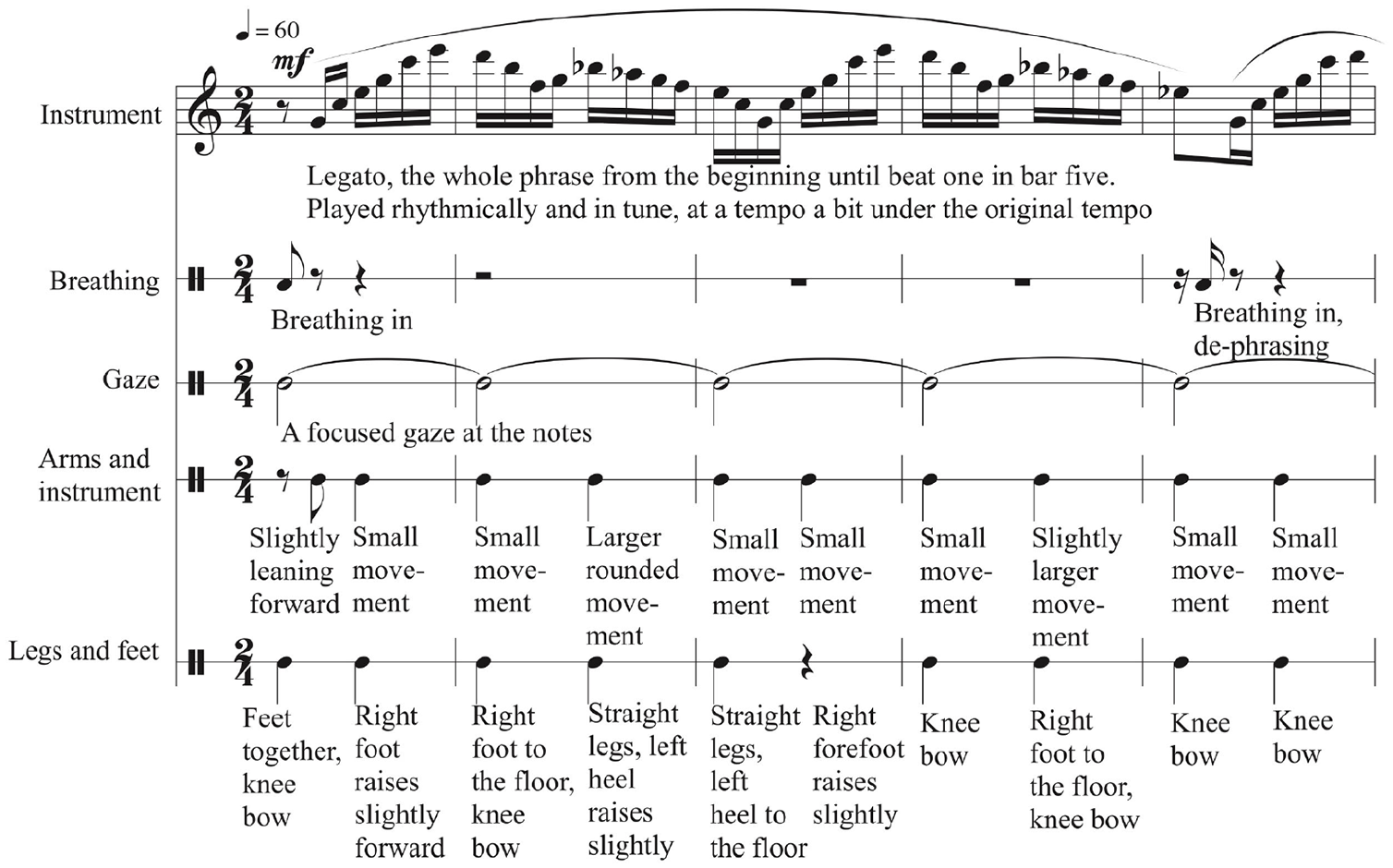
Example of Melodic and Bodily Representations.
The transcription shows how music-related resources, such as melodic notes, tempo, intonation, and phrasing, as well as bodily resources, such as breathing, gazes, bodily posture, and phrasing movements, interact with each other. Together they signal instrumental technical skills and genre-anchored interpretation, such as style and musical expression. Similar understandings of the applicant’s knowledge were expressed by an assessor: And I think she does this [i.e., meets the criteria] . . . she produces the tone consciously. She has breathing that works and, it is in tune, almost at least, and she has phrasing. She communicates with the pianist and she has a basic technique in place, I think. And not only plays the right notes, but also interprets to some degree . . . She has a kind of idea, a technique, and a sense of the notes and tone, and feels convincing, I think. It is musical, when she is phrasing, as well.
The excerpt illustrates how the assessor, using music-related terminology, considers the applicant’s technical skills and genre-anchored interpretation sufficient for approval. This signals the importance of being able to translate musical notation and, on the instrument, realise various technical resources, such as instrumental technique, phrasing, tone, and intonation, as well as interpretive resources, such as sense and ideas, in a meaningful way. The assessor’s statement about communication refers to the applicant’s listening to and interacting musically with the pianist. The mentioned musical communication with the pianist is not captured in Figure 2, but is evident later in the performance as a gaze towards the pianist.
Other assessors’ statements emphasise instrumental skills, such as bodily anchored pulse, timing, and rhythm, improvisation and singing/playing from chords. Regarding genre-anchored interpretation, the importance of instrumental and bodily musical expression aligned with the characteristics of a particular musical style, composer, or artist, representing familiarity with, understanding of, and feeling for the chosen music as well as musical rhythm and function, is also emphasised. These professional assessments can be seen as analytical, as they use several music terms elucidating different aspects of the performance. By using clear music-related terminology and an analytical approach, the assessors emphasise the ability to interact with other musicians and to control the unfolding of the music in interaction with fellow musicians, a band, or an accompanist.
Emotionally expressed assessments
The emotionally expressed assessment construct is based on the assessors’ statement that assessment criteria cannot fully capture all the targeted knowledge and life experience, so they cannot be expressed in a few words. Nor it is considered sufficient to describe the applicant’s knowledge representations using music-specific words or to use words at all. Instead, assessments are sometimes said to be based on unspoken emotions and experiences. Such emotion-based assessments are based on the assessors’ experience acquired through their own music-making in interaction with other musicians, and from assessing other musicians’ performances, articulated and developed as a bodily and experiential language used in musical contexts. The applicant’s knowledge representations noted and assessed in this construct are not explicitly expressed by the assessors but rather are based on emotional, physical, and experience-based meaning-making. Although the assessors do not explicitly talk about technical, genre-anchored interpretive or communicative resources, these criteria are hinted at as tacit aspects of the assessments. The assessments are also considered to be influenced by the instrument played and by the assessors’ profile, personal experiences, and preferences.
As an example of an emotionally expressed assessment, one applicant’s knowledge representations in a vocal performance are illustrated in Figure 3, commented on by the researchers, and then reflected on by an assessor.
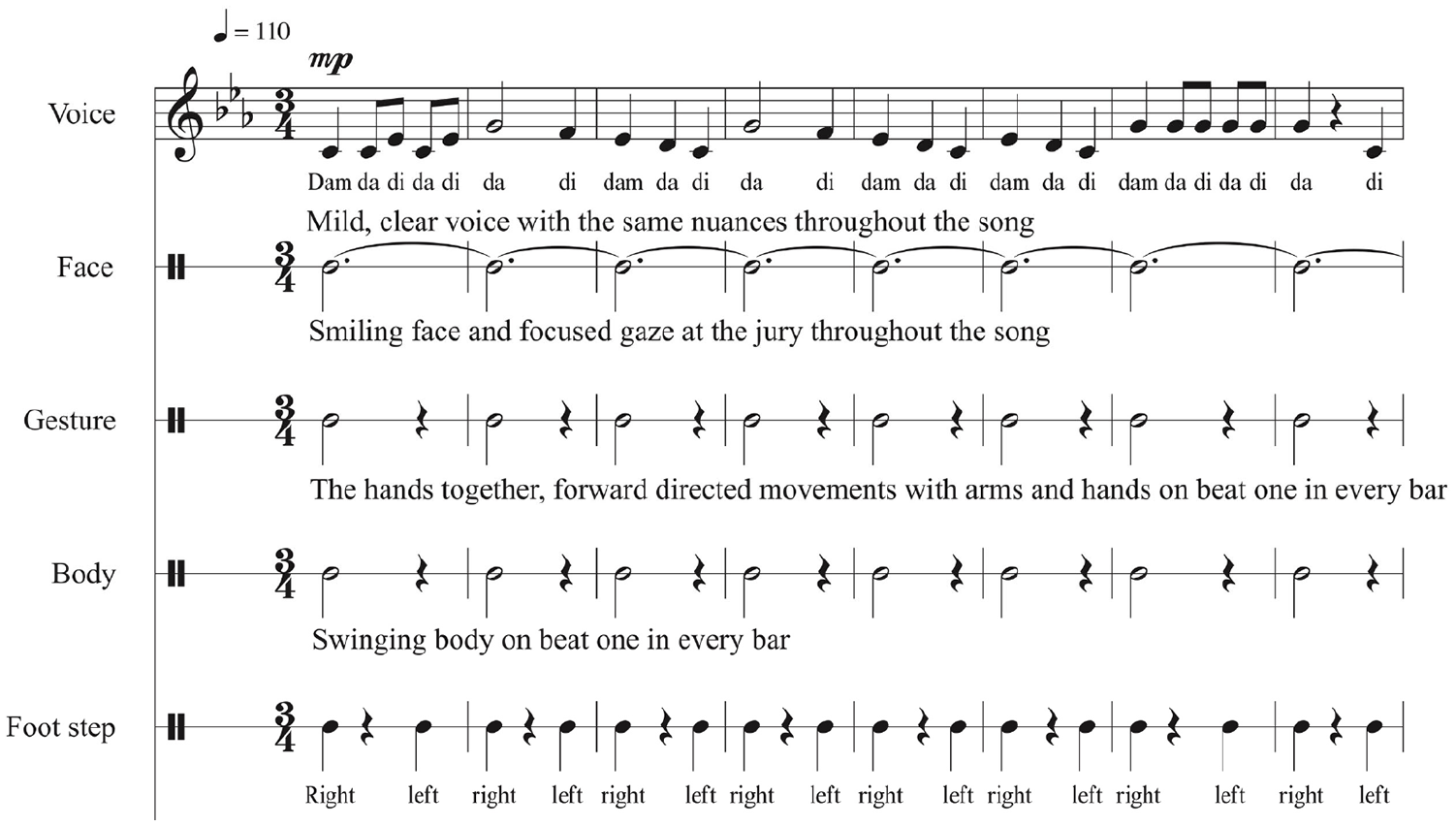
Example of Melodic, Rhythmically and Bodily Representations.
Figure 3 illustrates how the melody is presented by the applicant’s voice in a fairly consistent way, without accents or varied nuances, including positions of feet, hands, arms, and eyes, as well as facial expression. An assessor signals that nuances and details in a performance may be difficult to translate into words, but nevertheless contribute to an assessment. The assessor therefore emphasises the importance of discerning “how it affects [the listener],” and then says that “it is beautiful and nice to listen to,” that the applicant “has a good foundation in singing” and “so much knowledge, I think, that it [i.e., the performance] is absolutely approved.” The criteria are clearly described, but using emotion-laden words rather than the previously discussed musical terminology. However, the statements using the words “foundation,” “beautiful,” and “affects” can be related to technical skills, genre-anchored interpretation, and communication.
In other assessors’ statements, words such as “interesting,” “magic,” and “poetry,” as well as emotionally negative words such as “poor,” “careless,” “horrible,” and “puppyish,” are used to describe applicants’ performances. An assessor explains the difficulty of expressing all the nuances and details verbally: What makes it difficult to put it into words is precisely that I don’t think it would be possible to tell anyone else . . . this is based on long, long experience, that we have listened to or heard or played this music for so long, that there are several shades of rhythm and beat . . . it is life experience . . . and for us it should take a very long time to put our finger on it . . . because we speak a language that we understand.
In the excerpt, one’s own life experience is seen as extremely important when conducting assessments. The assessor also refers to a collective understanding of what constitutes quality and expertise, that is, quality aspects shared among the assessors that does not need to be explicitly articulated. These can also be seen as specialist’s statements that allow more holistic, well-founded judgements, difficult to translate into words to be made understandable to individuals outside the professional collective. Inarticulable assessment is also exemplified by expressions such as “gut feeling” and “intuition”: All our experience, all the years we’ve played with different music types, personalities, human types, and over the years . . . I try to apply all the knowledge I have, and one of the things is that you feel whether they, can they become something. Then this is about the music, of course, whether the person has a voice and wants to say something about the music played. Rhythmic ability . . . beat feeling . . . form feeling . . . musical phrases . . . These are things we intuitively feel and, ah, like a feeling for, and now when we have, of course we can break it [i.e., the performed music] down [the assessor taps on the table], but we do not dissect this every time, but for us, it is often so obvious.
The quotations show that the assessments are highly coloured by the assessors’ own musical experiences and norms as to what are recognised as skills, and that assessments do not always need clear verbalisation. At the same time, a connection to established assessment norms is suggested. It is also considered important that emotional expression should be heard in the performances and be visible in the performer’s bodily movements. The last quotation also emphasises the importance of a holistic approach to assessment, in contrast to a more analytical approach in which every detail of a representation is assessed individually.
Institutionally established but unstable assessment culture
The music-centred assessment culture can be seen as strongly coloured by criteria determined by the institutions and expressed in established musical terminology anchored in practice, rules, and norms regarding what is assessed. At the same time, its emotional and experiential basis makes this assessment culture somewhat unstable and fluid. Given that technical skill, genre-anchored interpretation, and communication are used as criteria by all assessors, tacit connections to predetermined institutional criteria may not only be based on difficulties verbalising criteria, but may also be linked to existing local habits and conventions regarding assessments in music, and therefore need not be articulated. Furthermore, the use of the communication criterion contributes to some instability, as this criterion is not addressed in the criteria determined by the institutions. Also, assessments of applicants’ potential to meet educational and professional requirements contribute to some inconsistency and vagueness, as these assessments sometimes become dominant despite being unconnected to institutionally determined criteria. It is also suggested that assessments may differ depending on who is assessing and on the instrumental culture of which the assessor is part, further contributing to the inconsistency of this assessment culture.
The person-centred assessment culture
The starting point for the person-centred assessment culture is the idea that applicants’ personality traits, behaviour, and attitudes, realised in both singing and playing tests and revealed in conversations with assessors, can and must be assessed. This construct emphasises applicants’ use of social, mental, and physical resources and how these resources are articulated and valued as personality-based aptitudes. This assessment culture is not rooted in institutionally determined criteria, as no personality traits are addressed in these. Instead, the assessors legitimise assessments of this sort by suggesting that the applicant’s personality must fit the music teacher programme, the particular institution, and the prospective profession. It is emphasised that such qualities must already be evident in the tests, as it is considered impossible to learn them during 5 years of education. The person-centred assessment culture has two criteria: personality fits the education and personality fits the profession.
Personality fits the education
The criterion personality fits the education is based on the assessors’ conversations about mental and social resources featured in the singing and playing tests, signalling the importance of learning what kind of person the applicant is, to decide whether he or she is suited to the educational context. The following quotations, from two different juries, illustrate the personal suitability criterion: It’s a song he can do well. He has not chosen too difficult a song, nor too simple a song. I think he has found a good jazz song to play. It indicates maturity, self-awareness.
There must be a match between teacher and student in this and, she is, yes, I think she is a student who would be fun to teach . . .
I also like this . . . she is standing here and is visible here, and dares to claim space. It is nice to see as well, and it means that she, she has some kind of, eh, mm, basic self-confidence, at least what you can imagine.
In the first quotation, the applicant’s capacity to make conscious and mature choices is presented as important. Here, the assessor allows the relationship between the song’s degree of difficulty and the applicant’s musical competence to form the basis of an assessment of the applicant’s mental resources. The dialogue between the two assessors concerns the playing test transcribed in Figure 2 and whether the applicant is suitable as a prospective student. In addition to referring to security when playing, they also assess personality traits. It is said to be important to consider whether the applicants and their prospective teachers will be suited to one another, as well as the applicants’ confidence to claim space. That the applicant would be an acceptable teacher education candidate is based on the assessors’ preferences for a good student–teacher relationship, self-confidence, and successful musical results.
In other assessors’ statements, other mental and social characteristics, such as responsibility, will, ambition, independence, stress management, ability to collaborate and interact, and human feeling, are highlighted. These resources are often connected to musical practice, in which seriousness, maturity, and self-confidence in music-making are articulated as important personality traits. A reasonable assumption is that applicants who display the opposite characteristics in their performances, for example, lack of independence, irresponsibility, and insecurity, will be considered unsuitable for admission.
Personality fits the profession
The criterion personality fits the profession refers to the importance the assessors identified of having personality traits and an approach appropriate to the teaching issues addressed in music teacher education. Personality traits are also said to be important in deciding whether, after 5 years of education, a student should be able to serve as a music teacher. Mental, social, and material resources are central to assessing personality.
Figure 4 depicts profession-related personality traits in the applicant’s instrumental performance and in the communication between the applicant and the pianist. The letters S, P, and F indicate how the applicant directs his gazes at the score, the pianist, or the instrument’s fingerboard, respectively.
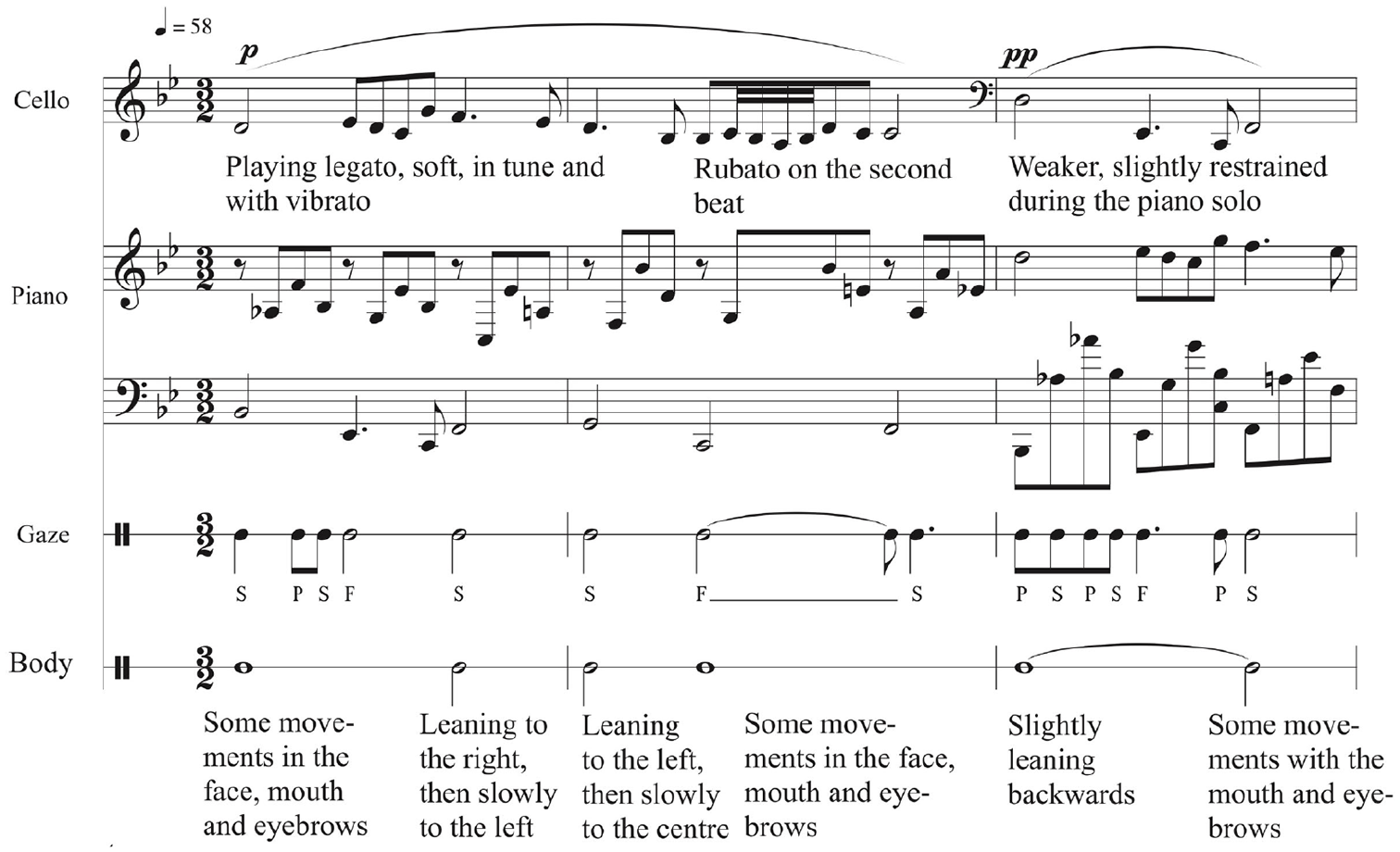
Example of Instrumental and Bodily Representations.
The professional personality traits illustrated by the researchers in Figure 4 can be attributed to the communicative criteria revealed by the cellist’s gaze, body postures, and facial expressions in the musical and social interaction with the pianist. However, in the following, the assessors suggest that it is possible to assess personality traits in such communication:
If you are going to work with children and youths, for example, you need a certain type of personality to manage it.
And how do you see this during the tests?
You see it especially when you talk to them, how they talk. If they are just people who are occupied with their own problems, and do not seem to reflect at all on having to work with children and youths—and yes, sometimes they say this themselves.
You see it in how they communicate with the pianist, for example, or when they listen, that they can focus outside themselves as well, because [as a teacher] you really have to.
In the dialogue, the assessors claim that it is noticeable, in both playing and conversation, whether or not an applicant has a personality suitable for a prospective teacher. They seem to claim that suitable teacher candidates should be problem-free, hoping to work with children and young people, and open to other people, and that this can be assessed in their singing and playing tests. The following quotation also mentions resources appropriate for a prospective teacher: Sometimes we see that a teacher candidate fits well here because, when we talk to them, those who are very alert, for example, very aware, very present, and during the time [i.e., the audition] we think that if they have applied for teacher education, then we think, yes they may fit. They are open, outgoing, normal. They can be strange too, but have something, a driving force—it doesn’t just have to be musical—a human driving force that we notice.
This passage can be interpreted as indicating that applicants who are not alert and outgoing, or who lack a clear “driving force,” are not considered suitable to become teachers. The importance of the applicant’s approach to music, colleagues, and prospective pupils is also emphasised in other assessors’ statements, for example, that it is important to have “come a long way with oneself,” to have “a mission . . . to teach and carry the music on,” to have “the right stuff,” so it does not “become a difficult situation . . . in seven years, eight years.” Also, “the person [i.e., applicant] must have a psychologically stable foundation” to teach children. Here, demands are made regarding the applicant’s character traits, as assessed from the singing and playing tests, although these traits are far from the musical knowledge being assessed.
In Figure 5, drawings and transcripts from a short video sequence show various knowledge representations that highlight aspects considered to say something about the applicant’s suitability to be a teacher.

Example of Bodily and Material Representations: (A) [00:00:26.02] the Applicant Is Standing Beside the Piano, With the Violin Under Their Right Arm and the Bow In Their Right Hand. With the Left Hand, The Applicant Places the Sheet of Music on the Music Stand. The Applicant Is Wearing Black Jeans, White Sneakers, A Dark Slightly Striped Short-Sleeved Shirt, and a Black Hat. (B) [00:00:46.12] the Applicant Places the Violin on Their Left Shoulder and the Bow On the Strings. The Pianist Plays the Concert Pitch, Looks At the Applicant Without Receiving Any Response, and Asks, “Don’t You Want to Tune the Violin?” the Applicant Replies, “I Did It Myself Out There.” (C) [00:00:58.27] the Applicant Starts to Play Without Introducing the Pianist. The Music Is Played With Many Wrong Notes and Often Out of Tune. In the First Bars, The Rhythms Are Played Fairly Correctly, but After a While, The Tempo Slows Down and the Applicant Shows Great Difficulties in Playing the Right Rhythm.
In the illustrations and transcript excerpts, the applicant’s body postures, way of holding the instrument, unwillingness to tune the violin to the piano, and, finally, the performance of the music with many wrong notes, poor intonation, and inaccurate rhythm and tempo can be related to criteria articulated in the music-centred assessment culture. However, the applicant’s personality traits are also evaluated by the assessors as not meeting the requirements for a music teacher:
Since this one [i.e., the applicant] is applying for teacher education, then I also consider how you [i.e., the applicant] view yourself, and it can also deal with how you dress, for example, if you dress quite confidently with a certain style, but you have no idea of what you are doing. To apply for teacher education like this, you have to know what you are doing, to have ideas about teaching children. For example, as to this, you must have ideas about where to stand and what to do with your hands. This is one of the first things I look at regarding the teacher [education applicant]—as well, it was extremely poor [playing] . . .
The one [i.e., the applicant] we saw on the video here, was invited to tune the violin and did not. I see that as reflecting immaturity.
The excerpt signals that the applicant’s body posture, clothing, and musical resources are unsuitable for the teacher educational programme and for the teaching profession. This unsuitability was assessed not only from the substandard playing test but also from the applicant’s attitude towards musicianship, style of dress, physical behaviour, and degree of maturity. The assessment of this construct is based on the assessors’ norms regarding the applicant’s character, behaviour, and appearance, which are argued to be completely relevant to the assessment of singing and playing tests.
Non-institutionally established, but stable assessment culture
The person-centred assessment culture, with its educational and vocational criteria, signals an established assessment culture not related to or correlated with past or current institutionally determined criteria. However, this construct is stable, as the assessors are relatively unanimous in their expressions of what are appropriate personality traits for music teacher education and for the profession. Whether the assessments are based on local assessment cultures with normative perceptions of personality traits, recognised as appropriate and valid for admission to music teacher education, is not evident in the assessors’ statements. Rather, assessment of applicants’ knowledge representations seems to depend on individual assessors’ interests, norms, and preference frameworks. The fact that such assessments are not challenged or questioned in the statements indicates that they fall within the framework of this assessment culture.
Discussion
In this article, we have examined assessors’ meaning-making when assessing primary instrument tests to Swedish specialist music teacher education. Questions of the relevance, credibility, and validity of the tests are highlighted by the attitudes and approaches constructed and realised in the music- and person-centred assessment cultures. Even though it is possible to recognise some overlaps within and between the assessment cultures, there is a great discrepancy between the constructions assessing musical skills and assessing person-related skills. A similar discrepancy is found between assessing the applicant’s musical ability to cope with the education and profession and how well the applicant’s personality and suitability to be a teacher fit the same. Here, the applicants’ abilities to do and know something can be set in opposition to being and behaving in a particular way, which can be seen as striking in tests intended to assess instrumental skills. Although the criteria communicated to both assessors and applicants via institutional channels regarding primary instrument tests only recommend assessing technical competence and artistic performance connected to the music played, person-centred traits are nevertheless assessed in these tests.
The fact that assessors do not always base their assessments entirely on institutionally formulated criteria, but also invoke other criteria, thus extending their commission, illustrates a problem in choosing and interpreting the criteria used in the assessment process. Assessments based on professional language and emotion-based expressions of quality regarding technical skills, genre-anchored interpretation, and communication recall previously observed clear and unclear defined criteria in higher music programmes (Olsson & Nielsen, 2020), tacit criteria observed in upper secondary schools (Zandén, 2010), and a lack of transparency in bachelor programmes (Harrison et al., 2013). Also, additional criteria such as appropriate personality traits recall previously observed fuzzy assessments conducted by music teachers both in higher education and in other educational systems (Russell & Austin, 2010; Wapnick et al., 1998; Zandén, 2010). However, compared with the results of previous studies regarding admissions to undergraduate music programmes, in which only musical aspects seem to be assessed in the instrumental auditions (Olsson, 1997; Olsson & Nielsen, 2020), the present results indicate a significant difference in the interpretation of the criteria. In the conversations with assessors, the criteria for primary instrument auditions for the music teacher programme apparently contained taken-for-granted assumptions about suitability for being a teacher, especially regarding what a music teacher is supposed to deal with in the profession. Predictions about applicants’ suitability for the teaching profession are frequently discussed in the conversations about audition assessments, although they are contrary to the official institutionally determined criteria regarding the primary instrument tests, and despite leadership skills are tested in other parts of the admission tests. Nor do applicants know that they will be judged based on premises other than the criteria communicated, reinforcing the questioning of such assessments. According to Kress (2010), an inability or refusal to recognise signs of learning—here, the applicant’s signs of musical knowledge—directly affects the possibility of conducting relevant assessments. If the applicant’s signs of musical knowledge do not correspond to the assessors’ views of what should be assessed, that is, music and/or personality, what effects will this have on the selection and whose interests will govern the selection? The questions are also whether teachers can assess the applicant’s personality traits in relation to teacher suitability and whether teachers with specialist skills in singing and playing an instrument should judge aspects other than those related to these competencies. Based on these arguments, the credibility of such assessments regarding applicant selection is highly questionable. The relevance of assessing teacher-appropriate personality traits can also be questioned, as previous research on tests of music teacher suitability have not reported positive results (Teachout, 2001). Although positive correlations are reported (Biasutti & Concina, 2018) and self-perceived teacher identity can be seen as strongly linked to teacher self-confidence (Isbell, 2008), teachers’ assessments of appropriate personality traits cannot be seen as at all relevant or credible when judging primary instrument tests. Another question is whether or not predictions based on these conditions can presuppose a relevant picture of what is successful. As in previous research, we doubt the significance of predictions based on person-related criteria and/or criteria intended to estimate an applicant’s ability to succeed as a teacher. In such assessments, there is also a great risk that requirements for broader recruitment, increased equality, and strengthened democracy will be difficult to achieve. In order for the tests to be more reliable and fair as selection tools, we consider it important that those designing and implementing the criteria and standards must strive for transparency, and that the measures are based on the applicants’ musical knowledge and skills rather than on their personalities.
Footnotes
Funding
The author(s) disclosed receipt of the following financial support for the research, authorship, and/or publication of this article: The work was supported by the Swedish Research Council, grant number 2017-03425.