




Abstract
In light of recent discussions on the importance of shared visions in teacher education, this inquiry raises necessary questions as to whose visions shape unified and shared visions, and whose remain absent, unspoken, or silenced in the margins. The starting point for this inquiry was a set of visions for music education in Nepal that were co-constructed with over 50 musician-teachers working in the Kathmandu Valley, during a series of 16 workshops guided by Appreciative Inquiry’s 4D cycle. Despite the challenges female musician-teachers encounter in their pursuit of music in Nepal, no reference to these injustices was apparent in the resulting shared visions. This inquiry therefore engages with the nature and possible causes of this lack of reference, leaning on economist and philosopher Amartya Sen’s (2009) idea of justice and social-cultural anthropologist Arjun Appadurai’s (2004) notions of the capacity to aspire and the capacity for voice. The critical (Kuntz, 2015) and reflexive (Alvesson & Sköldberg, 2009) work guiding this inquiry suggests that while the workshops were guided by the aim to be inclusive, the need to come to consensus when co-constructing shared visions both reflected and obscured the injustices experienced by female musician-teachers. The article concludes by offering insights for music teacher education.
Keywords
Introduction
I wanna be a musician, Just like any guy. I wanna be just as good as him, Play just as good as he is playing,
And not get questioned
Because I’m a girl.
It has been argued that “a unified vision for music teacher education is the means for advancing our work and meeting all of the challenges that we are facing” (Orzolek, 2015, p. x), and “that quality teacher education is designed around a clear and shared vision of good teaching” (Klette & Hammerness, 2016, p. 28, emphasis in original). However, teachers’ visions—their “images of ideal classroom practices … that reflect their hopes and dreams for themselves, their students, their schools and even sometimes their communities” (Hammerness, 2004, p. 34)—are not necessarily shared (see e.g. Ferm Thorgersen, Johansen, & Juntunen, 2016; Hammerness, 2013; Juntunen, 2014). This raises important questions as to whose visions shape these unified and shared visions, and whose remain absent, unspoken, or silenced in the margins; a question pertaining not only to visions, but to much of the work preparing future music teachers for increasingly diverse environments.
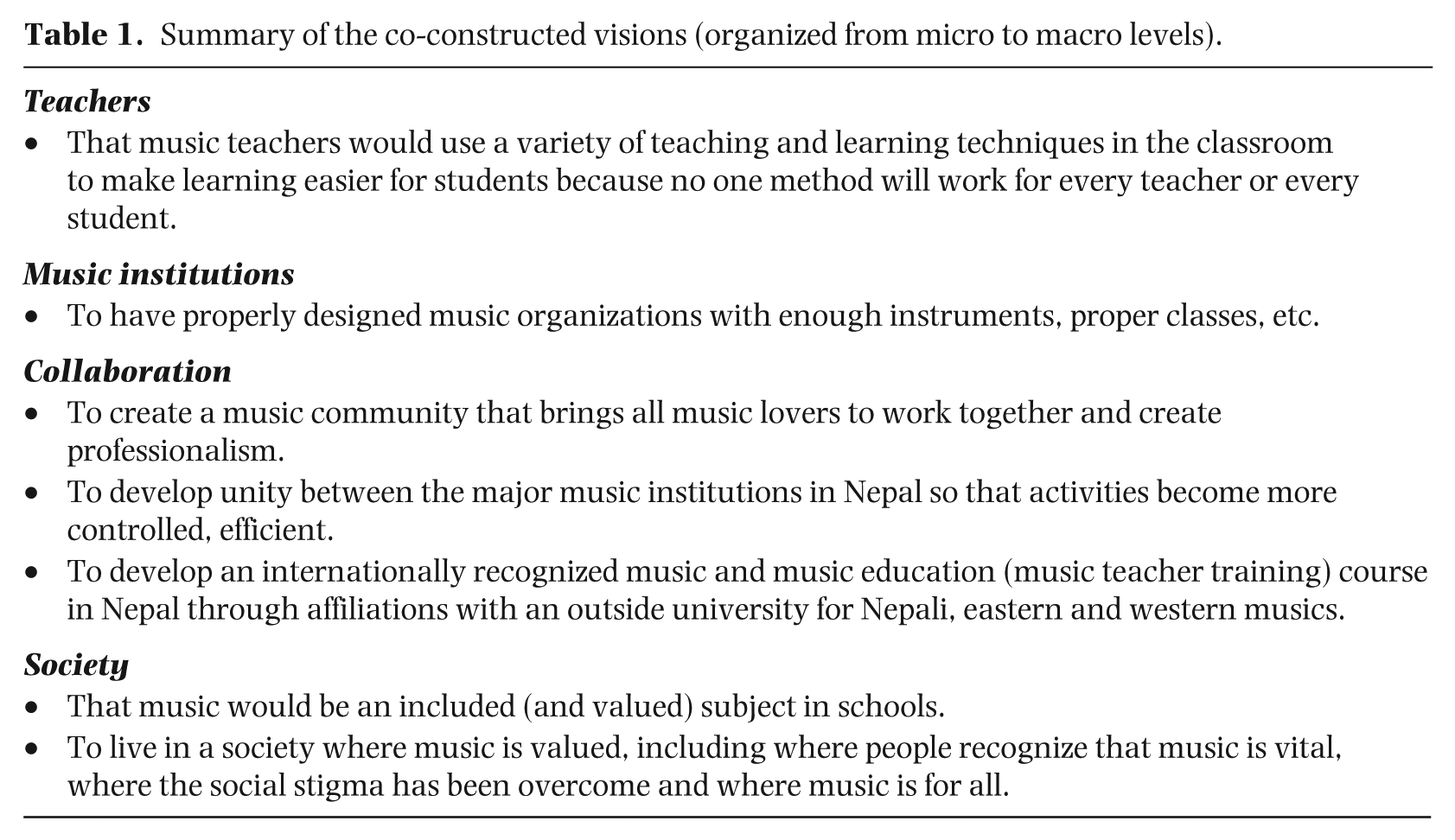
The starting point for this inquiry was a set of shared visions (see Table 1) for music education in Nepal that were co-constructed with musician-teachers 1 working in the Kathmandu Valley during a series of Appreciative Inquiry workshops I facilitated in 2016 (see Treacy, 2020). More specifically, the inquiry attends to the absence of the vision alluded to in the poem that opened this article, for a woman to “be a musician just like any guy.” Following Carducci, Pasque, Kuntz, and Contreras-McGavin (2013) who argue that “it remains vital that critical scholars continually investigate the absences, blind spots, and invisibilities inherent in research designed to interrogate, disrupt, and ultimately upend educational inequities” (p. 6), I investigate the absence of this vision in two parts. In the first part, I think with economist and philosopher Amartya Sen’s (2009) idea of justice to interpret and re-tell stories of the challenges female musician-teachers encounter in their pursuit of music in Nepal. These challenges were shared in an additional female-only workshop that I also facilitated in 2016. I then extend this interpretation through engaging in “productive critique” (Kuntz, 2015, p. 109) of the processes that took place in the main workshops, processes that were guided by an aim to be inclusive, but had marginalizing results. In doing so, I acknowledge the many other visions and voices—for example those from different musical genres, caste/ethnic groups, and age groups—that likely remained silent or marginalized without me noticing or because of my presence. Indeed, beyond gender, 2 the workshop participants had other identities related to, for example, caste/ethnicity, class, religion, languages, and age, identities which “are not objects but processes constituted in and through power relations” (Brah & Pheonix, 2004, p. 77). Nepal, for example, currently recognizes 126 caste/ethnic groups, 123 languages spoken as mother tongue, and 10 religions (Government of Nepal, 2012, p. 4), and has a long history of social stratification based on gender, caste, ethnicity, and race (Manandhar, 2009, p. vii). In engaging in this critical work, I lean on social-cultural anthropologist Arjun Appadurai’s (2004) notion of strengthening the capacity to aspire and the capacity for voice in order to change “the terms of recognition” (p. 70) of excluded, disadvantaged, and marginal groups. The article concludes by offering insights for music teacher education.
Summary of the co-constructed visions (organized from micro to macro levels).
Mode of inquiry
This inquiry stems from my work as a researcher in the project Global Visions through Mobilizing Networks. One of my main tasks in this project was to facilitate a process of co-constructing visions for music education in Nepal with musician-teachers in the Kathmandu Valley. In approaching this task, my primary concern was with how to negotiate the ethical dilemmas related to being an outsider engaging in a research project in a “majority world” (Dasen & Akkari, 2008) context. With the current ethnocentrism of music education research, which has been developed in western contexts, I had few studies relating to the majority world, either by locals or foreigners, from which to learn as I prepared. Moreover, I was particularly sensitive to the productive power of my position as a white researcher from an eminent university and aimed to adopt an anti-colonial stance, consciously seeking to counter what Patel (2014) refers to as “erasing to replace” (p. 363).
Appreciative Inquiry (henceforth AI, e.g. Cooperrider, Whitney, & Stavros, 2005; Watkins, Mohr, & Kelly, 2011) emerged as both a pragmatic and ethical possibility for addressing my methodological concerns. Its 4D cycle of Discover, Dream, Design and Destiny incorporates co-constructing visions, while its starting point of appreciation appeared to present an inclusive approach for valuing local experience. Thus, guided by AI and its 4D cycle, I facilitated a series of 16 workshops during an 11-week period between April and June 2016. These workshops involved 53 musician-teachers in three different groups: Group A had eight 3-hour workshops, the first two of which were repeated on two separated days in an attempt to widen participation; Group B had four 2-hour workshops; and Group C had two workshops ranging from 1.5–2 hours long with the intention of Group C participants continuing with Group B. The processes that took place during these workshops (henceforth main workshops) have been described in detail elsewhere (see Treacy, 2020).
Extending the methodological strategy
In applying AI, I aimed to “relationally enact responsibility” (Kuntz, 2015, p. 140). This involved, for instance, reflexively engaging in “critical questioning and deeper debate around taken-for-granted issues that have potential moral and ethical implications” (Cunliffe, 2016, p. 745), and attending “to the way different kinds of linguistic, social, political and theoretical elements are woven together in the process of knowledge development, during which empirical material is constructed, interpreted and written” (Alvesson & Sköldberg, 2009, p. 9). As such, my initial plan for workshops open to all interested musician-teachers was necessarily extended as I decided to host one female-only workshop (henceforth women’s workshop).
This decision was based on a number of experiences. From the outset of my work in the Kathmandu Valley, I was aware of gender inequality in Nepal in general (e.g. GESI, 2017). Moreover, studies in ethnomusicology in Nepal have discussed the limitations on women’s musical participation and the status of female musicians (e.g. Henderson, 2003; Moisala, 1999; Stirr, 2010, 2018; Tingey, 1992, 1993; Widdess, Wegner, Tingey, & Moisala, 2001), while studies of music education in Nepal have highlighted activist practices aimed at increasing female access and participation (e.g. Shah, 2018; Tuladhar, 2018; Westerlund & Partti, 2018). During my first visits to the Kathmandu Valley in 2014, the school administrators, teachers and musician-teachers I encountered were almost exclusively male. The two female administrators I did meet were part of a husband and wife team in high administrative positions, and the only woman who participated in my pilot workshops in 2014 reflected on how important participation had been for her. Furthermore, in 2016 out of a total of 53 participants in the main workshops, only 9 were female, and only 6 of these women participated throughout their respective group’s series of workshops.
My limited encounters with Nepali women made me much more sensitive to my own position as a woman. I often wondered, for example, how this position was affecting the research project, especially considering the status of women in Nepal in relation to my work which involved facilitating workshops attended predominantly by men. Indeed, in 2016 the director of one music institute in Kathmandu told me that because I am a woman, men would likely be deterred from participating. However, “woman”, “girl”, or “female” are not fixed or homogeneous categories but can be seen through complex intersectional lenses (e.g. Crenshaw, 1989). Indeed, some musician-teachers described their motivation to participate in the workshops as being related to my position as a “foreign trainer” or “visiting teacher” “from [an] international university.”
Added to these experiences, what motivated me to organize the women’s workshop was the exclamation by a male participant in the midst of a lively and overlapping workshop discussion, “Actually, I am very bad in teaching girls.” This comment inspired the aim of the women’s workshop, which was to co-construct knowledge based on the experiences of success of female musicians and musician-teachers, and later share that knowledge with other musician-teachers so that they could perhaps better understand and support their female students. Consequently, the women’s workshop was titled, Encouraging girls’ participation in music in Nepal. It was advertised during the main workshops both orally and in the handouts, by word of mouth, and on various Kathmandu Valley music education related Facebook pages.
The 1.5-hour women’s workshop took place after one of the main workshops in a cafe over tea, coffee, and snacks that I provided. Similar to the main workshops, the women’s workshop was guided by AI, and I prepared a handout in advance by adapting AI’s generic questions (Cooperrider et al., 2005, p. 25; Watkins et al., 2011, pp. 155–156). The workshop began with partner interviews focusing on sharing stories about each other’s best experiences learning music and overcoming challenges encountered along the way. This was followed by a full group discussion in which we introduced our partners and reflected on the partner interviews. Our group discussion then flowed in various directions, which we followed freely.
The women’s workshop was attended by a small number of women. 3 All of the women were university educated—some having studied abroad—and all were working and earning an income. Some of the women were employed in music and/or music education, however others were employed in a non-music related field, and others were employed both in music and non-music fields. They included vocalists and instrumentalists, and all performed musics not indigenous to Nepal. They were all in their 20s and mostly single but some were married. As is the norm, all were living in joint families, either with their parents or their in-laws.
Empirical material and ethical issues
The empirical material for this inquiry is drawn from two workshops. Whilst the women’s workshop is the primary source, I also draw from the discussions from the abovementioned main workshop in which the male teacher expressed difficulty teaching girls. The relevant sections of the latter workshop were transcribed and translated as needed by my Nepali co-facilitator. To maintain the female participants’ confidentiality, however, the women’s workshop was transcribed by external transcribers with whom I have a confidentiality agreement, rather than my co-facilitator who was a musician-teacher living and working in the Kathmandu Valley. All participants in all workshops gave informed consent through verbal agreements combined with a signed information sheet and participant’s agreement form that was in both Nepali and English.
Capability deprivation and the pursuit of music
The discussions during the women’s workshop highlighted a number of challenges the women perceived as being in conflict with their aspirations to pursue music. As many of these challenges were perceived to result from being a woman, they are interpreted, following Amartya Sen (2009), as injustices. In his theory, Sen (2009) contends that questions of justice should focus first, on assessments of social realizations, that is, on what actually happens (rather than merely on the appraisal of institutions and arrangements); and second, on comparative issues of enhancement of justice (rather than trying to identify perfectly just arrangements). (p. 410)
Thus, “social realizations are assessed in terms of capabilities that people actually have” (p. 19), and injustice is diagnosed through assessing individual advantage or deprivation.
Recalling that the aim of the women’s workshop was to co-construct and share knowledge that could potentially help musician-teachers better understand and support their female students, this section of the article narrates the social realizations and capability deprivations the women shared during the women’s workshop. Whilst I experience discomfort at having invited the women to share stories of their deprivations and writing about them (see e.g. hooks, 1990), Sen (2009) argues that “understanding the nature and sources of capability deprivation and inequity is indeed central to removing manifest injustices that can be identified by public reasoning” (p. 262). Furthermore, this narration is considered particularly necessary in light of the absence of visions to overcome these injustices in the shared visions co-constructed during the main workshops in which the women also participated. The narration is therefore understood as “truth-telling with the aim of intervening within normative practices of knowing and being” (Kuntz, 2015, p. 22, emphasis in original), not as an attempt to give voice to or speak for these women. Indeed, I strive to highlight not only the women’s marginal position as musicians, but also how the margins are “both sites of repression and sites of resistance” (hooks, 1990, p. 342).
Because of the depth of emotion with which the women shared and discussed their stories, a traditional presentation of the findings was deemed inadequate. Instead, poetic transcription (Leavy, 2009) was used to support “emotional evocation as a part of meaning-making” (p. 66). The use of poetry is further supported as Liamputtong (2010) suggests that cross-cultural researchers try “different” and “unconventional” ways of writing, including poetry, to “stay closer” to lived experiences and meanings (p. 213), and as “a powerful means of expanding your interpretive skills, raising your consciousness” (p. 222). To create the poems, I began by drawing exact words and phrases from the two abovementioned workshop discussions, while attempting to preserve speech patterns (Leavy, 2009, p. 84). I then sought to “push feelings to the forefront” through the careful placement of these words and pauses (p. 63). I chose to represent the different individuals’ stories through a composite woman, both to increase anonymity and because of the deeply personal nature of sharing stories in the first person. In doing so, I did not seek agreement through a shared narrative, but to represent the different individuals’ stories by “simultaneously exposing the fluidity and multiplicity of meaning” (p. 66). In later stages I made minor changes to the poems’ texts, for example to account for English not being their mother tongue, and maintaining consistency between first and third person and verb tenses. The poems were then condensed into the six poems, including the opening and closing poems, presented in this article. As part of my intention to write responsibly and ensure that my work does not harm or further marginalize the women (Liamputtong, 2010), drafts of the poems were shared with the women’s workshop participants. This served not only to refine my interpretations but also to reconfirm permission to share their stories as their anonymity cannot be ensured due, among other things, to the small number of women who participated in the workshops and the small number of female musicians in the Kathmandu Valley. I also shared a late draft of this article with the women.
The only girl in the band
We’d practised so hard,
I know we were good enough.
Not boasting about myself…
Some of the other bands were not even tight.
They were doubting themselves on stage.
You could see it.
But no one was questioning them,
No one was passing comments about them,
No one was staring at them like they were going to eat them.
And all of a sudden I am playing.
The only girl in the band.
Playing just as well as my friends,
Who chose to play with me,
Even though I am a girl.
But the audience had a problem with it.
They were coming near the stage,
Teasing,
Criticizing,
Calling me names,
With all different kinds of gestures,
Everything.
‘Cause I was a girl,
Playing distorted guitar and screaming,
And only boys play heavy music in Nepal.
You have stuff like that all the time.
I don’t even like to discuss about it.
It’s very embarrassing,
Shameful,
Depressing,
Frustrating.
I got so angry.
I screamed at them in the mic,
“If you wanna stay, stay, if you wanna make jokes just leave.”
I used to fight,
But I stopped gigging in pubs.
Just because they kept saying the same thing so many times.
I told them no,
I’m not playing in pubs anymore.
I told them myself.
My mother is calling me
In my home,
I am not allowed to practise.
My grandparents don’t like me singing.
My mother says, “First you finish the household work,
And then you go for practise.”
Or when I am going for practise she starts listing:
“Do this, do this, and bring this, and…”
Even when I have a really good mood for practise,
Am inspired to practise.
Even when I’m playing,
She is calling, “Come down!
Now you have to wash the dishes,”
Or “Go take the dog outside.”
Stuff like that.
Always.
My mother is calling me all the time.
But if my brother is there,
He will not do anything.
She is never calling him to come and help her.
He gets to go where he wants to go,
Practise any time,
Or go hang out with his friends and jam.
I don’t understand.
Music lessons
In music class I am very soft and shy.
Am I not energetic enough?
I cannot speak freely with my male teacher.
Am I too silent?
He thinks I am very fragile.
Am I too fragile?
He is very polite.
He speaks to me gently,
“Daughter you should do like this,”
Sister you should do like this.”
Am I too weak?
Too lazy?
The boys tease me,
Though the teacher never sees it.
When the teacher compliments my playing or ideas,
The boys pass side comments.
They think he’s just complimenting me,
Because I am a girl.
Music cannot make your life
My parents were really scared that I would go deeply to the music.
They think that music cannot make your life.
They are a little conservative.
They understand,
But not everything.
They support,
But sometimes I don’t feel supported.
I’m a good student,
It’s the only reason they allow me to do music.
They tell me to focus on my studies,
Be serious about my studies.
They compare to cousins, brothers, sisters,
Everybody.
“Your cousin, he has done engineering,
Your cousin, she is a doctor,
And you are still doing
Nothing.
Just focusing on music.”
But I also graduated in engineering,
Business,
Science.
You need to at least graduate,
That’s compulsory.
Do your degree,
Have some security,
And then they can marry you off.
They’re worried
If I don’t get a musical husband,
He won’t understand.
The in-laws won’t understand.
And it will be really difficult for me.
And when you get married,
You must have a baby.
Your career is ruined once you have a baby.
That’s why you should never get married.
They are just caring for me.
They’re concerned about the future.
They want me to have a safe life,
A secure life.
Don’t practise,
Take music as a hobby,
Do it on your free time.
But I don’t think security is everything.
I fought with my mom
For music studies,
For music as my career.
We literally fought.
And she cried and I cried,
And there were weeks that we didn’t talk.
I felt soooo guilty as if I had done a crime.
Aspiring to change the terms of recognition
While not all-encompassing, the poems re-present some of the injustices the women identified during the women’s workshop as being in conflict with their aspirations to pursue music. Although some of these issues also arose in the main workshops, it was the female-only space that allowed for deeper discussions of the women’s shared challenges. To provide a broader view of the women’s marginalized position both as musicians and in society as a whole, I now extend the interpretation begun in the poems. As one woman pointed out, these challenges are not limited to music, rather “[in Nepal] in any field females are not believed in.”
The capability deprivations described by the women can be understood as forms of social control (e.g. Moisala, 1999). Girls and women in Nepal are expected to behave in certain ways (i.e. Music lessons), which influences the forms of musical expression that are seen to be acceptable. They should be singers and not instrumentalists, for example, and certainly not players of heavy music (i.e. The only girl in the band). These expectations were described as being enforced through rumours, for example, about girls who play the flute growing a moustache or husbands accusing wives of prostitution because of their singing performances (see also, e.g. Stirr, 2010, 2018; Tingey, 1992). Straying from these expectations was met with criticism and insults from friends, non-musical boyfriends, and others, and intimidation from audiences (i.e. The only girl in the band). Girls and women are also positioned as in need of special or additional care (i.e. Music lessons). The women explained how they were generally allowed to leave home only to work, teach or practice, and leaving home required them to “ask for permission” and answer numerous questions telling “every detail” of who they would be with, what they would be doing, where, and for how long. Parents were especially concerned with their daughters’ safety, the presence of men (or lack of women), and of alcohol or drugs, and the women’s mothers were particularly concerned with the judgements of “society.” Despite their parents’ concern with ensuring their safety and future security, security was not thought to be “everything” (i.e. Music cannot make your life). Instead the women referred to their happiness and “freedom to choose how to live” (Sen, 2009, p. 238, emphasis in original).
Prescribed gender roles and responsibilities also dictate how women should spend their time and therefore posed major obstacles to women’s success as musicians both before and after marriage (i.e. My mother is calling me). The women described how Nepali women are expected not to be career focused, but to either become housewives or find a job that will still allow them to do all the housework, to “manage your time for your family, yourself, your husband.” They described their own mothers “com[ing] home and cook[ing]” for their fathers, and a concern for future mothers-in-law insisting that their sons not do any housework. Thus, the women discussed avoiding marriage, and even being advised by other musicians not to get married. Marrying a musical husband or into a musical family was considered ideal, though rare. One such “really lucky” woman articulated the support and encouragement, even pride, from her in-laws who were even saving up to buy her an instrument, and a mother-in-law envisioning her as the first female Nepali player of her instrument. This is especially important, as the women discussed how women in Nepal are not “privileged enough” to have really nice instruments, something seen as “very compulsory” for composing and “go[ing] out of the box.” These deprivations are cumulative, as one woman lamented that she “cannot grab the opportunities that come along” and sometimes she “just has to say no” to gigs and opportunities to watch and learn from others’ performances. She therefore expressed the frustrations and feelings of anger at not being able to learn, grow, and be challenged as a musician.
Women maintain a marginalized position as musicians in the Kathmandu Valley, and continue to be considered “rare.” Though the participants aspired to be “musician[s] just like any guy”, to play and to perform, they expressed frustration that they “don’t get bands” because they are women, or that “the only guy that wants to play with me is my boyfriend, every time.” Despite the stories the women shared of the support they received in their pursuit of music from their family, boyfriends who were also musicians, and music teachers, the support and encouragement they receive is often complex. Sometimes encouraging music teachers were described as being driven by the sentiment that “we must do something” about the lack of female musicians. Sometimes a woman is invited to work with other musicians, “just because she is female and it is rare for females to play in a band.” At the same time, a female’s success was said not to be her own. While girls were sometimes seen to be complimented, only because they are girls (i.e. Music lessons), “even with the biggest women who are in music” success is always attributed to a man, “always, for every woman” they said, “you’re only good ‘cause… [of] this famous guy.” As such, the female identity appears to obstruct the musician identity, leading to complex situations that are at the same time positive and negative, centring and marginalizing, empowering and disempowering, or as Swedish popular music education researcher Björck (2011) describes, “both a means for, and the obstacle to, authenticity and respect” (p. 52). Importantly, this is not just a matter of men oppressing women, but also of “women who don’t wanna play with women” and “women… not letting women do things.” Thus, society as a whole continues to recognize musicians as male, further bolstering and reproducing their position. When women are recognized it is “in ways that ensure minimum change in the terms of redistribution” (Appadurai, 2004, p. 66). Through the women’s resistance, however, they are taking steps to change the terms of recognition for female musicians and provide the role models they said they never had.
Content and limitations of Appreciative Inquiry
As the participants of the women’s workshop also participated in the main mixed-gender workshops, it is imperative to pause and consider the absence of any visions countering the injustices the women described in their pursuit of music from the resulting shared visions. Thus, in this section I extend the critical (Kuntz, 2015) and reflexive work through reflection on another level (e.g. Alvesson & Sköldberg, 2009), to suggest that the injustices were both reflected and obscured in the AI process.
It could be speculated that reference to the injustices experienced by female musicians in the Kathmandu Valley were absent from the shared visions that resulted from the main workshops due to AI’s positive principle. As a reaction to the focus of action research on problem solving (Cooperrider & Srivastva, 1987), the positive principle suggests that “momentum for change requires large amounts of positive affect and social bonding …. The more positive the questions… the more long-lasting and effective is the change” (Cooperrider et al., 2005, pp. 9–10). However, like others (see e.g. Bushe, 2012; Duncan & Ridley-Duff, 2014; Grant & Humphries, 2006), I had concerns about AI’s positive orientation. If “the questions we ask set the stage for what we ‘find’” (Watkins et al., 2011, p. 73), might framing the workshop discussions with only positive questions lead to only positive findings? At the same time, creating an appreciative atmosphere in the workshops was a conscious ethical choice, part of my aspiration to highlight the value of local expertise and nurture an ethos of learning from and with each other in a network of musician-teachers. AI, for example, has been found to create “a ‘safe’ environment characterized by respect for, and acknowledgement of individual uniqueness and an embracement of diversity” and consequently “encourages self- disclosure and the sharing of personal stories which aim to develop deep connections with others” (Dematteo & Reeves, 2011, p. 203). This finding also appeared to be relevant in the workshops I facilitated in Kathmandu, where the focus on appreciation may have contributed to creating a positive atmosphere and building rapport that made talking about challenging or sensitive issues comfortable. Indeed, both the main workshops and the women’s workshop featured animated discussions regarding not only gender issues, but other forms of discrimination based on social hierarchy, such as class and the caste system, that permeate the life and practices of musicians in Nepal. The co-constructed visions themselves also address a number of challenges such as the lack of both resources and collaboration between music institutions, and injustices such as the social stigma associated with music and being a musician (see also Treacy, Thapa & Neupane, in press). Thus, the focus on appreciation does not appear to have been the culprit.
Instead, it appears that the absence of these injustices from the shared visions may be due to the entanglement of consensus and voice. In other words, only experiences—positive or negative—inside common experience were attended to as the mixed-gender main workshop participants co-constructed the shared visions. This can be seen in the overlap between the vision, To live in a society where music is valued, including where people recognize that music is vital, where the social stigma has been overcome and where music is for all, and the injustices described in the poem Music cannot make your life. However, the women’s marginalized position in the mixed-gender main workshops—their adverse “terms of recognition” (Appadurai, 2004, p. 66)— may have impeded their capacity for voice, the capacity “to express their views and get results skewed to their own welfare” (Appadurai, 2004, p. 63). Thus, despite gender issues being raised in some of the main workshops, and all main workshop participants being aware of the separate women’s workshop I organized, any gender issues that were raised were either dismissed, disregarded, or undervalued. This finding is in line with Dematteo and Reeves (2011) who argue that AI does not pay adequate attention to the nature of structural factors—such as organizational, socio-economic and political—and as a result may help “to legitimate existing unequal power relations” (p. 207, emphasis in original). Moreover, Appadurai (2004) argues that “aspirations are never simply individual” but “derive from larger cultural norms” (p. 67), and are thus always located “in a larger map of local ideas and beliefs” (p. 68). As the workshop participants—and musicians and musician-teachers in the Kathmandu Valley more broadly—are overwhelmingly male, both positional objectivity and adaptation, whereby the deprived “typically tend to adjust their desires and expectations to what little they see as feasible” (Sen, 2009, p. 283), may have had powerful obscuring roles. Indeed, Sen (2009) draws attention to the difficulty of contesting inequalities. He asserts that since injustices relate, often enough, to hardy social divisions, linked with divisions of class, gender, rank, location, religion, community and other established barriers, it is often difficult to surmount those barriers to have an objective analysis of the contrast between what is happening and what could have happened—a contrast that is central to the advancement of justice. (p. 389)
Thus, the same injustices and capability deprivations affecting the women’s desire to pursue music appear to have been reflected in the main workshops, and obscured in the resulting shared visions.
Throughout this research project, I have continuously questioned my own power and influence as I aimed to adopt an anti-colonial stance (Patel, 2014). Sen (2009) argues, however, that there are two principal grounds for requiring that the encounter of public reasoning about justice should go beyond the boundaries of state or a region, and these are based respectively on the relevance of other people’s interests for the sake of avoiding bias and being fair to others, and on the pertinence of other people’s perspectives to broaden our own investigation of relevant principles, for the sake of avoiding under-scrutinized parochialism of values and presumptions in the local community. (p. 402, emphaisis in original)
Importantly, he stresses that listening to “distant voices” does not require the acceptance of or even respect for every argument or proposal (p. 407). Thus, in drawing attention to the women’s deprivations, through the questions I asked in the main workshops and offering a female-only workshop, I was exercising “the productive possibilities of [my] power” (Kuntz, 2015, p. 131) as someone seen as a “foreign expert.” The women expressed how just coming together to talk had value in itself, as they had previously felt alone in their struggles and were surprised that they were “talking about all this only in a workshop here.” Recognizing that “Together we are stronger”, completely independent of me or this research project, the women’s workshop was “fuel for action” (Appadurai, 1996, p. 7) as it led to an all-female concert several months later. This is especially important when recalling the women’s comments above about women not supporting each other and preventing each other from doing things.
Insights for music teacher education
The critical work (Kuntz, 2015) and reflexive interpretation (Alvesson & Sköldberg, 2009) guiding this inquiry offer important insights for those preparing future teachers to work in increasingly diverse environments, as well as those planning to facilitate AI-inspired processes in music teacher education. In this research project marginalization has been multifaceted. Females are marginalized in Nepali society in general, and this marginalization is reflected in their position as musicians. Added to this, however, is that despite extensive preparation focusing on methodological and ethical deliberations, and over a decade living and teaching as a migrant in intercultural settings, the main workshops that I facilitated in the Kathmandu Valley, with their starting point of appreciating “the best of what is” (Cooperrider et al., 2005, p. 5), marginalized some of the participants. As Sen (2009) states, “what we can see is not independent of where we stand in relation to what we are trying to see” (pp. 155–156). In the case of this inquiry, it was my position as a woman that both caused me to see and act, and motivated some women to participate. One woman explained her continued participation, for example, as being due to the “interesting discussions” and “cause Danielle is a woman and dealing with women’s issues and music was something we had a common interest in.” It is therefore possible that other voices were marginalized without me noticing, or because of my presence. The visions, for example, do not explicitly address caste/ethnicity, however, as an outsider I was unable to see how this form of social stratification was reflected and obscured in the workshops. A number of Nepali male musician-teachers I asked about gender issues commented on the improvements they had seen in terms of the increasing participation of women and girls, in the same way that I had initially been excited just by the presence of female participants in the workshops. Female musicians and musician-teachers are still so few that just their presence and participation seemed important, as was having these issues raised in the main workshops. This, however, is symptomatic of what Patel (2016) refers to as “gaining footholds on a slanted wall, rather than reconsidering the entire structure” (p. 18). Participation alone is not enough for representation, nor are well-meaning and supportive male musicians and teachers—and female researchers.
What this experience suggests is that as our teaching environments become increasingly diverse, it is not enough to merely recognize and appreciate the presence of minority or marginalized students in our classrooms and ensembles; rather, music teacher educators need to imagine ways to nurture broad participation and strengthen the capacity for voice (Appadurai, 2004) among all students. This highlights our ethical imperative to engage “in the kind of truly reflective practice required for visioning” (Talbot & Mantie, 2015, p. 176), to avoid the risk of visions “lapsing into idealized versions of the existing order” (p. 176). It therefore requires reflexivity from multiple perspectives and critical inquiry, not only in our own practice but also in our students, the teachers who may be facilitating similar processes in the future. To this end, music teacher education could aim to nurture future teachers’ capacity to inquire. Music teachers who continuously and systematically inquire can not only increase their professional knowledge (see e.g. Cochran-Smith & Lytle, 2009; Fink-Jensen, 2013; Holgersen & Burnard, 2013). The capacity “to make independent inquiries about their own lives and worlds” (Appadurai, 2006, p. 173) and therefore the teaching and learning taking place in their classrooms can also equip future teachers to successfully engage with intensifying diversity and uncertainty. Furthermore, through nurturing the development of “inquiry as stance” (Cochran-Smith & Lytle, 2009) as an outcome of music teacher education, future teachers could be equipped with “a way of knowing and being in the world of educational practice … intended to challenge the inequities perpetuated by the educational status quo” (Cochran-Smith & Lytle, 2009, p. viii).
This experience also suggests the need to develop future teachers’ abilities to facilitate collaboration and collective reflection in an ethical way. This requires awareness of the inclusive and exclusive processes at work in our societies and classrooms, the processes that frame who speaks, who listens and who is heard, when and how, and who and what remains in the silences; and the ability to challenge and disrupt these, rather than continue to reproduce them. Indeed, recent articles in this journal have called for the need to challenge issues like social stratification (Jeppsson & Lindgren, 2018) and to better recognize and support minority students, such as the LGBTQ community (Palkki & Caldwell, 2018). Importantly, this work requires pauses, “sit[ting] still long enough to see clearly what we need to reach beyond” (Patel, 2016, p. 88). Due to the hectic pace of my 11-week stay in Kathmandu when these workshops were conducted, there was no time to pause—as a facilitator or during the workshops—not until I returned to Finland. Another important task for teacher education is developing a critical relationship with—rather than blind appreciation for—tradition, one that nurtures an understanding of culture in all contexts, including the majority world, as “an arena for conscious choice, justification, and representation” (Appadurai, 1996, p. 44), thereby “plac[ing] futurity, rather than pastness, at the heart of our thinking about culture” (Appadurai, 2004, p. 84).
In taking such steps, however, it should be acknowledged that working towards more ethical and inclusive teaching practice will always be an incomplete process, full of mistakes, “absences, blind spots, and invisibilities” (Carducci et al., 2013, p. 6). Through an openness to continuously and publicly reflect on, critique, and reform our own practice, and encourage students to do the same, however, our inquiries may affect “both what we know and how we live our lives” (Kuntz, 2015, p. 12), and thereby our ability to work together towards not only greater participation but also representation for a more ethical and equitable future.
But I’m a girl.
That’s the shitty thing,
You know?
‘Cause I’m a girl in a third world country, Where people only wanna see guys live. They always wanna keep women down. I should have been born a boy. I wish I was a boy. But, I don’t like boys that much. I like being a girl.
Footnotes
Acknowledgements
The author would like to thank the women who participated in the workshops and shared their perspectives and experiences as part of this research, dhanyabaad!
Funding
The author(s) disclosed receipt of the following financial support for the research, authorship, and/or publication of this article: This research has been undertaken as part of the project Global Visions through Mobilizing Networks: Co-developing Intercultural Music Teacher Education in Nepal, Finland, and Israel funded by the Academy of Finland (2015-2020, project no. 286162, see  ).
).