



Abstract
This article examines how urban imageability operates in cinema through Kevin Lynch’s approach, focusing on three Paris-set films. It investigates how cinematic representational strategies and narrative structures reorganize paths, edges, districts, nodes, and landmarks to construct the on-screen urban image. The findings show that cinematic imageability is not a direct reflection of form but a product of how these elements function as representational agents with differing narrative weight. A comparative reading identifies two modes of cinematic imageability: a relational, movement-based mode in which elements are integrated into lived spatial experience, and a spectatorial, postcard-like mode in which isolated and aestheticized elements are visually consumed. Overall, the study argues that cinematic images depend less on which elements are present than on how distance, movement, bodily engagement, and framing are organized within narrative structures, extending Lynch’s framework into cinematic mediation and clarifying how cities are experienced or staged on screen.
Cinema has long provided cultures, societies, and individuals with new ways of seeing. Among the sources of its persuasive power, one of the most decisive is its direct relationship with space. Urban design, at its core, concerns the making of space; urban environments are formed through layered spatial practices. From its earliest decades, cinema entered into a close and enduring dialogue with the urban space (Mennel, 2019). So intertwined are their histories that the development of film is difficult to imagine without the urban stage (Clarke, 1997). Cityscapes, in turn, became central to cinematic storytelling, and cinema has often been described as a form of “urban exploration” (Michel, 2014, p. 73) that influences spatial perception (Matvejs, 2017), enables audiences to experience and visualize distant places (Roberts & Hallam, 2011), and contributes to the renegotiation of urban identities over time (Hallam, 2010).
Paris occupies a distinctive position within this nexus. The first recognized film in cinema history was both shot and screened in the city in 1985, and Paris has since served as a privileged and compelling site where cinema and urban life are mutually articulated (Abel, 1994; Bruno, 2002; Clarke, 1997; Mennel, 2019). In this sense, the cinematic “window to the world” (Bazin, 2004) has frequently opened onto Paris, where iconic vistas and everyday streets alike have mediated the encounter between image and city.
Kevin Lynch’s (1964) concept of urban imageability provides a theoretical basis for analyzing this encounter via specific urban elements. He proposes five components that underpin the legibility of cities: paths, edges, districts, nodes, and landmarks (Lynch, 1964). Following that, his framework has informed diverse inquiries into how architectural and urban elements shape the city image and provides a theoretical basis for analyzing how cinematic narratives articulate such elements (Bakan, 2021; Hao, 2014; Kayaarası, 2011; Şerbetçi, 2018; Singh & Singh, 2023).
This study explores the cinematic imageability of Paris through Kevin Lynch’s theory of urban imageability (Lynch, 1964), focusing on three Paris-based films from different decades and genres: Kezban in Paris (1971), Before Sunset (2004), and Midnight in Paris (2011). It hypothesizes that cinematic narration generates a hierarchical and non-uniform distribution of Lynch’s five imageability elements and, furthermore, extends them through emergent subcategories that unfold within the narrative. This article investigates the cinematic imageability of Paris through Kevin Lynch’s theory of urban imageability, focusing on three Paris-based films from different decades and genres—Kezban in Paris (1971), Before Sunset (2004), and Midnight in Paris (2011). It hypothesizes that cinematic narration generates a hierarchical and non-uniform distribution of Lynch’s five imageability elements and, moreover, that these elements are extended through emergent subcategories that unfold within the narrative. Methodologically, the study combines qualitative content analysis with a systematic spatial coding of paths, edges, districts, nodes, and landmarks, examining their frequency and co-occurrence across films. By treating the three films as a shared corpus rather than as isolated case studies, the analysis seeks to clarify how different narrative modes mobilize Lynch’s elements to construct distinct yet comparable on-screen image of Paris.
Urban Imageability in Cinema
Urban imageability, as formulated by Kevin Lynch (1964), explains how the legibility of cities arises from five complementary elements (paths, edges, districts, nodes, and landmarks) whose visual properties of form, scale, color, and arrangement render environments recognizable, memorable, and navigable (Lynch, 1964; Nasar, 1990). In the decades since Lynch, the fivefold schema has been adopted and elaborated across environmental psychology, architecture, urban geography, and spatial analysis (Al-Kodmany, 2001; Dalton & Bafna, 2003; Güngör & Harman Aslan, 2020; Holahan & Sorenson, 1985; Hunt, 1985; Tarçın Turgay & Unlu, 2025).
The perceptual logic of imageability also connects with theories of walking as a way of knowing and experiencing the city. The flâneur tradition (Benjamin, 1999) frames urban space as a text to be read through motion, in which walking is a spatial practice that writes lived experience onto the urban fabric (de Certeau, 1984). Environmental and behavioral studies note that on-foot traversal heightens awareness of paths, edges, and nodes, turning spatial legibility into a bodily event (Gehl, 2013; Whyte, 1980). On the side, phenomenological geographers emphasize that such movement anchors habitual place-structures and rhythms of encounter (Seamon, 2015), and walking is an aesthetic operation that projects meaning onto territory (Careri, 2002). Together these accounts situate imageability not only in visual cognition but in the embodied, mobile encounter with multi-scaled elements of urban form. Thus, walking foregrounds the human scale as a perceptual filter through which Lynch’s categories can be hierarchized, revealing how bodily movement in urban space distinguishes between dominant spatial reference points and local spatial cues.
This cross-scalar record further suggests a principled basis for sub-scaling within categories as an analytic device. In practice, one group of scholars separate symbolically dominant, city-wide anchors (e.g., primary boulevards or rivers as paths/edges, monumental ensembles as landmarks/districts) from finer-grain features of everyday life (e.g., side streets, local squares, and small businesses as tertiary instances), while still working inside Lynch’s fivefold taxonomy (Batty, 2008; Gehl, 2013; Jiang, 2012; McCunn & Gifford, 2018; Whyte, 1980). On the other hand, other group of scholars mobilize same the same categories at multiple spatial resolutions -from city and district, through neighborhood or campus, down to building ensembles and components- without abandoning the categorical integrity that makes the framework generative (Batty, 2008; Constantinides et al., 2021; Jiang, 2012; Montello, 1993; Tarçın Turgay & Ünlü, 2017). Such differentiation aligns with work that couples imageability to figural organization and spatial configuration (Hillier, 2007; Kubat, 1997). Several analyses relate perceived legibility to route structure, boundary continuity, or the embedding of focal points in movement networks (Dalton & Bafna, 2003; Hunt, 1985). Some research, on the other hand, operationalizes imageability alongside visibility and configurational indices to account for why certain elements register more strongly in cognition and orientation (Güngör & Harman Aslan, 2020). This indicates defining sub-scales within categories offers the potential to allow researchers to distinguish symbolic prominence from everyday granularity while preserving Lynch’s conceptual unity; where the five elements remain the lexicon, but their relative weight are articulated across scales.
When this framework turns toward cinema, this question of scale shifts from geometric magnitude to representational dimensionality. Urban space is socially produced and continually re-made through practice (Lefebvre, 1991), and cinema is among the most potent media through which this production is staged, mediated, and circulated as representation. Early film theory already emphasized cinema’s power to register and reconstitute reality through spatial form (Bazin, 2004; Kracauer, 1997). As Jean Baudrillard conceptualized in his definition of urban space, cinema gives rise to a “screen-space” in which the boundary between the real and the represented becomes increasingly blurred (Smith, 2015). In a similar vein, Debord’s notion of the “society of the spectacle” frames the modern city as an accumulation of images in which mediated representations increasingly substitute for direct spatial experience (Debord, 2012). Hence, cinematic space extends beyond what appears within the frame: the bounded image expands in the spectator’s perceptual field, animated by his memory, imagination, and embodied movement (Pallasmaa, 2012). This perceptual elasticity is central to cinema’s capacity to reframe spatial experience, transforming the city from a lived environment into a mediated construct. Within this perspective, cinematic space is never a passive container but an active agent of affect and meaning: framing, scale, and movement determine how space is sensed, remembered, and emotionally inhabited, while spatial cues become narrative operators once they are composed, repeated, and rhythmically organized (Bruno, 2002; Clarke, 1997).
Building on this perceptual grounding, and drawing on Pallasmaa’s (2005, 2012) notion of hapticity and Paterson’s (2020) phenomenology of touch, cinematic space can be regarded as a field where perception extends beyond the eye to include kinesthetic awareness, bodily orientation, and affective proximity that blurs the distance between spectator and space. Within this perspective, film spectatorship becomes embodied and mobile, and reading urban imageability through cinema ultimately entails translating spatial categories into perceptual and narrative tools. The viewer does not merely visually observe spatial configurations but senses them through rhythm, shot scale, and camera movement. In this respect, spatial legibility becomes a bodily event translated through filmic form, positioning cinematic urban space as a potential counterpoint to the disembodied, image-saturated urbanity diagnosed in Debord’s (2012) account of the spectacle.
Complementary to this embodied approach, the act of viewing and interpreting cinematic urban space parallels what Benjamin (1999) and de Certeau (1984) describe as walking in the city: a process of drifting, tracing, and rewriting the urban fabric through movement. Building on this, Jameson and Benjamin, as discussed by Kraftl and Horton (2009), lay the conceptual groundwork for understanding cinema as a space in which city dwellers may momentarily pause, reflect, and internalize the norms of modern urbanity. Bruno (2002) extends this to cinematic flânerie, in which the camera, like the flâneur, traverses the city as both observer and participant, transforming routes, edges, and nodes into visual itineraries of experience. In this sense, film analysis follows trajectories of movement, transition, and pause, mapping how spatial categories materialize not only as locations but as narrative elements that generate rhythm. This theoretical alignment with walking practices suggests that Lynch’s elements frequently operate as structuring devices for transitional sequences, narrative turning points, and the stabilization of environmental context and spatial legibility.
In this framework, a qualitative film analysis grounded in close reading and spatial coding becomes appropriate. Following established procedures in visual research (Rose, 2022) and film analysis (Bordwell et al., 2004), descriptive observation precedes interpretation and secures methodological transparency. Each shot and sequence can be systematically examined in terms of framing, camera movement, editing continuity, and recurrent spatial motifs, and the cinematic text is read scene by scene to establish functional descriptions before any inferential claims about emphasis or hierarchy are advanced. These visual parameters make it possible to trace how Lynch’s elements operate representationally; for example, paths through directional flow, edges through visual or compositional thresholds, districts through atmospheric repetition, nodes through spatial convergence, and landmarks through iconic emphasis.
Urban-representation research has therefore extended Lynch’s framework across cinema, adjacent screen media, and urban image studies, each clarifying how spatial elements perform within narrative and perception. In film-based analyses, scholars demonstrate that paths guide narrative motion and viewer orientation; edges organize territorial contrast; districts stabilize identity; nodes punctuate encounters; and landmarks consolidate recognition and memory; though their relative prominence shifts by genre, period, directorial intent and aesthetic preferences (Hao, 2014; Kayaarası, 2011; Mahima, 2019; Şerbetçi, 2018; Sönmez, 2022). For instance, Ezmeci (2016) argues that cinematic urban imageability in Istanbul is shaped not only by narrative structure, directorial style, and spatial characteristics, but also by the differentiated functional roles of each element: paths facilitate orientation, edges provide spatial framing, districts reinforce narrative identity, nodes structure turning points, landmarks enhance legibility, and urban soundscapes operate as a sixth sensory dimension of imageability. In extended screen-media forms such as television and streaming narratives, these same categories are reinterpreted across longer temporal arcs and recurring spatial frameworks to represent social contrasts, urban dilemmas, and perceptual boundaries (Bakan, 2021). Meanwhile, urban image studies attentive to local mappings and everyday practices illustrate how cinematic imageability interlaces with routine mobilities and place-based habits (Eyecioğlu, 2020; Habibi et al., 2016; Satur, 2018; Zeycan, 2021).
Taken together, these strands establish a theoretically grounded bridge between urban imageability and cinematographic image of cities. Lynch’s five categories remain the structural lexicon through which cities are cognitively mapped; the literature validates their multi-scale applicability and the sub-scaling logic that distinguishes symbolic urban elements from ordinary spatial fabric. Film theory, in turn, reveals how those categories are translated into images through framing, depth, montage, and patterned recurrence; the processes that define cinema’s spatial syntax. As such, analyzing urban imageability on screen entails not only identifying the presence of these elements but also evaluating their relative frequency, co-occurrence, and representational intensity, thereby uncovering the hierarchies and associations that govern the cinematic imagination of the city, without departing from Lynch’s conceptual architecture.
Method of the Study
This study employs a qualitative research design that integrates film content analysis and systematic spatial coding within the conceptual framework of Kevin Lynch’s (1964) theory of urban imageability. It examines how cinematic representation organizes the five imageability elements (paths, edges, districts, nodes, and landmarks) and how their relative visibility and interaction contribute to the construction of a coherent urban image. The analytical procedure consists of three interrelated stages: (i) film selection and analytical scope, (ii) data collection and coding, and (iii) relational interpretation of the cinematic image. No inferential statistics are employed; instead, the study develops a rigorous descriptive synthesis that elucidates representational imbalances and reveals cross-film sub-scale typologies integral to the on-screen image of Paris.
Film Selection
Paris offers a spatial structure that closely aligns with Lynch’s elements: the Seine as a continuous edge; Haussmann boulevards as legible paths; a dense network of squares and junctions as nodes; historically defined arrondissements, islands, and large parks as districts; and a layered set of monuments as landmarks. This relative stability across decades supports an imageability-based reading focused on representational salience and co-occurrence rather than on strict film-to-film comparison. Moreover, Paris holds a foundational position in film history. The first fee-paying public film screening took place there in 1895, and the city has since remained both a physical setting and a symbolic construct in cinema (Abel, 1994; Bruno, 2002; Clarke, 1997; Mennel, 2019).
The analysis focuses on three Paris-set films from different production periods and narrative modes: Kezban in Paris (1971), Before Sunset (2004), and Midnight in Paris (2011). In all three, Paris is not an incidental backdrop but a deliberately mobilized narrative and visual resource. While the urban context remains constant, differences in narrative structure enable a comparative reading of how the same city is mediated through distinct cinematic logics. Each film sustains location-based, route-oriented movement that renders Lynch’s elements legible on screen and features identifiable sites suitable for systematic coding. In line with walking-based approaches to urban perception (Benjamin, 1999; de Certeau, 1984; Gehl, 2013; Whyte, 1980), the selection prioritizes films that emphasize pedestrian itineraries while also including static compositions in which urban settings function as compositional backdrops. Productions relying primarily on studio sets, episodic vignettes, or highly stylized mise-en-scène that fragment spatial coherence were excluded from the sample; for instance, La Haine (1995) with its banlieue-centered suburban focus, Amélie (2001) with its strongly stylized color palette, and Paris, je t’aime (2006) as an anthology of discrete episodes constructing multiple, discontinuous Paris images.
Data Collection and Coding Procedure
The analysis adopts a qualitative film analysis approach grounded in close reading (Bordwell et al., 2004) and visual interpretation (Rose, 2016). Each film was viewed repeatedly to identify scenes that construct Paris through paths, edges, districts, nodes, and landmarks, and to establish consistent criteria for category boundaries and sub-scale thresholds. Building on this initial review, and to reflect the multi-scalar logic of Lynch’s framework (Batty, 2008; Constantinides et al., 2021; Jiang, 2012; Montello, 1993; Tarçın Turgay & Ünlü, 2017), each of the five imageability categories was operationalized in three sub-scales -primary, secondary, and tertiary- and associated with a set of descriptive annotations that distinguish symbolically dominant features from everyday, small-scale elements. Paths refer to continuity of motion or recurrent routes; edges denote physical or visual boundaries; districts correspond to cohesive atmospheric zones; nodes indicate points of convergence; and landmarks are visually distinctive structures. Subsequently, the films were re-examined scene by scene, and elements were coded according to their physical and functional qualities, with systematic attention to their scale and context. Following Kracauer’s (1997) and Bruno’s (2002) emphasis on cinematic spatial realism, coding prioritized sequences in which spatial composition contributed directly to narrative meaning rather than serving as a neutral backdrop. Coding was performed manually through scene- and frame-level examination, allowing the effects of cinematic framing, camera movement, and rhythm on spatial co-occurrences to be incorporated into the analysis. Table 1 presents the classification of imageability subcategories by scale and the spatial elements they encompass in the context of Paris.
Imageability Categories, Sub-Scales (Primary–Secondary–Tertiary), and Their Corresponding Urban Elements in the Context of Paris.
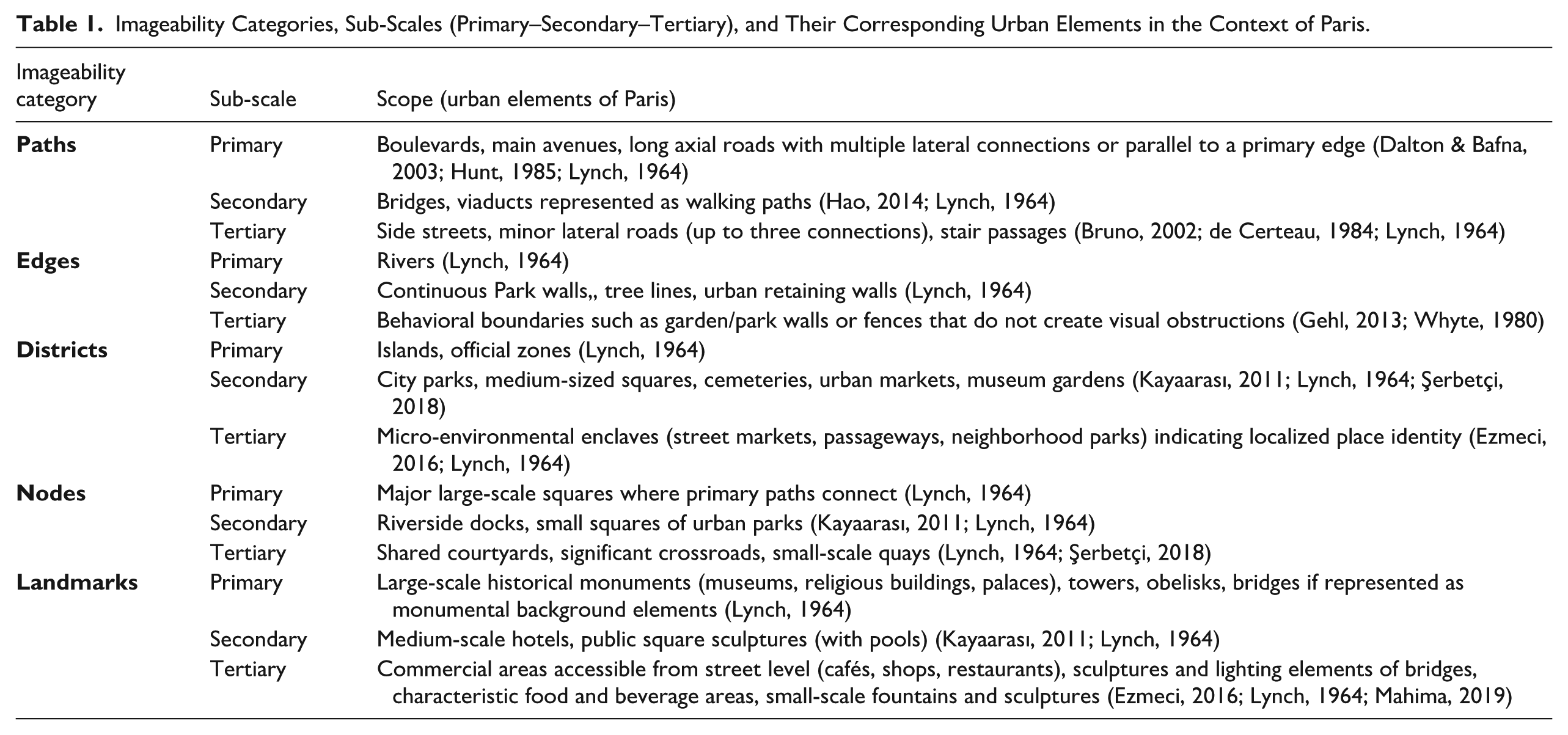
The resulting dataset was evaluated in two complementary ways. First, to examine how the elements operate individually, the frequency of appearance of each element was summarized in tables by category and sub-scale. Second, to investigate how the imageability elements function relationally, scene-by-element co-occurrence tables were produced for each film: any scene containing more than one imageability element was coded as a co-occurrence scene, and for each such scene, the number of elements per category and sub-scale was recorded. Finally, category visibility ratios and association patterns derived from these summaries were then interpreted for each film and subsequently compared across the corpus to clarify how Paris’s cinematic image is constructed through Lynch’s elements.
Selected Films and the Urban Representation of Paris
Each selected film presents a distinct representation of Paris shaped by its narrative structure, spatial focus, and temporal framing. Rather than offering general plot summaries, this section situates each film in relation to how urban space is mobilized cinematically and which aspects of Paris’s imageability are foregrounded.
Midnight in Paris (2011)
Directed by Woody Allen, Midnight in Paris presents Paris through a temporally layered narrative that intertwines contemporary and historical urban experiences. The film opens with an extended montage of iconic landmarks (such as the Louver, Eiffel Tower, Arc de Triomphe, Grand Palais, and Sacré-Cœur) establishing a recognizable image of the city (Figure 1). While some landmarks recur throughout the film, their narrative function varies. Nighttime scenes, cafés, and historically significant meeting points emphasize social interaction and memory, while daytime sequences highlight everyday streets and architectural atmospheres. The Seine River, prominently featured, functions as a symbolic threshold mediating emotional and temporal transitions. By combining iconic imagery with intimate urban encounters, Midnight in Paris constructs a multilayered representation of the city in which Paris appears both timeless and continually re-imaginable, shaped by memory, nostalgia, and experiential movement across eras.
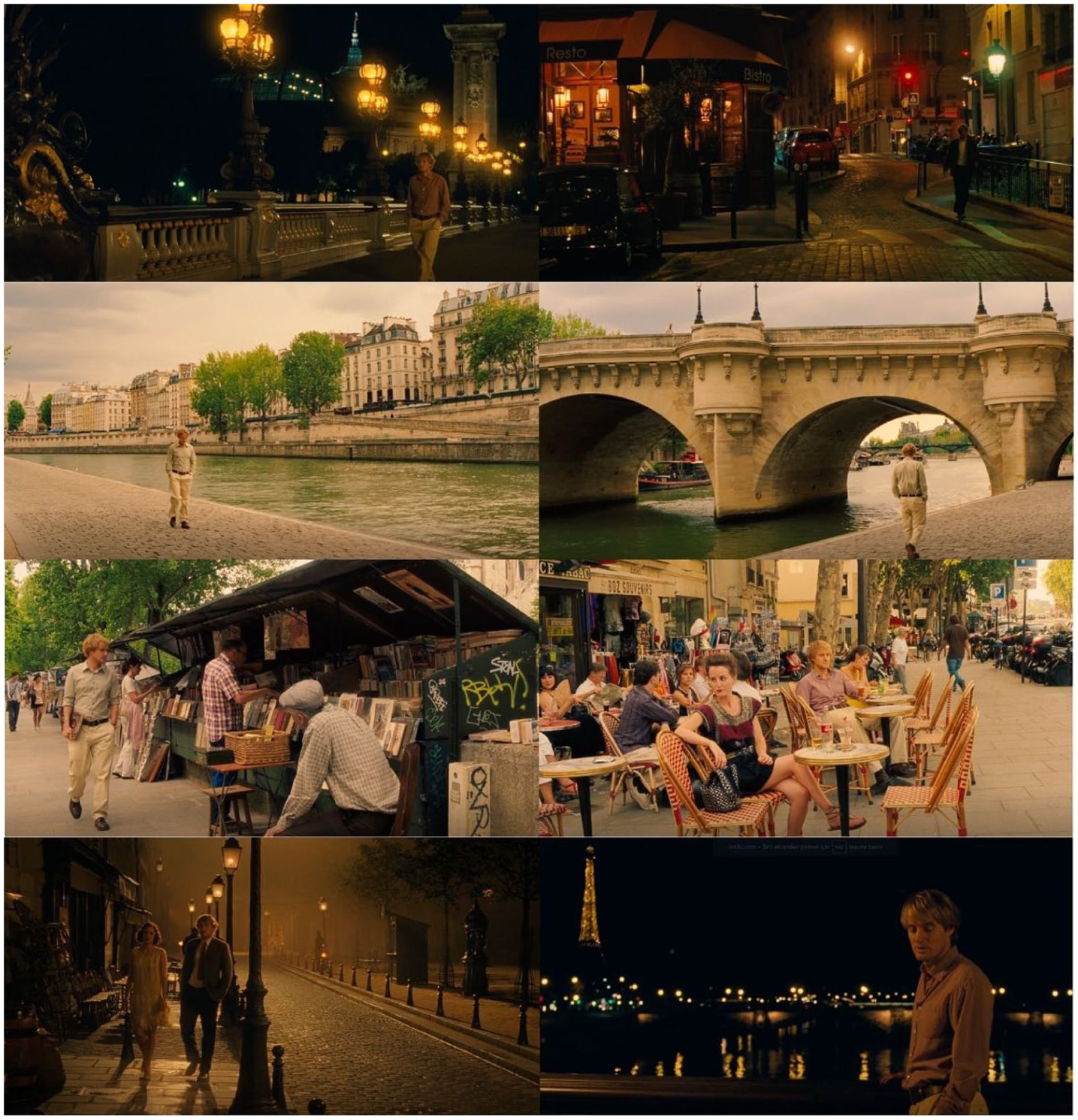
Selected Film Stills Illustrating Urban Imageability Elements in Midnight in Paris (2011).
Before Sunset (2004)
Directed by Richard Linklater, Before Sunset unfolds almost entirely through a continuous walk across Paris, as the protagonists Jesse and Celine reunite after 9 years. The film privileges everyday urban spaces and pedestrian movement over iconic representation. The narrative is structured around a walking route that begins in Cour de L’Étoile d’Or and gradually unfolds through side streets, riverbanks, cafés, and residential areas (Figure 2). Because Celine is Parisian, the city is experienced from a local perspective, emphasizing tertiary paths and intimate urban settings rather than touristic landmarks. Spaces such as Le Pure Café or Shakespeare and Company gain narrative significance through prolonged dialogue and emotional exchange, transforming ordinary locations into meaningful relational sites. The walk along the Left Bank and the boat ride on the Seine reinforce a sense of temporal continuity and embodied experience. Minimal editing and real-time sequences allow the viewer to perceive Paris as a lived, walkable city, constructed through movement, conversation, and proximity rather than visual spectacle.
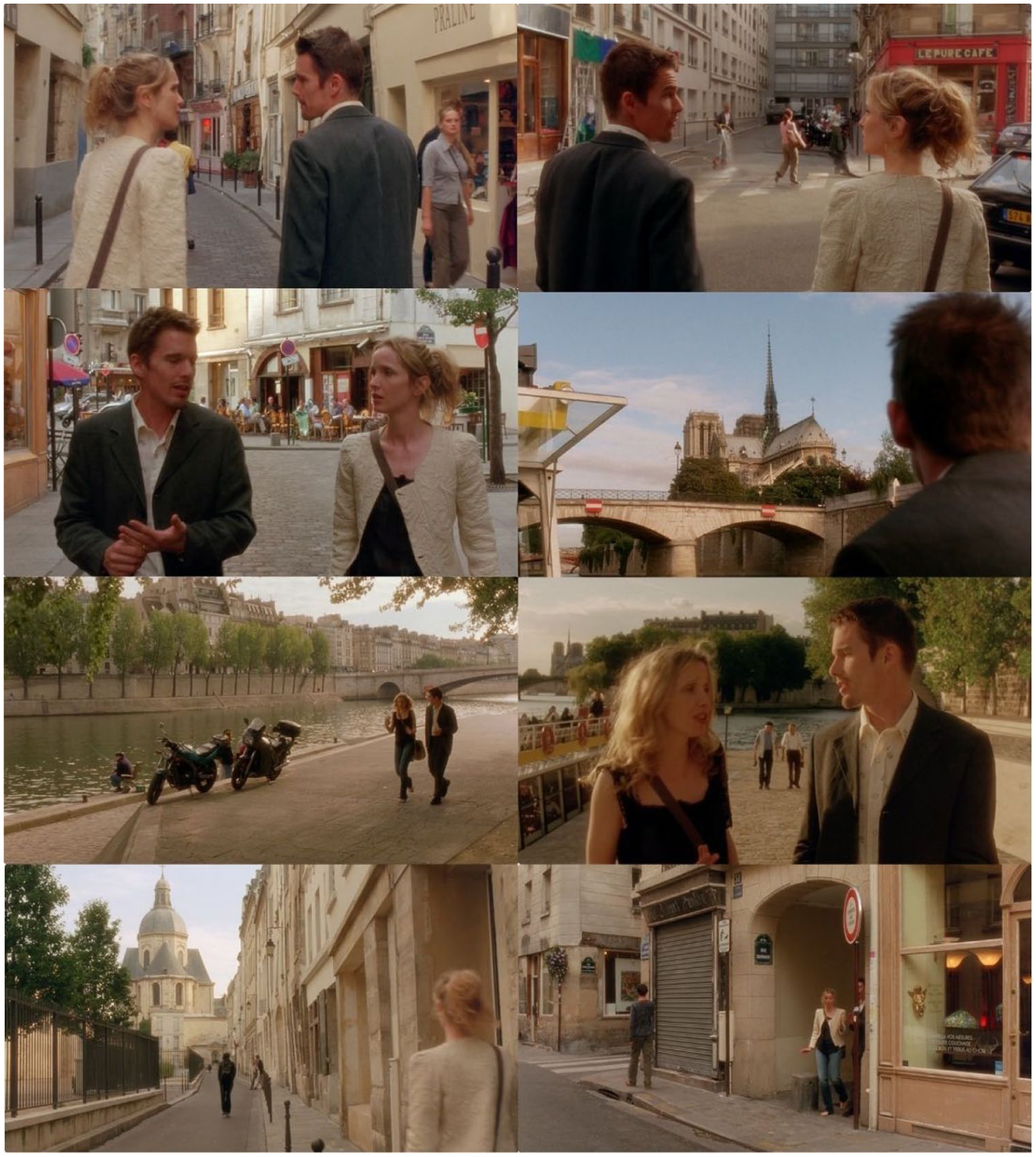
Selected Film Stills Illustrating Urban Imageability Elements in Before Sunset (2004).
Kezban in Paris (1971)
Directed by Orhan Aksoy, Kezban in Paris is a romantic comedy and a rare example of Turkish cinema shot abroad in the early 1970s. The film follows Kezban, a young woman who travels to Paris and encounters the city primarily as a first-time visitor. This narrative position strongly informs the film’s urban representation. Paris is presented through a sequence of iconic landmarks that frame the city as a touristic spectacle. The Eiffel Tower, Sacré-Cœur Basilica, Notre-Dame Cathedral, Grand Palais, Carrousel Square, and Luxembourg Palace are repeatedly shown through short, static shots resembling postcard imagery (Figure 3). Kezban’s guided city tour and her posing in front of these landmarks reinforce a tourist gaze, where the city is encountered through visual recognition rather than spatial engagement. Throughout the film, iconic structures function less as integrated narrative spaces and more as symbolic backdrops that consolidate a globally recognizable image of Paris. The city is thus constructed as an imagistic field dominated by landmarks, presenting Paris as a visually consumable environment shaped by aesthetic display and touristic familiarity.
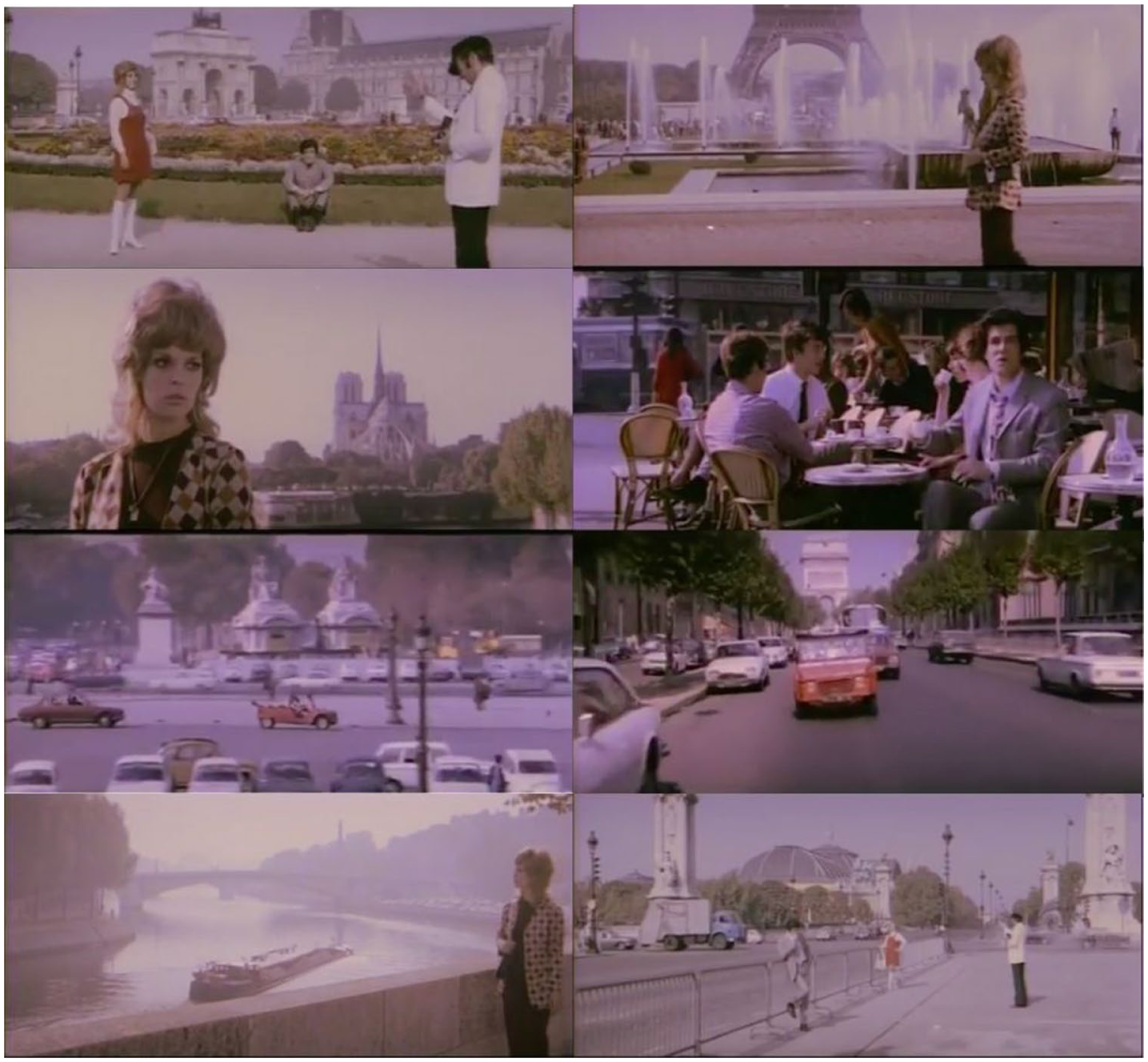
Selected Film Stills Illustrating Urban Imageability Elements in Kezban in Paris (1971).
Spatial Analysis Based on Lynch’s Framework and Findings
This section offers a comprehensive analysis of how Paris is represented in three selected films through Kevin Lynch’s urban imageability framework. The following subsections combine qualitative interpretations with quantitative insights to provide a multidimensional understanding of how the cinematic urban image of Paris is constructed. In all three films, the opening sequences function as non‑diegetic panoramas rather than integrated narrative setups; they present atmospheric urban fragments that do not yet participate in the relational logic through which spatial elements acquire meaning and hierarchy; thus, they are excluded from the analysis. Since the majority of the spatial settings reappear within the diegesis, their omission does not affect representational validity; indeed, including them would risk misleading interpretations, as imageability here is evaluated through narrative-driven spatial performance rather than isolated visual displays. Consequently, the focus therefore remains solely on scenes in which paths, edges, districts, nodes, and landmarks actively contribute to the unfolding narrative.
Midnight in Paris
In Midnight in Paris, although Lynch’s five imageability categories are all represented, their distribution reveals a pronounced hierarchy (Table 2). The urban image is predominantly structured through landmarks (50%) and paths (33.33%), and then supported by districts (11.67%) and edges (5%). Within the landmark category, primary iconic monumental structures (26.67%), everyday spaces and small-scale iconic elements (16.67%) stand out with their relatively high representation rates. The Seine, is the most reappeared element in the film (5%), despite its limited overall representation as an edge. Districts appear in a more constrained and selective manner, while there is a complete absence of nodes.
Distribution of Lynch’s Imageability Elements by Category and Sub-Scale in Midnight in Paris, Based on Scene-Level Coding.
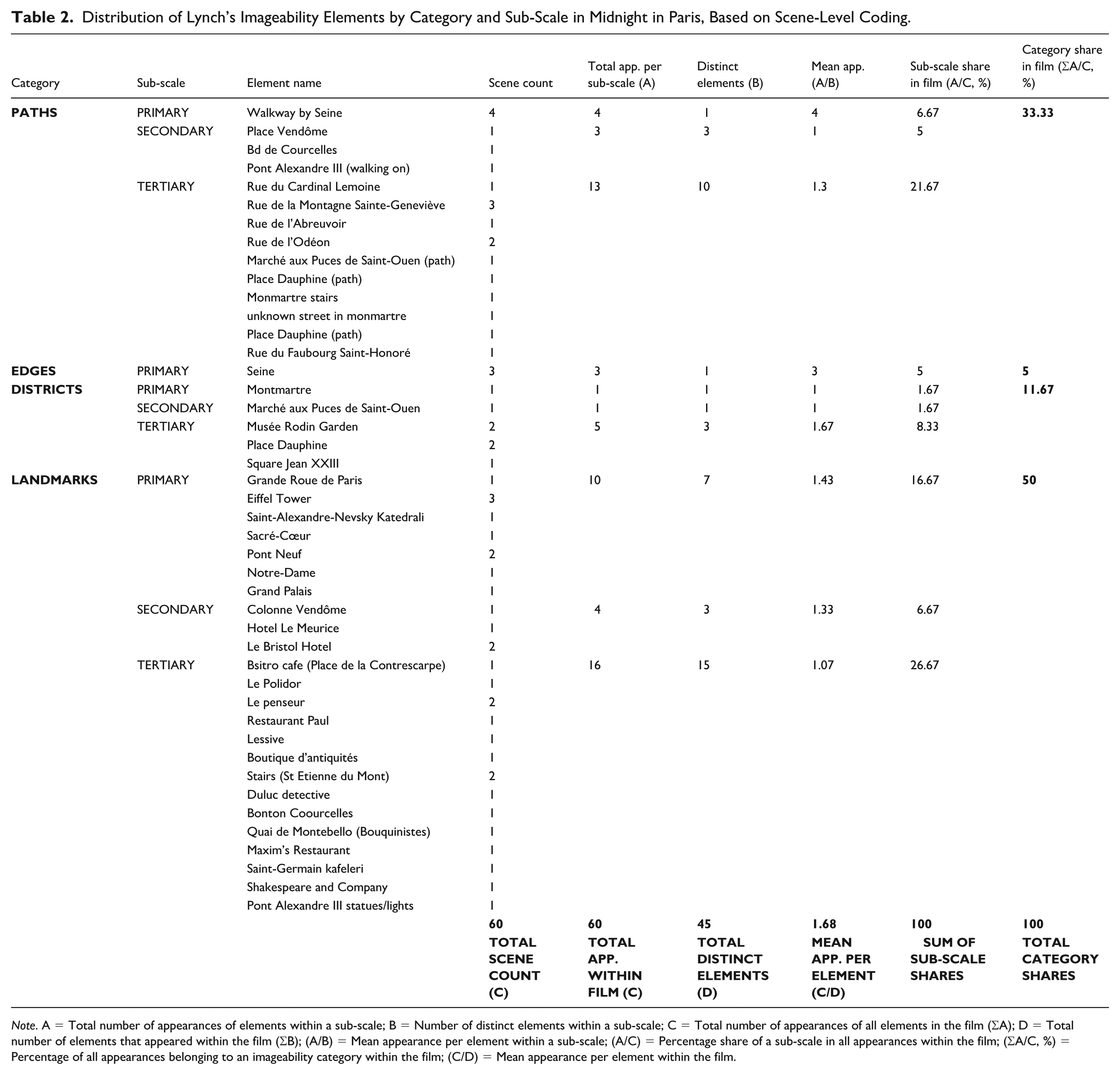
Note. A = Total number of appearances of elements within a sub-scale; B = Number of distinct elements within a sub-scale; C = Total number of appearances of all elements in the film (ΣA); D = Total number of elements that appeared within the film (ΣB); (A/B) = Mean appearance per element within a sub-scale; (A/C) = Percentage share of a sub-scale in all appearances within the film; (ΣA/C, %) = Percentage of all appearances belonging to an imageability category within the film; (C/D) = Mean appearance per element within the film.
Co-occurrence analysis further supports this reading, revealing that the film’s spatial organization is primarily constructed through binary associations (Table 3). Although the number of spatial elements significantly exceeds the number of scenes, the number of co-occurring elements in individual scenes remains limited. The most most consistent relation is the path–landmark pairings, while other categories appear only atypically within them. District elements perform two distinct relational roles, appearing in roughly equal measure alongside paths or alongside landmarks. Edge usage, by contrast, is highly limited: the primary edges present in the film co-occur only with the primary paths to which they are aligned. No consistent cross-scalar pattern emerges in the co-occurrence data.
Scene-by-Element Co-Occurrence Table of Imageability Elements in Midnight in Paris, Showing Dominant Relational Patterns Across Scenes.
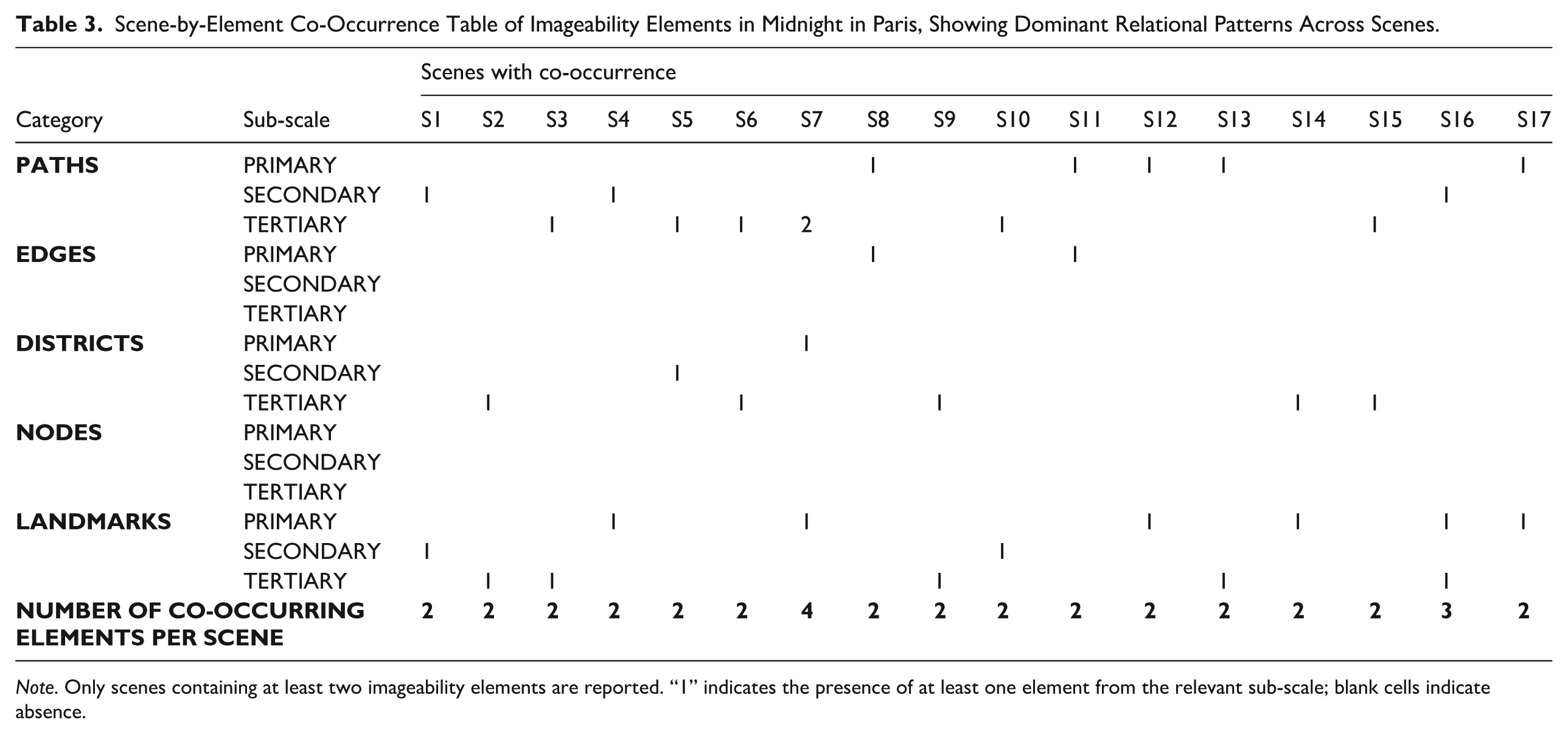
Note. Only scenes containing at least two imageability elements are reported. “1” indicates the presence of at least one element from the relevant sub-scale; blank cells indicate absence.
Before Sunset
In Before Sunset, all imageability categories are present; however, their distribution reveals a clear hierarchy (Table 4). The urban image is primarily structured through paths (38.24%) and landmarks (26.47%), while edges (14.71%), districts (11.76%), and nodes (8.82%) appear with substantially lower frequencies. Within the path category, tertiary paths (23.53%), particularly small-scale side streets, are the most prevalent. This emphasis on movement axes is reinforced by the Seine, which, despite its relatively low overall share as an edge, is the single most frequently recurring spatial element in the film. Landmarks appear in a restrained and context-sensitive manner, mostly the secondary and tertiary elements. Edge elements likewise are also restrained with one or two appearences per coded instance. No primary districts or nodes are recorded; the few secondary and tertiary examples of these categories appear only once or twice, indicating a marginal role in the film’s construction of Paris’s image.
Distribution of Lynch’s Imageability Elements by Category and Sub-Scale in Before Sunset, Based on Scene-Level Coding.
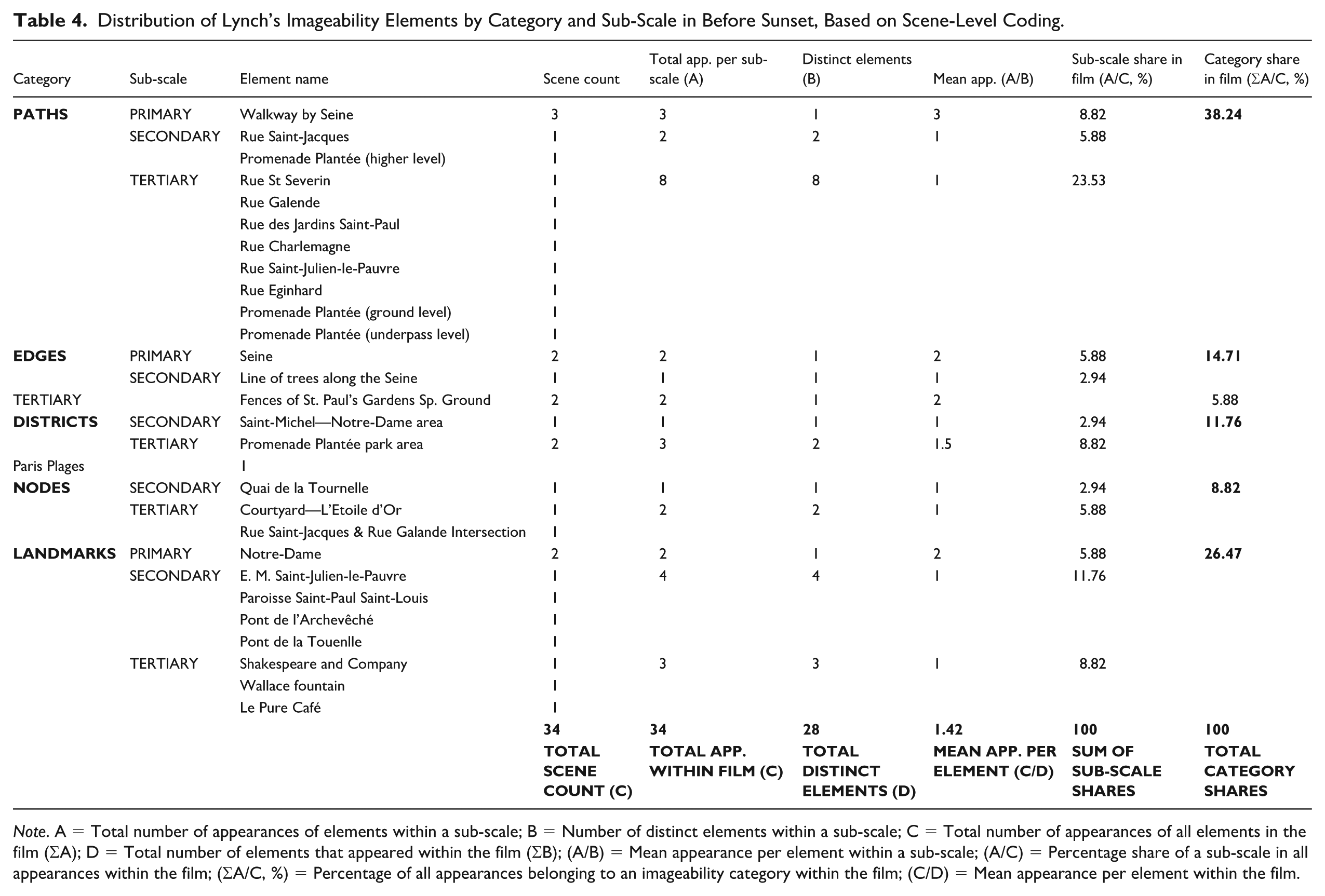
Note. A = Total number of appearances of elements within a sub-scale; B = Number of distinct elements within a sub-scale; C = Total number of appearances of all elements in the film (ΣA); D = Total number of elements that appeared within the film (ΣB); (A/B) = Mean appearance per element within a sub-scale; (A/C) = Percentage share of a sub-scale in all appearances within the film; (ΣA/C, %) = Percentage of all appearances belonging to an imageability category within the film; (C/D) = Mean appearance per element within the film.
The co-occurrence analysis reinforces this interpretation by indicating that the viewer’s spatial experience is organized primarily through movement axes and the relations that other elements establish with them (Table 5). The total number of co-occurring elements is substantially higher than the number of scenes, and their groupings remain highly variable. Although almost all co-occurrence scenes include at least one path, the number and type of accompanying elements change without a consistent regularity, and no stable cross-scalar co-occurrence pattern is observed.
Scene-by-Element Co-Occurrence Table of Imageability Elements in Before Sunset, Highlighting Path-Centered Relational Structures.
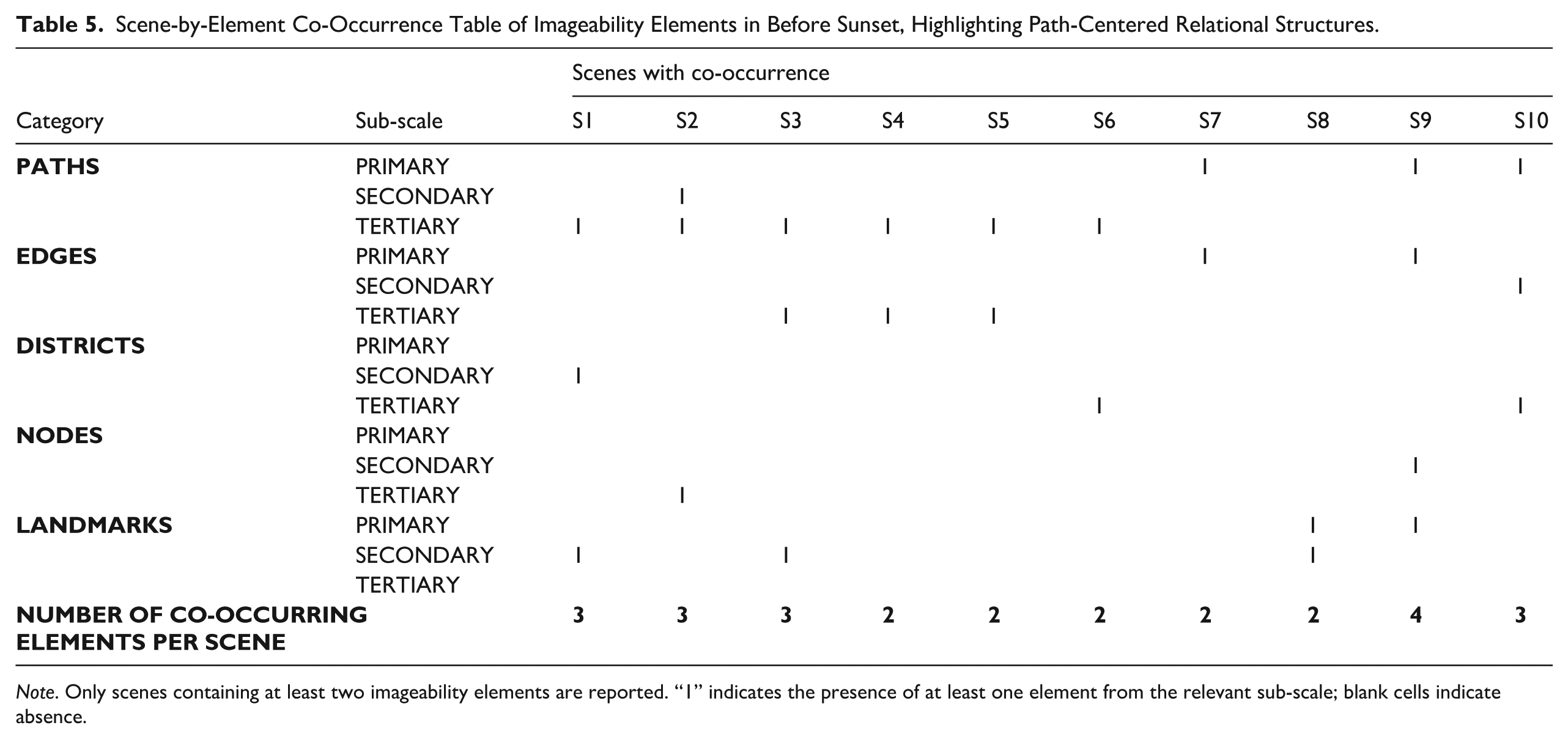
Note. Only scenes containing at least two imageability elements are reported. “1” indicates the presence of at least one element from the relevant sub-scale; blank cells indicate absence.
Kezban in Paris
In Kezban in Paris, although all of Lynch’s imageability categories are present, the urban image is constructed predominantly through iconic elements (Table 6). At the level of main categories, landmarks clearly dominate the representation of the city (48.98%), frequently accompanied by paths (22.45%); which followed by districts (12.24%), nodes (10.2%) and edges (6.12%). Across categories, primary and secondary sub-scale elements are markedly more prevalent, while tertiary elements appear only within the landmark category.
Distribution of Lynch’s Imageability Elements by Category and Sub-Scale in Kezban in Paris, Illustrating the Dominance of Landmark-Based Representation.
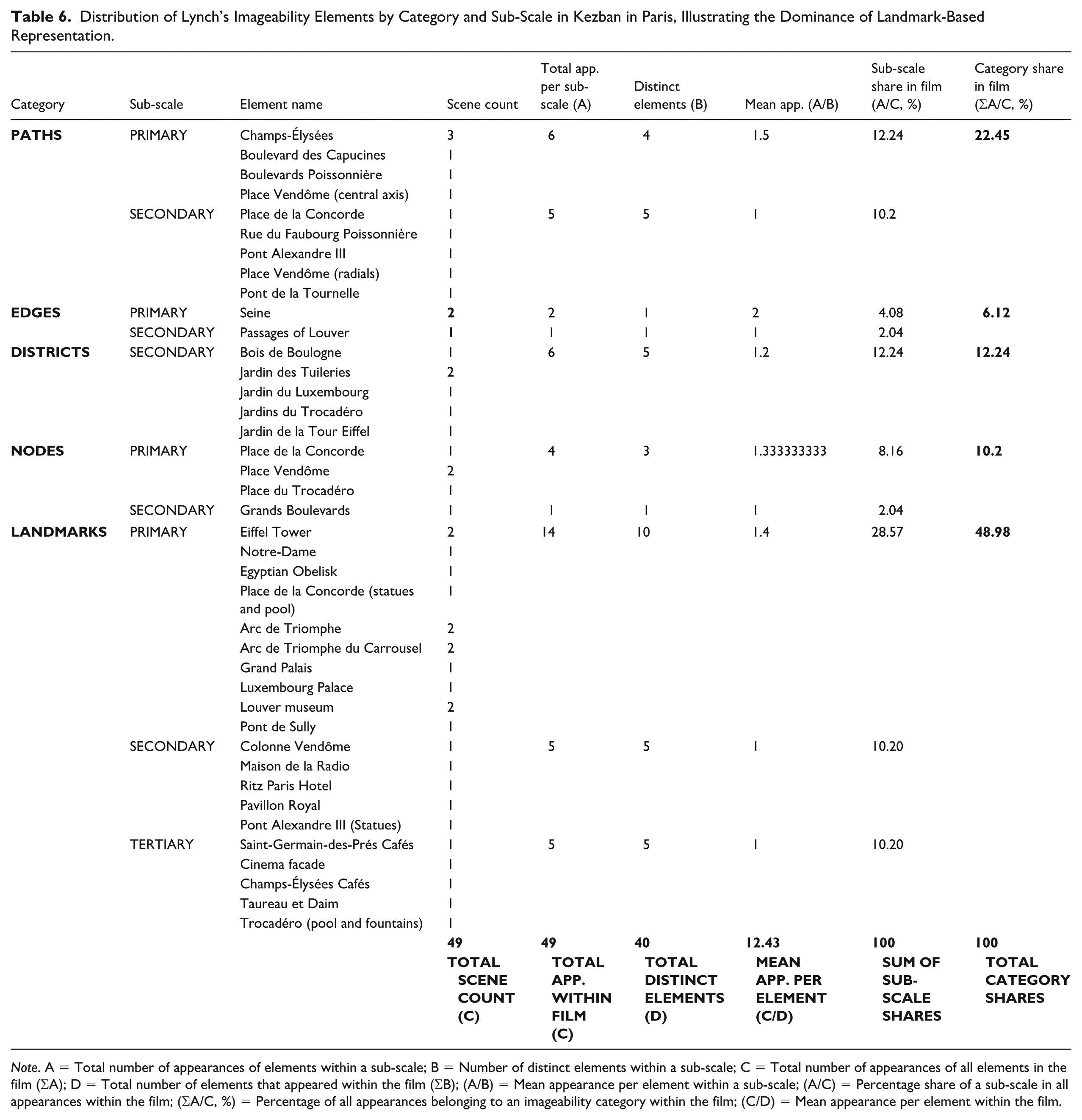
Note. A = Total number of appearances of elements within a sub-scale; B = Number of distinct elements within a sub-scale; C = Total number of appearances of all elements in the film (ΣA); D = Total number of elements that appeared within the film (ΣB); (A/B) = Mean appearance per element within a sub-scale; (A/C) = Percentage share of a sub-scale in all appearances within the film; (ΣA/C, %) = Percentage of all appearances belonging to an imageability category within the film; (C/D) = Mean appearance per element within the film.
Primary landmarks exhibit the highest frequency of appearance, with some recurring across multiple scenes and thus attaining a comparatively high average visibility. Secondary landmarks follow and, together with the primary ones, reinforce an iconic representation of Paris. Paths, while numerically significant, are largely constituted by primary boulevards and secondary axial routes rather than tertiary, human-scale side streets. Apart from secondary districts such as large urban parks, district and node elements play a subordinate role in the construction of the urban image. Edges remain the most marginal category overall, with their relatively lowest appearance.
The co-occurrence analysis also reveals that spatial relationships in Kezban in Paris are driven primarily by landmark-centered combinations (Table 7). Across co-occurrence scenes, landmarks appear systematically alongside other categories, bringing out their role as dominant referents. Path–landmark pairings are particularly frequent, while districts and nodes likewise tend to co-occur with landmarks. Similarly, the Seine, coded as the primary edge, appears only twice and in both instances in conjunction with well-known landmarks (Notre-Dame and a bridge), further underlining the landmark-centered logic of co-occurrence in the film.
Scene-by-Element Co-Occurrence Table of Imageability Elements in Kezban in Paris, Indicating Aestheticized and Spectatorial Spatial Relations.
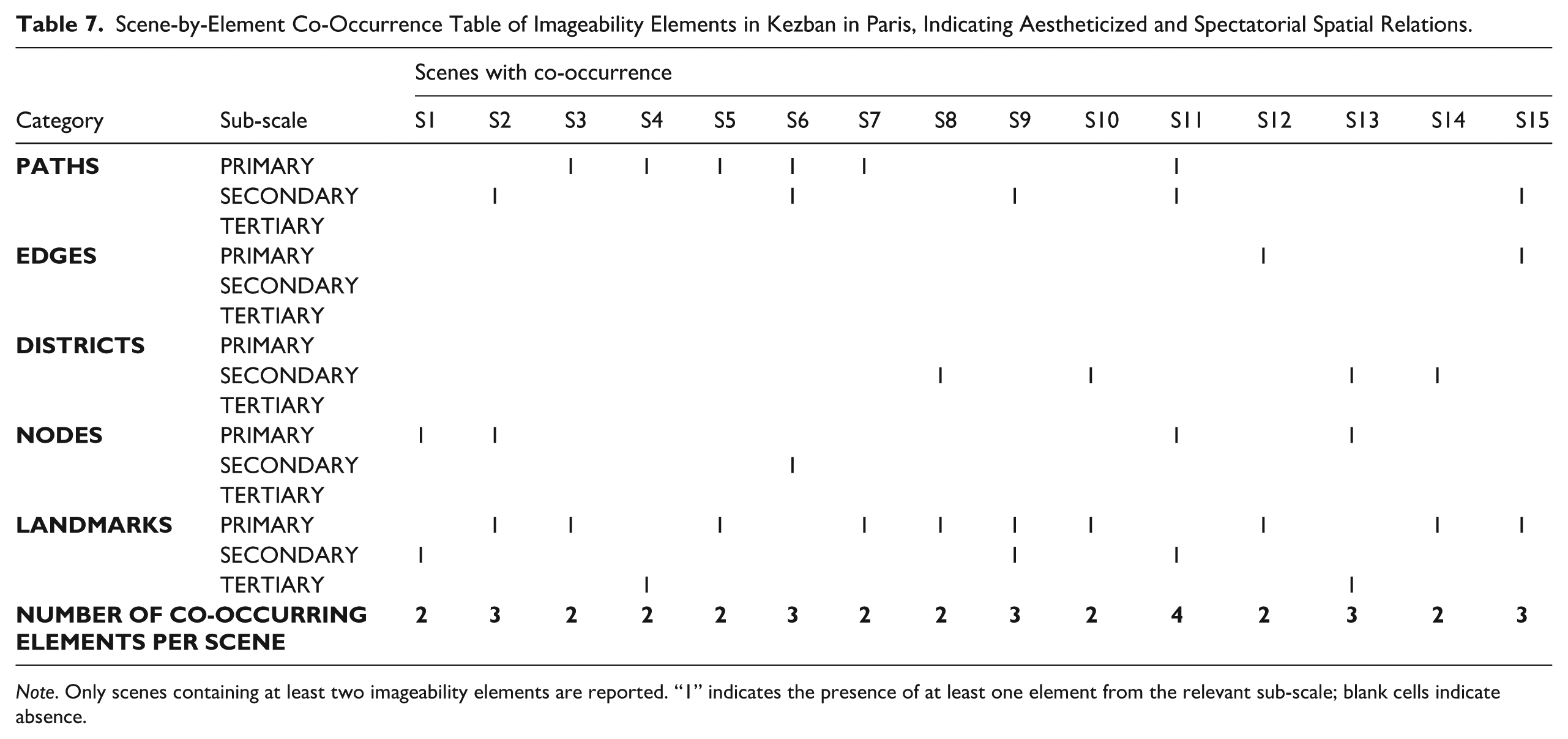
Note. Only scenes containing at least two imageability elements are reported. “1” indicates the presence of at least one element from the relevant sub-scale; blank cells indicate absence.
Interpretation of Film Findings (Narrative Roles of Lynch’s Elements)
Midnight in Paris
The quantitative data indicate that the urban elements Lynch proposed as complementary are reorganized through a functional hierarchy within the film’s narrative construction. Landmarks and paths emerge as the primary carriers of the narrative due to their dominance in both diversity and repetition. Within the landmark category, a two-layered structure becomes apparent: primary iconic structures establish the city’s recognizable image, while tertiary everyday spaces—such as cafés, stairways, and bookstores—frame the characters’ emotional and relational contexts. The frequent use of tertiary paths further suggests that the narrative is constructed through embodied experience at the scale of side streets.
Although the Seine, as the sole edge, is represented at a relatively low quantitative level, its recurring appearance allows it to function as a reference line supporting spatial continuity and narrative coherence. Districts, by contrast, operate as selectively foregrounded atmospheric focal points rather than as continuous spatial fields. Within a narrative shaped by the character’s ongoing quest and temporal transitions, the absence of nodes aligns with the film’s internal logic, as the scenes rarely accommodate moments of spatial pause or stasis.
The co-occurrence analyses reveal that the film’s spatial configuration is structured around representations of movement and memory. Urban space is not constructed through complex spatial assemblages, but rather through simple yet directive pairwise combinations at the level of main categories. The regular co-occurrence between paths and landmarks presents Paris as a walkable city experienced through iconic references, while edges and districts remain supportive background elements framing individual movement.
Taken together, the imageability elements in the film acquire contextual meaning not only through what they are in isolation, but through how they operate within a functional hierarchy and through their pairwise co-occurrences. This indicates that each element assumes a distinct role in the spatial organization of the narrative and, when combined, more deeply structures the viewer’s perception of the city. The spatial configuration, built through a simple yet strategic combination at the level of main categories, provides the basis for presenting Paris as a city that is experienced through the characters, discovered on foot, and inscribed into memory. In this respect, Paris is configured less as a site of rapid decision-making and more as a city that is slowly and sensorially experienced around iconic spatial references, and remembered in a multilayered manner through that experience.
Before Sunset
In Before Sunset, Paris is presented as a relational structure embedded in everyday life through the interaction of urban elements at different scales and with varying qualities. The characters’ sustained walking conversations along tertiary paths establish a clear city–body–thought relationship, demonstrating that urban experience is conveyed primarily through bodily movement at the street scale. The linear walking route along the Seine functions as a primary axis that reinforces narrative continuity, while associated edge elements define the movement corridor and strengthen the sense of spatial flow.
In this context, primary landmarks do not operate as static aesthetic interruptions; instead, they gain significance as environmental components that activate memory within the narrative. Tertiary landmarks, such as Shakespeare and Company or Le Pure Café, are similarly detached from touristic representation and are instead linked to the characters’ emotional states and everyday experiences. Districts appear sparingly and function as permeable background settings that are traversed through movement and imbued with meaning through social and experiential intensity. Finally, nodes, when present, operate as spatial thresholds marking directional shifts or framing critical dialogues.
Co-occurrence analyses demonstrate that paths form the primary connective structure, pairing with all other categories. The frequent edge–path pairings reinforce the film’s emphasis on linear movement. Spatial elements belonging to the landmark, district, and node categories, in the limited number of scenes where they co-occur with paths, provide partial historical context for the city without interrupting narrative continuity, typically by being integrated into the texture of quiet side streets as a background layer. This distribution clearly indicates a narrative structure in which paths function as spatial binders, while imagistic elements derive their meaning primarily through the relations they establish with these paths. The relatively small number of scenes in which co-occurrence is observed is also consistent with the film’s fundamentally dialogue-oriented rather than image-driven narrative structure.
Accordingly, Before Sunset presents Paris as a relational environment woven through everyday life at the human scale, insofar as small-scale side streets functioning as paths constitute the primary devices of spatial continuity in the film. The fact that the other categorical elements remain largely as background components accompanying the walk along these paths means that the film’s urban image is grounded in a street-level perception of the city, experienced through everyday walking and inscribed into memory.
Kezban in Paris
In Kezban in Paris, although all of Lynch’s imageability categories are represented, the urban image is constructed primarily through the aesthetic presentation of relatively large-scale, isolated, iconic elements. Paris is framed as an idealized postcard composed of iconic monuments, wide boulevards, and well-known service spaces. Within this configuration, paths function largely as compositional devices that organize landmark views into static, aesthetically framed distinct images. Districts are similarly detached from their functional affordances and reduced to static scenic backdrops that combine architectural and natural features. Even the primary edge, the Seine, is treated as a landmark visually disconnected from its broader spatial context, while nodes operate less as spatial connectors than as photographic pause points used for framing. Taken together, the dense presence of landmarks across all scales indicates a deliberate emphasis on Paris as an object of touristic visual consumption rather than as a lived, relational urban environment.
The co-occurrence findings reinforce this reading by showing that aesthetic display is prioritized over relational spatial organization. Landmarks consistently co-occur with all other categories, amplifying the city’s visual presentation across different spatial settings. While path–landmark pairings render both orientation and iconic imagery visible, paths function primarily as photographic background elements rather than as carriers of embodied movement. Districts and nodes similarly remain subordinate, serving as scenic backdrops that foreground landmarks.
Overall, in Kezban in Paris, Paris is detached from the multilayered texture of everyday life and is presented instead as a visually idealized panorama. Contextual meaning-making, interrelations between categories, and representational layering remain weak, as the urban image relies on a small selection of aesthetically curated iconic elements (particularly landmarks and pastoral districts), which are predominantly often conveyed through stop-and-go scenes framed as photographic compositions. As all elements are reduced to isolated aesthetic displays, the city is no longer portrayed as a walkable environment open to embodied experience, but rather as an idealized object of visual consumption—a “touristic stage” in which iconic points are observed from a distance rather than experientially engaged.
Discussion: Typologies of Urban Imageability in Cinema
The findings reveal that Lynch’s five elements do not merely appear in films as static, pre-defined urban signifiers but operate as representational agents whose narrative functions and perceptual intensities vary across cinematic contexts. Across all three films, paths, edges, districts, nodes, and landmarks function as cinematic operators that sustain movement, stabilize atmosphere, trigger memory, provide an aesthetic backdrop, or establish visual orientation. Collectively, the films demonstrate that cinematic imageability, in Lynch’s sense, depends on the representational weight urban elements acquire through narrative structure, camera movement, rhythm, and spatial sequencing. In this regard, cinematic imageability aligns more closely with how space is experienced than with how it is merely displayed (Benjamin, 1999; Careri, 2002; de Certeau, 1984; Pallasmaa, 2012), as urban elements derive meaning not only from their physical presence but also from their aesthetic, symbolic, and narrative use across varying cinematic contexts (Ezmeci, 2016; Hao, 2014).
Before Sunset and Midnight in Paris exemplify a relational, movement-based mode of imageability in which Lynch’s categories are translated into narrative trajectories shaped by characters’ displacement, spatial proximity, and embodied interaction. In both films, tertiary paths and everyday landmarks gain representational salience through walking, operating as relational cues that organize memory, rhythm, and dialogue rather than functioning as isolated symbols. This supports Lynch’s claim that urban legibility is fundamentally experiential, as space becomes imageable through cognitive and affective perception shaped by lived movement (Benjamin, 1999; Careri, 2002; de Certeau, 1984). Accordingly, cinematic urban representation is structured through temporal and physical engagement between characters and the city, forming an embodied relationality that also extends to the audience.
By contrast, Kezban in Paris departs from this embodied relationality and shifts toward a spectatorial mode of imageability. In this film, the city is organized for what Debord (2012) terms the “spectator-subject” of the spectacle: the accumulation of isolated, composed, and aestheticized elements constructs a commodified representation of place that is visually consumed rather than experientially engaged. Primary and secondary landmarks dominate, functioning not as narrative agents but as commodified visual objects that align more closely with postcard imagery than with Lynch’s (1964) notion of experiential legibility. Even movement becomes observational, as the camera frames the city as spectacle rather than traversing it, resulting in a panoramic representation in which imageability is curated according to a touristic logic rather than discovered through embodied engagement (Kayaarası, 2011; Şerbetçi, 2018).
What emerges from this comparison is a critical distinction between two modes of imageability: relational and spectatorial. This dichotomy resonates with Singh and Singh’s (2023) concept of social relatability, which suggests that imageability arises not only from recognizability but also from the narrative relations formed with urban elements. In the relational, movement-based mode of imageability, spatial cognition is integrated into narrative progression: Lynch’s elements function as dynamic navigational cues that gain meaning through co-occurrence and narrative flow, as in Before Sunset, where they structure conversation, and in Midnight in Paris, where they set mood, define transitions, and provide spatial punctuation. In the spectatorial mode, observed in Kezban in Paris, these elements lose relational depth and are reduced to aestheticized physical constructions whose narrative function is markedly diminished.
Another salient finding arises from the implementation of the multi-scalar coding framework. Previous studies have already noted the scale-based diversity of spatial representation in cinematic depictions (Hao, 2014) and the temporal layering of urban imagery across different cinematic periods (Şerbetçi, 2018). By operationalizing primary, secondary, and tertiary distinctions within each of Lynch’s categories, this study extends those insights and demonstrates how representational intensity is distributed within the cinematic articulation of urban space. In Midnight in Paris, primary and tertiary landmarks perform distinct functions, defining iconic memory on the one hand and supporting relational intimacy on the other. In Before Sunset, tertiary elements dominate due to the film’s reliance on proximity and embodied motion. In Kezban in Paris, the dominance of primary and secondary elements reflects an imageability model detached from bodily experience, in which the city becomes a staged spectacle to be visually consumed. Taken together, this scalar differentiation reveals not only that representational roles diverge at the sub-scale level across films, but also that systematic contrasts emerge between movement-based, relational imageability and spectatorial, postcard-like imageability.
Overall, these findings suggest that cinematic imagery is not a static reflection of urban space but a mediated form of urban readability shaped by spatial hierarchy, narrative flow, and embodied perception, and that in certain situations the city is constructed either as a visually consumable image or as a space of everyday livability. Lynch’s framework remains analytically robust; however, its cinematic articulation is contingent upon whether the city is relationally inhabited or visually staged as spectacle. In this sense, cinema does not merely depict cities but refunctions them, transforming Lynch’s elements into a cinematic syntax through which narrative space is organized, traversed, and ultimately remembered.
Conclusion
This study examined how urban imageability operates in cinema through Lynch’s five elements and demonstrated that these categories function not merely as visual signifiers, but as representational tools whose narrative roles, perceptual intensities, and experiential potentials vary across cinematic contexts. By applying a multi-scalar coding method, the study confirmed the applicability of Lynch’s imageability framework to cinematic representation while showing how scalar hierarchies within categories enable a more nuanced understanding of representational strategies used to construct urban images through movement, atmosphere, and narrative agency.
The comparative analysis of the three films revealed a critical distinction between relational and spectatorial modes of imageability. This contrast underscores a central finding of the study: cinematic imageability depends not only on the presence of imageability elements, but on how distance, movement, bodily engagement, temporal pacing, and framing are organized within narrative structures.
Methodologically, the study offers a replicable framework for analyzing urban space in cinema through the integration of spatial coding, sub-scalar categorization, and co-occurrence analysis. By bridging quantitative and qualitative procedures, this approach enables the simultaneous examination of spatial frequency and representational function, allowing cinematic cartography to be treated as a form of spatial reasoning through which perceptual hierarchies become traceable and comparable across films. The strategy further contributes to a more granular understanding of how representational salience is distributed across scenes, revealing not only which spatial elements are present but how they operate iconically, atmospherically, or experientially within narrative rhythms.
Theoretically, the findings extend the concept of urban imageability into the domain of cinematic mediation, positioning cinema as a powerful medium through which cities are cognitively organized and affectively inhabited. By aligning Lynch’s framework with embodied approaches to urban perception, the study demonstrates that cinematic space functions not only as a visual construct but also as a sensory, experiential, and mnemonic field. In this sense, cinematic imageability emerges as a mediated form of urban legibility shaped by narrative, atmosphere, and embodied engagement, while in certain cinematic configurations it also operates through the transformation of the city into a visually consumable and staged image.
This study has several limitations. The analysis is limited to three Paris-set films from a city with an unusually strong cinematic identity, and applications to other urban contexts may produce different patterns. Although the coding process was conducted collaboratively and cross-checked, the identification and interpretation of imageability elements remain partially influenced by the researchers’ shared cultural and visual frames. Moreover, the three-level scalar scheme simplifies Lynch’s inherently continuous scale logic and could be refined in future studies. Finally, while the analysis focused on narrative scenes, opening montages and establishing shots may also play a significant role in shaping the perception/presentation of the urban image and warrant further investigation.
In conclusion, cinema does not simply depict the city but actively refunctions its elements into cognitive and affective structures, composing a spatial syntax that shapes how urban form is experienced or observed on screen. Lynch’s categories persist not as static descriptors of urban fabric, but as dynamic narrative tools, reminding us that imageability is not solely a property of the city itself, but a process of encounter, activation, observation, and memory.
Footnotes

Ethical Approval and Informed Consent Statements
This study does not involve human participants, personal data, or animal subjects. Therefore, ethical approval and informed consent were not required.
Author Contributions
Zeynep Tarçın Turgay developed the core research idea. Zeynep TARÇIN TURGAY and Mine TUNÇOK SARIBERBEROĞLU jointly contributed to all stages of the research process, including the elaboration of the theoretical framework, the development of the methodology, data collection and coding, and the analysis and interpretation of findings. Both authors collaborated on the writing and critical revision of the discussion and conclusion sections and approved the final version of the manuscript.
Funding
The authors received no financial support for the research, authorship, and/or publication of this article.
Declaration of Conflicting Interests
The authors declared no potential conflicts of interest with respect to the research, authorship, and/or publication of this article.
Data Availability Statement
The data supporting the findings of this study are derived from publicly available films and are available from the corresponding author upon reasonable request. Coding tables and analytical matrices generated during the study are available in the manuscript for transparency and replication purposes.