




Abstract
Hybrid spaces – spatial figurations in which physical and digital dimensions are interwoven – remain conceptually fragmented across disciplines. Drawing on Martina Löw’s relational spatial theory and employing a theory synthesis approach, this paper integrates diverse strands of research on hybrid spaces into a coherent framework. Four interdependent dimensions – physicality, virtuality, sociality and temporality – are used to conceptualize how hybrid spaces are constituted through processes of spacing and synthesis. These dimensions are not additive layers but emerge through situated social practices, producing varying degrees of hybridity that can be described along a spectrum. The concepts of translocalization and polycontexturalization are further integrated to capture how individuals integrate distant, overlapping and temporally dispersed contexts into present spatial arrangements. The resulting framework offers a coherent conceptualization of hybrid spaces, bridging fragmented literature and providing analytical tools for future empirical research on spatial and societal change in the digital age.
Keywords
Introduction
Over the past two decades, mobile technologies and digital media have profoundly transformed how spaces are produced, experienced and navigated. Practices such as checking into locations via mobile apps, navigating cities through digital maps or communicating across spatial distances via smartphones exemplify how physical and digital spheres have increasingly become interwoven in everyday life. This development has led to the emergence of hybrid spaces – spatial constellations in which digital and physical elements are relationally entangled (de Souza e Silva, 2006, 2023). The academic discussion of hybrid spaces has evolved into a wide yet uneven field in which diverse disciplinary perspectives, conceptual vocabularies and methodological approaches coexist without a consolidated theoretical foundation (de Souza e Silva, 2023; Heinrich et al., 2025). Although there is broad agreement that such spaces involve an entanglement of physical and digital spheres, scholars have approached this entanglement through a variety of terms – augmented space (Manovich, 2006), mixed reality (Milgram & Colquhoun, 1999), cyberplaces (Malecki, 2017), hybrid ecologies (Licoppe & Inada, 2012) – each highlighting different aspects of technology, materiality and social practice. The result is a fragmented conceptual landscape in which overlapping but uncoordinated frameworks have proliferated. This conceptual heterogeneity has produced three persistent issues: a tendency towards additive or layered metaphors of spatiality, a lack of theorization regarding spatial constitution and limited attention to the experiential and socio-material complexity of hybrid spaces.
This paper offers a theory-driven conceptual synthesis, building on and extending the existing literature. Following Jaakkola’s (2020) framework for theory synthesis, we systematically review and integrate contributions from diverse fields and reframe them through the lens of relational spatial theory. Specifically, we adopt Martina Löw’s (2001, 2016) understanding of space as a relational arrangement constituted through processes of spacing and operations of synthesis. This method-theoretical lens shifts the focus from static or dualistic notions to a processual, situated and dynamic understanding of hybrid spaces. We introduce four core dimensions – physicality, virtuality, sociality and temporality – as analytical categories, and propose a relational, gradated understanding of hybrid spaces as a spectrum shaped by varying intensities of socio-material interrelations. To capture the subjective and contextual enactment of hybrid spaces, we further integrate the concepts of translocalization and polycontexturalization (Löw & Knoblauch, 2019) as interpretive tools. By advancing a relational and theory-based conceptualization of hybrid spaces, this paper contributes to the theoretical consolidation of a fragmented field. It offers a coherent framework for future empirical and interdisciplinary research and provides new insights into how hybrid spaces are dynamically constituted, enacted and experienced.
Methodological Framework: Theory Synthesis
This paper follows the ‘theory synthesis’ approach to conceptual research as outlined by Jaakkola (2020), which links and juxtaposes concepts, theoretical constructs and perspectives from fragmented or previously disconnected literature streams. The fragmented, heterogeneous state of hybrid-space research described by Heinrich et al. (2025) as conceptually unaligned, calls for consolidation and integrative theory building across disciplines. We address this by developing a coherent, theoretically grounded understanding of hybrid spaces.
Following Lukka and Vinnari (2014), as cited by Jaakkola (2020), we distinguish between domain theory – here, the fragmented hybrid-space discourse – and method theory, which provides the analytical lens. We adopt relational spatial theory as our method theory, specifically Martina Löw’s (2001, 2016) concept of spaces as relational arrangements produced through spacing and synthesis. This lens enables us to examine the processual and socio-material dimensions of hybrid spaces and to integrate key conceptual developments since the early 2000s into a unified definition.
Method Theory: Relational Space
Sociologist Martina Löw defines space as a relational concept rather than as a fixed, pre-existing physical entity or physical container (Löw, 2001, 2016). Space is socially produced as a relational ‘arrangement of living beings and social goods’ (Löw, 2016, p. 188). Löw analytically distinguishes between two interconnected processes: spacing – the dynamic positioning of social goods and living beings in relation to each other – and the operation of synthesis – the cognitive processes through which people merge arranged elements into a coherent whole, giving it meaning. While synthesis is subjective, it is socially pre-structured by shared knowledge, enabling individuals to interpret similar arrangements in similar ways. Through repeated spatial actions and the consolidation of routines, spatial structures are formed, which in turn shape and condition subsequent human actions (Löw, 2016, p. 188). This relational approach challenges an ‘absolutist notion of space’ (Löw, 2016, p. 9) as a fixed container and emphasizes that space is not a passive backdrop but an active outcome of social practices, constituted through the interplay of placing (spacing) and sense-making (synthesis) of social goods and living beings in relation to one another at specific locations.
Building on this foundation, we draw on two concepts within relational spatial theory – translocalization and polycontexturalization – to further develop our analytical understanding of how hybrid spaces are constituted, experienced and interpreted across multiple relational contexts. Translocalization describes linkages between geographically distant locations that create perceived or functional proximity via mediated connections. This phenomenon enables individuals to be virtually present in distant and potentially multiple places simultaneously embedding them in broader, networked spatial logics (Löw & Knoblauch, 2019; Million et al., 2021). Polycontexturalization refers to the simultaneous embedding of actions, communications and spatial practices within multiple, overlapping social, spatial and temporal contexts, often with conflicting interpretive frameworks. Digital media intensify this multiplicity by enabling participation in several spatial and social logics at once (Löw & Knoblauch, 2019; Weidenhaus & Stollmann, 2021). In hybrid spaces, this becomes particularly relevant as people continuously shift between physically co-present and digitally mediated environments – each shaped by distinct normative, emotional and communicative structures.
In her foundational text on hybrid spaces, Adriana de Souza e Silva (2006) also puts forward a relational perspective on space, defining hybrid spaces as ‘created by the ongoing and emerging networked relationships between people, spaces, and mobile technologies’ (de Souza e Silva, 2023, p. 59). This echoes Löw’s idea that space is constituted through social practices and the arrangements of social goods and living beings. De Souza e Silva draws on Manuel Castells’ space of flows (Castells, 2000, as cited in de Souza e Silva, 2006) and Henri Lefebvre’s concept of social spaces (Lefebvre, 1991, as cited in de Souza e Silva, 2006), where the infrastructure is composed of mobile technologies. Martina Löw engages with Castells and Lefebvre, integrating aspects of both into her relational theory of space (Knoblauch & Löw, 2020). Accordingly, the discourses on hybrid spaces and relational spatial theory share key premises: both reject fixed, absolute notions of space, viewing it as socially constructed, continuously evolving and co-constituted by materiality and sociality.
Lykouras and Mora (2025) apply Löw’s concept of relational space to sociotechnical transition studies, highlighting everyday perceptions of material arrangements. They call for integrating virtuality into relational spatial analysis, noting that it should be examined as part of relational spaces rather than in isolation. Our framework responds to this by extending relational spatial theory to account for digital–physical entanglements and introducing analytical dimensions through which hybrid spaces can be understood as dynamic, user-generated, context-specific socio-material arrangements unfolding across both physical and virtual domains. Löw’s theory thus offers a strong foundation for addressing key gaps in hybrid-space research.
Procedure: Conducting Theory Synthesis
Following Jaakkola’s (2020) call for methodological rigour in conceptual research, we structured our theory synthesis as a qualitative, progressive review of scholarship on hybrid spaces as the domain theory and an iterative, discursive integration with the relational spatial theory as the method theory. The aim was to integrate fragmented conceptual perspectives into a coherent relational framework.
From an initial unstructured pilot search, we defined relevant search terms – all used synonymously with, or closely related to, hybrid spaces – including augmented space, mixed reality, cyberplace, hybrid ecology, digital–physical assemblage, to capture research from diverse disciplinary contexts. Searches were conducted in Scopus, Web of Science and Google Scholar, complemented by backward and forward citation tracking of included papers. Inclusion criteria required that studies (a) focused explicitly on the hybridization of physical and virtual spaces, and (b) made a sound conceptual or theoretical contribution to understanding hybrid spaces. Excluded were works lacking a spatial lens, such as those addressing digital media use or technology adoption more in general. Selection was iterative rather than sequential: as initial publications were analysed, additional works were incorporated when they introduced novel, complementary or conflicting conceptual insights.
Each publication was reviewed by two of the authors. One author prepared a synthesis addressing the guiding question: How does this contribution advance, refine, or challenge our understanding of hybrid spaces? These syntheses were then discussed among all authors and collaboratively revised, resulting in a thick description of each contribution’s conceptual core. Through iterative discussions, we identified recurring, divergent and complementary conceptualizations, tracing how hybrid spaces have been theorized across media studies, geography, sociology and urban studies.
The background for the choice of relational spatial theory as our method theory lies in the authors’ involvement in the Collaborative Research Centre CRC 1265 ‘Re-Figuration of Spaces’ at Technische Universität Berlin, Germany. Two authors (Heinrich and Million) lead a subproject on hybrid spaces within this framework, which employs relational theory to explain socio-spatial change. Research within this project revealed an analytical fit between hybrid-space studies and relational spatial theory, suggesting that integrating both discourses could be theoretically productive—an endeavour further advanced in this paper. Through a series of workshops, we mapped conceptual gaps, assessed compatibilities among frameworks and refined our synthesis. This dialogical and reflexive process allowed us to articulate a relational conceptualization of hybrid spaces.
State of the Art: Conceptual Foundations and Gaps in Hybrid-Space Research
Early research on the connection between virtual spheres and physical environments in the 1990s revolved around the phenomenon of cyberspace and established that digitally mediated environments are not free-floating virtual realms but are embedded in material infrastructures and social contexts (Batty, 1993, as cited in Malecki, 2017; Castells, 1996/2000; Mitchell, 1996). Against the background of the rise of augmented reality technology, these works began to unsettle notions of an immaterial cyberspace detached from location, showing instead that networked connectivity depends on physical systems, spatial fixity and embodied practices (Kitchin, 1998). Some engineering- and media-centred approaches retained a layered metaphor, conceptualizing digital content as an overlay on an otherwise stable physical substrate (Manovich, 2006; Milgram & Colquhoun, 1999). Such models were valuable in foregrounding the technological mediation of spatial experiences but tended to treat physical and digital as analytically separable.
Subsequent research shifted attention towards the everyday social enactment of digitally connected environments, emphasizing that hybrid spaces arise from the interplay of mobile connectivity, embodied movement and co-present as well as remote interaction (Cohen, 2007; de Souza e Silva, 2006; Hardey, 2007). As introduced above, de Souza e Silva (2006) defines hybrid spaces as social environments emerging from the constant movement of users who connect physical and digital spaces through mobile interfaces. She emphasizes that such spaces are not static overlays but are dynamically constituted flows of people, information and technologies, collapsing the boundaries between online and offline interaction.
Empirical studies of location-aware services demonstrated how digital information actively shapes spatial perception, decision-making and patterns of encounter (de Souza e Silva & Frith, 2010). Importantly, Licoppe and Inada (2012) demonstrate that digital inputs within co-present situations do not unfold in a single mode: on-screen events and embodied interactions may align closely, producing ‘seamlessness’ (Licoppe & Inada, 2012, p. 202) as a quality of hybrid spaces, or they may remain juxtaposed yet concurrent, generating ‘seamfulness’ (Licoppe & Inada, 2012, p. 202) and thereby shaping distinct rhythms and textures of encounter. Extending this perspective, Frith (2012) shows how mobile media turn travel time from ‘dead time’ into a personalized database city, as internet-enabled devices and geolocated content allow individuals to customize their perception of public space – enhancing engagement but also risking greater insularity. Rather than being defined solely by technical affordances, hybrid spaces are contingent on the situated practices through which individuals integrate remote communication and local engagement, often producing highly individualized and context-specific arrangements.
As mobile media became ubiquitous, scholarship began to highlight the multiplicity of coexisting spatial narratives and the increasing fluidity of boundaries between on- and offline activity (Liao & Humphreys, 2015; Parisi, 2015). This ubiquity also refigured temporal experience: users move fluidly across realms, acting in synchronous and asynchronous environments (Schwartz & Halegoua, 2015). Even non-location-specific uses – such as engaging with social media while in public space – can shift individuals into virtual contexts that influence their physical presence (Iranmanesh & Alpar Atun, 2020; Schwartz & Halegoua, 2015). Hybrid spaces thus emerge as layered, contested and dynamic constructs in which physical settings and digital content are reciprocally shaped. The capacity to annotate places, circulate images and engage in real-time exchanges across distance expands the interpretive range of spatial experience, enabling connections that traverse conventional geographic and temporal limits (Hatuka & Toch, 2016; Löw & Knoblauch, 2019). Koch (2022) conceptualizes how digital content actively shapes how individuals approach and make sense of places, showing how digital extensions are materially and symbolically integrated into everyday environments. Mobile devices can function as a portable private-personal territory (Hatuka & Toch, 2016), carrying personal networks into public settings, while locative media and gamified platforms enable new forms of place appropriation (Lettkemann & Schulz-Schaeffer, 2020). From a place-centric perspective, Wang (2022) shows how such interactions operate across multiple scales, merging physical settings with networked interfaces. Extending this to the temporal domain, Castillo Ulloa et al. (2024) show how hybrid spaces integrate experiences across time, as digital content once encountered remains in memory and shapes subsequent online and offline practices. At the same time, these practices can reinforce socio-spatial inequalities, from the uneven distribution of infrastructural access to the differentiated capacity to participate in mediated networks (de Souza e Silva, 2023).
Theoretical refinements have underscored that hybrid spaces are neither neutral containers nor static composites. They are dynamic socio-material configurations, produced through the ongoing integration of technological mediation, material arrangements and social interaction (Smaniotto Costa et al., 2019). User agency plays a constitutive role: people do not merely occupy hybrid spaces but actively shape them through acts of filtering, customizing and embedding digital content into their spatial routines (Hatuka & Toch, 2016; Tan, 2021). This perspective complicates earlier views that foregrounded technology as the primary driver, shifting the focus towards relational practices and the situated synthesis of heterogeneous elements.
Despite this conceptual maturation, important gaps persist. Much of the literature continues to frame hybridity in additive terms, positioning the digital as an extra layer atop physical space. Such framing risks overlooking the processual nature of spatial production, in which digital and physical are not discrete strata but mutually constitutive dimensions of a synthetic, evolving arrangement. Here, relational spatial theory provides a productive lens. Löw’s (2001, 2016) conception of space as a relational arrangement – brought into being through spacing and synthesis – directs attention to the interplay of material infrastructures, social practices and subjective interpretations in constituting spatial experience. Extensions of this framework through the concepts of translocalization and polycontexturalization (Löw & Knoblauch, 2019) further illuminate how spaces are enacted across multiple, often overlapping spatial and social contexts, each carrying its own temporalities and normative structures.
Taken together, existing research establishes that hybrid spaces are deeply embedded in everyday life, that their constitution involves more than the technological overlay of digital information, and that their forms and meanings are contingent on the situated practices through which they are produced and navigated. The field lacks a unifying conceptualization that integrates the infrastructural, experiential and socio-cultural dimensions. Addressing this gap requires moving beyond additive metaphors towards an understanding of hybrid spaces as relational, emergent and variable figurations – an approach that informs the framework developed in this paper.
Towards a Coherent Framework: Dimensions of Hybrid Spaces
To define hybrid spaces more precisely and make them analytically accessible, we propose four interrelated dimensions: physicality, virtuality, sociality and temporality. These dimensions are distilled from our preceding conceptual synthesis and further shaped through the lens of relational spatial theory. Their purpose is first clarifying the constitutive elements of hybrid spaces beyond a general notion of digital–physical entanglement and second offering a heuristic framework for analysing hybrid spatial constellations in empirical research.
Physicality
Tangible, materialized infrastructures are the physical systems enabling digital connectivity and location awareness within urban environments (Malecki, 2017). Mobile phones, tablets and other portable devices serve as crucial interfaces. Through them, individuals – both synchronously and asynchronously (Liao & Humphreys, 2015) – access and interact with digital information that is geolocated and thus interwoven with physical environments (de Souza e Silva, 2006; de Souza e Silva & Frith, 2010; Tan, 2021). These devices enable users to ‘read’ or ‘write’ digital information onto physical locations (Glover-Rijkse & de Souza e Silva, 2022, p. 165). From a relational spatial perspective, these interactions are not additive but constitutive: hybrid spaces emerge as spatial arrangements produced through the ongoing interplay of actors, objects and infrastructures in processes of spacing and synthesis. Crucially, hybrid spaces are not simply located ‘in’ physical environments but emerge through relational interdependencies between physical structures and digital media as they are enacted through social practices.
Streets, buildings, public spaces and transportation systems form the foundational physical environment that influences how digital information is accessed and experienced. Physicality also encompasses the bodily presence and sensory engagement of users themselves; the human body anchors perception and movement. Embedded screens and interactive displays in the urban fabric further blur the physical-digital boundaries. Infrastructure density and device availability determine the intensity, duration and dynamics of the hybridization of spaces. Hybridization, in turn, can transform not only perceptions but also the material configuration of physical environments. As users interact differently with space – navigating it via apps, perceiving it through digital filters or avoiding it based on online reviews – spatial practices change, potentially influencing urban design, usage patterns and social meaning.
Virtuality
Virtuality encompasses the digital content, services and interactions that intersect with physical settings and form a constitutive element of the ongoing processes of spacing and synthesis that give rise to hybrid spatial arrangements. Mobile technologies, as the primary enablers of virtuality in hybrid spaces, place and connect information and people across both physical and digital realms. The virtual dimension encompasses the symbolic and representational character of digital content (Koch, 2022), engages with media platforms, algorithms and user-generated data, which selectively frame spatial meaning. In addition to their physical properties, places are also experienced through their virtual representations – ratings, geotags, hashtags and images. A café or landmark may be perceived differently due to digital filters, online reviews or user-generated narratives, altering how individuals navigate, linger or engage. In this sense, digital content becomes a spatial good, actively shaping how individuals approach and make sense of places – even before physically arriving at them (Wang, 2022).
Through virtual engagement, spatial boundaries expand: individuals can join online communities anchored in physical places, participate in remote events or navigate augmented environments. Virtuality concerns how digital content and spatialities unfold (Parisi, 2015). Accordingly, the ‘enfolding [of] distant contexts’ (de Souza e Silva, 2006, p. 15) becomes part of the process of synthesis. Depending on the situation, virtuality can have varying degrees of dominance. Digital inputs may be tightly integrated (seamless) or remain fragmented and co-present (seamful; Licoppe & Inada, 2012). Mobile devices allow users to filter, customize and personalize their digital environments. By curating map data or social media feeds, they actively shape the cognitive and emotional experience of space. Virtuality contributes not only to the formation but also to the differentiation and fragmentation of spatial perception within hybrid environments.
Sociality
Sociality in hybrid spaces centres on how these spaces emerge through social relationships and arrangements of people and technologies. Communicative acts become acts of spacing, positioning individuals in relational arrangements that span across physical locations via mobile devices. As much as the devices themselves, the content and quality of social interaction and the feeling of connection contribute to the synthesis of a broader social space including both physical proximity and distant social ties.
These arrangements often blur public and private boundaries. Individuals arrange themselves and their digital connections in public settings, effectively bringing elements of their private social networks and information into these spaces (Tan, 2021). The perception of a space as public or private is thus synthesized based on these evolving arrangements and the individual’s engagement with their mobile devices. For example, a person on a train messaging about a private matter creates a personal bubble within the shared space. This ‘portable private-personal territory’ (Hatuka & Toch, 2016) illustrates how hybrid spaces host nested individualized spatial arrangements within a larger public space.
Moreover, the emergence of new social connections and rituals facilitated by mobile technologies can also bring forth new forms of spatial sense-making, new social connections and new spatial routines (Frith, 2012), as individuals actively position themselves in relation to others via location-based platforms. Apps encourage users to ‘check in’, share locations and compete for visibility, creating digital traces that are woven into collective experiences and shared spatial narratives (Lettkemann & Schulz-Schaeffer, 2020). These repeated practices become ritualized forms of spacing, shaping both individual and collective sense-making. The impact of mobile phones can thus be seen as a shift in the priorities of spacing and synthesis – sometimes prioritizing distant digital ties over co-present interactions. This rearrangement of social goods can be perceived as either an ‘absent presence’ or an opportunity for enhanced local engagement. Thus, hybrid social spaces are both collective and individualized relational arrangements. Movements, proximities and shared trajectories become elements of spatial synthesis – reinforcing the relational constitution of hybrid spaces through sociality.
Temporality
A distinct dimension of hybrid spaces is their temporality. Hybrid spaces are both the product of repeated spatial practices and a condition for further actions. Over time, spatial structures created through hybrid practices influence subsequent spatial actions, which may reproduce or modify those structures. This recursive dynamic underlines their processual nature and inherent dynamism: hybrid spaces remain in flux, adapting to new technological possibilities, user behaviours and socio-spatial contexts.
Mobile technologies facilitate continuous and iterative digital–physical interactions. An ‘always-on[line]’ (de Souza e Silva, 2006, p. 262) connectivity generates a temporal thread in which the distinction between ‘online’ and ‘offline’ blurs. The ‘spatial self is enacted in both synchronous and asynchronous online environments’ (Schwartz & Halegoua, 2015, p. 1648). Even the expectation of connection shapes perception and behaviour. Hybrid spaces thus integrate temporally dispersed experiences: digital content once encountered remains in memory, influencing later online and offline practices (Castillo Ulloa et al., 2024). For example, researching a place online before visiting it means that the physical encounter is filtered through prior digital knowledge; past interactions merge with present impressions and anticipated futures.
Understanding hybrid temporality requires moving away from static snapshots and towards viewing space as a process in which physicality and virtuality merge over time. This process involves multiple interactions across different locations and moments, creating a dynamic experience of surroundings and an individualized perception within the time–space continuum. Digital technologies compress and converge time and space, enabling real-time interaction with remote others and instant access to location-specific information, fundamentally altering how places are perceived and experienced. For example, someone who researches a site online before visiting may then use AR to overlay images, live-stream their visit or encounter it as a virtual game location. In such cases, archived content, present interaction and anticipated futures combine into a single, multifaceted spatial experience. Hybrid spaces are therefore not only spatially connected but temporally fluid, blending memory, presence and projection into evolving spatial arrangements.
Hybridity as a Spectrum
Building on our relational perspective on space, hybrid spaces should not be understood as a singular type of spatial figuration, but rather we suggest conceptualizing hybrid spaces as a spectrum of spatial arrangements that differ in their intensity of hybridization. They are not defined by the mere presence of digital and physical components, but by the ways in which users actively relate to and synthesize these elements in their spatial experiences. Some hybrid spaces may display a greater density or complexity of relational arrangements – through overlapping digital engagements, multiple temporalities or deeply embedded technological infrastructures. In this sense, hybridity is not a binary quality but a continuum, reflecting the situational and processual character of hybrid spatial constitution. What matters is not whether a space is hybrid, but how the hybridity of a spatial constitution can be analytically described in any given moment – that is, what kind of relations between the four dimensions of hybrid spaces are enacted, perceived, synthesized and in which ways.
To visualize this, we introduce the metaphor of a sound-mixing console, with four sliders representing the core dimensions of hybrid space: physicality, virtuality, sociality and temporality. The position of each slider reflects the situational spatial figuration, emerging from processes of spacing and synthesis, shaped by the users’ everyday practices as well as infrastructural arrangements and socio-political frameworks such as urban design or digital literacy. This model does not imply centralized control but rather serves to illustrate the relational intensity and interplay of dimensions within specific spatial constellations. It functions as a heuristic for describing how hybrid spaces are dynamically constituted with varying levels of technological mediation and social interaction that influence spatial meaning-making.
While we use the term ‘spectrum’, we emphasize that hybridity unfolds not along a single linear axis but across multiple, overlapping gradients. The sound-mixing console metaphor captures this multidimensionality: like sliders on a mixing console, the four dimensions can vary independently yet are always experienced together in a dynamic composition. Just as live mixing produces shifting overlays rather than fixed harmonies, hybrid spaces are continuously refigured through the interplay of dimensions, creating complex rhythms and effects instead of stable, linear progressions. The spectrum should therefore be understood as multidimensional – or even polyphonic – rather than strictly linear.
The analytical merit of this perspective lies in its ability to describe highly diverse hybrid spatial experiences – from loosely hybridized settings to dense figurations marked by multifaceted digital–physical interrelations. The following four examples demonstrate how different intensities of hybrid spatial figurations can be described using this conceptualization.
A Densely Synthesized Hybrid Spatial Figuration – Playing Pokémon GO
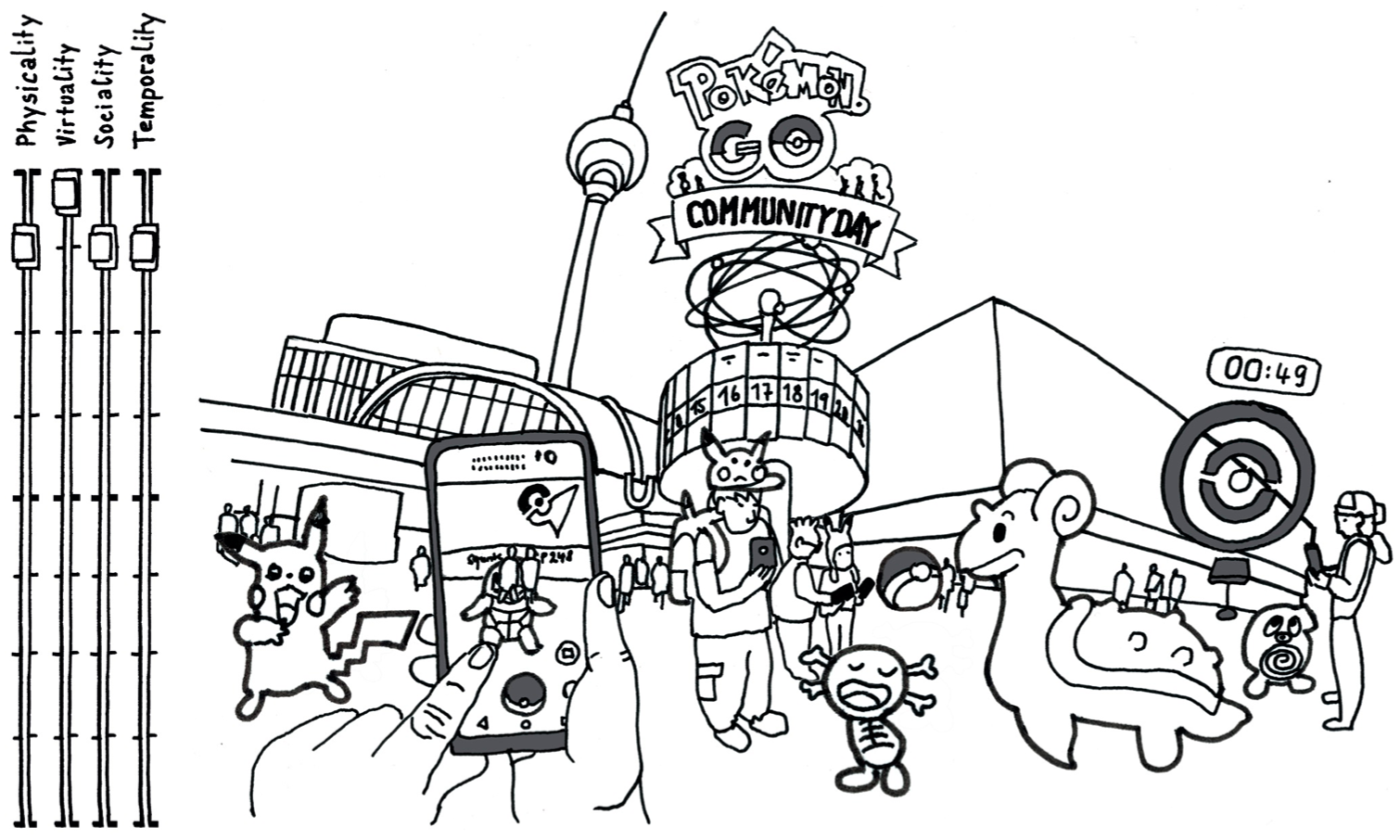
The mobile game Pokémon GO exemplifies a dense and dynamic hybrid spatial figuration, with all four sliders on the ‘hybrid space mixing console – physicality, virtuality, sociality, and temporality – pushed to high levels (see Figure 1). It integrates digital content into the physical city, requiring bodily movement through tangible environments. Augmented reality visualizations place Pokémon in users’ immediate surroundings, and game mechanics are deeply embedded in both spatial routines and social dynamics. The result is a seamless synthesis of digital and physical space in real-time.
The hybrid spaces created here are not only technically complex but also subjectively experienced as immersive and dynamic. Daily or event-based routines structure player engagement and hybrid spatial rhythms.
Playing Pokémon GO – A Densely Synthesized Hybrid Spatial Figuration.
A Moderately Synthesized Hybrid Spatial Figuration – Checking in at a Café Using Foursquare and Chatting Online
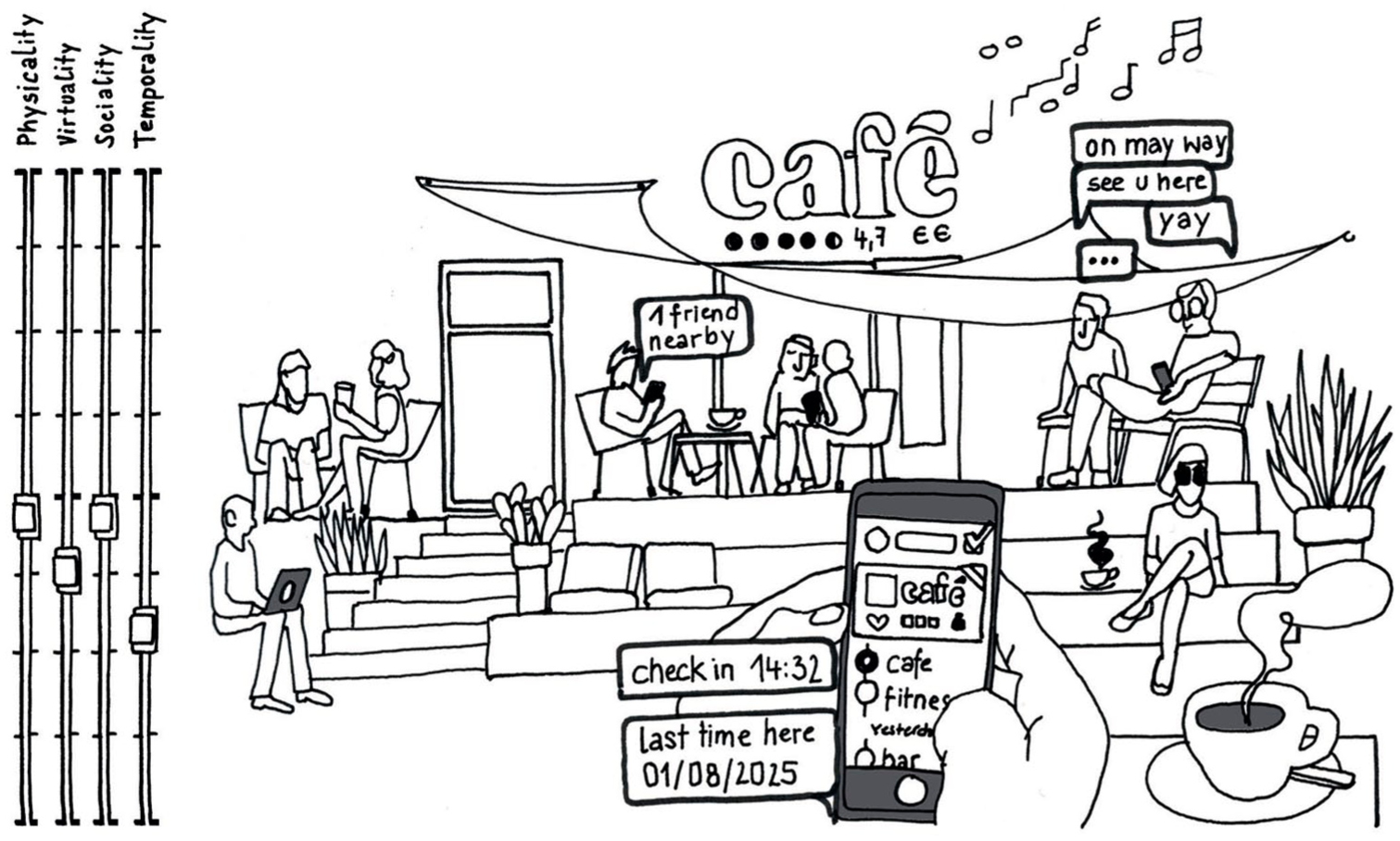
This example illustrates a mid-range position on the hybrid-space spectrum, with all four sliders moderately raised and multiple relational layers emerging. A person enters a café, checks in using a location-based social app like Foursquare, shares the location with distant contacts, and begins a casual messaging conversation (see Figure 2). While this interaction does not fuse digital and physical spheres as tightly as Pokémon GO, it nonetheless engages both spaces in meaningful ways. The user remains embedded in their physical environment while simultaneously extending their social and informational presence through digital means.
Checking in at a Café Using Foursquare and Chatting Online – A Moderately Synthesized Hybrid Spatial Figuration.
A Situationally Limited Hybrid Spatial Figuration – Working on a Laptop in a Café
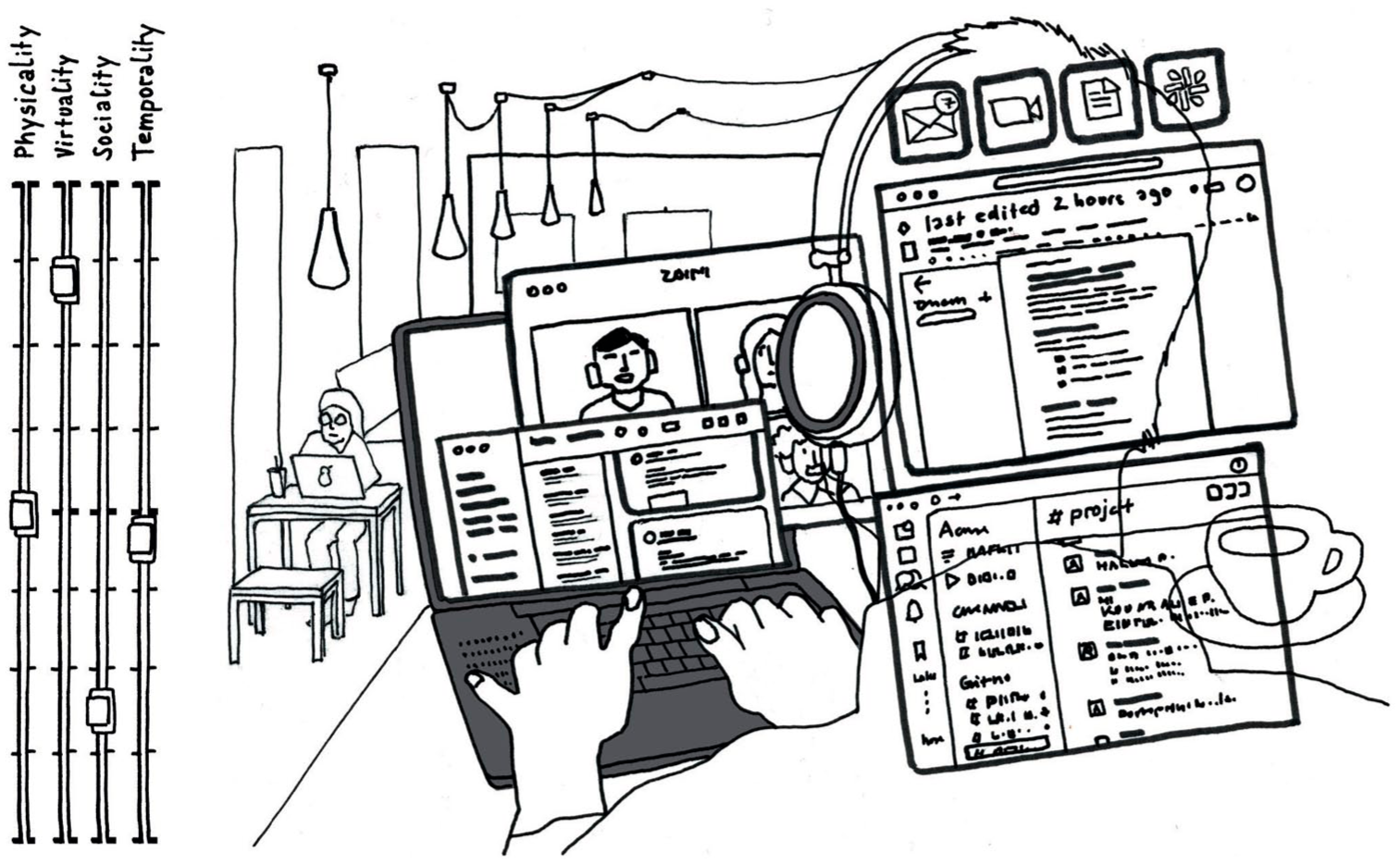
This example shows a more selective use of the hybrid-space mixing console. All four dimensions are present; however, the ‘virtual’ slider is set higher than the others, and the synthesis remains partial. An individual using a laptop in a public setting like a café or park engages digitally and physically, but without significant interaction between the spheres (see Figure 3). The experience is characterized by seamfulness and compartmentalization rather than fluid integration.
While this spatial figuration meets the criteria of hybrid space, it remains loosely synthesized. Still, as a practice on the lower end of the spectrum, it demonstrates how hybridization varies situationally – not only in structure, but in relational depth. Asynchronous communication enables flexible timing, but without recursive interaction or socially layered rhythms.
Working on a Laptop in a Café—A Situationally Limited Hybrid Spatial Figuration.
An Anticipatory, Pre-Synthesized Hybrid Spatial Figuration – Planning an Offline Urban Walk Without Mobile Data
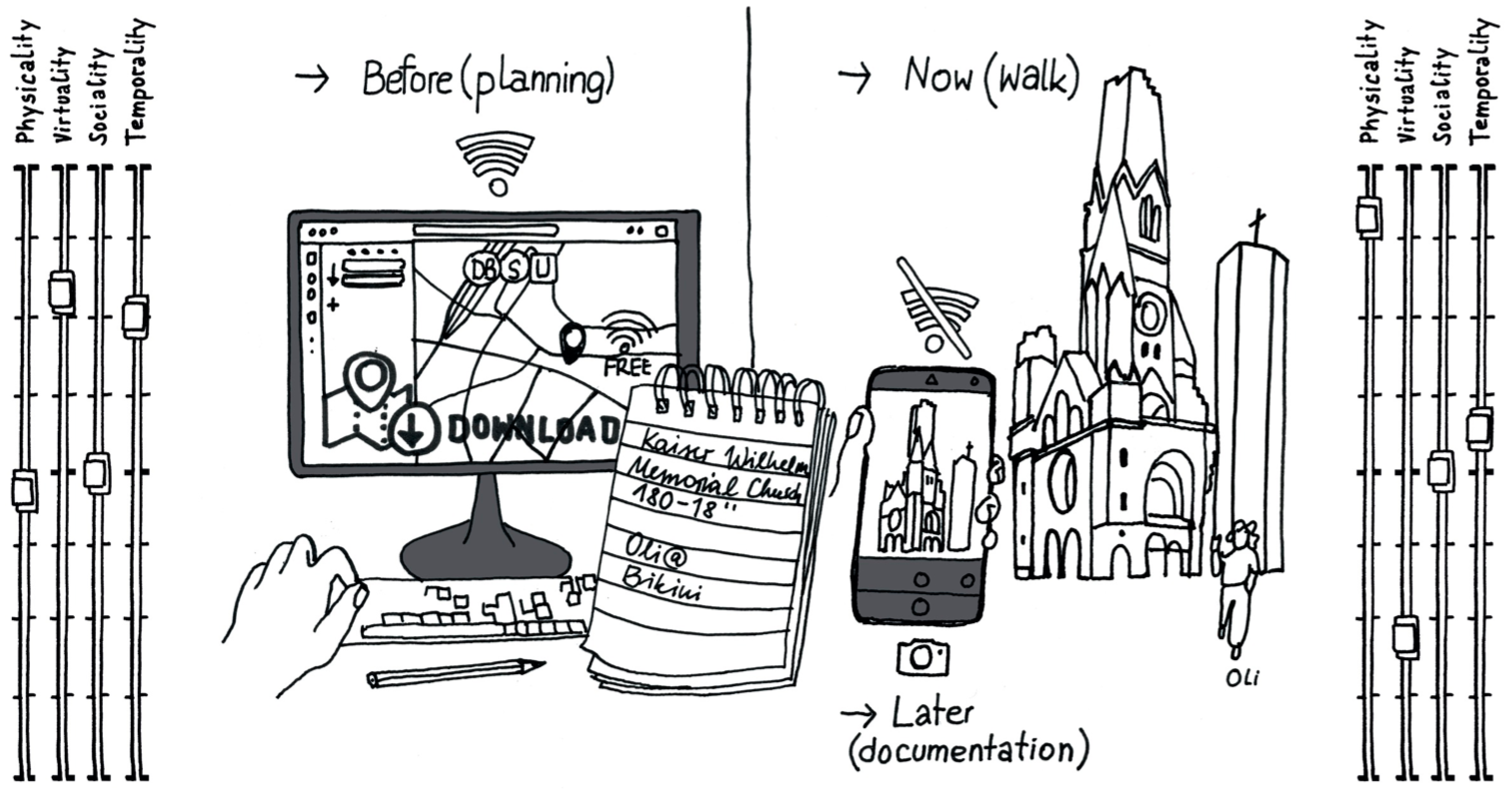
This example illustrates a spatial figuration in which the hybrid synthesis takes place in advance, rather than through ongoing digital interaction. A student without mobile data plans a day in the city by downloading maps, bookmarking café addresses and noting opening hours and transit connections ahead of time (see Figure 4). During the outing, no active digital connectivity occurs, but the experience remains shaped by digital infrastructures and practices – just in a temporally shifted mode. On our conceptual ‘mixing console’, virtuality is active in the planning stage but muted during execution; physicality and temporality are emphasized, while sociality may vary depending on the context.
This example underscores that hybrid space is not defined by constant connectivity but by the relational interplay of spatial elements across time. It also challenges assumptions of always-on digitality by showing how hybrid spatial arrangements can be synthesized through preparation and foresight, rather than simultaneity or seamlessness.
Planning an Offline Urban Walk Without Mobile Data – An Anticipatory, Pre-Synthesized Hybrid Spatial Figuration.
The four examples show that the dimensions of physicality, virtuality, sociality and temporality provide a valuable structure for describing hybrid spatial figurations. However, they capture only the presence and variability of these elements, not their subjective interrelation. To move towards a relational understanding of hybrid space, we must ask: How are these dimensions synthesized and experienced by individuals? This is where the concepts of translocalization and polycontexturalization, introduced in Section 3, become relevant.
Subjective Hybrid Spatial Experience
To better understand the constitution of hybrid spaces, we now turn to the relational processes through which users actively synthesize space. In particular, we incorporate the concepts of translocalization and polycontexturalization, drawn from our relational spaces framework (Knoblauch & Löw, 2020; Löw, 2022). These concepts do not describe discrete dimensions of hybrid spaces, but rather the relational logics that shape how hybrid figurations are experienced and assembled. As translocalization refers to the incorporation of geographically distant or digitally mediated spatial references – such as people, events or digital points of interest (like PokéStops) – into present spatial experience, it helps explain how hybrid spaces stretch beyond their immediate location and how users draw connections across multiple geographies in a single act of synthesis. Polycontexturalization, on the other hand, highlights how individuals navigate multiple overlapping roles, institutional logics or communicative settings simultaneously. This concept becomes especially relevant when spatial practices unfold across boundaries between work and leisure, private and public, digital and physical spheres, proximate and remote contexts.
Take for example the seemingly situationally limited hybrid spatial practice of working on a laptop in a café. While all four dimensions are activated, the spatial synthesis can vary significantly depending on the character of the digital engagement. A person casually checking their emails while enjoying a coffee remains mostly in a single role and limited communicative frame, producing a relatively low degree of translocalization and polycontexturality. However, a person sitting in the same café might simultaneously coordinate a global research project via Zoom, respond to Discord messages across time zones and edit a collaborative document for an international publication. Here, multiple geographically dispersed references are drawn into the present moment and the individual operates across institutional, linguistic and temporal contexts. In this second case, the spatial synthesis becomes markedly denser – showcasing the very processes that translocalization and polycontexturalization enable us to capture. Conversely, the practice of playing Pokémon GO demonstrates a rich synthesis: players engage with co-present individuals, digital interfaces and game mechanics that connect local space to global networks. They move fluidly between leisure, community, competition and mobility logics. Here, translocal and polycontextural references are deeply integrated, creating a dense hybrid constellation. The juxtaposition of both examples illustrates that the density of hybrid spatial figurations is not determined solely by the external presence of activated dimensions. Rather, it crucially depends on how the dimensions are relationally connected and subjectively synthesized. In other words, it is not the physical location or technical setup that determines the quality of hybrid spaces, but the connections between different social, virtual, temporal and physical contexts – that is, the degree of translocalization (linking distant places) and polycontexturalization (simultaneous embedding in and engagement with different contexts). Accordingly, the concepts of translocalization and polycontexturalization enable us to analyse the actual processes of synthesis that give rise to spatial experiences: how users draw spatial references across distance and how they navigate multiple overlapping roles, platforms or communicative frames.
Returning to the four examples introduced in the previous section clarifies this added value. In the café check-in scenario, moderate translocal connections (e.g. messaging distant friends) and a casual interplay of leisure and communication roles suggest a modest but tangible degree of synthesis. In contrast, PokémonGO involves complex, multi-scalar spatial references and overlapping contexts of gaming, mobility and community interaction – an exemplary case of translocal and polycontextural imbrications. Meanwhile, the laptop-in-café scenario illustrates that subjective spatial synthesis can diverge dramatically depending on task, platform use and social framing. Two individuals may occupy the same physical environment and technology setup, yet one may experience a light, seamful hybrid constellation, while the other – deeply embedded in global coordination – navigates a dense, multi-context hybrid arrangement.
Thus, integrated into the ‘mixing console’, the concepts of polycontexturalization and translocalization do not constitute additional ‘sliders’, meaning that they are no further dimensions of hybrid spaces. They serve as analytical categories that make the synthesis across dimensions accessible, hence their situational intensity, interplay and relational spatial entanglement. If the four dimensions are the sliders of a sound-mixing console, translocalization and polycontexturalization describe the ways in which users combine these signals into an emergent composition. Translocalization refers to how distant spatial references are pulled into present spatial arrangements, while polycontexturalization highlights how multiple spatial logics – such as institutional rules, material infrastructures or communicative settings – resonate simultaneously. In this sense, they capture the synthesizing act itself, showing how the relational intensity of hybrid spaces is enacted in practice. This distinction clarifies that dimensions structure the available elements of hybridity, while translocalization and polycontexturalization reveal how these elements are actively orchestrated.
Building on this, the experiential categories of seamfulness and seamlessness (Licoppe & Inada, 2012) allow us to further refine our understanding of the spectrum of hybrid spatial experiences. These concepts describe how individuals perceive the interplay of digital and physical dimensions of hybrid spaces. A seamful experience occurs when users are clearly aware of the disconnect or friction between digital and physical realms – suggesting a lower degree of synthesis. Conversely, a seamless experience indicates a high degree of integration, where digital and physical elements blend into one coherent spatial perception and are navigated simultaneously. Integrated into our mixing console, seamfulness and seamlessness offer an experiential lens to evaluate not just what dimensions are present, but how their synthesis is subjectively experienced by users.
Conclusion and Outlook
Throughout this paper, we have developed a relational and theory-driven framework to conceptualize hybrid spaces as dynamic, socio-material spatial figurations shaped by the interplay of physical, digital, social and temporal dimensions. Drawing on Löw’s (2001, 2016) theory of relational space and using a theory synthesis approach (Jaakkola, 2020), we identified four interdependent dimensions – physicality, virtuality, sociality and temporality – which, when synthesized through individual and situated spatial practices, give rise to hybrid spatial experiences of varying complexity and intensity. Building on this conceptual integration, we define hybrid spaces as follows: Hybrid spaces are relational and processual spatial figurations that emerge from the entanglement of physical, digital, social, and temporal dimensions in people’s lived, socio-spatial experiences. They are not fixed environments but situated and subjective acts of synthesis, in which material arrangements, mediated interactions, and temporal layers blend memory, presence, and projection. The resulting spatial figurations vary in complexity, scope, and experiential intensity, giving rise to different degrees of hybridization.
The significance of this framework lies not only in advancing theory, but also in providing researchers and practitioners with an analytical lens for grasping hybrid spatial experiences. For scholars in planning, media studies or urban sociology, among others, the framework offers an alternative vocabulary: it clarifies how digital–physical entanglements can be described without relying on additive conceptual metaphors – such as layers, overlays or blends – that dominate much of the existing terminology. For practitioners and policymakers, the sound-mixing console metaphor functions as a heuristic for identifying how infrastructures (e.g. broadband networks, transport systems and public displays), platforms (e.g. navigation apps or social media services) and social practices (e.g. wayfinding with mobile maps, livestreaming a protest or engaging in locative games) jointly shape urban experience. In this way, the metaphor makes hybridity diagnosable in concrete urban settings and offers a language for discussing how different spatial figurations or settings can be influenced by design, regulation or strategies. By connecting conceptual abstraction with real-world application, the framework thus bridges theoretical and practical domains, offering both explanatory and diagnostic value.
At the same time, our conceptual synthesis has several limitations: It relies on secondary literature rather than empirical testing, and further research is needed to operationalize the sliders of the sound-mixing console for measurement across different contexts and scales. The sound-mixing console metaphor, for instance, invites researchers to trace how the relative intensity of each dimension is enacted in practice – for example, through ethnographic observation, participatory mapping or in-depth analysis of spatial narratives. Future empirical studies might explore, for instance, how the intensity of dimensions varies between neighbourhood-level practices and global digital networks or how translocal and polycontextural syntheses are differently experienced across social groups. Moreover, as Jaakkola (2020) notes, theory synthesis unavoidably reflects the contours and biases of the literature it draws from. Given that existing hybrid-space research is unevenly distributed across disciplines and predominantly rooted in urban Global North contexts (Heinrich et al., 2025), future work should expand the empirical and geographical base of inquiry.
Stepping back from these theoretical and methodological reflections, it becomes clear that hybrid spatial syntheses do not evolve in isolation. They are conditioned by infrastructural availability, platform design, regulatory frameworks and broader sociotechnical environments. Hybrid spaces therefore emerge across multiple scales – from individual practices to urban systems and global networks – and understanding their dynamics requires attention to these scales and most importantly to their interrelations. Research is only beginning to explore how these multiple forces – bottom-up user practices and top-down planning, platform governance or algorithmic modulation based on artificial intelligence – interact in shaping hybrid spatial arrangements. The mixing-console metaphor therefore also highlights a future research challenge: to better understand not only the presence of hybrid spatial dimensions, but also how their interplay is mediated amplified, or muted across social and spatial scales.
Footnotes
Acknowledgements
This paper was developed within our research project ‘The Spatial Knowledge of Young Adults: The Constitution of Online, Offline and Hybrid Spaces’ embedded in our collaborative research centre (CRC) 1265 ‘Re-Figuration of Spaces’. We would like to sincerely thank our project team colleagues – Ignacio Castillo Ulloa, Luis Miguel Calvo Conseur, Sarah Friedel and Ludovica Tomarchio – for the many intense and enriching discussions that have informed and sharpened our thinking throughout the development of this paper. In addition, inspiration for this paper emerged from our teaching activities and classroom debates within the Master’s programme in Urban Design and the Bachelor’s programme in Urban and Regional Planning at Technische Universität Berlin. Therefore, we warmly thank our students for their critical questions and creative contributions, which have meaningfully shaped our thinking. We also benefitted greatly from workshops held within our broader research consortium, as well as from inspiring exchanges with external experts, whose critical input challenged and advanced our conceptual reflections. We are particularly grateful to Grit Koalick for creating the compelling visualizations that accompany this paper, effectively translating and clarifying our conceptual ideas. Our collaborative exchange with her went beyond matters of representation, offering valuable insights that helped us sharpen and refine the arguments of the paper. Finally, we thank the anonymous reviewers for their thoughtful and constructive feedback, which allowed us to substantially refine our arguments and strengthen the overall quality of the manuscript.

Ethical Considerations
Not applicable.
Consent to Participate
Not applicable.
Consent for Publication
Not applicable.
Funding
The authors disclosed receipt of the following financial support for the research, authorship and/or publication of this article: This research was funded by the Deutsche Forschungsgemeinschaft (DFG, German Research Foundation) – Projektnummer 290045248 – SFB 1265.
Declaration of Conflicting Interests
The authors declared no potential conflicts of interest with respect to the research, authorship and/or publication of this article.
Data Availability Statement
No new data were created in this study. Data sharing is not applicable to this article.