




Abstract
This article explores the role of participatory mural art as a catalyst for community development, symbolic dialogue, and place-based identity formation in Kaunas, Lithuania. Drawing on community mural projects across distinct urban neighborhoods, the study employs a multimethod qualitative design that combines ethnographic fieldwork, semistructured interviews, participatory observation, and multimodal semiotic analysis. Using MAXQDA for thematic coding, the analysis reveals how co-created murals foster social capital, intergenerational exchange, and spatial transformation by enabling residents to inscribe their stories, memories, and values into the built environment. The findings show that murals serve as more than aesthetic interventions; they operate as sites of community empowerment and symbolic negotiation. Through acts of storytelling, shared labor, and creative dialogue, community members re-signify urban space and articulate belonging in ways that are emotionally resonant and locally grounded. Cases highlight how symbolic choices reflect both cohesion and contestation, while illustrating how visual representation of daily life can reinforce place attachment and visibility. The article contributes to the fields of community development and urban communication by proposing an integrated framework that synthesizes social capital theory, place attachment, participatory design, and multimodal semiotics. It argues for recognizing community-engaged mural art as a form of visual citizenship and participatory infrastructure with the power to reshape relationships, activate dialogue, and strengthen the social fabric of neighborhoods in transition.
Introduction
Community-engaged mural art has become an increasingly recognized tool in urban development, known not only for enhancing public aesthetics but also for fostering social cohesion, local agency, and cultural memory (Goldbard, 2006; Sharp et al., 2005). In cities across Europe and beyond, murals serve as platforms through which communities visualize their identities, negotiate shared values, and assert symbolic presence in contested spaces (Irvine, 2012; Riggle, 2010).
Far from being merely decorative, these visual interventions are imbued with sociopolitical meanings, emerging from and contributing to processes of participatory design, grassroots communication, and symbolic spatial transformation (Deutsche, 1996; Manzini, 2015; Medhavi & Trehan, 2023a,b).
Despite their growing popularity, community mural projects remain underexamined in academic literature—especially with regard to their semiotic, ethnographic, and communicative functions in urban environments. Much research focuses on the artistic or social benefits of murals (Cartiere & Zebracki, 2015; Cockcroft et al., 1977), but lacks an integrated framework for understanding how meaning is co-produced, how space is symbolically redefined, and how community voices are expressed in public art. This gap is especially pronounced in post-socialist urban contexts, where questions of representation, memory, and civic participation intersect with historical regimes of top-down planning and visual control (Czepczyński, 2008; Stanilov, 2007).
The aim of this research is to investigate how community-engaged mural art functions as a medium of urban communication, place-making, and symbolic expression in Kaunas, Lithuania. By analyzing co-created murals through ethnographic fieldwork, visual semiotic analysis, and thematic coding (MAXQDA), the study seeks to understand how such artistic practices contribute to community empowerment, articulate local identities, and reshape the symbolic meaning of public space. The research further aims to explore how multimodal storytelling and participatory design impacts social cohesion, emotional attachment to place, and civic visibility in contemporary urban neighborhoods. These questions are addressed by investigating several community mural projects in Kaunas, Lithuania—a mid-sized, post-socialist city undergoing cultural and spatial revitalization. Implemented across four districts—Dainava, Panemunė, Centras, and Kalniečiai—the murals were developed through participatory workshops, storytelling sessions, and collaborative design processes involving residents, local and visiting artists, and civic actors. In particular, this study asks,
How do co-created murals foster community identity, empowerment, and place attachment?
What symbolic meanings and visual strategies emerge through collaborative mural-making?
How can murals be interpreted as semiotic and embodied acts within contested urban space?
To address these questions, the research integrates perspectives from social capital theory (Putnam, 2000; Woolcock & Narayan, 2000), place attachment theory (Lewicka, 2011; Tuan, 1977), participatory design (Manzini, 2015; Sanoff, 2000), multimodal semiotic and visual communication (Barthes, 1977; Kress & van Leeuwen, 2006), and urban ethnography (Dovey, 2010; Pink, 2009).
The article argues that murals should be understood as forms of visual citizenship (Cook, 2013; Isin & Nyers, 2014)—sites where community identity, memory, and power are negotiated through image, story, and space.
Theoretical Literature Review
The theoretical framework for understanding these murals is structured around four key dimensions. First, the role of community murals in social cohesion is evidenced in their ability to create inclusive narratives, encourage civic engagement, and enhance collective well-being (Cartiere & Zebracki, 2015; Sharp et al., 2005). Second, theories of place attachment and urban belonging (Lewicka, 2011; Proshansky et al., 1983; Tuan, 1977) underscore how visual representations of shared memory and identity foster emotional bonds with place. Third, the literature on participatory design and co-creation highlights the importance of collaborative processes in shaping the content and meaning of murals (Manzini, 2015; Pink, 2009; Sanoff, 2000), emphasizing the role of communities as co-authors. Finally, urban semiotics and the production of meaning in space (Barthes, 1977; Eco, 1976; Gottdiener & Lagopoulos, 1986) provide tools to interpret murals as symbolic texts that encode power, resistance, and spatial identity through visual and spatial forms. Together, these interrelated perspectives offer a comprehensive lens for examining how mural art contributes to urban transformation—not only in what it depicts, but in how it is made, experienced, and remembered.
Role of Community Murals in Social Cohesion
Social capital theory provides a foundational framework for understanding how participatory mural projects can foster community engagement, trust, and civic identity. Putnam (2000) distinguishes between bonding social capital, which strengthens ties within homogeneous groups, and bridges social capital, which connects individuals across cultural, generational, or social boundaries. In community muralism, both forms are activated as residents gather to share stories, generate ideas, and physically co-create visual narratives.
Freire’s (1970) concept of conscientization—the process of developing critical awareness through dialogue—resonates strongly with mural co-creation. As community members negotiate content and imagery, they become not only participants but producers of symbolic power (Goldbard, 2006). The participatory nature of such projects aligns with Woolcock and Narayan’s (2000) notion of synergistic social capital, in which participation is supported by institutional facilitation. Through collective action and visual storytelling, murals become a conduit for empowerment and solidarity, turning art into a form of visual social infrastructure. Lee (2013) suggests that participatory arts generate social capital by promoting intergroup social cohesion through high-level interactions and nonhierarchical relationships. This “bridged bonding” social capital acts as social glue, integrating diverse groups into a cohesive multicultural community (Lee, 2013). Importantly, the ethnographic method allows these social processes to be observed and analyzed in situ. Through interviews, participant observation, and collaborative workshops, the research foregrounds the subjective experiences of residents who negotiate meaning, identity, and memory through visual expression.
Place Attachment and Urban Belonging
Place attachment, as explored by Tuan (1997) and later expanded by Lewicka (2011), refers to the emotional, symbolic, and experiential bonds people develop with their environment. Lewicka (2011, p. 207) indicates that of the “three components of the tripartite model of place attachment (Scannell & Gifford, 2010) the Person component has attracted disproportionately more attention than the Place and Process components.” Lewicka (2011), while asking the question how important is the place to people these days, outlines the literature on people–place relationships representing empirical results, conceptual distinctions, and authors’ own attitudes. According to the present research, community murals reinforce and reshape these people–place attachments by making visible the everyday lives, memories, and values of local residents. As residents recognize their own realities in the public space—through imagery of familiar streets, cultural symbols, or shared rituals—they strengthen their sense of belonging and identity.
Proshansky et al. (2014) define place identity as a substructure of self-identity formed in relation to the physical environment. Murals, when developed collaboratively, reinforce place identity by acting as visual testimonials of a community’s history, struggles, and aspirations. Manzo and Perkins (2006) argue that community-driven urban projects enhance both emotional bonds and collective efficacy—key factors in neighborhood resilience and civic cohesion. This is particularly relevant in post-socialist contexts like Kaunas, where the social meaning of space is undergoing transformation from state-planned infrastructure to participatory, citizen-driven urbanism. Community murals act as visual narratives that encourage civic engagement and public discourse; they highlight the life experiences of participants and serve as tributes to the community, fostering social responsibility and democratic participation (Pilato, 2022).
Participatory Design and Co-Creation
Participatory design theory emerged from democratic design traditions and has evolved into a guiding principle for inclusive urban practice. Sanoff (2000) and Manzini (2015) emphasize that participatory design moves beyond consultation: it involves co-creation, knowledge sharing, and the redistribution of creative authority. In mural art, this translates into processes where artists act as facilitators rather than auteurs, and where community members shape the narrative, style, and symbolic grammar of the artwork. Murals created through community-driven efforts transform public spaces into interactive environments that foster social engagement, empowerment, and gender equality. These initiatives promote inclusivity and social justice, reshaping urban landscapes and inspiring collective action (Melis, 2024).
Chambers (1997) advocates for “putting the last first”—prioritizing the lived experiences and worldviews of marginalized voices. In mural workshops, this often takes the form of storytelling sessions, co-drawing, or participatory mapping. Such practices open up dialogue, make abstract concepts tangible, and allow for the negotiation of shared meaning. Ehn (2017) adds that participatory design must also account for the everyday knowledge of users—knowledge that is tacit, situated, and often visually expressed. In muralism, this manifests as the inclusion of local symbols, animals, objects, and gestures—transforming public walls into mirrors of collective experience. As noted by Petroniene and Juzeleniene (2022), mural art also contributes to sustainable community development by engaging community members in collaborative actions that improve the urban environment and strengthen community bonds.
Urban Semiotics and the Production of Meaning in Space
Public art, particularly muralism, is a semiotic act: it communicates meaning through signs, spatial placement, visual grammar, and cultural reference. Following Barthes (1977), murals can be read both denotatively (literal content) and connotatively (emotive, symbolic associations). Murals are also multimodal compositions that rely on color, form, composition, and context. Kress and van Leeuwen (2006) propose that meaning in visual design arises from the interplay of semiotic modes, and community murals exemplify this principle by combining verbal, visual, architectural, and embodied elements. In participatory murals, this multimodality is further amplified by community interpretations and reappropriations—residents continue to “read” and re-signify the murals long after their completion.
Importantly, murals are situated within the semiotic landscape of the city (Scollon & Scollon, 2003), which includes official signage, advertisements, graffiti, architecture, and other urban texts. Within this landscape, murals can function as counter-narratives—resisting dominant symbols or reclaiming public space for marginalized voices. Jenkins et al. (2013) refer to this as semiotic democracy: the idea that communities can and should shape the symbols that define their lives—by acting so, mural-making is not just about design but about negotiating the politics of representation (Hall, 1997).
Urban semiotics expands the semiotic perspective into the architectural and spatial domains, asking how cities “speak” through their built forms, visual markers, and spatial practices. Eco’s (1976) semiotic theory provides a comprehensive framework for understanding cities as systems of signs. Cities are also described as semiotic landscapes, where public signs such as street nameplates, traffic lights, and signboards provide essential information for navigation and behavior. These signs contribute to the city’s visual and functional organization, making it a complex texture of meaning (Denis & Pontille, 2016; Stachel, 2016).
Urban signage design is an important aspect of the city’s semiotic landscape. It involves a combination of verbal, architectural, and graphic elements that convey information and cultural values (Husukić & Zejnilović, 2023). Gottdiener and Lagopoulos (1986) argue that the urban landscape is saturated with ideologies and symbols, many of which are invisible or naturalized until challenged by public art or protest. Community murals serve as symbolic interventions in the urban text—they do not merely decorate space, but actively re-script it. They alter the narrative of neglected walls, alleyways, and industrial facades, transforming them into sites of meaning and encounter. Lefebvre (1991) theorizes that space is socially produced and politically contested; murals become one way communities claim the right to the city (Mitchell, 2003)—not only through access but through authorship of meaning. Urban semiotics thus provides the tools to understand murals as spatial speech acts, co-constructed with their architectural context, political history, and social use. These acts reaffirm or rewrite the identities of places and the people who inhabit them.
In conclusion, the key elements of community murals that contribute to social cohesion in Kaunas include community engagement, collaborative actions, and the city’s unique cultural and historical significance. In addition, the cultural and historical factors that shape the significance of community murals as tools for social cohesion in Kaunas are rooted in the city’s unique natural, historic, and cultural conditions.
The analysis demonstrates that the four theoretical lenses deployed in this study explained how community murals operate as semiotic and social infrastructures. Barthes’ myth-semiotics helps us see how visual motifs transcend denotative meaning and circulate as cultural myths. Symbolic articulations gain traction precisely because they are embedded within networks of social capital (Bourdieu), where participation in mural-making consolidates trust, reciprocity, and recognition among neighbors. This social embeddedness, in turn, is anchored through place-attachment theory, as murals transform abstract urban space into sites of belonging and emotional investment. Synthesized together, these lenses clarify how murals not only aestheticize walls but also reconfigure semiotic, social, and spatial relations answering the research question of how participatory art shapes urban belonging and cohesion.
Methodology
This study follows a qualitative, case study design, grounded in interpretive epistemology. It combines ethnographic fieldwork, semiotic visual analysis, and thematic coding to investigate how co-created murals in Kaunas serve as tools for symbolic communication, community cohesion, and spatial transformation. The research included several steps:
1. Defining Research Sites and Scope. Four neighborhoods in Kaunas, Lithuania, were selected for in-depth analysis based on their involvement in the Murals for Communities project: Dainava, Panemunė, Centras, Kalniečiai. Each site represented a distinct social and spatial context. The selection was based on mural diversity, level of community engagement, and accessibility for ethnographic immersion.
2. Establishing Research Questions and Theoretical Framework. Guided by the intersecting theoretical domains—social capital theory, place attachment, participatory design, multimodal semiotics, and urban ethnography—the research explored: 1. How murals foster social connection and local identity; 2. What symbolic strategies and visual elements emerge through co-creation; 3. How murals function as semiotic and spatial interventions.
3. Murals were selected according to three criteria:
4. Conducting Ethnographic Fieldwork. Over 24 months, the researchers conducted participant observation during mural workshops, painting sessions, and community meetings. Field notes documented: social interactions and atmospheres; conflicts, negotiations, and resolutions; gestures, emotions, and creative decision-making. Special attention was given to embodied practices—how people moved, collaborated, and responded to the mural spaces.
5. Collection of Semistructured Interviews. A total of 36 interviews were conducted with: community members (n = 22); artists (n = 8); municipal stakeholders and coordinators (n = 6)
Interviews explored perceptions of the mural-making process, symbolic content, spatial transformation, and long-term meaning. All interviews were audio recorded, transcribed, and anonymized.
The sample size was determined based on the principle of thematic saturation whereby new interviews no longer produced substantially novel insights. This number also aligns with standard practice in ethnographic and qualitative urban studies, which typically employ 20–50 in-depth interviews to balance breadth of perspectives with analytic depth. Furthermore, interviewees were recruited across five distinct neighborhoods to ensure diversity of experiences and voices.
6. Gathering Visual and Spatial Data. High-resolution photographs and sketches of all four murals were collected and geotagged. Spatial relationships between mural placement, pedestrian flow, and architectural surroundings were noted. Visual documentation included: mural motifs and symbols; color palettes and design choices; community members’ contributions.
7. Applying Multimodal Semiotic Analysis. Using Barthes’ (1977) model of denotation and connotation, and Kress and van Leeuwen’s (2006) visual grammar framework (taking into consideration ideational, textual and interpersonal functions), murals were analyzed for: literal content (figures, objects, inscriptions); symbolic meaning (metaphors, cultural references); spatial syntax (use of wall, corner, surface, or proximity). This analysis connected the visual features of each mural to its community narrative. The materials were collected in the form of audio and video recordings, written transcripts of dialogs and photos. The data is stored in hard drives and is Kaunas University of technology property.
8. Organizing and Coding Data in MAXQDA. All qualitative data—interviews, field notes, and visual annotations—were uploaded to MAXQDA. A thematic codebook was developed with key categories: participation, empowerment, place attachment, symbolism, transformation, urban visibility, nature, symbolic landscape, voice, cultural continuity, cultural memory, belonging, community, communication, negotiation, care, intergenerational dialogue. Software was used to generate code frequencies, co-occurrence models, and visual summaries.
9. Cross-Case Thematic Analysis. The mural sites were compared thematically to identify shared patterns and unique features. This allowed for the identification of common symbols (e.g., birds, ropes, everyday life); emotional responses (pride, conflict, humor); and shifts in space perception and community behavior. Themes were linked back to the theoretical framework to interpret how murals act as semiotic and social infrastructures.
Ethical Considerations
All participants gave informed consent. Codes were used for interviewees, and images were shared with permission. The research followed reciprocal and nonextractive principles, especially when working with vulnerable populations.
Limitations and Reflexivity
As a qualitative study, findings are context-specific and not intended for generalization. Interpretation of mural meaning is inherently subjective and open to change over time. Reflexivity was maintained through field journaling and iterative coding to check for researcher bias.
Findings and Discussion
This section presents findings from five community mural case studies in Kaunas, Lithuania, each analyzed as a distinct semiotic and participatory event. Murals are approached as public texts—multimodal compositions whose symbolic, spatial, and emotional meanings are co-produced by artists and community members. Data include ethnographic fieldwork, visual documentation, semistructured interviews, and thematic coding via MAXQDA.
The Case of Kalniečiai: Sharing is Caring
Theme: everyday care and symbolic reciprocity
Semiotic Reading: synecdoche, metaphor, gesture, relational ethics
Key MAXQDA Codes: care, participation, symbolism, intergenerational dialogue
The mural’s composition—two elongated arms extending across the architectural edge of a building, meeting at a strawberry—offers a subtle yet powerful narrative of invisible care. While its denotative imagery is gentle and accessible, the connotative depth emerges through its placement, scale, and community resonance. The corner itself functions as a liminal space, a threshold between two visual fields and, symbolically, between individuals who may not see each other but remain connected. From a semiotic perspective, the extended arms embody a synecdoche of the human body—where the part (the hand) stands in for the whole (the person and their gesture of care). The exaggerated reach disrupts visual symmetry, creating asymmetry of effort, which residents interpret as a visual acknowledgment of unequal but sincere contributions within a community (Figure 1). The strawberry functions here as a metaphor for reciprocity: it is both a gift and a reward, something cultivated and offered. The bright red color serves as an emotive visual anchor, drawing attention to the center of the gesture and highlighting the sweetness that emerges not from abundance, but from intentional sharing.
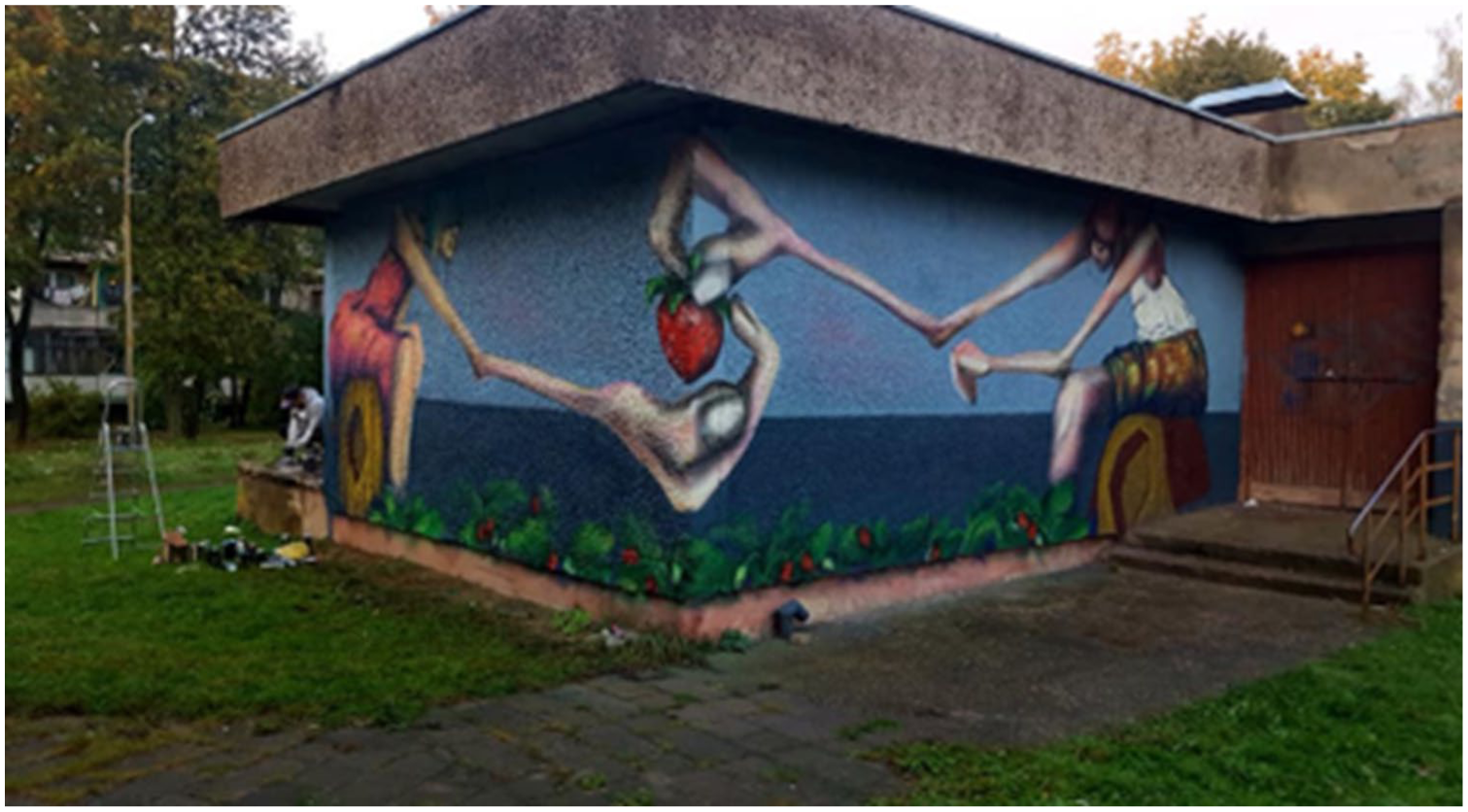
Mural Sharing is Caring.
The MAXQDA-coded categories of Care (15), Symbolism (13), and Belonging (9) confirm the layered emotional and cultural connotations by community members. These codes often co-occurred in interviews with residents who emphasized the relational meaning behind the mural: not simply what it shows, but what it reminds them of. One resident remarked: “Now when someone helps, we say: ‘That’s a strawberry moment.’ (INT_33, Kalniečiai resident). This quote illustrates how the mural has extended beyond its visual function to become a linguistic and cultural reference point—entering local vernacular as a shorthand for neighborly generosity. It exemplifies what Barthes (1977) might describe as the transformation of an image into a myth: a shared cultural sign that transcends its literal form.
Ethnographic notes from the co-creation workshops reveal that residents initially hesitated to paint on a corner wall, questioning its visibility and symbolic value. However, once the design concept emerged, participants described the corner as an ideal metaphor: “We all live next to someone, but we rarely meet. This brings us together.” (INT_33, Kalniečiai resident).
In this way, the mural performs spatial reclamation. What was once a blank architectural seam—visually neutral and functionally unnoticed—becomes a symbolic hinge that articulates community cohesion. The mural spatializes care, making emotional labor visible through artistic form. This aligns with Lefebvre’s (1991) notion of representational space—a lived space charged with symbolic meaning.
The Case of Kalnieciai: Field of Memory
Theme: Cultural memory, place identity, symbolic continuity
Semiotic Reading: Indexical realism, cultural mnemonic, spatial juxtaposition
Key MAXQDA Codes: Cultural Memory (19), Place Attachment (14), Empowerment (13), Belonging (11)
This mural, situated on the side wall of a post-Soviet electricity station building in Kalniečiai, depicts a golden cow, a blue tractor, and two elderly figures, visually referencing the area’s agricultural past. The denotative elements—livestock, machinery, and elderly protagonists—reflect ordinary rural life, but connotatively, they serve as indexes of lost time: symbols that anchor memory in the material traces of everyday labor and land.
From a semiotic standpoint, the mural draws on indexical realism to evoke cultural memory. The cow and tractor are not symbolic abstractions, but referents to lived experiences, based on recollections shared by community members during co-creation workshops. The choice of subjects, based on ethnographic accounts, reflects what Barthes (1977) terms a punctum—a detail that pierces the viewer with its specificity and emotional resonance, invoking what Hayden (1997) calls the urban landscape of memory. The mural (Figure 2) transforms the wall into a visual palimpsest, layering past over present, and reminding residents of what once defined their relationship to the land. As one participant described, “Even though the fields are gone, the stories remain. This wall proves it” (INT_36, Kalniečiai resident).
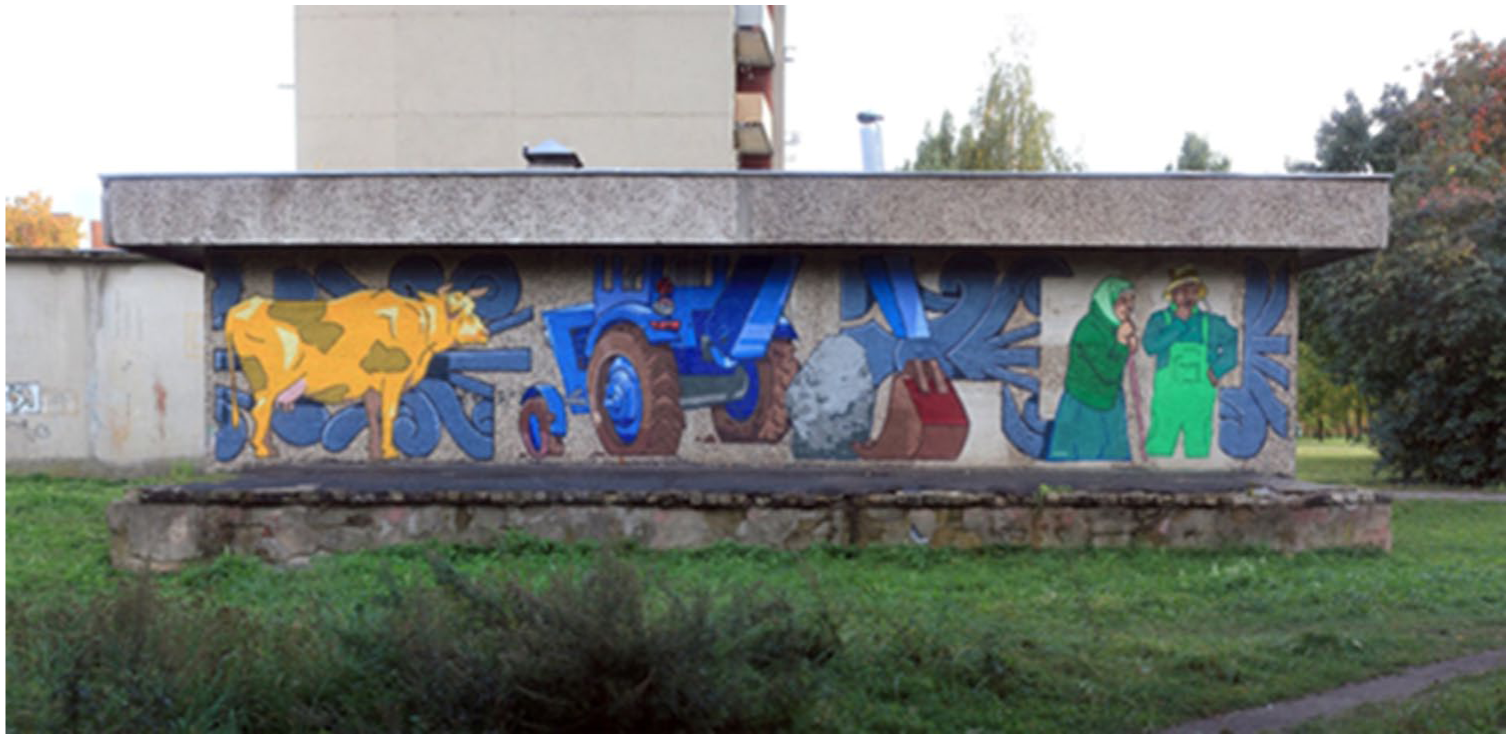
Mural Field of Memory.
This testimony, supported by MAXQDA-coded themes such as cultural memory, empowerment, and place attachment, reflects how the mural functions not only as a work of art but as a mnemonic marker. It invites both older and younger generations to engage with the symbolic sediment of place, forging intergenerational dialogue and cultural continuity.
In ethnographic observation, older participants lingered near the mural and shared spontaneous stories with children, transforming the site into a memory node—a place of informal education and affective transmission. This supports Dovey’s (2010) argument that place identity is performative, activated through narrative and symbolic inscription.
The mural’s scale and prominence reframe formerly mundane imagery as monumental, offering dignity and recognition to memories often marginalized in urban renewal. By placing agrarian symbols within a dense residential landscape, the mural creates a visual tension between erasure and remembrance—between what the land was and what it has become.
In this way, Field of Memory participates in the semiotic reconstitution of urban space, aligning with Lefebvre’s (1991) notion of representational space as a field of emotional, symbolic, and lived production. It asserts the right to memory and reclaims not only visual surfaces, but also cultural identity, continuity, and community authorship.
The Case of Centras: Abyss and Faith
Theme: Civic negotiation, symbolism, ideological contestation
Semiotic Reading: Spatial metaphor, visual abstraction, dialogic meaning-making
Key MAXQDA Codes: Conflict (11), Metaphor (9), Negotiation (10), Empowerment (8)
This mural, located on a large garage roof adjacent to a family-owned car repair business in the Centras district, emerged from a contested negotiation between the first, visiting foreign artist’s proposal and the community’s sociopolitical sensitivities. The initial concept—inscribing the word Lt. Šeima (En. Family)—was rejected by the community, primarily due to its colors-related ideological associations unacceptable for the community with traditional values.
As negotiations with the first artist regarding the change of the concept failed, another artist had to undertake the creation and implementation of the mural. What resulted instead was a symbolic compromise: a powerful visual metaphor. The mural depicts a deep abyss cleaving the wall, with a suspended rope tenuously linking its two sides. At the end of this bridge-like thread appears the word Lt. (tik)ėjimas, translating both as faith and keeping on going, depending on the inclusion of the prefix (Figure 3). This multivalent symbol retains the original theme of unity and continuity, but displaces it into the nonverbal and metaphorical register, sidestepping ideological tension through abstraction. “We couldn’t agree on the word. So after many attempts, the artist found a symbol that felt true to us.” (INT_28, Centro participant). This resident quote, coded under negotiation and empowerment in MAXQDA, illustrates how visual abstraction functioned as a consensus-building tool. The community’s shift from literal language to spatial metaphor highlights the semiotic flexibility of mural art in contexts of cultural and political sensitivity.
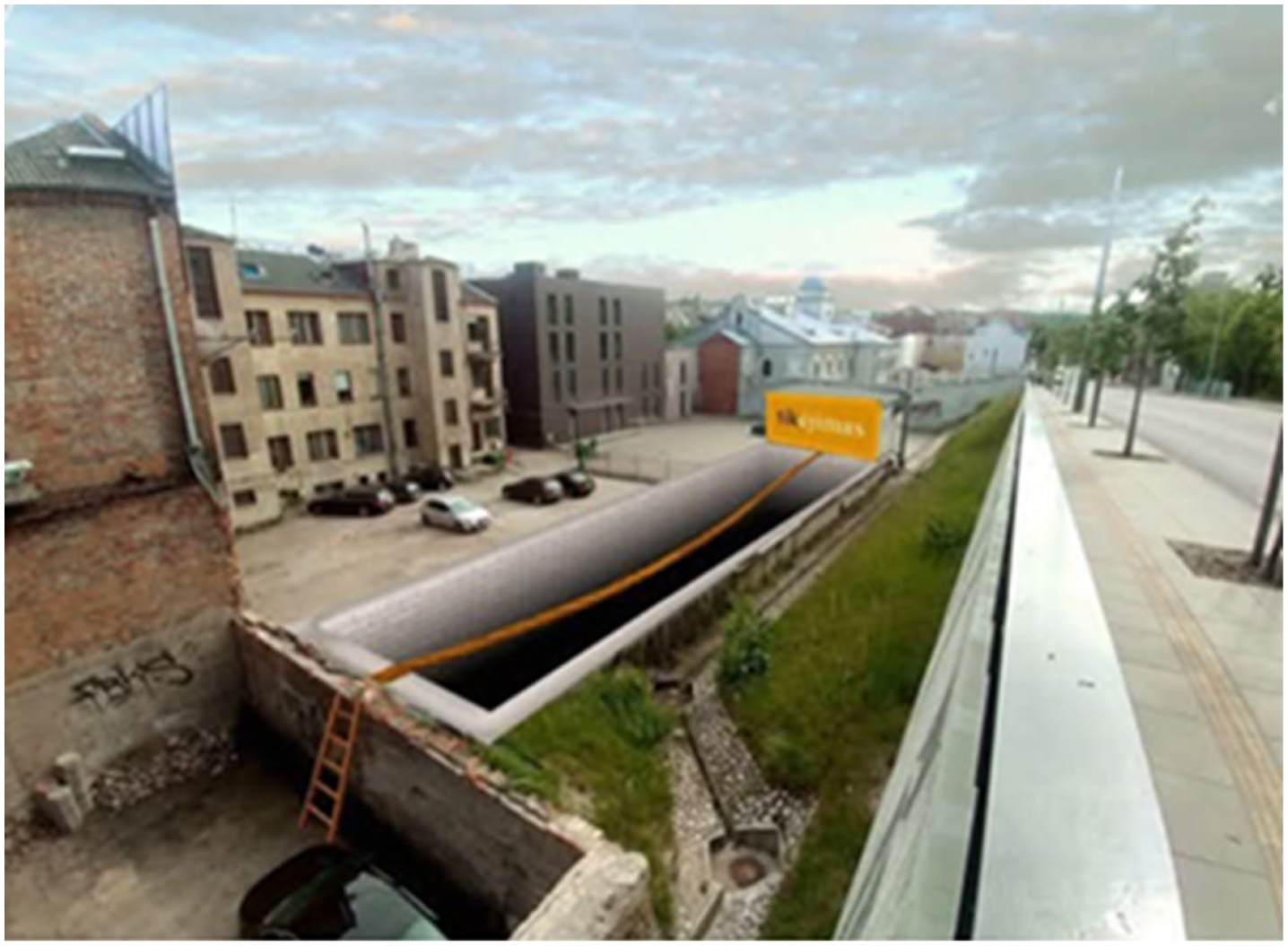
Mural (Tik)ėjimas / Faith.
From a semiotic perspective, the abyss, rendered in a dark palette with dynamic brushwork, visually suggests fracture, loss, or distance—not only spatially, but interpersonally and ideologically. It connotes generational rifts, social fragmentation, and even psychological isolation. The rope, by contrast, becomes a synecdoche of trust, mutual effort, and connection. Unlike a bridge—solid and engineered—the rope’s fragility signals tentative unity, sustained only by collective faith.
From a semiotic perspective, the mural embodies what Roland Barthes (1977) might term a mythical signification: an image that operates not only on the level of personal association but also as a cultural parable, offering shared meaning without didactic closure. The use of abstraction and negative space leaves room for plural interpretations, opening the mural to multiple publics across ideological lines.
Ethnographically, the decision-making process was deeply dialogic. Field notes reveal long debates among artists and the community, the withdrawal of the first artist, negotiations with the second one, and discussions about the surface of the mural. The choice of the final design was marked by reluctant agreement, achieved not through shared terminology but shared feeling. “The rope is thin, but it’s there. That’s how we are now. Not perfect, but holding on.” (Fieldnote, artist debrief)
This aligns with argument that public art in urban contexts functions as a platform for “agonistic pluralism,” where disagreement is not erased but mediated through cultural form. The mural does not resolve differences; rather, it aestheticizes negotiation, allowing for symbolic co-existence without rhetorical dominance. Furthermore, the mural reclaims a previously unnoticed roof of the building, visible from the nearby street to the hill, transforming it into a symbolic urban landmark. By situating this message of faith and endurance in the heart of the city, the mural anchors emotional resilience in spatial form, embodying Lefebvre’s (1991) notion of representational space, where symbolic and lived realities converge.
The Case of Panemune: Air, Earth, and Water
Theme: Nature, memory, ecological identity, and spiritual attachment
Semiotic Reading: Symbolic landscape, polysemic natural metaphors, temporal-spatial synthesis
Key MAXQDA Codes: symbolic landscape (16), voice (11), cultural continuity (12), place attachment (10)
Emerging from an intergenerational workshop in the Panemune district, this mural was conceived through the meetings with the community and storytelling of an elderly sailor, a long-time local resident who shared memories of his maritime journeys and reflections on the shifting nature of the neighborhood’s landscape. The final mural (Figure 4) visually synthesizes these narratives into a stylized, elemental tableau that includes air currents, flowing water, plants, flowers, and three animals standing on each other‘s backs—a symbolic ecosystem grounded in both memory and imagination.
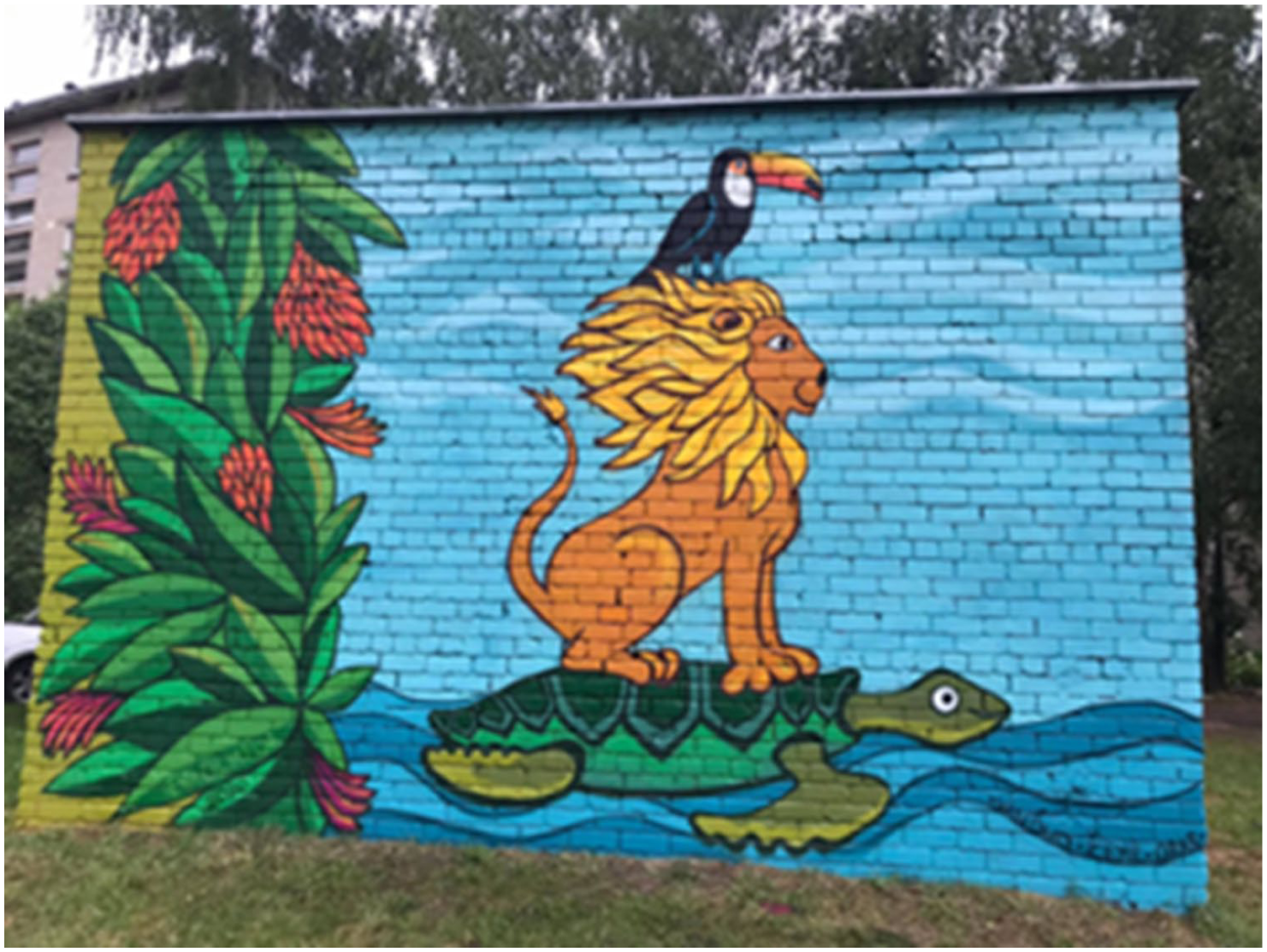
Mural Air, Earth, and Water.
On the denotative level, the mural is non-narrative and largely abstract. However, its connotative richness lies in its elemental metaphors. Each visual motif—whether a wave, a plant, a turtle, a bird, or a lion—functions as a polysemic sign, suggesting natural qualities (fluidity, stability, direction, strength) while also alluding to psychological and cultural states. The composition offers no literal story, but rather a visual poetics, akin to a haiku: condensed, contemplative, and emotionally resonant. “You don’t need to explain it. You just feel it’s about this place.” (INT_10, Panemunė participant). This comment, echoing MAXQDA-coded themes of Voice and Cultural Continuity, reflects the mural’s success in producing a nonverbal intimacy with place, what Tuan (1977) describes as topophilia, or the affective bond between people and environment. The artwork does not impose a single interpretation; rather, it invites open, sensorial engagement, allowing each viewer to draw upon personal associations.
From a semiotic perspective, the mural functions as a symbolic landscape, a visual composition that transcends geographic realism to embody internalized relationships with space, time, and nature. Barthes’ (1977) theory of signification applies here not only in how the mural denotes the natural world, but how it mythologizes local experience, transforming individual memory into shared iconography. The plants, for instance, visually connect the sky and the water, suggesting continuity between origins and growth, while the turtle may evoke the slow resilience of the neighborhood and its older residents. The lion nested subtly on the back of the turtle symbolizes unity, trust, and strength through silence, resonating with the stoic storytelling of the sailor. These images collectively produce a visual cosmology of Panemune, expressing a worldview that is both place-bound and metaphysical.
Ethnographic fieldnotes highlight how residents of varying ages responded differently to the mural: children identified animals, while older participants spoke of “cycles” and “energy.” This multivocal reception underscores the mural’s success as a civic canvas for symbolic projection, aligning with Zebracki’s (2017) framing of public art as a space of emotional co-presence. The artwork subtly counters narratives of modern disconnection by re-inscribing ecological imagination into daily life—a public reminder of nature’s omnipresence even in concrete contexts.
From the perspective of urban semiotics (Gottdiener & Lagopoulos, 1986; Scollon & Scollon, 2003), Air, Earth, and Water reframes the wall not as a division but as a membrane between memory and environment, the visible and the sensed. It spatializes community values—continuity, movement, groundedness—through nonverbal codes, turning the mural into a semiotic threshold that mediates time, identity, and space.
The Case of Dainava: Dainava. Everyday Life
Theme: daily rhythm, community recognition, symbolic ordinariness
Key MAXQDA Codes: Representation (14), Pride (13), Everydayness (11)
Semiotic Reading: indexical realism, neighborhood portraiture, symbolic familiarity.
The Everyday Life mural in Dainava district emerged from a participatory workshop in which residents engaged in visual mapping exercises. Using stickers, colored markers, and written annotations, participants shared associations with their neighborhood, memories of walking routes, favored benches, pet names, and seasonal landmarks. The artist used these inputs to co-design a mural that depicts recognizable local figures, including neighbors, their dogs, the dreams they shared, and other seemingly mundane features of the area’s lived landscape.
On the denotative level, the mural employs a realist aesthetic. It portrays familiar scenes and recognizable individuals, lending it a sense of immediacy and accessibility. On the connotative level, however, the mural performs a more subtle and powerful task: it elevates the ordinary. By memorializing daily routines and familiar faces, the artwork symbolically affirms the significance of the everyday, a gesture that resonates strongly with the theoretical work of de Certeau (1984), who argued for the cultural value of routine spatial practices.
The mural’s semiotic modality is that of indexical realism—its signs point directly to referents in the real world, serving as literal and symbolic markers of identity. Unlike abstract or metaphorical murals that rely on shared cultural codes, Everyday Life (Figure 5) engages a hyper-local visual vocabulary, intelligible primarily to those who inhabit the depicted environment. This aligns with what Kress and van Leeuwen (2006) describe as interactive meaning in visual grammar: the mural not only represents a world but speaks to its audience in familiar terms.
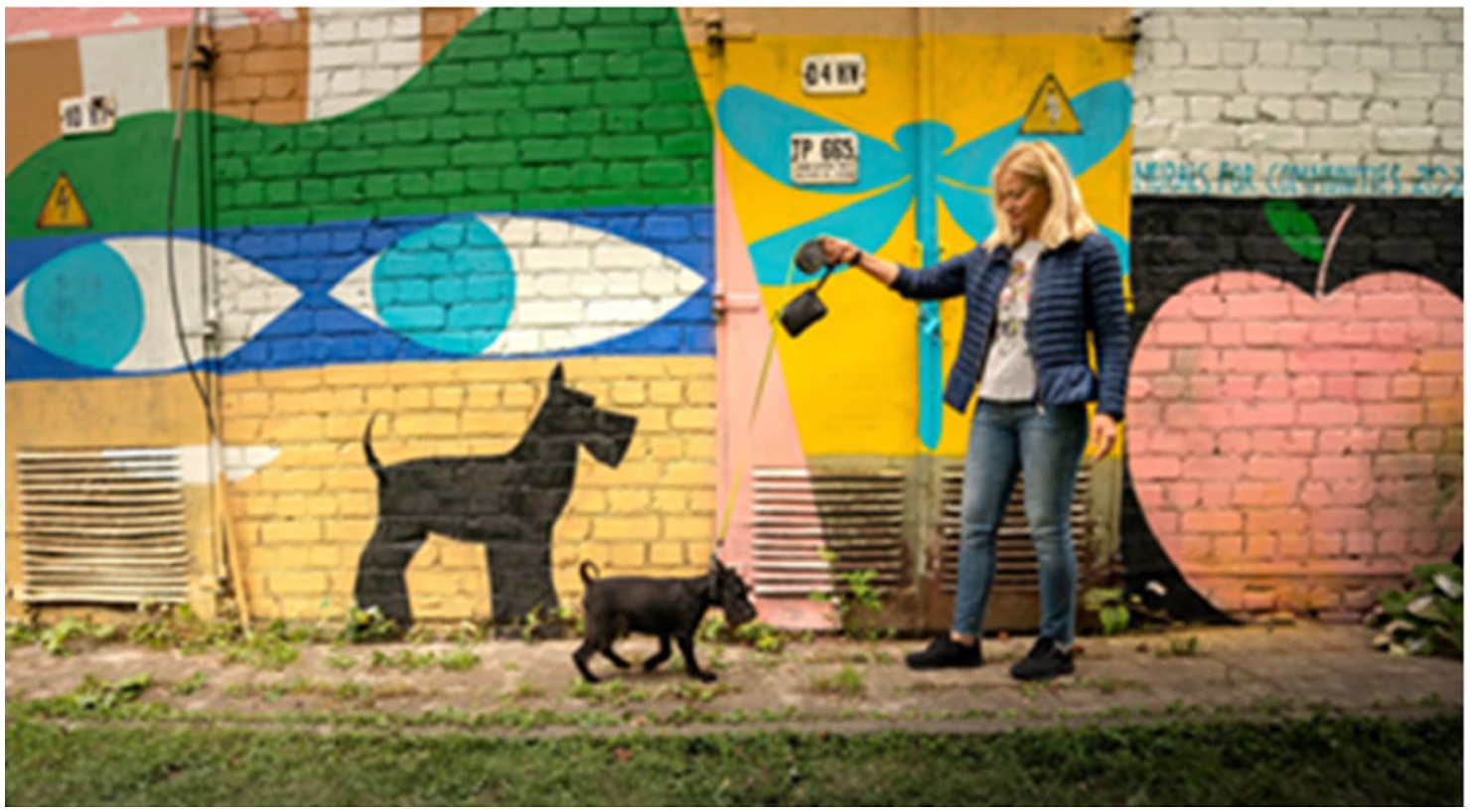
Mural Dainava. Everyday Life.
Residents expressed strong emotional responses during fieldwork, describing the mural as “ours,” “like a mirror,” and even “like being on TV.” These sentiments were captured through MAXQDA-coded interviews, where Representation (14), Pride (13), and Everydayness (11) were dominant. One participant shared, “My kid saw our neighbor’s dog in the mural and shouted, ‘That’s Tukas!’ That’s when it hit me—we’re in it. We matter” (INT_45, Dainava resident). This quote reflects not just recognition, but social affirmation. The mural transforms invisible routine into visible significance, enabling residents to experience a moment when one recognizes oneself in a public image and thereby feels acknowledged by the larger social system.
From a spatial perspective, the mural also performs a claiming function. Placed on a formerly anonymous electricity building wall, it renders the space emotionally specific, establishing what Hayden (1997) terms a “place of memory.” The image becomes a reference point, often used by residents in everyday conversation and orientation (“meet me by the mural with the dog”). In doing so, the mural contributes to the material inscription of community identity onto the urban fabric. Moreover, the process of participatory design imbued the mural with relational authorship. The artist acted as an interpreter of the community’s visual memory, but the creative power resided in collective decision-making. The ethnographic fieldnotes reveal how residents debated which dogs to include, whether to depict the postwoman, and what objects representing dreams should be shown—negotiations that affirmed a shared sense of symbolic ownership.
In sum, Dainava. Everyday Life exemplifies how muralism can articulate emotional proximity, civic pride, and mundane belonging. It blurs the line between public art and public mirror, offering not a spectacle for tourists but a symbolic portrait for the insiders—those who walk these paths daily, know the names of the dogs, and recognize the dreams without needing explanation.
Conclusion and Implications
This study examined seven community-engaged murals created in various districts of Kaunas, Lithuania—Dainava, Panemune, Kalnieciai, and Centras—through an integrated methodological lens combining ethnography, multimodal semiotic analysis, and qualitative coding using MAXQDA. The research foregrounds how participatory mural art activates urban space as a site of social cohesion, symbolic communication, memory, and belonging, particularly in a post-socialist cityscape undergoing cultural and spatial transformation.
Each mural case study, whether based on memories of agrarian life (Field of Memory), emotional solidarity (Sharing is Caring), abstract metaphors of resilience (Abyss and Faith), or representations of everyday life (Dainava), Air, Earth, Water (Panemune) demonstrated the mural’s capacity to both reflect and shape urban identity. Community co-creation played a critical role, not only in determining the visual content of the murals but also in fostering intergenerational dialogue, civic pride, and spatial reattachment.
The semiotic readings revealed how murals function as layered sign systems: objects of artistic expression, instruments of sociopolitical negotiation, and carriers of affective meaning. Themes such as care, memory, place attachment, symbolic dialogue, and cultural continuity emerged as central codes in MAXQDA analysis, offering insight into the lived experiences of residents and the evolving character of urban neighborhoods.
The findings show that murals function as more than visual embellishments: they operate as
From a theoretical perspective, the article contributes to the growing body of literature that intersects urban semiotics, participatory design, community psychology, and public space theory. The study shows how murals operate as dialogic media, making visible the intangible aspects of neighborhood life, such as emotional labor, historical memory, and local identity.
Implications for Practice and Policy
Future Directions
Further research could focus on the long-term impact of community murals on neighborhood change, identity resilience, and civic engagement. Exploring digital augmentation (e.g., AR-enhanced murals), or youth-led co-creation processes, would extend this field into new technological and pedagogical dimensions. In addition, integrating mural studies with mapping tools could visualize patterns of symbolic density across urban territories.
Footnotes

Funding
The authors received no financial support for the research, authorship, and/or publication of this article.
Declaration of Conflicting Interests
The authors declared no potential conflicts of interest with respect to the research, authorship, and/or publication of this article.