



Abstract
In this article, we present six autoethnographies of lives marked by crisis that reflect on the issues of access, very broadly defined, that the COVID 19 pandemic has raised or redefined for each of us. As the time of crisis has made access concerns more and more evident it also exposes how access is not an issue just for disabled people, but for all lives. Drawing on recent scholarship in disability studies that critically interrogates access through an intersectional lens, we take this unexpected unveiling as an occasion to further tease out the complexities, ambiguities, and messiness of access.
We are six authors, spaced apart and yet connected. At the time of writing in the spring of 2021, we had been working together closely as the founding members of the Access in the Making (AIM) Lab for a year-and-a-half. 1 Some of us have disabilities, some of us have disabled kin, and some have both. It is our different stories of coming into disability, no matter how incongruent and patchy, that bring us together despite being apart.
In this article, we present six stories of lives marked by crisis that reflect on the issues of access, very broadly defined, that the COVID 19 pandemic has raised or redefined for each of us. As the time of crisis has made access concerns more and more evident it also exposes how access is not an issue just for disabled people, but for all lives, beginning with access to basic necessities of life, including clean air, drinking water, and the like. We take this unexpected unveiling as an occasion to further tease out the complexities, ambiguities, messiness, and in certain cases, the taken-for-grantedness of access.
Since we, as the AIM Lab, work and operate across so-called Canada, we want to begin by situating ourselves in relation to the Land. 2 We are settlers living on stolen Indigenous lands which have been and continue to be the homeland to various Indigenous nations and other peoples including Kanien’kehá:ka, the Anishnabeg, the Mississaugas of the Credit, the Chippewa, the Wendat peoples, Cree, Dakota, Dene, Oji-Cree peoples, the Tsawwassen people and the Métis Nation. While we all are implicated in settler colonialism, we find ourselves differently situated in terms of our relationships to it. We are White and Brown, working-class and middle-class, able-bodied and disabled, chronically ill and healthy, immigrated and born in Canada, among many other things. Depending on these multiple positionalities that shape who we are as well on where we are, whom we are with, when and where, we varyingly benefit from or are oppressed by, what la paperson calls, “settler technologies” (p. 10). 3 These differences matter in our discussion of access under COVID 19 conditions because they, as it will become evident in the following, may at times be aligned, and at others be opposed, or completely incommensurable.
How We Define Access: Access as Research-Creation
Disability is messy, not just as a category but also as an experience. To recall Moser and Law (1999), “people are dis/abled in endless different and quite specific ways” (p. 198). Accordingly, access is also messy. As recent work in disability scholarship—also dubbed “critical access studies” (Hamraie, 2017, p. 13)—has shown, access is not as rigid and static as the concreteness of a ramp or automatic door opener might suggest. Nor is it “a self-evident good” that should always be there without first questioning what that “good” is and who it is for (p. 13). Instead, access is situated, specific, and fluid. It involves “conflicts” (Price cited in Dolmage, 2015) and tensions. It requires facing up to difficult and at times irresolvable questions, as when multiple disabilities, and intersecting social positions require potentially conflicting forms of access, or as Snyder and Mitchell (2008, p. 11) ask, “How do we get all these disabilities in here?.” Access is “a site of political friction and contestation” (Hamraie & Fritsch, 2019). It necessitates hard coalitionary work where we, as Margaret Price (2011) puts it, “must try, think, query, flex, observe, listen and try again” (p. 101).
It is precisely this necessity of perpetual trying and questioning that informs AIM Lab’s methodological approach to access. Bringing arts-led methods (also known as research-creation) in dialogue with critical access studies, we work with what we term “access as research-creation.” Research-creation refers to hands-on artistic, experimental or media creation as a research process in itself. Simply put, research-creation is a way of “trying things out” (Chapman & Sawchuk, 2012, p. 9) rather than arriving at finite conclusions. With the term “access as research-creation,” we want to put this ongoingness at the core of access work. By “access as research-creation,” we mean that “trying things out” constitutes our principal research modality to access, its indefiniteness and polysemy. Not concerned with what access is, but what it could be, we engage in collective experimentation and improvisation to generate speculative possibilities of access while attending to limits and impasses as they become evident. Rather than adopting an investigative role with respect to what is and what is not accessible, we engage with access as a site of creativity, curiosity, and hard coalitionary work, which, as Alison Kafer points out, inevitably entails going “beyond the limits of one’s comfort zone.” 4 Access as research-creation invites us to leave these zones, and allows us to tinker with forms of what might count as access, potentially transforming the meaning of access itself in the process.
An Anti-Colonial Framework of Access 5
As we experiment on access at the AIM Lab, we also take great caution to not limit our understandings of access only to how the term has been taken up in disability scholarship and activism. Our conversations with educator and scholar Kahérakwas Donna Goodleaf (Turtle Clan, a citizen of the Kanien’kehaka Nation) and Palestinian filmmaker Razan AlSalah as part of the “From Turtle Island to Palestine: How have we been surviving colonization?” panel 6 ; our collaboration with five photographers from the South West Asian/North African (S.W.A.N.A.) region as part of the “Air, river, sea, soil; a history of an exploited land” exhibition and artist roundtable, 7 as well as the works of Stó:lō artist and scholar Dylan Robinson, Métis artist and scholar David Garneau and Métis/Michif environmental scientist Max Liboiron 8 have taught us that access has many meanings, valuations, and genealogies. Crucially, not all of those are compatible with the ones known in disability scholarship and rights-based discourses. Drawing on this knowledge that were generously shared with us from outside disability studies, we insist on the urgency of framing access from an anti-colonial lens as a complex concept with multiple lineages. Such a framework, we argue, can allow us to acknowledge that access, while being liberatory and a cause for celebration in a disability context, has been un-called for in others, and that some lineages of access are, in fact, rooted in colonialism. Our anti-colonial framework on access provides a simultaneous recognition of antithetical realities of access. That is, to the extent that the fight for access has been crucial in improving the lives of disabled people in the context of late 20th-century North America (and globally onwards), in the context of colonial occupation, access was instrumental to violence, and functioned as an entitlement for the colonizer to occupy Indigenous Lands, intrude in Indigenous lives and knowledges that it had no business of doing so.
As we each continue our work at AIM and engage in our autoethnographies of access in the following, we speak from this anti-colonial framework, bearing in mind that access is far from being an innocent concept, and whatever we write here is only a partial story of access, 9 and that there are many other accounts of access that might not just be different from, but entirely incompatible with ours.
Our Methodology: Writing as Many and One
In this article, we extend AIM’s experimental “access as research-creation” approach to our writing method and form by writing as many and one. 10 Writing as many and one is a kind of coalitionary work, and as with all other coalitionary work, it requires us to face up to our own assumptions about access. To disrupt those, we must first identify—and confront—our own relations to space, our access needs; and then negotiate with others who may be significantly different from us in these aspects of our existence. This is why we first individually wrote our own stories of access, and then brought them together in a particular order and curation that most effectively brings out the tensions across each. The points at which one story ends and the other begins are methodologically meant to function as points of clash and conflict, by way of which we each can defamiliarize ourselves to the things that we take for granted, including our ideas about what counts as access. In other words, we took the deliberate decision to not directly engage with each other’s stories, and instead let the curation of our stories make them speak to, challenge, and contravene with each other.
So how does our curation unfold?
Jessie, a White Welsh-Canadian, middle-class, able-bodied, neurodivergent cis woman, and Arseli, a non-western, immigrant, middle-class, chronically ill, disabled cis woman, both write about how disabled people’s and their kin’s existing skills in creating micro arts of everyday survival, which Dokumaci terms “activist affordances” (2023), have allowed them to remain resistant, if not immune, to the emergencies and constraints of the current crisis. But for Nicholas, the times of crises is another situated reality. As a Brown skinned, Indo-Caribbean, second-generation Canadian male, Nicholas cannot find any such improvised affordance within the thin walls of a low-income housing in a racialized neighborhood—an affordance that would allow him to access the online mental health therapy that he pressingly needs. While Nicholas cannot “have” the “privacy” that online therapy asks from his living space—a space where private is always already public—Raphaelle, a White, non-disabled, middle-class, trans* cannot find any form of “public” within the domestic that queer recognition demands. Simone, a White, Canadian citizen of Jewish Ashkenazi descent, with inherited class privilege, normative abilities, and fluid sexuality/gender identities, then takes us to the materiality of institutional boundaries, with their concrete walls and stuffy air, and how they can become hostile, injurious, and at times murderous to those who are sick and disabled. Amy, a White, middle-class, heteronormative, cis woman writes about the reverse. That is, institutional lacunas without clear boundaries where there is a high risk of not getting it “right,” or what Price calls “kairotic spaces” (2011, p. 60). Amy reflects on how such spaces were further diffused by the pandemic, causing those in precarious academic positions (such as teaching assistants) to get lost in their muddiness.
Jessie’s Story
When COVID 19 hit, I was not yet a master’s student and found myself as a newly unemployed service worker with anxiety heightened over: my immunocompromised mum who, although in remission, had literally just grown back her hair post-chemo; the services for my brother, who has an intellectual disability, which had all been put on hold; and how my two divorced single parents who work full time would handle this. However, as I left Montreal to ride out the first 6 months of the pandemic in my father’s basement on the West Coast, I noticed that our habitual practices as a family “softened the blow” of this crisis times.
It was my sister who first pointed out that the early pandemic felt a bit like when our mum was recovering from her mastectomy. Dispersed between periods of panic and medical drama were days just spent chilling at home with her, in this liminal space of not doing anything, but being there to make a cup of tea, ensure my brother gets to the school bus on time, or adjust a blocked mastectomy drain tube. I bring up these seemingly unimportant moments because they constitute one of the many ways in which experiences of and around disability produce skills that are difficult to define because they relate to the tiny, ephemeral improvisations of everyday survival, or to what Arseli Dokumaci refers to as our “activist affordances” (2019, 2023). In the following, I explore how such affordances have allowed us as a family to dwell in, what is known as “crip time,” and develop a skill set through lifelong experiences of disability, which, in turn, has proved to be an asset in negotiating the precarities of the pandemic. 11
Living in Crip Time: Disability Skills
When my mother was going through chemotherapy, she called it “time travelling.” Her body was so exhausted that she would close her eyes in the afternoon for what felt to her like a second and open them to the dark of evening. My mum was inadvertently referring to “crip time”—that is, the ways in which disabled and/or chronically ill people experience time differently than normative “bodyminds” (Price, 2015) 12 —when she told me about this experience.
Alison Kafer (2021) writes that crip time is not necessarily about linear time at all, but about welcoming the kinds of “temporalities that unfold beyond the askance of productivity, capacity, self-sufficiency, independence, achievement”—the markers of able-bodiedness (p. 421). In other words, crip time is about learning how to live “against the grain” in a world designed within and only for such temporalities.
Living in crip time, I, as the eldest daughter, felt time transform during my mum’s cancer treatment in the sense that time “slowed down” or “accelerated,” and became unquantifiable, as in “have I really been in this hospital parking lot for four hours already!?” But I also experienced how time transformed in my understanding of the life course. At the time, it was a shock even to view my mum as vulnerable; I remember that 21 felt too young for the care role-reversal. My mum had always been someone who supported me, and hardly ever asked for my help in her own life. And I knew that the feeling was mutual as my mum, and I laughed through tears over the “prune treat” recipe that the doctor recommended as a natural stool softener. In these instances, crip time became an entirely different negotiation. But then what activist affordances did we make out of the constrictions of crip time?
Recognizing Activist Affordances
In times of crisis, my mum has always been an amazing mobilizer. When the pandemic hit, she had the logistical plans for a potential COVID sickness in the family. She shared supplies (like masks) with other mums of disabled kids and coordinated my sister and I to support my brother’s online school program so that she and my dad—who split bi-weekly custody—could continue to work. While these gestures may appear minor, and difficult to tangibly define as “skills” because Western modernist social norms do not validate them as such, they emerge in many hidden corners of our lives, such as when: my brother and I fulfill his gym class requirement through long walks counting the numbers on license plates; or when the retired nurse next door pops over some afternoons to check on my mum after a run of post-mastectomy infections; or when my family plays cross-timezone rounds of Freeze Dance over Zoom when we can’t all be together.
These activist affordances and the broader toolkit of skills that they generate are built on interdependence and care, and they are difficult to quantify into deliverables because they manifest in both small moments as well as habits that form over time. Furthermore, they often go missing in discussions of big policy, which, while necessary, often focuses on macro and institutional changes, erasing the messy, elusive and hard to define labor that is also involved in daily life. And yet they encompass what Leah Lakshmi Piepzna-Samarasinha identifies as “crip emotional intelligence” (2018), or what Mia Mingus calls “access intimacy” (2011): the feeling when someone just “gets it” and your access needs. These are disabled ways of being that value care over productivity, comfort over self-sufficiency, and interdependence over independence.
As the world confronts being at the will of the economic, social, and biological precarities of the pandemic, and as monotony and numbing repetition of pandemic sameness affects privileged social identities, it is becoming more and more apparent that ableist conceptions of time, productivity, and progress are incompatible with the day-to-day experience of crisis—disabled or not. While writing this story, I shared various drafts with my mum and sister. It felt strange for the three of us to realize how our lived family experience transformed into the skills we have, because neither of us really remembered developing them (in the way we remember other learned skills). This skill acquisition highlights precisely why we should look to and learn from the crip time experiences of sick and disabled people and their allies. Not necessarily for big “solutions,” but simply to make the world a more livable place, as we indeed live in it.
Nicholas’s Story
My mother, confused, raised her voice at me saying, “Son, you are not watching the TV, why are you putting the volume up so high?” Turning up the volume was me trying to create a private space in a one-bedroom apartment that I share with my family. I needed this space for an online psychotherapy session, whose use of a digital platform assumes that the client will have the necessary privacy otherwise provided by the therapist’s office. Without that assumed private room or home, I used the television volume as an improvised affordance to produce a sonic wall that would provide a separation from my family members, and create the privacy in what is otherwise always a shared space. Yes, it is physically separate from the street and from other apartments in the building. But there is no privacy whatsoever within our home.
I got to the point of seeking help as COVID 19 intensified much of the social precarity and marginalization I was experiencing as an Indo-Caribbean male caring for his disabled mother, and just beginning my PhD. Heightening my anxiety that I or someone else would contract and suffer severe illness or even death from COVID 19, my father, the sole provider for our family, described recent instances of virus outbreaks and deaths at the manufacturing plant where he worked. I gradually realized that after being stuck in my room for months on end, and dealing with multiple competing pressures, my mental health had drastically deteriorated. So, for the first time in my life, I considered seeking out a psychotherapist.
I had never thought about contacting a therapist through extended health care services provided by the province because of my mother’s past experiences as a Brown woman with mental health issues. Having seen her mistreated by the very state institutions that are supposed to offer care, I also witnessed my mother forced to consult our family-sanctioned spiritual healers/demon fighters. The fundamental differences in the two traditions, one Western (psychiatric wards) and the other Eastern (spiritual healers) were problematic enough, but in addition, they both embodied a strong degree of paternalism. In both situations, my mother did not have control over her body, and all healing practices were done for her, not with her. Navigating these differing forms of care was nauseating at best, and it created a long-standing racialized confusion in me about which type to use for what kind of difficulty. Who do I trust? The institutions that enacted violence upon my mother, or the spiritual healers that requested thousands of dollars to cast away demons from our plagued minds? And yet, I wanted, and needed care. Psychotherapy seemed risky. I was also unsure how I was supposed to “access” psychotherapy under the conditions of confinement.
Online Mental Health Therapy
Left on my own with these questions, I did what any other person in similar isolating conditions would do: I searched the internet. After visiting several websites, I realized that the new format of psychotherapy-counseling was via “online video chat.” As I’ve already mentioned, receiving psychotherapy in an online environment presented a privacy issue for me. I live in a crowded space with my family of three, a one-bedroom apartment in a low-medium income area. My parents sleep in the living and dining room, in close proximity to my compact bedroom. All the walls in the apartment are very thin . . . And by thin, I mean literally thin, thin as paper. These walls are known to make family fights and private conversations public exactly because they are so thin (Gans, 2002, p. 333). In an under-resourced community in Toronto, where class and race are materialized in the architecture of my building in the form of “thin walls,” how was I supposed to create the “private” atmosphere that the online psychotherapy required, and at the same time took for granted? What did “private” even mean in this setting, where even the material space of my home was always-already public?
To further complicate things, I was raised in an Indo-Caribbean household where mental illness is heavily stigmatized and seldom spoken of. As a result, I feared speaking about my mental health issues with my family. Moreover, I am a young carer for my disabled mother, and as I have mentioned, it is not common in my culture to disclose mental illnesses or their impact on family relations to doctors/therapists. The potential guilt of betraying my mother through such disclosures, and maybe even more so, my fear of experiencing the same mistreatment in the hands of the state, fostered my hesitation.
Where to Turn?
The material/social conditions of my home and the ways in which my Indo-Caribbean family dwells in it were at odds with the delivery mode of online psychotherapy that presumed a strict delineation of “public” and “private.” If I was to feel and be “at home,” online psychotherapy could not be a part of that home. Technology-enabled therapy did not solve my problem of accessing psychotherapy sessions under COVID-19 restrictions. My physical location in a classed and racialized space built with low-quality materials and without proper soundproofing, and my cultural location in an Indo-Caribbean family makes what is and is not accessible to me a deeply vexed question.
So I ask: What happens when the TV volume turned up too loud raises suspicions in a house where turning up the volume is the only way to create private space? What happens when subjected to the oppressive conditions of a raced and classed world, you can’t find or create a “private” space in your own home, no matter how hard you try? What happens when you are unable to locate yourself within the presumed accessibility of online therapy? Where then are you supposed to access refuge, support, and care?
Raphaelle’s Story
Am I Still Queer When I Am Alone?
I asked myself this question as the months of confinement were dragging on, and all of my life was now contained in my tiny studio. I had a space the size of one small room to teach, eat, try and fail to exercise, sleep, try and fail to share it with my partner, shower, wear real clothes—at least on top. My life, our life, was all domestic. How could I still be queer then? Queerness, to me, is both a resistance to the normative and the collective work of dreaming and enacting “other ways of being in the world” (Muñoz, 2009, p. 1). Although many queer communities also connect and are politically engaged online in pre-pandemic times, my own engagement in queer ways of resisting and world-making happened in public spaces and in-person queer community spaces. My queerness was often about being out in public. It was also about organizing spaces for queers to see and be with other queers, raising money for collectives who were doing important groundwork and creating scenes for marginalized artists. It was not about the pride of being able to fit-in despite difference, but about not fitting-in, not conforming-to, and being able to go on living nonetheless. And for that, we needed to see and be seen in a public space and in a community. So how could I be queer alone in my “private” room surrounded only by a computer, a bed, and two hotplates?
Queer Spaces
Since the terms of queerness that I self-identify with like “trans*” or “genderqueer” are often unavailable outside of queer community spaces, the possibility of being recognized in these terms is far from guaranteed. I am most often misgendered by others in non-queer spaces, or my gender is reduced to mere personal preference rather than the intentional and critical political standpoint that it is for me. This experience tells me that spaces, as Canli argues (2020), are performative. That is, spaces and by who they have been planned and designed for, can come to enable or disable the emergence of certain embodiments and identities. “Public” space is distinctly not accessible to all publics. This spatial segregation fundamentally concerns race, age, ability, and other marginalized subject positions. For example, it is structured by cisheterosexual norms and standards and shaped by gender binaries (among others). Think public bathrooms, clothing stores, and socially scripted gendered behavior. In the face of forced exclusion from public spaces, which can include the threat of violence, exiled communities have attempted to create their own. These are both material spaces to gather and—metaphorical—cultural spaces.
Queer public spaces allow me to express myself, meet other people, and create collectivity. Some of these spaces are ephemeral like a pink bloc in a protest or a queer-cabaret night, others are more commercial, like a community-run bar, or not-for-profit as the collective kitchen I use to be involved in. In all these spaces, I have found ways to live, express, and imagine modes of being that are less accessible or completely inaccessible elsewhere. Queer community space, as a space of visibility, is important for my mental health as a breathing space, a space of recognition, connection, embracing, love, celebration, and world-building.
I also know that these spaces and communities can be traversed by their own set of expectations and that there are many limits to their objectives of inclusivity, which challenge the well-being they come to create. Indeed, disabled communities have criticized queer spaces for being inaccessible and unwelcoming (Chin, 2018; Kulick & Rydström, 2015) and as Piepzna-Samarasinha (2018) aptly traces, these tendencies of queer spaces have left crip-QTBIPOC to organize communities of their own built on “collective access” and “webs of care.”
I now turn to “disability expertise” (Hartblay, 2020) and “crip wisdom” (Sins Invalid, 2016) to imagine how I could engage with the question of ableism when participating in queer spaces. Such critique is necessary because much of crip and queer activism hold in common the political objective of destabilizing “the arbitrary delineation between normal and defective” (Sandahl, 2003, p. 37). As these political objectives intersect and as many queer people also are disabled or will live through periods of disability, it is important to trace out the ways queer spaces can challenge its own ableist biases.
Cripping Queer Spaces
While keeping in mind that access needs are highly variant, ever changing and at times conflicting, I can think of a few things non-disabled queers could take on as allies. Following proposed guidelines by the collective Sins Invalid (2019), one is to include access at every step of organizing, from communication of events to transportation, the physical space and the possible media that will be presented or shared afterward. Cripping queer spaces could also include slowing down the pace of its activities, planning them ahead with wider and longer time frames—an obvious gain for all of those who feel they don’t have the time or energy to participate in creating or maintaining them (Wendell, 2001, pp. 25–26). Moreover, instead of opposing the in-person and the virtual modes of meeting how could we try and find ways to articulate them together? Many people disabled and non-disabled are asking to maintain the access possibilities implemented during COVID 19, such as remote education and work, the very access possibilities that disabled people had been asking for long before the pandemic. 13 How could we favor community building through both in-person and distance modes and their hybirdization?
In these times, I believe it is pressing to imagine queer spaces that can be stretched to hold those who have been squeezed out of traditional “public” spaces. I ask myself how I could crip my own participation in queer communities and continue to search for ways to crip and queer domesticity, surrounded only by a computer, bed, and hotplates.
Simone’s Story
It is the night of April 7, 2020, and I am dreaming about a house party taking place in a courtyard around a small pond. I dive into its dark waters, and a hand from beneath grabs my ankle. The hand pulls me downward, deeper. Fear of suffocation wakes me in a panic.
The fear in my dream surely reflected a collective sentiment during early pandemic days, where many were grappling with a foreboding terror of breath cut short—of death. In my case, however, and in many others’ lives, labored breath was not only a possibility but an embodied reality due to mild, chronic asthma, which I feared could put me at higher risk if I contracted COVID.
There is a public tendency to take air for granted until it is no longer available, as manifested in the social sciences where air, according to Choy (2011), “is left to drift . . . neither theorized nor examined, taken simply as solidity’s lack” (p. 145). Paying attention to air reveals how access to this vital substance maps onto social inequalities (Graham, 2015). Crucially, in his personal account of Black Lives Matter (BLM) protests, Justin Hansford highlights how anti-Black racism literally obstructs access to air as he describes running from dangerous, suffocating tear gas while surrounded by the resonating chant “I CAN’T BREATHE,” (Kielty et al., 2021). 14 From yet another perspective, disability activist Wong (2020) denounces the ableist policies and eugenicist triaging systems that have blocked disabled people’s access to air by putting them at the bottom of the list for receiving treatment during the pandemic. 15 Asking, “How does air become a problem of access?,” I draw on these activists and scholars to trace how I have been disabled and enabled in relation to access to air in my experiences with asthma during the COVID 19 pandemic.
My Pandemic Lungs
During the first weeks of the pandemic, I followed Canada’s official health guidelines by disinfecting surfaces, doorknobs, light switches, and some groceries in my Montreal home. A while later, I had to self-isolate for a few days, as I experienced shortening of breath and suspected infection from COVID 19. As it turned out, the very disinfectant I used to protect my body against an invading virus triggered asthma, a condition whose symptoms have an eerie similarity to the onset of a respiratory disease. Later, when my work as a part-time university employee required me to return to campus, I experienced a new wave of anxieties. Coupled with the dust of unused university spaces, day-long mask wearing, and repeated hand disinfection using harsh chemicals, my asthma was again triggered, further compounding underlying fears of COVID 19 sickness. Together with the demands of on-site work, these institutional measures of disease control led to strained breathing, uneasy self-monitoring, and lungs constricted by panic.
As BLM protestors chant, as disability activists tell, and as my experiences demonstrate, air matters. Furthermore, there is a politics of access that produces specific questions: Who is compromised by lack of access to air, when, and how?
Passages to Air
As a substance, air is flexible and permeable. While difficult to pin down or visualize, it is necessary for the existence of many living beings. Our access to air is dependent on its movement through spaces and bodies, which Moser and Law call “good passages” and “bad passages” (1999). On one hand, asthma pumps, toxin-free surgical masks, pathogen-free environments, reduction in air pollution, and ventilators allow for ability: they create “good passages” through which air can reach my body. On the other, access to air for my asthmatic body was diminished due to various “bad passages.” The overall conditions of collective anxiety, a global health crisis, and pathogens accumulating as a byproduct of COVID 19 prevention measures produced disability. The passage between breathable air and the heterogeneous specificities of complicated lungs, masks, and spaces was no longer easy. As Moser and Law argue, such “difficult” passages are painful, and give way to non-normative subjective experiences (pp. 203–204). In my case, difficult passages gave way to fear and nightmares and to my lungs needing air.
This situation was a case of “bad passages” occurring on a micro level, in one body with mild asthma 16 under material and psychic conditions that were certainly difficult but did not compromise me unduly or threaten my existence. Still, it begins to suggest how “bad passages” can occur at macro levels with the potential for life-threatening consequences. More broadly, ableist, discriminatory, and eugenicist practices and a wide network of policies and institutions can quite literally crowd or block access to air for significant populations under pandemic conditions and otherwise.
As an example of “bad passages” operating systemically and cemented within institutions, I share the story of my close family friend, Rabbi, and poet Ronnie Cahana, who decried the societal neglect that led to terrifying outbreaks of COVID 19 at Maimonides Geriatric Center, his long-term care facility in Montreal (Mann, 2020). 17 Ronnie has severely compromised lungs following a stroke in 2011. In a letter to Quebec’s Premier Legault on behalf of long-term care residents, he wrote, “We are pleading for our lives. . .We say, More life! Please! . . . I have always celebrated every gift of breath, and now it is being challenged” (Mann, 2020). For Maimonidies residents, 18 my nightmare became a reality as they found themselves pulled into dark waters—a place where they were not seen, and where access to air was outside their control.
The fears coursing through my dreams were not only personal, but resonant with a collective—though unevenly distributed—risk of being denied access to air. In my case, “bad passages” emerged alongside new institutional guidelines and policies in response to a novel pandemic. More broadly, disabling passages coalesce as material specificities: in dusty, enclosed university buildings; in the carceral walls of long-term care homes which prevent residents from going out and keep adequate care from safely coming in; and in the thick tear gas of police repression at BLM protests. These cases are distinct and highly specific yet bring us to the important question: “who gets to breathe?.” As Ronnie’s plea makes clear, to protect and defend “good passages” to air is to honor the lives of those who have been considered disposable. We do not all breath the same air in the same way. Yet there is political potential in recognizing our shared vulnerability to “bad passages” and insisting that access to air is access to life. 19
Amy’s Story
During my first semester as a remote Teaching Assistant (TA), and after becoming familiar with a student who regularly opened up to me about their classroom access needs, I was caught off guard by an “after hours” email that detailed their recent experience of domestic abuse. I read and re-read the student’s emotional message, unsure of how to reply or even if I should reply to her directly. I felt sick thinking about what she had been going through. I felt a responsibility to be there for her despite the professional distance implied by our student–TA relationship. I felt like I had failed her by being unaware of what she had been facing. This event “broke” my naive perspective of how I had been handling the ongoing public health crisis, as the emotional demands of pandemic-adapted teaching had now extended beyond my professional boundaries. I had been unknowingly floating in a space of academic liminality: unsure of how to approach my role as a work-from-home TA under COVID 19 conditions, and unsure of how much or how little I could challenge the blurry boundaries of this pandemic-necessitated reality.
Access and Kairotic Space
The situation that I found myself in fits the concept of kairotic space that Margaret Price (2011) uses to capture “the less formal, often unnoticed, areas of academe where knowledge is produced and power is exchanged” (p. 60). Classroom discussions, one-on-one meetings with faculty, conferences, coffee breaks, and other informal gatherings, whether in “real” or virtual spaces, are among the examples that Price lists (pp. 60–61). These spaces are not defined by their boundaries, material, or otherwise, but by the “spontaneity,” “high stakes,” and unequal power relations that mark the experience of those who enter them (p. 61). For those in subordinate positions, these characteristics manifest as uncertainty, risk, and hyper-awareness. These participants worry about going against the normative expectations that are at work in the space by, for example, being ignorant about knowledge that is taken for granted by more seasoned academics (pp. 60–62). The desk and computer through which I enacted my role as TA were miles away from both the institution I worked for and the student. I was not holding office hours in a dedicated university room, but from my home workspace in my small apartment. In this case, the normative boundaries of the space were unclear. I asked myself: What is expected of me as a TA in this situation? What power dynamics are at play here? What do I expect of myself as a person who is witnessing another’s suffering?
In answering these questions, it is important to consider the institutional aspects of my position. Teaching during the pandemic has presented a multitude of challenges to all faculty, but the particularities of supplemental teaching staff have not always been thoroughly considered by university administrators. This disconnect has left us, at times, in positions of precarious liminality—an unclear negotiation between our roles as students and entry-level teachers. 20 As TAs, we work alongside faculty, guide undergraduates, and direct enquiring students to the appropriate resources. At the same time, we are first and foremost students ourselves. At the precipice of our academic careers, we are grounded in our reality as students and far less sure of our roles as teachers. In fact, we—or at least me and some of my similarly situated colleagues—often feel like we have no idea what we are doing. Accordingly, I cannot know for sure whether this situation with my student would have occurred in pre-COVID times. But it seems at least possible, if not likely, that the virtual space in which I received my student’s email, together with its content, caused me to experience significant feelings of kairotic anxiety. 21
Losing in-person instruction and campus-based office hours has altered how I implement access and reasonable accommodations. 22 Sequestered from my physical workplace 23 and the boundaries it enables, I have become less and less able to compartmentalize my roles as a TA, graduate student, and pandemic-affected human. The result, in short, is that I have become increasingly available to my students and far less cognizant of my own access needs. I am an email away from my students at all times; always on and always “at” work. Put differently, in pandemic conditions, some “kairotic spaces” “shrink” (Dokumaci, 2023, p.7) while others expand by seeping into our non-academia-related lives. While academics have long opted for home/work hybrids, various stages of the pandemic have removed our ability to choose our preferred workspaces. Not only have we been limited to working from home, but having managed that situation, many of us are now (at the time of writing) faced with the pressures of a seemingly-too-soon return to campus.
Moving Through the In-Between
For me, the liminal precarity of my position as a graduate student TA generates a specific sense of uncertainty. The pressures of having to “perform” as a doctoral student during COVID times and having to consider how this public health crisis will affect my long-term career goals are never far from my mind. 24 Will working from home all this time put me at a disadvantage? Will the unprecedented virtual networking I have experienced translate to relationships at in-person events? While these concerns might be present for graduate students in non-pandemic times as well, I regularly wonder about how my choice to prioritize my mental and physical health now may affect my professional trajectory later.
In many ways, the pandemic has amplified the stresses of academic liminality: we simultaneously juggle COVID-inflicted barriers and our institutional responsibilities. Furthermore, pandemic-necessitated access to education now stands as something to be lost in the ableist push to return to pre-pandemic ways of being. While the pandemic forced the world to create and impart widespread accessibility to professional, social, and educational resources, many of these—as disability communities have long been decrying—are viewed as temporary and disposable to both governing bodies and the public. For graduate students, TAs, and others who occupy the liminal and anxiety-triggering kairotic spaces of academia, these realizations lead to questions about how pandemic-necessitated changes to educational access will inform our post-pandemic futures. Rather than being categorized as an expendable anomaly, my hope is that crisis-fueled adaptations to postsecondary teaching methods may be used as valuable templates for reimagining accessible pedagogies.
Arseli’s Story
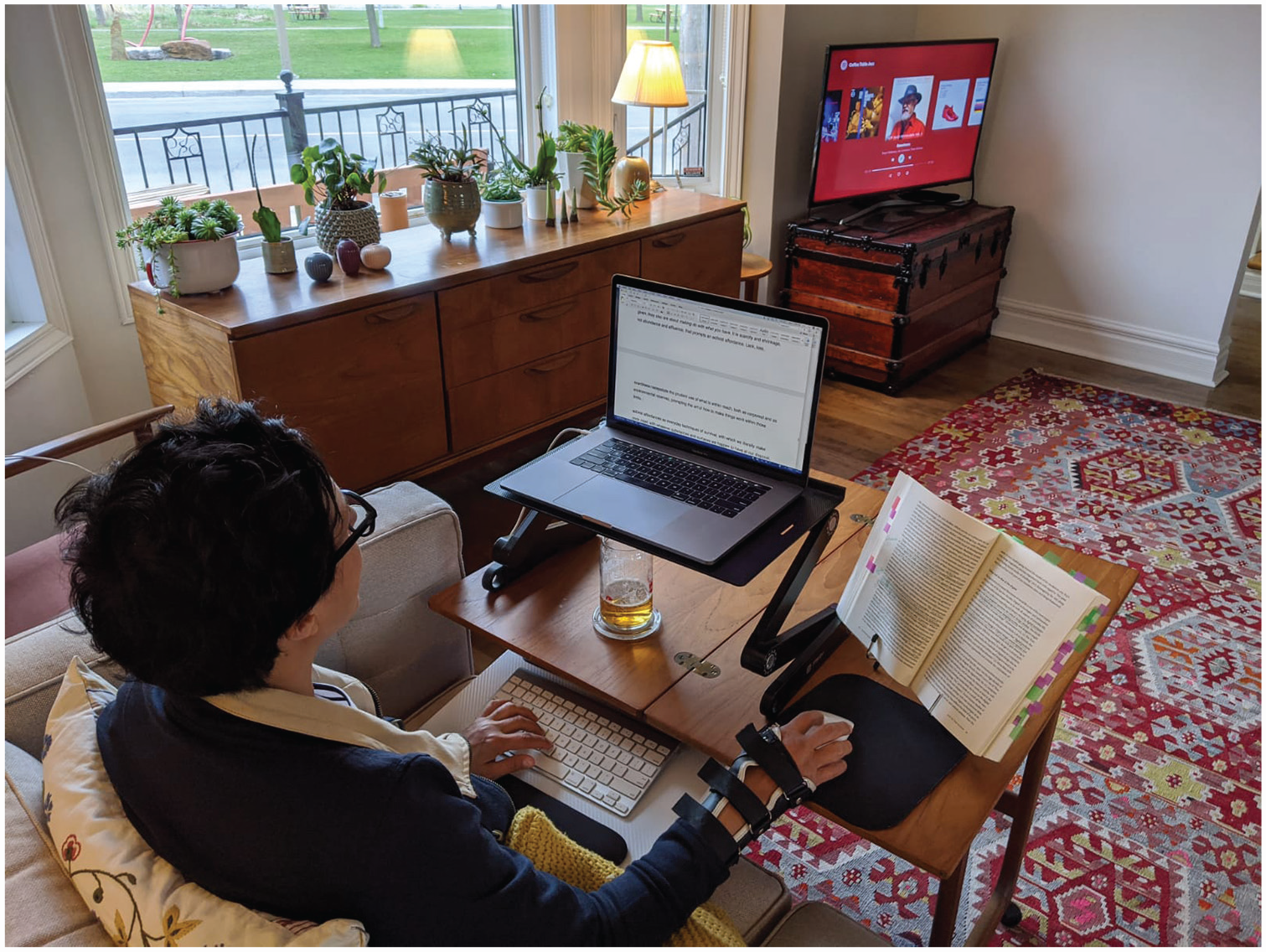
This is how I work. More precisely, it is one of the multiple arrangements in which I work. Let me translate what is happening here into words. The cushion under my arm supports my previously damaged and currently inflamed/painful elbow joint. The laptop stand raises the screen up to the level of my eyes so that the tightening of the joint space between my cervical spine’s two top vertebrae is not further reduced. The cushioned tray placed on my legs brings the keyboard to the level of my hands, and in so doing, prevents me from having to lift my arm beyond the limited range of motion I have due to a full rotator cuff tear. The custom-made brace is for my impaired and inflamed/painful right-hand wrist. The flowers, the music playing through the TV, and the half-drunk glass of beer are for my mental health—self-medications for the pandemic-aggravated symptoms of the obsessive-compulsive disorder (OCD) that I live with.
This photo was taken only a few months after the COVID 19 pandemic broke out, when given my immunocompromised status, my husband and I decided to go into full confinement. But the particular body–objects assemblage that this photo documents (and countless other variants that can be found in our house) existed long before the pandemic. As an academic (rather than having an eight-to-five job), I have had the privilege of being able to mostly work from home, so that when the pandemic hit, not much changed in my life. No doubt my privilege as a middle-class full-time faculty member at a university in Canada made the transition smooth. But importantly, as a chronically ill and disabled person, my life has always been somewhat “pandemic-proof” (Shew, 2020, p. 9).
Since my early teenage years, I have been living with juvenile rheumatoid arthritis—a chronic, progressive disease that affects and eventually damages multiple joints in the body, causing prominent pain and fatigue. As the disease has progressed over the years, irreversibly damaging several of my joints, limiting their motion, and causing severe instability in my neck, the everyday spaces that I can inhabit with my impaired body have correspondingly “shrunken” (Dokumaci, 2019, p. 498). By shrunken, I literally mean shrunken, just as a 100% cotton shirt shrinks after being put into dryer.
Shrinkage 25
As I have argued elsewhere (Dokumaci, 2019, 2023), when you live with disability, your environment narrows down and affords fewer and fewer affordances. 26 This is what I mean by “shrinkage.” Imagine a day after the photo of me in front of my computer was taken: if one more of my upper joints is swollen, I can’t reach that half-drunk glass on my table that I was able to reach a day prior. Or if I have a flare-up that makes my entire body burn in fever, I will be confined the circumference of my bed, unable to even reach the room in which that photo was taken. The environment is often reduced in size for those who are disabled and chronically ill, and for those who have weakened and debilitated “bodyminds” (Price, 2015). The environment that they can relate to, sense, and move in without irritation and friction—narrows down. It gets smaller in comparison to the everyday spaces, things, and their affordances that are doable for their more privileged able-bodied co-inhabitants, or in comparison to the spaces they themselves used to inhabit before they fell ill, acquired a disability, deteriorated to its next phase, or as it shifts day to day.
I developed the concept of “shrinkage” to name the bodily, environmental, and other kinds of diminished spaces and resources that disabled people have to live with.
However, it does not describe the condition of disabled people alone. In fact, I propose that the concept of “shrinkage” also names the prescient resonances that disabled living has for the restricted and confined conditions of living that larger populations experience under different crises—like the current COVID 19 pandemic. To mobilize the concept in this more expansive way complicates and blurs the boundary between able-bodied and disabled. The concept now prompts us to ask: How might the rest of the world, especially at this time of COVID 19, learn from the ways that disabled people have devised to go about their everyday lives under conditions of shrinkage?
Improvisation
Moving from my own experiences, I imagine disabled people to be going about their variously shrunken conditions of living through the following analogy with the theater stage: Just as actors enact other realities by engaging with the literally shrunken space of the stage and its limited number of props in highly imaginative and improvisatory ways, disabled people may imagine and enact other possible—more accessible, more welcoming—worlds in and through their improvisatory movements and actions that I have elsewhere theorized as “activist affordances” (Dokumaci, 2023, p. 103). 27 For example, when the normative design of utensils does not welcome their inflamed, painful, “deformed” fingers or their bodies without arms, disabled people may discard the use of knives and forks, cut with their teeth and eat directly with their mouths (see Dokumaci, 2017, p. 399, Taylor, 2017, p. 153). These activist affordances, and the accessible futures that they bring into being—futures to be inhabited with less friction, soreness and more gentleness—may not exist in an actual material form or a socially normalized configuration, but they are imagined and lived regardless. These makeshift, ad hoc, less-than-perfect improvisations may not eradicate barriers, pain, and irritation, but they may alleviate them, take the edge off things, so to speak, and keep life going on nonetheless. It is precisely these improvisatory affordances that disabled people develop by way of having to live in shrunken worlds. These affordances might provide an invaluable resource, a many-times tested-out toolkit, and a well-rehearsed repertoire for the broader societies that are currently facing the reality of having to live in literally shrunken (i.e., confined) spaces. Activist affordances are, in short, what might be needed for the world under the conditions of global crises like COVID 19, and the looming environmental catastrophe where there will be more and more large-scale crises to come.
A Non-Conclusion
And that is how our stories end. Rather than offering a conclusion of some kind, we want to dwell within that uneven and uncomfortable terrain that emerges through the coming together of our stories. What happens to access in this patchy terrain? How can one’s access become another’s barrier? Access to what, for whom, when, and under which conditions? Are there situations in which access might not be desirable? What does “incommensurability” (Tuck & Yang, 2012) mean for access? Crucially, can access hold together, not despite, but because of these multiplicities and dissonance?
Footnotes
Declaration of Conflicting Interests
The author(s) declared no potential conflicts of interest with respect to the research, authorship, and/or publication of this article.
Funding
The author(s) disclosed receipt of the following financial support for the research, authorship, and/or publication of this article: This article is supported by funding from the Social Sciences and Humanities Research Council (“Mobilizing Disability Survival Skills for the Urgencies of the Anthropocene”, PI. Dr. Dokumaci) and Canada Research Chair in Critical Disability Studies and Media Technologies.
