




Abstract
This article calls for a consideration of the reuse aesthetics of urban ruins in terms of cultural valuations related to the political status of social practices. In the context of debates on ruins in the field of memory studies and along the division between politics and the political, I argue for the recognition of affective atmospheric practices based upon performative knowledge-making and reenactments of atmospheres from the past. As demonstrated by an example of reuse in Berlin in the 2000s, these practices recall rituals and routines from the pasts of ruins by performatively exploring their futures. This position will be critically situated within the debate about “socially engaged arts” and the neoliberal “creative city” policies in the city of Berlin. It will also be presented as a cultural value-making in conflict with the paradigm of historical reconstruction in architecture and planning aimed at creating architectural replications from the archive. The article concludes with a reflection on reenactments as cultural value-making, a perspective that may have an effect on heritage policies.
Introduction
Urban ruins have been analyzed as artifacts of affect and of memory. They have been studied as the raw materials of cities with high mutability and affective excess, dismantled from their architectural classifications, typologies, and representational connotations (DeSilvey, 2006; Edensor, 2005). However, they are also understood as artifacts attached to processes of devaluation and are viewed as “indispensable eyesores” (van der Hoorn, 2009) or as the destroyed “rubble” of history (Gordillo, 2014; Navaro-Yashin, 2009). In reference to Georg Simmel (1907/1998) and Walter Benjamin (1983) and their analyses of ruins of modernity, a case has been made for the “ruinophilia” (Boym, 2008) of late modernity, addressing how ruins evoke cultural memories and affective imaginations about loss, nostalgia, and melancholy in postindustrial, post-socialist, and postcolonial times (Assmann et al., 2002; Hell & Schönle, 2010). With this clear link to the past, urban ruins can be described as sites of cultural value-making.
Over the course of the past decade, scholars in increasing numbers have studied memory practices related to the reuse of such artifacts (Bădescu, 2019; Elżanowski, 2018), in particular, along the division between politics and the political. “Politics,” which refers to the institutionalized order and state-related administration of common goods (such as heritage), is in opposition to the “political,” which stresses conflicts, controversy, and dissent in society. Urban ruins have been considered part of the latter category, focusing on the ways in which heritage and memory-making are woven into the political status of social practices (de Cesari, 2019). The dimension of the political conceives of memory-making as an “agonistic” practice of urban activism (Mouffe, 2007) that is also at odds with post-democratic tendencies in politics. Such memory practices are located beyond the policies of heritage-making of nation-states or local city governments and represent a contrast to the preservation of artifacts of universal significance by the United Nations Educational, Scientific and Cultural Organization (UNESCO’s) World Heritage List (Schäfer, 2016); in fact, memory practices irritate and puzzle these orders and practices of valuation.
Based upon this contrast, I wish to concentrate on the reuse aesthetics of urban ruins, which involves the sensual dimensions (Classen, 1997; Howes, 2003, 2005; Pink, 2006) of such cultural value-making on the political side, an aspect that has often been overlooked in memory studies (Freeman et al., 2016). Jacques Rancière (2004) presents a view on how sensual orders become distributed as powerful entities, which undermine institutionalized perceptions. Urban ruins stand outside the institutionalized order of perception (Edensor, 2007), but they provoke a specific “ruin gaze” (Boym, 2008), engaging with multiple pasts. I contend that the resulting practices of engaging with the past must be considered in greater detail.
I will apply this outlook to an empirical case study on the ruined German Democratic Republic (GDR)-era hall in Berlin known as the Palace of the Republic (PdR), building upon my own cultural sociological ethnographic research (Göbel, 2015). This case must be considered in the context of the struggle over heritage and memory-making (Till, 2005) after the fall of the Iron Curtain in 1989 and the politics derived from two opposing images of Berlin that influence the global reputation of the city even today. On the one hand, there are the “creative city” policies in the context of neoliberal authorities, the “culturalization” (Reckwitz, 2017, p. 173) of urban life, and the support of homegrown “memorial entrepreneurs” (Jordan, 2006, p. 2), engaging with the performative aesthetics of urban ruins; on the other, we find the planning paradigm of “stony Berlin,” which seeks to reintroduce the nostalgic idea of a European city of the nineteenth century by means of historical reconstruction, attempting to replicate original designs based solely upon archival materials. In my analysis, I will situate the case study within these conflicting positions in city politics, highlighting, in particular, how embodied practices of memory-making have emerged as a way of reenacting atmospheres of the past in existing fabrics.
First, I will outline how the aesthetics of ruined structures are mediated into practices by atmospheres that are capable of bringing about specific memories. As I will argue, second, these atmospheres maintain a performative approach to aesthetics. Third, this becomes visible in the shared performative methodology on the practical creation of atmospheres, which spans various expert fields and establishes new inquiries of memories. I will reflect on this point, using the case of the PdR, to highlight the analysis of reenactments of atmospheres from the past. Fourth, I will discuss how these practices of cultural value-making are embedded into the local politics of Berlin. Finally, I will present an outlook on how this understanding of the cultural valuation of urban ruins might influence the existing politics of heritage-making.
Affective Atmospheres and Atmospheric Practices
Over the past decade, “atmosphere” has become a concept linked to the political dimensions of the social, especially under conditions of post-democratic tendencies in politics and the establishment of neoliberal authorities (Anderson, 2009, 2016). The term was already in use as an aesthetic concept in phenomenological thought (Böhme, 1998, 2006) and in the context of debates over the aestheticization of the social; in this setting, it describes how subjects become enfolded by the built environment and experience it as a nebulous state and an ephemeral “half-thing” belonging neither to the subject nor to the object. Vitalist approaches concerned with the affective turn in the social sciences took this idea as their conceptual point of departure (Borch, 2014). It has been postulated that affective atmospheres come into view through the situated assembly of human perceptual capacities and nonhuman actors—namely space, sensory experience, and the built environment (Göbel, 2015; Sumartojo & Pink, 2019)—producing a dynamic interplay in the generation of affects. Especially in the context of approaches from Actor-Network Theory and the built environment (Jacobs, 2006), it is argued that they benefit from the analytical layers of sensuality and affect (Rose et al., 2010). By stressing the material and spatial components of affects, the character of atmospheres was related to the formation of neoliberal reason and the creation of affective imaginations of the nation-state (Anderson & Holden, 2008). It has been shown how this approach toward affective atmospheres can be linked not only to encounters at heritage sites (Tolia-Kelly et al., 2017) but also to other commemorative practices and national identities of memory-making (Sumartojo, 2016).
Based upon these conceptual foundations, it is emphasized that atmospheres should be grounded in practices (Göbel, 2015). First, by stressing the term “atmospheric practices” (Bille & Simonsen, 2019), scholars have indicated that the processual level of affectively attuning to atmospheres should be considered more directly. As a result, some have argued that the collective dimension should be analyzed more precisely. Practices also direct attention to the formation of collectively shared patterns of perception (Reckwitz, 2002; Schatzki et al., 2001; Shove et al., 2007), a category that includes affects (Reckwitz, 2012) and to how they materialize as over-individual structures. These resources of affective knowledge can be seen as a “regime of practices” (Thévenot, 2001). A regime connects and interrelates highly divergent practices that share performative knowledge patterns with regard to attuning to atmospheres.
Performative Aesthetics and “Socially Engaged Arts” in the City
Performative knowledge also originates in performance art. The focus, here, lies on aesthetic works on situations under conditions of bodily copresence that interrogate existing social orders of perception. As an interdisciplinary art genre that emerged in the 1960s, performance art crosses boundaries, primarily between the visual and the performing arts (Gronau et al., 2016). The aesthetic dimensions concern works on situations of the everyday, the body and its praxis, the perceptual repertoire of the body, and collective forms of movement.
This art genre has always been concerned with the critique of the museum and the theater and conventions of space-making. Alternative practices of appropriating and creating art spaces and gatherings in public have also involved urban ruins. Ruins came into focus in the context of urban strategies of the derive and of urban exploration as developed by the Situationists. They became a part of many art pieces, as is apparent in the minimalist work of Gordon Matta Clark and in the landscape art of Robert Smithson. Artists have also considered ruins in the context of “loft living,” as seen in the 1970s in New York’s Soho district, and of “squatting” in abandoned places, as was common in the 1980s in the former West Berlin (Zukin, 1982).
This understanding of artistic work situates the performative at the center of aesthetic practices. “Performative aesthetics” (Fischer-Lichte, 2008), a term originally coined in theater studies, focuses on how the actors performing on stage are turned into objects of aesthetic inquiry of the everyday perception of bodies and their social roles, rituals, and routines. The concept of “performativity” refers to this shift and to John Austin’s Speech Act Theory (1955/1971), which stresses that sayings must be performed in order to become real. In Judith Butler’s (1993, 1997) interpretation of this approach, this process is connected to all bodily acts, in which the bodily doing in the sense of performing also undermines what can be said.
With the term “performative arts” (Burri et al., 2014, p. 8), this perspective was broadened in the context of urban interventions and assemblies and as articulations of citizenship (Hildebrandt et al., 2019; Peters, 2016). Such approaches stress the performing character of the social in the context of political dimensions by means of “choreographic problems” (Cvejic, 2015) and by intervening in the existing spatial orders of the city (Beyes et al., 2009). These approaches conceive of the urban as a stage to develop collectivities (Schechner, 2003) such as flash mobs, protests, demonstrations, and other mass gatherings. Through such practices, artists invent the everyday life of the city anew—for instance, by means of “social choreography” (Klein, 2017) and the organization of spatial relationalities in urban encounters, and through working together with citizens in local neighborhoods and urban communities (Cvejic & Vujanovic, 2012; Pusca, 2010).
This turn toward community work was argued most prominently in the debate over “socially engaged” arts. It originated in the artist’s focus on self-initiated engagement in community work and interactive forms of participation and spectatorship in the urban realm or in the context of museum and theater spaces. Although it was initially celebrated by curators in the visual arts as a new “relational aesthetics” (Bourriaud, 2002), it soon drew criticism for its romanticized ideas about creating and sustaining social relationships that included very limited reflection on the scales and scopes of participation (Bishop, 2006, 2012) and the “powerlessness” of artistic labor (Kunst, 2015) in the context of cultural politics closely related to capitalist interests and entrepreneurship. The socially engaged arts were forcefully denounced due to their failure to consider the political dimension that they wanted to address.
Especially in collaborations with experts from architecture and design, many complained about how much these initiatives emphasized discursive placeholders and affirmed certain mechanisms of market logics (Richter, Göbel and Grubbauer, 2017). It has been acknowledged (Kwon, 2002) that artists move away from conventional understandings of public art in which isolated sculptural objects are placed in the urban, employing affirmative aesthetic proposals, and firmly under the control of public art policymakers. However, in reference to hegemonic theory, it is argued that most of these “socially engaged” projects fail to engage with democratic values and positions that prioritize “conflictual aesthetics” (Marchart, 2015, 2019). The dominating principles of such works focus on “doing good” for all involved, the interpretation of deliberation ending in the production of ambiguous positions, and misguided attempts at complexity related to brand recognition (Jackson, 2011). For interventions outside market-related aesthetic autonomy but positioned in the service of political work, it is argued that their concerns are articulated in relation to agitation and propaganda, to simplification and concreteness. Some have stated that such “agonistic” practices of art activism (Mouffe, 2007) address conflicts as an experience of democratic values, as an incoherency of positions, and as dissensus.
Images of Berlin: Creativity, Self-Culturalizations, and Historical Reconstructions
Any application of this understanding of the political must be situated within local politics, as well as in the images and related urban imaginations of the city.
Performative aesthetics should be seen as influenced by politics along the lines of the paradigm of the creative city. Political programs centered on the creative industries sector (Florida, 2005) have positioned the arts as urban catalysts for images on urban creativity; this was especially the case for local politics in Berlin in the 2000s. Several processes that currently impact urban neoliberal authorities today have placed emphasis on the “self-culturalization” of urban practices (Reckwitz, 2017), which included self-initiated projects in the cultural and creative sectors, also with a focus on the re-creation of abandoned ruins. However, from the start, the focus on the “creative class” was critiqued as an urban imagination of, and for, academic elites (Edensor et al., 2009; McLean, 2014; Peck, 2005). The arts and arts-related projects have, likewise, been marketed within the politics of creativity as cooperation partners and as “complicities” (Ziemer, 2013) with the primary aim of implementing greater diversity and cultural awareness by means of empowerment and participation (Krivý, 2013). This was argued as a complementary (Metzger, 2010), in the context of policymakers in planning and their underdeveloped cultural sensibility with regard to consideration of the needs of local neighborhoods, marginalized spectators, and participators. Although an “integrated epistemology” (Chapple & Jackson, 2010) was imagined for collaborations across various fields of expertise, especially cultural knowledge of historical imaginations and (counter-) memories related to the built environment (Oswalt et al., 2013; Rannila & Loivaranta, 2015), this inclusivity was often sidelined in practice.
However, in the reunified Berlin of the 1990s and particularly in the former East Berlin, many resisted cultural techniques of (legally or illegally) appropriating and reusing existing fabrics from the Socialist era at odds with the market logics of the paradigm of creativity. This self-understanding was clearly directed toward the political, with interventions critiquing the conventions of policymakers of creativity by introducing their specific cultural expertise and calling for a cultural valuation of these abandoned sites (Göbel, 2015). This was coupled with critiques of the cultural inability of politicians and planners to moderate such processes of empowerment and of the failure to institutionally address local historical imaginations and diverse memory-makings (Iveson, 2013). This was especially the case for the “culturepreneurs” (Lange, 2007) who have (in part, illegally) squatted in abandoned ruins in East Berlin since 1989, sustaining the transformations of these sites with alternative building practices (see also Ziehl, 2016). Although it is shown that such projects have produced many frustrations for the empowered participants (Tonkiss, 2017), including disenchantment over neoliberal methods of empowering knowledge and the lack of political expertise to intervene in the politics of established investor and policymakers’ constellations (Julier, 2017), it can be seen as a Berlin-specific case of “cultural activism” (Buser et al., 2013).
This activism can be viewed as in conflict with the paradigm of “historical reconstruction” in architecture and urban development, which involves a homogenized image of the city center. Berlin’s history as a city reflects a series of totalitarian design concepts in which the unity of a center stems from an “image of simulation” (Hertweck, 2010, p. 128)—never achieved but always longed for. Karl Friedrich Schinkel, the most important master builder of Berlin in the Wilhelminian era, Bruno Taut (Mietskasernenstadt), Albert Speer (Nazi-architecture Germania), Hans Scharoun, and Hermann Henselmann (Neues Bauen)—all of their visions for the city in the nineteenth and twentieth centuries have contributed to an image that builds upon an unbroken whole. From a memory perspective, it was argued that after World War II and the total loss of German identity, the strategy should be to continue with this tradition through “reconstructions” from the archive of history: first, by consolidating the simulation of a historical city center and, second, with reference to the Wilhelminian era and reconstructions of built ensembles from that time, in particular.
This predominant perspective of urban development was just one side of the coin: the opposite side conceived of Berlin as a palimpsest and a city of destruction, heterogeneity, deterioration, and displacement (Hertweck, 2010, p. 214), which flanks the paradigm of creativity. This view was based on the failure of each successive totalitarian concept of urban development to eradicate its predecessors and achieve unity, and on the result of the Allied bombings in World War II. With the deindustrialization of inner cities and with the Internationale Bauausstellung (IBA) in the 1980s, the fear of even greater destruction was countered by new and postmodern movements in urban development. This genealogy of urban development and of an image of heterogeneity also shapes many of the cultural entrepreneurial engagements with urban ruins even today, closely linked to the performative aesthetics of the city.
The urban development paradigm of Steinernes Berlin (“stony Berlin;” Hertweck, 2011), which arose in the 1990s after the reunification of the city, continues to promote such homogenized images with the clear objective of the reconstruction of a nineteenth-century city center (Fezer & Wieder, 2004; Oswalt & Kulturstiftung des Bundes, 2004).
“Atmospheres of the Past” 1 in the Ruin of the Palace of the Republic
The PdR, the GDR-era cultural hall in the historic center of Berlin that was also the meeting place of the Volkskammer, can be viewed as representative architecture over which the competing urban imaginations of Berlin battled. Because it came to be treated as a “monument to dismantlement” (Varvantakis, 2009), the palace became a showcase of the political machinations of competing memory-makings and an emblem of Berlin’s reuse aesthetics and other memory forms of “urban exploration” (Arboleda, 2016)—an alternative to heritage-making projects.
Shortly after the reunification of the city in the 1990s and the closure of the building due to asbestos problems, competing agendas from various sectors sparked a political controversy over the future of the palace. Early in the process, local politicians requested expertise from heritage-makers (Denkmalschutzamt) and asbestos experts, which attracted the attention of a civic movement, advocating for the memories of contemporary witnesses, and thus the maintenance of the palace. At the same time, another civic movement closely connected to the local government and the policymakers of “stony Berlin” lobbied for the destruction of the palace in order to facilitate a re-creation of the city castle of the Hohenzollern Dynasty. By the end of the 1990s, local politicians and the two civic movements were mired in a struggle over the issue: was it better to maintain a political, representative building from the Socialist era or to reconstruct a castle demolished 20 years before the PdR was built? From the year 2000 onward, the conflict drew national media attention and became a focus of politics at the national level. The German government, headed by the Social Democratic party, put the issue on its agenda, and in 2002, it decided to demolish the palace in order to reconstruct the facade of the city castle for an integrated museum to be called the “Humboldt Forum.” The palace was demolished (from 2006 to 2008); the new building has not yet opened.
Between 2002 and 2008, the development of performative memory practices inside the PdR and in the realm of the political took place. This was organized by cultural stakeholders, particularly those from the context of the performative arts. Four different alliance partners from cultural institutions belonging to the performing arts founded an association called Zwischenpalastnutzung 2 (“interim palace use”) and succeeded in the realization of a temporary-use period called Volkspalast (“people’s palace”) for 2 years (2004–2005) in the already-dismantled ruin of the former palace (Deuflhard & Krempl-Klieeisen, 2006; see Figure 1). Against the backdrop of squabbling local politicians, the civic movement lobbying for the castle, and the political decision by the German government to dismantle the building, the temporary-use period not only gained international resonance in architecture and the performative arts but also gained international resonance in the wider public interested in visiting the building as a ruin, and for the last time (Ouroussoff, 2006). The project was extensively documented, and it won awards for innovative urban design strategies.
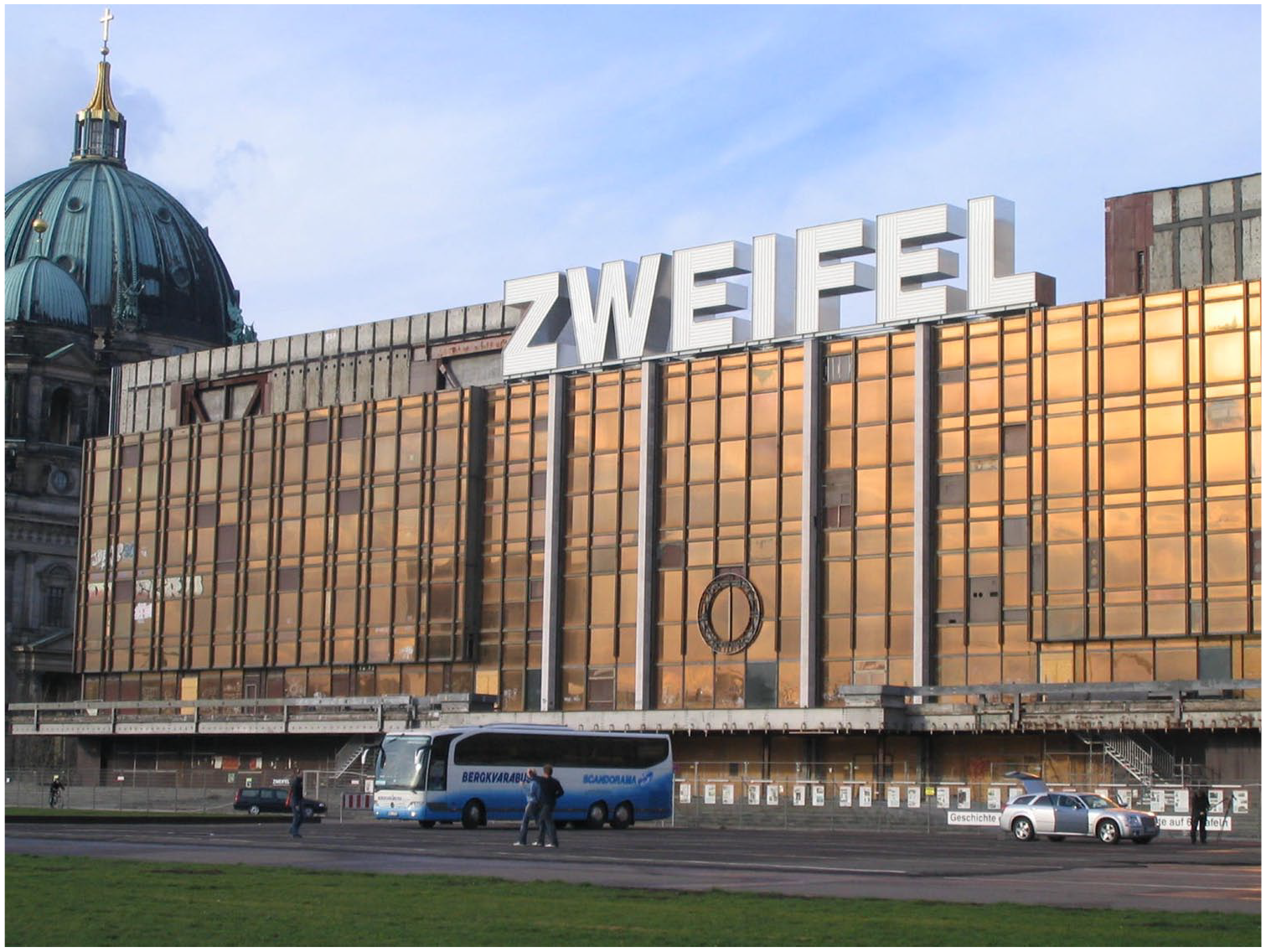
Installation by the artist Lars Ramberg entitled Zweifel (“Doubt”), referring to the public debate over the future of the building, 2005.
Performative Valuations
In the following text, the cultural program of the two summers of the Volkspalast is outlined and considered along the lines of performative knowledge and the practices of valuing atmospheres of the past anew.
Reenactments of Practices versus Reconstructions through Documents
The major performative device that encompassed all projects developed within the ruined structure of the palace was the excavation and aesthetic experimentation with the past, meaning the memory of the building, symbolic connotations, and multiple narrations of former uses. The concept was to exploit the nostalgia and melancholy strongly inscribed into the topos of the ruin in order to illuminate and reminisce about the affective attachments to the former building. However, the aesthetic aim was not simply to recall a bygone era; rather, by drawing on strategies of “reenactment” from performance art (Arns & Horn, 2007; Daugbjerg et al., 2016; Loreck & Ott, 2014; Roselt & Otto, 2012), which explore the aesthetic relationship between repetition and difference, the objective was to demonstrate how the past performatively meets with the present and the expected future (the historical reconstruction of the city castle).
The curators and artists involved coming from the performative arts were interested in creating a “virtual ritual” in the ruin. This was intended to enact rituals of the former GDR and specific practices from previous eras of the building anew, by disconnecting them from their political connotations and bringing them into dialogue with the social orders of the 2000s. For various exhibitions and as part of the creation of a temporary hotel and bar, these artists conducted archival research on photographic, video, and text materials about the old building and generated interview materials with witnesses from the GDR era. They used these materials not only as a means to explore the history of the building but also in ways in which the memories of the old palace were constructed. Based on these data, the organizers created settings and installations in which participants were enabled to experience these affects within selected practices. These included strolling through the ruin to feel the disconnect from Socialist-era marches involving the palace and from its GDR inscriptions, and the bourgeois enjoyment of fancy cocktails in the temporary bar, which was at odds with the nonconsumerist experience in Socialist-era palace restaurants. In all of these reenacted practices, the aesthetics of the ruin were exploited to spotlight the time difference between the actual state of the existing built structure and the virtuality of the past in order to value the potentialities of using the structure for new architectural programmings.
This methodical approach of valuing the aesthetics of the site based on reenactments differs from the major planning device currently in use—historical reconstruction—which dominated the conflict in this case study, particularly through the paradigm of stony Berlin and the reconstruction of the city castle.
Historical reconstruction differs, first, in a more general sense, because of the lack of cultural valuation of existing fabrics and their cultures from the past. The lived memory of an existing structure is often overlooked due to a misrepresented need for integration in the context of the paradigm of historical reconstruction (Göbel, 2015). Moreover, planners, even more than architects, are still trained to progressively build from scratch in order to look into the visionary future (Markus, 1979). This includes a strong preference toward demolition without consideration of alternative economies or culturally oriented strategies that might incorporate the existing but obedient built materials of the present. In memory studies, it is argued that since the 1970s, architectural movements of “architecture without architects” or building-in-existing-fabrics have led to a reorientation—turning the past—which was not necessarily supposed to be part of the cultural archive, into a resource for the future (Assmann, 2010, p. 17; Boym, 2001). The performative practices of reenactments do not value futurity, as such, but material cultures of the past and their potential architectural futures.
Second, different methodical tools of valuation are used in reconstruction, tools that give epistemic preference to working with the archive instead of the memory. In planning, but also in restoration and conservation, a broad concept of the archive dominates, but it is generally concerned with the very narrow methodical access to historical document analysis. This was the case in the conflict over the future of the palace: arguments for the historical reconstruction of the city castle involved glorification of the archive. As I would like to stress, this results in nostalgic accounts of the original through sparse and subjective visual imaginations of past cultural, political, and social orders, but only by sensing and experiencing them from scratch and primarily through image, video, and footprint materials (Assmann, 2009; Gagliardi et al., 2010). The atmospheric attunements to the past developed in the “reenactments” provide a clearly embodied, relational, and performative access to existing fabrics, serving as an epistemological extension of analysis of documents from archives.
Reenactments as Reuse: Performative Devices of Inhabitation
Furthermore, the reenactment approach enters new terrain by working in situ with the raw materials of the object to be designed. During the summers of 2004 and 2005, this was particularly evident in the creation of the hotel inside the palace ruin’s main hall, in which you could book single or double rooms and experience the ruin from different viewpoints. This hotel installation provided surprising explorations of the cultural forms and styles from the past through the material status of ruined existing fabrics (Yaneva, 2008). At the same time, these engagements with the ruin’s aesthetics also offered spaces for the imagination of different futures of the building, such as inhabitation. The Berlin-based architecture collective raumlabor, which conceptualized and realized the hotel, is engaged with the development of performative architectural devices for the imagination of possible programmings.
Using this as an example, one can finally argue that such embodied engagement with existing aesthetics is concerned with the area of conflict between experts and expertise. Practice theory has highlighted that the expertise developed through the daily routines and training-on-the-job character of practices displaces to some extent the cultural capital of the expert in his or her professional field (Collins & Evans, 2007). The practices of reenacting former rituals in a different political setting, as in the case of the bar, or practices of inhabitation to imagine new ways of comprehending the existing structure—these both serve as examples of how such practically developed expertise surpasses established expert knowledge. I have argued this for the case of Berlin and the decade of the 2000s specifically, but it can be generalized to the analysis of other urban constellations of practices.
Conflicts in Cultural Value-making
With this in mind, I would like to reflect on the overarching lines of conflict that address the cultural valuation of ruins. On the one hand, there are the productions of historical imaginations, aesthetics, and images of the city, predominantly from ontological scratch (Tait & While, 2009); this can be identified on the side of local politics and politicians, including heritage-makers, dominated by planners and architects from the paradigm of “stony Berlin.” As I have argued, all of this occurs primarily through consideration of the archive and through document analysis. This is in conflict with the discussed methodologies of valuing ruin aesthetics in which the premise is to develop memory “in the making” through performative and bodily oriented practices and by stressing an embodied notion of aesthetics from the past. They undermine other existing perceptual orders of existing fabrics. Thus, through the lens of Rancière’s considerations, they address the manifold nature of perceptions of memory. With regard to the positions of Mouffe and Marchart, these valuations can be seen as political interventions that stress the conflict, controversy, and dissensus around a ruin as a key democratic experience and value. Although the PdR was demolished, the prototypical case of the Volkspalast in the summers of 2004 and 2005 has led to these embodied methodologies of valuing ruin aesthetics. In Berlin, specifically, many other urban ruins have become objects of cultural value-making by performative aesthetics. The so-called ruin porn in various properties with the over-aestheticization of past eras is also an economic result of these changes (DeSilvey & Edensor, 2013; see also Göbel, 2015). In the context of the politics of decolonialization of the past decade, urban ruins have become critical objects of reenacting history anew, also bringing the performing character of memory-making to the fore (Stoler, 2008; see also DeSilvey & Edensor, 2013).
Concluding Remarks: Built Memories by Performative Means
This article has developed the notion of performative aesthetics for urban ruins, considering how this provokes a regime of memory practices with a focus on body-centered and performative inquiries of existing fabrics. I have reconstructed how the methodologies of valuing ruin aesthetics borrow their approach for reenactments from the performative arts; such aesthetics must be critically situated in the “creative city” policies and along the conflict lines of historical reconstructions in urban development and planning. By reviewing one of the showcases of the 2000s in Berlin, I argue for a renewed understanding of performativity, combining memory-making with inhabitation in the process of valuing ruins. The aesthetics of urban ruins have served as a case study for the development of these claims. As an outlook for heritage-making perspectives in politics, I wish to argue for a systematic cultural acknowledgment of these practices, which entails estimating the values of how they emerge and are developed in interdisciplinary constellations of cultural urban labor.
Footnotes
Declaration of Conflicting Interests
The author declared no potential conflicts of interest with respect to the research, authorship, and/or publication of this article.
Funding
The author received no financial support for the research, authorship, and/or publication of this article.
