



Abstract
In this article, we affirm that the feminist march of March 8, 2019, in Santiago constituted a safe and secure space for the women who participated in it. As a result, it created the conditions for the deployment of individual resocialization processes through which the categories and modes of organization of patriarchal society are challenged. Using the accounts of participants, the article describes some of the elements involved in the production of this safe space, contributing empirical evidence to a debate that tends to be mostly speculative. The article includes a theoretical discussion and analyzes 11 “walking interviews” with women who participated in the march. The interviews were conducted by one of the authors a few days after the march in the places where it took place (in situ).
Introduction
The march was called for Friday, March 8, 2019, at 5 pm, to mark International Women’s Day. It took place in Santiago’s Plaza Italia (subsequently renamed Plaza Dignidad after the outbreak of social unrest in October 2019), a traditional assembly point for social demonstrations. During the day, thousands of women took to the streets to protest and, according to the 8M Coordinator, 800,000 people participated in the mass event.
The March 8 demonstration is usually a culminating moment of feminist mobilization and brings together a great diversity of feminisms, identities and collectivities. In this article, we focus on its capacity to serve as a space for meeting among women that enables certain subjective and emotional experiences with political implications.
In geographic research into protest and social movements, one line of work analyzes the microscale of bodies, perceptions and feelings and how these are necessary to understand activist political praxis. Sziarto and Leitner (2010) look at how spatial–temporal relationships and their emotions are key to the development of a shared political identity that gives sustainability and cohesion to social movements. Chatterton (2006) argues that social change depends on the creation of a space of emotional connection so activists can achieve the feeling of empowerment that underpins opposition action. In his work on the Mothers of the Plaza de Mayo movement in Argentina, Bosco asserts that activists’ emotions play a key role in how interpersonal networks are created and maintained, allowing movements to grow and endure in space and time (Bosco, 2006, 2007). Following the notion of Gould (2009), we show how the feminist march of March 8 constituted a space of affectation that enabled the production of new collective worlds through the construction of alternatives that challenge the status quo.
For this purpose, we use the theoretical and conceptual framework of Sara Ahmed in “The Cultural Politics of Emotion” (2014) and “Queer Phenomenology” (2006) in a bid to understand how and through which elements the feminist march in Santiago permitted the creation of new lines of orientation toward copresence on the street. Specifically, we are interested in understanding how this march enabled alternative forms of affectation which, according to the interviews carried out, were antipatriarchal, liberating, safe and secure. We seek to understand the women’s accounts as a means of gaining an insight into the dynamics of affectation experienced in the context of the march. We pose two main questions: How was the March 8 march experienced by the women who participated in it? And what forms of affectation did the march enable according to the accounts of the participants?
Further, we present the theoretical framework used in our research. We then describe the methodology before going on to analyze the interviews conducted, focusing on four main aspects: the generation of a disposition to affectation, the mass nature of the march, deactivation of the hegemonic discourse, and the march as a safe space. We end with a reflection on the dynamics of resocialization triggered by the experience of the march.
Orientations Toward Affectation in Copresence
Under the approach of Sara Ahmed (2006), emotions are capable of generating movements of proximity or distancing, as well as enabling impressions that are inscribed in bodies. In this way, being in contact with others means that they leave an impression on us; they affect us. At the same time, we leave an impression on others. Under this logic, emotions are produced as a result of the relationship or contact between bodies, between bodies and objects, and between bodies and spaces. These encounters create reactions of “towardness” or “awayness.”
The bodily inscription of emotions makes us prone to incline or move in relation to other people or other objects (Ahmed, 2014, p. 211) and this is produced through a series of techniques provided by a specific social order. In line with Foucault’s genealogical perspective, Ahmed argues that the supposed spontaneity and automatism of emotions are, in fact, the product of a series of techniques that become habits and tend to become naturalized. This leads her to affirm that emotions are inclinations or directions toward others and toward things, but also toward the perception and recognition of those others in a certain way. This demonstrates that our ways of feeling are the result of long work, training, and habit-forming behavior.
Emotions accumulate over time in what Ahmed refers to as a form of “affective value” that is particularly visible in the case of emotions that are branded positive or negative, and that involve bodily directions and moral orientations toward or against them. In the always situated occurrence of emotions, these inclinations and orientations have been addressed in the theoretical field of affect through a series of notions that Ahmed accurately describes as “moods,” “attunements,” and “atmospheres” (2014, pp. 221–222). They all underline the relational, intersubjective and interobjective nature of emotions: “to be attuned to each other is not only to share on emotions (. . .) or to share an orientation toward objects (. . .) but to share leanings” (Ahmed 2014, p. 223). She stresses, however, that these attunements are not spontaneous, but require emotional labor.
Ahmed’s approach is helpful in investigating how certain forms of meeting “move” their participants. Specifically, in our case, Ahmed’s arguments allow us to study how the women who participated in the demonstration were affected by their attendance and the experience of being copresent in the space. Ahmed (2006, p. 58) argues that being affected may generate new impressions, which can be different from those that are socially accepted and can challenge social spaces and conventions. In other words, actions, and intentionality create “lines of direction” that shape our perception of what surrounds us and our orientation toward others.
When studying the dynamics of affectation experienced in the context of a collective mass activity, one of the great challenges is to grasp a phenomenon that often tends to become ethereal. This implies the risk, noted by Frers and Meier (2017), of projecting the researcher’s interests, expectations, and speculations onto the object being studied, without taking into account the specific and concrete effects on the subjects involved. To avoid this risk, we find the approach developed by Margaret Wetherell (2012) useful.
Wetherell (2012, p. 22) states that affect is necessarily related to the process of construction of meaning and can, therefore, be understood through the spoken narrative. She uses the term “affective practice” to refer to the constellation of material objects, institutions, individuals, bodily states, past experiences, and expectations of the future that make up the affective experience. She argues that affective experience can be something extraordinary and spontaneous (for example, unexpectedly “encountering” the atmosphere of the march and being affected) but is usually the result of expectations shaped by past experiences and previous affective work (having participated in previous mobilizations or, for example, having prepared to attend the march by painting a poster). The interviews conducted for this study showed that, in general, the march as a space of affectation is constructed in both the ways described by Wetherell: spontaneity and previous work.
Wetherell argues that, rather than focusing on nonrepresentational aspects of affective or emotional experiences, it is important to look at the discursive forms that make up the affective experience and its relationship with social and cultural structures. We find Wetherell’s approach and, in particular, her concept of affective practice helpful as a complement to Ahmed’s understanding of impressions and directions because it means that continuity and patterns of affective experiences can be included in the equation through the accounts of those involved. The impressions that other entities leave on us are often determined partly by our past affective experiences or our expectations of such encounters. In this sense, thinking about affectation as a continuity and an emerging process implies a need to understand a series of variables that interact in enabling an affective experience. In this sense, we recognize that our approach is partial, taking into account only the most salient and relevant elements of the interviews and our observation of the march. Despite these limitations, we consider that its main value lies in proposing an empirical approach to a complex affective experience, which is simultaneously “somatic, neural, subjective, historical, social, and personal” (Wetherell, 2012, p. 11).
Methodology
As indicated earlier, we approach the study through two main questions: How was the March 8 march experienced by the women who participated in it? And what forms or types of affectation did the march enable according to the accounts of the participants? In line with the theoretic framework discussed earlier, we organized our research by distinguishing between the pre-march experience and the experience during the march itself.
In accordance with the importance given by Ahmed to the relationships between bodies, objects, and spaces, we established three experiential registers of interest for our research: (a) a corporal register, understood as a sensory register with respect to the body itself during the march (for example, what was felt, how it was felt, what was perceived by the person’s own body); (b) a relational register, understood as a register of the forms of sociability and interaction established with others during the march (for example, who the person went with, who the person met, what they did together, what other people or groups does the person remember) and; (c) a spatial register, understood as a register of the space where the march took place (for example, the places where the person was, the feeling the person had about them, the movements of the person there). We decided to approach the relationship with the objects transversally throughout the study due to their ubiquity.
We observed the march in order to form a fuller idea of its characteristics and understand individuals’ affective experiences in context: in relation to the objects that make up the experience of attending a feminist march (Feigenbaum et al., 2013). It also allowed us to test our preconceived notions, addressing the problem of projecting our expectations, interests and speculations onto the object of study (Frers & Meier, 2017). Bearing in mind this critical point, we discussed and reflected on the material gathered during our observation of the march and reorganized our interview questionnaire.
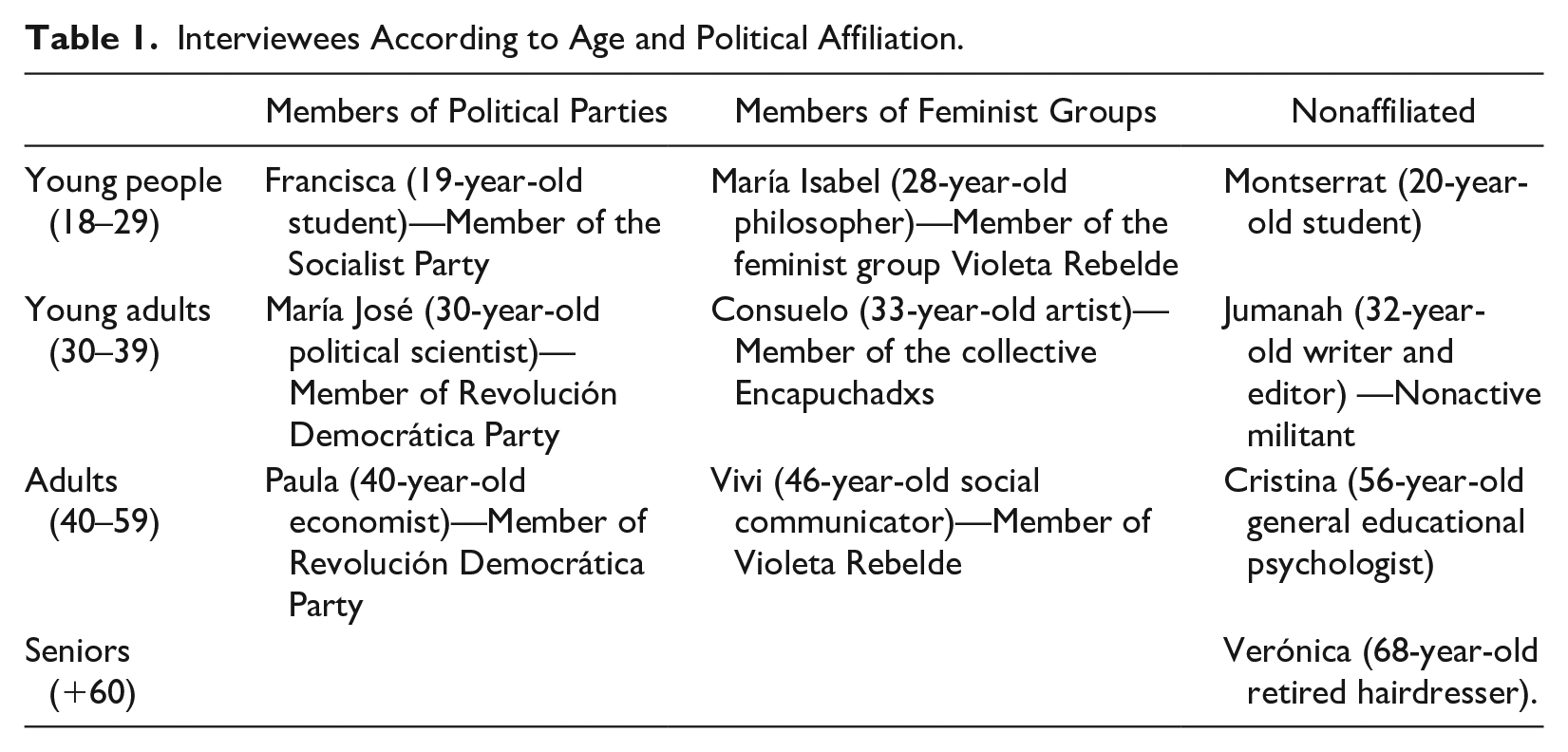
We interviewed 11 women, selected to provide a diversity of perspectives based on two criteria: age and political affiliation (see Table 1). On age, we distinguished between young people (18–29 years), young adults (30–39), adults (40–59), and seniors (+60). In the case of political affiliation, we distinguished between the nonaffiliated, members of political parties and members of feminist groups. We were also careful to include some diversity as regards the occupation of interviewees. In this sense, having more interviewees over 60 years old and women with diverse backgrounds rather than academic would have made our empirical material more robust. We are aware that the group of interviewees is reduced in scope, and we acknowledge the limitations of this research. Under the informed consent signed by interviewees, they had the option of remaining anonymous, but all agreed to participate using their first name.
Interviewees According to Age and Political Affiliation.
We used the “walking interview” format, which permitted the interviews to be informed by the spaces in which the experiences in question occurred. This generated an appropriate frame for the corporal, relational, and spatial registers since, as Bates and Rhys-Taylor (2017, p. 2) assert, talking while walking with an interviewee permits observation of “the transient, embodied, and multisensual aspects of ‘the social.’” The interviews were conducted in the places where the march was held (in situ), some days after the event. Given the difficulties that could have been created by the presence of the male author of this article, they were conducted by the female author, which proved key in creating a sense of trust and identification.
Interviews of this type take advantage of how the interviewees themselves compose and use horizons of meaning to establish and organize subjective meanings, based not only on the researcher’s questions, but also on what is evoked by the space itself. The researcher encourages interviewees in their accounts but the movement, the path taken and the places also invite them to elaborate stories that, in their content and connections, reveal various ways of structuring experiential significance. In this way, while the interview questionnaire offers various horizons and possibilities of narrative connection, the space, memory and the body itself collaborate in the production of the meanings of the interview. These “microgeographies of space” tend to be ignored or hidden when standard interview practices are used (Elwood & Martin, 2000).
Analysis of Interviews and Results
Based on our initial questions and the theoretical-methodological framework, we address five main points that reflect, firstly, the temporal distinction between the time before the march and the time of the march itself and, secondly, the three analytical registers indicated earlier: corporal, relational, and spatial. In addition, these five points are linked chronologically according to participants’ accounts of their experience. The five points are as follows: (i) generation of the disposition to affectation; (ii) the mass nature of the march; (iii) deactivation of the hegemonic discourse; (iv) the march as a safe space; and (v) the dynamics of the resocialization that was triggered.
The Time Before the March: Disposition to Affectation
In all the interviews we found that, in different ways—sometimes conscious and desired and sometimes unconscious and rather random—the interviewees predisposed themselves to participate in the march. All of them deployed an intervention on themselves in a bid to boost their individual positioning with respect to the demands of the feminist mobilization. In addition, there was an enhancement of their sensory abilities, their attentional capacities, and their connection with other women. The accounts also show how small and subtle practices have the ability to intervene in the sensory and reflexive register that participants in the march have of themselves.
In the temporal register, it is possible to distinguish references to the participants’ biographies in the form of evocations from earlier years (including their childhood and youth), which are activated in the weeks prior to the march. It is also possible to identify direct references to what happened in those previous weeks. There are also allusions to earlier in the same day. And, finally, there are allusions to the moments prior to the event: meeting up to go together to the march, the journey on public transport, the moment of going out on to the street and walking to the site of the march. It is not the purpose of this article to categorize these different temporal registers but it is important to note that they all contain allusions indicating that the women had previously undertaken activities that predisposed them to what would occur during the march:
That was a day we rather devoted to feminist activities. First, we were at a football match and an olla común 1 here in the park, but back over there, at lunchtime. With the girls from my organization, a very small organization called Violeta Rebelde, we got together to see the match and have an olla común at the same time as the match.
I didn’t tell you this before but, when we were getting ready, we wrote things, we put on stickers, we sprayed glitter all over ourselves, whatever each one wanted. It was basically an experience of sharing and getting ready to go to the moment that was important to each of us. Perhaps for others, it is their wedding, a birthday, a recital or a party. It’s a matter of helping each other, advising each other, believing in ourselves.
Both these quotes illustrate how processes of engagement with other women interested in the march are generated in a framework of equality and symmetry, two fundamental characteristics of the moods and attunements produced among the participants. However, we also see how this engagement occurs around objects and situations defined by the presence and circulation of those objects, such as the olla común or putting glitter on one’s body. The relationship with these objects and their mode of presence and circulation (Böhme, 2013) create a particular atmosphere that is conducive to being with others and affected by them. As Stepnisky (2018, p. 93) has argued, atmospheres or the feeling of space depend to a certain extent “on the ongoing efforts through which protestors jointly arrange objects and activities.” According to the interviews conducted, this is certainly a case of collectively generated bodily dispositions.
However, this work of the women on themselves can also take place in far more intimate settings. This is illustrated by the account of Jumanah, which reveals the subtlety of the affectation generated by trivial materials and listening to music:
Well, that day I was on strike so I didn’t go to work. That day, I made my poster, I spent a lot of time listening to Nina Simone and preparing my poster, looking at Instagram for inspiration and talking with Isa . . . thinking about what we could put on the poster. I found a few words from Emily Dickinson that said, “We don’t know our true stature until we stand up,” or something like that, and I thought “that’s it!” I spent a lot of time doing that. I found a piece of cardboard in the building outside the apartment where I live and asked the woman who does the cleaning if I could use it and she said I could. I took it to my apartment and started looking for something to make it with because I had no paint or anything, but I found a Sharpie and I made it. Then I felt as if I was more visible (. . .)
Jumanah’s account shows how small gestures become impregnated with meaning and are transformed into catalysts of affectation. The search for materials to make a poster becomes an activity full of meaning in which the intention of being visible is at stake. This reveals the powerful and profound direction toward others that occurred in the moments prior to the march and how this bodily disposition is always a function of otherness, whether present or imagined. There is a key trait here: a quest to be present and for others in a quite full sense. This produces attunement with the “mood” of the march in which all are present, active, and available in their diversity. A sense of responsibility and responsibilization arises as well as one of collectivity.
This last point is evident in the accounts of our two oldest interviewees, Cristina and Verónica, where the sense of responsibilization plays a key role in their disposition toward others, advancing in a temporary commitment that transcends the specific situation of the march:
I said: “If I’m going, I have to know why I am going.” I didn’t come thinking “what a good vibe, I am going to go because it’s fun.” I said: “Let’s see, why am I going, because I'm going to ask myself that and people are going to ask me and I want to be able to answer myself . . . the others didn't matter so much” (. . .) I prepared myself because I said I want to know why I’m going; in other words, I don’t want to march because of the drums, I want to march because I want, above all, to pay off that debt to myself and my male and female comrades because this movement is not only for women. I think it is for all of us.
Yes, I wanted to go to this march because it’s the least one can do. There is a lot of discontent, there are many things I don’t like, but I don’t know what can be done. Maybe, just go out on the streets and show your discontent. Well, then I said, “I’m just going to go.” It was ours, the women’s, it was about our rights. I had a hard time when I was young, when I was in a couple, so this was a way to free myself that the same doesn’t happen to other women.
This suggest that the time prior to the march is when supports and sensory conductors are formed that begin to intervene in the conception the women have of themselves; a time in which, collectively, a disposition toward affectation is generated. These actions and intentionalities create “lines of direction” that shape interviewees’ perception of the march and orientation toward it (Ahmed, 2006, p. 58).
Massiveness: A Sense of Equalization in Plurality
Interviewees highlighted various aspects of their relationship with other participants during the march. One aspect, in particular, stands out because it was mentioned by all the interviewees and because it involves the basic matter of the size of the march. This was the first thing interviewees noticed when they arrived and it affected them sensorially and corporally and triggered important reflections:
What struck me the most was the number of people, so much so that we were afraid of being crushed, that was how many there were (laughs). It far exceeded my expectations.
Really, there was no time to understand anything; it was like too many people, I was impressed. I have been on many marches in my life, lots of them, and this is the most impressive one I’ve been to. Yes, the most impressive one I’ve ever been to.
I don’t know, all through the march we were commenting that we didn’t believe how many people there were, that it was so impressive, that there were so many people (. . .)
The women were surprised by the size of the march which, in many cases, exceeded their expectations, creating a great impression, and giving them a significant emotional boost. The march’s size has to do with the important question of recognition because it visibilized the enormous quantity of women who felt identified by the mobilization and its demands and meaning.
It is important to stress here the sensory dimension of actually seeing the size of the march. Many women had expected it to a mass march and larger than in previous years, but seeing it with their own eyes and feeling it on their own skin was different. Moreover, because it occurred at the beginning of the march itself, the impression it created conditioned the body in favor of certain modes of affectation. One of these was of a temporary nature and was installed in the register of hope for the future, generating among the participants the feeling that what they were doing there would have positive consequences and bring a better tomorrow:
The massiveness of that march was something never seen before. As for remembering things, I think that, for many young girls and me, it’s a great sign of hope, not like other years when this march relied on many old women, the generation of the 80s, those who started it.
The massiveness of the march triggered historical reflection that transcended the current situation: the women realize they are at a different moment in their demands and the feminist struggle in Chile, a new stage in which their demands are no longer confined to a small militant or elite group, but involve all women.
We take the view that, in light of this, the massiveness of the march was not only a matter of numbers, but also enabled other elements in a qualitative register: a bodily sense of symmetry and a subjective sense of equality. This is reflected in a much-used expression: “We were all there for the same.”
Many interviewees also noted other aspects of the march’s size, particularly the variety of women present. This sense of equality serves as a minimum common denominator that permits recognition of the different subjectivities, experiences, and stories involved in recognizing oneself as a woman. In this sense, Milenka’s account is particularly illuminating because it shows that the variety and diversity are registered as a sense of pluralism and omnipresence: pluralism, because it indicates that the mobilization did not belong only to some organizations or to some militant women leaders, and omnipresence, because it showed that oppression of women occurs in all spheres of life:
When I joined [the march], I was excited by how many new occupations there were. I ended up marching alongside an organization of editors, women text editors who had their own banner, which said something like . . . I don’t remember what it said exactly, but it was something from feminist literature, something like that, and underneath it said, “Association of women editors of Chile.” Then I realized the extent to which feminism has permeated all spheres of life. There were so many specific organizations that were feminist and that was very impressive. There was a feminist group from everywhere you could imagine and that was heavy (. . .) It’s like a mixture of, finally, all the work of so many years has borne fruit and we have reached all women, not just some. It was like a season of joy because feminism is often criticized for being very academic, very political, but, in this march, I felt there was all the possible spectrum of women.
From the above, it can be concluded that the first affecting element is the intensified copresence of women at the march, that is, the abundant and unusual presence of others in the same space-time. This copresence accentuates a crucial element of our analytical approach, which is to conceive of the body as an open entity that is dependent on others, an entity open to its surroundings and with a high level of relationality (Haraway, 1991) whose sensory deployment far transcends the locus of the self and on which behavioral routines often impose important constraints.
Deactivation of the Hegemonic-Legitimist Discourse
The sense of equalization in plurality discussed earlier and, particularly, the feeling that the mobilization does not belong only to some organizations or to some militant women leaders, is also important in another way: it favors and facilitates the presence of women who do not have the credentials of affiliation and/or do recognize themselves in the established forms of representation. This not only enables an egalitarian mode of presence, but also deactivates political-militant valences and prevents their hierarchical operation within the march:
I was so pleased not to see any political party flags. I loved not knowing whether the political parties were there or whether it was the achievement of the movement that organized it, but that this thing was what it was from start to finish, I found that also shows some degree of respect for what this march means.
Well, I saw many feminisms (. . .) in fact, I knew that different feminisms converged there but, in the end, we were all there, respecting each other. I knew there were community, high-class, and liberal feminists but none of them put themselves above others or tried too much to show the feminism they adhere to and I think that is very important.
You really see all the kinds of women that can exist in the world. There is not that stupidity that exists in everyday life of judging each other. Many women performed during the march and there were also a lot of drag queens (. . .) It’s like a cloud of normalization and a space in which no one is going to judge you (. . .) That wouldn’t have happened in a march about the environment or another issue. Being surrounded by women, all very different, creates a cloud of safety. All marching for the same thing, regardless of the feminism for which you stand (. . .) It was our [moment] and not even the monkeys [men] came to intervene.
These comments can be interpreted in terms of avoidance of the march’s appropriation by conventional actors—such as political parties, militant organizations, associations of professionals and trade unions—that seek to monopolize the legitimate representation of the protest. This favors the appearance of minorities, dissent and marginal groups and women without any type of affiliation and also means that each participant, within herself, suspends her habitual daily judgments of the behavior of others.
These elements conspire to produce an atmosphere conducive to the appearance of other modes of presence in the march in addition to the conventional forms of participating by walking, chanting, or carrying a banner. They include forms of expression prepared especially for the occasion: dances, artistic interventions, and performances of different types. This atmosphere also creates the conditions for a form of subjective affectation of the participants, understood as the questioning of habitual forms of thought, action, and evaluation. As Böhme proposes “[atmospheres] seem to fill the space with a certain tone of feeling like a haze” (Böhme, 1993, p. 114, quoted in Wall, 2019, p. 146). This general framing of meaning plays an enabling role insofar as it permits the emergence of new forms of space-time occupation and different ways of inhabiting places. In this context, the two quotes below can be read as a sequence:
There wasn’t that much planning or very exact planning (. . .) and it was generated like something organic in which not everything was so planned, not everything was so pre-established, perhaps as if it had a touch more like wildness, you could say. I think it was not so governed by very strict guidelines. In that, there’s a lot of just feeling, letting oneself flow, for the group.
There is so much authority about that [what you are allowed to do on the street], about what is right and that is wrong. By achieving that review and that the woman dances and sings the song, you changed her world. Then, with the weeks and months, what you made kinetic, that she danced, moved, the energy moved, her brain moved, her priorities begin to change and, faced with the same newspaper article she could have read before that milestone, she is going to have . . . not that she will change completely, but she will experience a change, and a substantial one.
The sequence implicit in these quotes is that of feeling it is possible and legitimate to intervene in the march through unusual expressions. Consuelo is referring to a workshop she organized to make hoods for the march. She alludes to the feeling of intervening in the demonstration as a group of hooded women in freedom and security, making room for spontaneity. Moreover, in line with Vivi’s comments, this is related to the ability of a certain artistic intervention to make the women watching let themselves be carried away by it, creating a moment of indetermination after which the women’s own bodies are orientated in new directions.
Moments of disorientation are key in Ahmed’s proposal. She views them as disturbing bodily experiences that dismantle the sense of familiarity, one’s own beliefs and habitual confidence and can sometimes trigger personal crises (Ahmed, 2006). The artistic and performative interventions of the march can be interpreted as generating precisely such moments of disorientation, creating a form of “cognitive divergence” (Schaeffer, 2015): a momentary suspension of the judgment and classificatory reflex we apply in habitual situations, opening the way to the possibility of disorientation and reorientation in a new direction. This is the key issue for Ahmed: “the point is what we do with such moments of disorientation, as well as what such moments can do—whether they can offer us the hope of new directions, and whether new directions are reason enough for hope”(Ahmed, 2006, p. 158).
The March as a Safe Space: Dynamics that Enable Resocialization
Social movements and, in particular, activisms can support and foster different ways of feeling that challenge norms based on gender, class, or race. In addition, they can support the emergence of understandings that challenge the prevailing sense of what constitutes effective policy (Gould, 2009). In this sense, the encounters promoted by the feminist movement can be understood as political events or critical events, according to the perspective proposed by Lamond (2015) following Lacan, but also according to Bensa and Fassin (2002) or Romano (1999). They underline the event’s capacity to intervene in our habitual ways of giving intelligibility to the world that surrounds us. A key feature of the 8M march was the formation of a space of suspension of the usual affectations to which the participants’ bodily disposition, the sense of equalization generated in the crowd and the moments of disorientation all contributed. This kind of parenthesis in the dynamics that govern women’s daily behavior produces, for example, a sense of security and protection against patriarchal violence.
In this sense, the first key feature is the general feeling of the march being by and for those who identify as women, in which an unusual and surprising number of people participate and which is organized under an antipatriarchal dynamic. This feeling is installed in the participants’ bodies, enabling reflexive possibilities in them and generating fractures in the heteropatriarchal system that determines what is possible or not. This, in turn, enables the emergence of gestures that condense that affectation and that meaning: Consuelo exemplifies this by being topless and its relation with the feeling of owning one’s body and not being afraid while Jumanah refers to it through the possibility of marching with her lesbian partner and feel supported by the collective. As Francisca puts it, such gestures are always inserted in coordinates of meaning that connect them with historical demands that go beyond the situational framework of the march:
I think it is like that sense of wanting to lose fear and feeling all one’s life repressed by education, by the system, by society, by how one is supposed to be; I think this space makes women want to go topless and no one has a reason to have an opinion about their body and liberties or, I don’t know, want to do something else, something far more punk. I believe it happens in a space of care, protection, and confidence in being able to do it, as a communicating element.
Well, this was the first march I attended with a lesbian partner and, yes, I felt very comfortable. There were lots of lesbian couples and I felt there was collective support.
[The feminist march] is where we are all together, denouncing historical debts. Something that starts here but refers to all history; it’s as if I feel part of all history.
The march, as described in these quotes, represented a great bodily dynamic that enabled affectation and fostered the emergence of small expressive gestures, which challenged gender norms, and the bodies’ disposition to affectation through these gestures. A safe space.
As Linda Åhäll says, “feminist knowledge is about imagining how things could be different, and, importantly for the argument here, this imagination is developed affectively.” (2018, p. 50). There is abundant literature on how gender norms are deployed and govern bodies in subtle and often unconscious ways that are expressed in everyday value judgments and come to be seen as common sense. In this context, the feminist march becomes a relational dynamic that suspends habitual affectations and enables other affectations, this time attuned to the needs and aspirations of women.
The ephemeral and, in a certain sense, microscopic nature of the gestures and practices seen here should not blind us to their transformational potential. As Ahmed (2006) notes, the transition from the trivial or ordinary to the historical depends on how we relate to things. Our bodies, as incarnate socialization, are experts in “overlooking” and not being aware of the specificity of the gestures, practices, objects and individuals with whom we interact on a daily basis. However, if we reactivate our potential to be amazed, the story behind each of them can “come alive” and have the capacity to affect us (Ahmed, 2006, p. 164). The safe space of the march was, in this direction, a political act that challenged the gender norms that govern our daily relationships.
Conclusion: Triggering a Resocialization Process
The elements presented in the previous sections indicate that participation in the march constituted an interpellation of themselves on the part of the participants, particularly regarding the institutional arrangements that establish gender roles and have organized their lives over time. In other words, it questioned the process and mode of socialization that each of the participants embodied. Insofar as these institutional arrangements cover the full spectrum of the participants’ life experience—that is, insofar as gender socialization addresses all areas of women’s behavior—the forms of interpellation can be numerous and varied, ranging from how they organize domestic work with their partners to their patterns of behavior in the public space.
The different elements involved in the march, such as the mass presence of other women, the disposition to meet other women and the artistic performances, indicate that it was a space saturated with affects, in which each of the components could become an interpellation of the women that took the form of a moment of disorientation and questioning of themselves. In our view, the key point is that these interpellations prompt them to account for themselves in terms different from those that had previously predominated in their biographies (Butler, 2005). We are not witnessing the causation of a new socialization process, but rather the activation of a process that can lead to a resocialization process but which, for the women, is always a process of reflection about themselves, originating in their experience of and with others.
The dynamics of the march suspend the usual courses of action, even in the case of those women most involved in political activism. This suspension involves the attenuation of the affecting dynamics that saturate the daily life of any woman and the constraints of their routines, in the dual sense of automated behaviors and habitual relationships with themselves, since routine is both a custom and a pattern of recognition of the self:
Hopefully, we will do many other 8Ms because it’s a chance for women to let go of the husband’s hand and go to meet other women, where there is a disposition to learn, to understand. I am not saying that we are going to make a revolution and change the world because of that date, but it is a space to create complicity.
It attracted other people to go too (. . .) I don't do it for me, I do it because I think that these processes are also capable of helping other women in things that maybe happened to you too and have been processes of suffering, processes of self-knowledge, processes of trauma. . . .
Now [a few days after the march] what has happened to me . . . it’s not that I go around fighting, but I set things straight and say what I feel, without fighting or anything, but I speak out about what bothers me and what I find unfair (. . .) I find that I am more empowered about my affairs (. . .) You know, I think it maybe has to do with this issue of the marches and seeing that women are rising up. I think it gave me security (. . .) Seeing so many women who are empowered about all their affairs makes one feel the same too. You know, I’ve undergone a change. Well, it’s not been long but it’s kind of given me a little more security.
In the three quotes above, we see how Vivi notes the value and political potential of complicity while Consuelo refers to the power of sharing lessons and experience and Verónica realizes that she is now capable of doing things she would not have done before: dissenting and expressing her disconformity. This sequence illustrates the nature of the socialization process referred to by many of our interviewees: attunement and affective and bodily complicity; the creation of a collective feeling and the transmission of experiences; and the incarnation and application of a lesson. Echoing the interviewees themselves, even if a revolution is not going to be generated after that day, it seems plausible to assert that the safe space of the march also has an affective dynamic that boosts the possible emergence of new versions of its participants and new socializing directions
Footnotes
Declaration of Conflicting Interests
The authors declared no potential conflicts of interest with respect to the research, authorship, and/or publication of this article.
Funding
The author(s) disclosed receipt of the the following financial support for research, authorship, and/or publication of this article: This research is part of the Art, Performativity and Activism Millennium Nucleus supported by the Millennium Science Initiative of the Chilean National Agency of Research and Development.
