



Abstract
The sociology of knowledge approach to discourse assumes that cultural knowledge—and thus cultural spaces—are generated and shared through discourse. Actors’ shared perceptions of vulnerability and practices to create resilience should be interrelated with knowledge provided by the relevant discourses of local and historical influence. However, these assumptions have not been thoroughly examined. This study compares river-related knowledge (concerning human–river relationships: ecocentric and anthropocentric perspectives) in the German and Polish literary canons, with knowledge provided in the relevant public media and the shared knowledge of local populations in flood-prone city districts along the Odra River. It concludes that actors’ river-related knowledge interrelates with the knowledge produced by national and regional discourses and that culturally shared ideas of vulnerability and resilience are discursively embedded.
Keywords
Introduction
Various authors have empirically shown that vulnerability perceptions and practices to create resilience against environmental threats such as floods may differ between actors from different spatial contexts, even if the environmental threats occur under similar physical (geographic or climatic) conditions (Douglas & Wildavsky, 1982; Heimann & Mallick, 2016; Thompson, 2003). Areas along the river Odra, like Frankfurt/Oder (Germany) and Słubice (Poland), bear such similarities. In the past, both areas were affected by floods, not least, during the massive flood events in 1997 and 2010. Simultaneously, they are characterized by different national, regional, and cultural contexts, which might affect different perceptions of environmental threats and related practices to create resilience. Knowledge-oriented approaches to cultural space explain this phenomenon and describe how vulnerability perceptions and related practices to create resilience become shared knowledge for specific groups of actors (Adger et al., 2011; Douglas & Wildavsky, 1982; Dunlap & van Liere, 2008; Heimann, 2019).
As part of communicative constructivism, the sociology of knowledge approach to discourse is based on the assumption that specific knowledge of actors (such as vulnerability and resilience) mirrors the shared knowledge (or cultures, Heimann, 2019) that emerged historically in communication processes, namely, in different forms of discourses, for example, in literary works and the public media (Keller, 2005; Reichertz et al., 2013). This means that peculiarities of actors’ knowledge of vulnerability and resilience regarding floods in a specific regional and/or local context should show an interrelatedness with the specific knowledge that is provided in the respective regional and/or local discourses in the past and present (Christmann & Ibert, 2012; Heimann, 2019). Compared to previous concepts of vulnerability perceptions and related practices, this idea, thus, not only adds a historical perspective, but also operationalizes the discursive construction of cultural knowledge.
Since it was conspicuous in our data that different human–river relations, for example, forms of ecocentric (environment-centered) and anthropocentric (human-centered), knowledge (Barcz et al., 2018) could be found and that they were distributed in a specific way, we had to investigate this phenomenon.
So far, the discursive construction of cultural knowledge has not yet been theoretically conceptualized and empirically examined in the context of (river-related) cultural vulnerability perceptions and practices to create resilience. To address this research gap, we ask:
To what extent is the knowledge of today’s actors related to vulnerability and resilience in specific flood-prone areas along the Odra River interrelated with historical and recent lines of discourse in the specific socio-spatial contexts?
What are the particular forms of ecocentric and anthropocentric knowledge distributed in specific flood-prone areas along the Odra?
In the following, we first outline our theoretical framework, which conceptualizes the discursive embeddedness of culturally shared knowledge about vulnerability and resilience. Then, the mixed-methods empirical approach is presented, which combines a discourse analysis of literary works in the Polish and German canons and of national and regional newspaper articles, as well as a household survey in flood-prone districts of Eisenhüttenstadt, Frankfurt/Oder, Słubice, and Wroclaw. The results are discussed and compared, followed by conclusions.
Theoretical Background: The Discursive Embeddedness of Cultural Knowledge of Vulnerability and Resilience
Research on social vulnerability and resilience often highlights that actors and/or whole societies are not equally vulnerable or resilient against environmental threats (cf. Adger, 2000; Davoudi et al., 2012;). At the same time, it is often blindly assumed that the vulnerability or resilience of a social entity is an objectively given fact. What this misses is the integration of a social constructivist idea that suggests that social actors of a specific cultural context may ascribe different meanings to natural phenomena and that they may socially construct their specific, commonly shared knowledge about vulnerabilities and resiliencies (cf. Christmann & Heimann, 2017; Christmann & Ibert, 2012; Heimann, 2019), for example, in the form of specific river-related vulnerability perceptions and preferences for practices to create resilience. These socially shared (= cultural) knowledge constructions of vulnerability and resilience may completely ignore the “objectively given” threats that are discussed by natural scientists (Christmann & Ibert, 2012; Heimann, 2019). Polish scholars like Bokszczanin (2003) and Kaniasty (2003) also highlight that a river-related catastrophe, like the Odra-river flood of 1997, has consequences not only for the environmental and urban landscapes that have been damaged, but also for societies’ shared collective (=cultural) perception and action concerning potential future flood events.
Our understanding of culture refers to Alfred Schütz and his successors in German communicative constructivism, who define culture in terms of shared knowledge (Reichertz et al., 2013; Schütz, 1962). This includes possible forms of river-related knowledge (e.g., perceptions of vulnerability and/or practices to create resilience; Heimann, 2019). Authors of communicative constructivism state that different forms of shared knowledge (or cultures) are generated by communication (Reichertz et al., 2013). They built their ideas on Berger and Luckmann’s (1966) social constructivist premise that social actors create their own realities (namely shared knowledge) through social interaction (Christmann & Heimann, 2017). Within communicative constructivism, Keller (2013) adds the idea that shared knowledge may derive from discourses. In his sociology of knowledge approach to discourse (ibid.), the term discourse is understood as a range of different communicative actions that are topically related to each other and result in specific knowledge orders. Discourses are seen as accumulations of knowledge elements that define what is supposed to be valid in a society, for example, ecological worldviews, vulnerability perceptions, or preferred practices to create resilience. It is, thus, assumed that shared knowledge is generated through discourse and that, above all, the recurring contents of (public) discourses produce and structure societal knowledge. In conformity with Foucault’s discourse concept (1971, 1982), knowledge orders are historically bounded. Keller combines the (post-)structuralist tradition of Foucault with the phenomenological research tradition of Schütz (1962) and Berger and Luckmann (1966).
We suggest a heuristic funnel (Figure 1) to show how the knowledge being shared at a specific point in time and space might be embedded into other forms of shared knowledge being constructed by discourses of distinct historical and socio-spatial reach such as language in literary works of the respective national canons and the press. The term embeddedness, thereby, includes the perspectives of time and space.
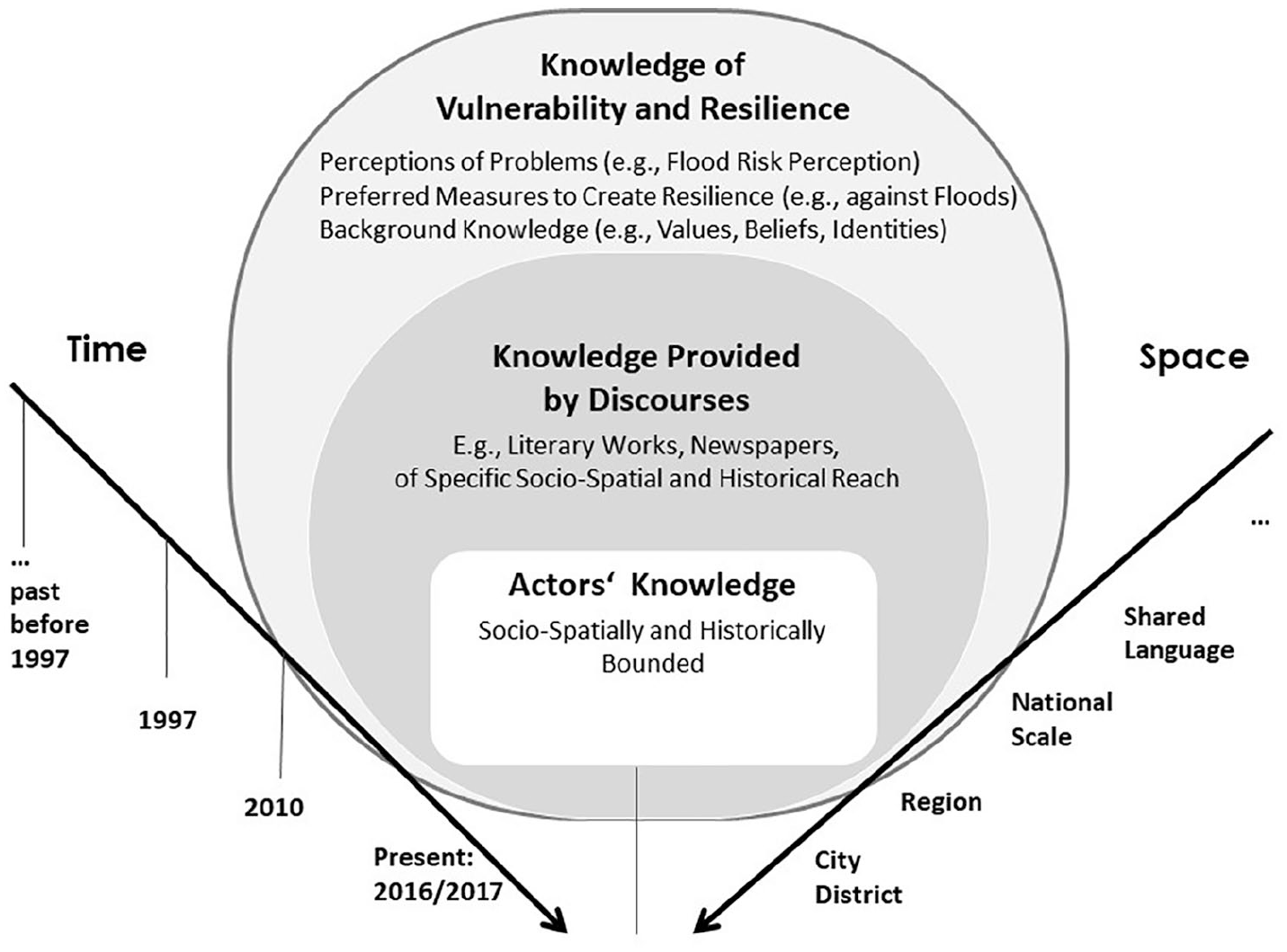
Heuristic funnel: The discursive embeddedness of cultural knowledge of vulnerability and resilience. Source: Author.
Time: From the perspective of communicative constructivism and the sociology of knowledge approach to discourse, today’s socially shared knowledge might be generated by historically relevant discourses (Christmann & Heimann, 2017). Therefore, we exemplify historical lines of discourse in this study through literature and articles in the public media.
(Social-) Space: The culture-as-relational space approach allows us to determine how far different forms of shared knowledge (or cultures) appear to be socio-spatially bounded (Heimann, 2019). Communication may lead to shared knowledge distributed relationally between actors (e.g., shared ecological worldviews) (ibid.). Since actors are involved in different discourses of a specific socio-spatial reach, accordingly, shared knowledge of vulnerability and resilience may be socio-spatially bounded (i.e., by regional or national newspapers). Finally, actors may refer to diverse knowledge resources (i.e., other cultural artifacts like literary works, music, and/or artwork).
To operationalize this (cultural) knowledge and its interrelation with the vulnerability and resilience perceptions of local actors in a specific time and space regarding flood threats, we use the ecocritical perspective, which enables us to filter empirical data into river- and human-centered representations of knowledge (Barcz et al., 2018). The question of how far local actors’ river-related knowledge of vulnerability and resilience is congruent with certain forms of knowledge is developed further, here, in the frame of communicative constructivism. It is accompanied by a specific research design that is explained in the next section.
Methodology
For the empirical investigation, we developed a methodological framework grounded on our heuristic funnel (see “Theoretical Background”). The research aims to compare the river-related forms of knowledge about vulnerability and resilience provided by socio-spatially and historically bounded discourses, as well as those of the local actors at a specific point in time and space. Therefore, we have created a mixed-methods research design to triangulate (Denzin, 2012) the different forms of knowledge contained in literary works and the public media, as well as those expressed by local actors.
Data Collection
According to our heuristic funnel, we collected data from different historical and socio-spatial scales in each module:
Literary works (history from the 16th century until today, language areas): we looked at knowledge of vulnerability and resilience in a longue durée. We analyzed key river-related literary works in German and Polish, as they might be a source for knowledge being shared by users of these languages. This is the broadest perspective in time and space in our funnel. 1
Public media (recent history from 1997 until today, city/national regional reach): we analyzed the daily national and regional newspapers with the highest circulation from the periods of the major floods in 1997 and 2010 and less severe floods in 2017, as they might serve as knowledge resources in both languages. For the media analysis, we selected two city regions along the Odra River in each country that experienced both major floods: Słubice and Wrocław in Poland and Frankfurt (Oder) and Eisenhüttenstadt in Germany. 2
Actors (current, city districts): this module explores the narrowest point in the funnel, namely, the local actors’ river-related vulnerability perceptions and preferences for resilience building at a specific point in time in a particular place. Under investigation were residents of the 1997 and 2010 flood-prone districts in Słubice, Wrocław, Frankfurt (Oder), and Eisenhüttenstadt. All areas were subject to floods that were a part of the public media discourse. The survey took place between May and August 2017. We reached a net sample of n = 456 actors, with a response rate of 24%. 3
Mixed-Methods Analysis: Comparison of Topoi in Literary Works and Newspapers with Actors’ Knowledge
For the analysis of the regular themes (topoi) appearing in literary works and public media in the wider framework of the discourse analysis, we applied the content-analytical approach of Krippendorff (2013) and ecocriticism (Barcz et al., 2018). In this article, we concentrate on the topoi analysis of the human–river relationships that are implied in the knowledge of vulnerability and resilience. For the investigation of the actors’ shared forms of knowledge, we have used a hierarchical cluster analysis, which allows us to relate actors’ practice preferences relationally and to build groups of actors’ shared practice preferences (detailed procedure conducted accordingly to Heimann, 2019, pp. 29ff.). Finally, we compare all forms of knowledge in order to determine the functionality of a discursive embeddedness.
Empirical Results
Literary Works
Literary works provide the most general insights into which forms of river-related knowledge are shared in the respective societies, in particular, how the human–river relationship is conceptualized. As a core result, we regularly find higher eco-orientation in German literary works and a higher anthropocentric orientation in Polish literature. The Odra River-related knowledge about floods is predominately represented in the context of major rivers in the national literature (i.e., the Vistula and the Rhine), however, as a border and regional river, the Odra uniquely appears in the literature of Polish–German cross-border regions, especially after the Second World War, when Silesia was incorporated into Poland.
The eco/human prevalence can be delineated in literature by a few factors, beginning with the general division between the anthropocentric and ecocentric approaches toward rivers, for which we find representative examples in both the Polish and German literary canons.
Jan Kochanowski’s limerick (“On the Bridge at Warsaw,” 1584) is the first significant literary reference to the Vistula, the most important river for building the Polish national identity, written in Polish. 4 The river is anthropomorphized as a living furious creature that has to be tamed like a wild animal. 5 This example represents a typical anthropocentric view: the affective, irrational river versus human power.
Being fascinated with wild nature is typical of European Romanticism. While in German literature we find examples of the so-called Naturpoesie within Universalpoesie of Romanticism 6 in reference to rivers (e.g., Eichendorff, 1970 [1815], p. 47; Goethe, 1999 [1798], pp. 27–28; Schiller, 1838 [1799], pp. 294–299), in Polish literature, patriotic attitudes tend to dominate over the romantic image of a free and apolitical nature. Due to the course of history and lack of independence, Polish bards emphasize more the anthropocentric character of the river, representing Polishness and motherhood (the case of the Vistula, e.g., Goszczyński, 1911 [1831], p. 42; Pol, 1891 [1843]), along with alleged adverse nations like Russia. 7
Whereas the Vistula represents Polish nationhood, the German Rhine plays a double role. It is the main river that symbolizes a united Germany after the Napoleonic wars (Seiderer, 1999, p. 292), as expressed in the Romantic literature of the spiritual roots of the fatherland (Heine, 1827, p. 120; Hölderlin, 1953 [1801–1802]; Schenkendorf, 1999 [1814], p. 192). Simultaneously, it is seen as the river representing a natural, fascinating phenomenon of the green Rhine (Cioc, 2002; Geibel, 1848, pp. 3–4; Schenkendorf, 1999 [1814], p. 192; Scholz, 1872, pp. 90–95), even in references to war memories (Eich, 2010 [1948], p. 6). The literary construct of the green Rhine has no such equivalent in Polish literature. In other German Romantic poems, including a masterpiece, Der Rhein (Hölderlin, 1953 [1801–1802]), the river even dominates over humans (p. 150), representing nature’s independence or—like in other nature poems from Hölderlin—“longing for the lost kinship between man and nature” (Beutin et al., 2005, p. 204), despite, or in contrast to, the industrialization of the Prussian State and the river regulations and embanking. 8 The sole romantic image of nature does not yet signify eco-orientation in the human–river relationship. The literary Rhine involves “green” imagery combined with patriotic attitudes. However, different cultural perceptions of rivers in Germany and in Poland are more embedded in the dramatic history of power relations as expressed in relevant political and military discourses.
The river-war association gains significance in the major texts of Polish literature from the beginning of the 19th century until 1945. It implicates the denaturalization of the river through patriotic symbolism and, subsequently, a more techno-oriented approach to the flood-related knowledge, for example, a metaphor of the river of blood (Baczyński, 1997 [1941], pp. 57–58; Słobodnik, 1946, pp. 27–28; Słowacki, 1976 [1840–1841], pp. 250–341). Another construct that is repeated involves military semantics (Niemcewicz, 1816), especially in the case of the flooding river (Kasprowicz, 1927 [1916]; Konopnicka, 1988 [1881]). The river-war connection is deeply embedded into the Polish identity, which separates humans from the river as a part of nature. The turn of the 19th and 20th centuries (Deotyma, 1898) and the communist and post-communist economy (Krall, 1998, p. 39; Ważyk, 1953, pp. 86–87) strengthened the belief in technological dominance, as did the knowledge that people have fought with the stream for centuries by regulating the river (the Vistula) (Chlebowski, 1893, p. 592; Żeromski, 2012 [1918], pp. 7–26).
While the German Democratic Republic’s (GDR) hyper-industrializing model of the economy, despite communist censorship, results in a great representation of eco-oriented literature (Kirsten, 1979; Maron, 1981; Wolf, 1987), including the Elbe (Czechowski, 1967, 1982, p. 5; Mickel, 1975, n.p.). This East German phenomenon of eco-literature echoes German Romanticism engaged with nature (Goodbody, 2007). To some extent, nature poetry from the Nazi era (e.g., Loerke or Lehmann) also belongs to this Romantic heritage (Beutin et al., 2005, p. 426). Another influence on the eco-oriented literature after 1945 is the German edition of Rachel Carson’s Silent Spring (Blackbourn, 2006, pp. 330–331). This major book for ecocriticism has not been translated into Polish yet.
Against these major tropes for Polish and German literary discourses, the wild Odra, marginalized in 19th-century German literature, will appear after 1945 not only as a lost eastern river for German and Silesian residents, but also as a river of a lost landscape in their shared memory (e.g., Bienek, 1982; Eich, 2010 [1948]; Grass, 1995; Wolf, 1976). Dangerous and flooding, the Odra in German-speaking Silesian literature will not be perceived as an enemy (Niekrawietz, 1976). This stands in contrast to the polonizing discourse of Polish–German border conflicts and fights for the Odra in politically engaged texts before 1945 (i.e., Kossak-Szczucka, 1932; Lelewel, 1857) and after 1945 in Polish communist propaganda literature (i.e., Fernikowski & Goliński, 1946; Fetting, 1966).
The end of the techno-oriented politics in the 1970s and the crisis of intensive industrialization under the Soviet regime results in a change of the flood discourse. The eco-oriented discourse continuously appears in German literary texts such as Günter Grass’s novel Die Rättin (1986), whereas it is definitely a recent and marginal phenomenon in Polish literature (Barcz, 2016). This is mainly related to the post-communist generation of authors (mostly born in the 1970s) who, with the example of the Odra, present environmental problems in Polish literature anew (Barcz et al., 2018; Sławczyński, 1999;). This also represents the belated criticism of the Prussian environmental colonization of the Oderbruch.
In conclusion, the representation of nature (rivers) in Polish and German literature differs, with a more eco-oriented reception of Romanticism in the German literature and more militarized semantics intertwined directly with the discourse of fighting for Polish independence and bloodshed in the Polish literature. In the case of flood-related knowledge, we find war semantics functional, since coping with even recent floods is conceptualized using war terminology, especially the Odra floods in 1997 and 2010 (Różycki, 2012; Rudnicki, 2011) and the flooding of the Vistula (Płaza, 2015).
Public Media: Newspapers
In this section, we look at the empirical results of the public media module and how the human–river relationship is presented there in terms of both vulnerability and resilience constructions. We understand discourse, here, as the public discursive practices from authors of regional and national newspapers on river-related vulnerability and resilience. The illustrated text fragments expose the categorized patterns of interpretation on how to deal with and perceive flood events. The chosen empirical examples spotlight the different narratives we are able to depict from the discourse on the construction of the 1997 flood event starting from 1997 until 2017. The national division of the narrations was not established from the outset, but rather was identified in the analysis.
Polish National and Regional Newspapers: Dominance of Human-Centrism until 2017
In the national Polish newspapers, we find a dominance of an anthropocentric orientation. In fact, the human–river relationship seems to be at war, as military semantics regularly emerge that imply an antagonistic difference between humans and nature. In the acute phase of the severe flood in 1997, the river is presented as the military enemy, for example, “the attack from the great water” or “Klodzko, the dying city. A victim of the murderous wave” (Gazeta Wyborcza, 1997, July 9th, p. 11). The military and war semantics reemerge in 2017: “if we have to fight, we fight. The flood in 1997 was the first battle we won” (Gazeta Wyborcza, 2017, July 14th, p. 6).
Similar patterns appear in the Polish regional newspapers, for example, “There is no war necessary. A little rain and this is the end [. . .] Nothing can stop it” (Gazeta Wrocławska, 1997, July 11th, p. 8).
The 20th anniversary of this catastrophic event brought consequent martial narration into the regional newspapers: “20 years ago our city looked as if it would be war” (Gazeta Lubuska, 2017a, July 19th, p. 6) and “We don't need a great flood event. We are still armed for war with the Odra River” (Gazeta Lubuska, 2017b, July 15th, p. 9). For this narration, we did not find a significant difference between the national and regional newspapers. Yet, we can indicate that an ecocentric discourse on how to deal with floods does not exist in the Polish Newspapers.
German National and Regional Newspapers: Higher Relevance of Ecocentrism
Looking at the discourse at the national level in Germany, we find differences in comparison to the Polish newspapers. Articles from 1997 in the Frankfurter Allgemeine Zeitung (FAZ) provide both anthropocentric and ecocentric orientations in the narration of the flood event. On the one hand, some anthropocentric motifs of the fight against the flood repeat, but at the same time eco-oriented approaches emerge: The fight against the flood and the reconstruction of the destroyed areas can be seen as a national obligation. [. . .] While visiting the dike in Ratzdorf on Tuesday, chancellor Kohl said: “Let the river have more space.” (FAZ, 1997, July 26th, p. 1)
Also in the regional discourses, the narration shifts toward an ecocentric perspective. The human–river relationship becomes less antagonistic: “People try to soften the river god Viadrus, which is the mythological monarch of the Odra River, by throwing roses into the water” (Märkische Oderzeitung, 2017, July 22nd, p. 15).
In summary, we observe constructions of a high-tension human–river relationship in how the military and war topoi are used in Polish newspapers. By contrast, in German newspapers, we observe a stronger presence of eco-orientation, with these tendencies stronger in the nationwide public discourse.
Actors
This section analyses how actors’ knowledge constructions of resilience, namely, the river-related preferences for practices to create resilience against floods in the year 2017. Considering culture as shared knowledge, we first explore which preferences are shared between the actors in the whole area, and then we analyze to what extent national and regional differences emerge.
The respondents were asked to evaluate relevant possible flood protection strategies that imply different constructions of the human–river relationship:
Protection: to preserve land through technological barriers, for example, dikes and other structures, where a clear distinction between human land-use and water-flowing areas is established;
Immersion: a more invasive technological approach where the whole riverbed is shaped by humans, for example, by deepening;
Retention: to create areas that hold space for the river; and
Integration: to share usage of some land areas next to the water, even under altered conditions, for example, by creating floating houses or houses on piles next to the river.
The respondents were requested to evaluate to what degree they see it as a necessity to conduct the different strategies in their area before 2025. 9 We used a hierarchical cluster analysis through which we identified three different groups who share similar practice preferences: techno-oriented, eco-oriented, and eco-techno universalists (Figure 2):
Techno-oriented actors prefer the technological strategies of protection and immersion to bring the river under human control;
Eco-oriented actors prefer retention areas and integrating water into existing land use while rejecting direct and powerful river immersion; and
Eco-techno universalists accept all strategies that are both techno- as well as eco-oriented, however, human effort-oriented protection, immersion, and integration practices find a higher acceptance amongst this group than retention practices.
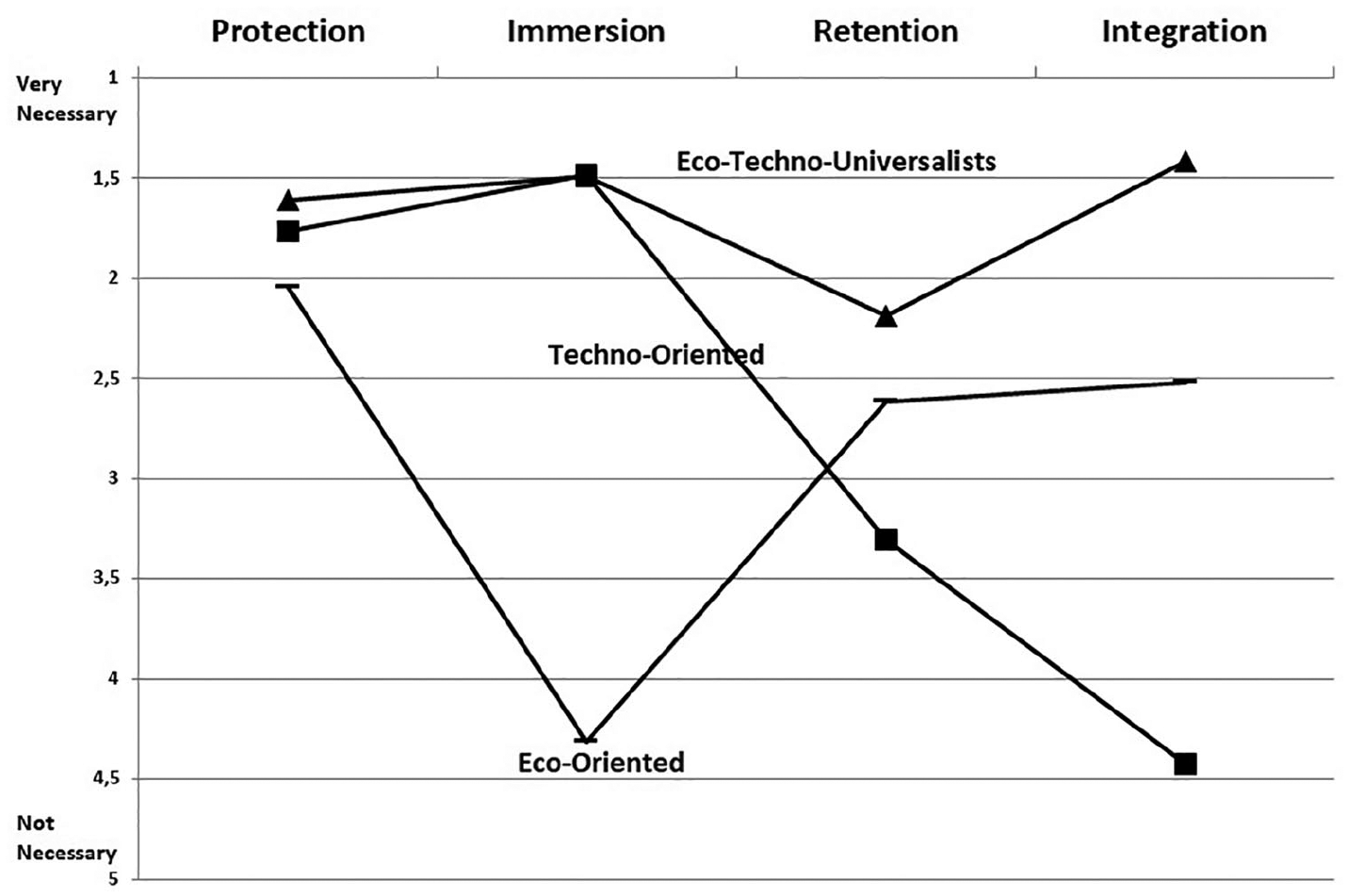
Cluster analysis, groups that share similar practice preferences. Source: Author.
The question arises, are the national and regional affiliations related to these groups? Our study indicates that there are strong national differences (Figure 3). In both German cities, the eco-oriented actors prevail (Frankfurt/Oder: 43%, Eisenhüttenstadt: 39%), whereas, in both Polish cities, they form only small minorities (Słubice: 6%, Wrocław: 10%). In these Polish cities, eco-techno universalists form the biggest group (Słubice: 54%, Wrocław: 43%).
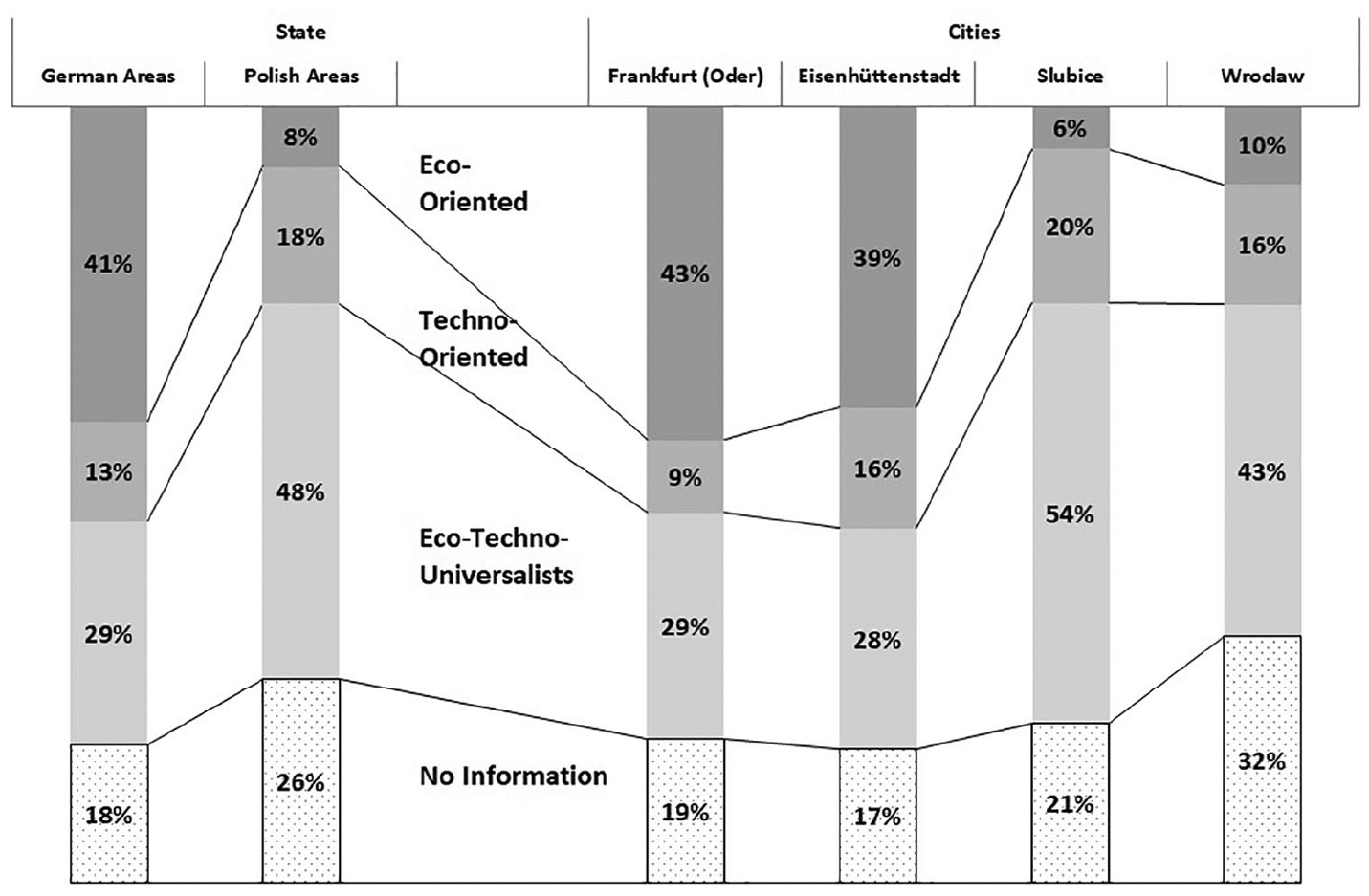
National and regional differences of practice preferences. Source: Author.
To summarize, we find higher eco-orientation and a rejection of harder, technological interventions on the German side. Polish respondents are more open to all types of intervention. They prefer harder, technological strategies, but are also open to retention and integration. All in all, the Polish river-relation is more invasive and interventionist, while Germans are less interventionist.
Comparison
The results of the actors’ survey indicate differences in knowledge between actors with Polish and German backgrounds. Concerning river-related flood protection, eco-oriented and non-invasive practices are much preferred by the German respondents, while many Polish respondents prefer more invasive practices. The cluster analysis unveiled groups of actors who share similar river-related knowledge elements. As these elements are likely to be bordered between Polish and German actors, we looked for a deeper comparison of the knowledge elements provided by the discourses.
Related discourse analyses of media and literary works unveil that different human–river relationships dominate in the German and Polish works. They can be summarized under the frameworks of human-centrism and ecocentrism and human–river tension (war and pacification), described below.
Human-/Ecocentrism
The analysis of literary works adds a comprehensive view, as it unveils peculiar knowledge elements in Polish and German works of the literary canons. In Romanticism, German Naturpoesie gains a higher relevance, while symbolic elements of nation- (and, therefore, human-) centeredness dominate during the Polish struggle for independence. While eco-oriented views continuously (re-)appear in German literature, they gain importance in the Polish literary canon only in the late 20th century.
The analysis of public media indicates that eco-orientation appeared in the German flood discourse already in 1997 and maintained importance through 2017. In contrast, human-centrism dominated in Polish newspapers until 2017. This observation involves different shades of human-centrism and ecocentrism on both sides of the river; however, some elements of ecocentrism recur and intensify on the German side, while human-centrism dominates on the Polish side until today. These results are congruent with the dominating non-invasive, eco-oriented focus, as well as the invasive, human-centric practice preferences of German and Polish actors.
Human–River Tension (War and Pacification)
Invasive techno-orientation on the Polish side and eco-orientation on the German side indicate different categorizations of how actors relate to their surrounding environment. In our sample, the binary human-centered categorization of humans vs. nature is recurrently connected with motifs of war. This is observable in Polish and German literary canons, as well as in newspapers, regardless of the periodization.
The sample of literary works indicates that from Romanticism (again, Poland was deprived of independence), the river-war association intensified in Polish literature. Additionally, much more diverse war motifs can be found until today when compared to that found in German literature, for example, the river of blood, victimization, and murder.
Until 2017, Polish newspapers mainly represented humans as more or less fighting with the elements, being in a “struggle against water.” This perspective is less in German newspapers. The results show that in the German media discourse, pacification between both humans and the river is an important motif until 2017.
To conclude, the relationship between humans and the aquatic surrounding appears to be much more filled with tension in Polish literary works and newspapers until the present. This seems congruent with our observation that more invasion and harder technological practices make much more sense for the Polish respondents and less sense for those with a German background, where less invasion, preferences for integration, and even retreat are more in line with the idea to stop fighting against the elements to pacify the river.
Conclusion
Our starting point was the idea that cultural knowledge—and thus cultural spaces—are generated and shared through discourses. Actors’ shared perceptions of vulnerability and practices to create resilience might be interrelated with knowledge provided by the relevant discourses of historical and socio-spatial relevance. However, these assumptions had not been thoroughly examined. This was the reason we created our approach of triangulating the knowledge of actors and the representation of discourses in media and literary works.
Our results show that similar knowledge elements appear to be discursively ordered between actors, newspapers, and the literary canons. We find human-centrism dominating the Polish actors and ecocentrism the German actors. These elements appear to be socio-spatially embedded into river-related discourses in works of both languages. The human–river relationship appears to be tenser in Polish literary works and Polish newspapers. Motives of war and active immersion appear to be stronger in Polish river-related discourses in the public media and literary works. We observe a high congruence of similar human and river-related knowledge elements in all research modules.
We conclude that specific elements of cultural knowledge of vulnerability and resilience are discursively embedded. Our article provides hints of how cultural spaces are generated by discourse and adds the concept of the discursive construction of cultural knowledge of vulnerability and resilience to the scientific debate.
Indeed, our results lead us to call for further research. Our comparative approach allows only the unveiling of certain knowledge patterns of the shared human–river relationship. Possible factors beyond knowledge, such as economic variables and their influence on knowledge of vulnerability and resilience practices could not be researched with our approach. We also wish to emphasize that other forms of knowledge beyond human–river relationships might be shared across different forms of media and, consequently, may appear in different socio-spatial formations (i.e., beyond language and national affiliation). Nevertheless, our results underline the core idea from communicative constructivism that discourses may indeed contribute to shared stocks of knowledge, namely, to the construction of cultural spaces.
Supplemental Material
sj-pdf-1-sac-10.1177_12063312211030827 – Supplemental material for Vulnerability and Resilience Embedded in Discourses: Literature, Media, and Actors’ Cultural Knowledge in German and Polish River Regions
Supplemental material, sj-pdf-1-sac-10.1177_12063312211030827 for Vulnerability and Resilience Embedded in Discourses: Literature, Media, and Actors’ Cultural Knowledge in German and Polish River Regions by Thorsten Heimann, Anna Barcz, Gabriela Christmann, Kamil Bembnista, Petra Buchta-Bartodziej and Anna Michalak in Space and Culture
Footnotes
Acknowledgements
This contribution is based on the research project “Socio-Cultural Constructions of Vulnerability and Resilience. German and Polish Perceptions of Threatening Aquatic Phenomena in Odra River Regions (CultCon)”. We wish to thank the German Research Foundation and the Polish National Science Center for their support (see “Funding”).
Author’s Note
Kamil Bembnista is also affiliated with Department of Regional Planning, Brandenburg University of Technology, Cottbus, Germany.
Declaration of Conflicting Interests
The author(s) declared no potential conflicts of interest with respect to the research, authorship, and/or publication of this article.
Funding
The author(s) disclosed receipt of the following financial support for the research of this article: Polish-German Grant BEETHOVEN 1 program of the German Research Foundation and the Polish National Science Centre (DFG-project no. 277230079, CH 864/5-1; NCN-project no. UMO-2014/15/G/HS6/04981).

Notes
Author Biographies
References
Supplementary Material
Please find the following supplemental material available below.
For Open Access articles published under a Creative Commons License, all supplemental material carries the same license as the article it is associated with.
For non-Open Access articles published, all supplemental material carries a non-exclusive license, and permission requests for re-use of supplemental material or any part of supplemental material shall be sent directly to the copyright owner as specified in the copyright notice associated with the article.
