




Abstract
Brutalist architecture is an object of fascination on social media that has taken on new popularity in recent years. This article, drawing on 3,000 social media posts in Russian and English, argues that the buildings stand out for their arresting scale and their association with the expanding state in the 1960s and 1970s. In both North Atlantic and Eastern European contexts, the aesthetic was employed in publicly financed urban planning projects, creating imposing concrete structures for universities, libraries, and government offices. While some online social media users associate the style with the overreach of both socialist and capitalist governments, others are more nostalgic. They use Brutalist buildings as a means to start conversations about welfare state goals of social housing, free university, and other services. They also lament that many municipal governments no longer have the capacity or vision to take on large-scale projects of reworking the built environment to meet contemporary challenges.
The growth of social media platforms, like Instagram, has allowed for the emergence of a number of niche aesthetic fascinations to gain an international following. This has occurred for tourist destinations, food trends, and fashion. One such phenomenon has been the reemergence of the architectural style of Brutalism, especially its midtwentieth century variant often called “New Brutalism” (Banham, 2011). Hulking concrete buildings, often designed for public housing or municipal government functions, have taken on new life online as people share images of places like Boston’s gargantuan City Hall (1968, Figure 1), the futuristic Robarts Library at the University of Toronto (1973, Figure 2), and the Barbican Housing Estate in London (1976, Figure 3). All these buildings share a similarly large scale, not just in their bulky presence in urban skylines but the considerable amount of financing, city planning, and municipal government coordination that made them possible: they are physically large and also the children of mid-century “big government.” Their reception was often chilly upon arrival (Monteyne, 2011) and there have been calls to demolish Brutalist structures throughout their lifespan. Yet, social media has given them new popularity and invigorated campaigns to preserve Brutalist buildings, such as #SOSBrutalism and others. This has opened up a conversation about the role of Brutalist buildings as roughly textured antidotes to the glass-and-steel facades of modernist skyscrapers (Thoburn, 2018).
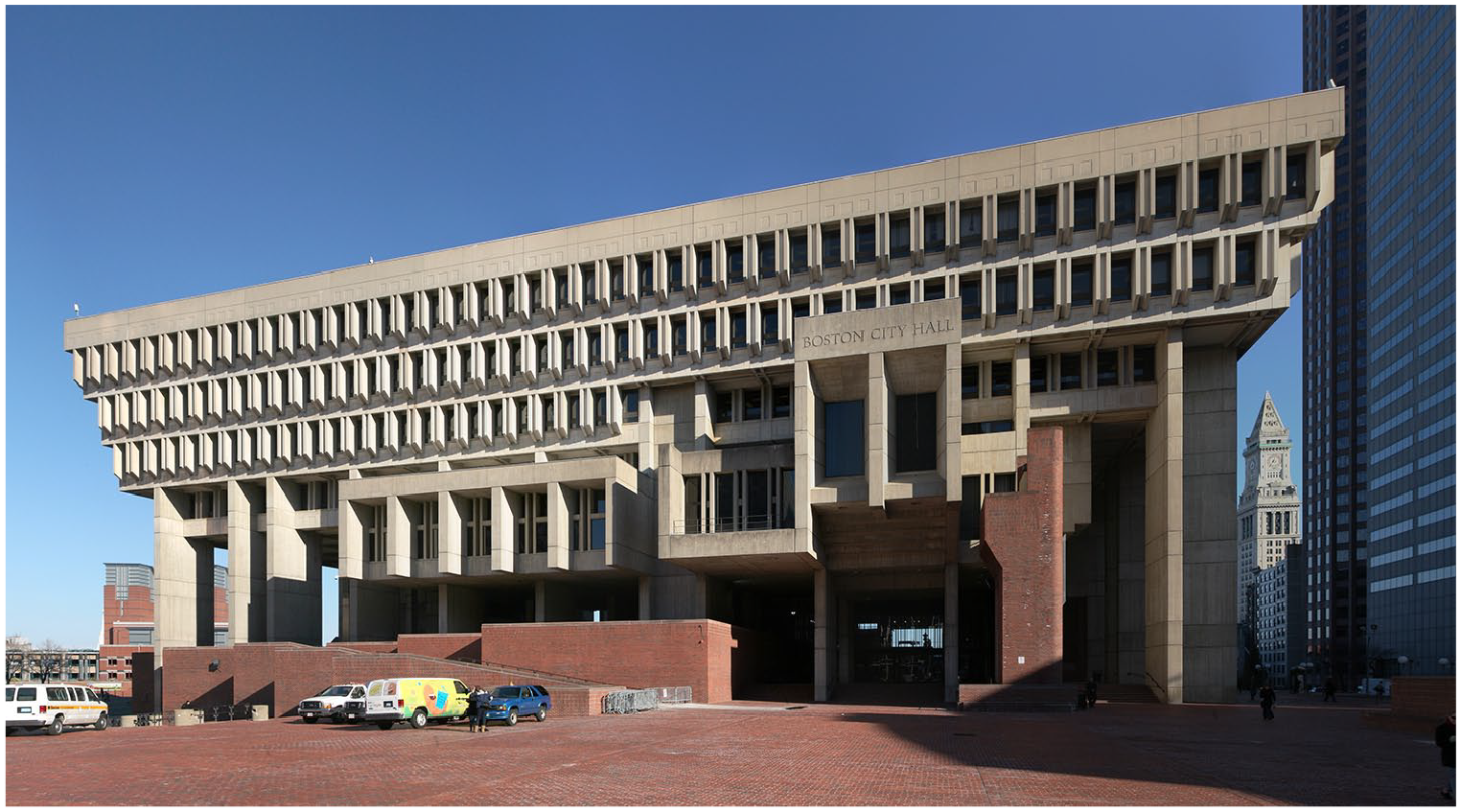
Boston City Hall, Photo by Daniel Schwen, Creative Commons.
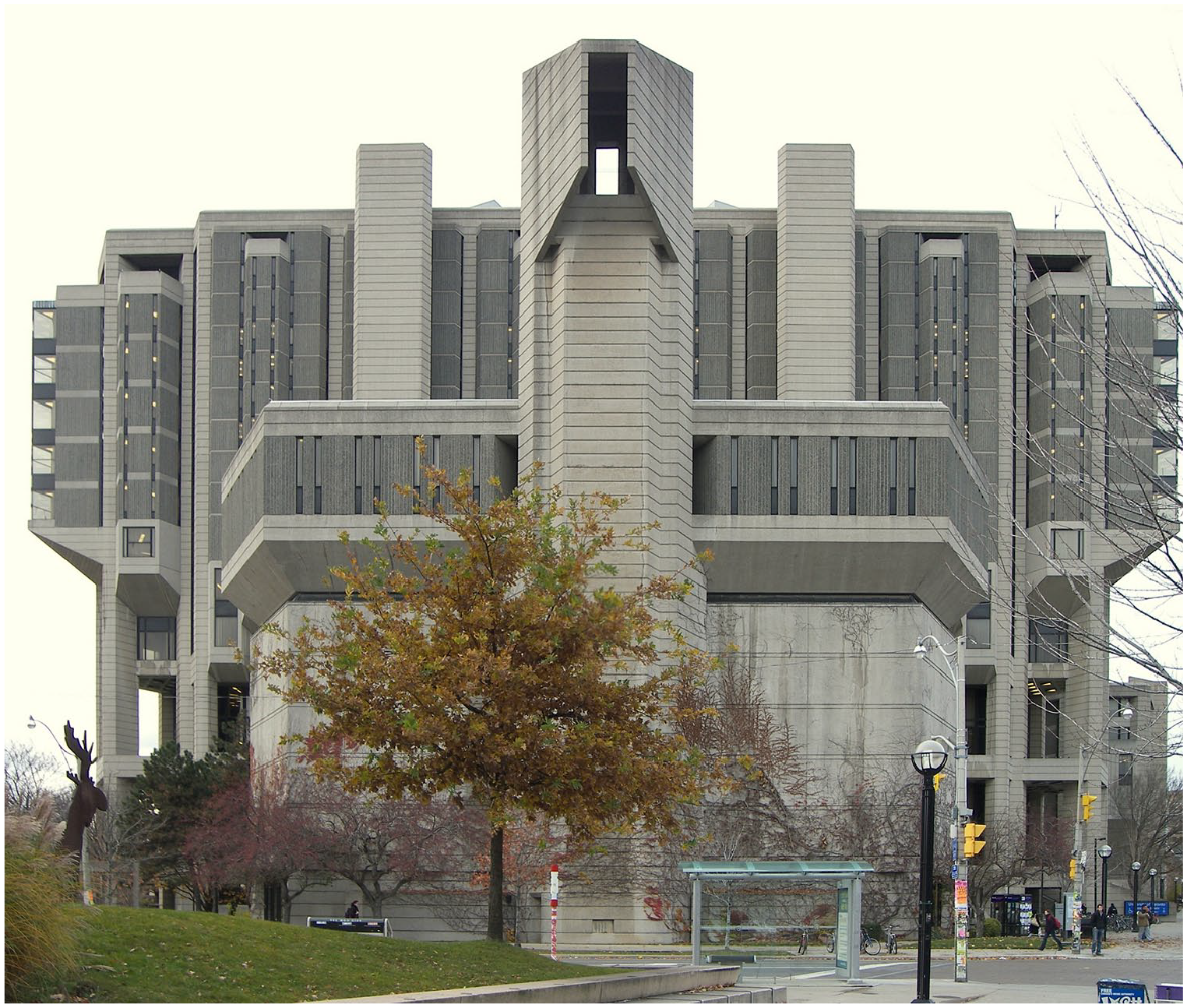
Robarts Library, University of Toronto. Photo by Dr K, Creative Commons.
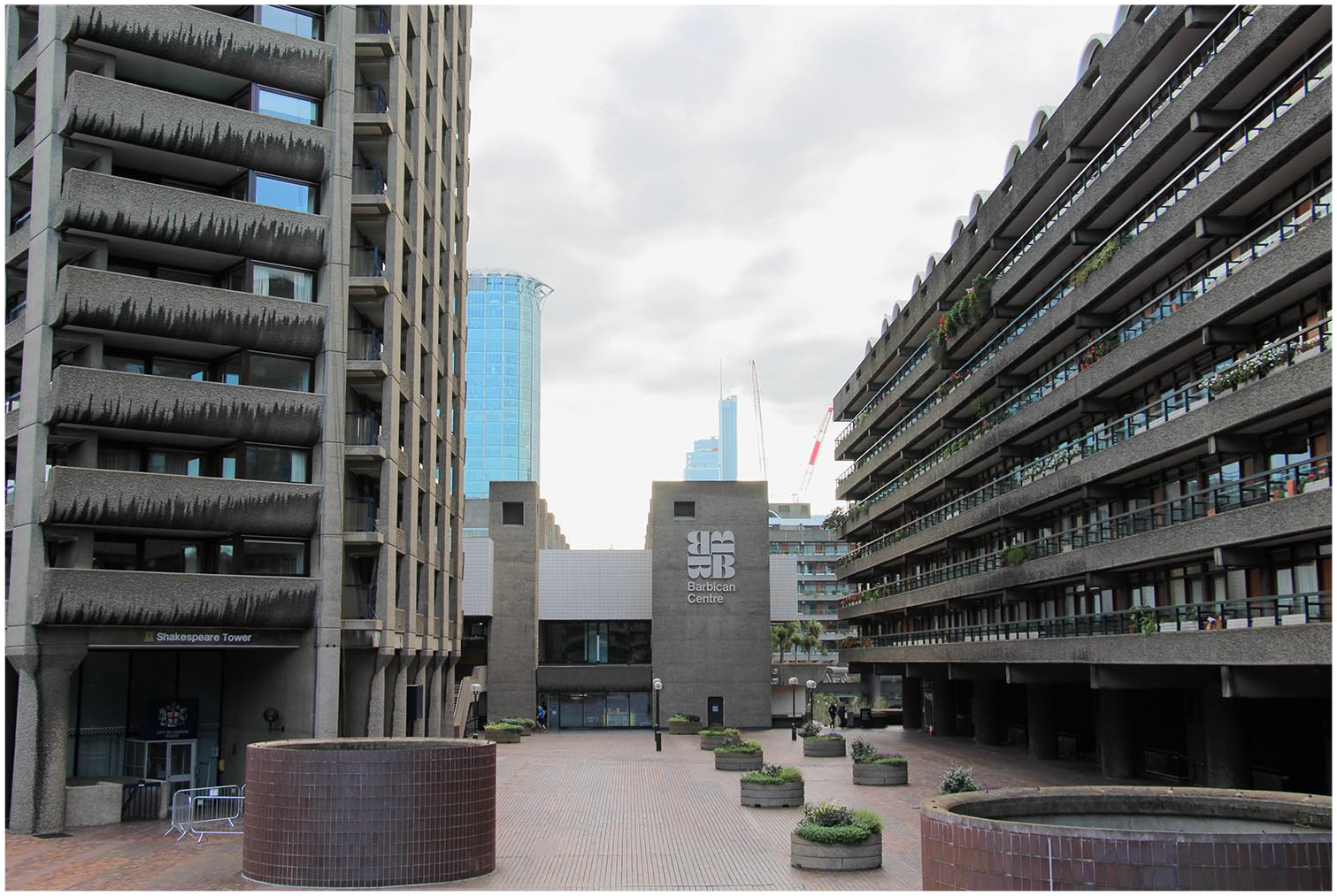
Barbican Estate, Photo by Flickr user Fred Romero from Paris, Creative Commons.
While the term Brutalism is derived from the Swiss architect Le Corbusier’s interest in using raw concrete (béton brut) in the immediate postwar period (Bacon, 2015), the movement got new wind in the 1950s when European cities sought to rehouse populations displaced by war and to remake the built environment (Highmore, 2006). The buildings themselves were meant to stand out as individual works of arresting aesthetic value but they often fit into wider replanning of cities: such as European postwar reconstruction, urban renewal in the United States, or the modernization of cities in developing countries (Bacon, 2015). The style of Brutalism spanned the ideological divide between reformist welfare states of Western Europe (Finnimore, 1990) and the socialist governments behind the Iron Curtain. In both contexts, Brutalism came to signify the strong state and the importance of utilitarian social programs for housing, schools, and local governance (Crowley & Reid, 2002). It also showed the new professionalization of urban planning and the emphasis on urban management in a number of contexts where federal coordination of the built environment was increasing (Scott, 1998). According to many architecture critics of the time, the unadorned style was meant to evoke a kind of structural honesty (Mould, 2017) that communicated to citizens, in both capitalist and socialist countries, that their needs were being met quickly and efficiently (Smithson et al., 2011).
In this article, I show how the renewed interest in Brutalist architecture is not just an online means to call attention to the more bizarre examples of the genre but a form of nostalgia for both socialist and capitalist welfare states (Boym, 2002) where architecture and urban planning were generously funded. Drawing on analysis of 3,000 online posts about Brutalism in English and Russian on the social media platforms Instagram, Facebook, Twitter, Reddit, and VK (Russia), the article illustrates how the style evokes a wider conversation about the role of government in planning and administering cities. While the approaches to sharing these posts is primarily visual, and thus hard to impute exact meaning, I argue that many of the posts show a nostalgia for a time when governments were committed to building large projects. While many considered Brutalist buildings both ugly and, sometimes, exemplars of an authoritarian approach to power they still inspire appreciation for the communal labor and planning that built them for public rather than private use (Stătică, 2019). They also stood out for their cathartic minimalism in a time of internet image saturation, eschewing the sometimes rococo aesthetics of other internet memes. Interpretation of these posts is based on hashtag classification but also comments, and sometimes entire forums, that accompany the visual evidence. Unlike primarily aesthetic interpretive methodology (Mirzoeff, 2000), the article concentrates on written debates that accompany online images, shifting the focus from merely posting to the more deliberative act of commenting. Posts were sorted first by language, then platform, then hashtag, and coded for location, building function, and year built. They were then prioritized by the number and length of comments attached to each post, with those that feature an image only taking less prominence in analysis. This approach has the effect of minimizing the influence of platforms like Instagram that are image-centered, and that also have the most shares, but it emphasizes deep engagement and posts that provoke online discussion rather than those that are merely “liked” and “shared.”
Brutalism is often ironically celebrated as another form of authoritarian kitsch that marks the end of state socialism (Todorova & Gille, 2010). It can also serve as an exemplar of what James Scott characterizes as overzealous state management of the built environment (Scott, 1998) in which centralization leaves the aspirations and desires of citizens by the wayside in order to complete overbearing modernization projects. Similarly, James Holston shows how midcentury architecture (in Brazil) erased the actual use patterns of urbanites in favor of an impractical plan that ignored the human scale (Holston, 1989). Others have shown that the very public nature of Brutalist design often stigmatized residents who were seen as test cases in an experiment (particularly social housing towers [Vidler, 2011]). At the same time, Brutalism was celebrated as an essentially progressive aesthetic that fit with new systems of urban management that relied not just on public money but public participation. Unlike prewar cities, where the skyline was dominated by businesses built largely by fiat from a company’s board of directors, postwar urbanism—some of which was completed in a Brutalist style—had far more public buildings that took up prominent positions in city centers (Hatherley, 2008).
Due to the thirty years that have elapsed since 1989, as well as the regimes of austerity following the 2008 financial crisis, a new symbolic space has been opened for Brutalism online (Elser et al., 2018). It is no longer only associated with the excesses of Soviet urbanization, nor does it represent the past promises of the welfare state that have been reneged upon (most notably social housing). Rather, it has become a visual presence to be simultaneously gawked at (for its weighty presence and, some would argue, its gracelessness) as well as to be marveled at: for creating cathedrals to mundane municipal functions such as social housing, city government, libraries, and other uses. As one Reddit user put it in an extended thread on Brutalist architecture: “The austere image of Brutalist buildings can be either awe-inspiring or soul-crushing.” Indeed, the premier Brutalist website (#SOSBrutalism), that catalogues every building in the style, ironically dubs their mission as devoted to preserving “our beloved concrete monsters.”
In this essay, I first briefly describe the history of Brutalist architecture and its popularization in both socialist and capitalist cities in the 1950s and 1960s. I then show how social media users discuss these buildings today as they decay and face the threat of demolition. These conversations go far beyond the aesthetic parameters of the style itself; they use Brutalism as a means to debate what cities should look like, the role of the state in city planning, and how beauty and functionality should be balanced in order to solve pressing problems like affordable housing, climate preparedness, and availability of public space.
The Honesty of Concrete
The movement known as New Brutalism was popularized in large part by the British husband and wife architectural duo Alison and Peter Smithson who lauded the honesty and straightforwardness of working in concrete (Highmore, 2006, Figure 4). Their philosophy was quickly embraced in the UK by architects such as the Hungarian émigré Ernö Goldfinger (See Figure 4) and, in the United States, by the Walter Gropius disciple Paul Rudolph. In Western Europe and the United States, the structures were often a soft rebuke to International Style modernism, which was employed in soaring new office towers of steel and glass, as popularized by architects such as Mies van der Rohe. Brutalism was both humbler and more solid: it bespoke a parsimonious attitude toward architecture needed for cities on a budget or in a rush. It also represented a generational divide between prewar architects and their predecessors, eschewing the grandiosity of early modernism for a more industrial inspired aesthetic, or as the Smithsons put it: the desire to build homes like “small warehouses” (Vidler, 2011). Indeed, the association with industry and the working class was often an explicit appeal of Brutalism, which, like other forms of modernism, rejected ornamentation but also sought to elevate inexpensive materials. The overall effect was often to create structures that were reminiscent of factories at exactly the moment when many Western European and North American cities were first experiencing deindustrialization (1970s) creating a problematically fetishistic relationship between style and the overall urban economy (Zukin, 1982).
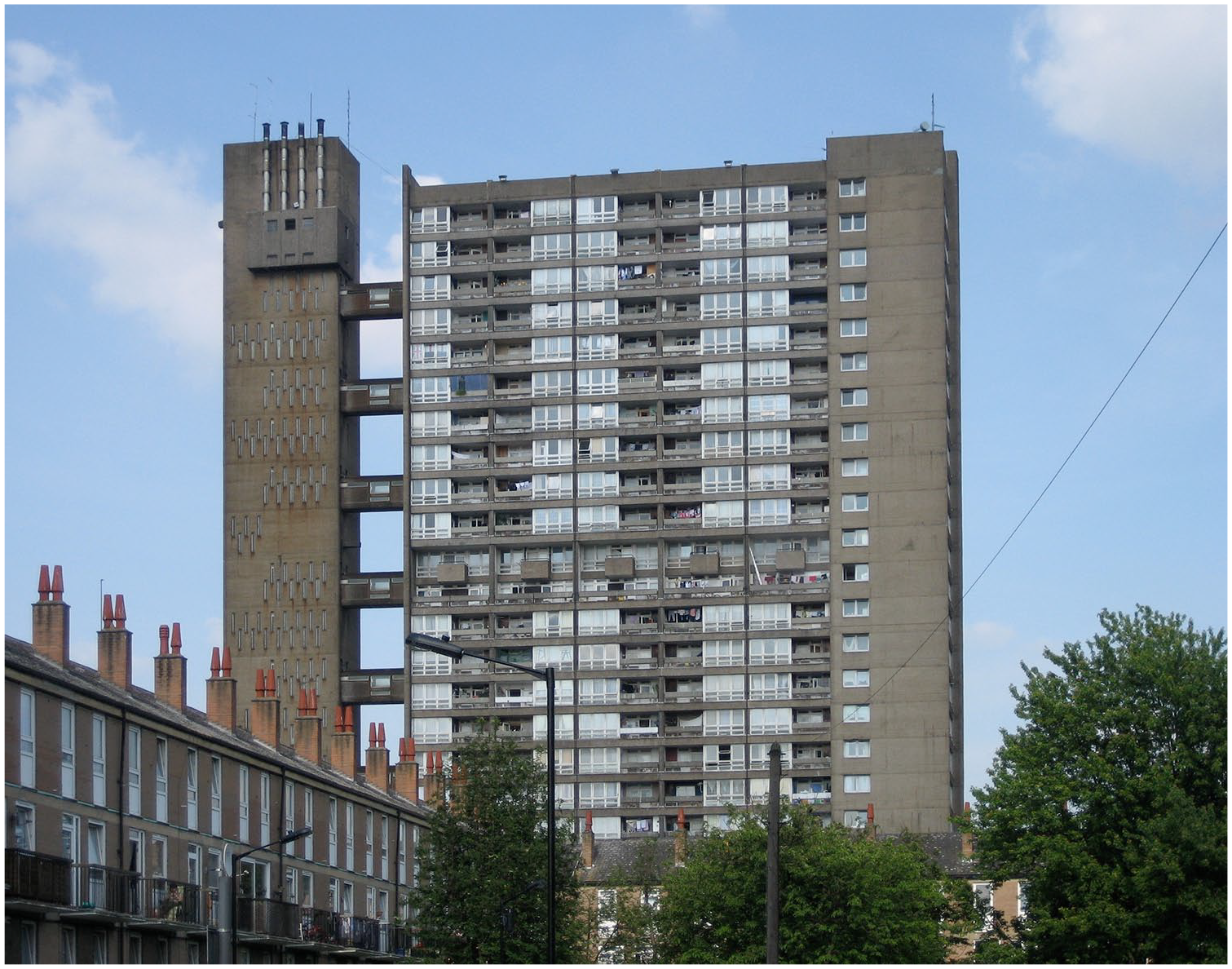
Balfron Tower, London designed by Ernö Goldfinger, Photo by Sebastian F., Creative Commons.
In Eastern European cities, the adoption of Brutalism was associated with the new aesthetic sensibility of the Khrushchev Era in which the bombast of Stalinist kitsch became less popular (Aman, 1992). More importantly, the Soviet Union had to build tremendous amounts of workers’ housing to fulfill industrialization and modernization plans as well as the displacement caused by the War (Kopec & Lord, 2010). Brutalism conveyed the solidity of the postwar state in a more nuanced way than Stalin Era design that relied more on form rather than outright symbolism like the monuments of the immediate postwar era. It also legitimized the use of prefabricated concrete panels in apartment towers, which was already being practiced at unprecedented scale, making it not just a matter of practicality but an architectural statement. This produced an architectural middle ground between Warsaw Pact and NATO countries that drew not only on similar forms but also proximate social goals being met by new construction.
Brutalism arguably reached its apex in the former Yugoslavia where Josip Broz Tito’s government created masterpieces of the style in civic buildings—such as Janko Konstantinov’s Central Post Office in Skopje, Macedonia (See Figure 5)—that melded the practical public functions of the aesthetic to a sculptural elegance. Yugoslavia, as a nonaligned socialist country with elements of monetization in the economy, became a model of how Brutalism both rejected more capitalist modernist styles as well as the monumental styles of the Soviet Union; just as Tito politically rebuffed both Stalin and Western European countries (Stierli, 2018). The Museum of Modern Art’s 2018 exhibition “Toward a Concrete Utopia: Architecture in Yugoslavia, 1948–1980” highlighted this style as well as acknowledging its revived popularity in the Instagram Age (Livingstone, 2018). The exhibit specifically showed how Brutalism became a transnational architectural language that often converged in Yugoslavia, particularly in the redevelopment of Skopje after a devastating earthquake in 1963. The team assembled to direct reconstruction, led by Japanese architect Kenzo Tange, was both inspired by early ideological flexibility around architecture and design in Yugoslavia as well as a transnational breadth of experience (Stierli, 2018). In this sense, Brutalism became a liminal ideological space where, through design and urban management, commonalities could be found between capitalist and socialist governance.
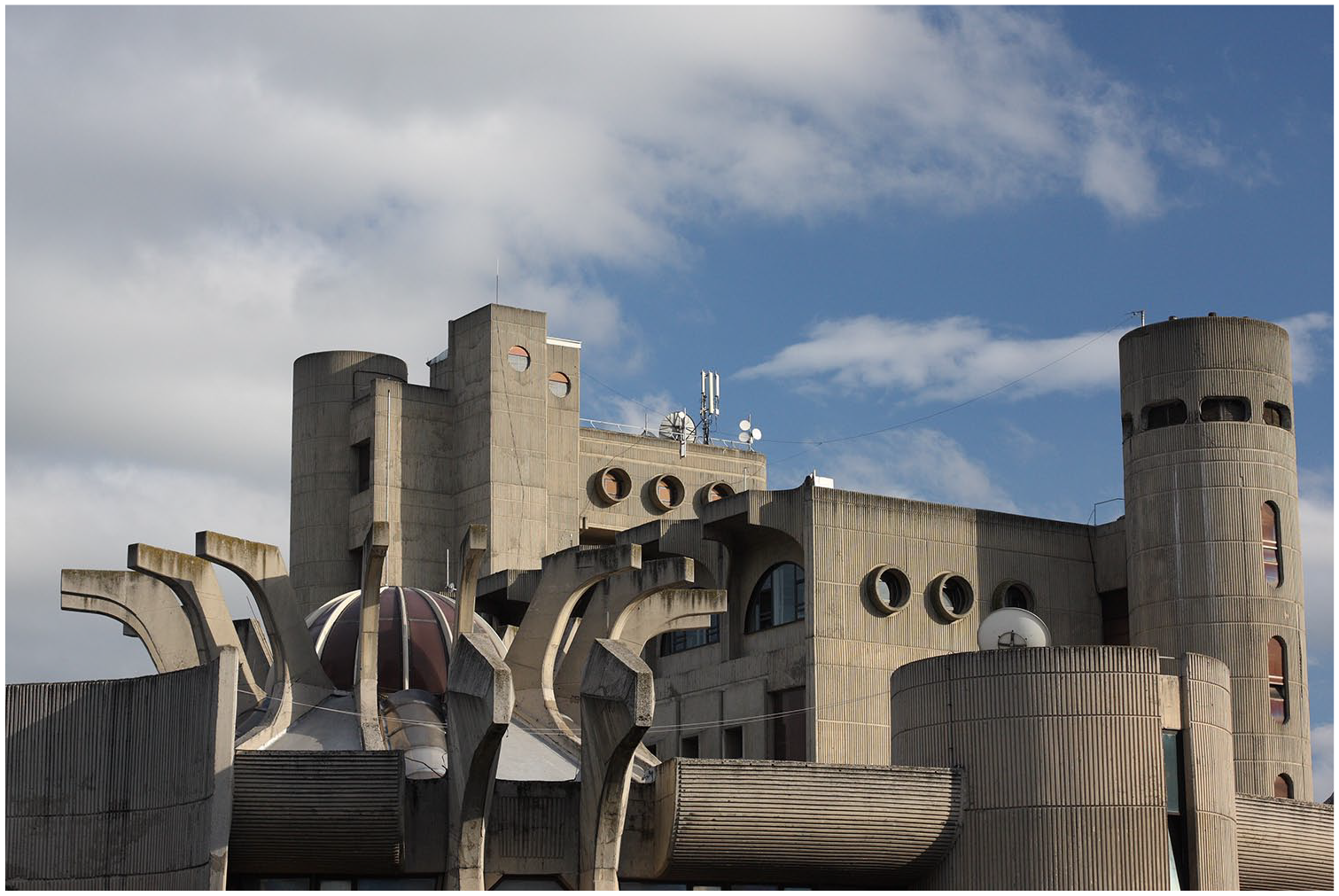
Central Post Office, Skopje. Photo by Flickr user yeowatzup, Creative Commons.
However, not everyone was pleased with Brutalist architecture during its heyday in the 1960s. To many, it smacked of a J.G. Ballard’s novel High Rise in which the main character lives in a comfortable but charmless flat “set in a mile-square area of abandoned dockland. . .looking out across an ornamental lake, at present an empty concrete basin surrounded by parking-lots and construction equipment,” (Ballard, 1975). Brutalism illustrated the monotony of housing estates and the overbearing presence of government buildings that did little to accommodate the human scale. This argument would only become more forceful in the latter part of the 20th century with the publication of books like Small is Beautiful (Schumacher, 2010 [1973]) and The Death and Life of Great American Cities (Jacobs, 1992 [1961]), which cast doubt on federal coordination of urban development at a grand scale. Yet, the key advocate for Brutalism, Peter Smithson, argued in 1959 that scale was everything: The building has to reflect the way it was built with pre-cast concrete blocks, and inevitably the building will not only have a different scale from an architecture that is conceived of being as a single object made by a machine, but it will be built at the scale of the genuine machine with which it is built. (Smithson et al., 2011)
Being able to build large efficient buildings was not seen as a power grab but a necessity to remake cities with abrupt and sometimes shocking changes. In this sense, the style was meant to stand out and to embody the state itself (Scott, 1998). Rather, than rendering the relationship between state power and the citizen as visible only in moments of duress, this style made the connection present in everyday life but particularly in the provision of services, reminding all of the benefits of centralized planning. The presence of large pieces of architecture deemed specifically social (or socialist in Eastern Europe) proclaimed a new relationship to citizens and the welfare state that was now tasked with more complex urban management, housing, subsidized higher education, and public health. Because so many of the buildings were both publicly owned and were in the service of the public, Brutalist architects felt that their style should communicate an antibourgeois ethos, even in settings like London or Boston (Vidler, 2011). This was achieved through inexpensive textured concrete that stood in contrast to the chrome, glass, and steel employed in modernist towers that inhabited the same city centers (Thoburn, 2018). The very roughness of béton brut was regarded as an antidote to the overly finished facades of private buildings erected in more opulent styles with higher construction costs: Brutalism, for its advocates, was populist in both form and function.
Smithson and others made clear that these buildings should fit into newly powerful municipal departments of urban planning, producing a coherent master-plan of urban space that, while private, would be coordinated by public servants. This was also inspired by the first variation of Brutalism that emphasized using concrete for its practicality and its structural engineering properties. Indeed, in a trip made to the United States immediately after World War II, Le Corbusier—the godfather of béton brut construction techniques—was taken by the simple elegance of the Norris Dam built under the auspices of the Tennessee Valley Authority: A New Deal program and one of the largest regionally coordinated development plans in U.S. history (Bacon, 2015). The style was frequently associated with activist government and federal financing from its earliest days, although the meaning of centralized control would shift markedly from positive to negative.
New Brutalist architects felt that the style could help reinvigorate the communal spirit of shared spaces as well as be employed in large state-directed projects. Brutalist apartment buildings, such as the now-demolished Robin Hood Gardens estate in London (See Figure 6), were known for wide “sky-decks” to connect apartment entrances to elevator banks in order to foster neighborliness (Thoburn, 2018). While this did not come to fruition in many cases, the question remains as to whether it was a design flaw or the consistent divestment in social housing that is to blame for the failure of many Brutalist estates. Indeed, both explanations are present in online discussions of Brutalism, and this point of contention is one of the major debates sparked by photos of Brutalist structures.
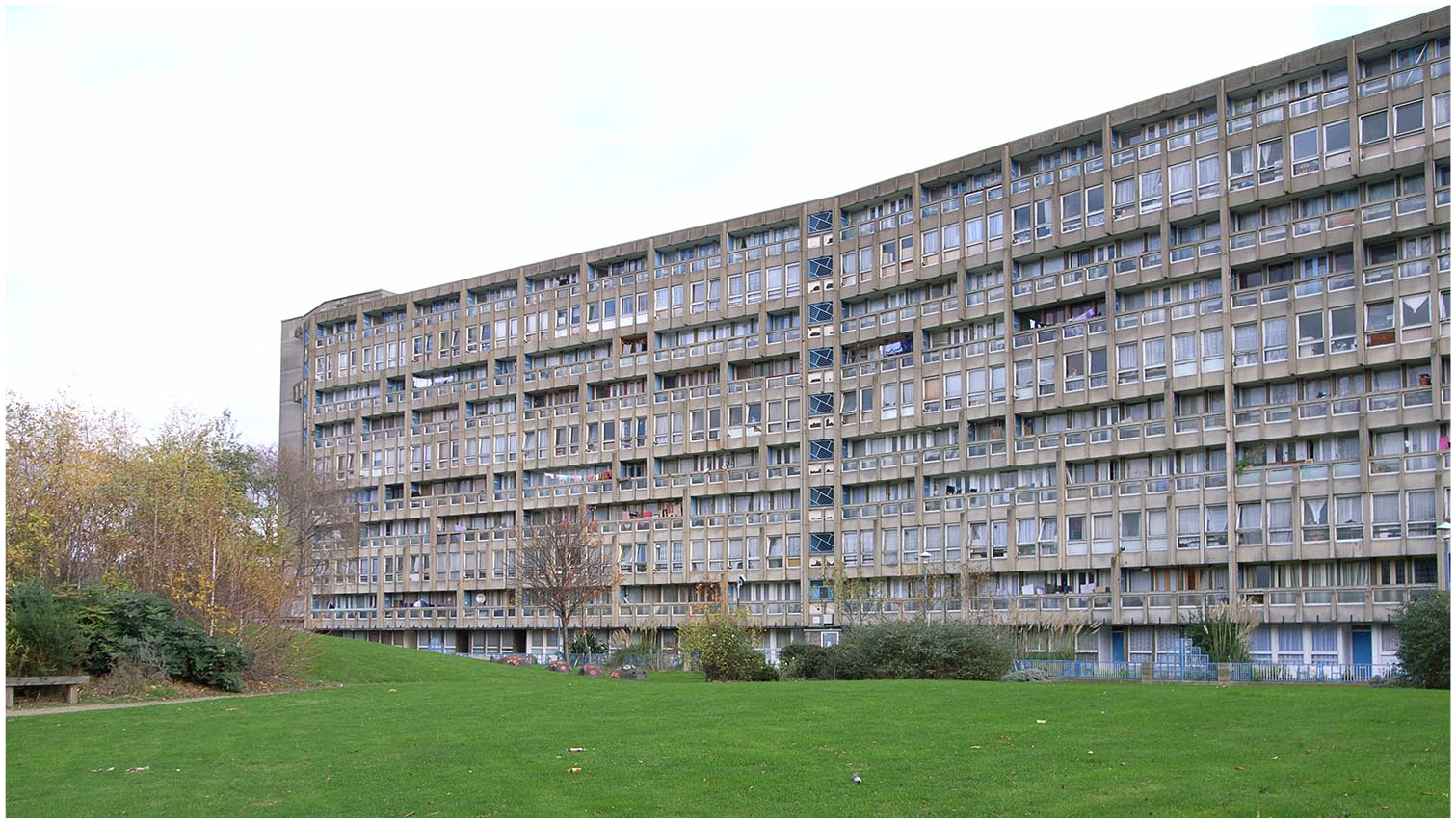
Robin Hood Gardens Estate shortly before demolition. Photo by Flickr user stevecadman, Creative Commons.
Online Brutalism: Bad Behemoths
Online discussions of Brutalist architecture are often premised with a feeling of shock: social media posters look upward at Brutalist structures as if they cannot imagine how they got there, almost as if they are extraterrestrial forms that quickly landed. The irony is that their provenance is well-known. In Instagram postings in both Russian and English, after simple identification of the style (#brutalism/#брутализм), some of the most popular hashtags were #socialhousing, #ussr, #socialistheritage, #sovietheritage, and #socialistmodernism. In discussions on Reddit—by far the most robust conversation of the style on social media—users likened the look and feel of the built environment to the political context in which it was created in nearly every post. They were particularly emphatic in connecting the structural heaviness of the buildings to the spending and social provisioning of the governments that commissioned them. Many online commentators were dismayed with Brutalist buildings as reminders of government overreach, in both the Soviet authoritarian context as well as in the democratic United States and European contexts. Indeed, as in the founding of the movement, the term “Brutalism” acted as a double-edged sword: a sensory shock that pulls the viewer out of their everyday life (Groys, 1992), reorienting them to the city around them, and as a “brutal” presence that scars the landscape and creates an unpleasant sense of apprehension. However, as in many cases of historic preservation, social media users could both recoil at the past as well as seek to preserve it as a legacy that has been surmounted (Lowenthal, 1999). In this sense, Brutalism was seen as a developmental stage in architecture and urban planning that went too far but was reined-in and modified after a period of excess.
In Russian posts about Brutalism, one of the hashtags used was “hopelessness,” suggesting that some online commentators found the style both irredeemable as well as embodying the sadness of socialist life. An English language Reddit user commented: “Grey, sad, depressing, and feelings of inferiority and feeling small and insignificant—these are the words I’d use to describe how brutalist architecture makes me feel.” Consistently, critics of Brutalism who found it overbearing used not just aesthetic but affective categories to convey their points of view. On Reddit one critical user stated: Looking at brutalist architecture evokes feelings for me—it makes me think of science fiction, futuristic dystopias—think of all the tingly feelings you get when reading 1984, the fascination of what society could become, what we’re capable of creating as a society—that’s what I think of when I see Brutalist architecture.
Other users agreed that Brutalist architecture seemed designed by those in power to control and survey the populace, arguing that when it appears in films it rightfully evokes a feeling of dread: “it ends up playing a big role in dystopian sci-fi, as headquarters for autocratic regimes and as cold, sterile environments.”
Some online discussions also dismissed Brutalism less on aesthetic grounds and more for its association with midcentury governmental overreach. Especially what many perceived as the failed experiments with social housing in the United Kingdom before Margaret Thatcher privatized much of the council housing stock (Finnimore, 1990). One Reddit user from Newcastle claimed that the city had its “heart ripped [out]” by “brutalist urban planning” and that fans of the style are passionate because they “can divide the architecture from many of the failed social issues they [sic] are linked to.” In this sense, the style represents an entire ethos to urban planning and the power of state intervention that comes with it (Rabinow, 1995). Another user employed the term as a stand-in for midcentury urban renewal itself and the demolition of the prewar British city: “I live in a city with a lot of them and I hate them all. Oppressive-looking federal government gray boxes looking weathered, probably chosen by committee with budgetary concerns in mind. They’re an eyesore.” For these social media users, Brutalism was not just adding forms to the built environment but also taking away parts of the previous city: the style went hand-in-hand with the modernizing drive to demolish the previous city. This created a sense of anguish and loss that is ironically similar to the feeling of nostalgia that other commentators associate with the eradication of Brutalist buildings and the history that comes with them. As the urban theorist Marshal Berman commented on the destruction of New York City for highways in the 1960s, there was a crushing cost to communities (like the Bronx) for purportedly public amenities like subsidized federal highways (Berman, 2010).
Social media commentators who disliked the style did not universally condemn it but found that it should be used sparingly for certain kinds of buildings. Many were fine with it being employed in the construction of government buildings because they had a negative opinion of the government. They expected the state to enact power over their lives and they did not mind Brutalist architecture as a representation of the violence of that power, in fact, they found it to be a reassuringly honest communication of citizenship (Holston, 1989). One Reddit poster wrote: “You’re right, it is ugly, but it is that ugliness that gives it such power and imposing dominance.” Others were dismayed when it “ruined” building types they had previously been fond of such as libraries and university campuses. One woman lamented that the style was even used in churches in France on Twitter: “Hey I know let’s build churches that look like windowless gray prisons!” In all these examples, social media users worried that the severity of Brutalist architecture inspired negative behavior or, at a minimum, depression. Many linked the style to the poverty and crime of public housing complexes in the United States and Britain, using a kind of architectural Broken Windows Theory. As a London Reddit poster insisted: “I think brutalism is seen as ugly because of its associations with rundown and dirty buildings, and in the UK, with government housing, the smell of urine and street crime.”
A smaller subset of social media users described Brutalism as a kind of “creeping communism” that had infected midcentury North America and Western Europe. They equated the public origins of Brutalist structures with socialist politics they were not fond of and they saw the hulking concrete forms as “typically Soviet.” A small portion of these discussions in other online forums, known for their lack of moderation, became derogatory. A Twitter poster ironically said: “When the communist revolution comes to America, the only building left in Seattle will be the Seattle Armory. Both due to its Brutalist architecture and also because it’s like 90% concrete.” Others, in darker portions of the web, not comprehensively surveyed in this article, were less measured stating that: “Brutalism also is a commie wet dream.” While many of the comments were derisive of Brutalism, they were seldom merely critical of aesthetics. Instead, the style became a means to discuss a range of urban problems from crime, to infrastructural neglect, to eminent domain (Berman, 2010). In short, Brutalism transcended a mere aesthetic critique and became a way to talk about a method of governance present at midcentury in both capitalist and socialist European and North American contexts.
Nostalgia for the Functioning State
Enthusiasts for Brutalism are often on social media for the “weirdness factor” of buildings that follow the aesthetic tendencies of bunker construction (Virilio, 1997). Like war fortifications, they seem to be both decaying as well as indestructible. Some users find the buildings to be a deviation from the aesthetic norms of 21st century city that, while a bit ugly, provide an interesting diversion from the otherwise uniform landscape. Their encounters with the style are recounted as moments of fortuitous discovery: “Even the grime on the concrete underhangs manages to add an air of future about it . . . like you’re hundreds of years in the future stumbling on the relics of an unknown advanced civilization,” as one person put it. They recount these moments as both an experience of the past and the future. Rather than describing the buildings as menacing they appreciate the novelty of using one main material (concrete) and working within this technical limitation. “The ‘brut’ part of brutalism also means ‘naked’, not brutal or aggressive,” one poster commented approvingly. Another Reddit user added: “The intention of the style is to project a no-bullshit attitude with the naked concrete and lack of ornaments, not to provoke fear (which is silly).” These discussions often took aim at contemporary landscapes in the U.S., U.K., and Russia that were regarded as hypercapitalist in terms of kitsch branded architecture compared to the structural honesty of Brutalism. In this sense, the discussions often carried a distinct sense of nostalgia amongst online commentators for a simpler, purer moment of architectural expression: one not coincidently before the clutter, chaos, and aesthetic saturation of the internet era.
The online appreciation for Brutalism is not limited to just its aesthetic originality but also its social purpose. Posters recalled a time when the state coordinated development and dispensed an unrationed welfare state devoted to solving social problems. As one Reddit user wrote in a rather engaging and artfully constructed thread: Brutalism is the physical representation of the 20th century’s heavy urbanization and concern for growth and scientific progress. Brutalist buildings unlike, say, Edwardian buildings were not meant to make you marvel at their ornamentation or harmoniousness, they’re meant to show power as opposed to wealth and opulence, they show strength and institution. It’s no surprise then that universities, governments, and banks favored brutalism most of all.
Others agreed that Brutalism represented the apex of state outlays for education, health care, housing, and municipal services very much in contrast to the subsequent period of neoliberalization in Western Europe (and privatization that occurred in Eastern Europe). As another Reddit user put it: In its own time, brutalism was associated with governments and architects with full social agendas, even if they were paternalistic in nature. In hindsight we might find the gravitas of state sanctioned housing and education projects . . . a little more compelling than the privatized cardboard box concessions we get today.
Reddit, in contrast to Twitter and Instagram, had a vibrant conversation of architecture enthusiasts who sought to connect buildings to their political circumstances (Rabinow, 1995). However, all the platforms had similar conversations that appreciated the more powerful midcentury state in Western Europe and North America that, while potentially drawn to political overreach, in the form of eminent domain, and aesthetic excess (Brutalism) was still working to try and solve social problems that have become worse since the advent of neoliberalism in city management (Hackworth, 2007). Online users also self-selected their platform for various kinds of engagement: Instagram users were more likely to simply post a photo with a hashtag while those using Reddit were drawn-in by a specific topic, enabling both a richer conversation and, potentially, selecting participants with more historical knowledge of the subject.
Online fans of Brutalist architecture also blamed some of the dislike of Brutalism on the new politics of cities weathering financial crises or deliberate budget cutting. They maintained that this parsimonious approach to funding had both doomed municipal experiments in social housing and other programs as well as led to the actual physical deterioration of the structures, which were crumbling due to neglect. “Any architecture looks ugly when not properly maintained,” one Reddit user commented. Others remarked on the solidity of the buildings despite their mismanagement. This often came in contrast to new construction: “when you build with it you don’t need to worry about anything seeming hollow and shabby,” one proponent of Brutalist buildings stated. Another reminded Reddit thread readers that the term is not just about aesthetics but “[The buildings] push a whole range of boundaries—this may include pushing the boundaries of concrete construction, trying to build something that lasts in an era where everything was moving to cheap knock-down construction, looking for new ways of living (particularly in high-density low-cost housing).” The purposefulness of this kind of state planning was a major draw, particularly because it came at a time of low-density suburbanization when cities were under threat of depopulation and financial decline. Social media users also tended to appreciate the mobilization efforts of municipal governments that sought to meet major midtwentieth century challenges (Mould, 2017), often expressing their concern that such an approach is needed today to address housing affordability and climate change adaptation. Brutalism may also look more attractive retrospectively both because of revanchist municipal budget cutting (Hackworth, 2007), that has stymied large projects and drained city coffers for basic upkeep, as well as concern about the effects of unchecked real estate capital (Hirt, 2012).
Brutalism, Connecting the World
While some of the most known examples of Brutalism (See Figure 7) are in major American and European cities—such as the Yale School of Architecture, designed by Paul Rudolph, or London’s Royal National Theatre by Denys Lasdun—it is also a truly global form. Not only did it bridge the divide between socialist and capitalist countries during the height of the Cold War, but it was also employed in a range of developing countries. Like other modernist styles, it came to signify the politics of internationalization in countries in Africa, Asia, and the Middle East. In doing so, it both overwhelmed vernacular forms of architecture (Rabinow, 1995), while also providing a sense of global connectivity worth the cultural sacrifice for technocrats and political leaders enthusiastic about modernization. Online users are frequently excited by the “discovery” of Brutalist architecture in a variety of locations as well as tracing the transnational networks that made their construction possible. Locating Brutalism outside of the Global North is often of great interest to social media users not just because it shows how far the style travelled but also because it is frequently juxtaposed against the background of more chaotic and informal cityscapes than North Atlantic or Eastern European examples.
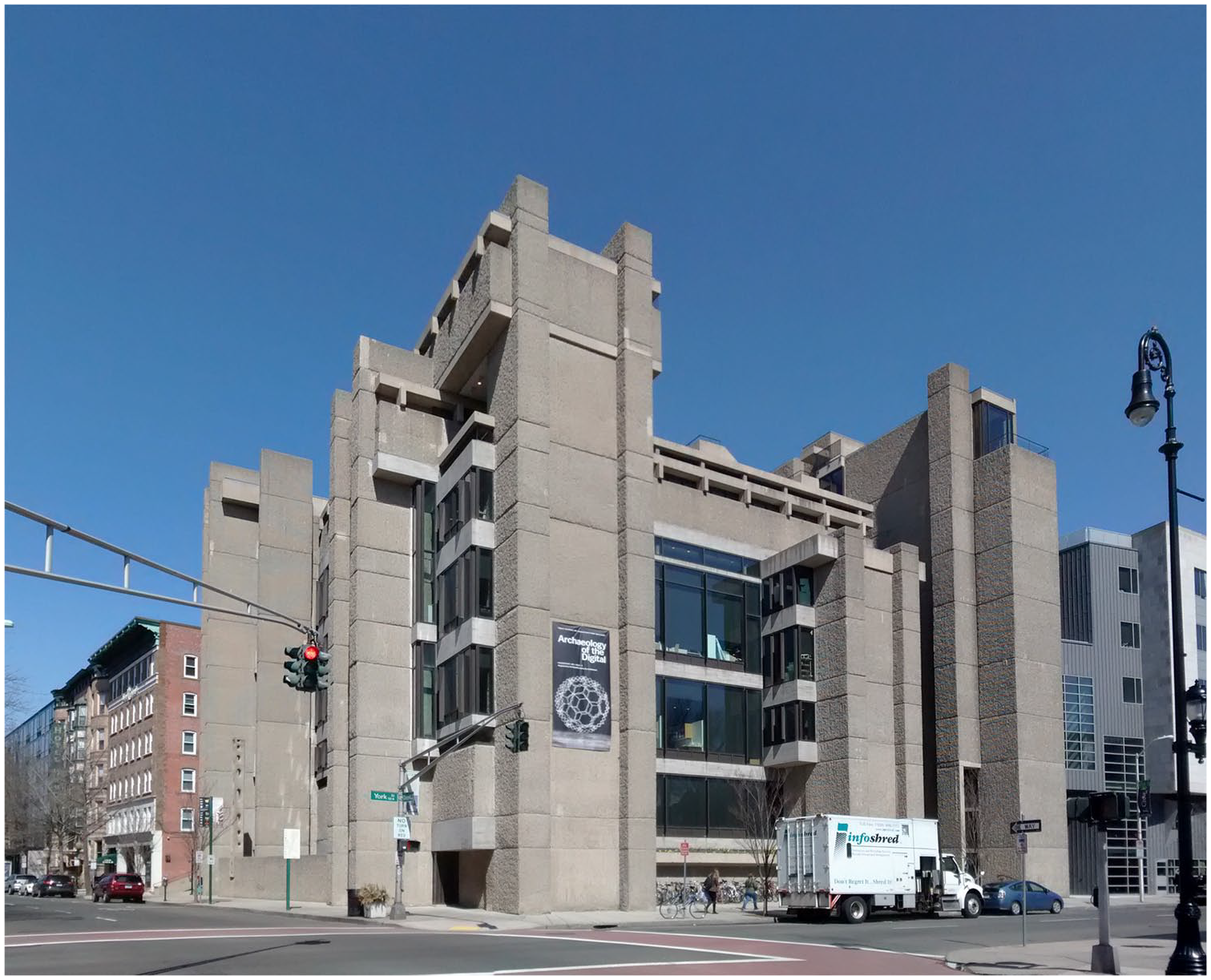
Yale School of Art and Architecture, Photo by Gunnar Klack, Creative Commons.
On Russian social media sites, users had mixed impressions of Brutalist architecture. Some commentators also warned that people who had a negative opinion of the USSR, both within and outside of postsocialist countries, were using the term Brutalism to describe all socialist styles. As one put it: “It would be nice to establish a stricter line between the Brutalism and cost-saving-bethonism [sic] of the Soviet era.” Others discussed how Brutalism conformed with international design standards that purely Soviet forms of architecture did not have to, making Brutalist structures superior to other buildings in the former Soviet Union. Social media users had conflicting opinions often using a Brutalism hashtag while talking about Soviet architecture or vice versa: “Ah Soviet era architecture. Ugly and beautiful at the same time.” Another said: “It’s both stylish and depressing.” Further adding to the confusion, concrete panel construction was widespread in socialist countries, sometimes called plattenbau, panelák, or Khrushchyovka (Crowley & Reid, 2002) but these styles were not necessarily purposefully Brutalist (although some were). The conflation of concrete construction, Brutalism, and Soviet architecture was a widespread trend in social media conversations but also one that agitated many users who felt that the three terms should be more carefully applied, especially when hash-tagging buildings.
While some wrote that Brutalism was “disgraceful” on Russian social media, others contrasted it with the badly managed privatization and loss of public space (Gölz, 2006) that followed democratization in Eastern Europe. Postsocialist styles have often been stylistically bombastic, using bright colors and materials such as tinted glass, marble, and neoclassical columns (Holleran, 2014) often executed for new and controversial land uses such as the gated homes, casinos, and shopping malls. Brutalism is frequently viewed as more public-spirited, connecting it to socialism and the previous state management of the built environment, provoking in many a sense of nostalgia despite acknowledgement of the many problems of socialist life before 1989 (Todorova & Gille, 2010, See Figure 8). “Once such panel buildings seemed scary to me, but after the current monsters they are so cute,” said an Instagram user about Kiev. Another wrote of Moscow: “It [Brutalism] was all about cheap housing, but it became a building for the elites . . . it’s beautiful.” Someone else posted on Instagram about a Brutalist building in Georgia calling it “monumental and beautiful” and not at all like the “ugly garbage” around today. The sense that Brutalism was a window into a more egalitarian socialist past may be especially important now when urban development in Russia is marred by corruption and the most emblematic change in all of Eastern Europe has been divestment in public services and the enclavization of those with wealth (Hirt, 2012).
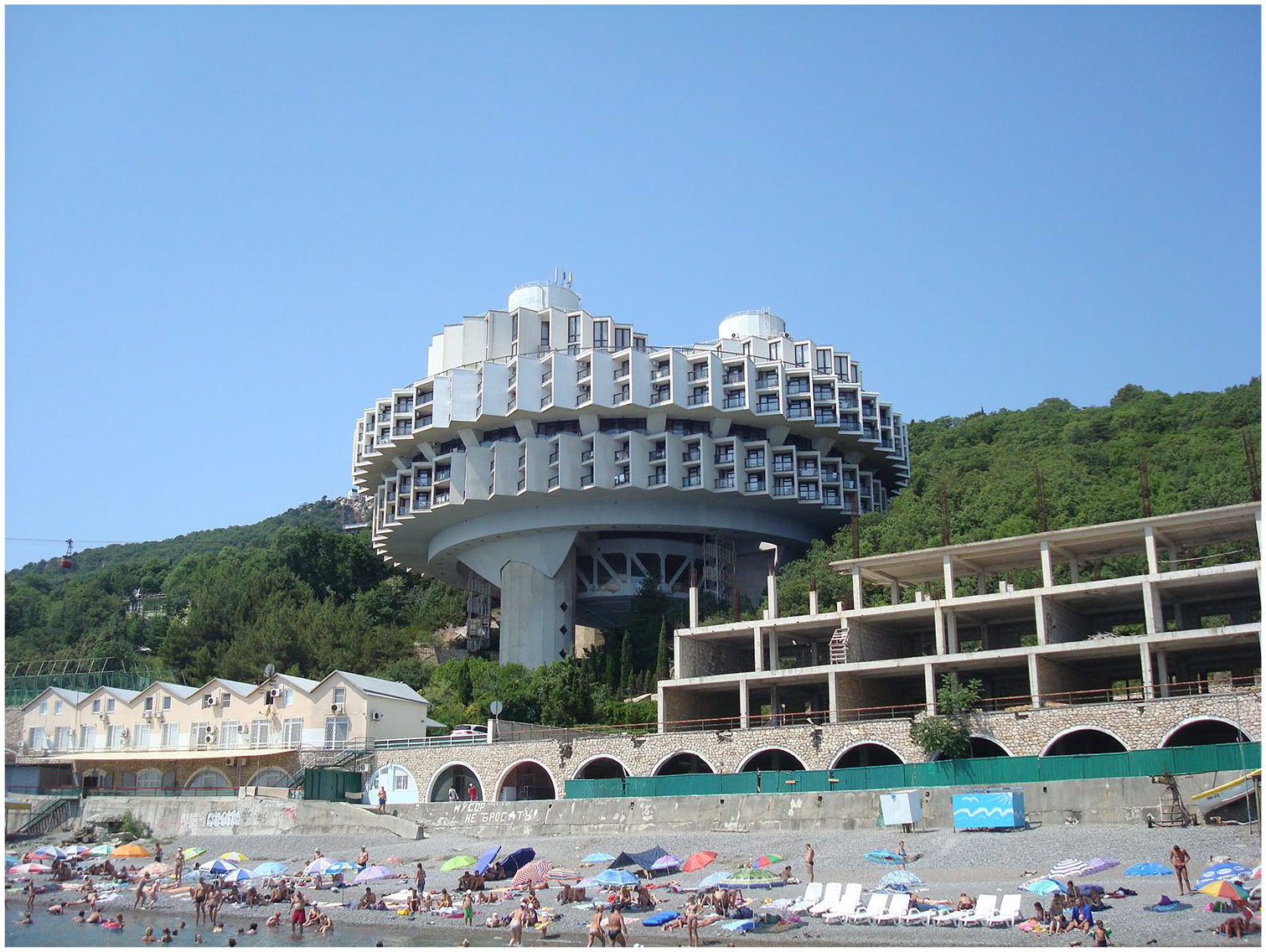
Beach Resort in Yalta, Crimea. Photo by Dimant, Creative Commons.
Outside of the North Atlantic, social media users often used Brutalist architecture to discuss a golden era of development in Latin America that came immediately before military dictatorships in Argentina, Brazil, Chile, and other countries. These buildings celebrated modernization and stood starkly in contrast with neoclassical architecture in urban centers (Holston, 1989). The Italian-Brazilian architect Lina Bo Bardi (See Figure 9) employed Brutalist touches in her São Paulo Museum of Art (1968) and the Argentine Clorindo Testa designed the National Library as a large concrete pedestal hovering above an elevated plaza. Buildings like El Helicoide in Caracas (1961) and Escuela Superior de Comercio Manuel Belgrano in Córdoba, Argentina (1968) indicate a time when prosperity seemed more achievable and the state took a proactive role in urban development. Not just in Latin America but in other parts of the world, Brutalism is not just appreciated for its futuristic intentions but the time period it was popularized, when a sense of national optimism was more pronounced. In particular, public spaces for the expansion of higher education such as the University of Zambia in Lusaka and the University of Cape Town, take precedence. What’s more, many Brutalist buildings in developing countries starkly illustrate the rise and fall of the dream of a more efficient and unified state, such as the Interdesign Building in Beirut, begun by the architect Khalil Khoury in 1971 but not completed until after the Lebanese Civil War. These structures simultaneously draw on the connectivity provided by an international architectural language while also pushing forward distinctly national modernization projects.
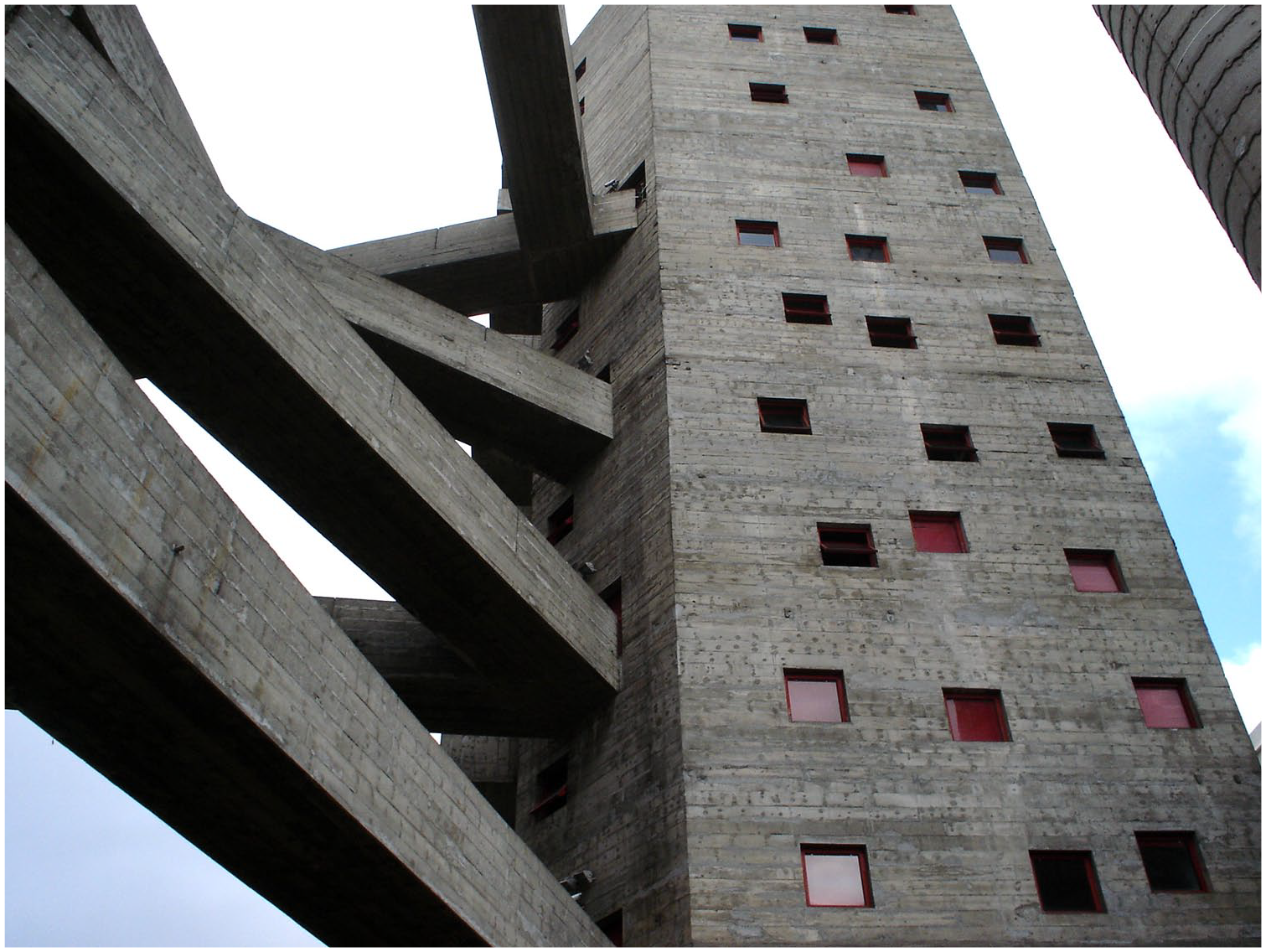
SESC Pompéia Cultural and Recreation Center by Lina Bo Bardi, São Paulo. Photo from Flickr user paulisson miura from Cuiabá, Brasil, Creative Commons.
Conclusion
While Brutalism has made a comeback on social media, the rise to prominence has not been unproblematic. Often the buildings seem to serve merely as a foil to other social media content that is color-saturated and overproduced, giving a dose of cathartic minimalism to posters who are overdosing on aesthetic immoderation. Some have also argued that the nature of social media, which prioritizes photos rather than text, has drained much of the political and economic context of Brutalist architecture from conversations (Livingstone, 2018). While many of the posts analyzed in this article simply featured hashtags, there was still a broad conversation about Brutalist architecture taking place. When users did begin writing more detailed posts that connected aesthetics to history and politics, others engaged them, starting a broader discussion about the role of the state in urban planning. Unlike discussions that start with a government intervention into housing or transportation planning, these dialogues started with a style allowing for a more free-flowing set of associations to emerge. It also allowed for users to compare transnational contexts, discussing urbanism in multiple continents simultaneously.
Many people are undoubtedly drawn to Brutalism for its otherworldly, futuristic, or dystopian qualities (See Figure 10). Even social media posters who were outraged by the style, seemed to appreciate it as a historical aberration that should be preserved in order to remember the considerable mistakes committed during the height of 20th century interventionist urban planning. At the same time, a surprising number of observations showed a nostalgia for municipal governments that moved forward aggressively on urban policy, even when they got things wrong. In Eastern and Western Europe as well as the United States, the late 20th century was marked by urban divestment (Hackworth, 2007) and a more cautious urban policy characterized by small-scale iteration. While this has potentially restored some degree of community control, it has also put big infrastructural solutions to issues such as sea rise, climate adaptation, and affordable housing out of reach due to budgetary constraints. What’s more, the public nature of Brutalist buildings has become a marker of a time period when some of the most dramatic architecture in city centers was meant for publicly held assets rather than corporate headquarters. In this sense, Brutalist buildings not only mark an aesthetic epoch but a period of governance that has come and gone.
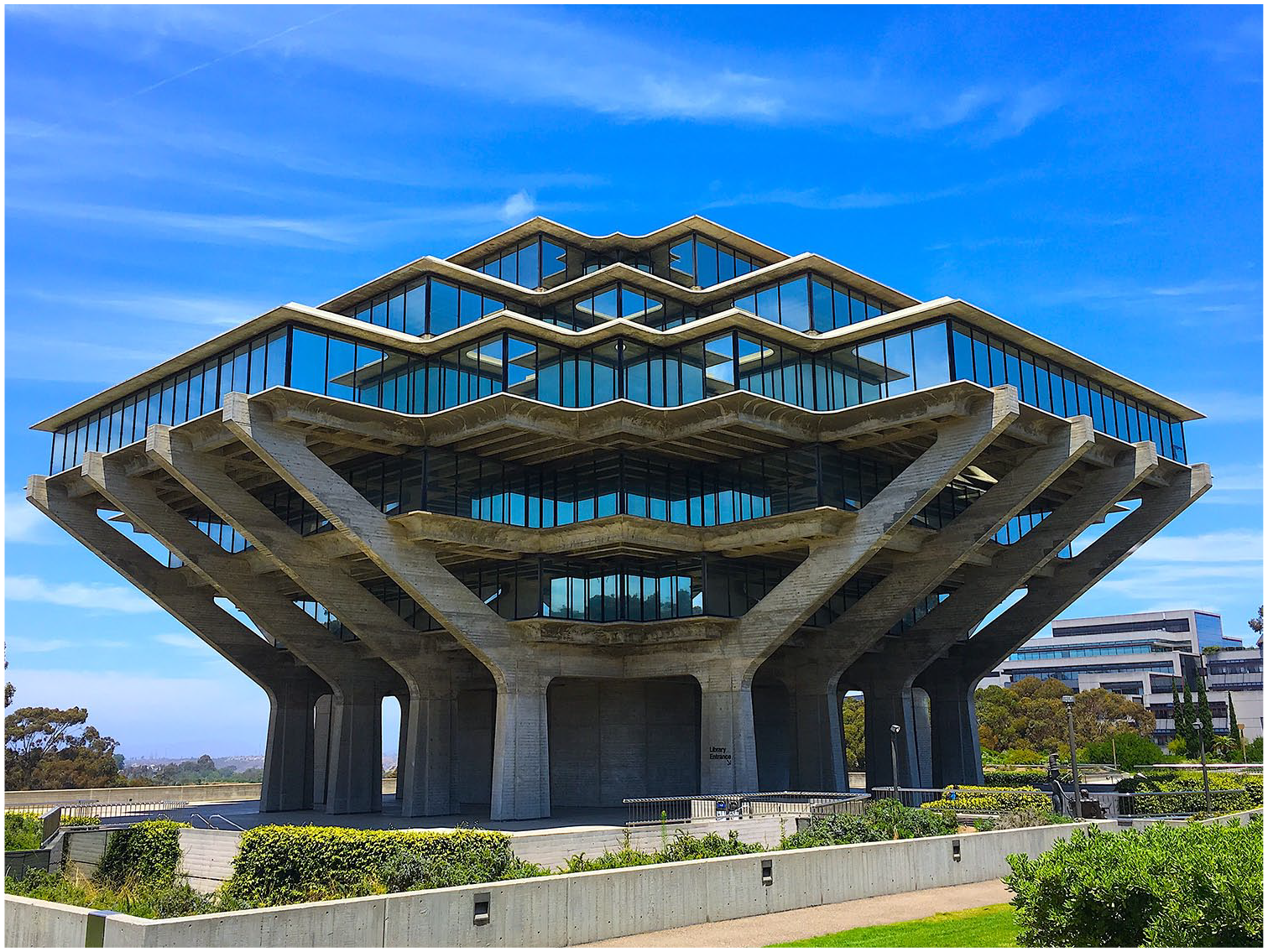
Geisel Library, University of California, San Diego. Photo by Codera23, Creative Commons.
Footnotes
Acknowledgements
I would like to thank my research assistants Kate Hume and Nina Serova for their work on this project. I also would like to express my gratitude for the very useful comments offered by the anonymous reviewers as well as those given by Michael Holleran and Samuel Holleran.
Declaration of Conflicting Interests
The author declared no potential conflicts of interest with respect to the research, authorship, and/or publication of this article.
Funding
The author received no financial support for the research, authorship, and/or publication of this article.