




Abstract
In this article, we use Hage’s (2000) critique of White multiculturalism’s orientalizing logic of ethnic enrichment as a lens to analyze the multicultural valorization through ethnic food of the Javastraat, the commercial artery of Amsterdam’s Indische Buurt district. Stemming from a larger ethnographic study of gentrification in the area, the article provides evidence of how racial aesthetics have served as the central guiding principle in the transformation of the neighborhood from a dark space of grime, crime, and decay to the current space of hipness, coolness, and global culture. While being celebrated as a living example of multicultural society in the inner city, we argue that the area embodies a multicultural reality in which White, middle-class residents, and visitors are the prime occupiers of space and aesthetic organizing principle of the neighborhood’s landscape.
Keywords
Introduction: Amsterdam’s Javastraat as a Multicultural Fair
In his book White Nation: Fantasies of White Supremacy, Ghassan Hage (2000) takes the children’s book The Stew that Grew as his point of departure for his critique of discourses of cultural enrichment inherent in Australian multiculturalism. Set during the gold rush era, the book is about how miners from different ethnic backgrounds combined their ethnic-specific food ingredients in the making of the “Eureka soup”—a clear symbol of the Australian nation as born out of the encounter between different cultures. According to the author, what initially appears as a celebration of diversity and a negation of White ethnocentrism gradually acquires the more disturbing contours of a White nation fantasy in which White people are in charge of managing diversity. In the book, in fact, it is the White Anglo-Celtic couple who decides what and how much every culture can enrich the multicultural soup. Hage identifies in this discourse of measuring and controlling the mix the very essence of White multiculturalism. Far from resulting in the overcoming of racialized hierarchies and putting “migrant cultures” on an equal footing with the dominant culture, White multiculturalism is still reliant on an orientalizing conception of non-White people as passive objects to be governed. As he writes, “the ‘ethnic other’ is made passive not only by those who want to eradicate it, but also by those who are happy to welcome it under some conditions they feel entitled to set” (17). In this sense, racist and multiculturalist discourses share in the conviction that the nation is a White space, and that it is up to White people to decide who stays in and under which guise, as well as who ought to be entirely kept out.
In this article, we want to use Hage’s critique of White multiculturalism’s orientalizing logic of ethnic enrichment as a lens to analyze the multicultural valorization of the Javastraat in Amsterdam’s Indische Buurt through so-called ethnic food, a term used by policymakers, media, and other revaluation stakeholders to refer to food sold in restaurants or shops owned by non-Western immigrants. We are well aware that Hage’s critique is born out of the specific historico-political context of Australia, a settler colonial society where the notion of civilization is racially determined as White (see also Ahmed, 2000; Hage, 2002). However, informed by critical race scholarship on The Netherlands (Essed & Hoving, 2014; Wekker, 2016), we believe that the notion of White multiculturalism effectively applies to the Dutch context, where prototypical Dutchness is also generally characterized as White, Christian, and middle-class. In particular, the multicultural valorization of the Indische Buurt sheds light on the hidden but well-established patterns of racist exclusion at the heart of Dutch multiculturalism as they manifest themselves in contemporary gentrification policy and practice. Until recently, the Indische Buurt was widely perceived as a dangerous immigrant ghetto (Hagemans et al., 2016), and media coverage depicted the Javastraat as a forlorn street at the mercy of Turkish and Moroccan criminal gangs (e.g., Kok, 2014). Over the past decade, however, the image of the Javastraat has radically changed. Following two waves of state-led commercial regeneration launched in 2009 and 2016 by the Amsterdam-Oost (East) borough, many of the small Turkish- and Moroccan-owned stores have steadily disappeared from the street, while in their wake, high-end clothing stores and hip cafés have sprouted. This operation was praised by institutions, media, and new middle-class residents and entrepreneurs alike as a successful social and entrepreneurial model that finally brought about “just the right mix of new and traditional elements” (Shorto, 2016). As a result, the Javastraat ceased to be perceived as an immigrant ghetto and now serves as the prime example of what multicultural society should look like (Smit, 2016, 2017a).
Central to both regeneration phases was the borough’s idea to turn the Javastraat into a promenade of “world shops” (Eigen Haard, Ymere, De Alliantie, & Stadsdeel Zeeburg, 2008; Stadsdeel Zeeburg, De Alliantie, Eigen Haard, & Ymere, 2007). In this institutional vision, diversity was not meant to celebrate or reflect the assorted ethnic composition of the local resident population. Rather, as van Eck et al. (2020) explain, it was intended as a corrective to a local population widely perceived as non-native and low-income. By constructing a specific discourse of diversity as a controlled and aestheticized “collection of otherness” to be carefully selected, managed, and then showcased according to a principle that Hage calls “multicultural exhibitionism” (2000, p. 157), the borough could represent the neighborhood in such a way that it catered to the needs of middle-class residents even before they arrived (Hoekstra et al., 2018). In other words, through a symbolic politics of territorial stigmatization that decreed the Indische Buurt at once economically failed and lawless (Sakizlioglu & Uitermark, 2014), the borough made it easier for itself to justify extraordinary measures that further destabilized and marginalized local immigrant entrepreneurship and livelihood, while at the same time obfuscating the relations of power and exclusion intrinsic to the process.
As we will show, racial aesthetics were a vital component of the construction of the Javastraat as a multicultural space of diversity. As Brandi T. Summers (2015) argues, differently raced bodies and their associated sensory-material cultures need to be explicitly visible in order to add to the diversity of a space. This visibility, however, needs be subjected to a high level of regulation before it can be deemed acceptable and unthreatening to prospective White residents and consumers. Thus, race remains visible but is emptied of its political baggage, reduced to a mere visual representation of different racial and ethnic groups based upon preconceived exotic narratives functional to the spread of neoliberal reforms. This is what Summers defines as “black aesthetic emplacement” (2019, p. 3), which is a process through which blackness is reduced to urban capitalist simulacra accruing the value of a neighborhood without extending the same revaluation to black people. Only once it is reduced to an aesthetic marker can blackness become “valued as a visible evidence of multiculturalism” (2015, p. 309).
This article investigates the role of a racial aesthetics of ethnic eateries and groceries in the transformation of the Indische Buurt into a space exuding hipness, coolness, and global culture. Looking at store fronts, brands, and product range, we will demonstrate how a White, middle-class aesthetics of multiculturalism was deployed by institutional and civil society redevelopment stakeholders in order to repurpose the neighborhood for a new market where White people are the prime occupiers of space and aesthetic organizing principle of the neighborhood’s landscape. The term White, middle-class aesthetics is used here to highlight the connection between Whiteness and class superiority in Dutch society (Wekker, 2016) and denounce the racial undertones of urban revitalization programmes centered on middle-class aesthetic values and tastes officially sanctioned and propagated by the state.
This article stems from Fiore’s larger comparative ethnographic study primarily consisting of a “multisensory ethnography” (Pink, 2009) of Amsterdam’s Indische Buurt and Rome’s Tor Pignattara, two so-called “multicultural” neighborhoods currently undergoing substantial processes of urban regeneration. Through “thick comparison” (Scheffer & Niewöhner, 2010), the research aims to, on the one hand, assess the ways in which multisensory experiences of urbanity are tied to the constitution, reproduction, and maintenance of social inequalities and spatial relations of gentrification (Kern, 2012) in these formerly immigrant neighborhoods; and, on the other, contribute to ongoing debates on the forms and practices of contemporary gentrification across the Northern-Southern Europe divide (Lees, 2012). The fieldwork of this project started in September 2017, and consisted of sixteen months of participant observation (eight months in each location) accompanied by forty ethnographic semistructured, in-depth interviews (twenty per neighborhood) with a variety of local residents, entrepreneurs, policymakers, and other regeneration stakeholders. The fieldwork was preceded by a preparatory research phase consisting of (critical) discourse analysis of media and policy documents published between 2000 and today, aimed to identify relevant debates and themes in both locations as well as to (re)trace the shifting representations of the two neighborhoods both before and during the regeneration. While the above project constitutes the main source of data and conceptual framework for our analysis, the theme of aesthetic revalorization discussed in this Special Issue has emerged especially in the Indische Buurt, and in particular in the context of the state-led regeneration of the commercial environment of the Javastraat. The research material we use consists of municipal policy documents explicitly ordering the physical and symbolic upgrade of the Javastraat, national media coverage of the process, and one fieldwork interview with an external urban strategist hired by the borough. The material analyzed here will allow us to deliberate on the sensorial politicization of the commercial environment of the Javastraat, and shed light on the institutionalization of sensory and aesthetic norms in the regeneration of the street.
One final disclaimer before delving into the analysis. Unlike most literature on multiculturalism that has non-Western immigrants as its object of analysis, this article focuses on one particular construction of multiculturalism within dominant White Dutch culture. Readers will thus be mostly confronted with documents and accounts reflecting the dominant White perspective on immigrants and how they should behave in order to be regarded as deserving members of Dutch society. Our decision to engage with institutional and other regeneration stakeholders’ accounts should not in any way be taken as meaning that immigrant residents and entrepreneurs of the Indische Buurt—and The Netherlands more broadly—are just passive objects of White governance, or that their experiences are irrelevant for the purpose of evaluating Dutch multiculturalism. On the contrary, we are interested in showing how local institutions have worked to mystify and limit the existing multicultural reality through practices of blatant discrimination operating along racialized and classed discourses of taste, style, and aesthetics, which have led to the systematic economic and cultural displacement of many immigrant entrepreneurs and residents of the Indische Buurt.
The First Phase of Commercial Regeneration in the Javastraat: Precipitating Gentrification in the Indische Buurt
The Javastraat is the commercial artery of the Indische Buurt, a relatively old neighborhood that developed around the turn of the twentieth century in what was then the polder area along the Eastern edge of Amsterdam (Ernst & Doucet, 2014; Hagemans et al., 2016). Originally built for the lower-middle classes, the Indische Buurt maintained a good level of appreciation until well into the 1960s, when the low quality of the houses and the sustained suburbanization of the rising middle class in Amsterdam ignited the rapid physical and subsequently social and economic decline of the area (Ernst & Doucet, 2014). Throughout the 1960s and 1970s, the neighborhood was met with the arrival of so-called guest workers from Morocco and Turkey, at once attracted by the abundance of cheap housing and segregated there by active and indirect “spreading policies”—spreidingsbeleid—that precluded non-White residents from settling down in central areas of the city (Ernst & Doucet, 2014; Hagemans et al., 2016; Heilbron, 2017). In response to these developments, Dutch media and political discourse started to narrate the area as a crime-swamped ghetto, plagued by burglary, drug-related crimes, and street violence (Akkermans et al., 2013; Heijdra, 2000; Meerendonk & Roegholt, 2000).
The neighborhood endured in a state of neglect until well into the 2000s, when the city government started to actively interfere in the management of the area, this time by implementing state-led social mixing policies in collaboration with housing corporations (De Alliantie, Eigen Haard, & Ymere, 2006; Stadsdeel Zeeburg, 2001; Stadsdeel Zeeburg, De Alliantie, Eigen Haard, & Ymere, 2007). From 2007 onwards, 1 the Indische Buurt became the target of enormous investments aimed at financing the restructuring of the local housing stock so as to break up the concentration of poverty by making the area more attractive to middle-class households. This renovation plan was accompanied by a process of tenure conversion privileging owner-occupancy, which set the ground for the ensuing gentrification and gradual substitution of a considerable part of non-Western immigrant residents with a concurrent influx of White newcomers—White Dutch and expats (Ernst & Doucet, 2014). In barely eleven years, these measures reduced the amount of social housing by 16% and increased the number of privately owned and private/free-market rental properties respectively by 33% and 55% (Onderzoek Informatie en Statistiek, 2002–2018) (Table 1). The transformation of the Indische Buurt is consistent with Amsterdam’s gentrification model based on a process of “suburbanization of poverty towards the urban peripheries and surrounding regions” (Hochstenbach & Musterd, 2017, p. 1), and with the observed effects of tenure conversion leading to “the increasing ethnic polarization between the central parts of the city and the post-war periphery” (Boterman & van Gent, 2014, p. 156), with the center predominantly racialized as White.
Distribution of the Housing Stock in the Indische Buurt 2007–2018.
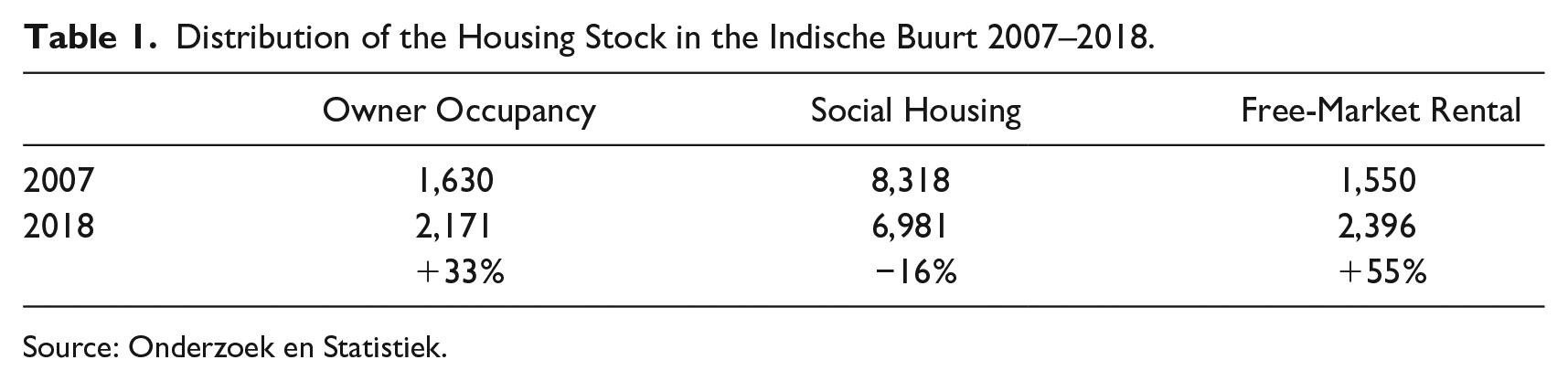
Source: Onderzoek en Statistiek.
Nonetheless, it was only with the launch of an aggressive institutional plan for the commercial gentrification of the Javastraat that the most striking change came about. Some authors argue that the reorganization of the commercial space of an area to accommodate the consumption practices of gentrifiers is bound to accelerate residential gentrification through the creation of new sociospatial meaning and the restructuring of sociospatial power (e.g., Zukin, 2005). In addition, heaps of research have revealed the interrelation between food cultures and commercial gentrification, in particular their potential for attracting younger and more affluent residents (e.g., Hyde, 2014; Slater, 2006; Zukin, 1990). The case of the Indische Buurt is in line with this scholarship. In the specific context of state-led gentrification in Amsterdam, the term “quartering” (kwartiermaken) was introduced to designate a specific form of symbolic politics through which policymakers try to influence the representation of neighborhoods in anticipation of the arrival of sought-after social groups—for instance, policies that finance or support new types of catering facilities and shops (Hoekstra et al., 2018). The regeneration of the Javastraat is a perfect illustration of “quartering” in its practical application. As Hagemans et al. (2016) suggest, the city government and housing corporations reasoned that highly educated professionals were more likely to relocate to the Indische Buurt if their apartments were surrounded by trendy cafés, restaurants, and boutiques. As a result, low-status stores and cafés owned by immigrants needed to make room for businesses that fit the state’s desired goal of urban redevelopment and gentrification (see also Sakizlioglu & Lees, 2019; van Eck et al., 2020).
The commercial regeneration of the Javastraat happened both at the level of the built and retail environment. Beginning in 2007, the city planning department designed and implemented—without asking store owners—a new streetscape that reduced parking space for cars but increased it for bicycles, tearing out trees, installing new planters, and imposing the use of paint colors for store fronts that were compatible with official plans for the regeneration (Hagemans et al., 2016). Then, in 2009, the borough issued the Horecavisie Indische Buurt, 2 a new policy document that laid out a revamping plan for the retail environment of the Javastraat—horeca is an acronym for hotels, restaurants, and cafés. The borough’s declared vision was to increase the number of high-quality restaurants, student cafés, and cultural establishments. The Javastraat and the adjacent Javaplein were meant to constitute the culinary heart of the neighborhood, and serve as a showcase for the local ethnic diversity through gastronomy (Stadsdeel Zeeburg, 2009). Existing immigrant-owned restaurants, bars, and cafés, however, were positioned in the document as low-quality and thus incompatible with the neighborhood’s imagined middle-class future. “It will not hurt anyone if, once a snack bar/fast food location disappears, it is not replaced by another,” the document bluntly stated, adding: “In the Javastraat [. . .] there is a need for commercial activities that give shine to the area” (5). 3
In arguing their case against immigrant-owned businesses, the borough resorted to two interrelated discourses in their 2009 Horecavisie: aesthetics and crime. On the one hand, existing commercial activities were blamed for bringing decay to the street and giving it a destitute appearance. With the aid of photographic evidence (Figure 1), the document lists all those characteristics that make these businesses “appear unwelcoming to many” (6): worn-out awnings, damaged windows, poor lighting, yellowed photos of kebab and deep-fried snack food, vegetables in crates on the sidewalk, and closed curtains shielding the inside from view. These qualities, the borough states, are not just uninviting, but also create an aura of suspicion around the kind of activities that take place “behind closed curtains.” In fact, the argument very swiftly moves from aesthetic judgements to explicit allegations of nuisance and criminal activities such as illegal underground gambling and money laundering. In the light of these allegations, the borough declared it necessary to implement restrictive policy measures against these stores, and resort to tighter enforcement controls “aimed either at their improvement or eventual disappearance” (8). These disciplinary measures were accompanied by preferential rents offered to “good entrepreneurs” (Stadsdeel Zeeburg, 2009, p. 14) to encourage them to move their businesses to the Javastraat.
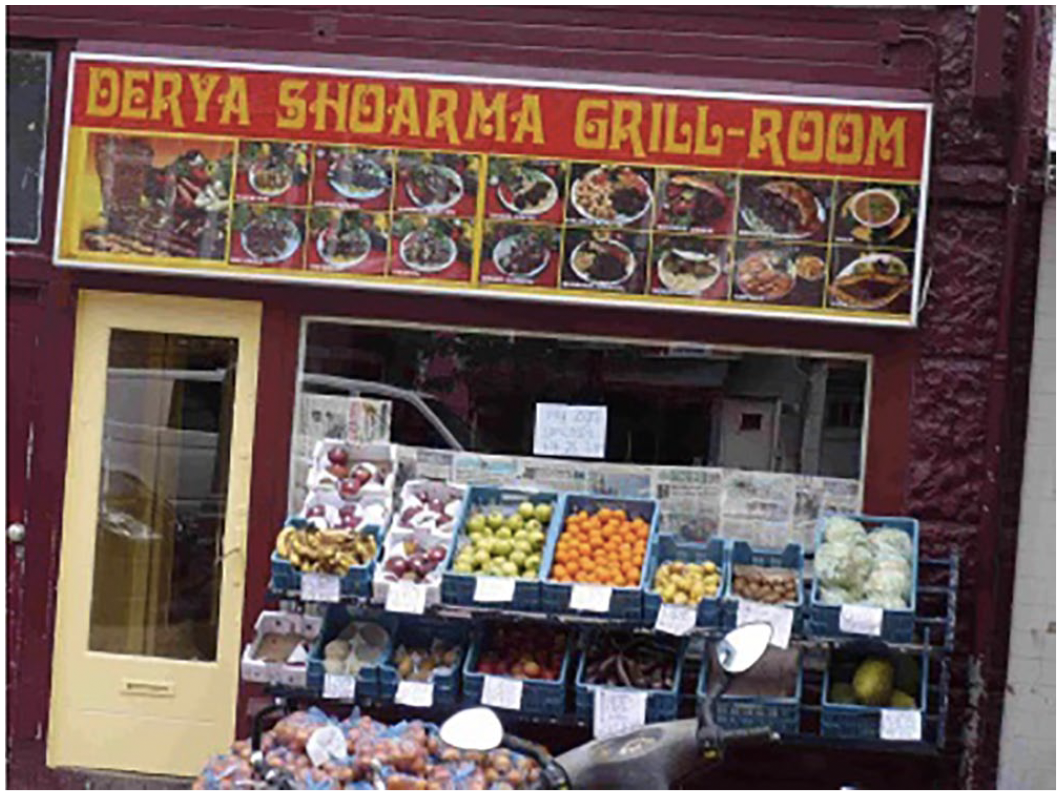
photographic evidence provided by Horecavisie Indische Buurt (Stadsdeel Zeeburg, 2009, p. 6).
Thus, the Horecavisie laid down “instructions in racist modes of seeing” (Butler, 1993, p. 10) that designated immigrant otherness as degraded, inferior, and criminal. As Dutch author Jacqueline Schoemaker (2017) writes, in this document “[t]he Javastraat is seen. It is looked at, monitored, valued with the eyes” (42; original emphasis). 4 By deploying aesthetic patterns of stigmatization that retrenched ethnocentric power hierarchies and visibilized non-Western entrepreneurs as deviant, the borough could subject the Javastraat to a new form of governmentality based on a “multicultural-assimilationist apparatus” (Hage, 2010, p. 248) that posited the domestication of ethnic communities as a precondition for their inclusion into the multicultural fold.
As a result of these disciplinary measures, the Javastraat quickly became one of the most expensive and sought-after streets in the whole city. The upgrading of the commercial environment and the rebranding of the area into “the Brooklyn of the city” (Stadsdeel Oost, 2012, p. 4) led to such a stark image change that the Indische Buurt soon came to be ranked as one of the most beautiful and lively neighborhoods in Amsterdam (de Vries & van der Pol, 2015, p. 36). With its “newest gin tonics” and the “hippest, coolest, and most surprising hotspots” (ibid.) of the whole city, the Indische Buurt suddenly revealed itself as the newest cash cow in Amsterdam. As the owner of a brand-new high-end clothing store put it, “[t]he new goldmine of Amsterdam is here in the East. That is why I wanted to have a shop here in the first place” (Smit, 2016; our translation).
However, it was only with the second phase in the redevelopment of the Javastraat that the multicultural imperative of the regeneration became manifest. Inaugurated in 2016, this second phase aimed to “[help] ethnic entrepreneurs ‘to take their business to the next level,’ apparently, by catering to the tastes and exotic fantasies of a native-Dutch, middle-class public” (Hagemans et al., 2016, p. 110).
The Second Phase of Commercial Regeneration in the Javastraat: Javakwartier as a Critical Infrastructure of Gentrification
It is with the above goal in mind that, in May 2016, the city government funded a “quartering” project titled Javakwartier (Java Quarter) within the framework of their Experiments City in Balance initiative (Gemeente Amsterdam, 2015) and the 2018–2022 City in Balance policy (Gemeente Amsterdam, 2018b), both meant to tackle the mounting touristification of Amsterdam. The aim of Javakwartier was a substantial branding operation that would market the Javastraat and surroundings as “just another piece of authentic, cosmopolitan Amsterdam” (Gemeente Amsterdam, 2018a, p. 3). 5 The overriding goal of the project was to enhance and promote the multicultural character of the Javastraat, and “use it as a unique selling point to promote the area to visitors and tourists and thus contribute to the distribution of tourism [across the city]” (ibid.).
If the Javastraat came to be widely celebrated as a space of diversity and a prime example of multicultural society in Amsterdam, a substantial part of the credit goes to Javakwartier and its creator, a placemaking and urban branding consultant with a consolidated experience in strategy and concept development for creative and inclusive cities. There are two ways in which Javakwartier’s mediation has become critical to the spatial and economic restructuring of the Javastraat and the Indische Buurt more generally as a space of “multicultural urbanity” (Hackworth & Rekers, 2005, p. 232). Firstly, the project launched a communication platform that renarrates the neighborhood for the Dutch middle-classes and international tourists. Through stories about the shops, their owners, products, and consumers, as well as through photography, it instructs its visitors about the neighborhood’s local culture and what to look for when in the area—users can search for recipes, groceries, boutiques, street food, cafés, and restaurants. This way, the Javakwartier website enforces a middle-class, tourist gaze on the neighborhood based on the symbolic and material production of urban value through the spectacularization of local immigrant food cultures and communities as exotic, authentic, and highly consumable. 6 By producing, recapturing, and redistributing over time and across space this middle-class, tourist gaze, Javakwartier has become part of the “critical infrastructure” (Zukin, 2005, p. 192) of gentrification in the Indische Buurt.
Secondly, Javakwartier enables White, middle-class consumers to appropriate the commercial environment of the Javastraat through a process of aesthetic upgrading of local immigrant-owned shops. The project provides professional marketing consultancy to six carefully selected immigrant entrepreneurs to help them conform to the aesthetic and consumption desires of newcomers and tap into this new market sector. The transformations the project enforces on these businesses range from superficial interventions of aesthetic makeover—often limited to the designing of a new logo and the installing of a new, clean awning—to more structural changes involving a complete rebranding of the commercial activity accompanied by a product differentiation strategy. The recruitment of these six entrepreneurs was made not only based on the authenticity and quality of their offer, but also and most importantly on “their willingness to make a transition and make changes, to move forward” (Javakwartier, 2018b). In other words, Javakwartier recruited entrepreneurs willing to adapt their businesses to the tastes of gentrifiers and leave behind their traditional customer base, deemed financially marginal and irrelevant in the imagined White, middle-class future of the Indische Buurt. “The people who came to live here have a different demand. You [immigrant entrepreneurs] can address both target groups, but don’t kill yourselves” (ibid.). Equating resistance to gentrification with entrepreneurial suicide exacerbated immigrant entrepreneurs’ sense of precarity, and coaxed them into complying with institutional aesthetic demands (see also Sakizlioglu & Lees, 2019). In fact, aesthetic upgrade has quickly taken a life of its own in the Javastraat. “Because they [immigrant entrepreneurs] look at each other, they imitate,” Javakwartier’s creator admits. “This is a development I didn’t think of consciously in advance, but it happened. When they see [the change] is working, you don’t have to intervene” (ibid.).
In sum, while laudable in its aim to help immigrant-owned businesses not to die from gentrification, Javakwartier and its promise of entrepreneurial success led to the restoration of White, middle-class consumers as the prime occupiers and users of the commercial space of the Javastraat, while at the same time reducing racialized others to “a lifestyle amenity” (de Oliver, 2016) under the guise of collective diversity. Although appearing as a process fostering ethnic life and ethnic value through the creation of an aestheticized space for diversity consumption, Javakwartier has in fact contributed to further the institutional vision for the Indische Buurt based on “an economy of otherness” (Hage, 2000, p. 128) whereby racialized groups feature only as excessive bodies to be administered or—once regulated—as exotic exhibits for the use and consumption of the White, middle-class tourist and consumer.
In order to illustrate our argument, we will now retrace the development of two local stores: Saeed’s Curry House, a Pakistani-owned grocery specializing in Indian, Pakistani, and Bangladeshi food; and the Moroccan-owned fishmonger Cape de l’eau. We have chosen to write about these two cases for two reasons. Firstly, they are the two shops that underwent the highest degree of transformation as a result of their participation in the project. And secondly, their makeover reflects two opposite ways in which Javakwartier has orchestrated ethnicity: ethnic enhancement for the former, and de-ethnicization for the latter. In both cases, however, White, middle-class aesthetic tastes emerge as the central organizing principle of the transformation.
Saeed’s Curry House: Ready-made Curries for Hipsters
Saeed’s Curry House is the most widely celebrated success of Javakwartier, and its transformation is currently advertised as the symbol of the positive development the Javastraat is undergoing (Smit, 2016, 2017a, 2017b). Located at number 9, this shop owned by a Pakistani-Dutch entrepreneur opened its doors in 1997 under the name SK Toko—where Toko is the generic Indonesian word for “shop” which has now become the customary Dutch term for a shop selling “exotic” or “tropical” products. The store remained there, almost unchanged, for about twenty years. When the shop was opened, it used to sport a hand-painted and colorful wooden signboard (Figure 2), which remained hanging above the shop’s awning until 2011, when the municipality ordered for it to be removed because it did not fit with the upgraded looks of the street (de Wildt, 2011; Smit, 2017a, 2017b). SK Toko remained for 6 years without a signboard. The clean white slate has often been interpreted as the owner’s lack of entrepreneurial spirit (e.g., Javakwartier, 2018b; Smit, 2016, 2017a, 2017b), yet it appears that he could rely on a steady customer base for which he did not need any advertisement.
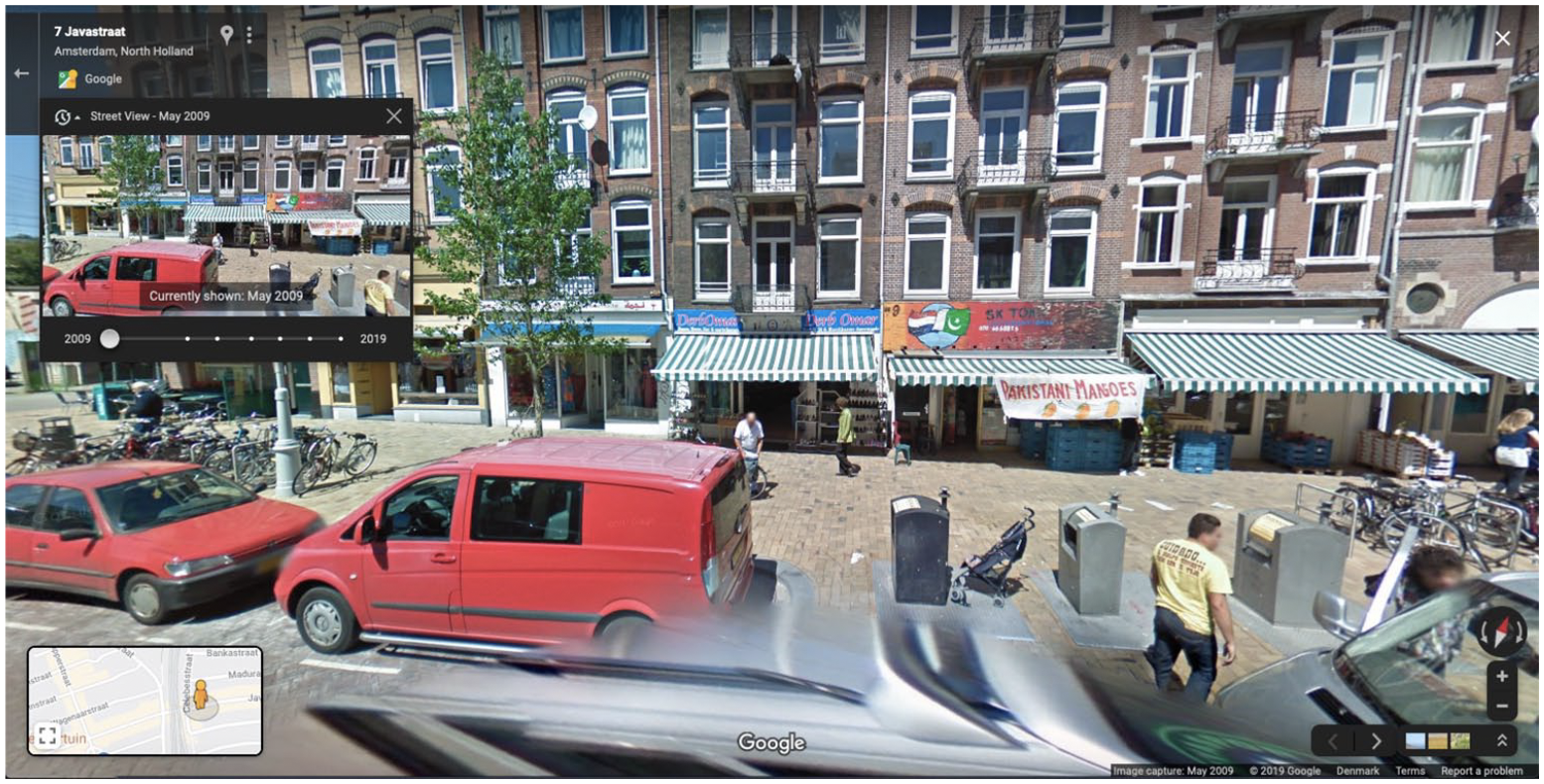
SK Toko, 2009—© E. Fiore with Google Maps street view data.
This visual anonymity lasted until the end of 2016, when the borough put the store owner in contact with Javakwartier to solve the—for them—thorny signboard situation. From then on, the shop went through a great many transformations that culminated in a shiny new brand. The anonymous, nameless white signboard and the striped white-and-green awning made way for a cheerful pink facade and bright yellow canopy (Figure 3). The store’s name was also changed from SK Toko to “the more accessible Saeed’s Curry House” (Smit, 2017b; our emphasis, our translation), which got finally painted “in a modern typography” (ibid.; our emphasis, our translation) on the new signboard hanging above the entrance. The rationale behind these changes was the creation of a recognizable visual identity that could make middle-class newcomers “go like, Aaah!” (Javakwartier, 2018b). As Javakwartier’s creator suggests, such moment of recognition is achieved by reducing cultural complexity to a few instrumental values of diversity consumerism. “You really have to think about the things that people know a bit—like the chai, the curry, the falafel. These are things that are part of our multicultural, global culture, and that is the connection you want to make” (ibid.). Javakwartier thus appropriates and repurposes immigrant cultures in order to fit ethnocentric, stereotypical ideas about them and provide a sense of authenticity. In the case of Saeed’s Curry House, this was achieved by conjuring an aura of Indian-ness through the use of Indian truck art typography and color set, the inclusion of the word “curry” in the shop’s brand—with curry being itself the vehicle for the metonymical incorporation of India into the British empire (Zlotnick, 1996) and Western culture more generally—exotically offset by the Muslim name Saeed and combined with the use of English in the shop’s name as itself a marker of globalized culture. Such reinscription of Pakistani culture within the British Raj is a violent gesture that elides the painful history of the partition of India.
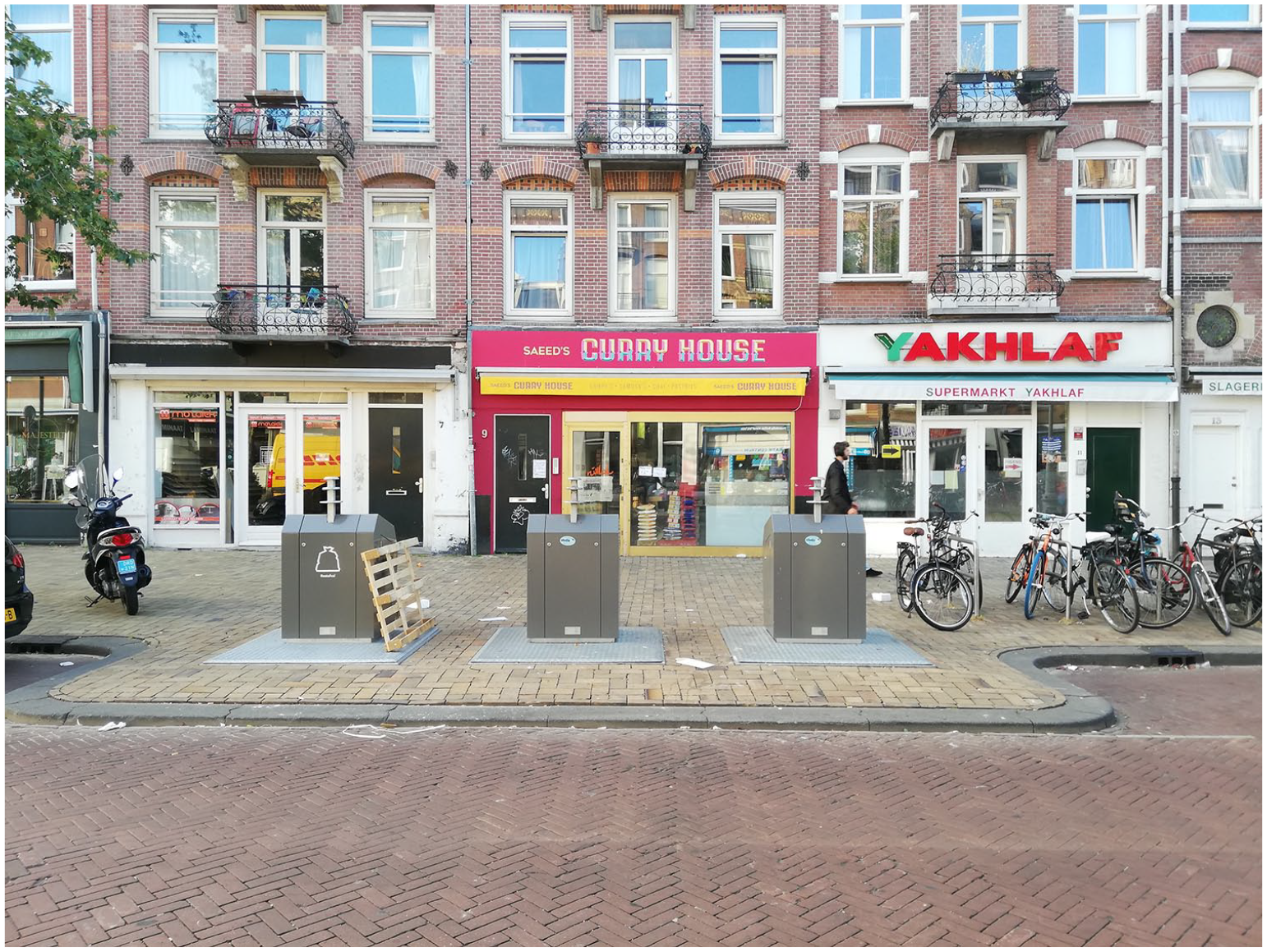
Saeed’s Curry House, July 2019—© E. Fiore.
The appropriation and repurposing of Pakistani culture are also visible in the reorganization of the product range on offer at the store. Since 2019, the store has a small food court right by the entrance selling freshly made samosa chaat, mango lassi, chai, and Pakistani sweets and pastries. But the “jewel in the crown” of Javakwartier’s intervention is the five-step plan to teach new customers how to “put an authentic curry dish on your table in barely thirty minutes!” (Javakwartier, 2018a). An integral part of this five-step plan is the fresh, home-made curry paste now available for sale in the chicken, lamb, and vegetarian options. According to Javakwartier, these home-made curries are for those people who want to make “the real curry but do not have a lot of time. [. . .] This concept is intended to make it really easy for them to use the ingredients” (Javakwartier, 2018b). As it appears, the curry pastes fulfil two important functions: on one hand, they materialize the new “curry house” identity of the store for the White consumer; and on the other, they feed a process of cultural appropriation through food, which not only disattends to the racist histories of colonization inherent in definitions of what is “authentic” and “ethnic,” but also turns the Western consumer into an innocent cultural connoisseur and champion of multicultural society.
In light of the above considerations, the case of Saeed’s Curry House shows that ethnic authenticity serves to preserve racial hierarchies of evaluations that objectify “migrant cultures” into products for White consumption and enable White consumers to stake their own claims on the neighborhood.
Cape de l’eau: From Moroccan Fishmonger to Fish and Chips Shop
If Saeed’s Curry house is the most celebrated success of Javakwartier, the transformation of fish shop Ras el Ma into Cape de l’eau has happened rather on the down-low. The owner, a Moroccan-Dutch man, originally named the store after his native town on the Mediterranean coast of Morocco. The new name is instead the (misspelled) French (colonial) name of the same town. This business is not just a fishmonger where to buy fresh fish to cook at home. Actually customers can choose their own fish, decide how they want it cooked—either grilled or fried—and then eat it in the small dining area at the back of the premises.
Despite the quality of its food, this shop-restaurant has never received much attention from the media. When searching online for information about it, there is not much else to be found than its address, phone number, and opening hours. On the Javakwartier website, the information available is rather meager as well. No mention is made about the renovations and the shop still sports its old name and design, which curiously match the definition of undesired appearance given by the borough in their 2009 Horecavisie: a slightly worn-out blue awning, a Plexiglas signboard with the shop’s name in bold, cursive typography, and the images of two dishes full of cooked fish photomontaged on a lo-fi image of a flat, calm sea (Figure 4).
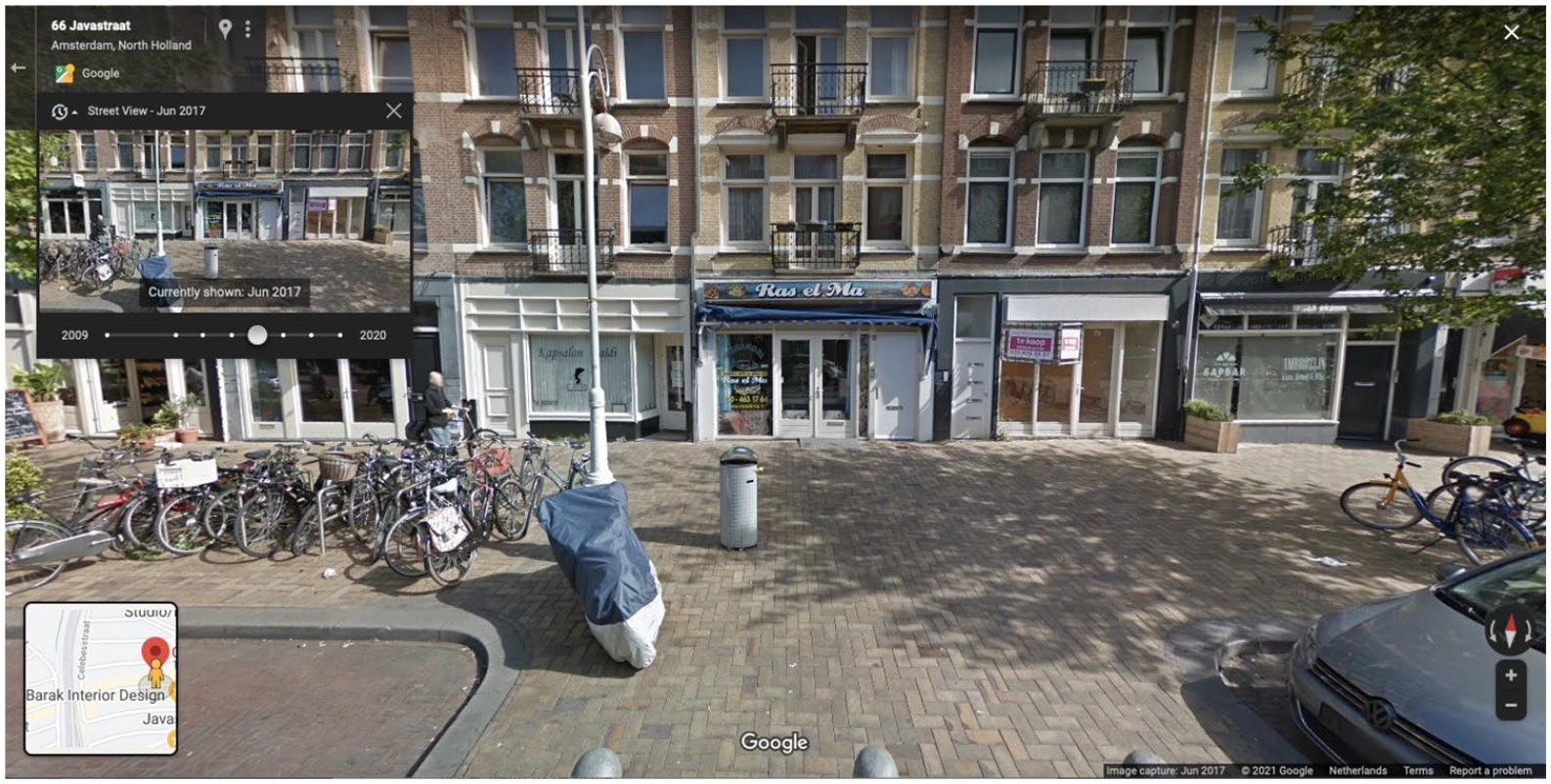
Ras El Ma, 2017—© E. Fiore with Google Maps street view data.
The upgrading, however, took place already in the summer of 2018. At the end of July, a new bright-blue awning was installed. The new name of the store—in a regular roundhand typography—was printed in white on the lower part of the awning, with underneath it the specification “fresh and fried fish” in capital letters in-between two hook-and-line decorations running along the lower rim. In the renovated design, the shop does not have a signboard, and the name has been printed on the window surrounded by the same hook-and-line decoration (Figure 5). The interiors have also been refurbished and redecorated. The dining area at the back of the premise is now surmounted by a deep-blue ceiling with white stucco decorations. In the shop’s front, the fridge counters have been replaced by bigger ones with seahorse and boat helm decorations. A large, grey menu board in the same white typography as the awning has been installed above the counter.
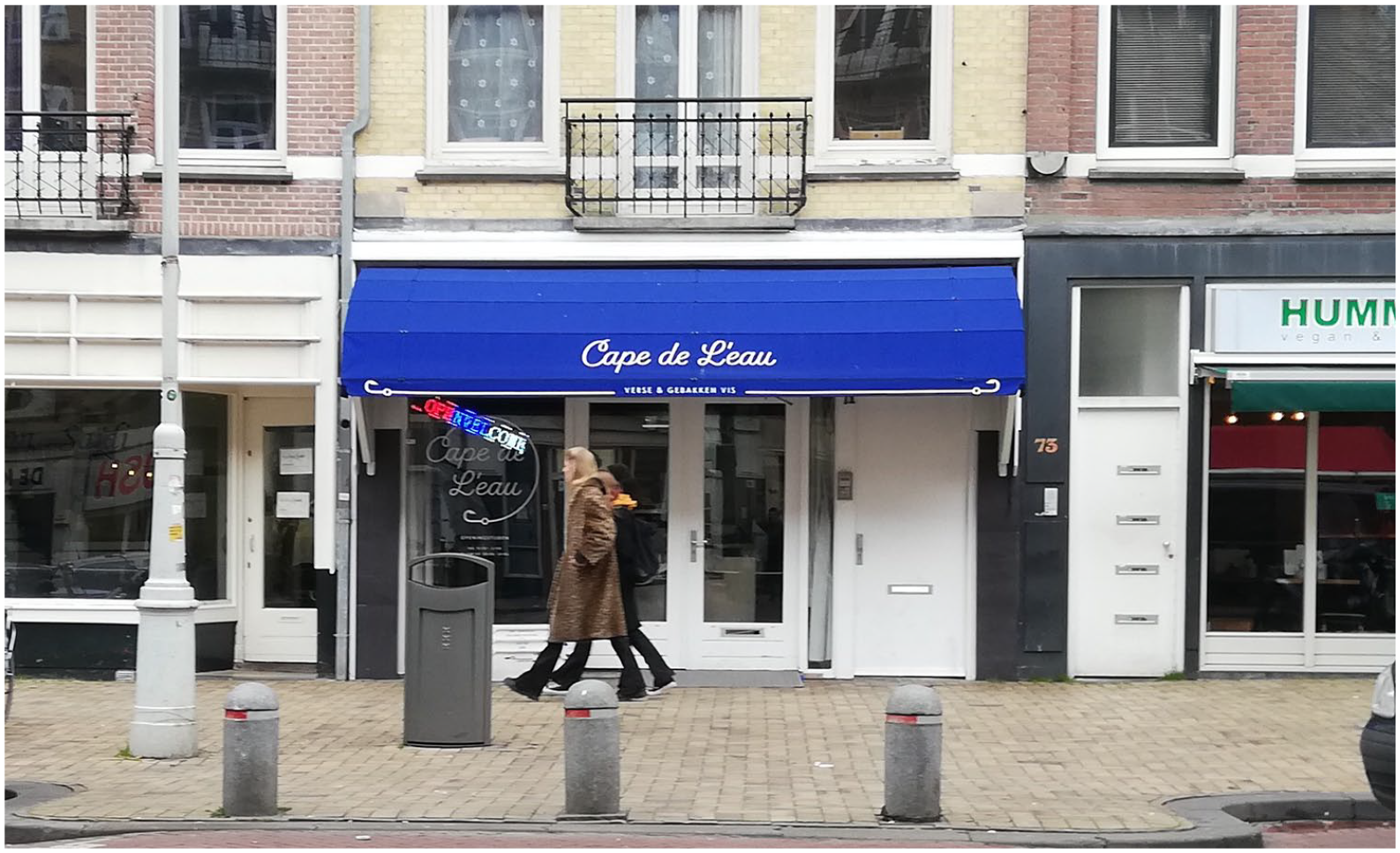
Cape de l’eau, April 2019—© E. Fiore.
When Fiore interviewed Javakwartier’s creator in May 2018, the shop was undergoing renovations of the interior. During their talk, the woman explained what plans she had in store for them. She showed the moodboards of what the inside would become, and revealed that they wanted to introduce fish and chips in the menu. “This is something that everybody knows and it is a product that can attract a different audience.” To be truthful, fried fish and fries were already on their menu, although not as a single dish. By coupling these two products and rebranding them through the much trendier signifier “fish & chips”—one of Britain’s most iconic and popular meals—Javakwartier hoped to be able to tap into a different kind of middle-class nostalgia, this time for what once used to be “the poor man’s streetfood” (Panayi, 2014). 7
As it appears from the above considerations, the transformation of Ras el Ma into Cape de l’eau has followed a trajectory that, while also reinscribing Moroccan culture within its colonial enunciation, is opposite to the one that Saeed’s Curry House underwent in a crucial way. Rather than enhancing the store’s ethnic identity, in this case Javakwartier opted for a de-ethnicized identity that erased any trace of Moroccan-ness from its brand. Such erasure is apparent both in the shift from the Arabic to the French—colonial—name of the Moroccan town and in the inclusion of fish and chips on the menu, both of which provide the shop with a more Western-European feel to it.
One possible explanation for such a de-ethnicization strategy can be found in the broader commercial landscape of the Javastraat as already “saturated” with Moroccan fish-eating culture. Just a few windows away from Cape de l’eau is another Moroccan-owned fishmonger and day-time restaurant called El Pescado, which is advertized by Javakwartier as selling authentic “Marokkaanse visschotels,” large plates of grilled fish the way they do it in Essaouira (Javakwartier, 2017). The multicultural world fair imaginary on which the reorganization of the Javastraat is based revolves around a principle of collecting and exhibiting diversity, which, like every collection, responds to a competitive preoccupation with quotas and proportions (Hage, 2000). Within the (neo)colonial exhibitionary logic of the world fair, there is no room for two of the same. This is probably why the Moroccan fishmonger deemed less authentic and valuable—in her interview, Javakwartier’s creator (2018b) admitted that “El Pescado has the best fish”—needed to surrender to a Western monoculture template in order to belong in the renovated White, middle-class aesthetics of the Javastraat.
Conclusion
In this article, we have examined a particular construction of multiculturalism that exists within the dominant White Dutch imaginary, and how it has been deployed by Amsterdam’s city government to upgrade the commercial landscape of the Javastraat. Focusing on local ethnic eateries and groceries, we build on a multisensory ethnography of Amsterdam’s Indische Buurt to argue that it was the institutionalization of a racial aesthetic discourse relying on black aesthetic emplacement, appearance, diversity, and authenticity that shaped what and who was deemed un/desirable in the renovated commercial environment of the street, thus legitimizing practices of racial inequality.
As could be seen, these interventions were carried out in blatant disregard of their consequences for the economic and social livelihood of local immigrant residents. The policymakers’ emphasis on prospective high-quality businesses as the only strategy to strengthen the local economy of the Indische Buurt suggests that the borough had no interest in supporting the existing economy of the Javastraat. Rather, as the examples of Saeed’s Curry House and Cape de l’eau illustrate, the regeneration, whether enhancing or downplaying ethnic difference, explicitly aimed to restore White, middle-class residents, and visitors as the prime occupiers of space and aesthetic organizing principle of the neighborhood’s landscape. White multiculturalism’s orientalizing logic of ethnic enrichment (Hage, 2000) was vital to dismantling the situation of preregeneration unconstrained and unregulated difference in the Javastraat. Conjuring the feel of a multicultural fair where immigrant cultures are on show, local authorities of the Indische Buurt successfully brought cultural diversity within the remit of a managerial imaginary that conceives of it only at the level of the managed object—both aesthetically and quantitatively.
Ultimately, then, this study demonstrates the importance of aesthetic patterns of stigmatization in processes of urban revaluation, and reveals the centrality of practices of seeing and standards of taste as key instruments of governmentality. As we have argued, aesthetic judgements such as ugly or beautiful, degraded or hip are used by Amsterdam’s policymakers and urban revaluation stakeholders as seemingly innocuous substitutes for racial or class evaluations of urban areas. The depreciation of preregeneration aesthetics in the Javastraat as degenerate and degraded was functional to the implementation of a multicultural-assimilationist apparatus (Hage, 2010), where the love of diversity is intrinsically linked to its control (see also Tissott, 2014). By cultivating an aesthetic normativity both in long-term residents and newcomers as to what “good” diversity means, policymakers were able to further legitimize their own regeneration strategies and at the same time obscure the unequal power relations and exclusionary measures intrinsic in the process. Operating as a cosmetic fix that obscures the violence of dispossession and provides an illusion of inclusion of the racialized other through consumption, the appropriation of cultural diversity for urban renewal purposes on the Javastraat exacerbates the existing racial and class cleavages intrinsic to Dutch multiculturalism.
Footnotes
Acknowledgements
The authors would like to thank the three anonymous reviewers for their helpful comments and Dr Willem Boterman (University of Amsterdam) for his feedback on early drafts of this article.
Declaration of Conflicting Interests
The authors declared no potential conflicts of interest with respect to the research, authorship, and/or publication of this article.
Funding
The authors received no financial support for the research, authorship, and/or publication of this article.
