




Abstract
The Iroquoian and Algonquian-speaking Peoples of North America discovered numerous natural treatments to dermatological conditions long prior to European settlement. Anthropological evidence suggests that treatments for atopic dermatitis, dermatophyte infections, and syphilitic lesions were derived from Sassafras albidum, genus Salix trees, and Sassafras officinale. Literature suggests these medicinal properties are attributed to the naturally abundant safrole, salicylic acid, and ascorbic acid in these flora. Numerous instances of these natural medicinal discoveries later being implemented into European literature reaffirms the impact of Indigenous medicine on contemporary dermatology.
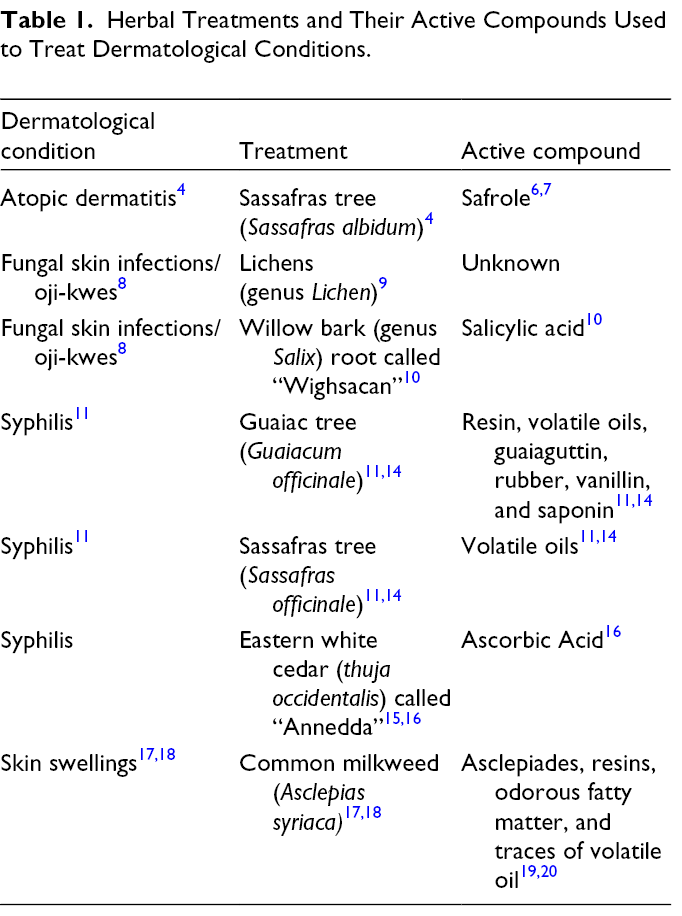
Long prior to colonization, Iroquoian and Algonquian-speaking Indigenous Peoples of North America developed natural remedies for skin injury and disease. Specifically, they implemented natural treatments for dermatological conditions which they utilized themselves and provided to colonizers after their arrival in North America. Natural medicines referenced and their respective active compounds used for the treatment of dermatological conditions can be found summarized in Table 1.
Herbal Treatments and Their Active Compounds Used to Treat Dermatological Conditions.
Indigenous perspectives on health and wellness prior to 1850 differed from western-centric medicine. Anthropologist George M. Foster argued that many Indigenous cultures valued “healing” over “curing,” and placed great emphasis on the holistic balance of health, spirit, and the natural world. 1 While curing specifically focuses on addressing biological symptoms, healing concerns itself with the broader repair of the spirit and mental health. 2 Years prior to colonization, Indigenous healers practiced dermatology to improve both the physiological and psychosocial states of patients with skin disease.
Several natural skin conditions which were recognized in early Indigenous communities were treated with natural medicine. Atopic dermatitis (AD), characterized by xerosis, pruritus, and edema, if not effectively treated, impacts a patient’s quality of life. 3 The cold climate of North America rendered Iroquoian- and Algonquian-speaking Peoples susceptible to AD. AD was recognized by the Indigenous Peoples, and instances of AD, often described as a dry rash, were reported long prior to colonization through oral history. 4 The impact associated with AD on the hands limited participation in activities requiring fine-motor skills, such as bow-hunting and tool crafting. 5 In the late 17th Century, the Jesuit priest Paul le Jeune, while living in a Huron-Wendat village, reported severe rashes of the hand being healed by “one of the most common and wonderful plants in those countries.” 4 Historical analysis suggests that the sassafras tree (Sassafras albidum), frequently described as the “the universal plant,” was used for treatment of AD. 4 The active compound, safrole, within the S. albidum root bark, served to reduce swelling and pruritus. 6,7
With warmer summer temperatures came an increased risk of fungal skin infection. Anthropologist Frederick Waugh noted that fungal skin infections, referred to in the language Seneca, as “oji-kwes,” were characterized by “lumps rotten at the top …. [and causing] red nose.” 8 It can be postulated that the fungal skin infections were transmissible in nature, as the term “oji-kwe” was also used to describe sexual infections. 8 The hindrance on quality of life and work productivity due to fungal infections created demand for their treatment. Subsequent research led to the discovery that the antimicrobial properties of lichens were useful in managing fungal growth on skin. 9 Limited research has been conducted on the active compounds which are responsible for these antifungal properties. Willow bark was also used as an antifungal agent. Salicylic acid, an anti-inflammatory compound with antifungal properties, is primarily responsible for the pharmaceutical nature of willow bark. 10
While naturally occurring skin conditions existed in North America long prior to colonization, recent archeological evidence, although controversial, suggests that syphilis arrived from Europe.
11
Syphilis, caused by the spirochete Treponema pallidum, is responsible for the development of the painless chancre at the inoculation site in primary syphilis. If untreated, it may progress into secondary syphilis or tertiary syphilis and be accompanied by neurological, cardiac, and cutaneous sequelae.
12
Ethnologist William Fenton reported that Seneca People would describe the primary skin lesions associated with syphilis as “the blood getting a cold.”
13
For treatment, the leaves of the guaiac tree (Guaiacum officinale
Following colonization, Europeans sought dermatological treatment from Iroquoian and Algonquian-speaking Peoples. Naturalist Mark Catesby wrote of the Tuscarora Peoples’ ability to use plants as medicine “with good success” after observing treatment of AD. The French explorer Jaques Cartier’s companions suffered immensely from syphilis before the majority of their cutaneous symptoms were relieved by an Iroquoian Annedda tea made of the eastern white cedar tree (Thuja occidentalis). 15 Ascorbic acid is thought to be responsible for the medicinal properties of T. occidentalis, although it is unknown what concentration of the compound remains after boiling. 16 English Captain John Smith also described how Indigenous People helped treat his fellow explorers’ skin swellings with a root called wighsacan which was derived from common milkweed (Asclepias syriaca). 17,18 A cardiac glycoside, resins, odorous fatty matter, and traces of volatile oil found in A. syriaca induced nausea and vomiting prior to alleviating symptoms. 19,20
Spanish, French, and British colonists arriving in North America likely brought with them their own therapeutics, however, without the benefit of Indigenous herbal medicinals, Europeans would not have been as well equipped to deal with their dermatological conditions upon their arrival in North America. Many European colonizers stated that, after seeing the Indigenous Peoples’ approach to dermatology, European fields of medicine would benefit from adopting their discoveries. 21 Ulrich von Hutten, a German scholar, was one of the first to formalize his learnings from the Indigenous Peoples’ treatments to syphilitic skin lesions in the 16th century with his dialogs Fever 1, Fever 2, Inspicientes, and Bulla. 11,22 Literature continues to incorporate Indigenous theories of dermatology. Numerous contemporary dermatological agents contain natural compounds which were used by Algonquian- and Iroquoian-speaking Peoples hundreds of years ago, long before contact with Europeans and western medicine. 23 Dermatology is fortunate to be grounded in the historical teachings of Indigenous medicine. The modern approach to dermatology, which values both the treatment of diseases and overall well-being of patients, is largely owed to its therapeutic roots in Indigenous history.
Footnotes
Declaration of Conflicting Interests
The author(s) declared no potential conflicts of interest with respect to the research, authorship, and/or publication of this article.
Funding
The author(s) received no financial support for the research, authorship, and/or publication of this article.
