




Abstract
College and university students are a group known for excessive sun exposure and indoor tanning. Health education campaigns for avoidance of ultraviolet (UV) radiation have been relatively unsuccessful in this population. This systematic review examines interventions aimed at post-secondary school young adults on college and university campuses for skin cancer awareness, photoprotection, and change in UV-exposure-related behavior. Fifty-nine studies were identified for inclusion according to predetermined criteria. Study heterogeneity was high; methods of intervention were individual or group-based, and were mostly visually delivered and/or passive learning. Most interventions occurred at a single time point. Intervention success was assessed by evaluating subject behavior, intention, attitudes, knowledge, and emotion. Multicomponent interventions, generally consisting of UV photography and a passively delivered educational component, may be more effective than a single component alone. Overall, study quality was poor. Sample size of the majority of studies was <150 subjects. Most studies used self-report of behavior and had a short follow-up time. Generalizability of findings may be impacted as women, particularly white/Caucasian women, were overrepresented in the studies identified by this systematic review. For this specific target population, themes arising from the review include the importance of self-relevance and message framing. Self-affirmation was identified as a potential challenge in designing interventions for this target group, which can lead to defensiveness and a negative reaction to the health message. The findings of this systematic review may inform future research in this field, as well as guide planning of effective interventions in this target population.
Keywords
Introduction
Skin cancer is rising globally. In Canada, cutaneous basal cell carcinoma (BCC) and squamous cell carcinoma (SCC), collectively known as nonmelanoma skin cancers or keratinocyte carcinomas, represent 30% of all new cancer cases. 1 Melanoma is currently the eighth most common cancer in Canada, and is the only one ranked where both incidence and mortality rates are increasing. 2 While risk for BCC, SCC, or melanoma may differ based on the patterns of ultraviolet (UV) radiation exposure, 3 UV light is a known carcinogen 4 that is a risk factor for all 3 skin cancers. Lifetime sunburn exposure is a risk factor for development of melanoma. 5 College and university students are known for unhealthy behaviors, including smoking, risky drinking, poor nutrition and physical activity, and a lack of sun-protective behavior. 6 Despite health education campaigns, this population has been unaffected by interventions aimed at decreasing UV exposure such as covering up with clothing or use of sunscreen 7 ; some studies have even shown increased intention to indoor tan post-intervention. 8,9 There is a known disconnect between health literacy and sun-protective behaviors in this specific age group—one American study showed that while higher health literacy was associated with lower levels of intentional tanning, it was also linked to higher incidental UV exposure and lower skin protection. 10 This systematic review examines interventions to change UV-related behavior of young adults (18, 30 years old) or post-secondary school young adults on college and university campuses. This work was conducted to describe knowledge gaps and inform the planning of interventions to increase awareness of UV-induced harm, and decrease tanning behavior in this population.
Methods
This systematic review was conducted and reported according to the Preferred Reporting Items for Systematic Review and Meta-Analyses (PRISMA) and documented in a protocol registered with PROSPERO (CRD42020152358). 11
Search Strategy
The initial search was developed in conjunction with a health sciences librarian. MEDLINE, EMBASE, PsycINFO, CINHAL, Cochrane Central Register of Controlled Trials (CENTRAL), and Web of Science were searched for articles published from January 1, 1990 to July 6, 2019, using a combination of search terms including sun safety, or photo protection, or sun avoidance, or skin protection, or skin cancer, or carcinoma, melanoma, or skin care, or skin tumour, or dermatology, AND young adult, or post-secondary, or university, or college, AND health education, or school intervention, or lifestyle modification, or health behaviour, or health behaviour, or risk reduction. The search strategy for MEDLINE is presented in Supplemental Material.
Eligibility Criteria
Retrieved English-language publications were intially screened for relevance by title and abstract. Inclusion and exlcusion criteria were specified prior to the literature search. Studies evaluating interventions aimed at educating and modifying health behaviors related to sun safety and skin cancer prevention in young adults (18, 30 years) or post-secondary students were considered for inclusion. More specifically, studies were considered eligible if they involved an intervention, either in isolation or in comparison to another intervention or control group, that implements a pre- and posttest design. To maintain an adequate number of studies in the systematic review, studies were not required to be randomized controlled trials (RCTs). In addition, studies were considered for inclusion if they reported outcomes related to best practices, evidence, and promising practices that have been or could be effective in raising awareness and changing health behaviors among post-secondary school young adult populations on college and university campuses, knowledge levels, perceptions, or behaviors related to sun safety and skin cancer prevention (eg, sun protection intentions, UV exposure intentions, sun-protective behaviors). Cross-sectional studies, case reports, editorials, news and letter, opinion pieces, systematic reviews, narrative reviews, or studies published in languages other than English were excluded.
Study Selection and Data Extraction
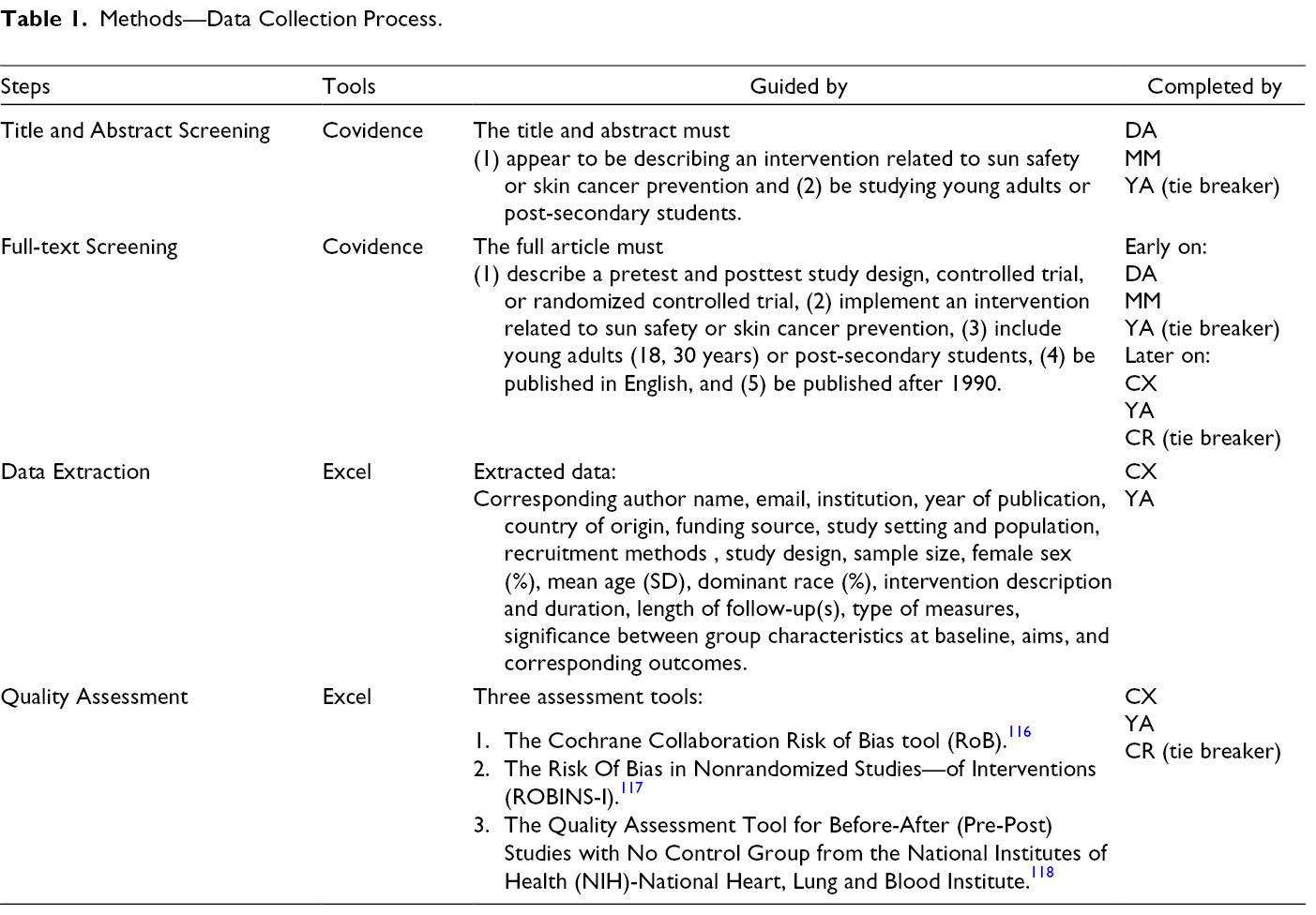
Details of the data collection process are presented in Table 1. Two reviewers (DA and MM) independently screened all relevant titles and abstracts for eligibility. Full-text articles were obtained for abstracts identified by both reviewers as potenially relevant. Eligibility assessment of full-text articles was performed independently by 2 reviewers (DA and MM or CX and YA). Data extraction was performed by CX using a form developed a priori. Accuracy of the data was checked by YA. The data extraction form was piloted prior to use and refined accordingly. Disagreement related to the extracted data was resolved through discussion and consensus between the reviewers. The data characteristics extracted from each included study is presented in Table 1.
Methods—Data Collection Process.
Quality Assessment
Two authors (CX and YA) independently assessed the risk of bias using 3 tools. The Cochrane Collaboration Risk of Bias tool (RoB) was used to assess randomized trials. The Risk Of Bias In Nonrandomized Studies—of Interventions (ROBINS-I) assessment tool was used for quality assessment for nonrandomized studies that contain at least 1 comparison or a control group. The Quality Assessment Tool for Before-After (Pre-Post) Studies with No Control Group from the National Institutes of Health (NIH)-National Heart, Lung and Blood Institute was used for pretest and posttest studies.
Results
The PRISMA flow chart is shown in Figure 1. Fifty-nine articles met the full-text inclusion criteria; 44 studies were RCTs, and the remaining were quasi-experimental (manipulation of an independent variable without randomization): 4 were nonrandomized studies with at least 1 comparison or a control group, 8 were pre- and posttest design, and 3 were posttest design. Two citations 12,13 were the same study with separate publications, with the same sample size and demographic characteristics. The majority of studies were quantitative. There was a large amount of study heterogeneity, in study type, recruitment, intervention, duration of intervention, assessment of intervention, as well as follow-up assessment and duration. The data extraction table including population characteristics can be found in Supplementary Material 2. Study populations skewed toward female and the majority occurred on campus or were recruited from campus. The mean age reported in the studies ranged from 17 to 25.
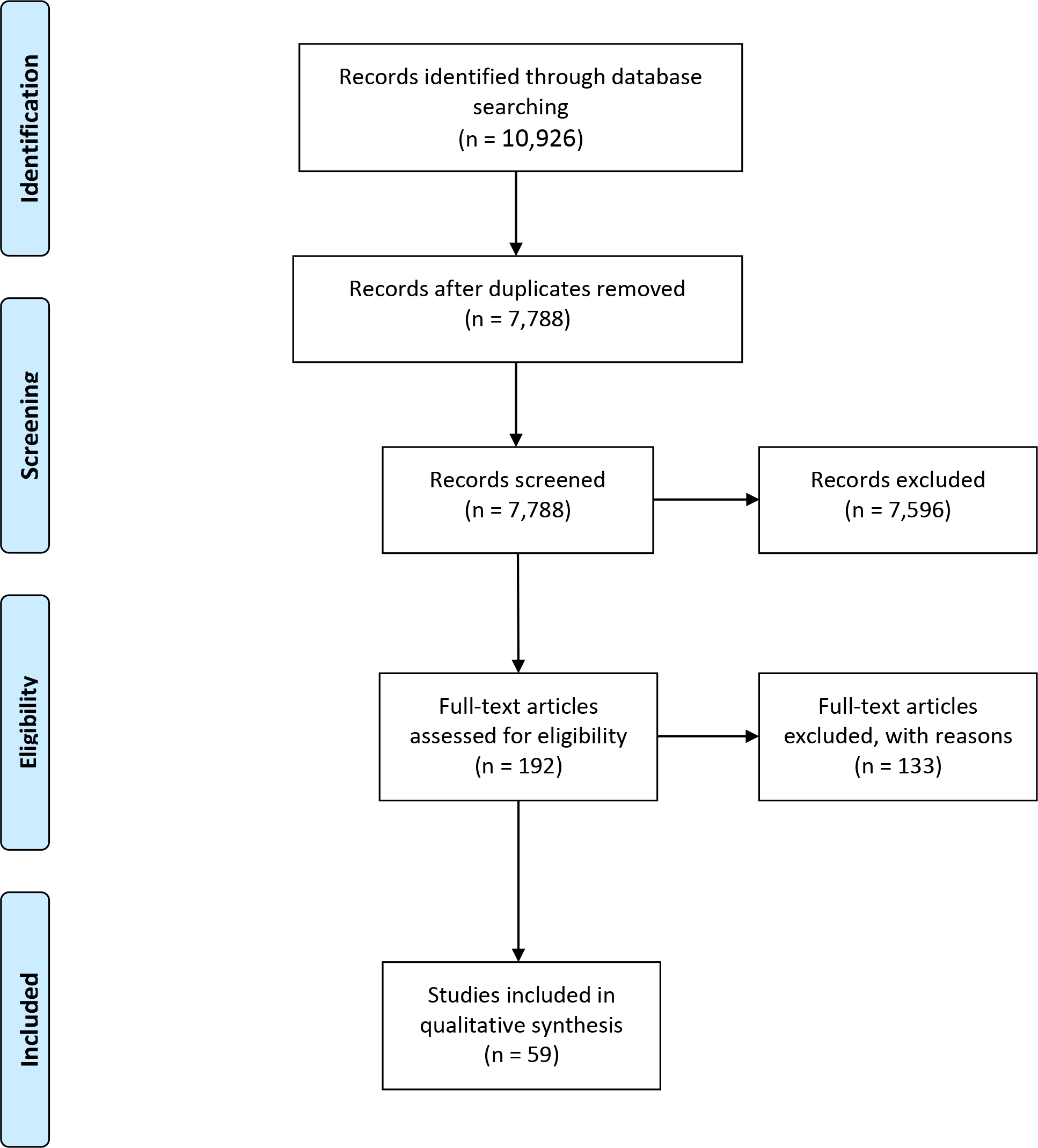
PRISMA flow diagram. PRISMA, Preferred Reporting Items for Systematic Review and Meta-Analyses.
Populations
While some studies targeted anyone within the age group or anyone in the location of interest (campus/college), other studies targeted specific groups for recruitment as a study parameter. Women, specifically white/Caucasian young women, were the most targeted group—27 of 59 studies only targeted women, and 9 specifically targeted white/Caucasian women. Twenty-two additional studies had a population that had a majority of women as subjects (>50%). Only 1 study specifically targeted college men. 14 Studies did not appear to differentiate biological sex versus gender.
Regional and ethnic differences are likely important due to behavioral and biological differences, but there is a paucity of data in this area. Fifteen of 59 studies did not report the race or ethnicity of the population. Two studies were conducted in the Middle East 15,16 and 1 in China.17 Even within a country there may be regional variation; comparison of American university students subjected to a 10-minute videotaped slide show and a UV photo found that compared to the California site, the Iowa site had higher tanning booth use, intentional sunbathing, and risky sun behavior at baseline and follow-up. 17
Interventions
Most interventions occurred at a single time point (40/59 studies) and fell into 2 main groups: visual and passive learning, and could be given individually or group-based.
Most visual-based interventions used an interactive visual interface to educate individuals about risks of UV radiation. These included photoaging software 18 or apps 19 that result in photoaging of a self-portrait of the subject (ie, a selfie), UV photos, 17,20 -26 or a side-by-side comparison of photoaged and non-photoaged photographs of themselves or others. 27,28 This type of intervention was used in 24 studies identified.
Studies where the subjects were given pamphlets, oral, video, website, or poster information with no interactive component were considered passive learning interventions. Studies mainly used text messages, 29 short (15 minutes) to long (45 minutes) presentations, either in group or individual format. Many studies used passive interventions as the control intervention—generally pamphlets or websites from national dermatology or skin cancer organizations. Some studies used photographs and information posters posted in communal areas used by the population. 16 This type of intervention was used in 27 studies identified.
A smaller number of studies had additional types of interventions available. Three studies made sunscreen samples or sunless tanners available to participants as part of the intervention or incentive or reward for participation. 21,30,31 Introspective interventions included a workbook on sun protection 32 -35 or behavior tracking (similar to a diary), 29 a self-assessment of risk 36 or web-based, interactive indoor-tanning intervention. 12,13,37
Cognitive-behavioral interaction in a small groups of 4-6 people, with rewards (eg, gift certificates for the participant who could name the most famous and attractive people who were not tanned), was conducted in 1 study, 38 and motivational interviews were also used in some studies. 39,40 Dissonance induction was used in 1 study: under deception, participants were advised they were providing input for an intervention for appearance beliefs and attitudes of adolescent females. They were required to role-play to convince someone to avoid pursuing tanning. 41
Many studies had multiple interventions, or interventions that were a combinations of methods, for example passive learning plus a visual-based intervention, 26 or sunless tanner and a visual-based intervention, 21 and cognitive behavioral interaction with personal UV imaging. 38 While multiple-component interventions—generally of UV photography combined with educational information—were commonly found to work better than 1 component alone, 17,20,22,25,42 these results were not consistent. 39
Message Delivery: Framing, Self-Relevance, Self-Affirmation, Self-Efficacy
Method of delivery of information within the intervention was a feature in several studies. Messaging was evaluated in 23 studies; narrative messaging generally employed a story, often about a peer who had a skin cancer related to UV radiation, while statistical messaging used facts and figures to convey information. Framing the message as a gain or a loss was also a key feature of interventions. Loss-framed warnings (eg, UV radiation causes skin cancer) were evaluated compared to gain-framed warnings (eg, protecting yourself from UV radiation leads to healthy skin) in some studies. 8,43 Messaging can be conveyed in written or spoken text, or a visual format such as images of tumors or postoperative pictures. Some interventions deliberately incite thoughts of mortality, such as the “terror management health model,” where individuals were shown an image of a woman sunbathing on the beach surrounded by individuals that looked as if they were attending her funeral. 44
Self-relevance, where a subject feels an idea is about or affects them personally, was also investigated in several studies. Self-relevant interventions are evident in UV photo selfies and facial morphing software, 18,19,26,27,45,46 but images of aspirational peers, such as fashion models or celebrities, 47,48 social comparison with peers with very little sun damage and high rates of sun protection, 23,25 and narrative examples of individuals similar to the subject 49 are methods through which interventions can have self-relevance. Experiential information processing, where the individual was encouraged to reflect on their feelings and previous experiences related to the narrative message about skin cancer, 50 as well as listening to other college students discuss sun protection trends 22 are also ways to increase self-relevance of interventions. Self-relevance is tied to threat appraisal—the perceived severity of the threat and perceived vulnerability of the individual. 51
Studies also identified self-affirmation as a potential challenge in designing interventions. Self-affirmation is a theory in psychology on how individuals adapt to information or experiences that are threatening to their self-concept or self-integrity and is linked to defensiveness, denial, and avoidance. 52
Assessments
According to the Theory of Planned Behavior, 53 health behavior changes are predicted by intentions, which are in turn predicted by 3 factors: (1) attitude toward the behavior, (2) subjective norm, and (3) perceived behavioral control. Factors such as emotions and levels of knowledge and awareness significantly contribute to a person’s attitude/belief formation and decision-making process, ultimately influencing behavior changes. 54 -56 Using this framework, assessments of intervention efficacy typically fell in 5 domains: (1) Behavior, (2) Intention, (3) Attitudes/Beliefs/Perception, (4) Knowledge/Awareness, and (5) Emotion/Reaction.
Assessments of Behavior could be reported or observed, and included sunscreen use, indoor tanning, outdoor incidental and intentional sun exposure (including sunbathing), sun protection (clothing, hat, staying in shade), and other measures of sun protection tendencies, such as number of sample sunscreen packets taken by the subject. 28,44 Most assessments in the Behavior domain were self-reported, because the majority of studies collected self-reported data, using surveys, questionnaires, interviews and phone calls.
Assessments falling into the Intention domain included intention to tan, intention to decrease or stop tanning, intention to use sunscreen, intention to avoid sun. These measured a subject’s determination to act in a certain way, but were not a measure of the act itself.
The Attitude/Beliefs/Perception domain investigated subject responses to questions regarding susceptibility, threat, severity, benefits, risk, barriers, self-efficacy, information avoidance or denial, and information acceptance. These types of assessments gage a subject’s broad beliefs about sun or sun exposure behavior.
Assessments in the Knowledge/Awareness domain investigated the subject knowledge level and awareness of facts about sun exposure, usually concerning risks for skin cancer, or identification of skin cancer, or self-skin examination. The Emotion/Reaction domain assessments evaluated subject emotions or reactions, such as worry, fear, shock, concern, and boredom.
Most studies focused on Behavior (N = 35), Intention (N = 46) and Attitudes/Beliefs/Perception (N = 43), although some also focused on Emotion/Reaction (N = 18). Fewest studies investigated Knowledge/Awareness (N = 9). Older studies were more likely to focus on Knowledge alone, 57 likely because newer literature shows the disconnect between skin cancer knowledge and behaviors and intention 58,59 in this population.
Choice of assessment tool was linked with the type of message used in the intervention. Emotion/Reactions were often linked with negative message framing. Self-efficacy, falling within the Attitude/Beliefs/Perception grouping, was a component of several studies, and also interacted with message framing. Self-efficacy refers to a person’s belief in his or her abilities to perform a given action and/or obtain a goal. 60 A Dutch study on skin self-examination found a loss-framed message may be more effective than a gain-framed message, but only in individuals with high self-efficacy. 61
Follow-Up Time
There is limited information on the long-term efficacy of any interventions in this target population. Follow-up time was categorized into immediate (evaluation occurred immediately after intervention), short-term (
Risk of Bias and Quality Assessment
For RCTs, studies were evaluated on the following characteristics: method of randomization, allocation concealment, blinding to participants, research personnel and outcome assessors, selective outcome reporting, incomplete/missing outcome data, as well as other types of biases specific to each article. Many of these features were not reported, making ability to assess bias limited. Although study quality for many studies was poor, no RCTs were excluded from the review on the basis of the risk of bias. For quasi-experimental studies, some had no paired data for pre- and posttest data (only group data), and most did not report response rate to surveys or could not report this information due to opportunity or convenience sampling. Of the 4 studies assessed using the (ROBINS-I) tool, 3 were found to be at moderate risk of bias and 1 could not be assessed due to lack of information. Evaluation of the pre–post studies found none were of good quality, but 9 were of fair quality and 2 were of poor quality.
The majority of sample sizes of 59 studies are relatively small, with 50% falling under a size of 200; the largest sample size was of 1 study of 956 participants.
Discussion
The multiple issues involved in the development and evaluation of complex interventions 63 explain the considerable study heterogeneity identified in this and other smaller systematic reviews of this population. 64 Despite these challenges it is encouraging that multiple research groups are investigating how to target this population that has been recalcitrant to sun safety interventions. 59 This systematic review identified multiple methods and important considerations to shape future research and choice of specific interventions for this population.
Previous work has found that education and policy approaches to increase sun-protective behaviors were effective for primary schools and in tourist or recreational settings; evidence regarding effectiveness in secondary schools and colleges was insufficient, 65 lending support for the necessity of our current work. Specific to college students, a previous systematic review focused on tanning behaviors, attitudes, beliefs, and intentions in college students supported that appearance is a factor in tanning behavior, as well as emotion, health perceptions, and the influence of parents, peers, and the media. 66 A systematic review and meta-analysis specifically investigating appearance-based interventions to reduce UV exposure found appearance-based intervention to be a significantly effective type of intervention, 67 and the update 5 years later found a moderate effect size for UV photography and photoaging information on meta-analysis; 68 the decrease in effect is likely due to studies that used an active control group that received baseline sun protection information rather than no education. McWhirter et al found in a systematic review of population-based studies that visual images specifically may be particularly effective in influencing attitudes and behaviors to UV radiation. 69 The themes of these previous related systematic reviews are paralleled in our results and a support for UV photography in combination with educational information was noted in our systematic review, 26,70 although our work focused on the university/college population, and included a larger number of identified articles than the previous systematic review. Extensive study heterogeneity means it would be inappropriate to meta-analyze results for this systematic review.
The disconnect between behavior and attitudes toward UV radiation exposure and knowledge of skin cancer has been described, 71,72 but is not fully understood. It has been suggested that the belief that a tan is attractive may be a part of the contradiction between knowledge and attitudes and behavior. 73 In those studies with control arms that had no intervention or a sham intervention unrelated to skin cancer, it is interesting to note that any intervention improved outcomes, whether it was passive reading, a lecture, or gain-framed messages. 15,16,42,74
Themes arising out of the studies in the review include the importance of self-relevance and message framing. In an era where individuals may be inundated with multiple and often conflicting preventative health messaging in the media, having a strong negative reaction to a photo relevant to one’s own face may motivate a change in behavior. Loss-framed messages appear to decrease intention to indoor tan. 8,42,43 However, framing may depend greatly on what specific message is being delivered and to whom—avoidance-oriented individuals may benefit more from loss-framed messages and approach-oriented individuals may benefit more from gain-framed messages. 31 Narrative messages may be more powerful for promoting preventive health behavior, 75 perhaps due to provocation of a feeling of realism, 36 and with a narrative message, subject identification with the exemplar was more likely to result in interaction with a loss-framed message. 49 Narrative messaging may be more effective due to self-relevance; the health message must be relevant to the target individual in order to resonate.
Self-relevance is key to reach this population through UV photos, facial morphing, images or experiences of peers or aspirational peers, 22,25,47,48 experiential information processing, 50 or a peer-delivered motivational interview. 40 Self-relevance has also been important in other behavioral health interventions, such as a study of visual aging and smoking in women. 76 As one of the key reasons for tanning behavior identified is the idea of attractiveness being linked to a tanned appearance, 73 targeting the main motivation behind tanning behavior through appearance-based interventions can be helpful. Pictoral messages appear to be more effective than text-only messaging 77 and facial aging interventions appear more effective than literature alone. 46 Several qualitative studies identified that the self-relevant images showing UV damage or photoaging provoked a sensation of shock, fear, or unattractiveness, which then influenced intentions or attitudes toward suntanning behaviors. 18,19,27 Interestingly, one study found one-third of subjects opted not to see their UV photograph; this was linked to greater perceived risk of sun damage particularly among those who reported infrequent sun protection behavior. 28 Negative emotions can be a powerful stimulus for behavior; expectation of negative emotions with failure to use sun protection was associated with self-reported sun protection intention and predicted sun protection use in follow-up. 26 Appearance-based interventions may be useful when combined with mortality information, 44 as self-relevance is tied to the perceived severity of the threat and perceived vulnerability of the individual, 51 and perceived threat of skin cancer has been found to be greater for appearance-focused negatively framed messages. 78 This aspect of self-relevance is seen in other data: in a study of 68 patients with melanoma, 71% reported being informed about sun protection prior to their diagnosis, but did not feel they needed to adopt these measures prior to their diagnosis; a diagnosis of melanoma was the main motivating factor for their behavioral change. 79
However, concentration on negative framing can backfire; self-affirmation was found to increase intention to indoor tan in college students by producing a defensive reaction to the framed message. 8 Reactance—a psychological concept where an unpleasant motivational state comes from an intervention that threatens behavioral freedom—has been identified as an issue in previous literature on tanning intention in young adults. 9 Researchers in one study of university students specifically avoided instructing participants not to sunbathe, but instead concentrated on positively framed messages in a deliberate effort to avoid reactance. 48 Phrasing of messages in directive language (“should”) versus nondirective language (“could”) decreases reactance to sun safety messages. 80
Manipulation of self-affirmation may be used, for example, having subjects rank values (eg, appearance, creativity, sense of humor, relations with family and friends, and so on) prior to exposure to the sun protection message, and write about either the value they deemed most important, or the value they deemed least important. 81 Photoaging messages may be subject to more defensiveness than skin cancer messages; the authors postulate that this is because the relationship between skin cancer and UV radiation is well known in the public domain, while the relationship between photoaging and UV radiation is less known and thus more easily denied. 81
Subjects in the target population in the United States who were randomized to receive behavior tracking of their tanning activities for 14 days reported UV radiation exposure and more sun-protective behaviors when compared to those who received text messages about sun protection and skin cancer. 29 Another Australian study investigating text-delivered sexual health and sun protection messages found that the sun protection arm of the study had limited effectiveness. 82 It is difficult to assess if the findings of the text-message studies are due to decreased self-relevance, or directive language, or self-affirmation, or a combination of these factors.
The variation in results of these studies is consistent with the research that shows that different types of indoor tanners may exist. 32,35 The variation in study results on gain or loss framing may be influenced by self-efficacy: a loss-framed message regarding skin self-examination may be more effective than a gain-framed message, but only in individuals with high self-efficacy. 61 Self-efficacy could also play a role in the healthy user bias—a type of selection bias where those individuals who agree to participate in medical research, or appropriately follow the experimental intervention are not representative of the general population as they tend to be healthier because they are more adherent to medical advice in general. Individuals who were randomized to a one-time exposure to their own UV photo did not appear to have any difference in subsequent sun protection behaviors compared to those who were randomized to multiple times, but those who had the option of viewing it more often than they were assigned engaged in more sun protection behaviors at follow-up 1 month later. 24 In addition to self-efficacy, response efficacy, or how well a recommended behavior works to prevent the threat may also be responsible for the varying results on health message framing. Individuals at the precontemplation or preintention phase for behavioral change react to different messaging compared to those at the contemplation or intention stage. 51,83 Similarly, high threat messages are most effective if combined with high response efficacy messages. 84 In other words, interventions with high threats must also be paired with an action that can be taken by the subject to prevent the threat.
Provision of sunscreen can act as both an intervention, through facilitation of its use via increased availability for application and reapplication, 30 or be used as a subject compensation, 31 token of appreciation, 21 or a surrogate of intention to avoid UV radiation. 28,44 Only 1 study provided sunless tanner (topical dihydroxyacetone) as part of an intervention, and interestingly only 37% of those individuals provided with sunless tanner sample reported using it, but those who did use it had the lowest mean reported hours spent sunbathing, although this was not statistically significant. 21 While sunscreen availability in the locker room increased sunscreen use by 1.13 days per week in an RCT of female college golf teams, it did not affect reapplication rates. 30 This may be because this study did not appear to include a knowledge-based component such as a presentation or pamphlet.
Knowledge Gaps and Generalizability
A major knowledge gap is the long-term efficacy of any of the interventions. It remains to be seen if the effects of any interventions are carried into adult life, and the impact, if any, on primary prevention of skin cancer. While the best study design would be to tie preventative interventions to the development of skin cancer rates, this type of study would be prohibitively long, given the lag time between carcinogen exposure and cancer development. Perception of susceptibility to and severity of skin cancer, as well as reduction of perceived barriers to sun exposure may not necessarily result in increased sun protection behavior in this target group. 85
The vast majority (53 studies) looked at intention or attitudes toward UV radiation, skin cancer and sun protection. Behavior, examined in only 34 studies, was generally measured by self-report, and thus may be subject to a social acceptability bias and recall bias.
There is an absence of assessments of occupational sun exposure in this age group—recreational and daily life appears to be the most studied area for this specific population. This is important as any interventions aimed at specific occupations rather than this age group or a campus population would have been excluded using the specified search strategy. College and university students may perform summer jobs or part-time jobs, which would result in high occupational exposure for UV radiation (painting, landscaping, construction, lifeguarding, ski instructor, as examples). The closest stand-in for occupational sun exposure would be studies targeting student athletes. 30,62,86,87 A key component noted in a few studies is the inclusion of individuals in positions of authority or guidance in the intervention, such as trainers or coaches. 62,86 Parental attitudes are known to shape child and adolescent attitudes toward sun protection. 88,89
The gender imbalance in many of the studies, either intentional or nonintentional, could be a potential issue with implementation of a campus sun safety program, as women, particularly white/Caucasian group, are overrepresented in the studies found in this systematic review. Although overall risk of melanoma is highest in men, melanoma is increasing among young adults, and the rates in this age group are greater in women than in men. 90,91 Women seek more health information in general than men, 92 and different genders have distinct preferences for acquisition of health knowledge 93 ; these differences may not be adequately captured by the studies in this review given the predominance of women in the studies. Three of the 4 studies found in this review focusing on student athletes were specifically targeted toward female student athletes. Masculinity predicts low levels of sun protection behaviors 94,95 and male young adults are less likely to perform skin self-examinations or receive professional skin examinations. 96,97 Only 1 study specifically investigated college men, which found that UV photography may be effective in this group. 14 No study specified inclusion of intersex or transgender individuals. Additionally, sexual minority males have a far greater rate of indoor tanning 45,98,99 and may require specific targeted intervention. However, this gender-based knowledge gap may not be related to the specific research question in this report: current guidelines for preventive measures and screening for Canadian primary care providers for all age groups and genders is exactly the same. 100
UV radiation exposure and sun protection behaviors are associated with other high-risk behaviors: smoking and sunbed use have been associated in a Danish study. 101 In a US study of indoor tanning among high school students, indoor tanning was associated with smoking, substance abuse, taking steroids without a physician’s prescription, having sexual intercourse with 4 or more persons, suicide attempts, and unhealthy weight control practices. 102,103 Some studies identified through this systematic review employed modalities previously used for smoking cessation 76 and eating disorders. 41 As these maladaptive and unhealthy behaviors may be linked, and specific types of individuals may be participating in multiple risk behaviors, it may be of interest for further research to investigate tools used in these linked conditions for effective means of reaching the university and campus population.
The nature of the search strategy excluded some sun safety programs that are public health interventions aimed at all ages and populations. These were often targeted interventions for all individuals found in a specific area—usually places with heavy sun exposure—such as the beach, 104 -106 ski hill, 107,108 swimming pools, 109 -111 or public spaces for day camps. 112,113 It would not be uncommon to identify college or university students at these locations, but the studies targeted a range of individuals at various ages. While the search strategy in this review identified these studies during abstract review, the outcomes were not stratified by age, resulting in their exclusion for final inclusion. Additionally, an argument could be made that some interventions aimed at high school students may also be relevant to this specific group. 114
Conclusion
There is little to no long-term data for effective interventions for sun safety in post-secondary school young adult populations on college and university campuses. Caution must be made with interpretation, given the predominance of studies on female Caucasian subjects, the low study quality of most publications, the lack of hard outcomes, reliance on self-reported behavior and absence of longer follow-up, as well as study heterogeneity. Studies with control arms show that any intervention is better than no intervention, but the most commonly studied intervention is UV photo-based interventions. Appearance-based interventions, in combination with a negatively framed, high-threat, self-relevant message, may be helpful in this group, but careful attention must be paid to framing of the message for best impact. Delivery within a narrative message, with strong elements of self-efficacy and response efficacy, is key: a story about prevention of skin cancer shown in one’s self or a similar peer, with information that is actionable may resonate with this group. It would be necessary to ensure the message is conveyed in a manner that would avoid defensiveness in the target audience. Many of these findings are echoed in a set of best practice guidelines from Australia for social marketing programs aimed at adolescent and young adults. 115
Supplemental Material
Supplementary Material 1 - Supplemental material for Systematic Review of Interventions to Increase Awareness of Ultraviolet Radiation-Induced Harm and Protective Behaviors in Post-Secondary School Adults
Supplemental material, Supplementary Material 1, for Systematic Review of Interventions to Increase Awareness of Ultraviolet Radiation-Induced Harm and Protective Behaviors in Post-Secondary School Adults by Yuka Asai, Dawn Armstrong, Meghan L. McPhie, Chao Xue and Cheryl F. Rosen in Journal of Cutaneous Medicine and Surgery
Supplemental Material
Supplementary Material 2 - Supplemental material for Systematic Review of Interventions to Increase Awareness of Ultraviolet Radiation-Induced Harm and Protective Behaviors in Post-Secondary School Adults
Supplemental material, Supplementary Material 2, for Systematic Review of Interventions to Increase Awareness of Ultraviolet Radiation-Induced Harm and Protective Behaviors in Post-Secondary School Adults by Yuka Asai, Dawn Armstrong, Meghan L. McPhie, Chao Xue and Cheryl F. Rosen in Journal of Cutaneous Medicine and Surgery
Footnotes
Acknowledgments
We acknowledge the work of librarian Siu Hong Yu for his assistance with the initial search, including identifying/extracting studies from databases and uploading them to Covidence. We are also grateful for the feedback provided by members of the Canadian Dermatology Association Sun Safety Working Group and Canadian Cancer Society on the initial results of this systematic review.
Declaration of Conflicting Interests
The author(s) declared no potential conflicts of interest with respect to the research, authorship, and/or publication of this article.
Funding
The author(s) disclosed receipt of the following financial support for the research, authorship, and/or publication of this article: This study was supported by funding from the Canadian Cancer Society and the Canadian Dermatology Association.

Supplemental Material
Supplemental material for this article is available online.
References
Supplementary Material
Please find the following supplemental material available below.
For Open Access articles published under a Creative Commons License, all supplemental material carries the same license as the article it is associated with.
For non-Open Access articles published, all supplemental material carries a non-exclusive license, and permission requests for re-use of supplemental material or any part of supplemental material shall be sent directly to the copyright owner as specified in the copyright notice associated with the article.
