




Abstract
It is common to use very high electric fields (E) to defibrillate hearts, which can damage cardiomyocytes, showing the importance of developing methods that can decrease the E applied in defibrillation protocols. We used COMSOL Multiphysics software to model, simulate, and analyze the application of an E in an isolated heart with monodirectional and multidirectional stimuli, using 2 pairs of electrodes and the superposition principle as a way to decrease the E applied and reduce the required number of stimulation electrodes. When applying an E of 3 V/cm in the 0°, 30°, and 60° directions, individually in the stimulation chamber, E was equal to 3.2 V/cm and its phases were equal to 0°, 30°, and 60°, respectively, validating the superposition principle. We observed a reduction up to 31.8% in |E| when applying a multidirectional stimulus when comparing to the monodirectional stimulus, in order to stimulate the same area of the heart. For the same amount of stimuli directions, we obtained up to 11.7% reduction of |E|, just by modifying the directions of the applied stimuli. In the simulation developed in this work, the superposition principle was validated in a stimulation chamber. For the same stimulated area, the multidirectional E has been always lower than the monodirectional. We observed that, in order to decrease the intensity of E, both the number of applied stimuli and their directions were relevant issues.
Keywords
Introduction
Diseases affecting heart rhythm can present different etiologies, such as structural heart diseases, myocardial ischemia, and even events such as traumatic accidents. Among the cardiac arrhythmias, the ventricular ones represent a great risk to life, due to their direct relation in the ejection of blood into the pulmonary and systemic circulation. Ventricular Fibrillation (VF), characterized by the asynchronous activation of ventricular cells, is considered the most lifethreatening, and can lead to death, since only about 30% of patients survive them. 1
The only known therapy to reverse VF is defibrillation, which consists in the application of high intensity electric fields (E) directly into the heart or through the chest, in order to stimulate simultaneously between 75% and 90% of the ventricular myocytes. 2
VF must be treated urgently, as the probability of the patient’s death increases by 10% every minute without treatment. Few cases of defibrillation are successful after 10 minutes of its initiation.3,4
However, a high intensity E applied to defibrillation can cause irreversible effects on the heart muscle, and may lead to temporary electrical and contractile dysfunction, cell death, and even trigger another VF. 5
On the other hand, during stimulation, an E high enough to stimulate a large number of cardiac cells is required. 6 The interaction of E with the heart is complex, due to its shape and the fact that the cardiac cells are oriented in different directions on the heart. So in a defibrillation protocol, some cells will be exposed to E of magnitudes below 1 V/cm, insufficient to stimulate them, 6 and other cells will be exposed to E of magnitudes greater than 100 V/cm, which can be lethal, 7 such as those that are close contact with the defibrillator electrodes. 8
In previous studies, it has been proven that the intensity of the stimulus applied to the cell major axis is half of that required to the cell minor axis, either for measuring the stimulation threshold or lethality. 7
Thus, prioritizing stimulation in the major axis is a way to minimize the E applied to the heart, which decreases cell death. However, cardiac cells are positioned in different directions in the heart, thus, it would be necessary to vary the direction of the E by applying sequential stimuli in different directions (multidirectional stimulation). 9
Fonseca et al 9 used multidirectional stimulation (3 directions) in a population of randomly oriented isolated cardiac myocytes and observed that a larger number of cells were stimulated with multidirectional stimuli compared with a monodirectional stimulus of same magnitude.
Viana et al 10 used a multidirectional defibrillator (3 directions) and observed a 30% decrease in the energy required to reverse VF in a population of pigs.
However, for multidirectional stimulation and defibrillation at least 3 pairs of electrodes are necessary (one for each direction), which in some preparations may be impractical, because placing 3 electrode pairs on the patient’s body can be a time-consuming task. Also, if we want to increase the number of stimulus directions, it would be needed to increase the number of electrode pairs. Therefore, in this paper we propose a method for multidirectional stimulation using only 2 pairs of electrodes, regardless of the number of stimulus directions, using the superposition principle.
Sabo et al 11 demonstrated that using one pair of electrodes (parallel plates) we can calculate the E inside a chamber by means of equation (1).

where
Assuming the use of 2 electrode pairs connected at different grounds and that its use does not affect the uniformity of E, we can use the same solution (equation (1)),
11
with the 2 electrode pairs orthogonally positioned to each other, using the superposition principle. The superposition principle demonstrates that the vector sum of the E generated by each axis is equal to the resulting


where

Schematic of 2 pairs of electrodes (red and black plates) generating ER (in yellow) from 2 stimuli (Ex and Ey—in red).
Thus, by rapidly varying the amplitude of each independent stimulus source, it is possible to change the direction and amplitude of the stimulus, making it possible to stimulate the heart in multiple directions. The number of directions is limited by each pulse duration and the cell refractory period, since it is undesirable for the same cell to be stimulated more than once.
Therefore, the aim of this work is to develop a simulation in the software COMSOL Multiphysics® to analyze the effects of E in a stimulation chamber and in an isolated murine heart, when applying monodirectional and multidirectional stimuli.
Methods
In this work a computer simulation was developed in the software COMSOL that applied monodirectional and multidirectional stimuli in a stimulation chamber and in an isolated murine heart, with 2 pairs of electrodes, in order to validate the superposition principle and compare the effects of E in these cases.
Next, we will detail the stimuli applied, as well as their calculations; the construction of the stimulation chamber and the isolated heart; the mathematical model used in this simulation and the analyses that were performed.
Monodirectional and multidirectional stimuli
In order to apply monodirectional and multidirecional stimuli we need 2 parameters: the magnitude of


Where
Isolating the current

Where G is the conductance of the stimulation chamber filled with Krebs-Henseileit’s solution, calculated for this work.
For example, if we want to apply a monodirectional stimulus, where


The results of these calculations are
Given these values, and knowing that


The results of these calculations are
With these results we can calculate


The results of these calculations are

Example of a monodirectional stimulus applied with the superposition principle, when

Example of a multidirectional stimulus applied with the superposition principle, when
For monodirectional stimulation, a voltage pulse with duration of 5 ms will be applied to the electrodes aligned with the x-axis. For multidirectional stimulation at least 3 pulses will be applied in each axis. Their duration is also 5 ms, and there is a 1 ms gap between pulses.
These pulses were created in a stimulation signal generation function in MATLAB R2021a software (Mathworks, USA). Once generated, the pulses were imported to COMSOL, where the simulation was carried out.
Geometry
The modeling geometry can be divided into 2 parts: stimulation chamber and isolated heart.
Stimulation chamber
The chamber (Figures 4 and 5) was inspired by the work of Antoneli et al. 12

Stimulation chamber used in this simulation.

Top view of the chamber. The yellow electrodes represent one stimulation direction (x axis), while the red electrodes represent another stimulation direction (y axis).
The chamber’s dimensions are 15 cm × 15 cm. These dimensions were calculated so that the
The chamber is filled with Krebs-Henseleit solution at 37°C. On its inner sides are positioned the stimulation electrodes. The 4 plates that form the electrodes have equal dimensions, so that it is possible to apply the superposition principle. The electrodes are 14 cm width, and the submerged part of the stimulation electrodes is 4 cm height. The dimensions of the chamber and the submerged part of the stimulation electrodes were designed to obtain a homogeneous E.
Heart
The heart was represented by joining 2 geometries, a half-sphere and a half-ellipsoid. The sphere has radius R = 1 cm, and the ellipsoid has dimensions a = 2 cm and b = c = 1 cm. The 2 geometries were cut in half and joined together, forming a simplified representation of a heart, as can be seen in Figure 6.

Representation of the heart used in the simulation.
The heart surface area was calculated with A = 17.02 cm2.
The dimensions were based on a real murine heart aged 5 to 6 months old, which is the average age of the animals used in ex vivo biological experiments.
Mathematical model
The numerical simulation was performed to evaluate the distribution of E inside the stimulation chamber, so that the thermal analysis of the model was not considered. Therefore, to study the E, we used the Laplace equation, applied by the physics of Electric Currents in the COMSOL software. In this physics, the Laplace equation is applied by the formula:

where
Two physics were used, one for each pair of electrodes, in order to isolate the 2 axes. The boundary conditions used were Ground and Terminal to define the potential to be applied by the electrodes, and 2 Current Conservation conditions, one for the chamber and one for the heart, for each axis. The mesh was automatically created by the generation COMSOL method for finer element sizes. The mesh has 15 205 elements, all of which are tetrahedra.
The parameters used in the simulation are presented in Table 1.
Simulation parameters.

Analysis of the effect of E
Analysis of the E inside the chamber using the superposition principle
The chamber was filled with K-H solution
Analysis of the E in the isolated heart
The heart
→ Monodirectional stimuli in the directions
→ Multidirectional stimuli (3 pulses) in the directions
→ Multidirectional stimuli (4 pulses) in the directions
Results
Analysis of the E inside the chamber using the superposition principle
In Figure 7 we can see the

Electric field inside the chamber in V/cm when the ER applied is equal to 3 V/cm and
In Figure 8 we can see the direction with which

Phase of the electric field inside the chamber in V/cm when
For the 30° and 60° directions, the value of
Analysis of the E in the isolated heart
In Figure 9 we can see the isolated heart being stimulated with a monodirectional

Representation of an isolated heart being stimulated with a monodirectional ER equal to 3 V/cm in the 0° (A), 30° (B), and 60° (C) directions. The area in red is stimulated with at least 4.5 V/cm.
Knowing that in order to defibrillate a heart it is necessary to simultaneously recruit between 75% and 90% of the ventricular myocytes,
2
in the case of monodirectional stimulation we would need an
In Figure 10 we can see the isolated heart being stimulated with an

Representation of an isolated heart being stimulated with a multidirectional ER of 3 V/cm in the 0°, 30°, and 60° directions, sequentially. The area in red is stimulated with at least 4.5 V/cm.
In Figure 11 we can see the comparison of the monodirectional stimulus

Comparison between monodirectional (
The result from varying the direction of the stimulus and increasing the number of directions in which E is applied can be observed in Figures 12 and 13, respectively. By varying the directions of the multidirectional stimuli, we can observe that the magnitude of E is lower for the same stimulated area of the heart, when applying 3 stimuli in
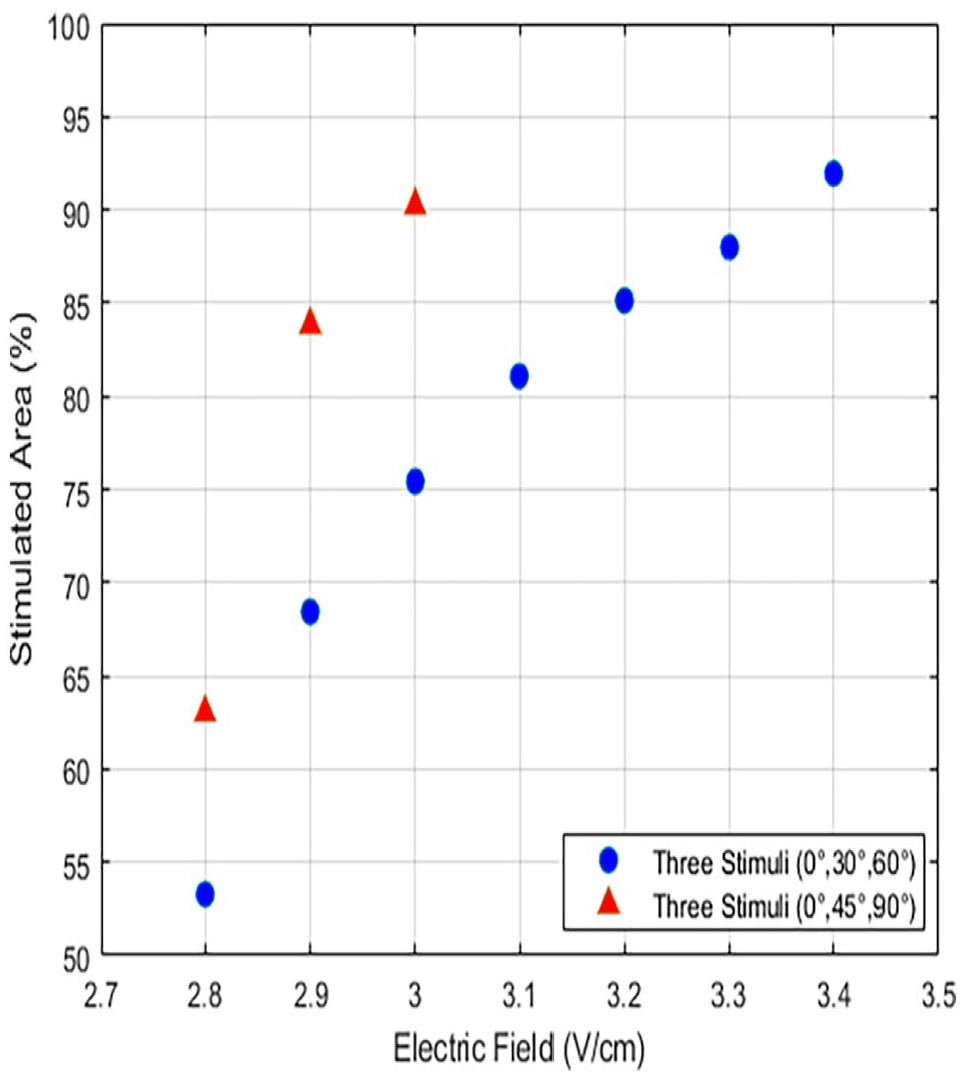
Comparison between multidirectional stimuli applied in 3 directions, when
By increasing the directions of the stimuli to 4, we can observe the same effect: for the same stimulated area of the heart, when applying 4 stimuli in

Comparison between multidirectional stimuli applied in 4 directions, when
Discussion
In the literature we can find several studies on multidirectional stimulation,9,10 but no one with only 2 electrode pairs.
In the simulation developed in this work, the superposition principle was validated in a stimulation chamber. The small difference found in the value of
Regardless, the results are very close to what was calculated, showing the effectiveness of the superposition principle when applying an E to a stimulation chamber using 2 pairs of electrodes.
When we compare the monodirectional and the multidirecional stimuli applied to the heart, we can observe that for the same stimulated area, the modulus of the multidirectional E is always smaller than the monodirectional, as it was expected. We observed a decrease up to 31.8% in
From the results found we can observe that, to decrease the intensity of E, not only does the number of stimuli applied matter, but also the directions in which we are applying them. It is possible to realize this because by applying an
Therefore, with 2 pairs of electrodes we can apply as many stimuli as necessary, in different directions and with different amplitudes, as a way to decrease the applied
In order to understand in greater depth—as well as validate—the effect of applying monodirectional and multidirectional stimuli using the superposition principle, it would be interesting to develop ex vivo experiments with murine hearts, applying the techniques reported in this study.
Furthermore, computational modeling is emerging to be a very important step in the advancement of cardiovascular research by enhancing innovations in cardiac study.
Conclusion
This simulation study aimed to use the COMSOL Multiphysics software to model, simulate, and analyze the application of an E in an isolated heart with monodirectional and multidirectional stimuli, using 2 pairs of electrodes and the superposition principle as a way to decrease the E applied and reduce the required number of stimulation electrodes.
The superposition principle was validated in the stimulation chamber, and we observed that, in order to decrease the intensity of E we should use multidirectional stimulation, and that both the number of applied stimuli and their directions were relevant issues.
Finally, the verified results allow future biological experiments with isolated hearts in which the same results obtained from this simulation shall be investigated. If the results are positive, this may enable the development of an effective defibrillator device built under these principles, what may be an important advance in cardiology and arrhythmia treatment.
Supplemental Material
sj-avi-1-bec-10.1177_11795972241266705 – Supplemental material for Multidirectional Stimulation in an Isolated Murine Heart: A Computational Model
Supplemental material, sj-avi-1-bec-10.1177_11795972241266705 for Multidirectional Stimulation in an Isolated Murine Heart: A Computational Model by Lizandra Alcantara Sá, Jorge A Costa, Lindemberg da Mota Silveira-Filho and Pedro Xavier de Oliveira in Biomedical Engineering and Computational Biology
Supplemental Material
sj-avi-2-bec-10.1177_11795972241266705 – Supplemental material for Multidirectional Stimulation in an Isolated Murine Heart: A Computational Model
Supplemental material, sj-avi-2-bec-10.1177_11795972241266705 for Multidirectional Stimulation in an Isolated Murine Heart: A Computational Model by Lizandra Alcantara Sá, Jorge A Costa, Lindemberg da Mota Silveira-Filho and Pedro Xavier de Oliveira in Biomedical Engineering and Computational Biology
Supplemental Material
sj-avi-3-bec-10.1177_11795972241266705 – Supplemental material for Multidirectional Stimulation in an Isolated Murine Heart: A Computational Model
Supplemental material, sj-avi-3-bec-10.1177_11795972241266705 for Multidirectional Stimulation in an Isolated Murine Heart: A Computational Model by Lizandra Alcantara Sá, Jorge A Costa, Lindemberg da Mota Silveira-Filho and Pedro Xavier de Oliveira in Biomedical Engineering and Computational Biology
Supplemental Material
sj-avi-4-bec-10.1177_11795972241266705 – Supplemental material for Multidirectional Stimulation in an Isolated Murine Heart: A Computational Model
Supplemental material, sj-avi-4-bec-10.1177_11795972241266705 for Multidirectional Stimulation in an Isolated Murine Heart: A Computational Model by Lizandra Alcantara Sá, Jorge A Costa, Lindemberg da Mota Silveira-Filho and Pedro Xavier de Oliveira in Biomedical Engineering and Computational Biology
Supplemental Material
sj-avi-5-bec-10.1177_11795972241266705 – Supplemental material for Multidirectional Stimulation in an Isolated Murine Heart: A Computational Model
Supplemental material, sj-avi-5-bec-10.1177_11795972241266705 for Multidirectional Stimulation in an Isolated Murine Heart: A Computational Model by Lizandra Alcantara Sá, Jorge A Costa, Lindemberg da Mota Silveira-Filho and Pedro Xavier de Oliveira in Biomedical Engineering and Computational Biology
Footnotes
Funding:
The author(s) disclosed receipt of the following financial support for the research, authorship, and/or publication of this article: The authors would like to thank CAPES (Proc. N 88887.470307/2019-00) for the financial support.
Declaration of conflicting interests:
The author(s) declared no potential conflicts of interest with respect to the research, authorship, and/or publication of this article.
Author Contributions
Lizandra Sá: Conceptualization, Methodology, Formal analysis, Investigation, Writing - Original Draft, Visualization.Jorge Costa Jr: Methodology, Writing - Review & Editing.Lindemberg Silveira-Filho: Writing - Review & Editing, Supervision.Pedro de Oliveira: Conceptualization, Methodology, Writing - Review & Editing, Supervision.
Supplemental Material
Supplemental material for this article is available online.
References
Supplementary Material
Please find the following supplemental material available below.
For Open Access articles published under a Creative Commons License, all supplemental material carries the same license as the article it is associated with.
For non-Open Access articles published, all supplemental material carries a non-exclusive license, and permission requests for re-use of supplemental material or any part of supplemental material shall be sent directly to the copyright owner as specified in the copyright notice associated with the article.
