




Abstract
Nowadays, kidney failure is a problem of many peoples in the world. We know that the main function of kidney is maintaining the chemical quality of blood particularly removing urea through urine. But when they malfunction, the pathologic state known as uremia results in a condition in which the urea is retained in the body. Failure of the kidney results in building up of harmful wastes and excess fluids in the body. Kidney diseases (failures) can be due to infections, high blood pressure (hypertension), diabetes, and/or extensive use of medication. The best form of treatment is the implantation of a healthy kidney from a donor. However, this is often not possible due to the limited availability of human organs. Chronic kidney failure requires the treatment using a tube dialyzer called dialysis. Blood is taken out of the body and passes through a special membrane that removes waste and extra fluids. The clean blood is then returned to the body. The process is controlled by a dialysis machine (tube dialyzer) which is equipped with a blood pump and monitoring systems to ensure safety. So this article investigates the real application of mathematics (diffusion) in medical science, and it also contains the mathematical formulation and interpretation of tube dialyzer in relation to diffusion.
Introduction
Kidneys are two bean-shaped organs which are situated in the rear part of the abdominal cavity of our body. They perform several important functions within the human body, such as cleaning the blood and waste products of the body, getting rid of the extra fluids in the body through the urine, and helping in the production of red blood cells. The main function of kidney is to maintain the chemical quality of blood by removing the waste products contributed to the blood stream by the metabolic process in the human body. In particular, kidneys help to remove urea through urine. When they malfunction, the pathologic state known as uremia results in a condition in which the urea is retained in the body. It leads to many severe complications which may prove fatal. When uremia cannot be cured by medicine, the only alternative is to take the impure blood out of the body, remove urea from it, and then return the purified blood to the body. The engineering device used for this purpose is called the tube dialyzer which serves almost as the same purpose as the human kidney.
Fluids
A fluid is defined as a substance that can flow, or a substance that does not maintain a fixed shape. Gases and liquids are fluids. That is, the particles making up the substances continuously change their positions relative to one another. Fluids do not offer any lasting resistance to the displacement of one layer over another when a shear force is applied.
Diffusion
Diffusion is a random movement of molecules, which results in molecules moving from an area of higher concentration to an area of lower concentration.
Fluid flow through tube dialyzer
Failure of the kidney results in building up of harmful wastes and excess fluids in the body. Kidney diseases (failures) can be due to infections, high blood pressure (hypertension), diabetes, and/or extensive use of medication. The best form of treatment is the implantation of a healthy kidney from a donor. However, this is often not possible due to the limited availability of human organs. Chronic kidney failure requires the treatment using a tube dialyzer called dialysis. Blood is taken out of the body and passes through a special membrane that removes waste and extra fluids. The clean blood is then returned to the body. The process is controlled by a dialysis machine which is equipped with a blood pump and monitoring systems to ensure safety.
Uremia
Uremia is a condition in which the urea concentration in blood is chronically elevated, reflecting an inability to remove from the body the end products of protein metabolism.
Dialysate
Dialysate is a buffered electrolyte solution, usually containing glucose at or above physiologic concentration, circulated through the water compartment of a hemodialyzer to control diffusional transport of small molecules across the membranes and achieve the blood concentrations desired.
Tube dialyzer
Tube dialyzer is the piece of equipment that actually filters the blood. One of the most popular types is the hollow-fiber dialyzer.
Hollow-fiber dialyzers are life-saving devices that extend life by removing toxins that accumulate in patients with end-stage kidney disease. Small solutes are normally removed by diffusion, whereas larger solutes are mostly removed by convection through ultrafiltration. Therefore, the efficiency of a hollow-fiber dialyzer depends on its ability to facilitate both diffusion and convection processes.
From a mathematical modeling perspective, typical hollow-fiber dialyzer geometry uses countercurrent blood and dialysate flows separated by hollow-fiber membrane. Blood flows inside the hollow fibers (tubes), whereas dialysate flows outside the hollow-fiber region counter currently.
In hollow-fiber dialyzer, the blood is run through a bundle of very thin capillary-like tubes, and the dialysate is pumped in a chamber of bathing fibers (Figure 1) 1 .

Circular duct hemodializer. 1
A larger dialyzer will usually translate to an increased membrane area and thus there is an increase in the amount of solutes removed from the patient’s blood. Different types of dialyzers have different clearances for different solutes.
Basic Equations
Diffusion equation
The basic partial differential equation that governs diffusion in tube dialyzer is the diffusion equation with the convective term 2 :

where c(r, z) is the concentration of urea in the blood at the point (r, z), v(r) is the velocity in the fully developed flow at this point,

Circular duct for blood flow.
The magnitude of the convective term as compared with the magnitude of the longitudinal diffusion term is given by the dimensionless Peclet number:

Which may be as large as 15 000 for the hemodializer so that the longitudinal diffusion term can be neglected and equation (1) is simplified as follows:

The boundary conditions for solving equation (3) are as follows:
Flow symmetry about the axis and finite concentration at r = 0, which give the following:

Assumption of constant entry concentration gives the following:

Assumptions of permeability

Introducing the nondimensional quantities,

Therefore, using the above boundary conditions, the solution of equation (3) will be as follows.
Now, let us differentiate

Then,

But from equation (7), we have

Then, substituting the values of equation (10) in equations (8) and (9), we will obtain the following results:

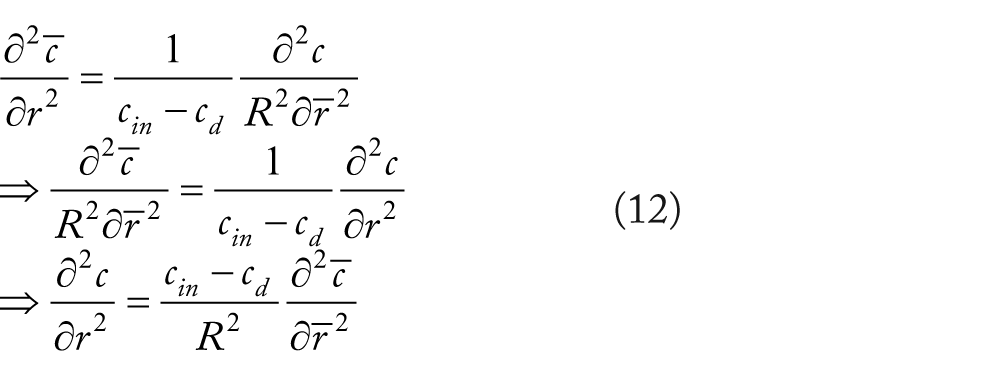
Again, let us differentiate

Again, from equation (7) we have
Then, substituting this in equation (12) gives the following:

Again using substitution and by multiplying both the sides of the above equation by

Now, substitute equations (14), (16), and (18) in equation (17) as follows:
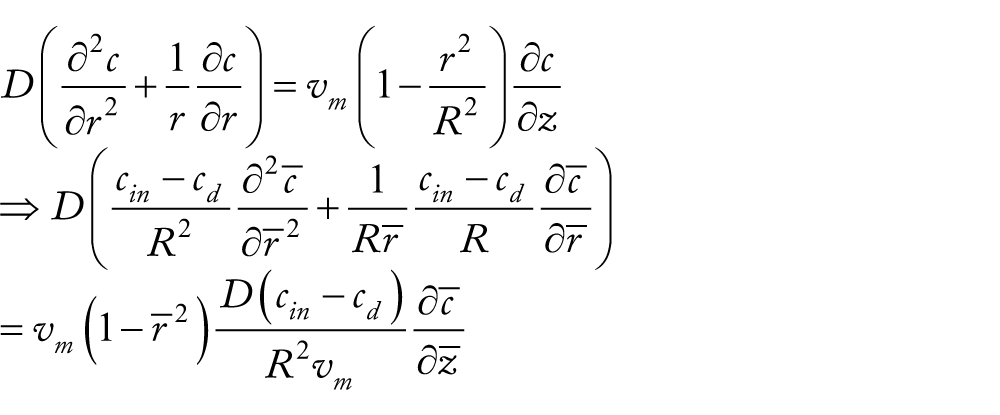
Then, simplifying the above equation yields the following:

Using equation (4), ie, at

Then, using equation (5), ie,
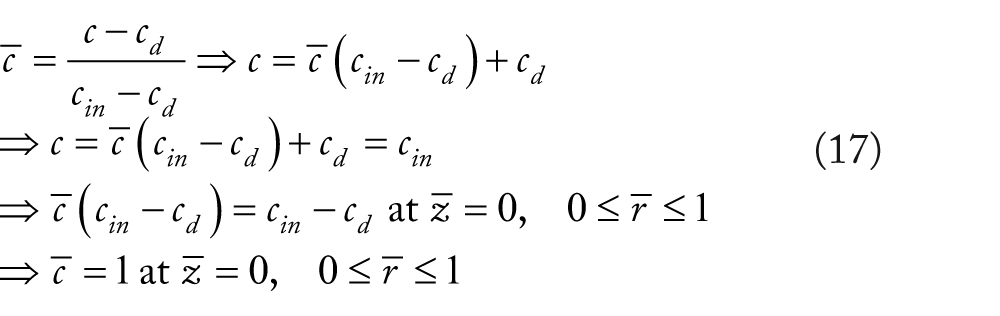
From equation (6), at

Generally, the system of equations from equations (3) to (6) gives the following:




where

is called the Sherwood wall number because it is obtained by multiplying the mass transfer coefficient in the usual Sherwood number by the wall permeability.
To solve equation (18) subject to equations (19) to (21), we have an alternative method, namely, separation of variables methods which will be discussed thoroughly in the following section.
Diffusion in Tube Dialyzer
The main objective of this article is to study blood flow through tube dialyzer.
The basic partial differential equation that governs diffusion in tube dialyzer is the diffusion equation.
Method of separation of variables for solving diffusion equation
From the above section, we know that the diffusion equation in its simplified from is as follows:

where
Therefore, to solve the above equation using the method of separation of variables, let us start by assuming that the solution is of the following form 1 :

where
Substituting equation (24) in equations (18) to (22), we obtain the following:


Assuming Frobenius infinite series solution to equation (25), ie,

Now, substitute equation (29) in equation (27) at

Again, to obtain suitable values that can be substitute in equation (25), let us differentiate equation (29) twice with respect to


Then, substituting equations (29), (31), and (32) in equation (25), we will obtain the following:
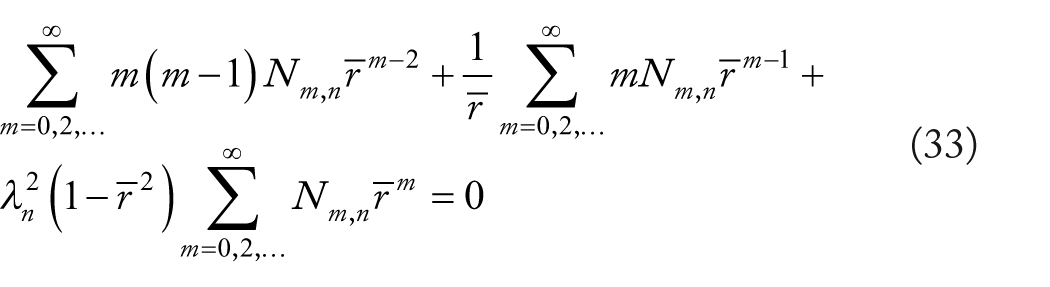
And multiplying both the sides of equation (33), by

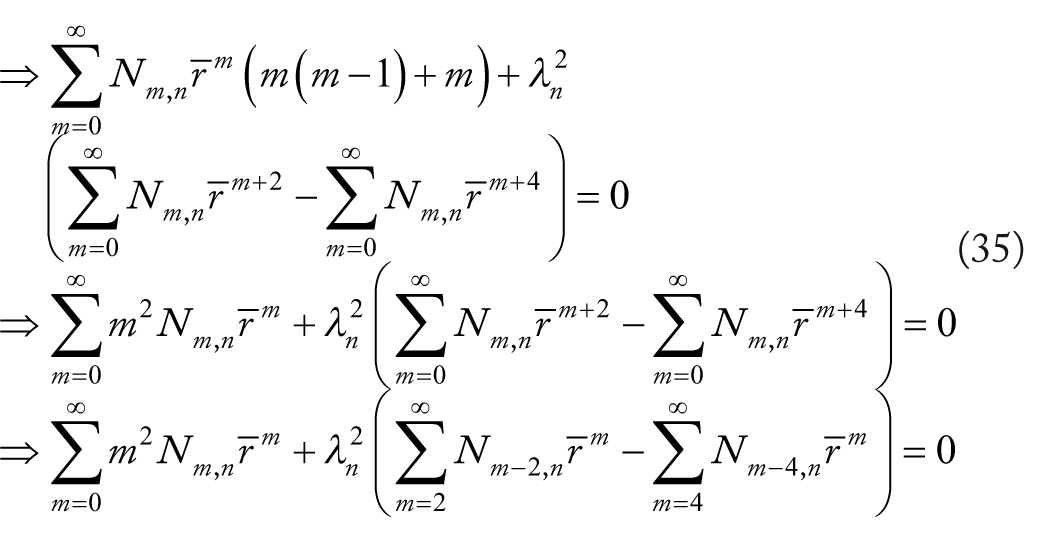
From the above equation, one of the series begins with

Because the sum of the terms is 0, power series must be equal to 0.
And by letting
From the above 4 steps, we can conclude that for any odd values of
Therefore, equation (29) which is

Now using equation (36), we can find the values for
But from the above, we have
Hence, for

Then, substituting equation (4) for m, we will have the following:
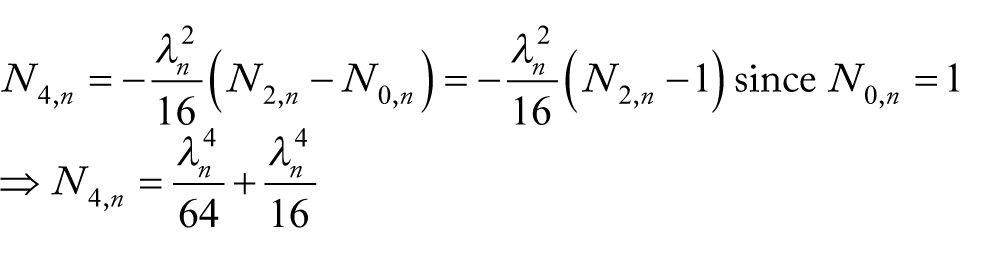
For
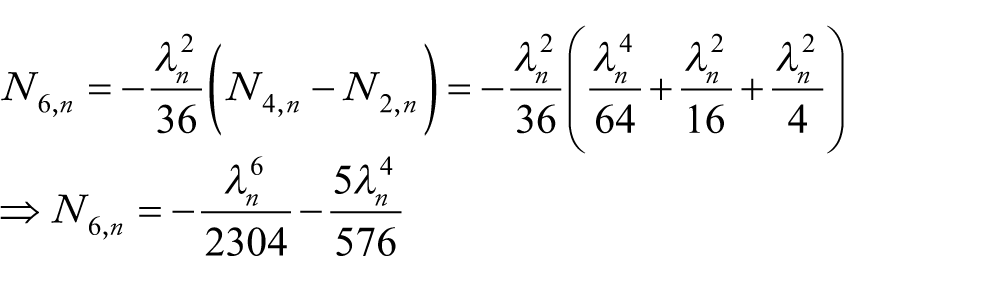
For

For

In a similar fashion, we can solve
Therefore, equation (29), ie,

If we substitute the above values, we will have the following:


Hence, by truncating the term with order 6, we have the following:

From the boundary condition equation (28), we can get the value of


Then, substituting equations (38) and (40) in equation (28), we get the following:

The above equation is of the quadratic form.
Now let

Then, using the general quadratic formula,
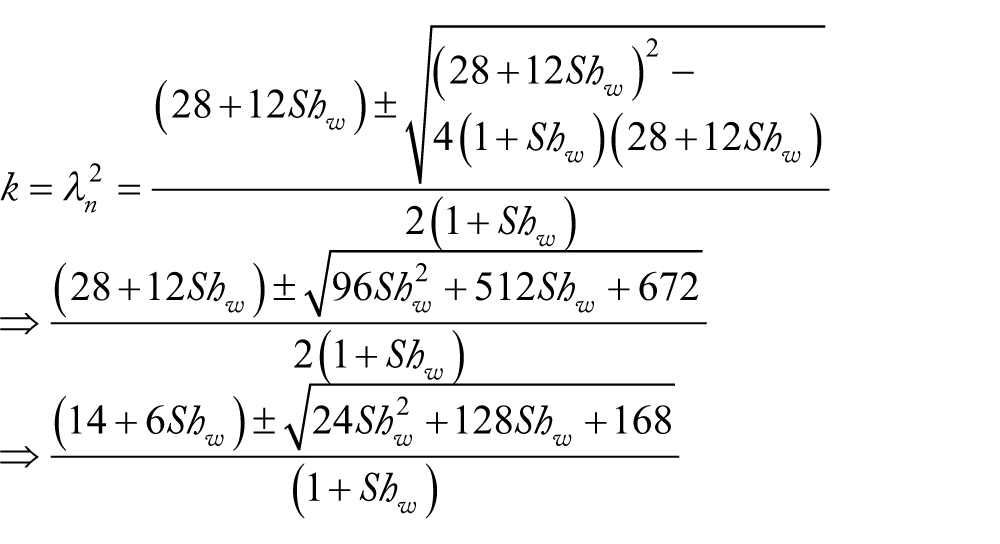
Hence, from the above, we can obtain 4 values of
But, we suppose that

Therefore,

From equation (25), we have the following:

Using the condition for the orthogonality of

Then, substituting the values of
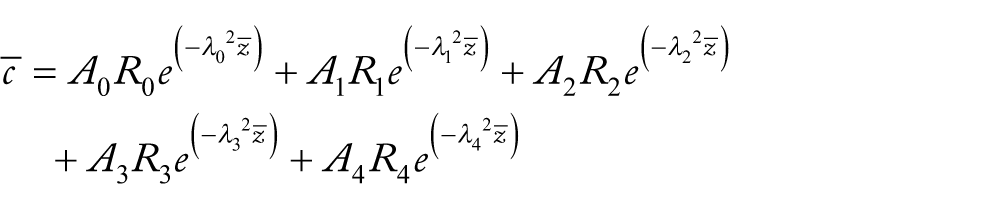
Which is the solution for

Discussion and Conclusions
As it can be seen clearly in Figure 1, of the “Introduction” section, when the length of the dialyzer increases, the solutes in the blood which comes from the patient’s body will have more possibility or places to diffuse to the dialysate through the membrane of the dialyzer. So the concentration of urea (solute) in the blood will greatly decrease when the length of the dialyzer increases. In general, the clearance of the dialyzer depends on the length of the dialyzer, ie, the tube dialyzer is best or effective when it is longer. This relationship is shown in the graph in Figure 3.

The graph of length of the dialyzer versus the concentration solute (urea).
The amount of solutes in the blood is also greatly affected by the surface area of the membrane and its thickness. That is, when the surface area of the membrane increases, more solutes from the blood will diffuse to the dialysate. Hence, the concentration of urea in the blood will greatly decrease. But when its thickness increases, the solutes will need a force to pass the membrane and diffuse with the dialysate. Therefore, the amount of solutes in the blood will never decrease as desired.
Therefore, the concluding remarks are as follows:
Longer dialyzers are more efficient than shorter dialyzers.
Dialyzers with thin membranes are more efficient than dialyzers with thick membranes.
Dialyzers with more membrane surface area are more efficient than dialyzers with low membrane surface area.
Footnotes
Peer Review:
Four peer reviewers contributed to the peer review report. Reviewers’ reports totaled 602 words, excluding any confidential comments to the academic editor.
Funding:
The author(s) received no financial support for the research, authorship, and/or publication of this article.
Declaration Of Conflicting Interests:
The author(s) declared no potential conflicts of interest with respect to the research, authorship, and/or publication of this article.
Author Contributions
YN explains in this article the biological functions of kidneys. YN wrote the first draft of the manuscript and the mathematical formulations related to a model of Tube Dialyzer.