




Abstract
Coccygeal polypoid eccrine nevi (CPEN) are rare, benign, cutaneous polypoid lesions localized to the coccyx region that are characterized by areas of hyperplastic eccrine ducts without hyperhidrosis. We present the case of an asymptomatic 16-month-old female with a congenital lesion in the lower sacral area and review the literature and the differential diagnosis for CPEN.
Introduction
Eccrine nevus is a rare, benign, congenital hamartoma composed of hyperplastic eccrine glands commonly found on forearms with associated hyperhidrosis. 1 Although there have been isolated reports of eccrine nevi associated with hypopigmentation, plaques, brown papules, and depressed lesions, eccrine nevi usually do not have underlying skin findings.2-5 An unusual variant of eccrine nevi consisting of coccygeal polypoid lesions without hyperhidrosis has been termed coccygeal polypoid eccrine nevus (CPEN).6,12 We present the case of an asymptomatic 16-month-old female with a congenital lesion in the lower sacral area. Few cases have been reported in the medical literature.7-9 The literature shall be reviewed in conjunction with the differential diagnoses that should be considered when encountering a sacral lesion.
Case Report
A 16-month-old female was brought to the clinic for removal of an asymptomatic papule in the coccygeal region that was present since birth. The patient was otherwise healthy with no significant birth defects or family history of similar lesions. The lesion was not associated with any pain, tenderness, constitutional symptoms, localized hyperhidrosis, or hypertrichosis. Grossly, the lesion was a solitary 0.3-cm, gray-tan, firm, nonerythematous, nonblanching papule on the patient’s lower coccyx, and a sacral X-ray demonstrated a normal 5-segment sacrum. A shave biopsy revealed a polypoid lesion with a nonacanthotic epidermis and a normally vascularized fibrous dermis. A focal collection revealed numerous hyperplastic eccrine ducts. A pilar structure is also noted at the pedicle of the lesion most likely a part of the hair bearing skin of the sacral area (Figures 1 and 2). The patient had no recurrence of the lesion a year after the excision.
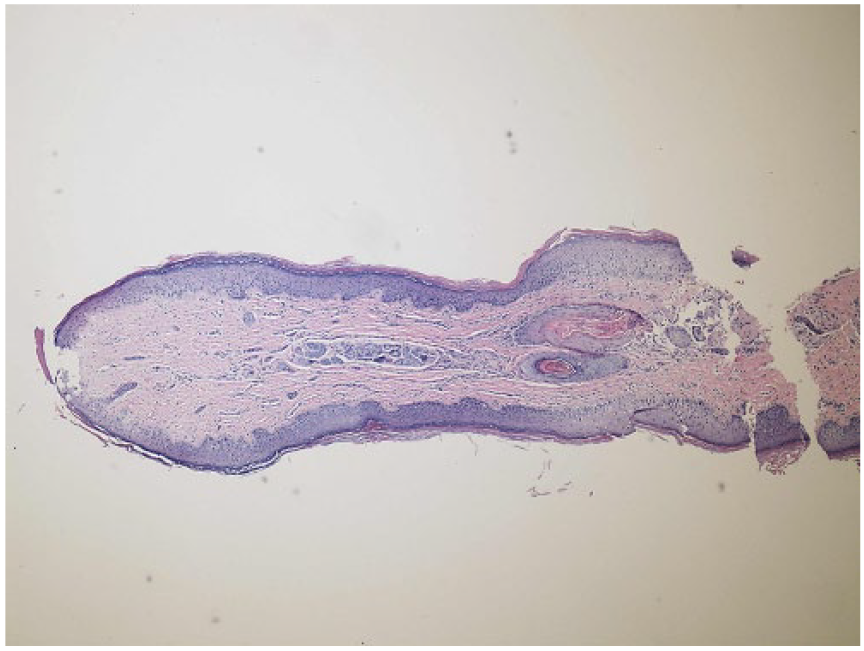
Elongated skin lesion covered with a thin layer of epidermis and normally vascularized dermis. It demonstrates the central coiled eccrine gland and surrounding dermis (hematoxylin/eosin stain 40×).

Hyperplastic eccrine glands surrounded by fibrous stroma (hematoxylin/eosin stain 400×).
Conclusions
Coccygeal polypoid eccrine nevus is an asymptomatic congenital polypoid lesion with no reported evidence of hyperhidrosis. 6 Histologically, there are hyperplastic eccrine ducts surrounded by adipose tissue and occasional vascular ectasia. There have been few cases of CPEN in the literature, with only 1 case associated with other congenital anomalies. 9 CPEN occurs predominately in women. The lesions ranged from 3 to 7 mm and are associated with adipose tissue.
The differential for CPEN includes eccrine nevus, eccrine angiomatous hamartoma, acrochordon, caudal appendage, and lumbosacral lipoma (Table 1). Histology, clinical presentation, and localization are important in distinguishing CPEN from other sacral skin lesion (Table 1). CPEN should be considered in the differential diagnosis of a coccygeal skin lesion in infants.
Differential diagnosis of sacral skin lesions.
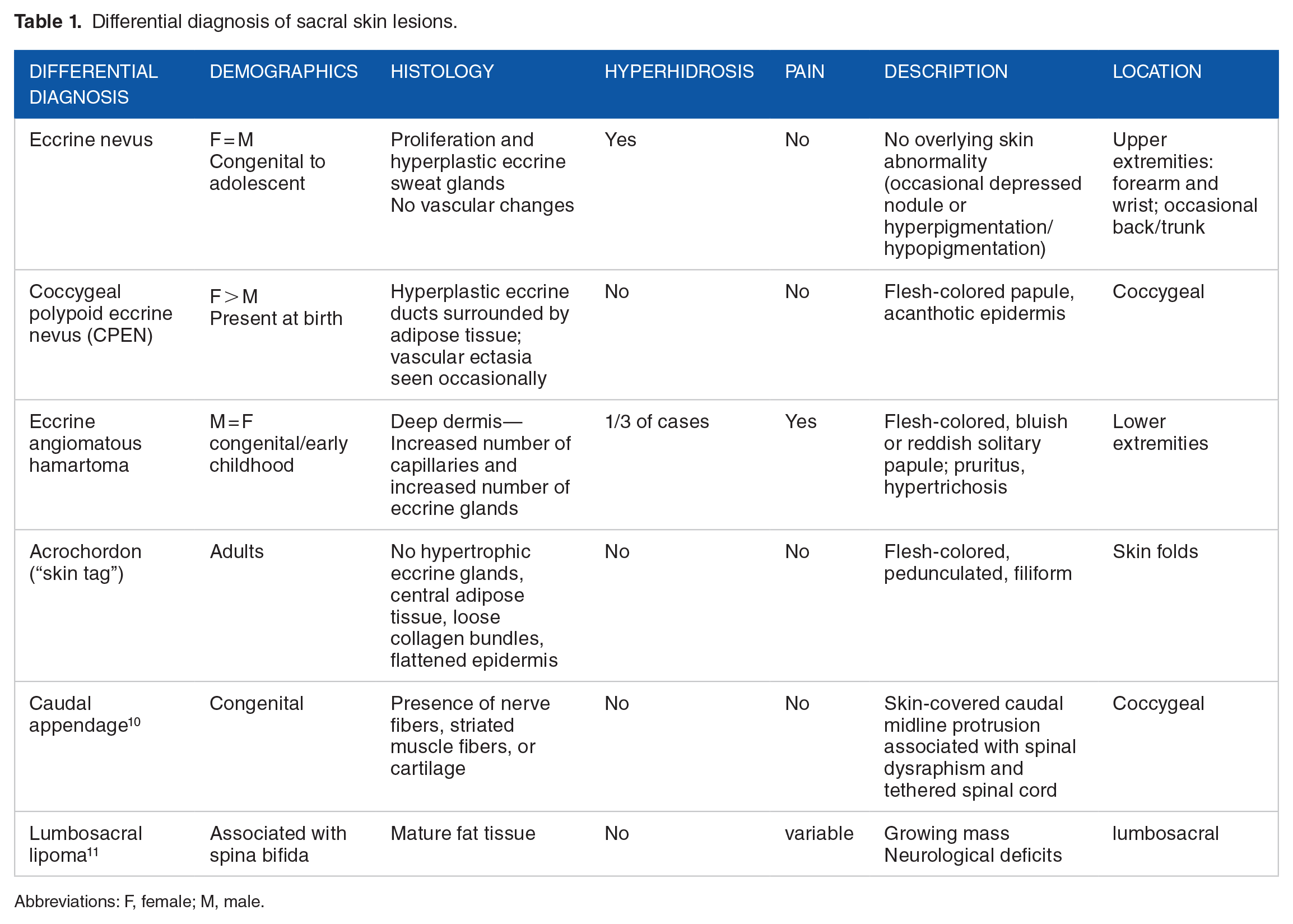
Abbreviations: F, female; M, male.
Footnotes
Funding:
The author(s) received no financial support for the research, authorship, and/or publication of this article.
Declaration of conflicting interests:
The author(s) declared no potential conflicts of interest with respect to the research, authorship, and/or publication of this article.
Author Contributions
Acquisition of data: Scott A Jenkinson, Amy M Zidron, Christopher G Gibson
Analysis and interpretation of data: Francis Essien, Christopher G Gibson, Ruby S Gibson
Critical revision: Christopher G Gibson, Amy M Zidron, Ruby S Gibson
Drafting of manuscript: Francis Essien, Christopher G Gibson, Ruby S Gibson
Final approval of the version to be published: Scott A Jenkinson, Amy M Zidron, Christopher G Gibson, Ruby S Gibson, Francis Essien
Study conception and design: Scott A Jenkinson, Christopher G Gibson, Amy M Zidron
Ethical Approval
Any identifying information was removed, and the Office of Human Research Protections for Ohio Health and the Institutional Review Board approved of this paper.