



Abstract
Background
Large health warning labels (HWLs) with pictures on tobacco packaging are an effective policy to communicate the harms of tobacco use and discourage consumption. The tobacco industry also uses packaging as a key communication tool, altering its design to appeal and attract specific groups. Few studies have assessed compliance of HWLs noting ways that the tobacco industry exploits packaging and labeling regulation loopholes. This study assessed compliance with HWL requirements on cigarette packs from Mexico.
Methods
The analysis included cigarette packs purchased in October and November 2021 using the Tobacco Pack Surveillance System (TPackSS) protocol in 12 low, middle, and high socioeconomic areas in each of five cities: Mexico City, Guadalajara, León, Durango, and Mérida. In total, 191 unique cigarette packs, with Mexican HWLs that were current at the time of data collection, were assessed for compliance based on HWL location, size, label elements (ie, text and background colors), and use of exact images as published by the government. Compliance with HWL size was examined by pack shape and type.
Results
All the cigarette packs that were assessed were compliant with HWL location and the majority (98%) complied with label elements; 85% complied with HWL size. Beveled edge packs were less likely to be compliant in terms of warning size than packs without them (P < 0.05). Only 27% of packs had the image appearing exactly as specified by the Mexican government, obscuring the intended visual composition and diverting attention away from the focal point—thus, diminishing the image’s impact.
Conclusions
Countries, including Mexico, implementing new or revising current HWL policies should establish enforcement procedures to ensure correct implementation of HWLs and prevent loopholes that can be exploited by the tobacco industry. Part of this would be to consider standardized tobacco pack shape to allow for better HWL implementation and effectiveness.
Keywords
Introduction
Tobacco packs are an important marketing tool, especially as other tobacco product marketing channels are eliminated. 1 Given their influence, the tobacco industry has created different pack designs and marketing appeals, including brand imagery, pack shape, and the use of different colors, to appeal to different consumers. 1 At the same time, tobacco packs with well-designed health warning labels (HWLs) can be a cost-effective measure to communicate the harms related to tobacco use and discourage consumption. 2 Thus, both tobacco companies and the tobacco control community seek to dominate the communication space on packs. The tobacco control community wants HWLs to be the main or only communication on packs, whereas tobacco companies have long found ways to make tobacco packs more appealing through the use of color, imagery, shape, and other design features. 1
Prominent HWLs with images (referred to here as pictorial HWLs) are more effective than smaller, text-only warnings. 2 Whereas several studies have assessed the impact of HWLs, fewer studies have assessed and/or monitored HWL compliance with country requirements. Cohen et al. assessed HWL compliance with country requirements across 14 low- and middle-income countries using the following compliance indicators: (1) health warning location (ie, top, bottom, front and/or back); (2) health warning size (ie, percent coverage); (3) health warning elements (eg, text color, background color); and (4) health warning text size. 3 This study found that health warning size was the indicator with the lowest compliance, with sizes that were sometimes smaller than required per each country’s legislation. The same study also found that standard-shaped packs (ie, rectangular packs with a width to height ratio of 2 to 3) were more compliant overall than wide cigarette packs (ie, rectangular packs with a width to height ratio greater than 2:3). Packs with 10 cigarettes or fewer were also less compliant overall than packs with more than 10 cigarettes. A study in Nigeria also looked at compliance by pack shape (ie, standard, wide, and narrow) and found no significant differences. 4 HWL size was the indicator with the lowest level of compliance, with HWLs being smaller than that required by legislation, among smokeless and bidi packs in India; non-standard pack shape and size were indicated by the authors as important factors that compromised compliance. 5
In addition to the limited information on HWL compliance, previous studies assessing cigarette pack HWL compliance have not explored the issue of different pack shapes, beyond standard vs wide/narrow pack or stick count in the pack. Mexico has implemented HWL legislation in accordance with the best practices recommended in the WHO Framework Convention on Tobacco Control (FCTC). 6 In 2023, Mexico introduced its 13th round of pictorial HWLs since 2010. 7 Nevertheless, while the FCTC guidelines recommend the use of pictorial HWLs that cover 50% or more of the front and back of the pack, Mexico’s pictorial HWLs only cover 30% of the front. 8 In addition, Mexico’s HWL include 100% text-only warning on the back and one side. 8 In terms of HWL rotation, Mexico meets all the basic criteria set out in guidelines for implementation of Article 11 of the FCTC, ie, rotation is required within set periods, and the number of pictograms is set in the national legislation. 9 Therefore, the goal of this study was to assess cigarette pack HWL compliance by pack shape and type in Mexico. See Supplemental Material for the Spanish translation of this article.
Materials and Methods
During October and November of 2021, we employed the Tobacco Pack Surveillance System (TPackSS) protocol 10 developed by the Institute for Global Tobacco Control (IGTC) at the Johns Hopkins Bloomberg School of Public Health to systematically collect unique cigarette packs in five Mexican cities: Mexico City, Guadalajara, León, Durango, and Mérida. A unique cigarette pack is any cigarette pack with at least one on the exterior of the pack including: stick count, size, brand name presentation, descriptor, colors, cellophane, and inclusion of a promotional item. To maximize the likelihood of purchasing all unique packs available in Mexico, we sampled (1) from the most populated city of the country (Mexico City) and four additional cities from the top 25 most populated cities on the basis of cultural and geographic diversity; (2) from within each city, where four characteristically distinctive neighborhoods of low-, middle-, and high-income areas were chosen (a total of 12 neighborhoods per city, 60 across the country); and (3) from four vendor types: packs were purchased from convenience stores, small/independent grocery stores, wholesalers, and pharmacies based on Euromonitor data on where Mexicans are most likely to purchase their cigarettes. 11 Data collection was carried out in collaboration with the Instituto Nacional de Salud Pública (INSP) which, as part of the Mexican Ministry of Health, focuses on generating and disseminating scientific knowledge related to public health issues through research, academic training, and advocacy for public health policy.
Of the 267 cigarette packs purchased during this data collection, 191 unique cigarette packs that displayed the current, legally mandated Mexican HWLs were assessed for HWL compliance using an established and tested codebook. Of those 191 packs, there were 24 that came inside of larger packaging, such as a sleeve or metallic box. In those instances, the larger packaging was also assessed for compliance using the same indicators of the primary packs.
A codebook was used to assess whether each cigarette pack complied with four main indicators based on the Mexican HWL administrative rule 12 : (1) location (ie, pictorial HWL on the upper portion of the pack front and text warnings on the back and one side), (2) size (ie, pictorial HWL occupying 30% of the pack front and a text-only HWL occupying 100% of the back and one side), (3) label elements (ie, text in yellow on pictorial HWL; and text in black and yellow background for back and side text-only HWL), and (4) use of pictorial HWLs exactly as provided by the government (ie, image appears exactly as shown in the administrative rule, including yellow text is outlined in black). All indicator variables were elements specified in the Mexican administrative rule, except for the use of pictorial HWL and yellow text outlined in black, which were added to the assessment because the regulation specifies that the image must appear exactly as shown. Each HWL was measured for size compliance using a virtual measurement software called ImageJ (https://imagej.net/software/imagej/), using photos of the purchased cigarette packs. In addition, we assessed the following physical characteristics of the packs: pack type (ie, hard pack, soft pack, slider, box) and pack shape (ie, standard, wide or extra-wide pack, with/without beveled edges). We also coded the manufacturer of each pack (ie, Philip Morris International (PMI), British American Tobacco (BAT), Japan Tobacco International (JTI), and other). Packs were deemed fully compliant if they met the requirements of all four indicators. Each pack was double coded independently. One designated member of the research team (GG) resolved any disagreement among coders.
For the analysis, packs within larger packaging were counted as one pack, ie, if any noncompliance was found for either the inner or outer packaging, the pack was determined to be non-compliant. Descriptive statistics were conducted using Stata (version 17.0; StataCorp LLC, College Station, Texas, USA). Chi-squared tests were used for comparisons across pack type and shape.
Results
Of the 191 unique cigarette packs assessed for compliance, the highest proportion was from PMI (46%; n = 88), followed by BAT (38%; n = 73) and JTI (14%; n = 27). The remaining three packs were from other manufacturers. Across the sample, 96% (n = 184) were classified as hard packs and 4% (n = 7) were soft packs. Additionally, 46% (n = 88) of the hard packs had beveled edges. Beveled edge packs comprised most of the sample from JTI and BAT (93%; n = 25 and 66%; n = 48, respectively) whereas for PMI they were a minority (17%; n = 15). Overall, the majority were standard size packs (95%; n = 181), whereas 5% (n = 10) were wide or extra-wide packs. Out of the 24 with larger packaging, 50% (n = 12) were sliders and 50% (n = 12) were boxes.
All cigarette packs complied with warning location, and most had all the correct label elements and complied with size (98%; n = 188 and 85%; n = 161, respectively). However, only 62% (n = 118) of the pictorial HWLs on the packs had black outlining the yellow text (not having the black outline made the mandatory text less legible with respect to the background in many cases). Additionally, only 27% (n = 52) of the pictorial HWLs had the image appearing exactly as shown in the administrative rule, which obscured the intend composition of the image and diverted attention away from its focal point. For example, some images were darker, and others were cropped (ie, resized) (Figure 1). One pack was determined to be non-compliant because its primary pack had an old HWL, which was covered by a larger pack with a current HWL at the time of data collection. Examples of Noncompliant Pictorial HWLs in Comparison With the Ones Shown in the Mexican Regulation
Compliance of Health Warning Label Size by Cigarette Pack Characteristics (Type, Shape, Beveled Edges, and Manufacturer)
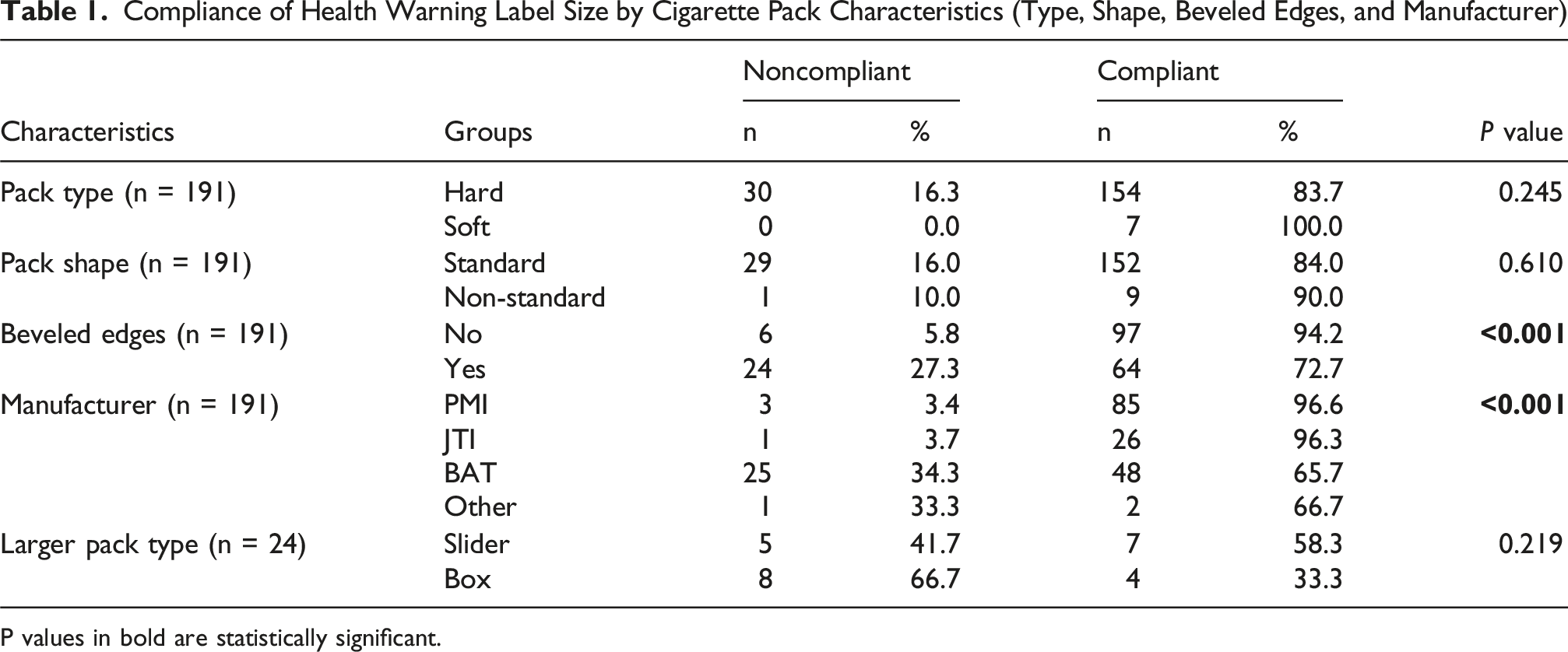
P values in bold are statistically significant.

Examples of How Pack Shape Affected HWL Size on Cigarette Packs
Discussion
Overall, the HWLs on cigarette packs were compliant with most indicators in Mexico. Yet, we found that the use of beveled edges on packs, which comprised almost half of the sample, was associated with lower compliance with the size requirement. We observed several cases in which the pictorial HWL did not match the government-provided image, ie, the full image was altered and/or the text was harder to read because it was not outlined in black.
These findings are consistent with a previous TPackSS study that assessed HWL compliance in Mexico in 2013. Both studies showed a high level of overall HWL compliance, despite issues with the visibility of yellow text printed on the pictorial HWLs. 3 In addition, the pictorial HWLs differed from the images available in the administrative rule. Whereas some variations (eg, darker images) might have occurred as a result of issues with print quality, other variations (eg, no black outline around the yellow text) are seemingly the result of intentional changes by the tobacco industry to the HWLs – a practice that has been reported by other studies. 13
Similar to a previous study in Nigeria, 4 we did not find a relationship between pack shape and compliance. Yet, cigarette packs with beveled edges were less likely to be compliant than packs without beveled edges. A study found that standard pack shape and size for smokeless products in Bangladesh could improve HWL noticeability. 14 Similarly, participants from focus groups in Bangladesh shared that the HWLs on bidi packs with standard size and shape were more noticeable and that they appeared more harmful considering they were larger and placed more prominently in comparison with current bidi packaging. 15 Given that pack shape and type can compromise HWL implementation and increase pack appeal, placing restrictions on the size and shape of tobacco packs in order to ensure compatibility with compliant HWLs should be considered as part of any measures taken to regulate HWL and tobacco packaging for all tobacco products.
This study was conducted across only five Mexican cities; therefore, the results might not represent all cigarette packs available in all Mexican cities. Per the TPackSS protocol, only unique packs are purchased, and results represent available products, but do not represent percentages of market share nor purchase patterns. Limitations of coding by pictures include potential light variation that we would not see if coding the physical packs as well as potentially missing some details. Yet, we followed a strict photography protocol that requires high resolution pictures as part of the professional photographer’s deliverable as well as photos of multiple angles of the pack to avoid light variation. The use of measurement software to assess HWL size compliance was previously compared with manual measurements by the TPackSS team, and no significant differences in the results between methods were found. Assessment of the pictorial HWLs was based on our interpretation of the statement of the administrative rule (“image must appear exactly as shown”); to further confirm our interpretation, we consulted with a Mexican lawyer working at the tobacco control department in the Mexican Ministry of Health. Despite these limitations, these results can support other countries considering or updating tobacco packaging and labeling regulations, including by supporting potential enforcement initiatives.
Conclusions
Despite their subtlety, several violations to the HWL administrative rule were observed in this study. Countries implementing or updating HWL policies should establish enforcement procedures to assure the correct implementation of HWLs and to prevent loopholes that can be exploited by the tobacco industry. The guidelines for implementation of Article 11 of the FCTC provide countries with key aspects to be considered as part of their HWL policies as well as innovative measures (such as placing HWLs on cigarette sticks). Countries could consider mechanisms in which the public can report on HWL compliance issues. If these mechanisms were to be established, then civil society could play a key role in monitoring policy compliance. Moreover, compliance information can help to elucidate loopholes in regulations and support best practices, which can be shared across countries. Mexico, and also other countries that regulate packaging and labeling or are considering regulations, should adopt standardized tobacco packaging for all tobacco products that restricts the use of beveled edges, as well as other pack shapes and types such as round packaging, to ensure better implementation and effectiveness of HWLs and lower marketing appeal for packaging.
Supplemental Material
Supplemental Material - Compliance in Jeopardy: Investigating the Manipulation of Pictorial Health Warning Labels Printed on Cigarette Packs and the Impact of Pack Shape in Mexico
Supplemental Material for Compliance in Jeopardy: Investigating the Manipulation of Pictorial Health Warning Labels Printed on Cigarette Packs and the Impact of Pack Shape in Mexico by Graziele Grilo, Katherine Clegg Smith, Bekir Kaplan, Kevin Welding, Luz Myriam Reynales-Shigematsu, Maria Guadalupe Flores Escartin, Joanna E. Cohen in Tobacco Use Insights.
Footnotes
Acknowledgement
We thank Jared Earley for designing the figures depicting the issues with health warning label compliance. We also thank Michell Castillo for providing legal input to our interpretation of the Mexican health warning label requirements, especially in relation to the pictorial health warning labels.

Authors’ Contributions
KCS and JEC conceived the TPackSS project. GG trained data collectors and supervised data collection in collaboration with LMRS and MGFE. GG trained coders, supervised coding and was the primary writer of the manuscript. BK and KW conducted data analysis. All authors have contributed to the conceptualization and design of the study as well as to the data collection and analysis. All authors contributed to revising the manuscript critically for important intellectual content. All authors approved the final version of the manuscript.
Funding
Declaration of Conflicting Interests
The authors declared the following potential conflicts of interest with respect to the research, authorship, and/or publication of this article: JEC was a paid consultant in litigation against a tobacco company.
Supplemental Material
Supplemental material for this article is available online.
References
Supplementary Material
Please find the following supplemental material available below.
For Open Access articles published under a Creative Commons License, all supplemental material carries the same license as the article it is associated with.
For non-Open Access articles published, all supplemental material carries a non-exclusive license, and permission requests for re-use of supplemental material or any part of supplemental material shall be sent directly to the copyright owner as specified in the copyright notice associated with the article.
