



Abstract
We aimed to explore the behavioural protective mechanisms against cannabis use among adolescents living in South African illicit cannabis-growing communities, based on the Self Determination Theory (SDT). Exploratory qualitative design techniques were followed in conducting the study. The snowball sampling technique was used to recruit thirty (30) non-cannabis smoking adolescents from 2 purposively selected communities and grouped into 4 focus groups and interviewed. A semi-structured focus group interview guide was used to moderate the discussions. Data were analysed inductively, using the ATLAS. ti software. Nine behavioural coping mechanisms, grouped under intrinsic and extrinsic protective behavioural mechanisms, protected participants from using cannabis. Intrinsically, participants’ determination not to engage in bad behaviours, focus on their academic work during their free periods, their non-financial dependence on cannabis-using peers, self-preservation to ensure good marriages, and religious beliefs on substance abuse motivated them to not use cannabis. On the other hand, the concept of Ukuphoxa (preservation of family dignity), fear of arrest, fear of being tagged a social deviant, and the fear of contracting illnesses such as lung cancer served as protective behavioural mechanisms against cannabis use. Health promotion and education programmes for adolescents on non-cannabis use in communities where illicit cannabis abounds must identify and draw on contextual intrinsic and extrinsic motivations that ensure non-cannabis use.
Keywords
Introduction
Although recent studies have debunked the cannabis gateway hypothesis for harder illicit drug use 1 , cannabis use among adolescents continues to be a public health challenge in many countries 2 , including South Africa.3,4
The South African Drug and Drug Trafficking Act of 1992 classified cannabis as a schedule 2 drug, thus, a dangerous dependency-producing substance. 5 Hence, the ACT prohibited cannabis cultivation, trafficking, and usage across all ages in the country. However, the recent ruling of the South African High Court granted individuals eighteen years or older, permission to privately cultivate and consume cannabis 6 This has provided an opportunity for widespread cannabis usage, complicating an already existing public health challenge of adolescent cannabis use.7,8
The World Health Organisation (WHO) prioritises adolescents’ health, as they are the parents of the next generation and, therefore, need to live a healthy lifestyle.9,10 Moreover, adolescent cannabis use has been found to impair cognitive development, functioning and mental health; hence, the need to prevent its usage. For instance, cannabis use results in a reduced improvement in processing speed and executive reasoning, and an increased risk of schizophrenia among adolescents with moderate cannabis use history. 11 In addition, bad verbal memory is associated with lifetime cannabis use. 12 Other adverse health outcomes associated with cannabis use include poor pregnancy outcomes and the risk of developing testicular cancer among males. 13
In the Eastern Cape Province of South Africa, illegal cultivation and trading of cannabis are prominent in the former Mpondoland region, along the Wild Coast.14,15 Traditionally, measures that addressed adolescent substance abuse in South Africa were either punitive in nature, such as the imprisonment of adult offenders or through education on the harmful effects of substance abuse, as well as restoration measures such as institutional rehabilitation of drug addicts, especially minors.16,17 Despite the various strategies employed by the Central Drug Authority to address marijuana abuse in South Africa, especially among adolescents 18 , the phenomena exist 19 , particularly among those living in environments where the drug is illegally cultivated for commercial purposes. 20
However, research has shown that not all adolescents living in illicit drug-producing environments indulge in its usage as some adopt protective behavioural mechanisms against illicit drug usage. For instance, in Mexico, sociocultural protective factors, such as the concept of Familisimo, which focuses on family-centeredness, have been found to militate against adolescent drug use. 21 Also, among American-Indian youth, the ‘refuse, explain and leave’ strategy has been found to protect adolescents from illicit substance use. 22
Thus, adolescents offered drugs by their peers politely refuse the drugs. They then explain why they refused and leave the company of those offering them drugs.
With educative and preventive measures against substance abuse failing to address adolescent cannabis use in South Africa16,17, it is prudent to explore alternative measures through which adolescent cannabis use could be addressed. For instance, drawing experiences from non-cannabis use adolescents who live in communities where illicit cannabis cultivation, trading, and usage thrive could be valuable in the fight against illicit adolescent cannabis use.
Moreover, qualitative evidence on protective behavioural mechanisms against illicit cannabis use is lacking in South Africa because most studies generally quantify adolescent substance use patterns in the country.23-27 Therefore, we decided to close a literature gap by adding to the body of knowledge on adolescent cannabis use prevention, using the qualitative reporting guidelines of O’Brien et al. 28
The self-determination theory
The study was premised on 2 broad tenets of the Self-Determination Theory (SDT), intrinsic and extrinsic motivation. SDT is a broad theory of human motivation, personality development, and well-being concerned with how individuals interact with and depend on their social environment. 29 As a motivational theory, the SDT addresses what energizes people’s behaviour and moves them into action and how individuals’ behaviour is regulated in the various domains of their lives. 30 Thus, SDT is concerned with the motivation behind people’s choices.
The theory posits that there are 2 types of motivation, intrinsic and extrinsic motivation and both types are powerful forces in shaping one’s behaviour. 29 Intrinsic motivation is performing an activity solely for inherent satisfaction. 31 An intrinsically motivated individual is, thus, energized about the task they are performing and upon completion, they feel a sense of satisfaction or fulfillment. The source of intrinsic motivation is innate and refers to the natural human tendency to learn and assimilate and has been found to have a positive association with behaviour engagement. 32 Likewise, intrinsic motivations such as positive time attitudes in the past, present, or future have also been shown to minimise cannabis use among adolescents. This is so because past positive attitudes are seen as nostalgic, present ones as happiness, and future positive attitudes as a source of hope. 33 Among adolescents in substance abuse treatment settings, intrinsic motivation has shown to be a powerful tool in treatment compliance. 34 Thus, adolescents’ happiness and hopefulness about the future motivate them to not engage in destructive behaviours such as substance use and abuse. Even when they are already engaged in health-damaging behaviours or surrounded by those who indulge in such behaviours, their desire to change motivates them to be able to refrain from such self-destructive behaviours. 34
In contrast, extrinsic motivation is a drive to behave in certain ways per external influences and results in external rewards. 29 Consequently, when people’s motivation is controlled, they act out of coercion, seduction, or obligation. They tend to experience pressure and compulsion rather than concurrence and choice. 35 Thus, extrinsic-driven motivation leads individuals to conform to the standards of others. 36 Knight and colleagues 37 found peer influence as an important extrinsic motivation factor influencing adolescents to either involve or refrain from illicit substance use. Similar findings have been made among teens who use drugs for performance enhancement during sporting activities, as they are often extrinsically motivated by external influences. 37 However, extrinsic motivation could also be employed in the right context to reduce adolescents’ indulgence in unhealthy behaviours, such as cannabis use. 38
Although qualitative research is more inductive
39
, we wanted to test the tenets of the SDT in a deductive manner to ascertain its applicability in addressing deviant adolescents’ behaviours, such as cannabis use.
40
The conceptual framework that underpinned the study has been presented in Figure 1. Conceptual framework of the self determination theory
Methods
Context
We conducted the study in 2 communities in the Ingquza Hill Local Municipality (IHLM) of the Eastern Cape Province of South Africa. The municipality and the communities were chosen for the study because they were involved in illegal cannabis cultivation and trading5,6, leading to the drug’s usage among adolescents. Cannabis use, as applied in this context, refers to any form of cannabis usage, aside from medical reasons. Although literature exists on the history, trend, and antecedents of adolescent cannabis use in South Africa,23-27,41 empirical evidence is lacking on behavioural protective mechanisms against adolescent cannabis usage, albeit involvement in its cultivation and trading. Thus, despite the awareness of illicit cannabis activities in IHLM, evidence of protective behavioural mechanisms against cannabis usage was merely perceived prior to this study. Therefore, our study communities were deemed to be information-rich because contextual motives that could drive adolescent cannabis use existed within them at the time of data collection.
Research approach
The exploratory qualitative research design was used to uncover adolescents’ protective behavioural mechanisms against cannabis use in 2 cannabis-growing communities in the Ingquza Hill Local Municipality of South Africa in March 2016. The exploratory qualitative design was preferred because the phenomenon under investigation, behavioural protective mechanisms against cannabis use, lacked empirical evidence. 42 Thus, we aimed to explain how adolescents in cannabis-growing communities strived to avoid using the drug despite its availability in their surroundings, as well as its usage by their peers. The design also allowed both the researchers and the participants to contribute to the development of new knowledge in adolescent cannabis use prevention. 43
Study participants
The study participants were adolescents who lived in the 2 selected communities where illicit cannabis cultivation, trading, and usage were prevalent, for at least 1 year. They also had peers who smoked the drug but were not involved in cannabis usage in any form.
Participants recruitment process
Non-probability sampling techniques were used to select 2 communities and participants for the study. A purposive sample was selected from the 2 communities. This is because the communities were known for their illicit involvement in cannabis cultivation and usage14,15; consequently, they had the potential to influence adolescents’ cannabis usage habits. On the other hand, the snowball sampling technique was used to recruit participants for the study. This technique was chosen because we needed to ensure that only adolescents who did not use cannabis in any form were recruited. We identified an initial contact (non-cannabis smoking key informant) in each community through our stay and interactions with community members prior to data collection. These key informants then assisted us in recruiting their non-cannabis-smoking peers. To ensure that participants were indeed non-cannabis users, we performed background checks on each proposed participant by asking at least 3 community members, including a relative and a close peer, whether they used cannabis or not. Potential participants for whom we received mixed responses about their cannabis usage status were excluded from the study. Thus, in situations where a referee could not authenticate the non-cannabis use claim of a potential participant or where it was established that 1 had used cannabis in the past, such an individual was dropped from the study. However, those whose referees were all able to vouch for their non-indulgence in cannabis use were included in the study. The process continued until the minimum number of people required to form a focus group was obtained. In total, 4 focus groups, 1 male group and a female group per community, with 30 participants, were formed. According to Krueger 44 , up to 3 focus groups are enough for exhaustive data collection; hence, our reliance on 4 groups.
The interview guide
An in-depth focus group interview guide was developed in English by 2 research team members (EM and MJN) and translated into the IsiXhosa language by a qualified language translator from the Eastern Cape Department of Education, South Africa. The interview guide was used to collect data for the study. Data was collected on the socio-demographic variables of participants and their coping mechanisms against cannabis use. Two broad questions were asked: (1) What inherent motivations protect participants from cannabis use? (2) What external motivations protect participants from cannabis use? The 2 concepts were explained to the understanding of participants, in their local dialect, before the commencement of the interviews.
Data collection
Data collection commenced after obtaining ethical approval for the study and following due processes to seek permission from chiefs and community members in the selected communities. Informed and parental consent was sought from participants aged 18 and 19 years and minors respectively after the study’s objectives had been thoroughly explained to participants and their parents. Participation was purely voluntary, with the privacy and confidentiality of participants and communities protected with pseudonyms. A small-scale version of the interview guide was first piloted with participants recruited from a third community within the Inqguza Hill Local Municipality that had similar characteristics as the 2 communities where the main study was conducted. The pilot study helped us to evaluate and revise the interview questions for the main study; therefore, ensuring the instrument’s trustworthiness and providing insights into the best approach to recruit participants. 45 The data were collected by 2 trained research assistants, with honours degrees in psychology and health promotion, under the supervision of the Principal Investigator (PI). Data collection began after an initial four-week stay in each community to interact informally with community members in order to gain their trust and establish the needed rapport with potential participants, which aided in opening them up for interviewing. Female focus groups were designated FFG (that is, female non-smoking focus group), while the male focus groups were designated MFG ( that is, male non-smoking focus group). In most African cultures, women tend to be passive in discussions when in the midst of men as a show of respect for men. 46 With this in mind, separate groups were formed for males and females in both communities. To distinguish between the focus groups and participants from the 2 communities, numbers 1 and 2 were used to denote responses from Community 1 and Community 2, respectively. Interviews were conducted in secluded, serene environments. Each interview session, 1 session per group, lasted for about an hour and was recorded with an Olympus voice recorder, having sought permission from the participants.
Ethics Approval and Consent to Participate
We obtained ethical clearance for the study from Water Sisulu University (protocol number 047/2013). Permission was also sought from relevant stakeholders such as community leaders. Informed consent was then sought from participants who were 18 and 19 years of age. Both assent and consent were sought from the parents of participants below 18 years and from participants 18 years or older, respectively. Participation in the study was purely voluntary, with participants having the right to withdraw at any point without any repercussions. We ensured that no participant divulged their personal information while the communities were given pseudonyms (community 1 and community 2) in order to protect their identity.
Data analysis
The data were first prepared for analysis by a qualified language translator who transcribed the recorded interviews. Data analysis was performed manually by a three-member team (EM, MD, and MJN). During the translation process, we continually visited and interacted with the translator to ensure that participants’ voices were not lost for methodological reflexivity. The transcripts were labelled to track their origin per the communities and focus groups they emanated from. A three-member team (EM, MD, and MJN) analysed the data by first, thoroughly reading through the various transcripts and gaining a general sense of the information. Both the deductive and inductive coding processes in analysing qualitative data were followed. Deductive codes were shaped by what the researchers brought to the data 47 , in this instance, the 2 tenets of the SDT that formed the global themes. Inductive codes, on the other hand, were codes that solely emanated from the data, without the researchers’ influence. 48 A meeting was subsequently held by the three-member team after coding was completed and compared and arranged the codes from each dataset based on major topics, unique topics, and leftovers.
Sub-themes were then developed from the 2 global themes, intrinsic and extrinsic motivation, per the tenets of SDT, using the most descriptive words for each category of codes. The process considered what participants meant, regardless of the terms they used, to ensure that the meanings of their expressions were not lost in translation. Related topics were then grouped in order to reduce the number of categories and create themes. The participants’ views from all the datasets were summarised in relation to the various sub-themes that emerged from the analysis. Nine sub-themes emerged from the data. These sub-themes were used to structure the manuscript’s results and discussion sections. The assigned abbreviations for the focus groups (MFG for males and FFG for females) and the numbers assigned to the communities (1 for Community 1 and 2 for Community 2) were used to identify the sources of the responses and conceal the identities of the communities and participants in the study. Data collection and analysis ended when saturation was reached and new codes ceased to emerge from the analysis. 49
Trustworthiness
The trustworthiness of the study’s findings was achieved by addressing issues relating to credibility, transferability, dependability, and confirmability. 50 We ensured that our findings were credible by informally spending time and socialising with community members, ensuring that we gained their trust and opened them up for conversation due to the sensitive nature of the study. Our stay in the community ensured effective member checking by cross-checking transcripts with participants to affirm their accuracy. Moreover, the services of experienced qualitative researchers were solicited to read through our data collection tools, transcripts and analysed data. Their feedback was then incorporated into the research process to give our findings an acceptable level of credibility. In reference to transferability, a detailed description of our study procedures, context and data make it possible for our findings to be compared to those from similar contexts, however, the naturalistic inquiry does not aim for generalisation. 39 Regarding the dependability of the findings, we achieved it through stepwise replication of the study’s findings. Thus, the datasets were analysed by 3 researchers (EM, MD and MJ) independently, after they met to resolve discrepancies. Also, an audit trail of all activities was kept, starting from community entry to data analysis. These documents were later given to an external auditor to audit the research process. Lastly, we ensured confirmability through reflexivity. Hence, participants were informed about why we formulated and presented the questions and the study’s findings the way we did. Likewise, we arranged for a confirmability audit that certified that data existed in support of our interpretations and were consistent with available data.
Results
Based on the tenets of SDT, 9 behavioural coping mechanisms, grouped under 2 forms of motivation: intrinsic and extrinsic protective behavioural mechanisms, deterred participants from using cannabis. The findings are summarised in figure 2. Summary of the study findings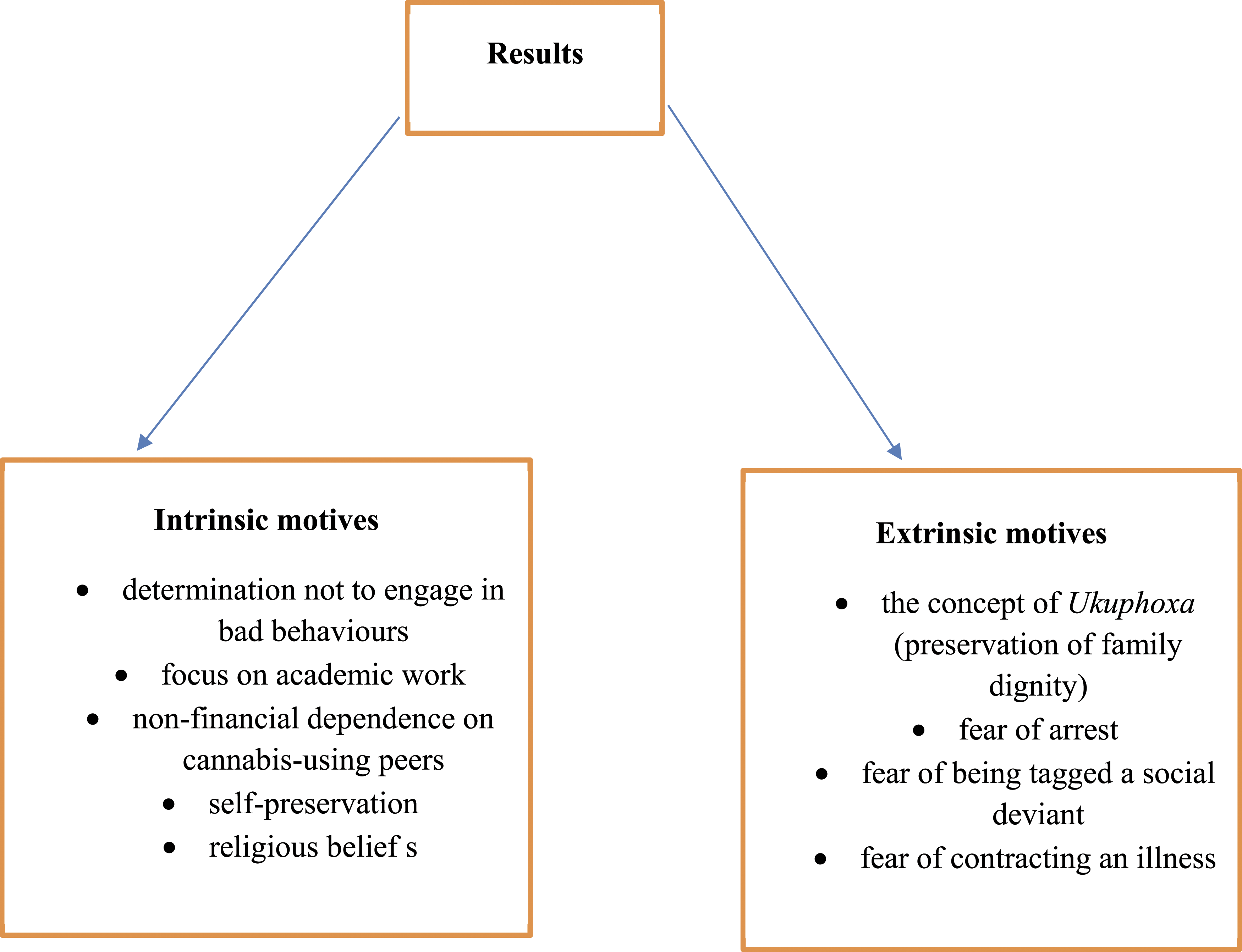
Participants Characteristics
There were thirty (30) participants, fifteen (15) males, and fifteen (15) females. Most participants (23) had secondary school education or were still in school. None of them had tertiary education, and they were all within the age bracket of 14 and 19. All participants were living with their parents.
Intrinsic Protective Behavioural Mechanisms for Adolescent Non-Cannabis Use
Determination not to engage in bad behaviour(s)
Adolescent cannabis use was frowned upon by participants as they saw it as a condemnable behaviour that 1 was not supposed to indulge in. Hence, they individually resolved not to use cannabis. Eight (8) participants, 5 (5) females and 3 (3) males affirmed this assertion. They explained: As a young man, you need to live a good life so that you can be an example to others, especially your own siblings. I never had a father figure at home, so I have decided not to engage in any form of bad behaviour that will make me not to be able to be a good example to my siblings. (MFG 2, 17 years old)
Recounting why she does not smoke cannabis although she lived in the midst of it, a female participant from Community 1 also narrated: Cannabis smoking is a bad thing that no decent girl is supposed to be engaged in. These days you will see girls of my age doing all sorts of bad things, but not me. I won’t do that. (FFG 1, 18 years old)
Participants were intrinsically determined not to indulge in any form of bad behaviour, including cannabis use.
Focus on academic work
Another intrinsic mechanism that participants adopted to avoid cannabis use despite its abundance in their immediate environment was their focus on school or academic work. In an attempt not to be swayed by their cannabis-smoking peers, participants focused on academic work during their free time in order to achieve academic excellence. Seventeen (17) participants, 9 (9) males and 8 (8) females, affirmed this assertion. A male participant from Community 1 opined: I try to focus on my homework and assignments after school so that I won’t have free time and become idle to be influenced by cannabis smokers. I want to be well-educated, so I concentrate on my schoolwork a lot. (MFG 1, 16 years old)
A female participant from Community 2 narrated how she also uses her free time to study and teach her peers to keep herself busy. She said: I don’t even have time to smoke dagga [cannabis]. Any free time I get, it’s either I am doing my own school work, or helping my colleagues to understand what was taught in school, so cannabis smoking doesn’t even come to my mind. (FFG 2, 17 years old)
Participants focus on academic work, therefore, tend to engage them enough so that they are not bored to be thinking of using cannabis.
Non-financial dependence on cannabis-smoking peers
A factor that could predispose participants to cannabis smoking, according to them, was financial dependence on their cannabis-smoking peers. However, as they were not ready to be lured into the act, they did what they could not to depend on their cannabis-smoking peers financially. This often happens in schools where financially independent cannabis traders and smokers lure non-cannabis users into their cult through the provision of incentives in the form of gifts and cash rewards. Five (5) participants, 4 (4) males and a female, raised this point. A male participant from Community 2 explained this.: These boys [cannabis smokers] can easily trick you into smoking if you keep asking for money from them [at school during break time]. Because I don’t want to smoke, I don’t ask any of them for money and also don’t eat their food or sweets and other gifts they [cannabis smoking peers] buy for me because you may never know what their intentions are. You can never trust them. (MFG 2, 18 years)
A female participant from Community 1 shared similar sentiments when she explained how she was able to avoid cannabis use. Very few girls openly smoke cannabis, and we know them. So because I don’t want to be trapped by any of them, I don’t go and be asking [sic] for financial favours from them since that would mean constantly being in their company and you may be tempted [to smoke]. (FFG 1, 17 years old)
Being financially independent of cannabis-smoking peers was seen as a way of keeping them away from influencing participants to smoke or use cannabis.
Self-preservation for a good marriage
Another important mechanism for adolescent non-cannabis use, especially among females, was self-preservation for a good marriage. To participants, a female who smoked cannabis was not good enough to attract a good man for marriage. Ten (10) females were of this view. A participant from Community 1 narrated: I want to ensure that my future husband is proud of me and pays the right ‘lobola’ [bride price] for me. If I smoke cannabis and everybody knows that I smoke since it [cannabis smoking] is not something 1 can hide, who will allow his son to marry me in the first place? (FFG 1, 18 years old)
Another female participant from Community 2 corroborated the narrative of her colleague from Community 1. She opined: It is a shame for a female to smoke cannabis. As a woman, you need to live a good life and preserve your body for your parents to be proud of you so that your husband will be willing to pay ‘lobola’ [bride price] for you. But if you are a tavern girl [drunkard] or a cannabis smoker, who will get married to you? (FFG 1, 19 years old)
Cannabis usage, thus, has a gendered connotation as women are not expected to indulge in such a behaviour in order to attract good and responsible men for marriage in the 2 communities of the Inqguza Hill Local Municipality.
Religious beliefs of participants
Cannabis smoking was against the religious beliefs of Christian participants; hence, it intrinsically motivated them not to use cannabis. Twelve (12) participants, 7 females (7) and 5 (5) males affirmed this point. A male participant from Community 1 explained that I go to church every Sunday [a Christian], and from the teachings of the Bible, it is a sin to smoke cannabis. So, as a good Christian, I have vowed never to smoke cannabis, not even a cigarette. (MFG 1, 18 years old)
A female participant from Community 2 shared similar sentiments as the male participant from Community 1. She stated: To me, it is a sin to smoke cannabis. I am saved, so I don’t even see myself doing things like that [smoking cannabis]. In fact, it has never crossed my mind that I should smoke cannabis, although it is grown here in this community. (FFG 2, 18 years old)
Christian teachings, thus, deterred some participants from smoking cannabis as they were willing to hold onto their religious principles.
Extrinsic Protective Behavioural Mechanisms for Adolescent Non-Cannabis Use
The concept of Ukuphoxa (the preservation of family dignity)
The practice of keeping a dignified family image, known as Ukuphoxa in the Isixhosa language, was identified as a strong motivational value that keeps adolescents from using cannabis. Thirteen (13) participants, 9 (9) females and 4 (4) males stated that their parents consistently counselled them about the importance of living a dignified life and refraining from deviant behaviours, such as cannabis use so that they do not tarnish their families’ images. A male participant narrated: My parents always advise me to not smoke [dagga] cannabis because those who do so disgrace themselves and their families. I am from a royal family, so people will begin to say bad things about us [our family] if they should see me smoking [dagga] cannabis. (MFG 1, 18 years old)
Expressing similar sentiments as her male counterpart, a female participant explained why she does not use cannabis. She explained: This thing [cannabis cultivation] is a business here, but these guys (cannabis smokers) don’t get it. When you begin to smoke it [cannabis], you begin to do bad things and bring shame to your family. Some of them [cannabis smokers] don’t bathe for days, and everyone in the community points their fingers at them, saying, look at how untidy that man or woman’s child is. It is a disgrace to their family. (FFG 2, 19 years old)
It is evident that some participants were aware of the shame cannabis use could bring to their families; hence, their resolve to protect their families’ dignity by not using it.
Fear of arrest
Although the participants illegally cultivated cannabis in their communities because commercial cultivation of the drug is prohibited, some participants (4), all males, were afraid of being arrested if they smoked it. This was the case because, at the time of data collection, private cannabis consumption in South Africa was illegal. A male participant from Community 1 explained, You know cannabis smoking, just as its cultivation, is illegal in this country, so if you are caught smoking it, you will go to jail or pay a fine. In addition, once you are hooked [addicted] to it, you cannot stop, and who knows, maybe in the near future I will leave this community to the city; what if I am arrested over there for smoking cannabis when I am there to better my life? No way. (MFG 1, 18 years old)
Another male participant from Community 2 held a similar view as the participant from Community 1. He noted: Imagine going to prison for smoking cannabis when people are going to prison for serious crimes. You will even become a prisoner’s wife over there because of your stupidity, so I see this cannabis thing as a business and not something for me to smoke, period. (MFG 2, 17 years old)
Although private cannabis smoking is no longer a punitive offense in South Africa, as it has been legalised, that was not the case at the time of data collection. Moreover, public smoking of cannabis is still illegal, as well as underage cannabis smoking. Hence, participants’ concerns about getting arrested remain valid to some extent.
The fear of being tagged as a social deviant
Although cannabis cultivation and trading were a common practice in the 2 communities, smokers of the drug were seen as social deviants, especially female cannabis smokers. Ten (10) participants, 7 (7) females and 3 (3) males regarded cannabis smokers as social deviants. A participant from Community 1 opined: For a female to be seen smoking cannabis in this community is taboo. Only a few girls are known to smoke cannabis here, and even they hide to do it. You will be seen as an outcast if you smoke cannabis as a female. (FFG 1, 16 years old)
A male participant from Community 2 explained why he does not smoke cannabis. He stated that he might be tagged as a social deviant in his community if he smokes cannabis. He said: For a young man to be seen smoking cannabis [in public], where will be your dignity? They will be calling you names and disrespecting you. I don’t see myself smoking cannabis in any way. (MFG 2, 18 years old)
Being tagged as a deviant was a strong extrinsic mechanism that prevented adolescents from using cannabis.
The fear of developing illness (lung cancer)
The fear of developing lung cancer was another strong extrinsic mechanism that deterred fourteen (14) participants, 9 (9) males and 5 (5) females, from smoking cannabis, as they were aware of some cannabis smokers in their communities who had developed the disease. A male participant from Community 1 said: My brother, I don’t want to die anytime soon. Just last month, my neighbour died of lung cancer. He used to smoke cannabis a lot. People called him ‘Gautrain’ (a train service in Johannesburg) due to the constant cannabis smoke that came from his nostrils. (MFG 1, 17 years old)
A female participant recounted how 1 of her classmates is currently on admission at the hospital for a suspected lung cancer case due to the excessive smoking of cannabis. She noted that This thing (cannabis smoking) can kill you. As I am talking to you, 1 of my classmates is at the hospital. He is coughing seriously, and they say it is because of the cannabis he smokes, so I do not want to suffer the way he is. (FFG 2, 18 years old)
The fear of developing lung cancer through cannabis smoking and the possibility of dying from it served as an extrinsic motivation that deterred participants from smoking or using cannabis.
Discussion
In this paper, we explored the protective behavioural mechanisms for adolescent non-cannabis use in the cannabis-growing communities of the Ingquza Hill Local Municipality of South Africa based on the intrinsic and extrinsic motivational concepts of SDT.
Self-determination is 1 of the intrinsic protective behavioural mechanisms that protect adolescents from cannabis use. Self-determination helped these adolescents not to use cannabis as they perceived its usage to be condemnable. Hence, they resolved not to indulge in cannabis use. Thus, they had higher autonomy control and were not easily persuaded by their peers to use cannabis. The literature has shown that when individuals have higher autonomy control, they are more unlikely to indulge in unhealthy behaviours such as substance abuse. 51 In this light, Moore and Hardy 52 opined that intrinsically motivated individuals are often more determined not to indulge in substance abuse. Such individuals, however, need guidance and support to sustain their resolve of non-substance abuse. In that regard, Wong and Rowland 51 suggest that adolescents should be taught strategies that would enable them to withstand peer pressure as key intervention strategies to enable them to sustain their resolve.
Another intrinsic mechanism participants in this current study adopted to avoid cannabis use despite its abundance in their immediate environment was their focus on school. In an attempt not to be swayed by their cannabis-smoking peers, participants focused on studying during their free time in order to achieve academic excellence. Research has shown that school connectedness and academic achievements protect the youth against risky health behaviours, including drug use. 53 Thus, individuals who focus on their academics and are more connected to school and its related activities are able to reject cannabis use despite its abundance in their surroundings. Therefore, Syvertsen and colleagues 54 posit that positive school orientation of children and adolescents’ attachment to school has long been recognized as a key internal source of protection. They further contend that establishing a positive orientation towards school, an institution with clear standards of appropriate behaviours, protects adolescents against substance use by encouraging them to act in ways that are consistent with societal norms. Hence, the academic interests of adolescents living in cannabis-growing communities should be promoted to prevent them from cannabis use.
According to the discussants, 1 factor that could predispose them to cannabis smoking is financially dependent on their cannabis-smoking peers. We found that adolescents who were financially independent and did not rely financially on their cannabis-smoking peers were able to refrain from cannabis use. Research has shown that adolescents with a controlling tool over their peers, such as financial control, 55 could use it as a bargaining chip to lure them into indulging in unhealthy behaviours such as cannabis use. Hence, depending financially on their cannabis-smoking peers could serve as bait to initiate non-smoking cannabis adolescents into cannabis use. This implies that, as found in this study, parents should endeavour to cater to the financial needs of their children, especially in settings where illicit cannabis activities are rife, to ensure that adolescents are not enticed by their cannabis-smoking peers.
In this current study, we found that self-preservation, especially among females, was a protective factor against cannabis use. Female indulgence in cannabis smoking is perceived as a despicable behaviour that could prevent a woman from getting a good partner. This finding is corroborated by the findings of May and Roomaney’s study. 56 They found that a large factor preventing participants from consuming illicit drugs was a strong sense of self-preservation. Thus, participants valued their reputations and did not like to be labelled as an out-of-control drug users who might not be able to attract responsible men for marriage. May and Roomaney 56 further note that illicit drug usage results in promiscuity and decreased self-consciousness, resulting in unprotected sex and sex with strangers. Hence, female participants’ fear of being deemed unfit for marriage prevented them from indulging in cannabis smoking. In South Africa, marriage is perceived as a dying institution because of high bride prices. 57 Hence, men prefer to get married to virtuous and independent women, 58 and drug users are not viewed as part of such women.
The final intrinsic factor that protected adolescents from cannabis use was their religious beliefs. Cannabis smoking is against the religious beliefs of some participants. It, thus, intrinsically motivates them not to use cannabis in any form because cannabis use is deemed as a sinful act. Studies have shown that spirituality offers protection against alcohol and cannabis use.59,60 Similar findings have also been reported among Christians in the USA. 21 Therefore, entrenching religious beliefs in adolescents could serve as a coping mechanism for substance use, including cannabis, especially in settings where the cultivation, trading and/or usage of the drug is prevalent. 61
Extrinsically, the concept of Ukuphoxa, which is the preservation of family dignity through non-indulgence in embarrassing situations 62 , was a key factor that shielded discussants from cannabis use. Even though some participants were involved in either cannabis cultivation or trading, they did so solely as a source of livelihood. Ironically, while some participants depended on cannabis financially, they deemed its usage as a bad habit, which could tarnish their family’s image. Hence, they strive to preserve their family dignity, a concept known as Ukuphoxa. It served as a deterrent for participants not to indulge in cannabis use. This is consistent with the concept of Famillismo, family-centeredness among Latin Americans, which protects them from substance use.63,64 Like Famillismo, under Ukuphoxa, parents give constant counsel to their children on the need to live a dignified life by refraining from deviant behaviours such as cannabis use in order to protect the dignity of their family. 62 This is against the backdrop that cannabis cultivation and trading were seen as economic ventures and not deviant social practices that could tarnish one’s family dignity.
Another extrinsic protective mechanism for adolescent non-cannabis use was the fear of arrest by law enforcement agents. Although cannabis was abundant in their communities, some participants were afraid of being arrested for smoking it. Hence, they refrained from cannabis use. This may no longer be the case if the user is eighteen years and above and uses cannabis privately, per the 2017 High Court ruling. 8 However, 1 could still be arrested for underage and public use of cannabis. Hence, participants’ fear of arrest is not farfetched. Globally, the fear of being jailed for illegal drug usage has been reported as a deterrent to drug use.65,66 This fear is because an arrest could lead to being locked up in prison, payment of fines, or both. Hence, although privately legalised, public and underage cannabis consumption-associated legal problems could still serve as an extrinsic motivation for non-cannabis use among adolescents in the 2 communities.
Although cannabis cultivation and trading were common practices in the 2 communities, smoking the drug was regarded as bad behaviour among discussants. As a result, this perception served as an extrinsic motive for non-cannabis use. Likewise, the fear of being tagged an outcast, especially for females, deters them from using cannabis in any form. Studies have shown that cannabis users are often viewed as criminals irrespective of their criminal status. 66 Hence, the stigmatisation associated with cannabis use served as a protective mechanism for discussants’ non-indulgence in its use. Even though criminal labelling and profiling individuals is wrong, in instances where unhealthy behaviour is concerned, it could serve as a motivating tool against such behaviour.
Lastly, the fear of developing a cannabis use-related illness such as lung cancer was another extrinsic motivation for adolescent non-cannabis use. At least 1 participant knew an individual that had fallen ill because of their cannabis smoking habit in their respective communities, which served as a deterrent against marijuana use. Research has shown that cannabis use could lead to the development of lung cancer. 67 Moreover, cannabis-related carcinogens are believed to be a major risk factor for initiating respiratory cancers more than those in tobacco. 68 Hence, participants’ fear of contracting an illness through cannabis usage is not wrong. This means that continuous sensitisation of adolescents on the health consequences of cannabis use, irrespective of its abundance or absence in their communities, could prevent its usage.
Implications for Public Health Policy
Our findings highlight pointers that could be considered in policy development to prevent would-be adolescent cannabis users in cannabis-growing settings in South Africa from its usage.
Regarding intrinsic motivational strategies, policy should focus on promoting strategies that recognise self-worth and self-esteem among adolescents to empower them to refrain from illicit cannabis use. Secondly, the interest in education among adolescents living in illicit cannabis-growing communities needs to be rekindled to re-orient their thinking and energies to focus on schooling instead of focusing on cannabis-related activities, including smoking. Policymakers should also liaise with religious leaders to teach children living in communities where illicit cannabis activities are rife, the needed religious values at an early age, to motivate them not to indulge in illicit cannabis use.
Extrinsically, families and communities should be encouraged to take collective responsibility for raising children. This could ensure that children do not mature and indulge in self-destructive behaviours such as illicit cannabis use. Moreover, law enforcement agents should make it their responsibility to engage with adolescents in their communities to educate them on the disadvantages of being arrested and criminally profiled in South Africa. Lastly, policymakers should engage the services of public health practitioners, such as health promotion officers, to educate adolescents on the adverse health effects of illicit cannabis smoking.
Conclusion
Despite how common cannabis was in the communities, essential intrinsic and extrinsic motivations protected discussants from cannabis use. Hence, health promotion and education programmes for adolescents on non-cannabis use in settings where illicit cannabis abounds have to identify and draw on these contextual intrinsic and extrinsic motivations to promote non-indulgence in adolescent cannabis use, as outlined in this study.
Limitations of the Study
Since the data for the study was collected about 6 years ago, perhaps the attitudes of adolescents in the study communities might have changed. However, without empirical evidence to ascertain that, we believe that our findings could still be valid. Moreover, although measures were taken to authenticate participants’ non-cannabis use claims before recruitment, such claims could be misleading, as drug tests were not conducted on individuals to medically ascertain their claims.
Footnotes
Acknowledgments
We acknowledge our study participants and members of the two communities where that data were collected for their cooperation, which made the writing of this manuscript possible.
Authors Contributions
E.Manu, M.Douglas and M.J.Ntsaba conceived the study. E.Manu and B.Makaula were responsible for the data collection and analysis. E.Manu, E.E.Tarkang and M.Douglas were responsible for the initial draft of the manuscript. All authors read and approved the final manuscript and agreed to be accountable for all aspects of the study.
DECLARATION OF CONFLICTING INTERESTS:
The author(s) declared no potential conflicts of interest with respect to the research, authorship, and/or publication of this article.
FUNDING:
The author(s) received no financial support for the research, authorship, and/or publication of this article.
