




Abstract
It has been suggested that smoking and age are associated with higher vulnerability to Covid-19. While threat of Covid-19 may reduce or stop smoking, increased stress due to lockdown could increase smoking behaviour. This study aimed to investigate changes in smoking behaviour in relation to age, Covid-19-related threat and subjective perceived stress during the UK lockdown. A cross-sectional study was performed. Online adverts were used to recruit UK residents who smoked combustible tobacco any time from January 2020. A questionnaire measured demographic information, smoking behaviour pre- and during-lockdown, perceived subjective stress (PSS), and Covid-19 related threat. Data were collected from a total of 145 participants (58% women, 39% men, 3% non-binary; mean age: 26 years, SD = 7.7), during UK lockdown between 22nd May and 22nd June 2020. Independent of stress and Covid-19-related threat, smoking was reduced in those aged less than 30 years. In participants aged 30 and above, increases in smoking behaviour were associated with higher PSS. The results highlight the relevance of the different stages of life on the relationship between stress, threat, and smoking behaviour. Greater emphasis should be placed on stress reduction for adult smokers aged 30 and above to enable smoking cessation.
Introduction
Research evidence has consistently linked smoking behaviour to Covid-191,2. It is indicated that smokers are more likely to develop severe symptoms with Covid-19 in comparison to non-smokers [for reviews, see1,3,4]. Furthermore, smoking has been implicated in accelerating the virus’s entrance to our cells, therefore increasing susceptibility towards the virus. 5 Some early research after the initial UK lockdown suggested that nicotine might be protective against Covid-19; however this has since been disputed and criticised for the misleading information presented. 6
Lockdown measures were put in place by the UK Government on the 23rd of March 2020, which may have increased stress 7 at that time. Furthermore, due to early research in this area, threat-based messages, indicating the risks of smoking and Covid-19, were conveyed by Public Health England 8 and the National Health Service. 9 During this time a variety of reactions were observed in individuals who smoke, including no change in habits, a reduction in smoking and an increase in motivation to quit. 10 Additionally, there were reports of greater perceived risk of Covid-19 associated with smoking behaviour10,11 and increased motivation to quit due to the threat percieved. 12 At the beginning of the pandemic older age was cited as a risk factor increasing vulnerability to Covid-19 13 and in later research being older has been associated with decreased smoking. 11 Therefore it could have been expected that young adults would have been less motivated to quit smoking and yet, increased quit attempt rates were reported in those aged 16-29 years compared to those aged 30 and above. 14 It is worth noting that nowadays in the UK, the main life events in early adulthood occur in most of the population by the age of 30. For example, according to the Office for National Statistics (UK) in 2020, 15 the average age of women having their first child was 29.1 in England and Wales. Also in the UK, by the age of 30, less than 10% of the population are still living with their parents, and more than 60% start living with a partner. 16
Robust evidence has linked stress to all aspects of smoking behaviour. 17 Therefore, amplified stress levels due to Covid-19 in this older age group could have elevated the likelihood to increase or relapse smoking. Additionally, the Covid-19 lockdown may have affected younger and older smokers differently. Middle aged and older adults experienced unique stressors associated with everyday life (e.g., home-schooling and working from home) during lockdown 18 and faced a disproportionate amount of adverse consequences from social distancing that increase stress and anxiety, 19 potentially disrupting attempts to quit smoking.
Whereas, perceived susceptibility and severity of Covid-19 has previously been found to have an impact on quit smoking motivations and behaviours, 20 yet this research has not focused on the impact of stress, threat on smoking outcomes dependant on stage of life. The current study therefore adds to the literature by investigating these changes within two distinct age groups. Pandemics of this nature are rare; however it is anticipated that similar life changes and stressful worldwide events are set to occur in the coming years (for example climate-induced challenges). Therefore, it is important to investigate the response of individuals who smoke in order to plan how best to support individuals in future events.
The current study aimed to investigate the relationship between perceived stress, Covid-19 related threat, and changes in smoking during lockdown, in relation to age. It was hypothesised that smoking changes during lockdown will be related to Covid-19 threat and stress and dependent on age. Specifically, we expected that i) higher Covid-19 threat would be associated with higher reduction in smoking behaviour, ii) higher perceived stress levels during lockdown would be associated with an increase in smoking behaviour. In addition, we took into account evidence discussed above that indicates different changes in smoking behaviour in those above and below the age 30 years. We therefore expected that, compared to smokers under 30 years, smokers 30 years and over would have higher levels of Covid-19 threat and perceived stress, and increased smoking behaviour during lockdown.
Methodology
Participants
Participants recruited were aged 18+, lived in the UK and smoked combustible tobacco products (not including only use of e-cigarettes) any time prior to January 2020. Participants were excluded if they were not a UK resident and were not able to understand written English and give fully informed consent. Participants (N = 270) clicked to start the online survey; of these, N = 145 completed it (54% of total responses). Responses were logged between 22nd May and 22nd June 2020. No incentive or payment was given to participants.
Measures
Demographic Information
Demographic Information and differences in smoking, stress and Covid-19 threat measures by Age Group

Note: PCTQ = perceived Covid-19 threat questionnaire (Covid-19 Threat), PSS = perceived stress scale (perceived stress), X2 = chi square value, df = degrees of freedom, Mdn = Median, Rng = Range.
*, P<0.05, **, P<0.01
Due to differences in the effects of Covid-19 on black and minority ethnic groups comparisons of the distribution of participants between age groups was made between participants who reported white ethnicity versus participants that responded in all other ethnic groups.
Perceived Coronavirus Threat Questionnaire
The level of threat an individual experienced due to Covid-19 was measured via the Perceived Coronavirus Threat Questionnaire (PCTQ). 21 This measure included six items, with questions such as “Thinking about the coronavirus (Covid-19) makes me feel threatened”. Responses were logged on a seven-point scale (1 = not true of me at all, 7 = very true of me), with scores within the range 6 - 42. The Cronbach’s alpha for the sample = 0.87, showing good internal reliability.
Perceived Stress Scale
Levels of perceived stress experienced in the past month (during the pandemic) were measured using the Perceived Stress Scale (PSS). 22 The 10 items asked participants to reflect on stress experienced on a 4-point scale (0 = Never, 4 = Very often), with scores within the range 0 - 40. The Cronbach’s s alpha for the sample = 0.89, again showing good internal reliability.
Smoking Behaviour
Participants were asked to report the number of combustible tobacco products smoked per week both pre- (i.e., consumed on an average week in March pre-lockdown) and during-lockdown. The percentage change in smoking behaviour pre- to during lockdown was calculated. An additional qualitative open-ended question on smoking during lockdown was added (findings reported in a separate paper-(26)).
Procedure
Ethical approval was granted from Manchester Mertopolitan University. An online questionnaire was created via Qualtrics. For sampling methods see Grogan et al., (26). Participants were given up to one week to complete all items before responses were logged.
Data Analysis
All analyses were conducted using SPSS v26. Chi Square analysis assessed the spread of participant demographics across age groups. Data were indicated as not missing at complete random (NMCR) using the Little Test and missing data was over the recommended amount for handling, 23 therefore missing data points could not be imputed and list wise analysis techniques were applied. Shapiro-Wilk tests were used to assess normality of the data. As data was not normally distributed, Mann-Whitney U tests assessed differences in PSS, Covid-19 threat and smoking behaviour at all time points between age groups. Differences in smoking from pre- to during lockdown were assessed using Wilcoxon Signed-ranks, in the whole sample and within each age group separately. Spearman correlations were then conducted for smoking % change, PSS and Covid-19 threat. This was conducted in the whole sample and again for each age group separately. The level of significance is reported as P-value <.05. Multiple linear regression models were then run within the individual groups to assess the impact of PSS and Covid-19 threat on the % change in smoking. Assumptions were checked prior to analysis, with collinearity found to be within an acceptable range.
Results
Demographic Characteristics
Demographic characteristics and distribution between age groups is presented in Table 1. No significant differences between age groups were observed for demographic characteristics (Table 1).
Age group comparisons on smoking, PSS and Covid-19 threat levels
No significant differences in smoking behaviour were indicated from pre- (Mdn = 40.0) to during-lockdown (Mdn = 32.0) (N = 145, Z = -1.29, P = .197, r = .11) for the whole sample. When split by age group, a significant decrease in smoking behaviour was observed in participants aged <30, from pre- (Mdn = 36.5) to during-lockdown (Mdn = 28.5) (n = 114, Z = -.20, P = .046, r = .02). However, no significant differences were found from pre- (Mdn = 67.5) to during-lockdown (Mdn = 70.0) in the older group (≥30) (n = 31, Z = .66, P = .509, r = .12).
Participants aged ≥30 smoked significantly more than those aged <30 pre-lockdown and during-lockdown, while no significant differences between participants aged <30 and ≥30 years were found on PSS or Covid-19 threat (Table 1).
Correlations
PSS and Covid-19 threat
In the whole sample and younger group, a significant positive correlation was observed between levels of Covid-19 threat and PSS (whole sample: N = 145, rs =.39, P < .001; younger group: n = 114, rs =.40, P < .001), but did not reach a significant effect in the older group (n = 31, rs =.27, P = .145).
PSS and Smoking Behaviour Change
For participants aged ≥30 there was a significant moderate positive correlation between PSS and change in smoking behaviour (n = 31, rs =.48, P = .006; Figure 1); however, this correlation was not significant in the whole sample (N = 145, rs =.15, P = .064) and younger group, (n = 114, rs =.04, P = .642; Figure 1). Scatter graphs displaying the relationships between perceived stress and smoking behaviour change in each age group. A) Age <30 n = 114, rs =.15, P =.064 B) Age ≥30 n = 31, r =.48, P = .006.
Covid-19 Threat and Smoking Behaviour Change
In the whole sample, younger group and older group, Covid-19 threat did not correlate significantly with percentage change in smoking from pre- to during-lockdown (whole sample: N = 145, rs =.05, P = .551; younger group: n = 114, rs = -.01, P = .961; older group: n = 31, rs = .08, P = .688).
Regression
A multiple linear regression was carried out to investigate whether PSS and Threat could significantly predict change in smoking within the different age groups. For participants aged <30 (n = 114) the model explained .03% of the variance; and it did not predict change in smoking F(2,113) = .19, P = .830. The individual predictors of PSS (B = .29, t = .34, 95% CI = -1.42, 1.99, P = .739) and Threat (B = .24, t = .31, 95% CI = -1.27, 1.74, P = .757) did not significantly contribute to the model.
Change in smoking behaviour predicted by Stress and Covid-19 Threat.
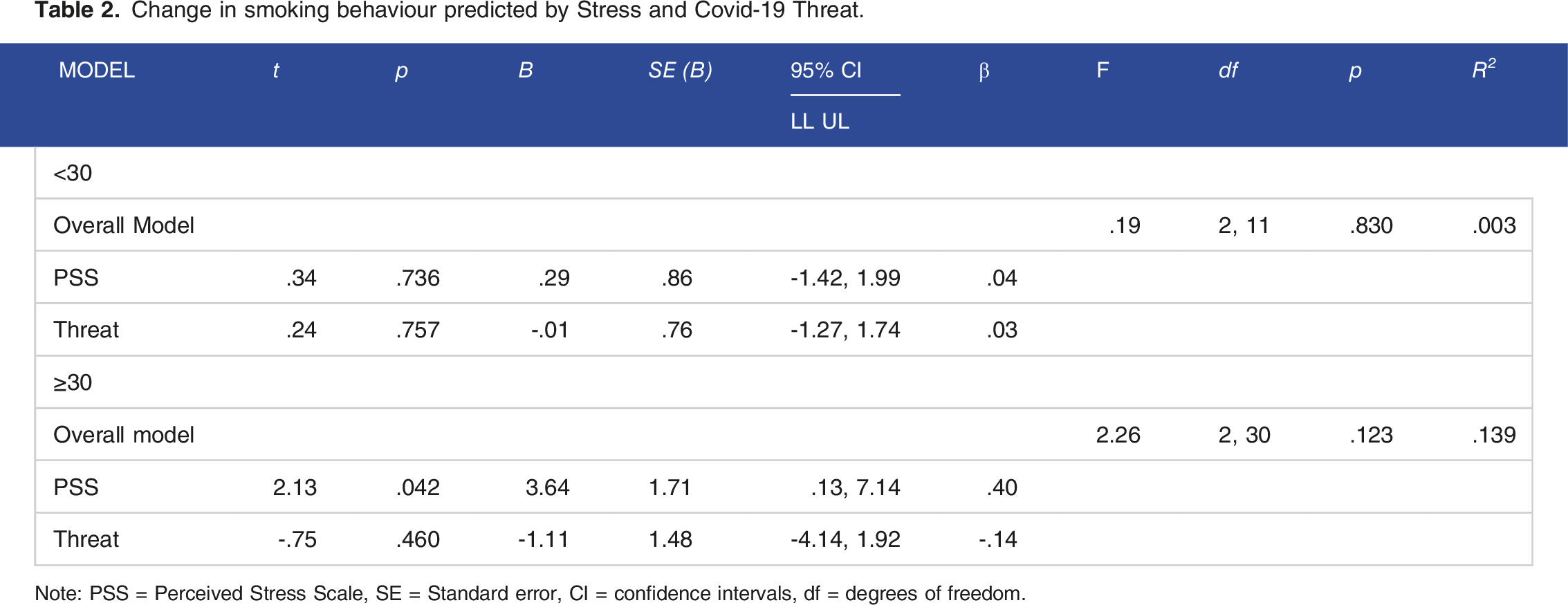
Note: PSS = Perceived Stress Scale, SE = Standard error, CI = confidence intervals, df = degrees of freedom.
Discussion
Younger participants (18-29 years) displayed a significant decrease in smoking from before lockdown to when restrictions were put in place. No significant differences in smoking behaviour pre- to during-lockdown were observed in participants aged 30 years and over; however, in this age group (but not in the younger group) a significant positive correlation was observed between change in smoking behaviour and stress. Regression analysis using both stress and threat as predictors indicated no significant prediction of smoking behaviour in both groups, yet for those aged 30 and over, stress was a significant individual predictor. However, it is worth noting that the analysis was not sufficiently powered within this older group. There was no impact of threat related to Covid-19 observed in the current research. Yet, the findings indicate that stress and Covid-19 threat were positively associated with each other.
Reports that highest rates of quitting smoking during the first wave of the pandemic were in younger adults (16-29 year olds) e.g. Action on Smoking and Health (2020), and instances of increased quit attempts in younger age groups 24 are supported in the current study. Unexpectedly, in this age group smoking behaviour did not correlate significantly with Covid-19 threat or perceived stress. A possible explanation of higher reduction in smoking behaviour observed in young adults could be related to the unique patterns of smoking behaviour in this age group, characterized by non-daily use, smoking during social interactions, lower levels of nicotine dependence 25 and increased chance of having a smoke free household. Furthermore, a qualitative exploration 26 revealed that younger participants explained how changes such as moving back from universities to family homes and less social interaction during lockdown reduced opportunities for smoking. Lastly, younger adults who were dual users (users of combustible tobacco products and e-cigarettes) could have used e-cigarettes more predominantly during this time. 27 Therefore, these changes, together with low smoking craving, could indicate the positive association between age and smoking change. The current study therefore adds to the current literature by highlighting how stress and Covid-19 threat may not have been significant factors in changes of smoking behaviour within this age group.
No significant differences in smoking behaviour were found in smokers aged over 30 years, supporting previous data. 14 However, a positive correlation was found between change in smoking behaviour from pre- to during Covid-19 restrictions and levels of perceived stress in those aged 30 and above. This finding indicates high levels of stress relates to increased smoking behaviour. The lack of significant correlation between Covid-19 threat and perceived stress in older smokers suggest that the stress in this of age group may be related to other stressors besides Covid-19 threat, e.g., life adjustments during lockdown such as working from home, home-schooling and threat to employment,18,28 associated with increased stress in everyday life.
It is also important to note, that in the current study, the group of participants aged 30 and above smoked more than younger participants even before the lockdown. High levels of stress have been evidenced as barrier to reducing smoking behaviour through increasing defensive and avoidant behaviour, 29 leading to smokers attending less to threatening information. 30 Stress also increases onset of withdrawal symptoms 31 and nicotine in smoked tobacco creates a negative reinforcing effect, as through smoking, levels of stress are perceived to be reduced32,33 Therefore, the higher nicotine dependence indicative of older smokers could have rendered them more vulnerable to the effects of increased stress related to the Covid-19 situation, cueing increased smoking behaviour. Therefore, the current findings highlight the specific stressful experience encountered in those aged 30 and older and its links with smoking behaviour, indicating targeting specific age groups may be useful in future research and practice.
Limitations
Despite making important contributions, this study still has its limitations. Firstly, the study commenced after initial UK lockdown restrictions were put in place on the 26th of March 2020 (study recruitment between the 22nd May and 22nd June), so initial changes in smoking behaviour from first instance of lockdown may not have been captured and the data collected were cross-sectional in nature; furthermore, smoking behaviour was not biochemically validated, therefore the results could be subject to recall bias. Despite this, the study was able to capture self- reported behaviour established further into lockdown that may have been more indicative of long-term changes in smoking behaviour. Finally, it is important to mention that this study only included the number of cigarettes smoked per week as a measure of smoking behaviour. Further research could include a more comprehensive assessment of smoking behaviour for example, biochemically validated measures of smoking and self-report measures of dependence (such as, waking up to smoke, time of first cigarette, among others.).
The sample obtained for the study was also limited in terms of numbers and spread of ages recruited to the survey, which may limit the power and generalizability of findings, this may be due to bias in selection due to the online recruitment strategy possibly failing to reach the upper limit of the sample. Moreover, the sample size precluded demographic variables such as gender, ethnicity or other factors such as having children in the home which could contribute to levels of stress being included in the analyses. Future research could continue to recruit from a diverse sample to identify unique factors contributing to smoking behaviour during Covid-19. Lastly, the measures implemented may have been subjected to information bias, specifically measures of Covid-19 related threat may not have captured the specific type of threat felt by this group. As this was an early measure developed during the first lockdown, efforts could be made to strengthen measurement tools going forward for similar events.
Conclusions
The current study highlights the relevance of considering different age groups on the effect of stress and threat on smoking behaviour. If levels of smoking are not reduced in those aged 30 years and over, further increased burden will be placed on health systems. Therefore, policy needs to reflect the differential effect of the pandemic situation at different stages of life. While health campaigns with clear and unambiguous messages on health risks are needed, without reducing levels of stress these messages may not motivate change, specifically emphasised with increases in age. In order to help older age groups to reduce smoking, health campaigns should also include stress reduction interventions. The results therefore highlight the importance of designing both policy and health campaigns related to the Covid-19 pandemic tailored specifically to different age groups. This information can also be used to inform health messaging surrounding further worldwide events moving forward.
Footnotes
Declaration of Conflicting Interests:
The author(s) declared no potential conflicts of interest with respect to the research, authorship, and/or publication of this article.
Funding:
The author(s) received no financial support for the research, authorship, and/or publication of this article.
Data Availability:
The data that support the findings will be available for open access in the Manchester Metropolitan e-space following an embargo of 24 months from the date of data collection completion to allow for use of research findings.