




Abstract
Aim:
The current study examined differences between individuals identifying as transgender and people identifying as cisgender in terms of (1) psychological distress (eg, anxiety, depression, and suicidal ideation), (2) rates of combustible and e-cigarette use, and (3) the potential for elevated psychological distress stemming from transgender identification to be associated with increased rates of smoking and vaping.
Method:
This was a secondary analysis of data from a study examining behavioral health, perceptions and behaviors associated with alcohol and other drug use, and mental health status at a large mid-western university. Differences in current use of cigarette and e-cigarette products were examined between self-identified transgender (n = 253) and cisgender (n = 18 371) respondents.
Results:
Overall, 17.2% (n = 2727) of the sample endorsed past 30-day use of cigarettes or e-cigarettes. Results demonstrated a significant effect of gender identity, with individuals identifying as transgender reporting higher odds of using cigarettes or e-cigarettes (AOR = 2.82, 95% CI 1.26-6.31). Regression analyses revealed significant effects of transgender identity on symptoms of anxiety (b = 3.45, 95% CI = 1.64, 5.25, P < .001.); depression, (b = 4.14, 95% CI = 2.21, 6.07, P < .001); and suicidal ideation, (b = 2.51, 95% CI = 1.48, 3.55, P < .001.), respectively. Finally, we observed significant indirect effects of transgender identity on cigarette and e-cigarette product use via increased symptoms of depression (indirect effect = 0.13, 95% CI [0.07, 0.19], P < .05), and suicidal ideation (indirect effect = 0.22, 95% CI [0.15, 0.28], P < .05), but not symptoms of anxiety.
Discussion:
This is the first study of our knowledge to examine the association between psychological symptoms and smoking and vaping products with transgender identity. The results of this study support previous findings that transgender individuals are at risk for elevated substance use and extend the literature by demonstrating this this risk is associated with elevated psychological distress.
Introduction
Individuals identifying as transgender often experience elevated mental health symptomatology and poorer physical health outcomes than individuals identifying as cisgender.1-5 Stressors unique to transgender identity, namely discrimination, likely place these individuals at risk for poorer health outcomes. Several studies have demonstrated elevated substance use rates among lesbian, gay, bisexual, and transgender (LGBT) populations compared to their heterosexual and cisgender peers.6,7 Furthermore, there is large variability of substance use 8 and mental health 9 outcomes across these groups, indicating that further examination of differences among these subgroups may be warranted. Previous studies have primarily investigated differences in sexual orientation, aggregating sexual identity data with transgender populations, while research identifying differences between transgender and cisgender people remains scarce.10,11 This is likely because gender identity is easily confounded with sexual identity, and transgender individuals are included in LGBT studies leading to a dearth of studies solely examining gender identity. 12 Additionally, studies investigating the associations between transgender identity and substance use remain scarce.13,14 This constitutes a significant public health concern as transgender populations may experience poorer or different physical and mental health outcomes than their cisgender peers.1-3
The negative mental health outcomes transgender individuals are likely to experience may be due to victimization and discrimination.1,3 Transgender individuals may experience unique stress, including societal stigma and violence, impacting their mental well-being.15-17 This can result in numerous manifestations of physical harm, including suicide, self-harm, and substance use.3,17,18 The Minority Stress Model has been used in many studies to explain the health of sexual minorities and has been further extended to understand suicide risk among these populations better. Meyer 19 and Meyer and Frost 20 described minority stress as stress stemming from the social position of LGB individuals as a stigmatized and disadvantaged minority group in society. According to the Minority Stress Model, the disadvantaged social positions of sexual minority groups exposes them to more stress and fewer coping resources than their peers. 21 The Minority Stress Model has recently been extended in a conceptual framework to transgender and gender-nonconforming individuals. 15 It is important to understand the associations between transgender identity and negative emotionality as gender minorities may experience increased stigma even compared to other vulnerable populations. In this paper, we define negative emotionality as negative psychological symptoms including depression, anxiety, and suicidal ideation. It has been suggested that gender minorities experience higher levels of depressive symptoms, suicide attempts, general psychopathology, and lower life satisfaction than their LGB peers.3,17 Increased negative emotionality is known to be associated with cigarette and e-cigarette use. 11 Thus, it is imperative to determine the associations between transgender identification and negative emotionality that contribute to greater cigarette and e-cigarette use rates.
With increased research efforts identifying cigarette and e-cigarette use disparities, resources can be adequately allocated to at-risk populations, potentially resolving a significant public health issue. E-cigarettes have become the predominant form of nicotine use among young adults.22-28 These results are concerning given the unknown long-term effects of e-cigarette use. Recently, studies have examined group differences between transgender and cisgender individuals’ cigarette and e-cigarette use, though results have been mixed. Several studies have suggested that combustible cigarette and e-cigarette use are higher among transgender populations than cisgender populations.6,10,29 Alternatively, some recent studies have indicated combustible and electronic cigarette use rates among transgender and cisgender populations to be equal.14,15 Given these mixed findings, more research is needed to identify if these differences require a more concentrated treatment effort for the target population to reduce public health disparities among these groups.
The primary aims of this study are threefold. They include an examination of differences between individuals identifying as transgender and people identifying as cisgender in terms of (1) psychological distress (e.g. anxiety, depression, and suicidal ideation), (2) rates of tobacco use across multiple products (e.g. combustible cigarettes and e-cigarettes), and (3) the potential for elevated psychological distress stemming from transgender identification to be associated with increased cigarette and e-cigarette use rates. Throughout this paper, we refer to tobacco use to refer to both combustible cigarette and e-cigarette use. To our knowledge, this is the first study to assess both psychological symptoms and cigarette and e-cigarette products in a large sample of transgender and cisgender individuals. We hypothesized that transgender individuals experience elevated psychological distress and combustible and electronic cigarette use rates compared to cisgender participants. Lastly, we hypothesized an indirect effect of transgender identity on smoking/vaping rates through increased psychological distress. That is, we hypothesized that individuals identifying as transgender would report significantly elevated distress, which in turn would be associated with an increased likelihood of using cigarettes or e-cigarettes.
Method
Participants
The current study includes data from 18 687 students from a large Midwestern university who responded to an online survey disbursed in 3 separate years of survey administration (2016-2018). The current study was limited to students who reported both their cigarette/e-cigarette use status and their identified gender.
Procedure
A cross-sectional, online survey was administered via email for each of the 3 years (2016-2018) to all enrolled students at a large Midwestern university. All 3 surveys were administered in March of the spring semester prior to spring break. In 2016, the survey was sent to 38 576 students, 37 709 students in 2017, and 35 927 students in 2018. The response rate was 20.9% in 2016 (n = 6701), 17.4% in 2017 (n = 6565), and 18.7% in 2018 (n = 6731). Of the 19 997 responses, 18 667 were retained for the final analysis. Each survey was available for 7 days and included 2 reminder emails following the initial email invitation containing a link to the survey. The invitation email indicated that the participant was being asked to complete an anonymous survey about perceptions regarding behavioral health, perceptions and behaviors associated with alcohol and other drug use, and mental health status. The invitation email also indicated that participation in the survey was voluntary, but that completing the survey qualified the participant to enter into a raffle drawing for a gift card if they chose to do so. Participants wanting to enter the raffle were provided with a link to a separate survey form where they could enter their contact information. Contact information collected for the raffle could not be linked to participants’ survey responses. Each survey offered gift cards of varying denominations ranging from $15 to $250, with 44, 30, and 11 gift cards available for 2016, 2017, and 2018 surveys, respectively. Participants younger than 18 years of age were told not to respond to the survey. The study was approved by the university’s Institutional Review Board.
Measures
Participants were asked to report demographic information, cigarette and electronic-cigarette use, and mental health status. The online survey utilized skip logic patterns to ensure that participants were only presented with relevant questions based on their responses. Demographic questions included age, class rank, GPA, student organization affiliation, college/school affiliation, ethnicity, current gender identity, and international student status. Cigarette and electronic cigarette use were defined as any use in the past 30 days (i.e., “In the past 30 days, how many days have you used cigarettes?”).
Gender identity was determined through a multiple-choice question (i.e., “What is your current gender identity?”). The question was designed to be transgender and non-binary inclusive while also preventing confusion for cisgender participants. 30 Participants were given the following options: Male, Female, Transmale/Transman, Transfemale/Transwoman, Genderqueer, Decline to State, or an additional category with an open response. Participants who selected the additional category were then required to specify in more detail their expressed gender. Every response was assessed by graduate-level students and categorized as part of the transgender group if it was consistent with umbrella terms of transgender identity (e.g. bigender, agender, gender fluid, etc.).30-32 Responses were discarded if they were deemed inappropriate or did not answer the question of gender identity (e.g. “there are only 2 genders”). A total of 18 nuisance responses were removed from the analysis.
Anxiety was measured using the Generalized Anxiety Disorder (GAD-7) scale. 33 The GAD-7 is an effective 7-item tool for assessing the severity of generalized anxiety disorder. Responses to each question of the GAD-7 range from 0 (“not at all”) to 3 (“nearly every day”). Total scores range from 0 to 21. Using a cutoff score of 10, the GAD-7 has an optimized sensitivity of 89% and specificity of 82%. 33
Depression was measured using the Patient Health Questionnaire (PHQ-9). 34 The PHQ-9 is a measure of depression severity. Responses to each question of the PHQ-9 range from 0 (“not at all”) to 3 (“nearly every day”), with a total score that ranges from 0 to 27. The PHQ-9 has a sensitivity of 88% and specificity of 88% for scores equal to or greater than 10. 34
The Suicidal Behaviors Questionnaire-Revised (SBQ-R) is a 4-item self-report measure that assesses suicidal behavior and ideation. 35 The SBQ-R total score ranges from 3 to 18, with higher scores indicating a higher risk for suicidal behavior. A cutoff score of 7 or higher, which indicates risk for suicide, has 93% sensitivity and 95% specificity. 35
Analytic strategy
Preliminary analyses included assessment of main hypotheses (association between transgender identity on combustible and electronic cigarette use and psychological distress) for each cross-sectional assessment year, separately. Results across years were consistent, in the same direction and significance level. Next, assessments across years were combined, and gender identity by time (0 = 2016, 1 = 2017, 2 = 2018) interaction terms were added to examine any differences in trends across years. A logistic regression model was used to examine the effects of transgender identity, time, and the transgender identity by time interaction on any cigarette or e-cigarette use, with cisgender identity set as the referent. In order to examine differences between combustible and electronic cigarette products, a multinomial logistic regression was used to examine the effects of transgender identity (referent = cisgender), time, and the transgender identity by time interaction on exclusive cigarette use, exclusive e-cigarette use, or dual-use, with non-use set as the referent. Next, linear regression models were utilized to assess the effects of transgender identity, time, and the transgender identity by time interaction on symptoms of depression, anxiety, and suicidal ideation. The dependent variable in each model was (1) PHQ-9, (2) GAD-7, and (3) SBQ-R. For logistic and regression models, the assessment year and an interaction term between gender identity and the year were included to assess any changes in product use rates across the three years of assessment, all models controlled for participant age. Finally, mediation analysis, including bootstrapping with replacement, 36 was utilized to estimate the indirect effects of transgender identity on cigarette or e-cigarette use via negative emotionality. A parallel mediation model was constructed. We examined a mediation model where the indirect effects of transgender identity on cigarette use (Y) were mediated by depressive symptoms (M1), symptoms of anxiety (M2), and suicidal ideation (M3). Bias-corrected bootstrapping with 1000 bootstrap samples was conducted using the SPSS PROCESS macro; this technique was chosen to maximize the power to detect mediation and allowance of nonnormality.36-38 This modeling technique estimates simultaneous regression analyses and generates confidence intervals that correct for bias in determining the indirect effects. The PROCESS macro only provides unstandardized regression coefficient estimates. An indirect effect is determined to be statistically significant if the confidence interval does not contain zero.
Results
Descriptives
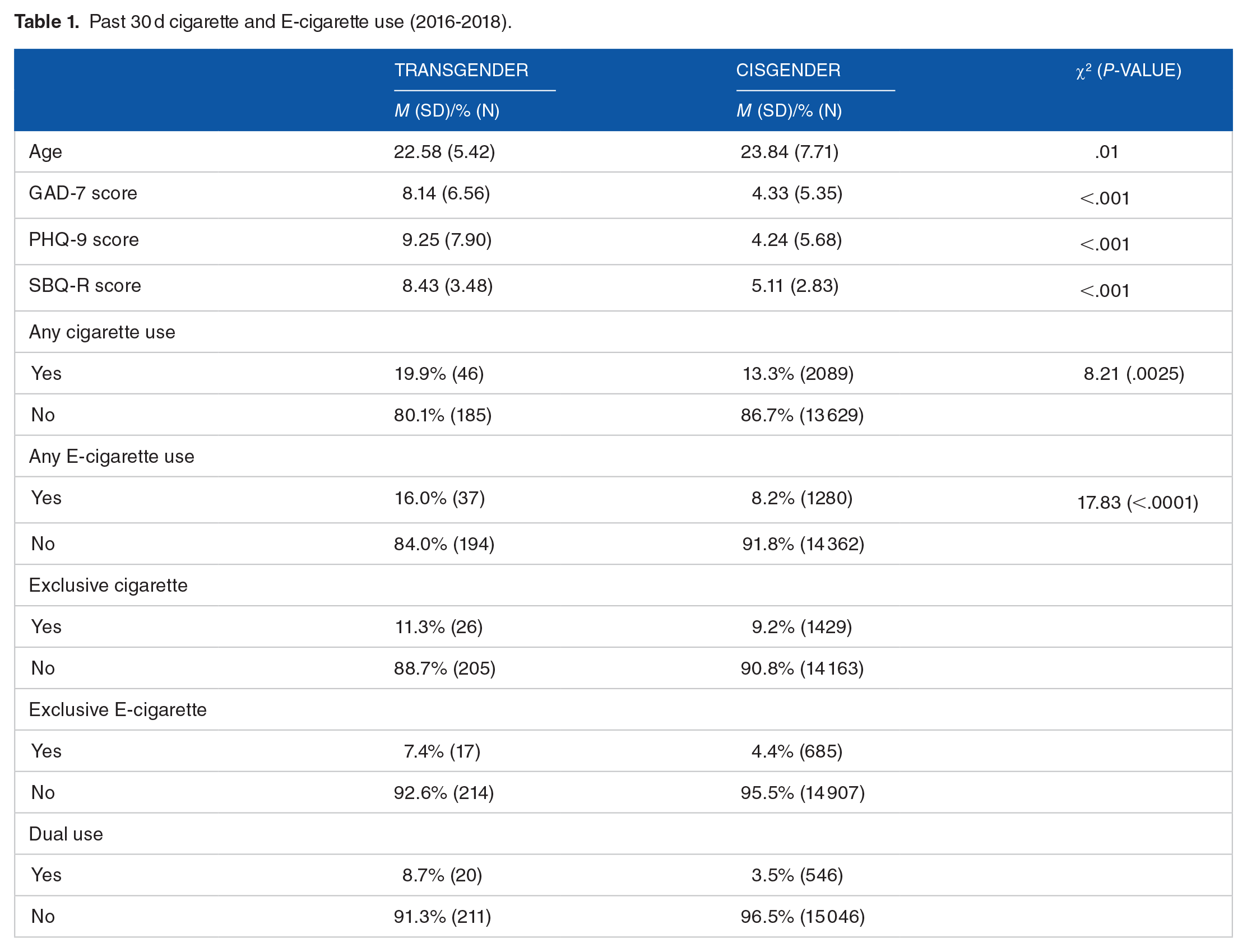
The sample was comprised of 98.6% of individuals identifying as cisgender, and 1.4% identifying as transgender, mean age was 23.84 (SD = 7.72). Of the non-cisgender participants, 22.9% of our sample identified as transmale, 5.92% of our sample identified as transfemale, 50.6% identified as genderqueer, and 20.5% provided a write-in response identifying as a non-binary umbrella term (ie, non-binary, genderfluid, agender, etc.). Overall, 17.2% (n = 2727) of the sample endorsed past 30-day use of cigarettes or e-cigarettes. Table 1 displays descriptive statistics including mean age, GAD-7 score, PHQ-9 score, SBQ-R score, and combustible and electronic cigarette use rates by gender identity status.
Past 30 d cigarette and E-cigarette use (2016-2018).
Binary and multinomial logistic regression
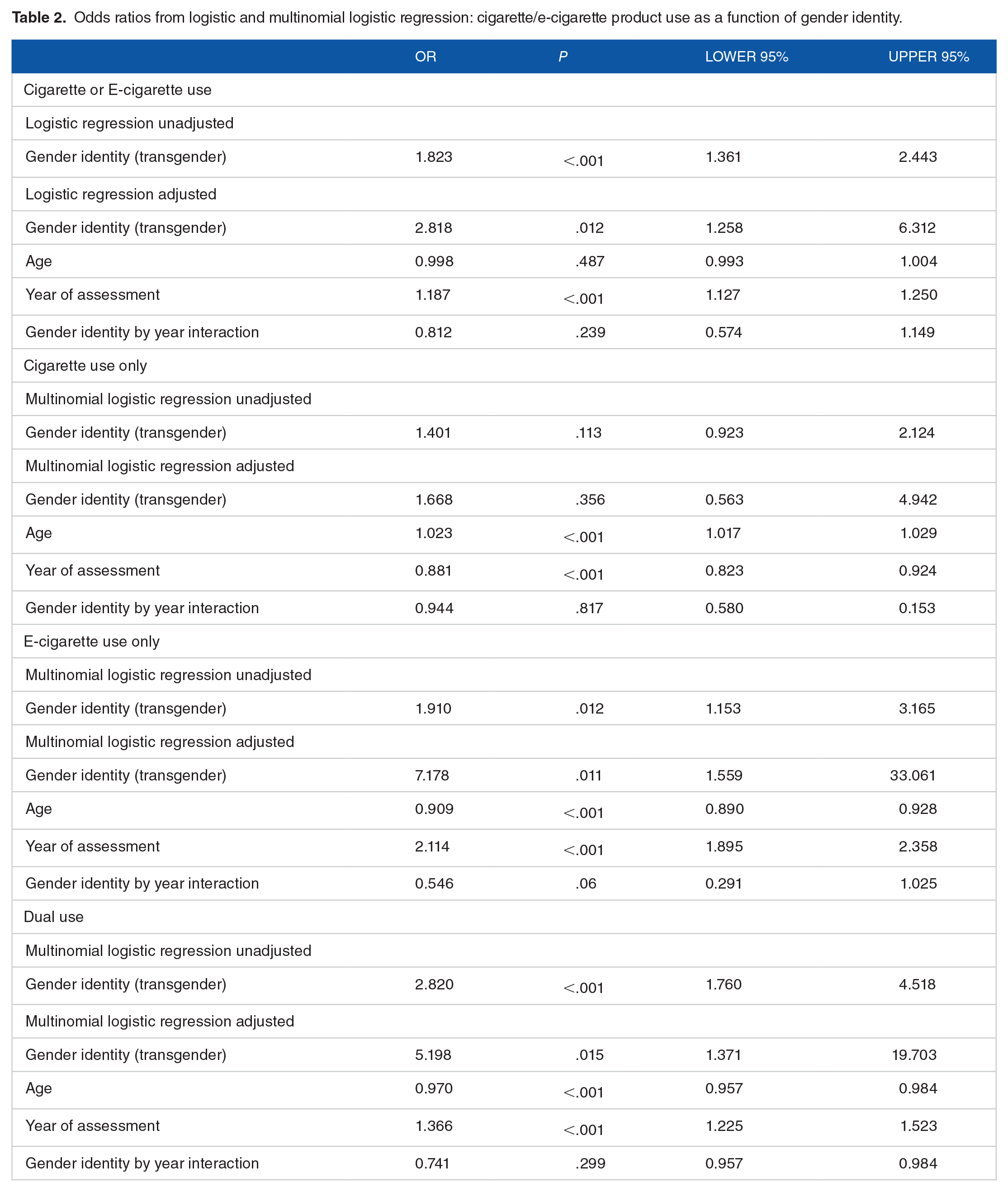
Table 2 displays results of the logistic and multinomial logistic regression models and resulting odds ratios for analyses examining associations of gender identity and combustible and electronic cigarette use. First, we examined the likelihood of using either product (cigarettes or e-cigarettes) in the past 30 days as a function of gender identity. Results demonstrate a significant effect of gender identity, with individuals identifying as transgender reporting higher odds of using cigarettes or e-cigarettes (AOR = 2.82, 95% CI 1.26-6.31). No effect of the interaction between assessment year and gender identity on cigarette/e-cigarette product use status was observed. Next, we examined single product and dual-use as a function of gender identity. Multinomial analyses revealed a significant effect of transgender identity on e-cigarette (AOR = 7.18, 95% CI 1.56-33.06) and dual-use (AOR = 5.19, 95% CI 1.37-19.70) respectively, but not cigarette only use. Again, no significant effect of gender identity by year was observed.
Odds ratios from logistic and multinomial logistic regression: cigarette/e-cigarette product use as a function of gender identity.
Linear regression and parallel mediation analyses
Next, we examined the association between gender identity and mental health symptoms. Regression analyses revealed significant effects of transgender identity on symptoms of anxiety b = 3.45, 95% CI = 1.64, 5.25, P < .001.; depression, b = 4.14, 95% CI = 2.21, 6.07, P < .001.; and suicidal ideation, b = 2.51, 95% CI = 1.48, 3.55, P < .001., respectively (Table 3). Finally, we conducted a parallel mediation analysis with bootstrapping to examine the indirect effects of transgender identity on combustible and electronic cigarette use status (past 30-day cigarette or e-cigarette use), through symptoms of mental health (anxiety, depression, and suicidal ideation). We observed significant indirect effects of transgender identity on combustible and electronic cigarette use via increased symptoms of depression (indirect effect = 0.13, 95% CI [0.07, 0.19], P < .05), and suicidal ideation (indirect effect = 0.22, 95% CI [0.15, 0.28], P < .05), but not symptoms of anxiety.
Associations of gender identity status and psychological symptoms.

Discussion
This study is the first to our knowledge to examine the association between psychological symptoms and combustible and electronic cigarette products with transgender identity across three-time points in a repeated cross-sectional study design. The current study provides important information regarding elevated psychological symptoms and the associated increased cigarette/e-cigarette product use among transgender individuals. This study supports previous findings that transgender individuals are at risk for elevated combustible and electronic cigarette use rates compared to cisgender individuals.1-5 This study extends beyond those studies with an expanded sample size and simultaneously examining combustible cigarette, e-cigarette use, and psychological factors of transgender identity. As anticipated, transgender identity was associated with greater cigarette/e-cigarette product use, specifically e-cigarette use and dual product use. Transgender individuals experience elevated psychological symptoms and may be more vulnerable to using substances to cope than their cisgender peers.
We also found that transgender identity predicted elevated psychological symptoms, specifically depression, anxiety, and suicidal risk. Transgender individuals are widely known to experience worsened mental health outcomes, compared to cisgender peers, due to external factors, such as discrimination, victimization, and social stigma.5,6 These exacerbated symptoms can increase the potential for substance use as a coping mechanism. As was observed in the current study, transgender identity was associated with increased depressive symptoms and suicidal risk. This, in turn, predicted higher combustible and electronic cigarette use. Our study highlights the associations between negative emotionality and gender identity to predict combustible and electronic cigarette use. Indeed, negative emotionality is widely documented as a clinical feature of substance use disorders and is reliably associated with increased drug craving and relapse. 39 Considering the likely impact of psychological distress on cigarette and e-cigarette use may be particularly important when considering how negative affect and related psychopathology may mediate the relationship between minority status and tobacco use outcomes. This places an increased risk of experiencing depression and suicidality on sexual minority populations, highlighting the importance of targeting psychological distress in cessation strategies and treatments for transgender individuals. This could, in turn, reduce the increased use of combustible and electronic cigarettes among this population. Although this proves to be difficult, this would yield a tremendous public health impact among this vulnerable population.
This study has several limitations to note. Notably, gender subgroup analyses were not conducted to determine potential differences between males, females, transmales, transfemales, and genderqueer individuals. Future studies that are adequately powered with large samples of transgender and genderqueer individuals should examine differences that may exist across these subgroups. The study relied on self-reported psychological symptoms and combustible and electronic cigarette use. Thus limitations associated with this assessment method are present in the current results. Additionally, the study did not specify the e-cigarette device type used by the sample (e.g. first-generation vs. second-generation vs. pod-based devices). Future studies should assess if device type yields pertinent information regarding vaping behavior and risk factors. Furthermore, assessing attitudes and perceptions should be investigated in future studies to explain increased cigarette/e-cigarette use.
Due to the cross-sectional nature, we cannot establish any causal relationships between the variables examined. Furthermore, it is possible that the same students responded to the survey in multiple years. At the same time, we accounted for the interaction between assessment year and independent variables of interest in our analyses, multiple responses from the same individuals could impact the effect sizes reported—and therefore, should be interpreted with caution. Additionally, the prevalence of any e-cigarette use endorsed in the past month appeared notably low in the current population compared to the high rates observed on a national level. 40 Lastly, although the current study aimed to clarify the mixed evidence for combustible and electronic cigarette use among transgender individuals, there is significant heterogeneity within individuals identifying as transgender that should be investigated in future studies.
This current study fills an important gap in a vulnerable population. Transgender individuals were found to experience worse mental health outcomes and elevated combustible and electronic cigarette use rates compared to cisgender peers. Treatment for this population should aim to reduce psychological distress as this may ultimately reduce substance use among an at-risk population. This information is needed to improve resources and strategies currently provided to support transgender individuals.
Footnotes
Funding:
The author(s) received no financial support for the research, authorship, and/or publication of this article.
Declaration of conflicting interests:
The author(s) declared no potential conflicts of interest with respect to the research, authorship, and/or publication of this article.
