




Abstract
Vitamin A deficiencies is a becoming persistent among young children and a growing concern to parents in sub-Saharan Africa, especially in crisis-affected areas. Fermented cereal paste from maize, millets, and sorghum grains are significant food for young children. Thus, the study focuses on food fortification using orange-fleshed sweet potato (OFSP) as fortifier as studies have confirmed the presence of nutrients that can help meet the Vitamin A dietary requirement. The cereals were soaked ambient temperature (27 ± 1°C) for 72 hours and were blended with OFSP (90:10, 80:20, 70:30, 60:40, 50:50), and the formulated products were studied for Vitamin A, β-carotene, proximate composition, physicochemical, functional properties, and storage. Application of OFSP as forticant increased the Vitamin A (4.98-6.65 mg/100 g), β-carotene (0.10-0.17 mg/100 g) and the calorific value (222.03-301.75 kcal) of the gluten-free multi-grain cereal paste. The addition of OFSP also increased the ash content (1.41%-3.35%), crude fiber (2.56%-4.225%), carbohydrate (39.83%-48.35%), total solid content (55.20%-60.87%), and water absorption capacity (112.20%-137.49%) of the formulated cereal samples. The fortified fermented paste was objectively stable throughout on the shelf from the storage studies. The study deduced that addition of orange-fleshed sweet potato to fermented mixed cereal paste as a fortifier can help increase the nutritional quality of the complementary food.
Keywords
Introduction
Micronutrient deficiencies have become a foremost health concern due to constrained diversity of inexpensive nutritious food thus limiting dietary diversity among indigents.1-3 The United Nations Inter-agency Group for Child Mortality Estimation 4 has revealed high risks of blindness and recurrence of measles, diarrhea, and sometimes death of children, pregnant women, and vulnerable groups around the world because of diets. Inter-communal violence is on the increase in Nigeria and children are believed to constitute more than half (58%) of the internally displaced population. 5 Nigeria ranked among the first 10 countries that have highest prevalence of underweight, stunting and wasting children under-5 years as 1 in every 7 children dies before attaining school age due to malnutrition. 6 With approximately 5.5 million newborns weaned each year in Nigeria and the high expense of imported weaning foods, it is vital to develop less expensive and more nutritious goods for the country’s developing children. 7 Minor grains like pearl millet and sorghum play an important role in African babies’ nutritional development as a primary and good source of protein (10%-16%), lipids (3.5%-5%), minerals, and phytochemicals. 8 Fermented cereal paste called Ogi is a common fermented pudding mainly produced in sub-Sahara Africa. This fermented paste is usually produced mainly from maize, millet or sorghum. 9 However, it is known as “Ogi-baba” when the sorghum seed is milled and “Ogi-gero” when milled using millet seed, respectively. 10 The color of the fermented cereal paste “Ogi” depends on the color of the cereal grains used; slightly cream for white maize, cream for yellow maize, light brown for sorghum, and greenish to gray for millet. It is a semi-finished food cooked into smooth, free flowing creamy or thin porridge. 11 Influence of fermentation duration, mix ratio, biopreservation of cereals during production of either fermented paste or flour have been studied by some researchers.9,12,13 Many studies have reported on supplementation of cereals with different legumes, because of the absence of lysine in cereal grains which is abundant in legumes, 12 the use of roots and tubers such as potato in supplementing cereal grains has not gained much popularity in production of complementary foods. Many households around the world have reported maize, millets, and sorghum grains as essential foods, making them part of the significant cereal recommended for promoting responsible food production and consumption.14,15 In the bid to curtail hidden hunger (SDG-3) which is addressing micro-nutrient deficiencies while encouraging responsible production and consumption (SDG-12) among consumers especially children there has been an ongoing advocacy campaigns for integration of orange-fleshed sweet potato (OFSP) a nutritious foods into many national dishes. 16 Orange fleshed sweet potatoes (OFSP) are preferred over white sweet potatoes due to their nutritional composition, which is high in vitamin A, bioactive compounds (flavonoids, polyphenols, stilbenes, glycolipids, lignans, anthocyanins, tocopherols, saponins, alkaloids, tannins, terpenoids etc), and beta carotene. 17 In low-income countries, vitamin A deficiency (VAD) affects 40% to 60% of African children and 10% to 20% of the pregnant women as these calls for an urgent need to address the issue of malnutrition with a replacement of complemented rich diets that is affordable and available. 18 Orange fleshed sweet potato (OFSP) consumption may be beneficial in combating the widespread prevalence of vitamin A deficiency (VAD) in children, which causes blindness and death in 250 000 to 500 000 African children each year.19,20 In some countries, such as Mozambique and Uganda, recommended orange-fleshed sweet potato (OFSP) as a viable option for increasing serum retinol concentrations and vitamin A intake during childhood. 21 Through increased consumption of OFSP, young children and adults can obtain adequate calories, vitamin C, and other micronutrients in addition to carotene and provitamin A. 22 Apart from being a low-cost source of energy, the OFSP tubers are high in starch, sugars, and minerals. 23 Due to several positive reports of potato on the health of consumers, the incorporation of orange-fleshed sweet potato is solicited.16,17 Production of weaning food from complementing OFSP with cereal grain in the production of fermented mixed grains paste may help to supply the adequate nutrient needed by the infants. Contemporary review has established that food-to-food fortificant up to 50% substitution levels is permitted. 24 Child malnutrition is the single biggest contributor to under-5 mortality due to higher susceptibility to infections and gradual recuperation from sickness. Children with stunted growth are those who do not reach their ideal height or who consistently lose weight as children. 25 They do not reach their full adult size, have lower IQs, are more susceptible to infection, and their mortality rates may be high. 26 The OFSP also included more nutrients than unfortified maize flour, according to reports. When compared to maize flour, OFSP had no detectable tannins, half the amount of phytate, and 6 times more total phenolic. The iron and zinc content of the unfortified maize porridge increased after the OFSP powder was added. 27 Therefore, supplementing cereal grains with common foods that are locally available, such as orange fleshed sweet potatoes, may be a way out in combating vitamin A deficiency prevalence among children, resulting reason for this study. This study aim to explore the effect orange-fleshed sweet potato (OFSP) as fortifier in fermented cereal to boost the product in meeting the Vitamin A dietary requirement.
Materials and Methods
Production blend of maize, sorghum, millet, and orange fleshed sweet potato paste
Procured cereals (quality protein maize (yellow variety), sorghum (red variety), and millet grains) from local market located in Omu-Aran, Kwara State, Nigeria were processed as described by Olaniran et al. 28 Cereal grains were separately winnowed, dirt picked, and weighed. Five kilogram each of quality protein maize (QPM), millet, and sorghum were weighed (15 kg) mixed in a transparent bucket and soaked in 30 L of water for 3 days (72 hours) at ambient temperature (27 ± 1°C) and drained as shown in Figure 1. Freshly harvested orange fleshed sweet potato (OFSP) tubers were washed under running water allow to drain and sliced into 4 mm. Different percentage (w/w) of peeled OFSP were weighed and added to the mixed fermented grains as follows 10%, 20%, 30%, 40%, and 50% and milled to smooth paste. The samples were weighed (100 g) and package in airtight containers in replicates and kept for further analysis.
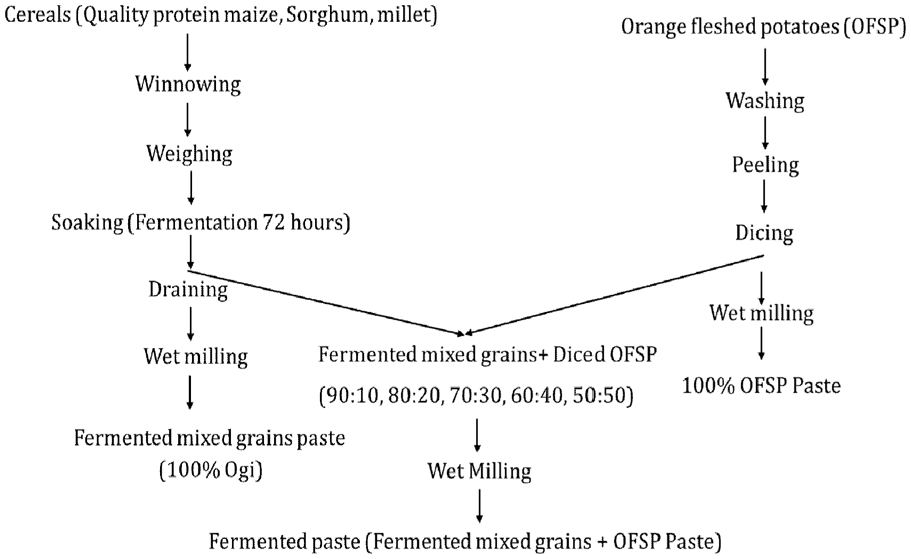
Flow diagram for production of fermented mixed grains and orange fleshed sweet potato paste (Modified Olaniran et al. 28 ).
Proximate composition of fermented paste
The AOAC method was used to determine the proximate composition of each paste (mixed fermented grains + OFSP paste). The protein content was determined using the Kjeldahl method (6.25 N), and the total carbohydrate was calculated using the weight difference method. Each sample’s energy values were also calculated and recorded. 29
Crude fat content determination
Fat content for all fermented samples were determined through continuous liquid-solid extraction method using Soxhlet extractor with a reflux condenser and a distillation flask (previously dried and weighed). Weighed (2 g) sample into an extraction thimble/filter paper was labeled and recorded (W1) while weighed fat free 500 mL round bottom was recorded as W2. The Soxhlet flask with sample was weighed and placed into the Soxhlet apparatus. The distillation flask was filled to two-third capacities with petroleum ether (300 mL) and fitted on the Soxhlet extractor with a reflux condenser. Adjustment of the heat source to ensure that the solvent boils gently was done, and it was left to siphon 6 hours. After siphoning the petroleum ether, the condenser was detached and the thimble or filter paper removed. Drying of the flask containing the fat residue was performed in an air oven at 100°C for 5 minutes, cooled in a desiccator, and then weighed (W3). The difference in the final and initial weight of the distillation flask represented the oil extracted from the sample. 29
Moisture content determination
Moisture content of all fermented cereal paste samples were determined by drying in a Gallenkamp forced hot air oven. The determination was carried out in triplicate. Each sample (5 g) was weighed into pre-weighed moisture content cans. The samples were dried at 105°C for 3 hours and the weight taken. Drying continued until their weights were constant. The samples were cooled to room temperature in a desiccator, weighed, and recorded. The final weight of each sample was determined and the moisture content was calculated from the weight loss equation below. 29

where w1 is weight of sample before drying (g) and w2 is weight of sample after drying (g).
Crude protein determination
Crude protein of the samples were evaluated using Kjeldahl nitrogen determination method as described by AOAC. 29 Samples (1 g) was weighed into digesting tubes and a tablet of Kjeldahl was added. Sulfuric acid (12 mL) was added through a dispenser and mixed thoroughly. Labeled samples in a rack of 8 were then placed on a digester for 1 hour to digest the samples. The samples were allowed to cool, and on cooling down, samples were then taken to the automatic distillery (Foss™ KJeltec™ 8200 Auto Distillation Machine, FOSS, Hilleroed, Denmark) for 5 minutes. The distillate was titrated against 0.01M HCl with an automatic titrator. Percentage nitrogen was then calculated; crude protein content was estimated by multiplying with the factor 6.25.
Crude fiber determination
Crude fiber was determined using the already weighed (W1) defatted samples. Each sample was transferred into conical flask and 100 mL boiling 1.25% H2SO4 added. Each beaker was heated for 30 minutes with periodical rotation to prevent adherence of solids to the sides of the beakers. The solution was filtered and rinsed with 50 mL portions boiling water; repeated 4 times then dried. Boiling 1.25% (w/v) NaOH (Sigma Aldrich Co., St. Louis, MO, USA) solution (200 mL) was added and the mixture was boiled for 30 minutes after which the contents of each beaker was removed and filtered through muslin cloth and washed with 25 mL boiling 1% sulfuric acid, 3 portions of 50 mL boiling water, and 25 mL ethanol. The residue was dried at 100°C to a constant weight followed by cooling in a desiccator to room temperature and weighed (W2). The weighed residue was ignited at 600°C in a Gallenkamp muffle furnace for 30 minutes, cooled in a desiccator and reweighed (W3). 29
The percentage crude fiber in each sample was calculated as:

Total ash determination
Crucibles to be used for the determination of total ash content of the fermented samples were placed in the oven at 105°C for about 30 minutes, cooled in a desiccator to room temperature and weighed (W1). The total ash (inorganic residue from the incineration of organic matter) was determined by dry ashing procedure. The samples (2 g) were weighed into a pre-weighed dry porcelain crucible. The samples were incinerated in a Gallenkamp muffle furnace at 550°C for 6 hours. After ashing, the remains were removed from the furnace, cooled to room temperature in a desiccator, and weighed. The porcelain crucible was weighed and the % total ash weight was obtained by using the equation below:

Carbohydrate determination
The carbohydrate content was determined by calculating the difference. The sum of the proximate composition of the respective samples was subtracted from 100 to obtain percentage carbohydrate:

Physicochemical analysis
The titration method described by Sharma et al 30 was used to determine the titratable acidity value for each sample. A pH meter was used to determine the pH (Jenway model 6505). Standard buffers of 7.0, 4.0, and 9.2 were used to calibrate the pH meter. After calibration, pH readings were taken and recorded only when the pH reached equilibrium. The total solid of the samples was determined using the gravitational method. Briefly, 100 mg of the sample was placed in an already weighed evaporating dish and dried overnight at 105°C in a hot air oven (Memmert UF75). The dried sample was weighed and the total weight was recorded. The formula below was used to calculate total solid:

Where A = final weight of the dried residue + the tarred evaporating dish (mg), D = Tarred evaporating dish weight (mg), S = Sample weight (mg).
Color of paste
The color of the control sample (100% mixed fermented grains and 100% OFSP) and mixed fermented grains-OFSP pastes were measured in scale L* a* b* using a bench-top spectrophotometer Colorflex-EZ (A60-1014-593, Hunter Associates, Reston, VA, USA). The color of the samples was taken 3 times and then averaged. Hue value (H*), color saturation intensity (Chroma, C*), and total color difference (ΔE*) were estimated from L*, a*, and b* values. 30 The equations (2)–(4) below were used to calculate all the parameters:



Differences of L*, a*, and b* (equations (5)-(7)) were used to calculate the changes in different color attributes of samples.



Where, L, a, b is color component values of control. The following values were used to determine if the total color difference was visually obvious. 31
∆E* < 1 = color differences are not obvious for the human eye
1 < ∆E* < 3 =color differences are not appreciative by the human eye.
β-Carotene and Vitamin A quantification in fermented paste
The fermented paste samples were weighed (0.5 g), homogenized, and saponified in a water bath at 60°C for 30 minutes with 2.5 mL of 12% alcoholic potassium hydroxide. The saponified extract was transferred to a separating funnel with 10 to 15 mL of petroleum ether and thoroughly mixed. The lower aqueous layer was then transferred to another separating funnel and the upper petroleum ether layer containing the carotenoids was collected. The extraction was repeated until the aqueous layer became colorless. A small amount of anhydrous sodium sulfate was added to the petroleum ether extract to remove excess moisture. The final volume of the petroleum ether extract was recorded. The absorbance of the yellow color was read in a spectrophotometer at 460 nm using petroleum ether as blank. 32 β-carotene was determined from the dried methanolic extract. Hundred milligrams of extract was mixed with 10 mL of acetone-hexane mixture (4:6) for 1 minute and filtered. The absorbance was recorded at 3 different wavelengths (453, 505, and 663 nm). The β-carotene content was calculated by:

The final volume of the petroleum ether extract was recorded. The absorbance of the yellow color was read in a spectrophotometer at 460 nm using petroleum ether as blank for quantification of Vitamin A in fermented pastes samples. 33
1 μg retinol = 1 RE (retinol equivalent) method used.
1 μg β-carotene = 0.167 μg RE
1 μg other pro-vitamin A carotenoid = 0.084 μg RE contributing factors.
Determination of water absorption capacity of fermented pastes
Four grams of fermented paste was used for determination of water absorption capacity. Distilled water (40 mL) was mixed with the paste for 30 seconds in previously weighed centrifuge tube and allowed to stand for 10 minutes. Afterward, the mixture was centrifuged at 1788 rpm for 20 minutes and the supernatant was carefully decanted, drained, and re-weighed the tube. The water absorption capacity results were expressed as percentage of the volume of water absorbed per weight of the sample. 34
Storage study of fermented paste
To assess the stability on the shelf of the fermented pastes; standard procedure for pour-plating method by Da Silva et al 35 for 3 weeks on weekly basis was adopted. Nutrient agar (NA) for total bacterial count, MRS (De Man, Rogosa, and Sharpe) agar for enumeration of lactic acid bacteria and PDA (potato dextrose) agar for estimation of the fungal count the sample. Ten-fold serial dilutions using 1 g of paste in 9.0 mL of water to form slurry. One milliliter of slurry was used for enumeration of microbial populations over a range of 10. NA and MRS culture plates were incubated at 37°C for 20 to 24 hours before being examined. Sabouraud Dextrose agar plates were used to count yeasts and molds, which were then incubated for 3 days at 28°C and examined.
Statistical analysis
Analyses of the samples were conducted in triplicates. The effect of the OFSP on the proximate analysis, titratable acidity, pH, color, total solid, vitamin A content, water absorption capacity was evaluated. Analysis of variance (ANOVA) and Duncan’s multiple range tests (P < .05) were conducted using IBM SPSS Statistics 22.
Results
The proximate composition of the fermented mixed grains-OFSP paste
The moisture content of fresh fermented paste and 100% OFSP paste were 44.04% and 23.56% respectively, while that of the mixture of fermented-OFSP pastes ranged 41.24% to 35.69% as shown in Table 1. The fermented paste contained the most protein (7.15%), followed by a mixture of fermented-OFSP paste with varying substitution ratios. The protein content of OFSP paste was the lowest (2.20%). The crude fat of the fermented sample slight reduced with addition of OFSP. There was no significant difference (P ⩾ .05) in the crude fat content (1.03%) in orange flesh sweet potato (OFSP). The ash content of the formulated sample increased with increase in the amount of OFSP added to fermented mixed grains paste and the highest value was recorded for sample with 50% fermented mixed grains and 50% OFSP (3. 82%). The crude fiber of the fermented sample slightly reduced with addition of OFSP in which the sample with combination of 50% fermented and 50% OFSP paste showed no significant difference at P ⩾ .05. The carbohydrate content of the samples increased with increase in the amount of OFSP added to fermented paste. This was shown in the calculated calorific value which increased with increase in the percentage of OFSP added to fermented mixed grains.
Effects of OFSP on proximate composition of fermented paste (Wet basis) (%).
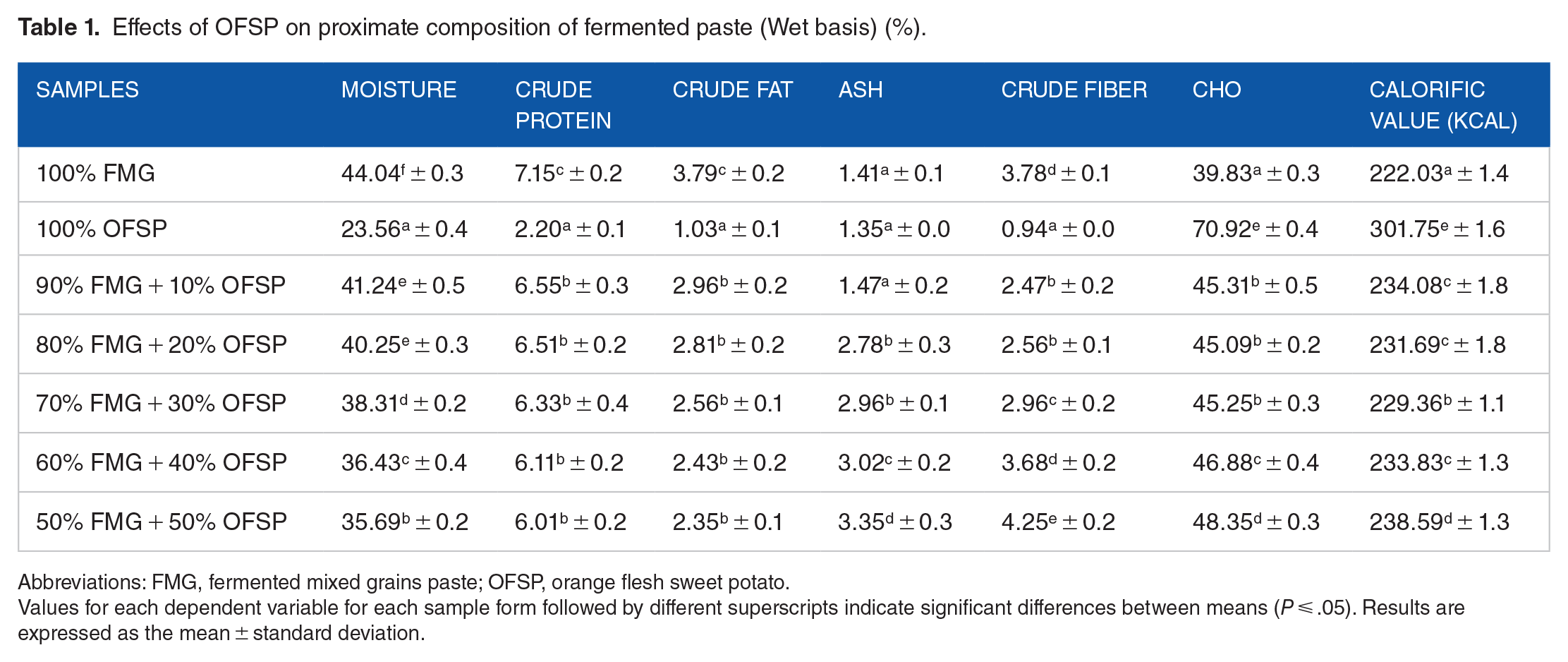
Abbreviations: FMG, fermented mixed grains paste; OFSP, orange flesh sweet potato.
Values for each dependent variable for each sample form followed by different superscripts indicate significant differences between means (P ⩽ .05). Results are expressed as the mean ± standard deviation.
Effect of fermented mixed grains-OFSP paste total acidity, pH and total solid
The total titratable acidity (TTA) of the fermented paste showed a slight increase with increase in the percentage of OFSP added (Table 2), but no significant difference (P > .05). 100% OFSP has the highest TTA value (0.51) followed by sample with 50% fermented mixed grains and 50% OFSP. There was no significant difference (P > .05) in the pH value of the formulated samples while there was a significant difference (P ⩽ .05) in the control samples (100% fermented mixed grains paste and 100% OFSP).
Effects of OFSP on pH, total titratable acidity, and total solid of the fermented paste.
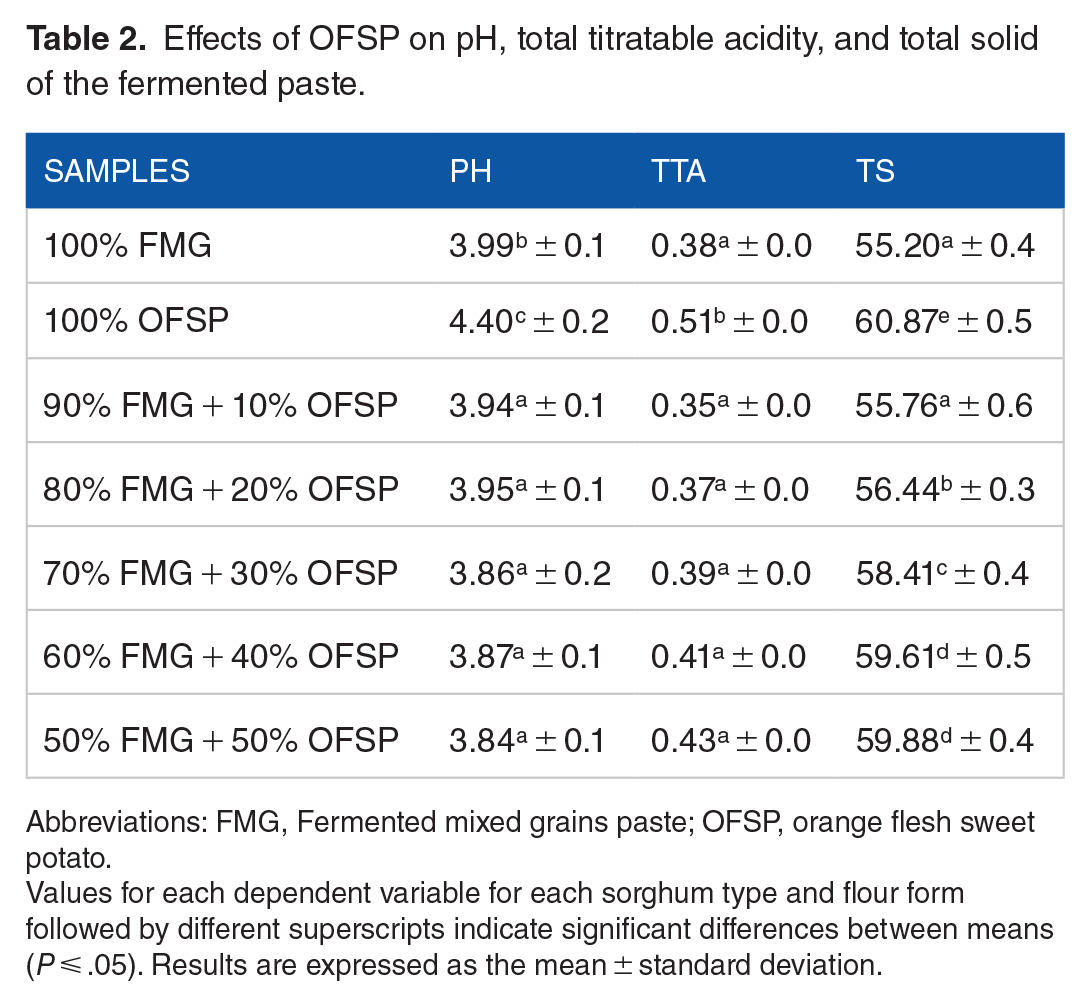
Abbreviations: FMG, Fermented mixed grains paste; OFSP, orange flesh sweet potato.
Values for each dependent variable for each sorghum type and flour form followed by different superscripts indicate significant differences between means (P ⩽ .05). Results are expressed as the mean ± standard deviation.
Effect of fermented mixed grains OFSP paste’s color
The degree of lightness from black to white (Hunter L, a, and b value) of the control samples (100% fermented mixed grains paste and 100% OFSP) and fermented pastes were shown in Table 3. The L* values of the samples which indicate lightness ranged from 48.85 to 71.75. Addition of OFSP to fermented mixed grains increase slightly the L* of the fermented samples. The a* value of the fermented samples decreased with increase in the percentage of OFSP added to fermented mixed grains. The a* which signifies the redness or greenness of the sample decreased in the fermented samples due to the color of the OFSP used for this study. The b* values of the formulated fermented samples ranged between 17.37 and 18.25 and slight increased with increase in the percentage of OFSP added when compared with fermented mixed grains paste. The color intensity (C*) of the fermented samples slightly increase with increase in OFSP added, while the hug angle decreased with increase in the percentage of OFSP added. The C* value ranged 18.09 to 18.98 (Table 3).
The effects of addition of OFSP to color of the fermented paste.

Abbreviations: L*, lightness; a*, redness; b*, yellowness; C*, color intensity; H*, hue angle; ΔE*, total color change; FMG, fermented mixed grains paste; OFSP, orange flesh sweet potato.
Values for each dependent variable for each sorghum type and flour form followed by different superscripts indicate significant differences between means (P ⩽ .05). Results are expressed as the mean ± standard deviation.
The effect of β-carotene, vitamin A, and water absorption capacity
Table 4 shows the concentrations of β-carotene, vitamin A, and water absorption capacity in supplemental foods produced from blended fermented mixed grains and OFSP. The β-carotene value ranges from 0.10 to 0.17 mg/100 g and there was a significant difference (P ⩽ .05) in the β-carotene of all the samples. In terms of β-carotene content, a 100% OFSP sample has a higher value than a 100% fermented mixed grains paste. The value increases as the percentage of OFSP added to the fermented paste rises. The value of vitamin A obtained in this study ranged between 4.98 and 6.57 mg/100 g as shown in Table 4. The water absorption capacity (WAC) of the samples ranged between 112.20% and 137.49%. 100% fermented mixed grains paste had the least value (112.20%) and 100% OFSP had the highest value 142.32% (Table 4). It was observed that the water absorption capacity (WAC) increases as the addition of OFSP increases.
Effects of OFSP on beta-carotene, Vitamin A, and water absorption capacity of the fermented paste.

Abbreviations: FMG, fermented mixed grains paste; OFSP, orange flesh sweet potato.
Values for each dependent variable for each sorghum type and flour form followed by different superscripts indicate significant differences between means (P ⩽ .05). Results are expressed as the mean ± standard deviation.
Storage stability of fermented mixed grains-OFSP paste
The total viable count (TVC) of the fermented samples (fermented mixed grains-OFSP paste) and the control samples (100% fermented mixed grains paste and 100% OFSP paste) are shown in Table 5. The orange flesh sweet potato paste has the highest number of total viable count which increases with increase in storage period (3 weeks). Also, the TVC of 100% fermented mixed grains paste increases with increase in storage time. All the fermented samples also followed the same trend with increase in TVC along the storage period. The TVC of the fermented samples increase with increase in the percentage of OFSP added to the fermented mixed grain.
Effects of OFSP on total viable count of fermented paste during storage (cfu/ml).

Abbreviations: FMG, fermented mixed grains paste; OFSP, orange flesh sweet potato.
Values for each dependent variable for each sample type formed followed by different superscripts indicate significant differences between means (P ⩽ .05). Results are expressed as the mean ± standard deviation.
Table 6 showed the result of lactic acid bacterial (LAB) count of the samples during storage. 100% OFSP paste have the highest LAB count through the storage period and 100% fermented paste had the least LAB count value throughout the storage period. Table 7 revealed that the yeast and mold growth count in the increased in all the samples during storage. The 100% fermented paste had the highest count (2.79 × 10³ cfu/ml) followed by 100% OFSP paste after 3 weeks of storage. The presence of yeast in the fortified fermented paste during storage is essential due to their ecological interactions with lactic acid bacteria. Yeasts produce vitamins and aids the growth of LAB in cereal fermentations. The presence of yeasts throughout the storage period has a positive role in improving the development of the distinctive flavor in the final fermented cereal products, as well their aid nutrient availability, may also produce enzymes such as amylase, protease, and phytase. 28
Effects of OFSP lactic acid bacteria count of fermented mixed grains-orange fleshed Sweet potato paste during storage (cfu/ml).

Abbreviations: FMG, fermented mixed grains paste; OFSP, orange flesh sweet potato.
Values for each dependent variable for each sample type formed followed by different superscripts indicate significant differences between means (P ⩽ .05). Results are expressed as the mean ± standard deviation.
Effects of OFSP yeast/mold count of fermented mixed grains-orange fleshed sweet potato paste during storage (cfu/ml).

Abbreviations: FMG, fermented mixed grains paste; OFSP, orange flesh sweet potato.
Values for each dependent variable for each sample type formed followed by different superscripts indicate significant differences between means (P ⩽ .05). Results are expressed as the mean ± standard deviation.
Discussion
The proximate composition of the fermented mixed grains-OFSP paste
Moisture content and water activity are fundamental elements affecting the safety of food and shelf life. 36 Laelago et al 37 reported that high moisture content does not favor the growth of microorganism which in turn may increase the shelf stability of the product. The fermented paste contained the most protein (7.15%), followed by a mixture of fermented-OFSP paste with varying substitution ratios. As a result of this finding, it is possible to state that OFSP addition to fermented paste slight reduced the protein content of the sample. This may be due to small amount of protein present in the variety of OFSP used for this study. The carbohydrate content of the samples increased with increase in the amount of OFSP added to fermented paste. This was shown in the calculated calorific value which increased with increase in the percentage of OFSP added to fermented mixed grains. The increase in the calorific value to the fermented samples make the formulated sample a better product to supply energy needed by infant during weaning time. 38 The variation in proximate composition of the formulated fermented samples (mixed fermented grains-OFSP paste) may be of great importance in this study. The reduced moisture content of the formulated fermented samples indicates that the product may have a longer shelf life than fermented mixed grains paste alone. Additionally, the increased ash, crude fiber, carbohydrate content, and energy make the product more suitable for providing the required nutrients to both infants and adults. The addition of OFSP to fermented mixed grains may account for the slight decrease in crude protein and crude fat in the formulated samples. Rodrigues et al 39 found fresh orange flesh sweet potato to have low crude protein (3.69%) and crude fat (0.42%). The findings of this study are similar to the findings of Fausat et al 40 who reported a slight decrease in crude protein and crude fat of formulated moringa-fortified complementary food.
Effect of fermented mixed grains-OFSP paste total acidity, pH, and total solid
OFSP (100%) has the highest TTA value (0.51) followed by sample with 50% fermented mixed grains and 50% OFSP. The slight increase in total titratable acidity (TTA) may be attributed to addition of OFSP and increase in acidity of the formulated product by lactic acid bacterial. The difference in pH of the control samples may be attributed to fermentation of mixed grains and unfermented OFSP. Changes in acidity and pH of the samples during storage is due to fermentation leads modifications in the population of the fermenting microorganisms as well as the flora which results of continuous enhancement of the fermentation environment. This assist the viability of microbial flora that are responsible for the production of new enzymes that improve digestion of the food. 41
The fermentation of mixed grains allowed the lactic acid bacterial to breakdown the sugar and release acid. Addition of OFSP to fermented mixed grains have little or no effects on the pH of the formulated samples. The total solid (TS) of the fermented samples increased with increase in the percentage of OFSP added to the fermented mixed grains. This was expected because the total solid of OFSP was higher (60.87%) than fermented mixed grains (55.20%). This was expected because OFSP like other sweet potato have a high dry matter with high amount of sugar (sucrose) which may be responsible for the high TS found in this study as the ratio of addition increases. 42 The increase in the TS have been reported to increase the nutrient density of the formulated complementary food. 43
Effect of fermented mixed grains OFSP paste’s color
The increase in the degree of lightness may be attributed to yellow color of OFSP root used which supplement the yellowness color of the mixed grains used for this study. 44 The increase in the color intensity of the samples may be attributed to OFSP added which help increased the formulated fermented samples color compared to fermented mixed grains paste. 45 Although the fermented mixed grains paste color intensity was higher than sample with 10% OFSP. The total color change (ΔE*) of the formulated samples increase with increase in the percentage of OFSP added to fermented mixed grains. It was observed that OFSP retained its color after processing and upon inclusion in sample improved the brightness of the fermented paste. The increase in color intensity (C*) and total color change is beneficial to the complementary food because when prepared, it may attract the infant since they are attracted to bright colors. 46
The effect of β-carotene, vitamin A, and water absorption capacity
The β-carotene value increases as the percentage of OFSP added to the fermented paste rises. The inclusion of OFSP, which has been known to be high in β-carotene, may be responsible for the rise. 17 The increase could possibly be owing to the high intensity of the OFSP color utilized in this investigation, as evidenced by Table 3 total color change (ΔE*).
The minimum stipulated vitamin A density of cereal-based complementary foods for 6 to 8 months-old infants and young children is 350 to 400 μg/day. 47 The increase in the Vitamin A may be attributed to addition of OFSP which have higher value of Vitamin A than fermented mixed grains paste. 48 The formulated complementary foods under study met the minimum requirement of vitamin A based on the result obtained in this study. The recommended dietary allowance (RDA) of vitamin A can be satisfied if children or infants drink a blend of fermented mixed grains and OFSP in equal proportions, as well as if the ratio of weaning mix under research is utilized in the formulation of their diet. The daily retinol activity equivalents (RAE) dosage recommended for children (6-11 months) is 100 000 IU or 30 000 µg RAE of vitamin A while double is required for children between 1 and 5 years old49,50
The reduction in the WAC of 100% fermented mixed grains paste may be attributed to fermentation which limit the water absorption capacity of the samples. It can also be due to effect of fermentation which is an exothermic metabolic process in which microorganisms utilized the food nutrients during storage. 41 Also, the reduction in water absorption capacity is expected since the carbohydrate content of the sample is low (Table 4). The WAC of fermented samples increases as the percentage of OFSP added increases. This is also to be expected, given that OFSP had the highest carbohydrate content and had not been processed other than peeling before use. Water absorption capacity refers to a sample’s ability to absorb water and swell for enhanced uniformity in food. It is required for food systems to improve yield and consistency and to give food to the body. 51
Storage stability of fermented mixed grains-OFSP paste
The increase in total viable count of the control and that of the formulated fermented samples may be attributed to fermentation of cereal grain for 72 hours which encourage the action of beneficial micro-organism like lactic acid bacteria to grow in the mixed grain before being blended with OFSP. Also, the addition of OFSP to the fermented grains may improve the growth of the organism due to availability of more substrate (sugar) supplied by OFSP. This result is in line with the report of Ogodo et al 13 who reported an increase in total viable count of fermented red sorghum paste.
The LAB count increases in the fermented samples with increase in the percentage of OFSP added to fermented mixed grain. This was expected due to the increase in the total viable count of the samples. The addition of OFSP to fermented mixed grain help to produce a fermented paste with better quality than fermented mixed grains pastes alone.
The increase in the LAB count in all the samples (both control and formulated) may be attributed to present of good and abundant substrate which aid the growth of lactic acid bacterial. This result is supported by Olaniran et al 28 who reported dominance of LAB in fermented red sorghum paste and maize. Musyoka et al 52 reported increase in yeast and mold count of OFSP puree during storage when studying the effectiveness of combining chemical preservatives and acidification for preventing spoilage microorganisms in sweet potato puree. The presence of lactic acid bacteria in food has been shown to aid extension of shelf life of the product. 13
This study showed the importance of OFSP in relation to supply of β-carotene, Vitamin A and energy to infant when OFSP is blended with fermented mixed grain in making complementary food. The formulated complementary food (Fermented mixed grains-OFSP) was stable for 3 weeks with increase in the total viable count, lactic acid bacterial, and yeast and mold count.
Conclusion
From the results of the research, addition of orange-flesh sweet potato to fermented cereal improved the shelf stability and the micronutrients of the product. Therefore, dietary supplementation with orange-flesh sweet potato pastes up to 50% substitution is recommended. Also, sequel to it availability of raw materials, and flexibility to domestic production if incorporated as a supplement to fermented cereal paste will augment the micro and macro nutrient intake toward reduction of vitamin A deficiency.
Footnotes
Funding:
The author(s) received no financial support for the research, authorship, and/or publication of this article.
Declaration of Conflicting Interests:
The author(s) declared no potential conflicts of interest with respect to the research, authorship, and/or publication of this article.
Author Contributions
Conceptualization, AFO; methodology, CEO, YMI, OOO, AAM, OPB; software, OOE; validation; AET, OOE, YMI and AFO.; formal analysis, AFO, YMI and CEO; investigation, AFO, OOM, AAM and CEO; resources, OAO; data curation, OOM and OPB; writing—original draft preparation, AFO, CEO, YMI, OOE, AAM, and OPB; writing—review and editing, AET, AFO, CEO, OAO, OOO; supervision, AFO; project administration, OAO, OOO; technical editing of the manuscript, OAO, AFO, OOO, funding acquisition, OAO, AFO. All authors have read and agreed to the published version of the manuscript.